The main gallery of the Marshall M. Fredericks Sculpture Museum in Saginaw is a forest of white plaster, packed with casts of the ubiquitous Michigan sculptor’s works in varying scales and levels of abstraction. The massive head of The Spirit of Detroit is flanked by similarly epic portraits of Churchill and JFK. Horizontal male and female figures titled Night and Day sail by at just above head height, not far from a row of attenuated figures representing Seven Saints and Sinners. (A long Satanic snake hangs from the hands of the female figure of Temptation.)
Stylized creatures — birds, otters, bears, gazelles — undulate and soar through the gallery, all watched over by an enormous crucified Christ, sans cross. Fredericks has been called “America’s Public Sculptor,” an epithet one doesn’t earn by being overly confrontational or controversial, and indeed there’s nothing much in Fredericks’s cute critters, children’s book scenes, patriotic and religious themes, and writ-large theatricality that might ruffle anyone’s feathers.
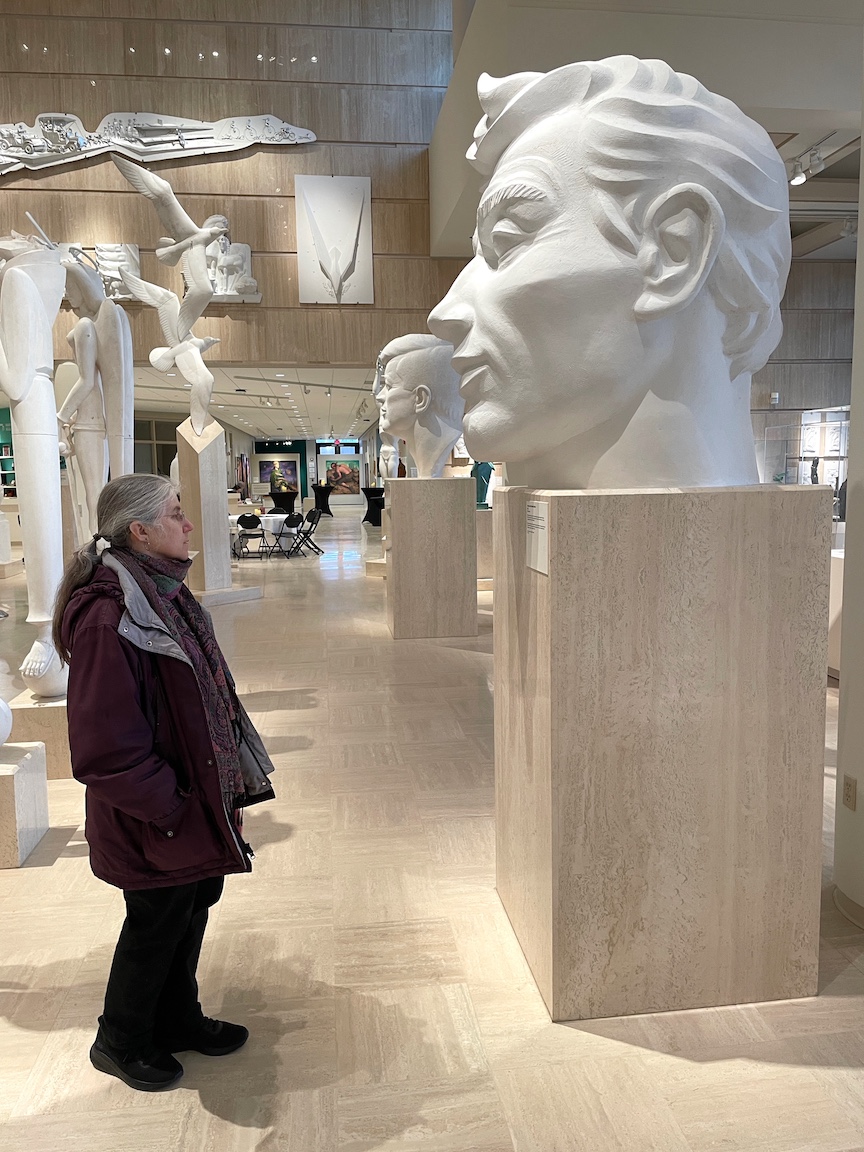
Head of The Spirit of Detroit, plaster, Marshall Fredericks, 1958
Frederick’s energetic figurative and narrative sculptures rhyme nicely with the similarly bold, muscular, allegorical works of Detroit-based painter Peter Daniel Bernal, whose exhibition Searching & Finding Hidden Heritage is on display now through May 24. In fact Bernal, who sometimes adopts the pseudonym “Perez,” is currently working on a mural commemorating Fredericks’ work. It’ll be interesting to see how much the mural celebrates the sculptor and to what extent it pushes back against his visions of American progress or benevolent religion. Bernal’s own work, after all, is hardly non-confrontational.
Bernal is Tejano — Mexican American born and raised in southern Texas. Since 2015, he’s lived in Detroit. In between, he studied art in Kansas City, Rhode Island, and Germany. If you want a fuller biography than that, I think you should just come see his paintings. Bernal’s relationships with family and friends, school and religion, art and politics, his health and that of his community, and above all his search for an understanding of his own complex identity, is on display here in vibrant color and vivid imagery.
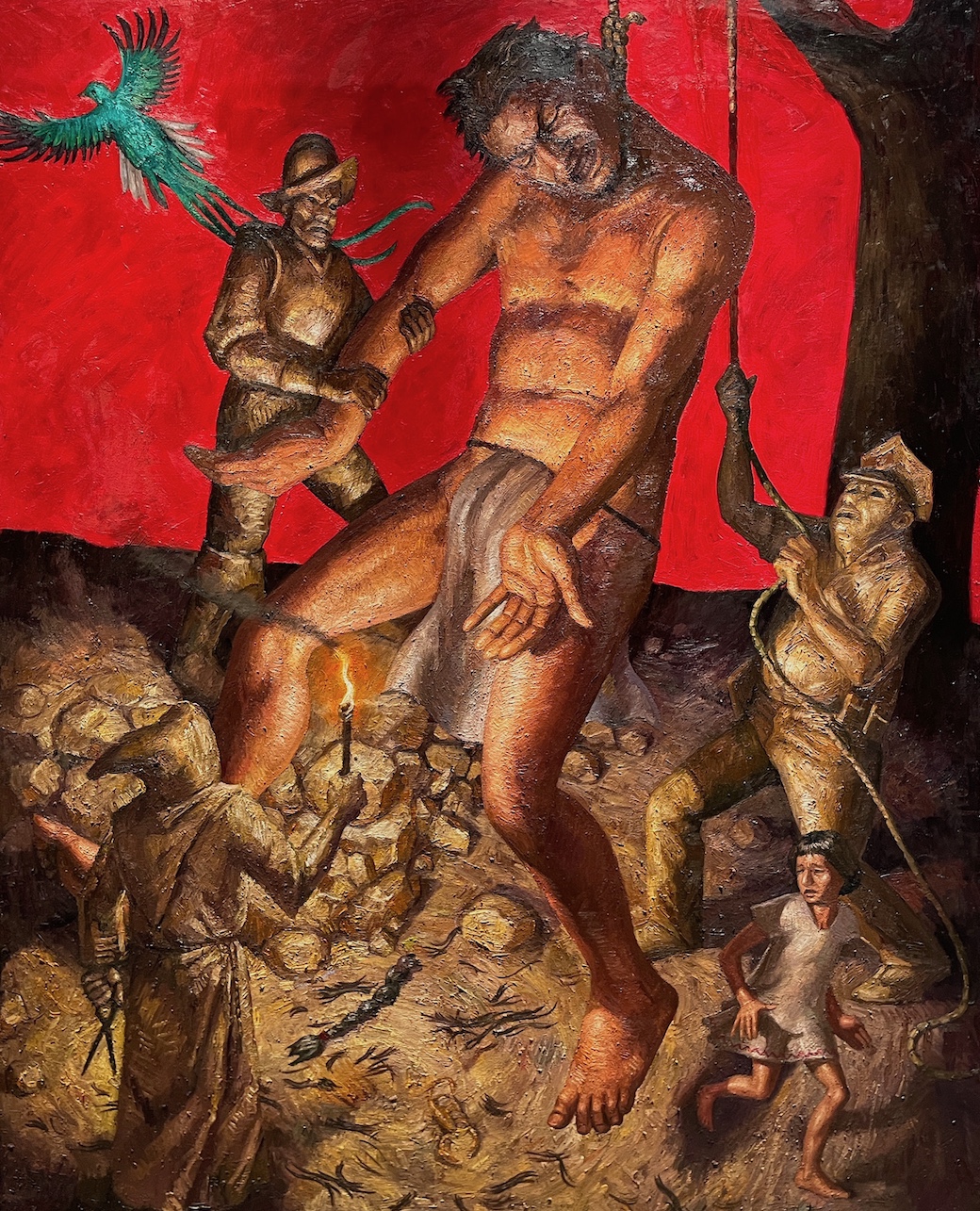
The Night, oil on canvas, Peter Bernal, 2021
To begin in the middle: about halfway through Hidden Heritage, Bernal quotes, in title and composition, a brutal painting by Max Beckmann, The Night, a scene of home invasion, rape, and lynching. It can’t be a good sign of the times when a contemporary artist can directly reference art of the Weimar era and it resonates all too well with the current climate. (Bernal lived and studied printmaking in Weimar for five years.)
However, in Beckmann’s painting the victims and perpetrators are almost indistinguishable from one another but for their actions, whereas in Bernal’s The Night, the characters are more specific. A Native American man, whose shorn hair lies at his feet thanks to a scissor-wielding, hooded priest, is strung up by his neck by a modern-day policeman, while a conquistador twists his arm. The dying man is painted in realistic flesh tones, but his half-sized attackers are as uniformly tan as the earth they stand on, like plastic toy soldiers or clay golems, making them preternaturally monstrous. The only hopeful elements here are an Indian child who flees the scene in one corner and an emerald green quetzal bird, an ancient symbol of freedom, that flies off into the blood-red sky in the opposite corner. The collapsing of the temporal distance between conquistador and cop is, as the label for The Night bluntly states, Trumpism depicted not as an unusual historical blip but as an acute case of the authoritarianism undergirding so much of the American project.
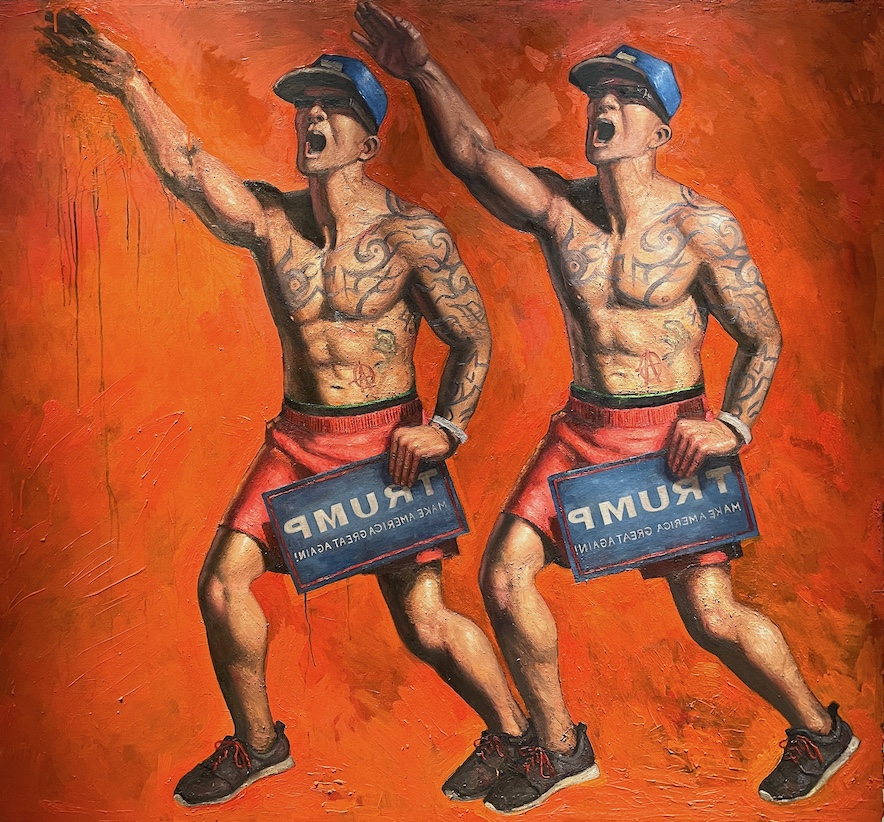
Critical Thinkers, oil on canvas, Peter Bernal, 2016
Trump is specifically name-checked in Critical Thinkers, an image of two identical clones of an enraged white man, neck veins bulging, who was caught on video hollering racist comments at Latinos during a protest rally. Each of the two figures carries a mirror-image Trump campaign sign in one hand while thrusting a Nazi-style salute with the other (years before Elon Musk would do likewise after Trump’s victory). The two stand in front of a conspicuously orange backdrop. Contrary to the ironic title of the painting, the two men are depicted as mindless group-thinkers overwhelmed by manipulative rhetoric and blind rage.
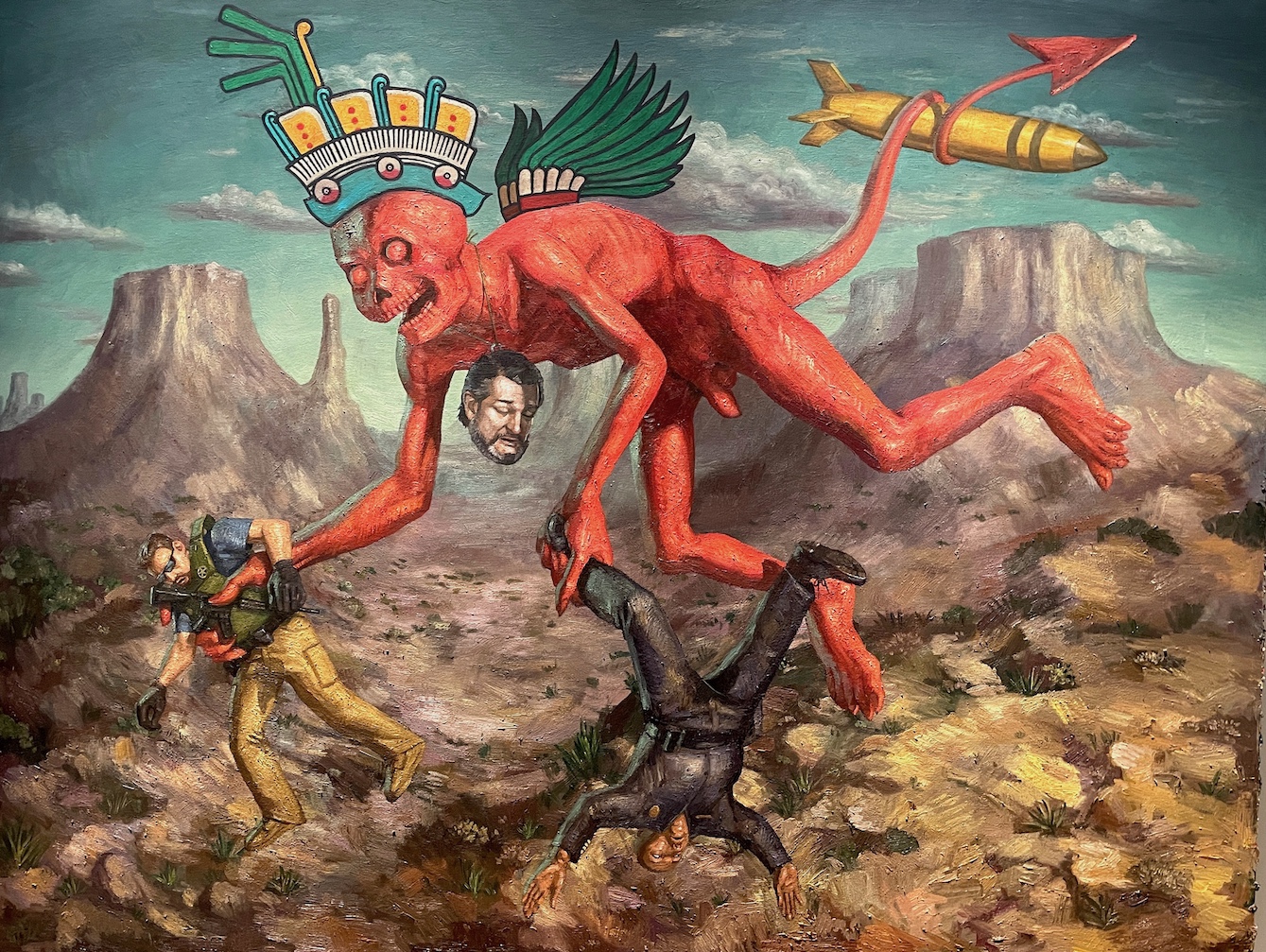
There’s No High Road In Dealing With Monsters, oil on canvas, Peter Bernal, 2021
Not that Bernal is immune to rage. In one of the most astonishing paintings in the show, There’s No High Road In Dealing with Monsters, a skeletal, demon-like apparition wearing the severed head of Texas senator Ted Cruz as a necklace swoops down onto a desert landscape to snatch a police officer and a border agent. Though realistically rendered, the monster’s wings and headdress are flatly painted in the style of Aztec murals, and it carries a bomb wrapped in its long tail. It’s a violent image, created from anger in the wake of two violent acts — school shootings in Uvalde and Detroit — and while it’s not a prescription for violence, it does question when, as the accompanying label puts it, “complacency becomes complicity” with authoritarianism. One character in another of Bernal’s paintings seems to have decided his own complicity has gone too far; in A Policeman Disgusted With Himself, a uniformed officer vomits up a stream of blood, bones, and mutilated corpses, including one still wearing an orange prison jumpsuit. Lit red from behind, perhaps by the lights of his own cruiser, the officer sports a badge on his sleeve indicating his jurisdiction: “Doesn’t Matter Where,” it reads.
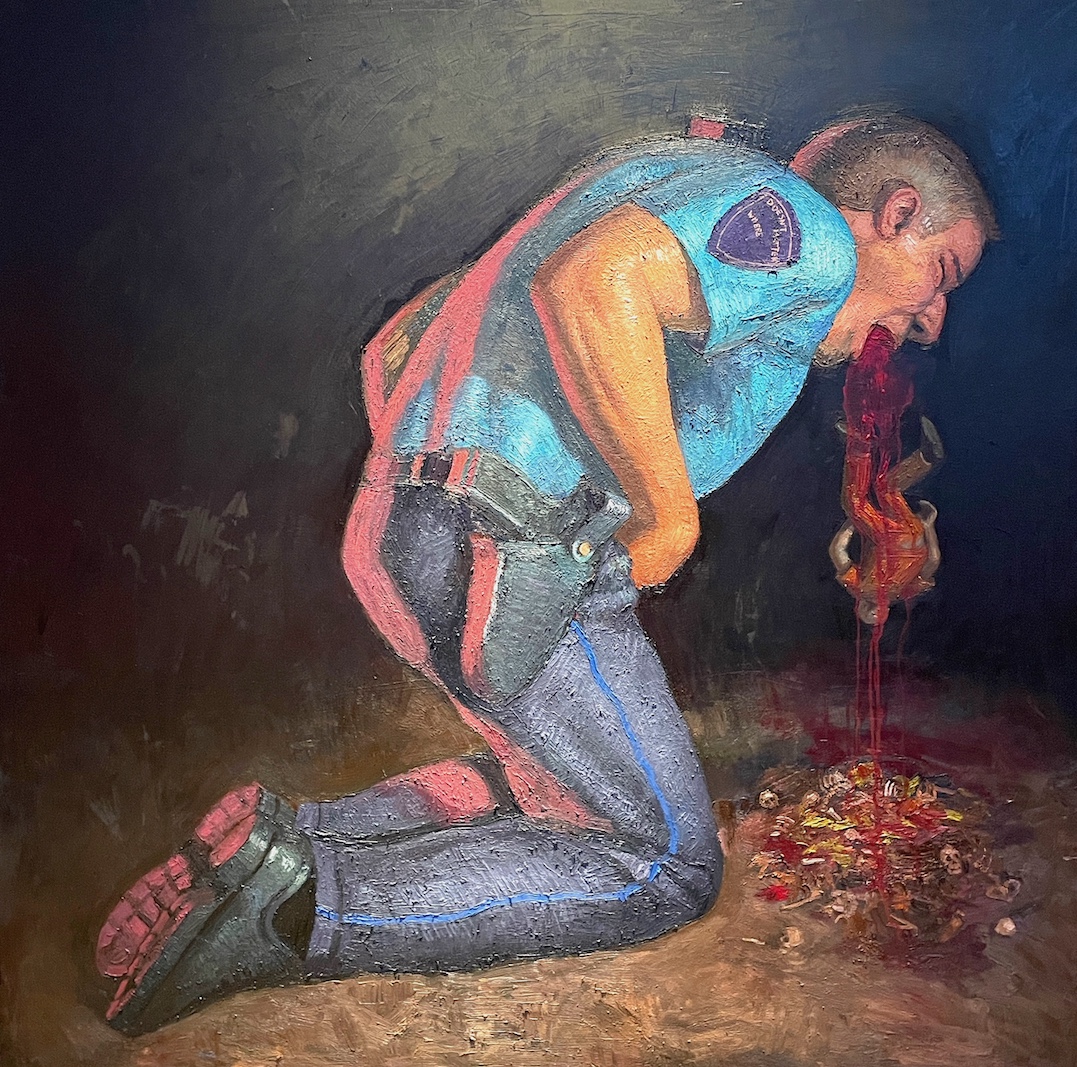
A Policeman Disgusted With Himself, oil on canvas, Peter Bernal, 2021
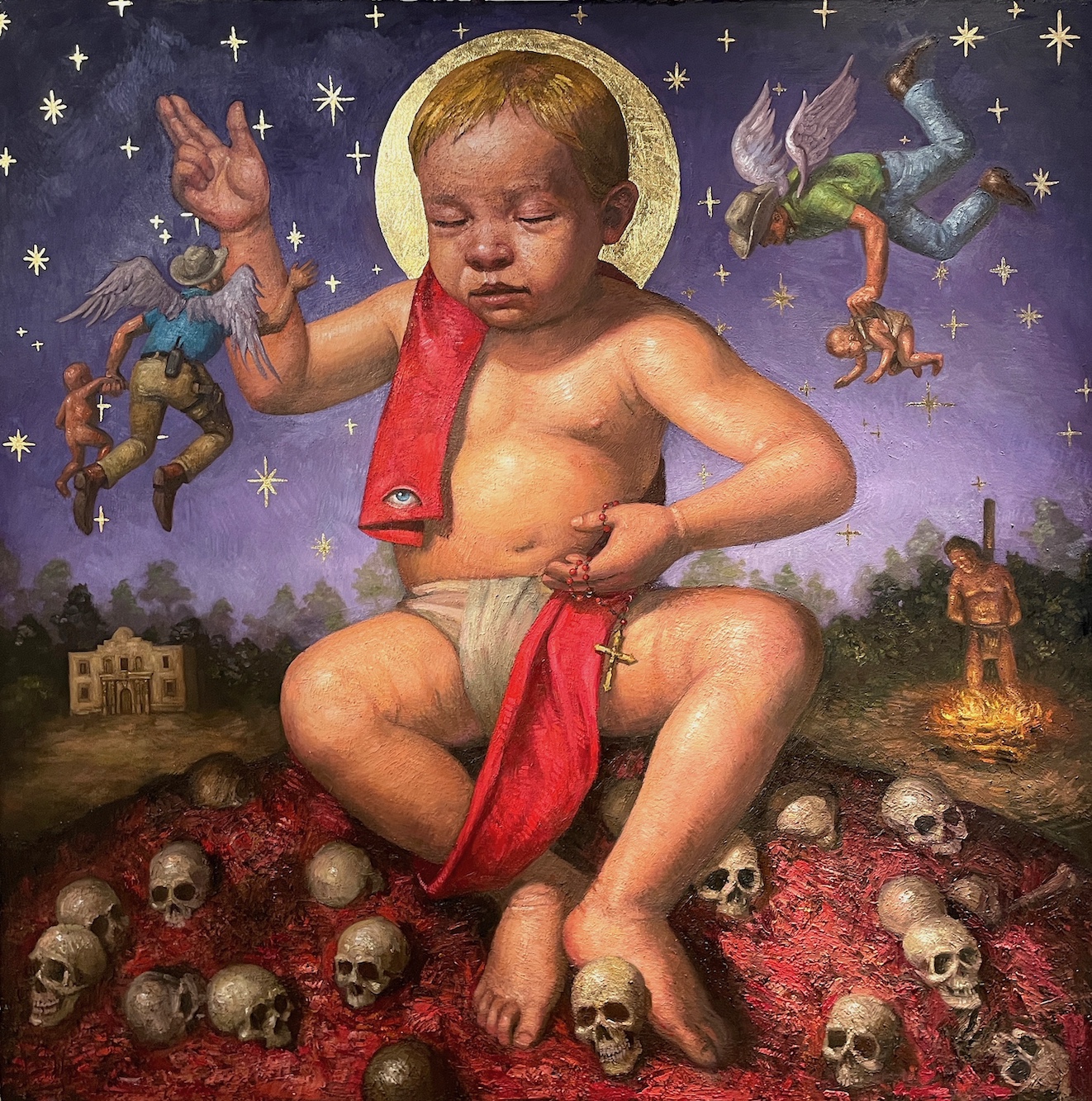
Deuteronomy 20:14, San Antonio, oil on canvas, Peter Bernal, 2024
Bernal’s narrative scenes sometimes evoke poppier artists of the Juxtapoze magazine school of painting, but only superficially. In his Deuteronomy 20:14, San Antonio, an indictment of biblically sanctioned conquest, a huge infant clasping a rosary and seated on a heap of skulls represents God. Its eyes are shut to the angel-winged cowboy types that flit around its head stealing babies while an Indigenous man burns at the stake in the background, but it raises its hand in blessing nevertheless. Something about the “all-seeing eye” on the baby’s red sash and the composition in general are reminiscent of Mark Ryden’s work. Elsewhere, Bernal’s paintings bring to mind the crazy scenarios of Robert Williams, but those artists’ polished pop wackiness have nothing on Bernal in the content department. Religion is a frequent target of Bernal’s work, specifically its role in indoctrinating and dismantling Native American cultures. In Cuauhtlatoatzin Having an Ocular Migraine, Bernal suggests that the Catholic church’s first Indigenous saint, who allegedly saw a vision of the Virgin Mary, might actually have been suffering from a painful optical disorder (Bernal himself has experienced such migraines). On the other hand, Bernal lays claim to Catholic imagery in two paintings, both entitled Santa Marta La Dominadora. In one, the titular saint, who devoted herself to caring for the sick and the poor, carries a large snake that plucks a combat drone from the sky. In this painting, she is shown in her native Dominican Republic; in an earlier version, she’s seen in hospital scrubs with the Detroit skyline behind her.
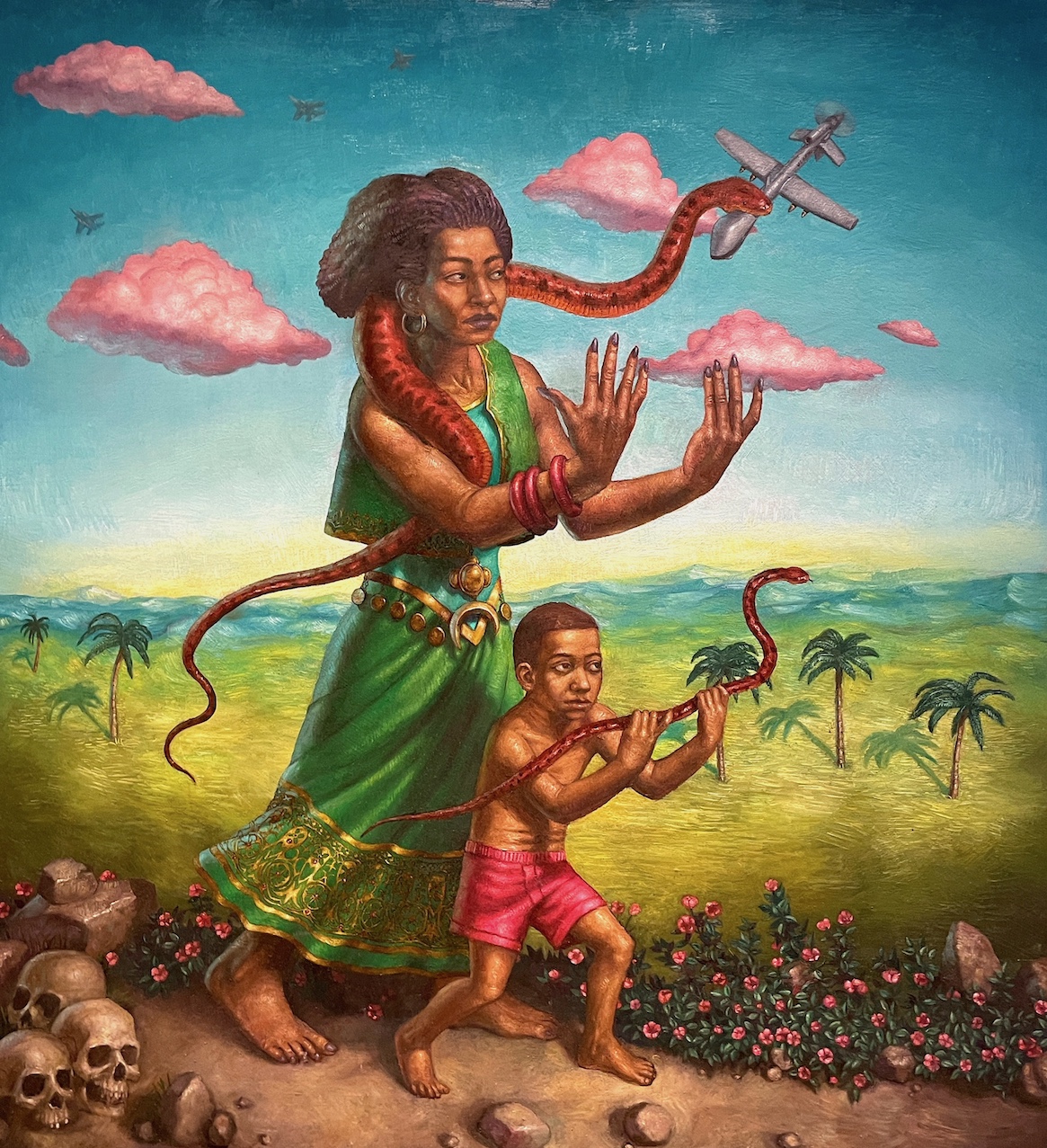
Santa Marta La Dominadora, oil on canvas, Peter Bernal, 2020
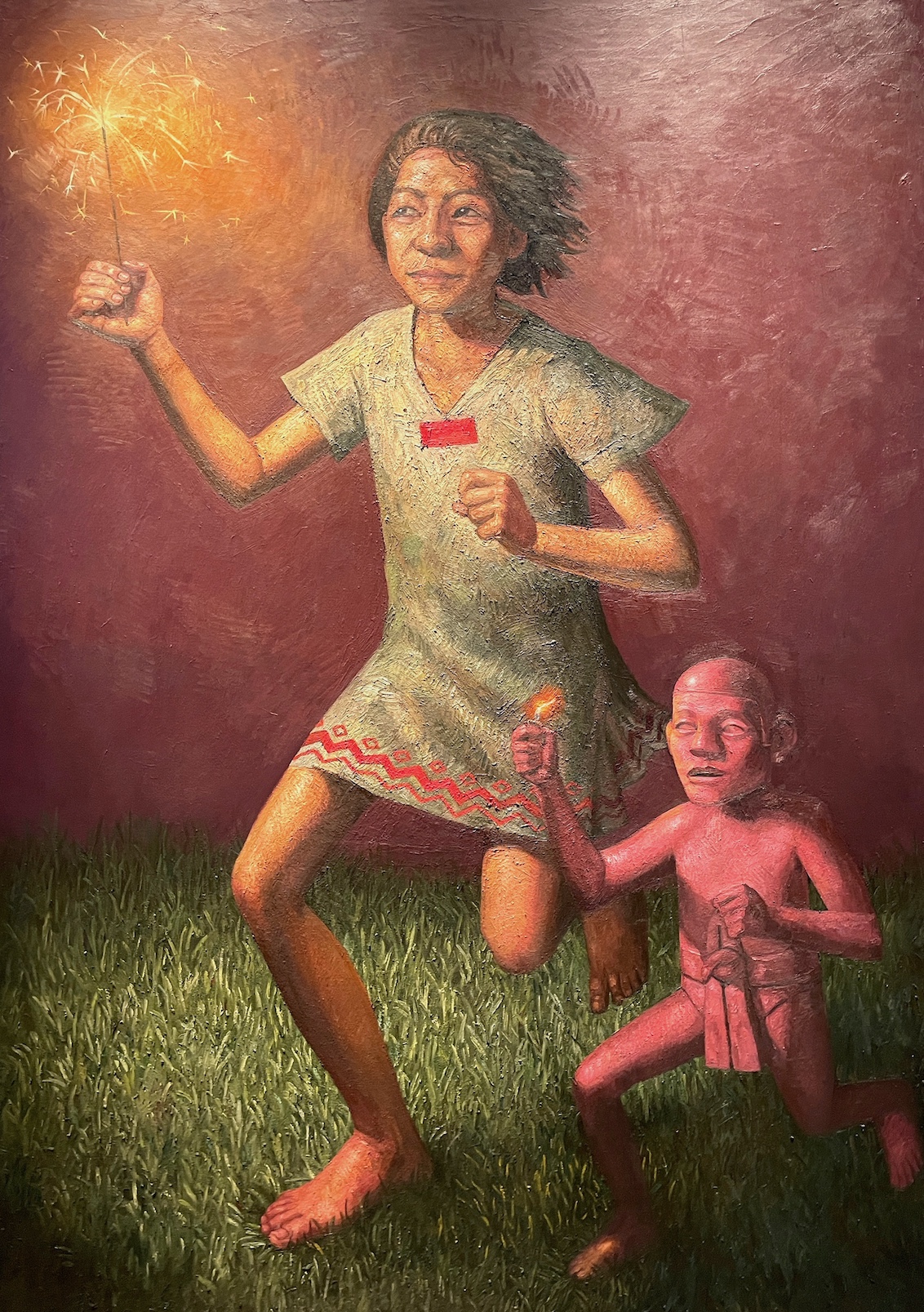
Firecracker, oil on canvas, Peter Bernal, 2021
There are moments of gentle respite in the show. One is a tender portrait of the artist’s wife, Ellen, seated before a dark backdrop with their black cat, Wilhelmina von Kratzleben, curled up on her lap. Another is Firecracker, in which a smiling Indigenous girl runs with a sparkler in one hand. Beside her runs a smaller figure, an animated sculpture of an Aztec warrior, flicking a lighter. Back in the main gallery, over the entrance, Marshall Fredericks depicts the march of progress in a plaster relief sculpture, a timeline of technology showing Native Americans on horseback inevitably supplanted by covered wagons, trains, automobiles, and airplanes. Bernal knows that technologies like the gunpowder in the child’s sparkler can be harnessed for good, though much of the rest of the work in his show reiterates that progress, to put it entirely too mildly, is a double-edged sword, and its history cannot be whitewashed.
Searching & Finding Hidden Heritage @ Marshall Fredericks Museum. Work by Peter Bernal. Through May 24, 2025.
[adrotate group=”2″]