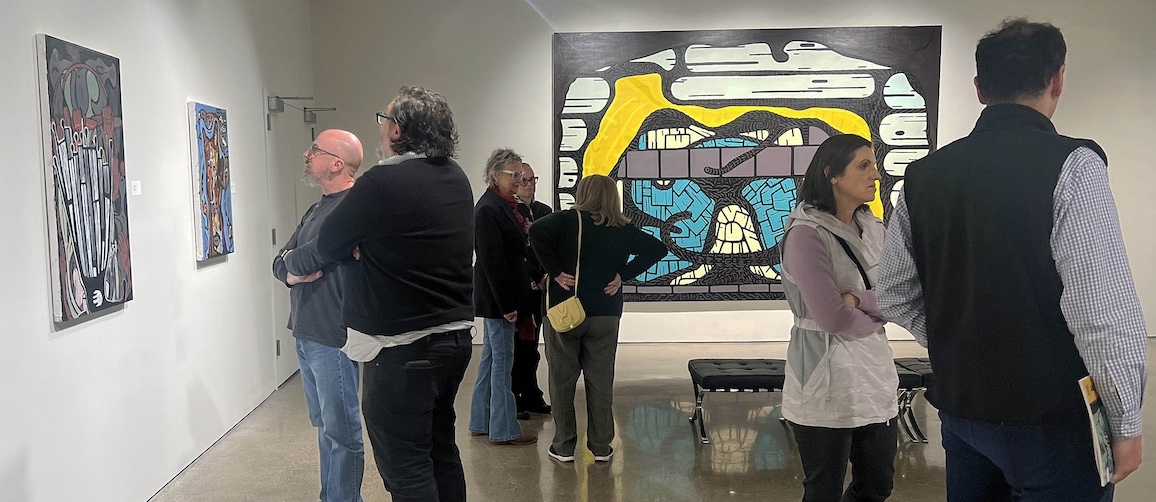
Four: Lester Johnson’s Selected Works, September 12-December 8, 2024, Stamelos Gallery Center, University of Michigan Dearborn
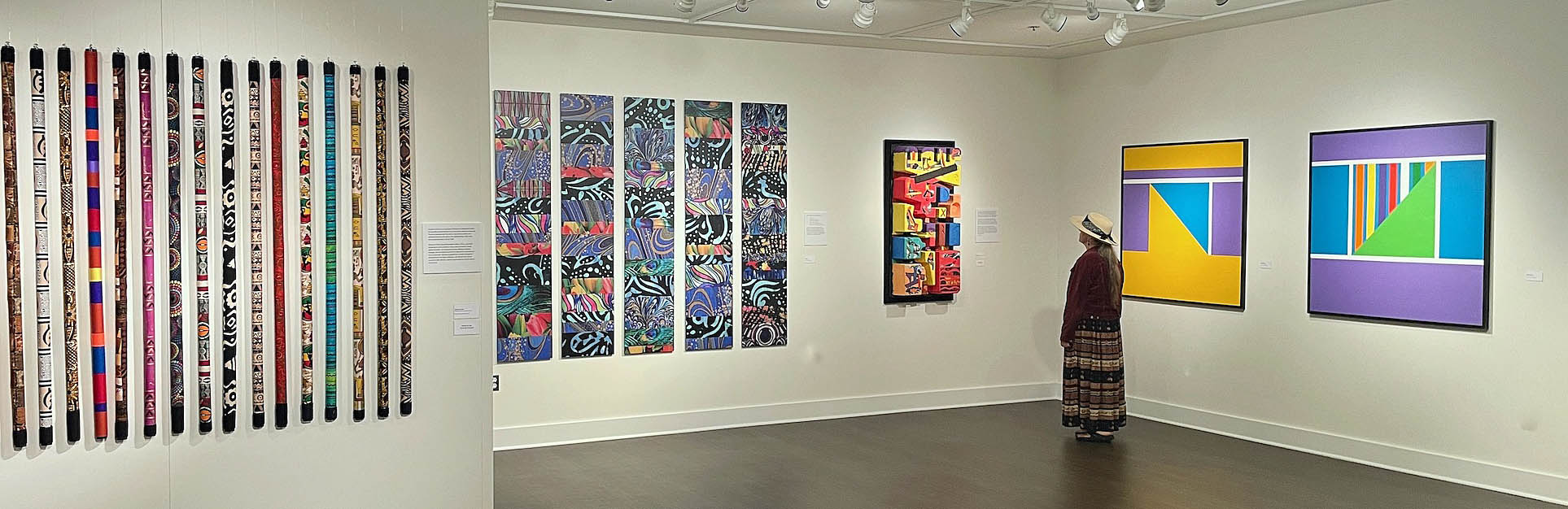
Lester Johnson, Four: Lester Johnson’s Selected Works, Installation View
Before visiting the exhibition Four: Lester Johnson’s Selected Works, give a listen to the 1954 jazz standard, performed by the Miles Davis Quintet, that lends the show its title (if you forget, there’s a QR code near the front of the gallery that will take you to it). Calling the tune “toe-tapping” is a little corny, but — see if you can resist. A wall plaque says the song celebrates “four cherished things in life: truth, honor, happiness, and love.” Those all seem to be in short supply of late, replaced instead by bias, expediency, dopamine hits, and heart emojis. But there’s plenty of all four on vivid display on the walls of the Stamelos Gallery, as venerable Detroit artist and educator Lester Johnson takes every opportunity to share his spotlight with a pantheon of family, friends, artists, ancestors, teachers, musicians, and personal heroes that have helped shape and inform his art over the course of his long career. Consider the second part of the show’s title: it’s not “Selected Works of Lester Johnson,” but “Lester Johnson’s Selected Works,” a subtle difference that shifts the focus more to the works, all of which are, to some extent, group efforts, even if only via musical inspiration. This is true of the work of many artists, but Johnson, in the titles of his art and in his commentary on wall labels throughout the show, foregrounds this communal aspect, never missing a chance to generously acknowledge his collaborators and muses.
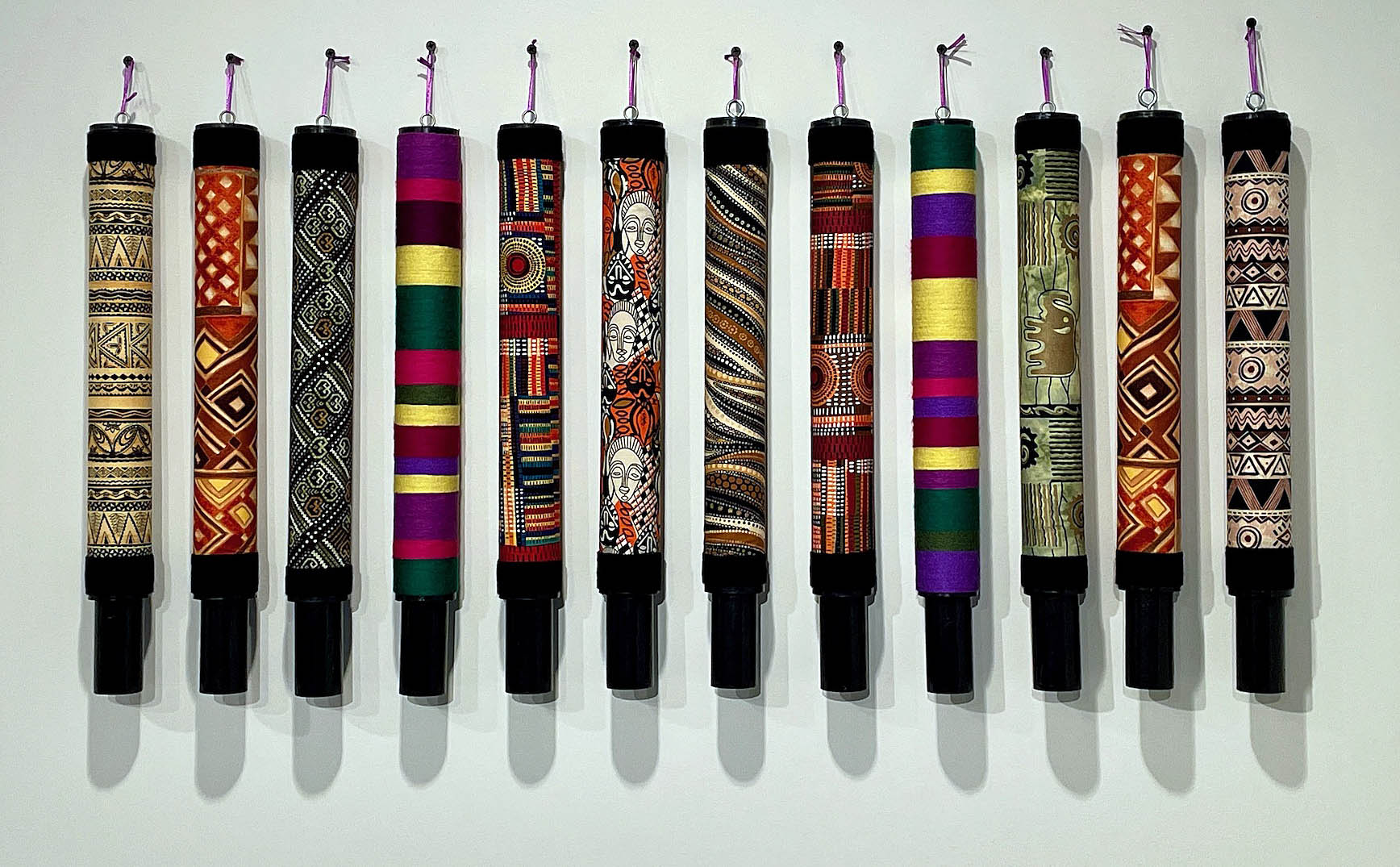
Lester Johnson, Elaine’s Gift, 2010 Fabric, fiberglass, paint, and tape.
Notice the number of titles that include the names of others: Marlene’s Gift; Elaine’s Gift; Claudia’s Choice, a nod to a friend who brought back printed cloth from a trip to Africa for Johnson to use in his art; Lynn’s Song, a multicolored work in cast paper dedicated to Lynn Forgach, director of the Exeter paper company in New York, with whom Johnson collaborated in the early ‘80s at the suggestion of another great Detroit creative, Al Loving. The tag for the piece even includes nods of gratitude to the student apprentices at Exeter for helping Johnson expand his abilities.
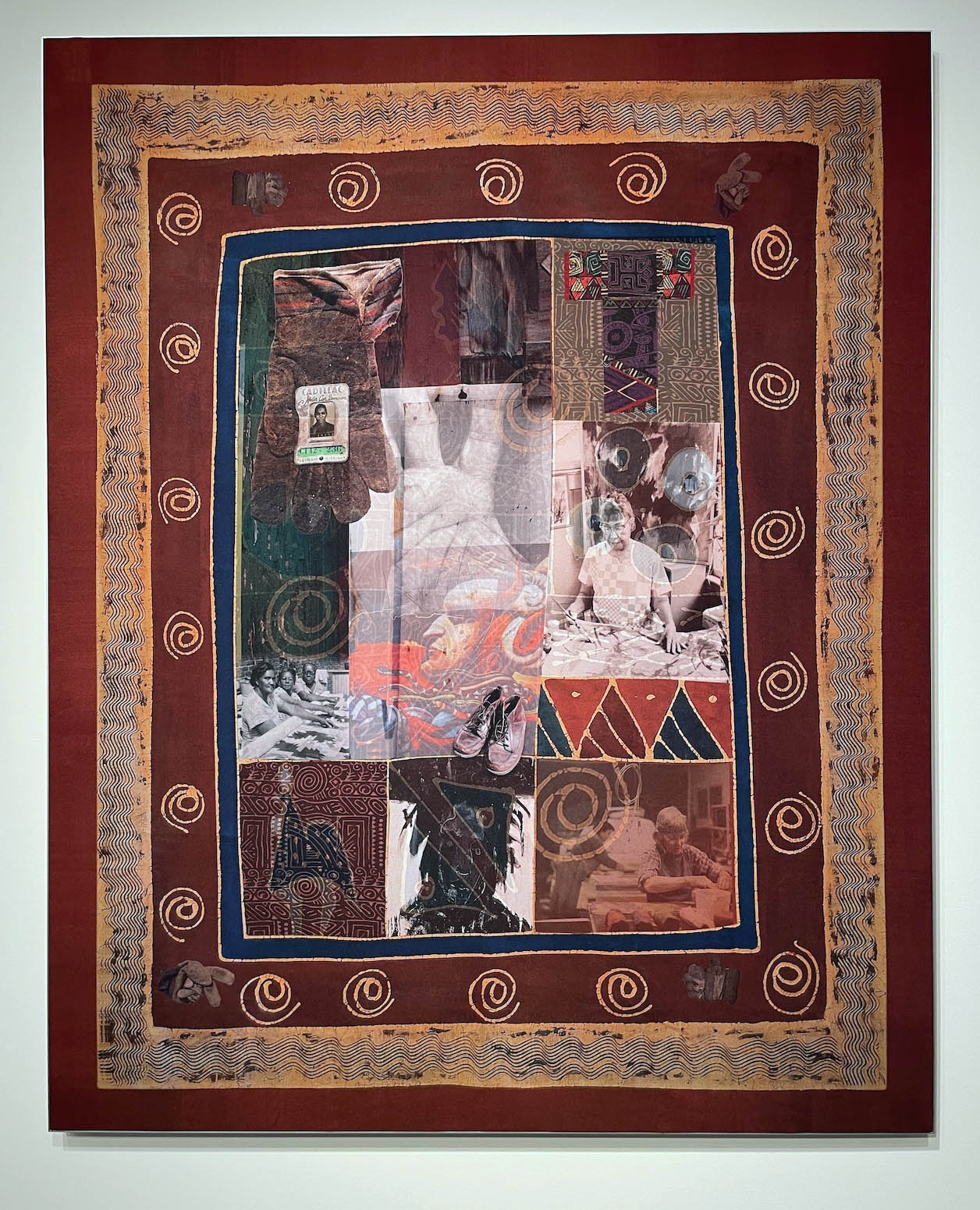
Lester Johnson, Alma Thomas, Digital Print, 2018.
The painter Alma Thomas, whose mosaic-like abstractions share the bright hues used in many of Johnson’s works, is honored in a tapestry-like digital print. The print itself is mostly in muted browns and blues, a collage combining African motifs, a photo of women stitching a quilt, a gnarled glove holding an auto worker’s ID badge, and a picture of Thomas at work on a painting, suggesting a kinship across time and space between these various forms of the labor of Black hands.
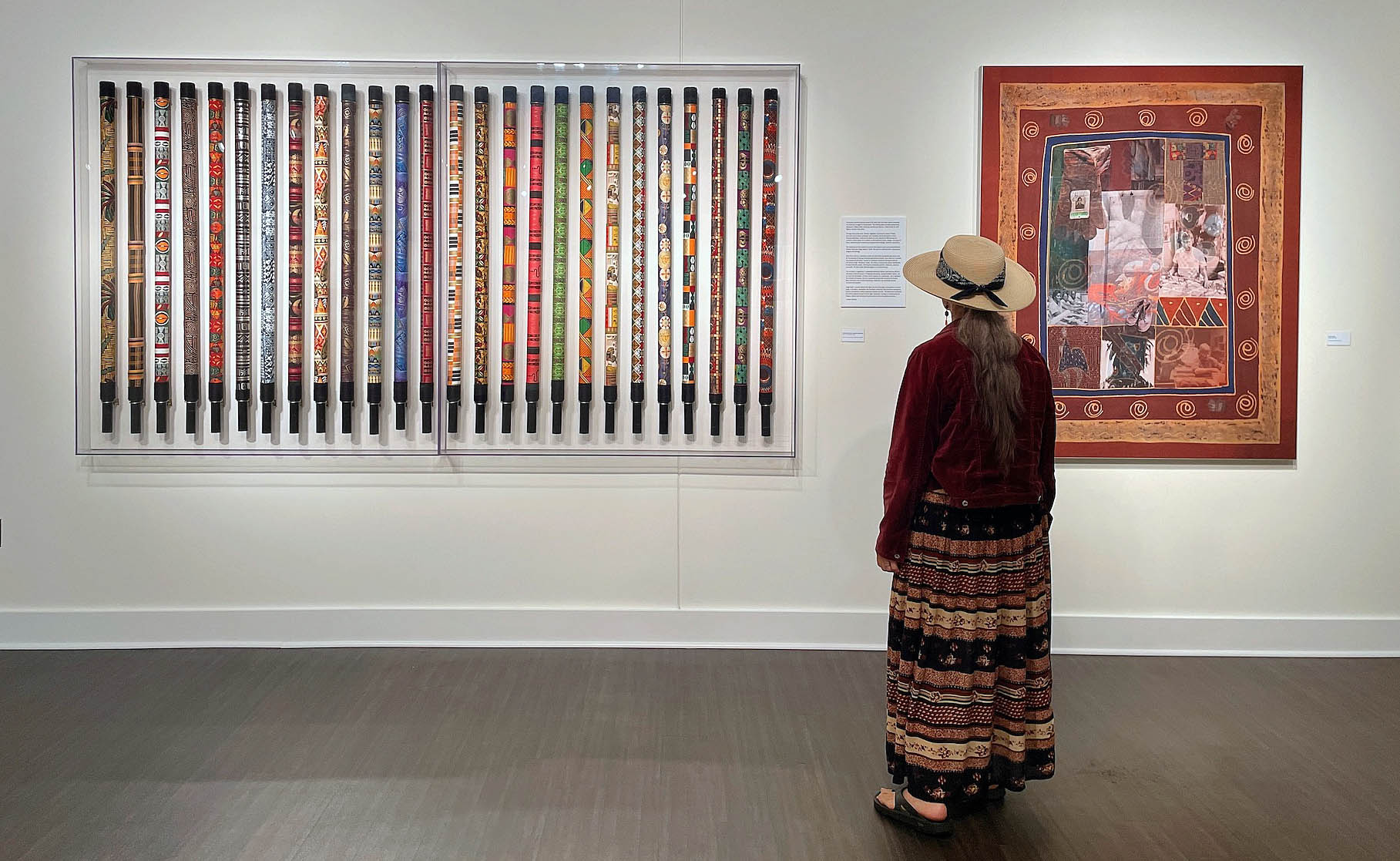
Lester Johnson, A Garland of Praise Songs for Rosa Parks, 2013 Fabric, wood, and paint.
A Garland of Praise Songs for Rosa Parks is dedicated to the storied civil rights icon, as well as to America’s longest-serving Black judge, Detroit’s Damon Keith. (The piece resides in the Damon J. Keith Center for Civil Rights at Wayne State University.) It’s the largest example on display here of Johnson’s “totems” — staff-like cylinders of wood or fiberglass, wrapped in twine, tape, reeds, digital prints featuring colorful patterns, or, more often and most strikingly, fabric printed with African designs. Attributed on Johnson’s website to his African and Native American spiritual heritage, the totems call for “a cross-cultural exchange of energy and vision.” Standing vertically in collections of eight, ten, as many as 26, most of the totems are a few feet tall, but even those made of paper that are no taller than one’s hand project an aura of strength, confidence, and authority. The totems appear again worked into Johnson’s multiculturally-inspired “kimonos” — robe-shaped wall hangings weaving together Japanese, African and Australian Aboriginal influences. Built into the kimonos like columns or spines, the totems lend the garment-like constructions an almost architectural stability. The kimonos displayed here are named in honor of Nelson Mandela, Judge Ketanji Brown Jackson, and Egyptian queen Nefertiti.
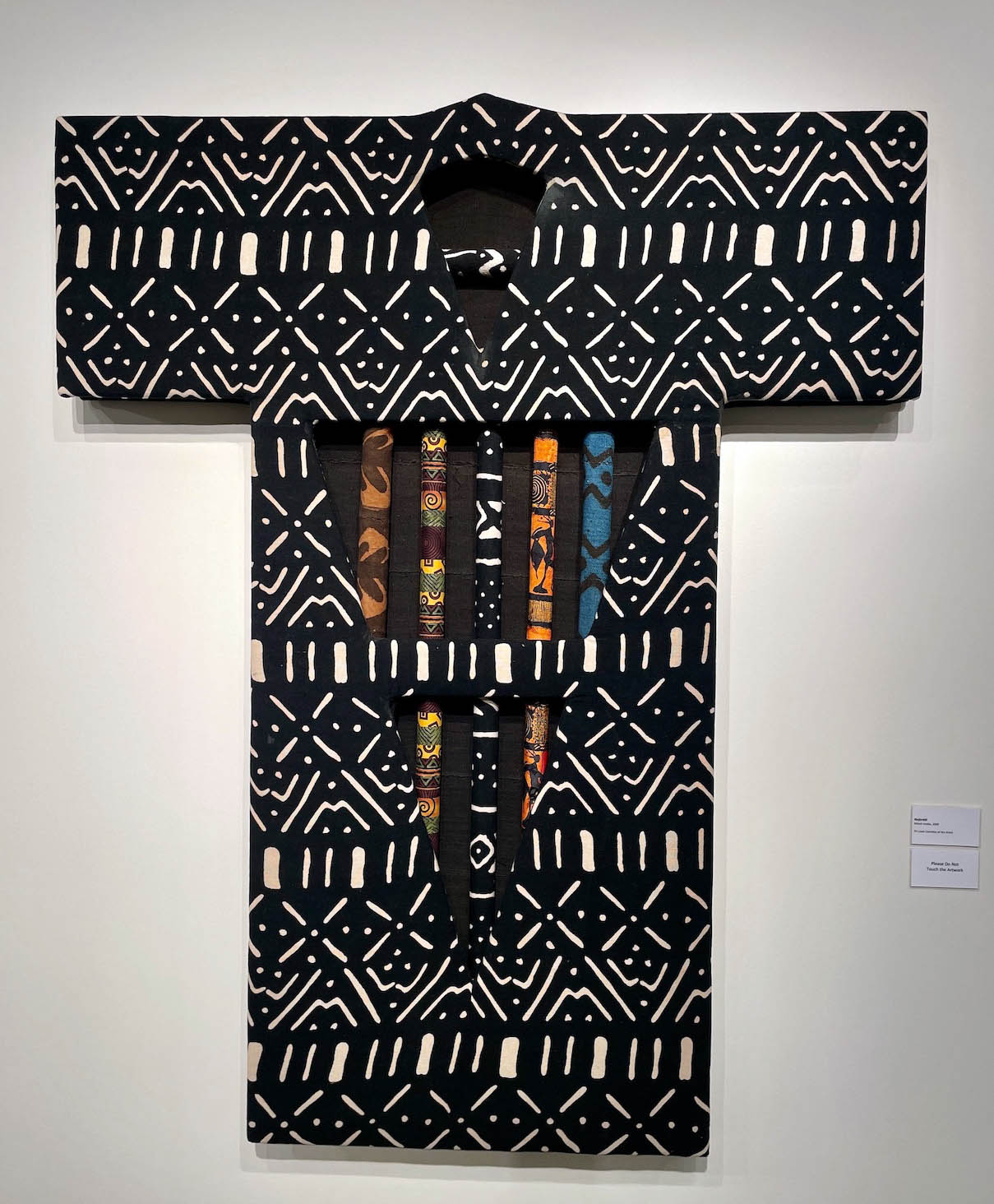
Lester Johnson, Kimono Nefertiti, 2009 Mixed media.
Johnson was born in Detroit in 1937; born that same year, just a few blocks from where Johnson would grow up, was the Blue Bird Inn, the legendary nightclub that hosted a stellar line-up of modern jazz players in the 1950s and ‘60s. Jazz music has greatly informed Johnson’s work through the years, particularly that of Miles Davis, who lived in Detroit briefly in the mid-‘50s. Davis and his music are mentioned a number of times in Four. An airbrushed painting from 1972 named for his influential 1959 album Kind Of Blue features arcs and angular shapes, leaning back to the right against a blue background. The shapes are striped with what look like tire tracks, as if pointing out the musician’s Motor City connection. As recently as this year, Johnson evoked Davis again with In A Silent Way Miles Davis and Wayne Shorter Tribute, an upward-pointing triangle of nine interlocking pyramids, painted a cool blue. The many facets of the structure cast shadows and catch the light, creating varying tones and intensities of color, perhaps even suggesting dignified facial features.

Lester Johnson, In A Silent Way Miles Davis and Wayne Shorter Tribute, Mixed media, 2024.
Johnson honors other musicians here as well. The woman known as “Mama Africa,” South African anti-apartheid activist and Afropop star Miriam Makeba, is commemorated with a collection of twelve richly patterned totems. Motown’s Gladys Knight inspired a 1974 print that comprises several panels of hard-edged black-and-white angles and stripes, like noir-ish depictions of urban architecture, countered by single red square with a record-like circle inside, a point of stability in a field of anxiety. John Coltrane Print from 1969 has the hip feel of jazz album graphic design. A 2005 abstract painting, showing colorful vertical stripes reminiscent of Johnson’s totems emerging from behind a green triangle, is named for the Luther Vandross song Never Too Much. A similarly vivid abstract work from the same year, named for the Thelonious Monk standard Round Midnight, features (ironically) areas of sunny yellow intersected by a purple field and a blue triangle, suggesting a passageway.
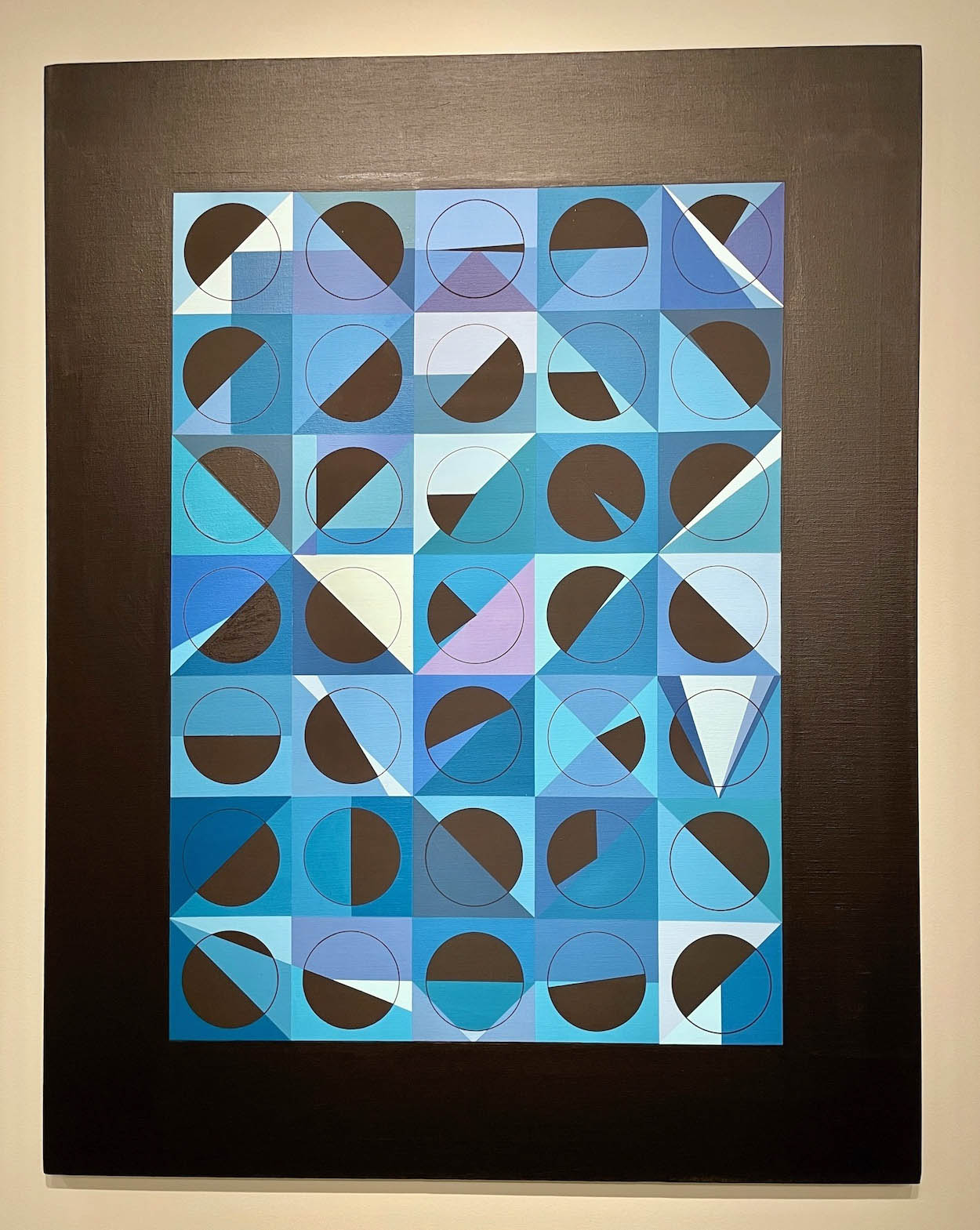
Lester Johnson, Total Eclipse, Acrylic, 1971.
One of the few works here that doesn’t bear someone’s name is Total Eclipse from 1971, an acrylic painting made up of 35 squares with circles inside, each intersected and subdivided by lines and angles like a pie chart. Despite the title, none of the circles is entirely occluded, and none are without shadow. Each “lunar” disc has some part shaded in, and each angular segment of the squares is painted in varying shades of blue and purple, or else white. It’s not a scientific diagram nor a mystical chart, but it looks like it could be either if you knew how to read it. As it is, the image seems to flicker like a multi-faceted gem, an ode perhaps to diversity and perpetual change.
There’s a lot of “cool” in this show — cool colors, cool music — but the overall vibe is a warm one, celebratory and grateful. Seen as a portrait of Lester Johnson, the exhibit is testimony to how any of us are, in many ways, collages of the people we’ve let into our lives — the ones who have informed and inspired us. It might be a fruitful and fun question to ask one’s self: “Whose names would appear on the wall tags if this was my show?”
Four: Lester Johnson’s Selected Works, September 12-December 8, 2024, Stamelos Gallery Center, University of Michigan Dearborn.
[adrotate group=”2″]