Critical art reviews of Detroit galleries and museums weekly

Category: Stain-glass

Mel Rosas: La Frontera @ N’Namdi Center for Contemporary Art

An installation image of Mel Rosas: La Frontera at the N’Namdi Center for Contemporary Art in Detroit. Also on view are two other shows — Darcel Deneau: Remnants, and Omo Misha: Whatsoever Things Are Pure. All three exhibitions are up through Jan. 23.

Detroit’s N’Namdi Center for Contemporary Art is hosting three separate exhibitions by Detroit artists – Mel Rosas, Darcel Deneau and Omo Misha – very different practitioners of their craft, and yet each an undeniable colorist with a strikingly personal intensity. Gallery director Izegbe N’Namdi says she brought these three together at the same time because she likes the dialogue they set up with themselves, as well as with the other two artists.

Longtime Wayne State University art and art-history professor Mel Rosas takes us once again to a mostly imaginary Latin America in La Frontera, where his eye generally lands on street scenes defined by deeply saturated colors and, not uncommonly, a solitary pedestrian passing across the canvas, as with Primo Textura, below.

Mel Rosas, Primo Textura, Oil on panel, 24 x 36 inches, 2024.

Rosas’ life, as he tells it, has been an exercise in straddling various lines or divisions. Much of this runs bone deep, perhaps springing from his experience growing up as a half-Panamanian, half-American kid in homogenous Des Moines, Iowa. (He overcame in part by becoming a high-school baseball star.)

This neither-one-side-nor-the-other philosophical orientation plays out in his artistry as well. He’s particularly drawn, he told the Detroit Art Review in 2023, to opposites, as with his highly realistic painting style that, counterintuitively, all the same often manages to convey dreaminess and uncertainty.

As critic Matthew Piper put it in a 2016 Essay’d, “With their luscious surfaces, painstakingly lifelike textures, and subtly surreal depictions of almost-possible places, Rosas’ paintings are portals that offer the artist passage into his Latin American ancestry, and the viewer into a lush and evocative dream world.”

Indeed, passages and openings nearly always figure in Rosas’ work, sometimes framing an impossibly verdant landscape, or the immensity of the ocean itself. But with this show, La Frontera – easily translated, and, you’ll note, yet another line or division – the doorways are mostly closed, as with Primo Textura, or open into an impassable hellscape as in The Four Elements (Fire).

Mel Rosas, The Four Elements (Fire), Oil on board, 8 ½ x 11 inches, 2008.

It’s something of a departure for Rosas. Generally in the past these glimpses through doors and windows pull us into beguiling natural landscapes, but with The Four Elements, this aperture is full of threat and menace. Not to wax too psychological, but if these portals are in their way windows into the unconscious, Four Elements offers up a troubled and troubling vision, indeed.

Rather more enigmatic and possibly hopeful is The Need for Angels, in many ways the most surreal piece that Rosas has in this show. We’re presented with what appears to be a freestanding blue wall that also acts as a film strip with holes for sprockets at top and bottom, all framing black-and-white ads for movies set in large, deep squares. To the left, a giant pink arrow points at the classic image from filmmaker Wim Wenders’ 1987 “Wings of Desire,” with a trench-coated Peter Falk sporting angel wings, standing on the edge of a rooftop. Yet to his left, in case we thought this was all mysticism and reverie, a fire is in full and violent eruption from within a metal garbage bin.

Mel Rosas, The Need for Angels, Oil on canvas, 48 x 72 inches, 2024.

Izegbe N’Namdi says the first time she saw work by Rosas, she was immediately sucked into the piece at hand, landing in her a deeply meditative frame of mind. It’s a judgment the artist might well treasure.

Darcel Deneau, Heading West, Stained glass and found objects on wood panel, 12 x 16 inches, 2024.

Detroit artist Darcel Deneau works in a rarefied medium – constructing large mosaics out of tiny shards of stained glass, as with the current show, Remnants. It’s painstaking, time-consuming work. Moreover, colored glass always runs the risk of being “too pretty,” thereby trivializing its subject, whether fair or no. Darcel nicely avoids this trap by working with urban vignettes drawn from Detroit streets – “throwaway” shots of cars and buses and traffic lights, what you could call your standard city-road view.

A particularly nice example of this is Heading West – looking down Warren Avenue from Woodward toward Old Main at Wayne State. A striped, mint-colored city bus taking up the right side of the frame is reflected in nearby puddles, while a sunset edges, convincingly, from yellow-orange to chilly blue and lavender overhead.

Omo Misha, Brotherhood (The Mother’s Garden Series), Oil on canvas, 48 x 60 x 1.5 inches, 2025.

The third exhibition on display is Whatsoever Things Are Pure by Omo Misha, aka Misha McGlown, a multifaceted artist and curator. (The title comes from a Biblical passage.) Among other positions, Misha – a Detroit artist with a large presence in New York City – is curator of the Windows on Amsterdam gallery at City College of New York. In Detroit, she’s worked with various groups, including the Irwin Gallery on West Grand Boulevard.

Her art ranges widely, but in this particular case Misha gives us a series of fairly realistic portraits of young people. Several canvases are bright and highly vivid. But Brotherhood: The Mother’s Garden Series is set in a landscape of soft green on the edge of a forest. Its subjects, however — little boys dressed to the nines in their Sunday best — are rendered in shades of brownlish-gray, setting them off from the rest of the canvas.

But the focal point of the painting is the doll the smallest boy, right there in front, is holding out in front of himself. The doll is a veritable technicolor feast with rich yellows, reds and greens that sets up a striking and otherworldly contrast with the monochromatic children.

Three shows, Mel Rosas: La Frontera, Darcel Deneau: Remnants, and Omo Misha: Whatsoever Things Are Pure, will up at the N’Namdi Center for Contemporary Art in Detroit through Oct. 30. Three artists’ talks are scheduled, each from 2 to 4 p.m. on Nov. 8 (Omo Misha), Dec. 13,2025 (Mel Rosas), and Jan. 10 (Darcel Deneau).

[adrotate group=”2″]

Luminous Visions and Path to Paradise @ Toledo Museum of Art

Phillip K. Smith III, Flat Torus 4. Photograph by Lance Gerber Studio

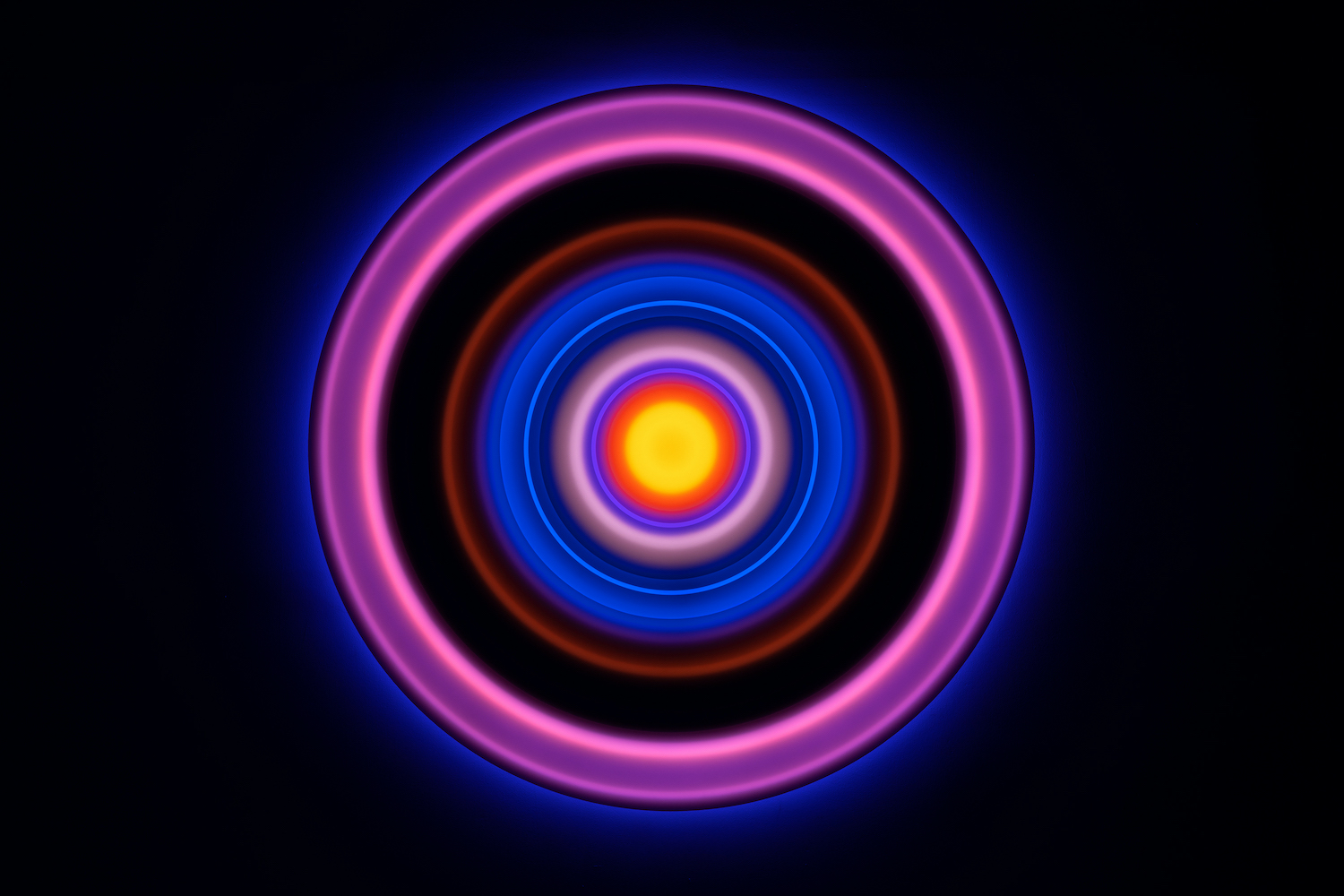
This year, the Toledo Museum of Art added to its permanent collection Flat Torus 4, an ethereal light installation by multimedia artist Phillip K. Smith III.  This work is the visual anchor of the exhibit Luminous Visions. Concurrent with this single-gallery show is a sprawling retrospective of the stained glass art of Judith Schaechter.  As different as these two exhibits are in form and content, they both directly engage with centuries of art history, they both take luminosity as their subject, and they’re both visually mesmerizing.  As such, these two separate shows compliment each other like the varied notes of a musical chord.

The centerpiece of Luminous Visions is Flat Torus 4, a series of wall-mounted concentric rings which, with the aid of computer software and LED lights, moodily project diffused light into the gallery space.  It’s an instillation which recalls the atmospheric light sculptures of Dan Flavin.  Flat Torus 4 is tactfully placed in conversation with an ensemble of other works from the TMA’s collection which literally or metaphorically take light as their subject.  These include a 19th Century painting by Sanford Robinson Gifford of Maine’s Mt. Katahdin, beautifully illuminated by a rising sun.  And a 15th Century sculpture of a seated Buddha speaks to the metaphorical and spiritual associations of enlightenment and illumination.  The works in this exhibit span nearly 700 years, but Flat Torus 4 is the undisputed star of the show; its soft light bathes the whole room in its shifting colors which slowly and satisfyingly cycle over the course of 40 minutes.  This micro-show is an interesting and visually satisfying vignette, and it seems like great starting point for what could be a larger exhibition addressing light and illumination in art across the TMA’s collection.

Phillip K. Smith III, Flat Torus 4. Photograph by Lance Gerber Studio

In contrast to the stately serenity of Luminous Visions, the glass works on view in the traveling show Path to Paradise are loud, irreverent, uncomfortable, and often violent. Yet they’re also undeniably beautiful and cathartic.  Glass artist Judith Schaechter takes her inspiration in equal parts from Northern Renaissance art and the aesthetics of Mad magazine.  Through January 3, the TMA is showcasing forty of her works, supplemented with original sketchbooks brimming with preparatory drawings which offer behind-the-scenes access into Schaechter’s creative process.  Path to Paradise is her first survey exhibition, and given the impressive scale and scope of her body of work, it seems like one that’s long overdue.

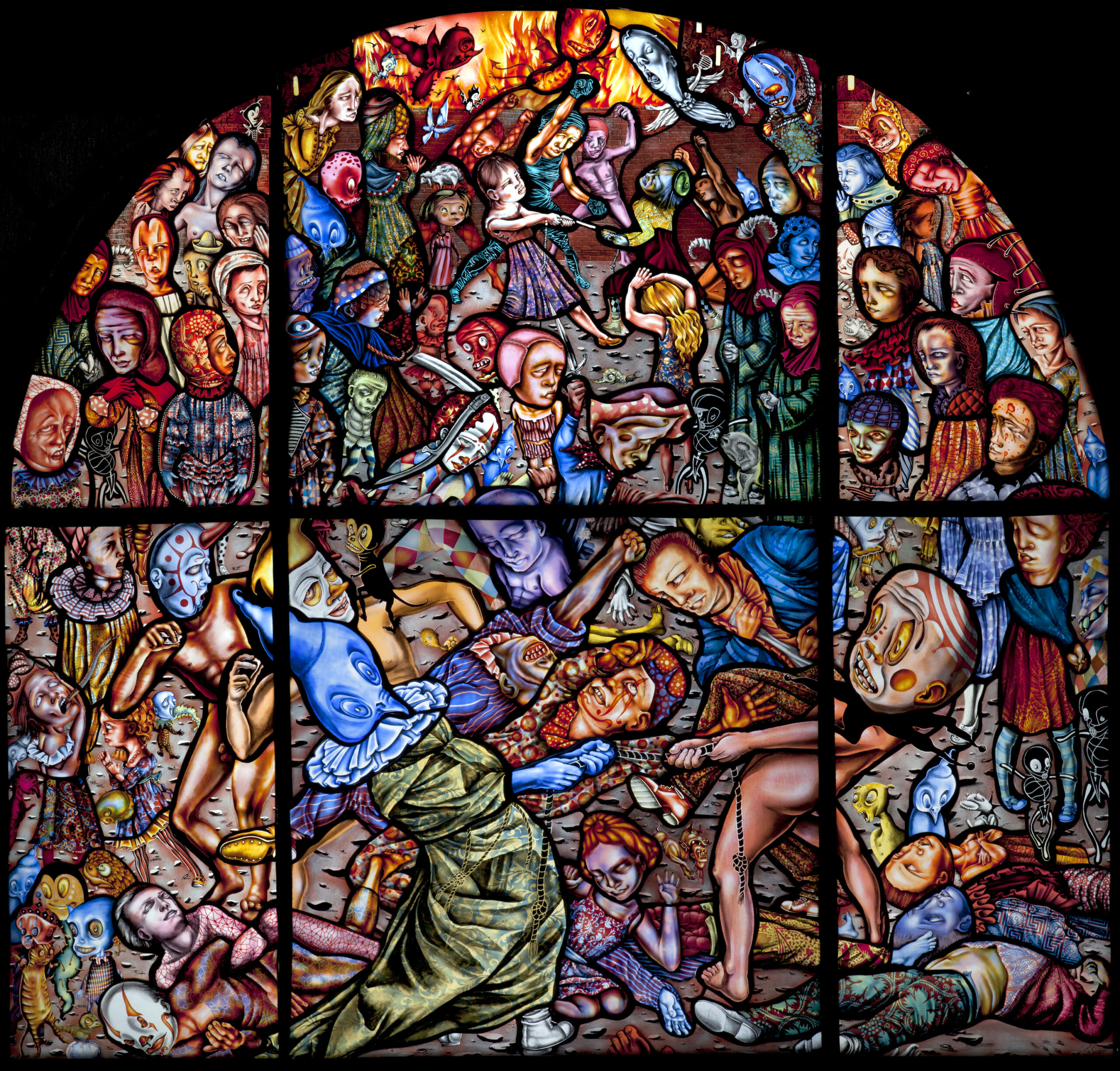
The Battle of Carnival and Lent, 2010-2011. Stained-glass panel, 56 x 56 in. Memorial Art Gallery of the University of Rochester, NY; Marion Stratton Gould Fund, Rosemary B. and James C. MacKenzie Fund, Joseph T. Simon Fund, R. T. Miller Fund and Bequest of Clara Trowbridge Wolfard by exchange, and funds from deaccessioning.

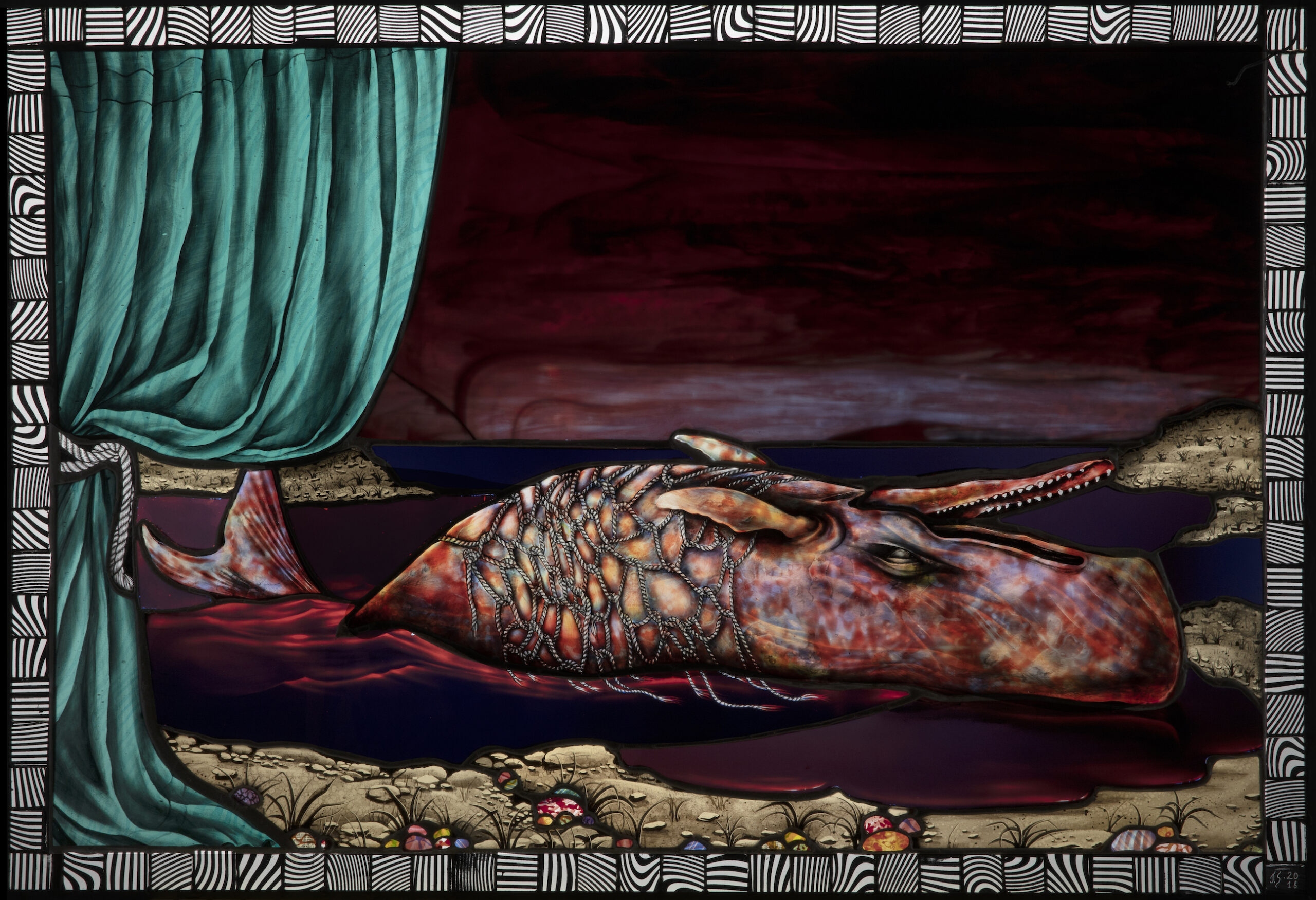
Beached Whale, 2018. Stained-glass panel, 27 x 40 in. Courtesy Claire Oliver Gallery, Harlem, and the artist.

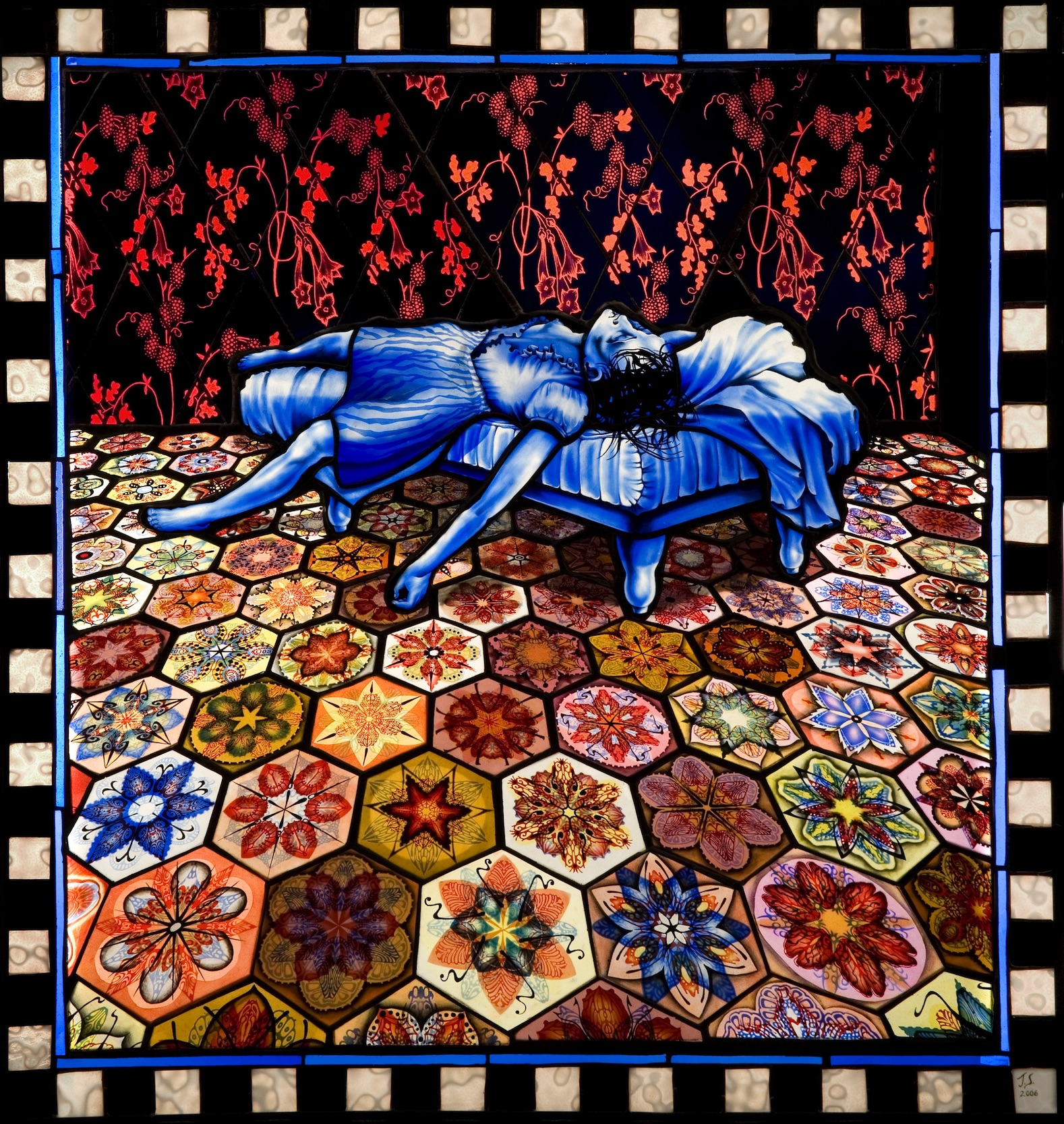
Schaechter manages to take a medium that reached its apex in the Gothic era and masterfully translate it into a 21st Century vocabulary. By applying a technique of layering glass which results in subtle gradients and shading, she lends her work a contemporary illustrative quality that you wouldn’t see in a 12th Century rose window.  It’s a tedious process—each work takes months to complete– but much like the Old Masters of the Northern Renaissance, Schaechter delights in the details.

This show presents her earliest works in conversation with some of her most recent, surveying the trajectory of her career.  Among these include The Flood, a triptych which thrust Schaechter into the national spotlight when it was displayed at the Smithsonian’s Renwick Gallery when the artist was 29 years old. The figures that populate her fabricated worlds often seem caricatured, but she demonstrates an impressive ability to switch back and forth between cartoonish imagery and lucid realism, even within the same work.  New or old, all her works are rendered with astonishing detail.  In My One Desire, the background is teeming with plants, animals, and dazzling kaleidoscopic bursts of geometric patterns that snugly fill every bit of negative space, recalling a Renaissance tapestry. The work’s theme of a dying unicorn also situates this work in the tradition of Renaissance art, though the story here remains characteristically enigmatic. This horror vacui recurs frequently in her work. In A Play About Snakes, we encounter an elaborate pattern of twisting, writhing snakes that mimic the ornamental patterns found in medieval illuminated manuscripts– the Cross Page from the Lindisfarne Gospels, perhaps.  Regardless of the subject matter, all her works teem with ebullient detail; no wonder she describes herself as a “militant ornamentalist.”

Although her work is often thematically dark, it can at times be playfully whimsical.  Specimens shows a grid of various imaginary creatures preserved in little jars as if on display in a natural history museum; they seem plucked from the world of Hieronymus Bosch…or perhaps Dr. Seuss.  And her improvisatory Exquisite Corpse is an homage to the silly party game of the same name which famously originated at the dinner parties thrown by Surrealism’s founder Andre Breton.

But much of Schaechter’s work is unsettling. We encounter many images of violence and death, a surprising number of which are actually sourced in Renaissance-era paintings and illustrations. Some of these works directly speak to recent and contemporary events.  Sister is a disquietingly calm work in which the pose assumed by its lifeless subject references the haunting Vietnam-era photograph of the “Napalm Girl.”  But within the work, this young girl inhabits indeterminate space, and Sister (much like Picasso’s Guernica) comes across as a universal statement against wartime atrocity which could apply to any time and any place.  And in Emigration Policy, we see a dog drowning as it desperately tries to catch up with a departing ship (or was it thrown overboard?).  The violence in her work is never gratuitous, but rather serves to encourage empathy and compassion on the part of the viewer.

The Floor, 2006. Stained-glass panel, 36 x 34 in. Collection of Claire Oliver

The subject matter of Schaechter’s work runs the gamut between agony and ecstasy, and is Shakespearian in its scope.  As to the question of why her work is often so uncomfortable, Schaechter responds on her website with a passage excerpted from James Poniewozik essay The Art of Unhappiness: “What we forget…is that happiness is more than pleasure sans pain.  The things that bring us the greatest joy carry the greatest potential for disappointment.  Today, surrounded by promises of easy happiness, we need someone to tell us that it is O.K. not to be happy, that sadness makes happiness deeper.”  Bearing this in mind, as uncomfortable as many of her works might make us, it seems that the body of her work is– in the final analysis—ultimately life-affirming in its unashamed embrace of the totality of the human experience.

The Path to Paradise: An Interview with Artist Judith Schaechter

Toledo Museum of Art  –  The Path to Paradise: Judith Schaechter’s Stained-Glass Art   —  Jan. 3, 2021 | Levis Gallery

Powered by WordPress & Theme by Anders Norén