Critical art reviews of Detroit galleries and museums weekly

Category: Fiber

Michigan Fine Arts Competition @ BBAC

Birmingham Bloomfield Art Center Hosts the 35th MFCA
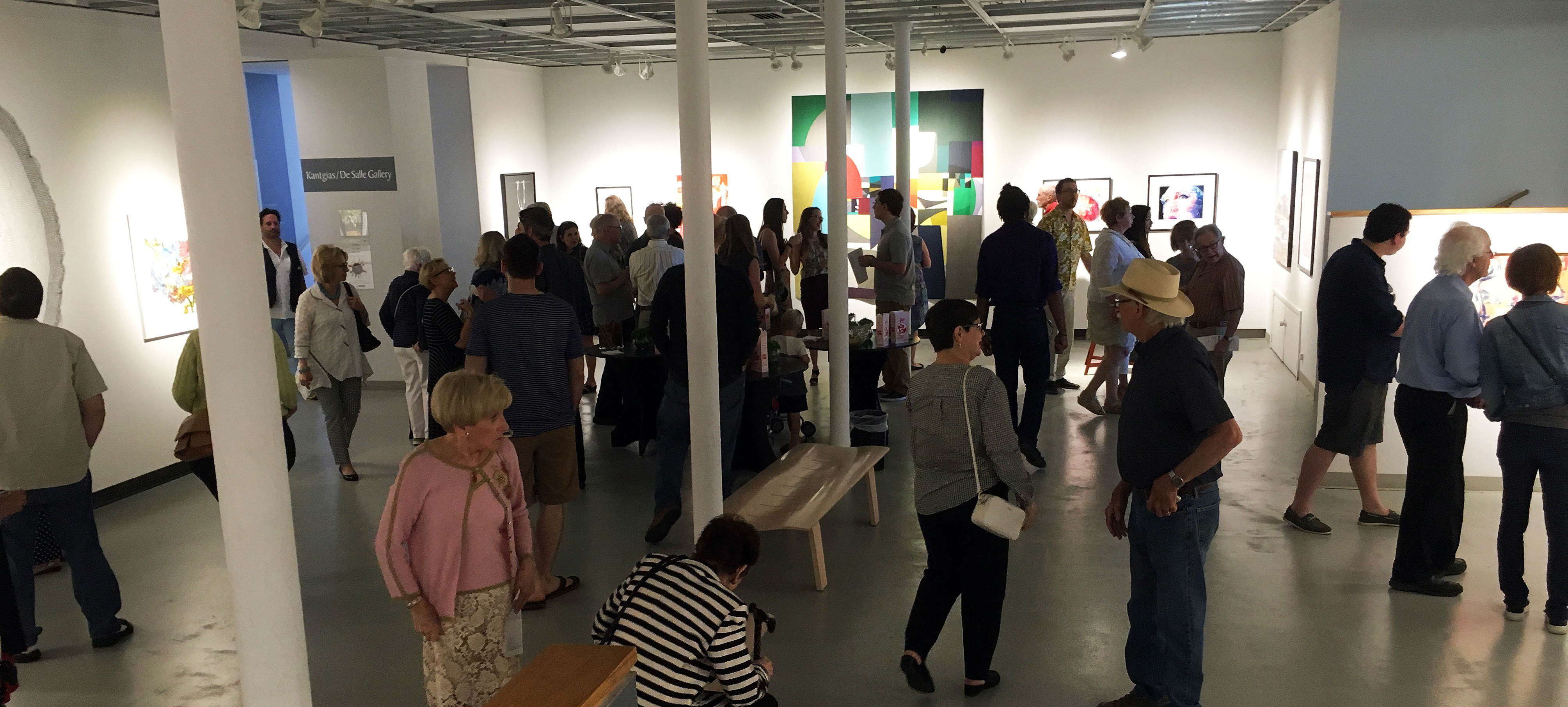
BBAC Install

BBAC / MFAC Installation Image – Courtesy of DAR

The Michigan Fine Arts Competition (MFAC) exhibition opened June 24, 2016, and is one of the best they have had in their long existence, beginning in 1982. Not many know that the competition was previously held by the Detroit Institute of Arts, but with their demise of leadership in contemporary art, they were pleased to find a home at the Birmingham Bloomfield Art Center (BBAC). The key to this year’s success is Terence Hammonds; the juror selected to make this year picks. Originally from Cincinnati, Ohio, he attended the School of the Museum of Fine Arts, Boston for his BFA, and Tufts University for his MA. One of the factors that make this exhibition so exceptional is that it draws on a mid-west region, where more than 500 artists compete from Michigan, Ohio, Indiana, Illinois and Wisconsin.
G.Moore

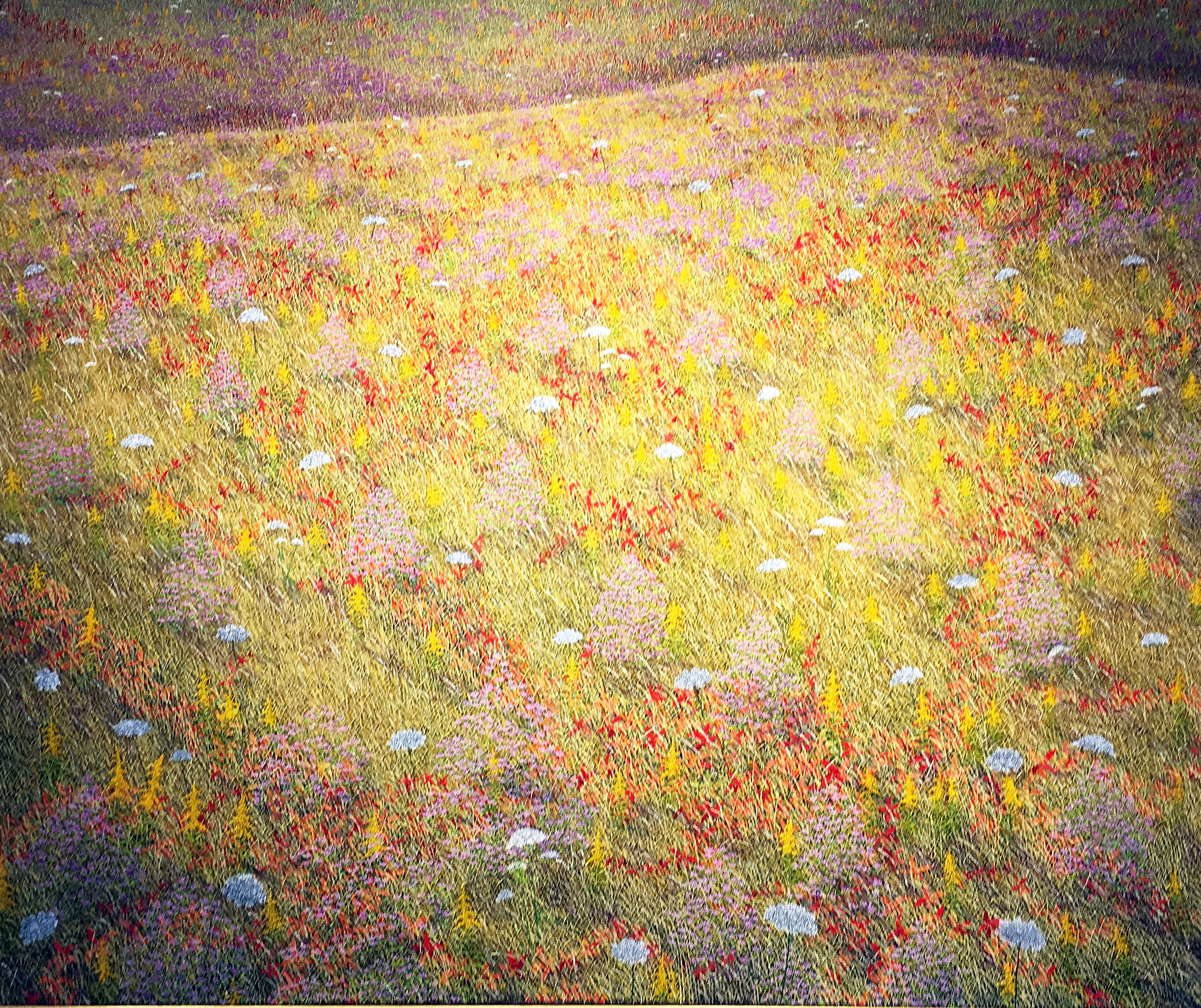
Gerald Moore, Late September Field, Oil on Canvas

Gerald Moore is an expressive landscape painter who holds an MA in painting from Central Michigan University. He says “I work opposite the Oriental painting philosophy that ‘less is more.’ ‘More’ is the engine of my work; ‘more’ is more.” His large landscape painting seems to draw on the landscape as a subject, but flirts with abstract field painting and gives us a little of both. Color field painting, championed by Clement Greenburg in the 1950’s characterized this expression as solid color creating an unbroken surface and flat picture plane. One might view the Wheat Fields of Van Gogh to see early examples.
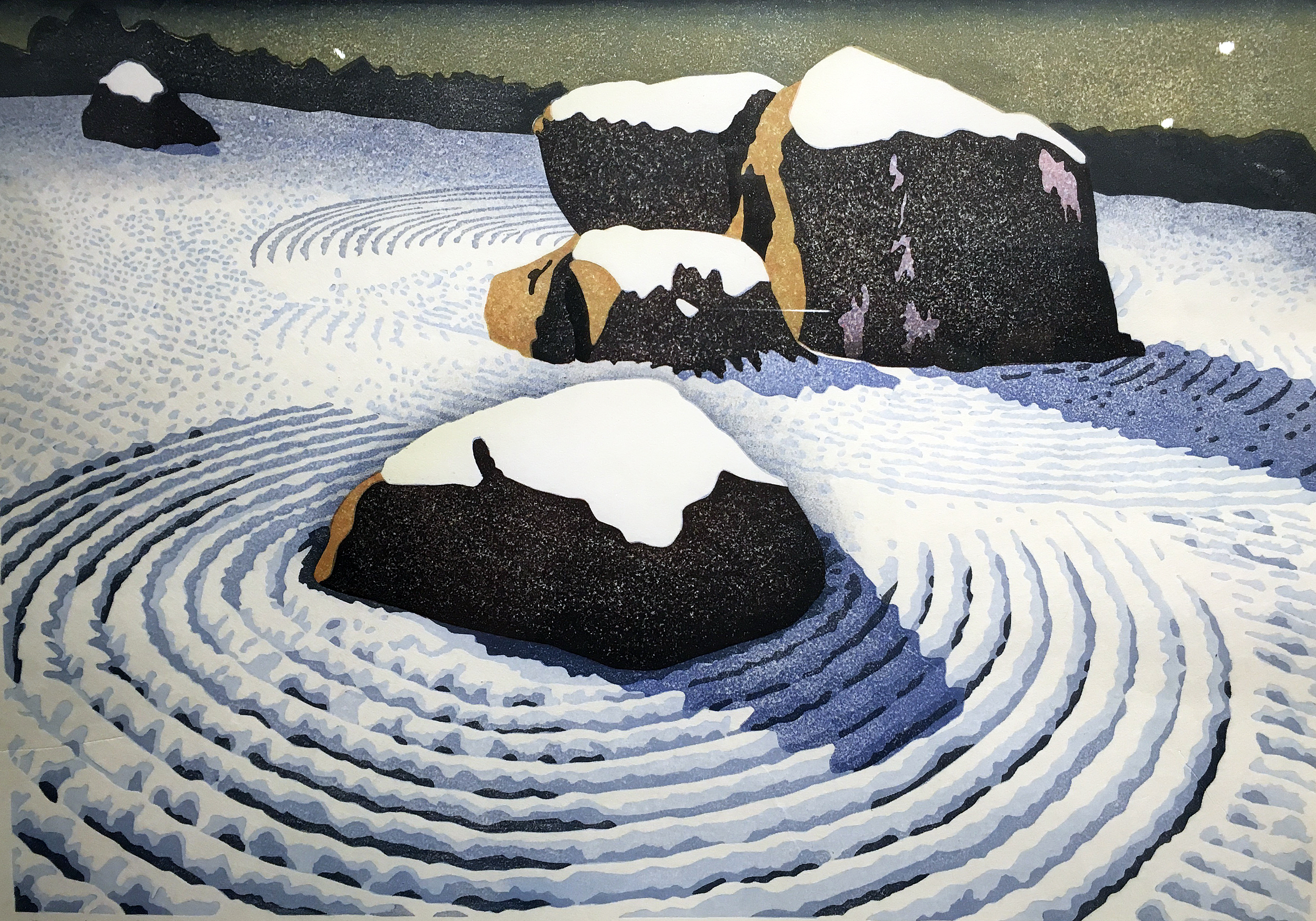
Woodcut

Mary Brodbeck, Blanket, Woodblock Print

Maybe it’s because we don’t see a lot of artists working with wood-cut printmaking, that this landscape with rings and melting snow is so attractive. She says in her statement “ Affected by my travel and study in Japan, notably by visiting traditional Japanese gardens, my landscape prints are carefully designed in abstract and stylized ways that are intended for viewers to have a contemplative experience. “ These Zen-like impressions made by the woodblock can transport the viewer to a place that blends design, craft and a spiritual aesthetic. Ms. Brodbeck holds a BFA from Michigan State University, and an MFA from Western Michigan University.
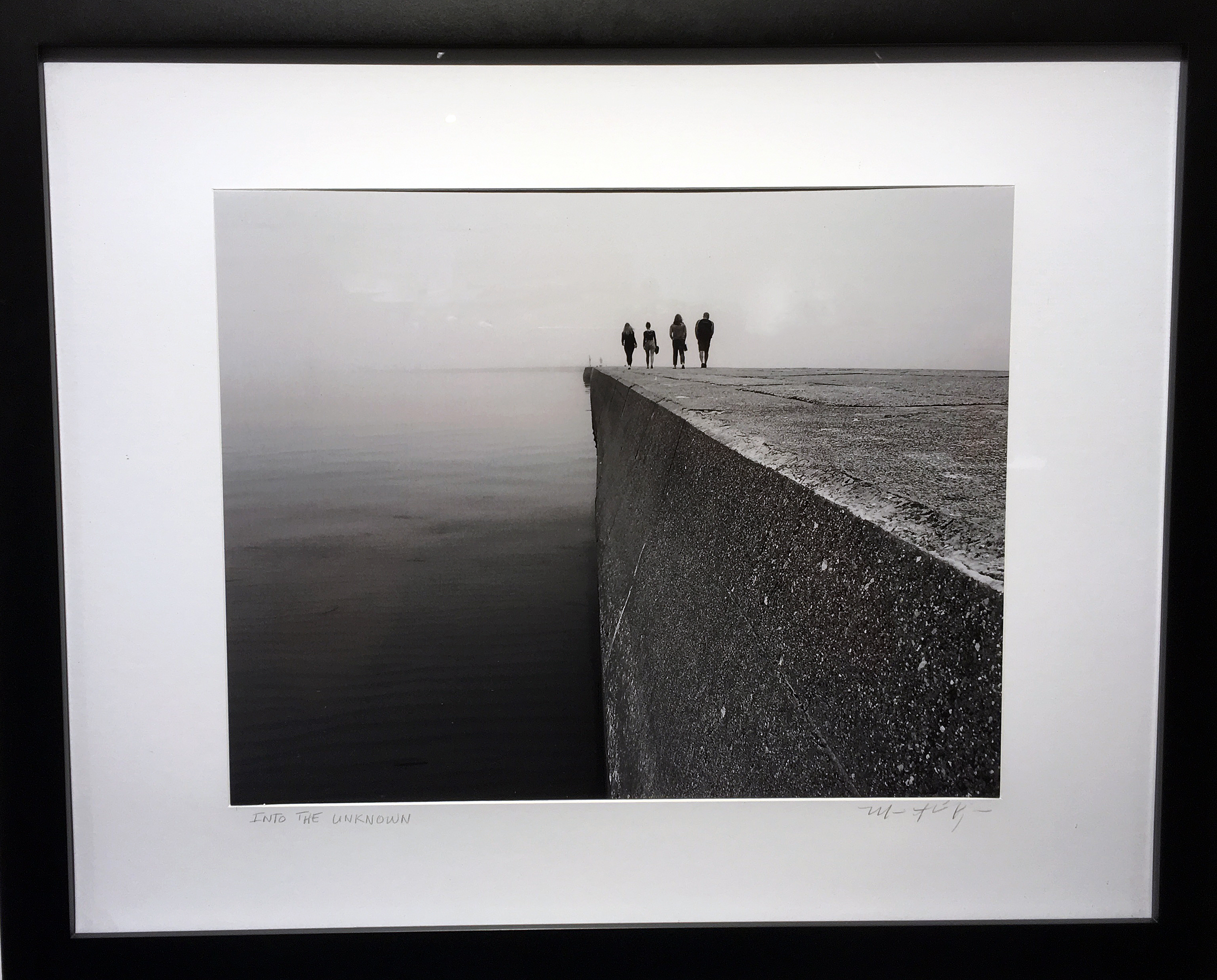
Photo

Mario Inchaustegui, Into the Unknown, Digital Print

Mario Inchaustegui’s digital print “Into the Unknown” draws purely on composition for its power and interest. The geometry along with perspective leads us to four figures on the edge of some type of a concrete pier. This middle school teacher at West Bloomfield Schools has been part of photo exhibitions in Metro Detroit, most recently at the Scarab Club.
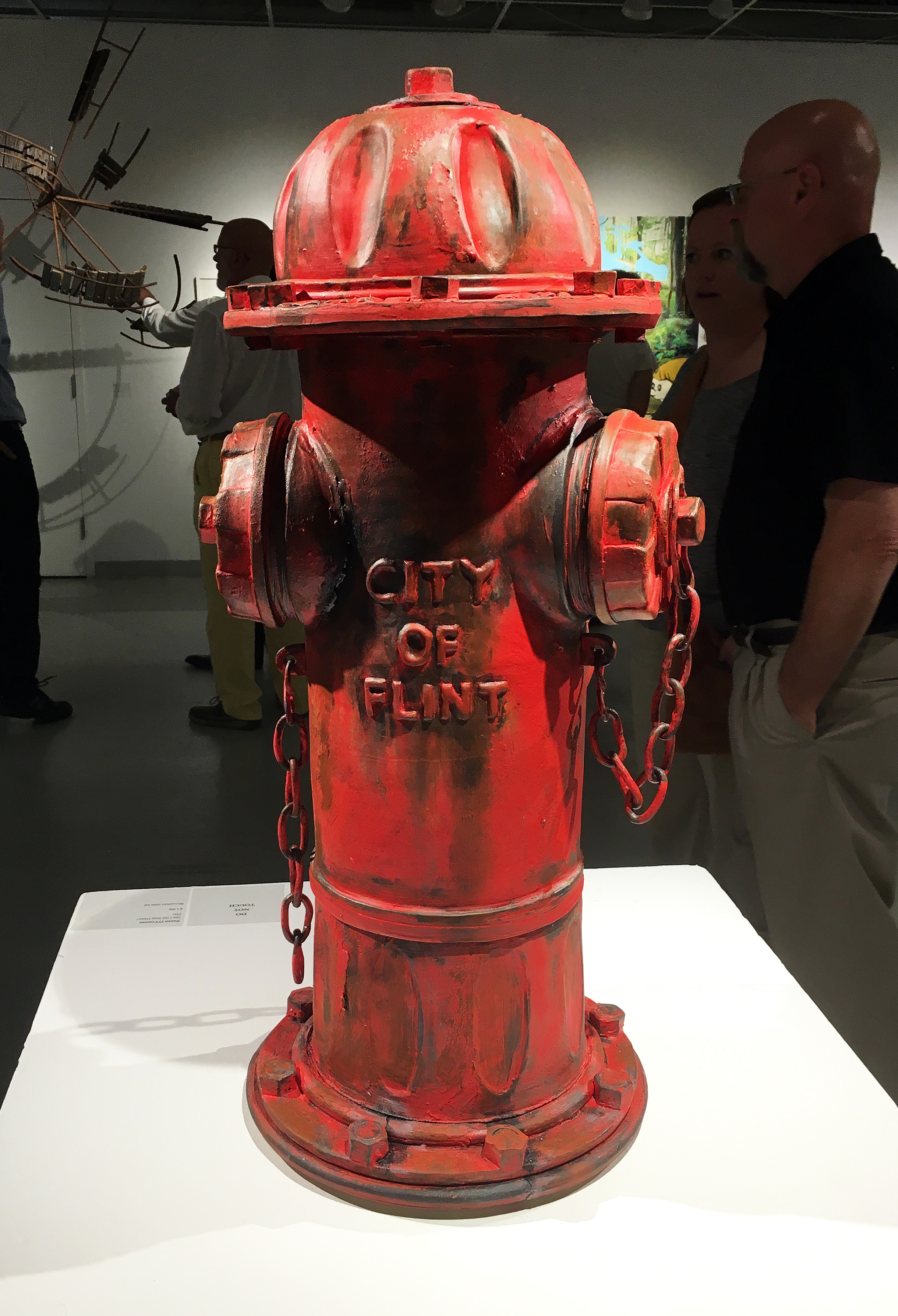
Clay Hydrant

Susan O’Connor, Can I Get Some Water, Clay

Susan O’Connor, who teaches hand-built ceramics at the BBAC, grabs the audience with a pop art object, that also carries a current social message. So, she got me with this Fire Hydrant from Flint, Michigan where the water has been contaminated by a decision leading to elements of lead in the water supply.

This exhibition has many generous prizes totaling $5800 and goes a long way to showcase artists in the Midwest. I will mention here that I usually stay away from covering these large competitive exhibitions, largely because they jury the work from jpegs, which makes the process more of a challenge. In this particular case, I give Mr. Hammonds a lot of credit for getting most of his decisions right. I have heard it many times, that it is the only practical way to conduct such a large undertaking, however when only viewing an image of an artwork, mistakes are made.

The 35th Annual Michigan Fine Arts Competition – June 24 – August 26
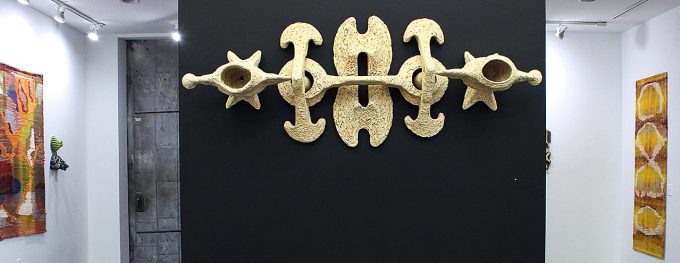
Birmingham Bloomfield Art Center

“ECHOES”: Three Artists Resonate @ Galerie Camille

“ECHOES” at Galerie Camille is a three-person show featuring the work of Robert Mirek, John McLaughlin, and Paula Schubatis . The show demonstrates points of resonance that carom throughout the individual bodies of work, as well as creating a kind of visual conversation between the three artists, who would seem to have little in common, at first glance.

Mirek and McLaughlin are both established artists with long histories in the Detroit Metro scene. Schubatis is an emerging artist and recent graduate from University of Michigan Stamps School of Art and Design, and has been tearing up the Detroit scene lately, with a turn as a Red Bull House of Art resident, and a number of group and solo shows in the area.

EC1

Installation Image, Robert Mirek, Mitosis – All Images Courtesy of Sarah Rose Sharp

Upon entering Gallerie Camille, the viewer is greeted by “Mitosis”—a large-scale wall-hanging sculpture by Mirek, composed of hundreds upon hundreds of tiny wood scraps. These are the remainders from his labor-intensive series of graphic shape sets, which he designs by computer and then cuts from plywood; two series face off against each other on the walls leading into “Mitosis”: the Strand series on the right, and the newer Thread series on the left. Mirek’s works have a feeling of alien archeology, and the interspersing of his work with that of Schubatis is nearly seamless. The two artists inadvertently echo each others’ palettes, and her abstract and lovely wall-hangings and humorous rock-based sculptures look right at home alongside his meticulous vocabulary of symbols and oil paintings that veritably leap off the page in their desire to achieve the greater dimensionality accomplished by his sculptural forms. “Mitosis,” with its many constituent parts, is the perfect centerpiece for the show, which features work that seeks to impose order upon a chaos of objects, symbols, and materials.

EC3

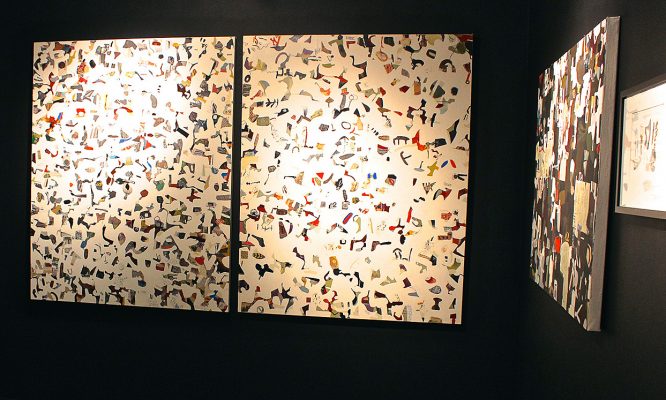
John McLaughlin, Ground Floor (diptych) Painting / Collage

This is evident in McLaughlin’s work, which sits mostly apart from the others, in the deep-set black box gallery. Collage typically implies the layering of images—by contrast, McLaughlin’s mixed media drawings on paper are a colorful motif of stand-alone squiggles, each cut from media materials, which occasionally abut each other, but do not overlap. The effect is something like pouring a colorful jigsaw puzzle out onto a white table; there is a sense of some potential connection or relationship between these shapes, but it is not figurative and not explicit. The whitespace becomes equally as important as the particulates, and the eye caroms around the visual static, looking for imagery—a kind of highly mediated form of cloud-watching. Though his work stands physically and materially apart from Mirek and Schubatis, McLaughlin’s works collectively reinforce the effect created by ECHOES, with swarms of shapes hanging together that effectively echo Mirek’s symbol-clusters in the main gallery.

EC6

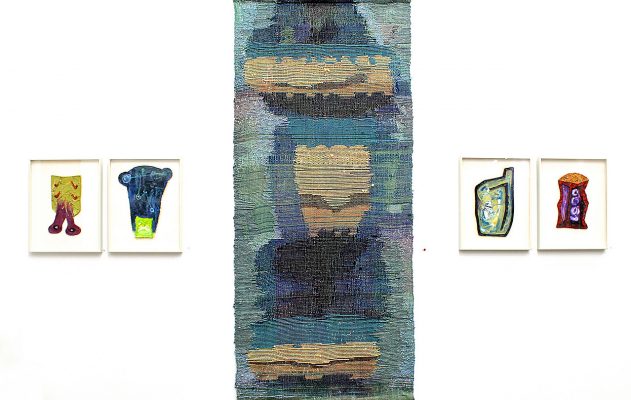
Schubatis, Wall Hanging, flanked by Mirek’s Paintings

Schubatis has drawn her components into an even tighter matrix—that of the woven body. Her weavings have been, at times, highly experimental in her incorporation of odd materials, such as caution tape and other plastic waste, but even in these more conventional wall-hangings, her impeccable sense of balance and bold color choices make for dynamic and achingly lovely compositions. In the center gallery, which is almost entirely work by Schubatis, these are interspersed with sculptural oddities—improvisations on rock forms, embellished with melted candlewax, paint, and bedazzling gemstones. The combination of bold materials, mineral shapes, and paradoxically minimalist finish create a kind of paleo-futuristic effect; these works would be fitting interior decorations for the Starship Enterprise.

EC7

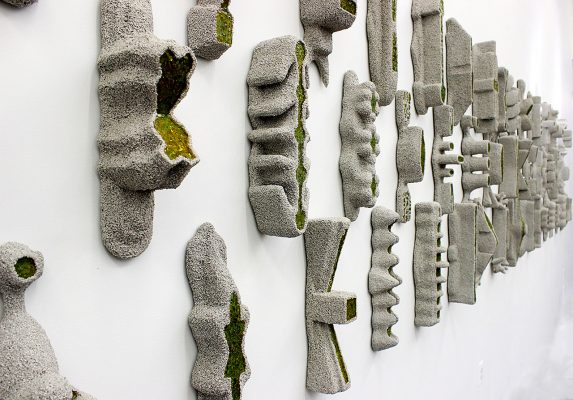
Robert Mirek, Stand Series, detail view

Or perhaps, again, that influence is seeping through from Mirek’s work, which inescapably suggests alien art: mysterious shapes that beg for translation. The Strand series finishes his plywood forms in an exterior of gray pumice punctuated by sharp chartreuse pebbles of window glass. There is an undersea feel to these, like the superstructure of a reef, the rough irregularity of which has given rise to vibrant life. The Thread series reveals more of the underlying woodwork, and give the sense of architectural models for fabulously modern space-buildings and complexes, with the threads tracing out colorful infrastructure—water lines, green spaces, or transit systems (hovercrafts, one imagines). In the small transitional space between main gallery and the back room dominated by Schubatis, her work and Mirek’s mix almost indiscriminately. Here, a wall hanging is flanked by two of Mirek’s standalone wall sculptures, which tonally mimic each other so perfectly that the truth of that happy accident seems stranger than fiction. There, another woven piece by Schubatis provides a calm striation of undulant yellow-on-gold-on-brown forms, which make a harmonious landscape for several pieces from Mirek’s Scorch, series, which seem almost carved out of bone, with the darker backdrop material revealed, upon closer inspection, to be hundreds of tiny drawn and glued elements—replicating just like cells, alluded to in the title of Mirek’s sprawling centerpiece.

Altogether, much to be considered and enjoyed within ECHOES, proving that sometimes the best part of work is the visual echoes that emerge when visions bounce off each other.

Allie McGhee @ N’Namdi Center for Contemporary Art

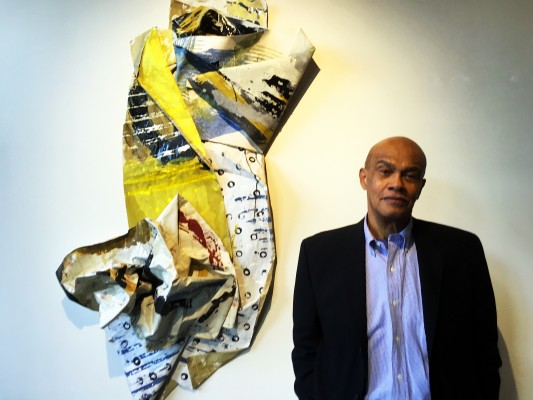
Installation image AM NNamdi

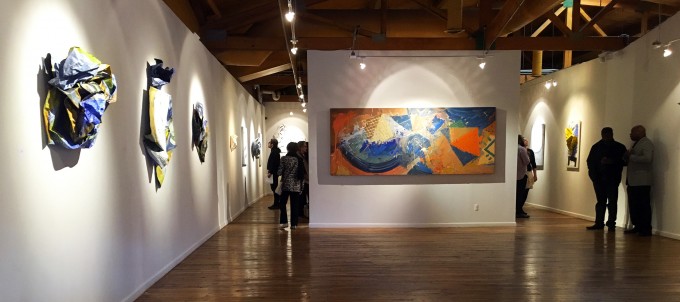
Installation image – Allie McGhee, All Images Courtesy of the Detroit Art Review

The N’Namdi Center for Contemporary Art opened a large exhibition of work, Now & Then,  by the veteran artist Allie McGhee on April 15, 2016. A Detroiter who attended Cass Technical High School and completed his undergraduate work at Eastern Michigan University in 1965, McGhee was born in Charleston, West Virginia. “As an artist I have always been inspired by the diverse rhythms of our environment,” McGhee says. “It has been a great reserve of energy for my work. In my recent works instead of seeing the natural world as a rational observer, I see if from within as if through a telescope or microscope.”

AM Simiar Rhythm MM on paper 2016

Allie McGhee – Similar Rhythm- Mixed Media on paper 2016

For the most part of this exhibition, these works hang on the wall as three-dimensional reliefs, made of paper and mixed media. These delicate creatures of raw substance seem as though they may start out as flat painted material and then folded to form a cumulative formal beauty underscored by a diverse paint surface. McGhee’s emphasis on discovered and spontaneous correlations that are twisted, crushed and crumpled, remind this writer of John Chamberlain, who worked in a similar fashion but mostly with metal and automobile parts. Given the time period of Allie McGhee’s formative years, the obvious influence here is Abstract Expressionism with shades of Willem de Kooning and Franz Kline that, despite a seemingly spontaneous appearance, maintains a balance of chaos and control.

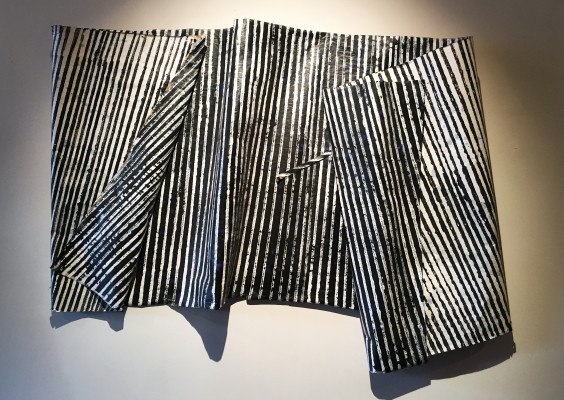
Allie McGhee, Rainforest Mixed Media on Paper 2012

Allie McGhee, Rainforest, Mixed Media on Paper 2012

In his biography, McGhee says he favors using sticks to apply paint rather than brushes. Rejecting the brush, he pulls and scrapes the paint across his material, whether it is canvas or paper. The action of the stick allows McGhee’s hands to interact with the paint and the surface in a visceral way, where the thin paint spatters as he arranges his lathe-like constructions. In Rainforest, there are a variety of parallel bars that play against the light and abstract forms caused by the folds. These are forms we see in nature and our urban environment, making them familiar, if not inviting. He reveals his ability to make something interesting out of the mundane.

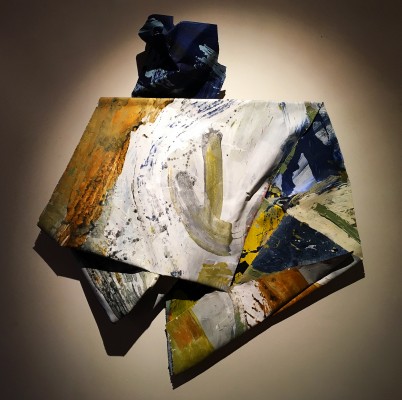
Allie McGhee, Visit, Mixed Media on Fiberglass 2015

Allie McGhee, Visit, Mixed Media on Fiberglass 2015

Not all of the work is on paper. Visit is a piece on folded canvas that has been coated in fiberglass and painted with loose strokes of paint. McGhee has said his work is informed by science, and refers to imagery that is close up, like through a lens, but it’s easy to see a shallow grid and re-jostled composition that works against formality. These works are a change from the flat abstractions of ten years ago with ovals and space-like compositions. The new works are flat ideas that have taken on the third dimension of physical depth and engage the viewer with draped compositions of muted color and a play on light.


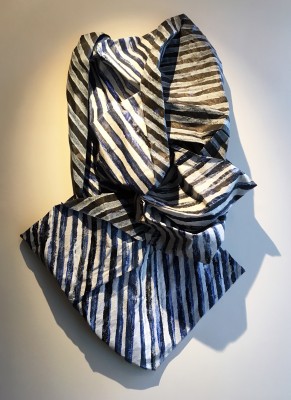
Allie McGhee, Sacred Wrap, Mixed Media, on paper 2009

Allie McGhee, Sacred Wrap, Mixed Media, on paper 2009


Like a worship robe that hangs waiting to be used, Sacred Wrap, could be a garment waiting to be worn for a special ceremony. The subtleties in white, blue and black are mixed media material on paper that come off the wall enough to cast deep and dramatic shadows. Whether inspired by science or the music of Eric Dolphy, Allie McGhee brings a nostalgic feel to these texturally rich reliefs that feel both powerful and lightly sensitive.

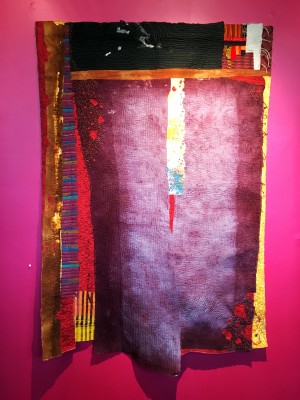
Carole Harris, Fiber Construction

Carole Harris, Melody Lingers, Fiber Construction


The N’Namdi Center for Contemporary Art opened a parallel exhibition by Carole Harris, a fiber artist who uses traditional quilting techniques to make abstract expressionistic compositions. “My work relies on improvisation,” Harris says. “I am fascinated by the rhythms and energy created when I cut and piece multiple patterns. I let the fabric and color lead me on the journey.”

For visual artists who quilt, Harris’s work transcends the traditional expectations we think of when mentioning quilting. In a reproduction, we see an abstract painting, dynamic in the use of color, line, shape and form. It’s only on closer observation that one realizes these are compositions executed using embroidery, stitchery and multiple patterns of cotton, silks and hand-dyed fabric.

N’Namdi Center for Contemporary Art     Allie McGhee   Now & Then   April 15 – June 25, 2016


Page 5 of 5

Powered by WordPress & Theme by Anders Norén