Critical art reviews of Detroit galleries and museums weekly

Author: Ron Scott Page 2 of 35

Sharon Que @ MATE’RIA Gallery

Sharon Que, Installation image. All images courtesy of DAR

Born Sharon Querciograssa, Sharon Que opened a new exhibition at the MATE’RIA Gallery on June 8, 2024, with constructed reliefs that rest on the wall, keeping the viewer engaged through exotic material, illustrated line drawings, and intriguing compositions.  Que refreshingly sets her oeuvre apart from mainstream American sculpture.  Her eclectic collection of disparate objects first confronts the viewer with an aesthetic experience, followed by a precise, calculated, measured, and intellectually investigated, sometimes having scientific connotations.

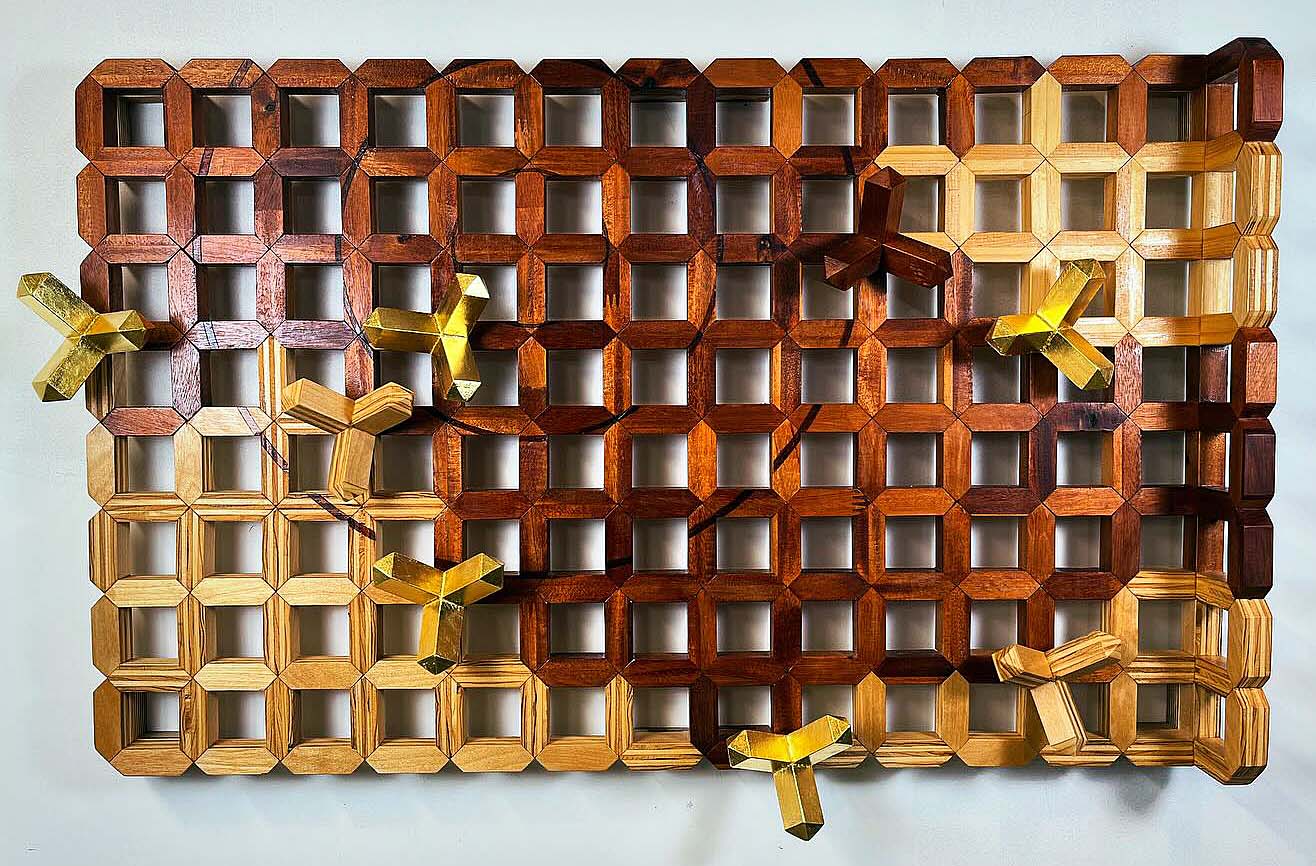
Sharon Que, Pollination, Mahogany, Plywood, Pine, Gold Leaf 20x31x3.75″

In Pollination, the wooden grid pieces are divided into two fields; squares of solid stained mahogany are juxtaposed against laminated squares of like-sized pine, punctuated with a spill of protruding star-like objects painted and covered with gold leaf. We are left be-dazzled in wonder, in awe of the precision with which the squares are made and arranged.

In an essay by Mary Ann Wilkinson, the former curator at the Detroit Institute of Arts, she says, “Que has been making objects for more than thirty years.  She credits her awakening as an artist as a consequence of her eye-opening travels to Italy, Greece, and Turkey in the mid-1980s.  Que’s deft combinations of physical elements often lead viewers to overlook the subtle emotional undercurrent of her work.  Often, the mood seems to be melancholy, evoked by dark coloration, a sense of being anchored or bound, or a suggestion of emotional ambivalence.”

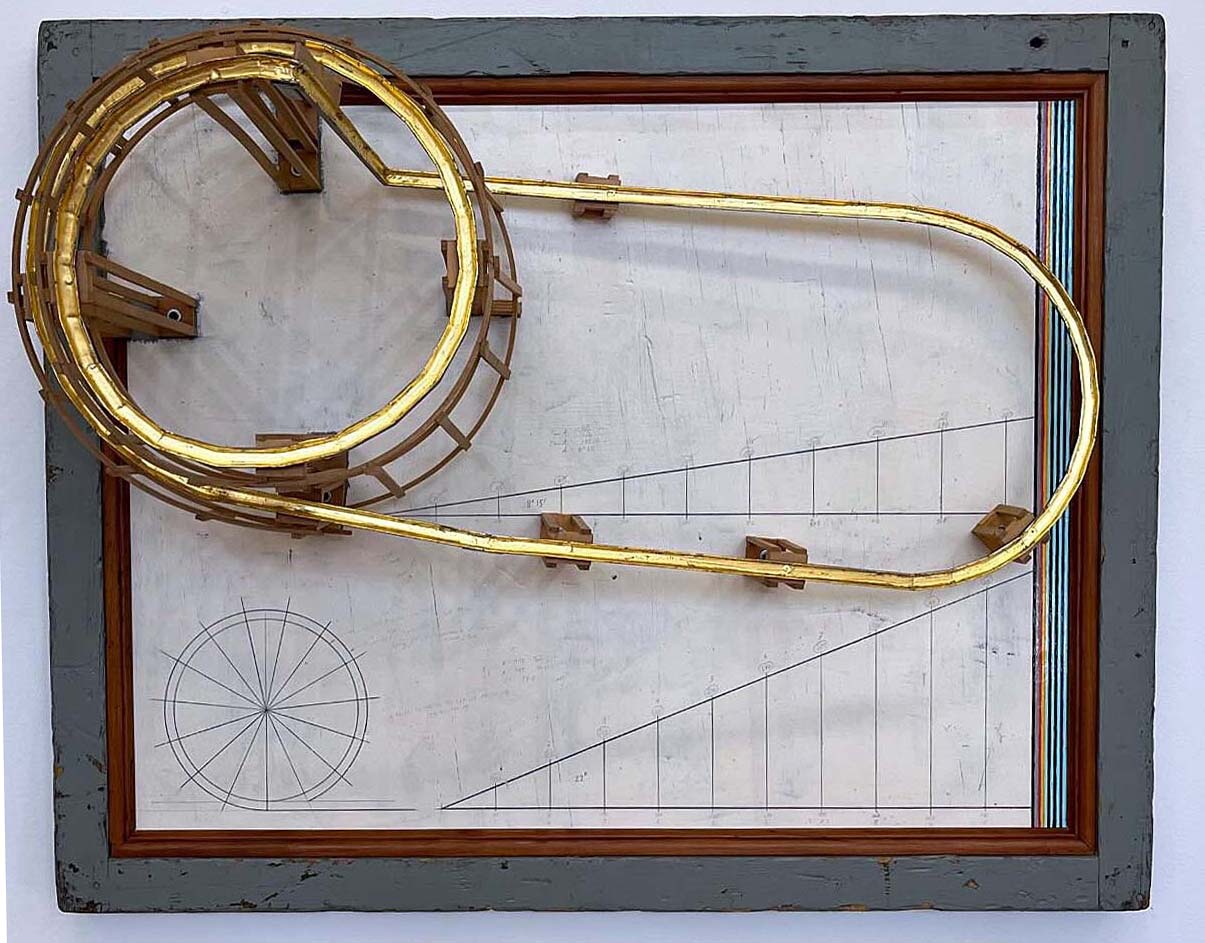
Sharon Que, Roller Coaster, Steel, Wood, Gold Leaf, Paint 29x36x15″ 2024

In Roller Coaster, Que finds a used wooden frame, creates an imaginary metal circular structure, and places it in the upper half of the composition, where it rests and comes forward.  The simple line drawing acts as a side view, which we might perceive as an elevation view.

In her statement, she says, “There is a scaffolding system that exists for each of my sculpture exhibitions made up of the interactions with people, nature, music, and art that I have come across accidentally or made great efforts to experience.  My imagery can take the form of data visualization algorithms.  Algorithmic operations describe motion and growth; data visualization aims to reduce the clutter to make complex data more accessible.”

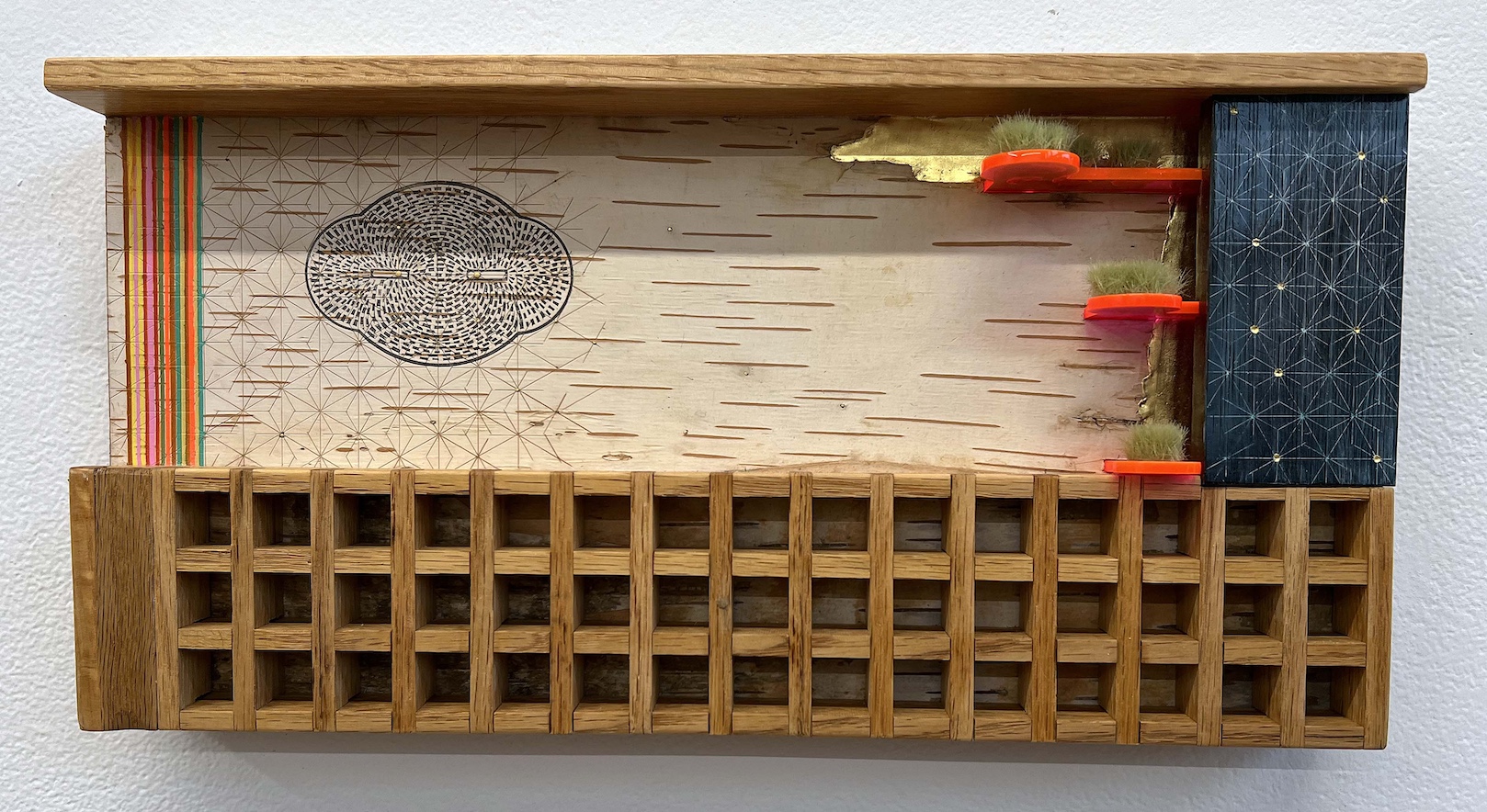
Sharon Que, I’ll Watch Over You, Wood, Birch Bark, Paint, Gold Leaf, 2024

Those familiar with Sharon Que’s work will notice motifs that often reoccur.  In “I’ll Watch Over You,”  the squares of wood appear with a drawing of a previous oval sculpture on the left (Dear Mr. Fantasy), and the repetition of a line matrix forms a field on the right side.  In addition, she is repeatedly drawn to using the same tree bark as a background (Birch) while finding comfort in a band of colored strips next to her geometric field of circular shapes.

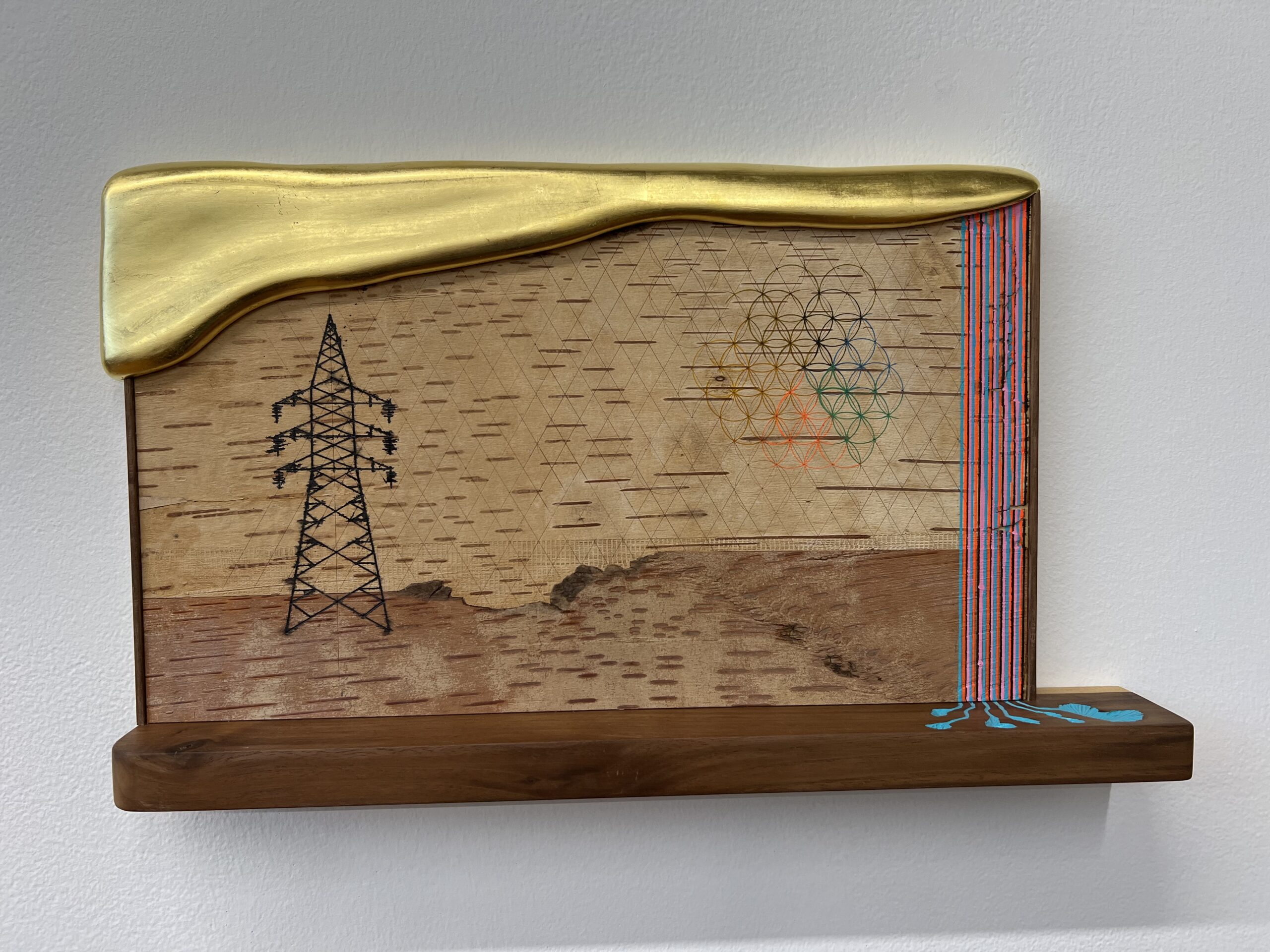
Sharon Que, That Long Lonely Highway, 9.5×16.5X2.25″ Wood, Birch Bark, Paint, Gold Leaf, 2024

In an interview with Sharon in 2014, I asked her about influences in her work, and she responded by talking about walks in the woods and at the beach; she said, “I was working simultaneously with magnetic sand from Lake Michigan and a two-dimensional image of the field of force around a magnet.  In retrospect, it seems obvious to put the two together, but the obvious sometimes evades me.”  In response to a question about her family, she says, “Some of my ancestry goes back to Emilia Romagna in Italy, where Ferrari, Maserati, and Lamborghini all originated.  Before that, in ancient times, this region was inhabited by Etruscans, the undisputed masters of bronze casting.”

Simone DeSousa, the gallery owner, says that Sharon Que approaches her work from a triad of content, material, and technique, looking for synergy among the three.  She uses recurring images from nature and geometry to reveal her own “coded inner life.

My personal experience with Sharon started when she was a middle school student at Shelby Jr. High School.  She was taking my art class, and there was a brief introduction to ceramics.  It was her turn after I did a rather crude demonstration of using the electric potter’s wheel.  She dropped a large clump of stoneware down, centered the clay without effort, and pulled a beautiful, perfect cylinder with ease.  At that moment, it was clear the teacher became the student.

It is hard to place Que’s work in a historical context.  Still, in some ways, her work reminds me of the work of Joseph Cornell, a collector of objects with ambiguous meanings and mysterious connections.  In both Que and Cornell, their work becomes a metaphor for their lives.

Transcending a simple literal reading, Que’s work explores the mysterious link between the known and the unknown.  In each piece, she dips into her trove of life experience and formulates an expression that is exclusively hers, a very personal sensibility, and original.


Sharon Que earned a BFA from the University of Michigan in 1986. Her works are part of the permanent collection at the Detroit Institute of Arts and the public sculpture on the campus of Oakland University. She has also exhibited in Venice, Italy, San Francisco, and Chicago and extensively in the metro Detroit area.

Sharon Que’s Ice Cream Castle exhibition will be on view at the MATE’RIA Gallery through August 10, 2024.

[adrotate group=”2″]

Benjamin Pritchard @ David Klein Gallery

Installation image of three paintings DKG 4, 2024

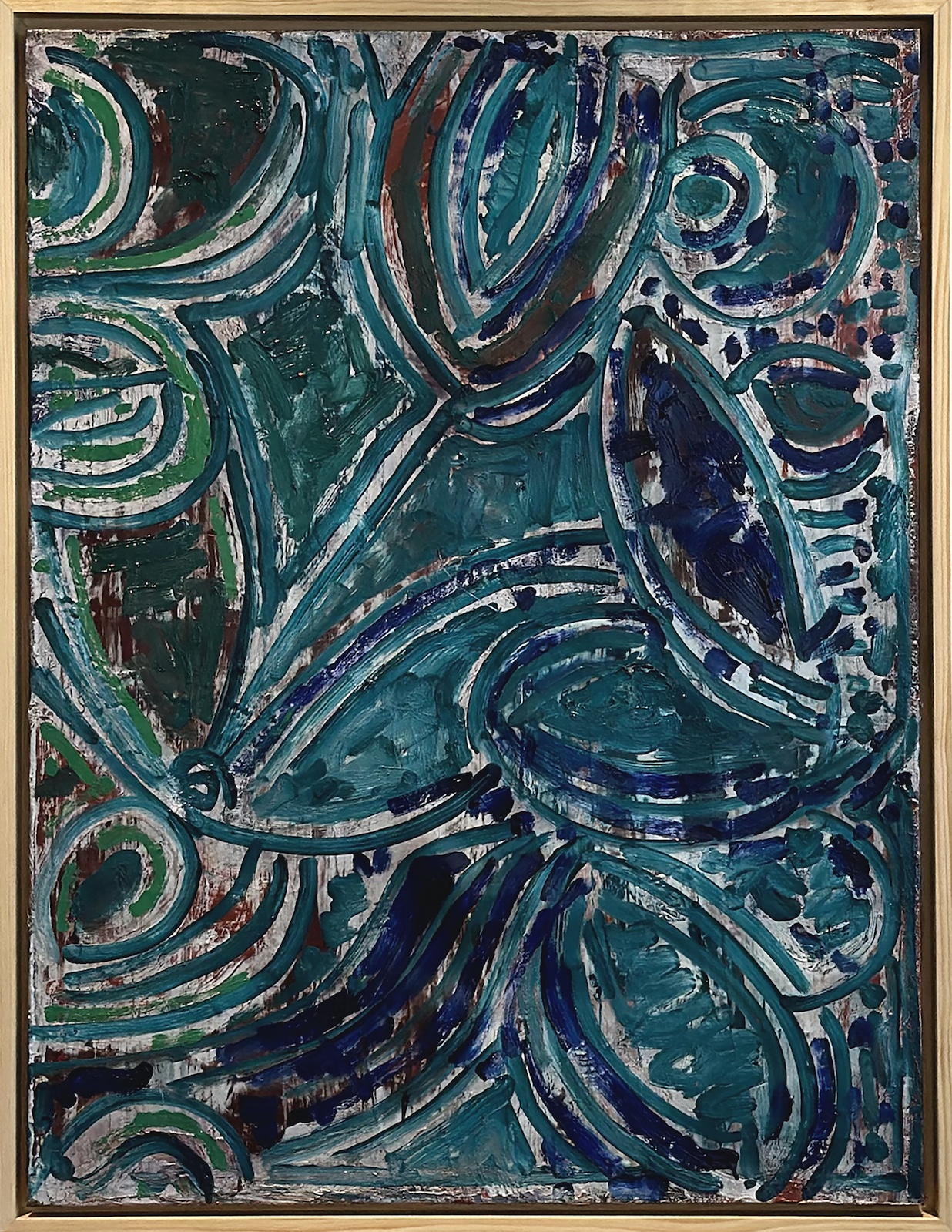
Artist Benjamin Pritchard opened a solo exhibition, Nature Worship, comprised of paintings at the David Klein Gallery on March 23, that will run through May 4, 2024. The thick oil paint in these mostly monochromatic compositions with heavy line work, either dark or light backgrounds, are Expressionistic Abstractions with attention paid to the structure by working in multiple layers of color that seek to find the balance and substance in each canvas.

Prichard grew up in Franklin, Michigan, and set voyage to grad school in London, earning his MFA from the Royal Academy of Arts to time spent on the West Coast, ending up in Brooklyn, N.Y., only to return home to a small studio space that seemed to nurture and find answers.

He says, “The irony is that I left for so long to find a solution or an answer… And then, of course, I come back, and here it is. It’s always been right here.”

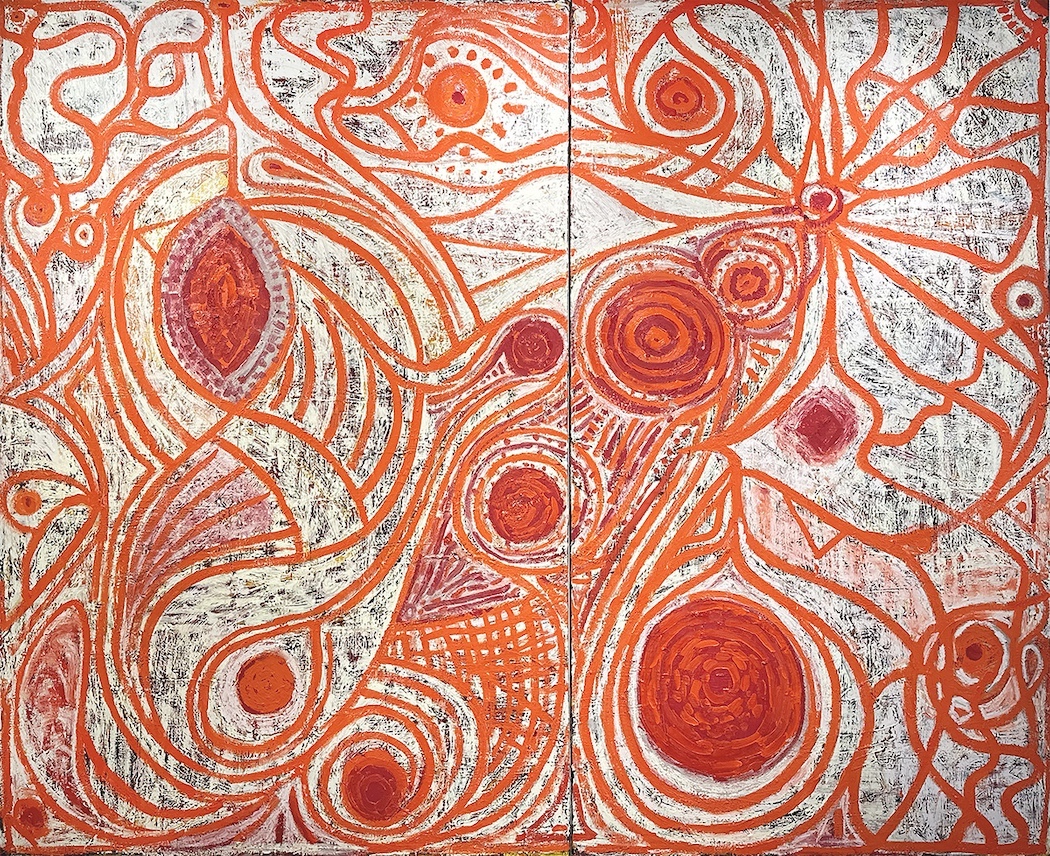
Benjamin Prichard, Light Years, 108×132″, Oil on Canvas, All images courtesy of DKG

It is easy to say the painting that dominates the exhibition is Light Years. This large (108 x 132”) diptych does so with its scale. The orange and red circular organic motifs place themselves throughout this roadmap of lines and shapes. The feel of these designs can be described as a field of organic Petroglyphs (not figurative but more plant-like) that meander space informally. If only all these paintings were larger in scale, the power and influence would follow.

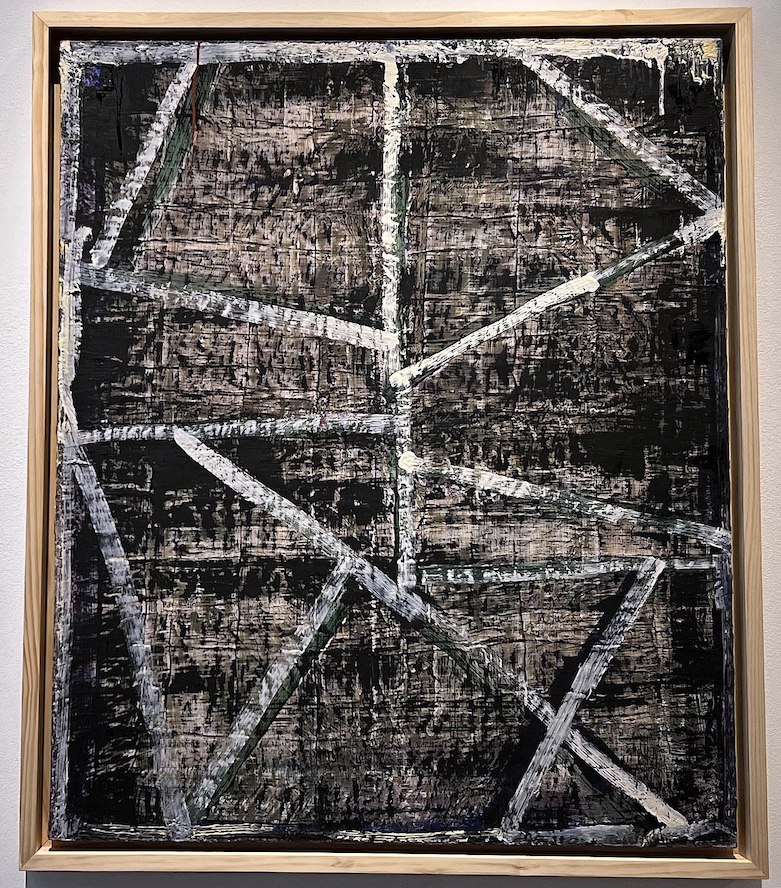
Benjamin Pritchard, Structure/Surface, 36×30″, Oil on Canvas.

One of the most successful smaller paintings (36×30”) is Structure/Surface, where Prichard divides the rectangle with a white line. Here, the artist lays down an attractive grid over a black horizontal field of brush strokes.

Benjamin Pritchard, Arboreal, 48×36″, Oil on Canvas

The painting Arboreal (48×36″) pulls on the heartstrings from the sky in The Starry Night by Van Gogh, using an Ellipse shape instead of circles. However, color and abstract expressionism are present in both. The spirit of Van Gogh lives in the sky, while the spirit in Arboreal lives in the trees.

In a statement from New York Artist Equity, he says, “I like to think that the direct, honest daily practice of painting over time reflects both the cares and concerns of the deep self and an optimistic projection regarding concerns of the world. I believe that being with work over long periods reveals humanistic qualities in relation to the observer and is added to by the viewer. In this way, art functions as both psychic nourishment and as a mirror to the self and the world. I think of painting as a quasi-religious activity involving the concept of the sacred. What this actually means and how it is represented is revealed piece by piece in the work. In this way, I think that the subject of painting exists outside of language and is more involved with the unsayable experiential aspects of life and the world.”

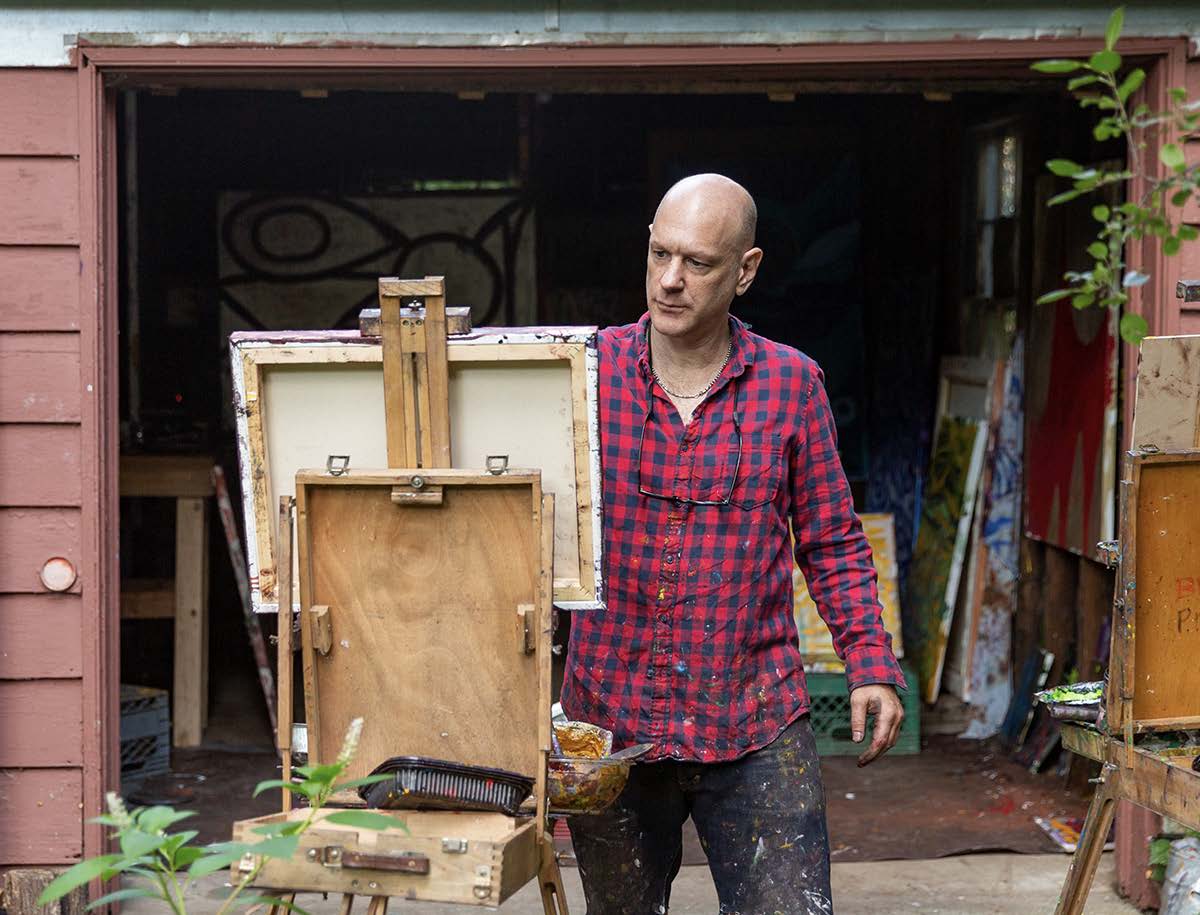
Artist Benjamin Pritchard at the home studio

Benjamin Pritchard is a Brooklyn-based artist originally from Detroit. He has had solo exhibitions at Daniel Weinberg Gallery (Los Angeles, CA), John Davis Gallery (Hudson, NY), and Life on Mars (Brooklyn, NY). The artist earned a BFA from the School of the Art Institute of Chicago and an MFA from the Royal Academy of Arts, London. He attended the New York Studio School from 1994-1996. Ben Pritchard lives and works in Detroit and Brooklyn.

Benjamin Prichard’s Nature Worship at the David Klein Gallery on March 23 will run through May 4, 2024.

[adrotate group=”2″]

Islands Inlands: James Collins @ Matéria Core City

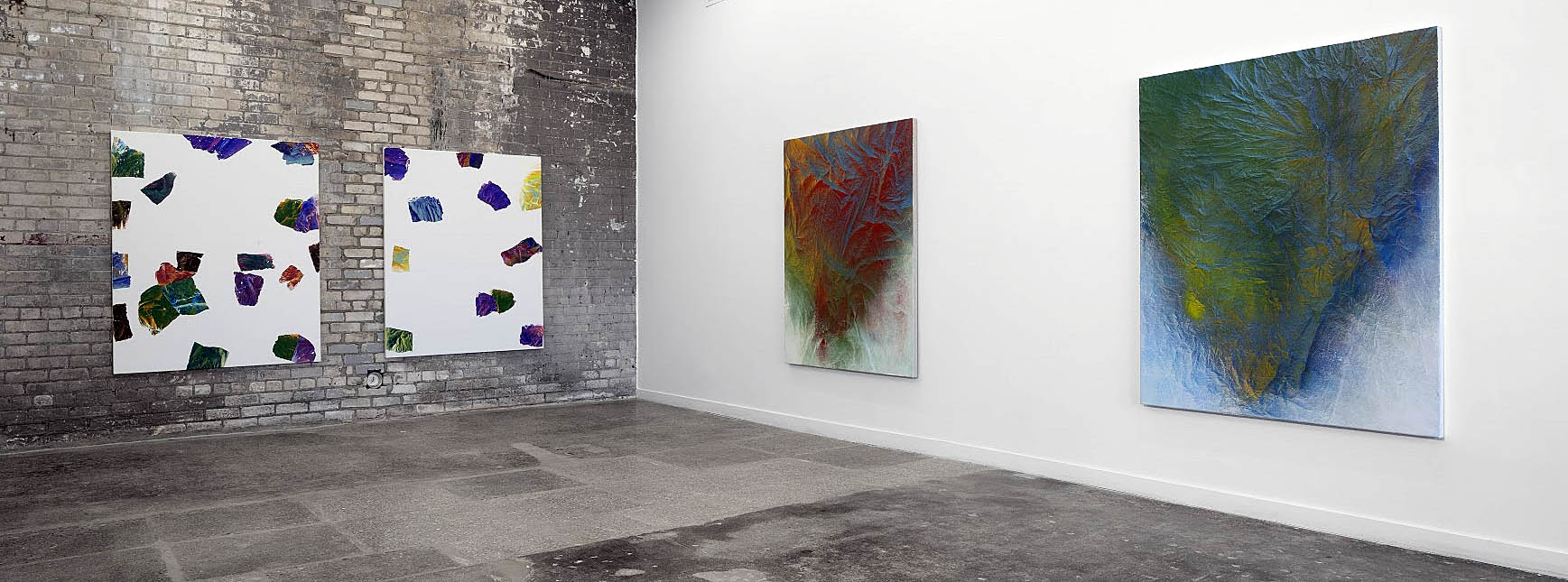
Islands Inlands: James Collins at Matéria Core City previously Simone DeSousa

The series of paintings on display at Matéria Core City embodies the most recent explorations of Detroit-based artist James Collins. Since the onset of his career in the late 1990s, Collins has been working with the harmonies and disharmonies of oil and acrylic paint on canvas. His dedication to the study of these materials has resulted in an array of abstract compositions that align his work with minimalist philosophy from the 1960s, bringing it into the present day.

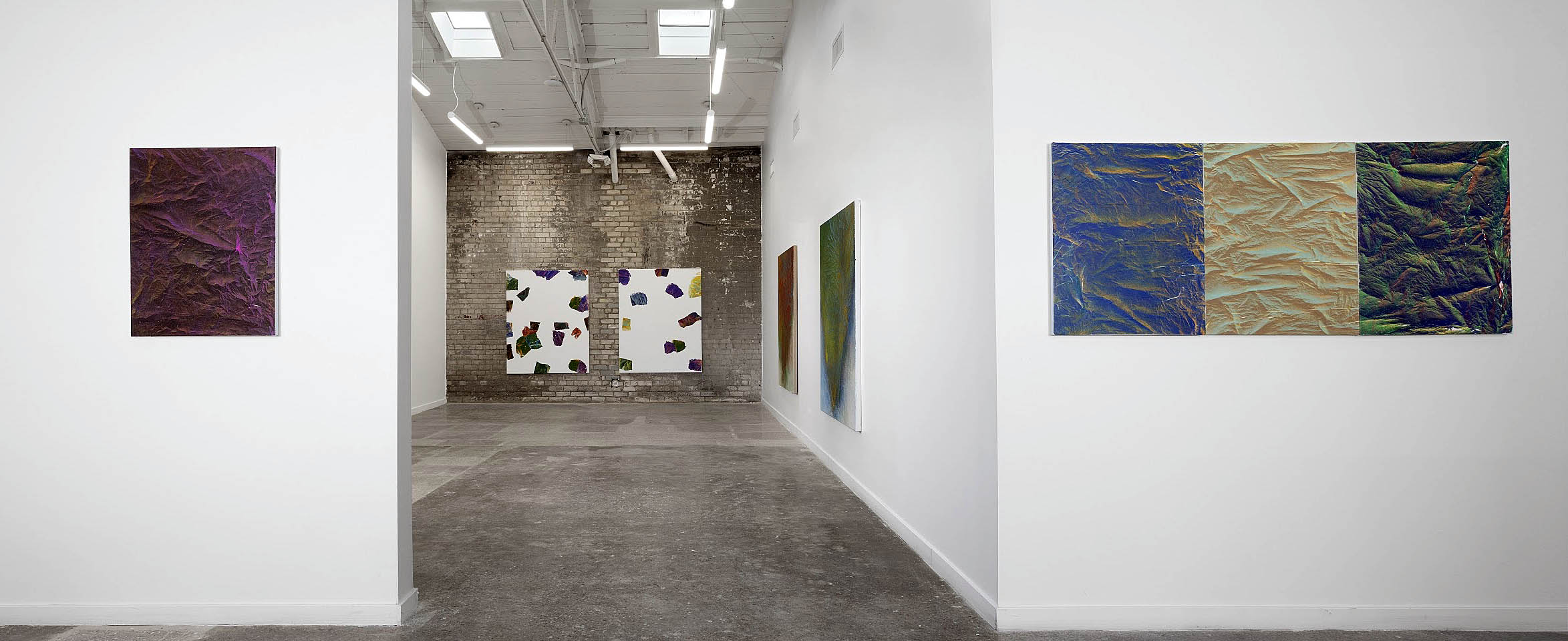
James Collins, installation of Islands Inlands at Matéria Core City, 2023,  All photos courtesy of Matéria Core City.

Minimalism emerged as a creative movement in New York City as a reaction to the traditional expectations of artists to be messengers of narrative or conduits of expressive thought. Many artists of the time became bored of methods used in abstract expressionism and other preexisting movements. Setting out to challenge the concept of romanticism in art, artists like Donald Judd, Agnes Martin, John Cage, and Meis van der Rohe simultaneously worked to explore material abstraction and the reduction of meaning in creative production. This resulted in the blurring of boundaries between painting, sculpture, architecture, writing, and music that became profoundly revolutionary.

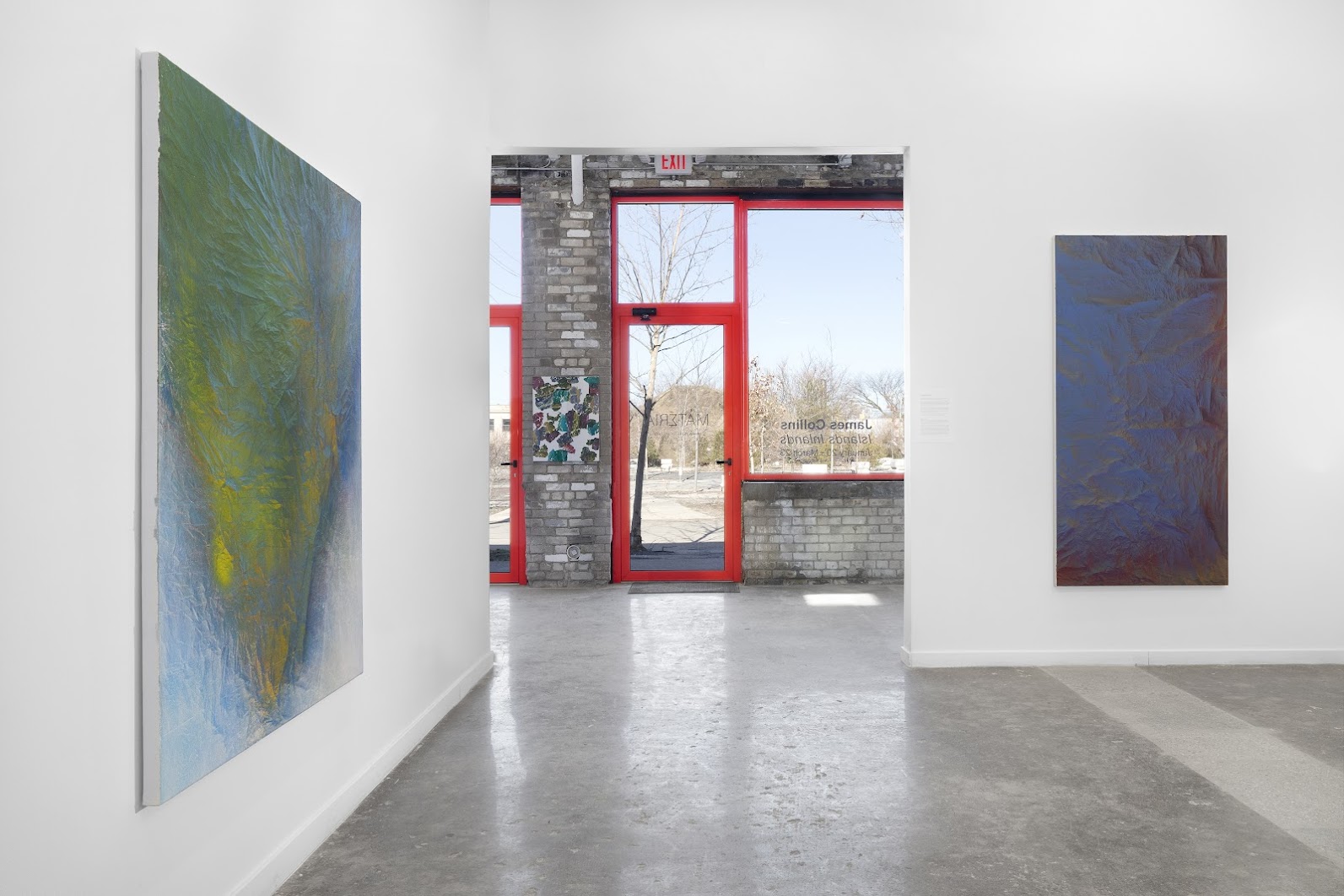
James Collins, installation of Islands Inlands at Matéria Core City, 2023

Frank Stella, one of Minimalism’s founding painters, was famous for saying “what you see is what you see,” and in this statement, summarized the movement’s embrace of the literal properties of any object presented as art. Size, form and the work’s relationship to its surrounding environment held precedence over symbolism and emotion. Artists used prefabricated forms and geometric shapes to reduce the influence of the artist’s hand and promote an exploration of the form or process as subjects in themselves.

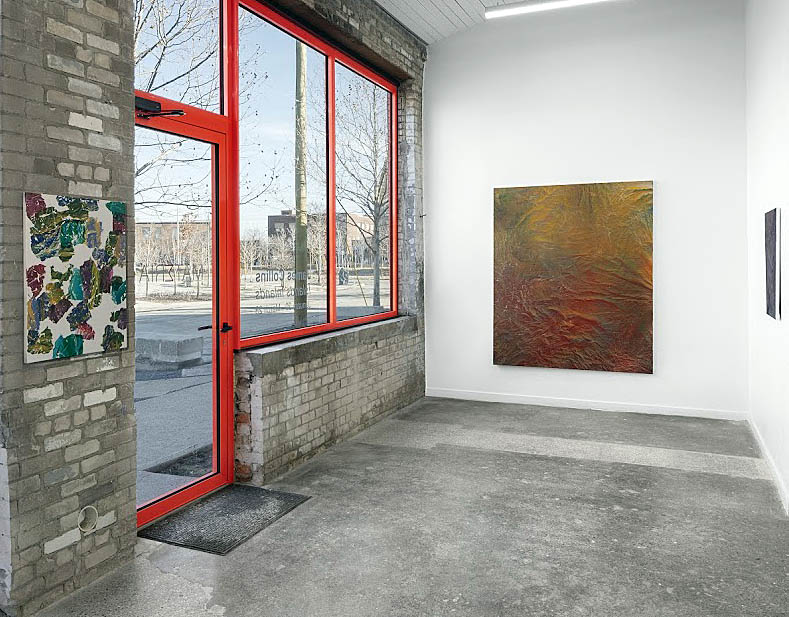
James Collins, installation of Islands Inlands at Matéria Core City, 2023

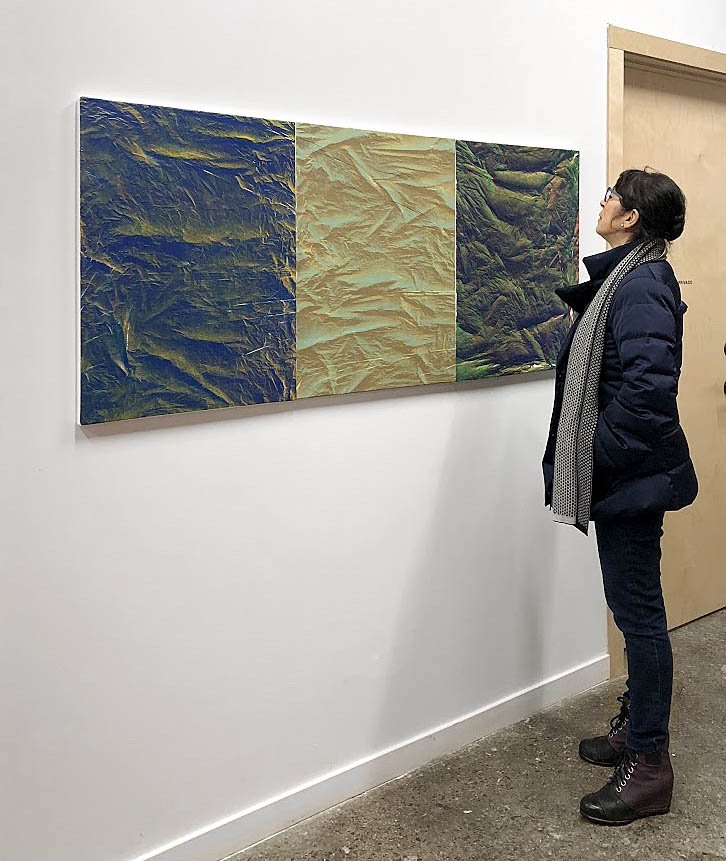
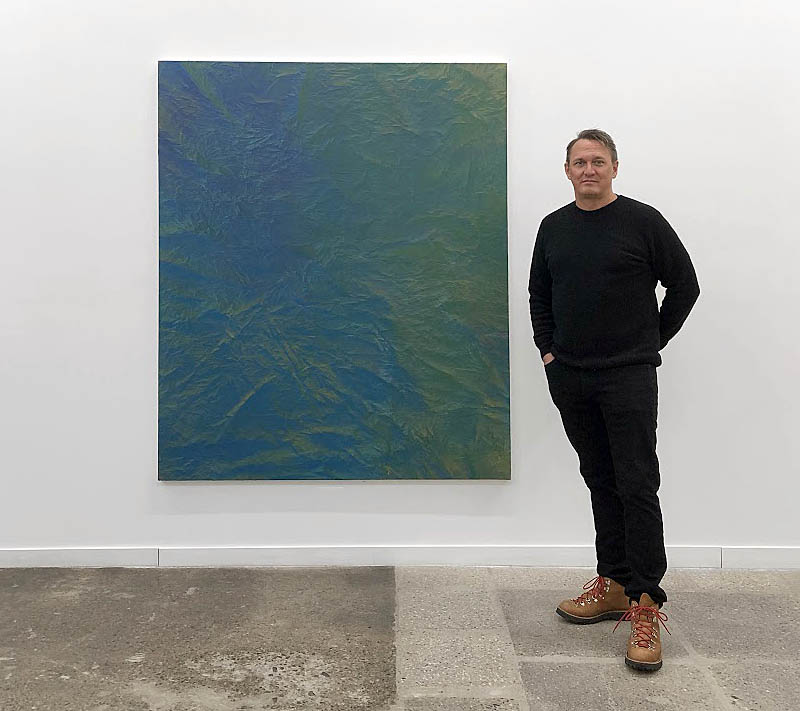
Naturally as a painter, the presence of the rectangle is prominent in the artist’s practice, but in addition to this geometric form that mirrors the surrounding architecture, James Collins’ “employment of the process as content” sustains traditional minimalist characteristics. The exhibition text underlines this sentiment through descriptions of the household items used to produce these images that resemble detailed aerial views of natural landscapes. However, despite us learning about what he used to make the paintings, the details of how he used them remains a mystery. Viewers have the opportunity to engage in a phenomenological experience that challenges perception through direct interaction with the work. From afar, many of them seem to be photographic prints only to reveal intricate applications of paint upon closer analysis.

James Collins, installation of Islands Inlands at Matéria Core City, 2023

Illusionism, dating back to ancient times, is an artistic tradition that attempts to mimic three- dimensional forms on two-dimensional surfaces. Artists of this practice have used color and perspective to mimic reality to such a degree that it could deceive any eye that sees it. In fact, there is an old myth from the elder Pliney in 464 BCE Greece that tells a story of the artist Zeuxis painted grapes so realistic that the birds attempted to eat them right off the wall. The occupancy of illusionism in these twelve paintings by Collins is carried forward as an effect achieved through the artist’s exploratory approach to the medium of paint. Texture is used to suggest space on these flat surfaces the way line was used to imply depth in his previous works. What is interesting about the body of work is its tendency to oscillate between an illusionist and minimalist approach, both of which are inherently opposite of one another. The sophisticated use of color in them further stimulates our tendencies to make sense of abstract
forms based on optical likeness, but in the end, time spent with the work becomes a moment of visual play that forgoes definition due to its high degree of investment in abstraction.

Photograph of the artist with his painting, 2023, photo: Matéria Core City

Each painting in Islands Inlands utilizes patterns of sharp lines that mimic the visual qualities of arteries found in nature. Blood vessels, root systems, and canyons become visible through contrasts in color and tone, and these two-dimensional simulations are achieved through the delicate chromatic gradients that render shadows into these micro or macro pathways. Small hints to inspire this read occur in titles like Here Come the Warm Jets, Points Beyond, Untitled (arquipelago #1) and Untitled (arquipelago #2). A denial of external references becomes present, however, through the majority of untitled works in the show, and it is again confirmed through the same textures having seemingly exploded into fragments on a few white canvases. The reduction of subjectivity is another marker of minimalist thought that emerges not only in limited visual elements but also in the sparseness of information provided to guide translation. Like many creative approaches in this postmodern era of art, minimalism continues to be investigated decades after its debut. Perhaps the reason it continues to be relevant amongst the wide scope of methodologies is its ability to provide an experience of open interpretation. It can be rewarding to locate meaning in such abstraction and the ambiguous nature of these minimalist compositions allow for a range of meaning as broad as its diverse audience.

James Collins, installation of Islands Inlands at Matéria Core City, 2023.

The exhibition will be on view at Matéria Core City until March 23rd.
Learn more about the gallery here:  https://www.materia-art.com

[adrotate group=”2″]

DIA opens a new exhibition: Regeneration: Black Cinema 1898-1971

Regeneration: Black Cinema 1898 -1971 features nearly 200 historical items – including photographs, film clips, costumes, props, and posters.
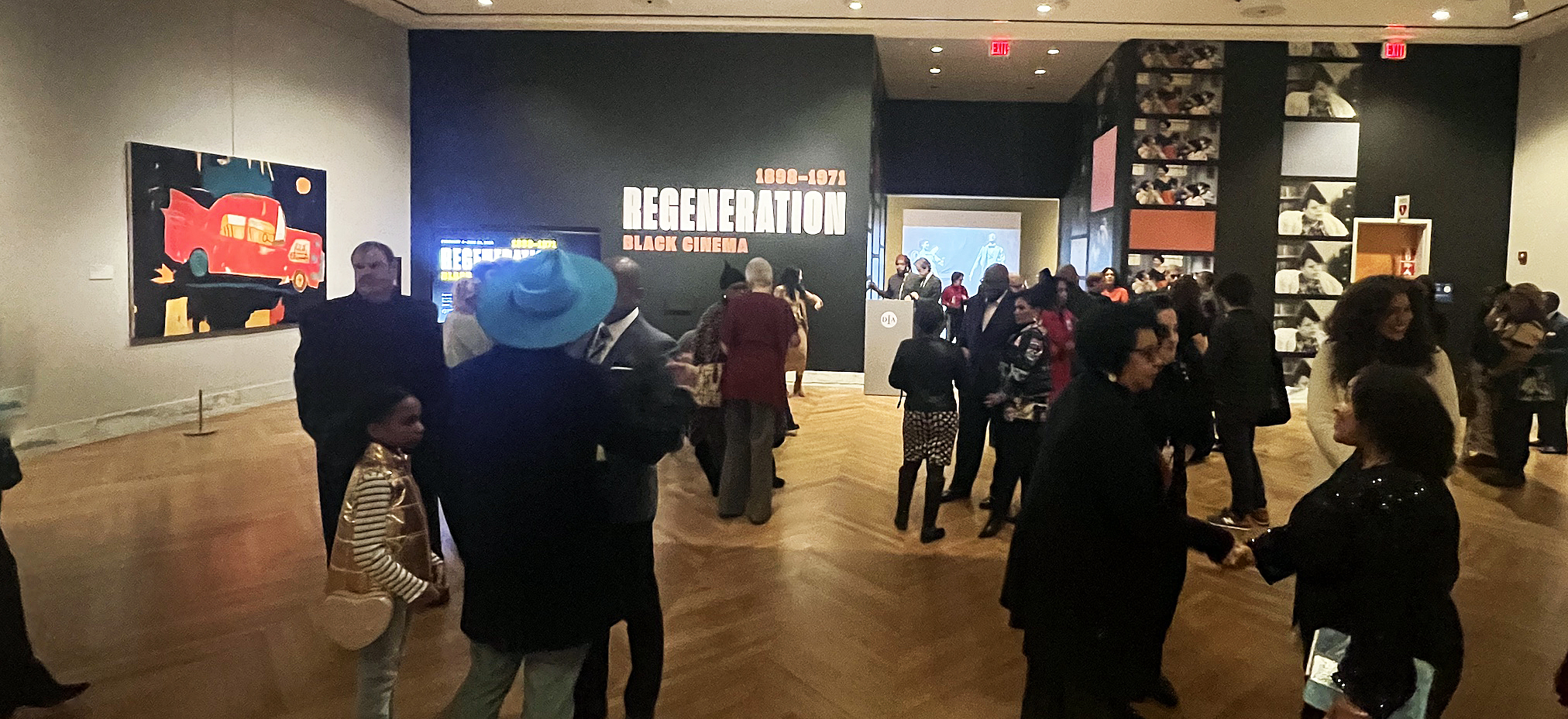
Installation image at the entrance to the exhibit. Image courtesy of DAR. All other images courtesy of the Detroit Institute of Arts.

The Detroit Institute of Arts (DIA) opened a new exhibition, Regeneration: Black Cinema 1898-1971, a landmark exhibition exploring the profoundly influential yet often overlooked history and impact of Blacks in American film from cinema’s infancy, as the Hollywood industry matured and the years following the Civil Rights Movement. The exhibition, originally organized by the Academy Museum of Motion Pictures, will also include a new, unique film series in partnership with the Detroit Film Theatre.

“We are honored to present Regeneration, a powerful, inspiring, and important exhibition that examines the rich and often untold history of Blacks in American cinema,” said DIA Director Salvador Salort-Pons. “The exhibition explores the critical roles played by pioneering Black actors, filmmakers, and advocates to shape and influence U.S. cinema and culture in the face of enduring racism and discrimination.”
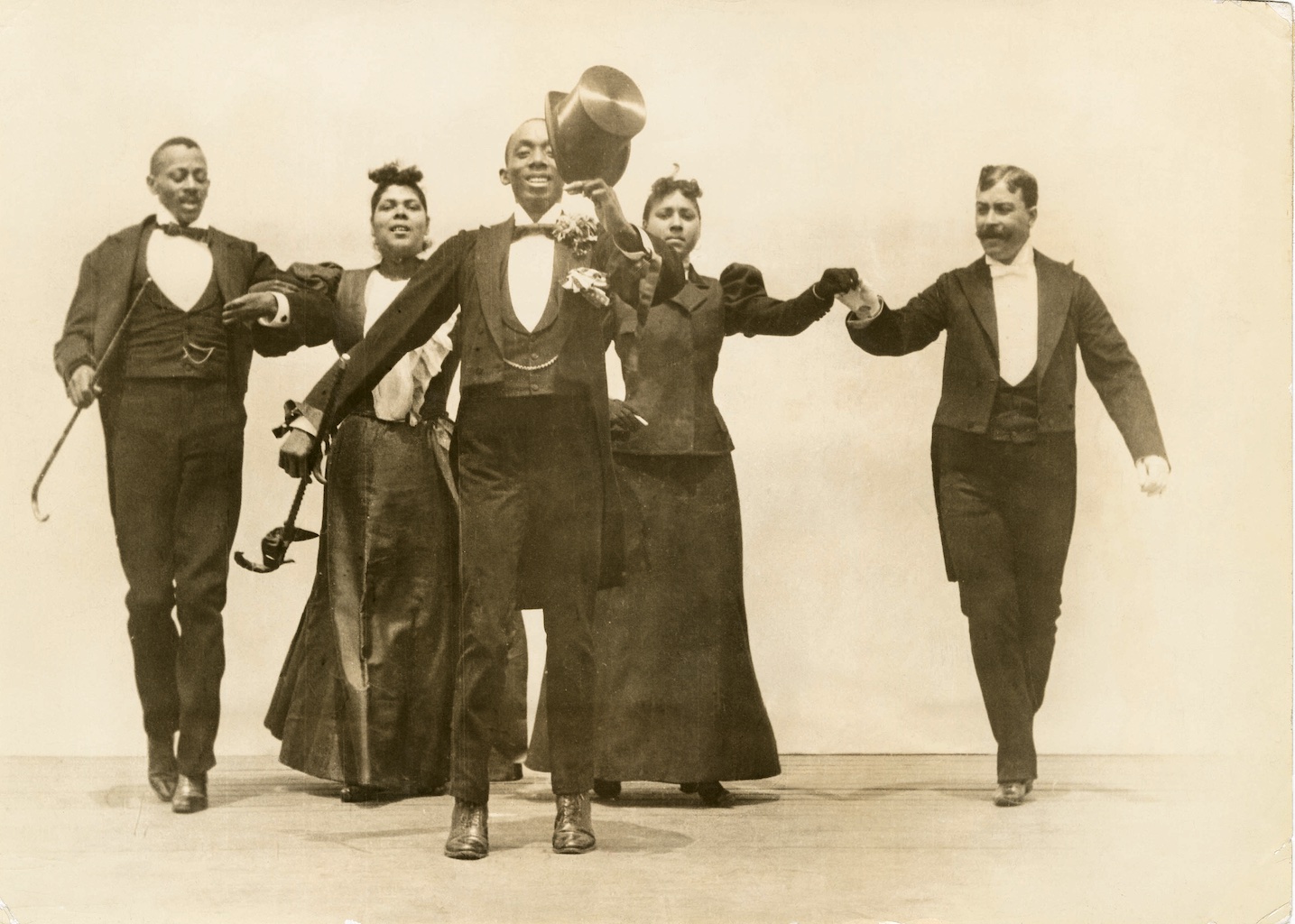
Dancers Performing the Cake Walk, 1887. Gelatin Silver Print. Culver Pictures. Schomburg Center for Research in Black Culture. Photographs & Print Division. The New York Public Library.

The exhibition opens with early cinema and explores moments of progress as other forms emerged in the early 1900s despite the prevalence of racism that permeated the culture. Many Black artists appeared in blackface and played roles subservient to their skills and interests. Performers like Bert Williams and Sam Lucas found work on stage that did not represent their full humanity in the roles cast would depend on adapting to racist tropes. The exhibition includes Newsreels.  Home movies, excerpts from narrative films, documentaries, and a selection of fully restored, rarely-seen films amplify African American contributions to the history of cinema in the United States.
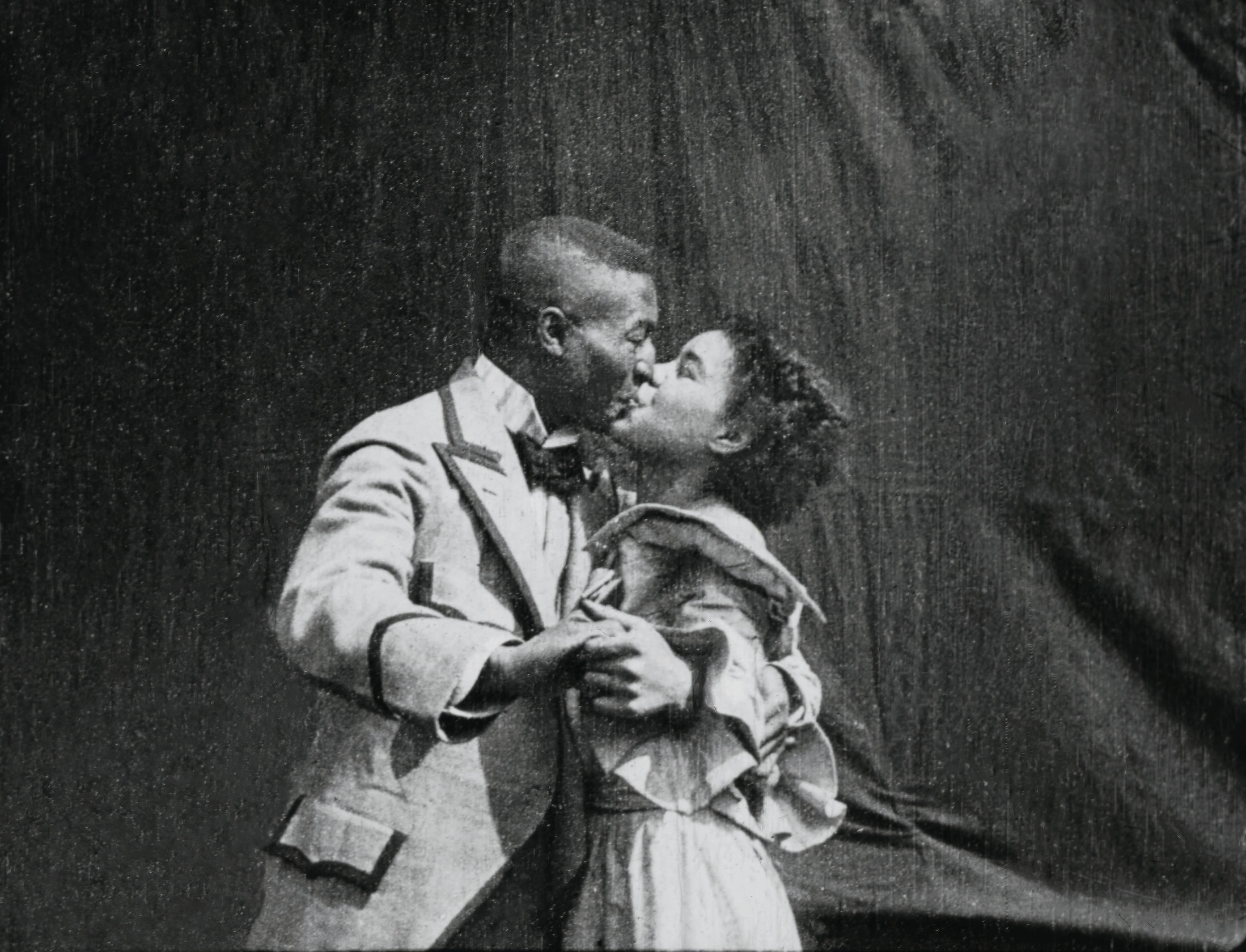
Excerpt from Something Good, Negro Kiss, 1898, Director Nicholas Selig, the National Library of Norway.

“This critically important presentation chronicles much of what we know on-screen but shares so much more of what happened off-screen,” said Elliot Wilhelm, DIA Curator of Film. “Our community will learn how each generation of these pioneering actors and filmmakers paved the way for the following generation to succeed and how they served as symbols and advocates for social justice in and beyond Hollywood. The museum’s beautiful Detroit Film Theatre will help further share this history with a wide-ranging film series that ties together the exhibition and Detroit’s cinema history.”
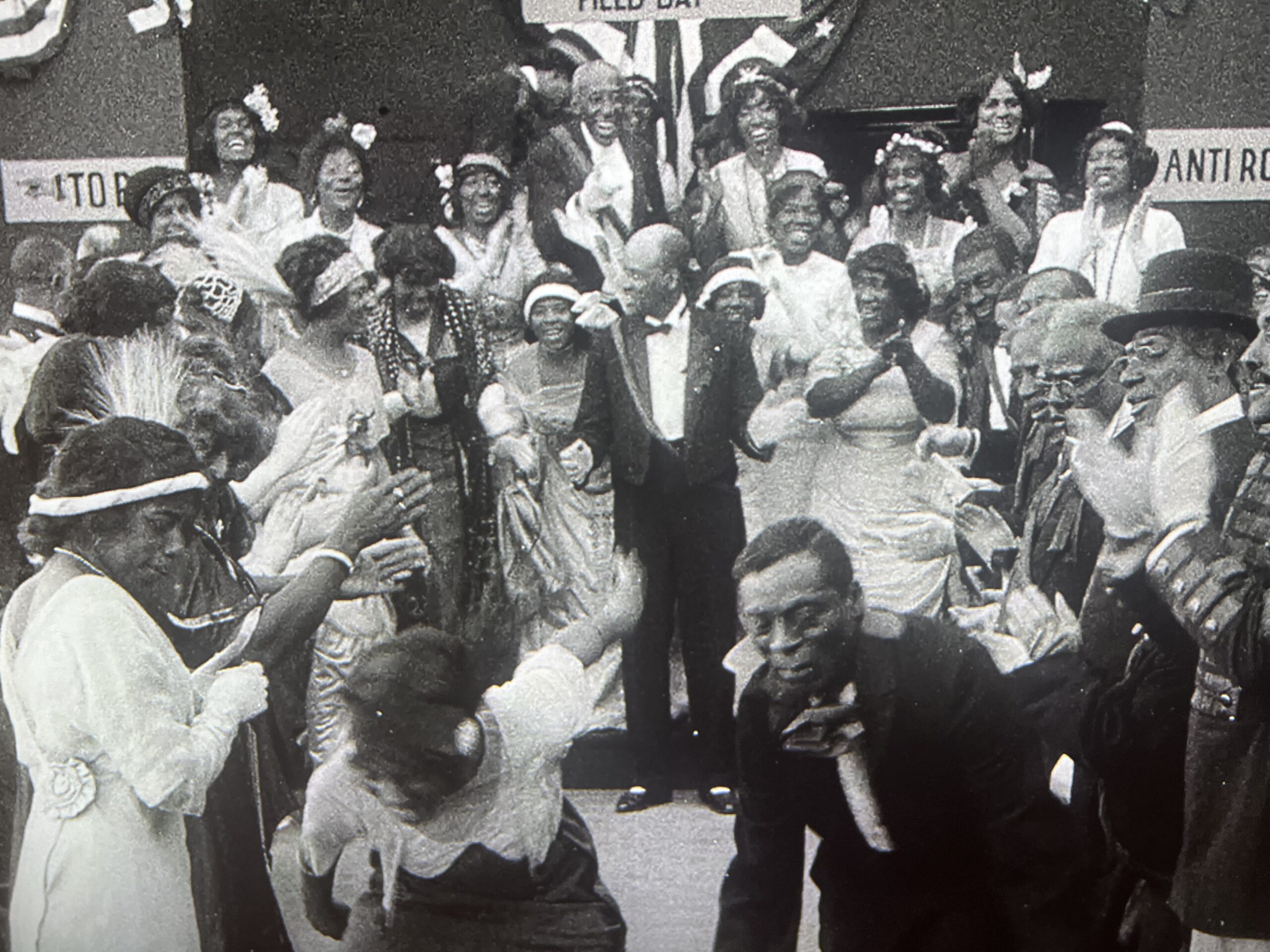
Lime Kiln Club Field Day, Excerpt for the film, Museum of Modern Art. 1913. American black-and-white silent film produced by the Biograph Company and Klaw and Erlanger.

This archival assembly of one of the oldest surviving silent-era films featuring an all-black cast was created by the Museum of Modern Art in New York after seven unedited film reels were discovered in its collection. Based on a popular collection of stories, Lime Kiln Club Field Day features Black stage performer Bert Williams, actor Abbie Mitchell, and hat designer Odessa Warren Grey; many cast members were recruited from the popular Harlem Musical Darktown Follies.

Among the artifact highlights on view, Regeneration presents home movie excerpts of legendary artists such as Josephine Baker and the Nicholas Brothers; excerpts of films featuring Louis Armstrong, Dorothy Dandridge, Ossie Davis, Ruby Dee, Sidney Poitier, Paul Robeson, Cicely Tyson, and many others.
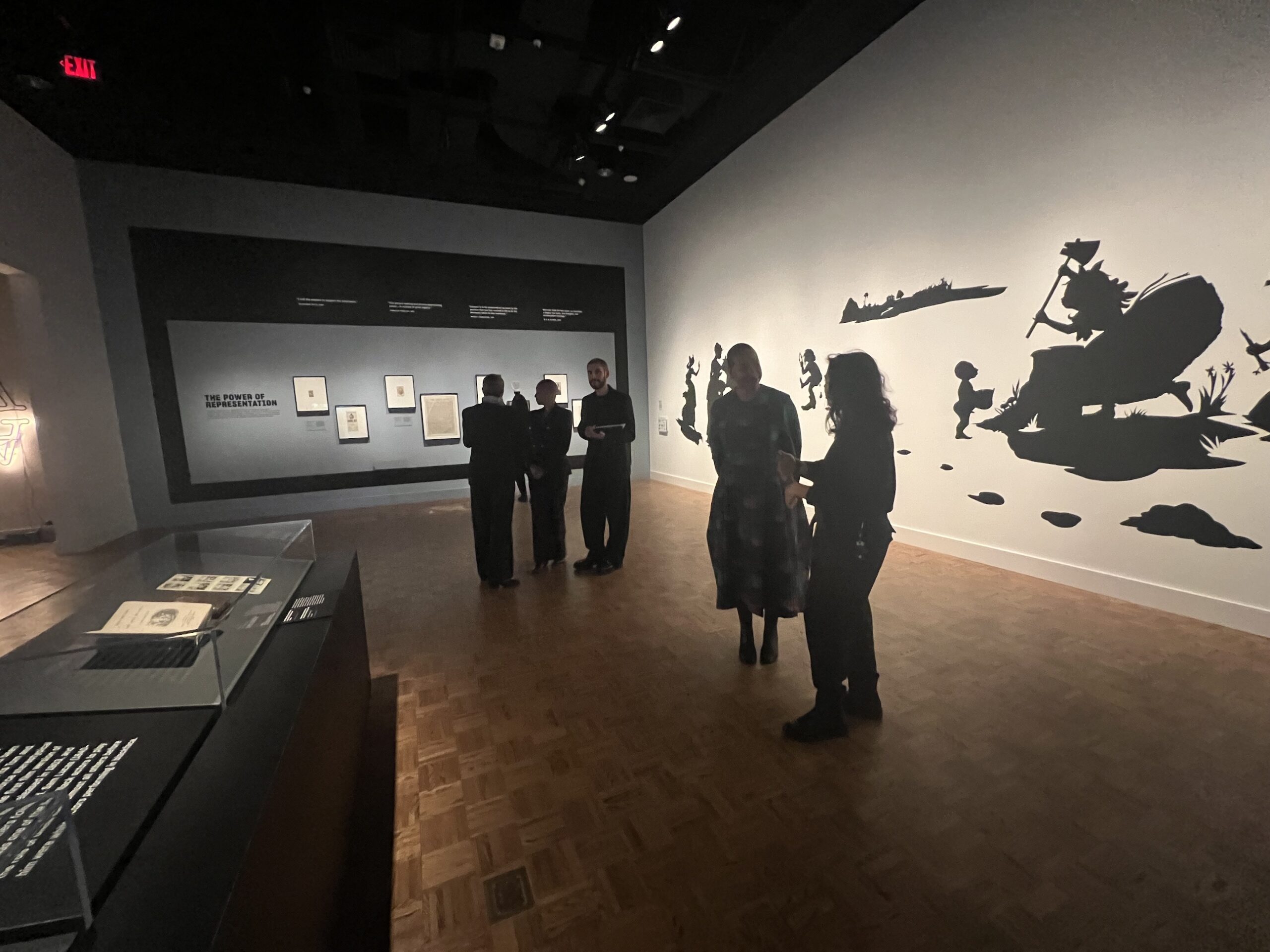
Installation image, Opening room to the exhibition. Detroit Institute of Arts. 2024

The famous contemporary Artist Kara Walker presents the viewer with The End of Uncle Tom and the Grand Allegorical Tableau of Eva in Heaven, created using cut paper and adhesive on the wall, which stretches out 35 feet long. Her well-known silhouettes recall and interpret the trauma of slavery, restating historical memory and forcing the viewers to bear witness to her world of racial oppression and suffering on pre-Civil War plantations. The curators from the Academy of Motion Pictures in the image above are, starting from the left: Doris Berger, Co-Curator of Regeneration; Jacqueline Stewart, Director and President of the Academy Museum of Motion Pictures; and Rhea Combs, Co-Curator of Regeneration. The first exhibition of Regeneration opened in Los Angeles as part of its parent institute, the Academy of Motion Picture Arts and Sciences.
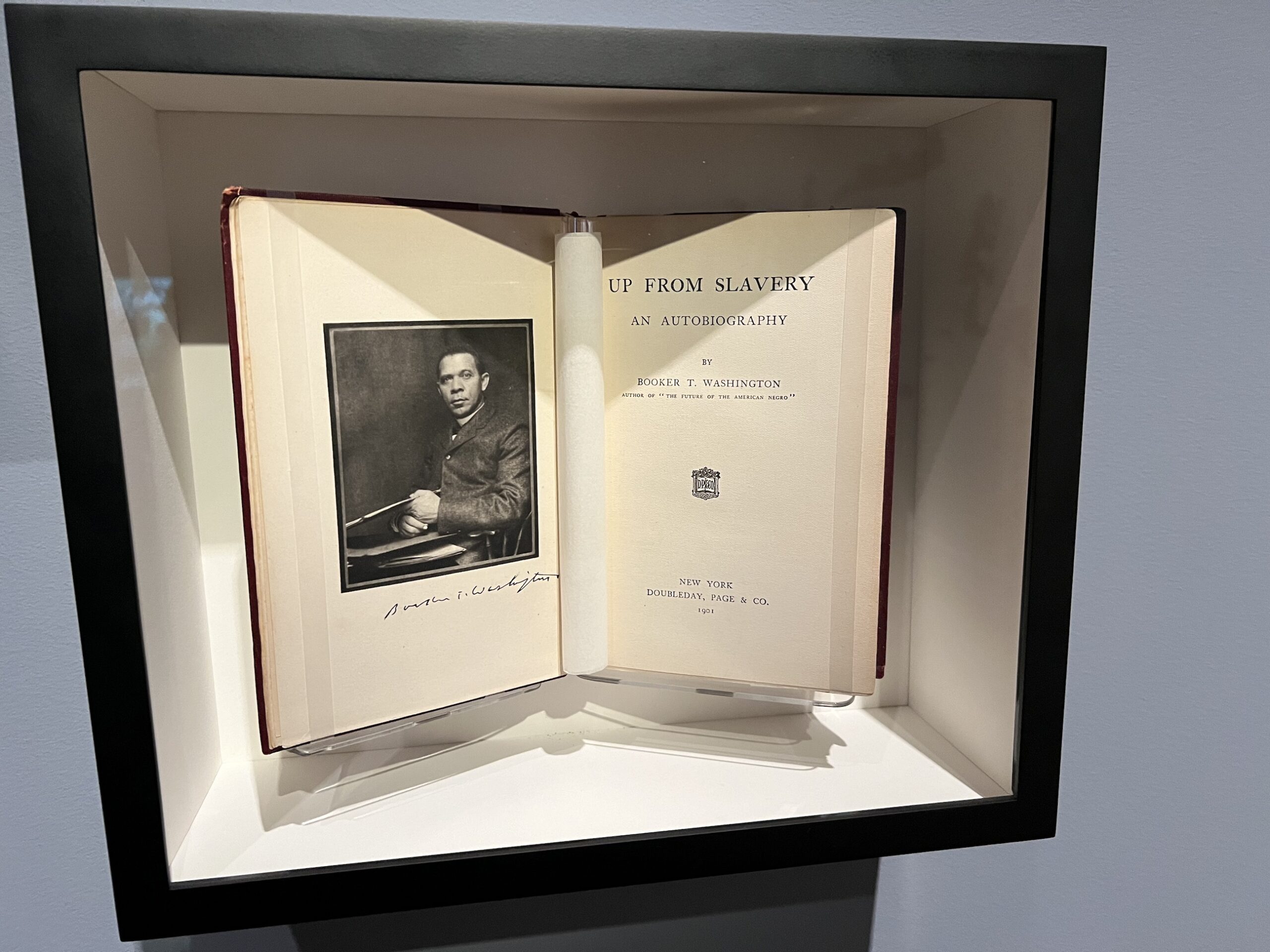
Image from Up From Slavery, An Autobiography, Booker T. Washington. 1901.

Up From Slavery by Booker T. Washington is the 1901 autobiography of the American educator Booker T. Washington (1856–1915). The book describes his experience of working to rise up from being enslaved as a child during the Civil War to help Black people and other persecuted people of color learn helpful, marketable skills and work to pull themselves, as a race, up by the bootstraps. He reflects on the generosity of teachers and philanthropists who helped educate Black and Native Americans and describes his efforts to instill manners, breeding, health, and dignity into students. Washington explained that integrating practical subjects is partly designed to “reassure the White community of the usefulness of educating Black people.”
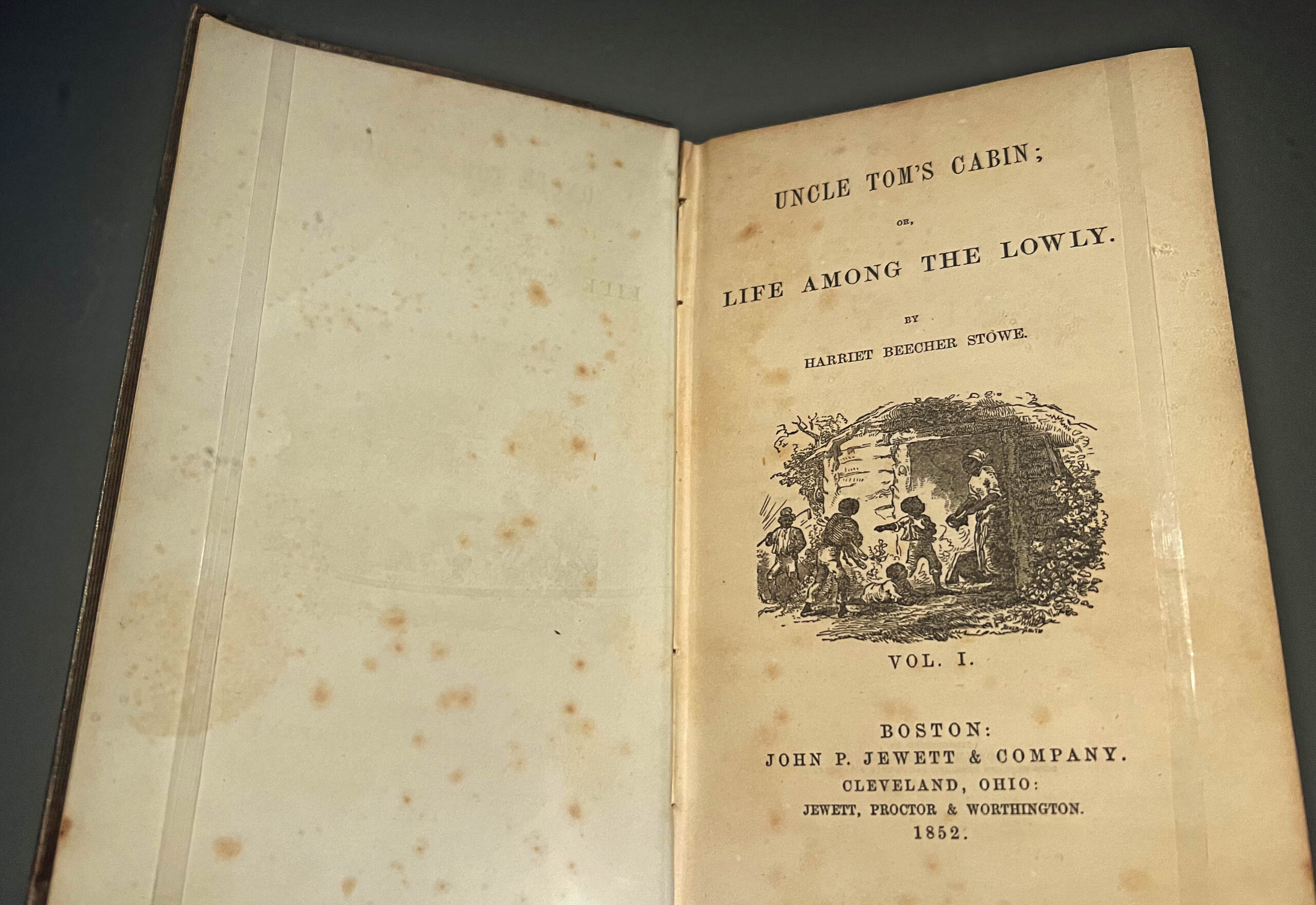
Uncle Tom’s Cabin, Life Among the Lowly, Harriet Beecher Stowe, 1852. Published by John P. Jewett and Company.

One of many artifacts in the exhibition is the famous book Uncle Tom’s Cabin, an anti-slavery novel by American author Harriet Beecher Stowe, which is said to have “helped lay the groundwork for the American Civil War.”  Stowe sent a copy of the book to Charles Dickens, who wrote her in response: “I have read your book with the deepest interest and sympathy, and admire, more than I can express to you, both the generous feeling which inspired it, and the admirable power with which it is executed.” Some modern scholars criticized the novel for condescending racist descriptions of the black characters’ appearances, speech, and behavior, as well as the passive nature of Uncle Tom in accepting his fate.
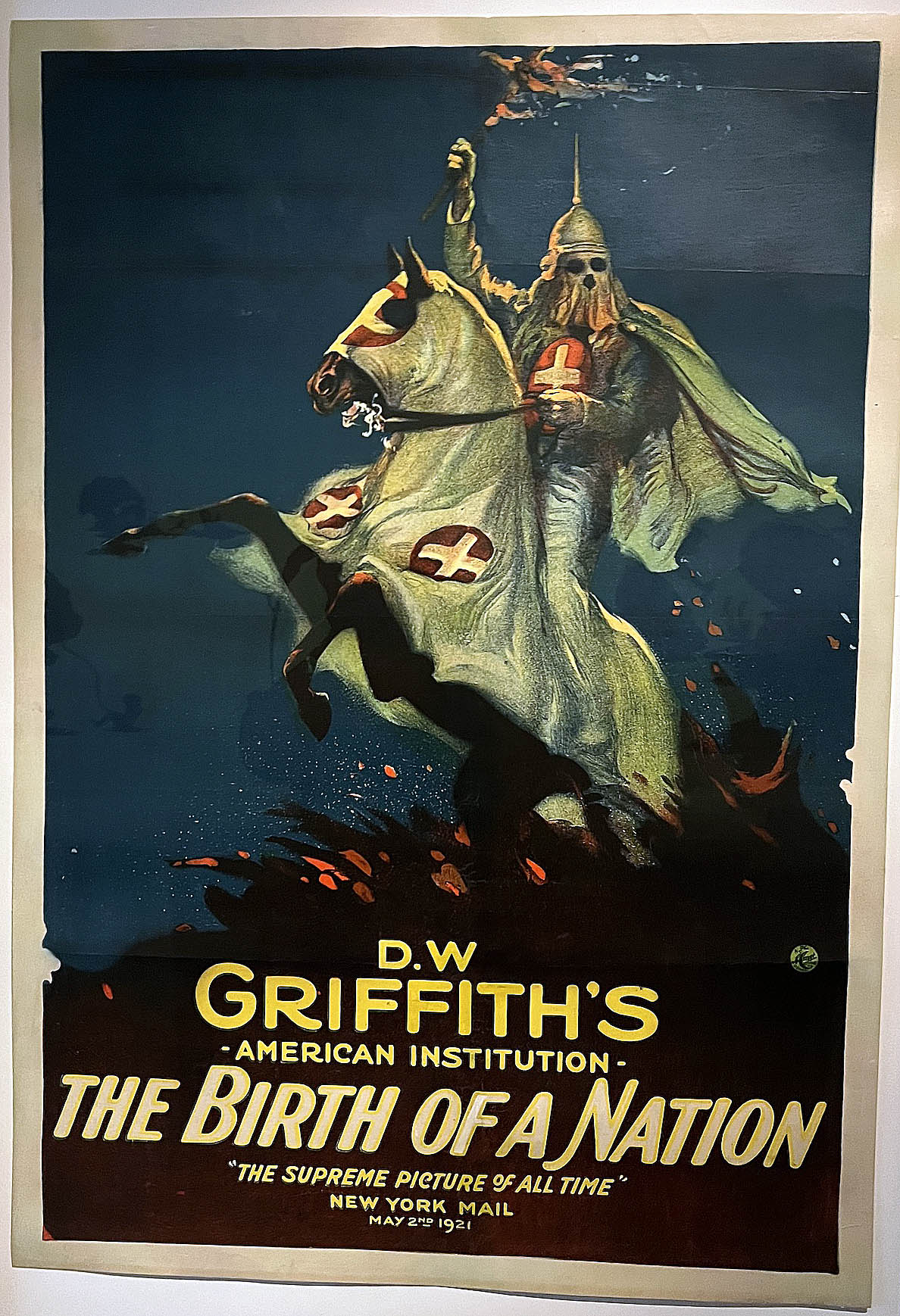
Movie Poster, D.W. Griffith’s Birth of a Nation, Epoch Producing Co. 1915.

The film made in 1905, The Birth of a Nation, is a landmark silent epic film directed by D.W. Griffith. Its plot, part fiction, and part history chronicles the assassination of Abraham Lincoln by John Wilkes Booth and the relationship between two families in the Civil War.  The Ku Klux Klan (KKK) is portrayed as a heroic force necessary to preserve American values, protect white women, and maintain white supremacy. The story that many recall is that Birth of a Nation was the first motion picture to be screened inside the White House, viewed there by President Woodrow Wilson, his family, and members of his cabinet.
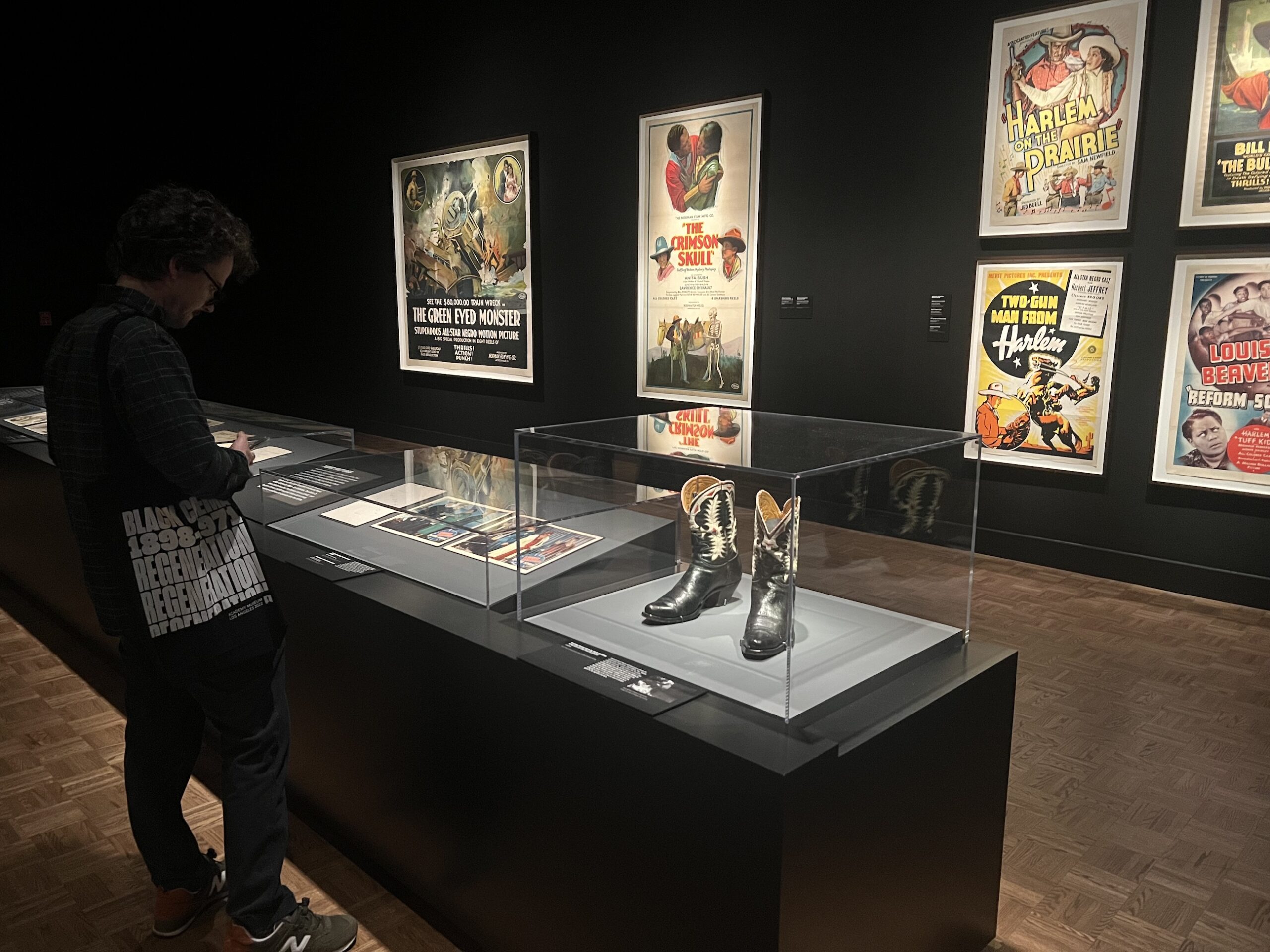
Installation image, Early Movie Posters

The exhibition Regeneration: Black Cinema 1898-1971, now at the Detroit Institute of Arts, came from Los Angeles and was organized by the Academy Museum of Motion Pictures in 2022 to help people fully understand how people of color participated in the motion picture industry from the very start.

Seeing this exhibition is the perfect experience for the people of Detroit to take their family to the DIA (at no cost to those living in Wayne, Oakland, and Macomb Counties) to view the chronology of events as they unfolded despite the challenges of reconstruction and the everlasting racism that permeated the culture for a century. The DIA is the first stop; in an attempt to educate people across the country with truth, facts, and evidence, this exhibition is bound to make an impression. It is critical today, more than ever, that we embrace our history. In current events across the country, there are plans to erase black history forever. At last count, 44 states have started debating whether to introduce bills that would limit what schools can teach about race, American history, gender identity, and sexual orientation.

One of the most articulate writers on this topic is James Baldwin, who writes, “It is the utmost importance that a black child sees on the screen someone who looks like him or her. Our children have suffered from the lack of identifiable images for as long as they were born. History is not the past. It is the present. We carry our history with us. We are our history.”

Museum Hours – Tuesdays – Thursday- 9:00am – 4:00pm
Friday – 9:00am – 9:00pm
Saturday – Sunday – 10:00am – 5:00pm

The DIA exhibition Regeneration: Black Cinema 1898-1971 February 4 – June 23, 2024.

[adrotate group=”2″]

Japanese Friendship Dolls @ Detroit Institute of Arts

Miss Hiroshima and Miss Osaka Installation, 2023.  All images courtesy of Ashley Cook

On December 2, 2023, the Detroit Institute of Arts celebrated the opening of a new exhibition that features five unique dolls, handmade by Japanese craftsmen as part of an initiative to build friendly relationships between the children of the United States and Japan. As a response to the Anti-Japanese mentality that was spreading throughout the United States in the late 1920s, American educator, author and missionary Sidney Lewis Gulick formed the Committee of World Friendship Among Children. He collaborated with adults from the United States and Japan, including prominent Japanese businessman Shibusawa Eiichi, to organize an exchange of dolls to teach the children of each culture about each other.  The story of the Japanese Friendship Dolls serves as an example of a unified effort to heal the wounds that result from conflicts of cultural difference. It is a lesson on peacekeeping and a reminder of the role that youth hold in the ongoing conversation on diversity and acceptance around the world.

Miss Osaka’s Accessories, 1927.

On the first floor of the DIA in the hallway between the Egyptian and Romanesque exhibits are three large windows dedicated to the history of puppetry. Here, guests of the museum are invited to visit Miss Osaka, Miss Hiroshima and Miss Akita, all made in 1927. These traditional Ichimatsu dolls have a white skin-tone and large black eyes. Their fair complexion is achieved through the use of gofun, an art material made of powdered clamshells that was invented in the Heian Period of 12th century Japan. For Japanese-American children living in the United States in the early 20th century, the dolls available did not resemble their physical attributes or cultural heritage. With the Ichimatsu doll being one of the most popular dolls in Japan, they became the template for the 58 Friendship Dolls that were sent as gifts from the children of Japan to the children of the US at that time. Their names, wardrobe, and accessories taught white Americans about the culture of their Japanese neighbors and inspired Japanese Americans to embrace their own heritage with pride.

Miss Hiroshima’s Accessories, 1927

Over 12,000 American Friendship Dolls were also produced and sent across the Pacific to children in Japan as part of this cooperation. While the American dolls were smaller in size and manufactured in an industrialized way, the Japanese Friendship Dolls had unique details and qualities that spoke to the location where they were made. As opposed to functioning as toys for the children to play with, they were sent over as cultural diplomats to share information, promote curiosity and encourage appreciation for Japan. Miss Osaka brings with her a harp, a guitar and a music stand, Miss Hiroshima brings a blue and white tea set and Miss Akita brings a sewing kit. As travelers, each of them also has a clothing chest, a passport and a steamship ticket. Their Kimonos are hand-dyed, outlined with silver or gold and tied with a sash. The tabi socks and sandals complete their formal dress which is worn on special occasions in Japan, communicating to whoever they encounter that they are honored by their presence. The museum provided placards amongst these various elements to further inform its viewership about the relevance of each individual detail.

Miss Hiroshima’s Travel Documents, 1927.

As guests visually traverse the exhibit of delicate figures and their belongings, archival photographs and cross-cultural messages, they are also greeted by Akita Sugi-o, created in the 1930s, and Tomoki, who was created in 2018. As a way to communicate to the boys of Japanese heritage living in the United States, Akita Sugi-o was made in the late 1930s by the same artist who made the aforementioned Miss Akita. Like Akita Sugi-o and the other three dolls, Tomoki demonstrates the long-standing legacy of traditional Japanese doll making and its ongoing presence into the 21st century. He was created specifically for the DIA and arrived complete with accessories including carp flags, a sword and a bow and arrow.

Miss Akita Installation, 2023.

The Japanese Friendship Dolls of the early 20th century, including those included here, toured the United States like agents of peace. Through the literature provided as part of this exhibit, guests have the opportunity to learn about the multifaceted approach taken by The Committee of World Friendship Among Children, who, in addition to producing and shipping the dolls and their accessories overseas, also invited a variety of public arenas to join the “Doll Travel Agency” and receive a visit from a doll. Arrivals and departures were welcomed with celebration followed by reflections and demonstrations that kept their message of goodwill and harmony alive. The amazing artists listed as the makers of these dolls include Kokan Fujimura, Takizawa Koryusai II and Hirata Goyo II. Their exquisite work played an essential role in this effort to bring healing to the Japanese communities of the United States. As an exhibition that directly touches not only on the challenges that come with diversity but also presents potential solutions to those challenges, Japanese Friendship Dolls at the Detroit Institute of Arts serves a valuable purpose beyond leisurely engagement.

Akita Sugi-o and Tomoki Installation, 1927.

Japanese Friendship Dolls at the Detroit Institute of Arts opened in the Founders Junior Council Puppet Case on December 2, 2023, and will be on view until June 5, 2024.

Tomoki’s Carp Flags Accessory, 2018.

[adrotate group=”2″]
Page 2 of 35

Powered by WordPress & Theme by Anders Norén