Critical art reviews of Detroit galleries and museums weekly

Category: Jewelry

Contemporary Anishinaabe Art: A Continuation @ DIA

Cressandra Thibodeaux, Fever Visions I ,2023, Infrared photograph

If anything, the photos included in the press kit for the Detroit Institute of Arts’ latest exhibition, Contemporary Anishinaabe Art: A Continuation, don’t do the show justice. To be sure, the kit does include some of the most striking artworks in the show: Cressandra Thibodeaux’s photographic image Fever Visions I, for instance, a color field-like composition of five turquoise discs on a red background, superimposed onto cylindrical hay bales lined up in an actual field. As the title suggests, the piece was inspired by hallucinations experienced by the artist during an illness. Also visionary is Jonathan Thunder’s painting called Basil’s Dream, in which rival spiritual beings — a Thunderbird and a lynx-like Mishibizhiw — shoot some pool while a DJ spins tunes and Ojibwe storyteller Basil Johnston records the scene on a typewriter. Painted all in shades of magenta, the image’s dreamworld atmosphere and cast of enigmatic characters (as well as its “widescreen” format) feel almost Lynchian, though the scene is more good-natured than creepy.

Thunder, Basil’s Dream, 2024 – Acrylic on canvas


Gordon M., 1868: Remember Our Relatives 2022 Annigoni paper, cedar smoke

Also in the press kit: Washita 1868: Remember Our Relatives (2002) by Gordon M. Combs, a sepia-tone tableau of rearing horses, teeth bared and eyes flashing, that seem seared into the paper (it was created using cedar smoke). This harrowing image of terror and pain commemorates the massacre of the Native Americans and the subsequent slaughter of the horses and mules of Washita, Oklahoma by George Custer’s 7th Cavalry. The creatures evoke the horse bellowing at the center of another visual chronicle of military cruelty, Picasso’s Guernica.

Morriseaux Punk, Norval Morriseaux, Punk Rockers, Nancy and Andy 1989 Acrylic on canvas

And naturally, the press materials for the exhibition include a work that’s become something of a signature image for the show (it’s on a lot of the gift shop merch): the irresistible Punk Rockers Nancy and Andy, a vivid acrylic painting from 1989 of a big-haired, leather jacketed couple in profile against a bright red background by the late Norval Morrisseau. A member of the Bingwi Neyaashi Anishinaabek First Nation (the DIA cites the tribal nationalities of the artists on the wall labels), Morrisseau was Canada’s best known contemporary Indigenous artist, in part because his biography is marked by the sort of pitfalls, comebacks, and eccentricities that the popular press enjoys latching onto when reporting on artists. However, it’s Morrisseau’s bold, compelling, often narrative paintings — influenced by ancient petroglyphs, 20th century modernism, Anishinaabe, Christian and Eastern spiritual traditions, and more — that justify his status as the “grandfather” of contemporary Anishinaabe art.

George Morrison, Totemic Column, 1995 (fabricated 2024-25), stained redwood, granite base; Jim Denomie, Untitled (Totem Painting), 2016, Oil on canvas, wood

To be fair to the DIA’s publicity department, no handful of images could entirely do right by such a large, rich, and wide-ranging exhibition, which is fine — it just means there are wonderful surprises awaiting visitors throughout Contemporary Anishinaabe Art: A Continuation. The spirit of the show is encapsulated outside the entrance by two contemporary takes on the totem pole. George Morrison’s beautiful Totemic Column is constructed like a puzzle from wavy, interconnected pieces of redwood; the effect feels a bit like looking down into a flowing river. Jim Denomie’s Untitled (Totem Painting), a tribute to his mentor Morrison, is both more traditional than Column — it features the animal heads one might expect to see on a totem pole — and very modern, as the faces of the creatures are painted onto the column in an expressionistic, cartoon-like style (and anyone who knows my love of comics will know that’s high praise coming from me). Harking back to tradition, forging varied paths forward, integrating old and new influences, commenting on past and current events, honoring predecessors: these threads run throughout the exhibition.

Jim Denomie, Untitled (Totem Painting) 2016 Oil on canvas, wood


Jim Denomie,  Untruthful 2014 Oil on canvas

As someone unfamiliar with his work previously, Denomie is a happy revelation for me. A large painting by the late Ojibwe artist greets visitors just inside the show. Depicting four figures on horseback, some with mask-like animal heads, it might be mistaken for some variation on the Four Horsemen of the Apocalypse. In fact, Four Days and Four Nites, Ceremony (2019-20) refers to the journey to the afterlife made by the souls of the dead in Ojibwe tradition. Denomie’s vivid colors and expressive brushwork give this spirit world a heightened, electric feeling. Denomie often brings a sharp, dark sense of humor to his examinations of historical injustices. His other painting here, Untruthful (2014), depicts the Lone Ranger and Tonto astride their steeds (the pair appear in a number of Denomie’s artworks). “You lied to me!” says Tonto in a cartoon word balloon. “Get used to it,” replies the ranger. Denomie said he used color and humor to draw a viewer in, then he was “able to zap ‘em” with the truth.

Heron Hill, Joe Kennedy & Daniel Collazos Baakaani-inaaddizi: Their Actions Are Different 2025

One room here is devoted to some amazing fashion designs. Victorian gothic meets East Coast and Great Lakes Native American influences in Ojibwe designer Delina White’s Woodland Elegance: Four Piece Evening Apparel Ensemble, a silky purple dress and black shawl, with gold embroidery, over a black lacy underskirt. Joey Kennedy and Daniel Collazos of Heron Hill Designs offer a melding of Indigenous and queer styles, including an enviable pair of embroidered Doc Marten boots and matching hat. And Jillian Waterman contributes the astonishing In Case of Emergency Bury Me and Watch Me Grow (2024), an ensemble complete with vest, purse, and gas mask, all beaded with red, white, and yellow corn seeds. Also check out Adam Avery/Naawikwegiizhig’s beautifully beaded hats in the next room, Blooming Hat (2020) and Flowering Moon (2024).

Jillian Waterman, In Case of Emergency Bury Me and Watch Me Grow, 2024

Much of the work on display here, in fact, is three-dimensional — furniture, sculpture, jewelry, and other handiwork, from two sturdy birchbark canoes built by Chippewa craftsman Ronald J. Paquin, to a delicate beaded veil with the phrase I Get Mad Because I Love You repeated across it in white and translucent beads, created by Chippewa artist Maggie Thompson as a commentary on psychological abuse. Dennis Esquivel contributes a beautiful cabinet of maple and cherry wood entitled Out of the Woodlands (2019); its legs are streamlined versions of Ottawa war clubs. A dress-shaped object hanging on a wall — Dress for Nookomis, (2023) — made of fabric and painted blood red with thick black and white outlines, is more than just a piece of Pop art; it’s a liminal thing that “exists between worlds — part textile, part memory, part protest,” as artist Nonamey describes it. The red dress is the symbol of the Missing and Murdered Indigenous Women and Relatives movement, which raises awareness about violence committed against Native American women.

Maggie Thompson I Get Mad Because I Love You 2021-22 Beads, filaments, jingles


Dennis Esquivel, Out of the Woodlandds: Standing Cabinet 2019


Nonamey, Dress for Nookomis 2023 Acrylic on reclaimed fabric

I’m getting close to my word count here, and I see I’ve done not much better than the press kit at encapsulating the full breadth of this show. I haven’t mentioned the display discussing African American/Ojibwe sculptor Mary Edmonia Lewis’ friendship with  Henry Wadsworth Longfellow, author of the fictional Song of Hiawatha. I haven’t discussed Rabbett before Horses Strickland’s sprawling battle scene Right of Consciousness, or Summer Yahbay’s beaded bandolier bag Nmamiikwendis: I Am Proud of Myself (2024), a traditionally male garment cast in shades of pink that makes a good case for the true strength of that color. There are a number of photo portraits of folks from tribal elders to Iggy Pop. (Why Iggy? Because photographer David Dominic, Jr. of the Little Traverse Bay Bands of Odawa Indians respects the rock star for building a diverse community through his music.) And then there’s the short film that closes the show, Happy Thanksgiving (2023), a comedic crime flick about an Anishinaabe youth who comes up with a creative way to get payback after being asked one too many times to celebrate the subjugation of his people. Suffice to say, Contemporary Anishinaabe Art: A Continuation rewards repeat visits. Museums often tend to seal Native Americans in amber, reducing their culture to a collection of artifacts in a vitrine, but this show leaves no doubt about the multiplicity of artistic voices and practices that live and thrive within the contemporary Anishinaabe community.

Detroit Institute of Arts’, Contemporary Anishinaabe Art: A Continuation

With Eyes Wide Opened @ Cranbrook Museum of Art

Cranbrook Museum of Art, With Eyes Opened, Sculpture Court and Mixing Chamber, installation, photo: PD Rearick

With Eyes Opened: Cranbrook Academy of Art since 1932 has just opened at the Cranbrook Museum of Art in Bloomfield Hills, to great acclaim and national attention. Covered by the New York Times Magazine with a spiffy video tour and ample media attention both local and national, it’s a hydra-headed beast of a show with many sponsors but no single curator. Objects and images from every period of the Academy’s history compete for space and attention, with no fewer than ten dueling accounts threaded throughout the museum’s seven galleries.

The organizers seem to have had difficulty settling on a single narrative for this exhaustive survey of the Academy’s history–and no wonder. The tapestries, sculptures, paintings, prints, photographs, product prototypes and mass-produced products tell a kaleidoscopic story of the many creative minds whose vision and creativity have emanated from the school over time.

The history of this premier American art institution is told through objects in only piecemeal fashion in the physical exhibit; the accompanying printed volume, a 624-page doorstop of a book, contains a more complete narrative of the school’s history, along with one-page profiles of many (though not all) of the artists and designers represented in the show.

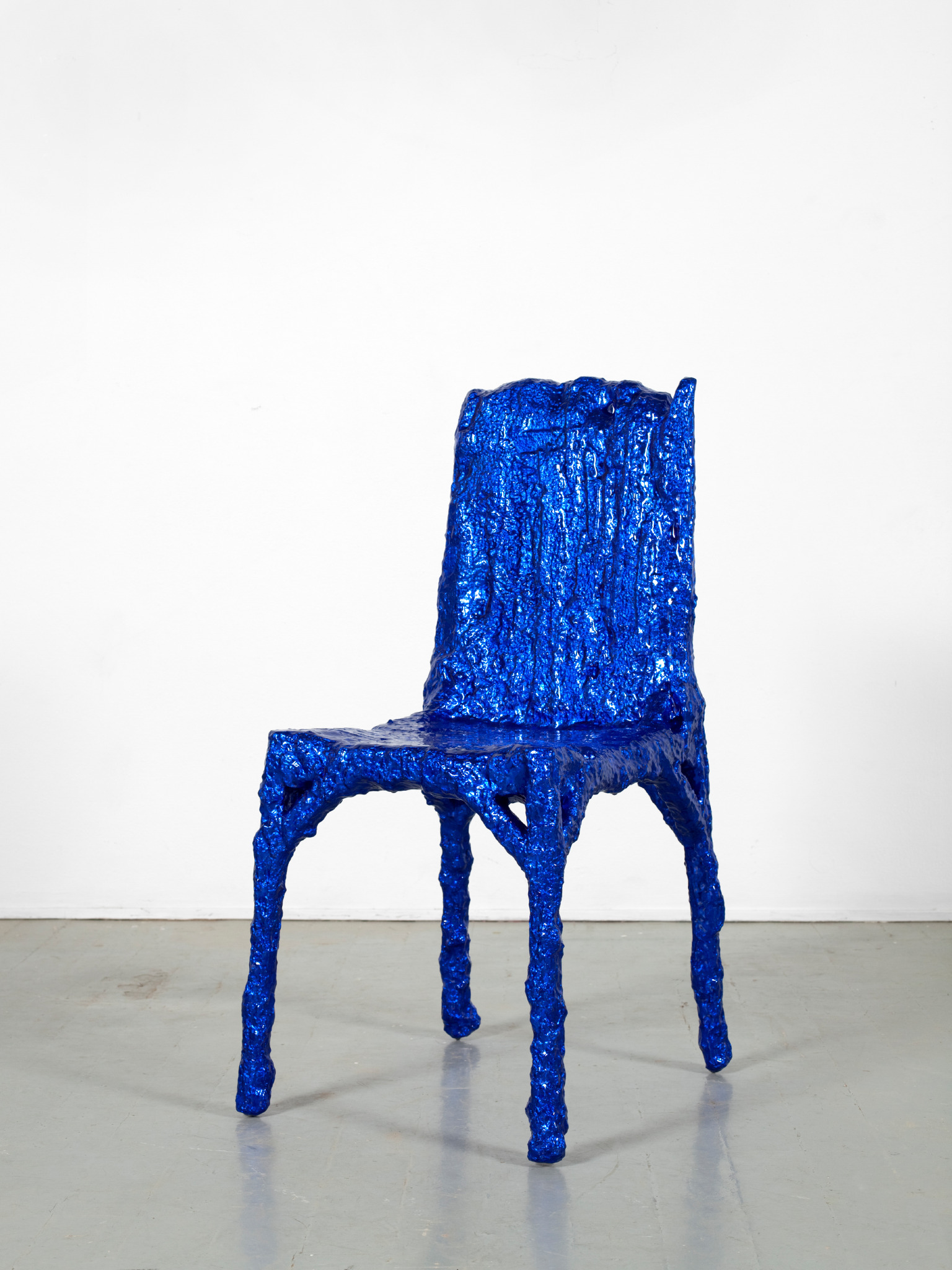
Untitled (Aluchair) by Christopher Schanck (MFA, 3D Design 2011), 2019, aluminum foil, resin Collection Cranbrook Art Museum

At the entrance to the main gallery, visitors can watch American Look. Commissioned in 1958 by Chevrolet, this cold war artifact celebrates many of the post-World War II designed amenities that were newly available to middle class consumers of a certain limited demographic.  Throughout the celebratory video, the “American-ness” of the consumer lifestyle is promoted relentlessly. Even though the uncritical materialism may seem cringe-worthy to a modern viewer, the optimism and can-do mentality expressed in the video amply show why the period beginning in 1950 is often called the American Century. The film provides a good starting point for With Eyes Opened, which takes us on a visual tour not only of the mid-century American esthetic, but also, by implication, through a consideration of how those perceptions and values have grown and changed over time to include contemporary preoccupations with equity, diversity and sustainability.

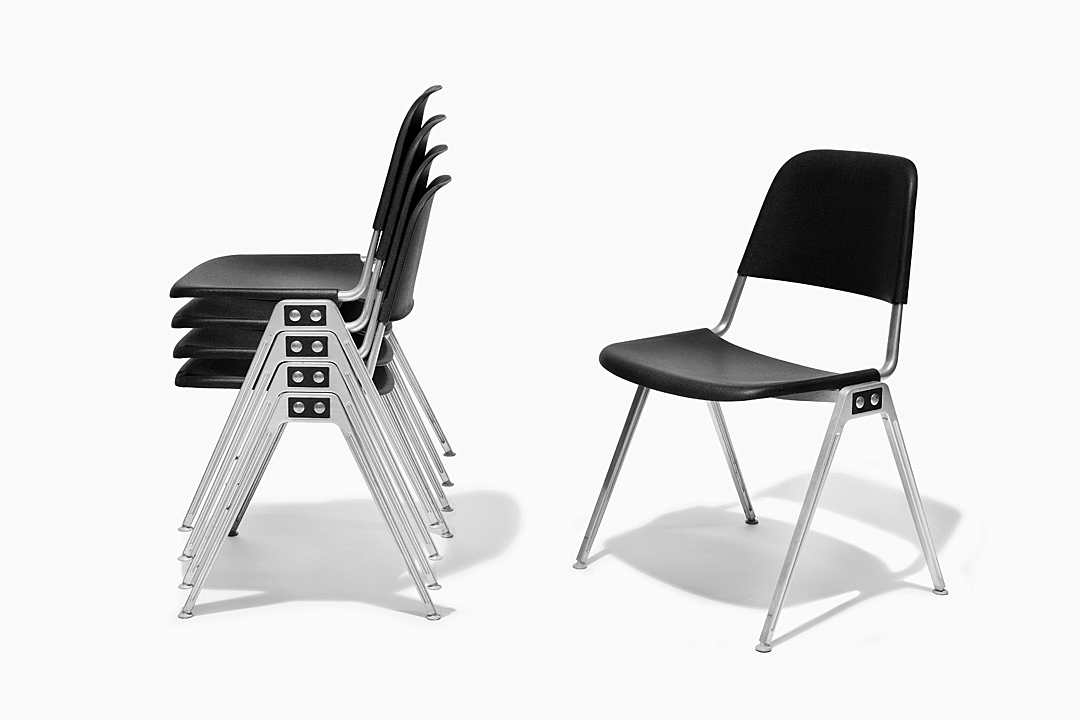
Model 1601 Stacking Chair by Don Albinson (Cranbrook Academy of Art Sculpture, 1940-1941), 1965, aluminum, nylon, molded plastic. Photo PD Rearick

The video serves as an introduction to one of the more successful elements of the exhibit, which celebrates the modern chair. Designers like Charles and Ray Kaiser Eames and Don Albinson  were uniquely successful at conceptualizing and producing practical, relatively inexpensive and attractive mass production chairs, many instantly recognizable today as fixtures of modern life in home and office.  The chair as a concept unifies this display;  in addition to the mass produced chairs there are a number of hand-crafted, one-of-a-kind examples such as Chris Schank’s Alufoil  Chair and Terence Main’s  Queen Anne, Queen Anne doubled chair. Here, as throughout the exhibit, the organizers have decided to mix the mass-produced and the hand-crafted, without comparing or contrasting the purposes and philosophies involved.

Cranbrook Museum of Art, Sculpture Court, installation. Photo: DAR

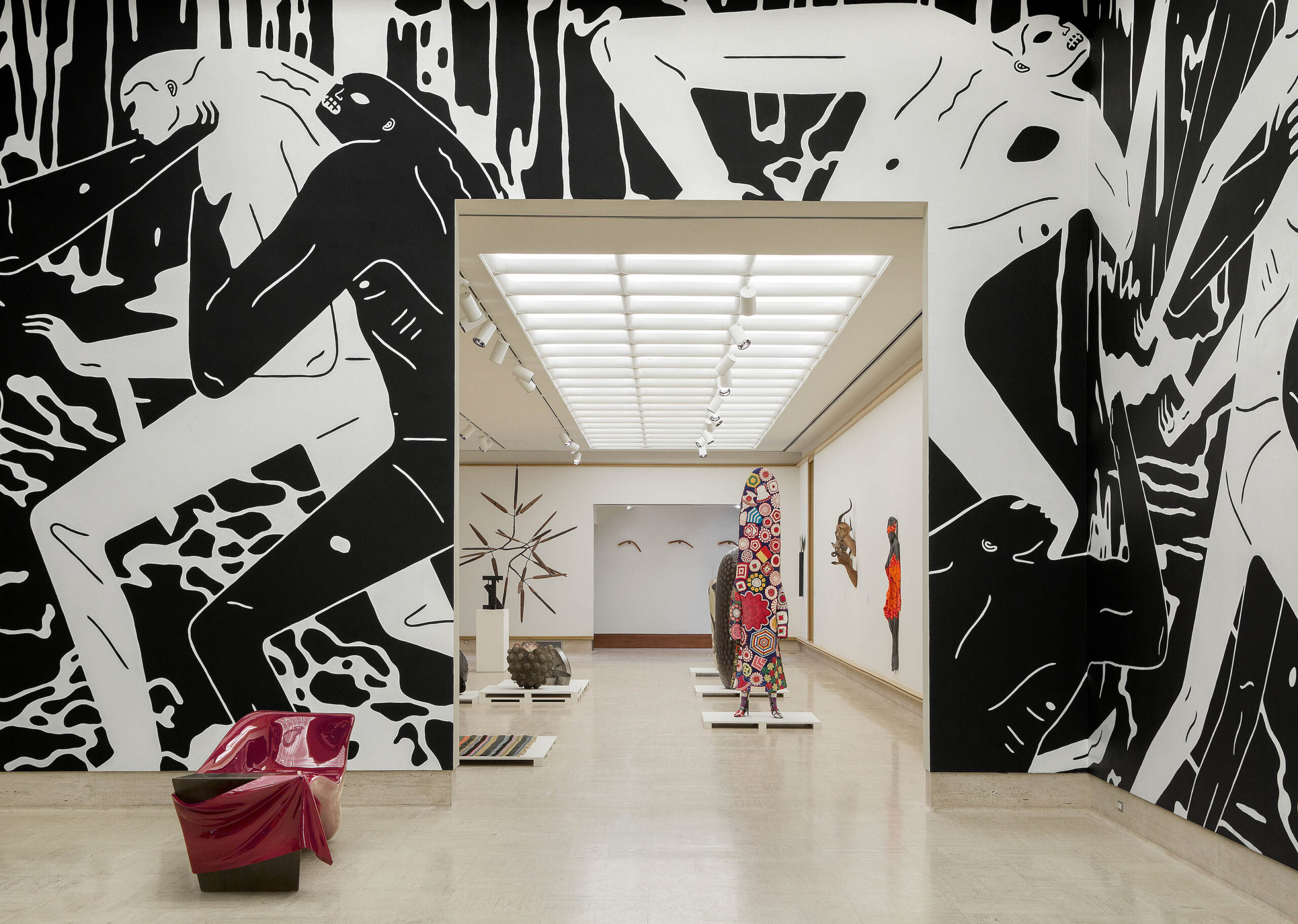
The physical and esthetic center of the exhibition, which brings the concept of design and art to a satisfying apotheosis of the handmade and the mass-produced, comes in the Mixing Chamber. There,  the room-sized mural of black and white figures by Cleon Peterson suggests the sensibility of a 21st century Egon Schiele. Tortured, semi-nude bodies surround the wittily conceived bench by Vivian Beer, whose automotive-painted red drape on the slipper shape is at once modern and baroque.

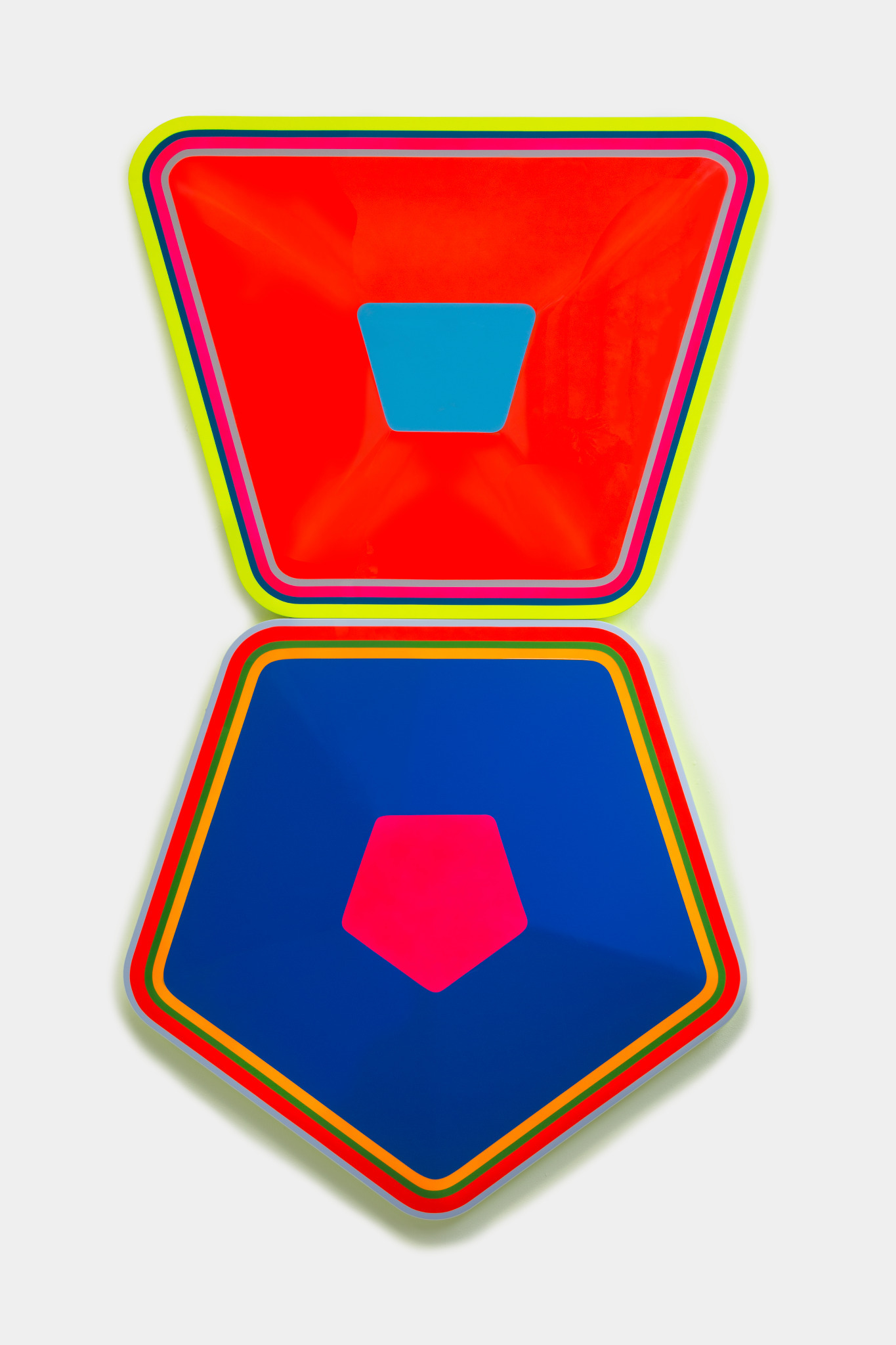
Untitled (Asthma, High Blood Pressure) by Beverly Fishman (Artist-in-Residence, Dept. of Painting 1992-2019) 2018, urethane paint on wood. Photo: PD Rearick

In the adjacent North Gallery, 34 paintings, works on paper and photographs hang floor to ceiling, with abstraction as the ostensible unifying theme. The hanging of contemporary art salon style is a fraught strategy that calls for sensitively selected and carefully coordinated curation and enough space around each piece to allow the work to breathe.  Here the disparate artworks compete visually, like guests at a crowded cocktail party shouting to be heard.  Beverly Fishman’s brightly colored, sharp-edged geometric polygons (almost) hold their own, and McArthur Binion manages to succeed simply by installing a painting, DNA: Study (Lake St. Clair), too large to share the space with other artwork. As worthy as each piece in the gallery may be, a little editing would have been welcome.

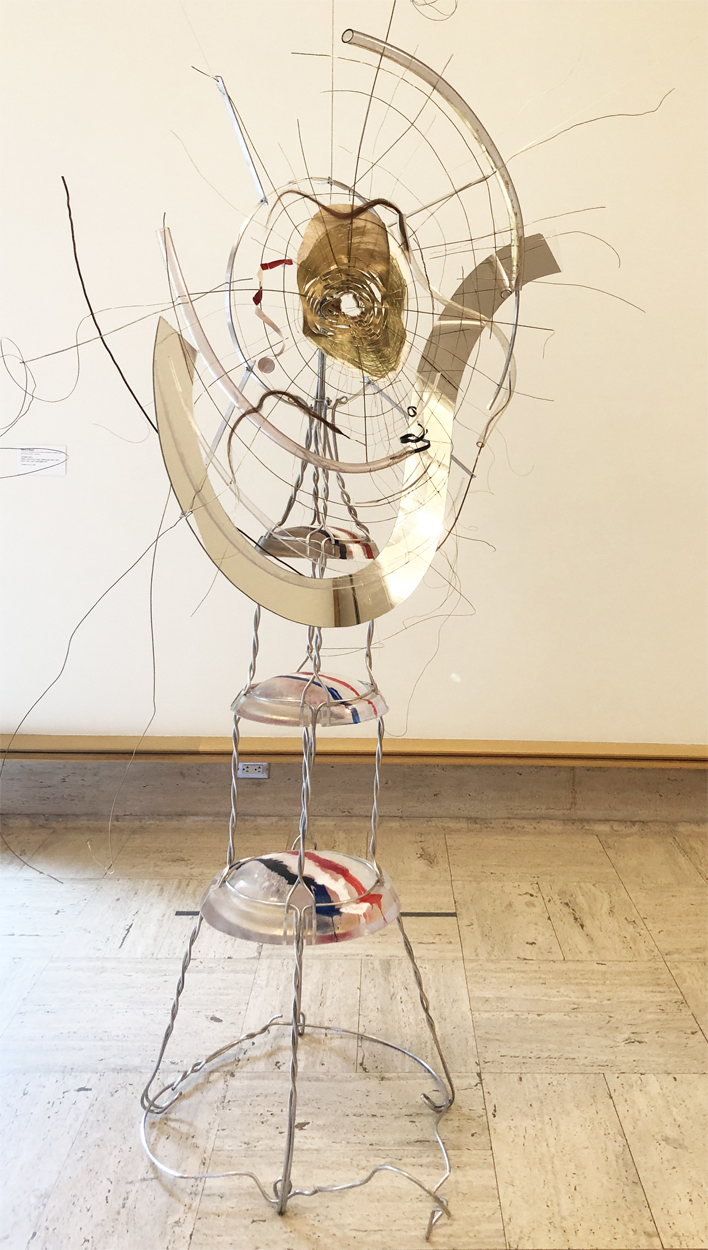
Untitled by Rebecca Ripple (Artist-in-Residence, Dept. of Sculpture, 2017-present) 2016, plastic, aluminum brass, photocopy, pencil, hair, champagne foil. Photo: K.A. Letts

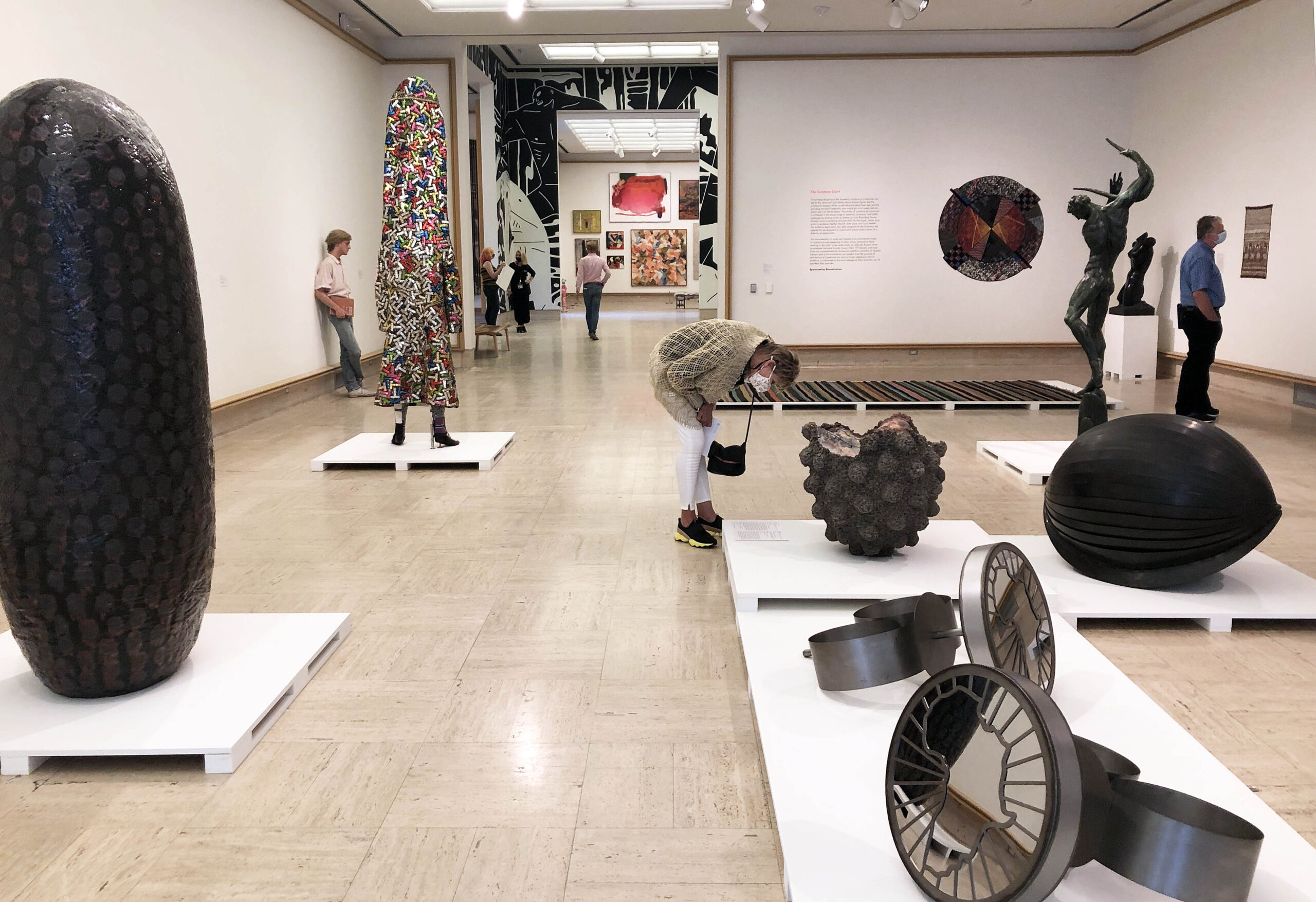
In the Sculpture Court, through the Mixing Chamber ‘s other doorway, Nick Cave’s exuberant  SoundSuit (2012) holds the floor, with a recessive companion, Flamer, by Mark Newport, hanging on the adjacent wall.  Duane Hanson’s provocatively banal figure lounges nearby, unimpressed. Other strong work in the sculpture court includes several fiber pieces which seem to have wandered in, perhaps to provide space between the large and diverse 3-dimensional works–not a bad idea as it turns out. The white-on-white tapestry Montana 30, by Colombian artist Olga de Amaral, made up of small squares of white painted canvas relieved with touches of red, is especially welcome here. Sculptures by artists of the past such as Marshall Fredericks and Carl Milles share the space, more or less peacefully, with artworks by younger artists like Tyanna Buie and Kate Clark. Toward the back of the gallery, James Surl’s spiky mobile floats in its own private galaxy, next to a terrific assemblage by Rebecca Ripple that radiates an ad hoc starburst of Miro-esque energy.

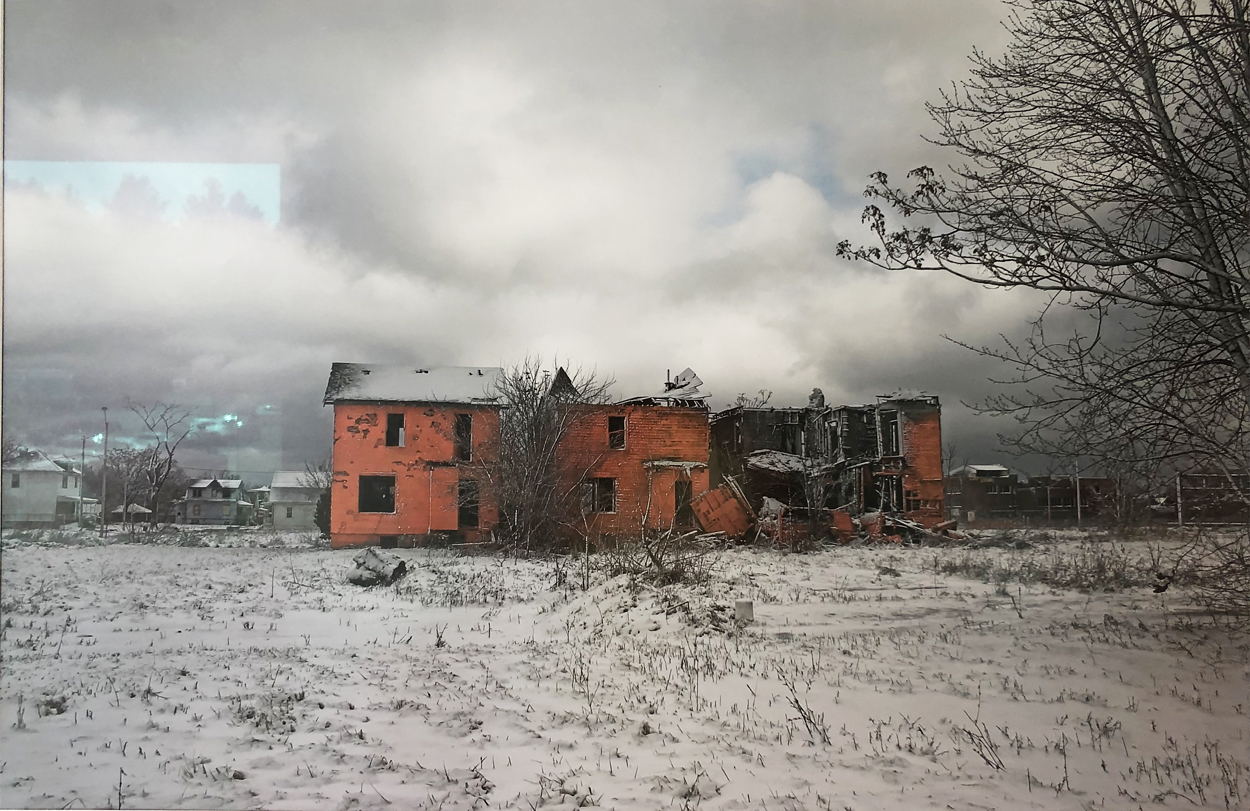
Auburndale Site, Detroit MI (#4) by Object Orange, 2006, archival color photograph, 1/25 Cranbrook Museum of Art. Photo: K.A. Letts

In a small side gallery near the elevators, three photographs by the art collective Object Orange deliver a moment of surreal surprise. From 2005-2007, these (anonymous) Cranbrook graduates undertook a conceptual project called Detroit, Demolition, Disneyland which involved painting–in “Tiggerific” Orange– derelict structures in the city as a form of both public performance and protest. The photographs, brilliant orange structures against bleak gray backgrounds, are arresting, unexpected and a bit melancholy.

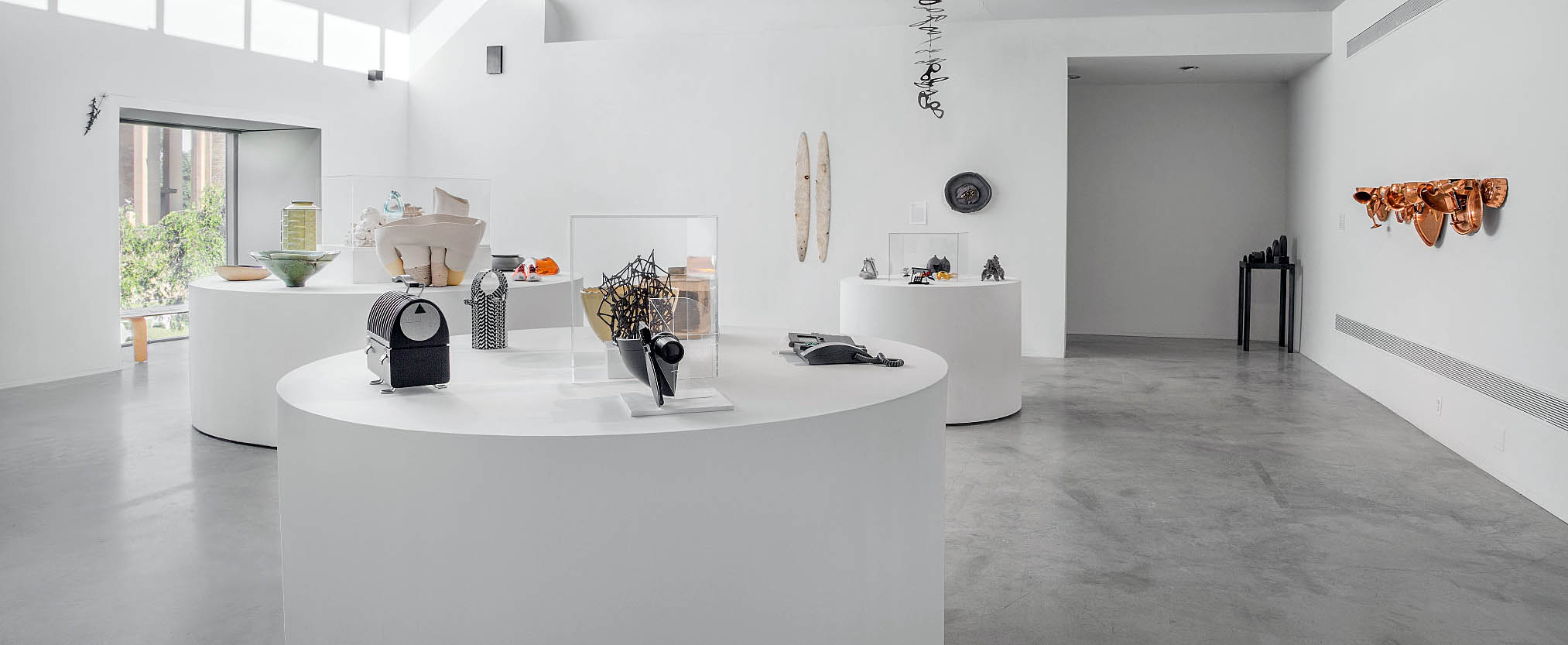
Cranbrook Museum of Art, With Eyes Opened, Object Islands, installation, Photo: PD Rearick

The Wainger Gallery, last stop on the main floor galleries, features a clever installation of “object islands,” table height circular plinths that subtly guide the viewer through a broad array of fairly small- scale ceramics, metal objects and product design prototypes. Many of the objects in this gallery are one-of-a-kind art objects in a variety of media, often in unusual combinations, such as Iris Eichenberg’s untitled brooch made of porcelain, silver and linen.

With Eyes Opened takes on a lighter tone in the museum’s lower level gallery with The Menagerie, a whimsical collection of figures and objects inspired by the natural world, from Marshall Frederick’s chunky Two Bears to Stephen Malinowski’s photograph Cafeteria, a surreal bison-in-a-dining room.  The playful theme of The Menagerie is echoed nearby with a small collection of toy and playground designs that, while welcome, seem like an afterthought.

In the adjacent hall gallery, prints and posters highlight Cranbrook’s influential graphic design program. Installed next to printed media that feature collage, photomontage and progressive typography, several unique works hint at the endless formal potential of paper as a medium.  Elizabeth Youngblood’s elegant, silvery process drawing is tucked into a corner near Laurence Barker’s more exuberant hand-made paper piece.  Layers from the Disemboweled Series by Winifred Lutz takes the medium into the realm of expressionism.

Yet Untitled by Elizabeth Youngblood (MFA Design, 1975) 2018, paint, mylar. Photo: Glenn Mannisto

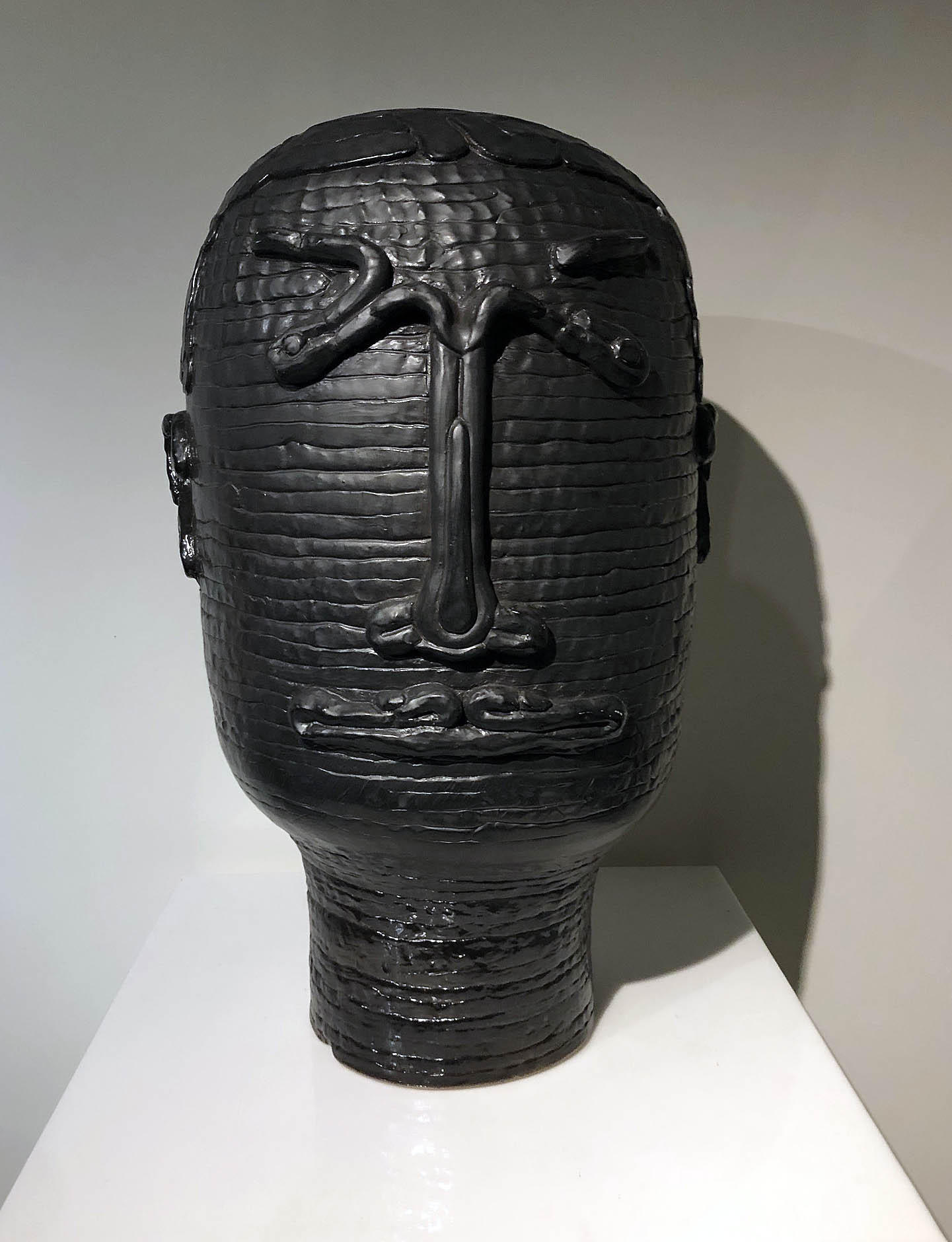
And last–but not least–some of Cranbrook Academy’s most recent graduates inhabit the lower level deSalle Gallery with distinction. Many of these young artists currently live and work in Detroit and continue the Academy’s tradition of excellence in both craft and conception. The growing diversity of the school is on display here, pointing to a more inclusive future, now enabled by the recent $30 million gift from Dan and Jennifer Gilbert to support student diversity.  Ricky Weaver’s gray and white photo-apparitions emanate spirituality, across from Ebitenyefa Baralaye’s Portrait II, a comic-sinister stoneware head.  Around the corner, Marianna Olague’s painting El Pleno Dia seems to emit its own light.  The emerging artists in this gallery demonstrate the continuing influence of the Academy’s alumni on the Detroit art scene and beyond.

With Eyes Opened is multi-faceted, rich and a little chaotic, more of a class reunion than a retrospective.  What comes through loud and clear in this exhaustive–and sometimes exhausting–survey, though, is the Academy’s continued vitality and its ongoing relevance to any discussion of the 21st century designed environment. And really, that’s enough.

Cranbrook Museum of Art, With Eyes Opened, deSalle Gallery, installation, Photo: P.D. Rearick.

Eyes Wide Open at Cranbrook Museum of Art through September 19, 2021

Culture at the Crossroads @ Toledo Art Museum

Glorious Splendor: Treasures of Early Christian Art

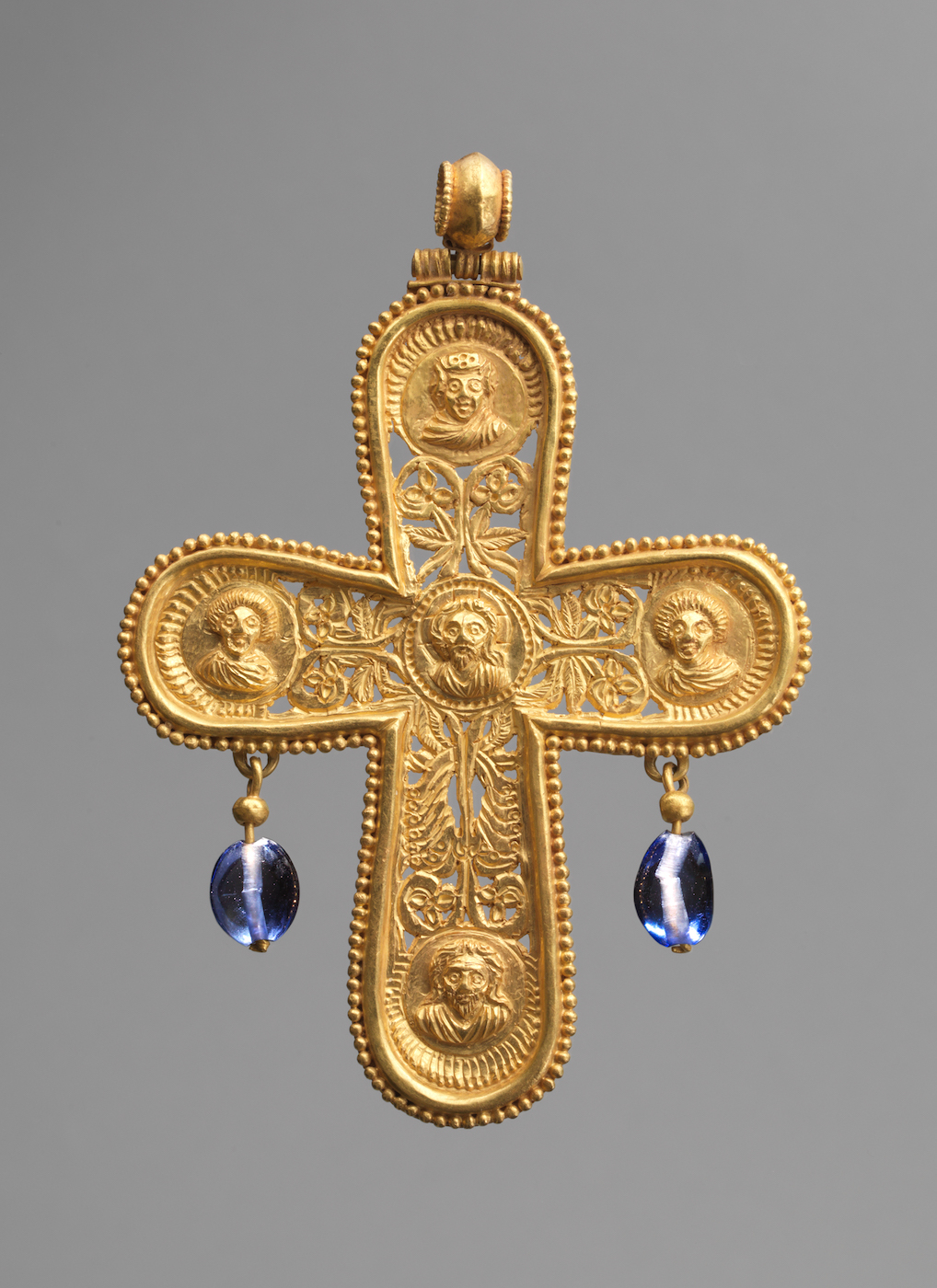
Byzantine, Gold Pendant Cross with Openwork Decoration and Sapphires, 6th–early 7th century. 11.3 x 8.0 cm; weight: 64.8 g. Private Collection, North America


It was a family feud that would irrevocably shape the culture of the Western World. In 312, Constantine, who for years had challenged the legitimacy of Emperor Maxentius— his brother-in-law— led an army toward Rome seeking to depose the alleged usurper. Establishing an encampment near the Tiber River, on the eve of battle Constantine famously had a vision of a cross in the sky, which he interpreted as mystical assurance of victory. The following day, he ordered the symbol painted on the shields of his soldiers, who subsequently defeated Maxentius’ army at the Battle of Milvian Bridge, establishing Constantine as the emperor of Rome. Whatever the precise details of the account (and they do vary), it’s hard not to see the battle as one of history’s decisive turning points. It resulted in the legalization of Christianity in Rome and, eventually, the establishment of a second Roman capital in Constantinople, later the heart of the Byzantine Empire.

Glorious Splendor: Treasures of Early Christian Art, on view at the Toledo Art Museum through February 18, offers a compelling glimpse of cultures at the crossroads, revealing the fluidity of Roman visual culture during the empire’s slow transition toward Christianity. The exhibition is an intimate single-gallery display of 30 precious objects– mostly on loan from other collections– dating from the 2nd through 7th century. The instructive selection of objects highlights the perhaps surprising cross cultural exchange between Christian and Pre-Christian Rome, not merely in subject matter, but in media, style, and technique

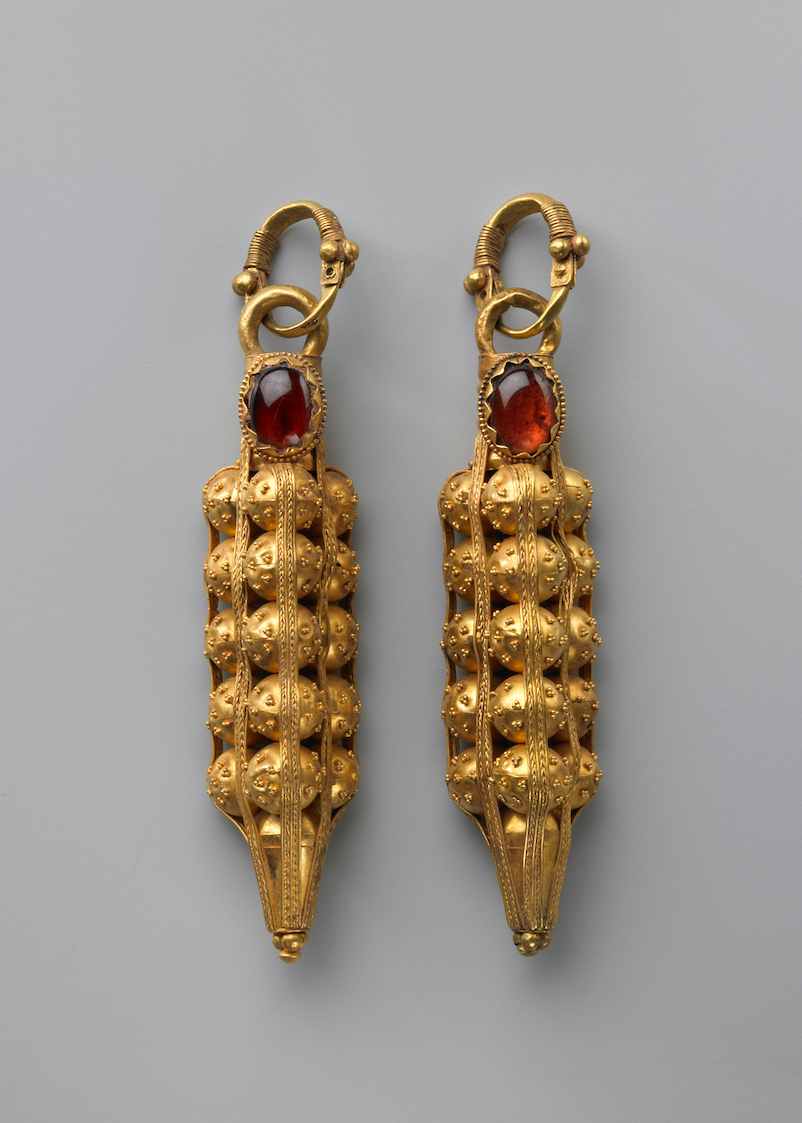
Parthian, Gold Earrings with Woven Wire, Granulation, and Garnets, 1st century A.D. Length of each: 8.0 cm.; weight: 11.2   and 11.4 g. Private Collection, North America


Upon first appearance, these nearly two-thousand year old objects are perhaps disappointingly small, but they reward close inspection. Several pairs of magnifying lenses, thoughtfully supplied by the museum, allow visitors to get in close. Most of these artifacts loosely fall under the umbrella of decorative art, and include pendants, bracelets, broches, rings, earrings, cameos, belts, and other finely crafted jewelry. They’re almost all made of gold and are frequently adorned with precious stones.

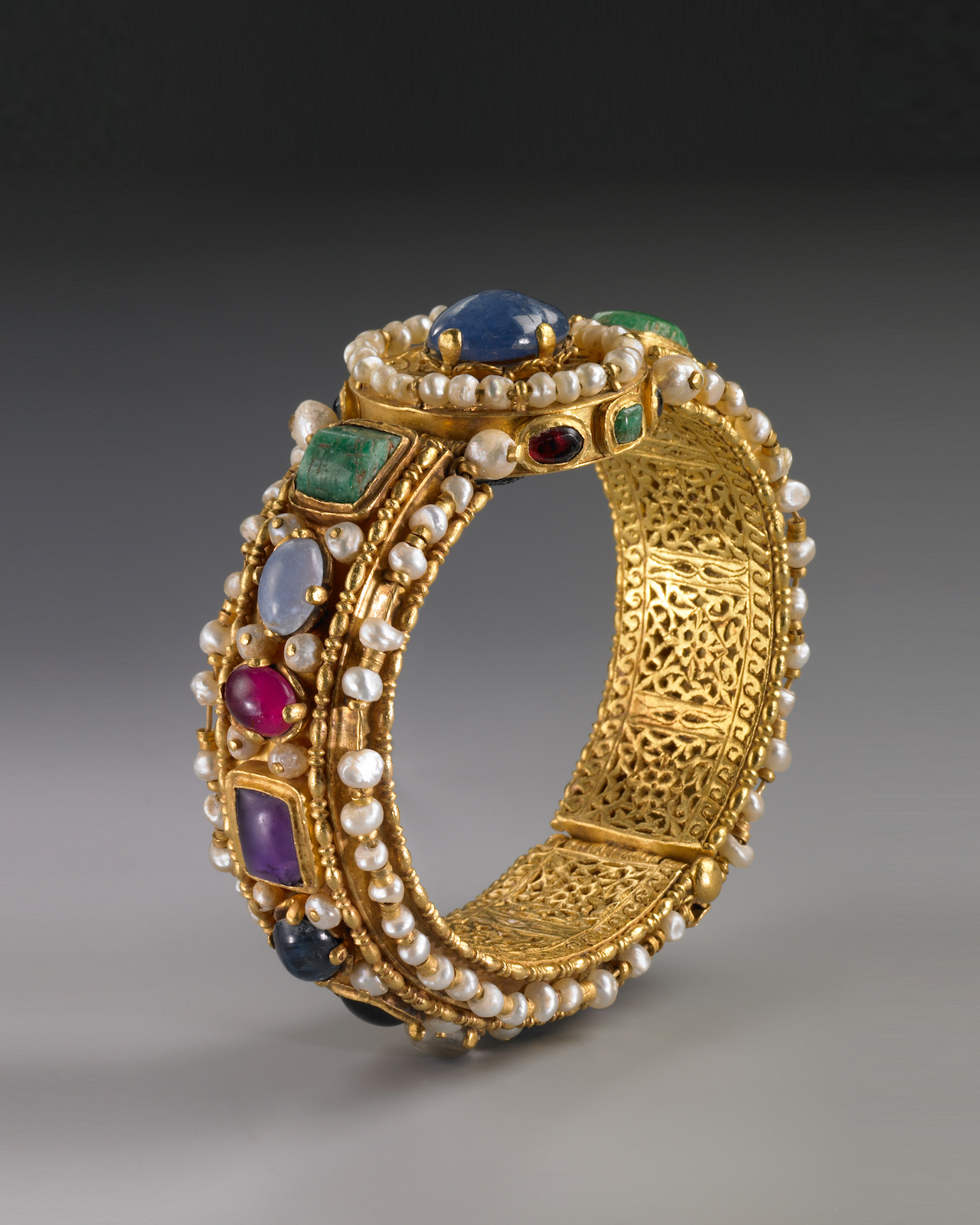
Byzantine, Gold Openwork Bracelet Set with Gems and Pearls, 6th century. 10.5 x 9.5 x 4.0 cm; weight: 239.6 g. Private Collection, North America


Most of these artifacts are comparatively small, but all are exquisitely handcrafted. A Byzantine cross-shaped gold pendant is a tour de force, its surface adorned with vegetal patterns and sapphires. The exhibition’s pièce de résistance is a dazzling 6th century bracelet studded with gems and pearls, the sinuous intertwining tracery on its interior anticipating the elaborate 8th century Hiberno-Saxon decorative knotwork later made famous in illuminated manuscripts like the Lindisfarne Gospels and the Book of Kells. An explanatory note on the display case reminds us that these fine works were crafted after the fall of the Roman empire, checking the notion that the dark ages marked a universal cultural decline.

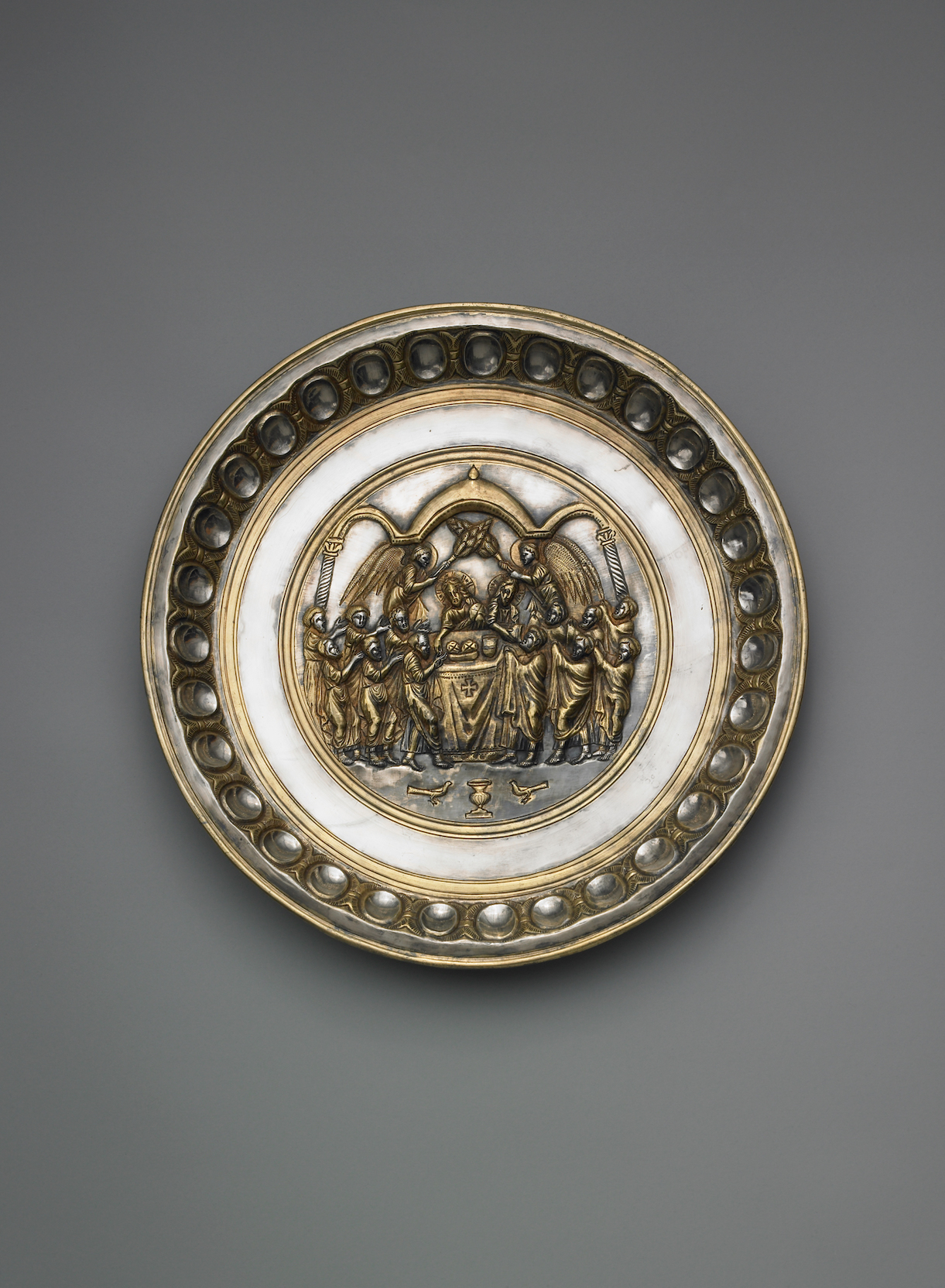
Byzantine, Silver Paten Depicting the Communion of the Apostles, 547–50. Diameter: 40.2 cm; weight: 1813.0 g. Private Collection, North America


Some of these objects are freighted with real historical significance. A small golden bust of the assassinated Emperor Licinius II is a rare image of the emperor that survived his damnatio memoriae (damnation of memory), a posthumous dishonor in which the Roman senate required all images of the disgraced emperor to be destroyed. And a silver patin (a plate used to hold the bread during the celebration of the Eucharist) from the 6th century portrays the earliest known depiction of the Communion of the Apostles.

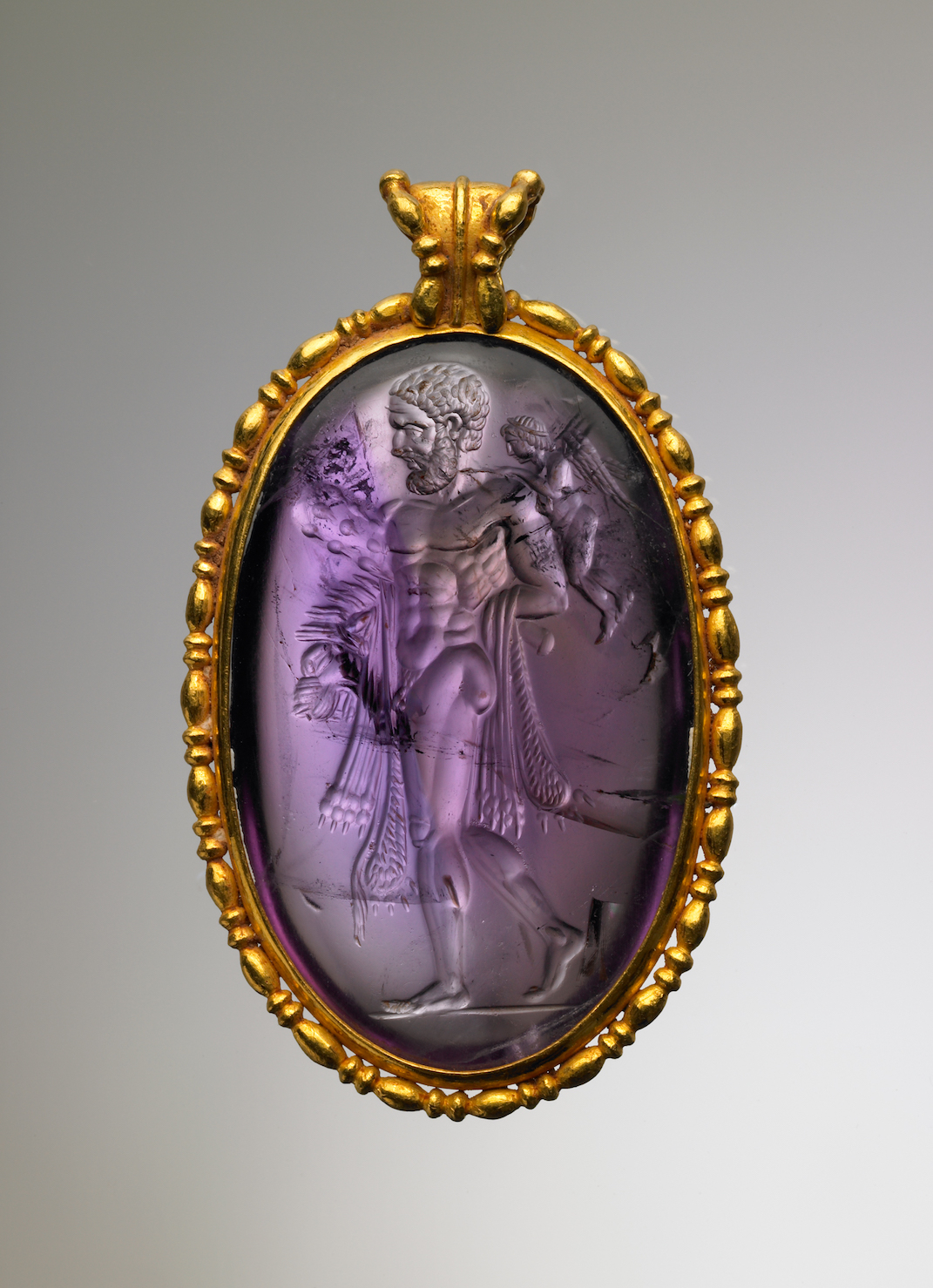
Greek, Amethyst Intaglio Depicting Eros Binding the Arms of Herakles, Set in a Gold Pendant, 2nd Century B.C. 6.5 x 3.8cm; gem: ca. 4.8 x 3.0 cm; weight 39.3 g. Private Collection, North America

Perhaps the biggest surprise of the exhibition is that most of these works, despite the title of the show, are hardly “Christian” as we might expect. There’s an abundance of imperial propaganda, including a handsome silver shield portrait of Rome’s first emperor, Augustus, who more than any other Roman emperor capitalized on art as a means of political persuasion. There’s also an abundance of mythological characters which (in a very literal sense) make cameo appearances– Helios, Eros, Herakles, the Three Graces, and Venus (who also appears in her Greek iteration as Aphrodite). In some of these works we see prototypes for the more explicitly Christian visual culture which would follow. A golden pendant depicting the sun god Helios shows thorny rays of light emanating outward from the deity’s head, a visual precursor of the halo, so ubiquitous in subsequent Christian art.

Glorious Splendor is a small but worthwhile exhibition that hints at the gradual seismic shift in Western visual culture during Christianity’s first few centuries, reminding us that early Christian art didn’t emerge in a vacuum. While the battle of Milvian bridge is understandably viewed in retrospect as a decisive, watershed moment, this exhibition reminds us that the view from the ground was much more nuanced, and offers a rare opportunity to see lucid examples of Christian and Classical visual culture jostling at the crossroads.

Toledo Art Museum  – Through February 18, 2018


Powered by WordPress & Theme by Anders Norén