Critical art reviews of Detroit galleries and museums weekly

Author: Ron Scott Page 11 of 35

Russ Marshall @ DIA

Detroit Institute of Arts presents Russ Marshall: Detroit Photographs, 1958-2008 Image courtesy of DIA

Russ Marshall, Installation image courtesy of the DIA

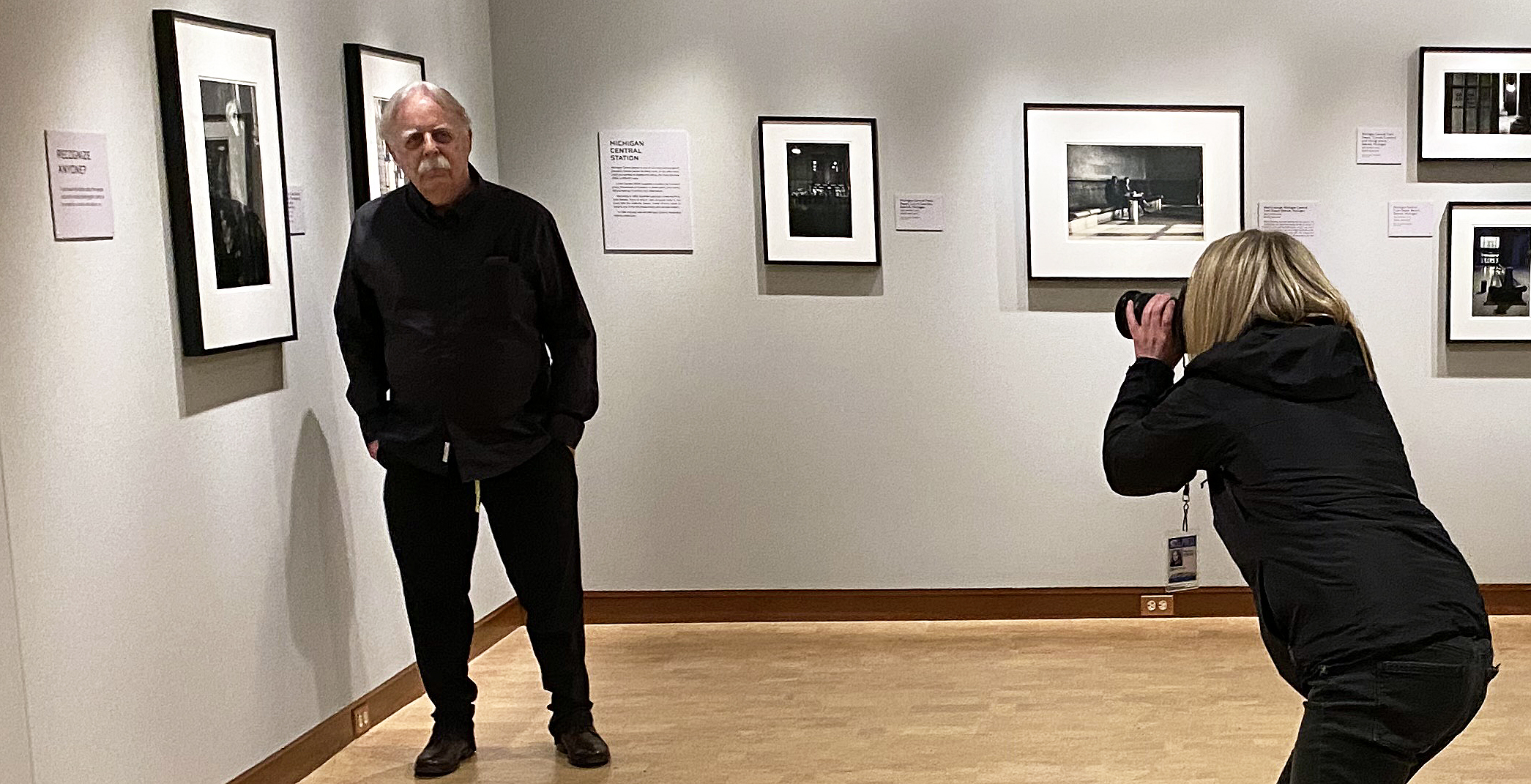
The Detroit Institute of Arts is currently exhibiting over 90 black & white photographs by the Detroit photographer Russ Marshall in their first-floor de Salle gallery. Russ Marshall: Detroit Photographs, 1958–2008 opened November 15, 2020, and will run through June 27, 2021. Department Head in the Prints, Drawings, and Photographs department and the James Pearson Duffy Curator of Photography, Nancy Barr has been working at the DIA for the best part of twenty-five years and is responsible for the very tasteful curation of this rich and comprehensive exhibition.  Although the work broadly covers six decades of freelance work capturing the local labor movement in and around Detroit, for this review, I will focus on the imagery that speaks to Marshall’s artistic work both from his interests in the cultural events of Detroit and his travels to Europe during the years 1987-1990.

To understand his beginnings, Russ Marshall was born in 1940 in the coal-mining town of South Fork, Pennsylvania, to a coal miner and industrial factory worker family. His parents relocated to Detroit in 1943, and he grew up in a federal housing project surrounded by the neighborhood activities comprised of thousands who worked in the automotive factories. His father worked in the Chrysler DeSoto plant assembly line where steel from Great Lakes Steel company provided the iron ore that transformed the raw material into steel for car parts. In his teens, Marshall was the owner of a Scout 120 box camera and began capturing the people around him and the places where he lived.

Marshall says in his statement, “Our family photo album was probably my first significant exposure to photography and on some level, at an early age, it was impressed upon me that it was important to keep the memories of these miners, steelworkers, and farmers alive.”

He goes on in the Huffington Post to describe his childhood, “Growing up in a federal housing project in a working-class neighborhood in Detroit provided a unique perspective to a young boy in the 1940s and ’50s. With activities of the big three auto companies always in the news, which could affect most of my relatives and neighbors, including my father who worked on the Chrysler DeSoto plant assembly line, I was conscious of where I was in this life — where I fit in.”

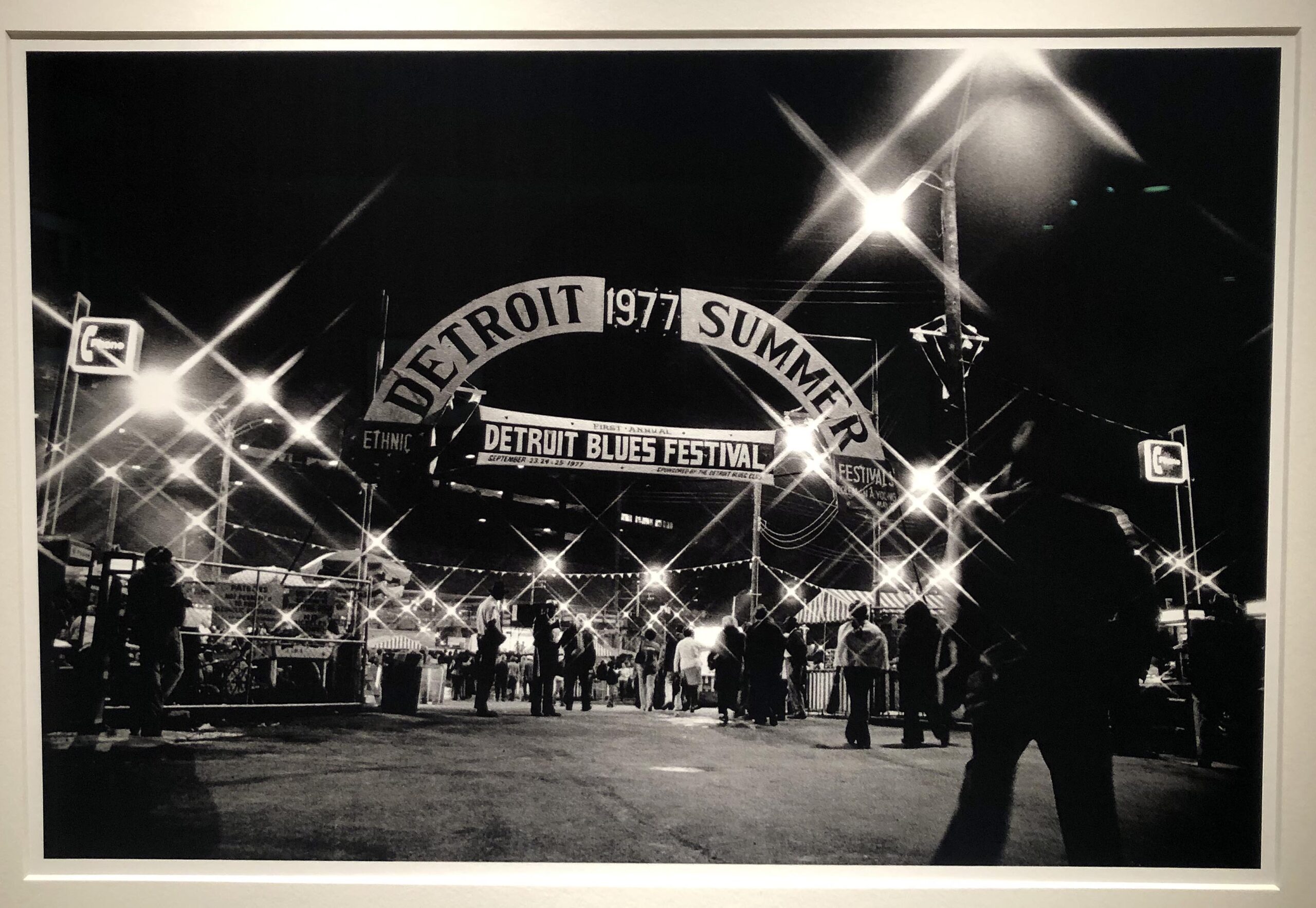
Russ Marshall, First Annual Detroit Blues Festival, 1977, Dye-based inkjet print, 2019

It was September 22-25, 1977 that Marshall must have discovered the new filters that could be used on a 35mm single reflex lens that applied a star-burst effect filter to light sources as seen in the entrance shot of the first Detroit Blues Festival.  During these predigital years, the filters absorb part of the light available, often necessitating a more prolonged exposure. This image provides a high contrast moment in time, probably 35 mm negative, dominated by the then-latest star filter’s effects.  In 1977 it was a time for trying the filter and its impact, but eventually, photographers grew tired of the special effect. From the citation, the negative was recently printed by creating a Dye-based Inject print in 2019. My guess is that Marshall may have scanned the 35mm negative and brought the image into a digital environment to print.

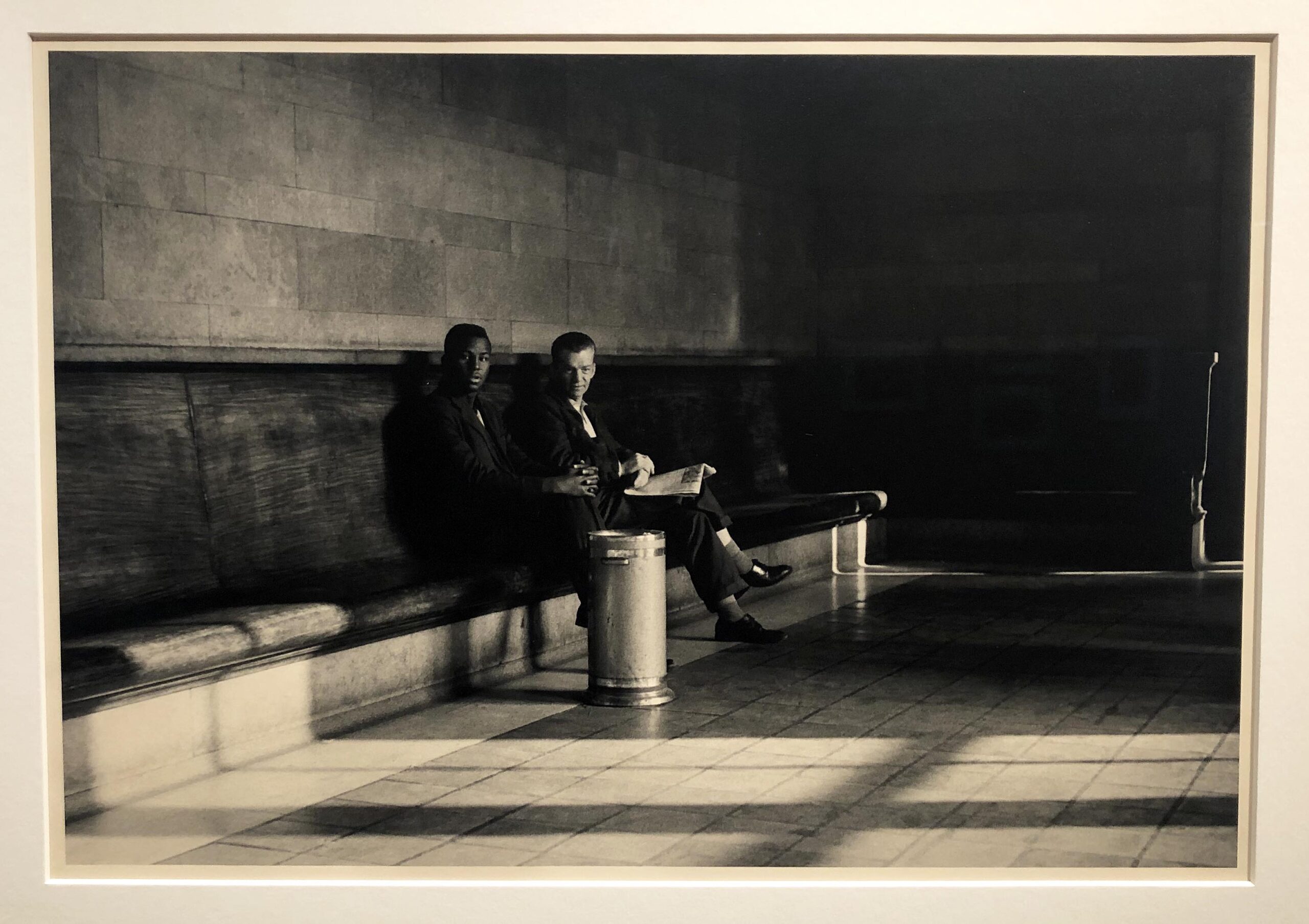
Russ Marshall, Men’s Lounge, 1959, Gelatin Silver print, 2005

Some will notice the Men’s lounge at the Michigan Central Train depot as a moment in time where the two men are gazing directly into the camera.  The low light source is probably natural light from large windows off-frame to the right.  The citation tells us it is 1959, at a time just as the civil rights movement was just gaining momentum.  The attraction here is on two fronts; the composition, off-center to the left, and dramatic light provide the symbolic idea of two young men, one white, one black, sitting next to each other with ease. For this writer, this may be the strongest work in the exhibition.

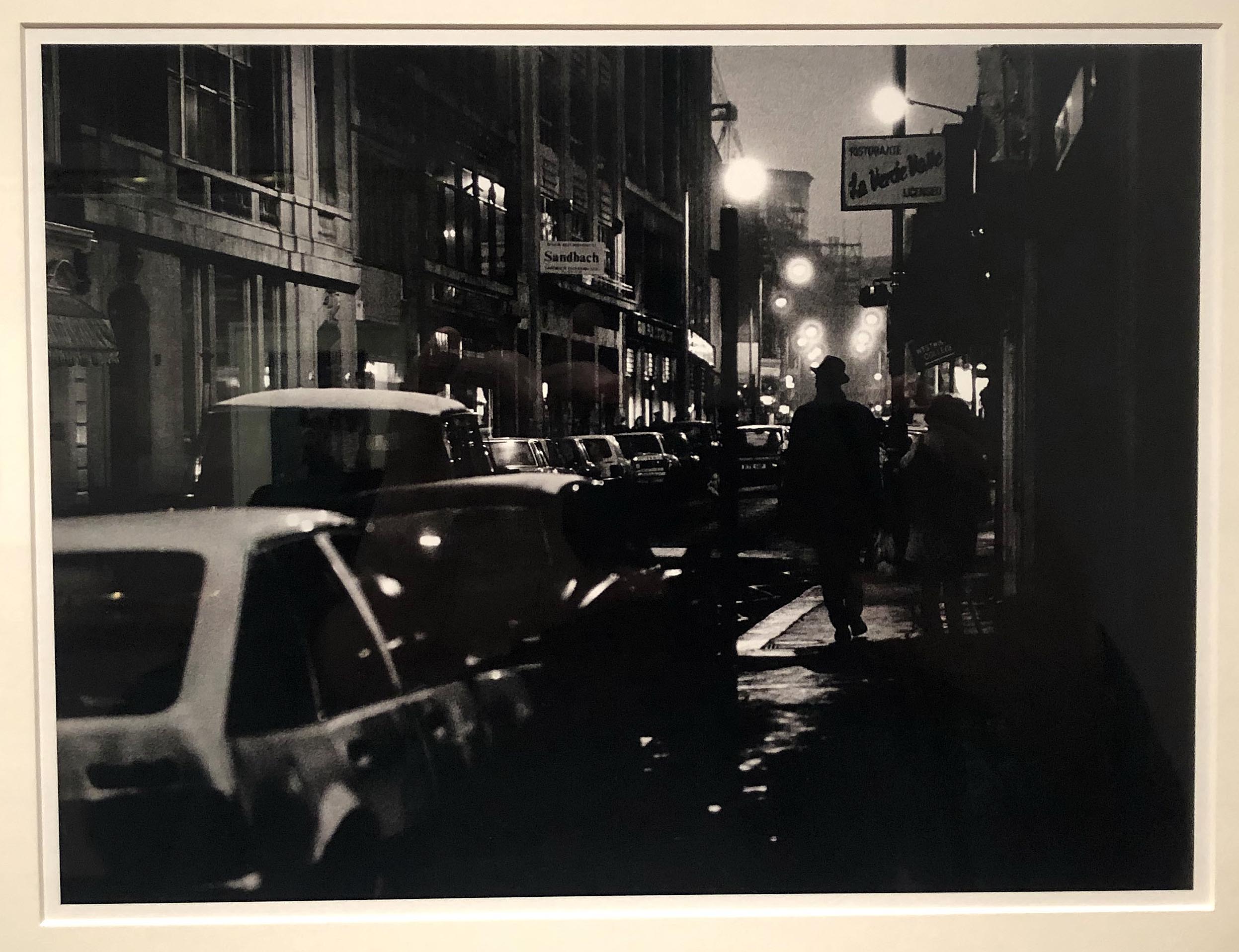
Russ Marshall, Soho District, London

In addition to Marshall’s journalistic work, the exhibition includes images featuring Marshall’s photographs taken of public life in England and eastern Europe as the Cold War was on the decline from 1987-1990. The photo taken in the Soho district of London,  captures a figure entirely in silhouette right of center, which depicts this London street’s mood, tightly packed with cars.  The street lights (possibly filtered) takes the viewer back in space along the street’s edge.  A picture like this could quickly be taken on a tripod, where the exposure and focus would require a still camera or braced himself for a slower shutter speed.  From Marshall’s images in Detroit factories and city streets, he usually includes a figure, whether it was hippies on Belle Isle or city workers in a protest line.

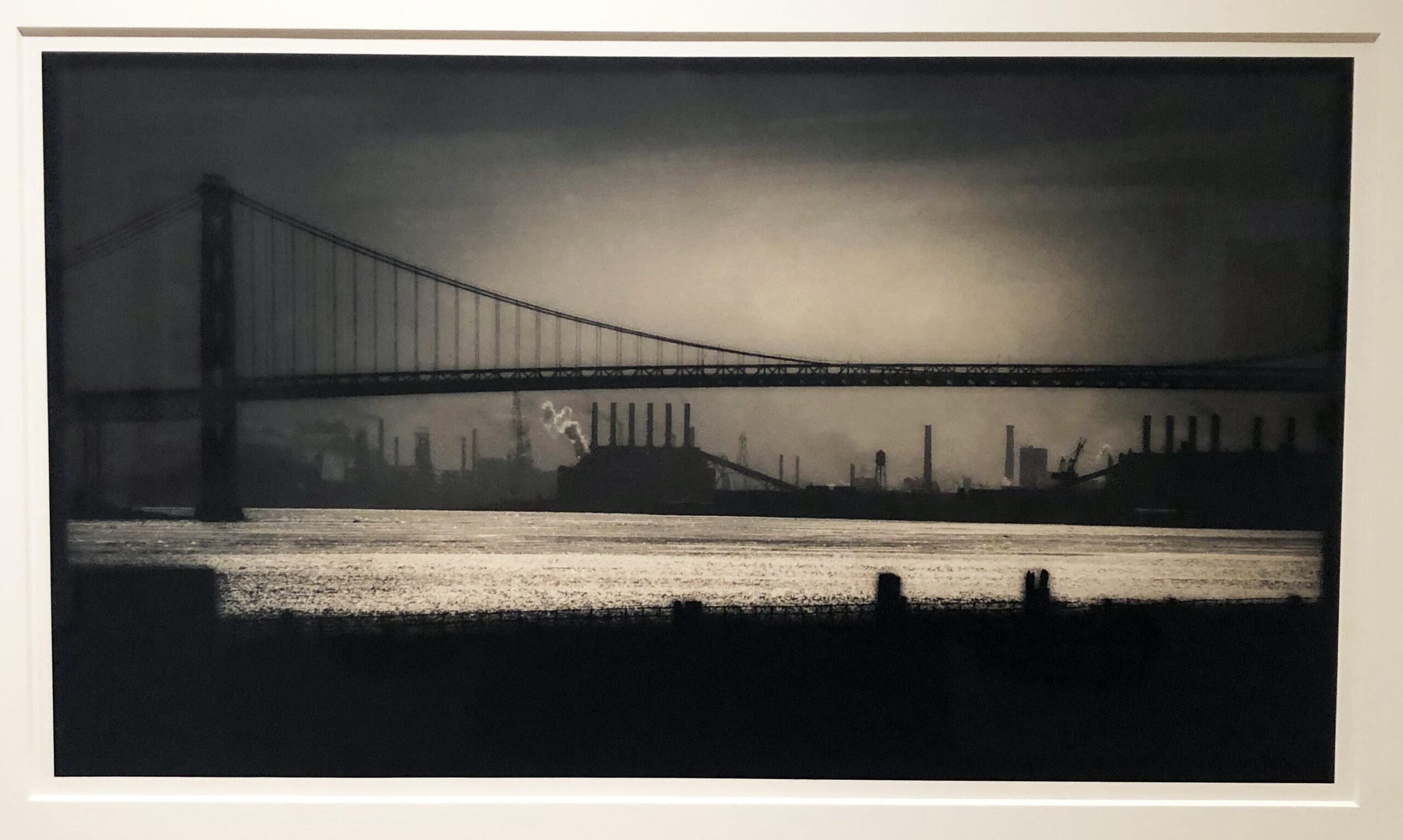
Russ Marshall, Ambasador Bridge & Zug Island

Many of Marshall’s industrial images are products of controlled light and soft focus.  Telephoto lenses can make objects in the distance appear larger, and the time of day and printing filters can create a mood.  The Ambassador Bridge and Zug Island image uses these tools and the design element of repetition to capture what he sees as a marker in time.  Often a photographer will set up his camera on a tripod and experiment with various exposures where one will work with the effect he is after.  In this image, the little smoke that billows from behind the six stacks of dark vertical chimneys catches light from the source near the horizon and creates a focal point just left of center.  The sky could be easily manipulated in the darkroom using a dodging tool that helps the late evening sky become diffused and darkened at its edges.

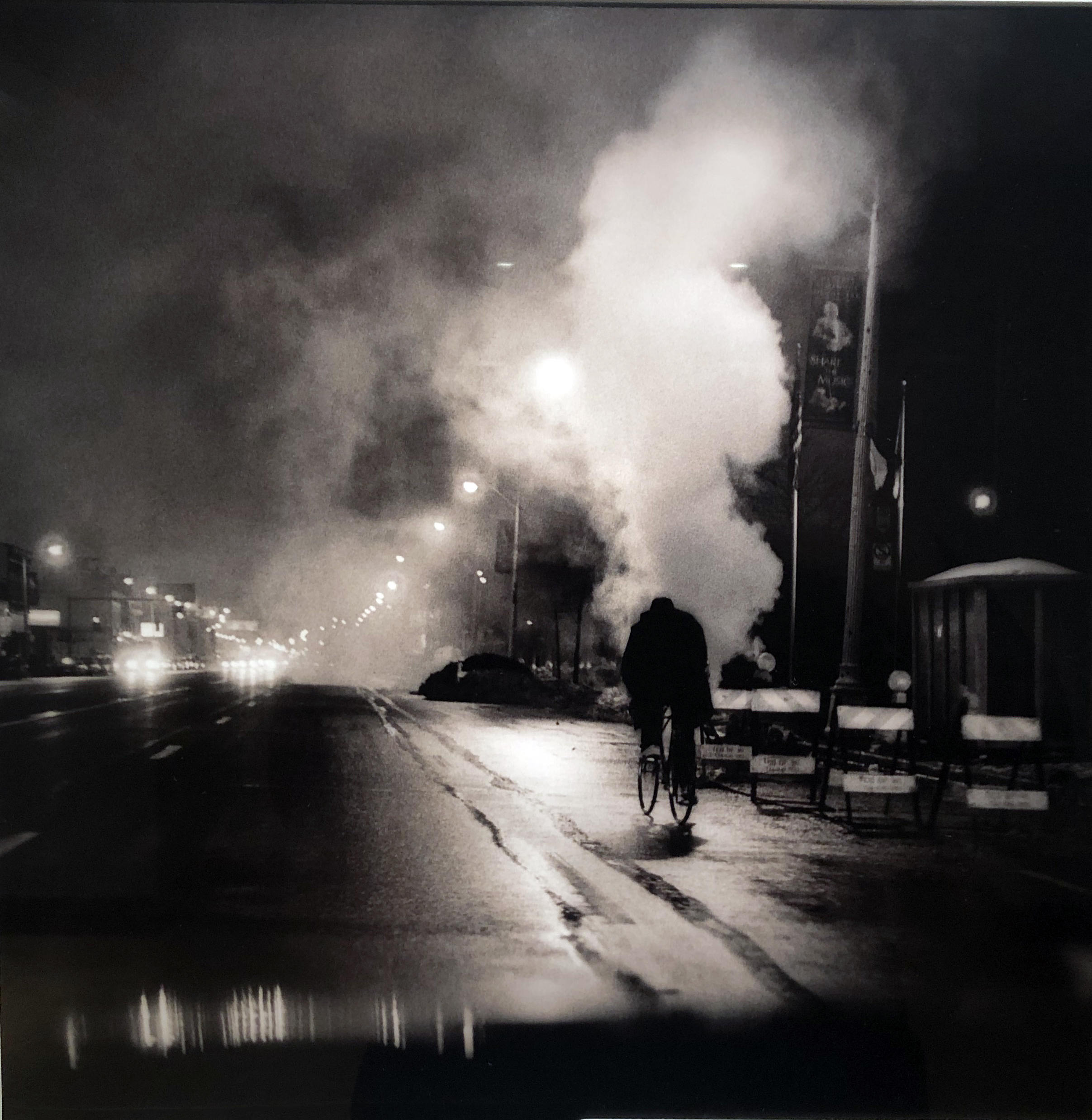
Russ Marshall, Woodward City Man, 2000, Gelatin Silver print, 2005

Similar to London’s image, Marshall grabs a moment of a man on a bicycle in silhouette with the focus on the mood and light, but it is essential to include a figure.  Why? Because it humanizes the setting and provides the viewer with a sense of scale. I asked Marshall about the square formatted images that could suggest using a 2.25-inch format to present square-framed compositions, but he said the square was created in the darkroom from a 35 mm negative.

It would be easy to say that these images fall under the influence of Robert Frank, who spent time in Detroit documenting the auto industry and the people of Detroit.  It would be impossible for someone so dedicated to photography as Russ Marshall to not be drawn to the work of Robert Frank.  Photographers who have seen Frank’s book, The Americans, and are familiar with his images, still feel the overpowering influence of his work today.

The exhibition at the Detroit Institute of Arts is organized by themes: Everyday Detroit, Public Life, Workers, Sounds of Detroit, and A Lens Towards Europe, including some rare images of an intact Berlin Wall.  Although most of Russ Marshall’s work was journalistic by the nature of the subject, his eye for artistic compositions that transcend time makes the work a perfect exhibition for the DIA.

Detroit Institute of Arts, Museum Hours: Wed – Fri  9am – 4pm, Sat – Sun 10am – 5-pm

Closed Mon & Tues   The museum will be closed New Year’s Day.


Mark Beltchenko @ MFSM

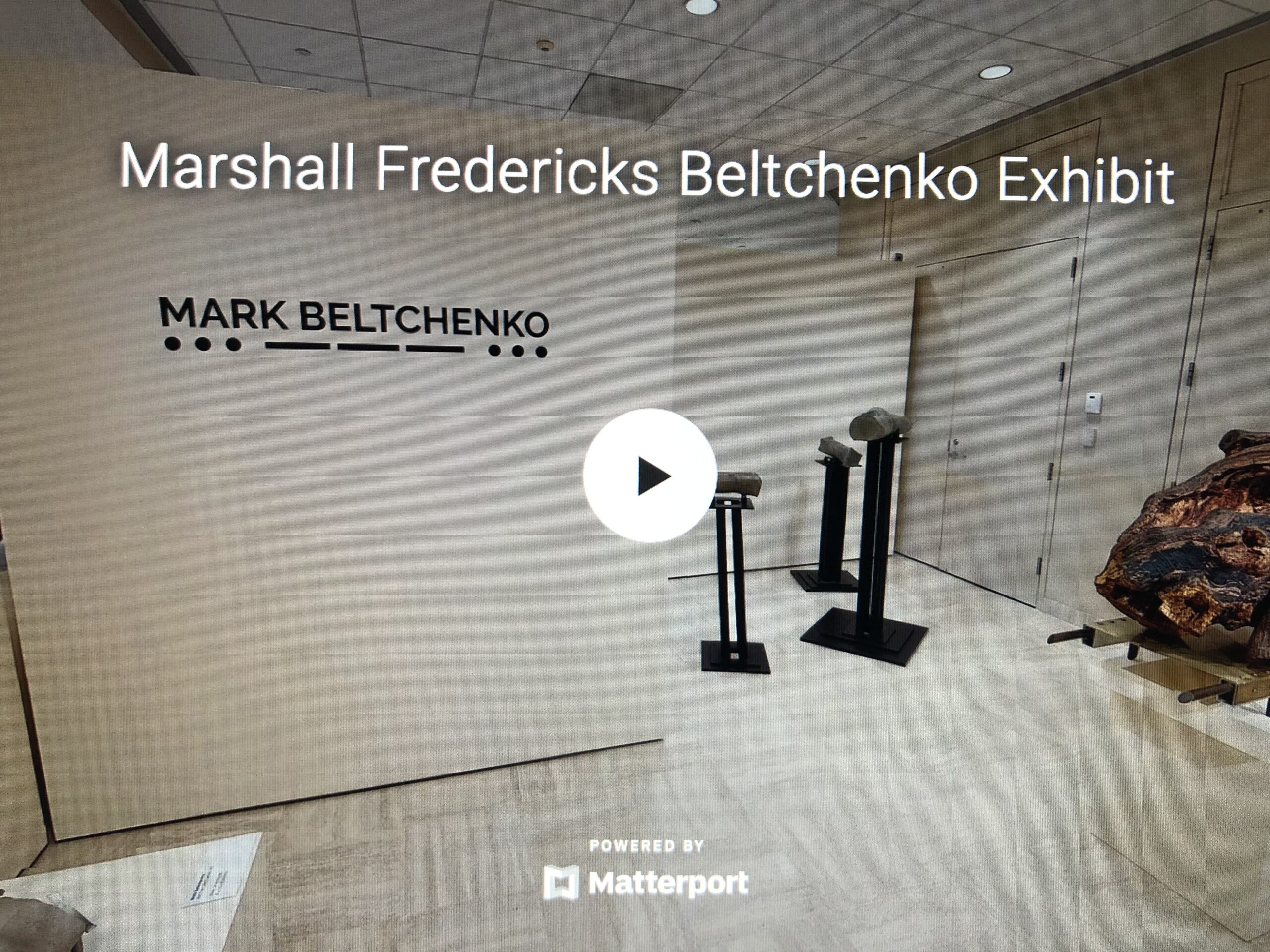
Marshall M. Fredericks Sculpture Museum at Saginaw Valley State University exhibits the work of Mark Beltchenko

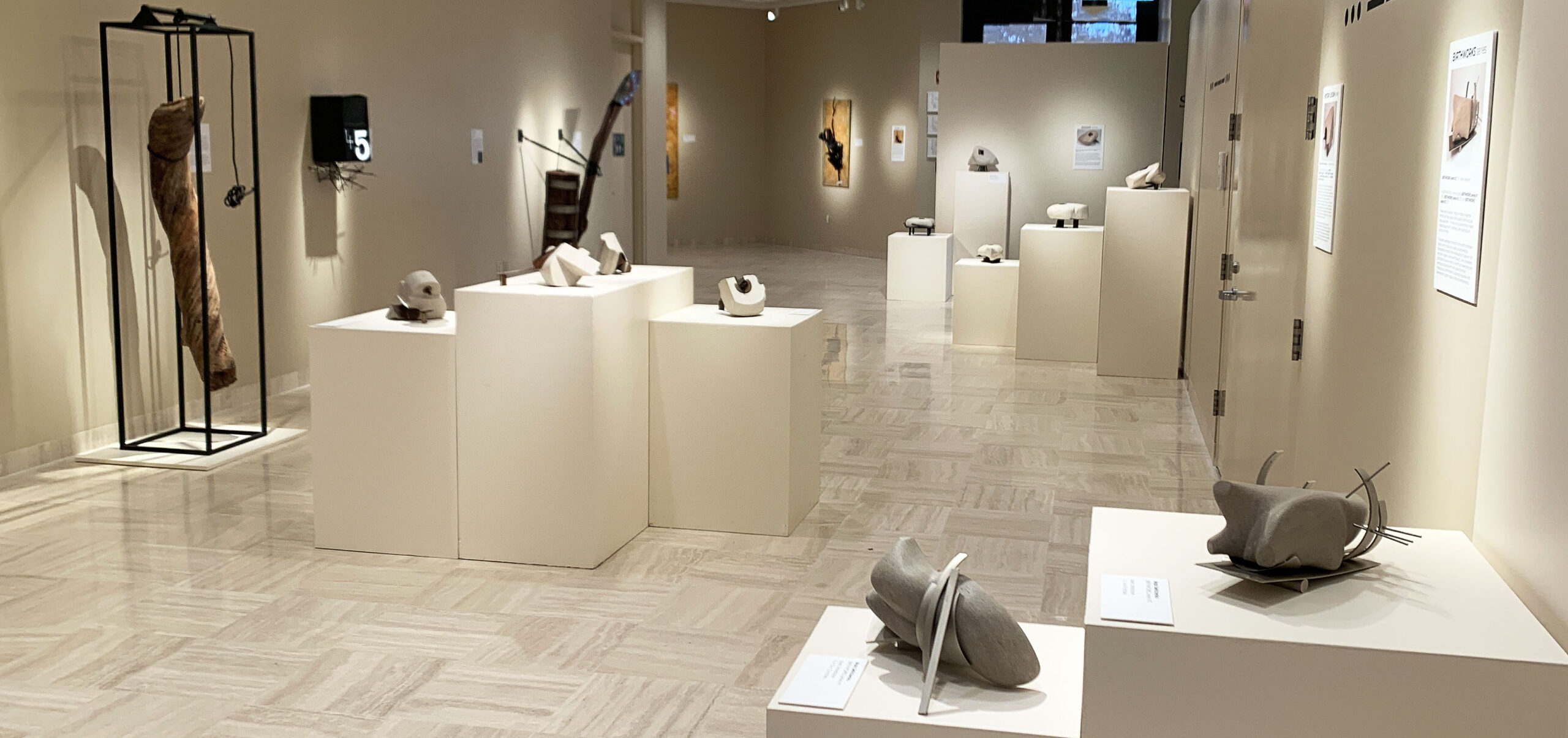
Mark Beltchenko, Installation image, Images courtesy of MFSM.

The Marshall M. Fredericks Sculpture Museum conducted its 2018 Regional Biennial Juried Sculpture Exhibition, a state-wide competition for sculptors, and the first prize went to the Detroit Artist Mark Beltchenko.  Part of that process resulted in a one-person exhibition at the museum. The Detroit-area sculptor is highly skilled in multiple media can be currently viewed online at marchshallfredericks.org  The title of this virtual exhibition ‘SOS (or ***—*** in Morse Code) is often used to denote phrases such as ‘Save Our Ship’ and is comprised of six different series of works by Beltchenko: INSIDER, BIRTHWORKS, HISTORY LESSONS, NOT MY PRESIDENT, PEDESTAL, and DISTRESS, spanning from the year 2006 to the most recent works completed in May 2020.

Mark Beltchenko, MFSM, virtual exhibition at their website, 11.2020

Museums in Michigan and around the country have been hosting virtual exhibitions due to the Covid-19 regulations and have harnessed various technologies to assist in the process.  The MFSM used MatterPort technology, allowing the viewer to begin at the open of the exhibition and proceed for a self-controlled visit through the virtual space. https://www.marshallfredericks.net/mb

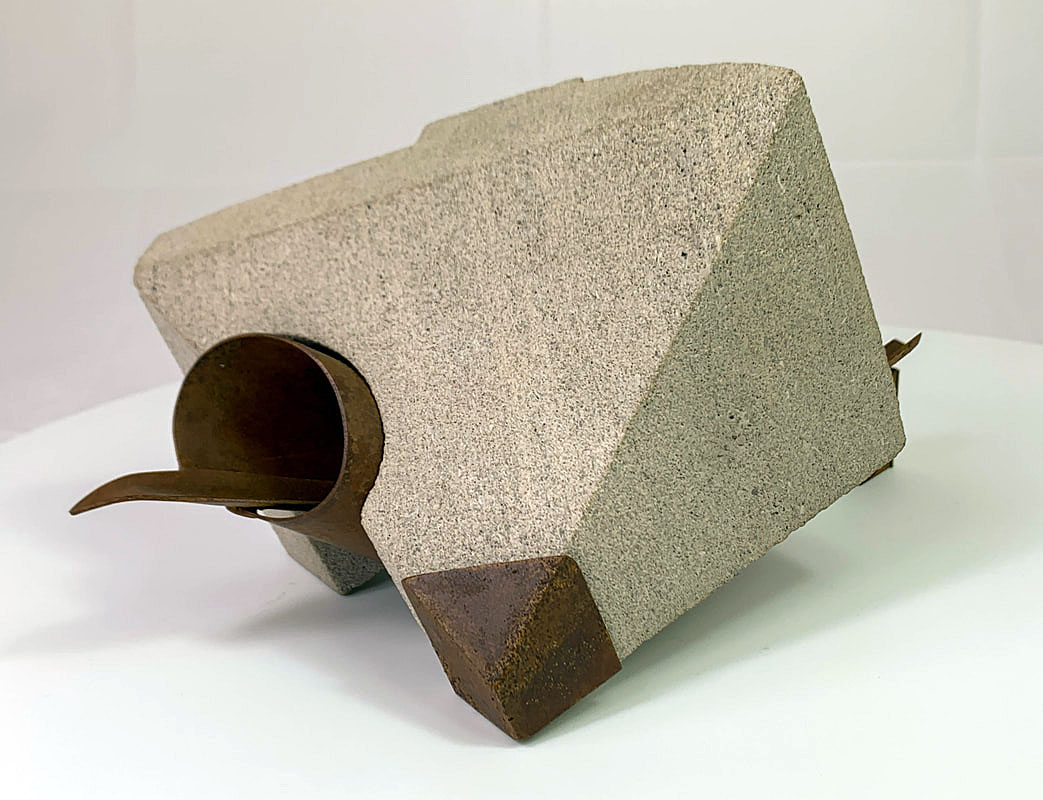
Mark Beltchenko, HISTORY LESSON – 3rd STONE steel, limestone, brass 6 x 11 x 8 inches

As mentioned, Beltchenko’s work is sorted by what he calls series, and these stone pieces are cut from building parts and then combined with other material. Steel, brass, and limestone carved to look like concrete structures are the ghosts of a man-made world in decay. The metals protrude from and through the concrete-appearing objects as the sculptor reclaims the man-made world’s parts.

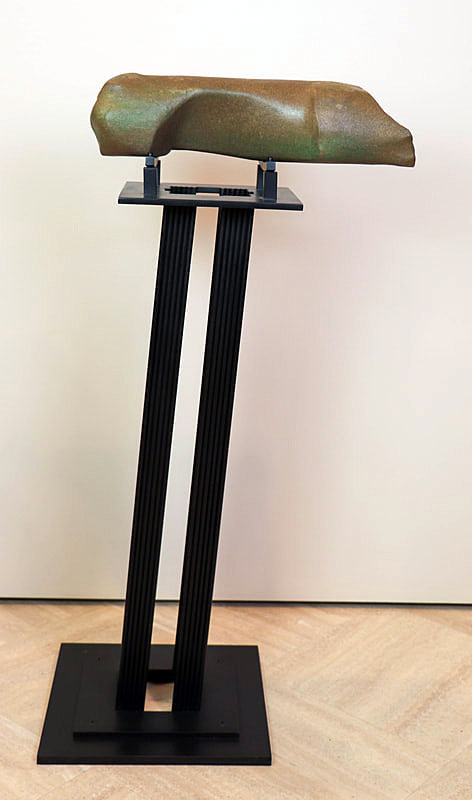
Mark Beltchenko, PEDESTAL SERIES #2, limestone, steel

Another series is Beltchenko’s pedestals. This series is a dystopian view of what art could look like in a world void of artistic expression and freedom. The sculpture, Pedestal #1 has an engraved plaque that states “1 of 3 carved objects discovered on the North American continent of Earth.” Art encapsulates and makes possible reasonable communication throughout the history of humankind. The limestone has been carved to resemble human bone as the pedestals are made of steel vein structures that are bare, out of balance, and leaning uncomfortably on edge.

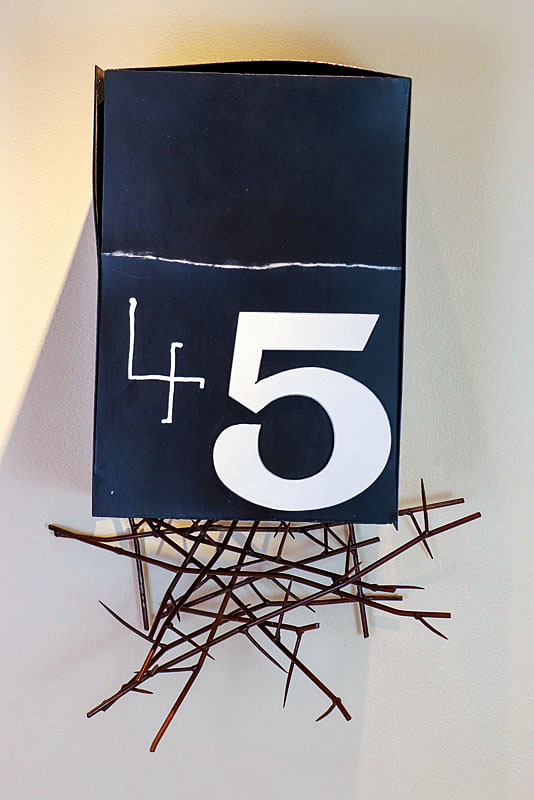
Mark Beltchenko, GOOD OLE NUMBER 45 – steel, 22 x 13 x 24 inches

Artists are people with political views, but few choose to bring those views into their art.  Mark Beltchenko is a three-dimensional artist who decides to devote a small part of his work to his view of the United States’ 45th President.  The artist uses thorns in this artwork represent the poisonous nature of the 45th President and his current administration; the hiring’s and the firings, the infighting, the tell-all book writing that now exists.  So much so, it requires the museum to place a disclaimer upfront: CAUTION This exhibition contains subject matter and imagery that some may find difficult, disturbing, and uncomfortable. Museum staff is available to discuss the works and the artist’s intent.

“The views and opinions expressed in this exhibition are those of the artist and do not necessarily reflect those of the Marshall M. Fredericks Sculpture Museum, Saginaw Valley State University, our funders or sponsors, including Michigan Council for Arts and Cultural Affairs.”

The director of MFSM, Megan McAdow, is quoted from a review, “Beltchenko is not a loud or verbose man, but his work screams at us with a dire urgency. That is not to say that his work is obvious; rather, it is not. It requires effort. One must spend time with the work and breathe into it. You may not immediately recognize the discourse; however, allow yourself to linger, and as one lingers, the layers begin to unfold and reveal its meticulous detail and dialogue. It affects and changes you.”

Equally comfortable working in stone, steel, aluminum, wood, and the non-ferrous metals, Beltchenko’s work serves as a meditation on the good and bad in our current lives: The environment, political hypocrisy, positive growth, greed, and human narcissism – not necessarily in that order, are all covered through his works.

His three-dimensional imagery communicates ideas in ways that are both primitive and profound.

The artist, through his work, is clear about his political views. Beltchenko states: “These works reflect extreme emotion because I’m highly affected by what is going on. I’ve never been politically motivated in the past, but we are at a point where we can’t take this anymore. I have a voice, and my voice is in my art.”

Mark Beltchenko earned his Bachelor of Fine Arts from Alma College, Alma, Michigan.

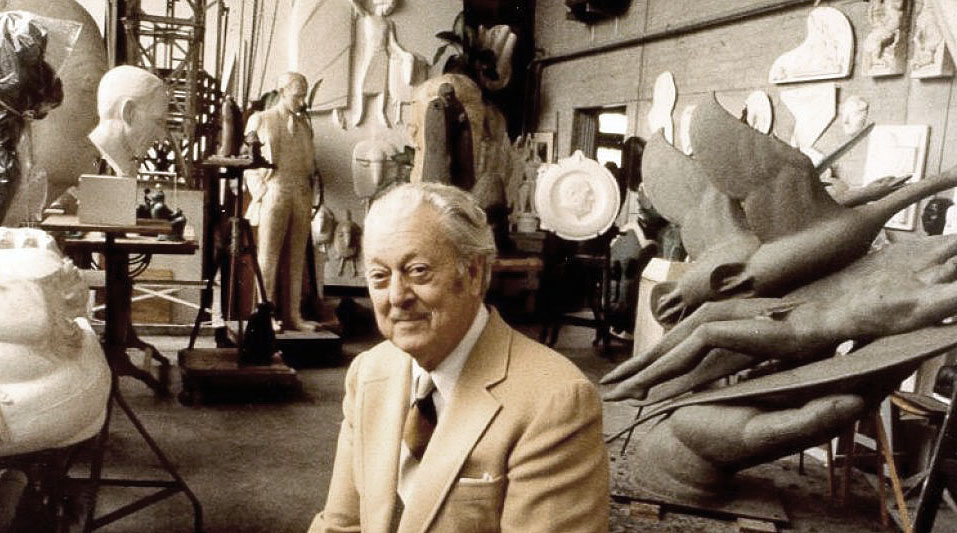
Marshall Fields, Sculptor, in his studio in the mid-1980s.

The exhibition at the Marshall M. Fredericks Sculpture Museum, Mark Beltchencko: • • • – – – • • • (SOS) runs through January 16, 2021.

To plan your visit:   https://www.marshallfredericks.net/mb


Moving Forward @ OUAG

Oakland University Art Gallery opens the fall season with a faculty exhibition

Installation image, Moving Forward, OUAG, 10.2020

Every fall since I can remember, the Oakland University Art Gallery, under the direction of Dick Goody, Professor of Art, Chair of the Department of Art & Art History and director of the Oakland University Art Gallery, has started off the fall season with a large curated show (supported with a four-color catalog) that would have required months in the planning and often brought in artwork from various parts of the United States and beyond.  Given the current situation under Covid 19 restrictions, Goody has opted to curate a faculty show, including his own work, supported with information on the web site to provide a venue for his faculty members. I suspect he is waiting until later in 2021 to present the public with something more in keeping with his previous tradition. Nevertheless, the gallery is open to the public, with Covid 19 restrictions in place,  noon – 5 pm, Tuesday through Sunday, closing November 22, 2020. It’s worth a visit.

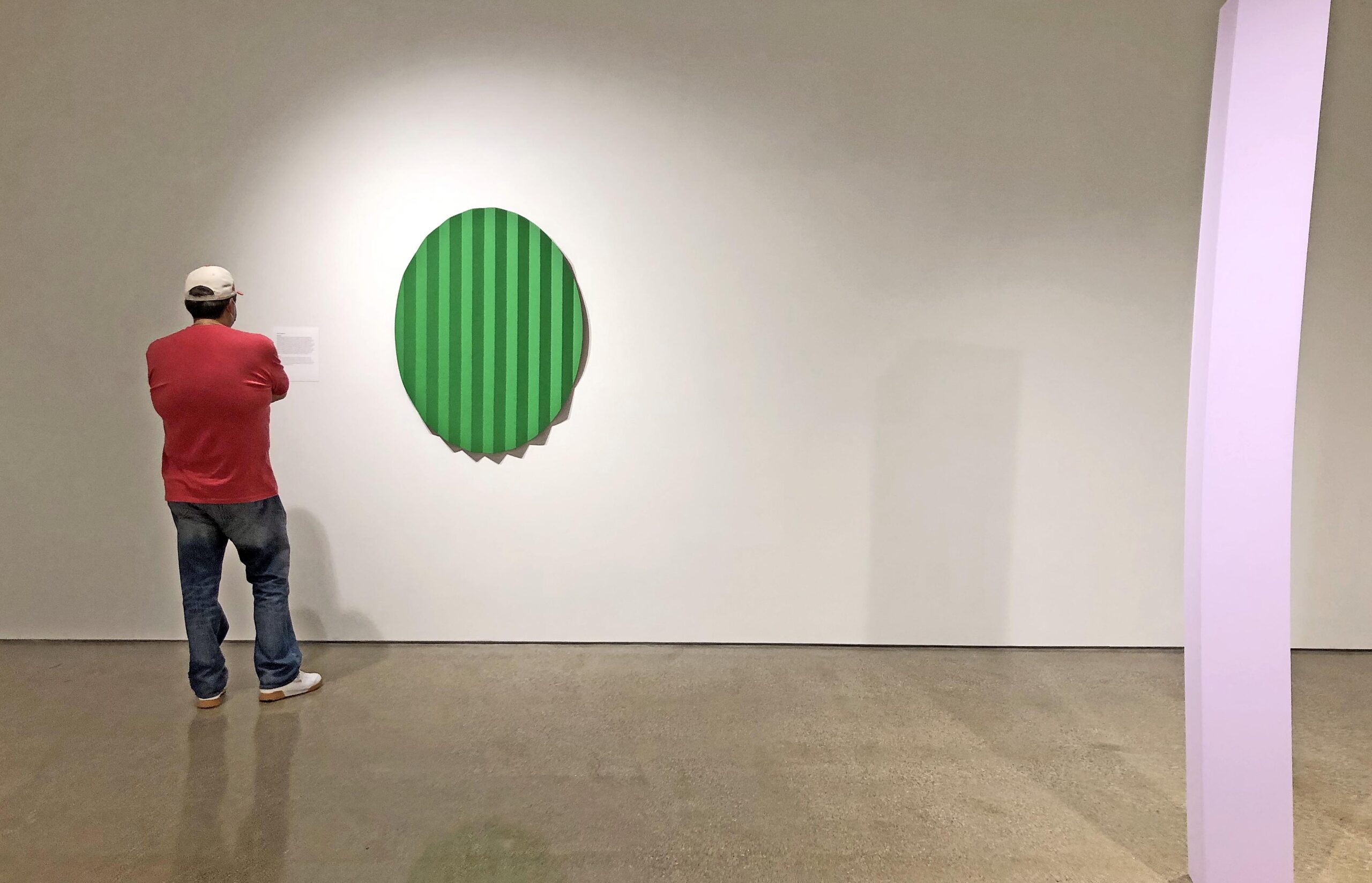
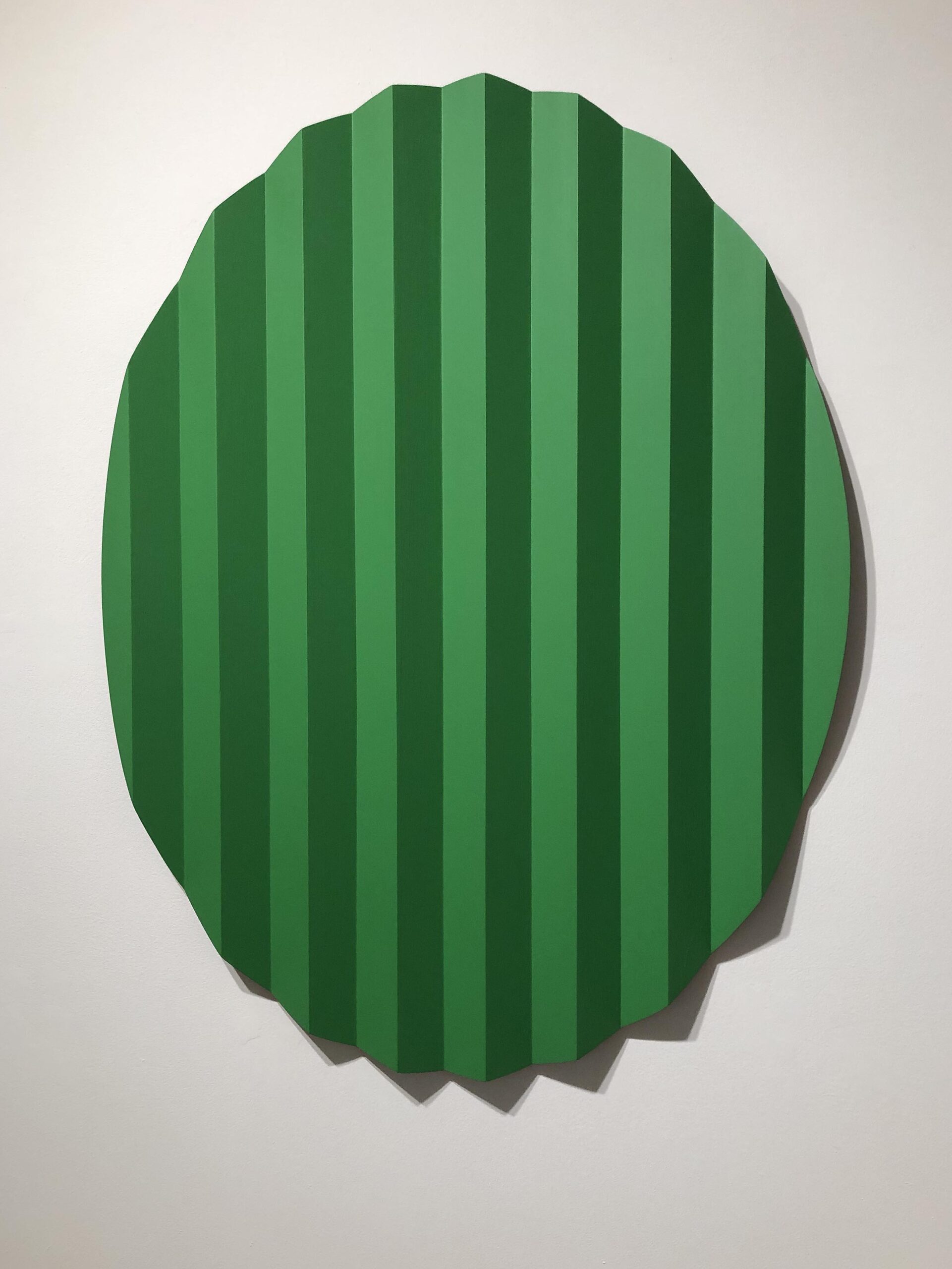
Cody VanderKay, Flattening, 32 X 43 X 3 20, PAINTED OAK, 2020


The work of art that jumped out at me was Backstage, by the artist Cody Vanderkaay, an eclipsed shape object with a highly constructed surface of vertical squared planes painted in progressive shades of green. It’s a new experience.  Not a figure, landscape, still life or photo image reference, but a newly experienced object.  In the surge of artist returning to painting the figure, Vanderkaay stays on course with his abstract imagery presenting a consistent path for his work to expand and enlighten.

He says in his statement, “The artworks explore and consider how individuals, objects and spaces interrelate, and how relationships between these entities develops over time. The sculptures displayed in this exhibit signify various states of change: A circular plane of wood appears pleated and compressed to produce a variegated effect; a vertical square column bends in diverging directions under invisible force; a small-scale architectural relief implies stories behind the scenes.”  Cody VanderKaay was born and raised in North Metro Detroit and graduated from Northern Michigan University with a B.F.A. in Sculpture and from the Lamar Dodd School of Art at the University of Georgia with an M.F.A. in Sculpture.

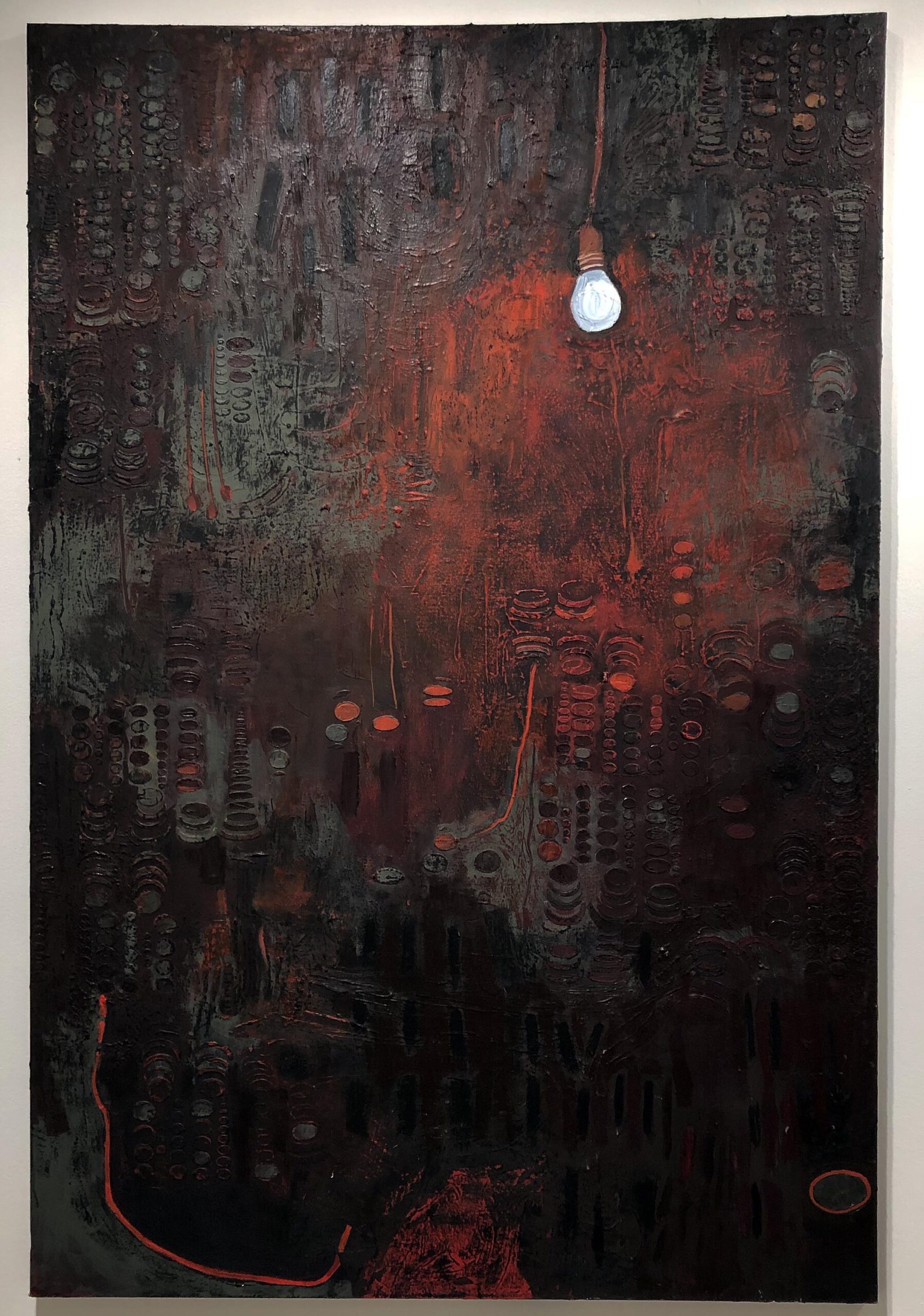
Sally Schluter Tardella, Bulb, Oil on Canvas, 72 x 48”, 2020

The work of Sally Schluter Tardella, Bulb, also attracted this writer, a sort of melancholy oil painting that revolves around a painter’s favorite subject, light.  This single bulb illuminates its surrounding  vertical space filled with tones of red, brown and grey and a repeating motif of ellipses, lines and small shapes creating a somewhat mysterious abstract space.  It is the idea that draws the viewer to the work of art highlighted by something we all recognize: a small domestic light bulb.

Tardella says in her statement, “A wall surrounds, encloses, immures. A barrier, it is a continuous surface that divides rooms, separates and retains elements. I see transparent and opaque layers of material from above and below, as I imagine cross sections of wood beam structures folding into new systems of wall. In Bulb the atmosphere is lit by the single light bulb, the space defined is both deep and blocked by surface texture, whereas in Light, the light source is transparent and the space is shallow. In Fan the screen is made of tactile architectural symbols.”  Sally Schluter Tardella uses architectural tropes as metaphor to explore personal ideas of body, gender, culture, and politics. Tardella moved from New Jersey to study Painting at Cranbrook Academy of Art.

Susan Evans, Some Art From My House, Mixed Media, 2020

This eclectic collection of photo imagery, Some Art From My House, is exactly that, a mixture of small photographic images that vary in color size, format and subject, which is meant to demystify the taking of images and their content.  There are images I like and others not so much, but it is a window into her perception of what photography is, at least for her.

Evans says in her statement, “ What we look at everyday becomes familiar and generally, familiar things become preferences which define ideas, beliefs and experiences. Although I have not made any of these works as a group these pieces become an intimate self-portrait. The true meaning of the piece is not about each image individually, instead it is about the sum, juxtaposition and connection between the different elements. Who then is the true author of the artwork?”  Susan E. Evans received her B.F.A. in photography/holography from Goddard College, and an M.F.A. in photography from Cornell University.

The Moving Forward exhibition features the work of the full-time faculty of the Department of Art & Art History at Oakland University that includes the work of Aisha Bakde, Claude Baillargeon, Bruce Charlesworth, Susan E. Evans, Setareh Ghoreishi, Dick Goody, David Lambert, Lindsey Larsen, Colleen Ludwig, Kimmie Parker, Sally Schluter Tardella, Maria Smith Bohannon and Cody VanderKaay.

OUAG Hosts Faculty Exhibition Moving Forward closing November 22, 2020


Peter Williams @ MOCAD & Trinosophes

Where do Black people go during times fraught with pain and sorrow?

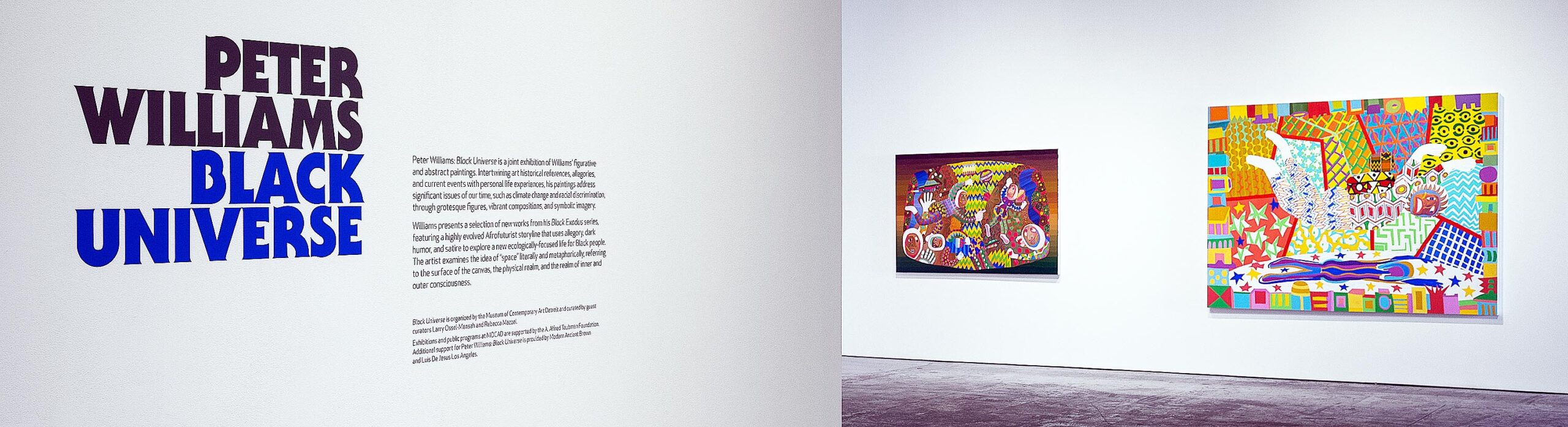
Installation Image Peter Williams: Black Universe, MOCAD

Peter Williams’ query is one with a storied lineage within the Black community. Over the course of 45 years, Williams, a senior professor of painting at the University of Delaware with time spent in the Detroit arts community and as a professor at Wayne State University, has tackled problematic social structures of white supremacy and discrimination with uncensored perspectives. Curious and inquisitive, he is often in a state of mental travel and critical culture investigation within his practice.

These themes set the foundation of Peter Williams: Black Universe, an Afro-futuristic narrative that takes the viewer on a journey through consciousness and pursuit of a better life. Within this universe, Williams creates a melanated race who travels to outer space with hopes to discover new planet homes and an end to systemic constructs of oppression, racism and injustice.

Co-curated by Larry Ossei-Mensah and Rebecca Mazzei, Peter Williams: Black Universe exhibits at Trinosophes and Museum of Contemporary Art Detroit (MOCAD) through January 21, 2021. The installation is experimental and actively fuses abstract strokes with contemporary figuration. Narration and Transitions at Trinosophes begins as a meditation. Its energizing colors, use of repetition and symmetric designs flirt with sensuality, sarcasm, spirituality and identity. Through use of abstraction, Mazzei notes that the viewer is experiencing a “painter’s painter” working through ideas and experiments that create space to sort through ideas.

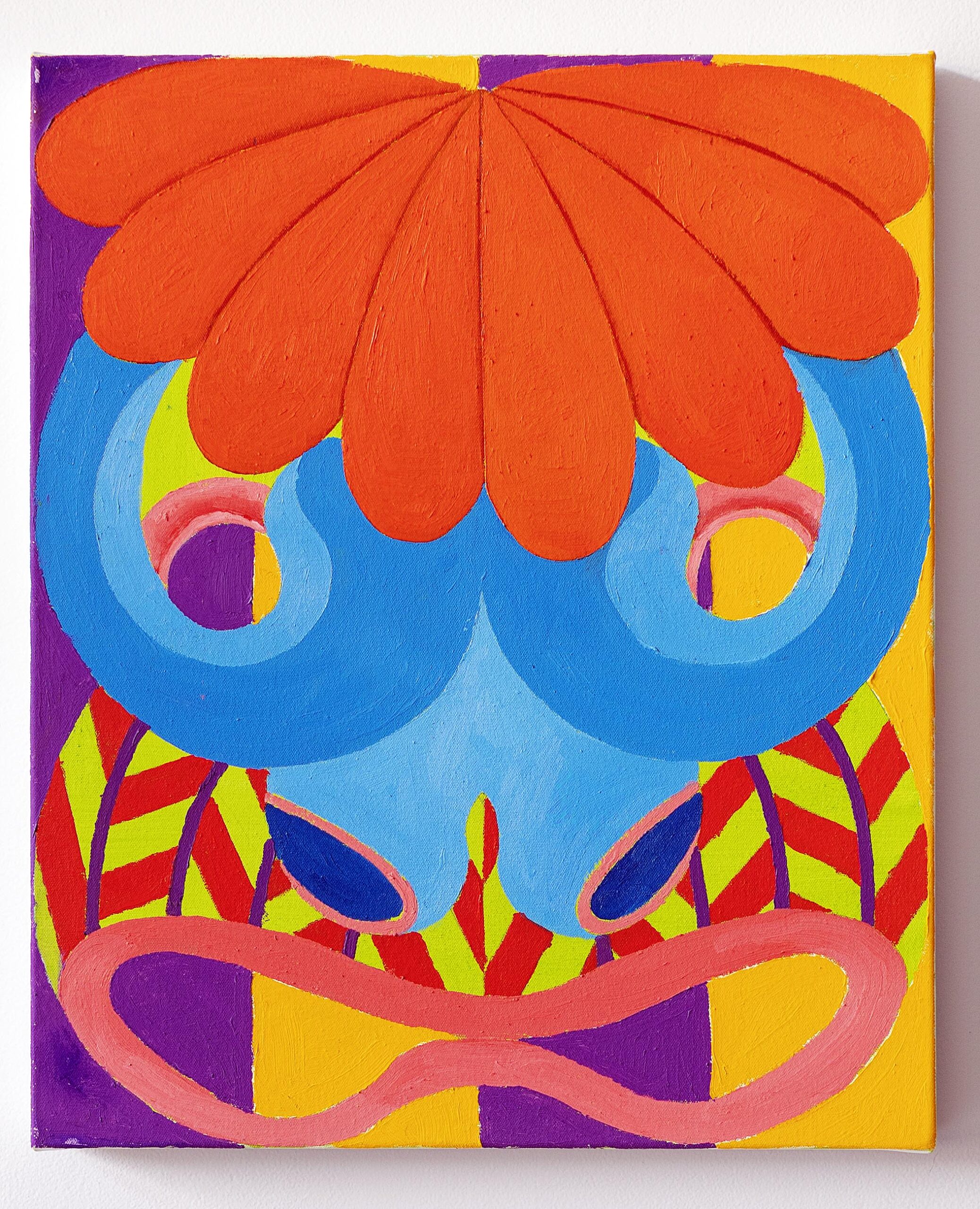
Peter Williams, OWL, 2019, Oil on Canvas; 24×20 inches


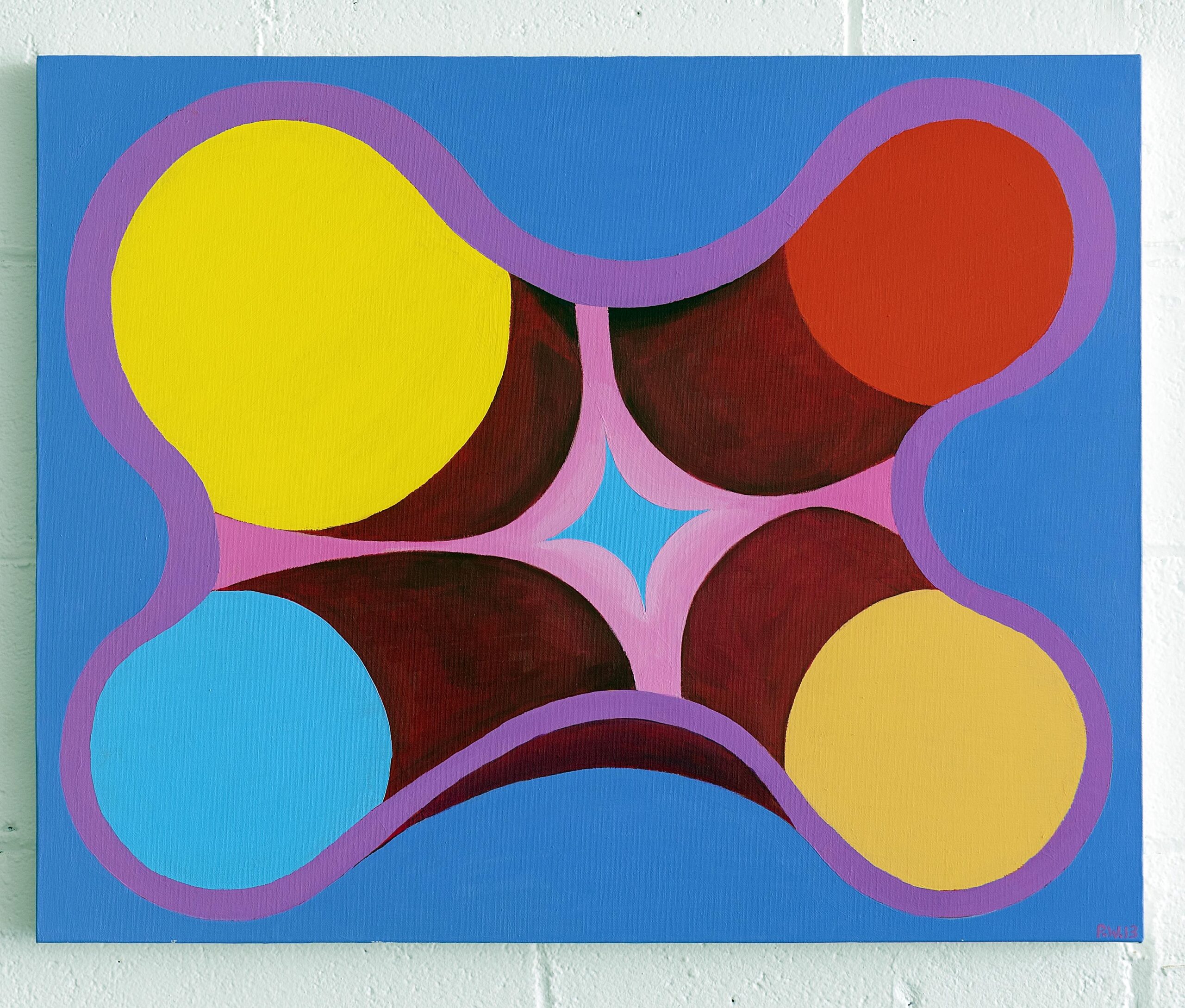
Peter Williams, SQUEEZE II, Oil on Canvas; 24×30 inches

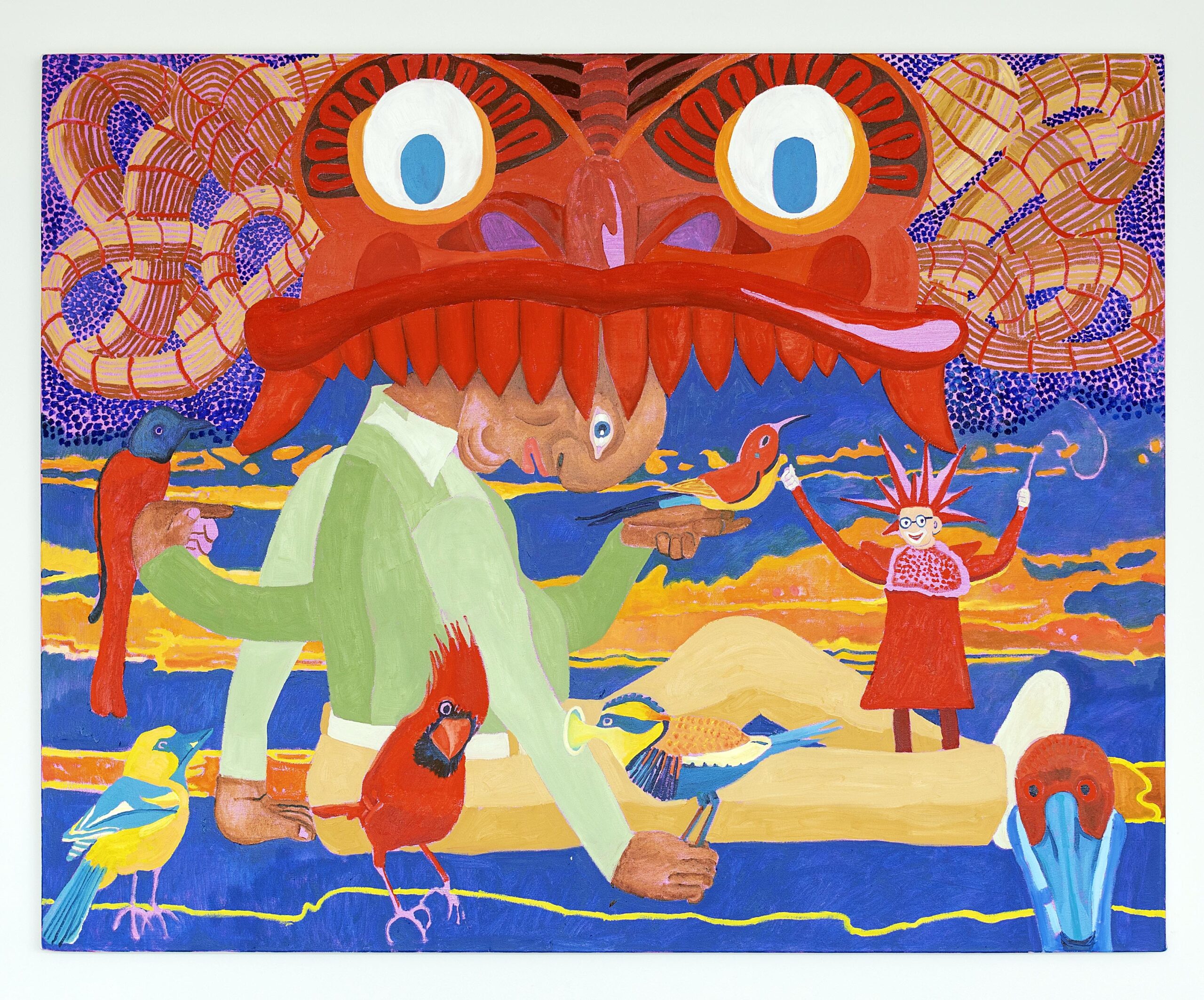
Bird Man closes Narration and Transitions. The active piece steers from the serene and transitions to dark humor and an evolving narrative. The larger canvas preludes Williams’ Black Exodus suite of paintings on view at MOCAD. The figurative composition is a self-portrait of the artist after a major surgery. A bit disoriented, the subject sits, appearing unbothered, in the middle of the frame with a dragon devouring his slumped body. Movement seems to be controlled by the wizardry figure in the lower right corner raising its wand. This sense of energy and twist on a thematic composition that could be viewed as defeat, may be informing what’s to come.

Peter Williams, BIRD MAN, 2019 Oil on Canvas; 48×60 inches


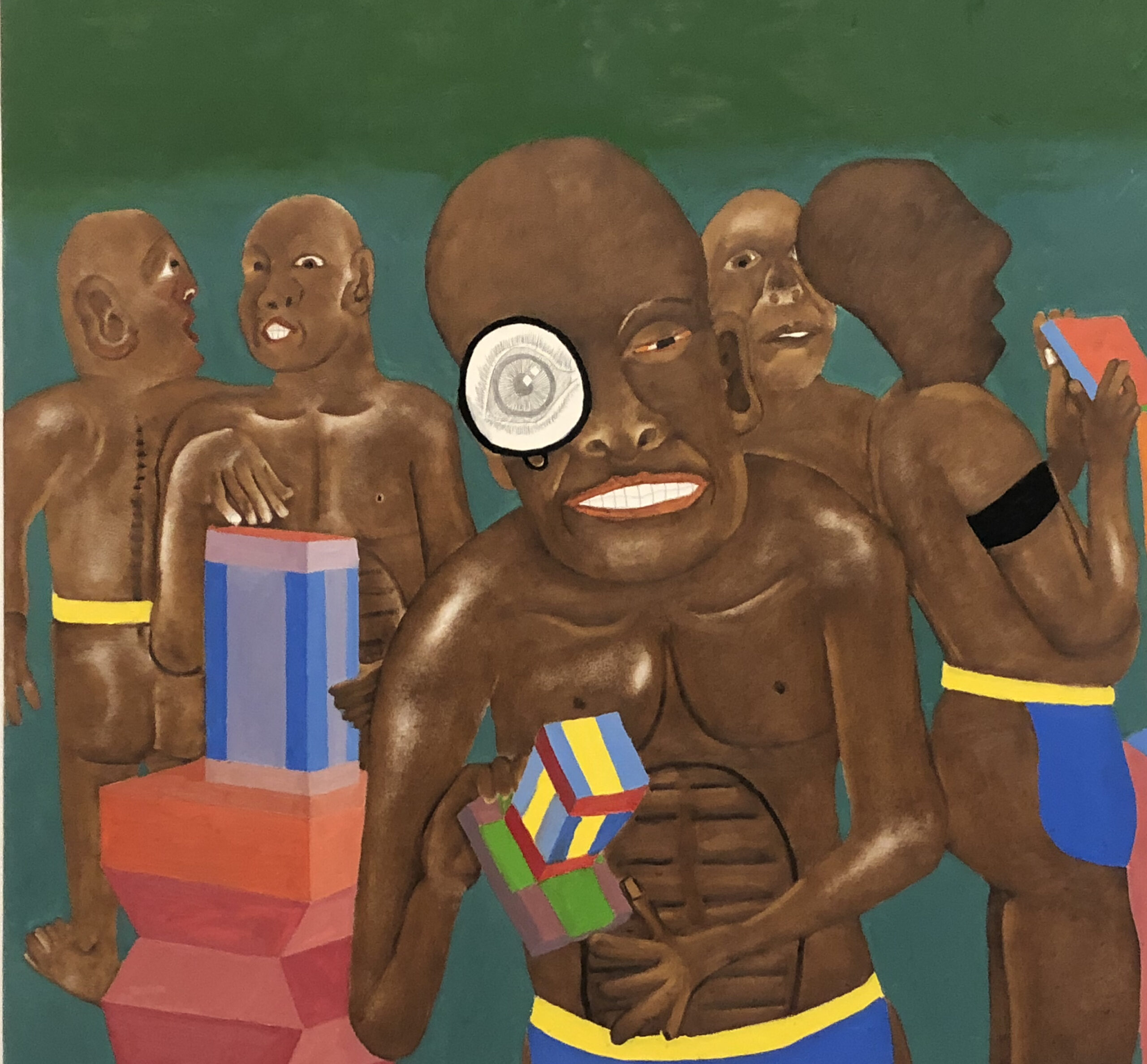
Peter Williams, SPECTACLE, 2019, OIL ON CANVAS, 48×48 inches

MOCAD’s Black Exodus gets to the gristle of the narrative using color as a luring factor toward bigger ideas and societal confrontations on large canvas. Here, Williams uses dark humor, allegory, art history, and witty satire as a way to challenge us to confront the truths about society and ourselves.

In Spectacle, blackness is on display. The tone is blunt and touches on the eerie and invasive feeling of being watched and observed. The figures are constructing the building blocks of their new alien planet. Wearing garments from historical myths, they have a heightened awareness of their surroundings but make no effort to perform, if you will, or oblige the onlookers’ expectation for something to happen. The last laugh, however, is owned by the “spectacle” with his sharp, hard gaze refocusing the lens by peering through a monocle implying a shared curiosity and the discomfort of surveillance.

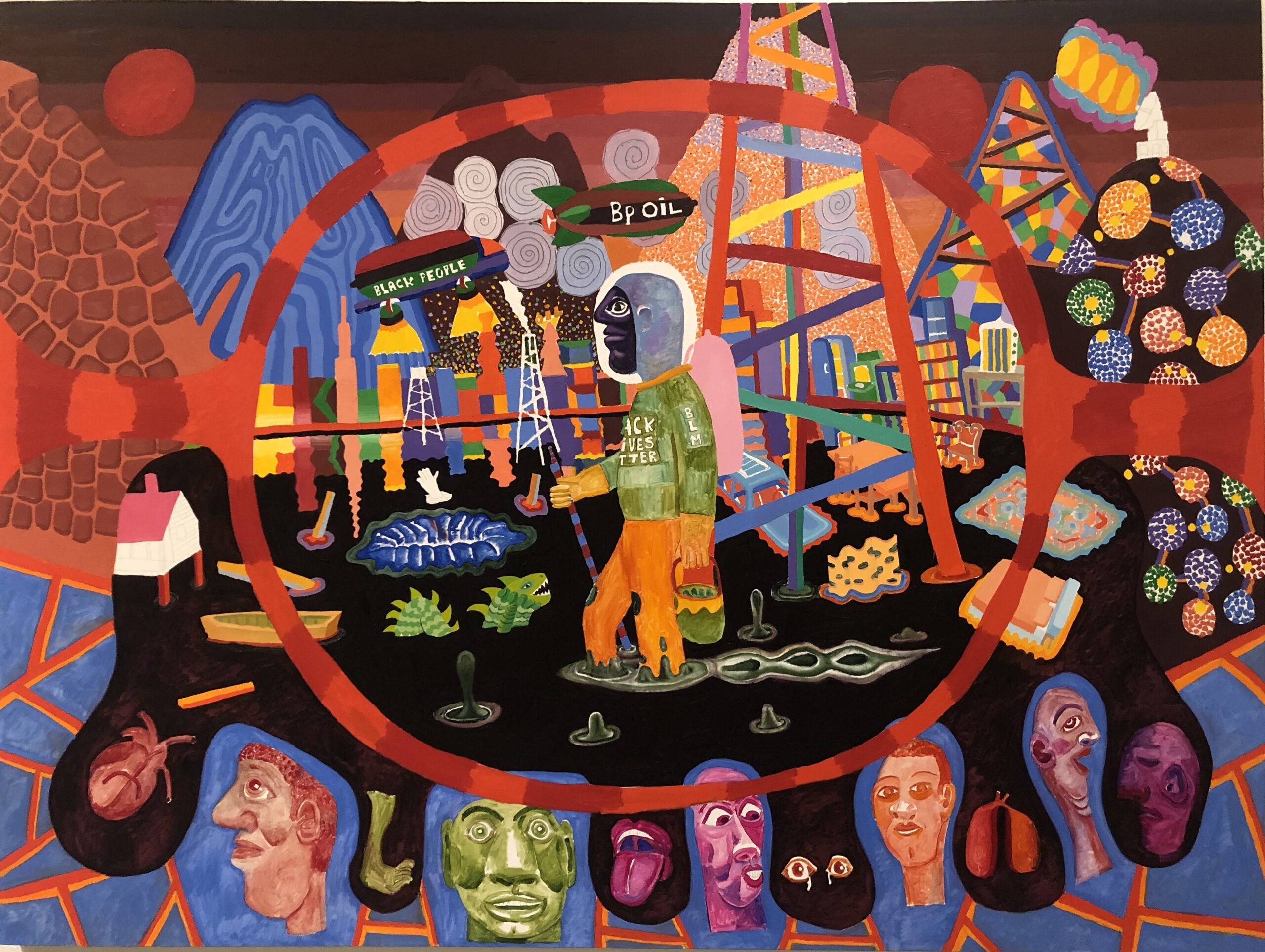
Peter Williams, BLACK PEOPLE’S OIL, 2019, Oil on Canvas, 72×96 inches

Ossei-Mensah worked with Williams in 2018, for a show at the CUE Art Foundation, and speaks to the allure of Williams’ knowledge and experimentation with color theory. “It’s a common place to enter while suggesting that you spend more time not only looking at the full picture composition but paying attention to the details,” he says. “These are the little norms that I think make Peter such an incredible, not only artist but just a thinker reflecting on the Black experience.”

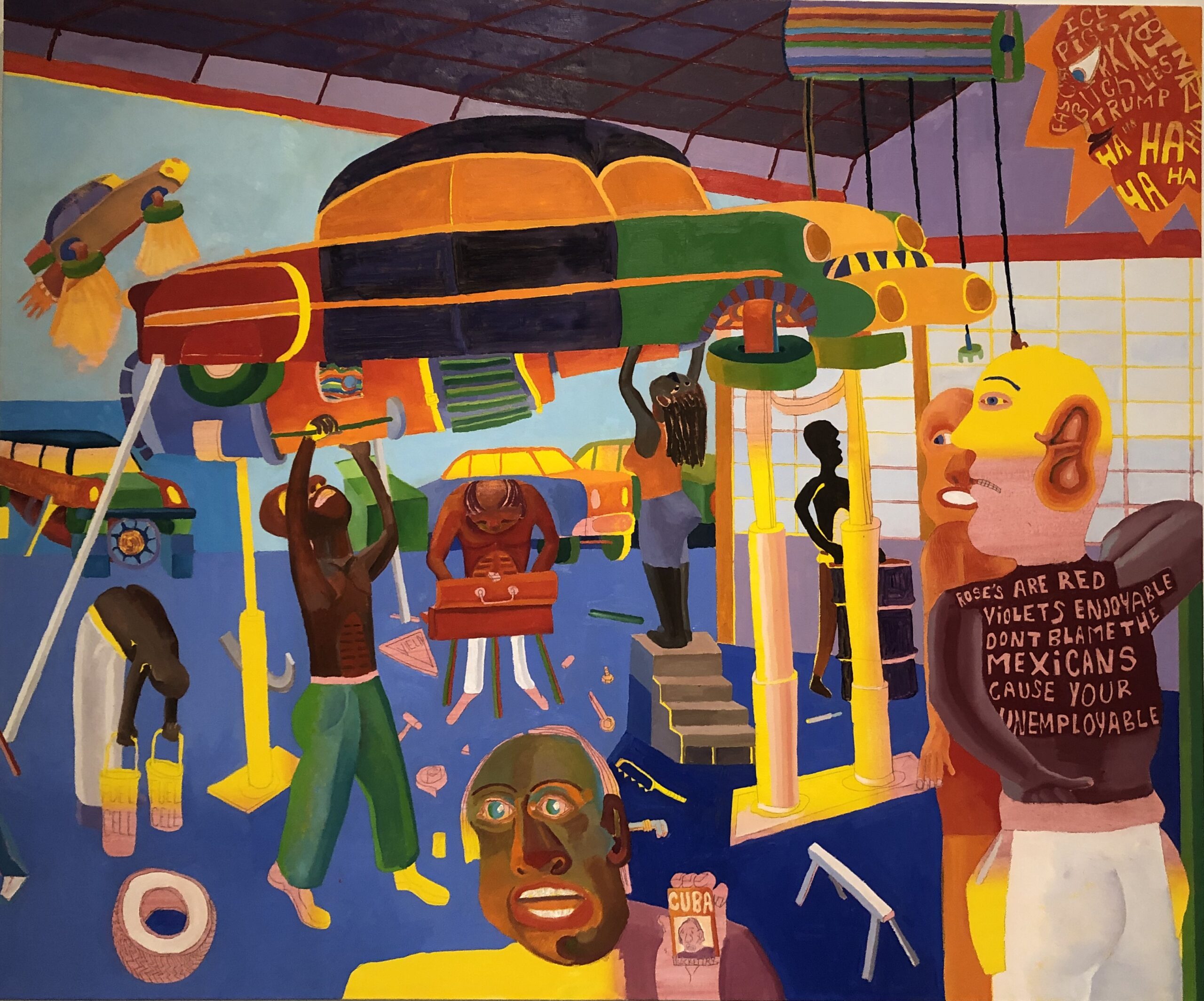
Peter Williams, ROCKETTRY, 2019, OIL ON CANVAS, 60×72 inches

The central element in Black People’s Oil  is the figure trudging through swamp-like oil in a spacesuit emblazoned with ‘Black Lives Matter’ on the front and the letters ‘B L M’ scrolled on the arm of the suit. A ‘BP Oil’ blimp flies above, likely referencing the 2010 oil spill that deeply affected the Gulf of Mexico and another flying car resembling the Pan African flag reads ‘Black People.’ A goggle lens frames the Black figure in the space suit. The piece is a complex visual suggesting routes of escape, but also questioning if that means something better or the type of desired difference that alleviates one from oppression and despair.

Rockettry doesn’t answer that but serves as a call to action. Here, Williams paints a community of people working together to build their mode of transportation and way out of a corrupt and disastrous planet. Car parts and tools are scattered, men and women work individually and collaboratively on vehicles. There’s a lot of  movement on canvas that offers commentary on the inventiveness that can be birthed within a confined environment. The details are pivotal as Ossei-Mensah references. Notice the brown man slumped over holding cans of fuel cell,  another holding his Cuba identification card, and a  community member wearing a shirt that reads: Roses are red/violets enjoyable/don’t blame the Mexicans cause your unemployable. In the upper right corner, a burnt orange, sun-like shape overlooks the community working to create a way out, but this is not a beam of light. The words: Fascist, Pigs, KKK, FBI, Lies, Bitch, Ice, Trump with multiple HaHas are carved on the figure. The community continues on their mission.

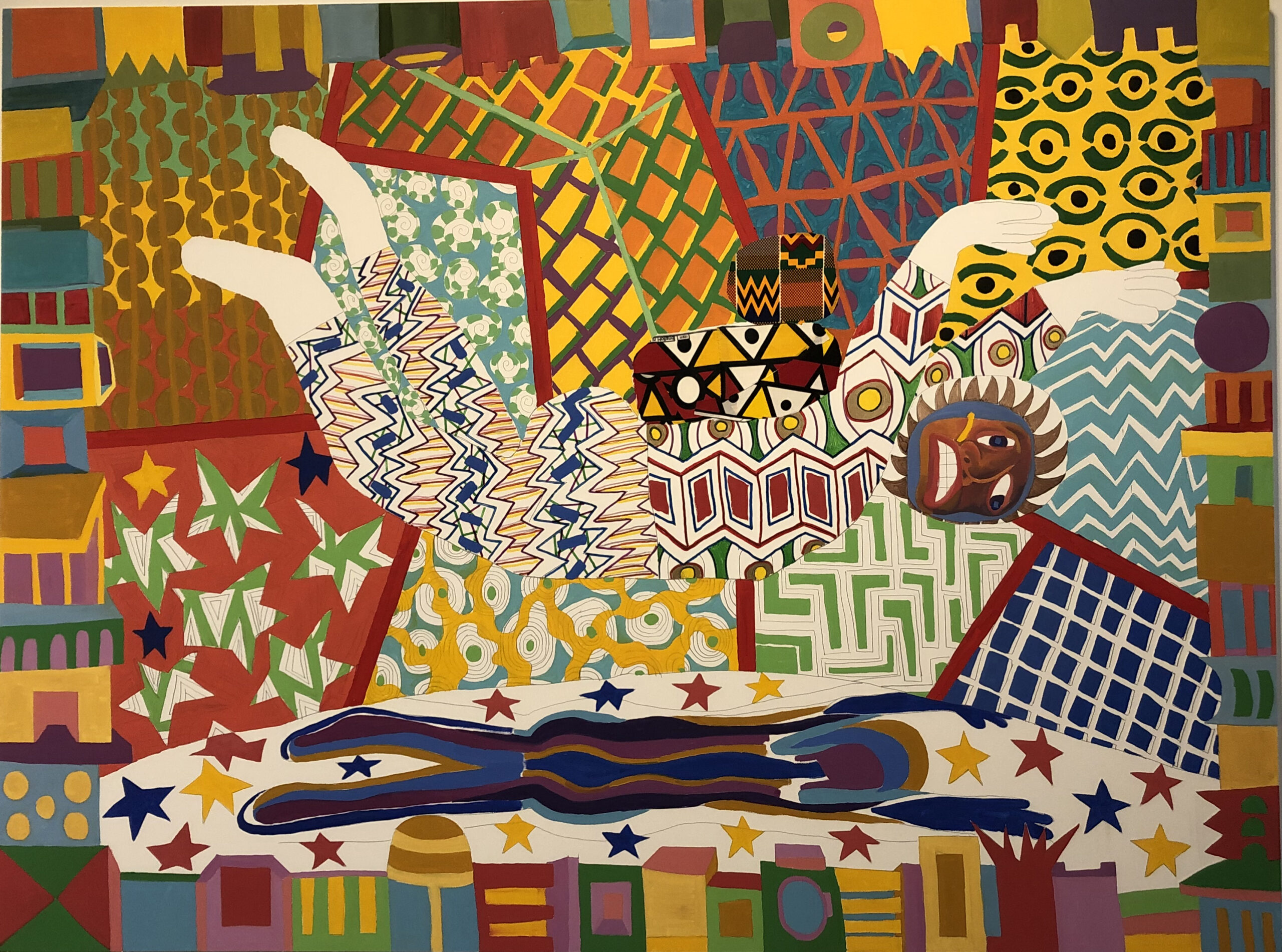
I Fell From the Sky references the history of painting the human form. We see astronauts floating in a “suspended state of consciousness” and uncertainty regarding their future – a testament to the present day in the midst of a global health pandemic,  hyper-visible racial and political tensions. The astronauts hands are  covered with white gloves, referencing the minstrel show and television shows illustrating Black people as cartoon buffoons. The visual statement traces a traumatic past that has seeped into mainstream consciousness in various forms from  — some of which holding such an aesthetic appeal the foundational roots have been obstructed from memory or a desire to know. But Williams doesn’t paint frivolously. History is significant even while the artist deciphers thoughts and colliding worlds.

The figure at the core of the canvas is flying in a space suit designed with stitches of Kente cloth – an homage to Ghana in West Africa. The symbolism here is communication. Gold articulates status and serenity; yellow is fertility; green speaks to renewal; blue aligns with spirit and harmony; red is passion and black represents a union with ancestors and spiritual awareness. These elements arrive in the conscious state, perhaps serving as a guided language for Williams while conceptualizing the series and dialogue that discusses the Black experience.

Peter Williams, I FELL FROM THE SKY, 2019, OIL ON CANVAS, 72×96 inches

Peter Williams is an educator and artist with the condition of Black lives always at the forefront of his creative transport. In Black Universe, we journey along an experiential thinker and conversationalist en route to another world within and beyond the known. He extends the invitation to use your imagination when digesting the complexity of his works and exploring how to come to terms with the world that presently exists. The solution does not rest in escapism that suggests something new is better, but the power to choose and decide how to make the lives we lead on this planet our version of utopia.

Peter Williams at MOCAD (Museum of Contemporary Art – Detroit) and Trinosophes.

*Writer’s Note: Thank you to Rebecca Mazzei,  Larry Ossei- Mensah  and Zeb Smith for conversation and insight.

We Used to Gather @ Detroit Library Street Collective

Installation, We Used To Gather, Library Street Collective, 8.2020

The walls of Detroit’s Library Street Collective are lined floor to ceiling with vibrant canvases that match the bright, sunny days of this hot Detroit summer. The gallery’s first opening since the widespread closures following the COVID-19 pandemic, We Used to Gather ambitiously responds to communal anxieties with a series of figurative works by 26 different artists. As we begin to tiptoe wearily out of social isolation, many of us are reflecting on what we learned both about ourselves and our relationships with our communities over the past few months. The show reminds us that reflections of ourselves are everywhere we look and often, we struggle to make sense of what we see. The title itself recalls a time when we were able to gather freely, only here, the presence of others is supplanted by two-dimensional representations.

Tylonn J. Sawyer, American Gangsta: Uncle Sam, 2018 Oil on canvas 48 x 60 in. (121.92 x 152.4 cm)

At the very entrance of the gallery, the eye is immediately drawn to Tylonn J. Sawyer’s American Gangsta: Uncle Sam, 2018. Sawyer’s fine technical skill and command of his medium shine through in this life-sized depiction of a Black man sporting a clean suit and touting a cigarette in front of the American flag. With a gun tucked in his belt line, he peers critically out of the canvas. His dubious expression begs the question: who exists to protect and serve America? And likewise, who does America exist to protect and serve?

Conrad Egyir, Sydney King, 2020 Oil with mixed media on panel 48 x 48 in. (121.92 x 121.92 cm)

Conrad Egyir, JustTina, 2020 Oil with mixed media on pane, 48 x 48 in. (121.92 x 121.92 cm)

Conrad Egyir touches on similar themes in the two works he has featured in the show. In Sydney King and JustTina, his subjects are framed by another hallmark of national institutionalism: the postage stamp. Both women gaze outwards with their right hands laid gently over their hearts. Ghanan-born Egyir is interested in how African identity is perceived as it travels across the diaspora. The postage stamp is quite literally a vehicle for the transportation of words and ideas. It also serves as a sort of tribute to those prominent figures who we, as a society, have chosen to honor. In these two works, Egyir chooses to honor Black women, whose lived experiences and contributions are far too often overlooked in daily life.

Maja Djordjevic, Be here and be loud, 2020 Oil and enamel on canvas 48 x 36 in. (121.92 x 91.44 cm)

Maja Djordjevic, Waiting and hoping, 2020 Oil and enamel on canvas 48 x 36 in. (121.92 x 91.44 cm)

A little further down the salon-style lineup of paintings hangs a work by Serbian artist Maja Djordjevic. The artist has two pieces featured in the show, both of which depict a pixelated nude female figure in dramatic posture. With her stiff limbs and mouth fixed open, she bears semblance to an inflatable sex doll. Though painted entirely by hand without tape or stencils, the digitized style of Djordjevic’s work alludes to the virtual realities many of us live via the internet, especially over these past few months when contact with the outside world has been so limited. To whom do we turn for comfort during these trying times? More often than not, it’s the women in our lives, be they real or digitally imagined, who play the role of caregiver.

Gisela McDaniel, Do Right, 2020 Oil on canvas, found object, resin, flower, sound on USB, 40 x 20 in. (101.6 x 50.8 cm)

An ode to the feminine is also made in Gisela McDaniel’s Do Right. McDaniel creates visual realms where victims of sexual abuse can seek refuge from their trauma. In Do Right, a woman envelops herself gracefully in her own criss-crossed arms. Intertwined with her are two small white dogs. Bright colors, vibrant foliage, and three-dimensional trinkets fixed to the surface of the canvas all serve to delineate a personal fortress where this woman reigns free. Stories, especially as they are told and personally reclaimed by women, are at the heart of McDaniel’s work.

Jammie Holmes, Untitled, 2020 Acrylic on canvas 60 x 44 in. (152.4 x 111.76 cm)

The show also features two works by Louisiana-native Jammie Holmes. His untitled work depicts a young man sitting, facing squarely forward, on a wicker Peacock Chair. The ornate chair was popularized in the twentieth century by countless celebrities and public figures who often posed sitting in the chair for portraits, album covers, and publicity stunts. One famous Peacock Chair portrait is that of Huey Newton, co-founder of the Black Panther Party. Here, the subject is poised in a commanding position of authority, not unlike that of Newton’s in his respective portrait. It is not difficult to imagine that Holmes might have intended to invoke the radical notions of the Black Panther Party during a time in the United States when police brutality against Black people is at the forefront of national attention.

Photography attributed to Blair Stapp, Composition by Eldridge Cleaver, Huey Newton seated in wicker chair, 1967. Lithograph on paper; Collection of Merrill C. Berman

Marcus Brutus, Annie, 2020 Acrylic on canvas 30 x 24 in. (76.2 x 60.96 cm)

Along the same lines, Marcus Brutus has four intimate portraits featured in the show. Each of them center in on a Black male figure set against bright yet minimal backgrounds. Annie is calm and stoic in its presentation of a young man gazing tiredly out of the canvas. His downtrodden expression and timeless dress are enlivened by the brilliant lime-green backdrop just behind him. Traces of bright green glint off of his skin. Brutus celebrates the ordinary with his reverent portraits of familiar faces.

Pedro Pedro, Figure Fumbling for a Cigarette, 2019 Acrylic and textile paint on linen 49 x 34 in. (124.46 x 86.36 cm)

Pedro Pedro, Portrait of Kaitlin Concerned, 2019 Acrylic and textile paint on linen 19 x 16 in. (48.26 x 40.64 cm)

In fitting contrast, LA-based Pedro Pedro offers two portraits of female figures. The features of each woman are exaggerated to the point of comedic effect, yet each composition feels wholly balanced. The warm hues and richly blended colors pay service to the expressions of the women, each of which appear to be frozen in a moment of contemplation. The variation of style and concept in We Used to Gather might at first overwhelm, but ultimately succeeds in capturing the feelings of chaos and uncertainty most of us are experiencing in these trying times.

All works mentioned above as well as many others are available to view at Library Street Collective through September 18, 2020. The gallery is open Wednesday through Saturday, 12-6PM. A virtual tour of the exhibition is also available on the Library Street Collective website. 10% of the proceeds on any works sold from We Used to Gather will be donated to the Metro Detroit COVID-19 ACE Fund.

WE USED TO GATHER

Library Street Collective, July 18 – September 18, 2020  –   1260 Library Street, Detroit, MI  48226

Page 11 of 35

Powered by WordPress & Theme by Anders Norén