Critical art reviews of Detroit galleries and museums weekly

Author: Ron Scott Page 10 of 35

Brian Rutenberg and Frank Fisher @ BBAC

Brian Rutenberg, painter, and Frank James Fisher, ceramicist, open the Spring Season of 2021 at the Birmingham Bloomfield Art Center

As Michiganders crawl out of the winter and the Covid-19 pandemic (be it as slow as it is), we are greeted by the BBAC exhibitions that make it worth our time for a visit.  The main gallery features the ceramic work by Frank Fisher and Brian Rutenberg’s abstractions in the Robinson Gallery. “This is a must-see, exceptional exhibit,” said Annie VanGelderen, BBAC president and CEO. “Truly, all of our spring exhibiting artists are particularly wonderful in their own mediums.  Visitors will certainly leave inspired.”

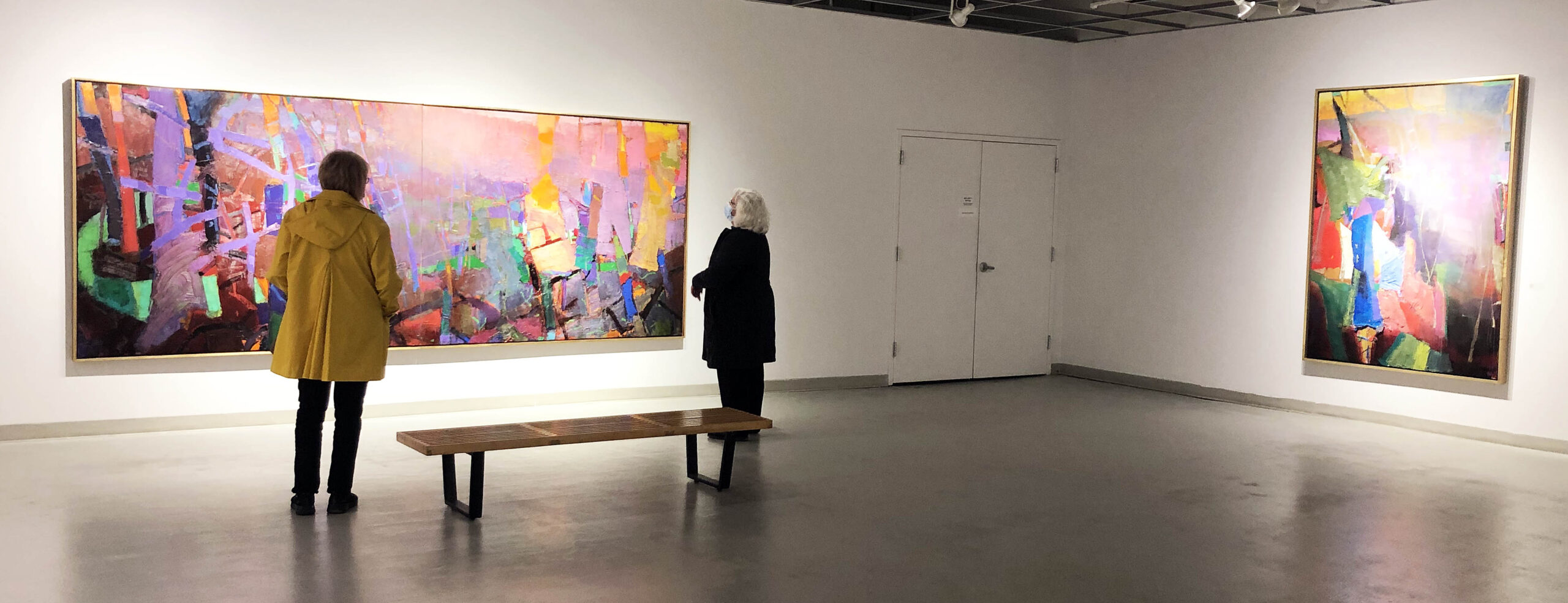
Brian Rutenberg, Installation, 3.2021 All images courtesy of DAR

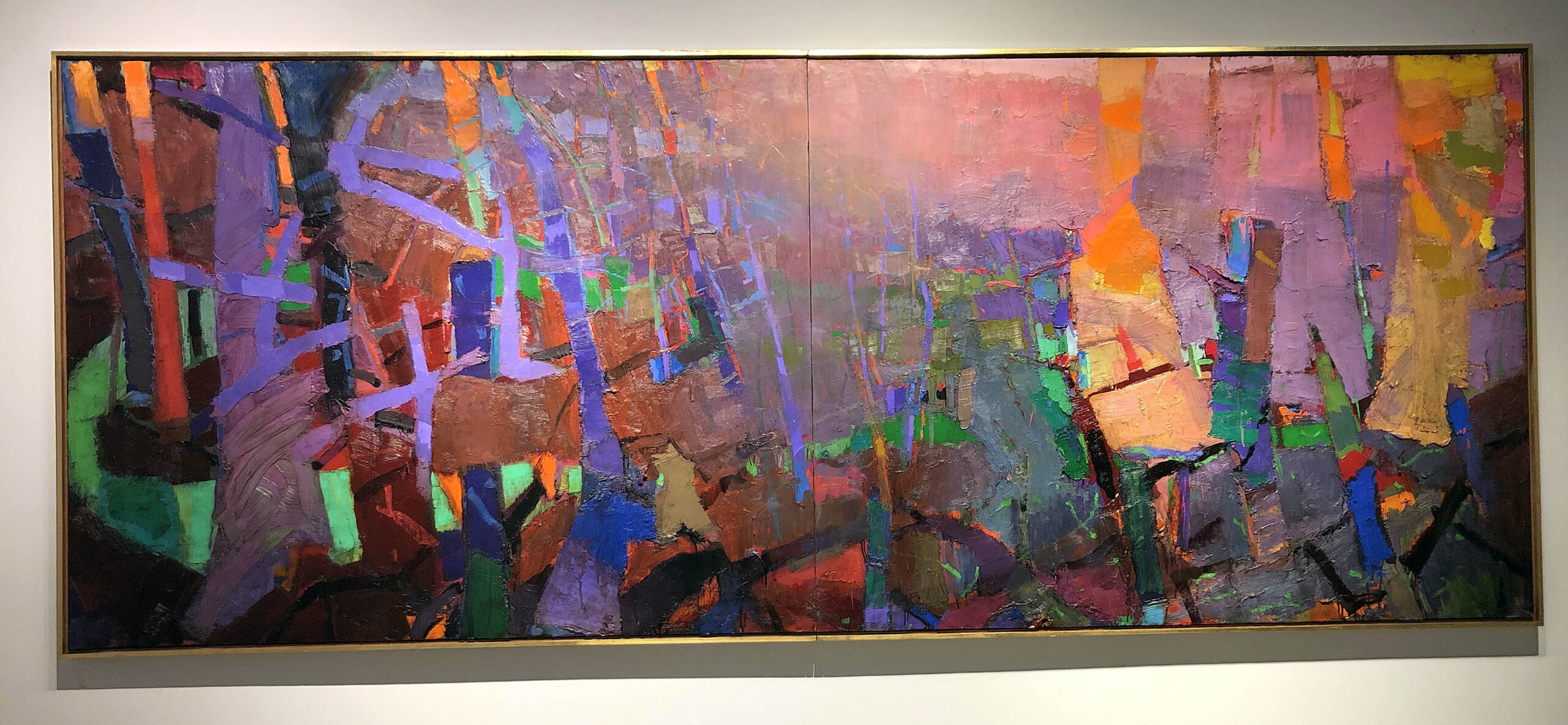
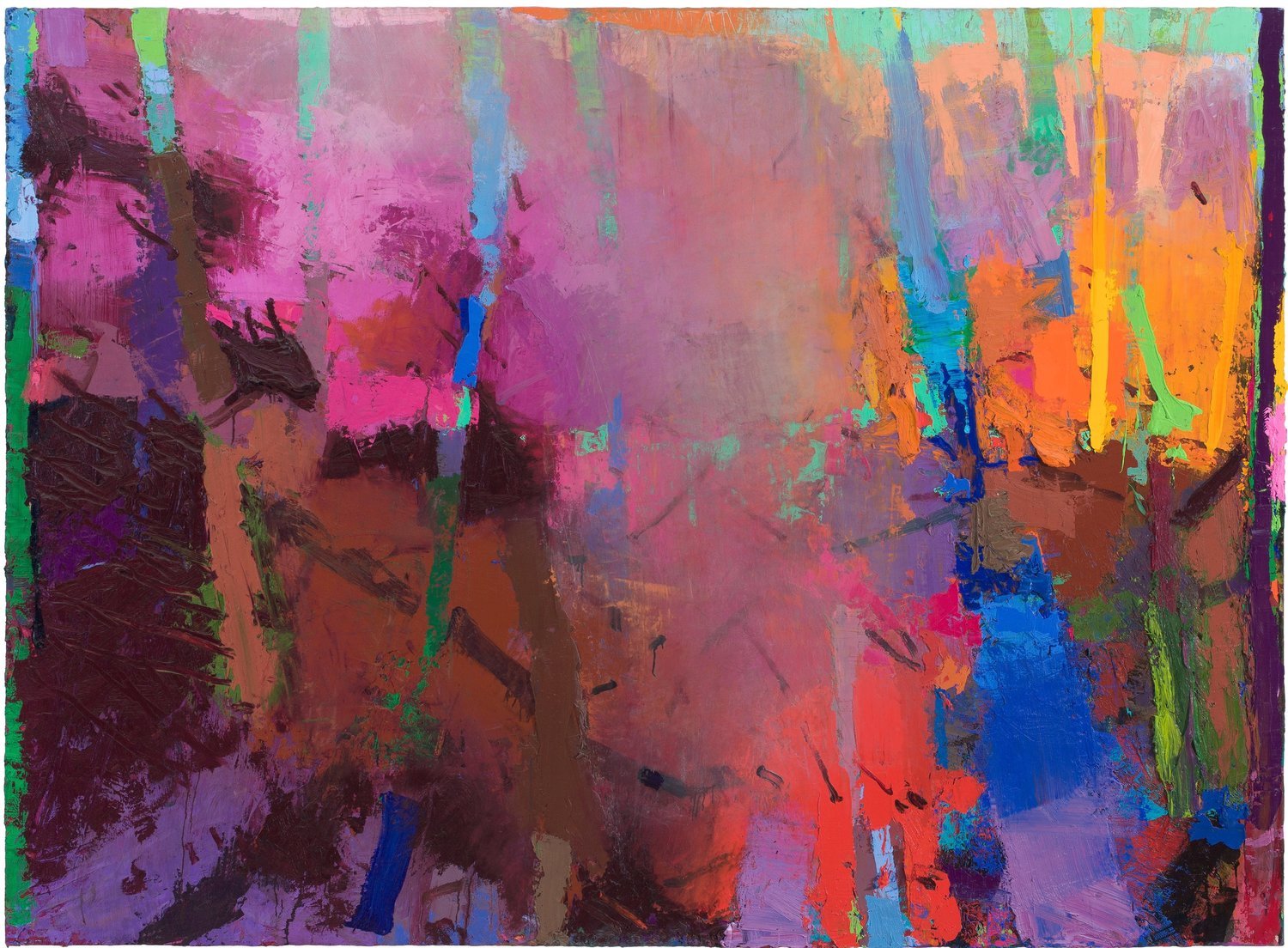
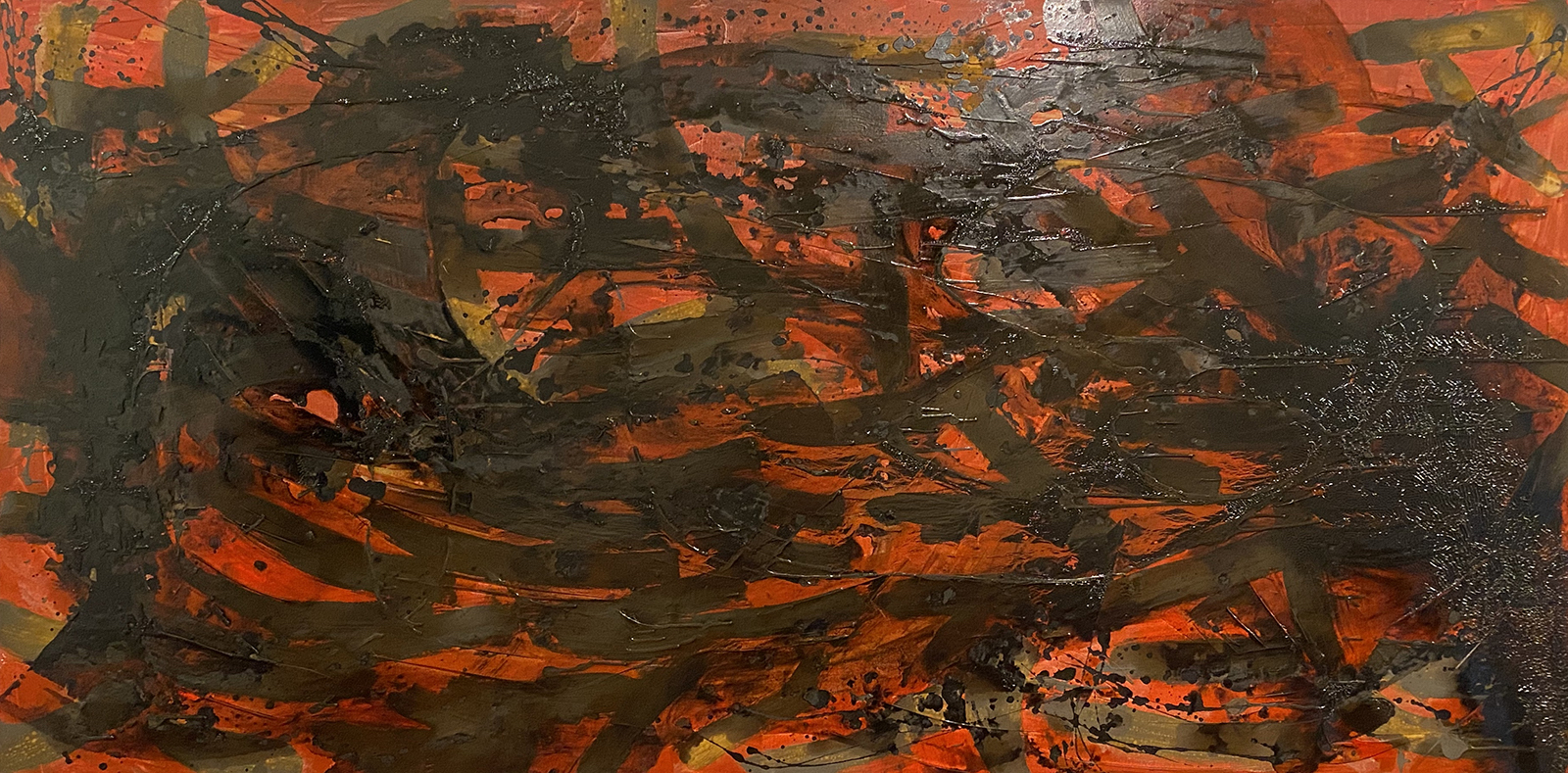
Sitting in the Robinson Gallery for a lengthy amount of time, I begin to acclimate to these large oil paintings by the nationally known artist from South Carolina, Brian Rutenberg.  The imagery gradually falls into place, something I would describe as abstract landscapes where there is an abundance of woodlands, horizons, skies, streams and rivers. Although he has spent his adult life, post-graduate school,  in New York City, these compositions are unique, inspired by the coastal Carolina landscape of his youth.  Those formative years must have made its mark on Rutenberg’s sensibility in terms of subject matter, as he brings this vibrant color scheme and the issue of scale to the forefront of the work.  If these paintings were all 20 x 30 inches, we would not be so affected. Still, Green River is a portal into the richness of heavily applied oil paint in a variety of ways and a color scheme that uses primary and secondary colors in a form that is individual to each painting.  There is a newness in how Rutenberg handles his forms, something that separates him from other abstract landscape painters, leaving us with a unique experience.

Brian Rutenberg, Green River, Oil on Linen, 63 x 160″

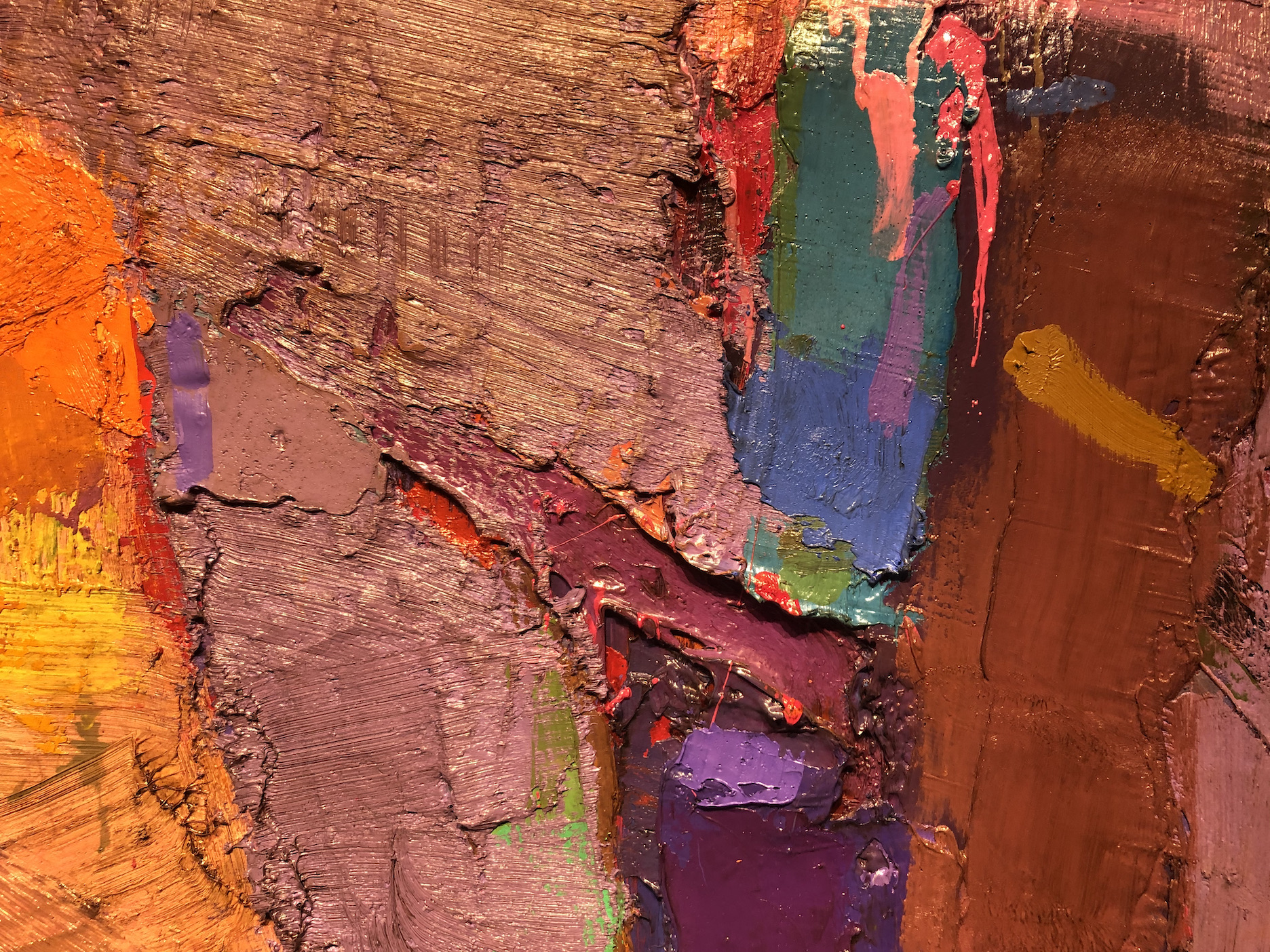
Brian Rutenberg, Detail Green River

Here is a detail from Green River (18 x 20 inches), where we see Rutenberg using a large variety of tools to spread paint: brushes, sticks, pallet knives and trowels. There is a color selection which repeats throughout the work that reflects on the subjects, a stream or vertical branch, and skies that reach out into a variety of pastel hues.

Brian Rutenbert, Corsair, Oil on Linen, 60 x 82",

The large 60 x 82 inch oil painting, Corsair, is another example of an abstract landscape where there is a horizon running horizontally with vertical lines like tree branches on the left and a blue stream on the right. The foreground dominates the composition with organic brown and foliage green.  The landscape may be subliminal, but it is clear to this viewer that Rutenberg’s abstract expressionism consistently repeats itself throughout the work. The Myrtle Beach-born painter is obsessed with the physicality of low hanging trees along South Carolina’s waterways, and continued to draw on those years long after moving to New York City.  When I refer to the term abstract expressionism, it would be similar to the female paintings by Willem de Kooning, where the figure is abstracted. Rutenberg does this in a unique way with his abstract landscapes.

Brian Rutenberg earned his undergraduate degree from the College of Charleston and his Masters of Fine Arts from the School of Visual Arts in New York City.


Frank James Fisher Ceramics Draw on Everyday Imagery

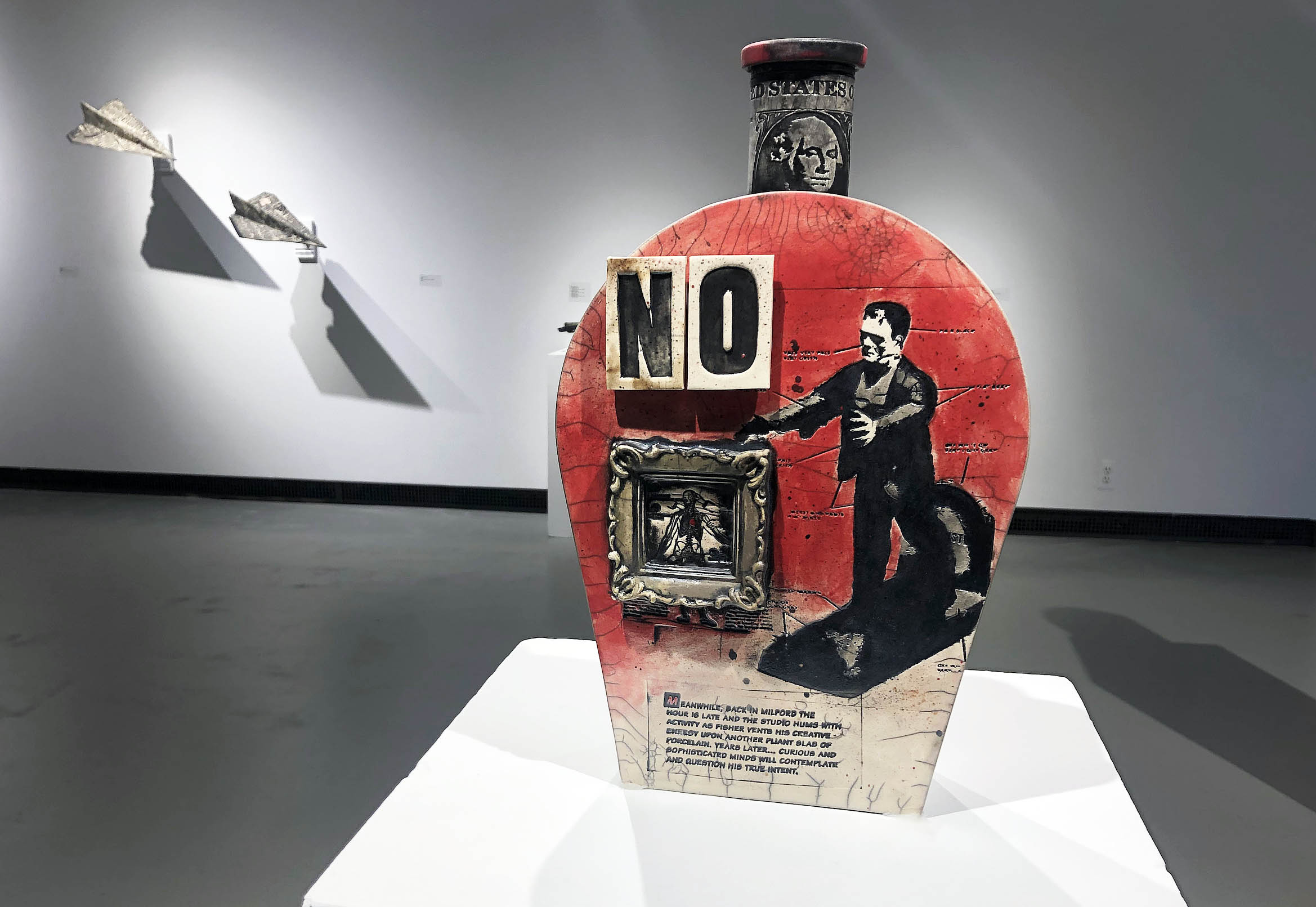
Frank James Fisher, The Ol’ Yes No, Slab-built porcelain, Raku Fired, reduction

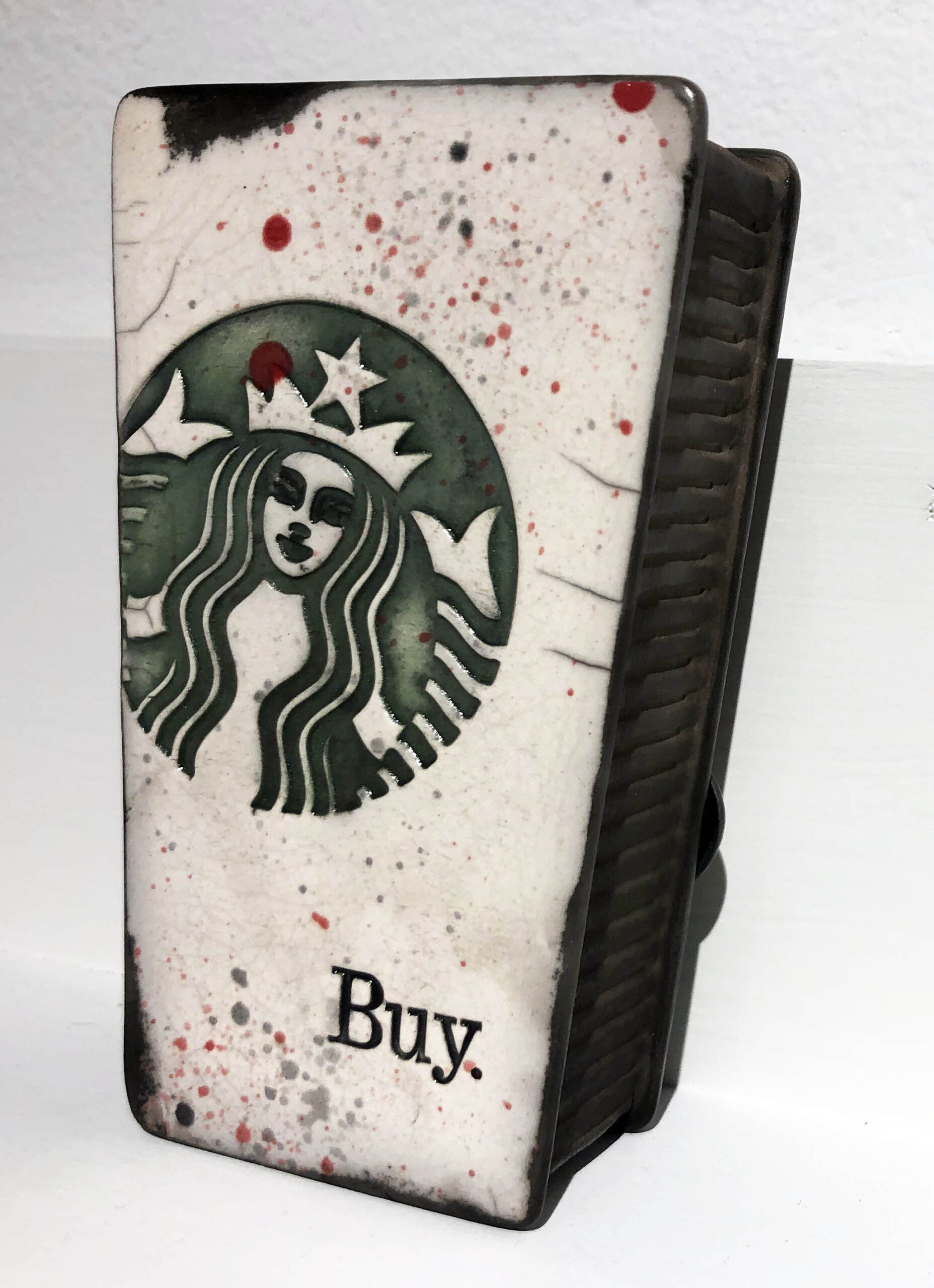
A native Michigander from Milford, Frank James Fisher, has what he calls Pop Artifacts on display in the Birmingham Bloomfield Art Center’s main gallery.  These reasonably small works are mostly slab construction using porcelain clay and a Raku firing. Some of the parts to these ceramic pieces are thrown on a potter’s wheel, but most come from lumps of clay rolled out into slab constructions where he adds photo imagery to the surface.  The title Pop Artifacts comes from using commercial images like Starbucks and goes back to the 1970s when artists like Andy Warhol used images from Campbell soup cans and a Brillo pad logo to create their art.

Frank James Fisher, Starbanks, Slab-built porcelain, Raku Fired, reduction

He says in his statement, “Advertising has recalibrated my brain. Forty years of working in the marketing community has saturated and skewed my aesthetic away from traditional art expression. My mind prefers graphics, headlines, logos, body copy, photos, illustrations, taglines, and any other marketing tool to express my creative thoughts. These are the tools I use to build narratives and fabricate impossible consumer products out of clay. I call them Pop Artifacts. Sculpted, cast, pressed, or thrown, these ceramic objects represent the desires we chase in the hope of capturing satisfaction.

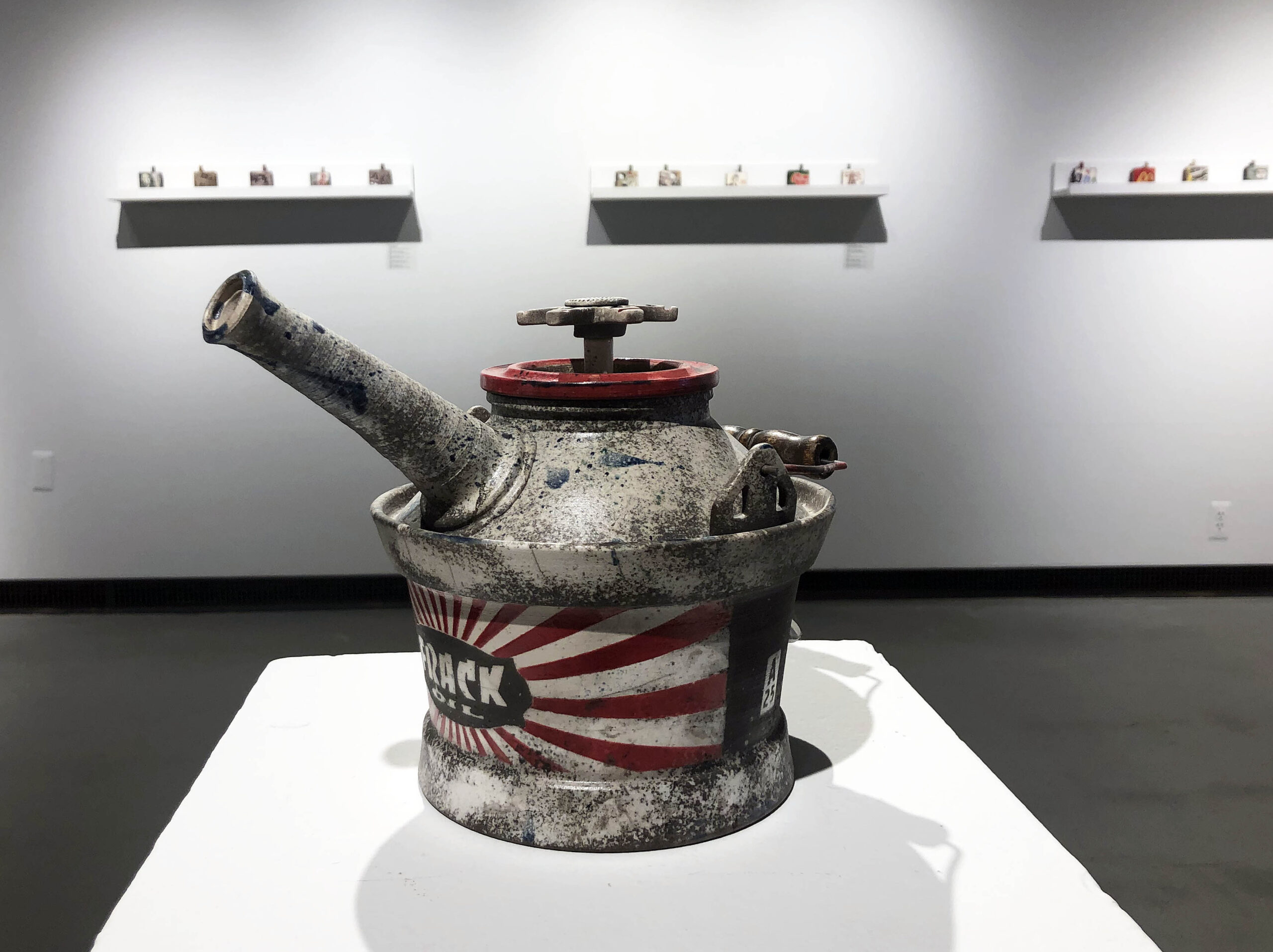
Frank James Fisher, Frank Oil Tea-can, Wheel thrown, hand-built porcelain, Raku- fired, reduction, metal & wood handle

Inspired by mineral spirit containers from years ago, Fisher’s Tea-cans have the retro-look of an older metal fabricated chamber that might resemble a favorite of many ceramicists, the Tea Pot. Using hand-cut stencils, he applies them to greenware by adding glaze to the bare surface in various steps and then relies on the Raku process to achieve his desired aged look.

Frank James Fisher earned his BFA in graphic design from Central Michigan University and worked in advertising for 25 years until 2006 and teaches advanced ceramics courses in the metro-Detroit area where he demonstrates his art methods at workshops.

Both exhibitions at the BBAC run through April 22, 2021

Tylonn J. Sawyer @ N’Namdi Center for Contemporary Art

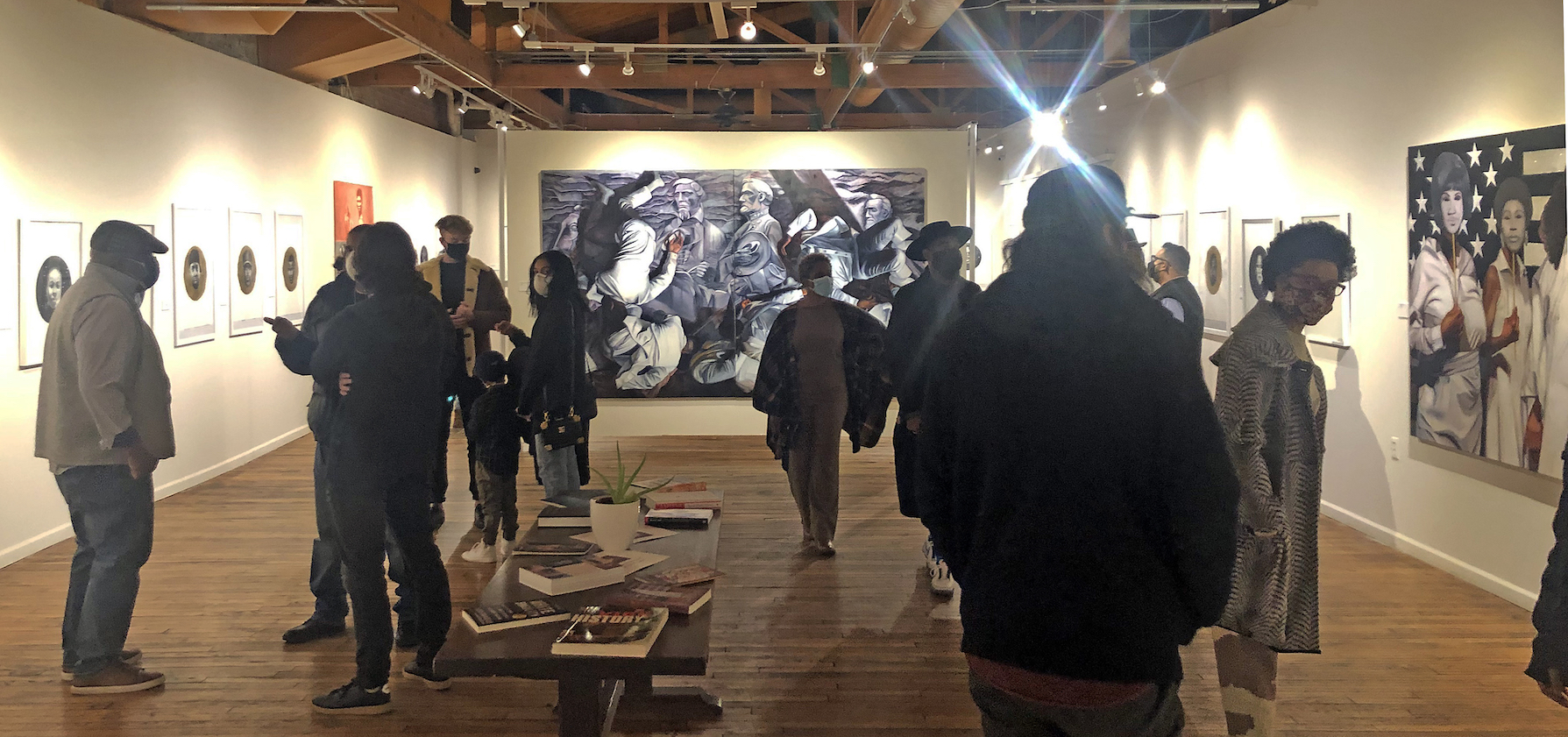
Installation image, Tylonn J. Sawyer, N’Namdi Center for Contemporary Art, 3.2021 All images courtesy of the Detroit Art Review

A new exhibition, White History Month Volume I and II: The Year of the Flood by Detroit native artist Tylonn J. Sawyer is now on display at the N’Namdi Center for Contemporary Art and runs until June 19, 2021.  There is a cadre of contemporary Detroit artists that express themselves using the figure as the dominant source of their subject matter, including Mario Moore, Sydney James, Peter Williams, Tyanna Buie, Senghor Reid, Rashaun Rucker to name only a few, but no one that takes on the visual language associated with the power and oppression leading to the social injustice against African Americans, as does Tylonn J. Sawyer.

He says in his statement, “Within this collective body of work, I’m interested in themes of black motherhood, confident hypocrisies observed in politics, religion, and the overall social order. Culling from the Western History and cultural tropes, the work in this exhibition centers on the distortions in American social fabric.”

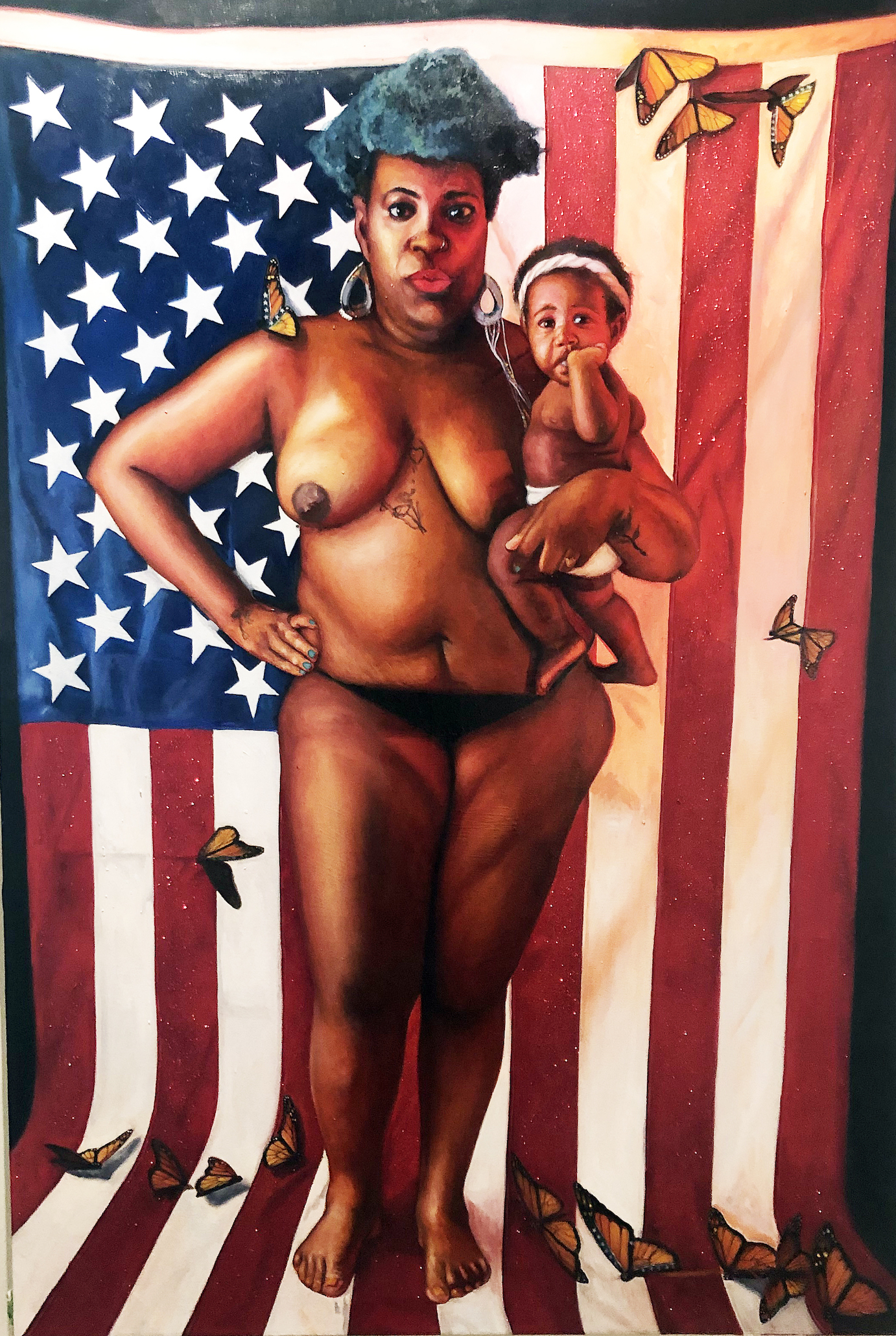
Tylonn J. Sawyer, The Birth of Venus, Oil and Mixed Media on canvas, 72 x 48″, 2021

The painting from 1480 by the Italian artist Sandro Botticelli, The Birth of Venus, depicts the goddess Venus arriving at the shore after her birth when she had emerged from the sea fully-grown. The painting was created during the Italian Renaissance, has dominated western art for seven centuries, and as we see,  Sawyer selects the title to give new meaning to this painting’s title.  When I first experienced the work, I was thinking of Madonna and Child in our contemporary urban world, taking from one of the most popular titles in art history. Here in Sawyer’s work, the standing portrait with child is drenched in symbolism. The American flag is the backdrop for this new mom holding her infant surrounded by butterflies.

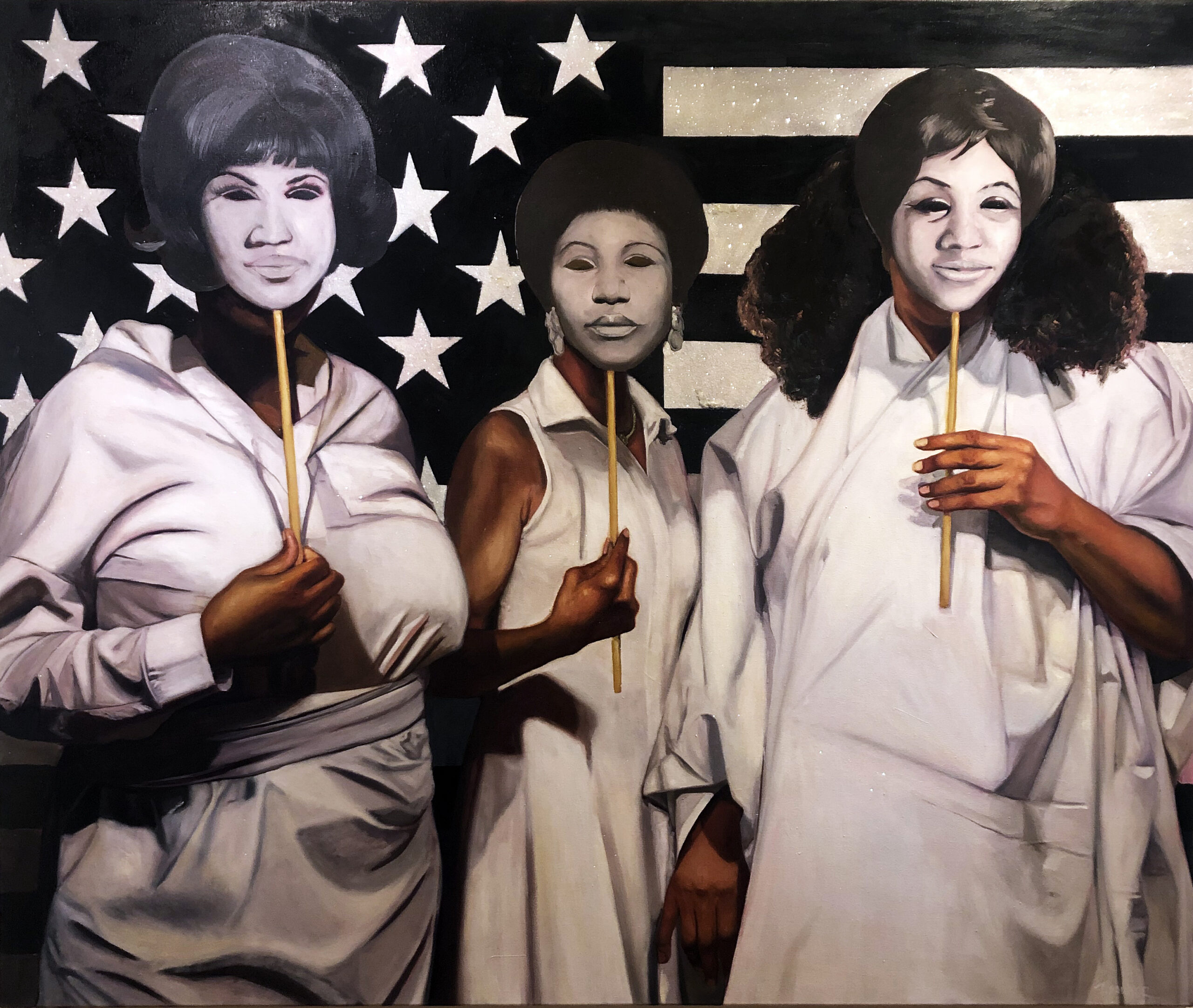
Tylonn J. Sawyer, Three Graces: Aretha, Oil on canvas, 72 x 60″, 2019

The painting Three Graces: Aretha is a large oil painting that depicts three African American women standing in front of the American flag with these hand-held black and white masks of the performer Aretha Franklin.  This motif is used in several of Sawyer’s paintings; as an example, he uses Nina Simone and Martin Luther King as the subject of masks.  The concept raises a question in the viewer’s mind: What is the idea presented, and where does it come from?

Sawyer explains, “Borrowing from rituals in sub-Saharan Africa where people would place the mask of their ancestors and spiritual deities to seek counsel for contemporary problems, the figures in this exhibition wear masks of civil rights leaders, activists, artists, and political figures. The figures represent metaphoric deities placed on the backdrop of Americana. Using religious metaphor, history, pop culture, and the flag as sacred symbols of America, I am exploring questions of how Blacks exist within the mythology of Americana.”

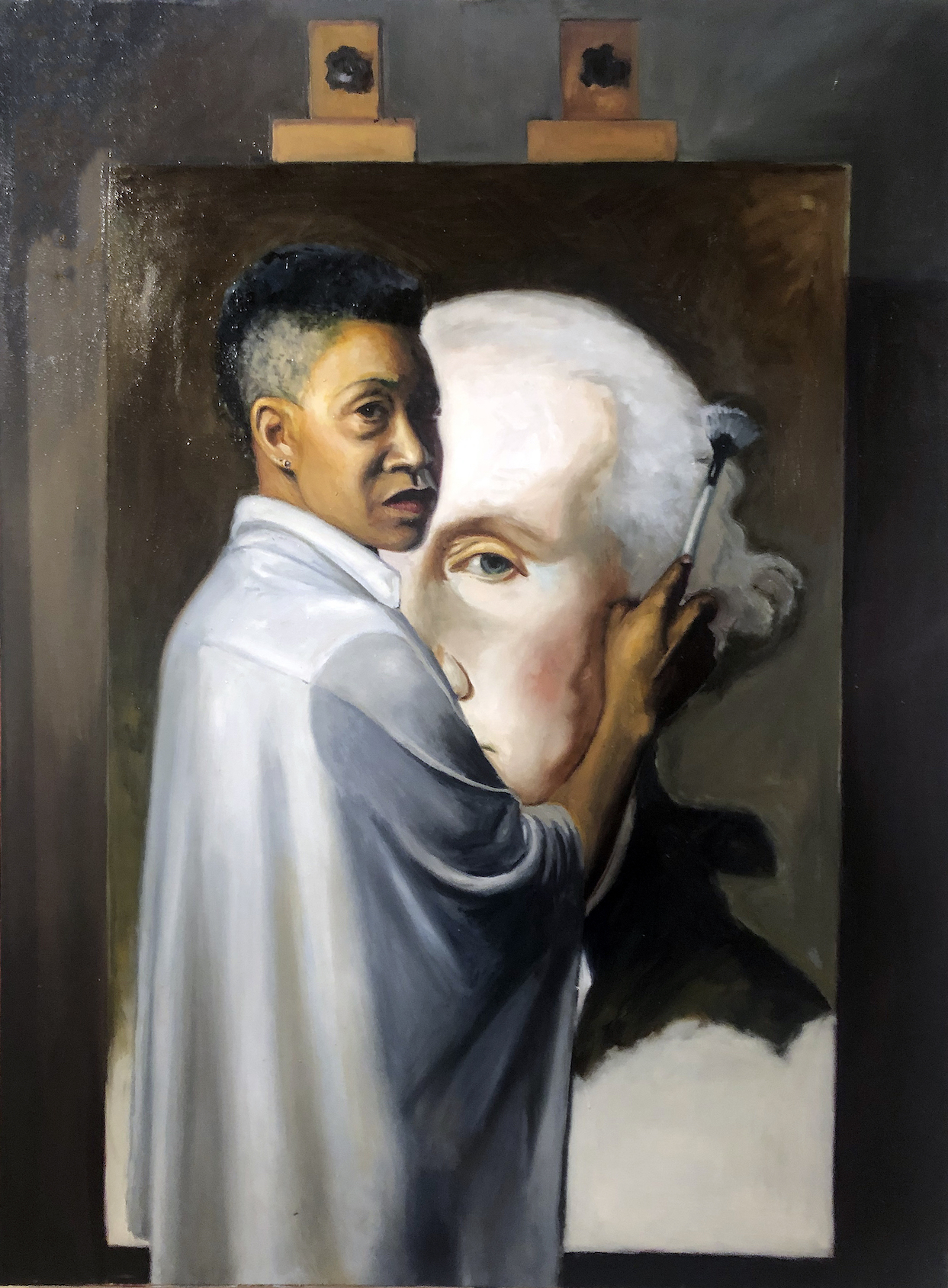
Tylonn J. Sawyer, Your Founding Fathers Owned Slaves and We Ain’t Forgot that Shit II, Oil on canvas, 48 x 32″, 2021

Tylonn Sawyer must have known that when it came time to apply for graduate school, he wanted to attend a school specializing in representational art, focusing on figurative painting. The New York Academy of Art is a graduate school that combines intensive technical training using methods and techniques that met his goals.  The painting Your Founding Fathers…the work that is tongue-in-cheek where the African American female is working on a portrait of George Washington—reminds us that not everyone is a descendent of the first U.S. president.

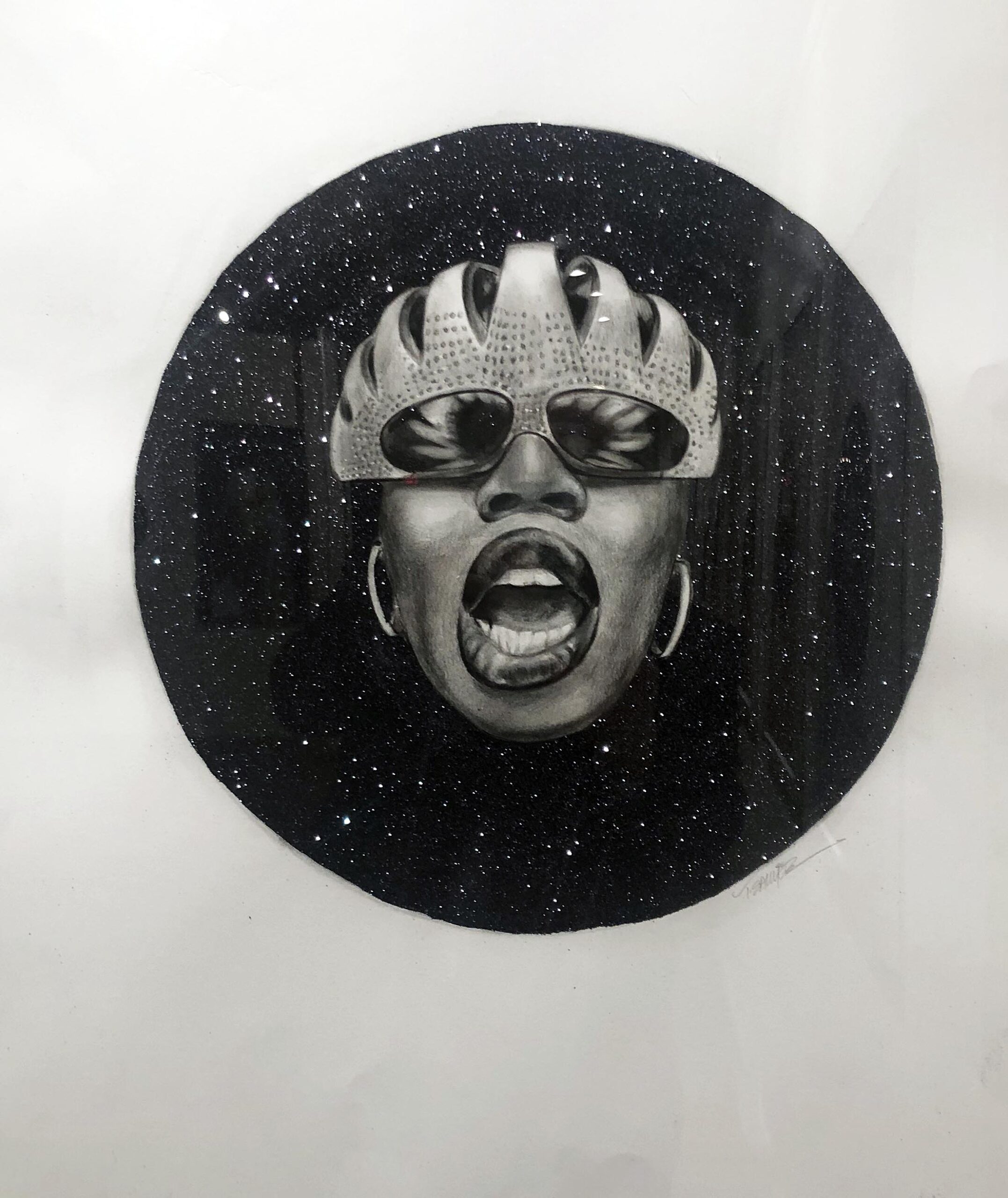
Tylonn J. Sawyer, Missy Misdemeanor Elliot, Charcoal and glitter on paper, 30 x 22, 2020

Throughout the exhibition, there is a collection of charcoal drawings, 30 x 22″ as in Missy Misdemeanor Elliot, that illustrates portraits from famous contemporary celebrities that remind people that there is much accomplishment in the entertainment business.  Sawyer gives credit where credit is due by featuring these realistic headshots where some are surrounded with gold foil.  Sawyer says “Using Hip-Hop, a music genre and culture as a not only medium for both the audio and historical soundtrack, but also as witness to our participation in history, Year of the Flood, immerses the viewer in a body that  refracts movement through a false sense of stasis, offering various aspects of praise and conflict with and of Americana.”

Tylonn J. Sawyer, Every Now and Then, 84 x 50″, Charcoal and Acrylic on Paper, 2017

The large work, Now and Then, charcoal and acrylic is a field of police painted with flat white acrylic faces, depicts the officers as automated cutout droids crammed together in search of a strategy. The symbolism of a police force lacking the diversity it deserves is one more example of Sawyer’s tools to make his social injustice message loud and clear.

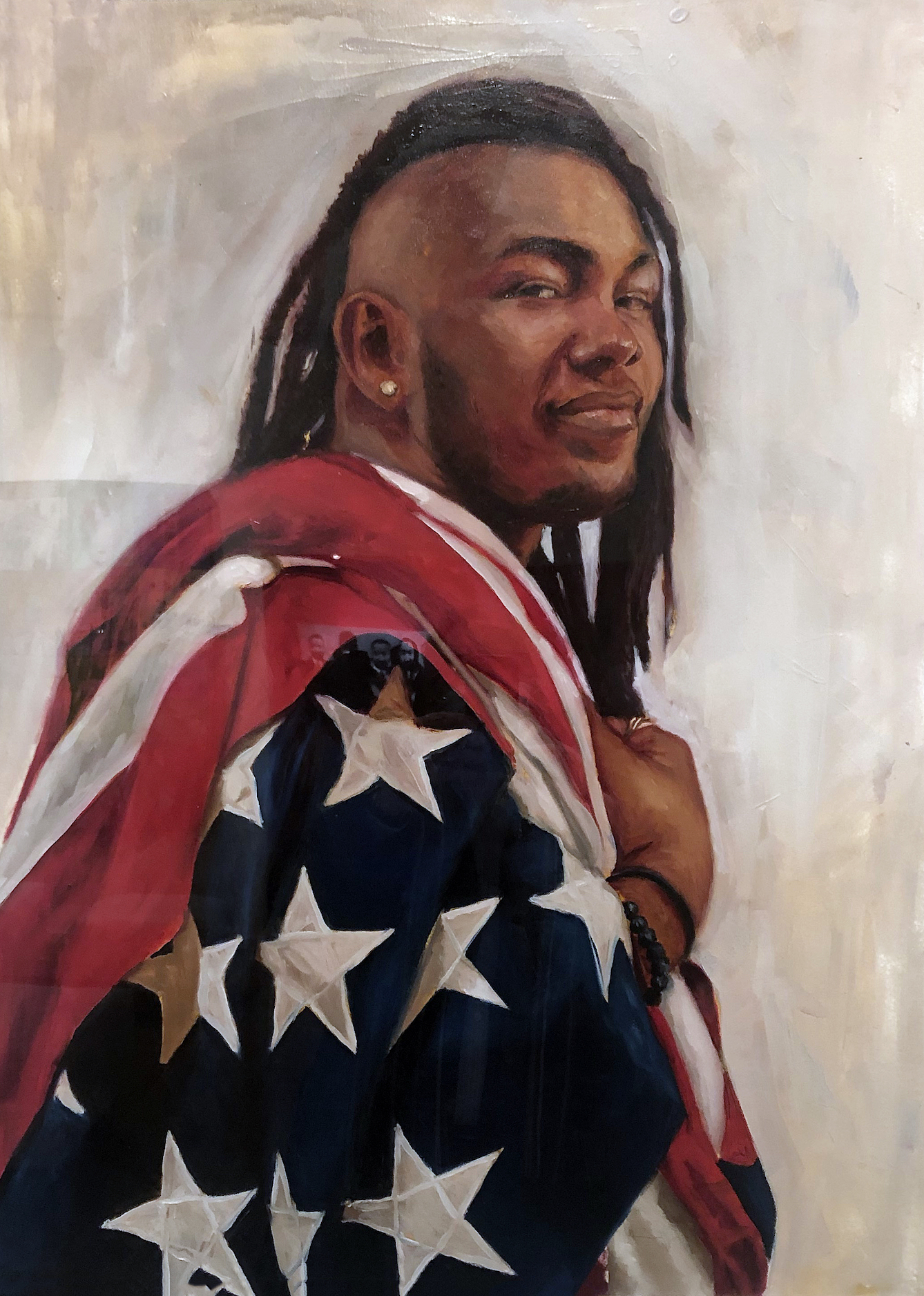
Tylonn J. Sawyer, The King James Version, 30 x 22″, Oil on Paper, 2020

The King James Version, also known as the King James Bible, is an English translation of the Christian Bible for the Church of England in 1604.  Historically,  Britons were enslaved in large numbers, typically by wealthy merchants, who exported indigenous slaves from pre-Roman times and became significant participants in the Atlantic slave trade. The painterly portrait here depicts a contemporary African American draped in the U.S. flag, poking fun at such an event’s impossibility.

Throughout our country’s history, the intersection of art and activism has played a crucial role in social movements against inequality, oppression and injustice.  The authors of the Declaration of Independence outlined a bold vision for America: a nation where there would be equal justice for all. More than two hundred years later, it has yet to be achieved.  Though generations of civil rights activism have led to significant gains in legal, political, social and educational realms, the forced removal of indigenous peoples and the institution of slavery marked the beginnings of a system of racial injustice from which our country has yet to recover.

Tylonn J. Sawyer earned his BFA from Eastern Michigan University and his MFA from the New York Academy of Art.

White History Month Volume I and II: The Year of the Flood at the N’Namdi Center for Contemporary Art runs through June 19, 2021.


Souls of Black Folk: Bearing Our Truths @ Scarab Club

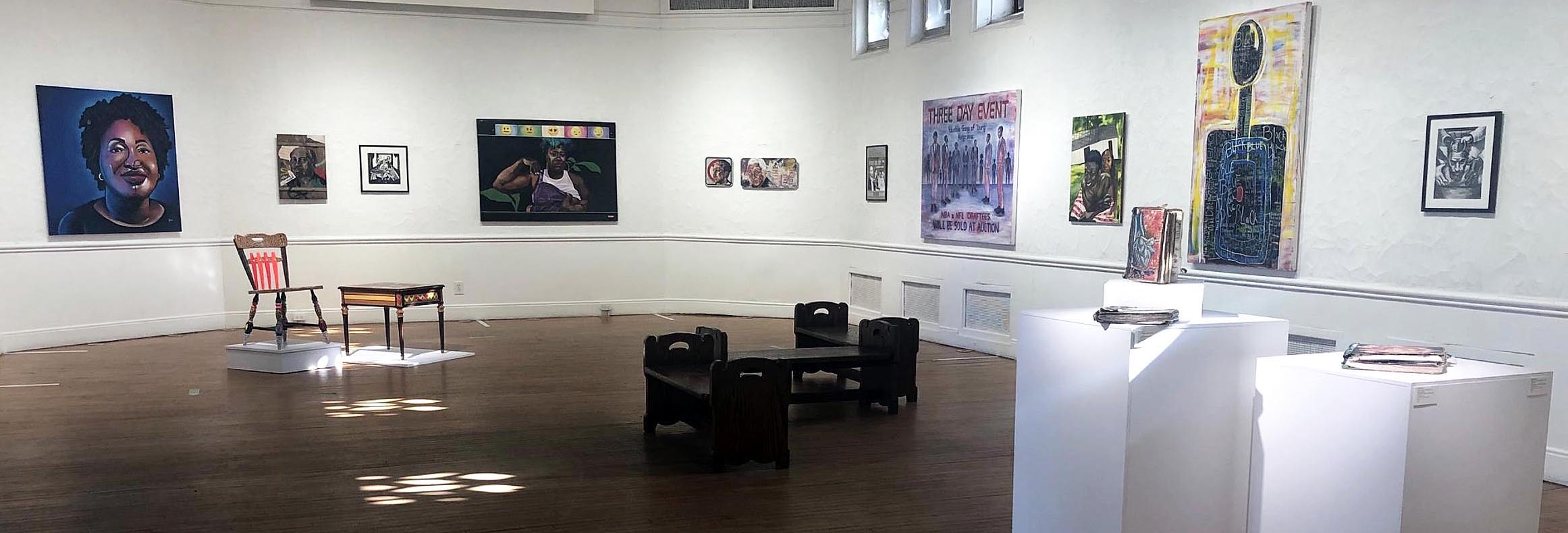
Installment Image, Souls Of Black Folk, Scarab Club, Detroit, Images : Courtesy of David E. Rudolph/ D. Ericson & Associates Public Relations.

In  W.E.B. DuBois’ essay, “Of Our Spiritual Strivings” from his poignant collection, The Souls of Black Folk, the sociologist makes a thorough and thought triggering assessment on being Black in America.

“The  Negro is a sort of seventh son, born with a veil, and gifted with second-sight in this American world, — a world which yields him no self-consciousness, but only lets him see himself through the revelation of the other world,” he wrote. “It is a peculiar sensation, this double-consciousness, this sense of always looking at one’s self through the eyes of others, of measuring one’s soul by the tape of a world that looks on in amused contempt and pity. One ever feels his two-ness; an American, a Negro; two souls, two thoughts, two unreconciled strivings; two warring ideals in one dark body, whose dogged strength alone keeps it from being torn asunder.”

Written in 1903, this passage is  the impetus for  the exhibition Souls of Black Folk: Bearing Our Truths, on view at the Scarab Club through March 20. Curated by Donna Jackson, artist and owner of DMJ Studios, DuBois’ words and concept of dual identity – being Black and being American– resonated on a deeper and heightened level for Jackson throughout 2020 – a year imploded with a global health pandemic that still looms and a socio-political and racial reckoning that forced America to finally discuss racism and injustices on a worldwide stage.

In a reflective statement about the exhibition, Jackson expressed, “With the death of George Floyd and the amount of pain and in many cases,  guilt I have seen poured in our streets and in our media, I went back and re-read The Souls of Black Folk. The two-ness of being Black and American sits heavy and true with me. Sometimes this feeling is hard to pinpoint or express and yet, DuBois did it simply. It freed me to know that this feeling can be described. It is okay to be these two things. To be Black. To be American. The challenge is being accepted as both.”

The collection features the works of twenty, established and emerging Black artists – a first in the Scarab Club’s 100+ year-history– and range in emotion from depictions of harsh truths of existence in a Black body as well as expressions of joy, love and being human.

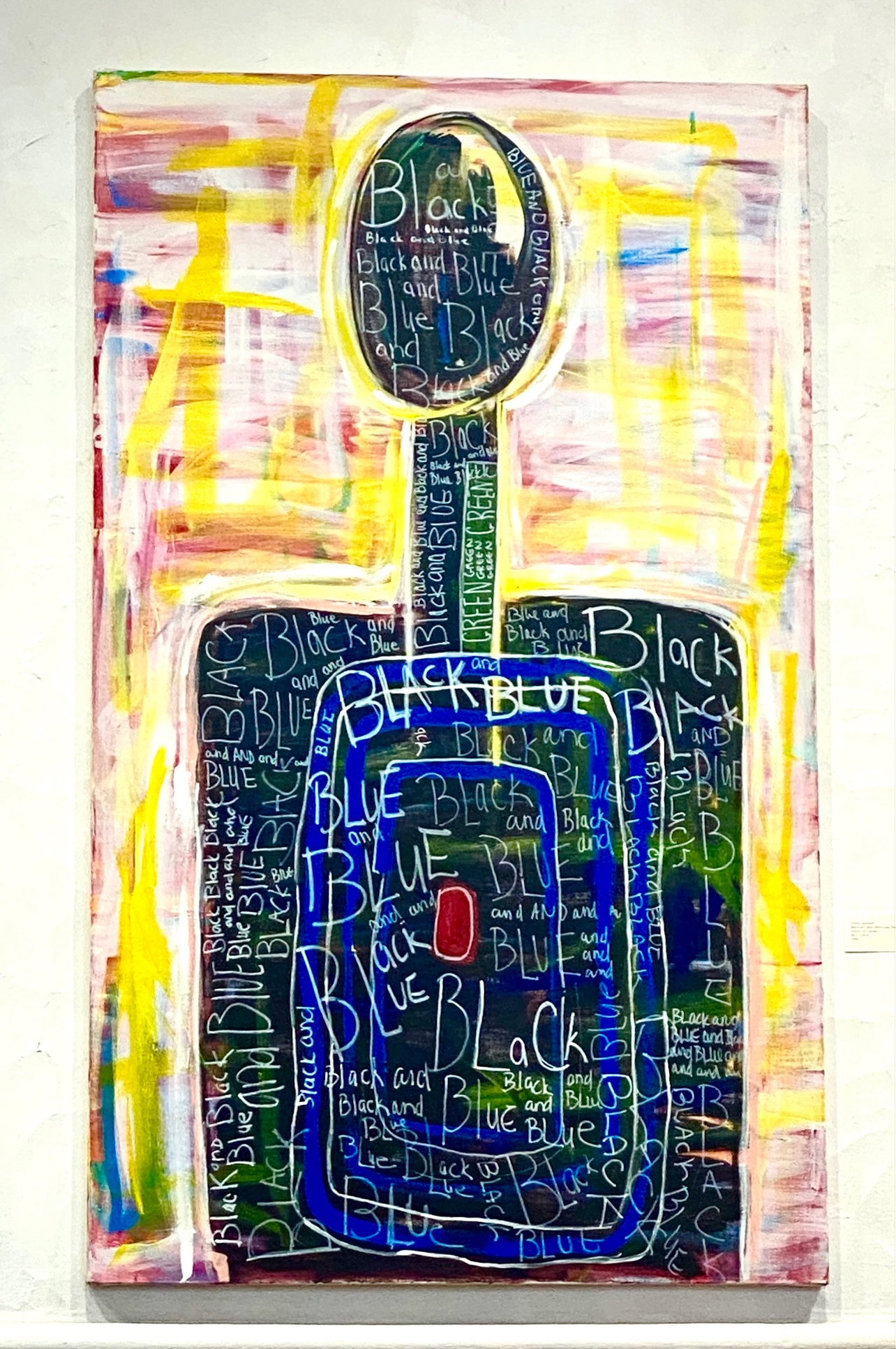
Jackson’s Black and Blue, sets a strong tone. The massive acrylic painting depicts a faceless  black body as a shooting target, a red dot is on the chest and  the words black and blue are scribbled throughout.  ‘Black Lives Matters’ and  ‘Blue Lives Matter’ chants mentally collide, drawing flashes of the racial  contention and shooting deaths of Black men and women by police officers and white citizens. I am reminded of Dubois’ use of the veil as a metaphorical presentation of the color line, racial oppression and injustices.

Donna Jackson| Black and Blue (Who’s The Target) | Acrylic on Canvas

There’s a trauma that exists within  Blackness that is inexperienced in mainstream America. Yvette Rock’s The Brutal Passage depicts the foundation of that pain. Accompanied by a performance, entitled 400 Years of Labor, the magnitude of the mixed-media canvas is aptly felt. Before the artist appears on screen, chains clinking is the first sound, followed by foot thumps, groans and heavy breathing. The artist appears carrying the thick canvas, each step a struggle. Each step a reminder of slavery and the oppressive mentality behind it.

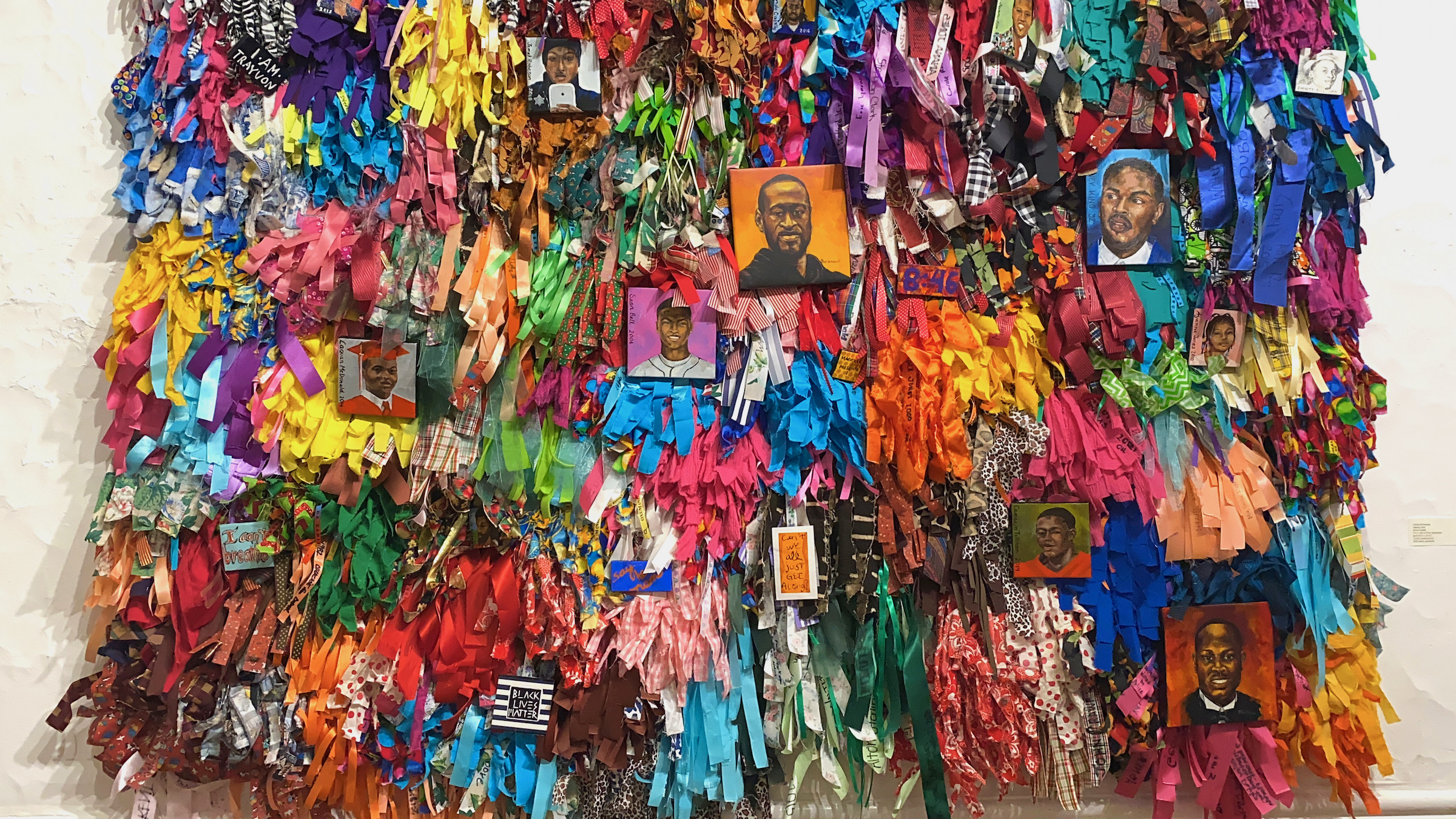
The emotional and psychological grief  that comes with injustice and trauma carries over into Carole Morriseau’s chilling, The Healing Wall. The mixed-media ensemble comprises four quadrants, containing 1200-1500 colorful ribbons with painted portraits bearing the names of Black lives lost due to police brutality. George Floyd.  Rodney King. Breonna Taylor. Ayanna Jones. Emmett Till. And the list of Black and brown souls, gone (as we see it) too soon, goes on. Morriseau also incorporates phrases #StopTheKillings and #IAmTrayvon to represent social justice movements.  The visual breaks your heart, but there is  also a source of strength, purpose and a knowing that this is why we must continue to lift their names and use the tears as fuel to keep marching forward in hopes of a just world.

Yvette Rock | The Brutal Passage | Mixed Media on Canvas| 72×36| 2020

Carole Morriseau | The Healing Wall | Mixed Media | 45×50| 2020

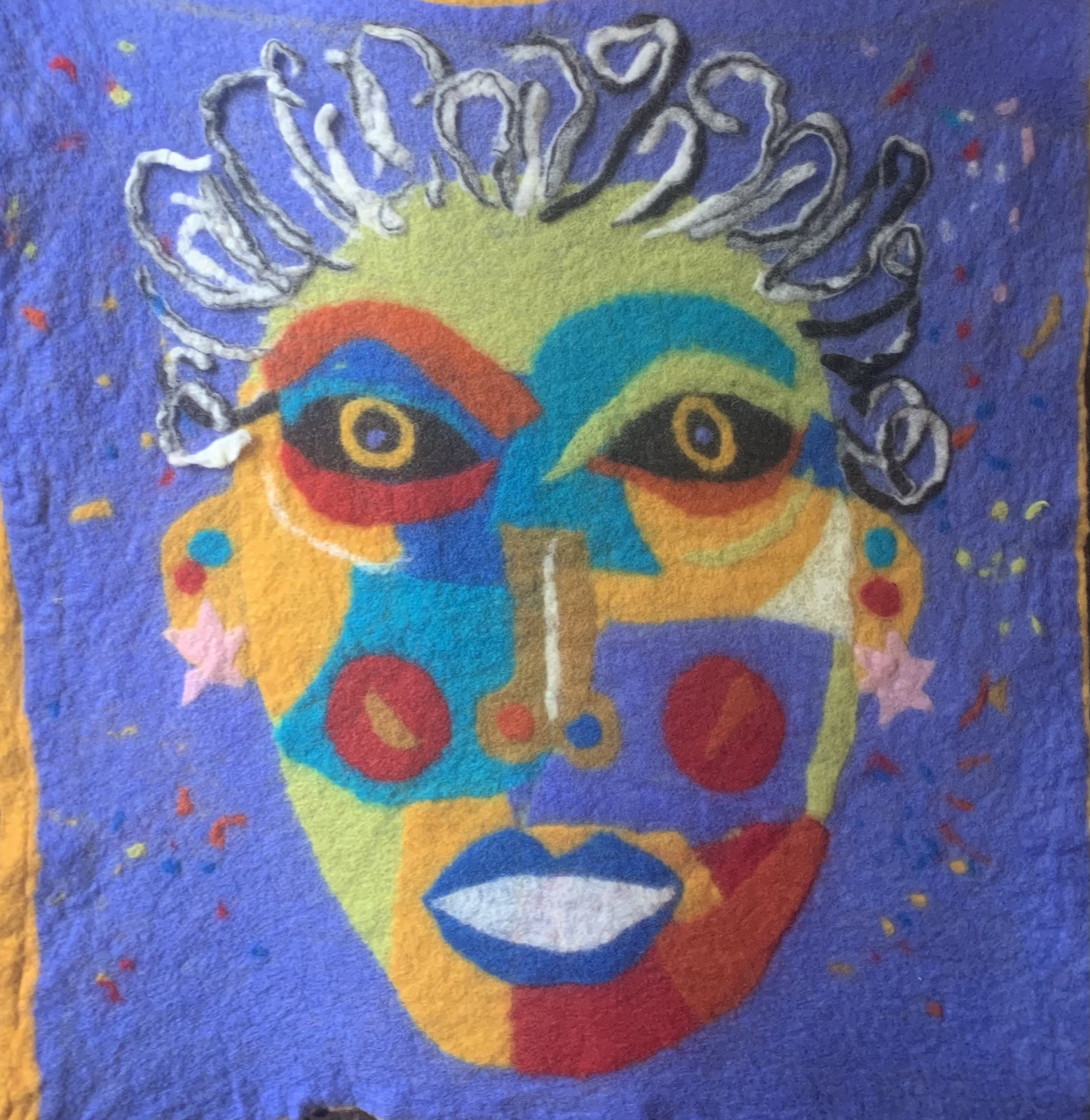
Grief is heavily felt in the aforementioned pieces and in Rita Dickerson’s$100,000,000 SLAVES: The Absence of Black Ownership and Control, that never settles.  In this assortment of feelingsthere is a visceral balance and resilience presented in the installation. We see the way joy claims its right to shine in spite of historical pain and constant wearing of the veil in Cydney Camp’s Juneteenth (Teenth) painting, which depicts a couple laid out in a yard, smiling while taking in a hot day, and Ralph Jones’ life photo, We’re All Here,  that shows Black and brown children and families playing in water at Hart Plaza,  and certainly in Mandisa Smith’s Black Joy made from felted wool. This is part of the story, too. This is love and care.

Mandisa Smith | Black Joy | Mixed Media | 18inx18in | 2020

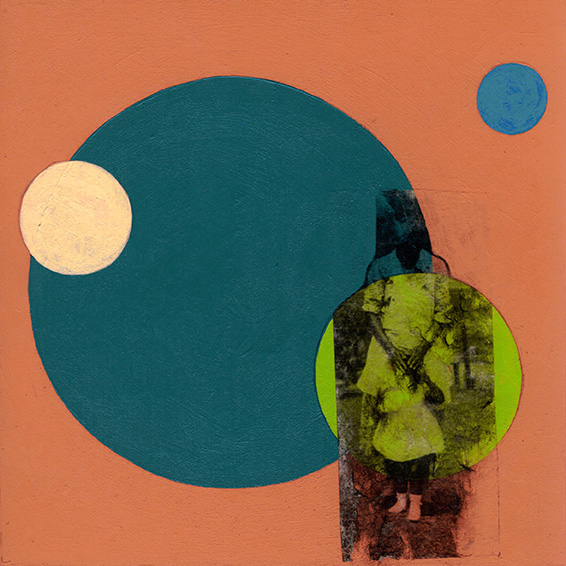
Honoring the ancestral realm with spiritual grounding and understanding “I am, because they are,” Monica Brown’s mixed-media-on-wood painting and image-making, I Prayed For You Before You Were Born (I) and Prayed For You Before You Were Born (II ),  are soothing like a needed hug. The art works are part of the artist’s ‘Mythical Memory’ series rooted in connections between the body, memory, personal history and healing. The circular motion in these small but mighty visuals feels like  a continuous prayer and donning of armor by loved ones. 

Monica Brown | I Prayed For You Before You Were Born (I) | Acrylic and Mixed-Media on Wood | 8”x8”

Monica Brown | I Prayed For You Before You Were Born (II) | Acrylic and Mixed-Media on Wood | 8”x8”

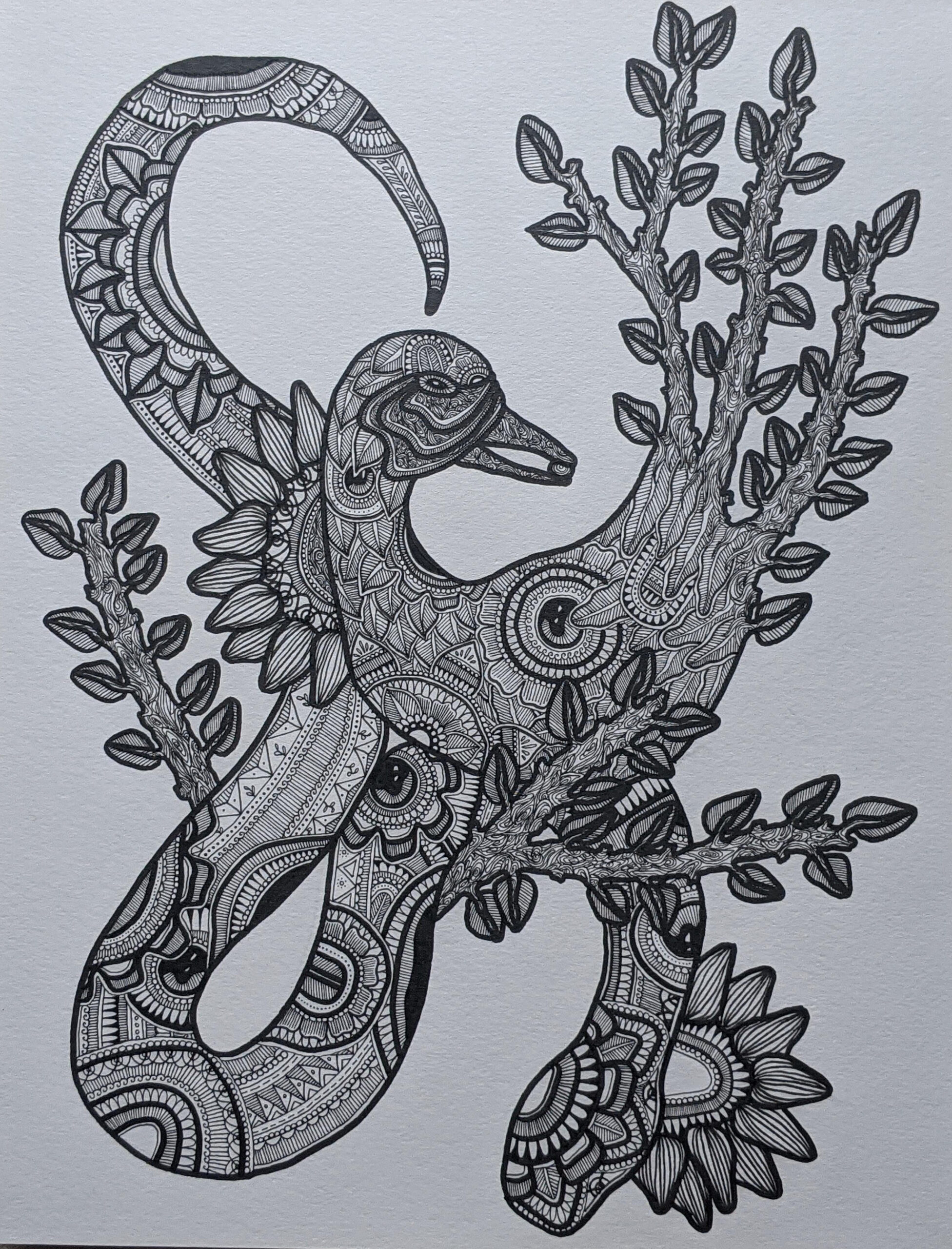
Olivia Guterson’s Sankofa, is reminiscent of Ghana’s Akan tribe and the mythical bird that serves as one of the Adinkra’s cultural symbols. With its head turned backward, the posturing speaks to embracing “what is at risk of being left behind.” Further, the three syllables that make up the word “Sankofa” mean return, go, look, seek and take. With this in mind, Guterson’s illustration welcomes a form of travel and seeking wisdom. There’s a present comforting that feels ancestral and communal. The artists’  use of black-and-white, textured lines and eyes throughout the image, brings both intensity and a sort of calm on this quest for knowledge and using the past as a guide to the future.

Olivia Guterson | Sankofa, 2020 Oil and ink on archival paper | 10×14

Throughout Jackson’s curation, we see the complexities and layers of the Black experience. We see love, the rich appreciation of  literature, music, connection, progressive thinking and being amid the struggle and the striving. Souls of Black Folk: Bearing Our Truths is a looking glass for not only a deep dive into DuBois’ philosophy but that of Black life as narrated by Black visual artists.

View closely, Black voices have stories to tell. And this exhibition SPEAKS.

“The human soul cannot be permanently chained.” – W.E.B. Dubois

Olivia Guterson | Sankofa, 2020 Oil and ink on archival paper | 10x14

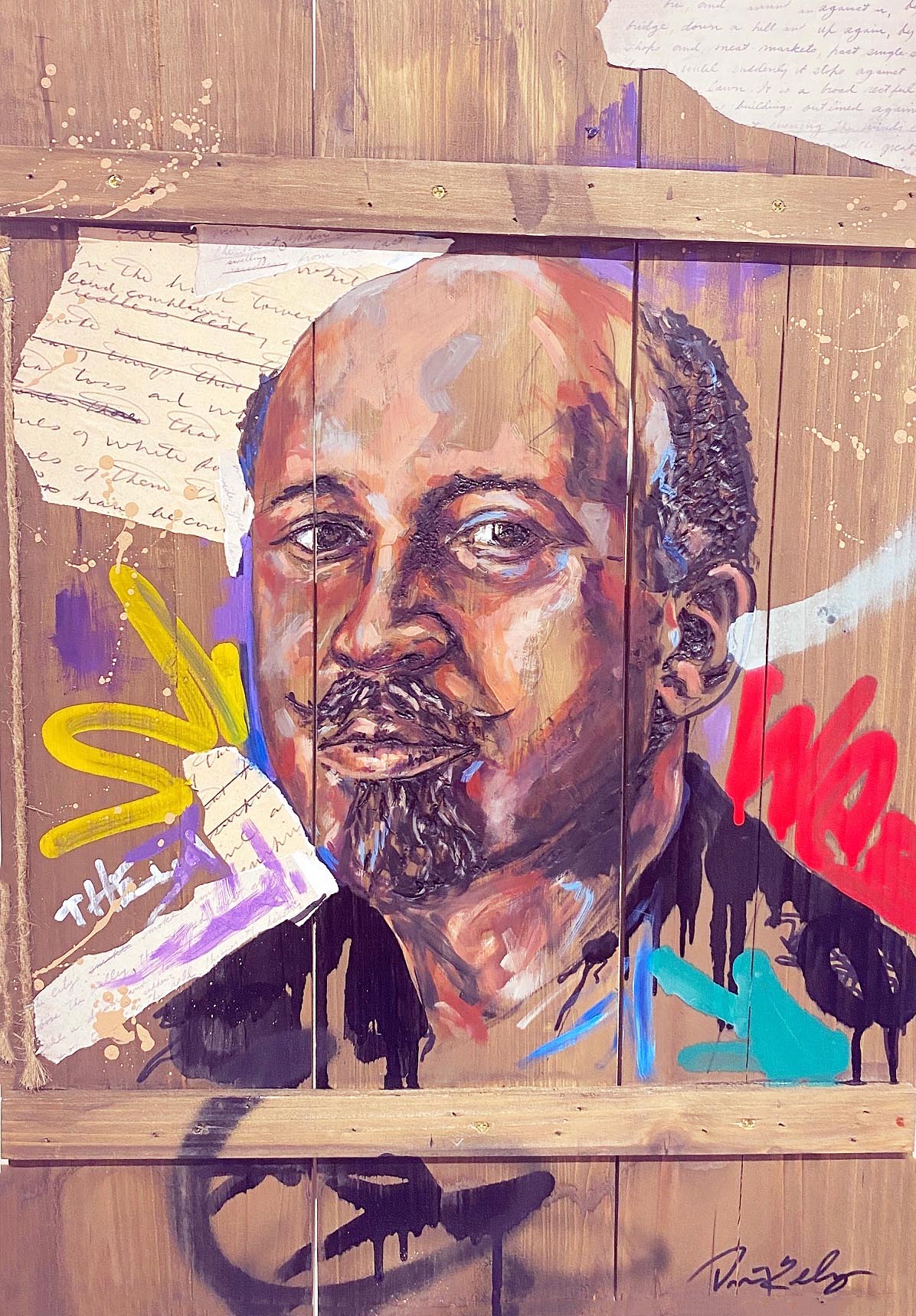
Desiree Kelly | W.E.B Du Bois | Woodburn, oil, acrylic, collage on wood | 12 x 12

Participating Artists: Monica Brown, Taurus Burns, Cydney Camp, Rita Dickerson, Olivia Guterson, Asia Hamilton, Donna Jackson, Sydney James, Ralph Jones, Desiree Kelly, Charles Miller, Carole Morisseau, Sabrina Nelson, Yvette Rock, Phillip Simpson, Mandisa Smith, Rachel E. Thomas, Charlene Uresy, Carl Wilson, Cara Marie Young

Souls of Black Folk: Bearing Our Truths – On Display at the Scarab Club until March 20, 2021

ALSO ONLINE: https://www.soulsofblackfolk.com/  

New Work / New Year @ David Klein Gallery

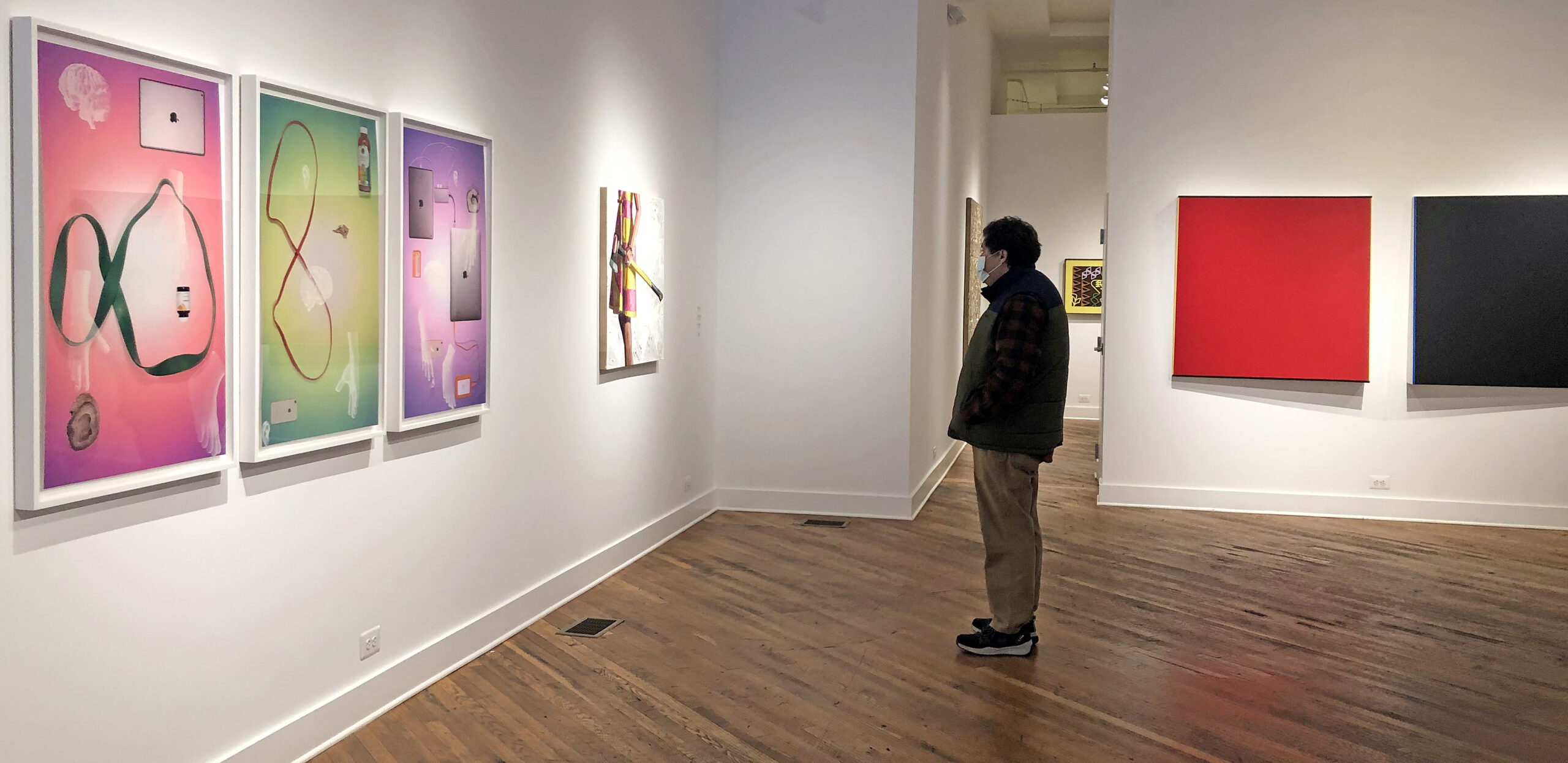
Installation image, New Work, New Year, 2021

If it has been hard to survive 2020, that has been especially true for the art community. Artists have had to be concerned with their health, livelihood and families, endure a deadly virus and experience a tumultuous political environment that heightened the anxiety in everyone’s lives.  Art exhibitions struggled to even exist in 2020, while some opted to be exclusively virtual. The David Klein galleries have consistently staged openings, albeit with masks, social distancing and staggered appointments.

The David Klein Gallery’s Director of Contemporary Art, Christine Schefman, has started off the new year by looking back at 2020 with an exhibition statement about this new show. She says, “2020 was a year of uncertainty, but one thing we know that remained constant was artists making art. Maybe there was a pause at the beginning, but ultimately artists found the inspiration to keep moving forward. Whether they continued to explore an ongoing body of work or create something entirely new, their practice endured.”

In this exhibition of fifteen artists, the first two artists I will mention are Robert Schefman and Kelly Reemtsen, both clearly figurative painters with a depth of experience yet whose work is completely juxtaposed.

Schefman talks about choosing an illusionist narrative while avoiding the term photorealism, and he has worked hard at finding a story that uses the human form as his subject.  Over the years, his technique has been impeccable. He has made a point to find a theme, a secret or a mystery that dominates these large oil paintings, and he obviously devotes time to the color pallet and composition.  Reemtsen on the other hand, who has spent time on the west coast and is drawn to Wayne Thiebaud’s work, creates tension between a headless female figure in a pop art patterned dress grasping tradesmen tools; be it a saw, a shovel or an ax. Schefman’s oil paint is carefully and smoothly applied with photo accuracy. In contrast, Reemtsen’s oil paint is very thick and applied loosely at times with a palette knife to the background, while the dresses are always A-line designs cinched at the waist. Her work shouts out contemporary like Balthus, while Schefman’s work is soft and traditionally romantic like Vermeer. It is noted here that the figure has become popular as of late, but it is always a challenge to follow in the steps of DaVinci, Botticelli, Michelangelo, Rembrandt, Caravaggio, Ingres, Manet, Klimt, Sargent and Picasso, to name just a few.

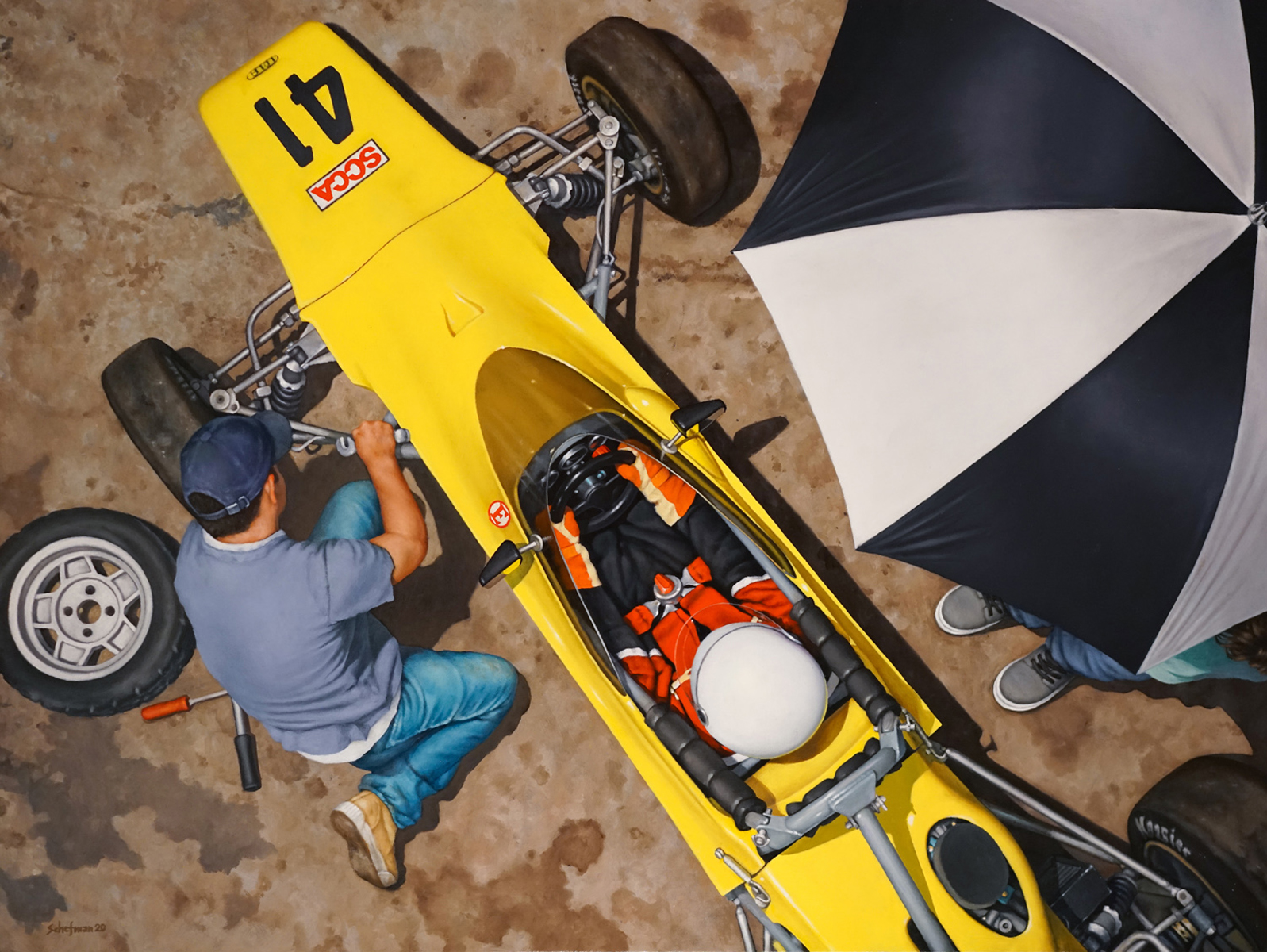
Robert Schefman, Lola, Oil on Canvas, 50 x 40″, 2020

Robert Schefman’s last solo exhibition at the David Klein Gallery in November 2019 focused on a series of works exploring hidden secrets sent to him via social media with no names attached. He leaves that process during 2020 with Lola, an aerial view of a Formula 4 race car as a crew member changes a tire while a figure holds the umbrella protecting the driver from heat or approaching rainfall.  It fits nicely into his illusionistic narrative. The strength here is the point of view, the use of color and the construction of a compelling composition. Although it gleams with the craft of realism and the precise replication of photo imagery, it is likely the nostalgia of this moment in time draws the artist back to an earlier period in his life.

Robert Schefman earned a B.F.A. from Michigan State University and an M.F.A. from the University of Iowa.

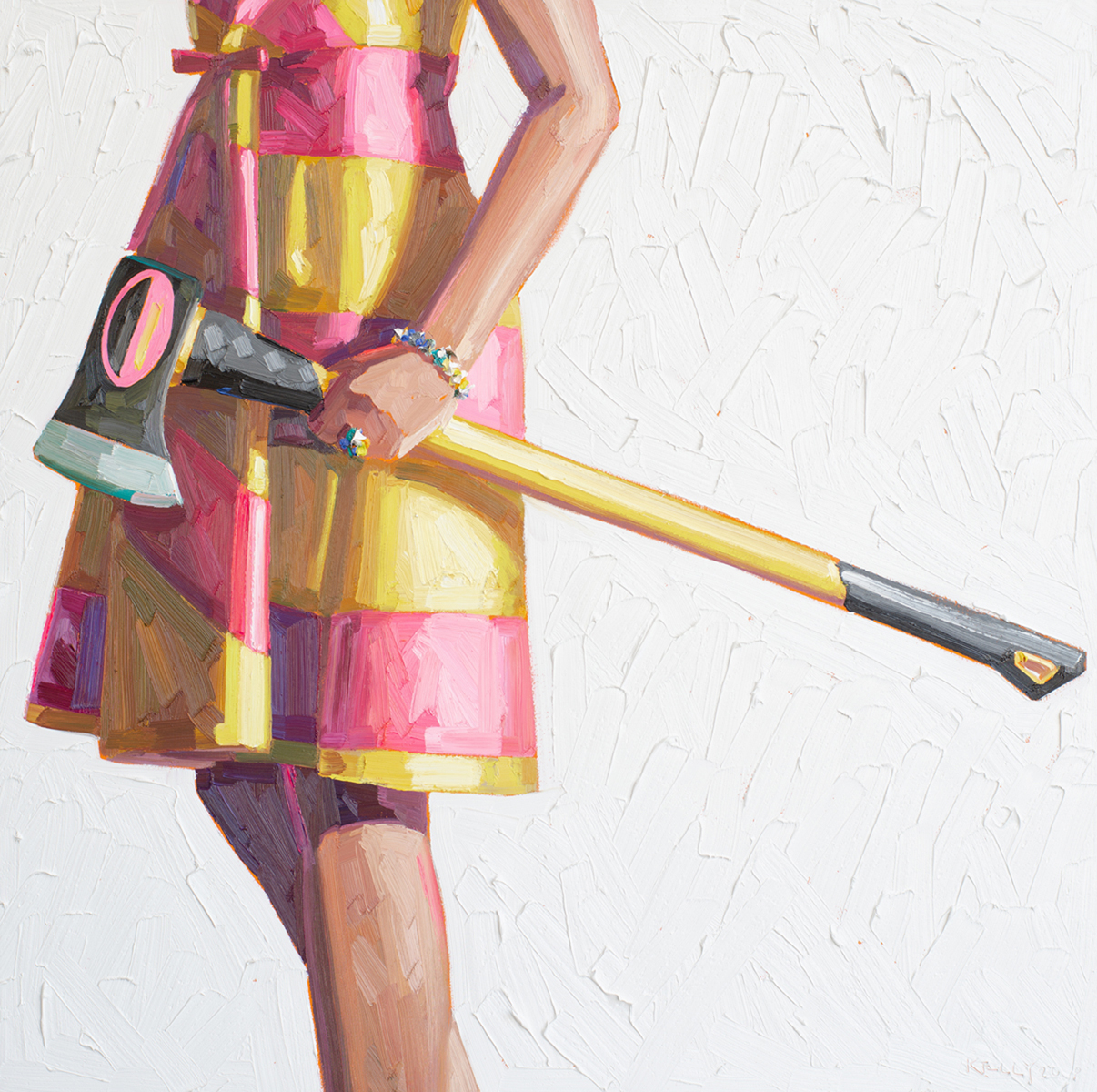
Kelly Reemtsen, Bits and Pieces, Oil on Panel, 36 x 36″, 2020

Kelly Reemtsen gives us her now-familiar depiction of a young woman in retro skirts carrying an ax, with her trademark being pictorially cropped at the head.  Although there have been large paintings in the past that include the female’s head, the work here, Bits and Pieces, is repeated both in composition and the thick, painterly impasto of oil paint.  Set against a white background, the viewer is forced into the tension between the dress pattern and the manly grasp of the color-coordinated ax. Perhaps an early interest in fashion found its way into her mindset, and the niche was oddly a new “post-feminist” expression. The other element that keeps repeating itself is the reoccurring geometric patterns, both on the dresses and in the backgrounds.

Kelly Reemtsen earned her undergraduate degree from Central Michigan University and pursues her graduate degree at California State University at Long Beach.

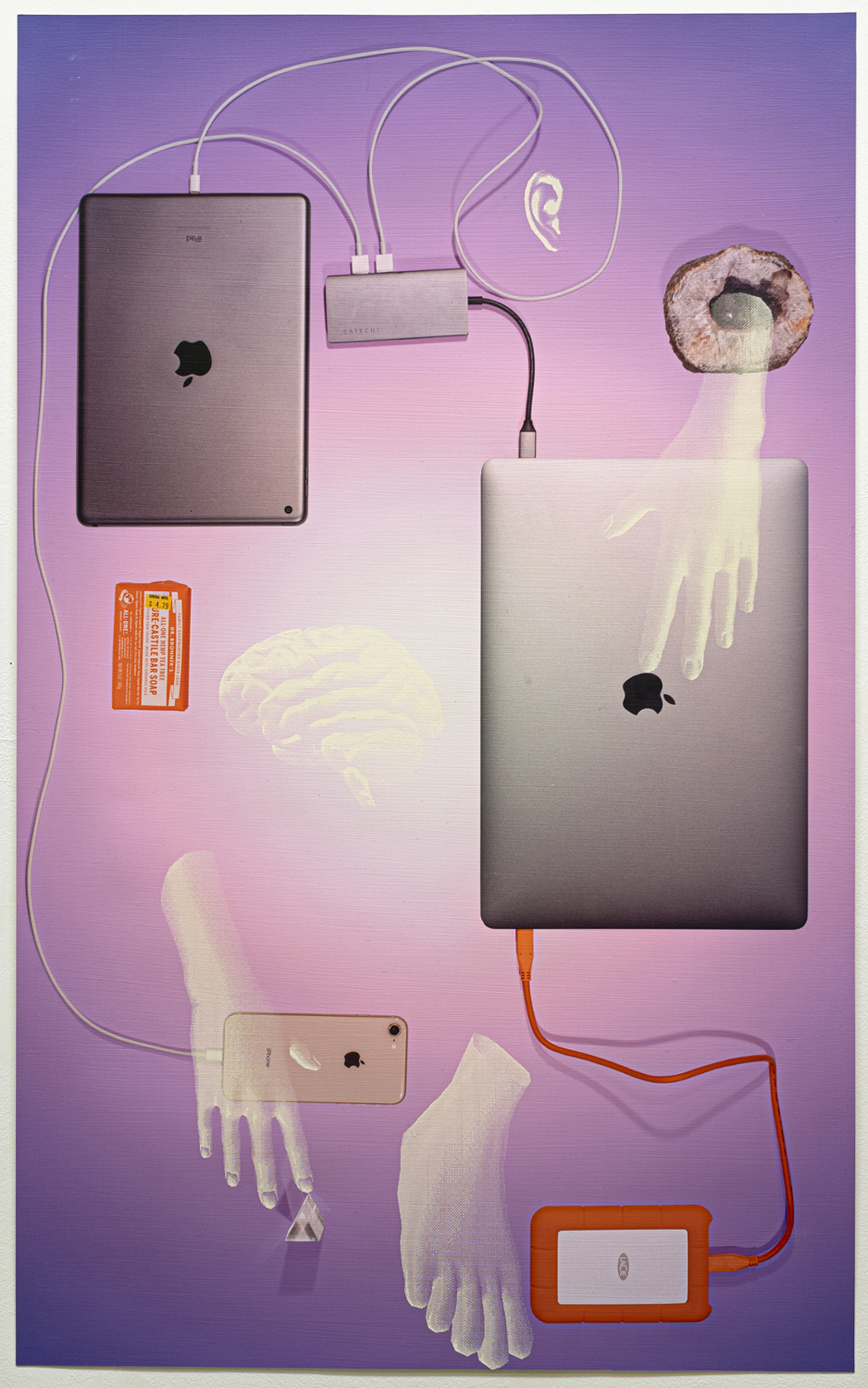
Cooper Holoweski, Late Stage, New Age Process, Mixed Media, 40 x 24″, 2020

In this exhibition, Cooper Holoweski’s Mixed Media pieces were new, fresh and fascinating. Based on a composition of photo illusions of objects, human parts and abstract forms, the work has an underlying grid that supports the vertical work on paper.  Although the work was a new experience, the name was familiar. I had written  about his video work at the Center Gallery, College of Creative Studies, in 2017.  What still fits from the review is his mention of tension, contradiction and counterbalance, elements present in this new mixed media collage imagery. These mixed media prints are highly technical in their creation, something described as New Age Process. Made on Homasote, a cellulose-based fiber wallboard, several gesso coats are applied, and Holoweski uses a laser engraver to obtain a variety of effects creating his archival inkjet print.

Cooper Holoweski earned a B.F.A from the University of Michigan and an M.F.A. from the Rhode Island School of Design.

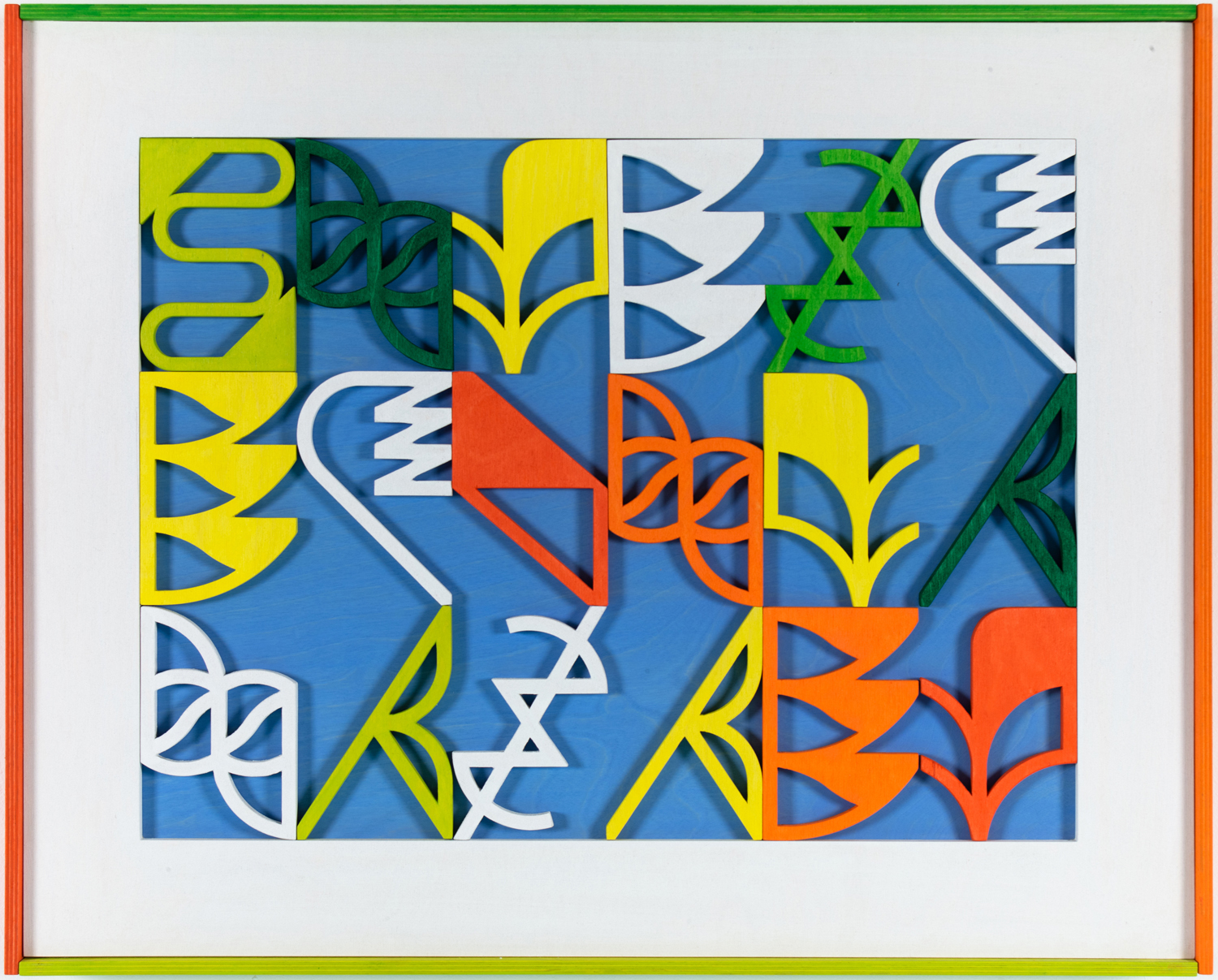
Mark Sengbusch, Singin in the Rain, Acylic on Plywood, 25 x 31″, 2020

Mark Sengbusch’s work is an assemblage of pieces of colorfully painted shapes made from wood that are arranged on a grid with a solid colored background. From his biography, it appears as though the types of forms he uses have been influenced by the architecture he experienced in his travels to Europe and the Middle East. The feeling one gets relies on the pattern created by these new and unusual shapes in this work, Singin in the Rain, which is a combination of secondary color and repetition. These design elements’ craftsmanship extends to the surrounding border and frame, making it an integrated part of the work. He refers to asemic approaches to writing with no semantic content but rather symbolism that is open to subjective interpretations.

Mark Sengbusch earned his B.F.A. from the College for Creative Studies and his M.F.A. from Cranbrook Academy of Art.

Ricky Weaver, My First Mind Tells Me, Archival pigment print, 30 x 45″, 2020

Ricky Weaver’s work employs magical realism to investigate the moment. She uses images of herself to capture a metaphysical sense of reality in her work.  In the work My First Mind Tells Me, she recreates a moment with multiples of the same person while shifting to composition and color aesthetics. The attraction here is bringing the viewer into her world and keeping them questioning where the reality lies. The theme that resonates throughout her work is the black female and her relationship with faith. Much of her work is black & white images, but My First Mind Tells Me is rendered in full color. Repeatedly, she investigates the possibilities of these moments and forces the viewer to imagine a variety of alternatives. It is refreshing to experience an artist so grounded in her beliefs that it transfers to her work.

Ricky Weaver earned her B.F.A. in Photography from Eastern Michigan University and an M.F.A. in photography from Cranbrook Academy of Art.

Scott Hocking is well known for installations both in the gallery and on sites throughout the Detroit Metro region and beyond.  In answering what an artist did in 2020, he responds with a digital film, Kayaking Through the Quarantimes. He mentions in his statement, “Over the years, the experience of kayaking has developed into a full-blown obsession, a much-needed connection to nature and quietude, an art project in itself.”


The exhibition includes the work of: Ebitenyefa Baralaye, Susan Campbell, Matthew Hawtin, Scott Hocking, Cooper Holoweski, Kim McCarthy, Mario Moore, Marianna Olague, Jason Patterson, Kelly Reemtsen, Lauren Semivan, Mark Sengbusch, Robert Schefman, Rosalind Tallmadge and Ricky Weaver.

Hourly time slots are available with a maximum of 20 visitors per hour. Plan your visit to the gallery at www.exploretock.com/davidkleingallerydetroit For further information, please contact: Christine Schefman Director of Contemporary Art: christine@dkgallery.com

WSU 2020 Art Faculty – Virtual Exhibition

The James Pearson Duffy Department of Art and Art History, Wayne State University, presents the 2020 WSU Faculty Exhibition, a virtual exhibition that opened November 19, 2020.

The Art Department Faculty Exhibition at Wayne State University began as an installation in the Community Arts Gallery but quickly became virtual in mid-November 2020 to conform with university Covid-19 requirements. Faculty members from the department who advance the study and practice of art history, design and fine art come together to reflect the university’s full spectrum of area disciplines.  Click on this link, and you’ll find these images above are links to each faculty member’s work here: https://www.waynestategalleries.org/2020-faculty-exhibition-2

Adrian Hatfield, If this isn’t nice, what is?, 2019 oil and acrylic on canvas 48” x 36”

The painting and sculpture of Adrian Hatfield remind this writer of the term magical realism, more often referred to in literature, but that may apply here.  The term magical realism was introduced by Franz Roh, a German art critic in 1925. When Roh coined the term, he meant it to create an art category that strayed from the strict guidelines of realism, which Hatfield’s collage-like work conveys. Hatfield’s work recombines art historical imagery from the industrial revolution and the Romantic era with imagery from current and environmental concerns. In the work, he creates a black & white drawn universe, juxtaposed to these full colored floating dimensional shapes and landscape, part of a dualism that plays with the viewer’s process.

In his statement, he says, “As I explore this dualistic theme through the remodeling of art-historical and scientific imagery, the resultant pieces are mournful, unnerving, and yet oddly hopeful.”  Adrian Clark Hatfield earned his B.F.A. from Ohio State University and his M.F.A. from Ohio University.   https://www.adrianhatfield.com/

Margi Weir, Caution Guardrail, 2020 India ink, Sumi ink, watercolor

Patterns are a large dominating part of Margi Weir’s oeuvre, as illustrated here in this work, Caution Guard Rail, 2020. She uses this technique she describes as Snap Line when she dips cotton twine into thinned acrylic paint or ink and snaps a taut line onto a supporting surface. The spray from the line often begins the process for the composition. Weir’s body of work is expansive and includes paintings, drawings, prints, and installations. The paintings and prints are dominated by a highly developed geometric and colorful pattern. There is a theme reflected somewhere in the pattern, often in the border, where she stitches together multiple symbols to make them visually appealing.

She says in her statement, “In one body of my work, I use a computer (a non-traditional painter’s tool) to repeat images that I stitch together visually in order to make an appealing pattern, often resulting in tapestry-like, spatially flattened compositions.  This references pre-Renaissance and/or non-western methods of pictorial organization, for storytelling purposes, that were used in textiles, ceramics, and architectural decoration.  This particular use of juxtaposed images, stacked and repeated, is a unique addition to the visual language of painting in the 21st century.”

Ms. Weir earned her MFA in painting from the University of California at Los Angeles (UCLA); her MA in painting from New Mexico State University. She also holds a BFA in painting from San Francisco Art Institute and BA in art history from Wheaton College.   https://margiweir.weebly.com/

Millee Tibbs, Transfrontalier, 2018 Gelatin Silver Print + Custom Frame

To describe Millee Tibbs’s work as landscape photography would not be complete, although she is using a camera and capturing images of mountainous terrain. Instead, that would be the starting point for various manipulations; whether it be the entire shape of the image or the overlay of a second geometric shape on the terrain, there is an astute variety in how these images are presented.  The artwork derives from Tibbs’s interest in photography’s ubiquity and the tension inherent in manipulating reality. Sometimes it is in the overlay of a geometric shape on the mountainside; other times it includes the shape of the image, mat, and frame. It’s as if the mountain terrain becomes the backdrop for an artist interested in what I might call a shaped canvas work: Frank Stella, 1965; Ellsworth Kelly, 1970, or Elizabeth Murray, 2006.

She says in her statement, “My work has evolved into an investigation of idealized landscape imagery – the kind that is easily consumable and often commodified. I am fascinated with the landscape genre and its language, the aesthetic imposed onto the land through photographic framing, and the historical rhetoric inherent in these images that justified Manifest Destiny and conquest through what is left out—namely inhabitants.”

Millee Tibbs earned her B.A. from Vassar College and her M.F.A. from Rhode Island School of Design (RISD)    https://www.milleetibbs.com/

Sheryl Oring, “I Wish to Say” Video, 5:13 minutes

The video work of Sherl Oring investigates social issues through projects that incorporate on-camera interviews that examine public opinion. In “I Wish to Say”, Oring sets up a portable office where woman in secretarial costume interview individuals at large about the state-0f-affairs in the U.S. and documents their comments using a typewriter, intending to main a postcard to the White House.  To date, nearly 4000 postcards were mailed.

Having worked in educational television, it is important to say the standards and caliber of production in these short videos are of the highest quality: the recording of imagery and audio and the direction and editing of these videos are highly produced.  The “I Wish to Say” project has a companion book from the University of  Chicago Press, Activating Democracy, a result of helping people from across the United States voice their political concerns.

From the Public Art Review, “Sheryl Oring’s multiyear, ongoing I Wish to Say project—in which she sets up a desk with a typewriter and invites people to dictate a letter to the President or a presidential candidate, which she types and sends—is a catalyst for a deeper look at artists’ intersection with public policy.”

Sheryl A. Oring earned her B.S. in Journalism at the University of Colorado and her M.F.A. from the University of California.  http://www.sheryloring.org/

Works by the following full and part-time faculty are featured in the exhibition: Maria Bologna, Kiley Brandt, Betty Brownlee, Allana Clarke, Pamela DeLaura, Jessika Edgar, Laura Foxman, David Stephan Graves, Richard Haley, Adrian Hatfield, Margaret Hull, Lauren Kalman, Deborah Kingery, Ruth Koelewyn, Brian Kritzman, Claas Kuhnen, Evan Larson-Voltz, Heather Macali, Katie MacDonald, Heather Mawson, Judith A. Moldenhauer, Carole Morisseau, Sheryl Oring, Kathyrose Pizzo, Tom Pyrzewski, Kyle Sharkey, Rebekah Sweda, Andrea Thurston-Shaine, Millee Tibbs, Maureen Vachon, Margi Weir, and Golsa Yaghoobi.

Wayne State University,  2020 Faculty Exhibition, a virtual exhibition opened November 19, 2020, and runs through January 8, 2021.


Page 10 of 35

Powered by WordPress & Theme by Anders Norén