Critical art reviews of Detroit galleries and museums weekly

Author: Ron Scott Page 30 of 36

Ray Johnson @ CCS’s Valade Family Gallery

The Bob Boxes at the College for Creative Studies and the Valade Family Gallery
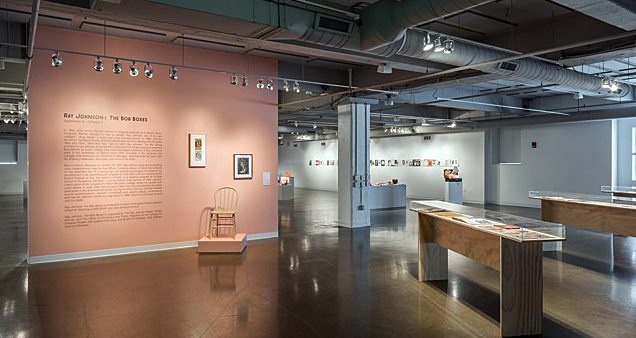
rj-1-install-1

Ray Johnson, Installation – All images courtesy of Robert Hensleigh

There is a remarkable exhibition at the College for Creative Studies’ Valade Gallery and the subject, Ray Johnson, has haunted me for years. I thought this obsession was because he was a Finnish kinsman with similar, exotic ethnic roots in the Copper Country of Northern Michigan, or maybe because a seminal figure of Detroit art and culture, Gilbert Silverman, famed for his iconic collection of Fluxus art, was his close friend and became his lifelong patron. Of course the great documentary film about Johnson’s life and death, “How to Draw a Bunny” (a must see for anyone interested in Johnson’s artistic strategies), was also instrumental in creating his haunting identity. I thought maybe my fascination with Johnson was that he was a Detroiter who went to Cass Technical High School and then attended the unique and ultimate, progressive Black Mountain College, where the American avant-garde art was born, and where my own poet-model, Charles Olson, taught. While there in the vital Post WWll years Johnson engaged with John Cage, Merce Cunningham, Elaine and Willem de Kooning, Josef and Anni Albers, Charles Olson, Robert Creeley, Buckminster Fuller, Franz Kline, Jacob Lawrence, Cy Twombly, Fracine du Plessix Gray, and many other art world lights.

But yesterday, curious about his local roots, I went to his childhood home on Quincy Street in Detroit and astonishingly discovered I was born directly behind his house on Holmur Street, the year he left for Black Mountain College. We discovered that my sister went to school with him.

None of this means a thing of course unless you’re Ray Johnson. And then it means everything, because if anything Johnson is about relationships: between people, objects, words, colliding and collaging (his basic gesture as an artist) or putting things together.
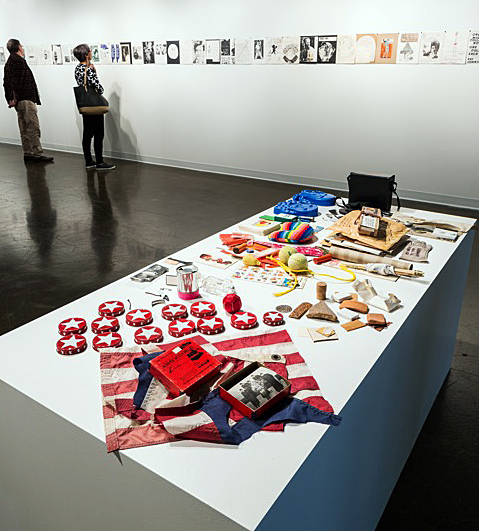
rj3-table-2-people

Johnson, often referred to as “the most famous unknown artist in America,” in addition to running with the New York School of famous painters, poets, and composers, spent years developing a network of relationships in the art world via that most democratic of institutions, the United States Postal Service. He basically created the New York Correspondance School (a play on the New York School of Abstract Expressionists and pun on creative movement of his art) and the phenomenon of “mail art” as a way of circumventing the capitalist art market of collectors, galleries, curators, and museums, creating a direct and intimate communication between artists. Using his own very finely crafted collage techniques and a complex personal iconography (rabbits, strange silhouetted portraiture of famous movie stars and artists, homoerotica, spinning on complex language games and puns), he created a network that sent out small-scale art works composed of drawings, photos, and cut-out texts from magazines of movie stars, product packaging, found objects, and ultimately whatever was part of the visual surface of post war popular culture that he swam in.
rj4-3-tables

In the most significant aspect of Johnson’s mail art project, he asked for additions and collaborations on his work, as well as others he had “sent out,” to redirect and create an alternative visual dialogue among chosen artists. Johnson’s interest in both Zen practices and chance operations (through his close friendship with composer John Cage and choreographer Merce Cunningham) played a central part of his artistic practice and even more significantly in his enigmatic philosophical vision and life practice. Ultimately the New York Correspondence School attracted thousands of participants becoming a global network that eventually lost its human connectedness, which perhaps prompted Johnson in 1973 to proclaim the New York Correspondence School dead.

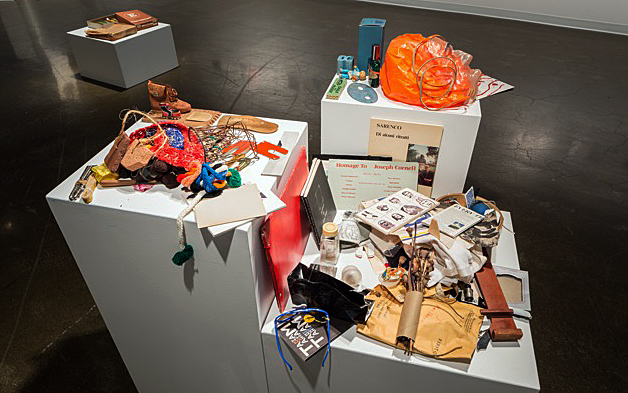
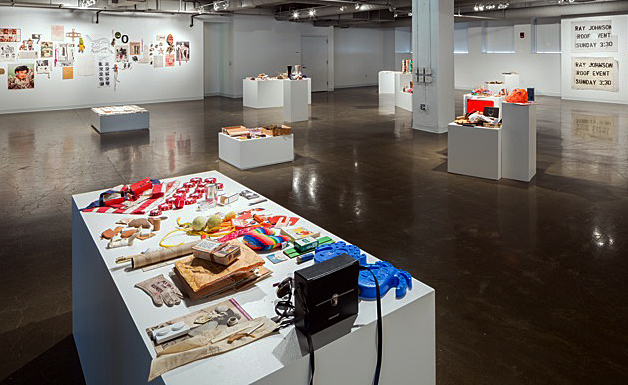
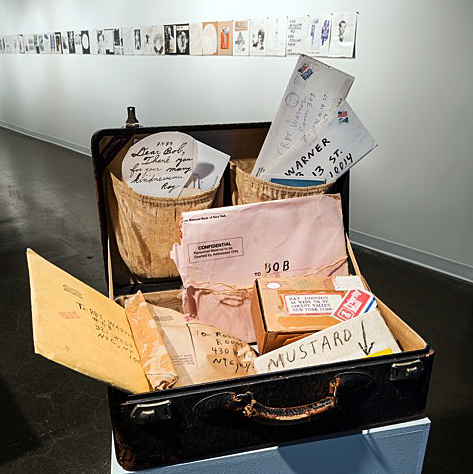
The exhibition at the Valade Gallery, The Bob Boxes, is the result of one particular mail art relationship that Johnson had with artist/collagist, Robert Warner. From 1988 until Johnson’s death in 1995, they maintained a correspondence exchanging mail and phone calls. At one point Johnson delivered thirteen boxes of various “mail art” he had created and collected, including found objects from everyday life and popular culture. (It is probable that the famous boxes of “assemblage” artist Joseph Cornell, whom Johnson had admired and befriended, inspired the “boxes” he created for Bob Warner, “The Bob Boxes.”)
rj5-many-tables

Like Cage and, indeed the ultimate assemblage artist, Marcel Duchamp, Johnson was primarily interested in how chance encounters, between people, objects, or words, created new sets of possibilities or connections, or extended the possibilities for making meaning out of the world. He wasn’t interested in a singular system, visual, linguistic or cinematic, but any kind of “relationship” between things that prompted a vital often satirical critique. He referred to his small collages as “moticos” (an anagram for osmotic), created to stimulate or inspire connective tissue in everyday life. In a very real sense then there was no separation between Johnson’s art and life, and his seamless playful landscape provoked many to call him a Neo-Dada artist, a surrealist, which of course he rejected as just one more effort to classify him.
rj6-suitcase


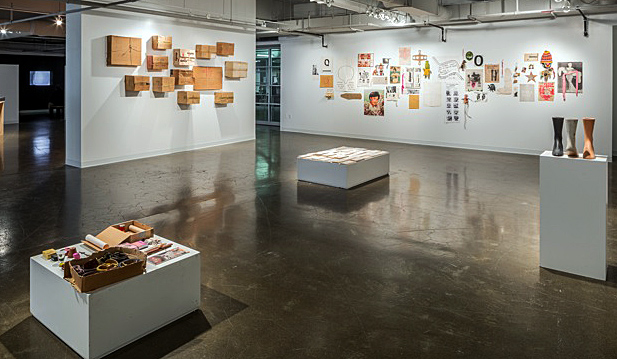
The Valade Gallery’s exhibition is then really a performance of Bob Warner’s “unpacking” of the 13 boxes that Johnson gave him. Placed on tables, the contents of the boxes — Warner’s humorous title for the exhibition is “Tables of Content” — have been distributed, and the results on each table are a tsunami of the flotsam and jetsam of the American visual landscape that Johnson assembled for Warner and us, providing a ready-made mail art kit for our visual challenge.
rj2-install-2

In addition to the “Tables of Content,” there are three vitrines containing early photographs from Johnson’s life in Detroit, including some wonderful drawings that he made while at Cass Technical High School. There are also seven hours of video — ”The Ray Johnson Videos” made by Nicholas Maravel — of Johnson talking about his work and generally performing himself for the camera.

Amazingly “The Bob Boxes” is the first exhibition of Ray Johnson in his hometown of Detroit for over forty years, and the Valade Gallery’s curator, Jonathan Rajewski, has provided a fine context and perspective on the work of one of the most enigmatic artists of the 20th century.

College for Creative Studies

A.Alfred Taubman Center for Design Education

The Valade Family Gallery       460 W.Baltimore   Detroit, MI 48202

Gallery Hours: Wednesday-Saturday, 12 to 5 p.m.
Drawn Together @ the Scarab Club

Brienza, Bruner, Galbreath, and Carmen-Vian make drawings that engage

together2

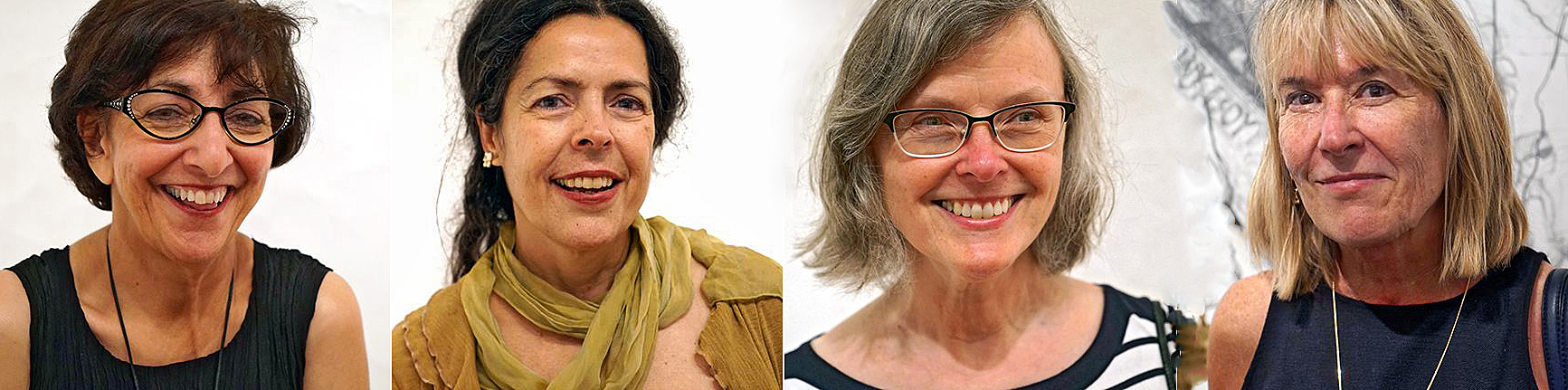
Artists, Sue Carmen-Vian, Joyce Brienzia, Coco Bruner, Lynn Galbreath Image Courtesy of Jeff Cancelosi

Drawing has been around for a while. Think: Lascaux cave in Dordogne, France. And drawing is one of the major forms of expression, concerned with the making of lines, tonal areas, black and white or color, representational or abstract, the work in DRAWN TOGETHER is a strong exhibition, curated by Joyce Brienza. She says, “We are a group of artists and friends who have in common an interest in the idea of drawing as end point rather than merely a preparatory act. We are in love with drawing as a direct, no tech and un-electronic media. We see the pencil in some ways as an instrument of nostalgia, recalling the Renaissance quest for virtuosity. Our work ranges from narrative to abstraction but there is a conceptual bent towards popular culture that questions the separation of fine and applied arts.”

name-2

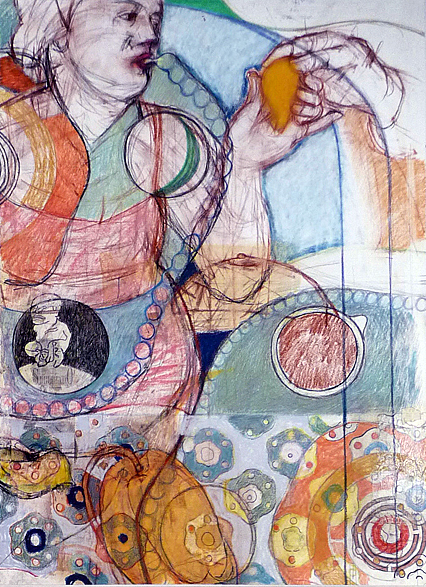
Joyce Brenzia, Mixed media on Paper, 28″ x 22″

Joyce Brienza’s work, Given Name ll, is a colorful mixture of images that seem to have the feminine as a theme with overlapping figure and design elements. The compositional construction provides the audience with her artful dexterity with the human anatomy. She says, “In dreams and memories fragments are all we have to make up the whole. I work with images the way a DJ samples music to create my own brand of visual hip hop. By employing a collage technique, the works are constructed of layered and juxtaposed elements drawn from multiple sources that possess a particular personal and/or social significance. Among these sources are still life objects, toys, atomic structures, old master works, family photographs etc. This re-contextualization of images is a conduit for the generation of new meanings.” Her patterns are critical elements set within a grid that tell a story which resonates with the viewer. The work is both personal, and societal.


rhysitmes-with-silence-coco-b

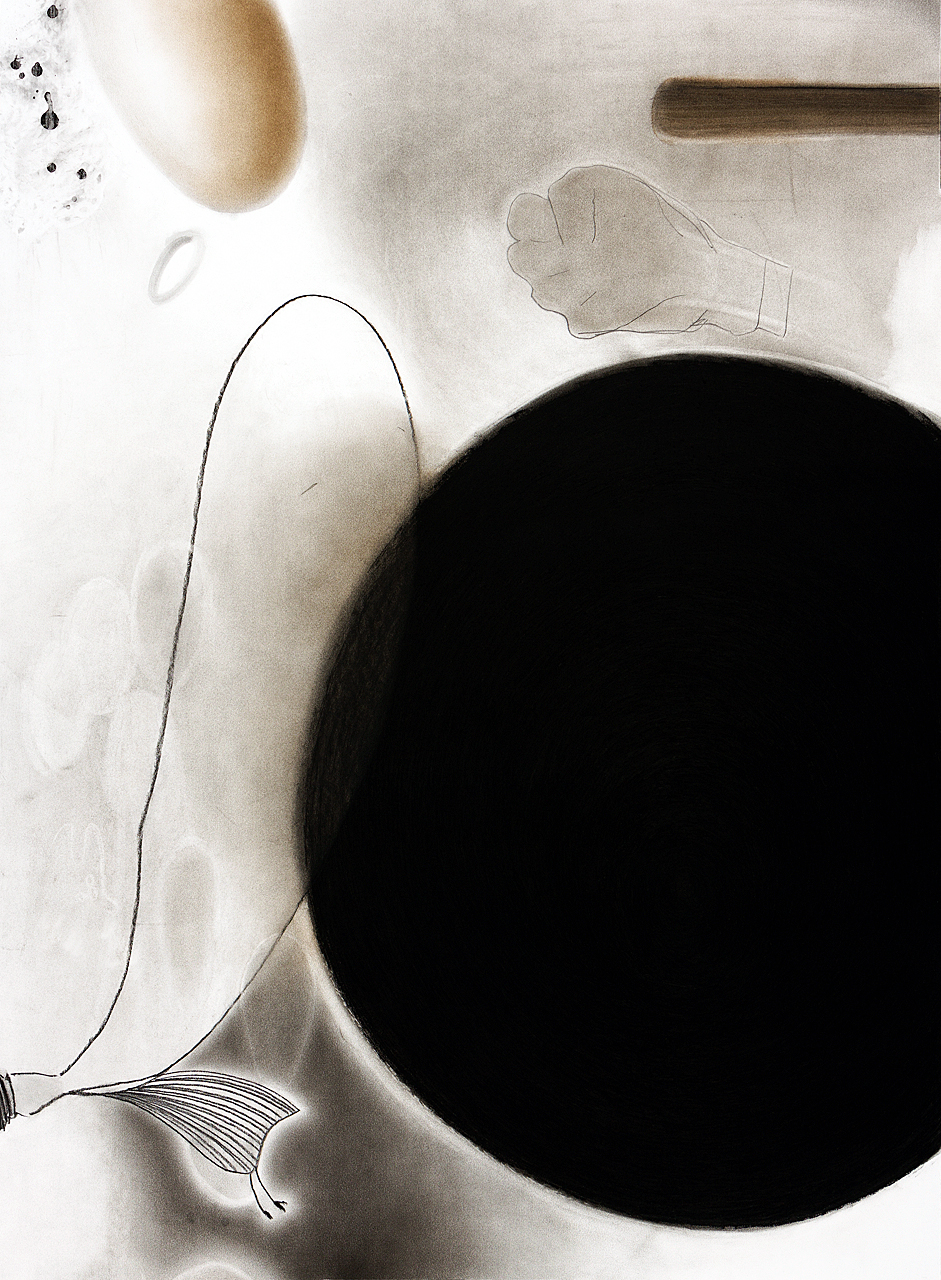
Coco Bruner, Rhymes with Silence, Charcoal and Conte crayon , 30 X 22 – 2015

Coco Bruner’s work, here embellished in Rhymes with Silence, includes a variety of media, in which she manipulates the illusion of space and light. She includes both spontaneous and calculated gestures, while presenting an unconventional composition dominated by this large black circular shape. She says, “Each drawing begins with as spontaneous a gesture as possible. What follows is navigation between control and impulse, the known and unknown. It’s a bit like hitchhiking. You take a risk, not knowing where you’ll arrive, but you’ll probably learn something.” These rather pure abstractions present a sense of mystery that have no definable meaning. An MFA graduate from the School of the Art Institute of Chicago, and recipient of a Kresge Visual Arts Fellowship in 2013, Bruner works in drawing, painting, sculpture and photography.

pony-boy-1

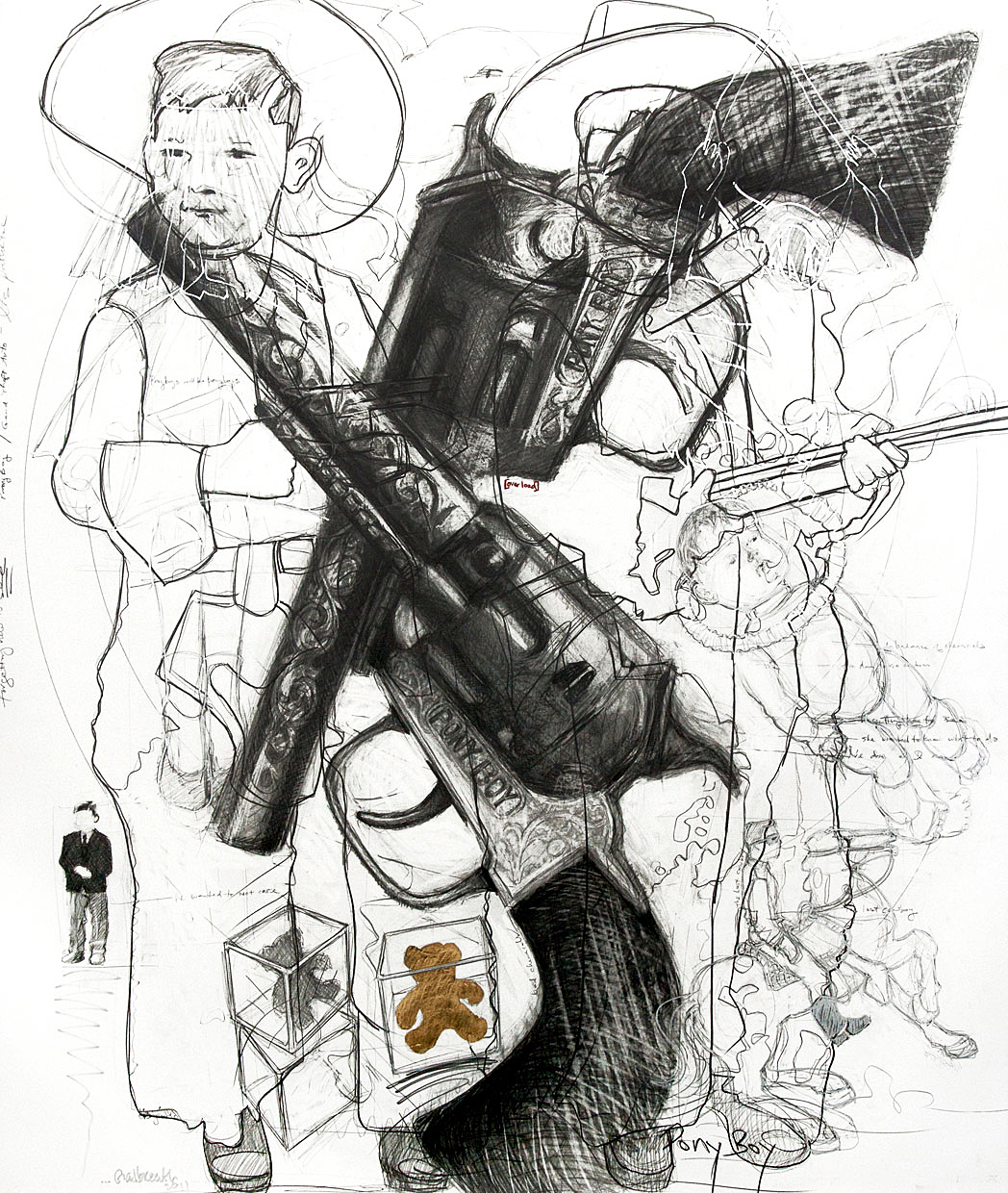
Pony Boy, Graphite and gold leaf on Paper, 60″ x 50″

Here in her drawing Pony Boy, Lynn Galbreath juxtaposes a realistic rendering of two toy pistols against a background of line drawing and creates a young boy’s world filled with imagery and costume. She says in her statement, “I am born to create and cannot function on a daily basis without making something. I create to communicate. To me, art is the conversation we’ve been having since the beginning of time, the one that’s always probing the human condition.” In this drawing, it is the scale that works so well. If it were 8 X 11″, it would feel more like an illustration. Given its size 22 X 40″, the power of scale makes the work stronger, which is not always the case. These toy objects are rendered with such contrast and detail, they take on a life of their own.

sue-carmen-vian

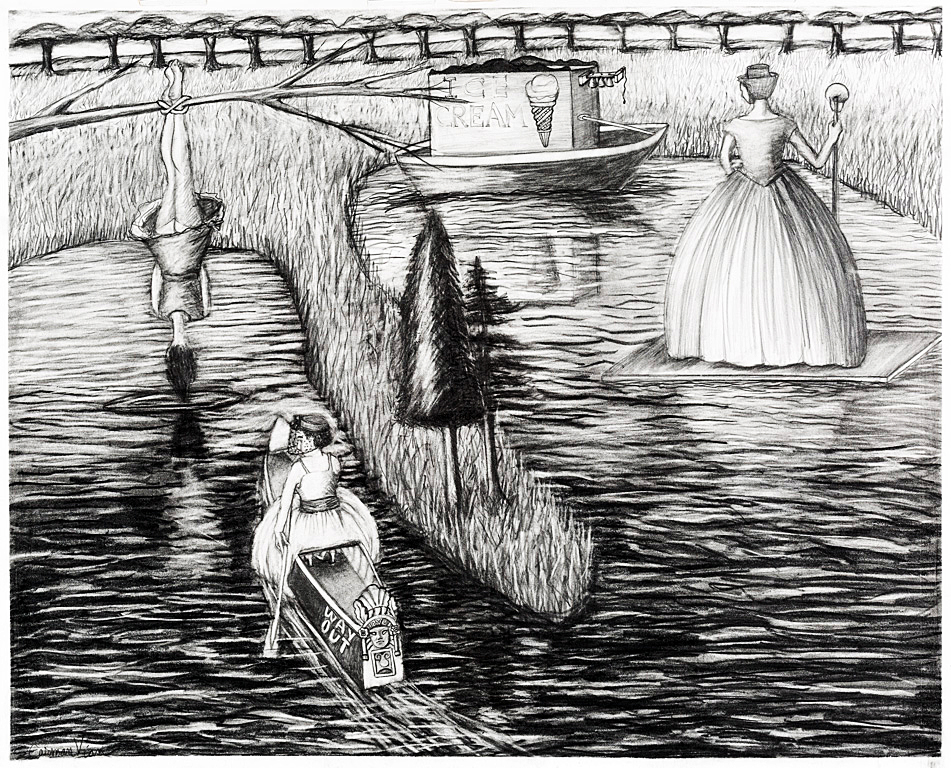
Sue Carmen-Vian, Way Out, 34 x 42 Graphite on Paper, 2016

In her work, Way Out, Sue Carmen-Vian, an MFA graduate from Wayne State University, provides a collection of stylized Van Gogh-like drawings that introduces her audience to a figurative type of surrealism that is personal and at times autobiographic. At a distance, these heavy black and white pencil drawings can have a woodcut feeling with her textural markings. In her statement she says, “The challenge of retirement from teaching is to continue to feel useful. As this part of my life fades my art has become more defined and developed. These drawings contain costumes and props from my on going performance art and teaching days.” On her way out in her new canoe, she seems to be navigating between herself on the right, standing up straight and balanced, versus herself hanging upside down in a quandary. I am sure, since she’s in charge of the canoe, everything will turn out just fine.

On September 9, the first Friday of the new fall 2016 season, there were six openings in Detroit (perhaps more). As I visited each, it wasn’t until I ended up at the Scarab Club that I experienced a loud and joyful community of artists, friends and family, who all had relationships with these four artists. If you’re a painter or a sculptor, it is likely that drawing is at the core of your work. We can look back in history and see the preliminary drawings made by Michelangelo, da Vinci and Rembrandt. Certainly, as demonstrated by these four artists, drawing as an art form is alive and well in history and present in Detroit. The Scarab Club, under the leadership or Treena Flannery Ericson, is the perfect home for DRAWN TOGETHER.

August 31-October 15, 2016
, 7-10 pm
 Gallery Talk: Saturday, September 24, 2 pm

Scarab Club


Colnaghi @ Wasserman Projects

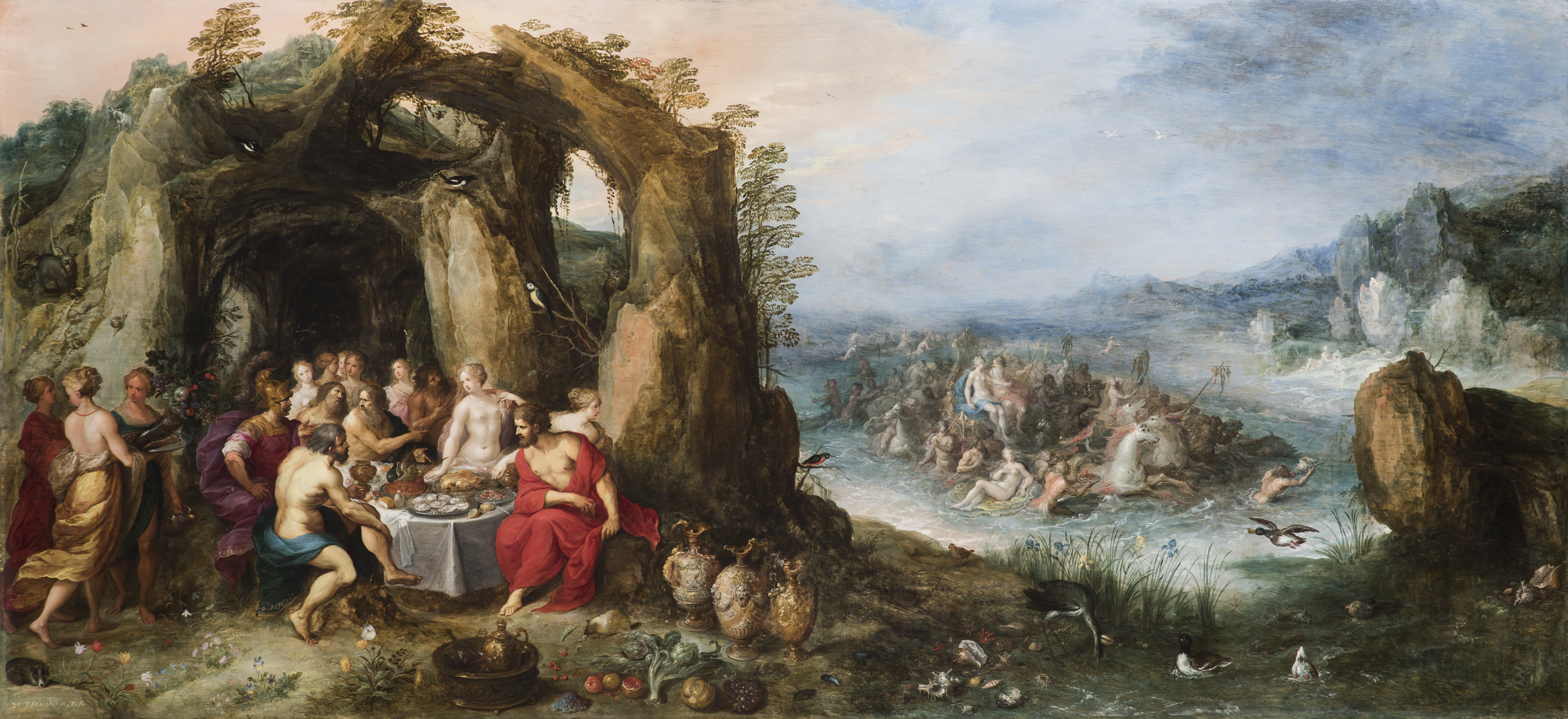
feast-of-the-gods-frans-francken-oil-on-panel-727-x-1575-cm

Frans Francken, Feast of the Gods, Oil on Panel – A landscape with Theseus and Achelous, with the Triumph of Poseidon and Amphitrite beyond Frans Francken the Younger / Antwerp, 1581 – Antwerp, 1642 Joos de Momper the Younger / Antwerp, 1564 – Antwerp, 1635 Signed lower left :Dᴼ FFRANCK. IN.E.F. Oil on panel, 72 x 157 cm. (28 ½ x 61 ¾ in.)

The Wasserman Projects opened a new exhibition, Old Masters / New World from the Colnaghi Gallery of London, for a limited time, September 7-11, 2016. The work includes major painting and sculpture by such artists as Frans Francken, Gaetano Gandolfi, Jusepe de Ribera, and Pedro Duque y Cornejo.

Gary Wasserman, Founder of Wasserman Projects says, “We share Colnaghi’s vision to connect the historic with the contemporary, and to show art in a diversity of contexts and through a wide range of collaborations. To be able to show these tremendous Old Master works in the contemporary, industrial-style setting of our exhibition space is an exciting proposition that highlights the connection between the past and present and offers a new way of experiencing both the art and the space.”

If you look at the trajectory of Wasserman Projects, set in a former firehouse in Detroit’s historic Eastern Market, the work on exhibition there has been contemporary and at times conceptual. The gallery works with artists from across disciplines and around the world, presenting exhibitions and performances that spark a discourse on art, but also cultural, social, or political issues, which are particularly active and timely in Detroit.

In attendance for this opening was Jorge Coll, CEO of Colnaghi, “We are thrilled to build on our long and storied history in America by holding our first exhibition in Detroit, and to be doing so in partnership within many of the greatest American museums and collections, including ones in this city. It is in this spirit of engaging new and existing communities of arts enthusiasts and collectors that we are holding Old Masters / New World in Detroit. We see our vision to present Old Master works across a wide range of locales as parallel to the missions of museums and universities to educate on the arts.”

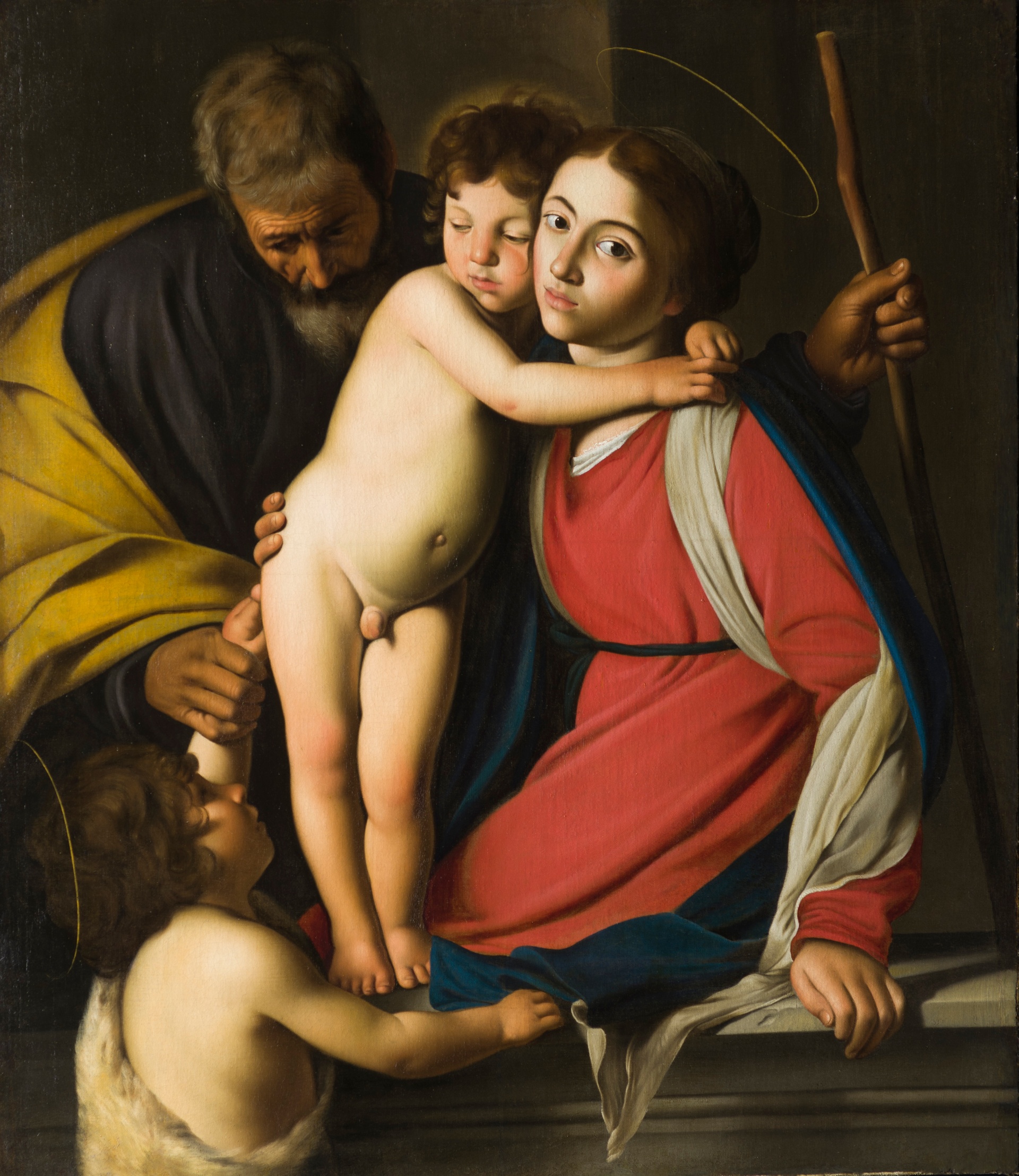
1342_juan-bautista-maino_the-holy-family_oil-on-canvas_106-x-93-cm-unframed_small-1

Fray Juan Bautista Maíno “The Holy Family with the Infant Saint John the Baptist” Pastrana, 1581 – Madrid, 1649, Oil on Canvas 110.5cm x 92.5cm

The painting, The Holy Family, reminds this writer of how popular it was in the 14th through 16th centuries to paint the Madonna and Child. Here, the artist Stozzi,  includes Joseph, the husband of Mary, and the young child Jesus, reminding us of the age difference, and provides the audience with a direct and comforting look from the mother. When I first read and studied the work of Giovanni Bellini, it was amazing how many paintings he made of Madonna & Child. People of wealth during these times, would commission a painting for their home, and because Catholicism was the dominate religion, there was nothing more pure and sacred than this image. One gets the impression there was tremendous status in having such a painting in their home. So the answer to the question is that it was very lucrative for artists to make so many of these paintings. The only question raised here is who is the child at the bottom of the painting who draws the attention of both Jesus and Joseph with the halo? The answer is his cousin, John the Baptist.

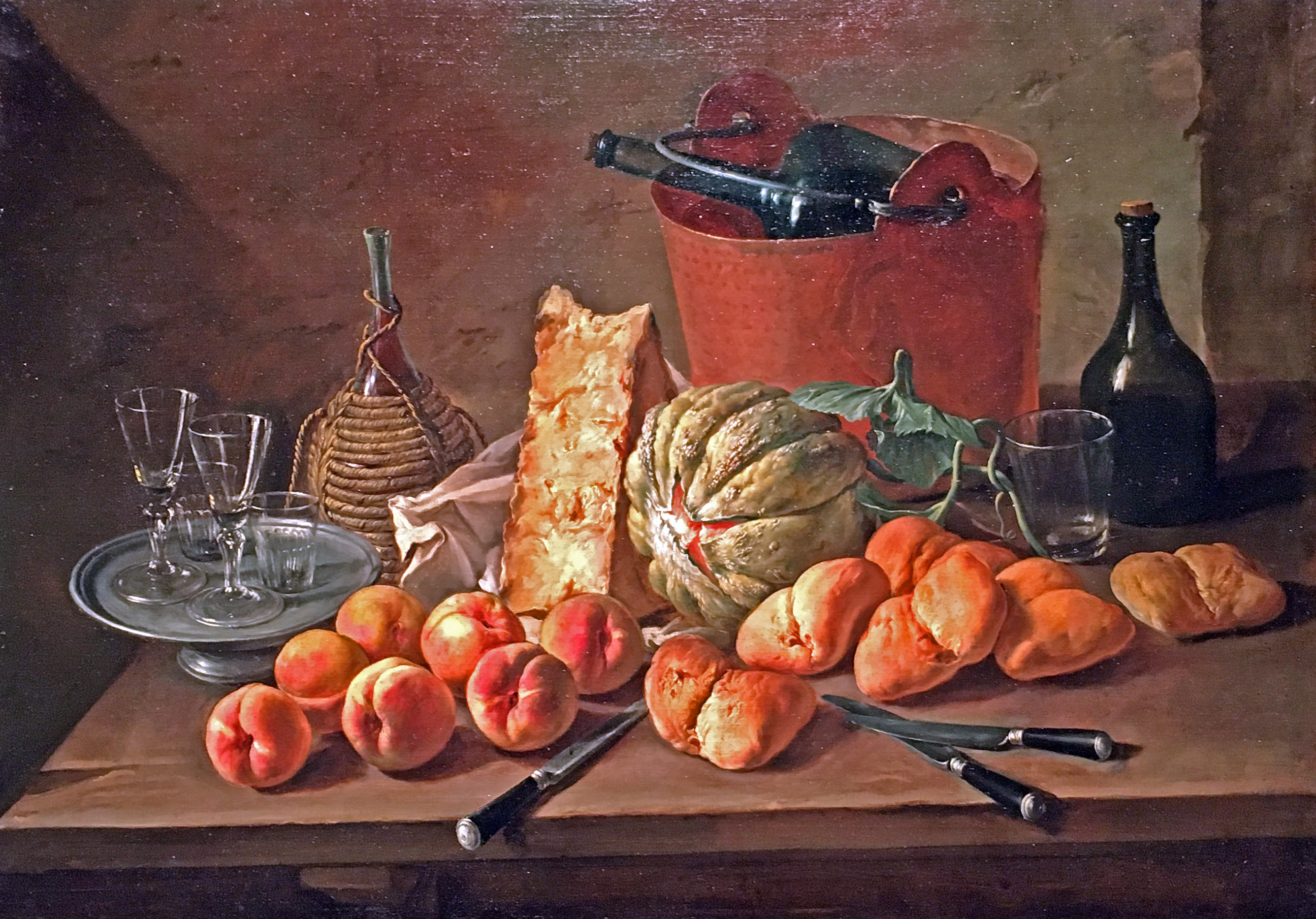
giacomo-deruti-kitchen-still-life-33-x-47-milan-1698-1768

Giacomo Ceruti, Kitchen Still Life, 84 X 118 cm, Milan, 1698 – 1767

Still life paintings were popular during this time period. In Kitchen Still Life, the painter Giacomo Deriti produces a classic realistic composition that easily sets the stage for painters to come a century later. These near photo realistic images (before the invention of photography) are composed and lit, which provides the artist with an unlimited amount of time to compose, draw, under-paint, and add reflective details. Elements of illusion are magnified by having the knives come off the front edge of the table, while at the same time create a balance of shape and form with the light source coming from the upper left.

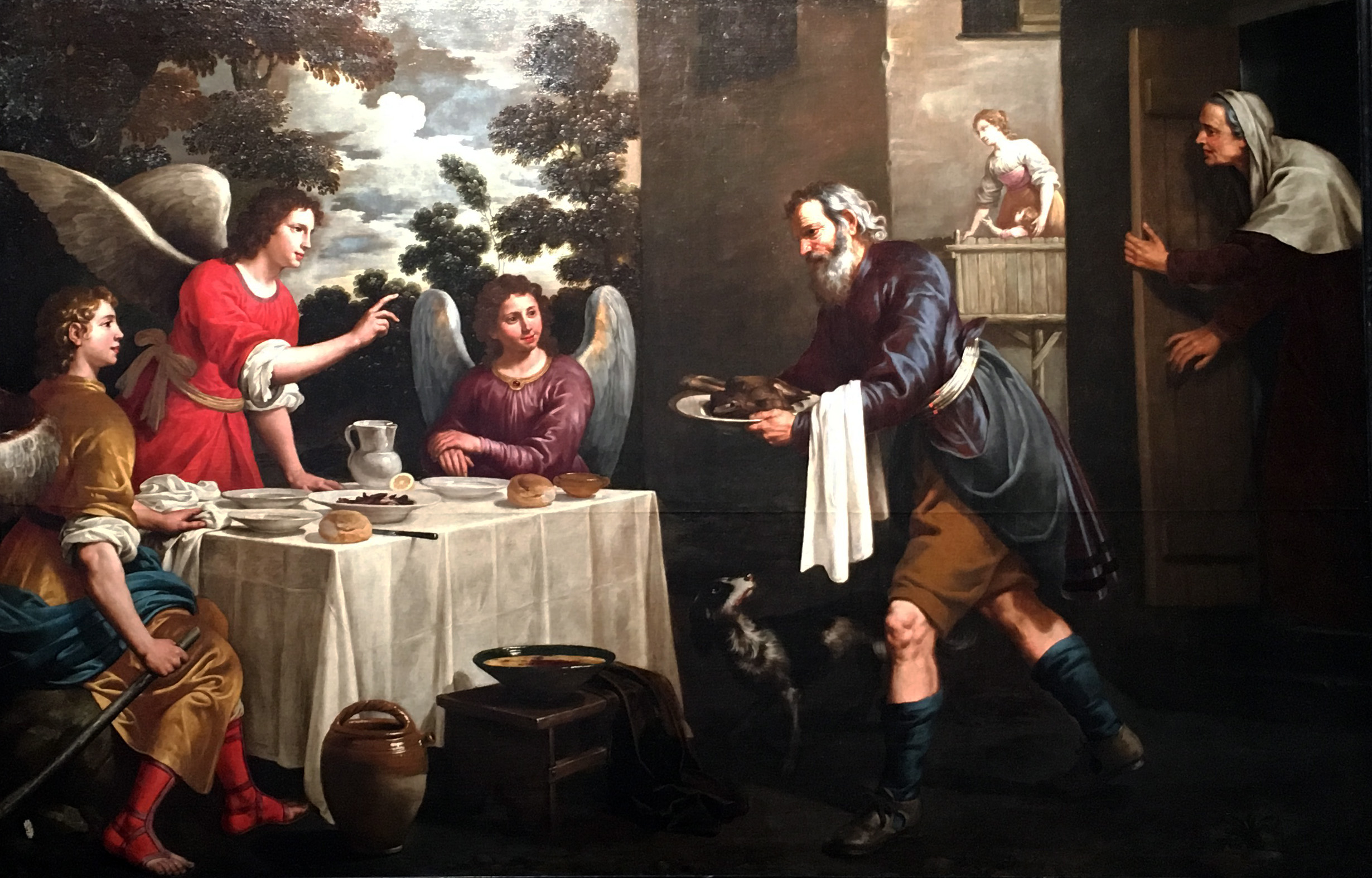
juan-van-der-hamen-y-leon-abrahanm-and-the-three-angels-72-x-110

Juan van der Hamen y Leon, Abraham and the Three Angles, 279 X 181cm, Madrid 1596-1631

The Spanish painter, Juan van der Hamen, was born in Madrid in 1596 and was recognized for his allegories and landscapes during the Baroque period. A prolific artist, van der Hamen painted all his works during the first decade of the reign of Philip IV. As a religious painter Hamen worked for several religious institutions in and around Madrid and Toledo, like the Monastery of the Descalzas Reales, in Madrid, for which he painted altars. The best surviving examples of his religious work are in the cloister of the Royal Convent of La Encarnación in Madrid, painted in 1625 in a naturalistic tenebristic style. The painting Abraham and the Three Angels is known for the stylistic characteristics and the iconographic interest of the scene, by which the artist interpreted the Biblical theme of the apparition of the three angels in the house of Abraham to announce that Sara would conceive a son.

So why is it important for young people today to experience this work, both in galleries and museums? Let me start by saying that many things that are part of human history continue to enrich our lives: Mathematics, Philosophy, Literature, Music and certainly Art. Do we not still listen to Bach and derive meaning that connects us to all music, and can we not still relate to the allegory in Dante’s Divine Comedy? For Wasserman Projects to bring this experience to Detroit creates the opportunity to expose Italian and Spanish Renaissance Painting to an audience that may not have thought of the connection that all art shares.

Wasserman Projects demonstrates that it is guided by a spirit of collaboration, recognizing that art is best realized and most meaningful when it engages the broad range of people such as the dynamic and diverse population of Detroit.

Wasserman Projects, September 2016


Laszlo Moholy-Nagy @ Guggenheim, NYC

Guggenheim

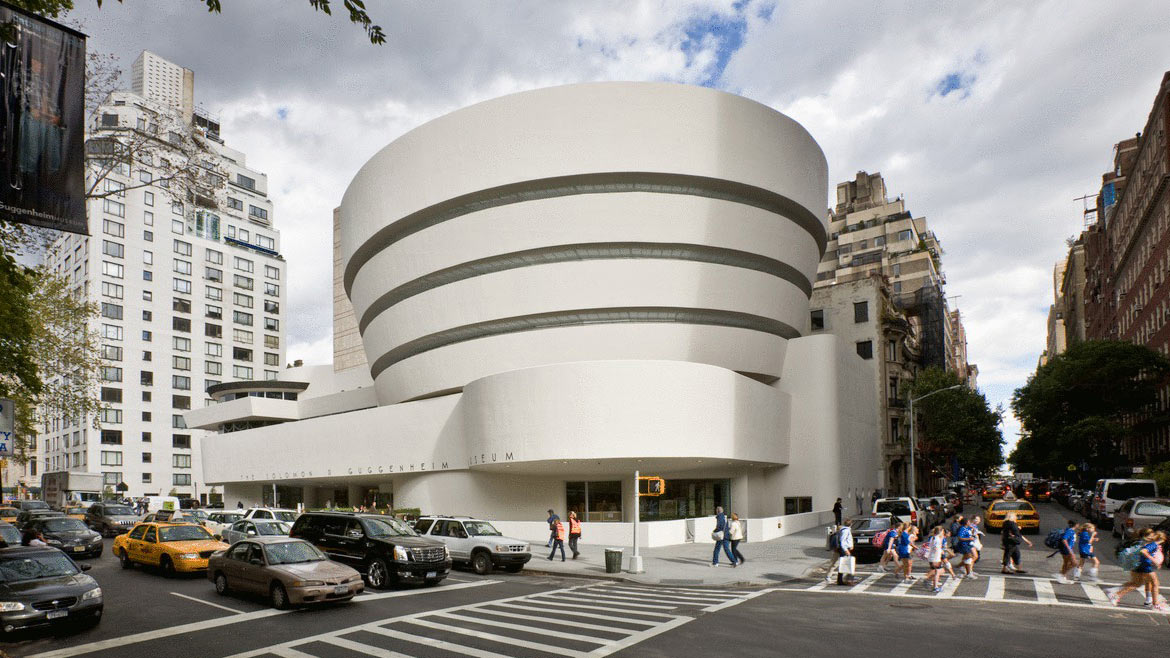
Guggenheim Museum, New York City. All Images Courtesy of the Guggenheim Museum.

Moholy-Nagy: Future Present

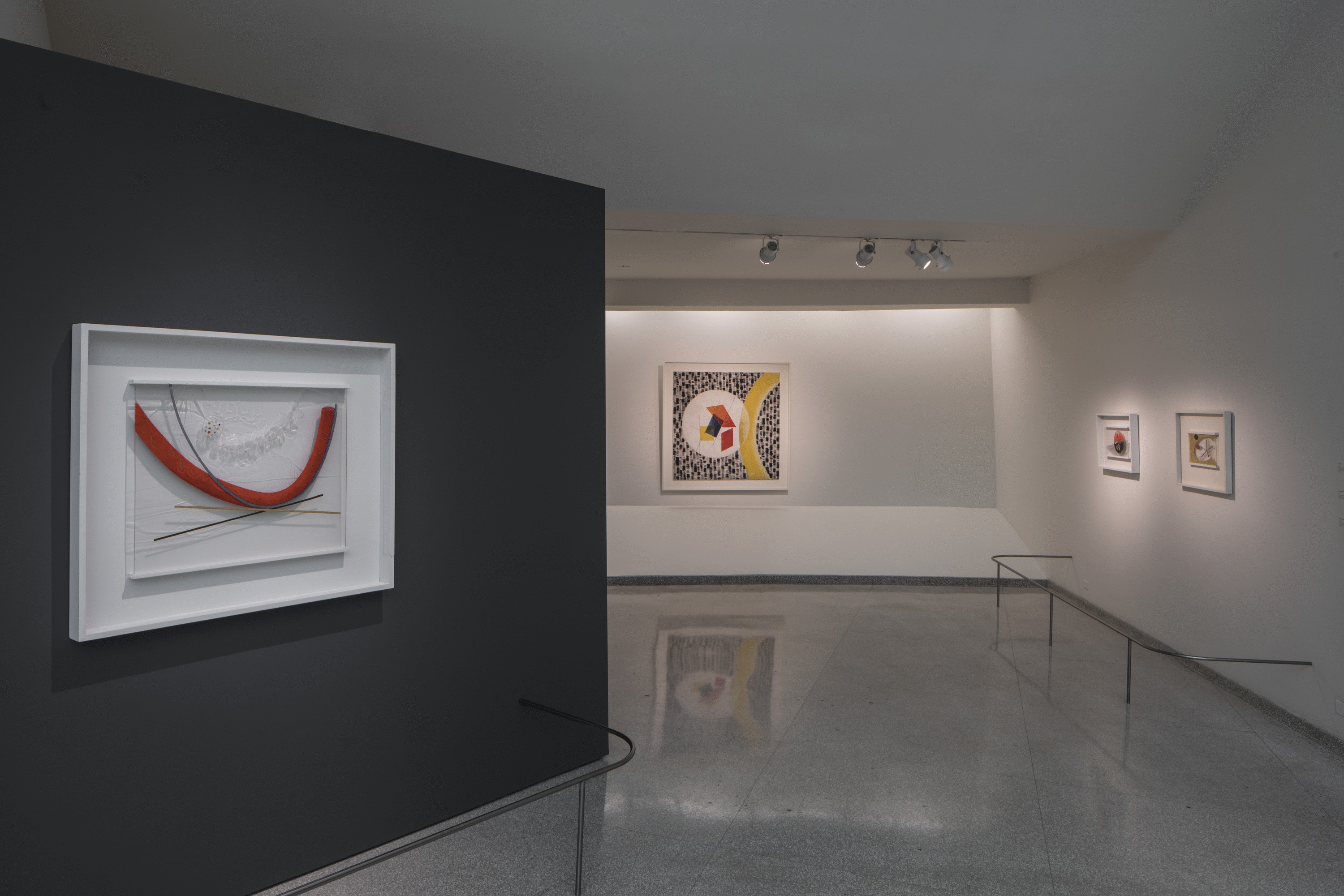
Before a recent visit to NYC, I was set on visiting the new Met Breuer Museum (housed in the former Whitney Museum building) that is hosting a large photographic exhibition by Diane Arbus. But my interest in European Modernism pulled me away to the Guggenheim, which has mounted a major retrospective of work by the Hungarian artist, László Moholy-Nagy (1895-1946) who is unknown to me.   The compilation of work is the first comprehensive retrospective of Moholy-Nagy, likely the first artist with a large and diverse field of media, including painting, sculptures, works on paper and Plexiglas, photograms and films. Despite his visibility as a Bauhaus teacher and artist, his profile has been little known to American art schools. This exhibition conveys the experimental nature of his work that includes industrial materials, movement, light, and a variety of photo-based images.

Moholy-Nagy-Install-exh_ph046

Installation View: Laszlo Moholy-Nagy, Future Present, Solomon Guggenheim Museum, 2016

The Bauhaus School (1919-1933), meaning in German to construct, struggled to exist at three locations in Germany during the early part of the 20th century. Founded by Walter Gropius in 1919, in Weimar, it moved to Dessau in 1925 where it housed an artist faculty that included Wassily Kandinsky, Marcel Breuer, and László Moholy-Nagy, and then finally ended up in Berlin for one final year until the Nazi Party came to power. The school specialized in fine and applied arts influenced by the Constructivism movement that originated in Russia in 1913 under Vladimir Tatlin, where art was practiced for social purpose, and included architecture and typography. Constructivists proposed to replace art’s traditional concern with composition, rather a focus on construction. For many Constructivists, this entailed an ethic of “truth to materials,” the belief that materials should be employed only in accordance with their capacities.

Laszlo Moholy-Nagy

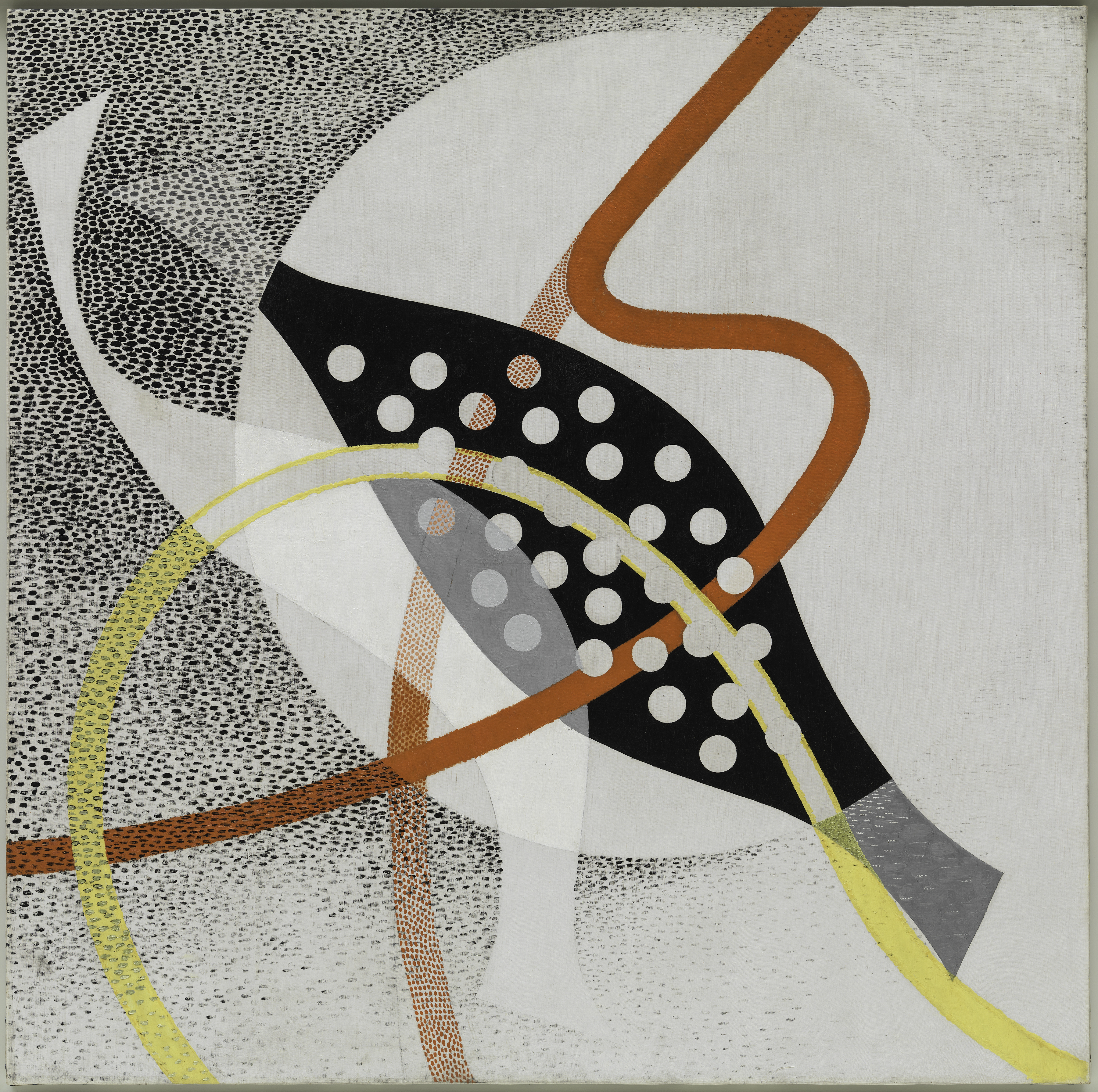
Laszlo Moholy-Nagy, CH BEATA l, 1939, Oil and Graphite on Canvas, Collection of the Solomon Guggenheim Museum

Juxtaposed against German Expressionism, Moholy-Nagy creates an image that reminds this writer of Kandinsky in his large oil on canvas, CH Beta 1. A non-objective abstract composition, the work relies heavily on design and the use of space, line and color on a flat plane void of objective meaning. If Kandinsky is the father of abstract art, then Moly-Nagy is an apostle presenting a new venue of work for the modern world. Born in Hungary in 1895, he attended art school in Budapest before bringing his Constructivist aesthetic to the Bauhaus school in Dessau. The mechanical free-floating geometries influenced many artists in the United States to follow, including Frank Stella, David Smith, Ad Reinhardt, Sol LeWitt and Sean Scully.

Moholy-Nagy-Nickel-Plated-Install-exh_ph037

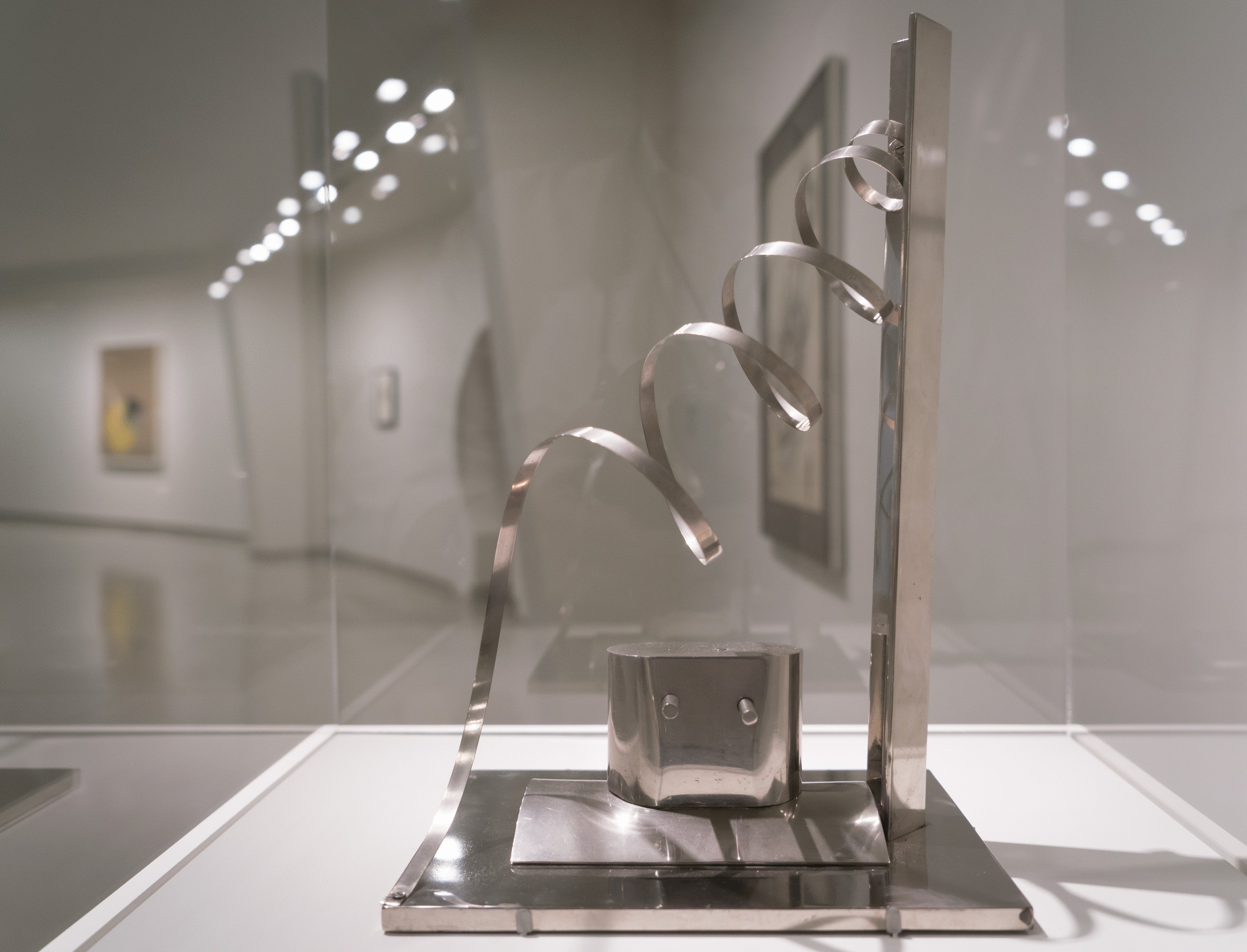
Laszlo Moholy-Nagy, Nickel Sculpture with Spiral, 1921, The Museum of Modern Art, Gift of Sibyl Moholy-Nagy

Moholy-Nagy’s nickel plated on iron-welded sculpture, owned by the Museum of Modern Art, demonstrates his industrial design and constructivist approach to the machining of objects and a spiral that inadvertently echoes the Guggenheim’s internal architecture.

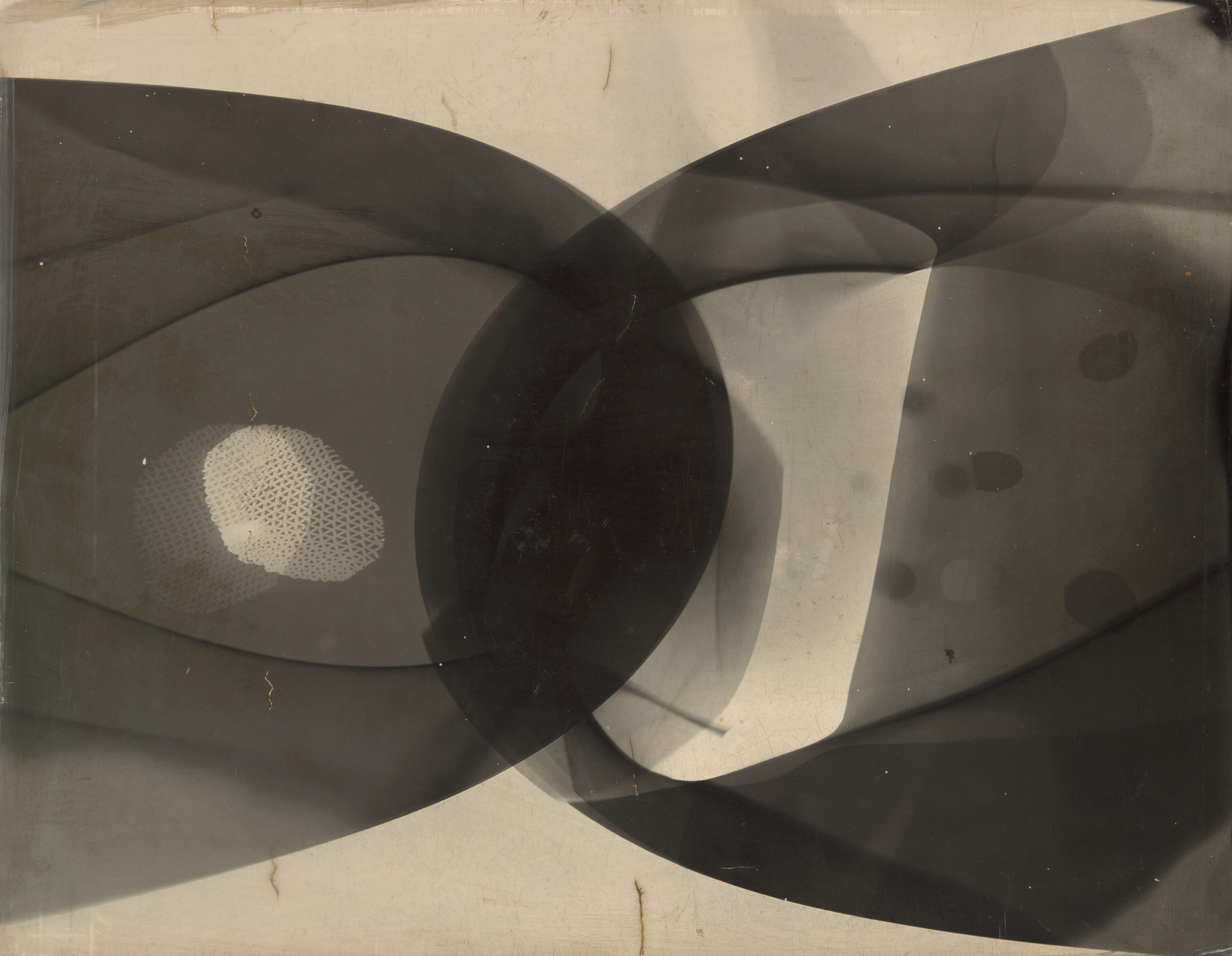
gen-press-moholy-nagy-photogram-1941

László Moholy-Nagy Photogram, 1941 Gelatin silver photogram, 28 x 36 cm The Art Institute of Chicago, Gift of Sally Petrilli, 1985 © 2016 Hattula Moholy-Nagy/VG Bild-Kunst, Bonn/Artists Rights Society (ARS), New York

Collected by Hilla Rebay and Solomon Guggenheim, founders of the museum, this exhibition is beautifully arranged by Kelly Cullinan, the senior exhibition designer. I especially appreciated the extensive writings of Moholy-Nagy displayed on each level of the museum in vitrines. If I were still teaching painting at the college level, I would spend more time discussing European Modernism, especially the influence of the Bauhaus School and its teachers and artists.

Moholy-Nagy: Future Present is co-organized by Carol S. Eliel, Curator of Modern Art, Los Angeles County Museum of Art; Karole P. B. Vail, Curator, Solomon R. Guggenheim Museum; and Matthew S. Witkovsky, Richard and Ellen Sandor Chair and Curator, Department of Photography, Art Institute of Chicago. The Guggenheim presentation is organized by Vail, with the assistance of Ylinka Barotto, Curatorial Assistant, and Danielle Toubrinet, Exhibition Assistant.

Guggenheim Museum


Charles McGee @ Charles H. Wright Museum


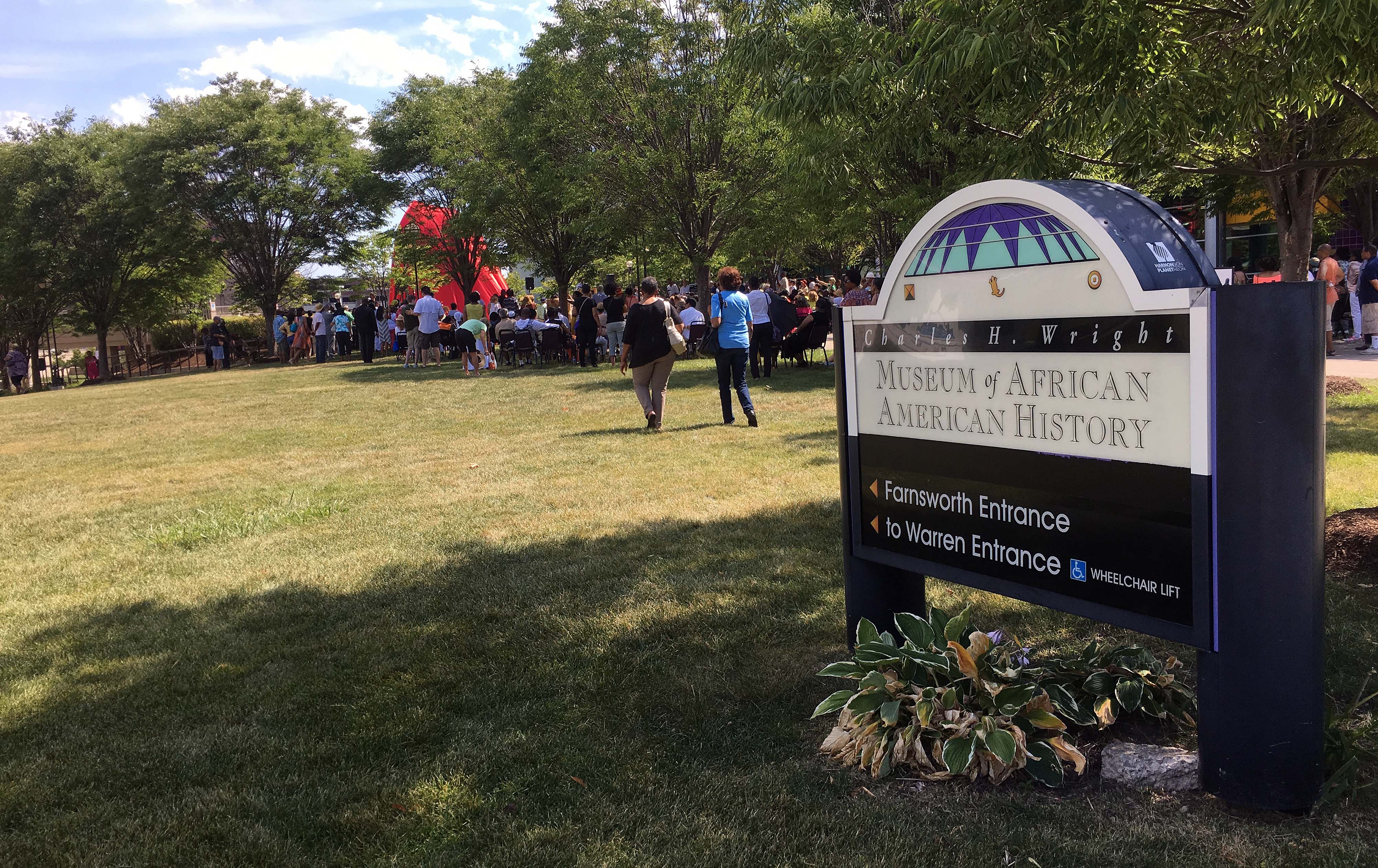
CHW long

Charles McGee unveiling of United We Stand sculpture -Farnsworth Entrance to the Charles H. Wright Museum

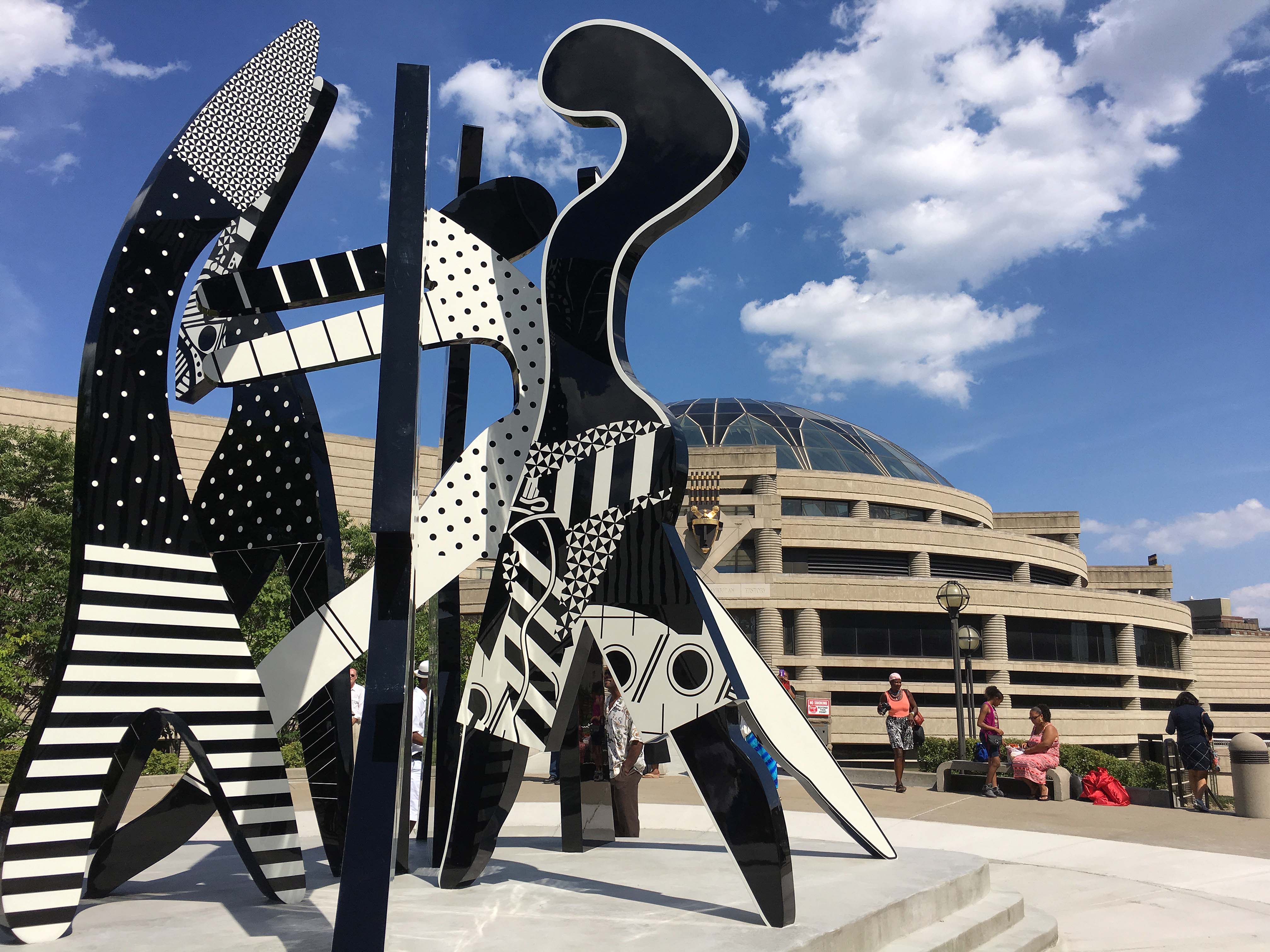
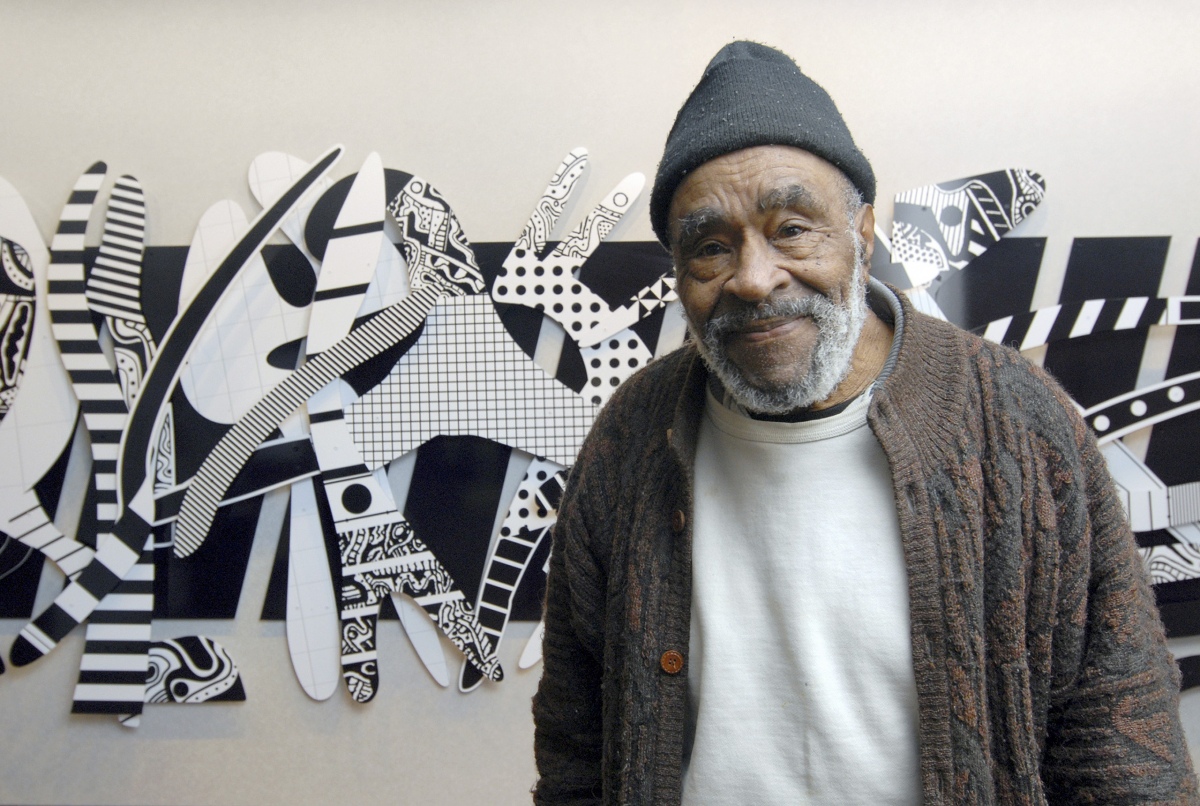
Charles McGee, the first Kresge Eminent art artist in 2008, and one of Detroit’s most well-known artists was present July 23, 2016, at the Charles H. Wright Museum for the unveiling of his massive sculpture, “United We Stand”. The new sculpture displays seven abstract figures in black and white motifs that one cannot help observing the symbolism in its meaning: one people together.

United We Stand

Charles McGee, United We Stand, Poly-chrome steel, high-gloss enamel paint, concrete base

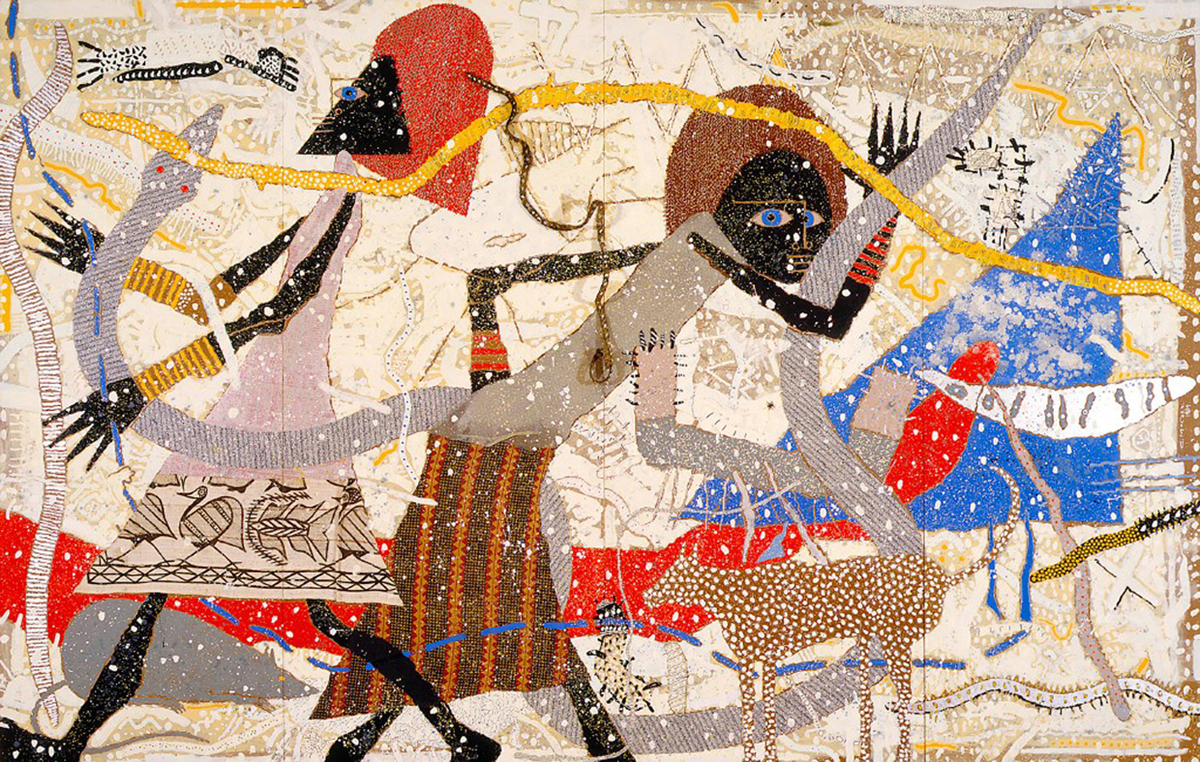
Funded by the Chicago-based Joyce Foundation, the award of $50,000 was used to create the sculpture that is prominently located just west of the museum’s Farnsworth entrance. The sculpture will serve as a capstone to a long and prestigious career by the Detroit artist, Charles McGee. McGee’s paintings, assemblages, and sculptures are part of many distinguished collections. One of my favorites is “Noah’s Ark” at the Detroit Institute of Arts in the Prentis Court. The enamel and mixed media piece measures fifteen feet long and ten feet high and combines two female figures with animal forms and colorful bands of color.

08 Mcgee_Noah's Ark Genesis

Charles McGee, Noah’s Ark Genesis, Collection of the Detroit Institute of Arts

Charles McGee, now 91 years of age, migrated to Detroit from South Carolina at the age of 10, and attended the College of Creative Studies (then called the Society of Arts and Crafts). He taught art for 18 years at Eastern Michigan University, before retiring in 1987. He also taught at the University of Michigan and received an honorary doctorate from the College for Creative Studies. “The creative mind, “ McGee has written, “continues to test the parameters of conventional knowledge, forever in pursuit of new vistas.”

01 McGee_portrait by Ray Manning

Portrait of Charles McGee by Ray Manning

“United We Stand” is to kick off the upcoming year of exhibitions and activities to commemorate the 50th Anniversary of the 1967 summer of the Detroit Riots.

The Charles H. Wright Museum

Page 30 of 36

Powered by WordPress & Theme by Anders Norén