Critical art reviews of Detroit galleries and museums weekly

Author: Ron Scott Page 31 of 36

Road Trip @ Detroit Institute of Arts

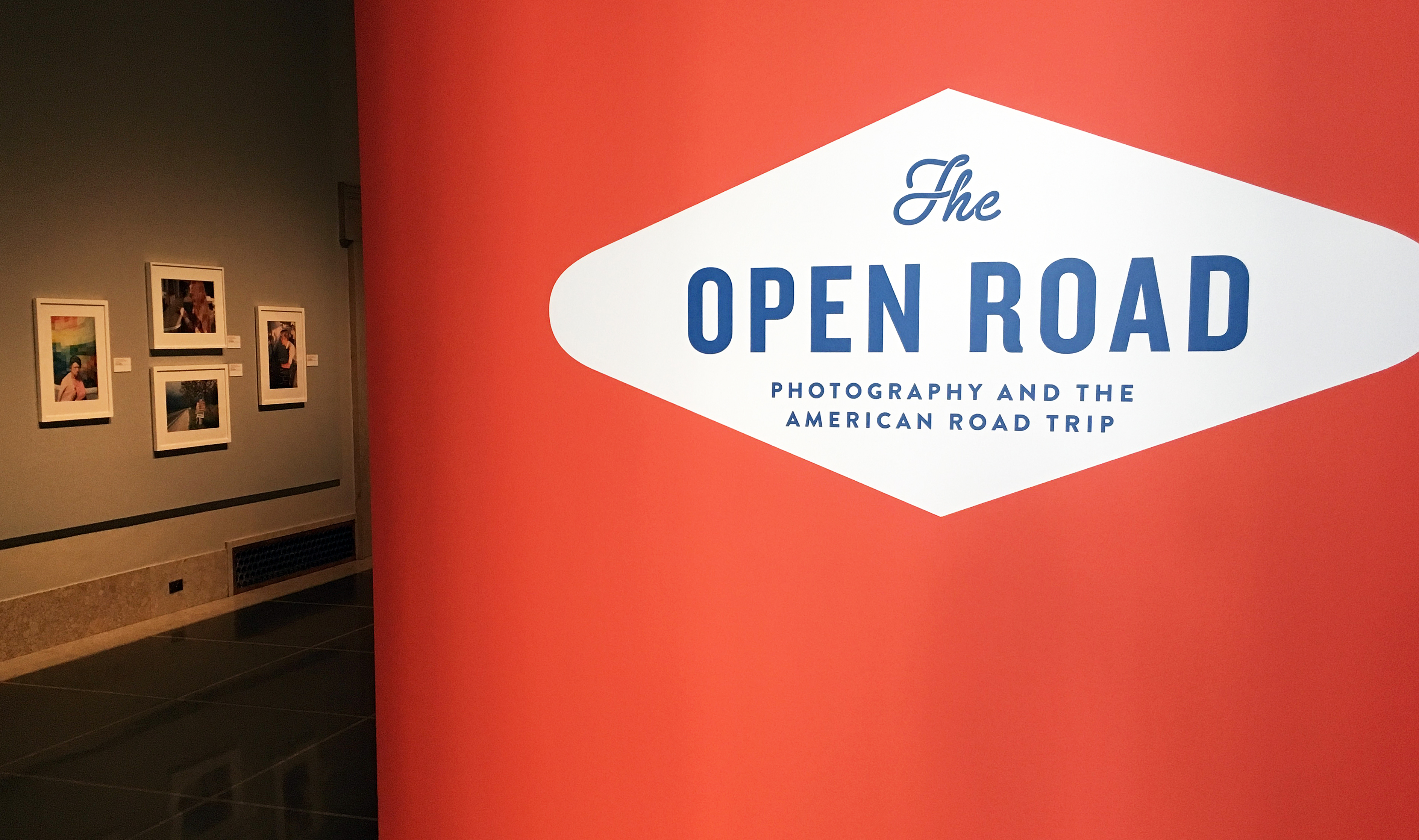
Road Trip! Detroit Institute of Arts presents “The Open Road: Photography and the American Road Trip.”
IMG_1705

The Detroit Institute of Arts (DIA) opened a photography exhibition on June 17, 2016; The Open Road: Photography and the American Road Trip, sponsored by Aperture Foundation, New York, with a grant from the National Endowment for the Arts.

“Road trips are a tradition in America and can clearly reveal what is unique about this country’s culture,” said Salvador Salort-Pons, DIA director. “Photographers traveling through the United States have defined, critiqued and celebrated America.”

Truer words were never spoken. In my sophomore year of college while studying art and playing trumpet, I read On The Road by Jack Kerouac. I knew that after reading the novel, I had to take a road trip. That next summer I took my VW Beetle across the country to California and ended up in San Francisco’s North Beach listening to Grace Slick and The Jefferson Airplane at the Fillmore. Just by chance, I bought a copy of The Americans, the now famous book by Robert Frank, at the City Lights Book Store. Back then, the City of San Francisco offered free darkroom facilities to its city folk. I had brought my used 35 mm Nikkormat, with a 50mm lens and a carton of Tri-X film, so all I needed to do was buy a box of Agfa paper and start printing images from the trip. What a deal! Much of my experience that summer resonated as I browsed The Open Road.
R.Frank Gratiot Drive IN

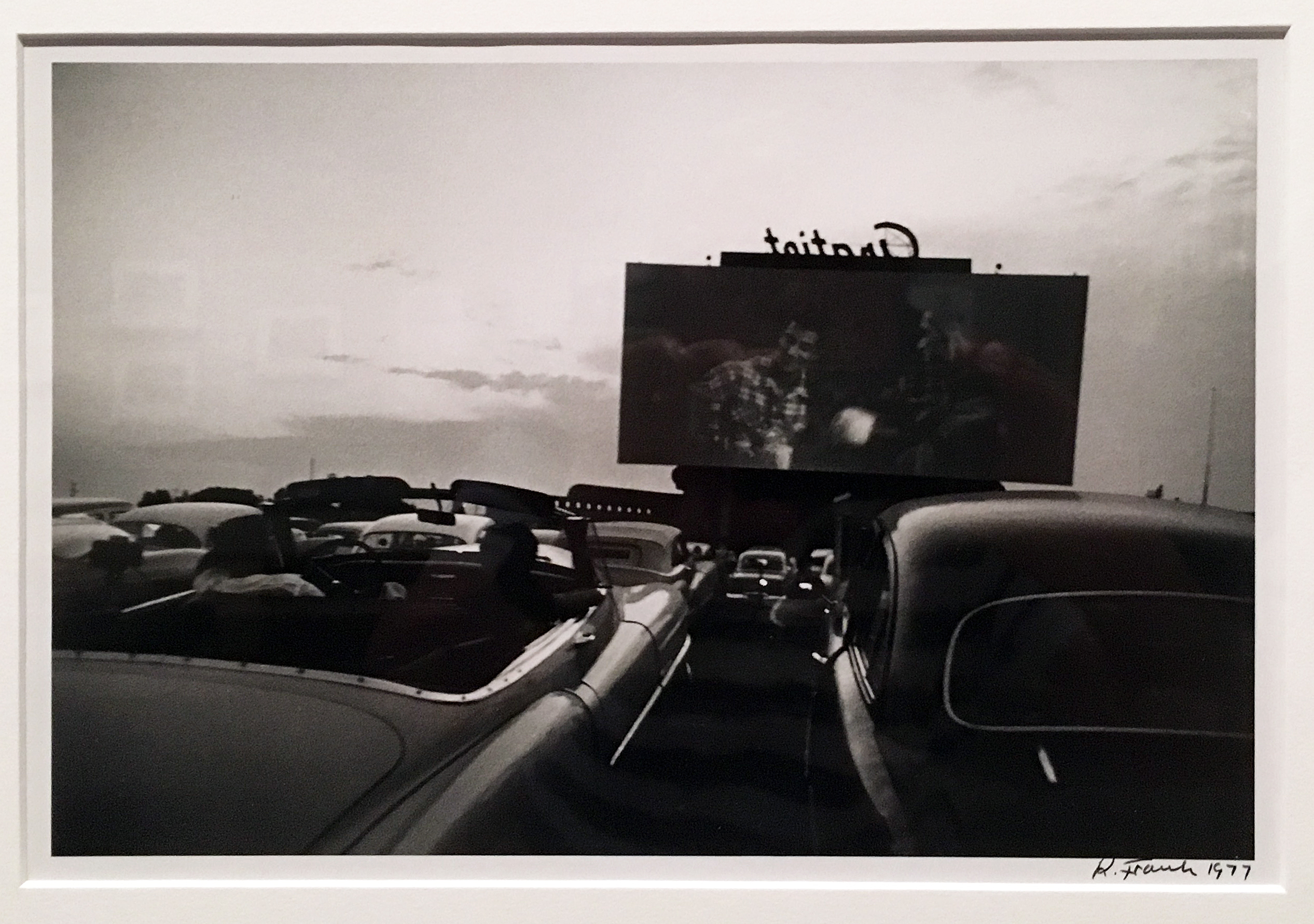
Robert Frank, Drive-In Movie, Detroit, 1955 (Printed 1978) Gelatin Silver Print, Courtesy of the DIA


Robert Frank emigrated from Switzerland to New York City in 1947, and eventually got work as a photo assistant at the fashion magazine, Harper’s Bazaar. After receiving a Guggenheim Fellowship in 1955, he embarked on a two-year trip across America and captured 28,000 images with his Leica 35mm rangefinder. Detroit was one of his longer stops, and here, Drive-In Movie, Detroit 1955, is one of sixty black & white images taken during his stay. This photograph, owned by the DIA, cements in time the moment, the light, the automobiles and the movie screen images that are so distinctly American. For this review, I pulled out my copy of The Americans, where Kerouac begins his introduction, “That crazy feeling in America when the sun is hot on the streets and the music comes out of the jukebox or from a near-by funeral, that’s what Robert Frank has captured in his tremendous photographs…”
Winogand Photo

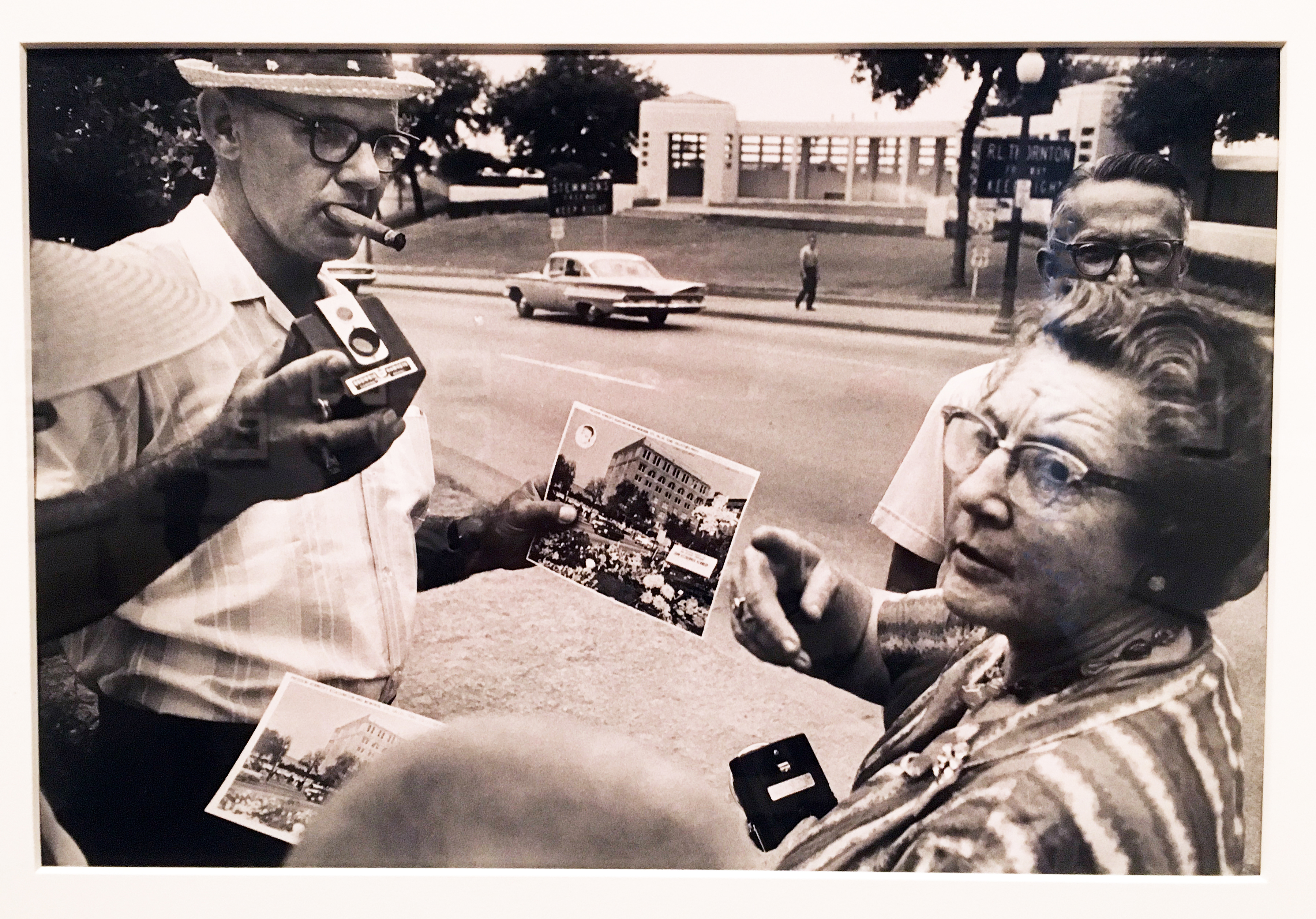
Gary Winogrand, Dealey Plaza, Dallas 1964

Gary Winogrand (1928-1984) was born in the Bronx, New York, and studied painting at City College of New York. Soon after, he studied photography with Alex Brodovich at the New School for Social Research and was commissioned by Harper’s Bazaar where he linked up with the American Society of Magazine Photographers. This photo, shot in Dallas, Texas, was part of a road trip that took him to fourteen states, where he shot 520 rolls of film. My favorite image is his untitled photo taken at a New York Thanksgiving Parade that captures a male figure high in the air in the middle of a flip off of a trampoline that was on top of a rolling float. Winogrand taught at Parsons School of Design and the School of Visual Arts, both in New York City. His work is a rendering of a classic street photographer, out of the tradition of Robert Doisneau, Ruth Orkin, and others.
Shinya Fujiwara

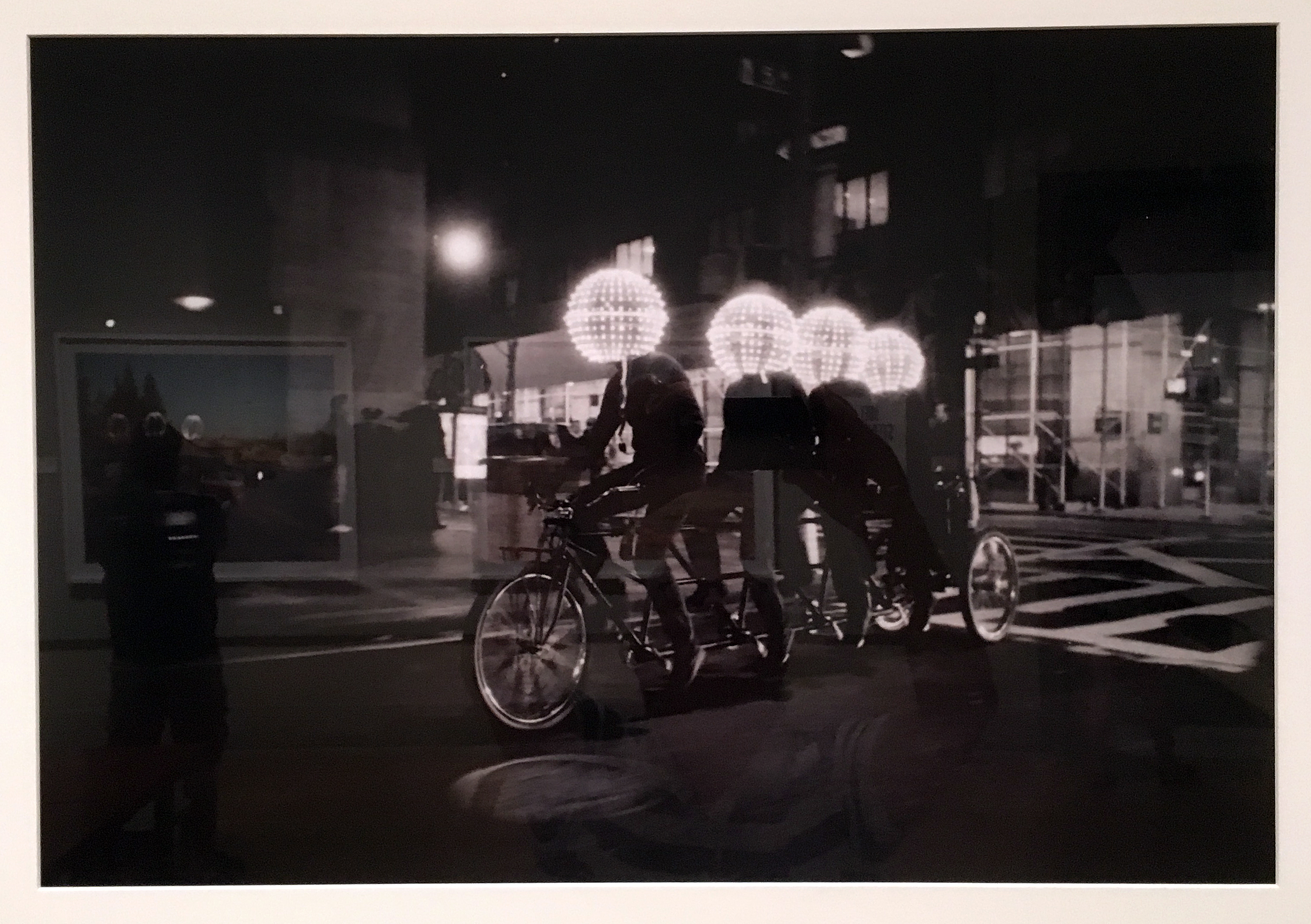
Shinya Fujiwara,Untitled, from the series American Rouleete, 1988 Courtesy of the Artist

This photographer, Shinya Fujiwara, a native of Japan, traveled across the United States for seven months in a motor home, seeking images that were peculiar to his sensibility. A leading Japanese photographer born in the 1940s, he has spent most of his adult life exploring different continents. He brought his life in another country and cultural to his experience on the road. Fujiwara has gone on to influence travelogues and books, both non-fiction, and fiction.
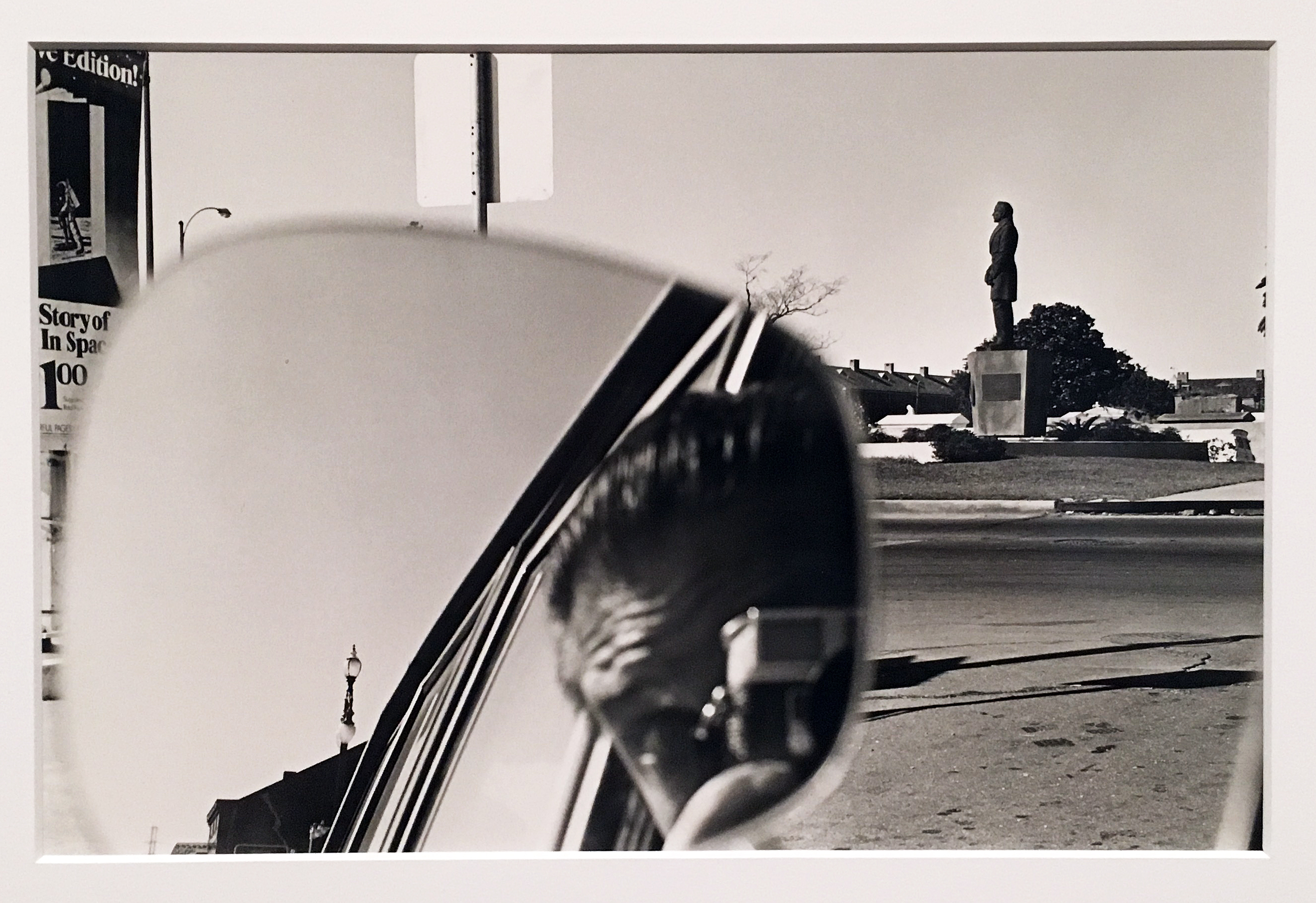
Lee Friedlander

Lee Friedlander, Dealey Plaza, Gelatin Silver Print, 1964, Dallas, TX,

Lee Friedlander, born in 1934, began photographing the American social landscape in 1948. This photograph, New Orleans 1969, reminds me of his 2008 exhibition, America by Car, at the Fraenkel Gallery. It does so, because he used the rear view mirror on his car on many occasions, as a framing device, providing the viewer with a front and rear view of his subject. Friedlander was the recipient of the prestigious Hasselblad Award as well as the subject of a major traveling retrospective and catalog organized by the Museum of Modern Art. In 2010, the Whitney Museum of American Art, New York, exhibited the entirety of his body of work, America by Car.
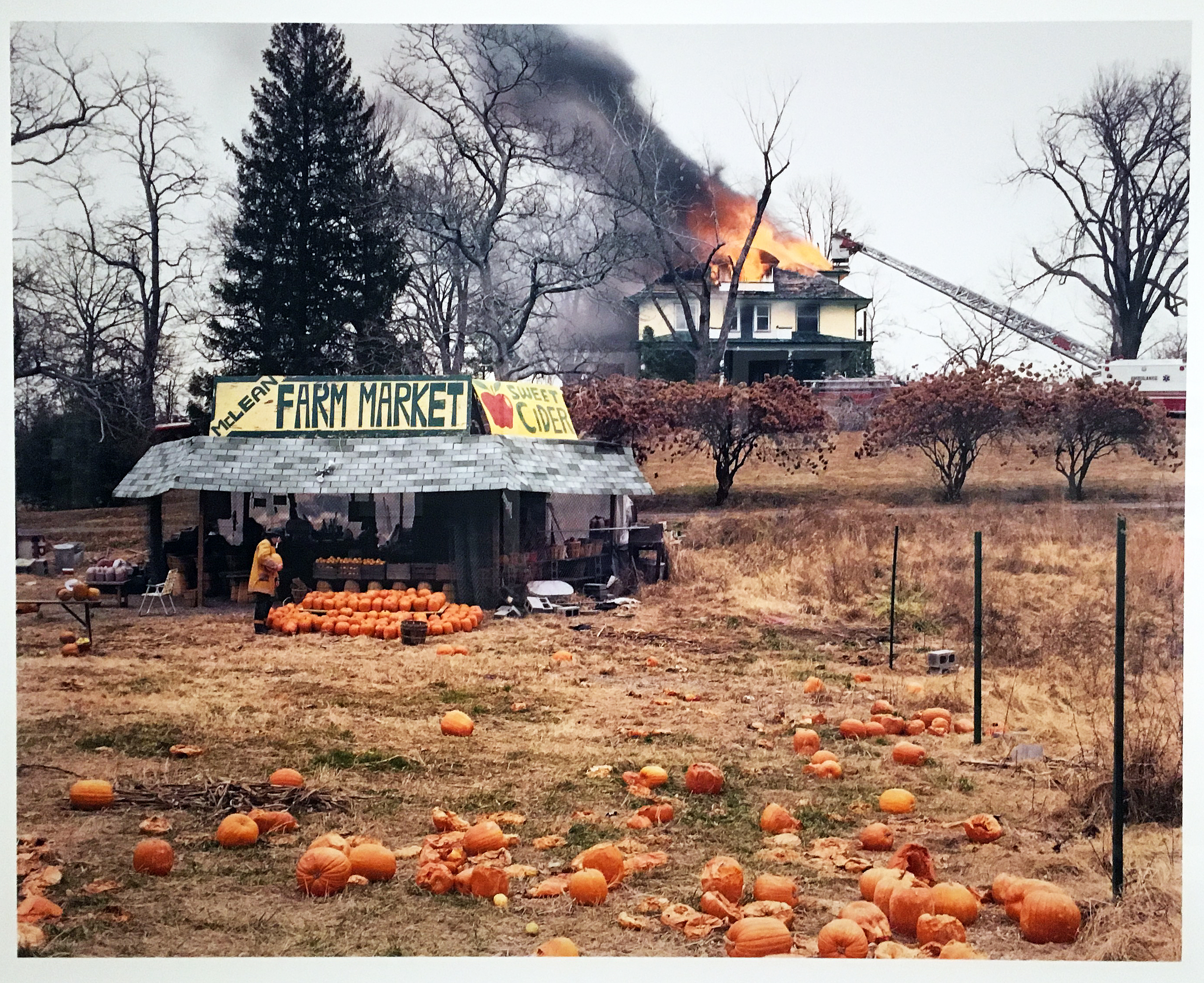
Joel Sterneld

Joel Sternfeld, McLean, Virginia, December 1978

The America photographer, Joel Sternfeld, was born in 1944, received his BA from Dartmouth College and taught photography at Sarah Lawrence College. Known for his large format color photography, Sternfeld was influenced by color theory by Josef Albers. Here in Mclean, Virginia, December 1978, one of his most famous images, he depicts a fireman shopping for a pumpkin as a house burns in the background. The pumpkins’ vibrant oranges match the autumnal colors of the countryside, and ironically, the fire’s flames. The image is peculiar because the fireman appears to be casually browsing as the flames roar.
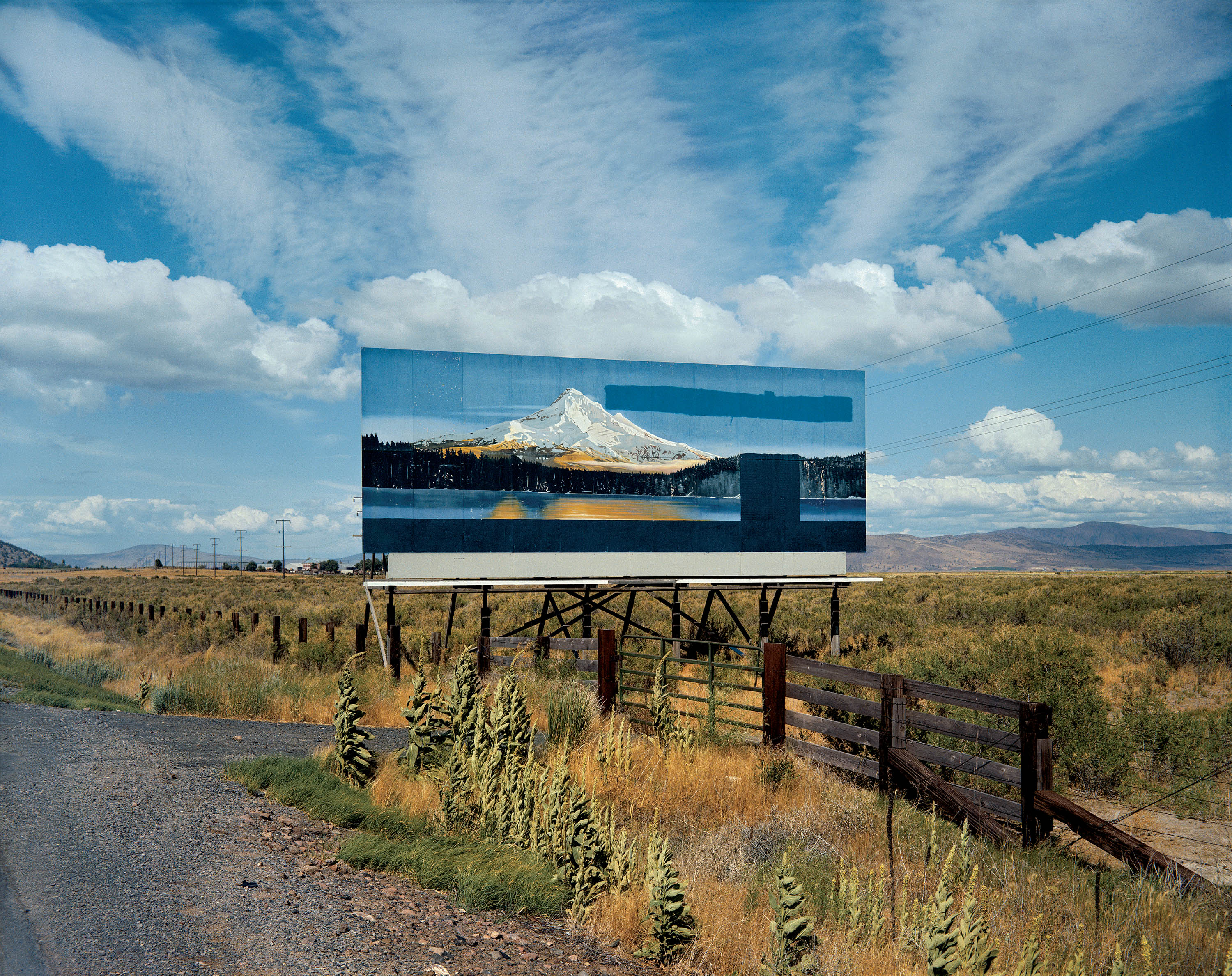
U.S. 97, South of Klamath Falls, Oregon, July 21, 1973

Stephen Shore“U.S. 97, South of Klamath Falls, Oregon, July 21, 1973,” Courtesy of the artist and 303 Gallery, New York

The billboard along a highway with its copy blocked out might just be the surface in transition, waiting for its next advertisement. For Steven Shore, it’s a landscape set against a landscape where he finds art along the road. Stephen Shore’s photographs are attentive to ordinary scenes of daily experience, yet through color and composition Shore transforms the mundane into subjects of thoughtful meditative. He was the first living photographer to have a one-man show at the Metropolitan Museum of Art in New York since Alfred Stieglitz, forty years earlier.
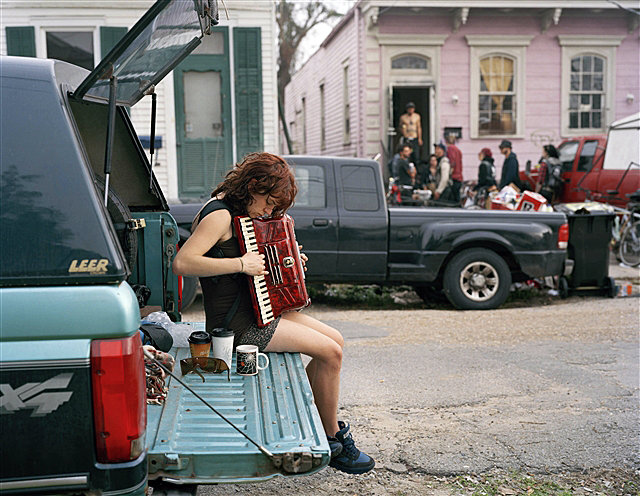
image-436Claire, 8th Ward, Justine Kurland, 2012

Justine Kurland – Claire, 8th Ward, 2012

One of the younger photographers in this Open Road exhibition, Justine Kurland, was born in Warsaw, New York in 1969 and studied photography at Yale University, graduating with her MFA in 1998. She was the only photographer who attended the opening at the Detroit Institute of Arts, where she appeared on a panel after the opening. There she described her years on the road, photographing images in all part of the United States, often with her husband and young child. Her photography is comprised of large-scale C-prints, mostly of rural landscapes made up of utopias or pre-industrial worlds. Many of her images capture cars, or parts of them, with anonymous auto-mechanics. She described in her talk the trials and tribulations of raising a family while traveling with the sole purpose of capturing this kind of post-apocalyptic imagery. She gained popularity with her work in the group show, Another Girl, Another Planet, at the Lawrence Rubin-Greenberg Van Doren, in Manhattan 1999, which was reviewed in the New York Times by Ken Johnson.

On The Road: Photography and the American Road Trip is a great survey of American photographers who traveled the country in search of moments in time, capturing oddities in the American culture with an eye on composition, color and light. It is good to know and remember that a revolution has taken place in photography, largely due to the technology that has given every smart-phone user a camera. The impact that the digital revolution has had on producing images is immeasurable. Many professional photographers have lost their employment to mammoth stock photo collections, like Getty Images, and with the development of the Internet, the delivery of imagery has made certain aspects of the profession, obsolete. People will say, “Today, everyone is a photographer.” An art director sends the intern out to get a shot with their cell phone.

But the truth is that once this settles down, photography by professionals will rise again, and although everyone will still be able to take a snapshot, true artistic composition will be an important commodity. Large format cameras and a variety of lenses with specific focal lengths will become unique and powerful. Let’s not forget that photography is an art, and this exhibition, On the Road, serves as an example of how artists use their cameras to capture and create amazing images.

Museum Hours and Admission

9 a.m. – 4 p.m. Tuesday–Thursday,

9 a.m. – 10 p.m. Friday,

10 a.m. – 5 p.m. Saturday and Sunday.

General admission (excludes ticketed exhibitions) is free for Wayne, Oakland and Macomb county residents and DIA members.

For all others, $12.50 for adults, $8 for seniors ages 62+, $6 for ages 6–17.

For membership information, call 313‐833‐7971.


Michigan Fine Arts Competition @ BBAC

Birmingham Bloomfield Art Center Hosts the 35th MFCA

BBAC Install

BBAC / MFAC Installation Image – Courtesy of DAR

The Michigan Fine Arts Competition (MFAC) exhibition opened June 24, 2016, and is one of the best they have had in their long existence, beginning in 1982. Not many know that the competition was previously held by the Detroit Institute of Arts, but with their demise of leadership in contemporary art, they were pleased to find a home at the Birmingham Bloomfield Art Center (BBAC). The key to this year’s success is Terence Hammonds; the juror selected to make this year picks. Originally from Cincinnati, Ohio, he attended the School of the Museum of Fine Arts, Boston for his BFA, and Tufts University for his MA. One of the factors that make this exhibition so exceptional is that it draws on a mid-west region, where more than 500 artists compete from Michigan, Ohio, Indiana, Illinois and Wisconsin.

G.Moore

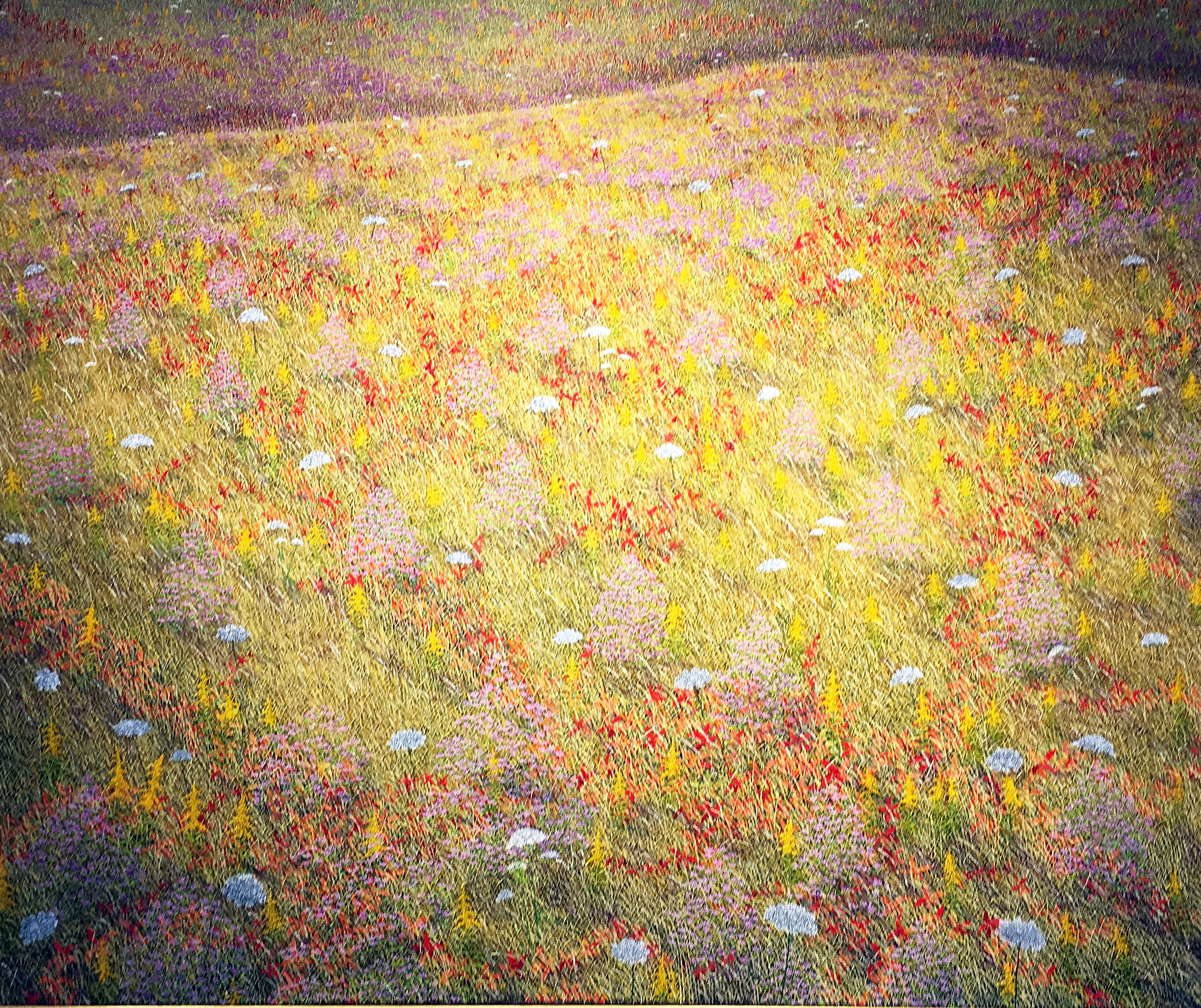
Gerald Moore, Late September Field, Oil on Canvas

Gerald Moore is an expressive landscape painter who holds an MA in painting from Central Michigan University. He says “I work opposite the Oriental painting philosophy that ‘less is more.’ ‘More’ is the engine of my work; ‘more’ is more.” His large landscape painting seems to draw on the landscape as a subject, but flirts with abstract field painting and gives us a little of both. Color field painting, championed by Clement Greenburg in the 1950’s characterized this expression as solid color creating an unbroken surface and flat picture plane. One might view the Wheat Fields of Van Gogh to see early examples.

Woodcut

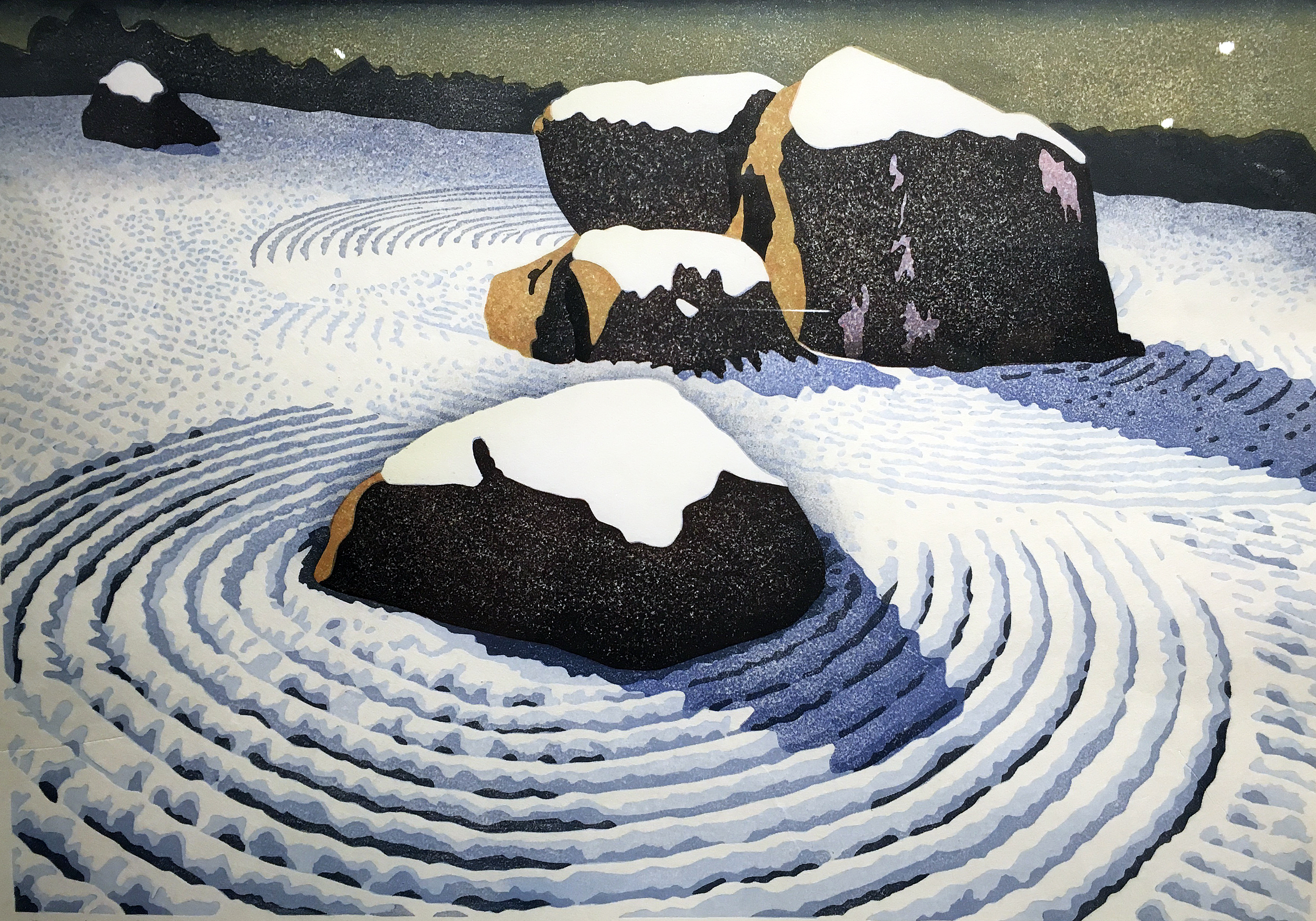
Mary Brodbeck, Blanket, Woodblock Print

Maybe it’s because we don’t see a lot of artists working with wood-cut printmaking, that this landscape with rings and melting snow is so attractive. She says in her statement “ Affected by my travel and study in Japan, notably by visiting traditional Japanese gardens, my landscape prints are carefully designed in abstract and stylized ways that are intended for viewers to have a contemplative experience. “ These Zen-like impressions made by the woodblock can transport the viewer to a place that blends design, craft and a spiritual aesthetic. Ms. Brodbeck holds a BFA from Michigan State University, and an MFA from Western Michigan University.

Photo

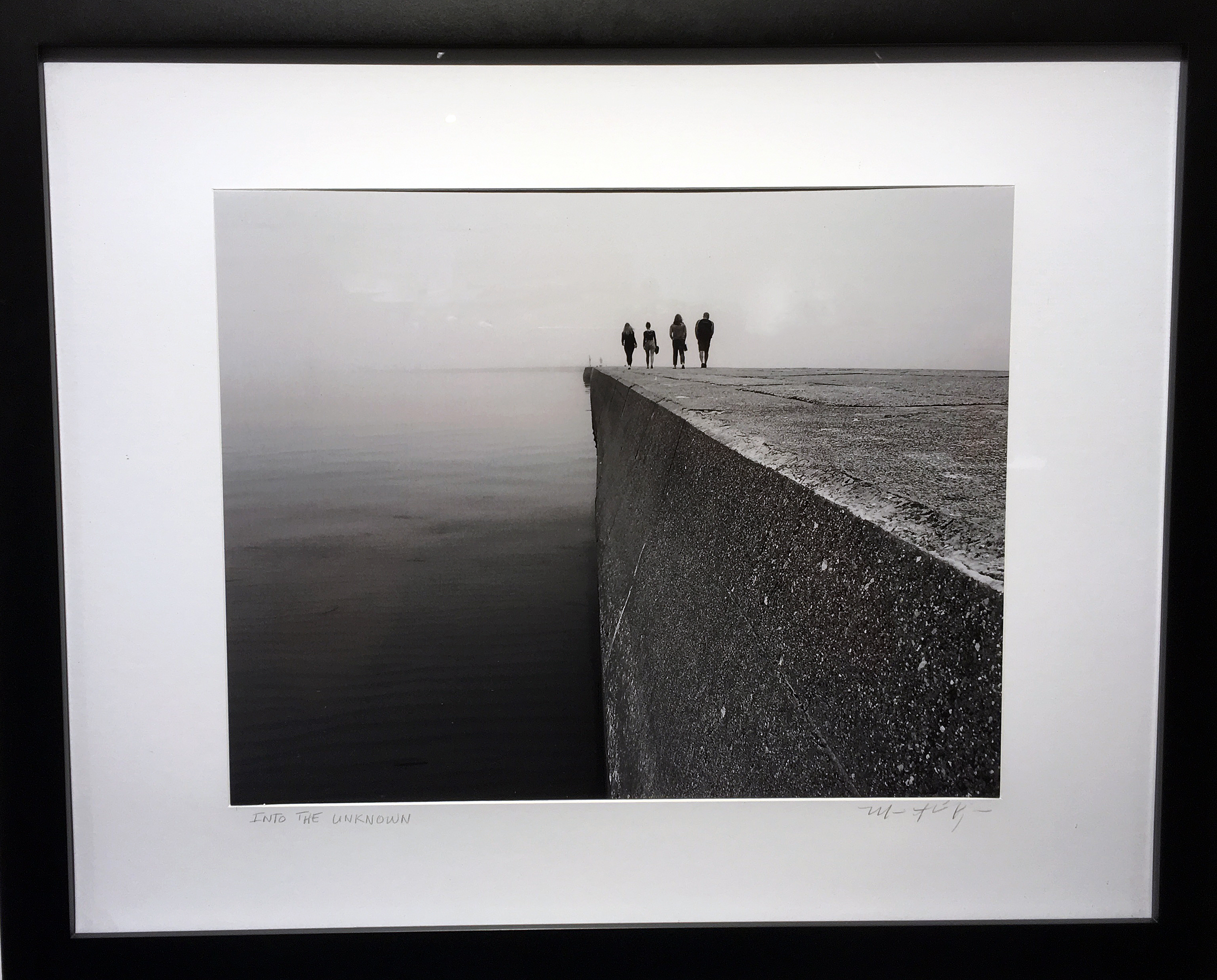
Mario Inchaustegui, Into the Unknown, Digital Print

Mario Inchaustegui’s digital print “Into the Unknown” draws purely on composition for its power and interest. The geometry along with perspective leads us to four figures on the edge of some type of a concrete pier. This middle school teacher at West Bloomfield Schools has been part of photo exhibitions in Metro Detroit, most recently at the Scarab Club.

Clay Hydrant

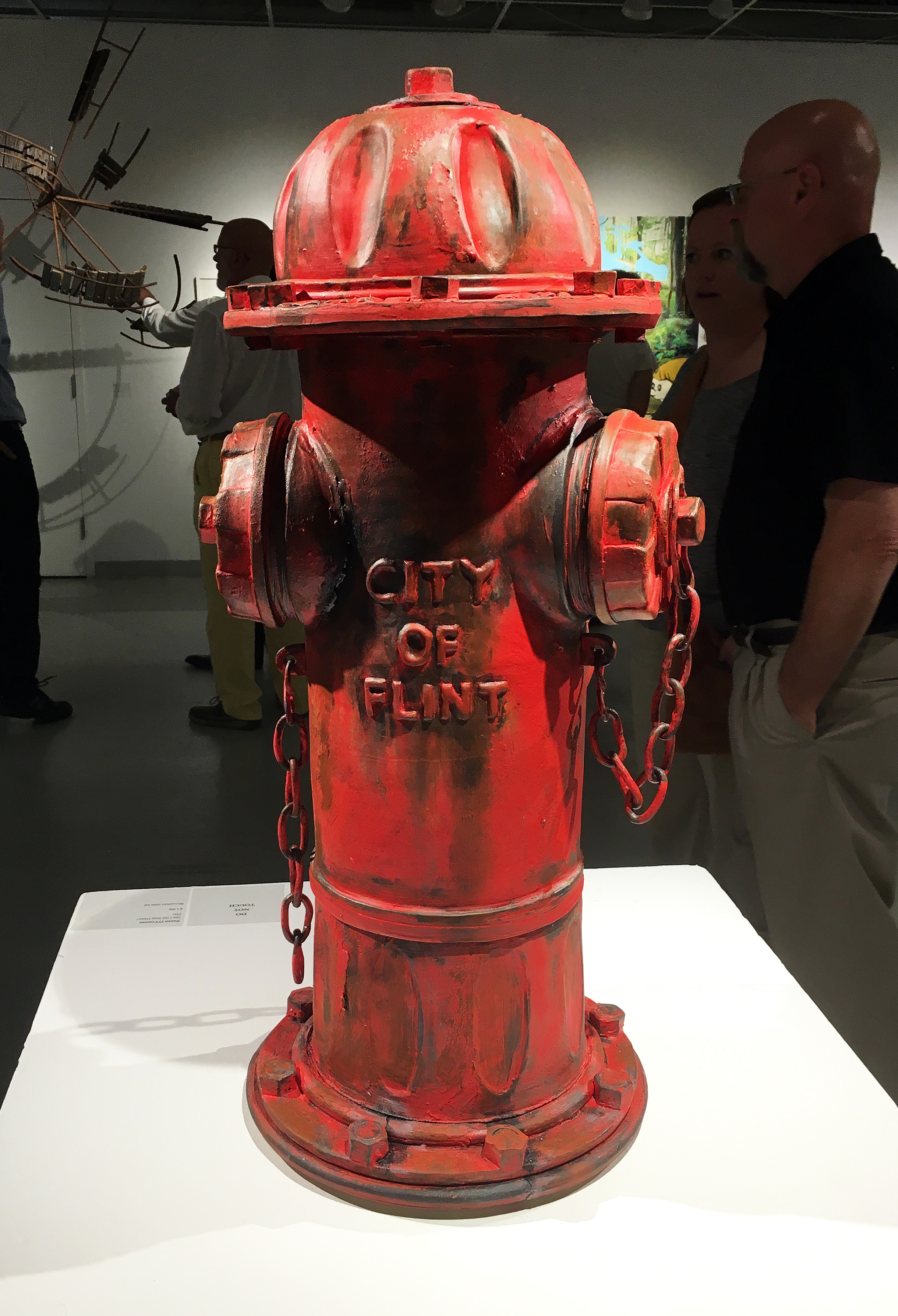
Susan O’Connor, Can I Get Some Water, Clay

Susan O’Connor, who teaches hand-built ceramics at the BBAC, grabs the audience with a pop art object, that also carries a current social message. So, she got me with this Fire Hydrant from Flint, Michigan where the water has been contaminated by a decision leading to elements of lead in the water supply.

This exhibition has many generous prizes totaling $5800 and goes a long way to showcase artists in the Midwest. I will mention here that I usually stay away from covering these large competitive exhibitions, largely because they jury the work from jpegs, which makes the process more of a challenge. In this particular case, I give Mr. Hammonds a lot of credit for getting most of his decisions right. I have heard it many times, that it is the only practical way to conduct such a large undertaking, however when only viewing an image of an artwork, mistakes are made.

The 35th Annual Michigan Fine Arts Competition – June 24 – August 26

Birmingham Bloomfield Art Center

Ceramics and Watercolor @ Flint Institute of Arts

Flint Institute of Arts Exhibition: Function, Form, Fantasy: Ceramics from the Robert and Deanna Harris Burger Collection

Ceramic work is one of the most ancient arts in the world, but in the United States and many parts of the world, has evolved over the last hundred years from what was once traditional functional craftwork to a high form of creative art that competes with painting and sculpture. This current diversity of ceramics has evolved dramatically as illustrated by the Burger Collection, now on display at Flint Institute of the Arts. Function, Form, Fantasy is currently on exhibit in three jointing galleries. The Function section has ceramic work that is traditional as it relates to its use: bowls, vases, plates, etc., Form moves away from being utilitarian, and experiments with shape, clay properties, and glaze, where as Fantasy uses a new freedom to create a narrative that could be comic, industrial, surreal, futuristic; You name it.

Function

Pippin Drysdale

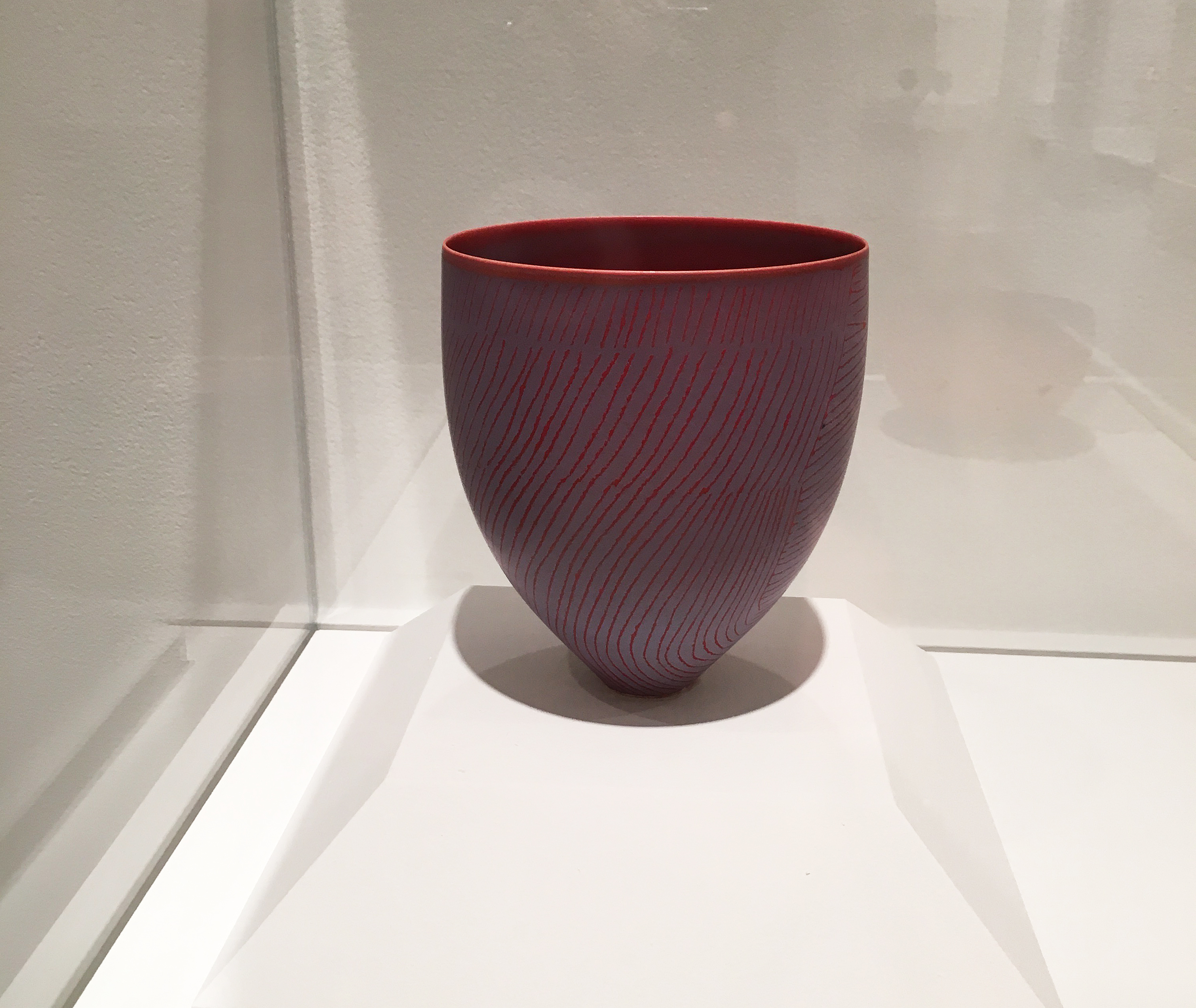
Pippin Drysdale, b. 1943, Horizon Traces, 2010, Stoneware

Horizon Traces, was created by Pippin Drysdale, a ceramicist from Australia that creates the perfect shaped vessel while revealing fine lines of multiple colors. She says in her statement she is inspired by the desert sands.

Form

Adrian Arleo

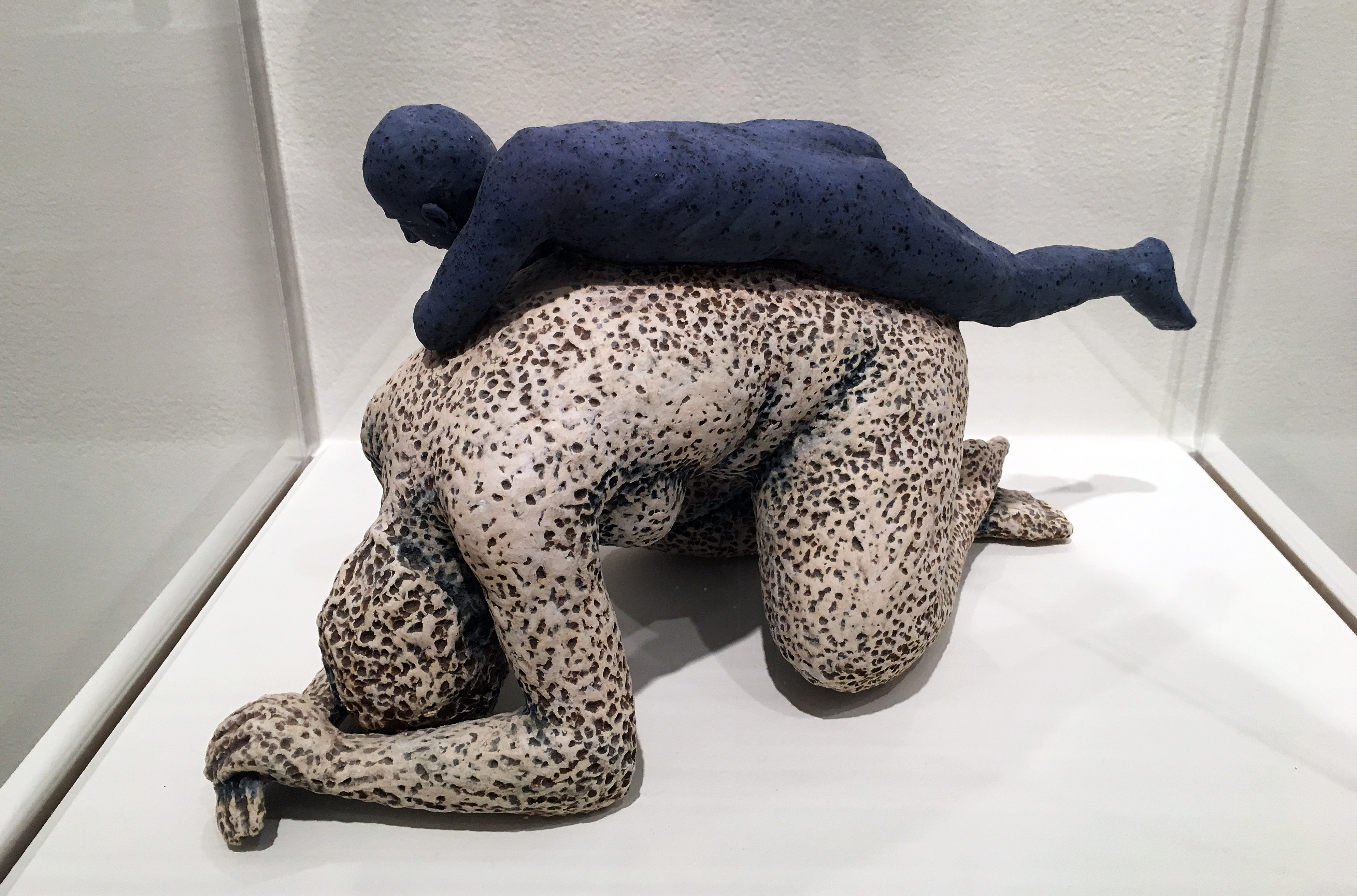
Adrian Arleo, b. 1960, Dreaming of Rama Teapot, 2001, Stoneware

The titled Rama, refers to an Indian king of lore, where the American artist Adrian Arleo, creates two human forms contrasting in size and glaze selection. Rama, the blue-tinted man, represents the perfect form of man, full of virtue, justice, and peace. The highly created textures assist in creating dimension and contrast to the forms.

Fantasy

Andy Nasisse

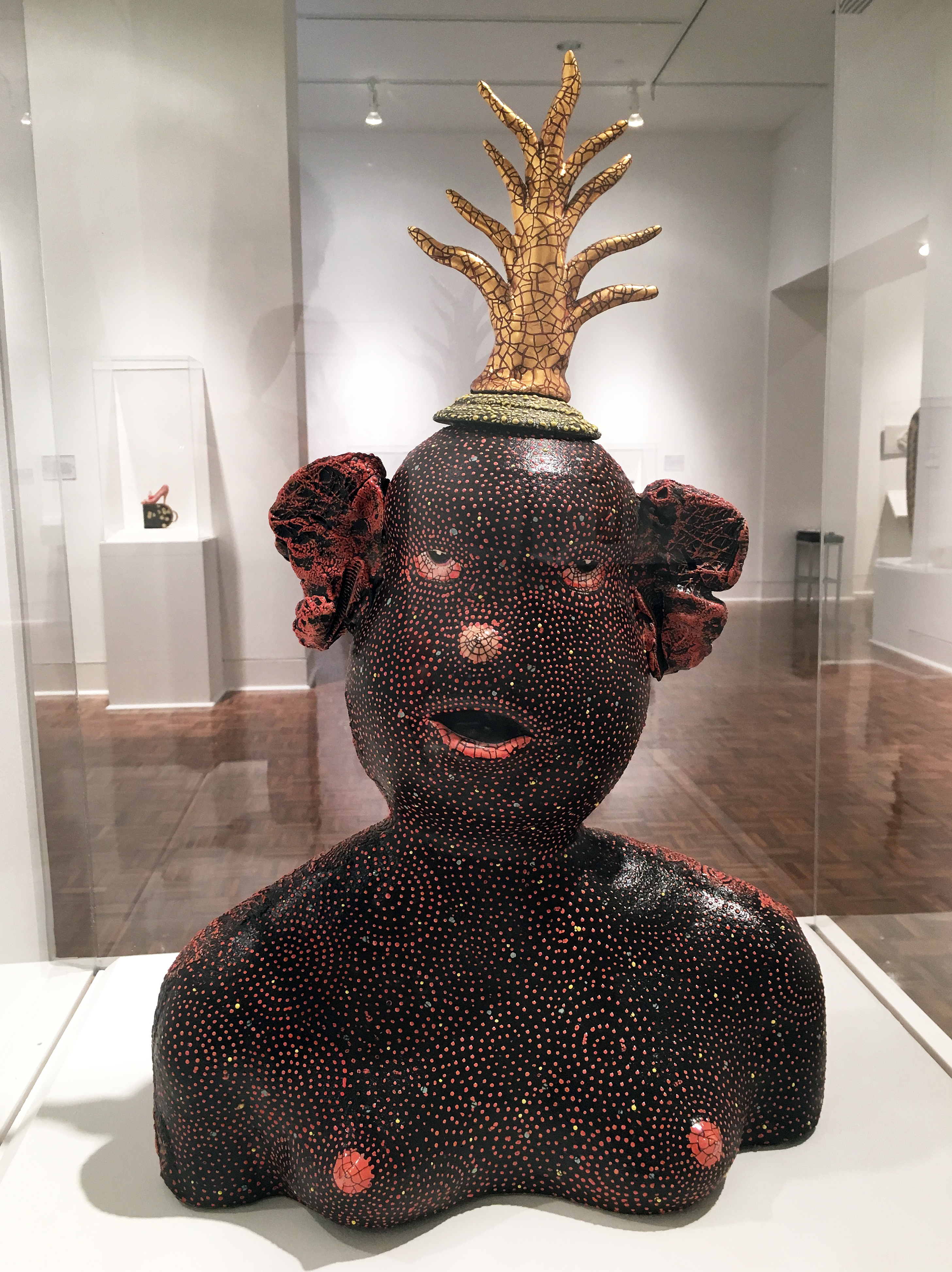
Andy Nasisse, b. 1946, Untitled, 2006, Stoneware

The American, Andy Naisise, creates Untitled, 2006 where he incorporates male and female, good and evil as opposites in this figurative piece of stoneware. In his statement, he says, “I think of figures as “part of a family of images that find their way through my hands and into the outer world.”

This exhibition offers the audience a view of recent ceramic work, beginning in the 1060’s to present day. Dr. Robert Burger and his wife have been collecting works of art since the 1970’s and have donated nearly 250 works of art to the FIA. Mrs. Burger has ties to Flint, having enjoyed ceramic classes at Flint Institute of Arts in her youth. You will find large and small works, simple and complex, by well-known artists that are elegant while thought-provoking works of clay that go a long way to blur the line between craft and fine art.

Moving Toward the Light

New Cycle

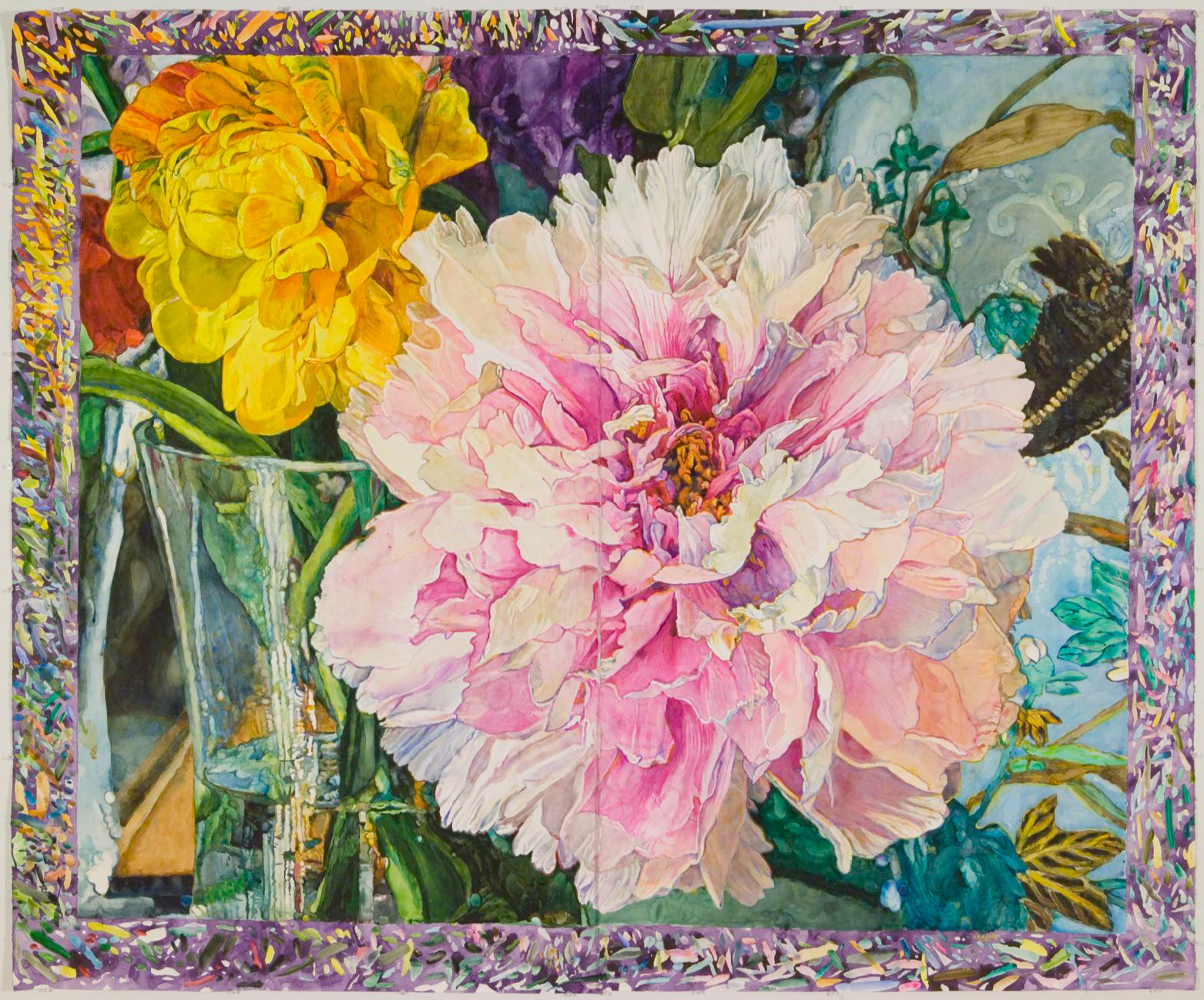
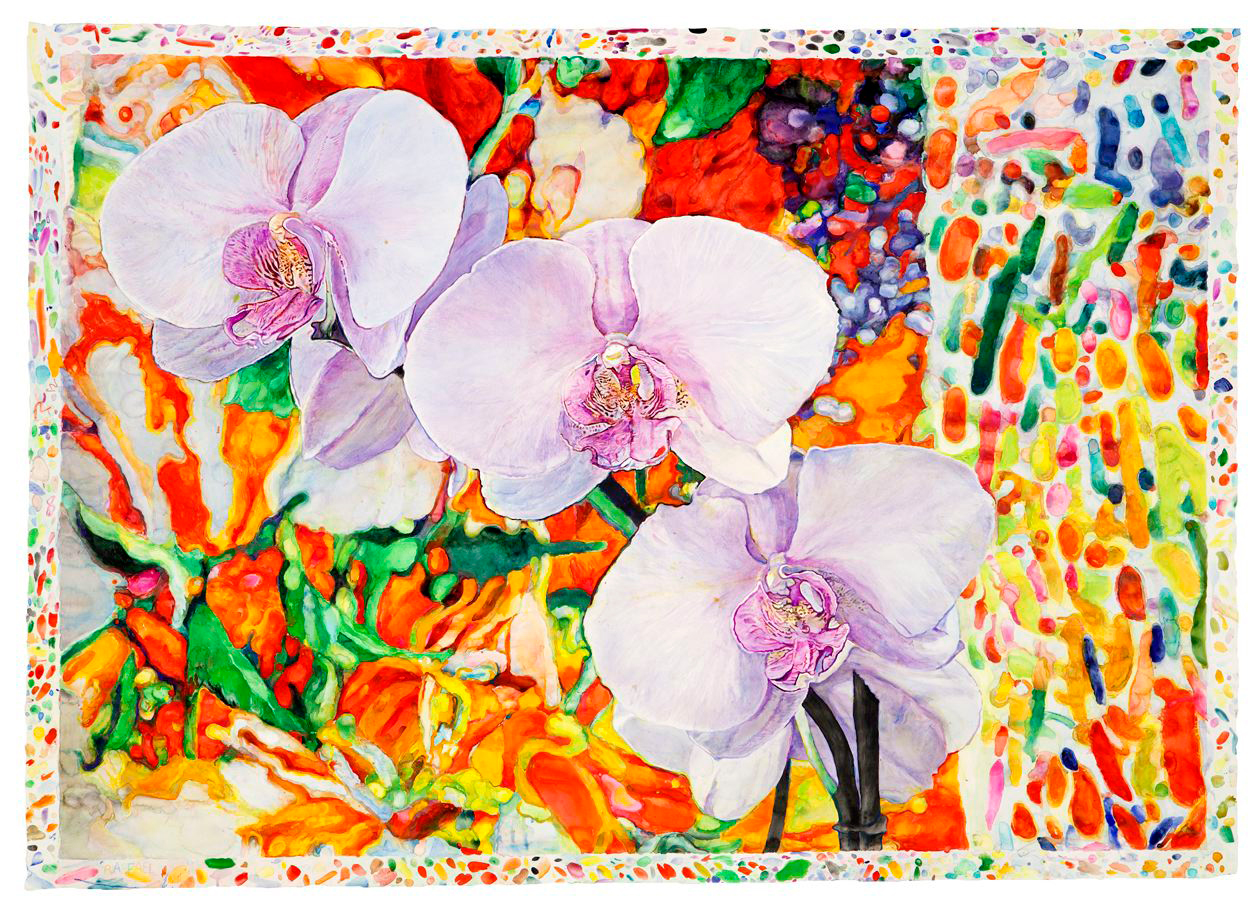
Joseph Raffael, American, b. 1933 New Cycle, 2009–10 Watercolor on paper 73 1/2 x 89 x inches Courtesy of Nancy Hoffman Gallery, New York, NY

On exhibition in the Graphics Gallery during these summer months, the artist Joseph Raffael has an exhibition of unusually large watercolor paintings, courtesy of the Nancy Hoffman Gallery, NYC, NY. This collection of eleven large watercolor paintings celebrates flora and fauna where Raffael captures a deep view of floral life, both in and out of focus. Growing up in Brooklyn, Raffael helped his mother with the fruits, vegetables, and flowers in her garden, where he came to regard the changing of seasons as a form of magic. He says “Seeing blossoms come alive is the same as watching a painting come forth out of the white space of a page or a canvas. The garden is another example of how one begins with nothing but seeds and the brown-colored space of the earth from which, little by little, the garden emerges.”

Orchids Dream

Joseph Raffael, American, b. 1933 Orchids Dream, 2013 Watercolor on paper 55 x 78 x inches Courtesy of Nancy Hoffman Gallery, New York, NY

The scale and intensity of these paintings provide the viewer with a combination of the representational subject matter set in a personal world of abstraction. His backgrounds and borders bring compositional strength to the composition and heighten the vision of watercolor. These large-scale works depict flowers, water, and fish swimming in in ornamental ponds. The artists say, “I don’t paint flowers; I paint energy.”

Those traveling north from Detroit this summer will find pleasure in stopping by for both exhibitions at Flint Institute of Arts, just a few blocks off I-475.

The Flint Institute of Arts is located in the Cultural Center Park just two blocks off I-475 between UM-Flint and Mott Community College. Hours are Mon-Wed & Fri, 12p-5p; Thu, 12p-9p; Sat, 10a-5p and Sun, 1p-5p. Admission to the exhibition is free to members and children under 12; Adults $7.00; Senior Citizens and Students $5.00. Saturdays are free thanks to First Merit Bank. For more information call (810) 234-1695 or visit www.flintarts.org.

Nancy Mitchnick: “Uncalibrated” @ MOCAD

Install NM MOCAD 2016

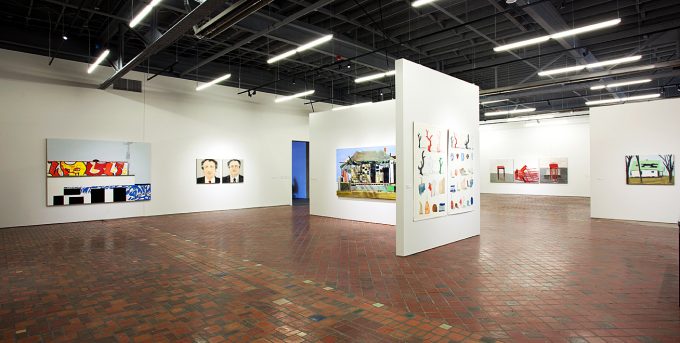
Nancy Mitchnick, Installation at MOCAD, 2016 – Courtesy of MOCAD

Nancy Mitchnick has had a spate of exhibitions this past year. She had a great show at Hamtramck’s Public Pool, showed a few earlier works in a cool three-man exhibit at the iconic Detroit gallery, Alley Culture, and really opened some eyes with new paintings at Wasserman Project. The exhibitions signify a return to and embrace of her hometown after she escaped from the Cass Corridor art community in 1973, and lived and worked as a painting professor and artist for years in New York (Bard College), California (CalArts), and Massachusetts (Harvard). She was also honored as a Kresge Fellow in 2015, and most recently was selected by the prestigious American Academy of Arts and Letters as a recipient of the organization’s 2016 art awards. Quite a homecoming!

The most recent iteration of her work is in the big room of the Museum of Contemporary Art Detroit (MOCAD). The huge gallery of MOCAD seems like it was made for Mitchnick and she comfortably fills the space with what at first seems a most curious selection of paintings—ranging from two portraits of a friend and three portraits from her “Wonder Women” series, to a work in progress recovered from what she herself calls a “bad” painting (about which she recently lectured at MOCAD), a couple of expressionistic still lifes, two landscapes and nine houses from her old neighborhood, and two new “narrative paintings.” In a sense the show constitutes a mini-retrospective of the range of Mitchnick’s work over the past thirty years—portraiture, still life, landscape—and two new, auspicious paintings that signify a leap into her future. But much more poignantly, “Uncalibrated” (the title of the exhibition) seems to explore Mitchnick’s quest over the years to mine the vast rhizoid root system of painting, to find out what being an artist is and what it can do, and what it will come to be. (In mock despair she exclaimed, “Sometime my studio looks like a group show.”) “Uncalibrated” is fundamentally a self-portrait, or perhaps a memoir, of Mitchnick as painter.

Virginia Woolf 48 X 48

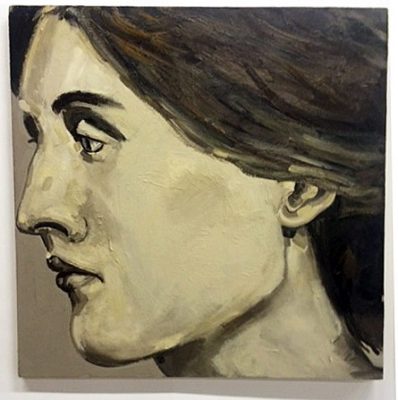
Nancy Mitchnick, Oil Painting 48 x 48, “Virginia Woolf”, 1990-91        All following Images Courtesy of Glen Mannisto


At the entrance of MOCAD are three early portraits, from the Wonder Women series, of Virginia Woolf, George Eliot, and Frida Kahlo. Painted in grisaille-like, gray shades that produce a classical sculptural effect, the heads of these three great, prototypical, feminist artists have a heroic scale and echo both Renaissance sculpture and certainly Enlightenment ideals. That they are outside of the main gallery, at the entrance, provides a hint of what part these heroic women might play in Mitchnick’s life as a painter. All three were experimental, independent, rational and investigative, secular beings and certainly, like Mitchnick, lived large lives. They also suggest a classical meta-literacy—to challenge the status quo, to invent, hybridize, psychoanalyze, to utilize—that is certainly part of Mitchnick’s own strategy as an artist. In her conversation with Jens Hoffmann,
 MOCAD’S Susanne Feld Hilberry Senior Curator at Large, she admits to being a voracious reader, which somehow parallels and infiltrates her work as an artist.

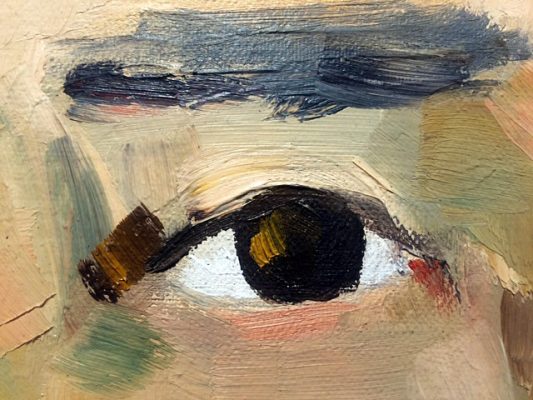
rough eye

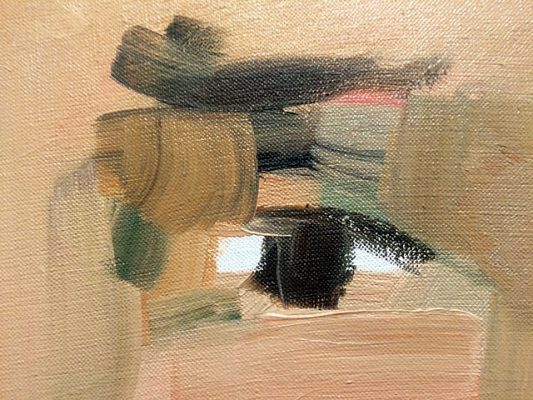
Nancy Mitchnick, Eye Detail, Oil Painting, 1992 -” Davy Butler First Hit”

eye 1 with red in corner

Nancy Mitchnick, Detail of Eye Painting, 36 x 36 “Davy Butler  Finished” – 1992


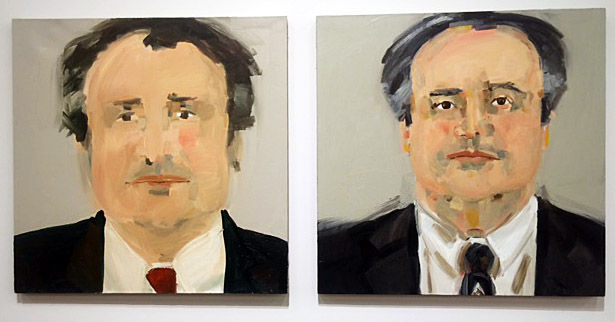
Her two portraits of a friend and patron, “Davy Butler: First Hit,” and “Davy Butler: Finished,” are elegant illustrations of Mitchnick’s carpentry skills in building these paintings, readily apparent throughout all of her work since. (“My father was a cabinet maker, but sometimes had to frame houses to make money.”) In “First Hit,” eyebrows and eyes are a dozen or so quick brush strokes—they are elegant and deft, making a sketchy, speculative architecture. “First Hit” is more mysteriously suggestive than descriptive, framing the first marks of the physiognomy of identity. Then in “Davy Butler: Finished,” the painting confidently assembles itself around the subject’s eyes. The head is smaller, more contained, and from each part of the facial landscape—the nose, the lips and mouth, and the eyebrows are precise—a commanding, almost Roman presence emerges. While making portraits to earn money, Mitchnick disavows a preoccupation with likeness, with making a painting that looks like the subject: “”Making likeness is not good painting, I’m making great paintings.” Her process, she says, is “all trial and error,” sometimes “losing whole beautiful passages to erasure, to get it right, to make a good painting.” In an offhanded aside she adds, “you writers just keep a record in your computers of every version of what you do. I lost a beautiful turtle here,” she muses pointing to a spot on the recent painting “Night Heron.” However not surprisingly, “Davy Butler: Finished” (the portrait of the friend who attended her recent MOCAD conversation with Hoffman), is not only an extraordinarily articulate painting, but an ennobling likeness as well.

IMG_2277

Nancy Mitchnick, Two Portraits, “Davy Butler First Hit” , “Davy Butler Finished “, 1992, both 36 x 36


The heroic scale that she is given to (“I didn’t realize at first that I was a heroic scale painter”), necessitates a physicality and energy apparent in most of these recent works (as well as in her person). Fortunately disregarding all of the foreboding claptrap about “Ruin Porn,” Mitchnick took scores of photos of her old neighborhood near and around Hamtramck and began working from them during her first return to Detroit after losing her Harvard position to a “Conceptual artist.” (“I wanted to do something with Detroit.”)

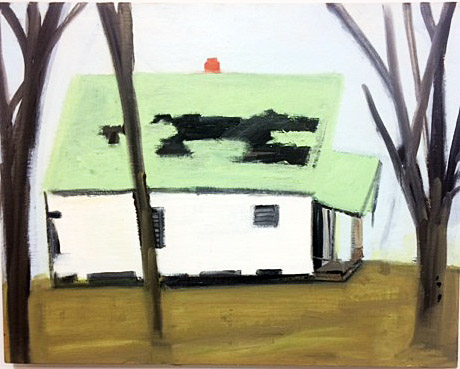
First House

Nancy Mitchnick, “First House”, 34 x 45 Oil Painting, 2006

The centerpieces then of “Uncalibrated” are the nine flat, elevation portraits of Detroit houses in various states of devolution. Depicting mostly the homes of working class people and perhaps middle-class families who ran small businesses or auto industry management, these are not memorials nor documentation of the state of derelict Detroit, but exquisite paintings that celebrate a presence of people who built and inhabited this place. Even the smallest painting, “First House,” exudes a very particular ethos and an aesthetic filled with a humanizing spirit.

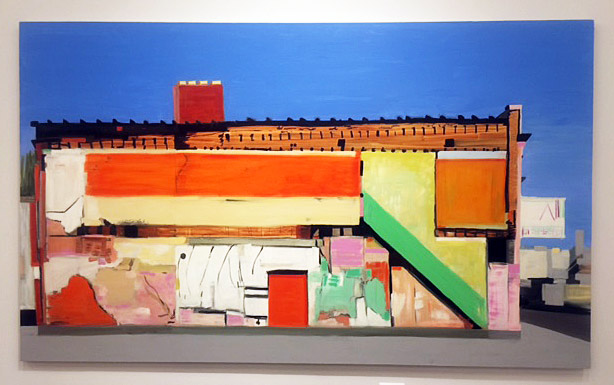
Torn Orange 59 X 99

Nancy Mitchnick, “Torn Orange”, Oil Painting, 59 x 99, 2009

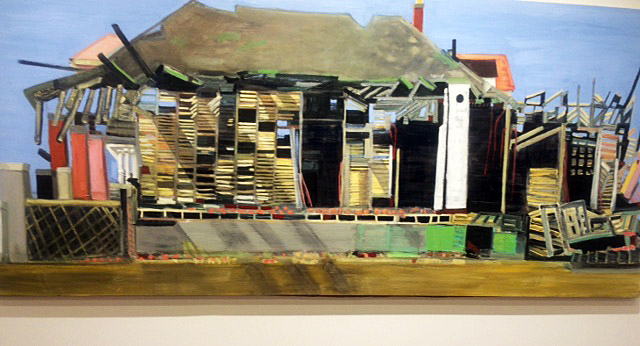
In reminiscing about her Cass Corridor days, Mitchnick talked about wanting to be an abstract painter but was never able to escape narratives but perhaps, ironically, that has finally (almost) been achieved in two of the most monumental paintings in the exhibit. “Torn Orange” is the painting of a surgically exposed side of a store. Composed of modulated tones of orange colliding with a diagonal green and yellow slash, it features the typical markings of a classic abstract expressionist work, but Mitchnick keeps the context of the building by depicting the surrounding light and air of the city. “Big Burn” is a triumphant exploration of the remains of a home that, in its abandoned state, is slowly rotting and returning to the earth. Exposed rafters, plaster lath and crumbling foundation are astonishingly caressed into a derelict geometry that made Mitchnick blurt, “I felt like I was composing a symphony!” It is triumphant painting that in itself is a marvelous history lesson.

FullSizeRender

Nancy Mitchnick,” Big Burn”, Oil Painting, 129 x 59, 2006-20016

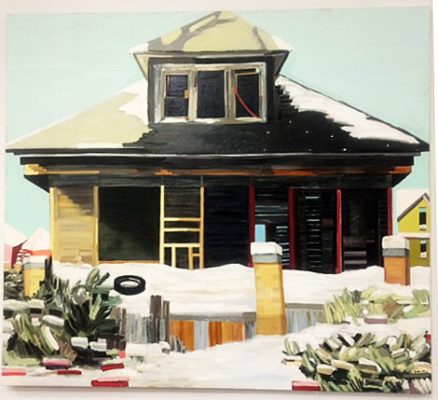
Each of the house paintings has a complexly charged presence. “Buffalo Street” is of the house in which Mitchnick grew up, and while it was in its last stages of devolution, Mitchnick’s painting still captures what seems a classical bearing, with its gabled roof and three-windowed dormer still erect and proud, and still evincing the colors that it once wore. It is difficult to imagine Mitchnick’s mindset when revisiting and painting this moment of her life and prompts the question of whether this is an elegy for the Buffalo Street house or an objective portrait.


Buffalo Street 99 X 88

Nancy Mitchnick, “Buffalo Street”, Oil Painting, 99 x 88, 2008-09

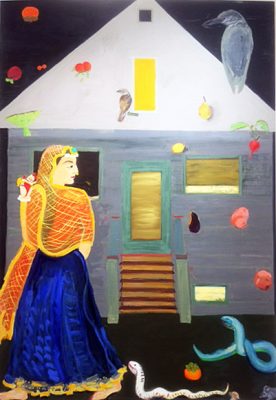
One of the most interesting aspects of Mitchnick’s work is the lesson that she teaches with each composition, which is that it takes a long look to realize a painting. Her latest pieces, “Night Heron” and “White Front,” seem almost recklessly whimsical compared to the disciplined, graphic painting of the abandoned houses. Populated with strange bits of ocean coral, odd mythic creatures (snakes, birds, turtles), and a Persian Princess, they are a gargantuan leap into another mind space. However, after one spends time with them, they gain traction, and their amazing palette of colors (throughout “Uncalibrated” her palette is symphonic) begins to tantalize, and an almost fairytale narrative gathers. It might be the story of a new Hamtramck or not, but it certainly signifies another trajectory for Nancy Mitchnick’s painting to mine.

Night Heron 77 X 111

Nancy Mitchnick,”Night Heron”, Oil Painting 77 x 111 – 2016


“Uncalibrated” will be at MOCAD until Sunday, July 31, 2016.


Lois Teicher @ Robert Kidd Gallery

Cosmic Journey 3 & 1_web

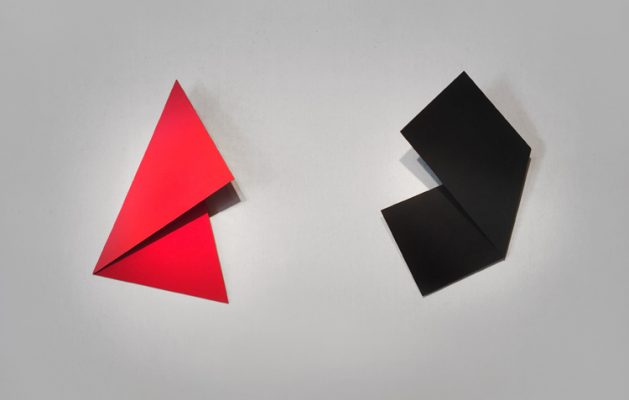
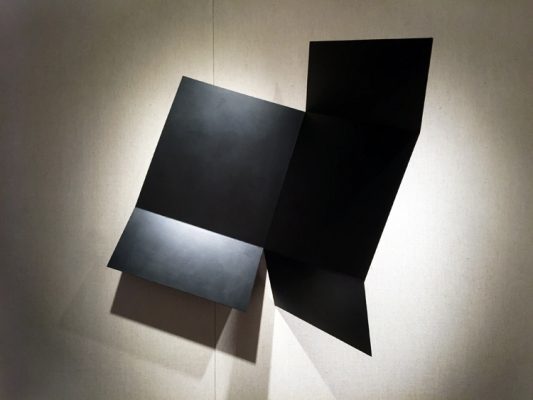
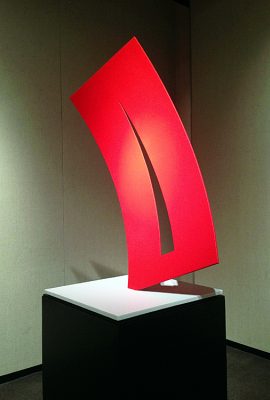
Lois Teicher, Cosmic Journey #3 (Red) welded aluminum with acrylic 35 x 23-1/2 x 6-3/4 inches Cosmic Journey #1 (Black) welded aluminum with enamel 37 x 23 x 9 inches

The Robert Kidd Gallery, in Birmingham, Michigan opened an exhibition of sculpture by the artist Lois Teicher on May 21, 2016. These hand-welded shapes of metal with spray painted surfaces rely heavily on her use of space and form. Working in a minimalist tradition, Teicher brings a high level of technical accomplishment to these abstract works. These sometimes folded pieces of colorful metal are hard-fought ideas that use pure geometric forms that give the viewer a certain type of comfort that is easy on the eyes. It brings to mind a piece of Teicher’s work outside in a lush organic and natural setting where there is an extreme contrast presented.


Fragment_web

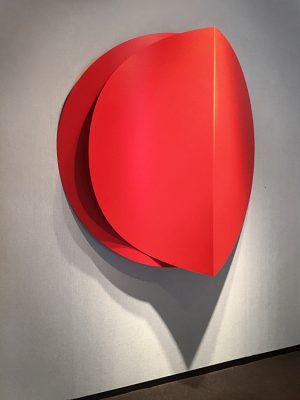
Lois Teicher, Fragment – welded aluminum with enamel 43 x 43 x 22 inches

The conceptual idea presented in Teicher’s work reminds this writer of work by Robert Mangold and Ellsworth Kelly. Searching for the roots of the minimalist tradition in a broad sense, these geometric abstractions are easily associated with the Bauhaus School in the work of Yves Klein, Piet Mondrian, and Joseph Albers. Some might suggests the movement was a reaction to abstract expressionism, but I would argue it is more of an inner-sensibility that drives this work; that there is an internal intellectual idea that says these forms are part of what creates the space/time continuum in the universe.


CurvedFormTriSpaceIII_Red_web

Lois Teicher, Curved Form with Triangle and Space III – welded aluminum with acrylic and enamel 36 x 23 x 18 inches

It’s taken this writer a trip to Donald Judd’s Marfa, Texas, and Dia: Beacon up the Hudson River from New York City, to contemplate and digest minimalist concepts. The recent passing of artist Ellsworth Kelly in December 2015 bring to mind a kindred spirit with Ms. Teicher, who completed her graduate work in 1981. She says in her statement, “My studio work is generally constructed of hand-welded metal that I personally fabricate. The process of expressing ideas mostly germinates from a solitary inner experience the flows outward and takes the form of visual expression.”


Eclipse Series VI_side_web

Lois Teicher, Eclipse Series VI – welded aluminum with acrylic 52 x 52 x 14 inches


The work on the floor and the wall sings a similar minimalist note, but Ms. Teicher takes her own step when she makes the form fold. What needs to be said is the role scale plays in this work. Some of the work in this exhibition seems like scale models for larger work that would be placed in public spaces. Given the space afforded by galleries, it’s these models that often stand alone as works of art in search of a public space. There is a natural balance in Teicher’s pieces with a Zen-like simplicity that informs each piece of work with a high caliber of visual experience.

Continuum, May 21 – June 18, 2016  Robert Kidd Gallery, Birmingham, MI


Page 31 of 36

Powered by WordPress & Theme by Anders Norén