Detroit Art Review

Critical art reviews of Detroit galleries and museums weekly

Breaking the Mold @ Flint Institute of Arts

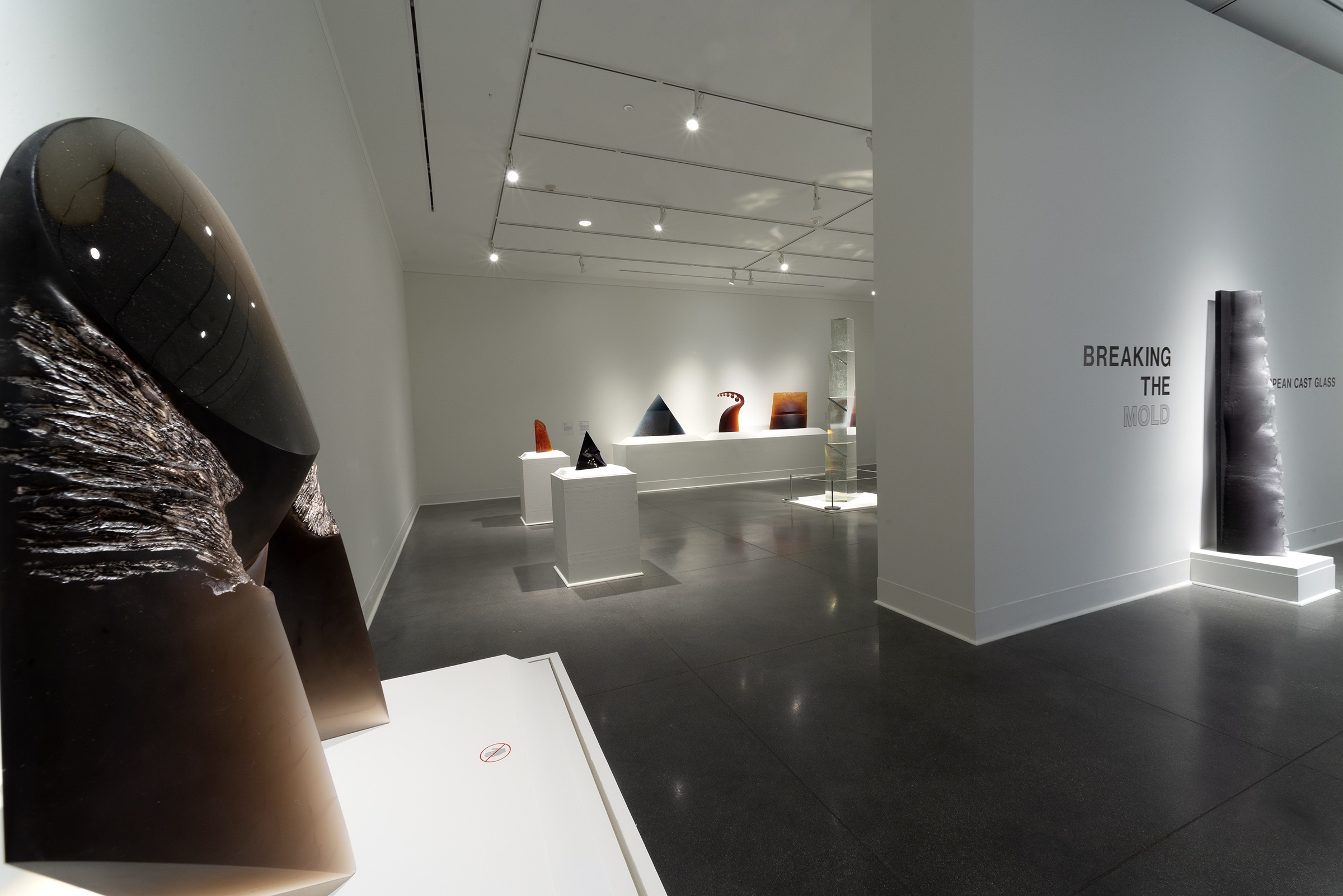
Breaking the Mold, installation, and all images are courtesy of the Flint Institute of Arts.

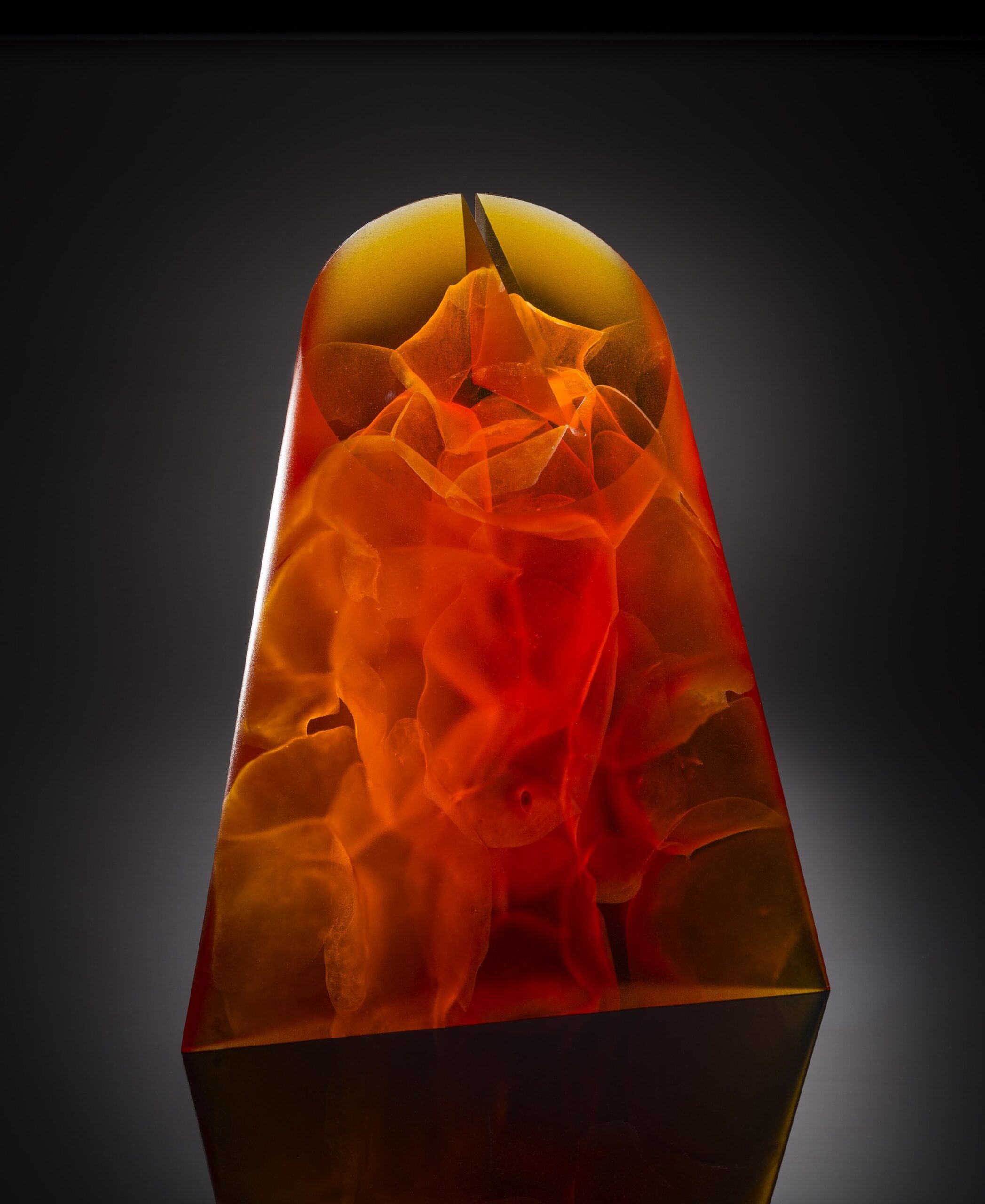
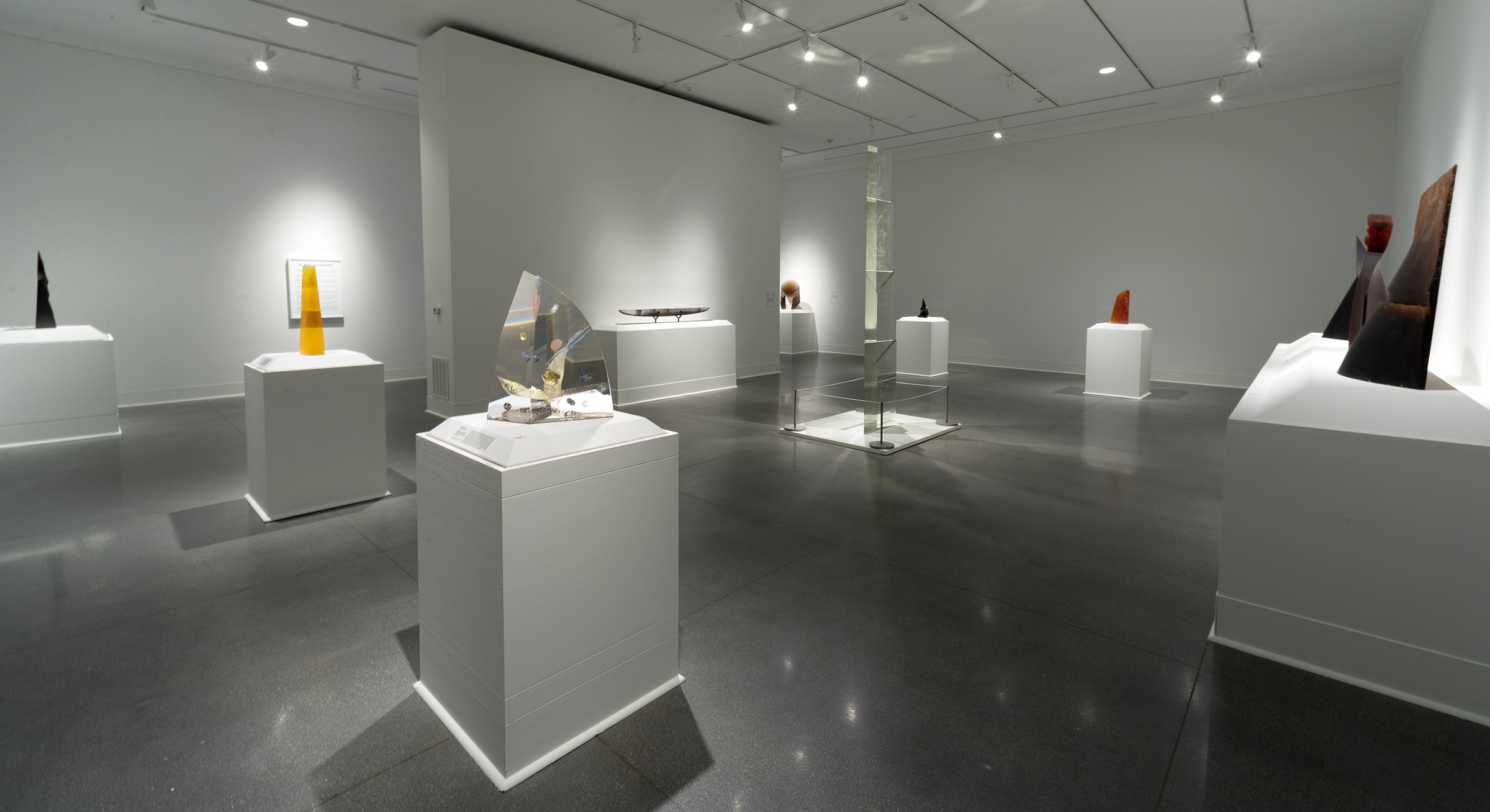
Whenever I visit the Flint Institute of Arts, I always leave feeling that the FIA is a seriously under-hyped museum, not just because of the strength of its collection but also because its galleries are just downright cool spaces, each varied and perfectly suited for the time period and style of the artwork they contain.  A major expansion in 2018 added to these galleries a chic and suitably contemporary space to showcase the museum’s collection of modern and contemporary glass. Until April 2, many of these glass works join forces in the Harris-Burger Gallery (also a relatively new addition) with works pulled from storage to offer a visual survey, European Cast Glass, offering viewers an intimate single-room micro-exhibit that hints at the diversity and the surprisingly subversive beauty of the medium.

It’s a show entirely of European cast glass, offering a truncated survey of the medium while suggesting its enduring relevance. The method of using a mold to cast glass dates back to the 15th century BC, long predating the development of blown glass, a first-century innovation. The 20th century brought about a Renaissance of glassmaking in Europe, fueled by artists who began their careers in manufacturing but broke away from commercial glassmaking and focused instead on glassmaking as fine art.

Petr Hora, Czech, born 1949, Hadros, 2006. Cast and acid-polished glass 18 3/4 × 15 1/2 × 4 3/4 in. (47.6 × 39.4 × 12.1 cm). Courtesy of the Isabel Foundation. L2017.59. Photo Credit: Douglas Schaible Photography.


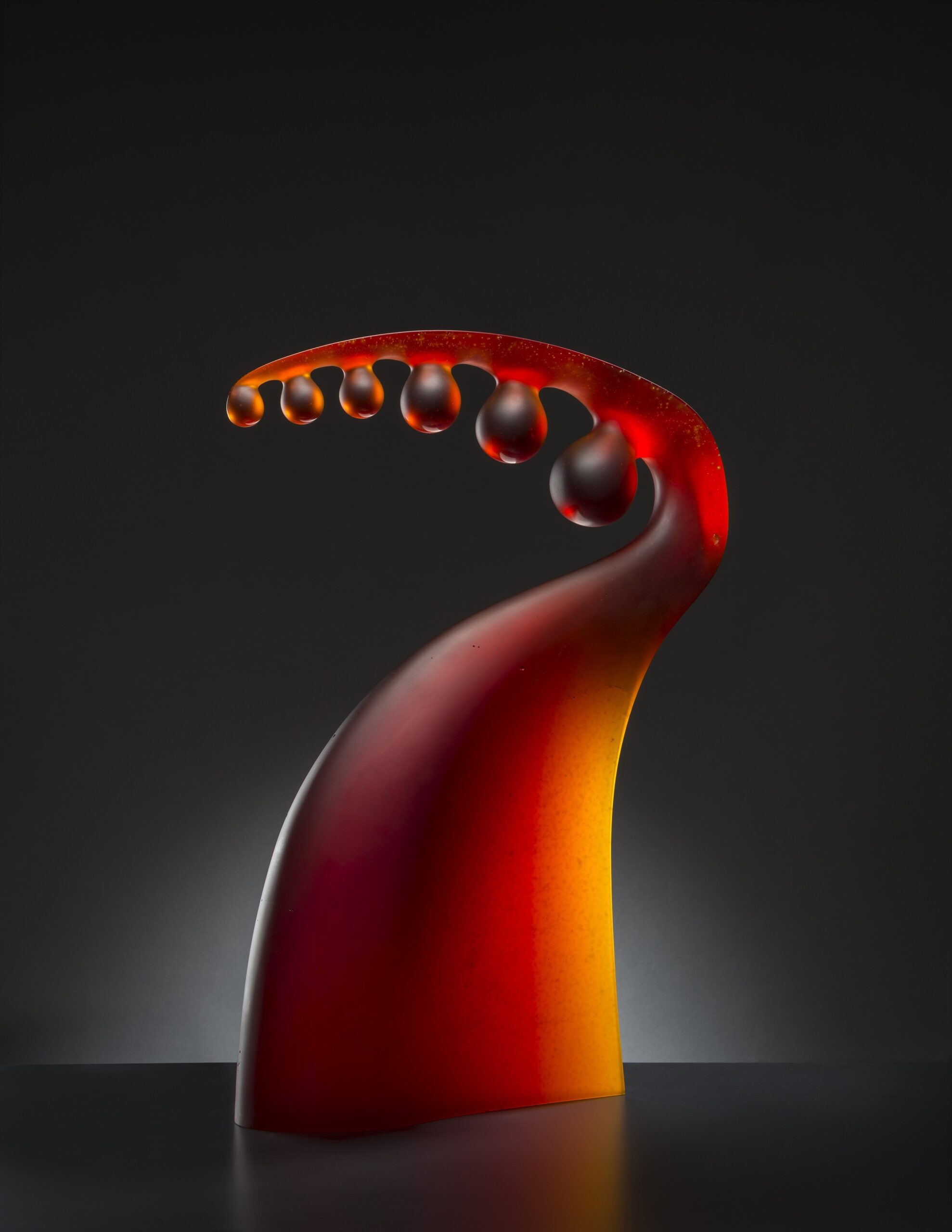
Vladimira Klumpar Czech, born 1954. After Rain, 2007, Cast glass. 33 3/4 × 23 1/2 × 8 3/4 in. (85.7 × 59.7 × 22.2 cm). Courtesy of the Isabel Foundation. L2017.67. Photo Credit: Douglas Schaible Photography.

Most of these works are abstract or non-representational, but not all. North Sea Waves by Slovakian artist Zora Palová is a vertically oriented column of gently undulating waves of glass. Unlike many of the works in the exhibit, which have clean, crisp lines, North Sea Waves has a very textural, rough surface, revealing the hand of the artist. In her choice of dark violet and white, Palová wanted to mimic the color of crashing waves of the North Sea, and in this work, she presents us with a seascape playfully flipped on its axis (having lived for a while in St. Andrews, Scotland, I can vouch with Palová that the North Sea can certainly get dark, and moody).

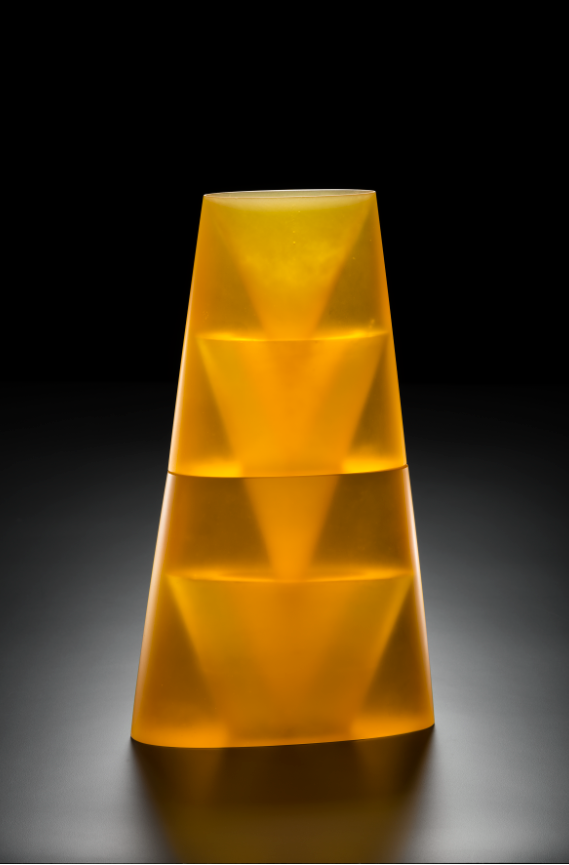
Many of these artists were simply exploring the capabilities of color, shape, light, and form, and their works seem largely the result of play and experimentation. The organic appearance of Vladimira Klumpar’s After Rain is delightful, vaguely organic in form, reminiscent of some kind of otherworldly plant gently bending from the weight of droplets of liquid glass. And the vertically ascending triangles of Vladimir Bachorik’s Escalation, to me anyway, read almost as an inverted stack of highly abstract nesting dolls.    Depending on the thickness or thinness of the glass, the color of these abstract works can alternate between rich and opaque or thin and translucent.

But some of the works in this exhibit are charged with surprising social and political relevance.  Stanislav Libenský and his wife Jaroslava Brychtová are both represented in this exhibit with several works. Heavily influenced by Cubism and Constructivism, their work stood as a subtle foil to the government-sanctioned Soviet-realist style so prevalent in Eastern Europe, something they had in common with other Czech artists. Together they innovated methods for casting monumental cast glass, and became renowned artists and teachers with an international following. Many of the artists in this show followed in their footsteps, and Sarah Kohn– the exhibition’s curator– likens this show to a sort of visual “family tree,” allowing us to see how these artists influenced each other.

Vladimir Bachorik Czech, born 1963, Escallation, 2005 Cast glass. 23 1/2 × 13 1/2 × 4 in. (59.7 × 34.3 × 10.2 cm). Courtesy of the Isabel Foundation. L2017.13. Photo Credit: Douglas Schaible Photography.


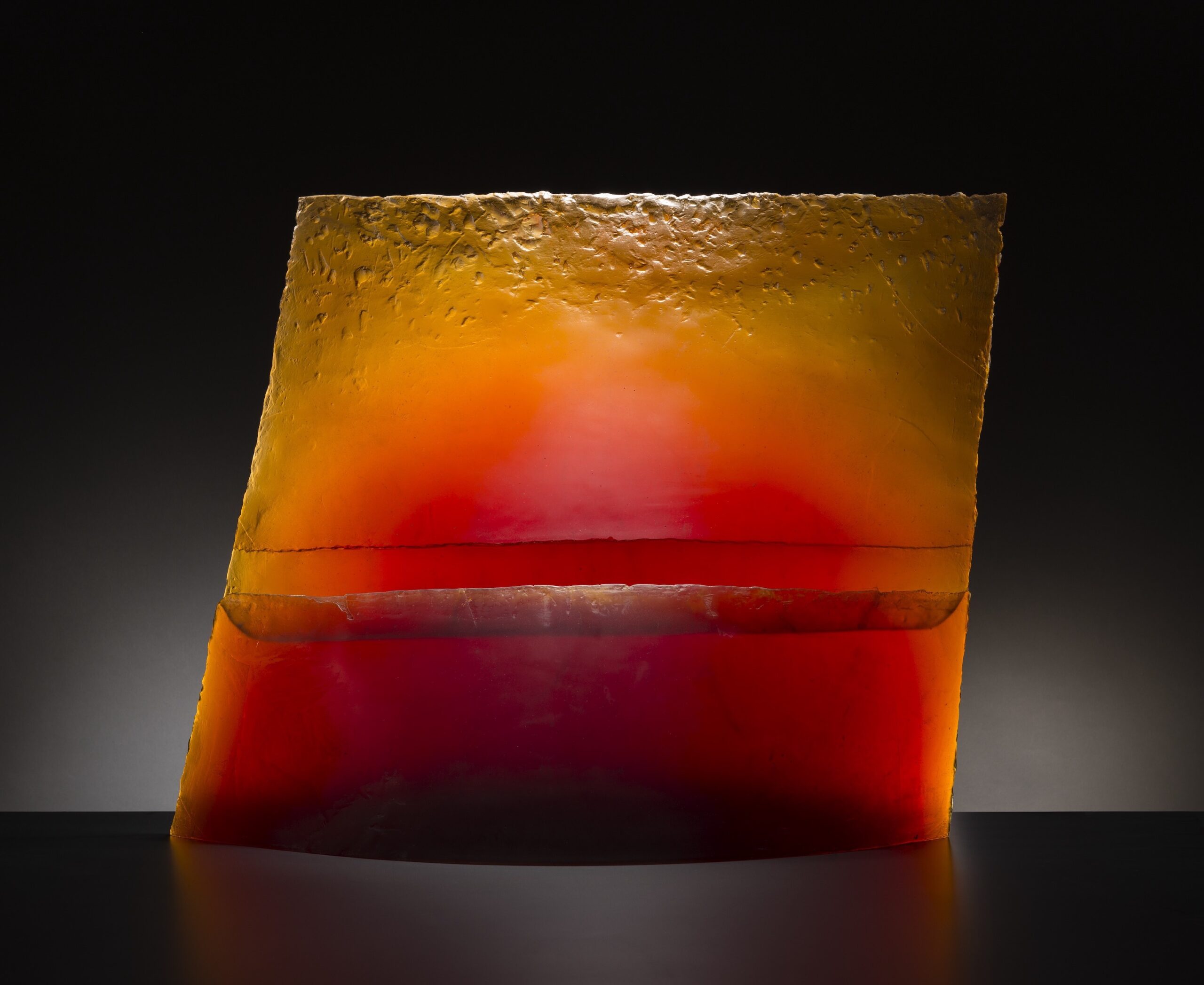
Stanislav Libenský Czech, 1921 – 2002 Horizon, 1992-2005 Cast glass, 33 × 43 × 11 1/2 in., 500 lb. (83.8 × 109.2 × 29.2 cm, 226.8 kg). Courtesy of the Isabel Foundation. L2017.74. Photo Credit: Douglas Schaible Photography.

Stanislav Libenský’s 3V Column, the exhibition’s literal centerpiece, was a direct response to Czechoslovakia’s Velvet Revolution, which Libenský witnessed firsthand from his studio window. The half-million protesters who in 1989 gathered in Wencelas Square and collectively brought an end to Communist one-party rule flashed their fingers in a Churchillian V Shape: a shape directly referenced by the horizontally oriented V-shaped cuts incised in three different places in the column. The column was previously displayed in the FIA’s glass gallery on a podium against a wall, but here it’s in the center of the gallery space, allowing viewers to appreciate it in 360 degrees, and view up close the thousands of minuscule air bubbles arrested within its form.

Breaking the Mold allows the FIA to flaunt highlights from its robust collection of glass art, including works previously in storage. It also re-presents the way some of these works are displayed, yielding a different viewer experience.  Even if the historical context or subject of a work of glass art is not readily apparent, glass still possesses an undeniable beauty that prevents it from being prohibitively esoteric; it’s art that anyone can enjoy. This is a small exhibit, so come for what it is, and while you’re there, explore the rest of the much underhyped spaces the FIA has to offer.

Breaking the Mold, installation image courtesy of the Flint Institute of Arts.

I want to thank the curator of this exhibition, Sarah Kohn, who was very generous with her time in discussing this exhibition with me, and fielding my many questions.

Breaking the Mold: European Cast Glass -October 29, 2022 – April 2, 2023, at the Flint Institute of Art.

[adrotate group=”2″]

Printmaking in the Twenty-First Century @ DIA

Exhibition view of Printmaking in the Twenty-First Century. All Images: Ashley CookPrintmaking in the Twenty-First Century at the Detroit Institute of Arts

Printmaking in the Twenty-First Century @ Detroit Institute of Arts

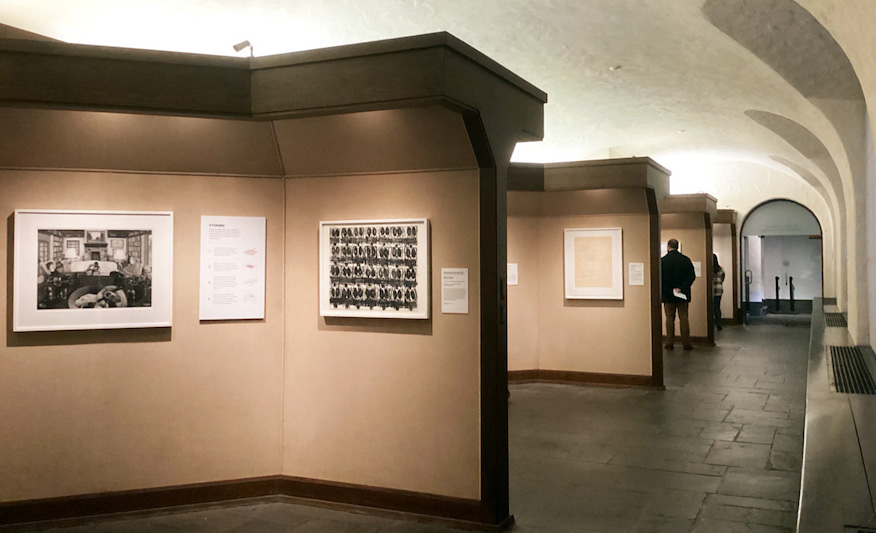
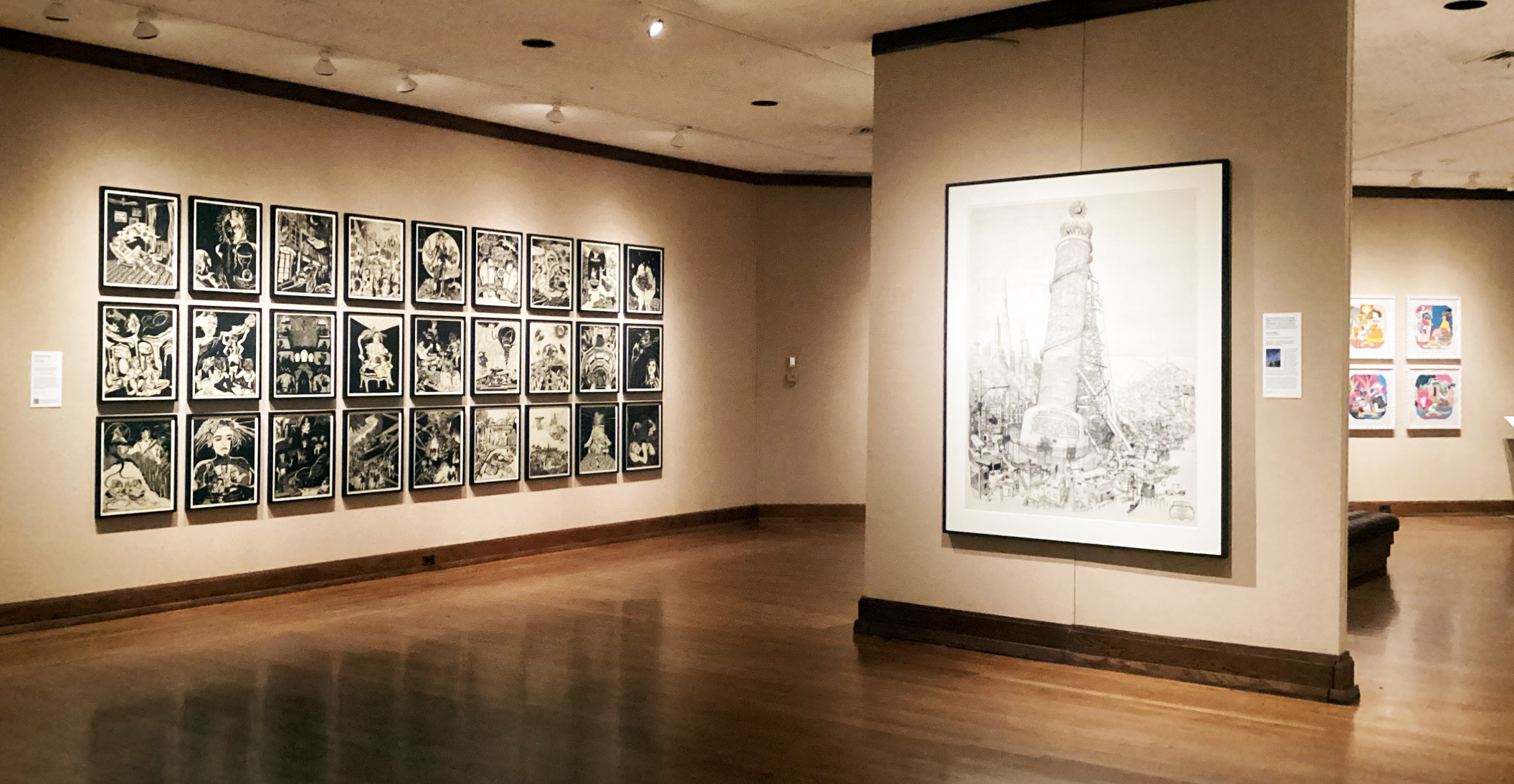
On view at the Detroit Institute of Arts is an exhibition that focuses on printmaking with over 60 works by local, national and international artists. Clare Rogan, who is the Curator of Prints & Drawings at the DIA, unpacks the magic of printmaking through placards that explain some of the most widely used processes and their history dating back to 700 AD in China. Since the first moment that ink was applied to a carved plate and pressed onto paper, it became evident that this new technology would change the trajectory of creative expression forever. Printmaking, unlike drawing or painting, allowed for the production of multiples, which gave artists a chance to produce more and reach a broader audience while still remaining true to their vision. Printmaking in the Twenty-First Century presents a plethora of practices including woodcuts, aquatints, linocuts, screenprints, lithographs, intaglios, relief collagraphs, letterpresses, monoprints, etchings, drypoints, spitbites, photo etchings and engravings. While the featured artists draw inspiration from a lineage over 1300 years old, the works in this exhibition span from the year 2000 until now.

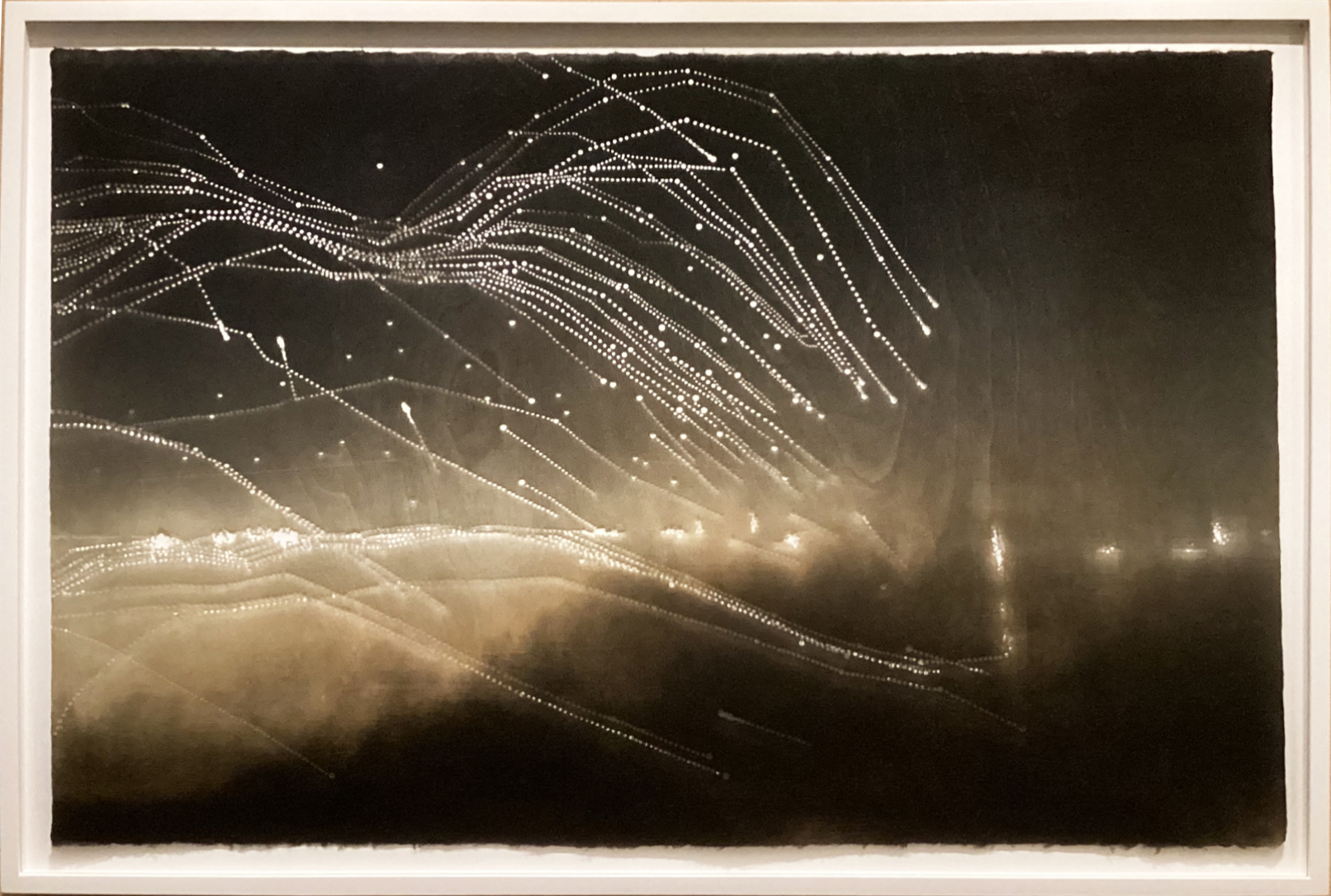
The Schwarz Galleries of Print and Drawing is where you can find this show. Depending on which door you enter, you will receive the body of work differently, however all guests will walk away having witnessed the breadth of concerns these printmakers have addressed. Experimentation is particularly evident in works like Shadows II by William Kentridge, Arise by Fred Wilson, Aerial #3 by Susan Goethel Campbell and Untitled by Tara Donovan. Each of these pieces participate in conversations of abstraction through investigations of material and process. Visually, experimentation by printmakers seems to have furthered aesthetic potential and often achieved deeply mystical outcomes. Many times the printmaker’s multi-step process of creating is mysterious; the informative literature throughout the show satisfies the curiosity a fascinated viewer may have.

Susan Goethel Campbell, Aerial #3, Monoprint printed in brown and black ink with hand punching on kozo paper, 2010

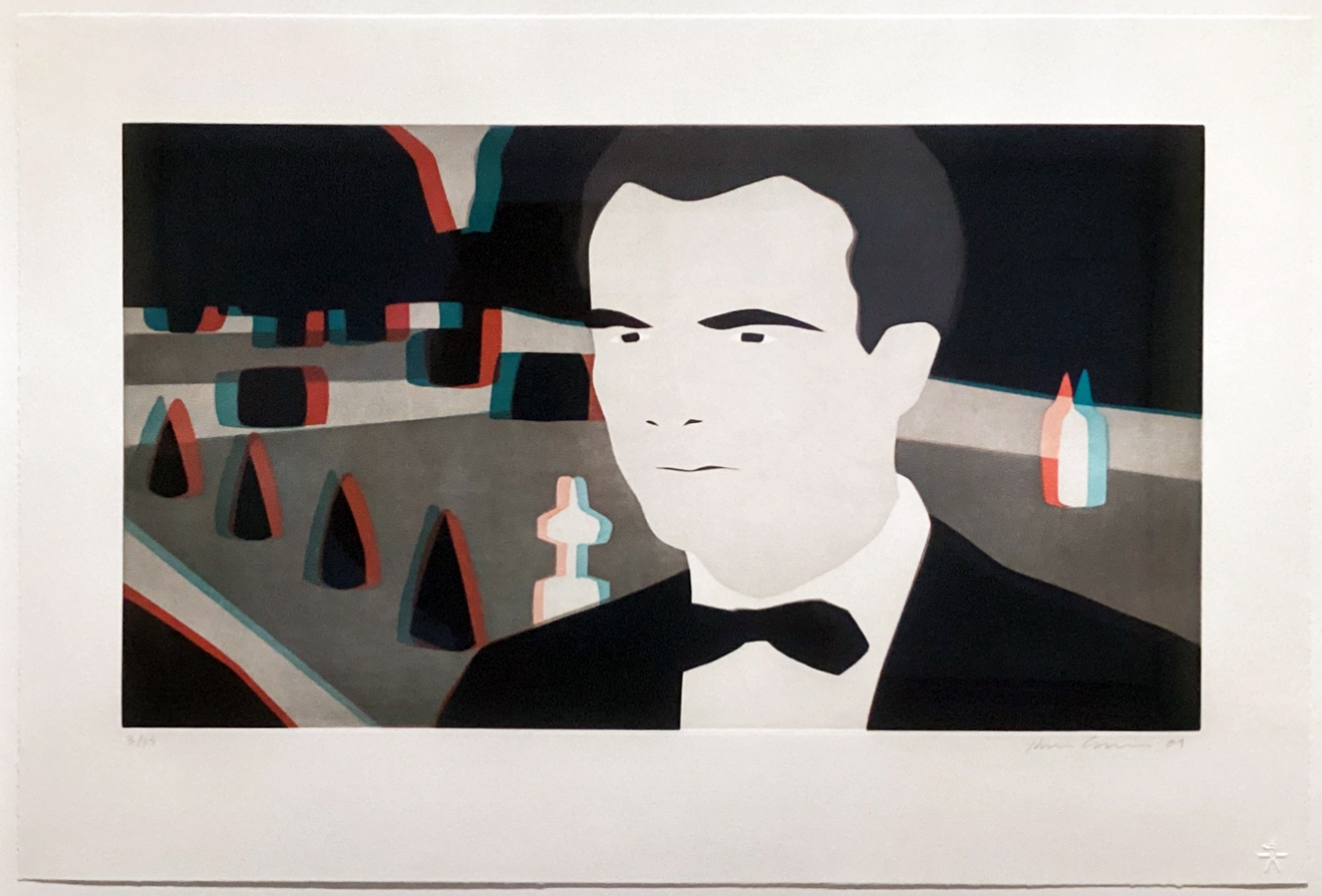
Kota Ezawa, X3D, Color aquatint on paper, edition 3/35, 2009.

 For those who prefer representation, this show also has what you’re looking for. While experimentation is still evident in pieces like Watermark by Nicole Eisenmen and X3D by Kota Ezawa, there is as much concern for producing a legible illustration as there is for exploring the different ways to do so. There are also impressively complex representations of birds in Dying Words by Walton Ford and bugs in The Bestiary of Museum Visitors Notable Bird Beaks of American Museum History Exhibition Paradise and Perdition Thorny Territory by Mark Dion. These two, however, utilize more traditional methods of printmaking to explore the possibilities of realism, which highlights yet another of printmaking’s many facets.

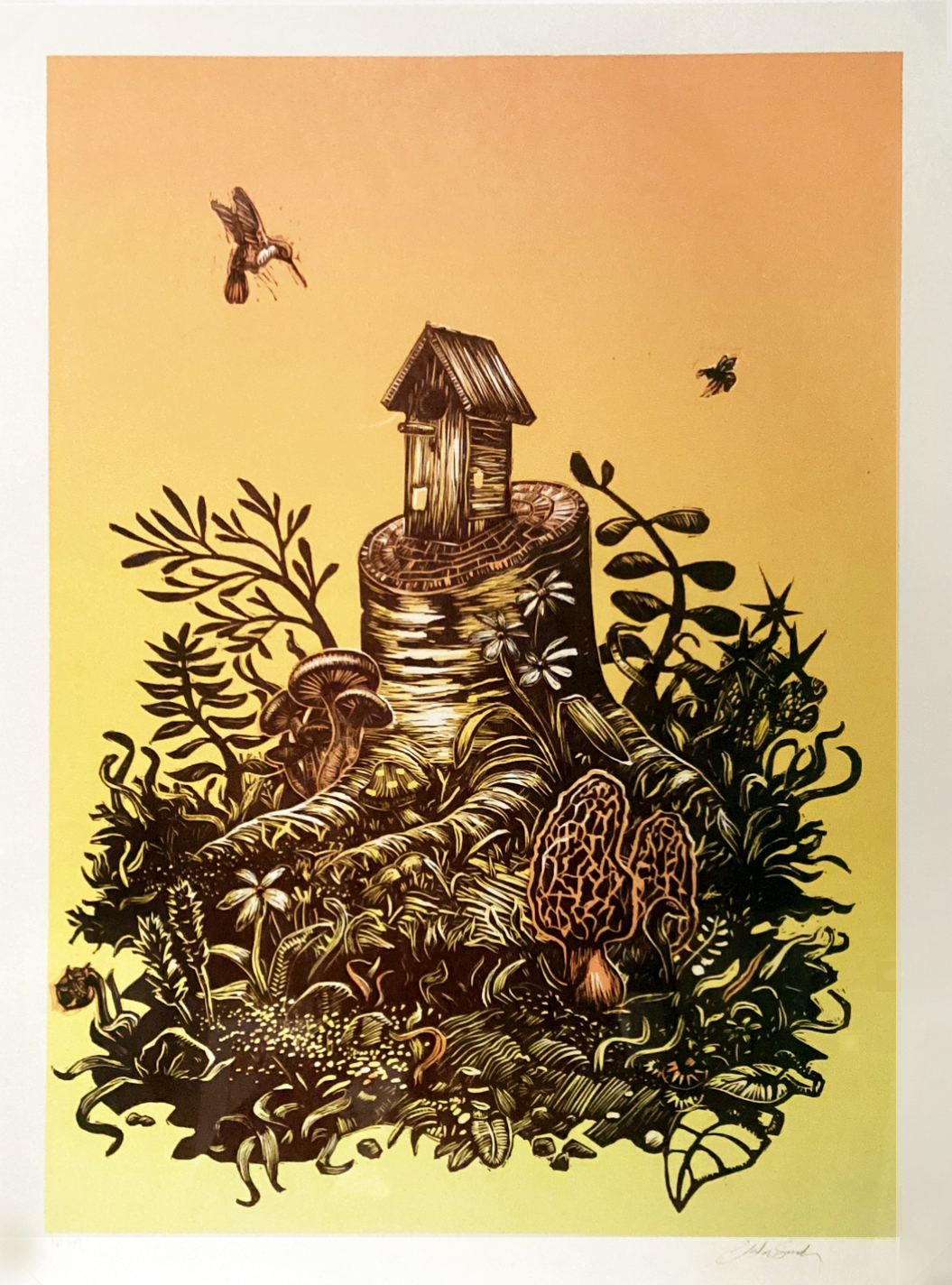
Further into the exhibition is On Press Project: Prints for Non-profits, organized by Detroit-based printshop Signal Return who invited local artists to produce posters for non-profits in the Detroit area. There are 24 linocut and letterpress posters that were made between 2018 and 2022 that bring awareness to organizations, including Detroit Hives, Black Family Development, Keep Growing Detroit, Freedom House, The Children’s Center, and Greening of Detroit. Amongst them are posters for Detroit Will Breathe, an activist group that represents and supports Detroit’s participation in the global Black Lives Matter movement. These simple yet powerful protest posters silently shout DEMOCRACY FOR ALL! and remind us of the essential role that printmaking has held in the realm of activism throughout time. Signal Return spent much of 2020 producing protest posters for Black Lives Matter activists free of charge, which have fueled the demonstrations in the streets. This gesture is not new; researching images of human rights marches throughout history, we see that mass-produced messages designed by artists and produced by printmakers have been critical.

Clinton Snider, Greening of Detroit, Linocut, 202

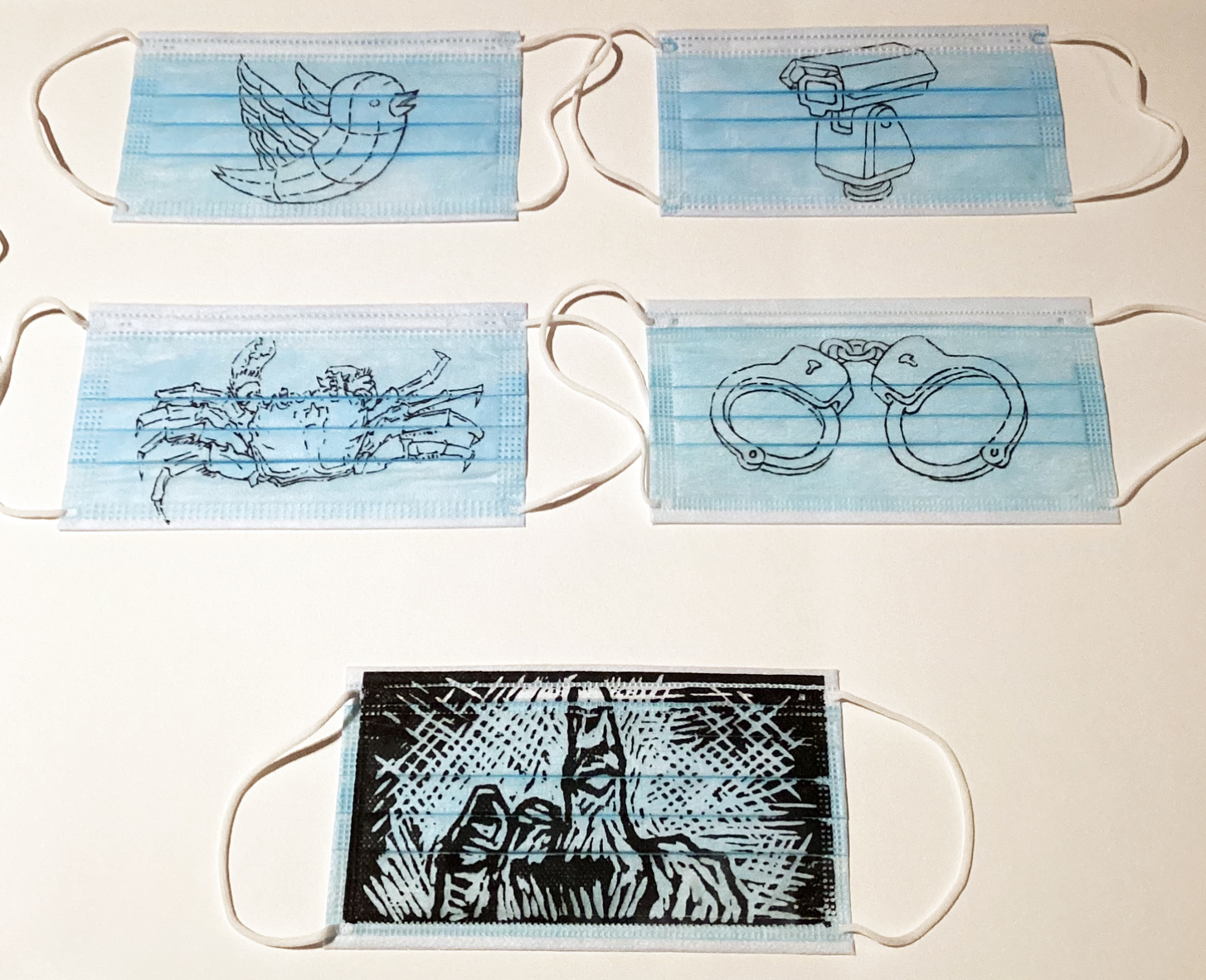
This exhibition does not shy away from themes of colonization and the oppression of marginalized groups. It confidently moves on to explore more ways in which printmaking can be a functional approach to critiquing such realities while honoring and supporting those who are challenged with underrepresentation. Curated into the show is a series of printed medical-grade masks by world-renowned political artist Ai Weiwei. They were created in 2020 and sold to raise money for Covid-19 relief programs like Human Rights Watch, Refugees International, and Doctors without Borders. Sultana’s Dream is a large-scale imaginative series that depicts the array of achievements by women who live in a world free from the laws and wars of men. The purpose of these images is to illustrate a short novel by Bengali writer and women’s rights activist Rokeya Sakhamat Houssain.

Ai Weiwei, Ai Weiwei MASK, Screenprints on polypropylene masks, unlimited edition, 2020.

 Additionally, the beautiful life-size works of artist Dyani White Hawk represent the dentalium dresses worn by indigenous women of North America. Roger Shimomura addresses anti-Asian racism through his depiction of childhood memories as a boy living in Japanese internment camps during WWII. Robert Pruitt illustrates the complexities of Black identities through an image of a female basketball player with the Black Panther Party slogan “Black is Beautiful” on her jersey. Hernan Bas presents the male characters of Hardy Boys mystery novels with fairy wings to challenge gender norms and the disparagement of homosexuality. It would be safe to assume that nearly half of the works on display in this exhibition were done as a product of material experimentation with something to learn, while the other half were done as a product of support with something to say. The common thread is that they all require a curious urge to explore and an open mind to appreciate.

Exhibition view of Printmaking in the Twenty-First Century

Printmaking in the Twenty-First Century is on view at the Detroit Institute of Arts until April 9, 2023, accessible with the museum general admission pass.

[adrotate group=”2″]


Outside Work: Faculty Exhibition @ OUAG

Outside Work: Faculty Exhibition at Oakland University Department of Art and Art History

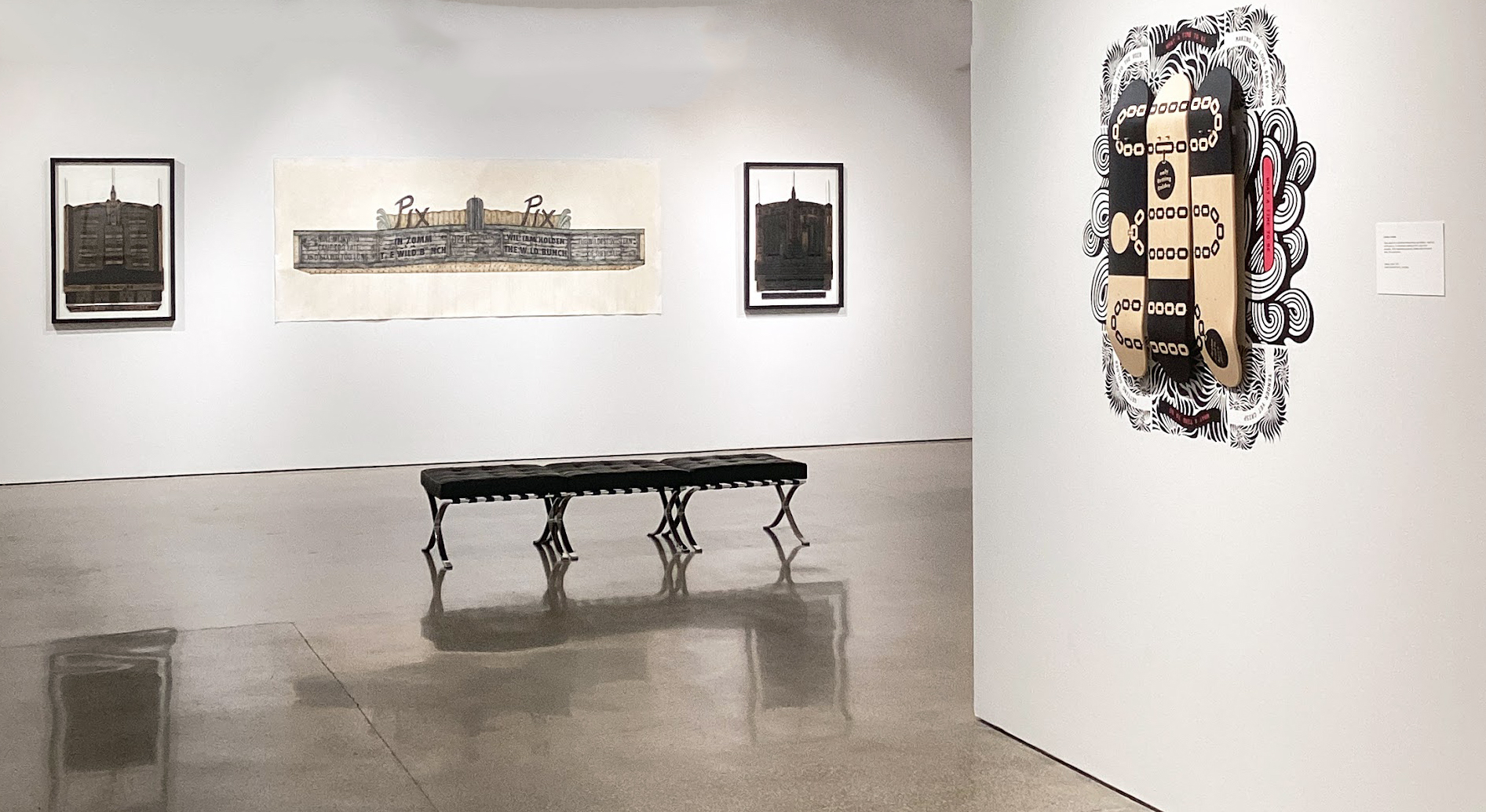
Installation view of Outside Work featuring Black Marquee, The Wild Bunch by Ryan Stanfest, and Getting Golder by Lindsey Camelio.  All images courtesy of Ashley Cook

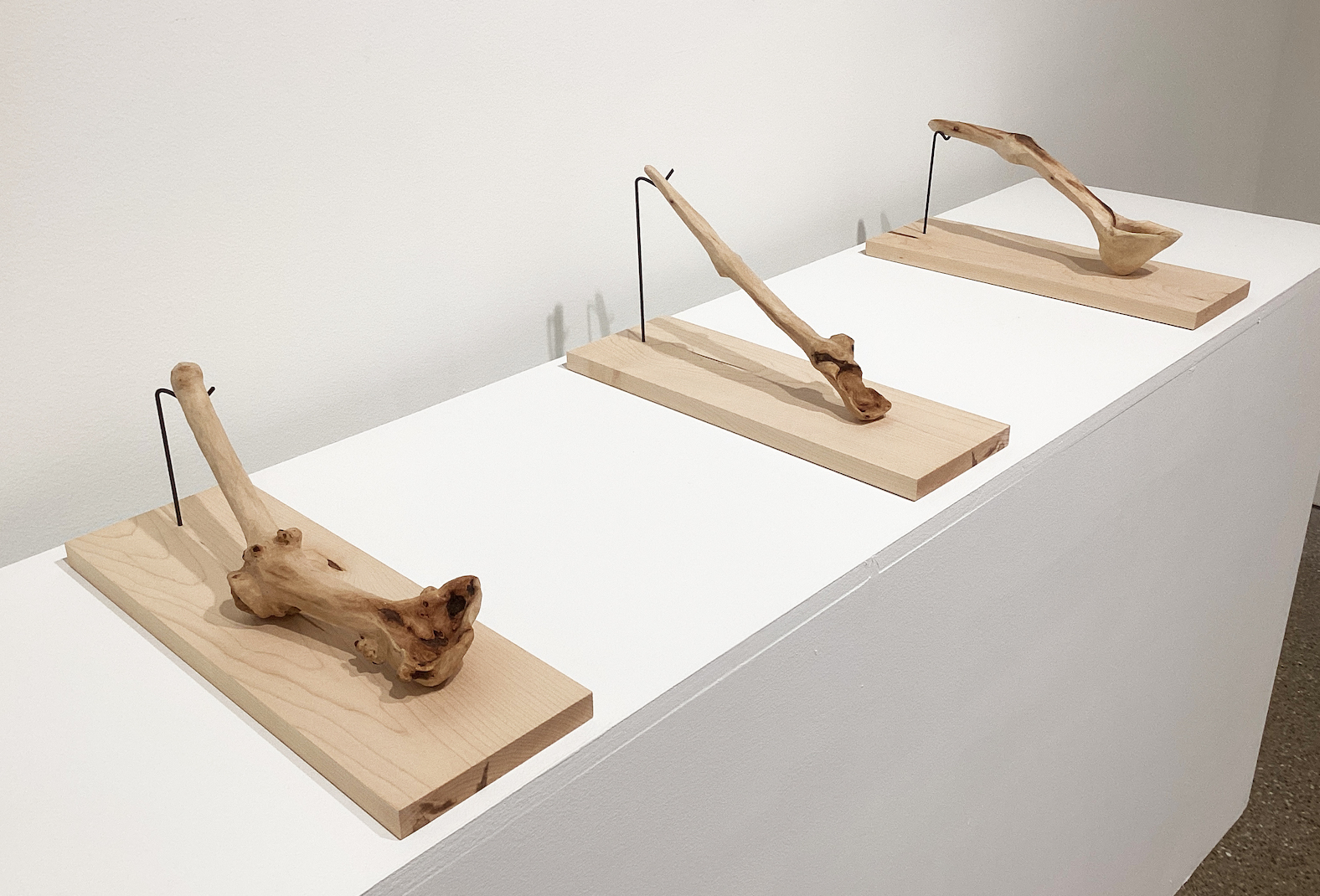
The promotional material for Outside Work at Oakland University Art Gallery includes an image of an organic object with a form similar to a bone or a piece of wood, lending itself to preconceptions that the exhibition would be focused on the natural outside world. Realizing upon visiting the work that this piece by David Lambert is a series of spoons carved from a native sycamore tree could pique the interest of nature lovers. The rest of the work, however, undermines from this assumption that nature is the consistent focus and quickly clarifies that what we have is a group of works by the faculty of the university done outside of their work within the Department of Art and Art History. Dick Goody is the director of the gallery and a Professor of Art at Oakland University; curated into the show are fourteen of his oil paintings along with other works of art by Claude Baillargeon, Meaghan Barry, Lindsey Camelio, Dho Yee Chung, Satareh Ghoreishi, David Lambert, Colleen Ludwig, Karen McGarry, Maria Smith Bohannon, Ryan Standfest and Cody VanderKaay.

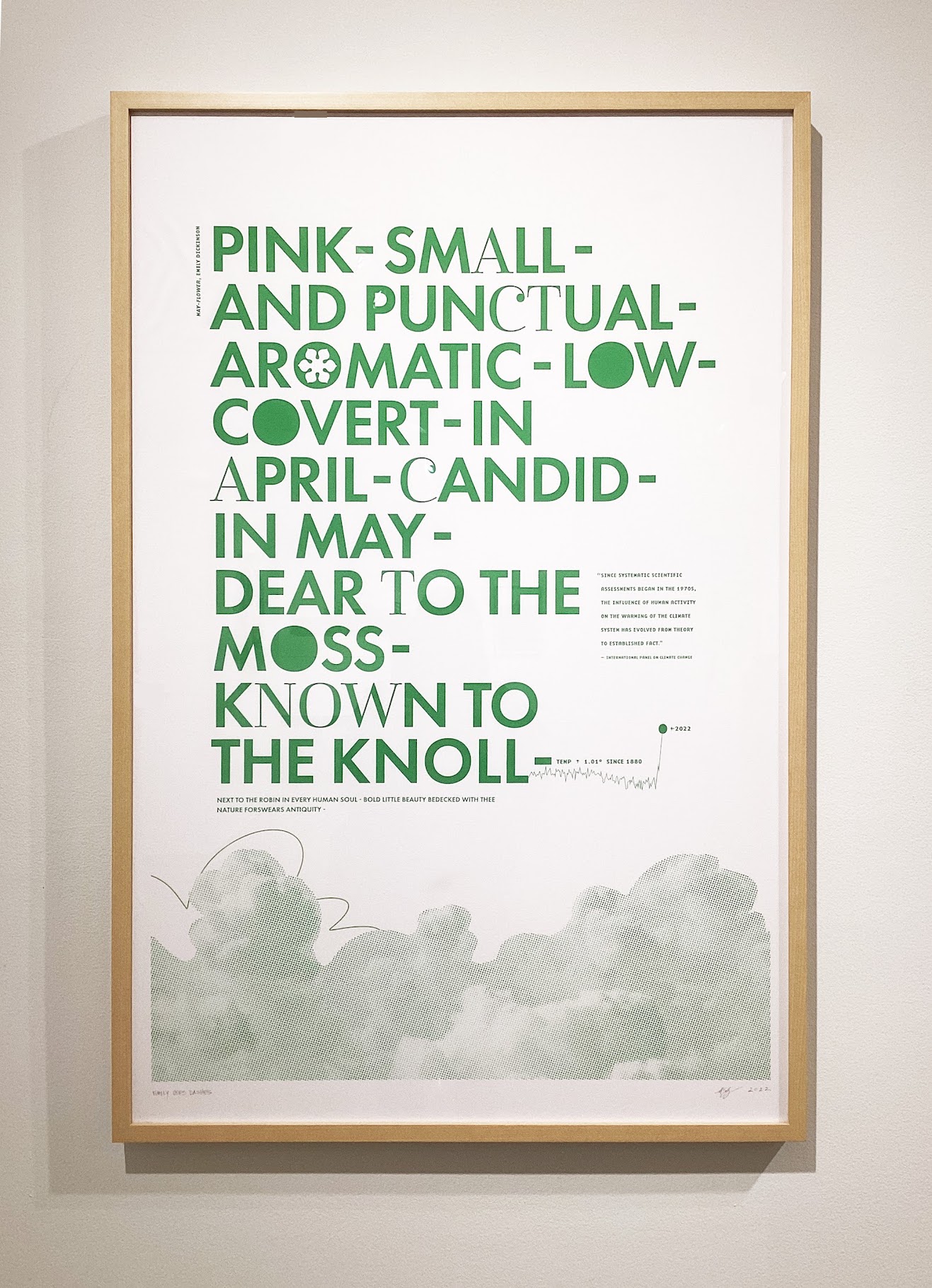
Maria Smith Brohannon, Emily uses Dashes, Glichee on canvas, 2022.

Visitors are first welcomed with a poster by Maria Smith Bohannon, who is an Assistant Professor of Graphic Design. This poster Emily uses Dashes places a strong focus on the poetic punctuation practices of Emily Dickinson in order to soften the heavy statistics of climate change that are peppered around the poetry. Eight conceptual maps by Karen McGarry are presented along the adjacent wall and then a second piece by Bohannon, Emily is Hopeful. The maps entitled These Places Thus Far by McGarry, who is a Lecturer in Art, utilize collage as the primary technique to touch on her experiences living in different places throughout her life as a student and arts educator, including Detroit, Chicago, New York, Oxford, Singapore, Dublin, Cincinnati and Los Angeles.

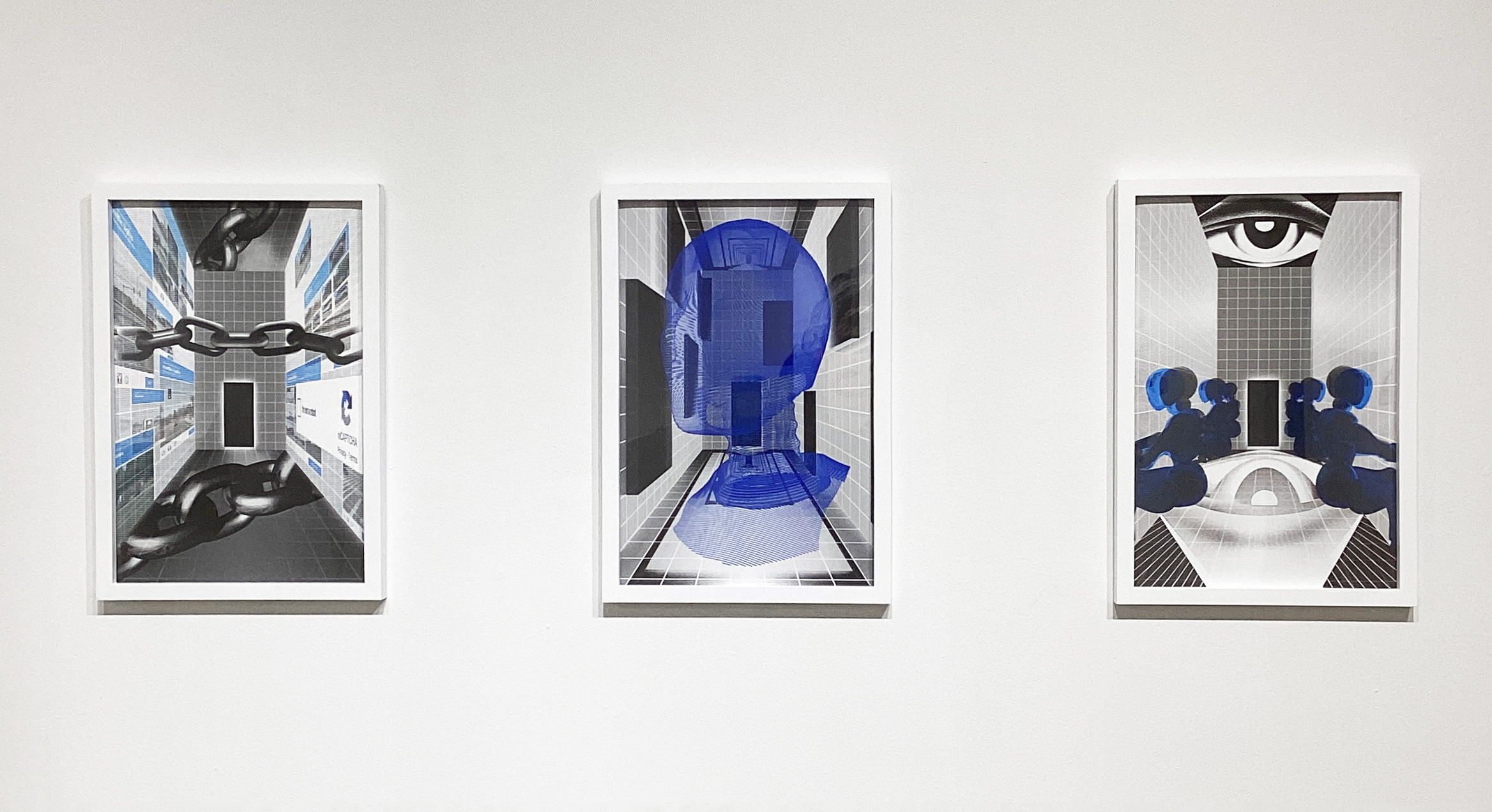
Dho Yee Chung, The Room Series, mixed digital media, 2022.

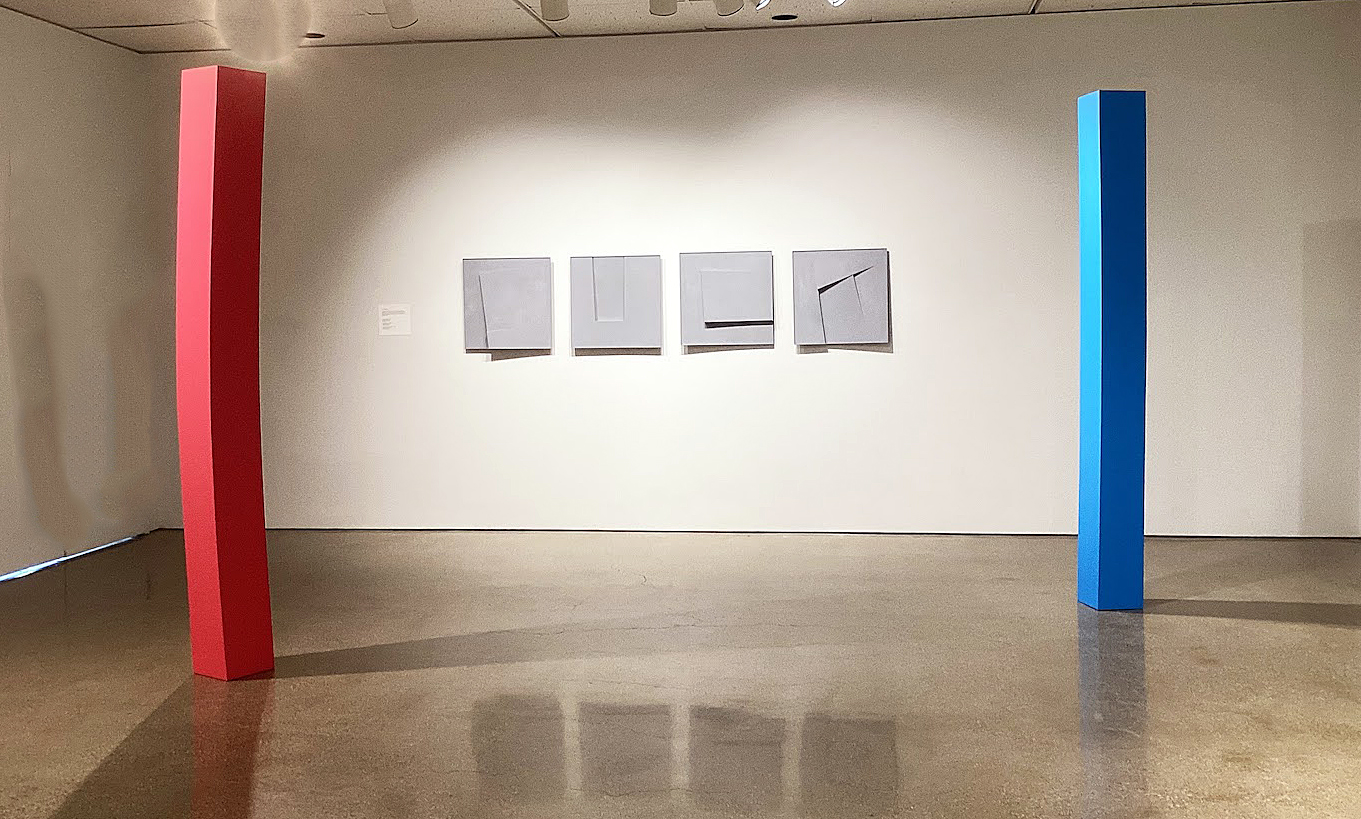
Works by Assistant Professors of Graphic Design Dho Yee Chung and Lindsey Camelio differ from each other despite both using digital media as their means of production. Dho Yee Chung’s triptych The Room Series uses surrealist compositions, missing ceilings and floors, animated walls, and translucent floating forms to depict the control of human labor within a digital workspace. Camelio embraces elements of surrealism too, but with the objective of exploring a realm between luxury and everyday life through odd combinations of subject, pattern, color, and form. A strong focus on color and form is also at play in the work across the room by Cody VenderKaay who is an Associate Professor of Art, the Director of the Studio Art Program, and a sculptor. These abstract red and blue towers are in fact made of pine despite them looking like plastic. This carries over as well to the gray wall works they frame, which are shaped and primed birch.

Cody VanderKaay, Lodestone (Roulette) and Lodestone (High Dive) made of shaped and painted pine, Untitled (Subliminal Landscape) made of shaped and primed birch, 2022.

Assistant Professor of Graphic Design Satareh Ghoreishi and Assistant Professor of Art Ryan Standfest encourage us to consider the impacts of Covid-19 on consumerism around the world. The two works by Ghoreishi focus on the massive influx of online shopping that took place during the onset of the pandemic through her sculptural assemblages that combine contemporary shipping boxes and fashion items with personal items from years ago. The 3D collages by Standfest highlight the unfortunate impact that the pandemic has had on our ability to gather together in physical spaces. He touches on this through the display of two abandoned movie theater facades and a watercolor painting of a rundown marquee. Sharing the same space is Associate Professor of Art Colleen Ludwig’s crocheted fiber and mushroom root sculptures Saccu 1 and Saccu 2. They use the superorganism mycelium to test its ability to merge with fiber with the aim of discovering the potential for new habitat designs to house small creatures within the natural world. This work has a very particular concentration that combines biology with creative production similar to Untitled (Spoons) by Lecturer in Art David Lambert, who uses the tradition of spoon making from his Scots/Irish ancestry to produce these seven forms that teeter on the line between concept and function.

David Lambert, Untitled (Spoons), sycamore, 2020.

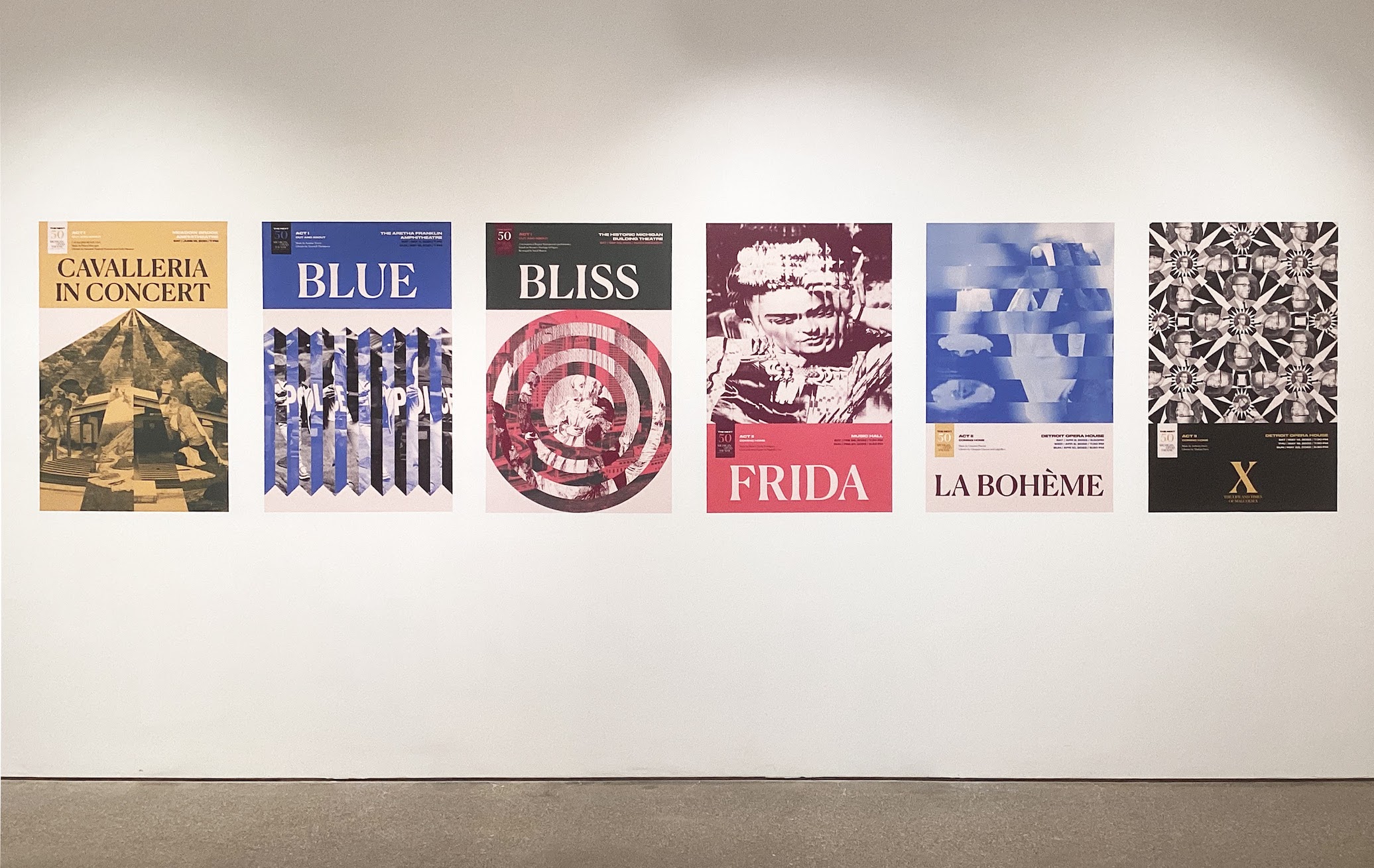
The long-standing painting practice of Dick Goody holds a place in this show alongside Professor of Art History Claude Baillargeon’s ink-jet prints entitled Memorial Monuments of Racial Terror, The Equal Justice Initiative (EIJ) Community Remembrance Project, and A Knight of Columbus Facing Justice. These photographs represent the Equal Justice Institute and its work in confronting the history of racism in the United States as a way of healing and achieving justice. And finally, the Department of Art and Art History Chair Meaghan Berry introduces her graphic design firm Unsold Studio through the presentation of six posters that were commissioned by the Michigan Opera Theatre’s 2021-2022 season In MOTion. These promotional designs were made for each performance in the season and visually communicated a freshness through the sense of motion with the goal of not only continuing to attract long-time attendees but new audiences as well.

Meaghan Barry, In MOTion: A visual identity system for Michigan Opera Theatre’s 2021-2022 Season, 2021.

The professional and personal concerns of the artists are represented through the work they chose to include in this group exhibition. Outside Work successfully highlights the dynamics at play within the Department of Art and Art History and makes it clear that each of these artists sustains a studio practice and active professional career in the world of art and design in addition to their position as an educator, which is an essential trait to the faculty of any distinguished university.

Outside Work at Oakland University Art Gallery opened on January 12 and is on view until April 2, 2023.   You can learn more at https://www.ouartgallery.org/exhibitions/outside-work/

[adrotate group=”2″]


Rick Vian @ M Contemporary Gallery


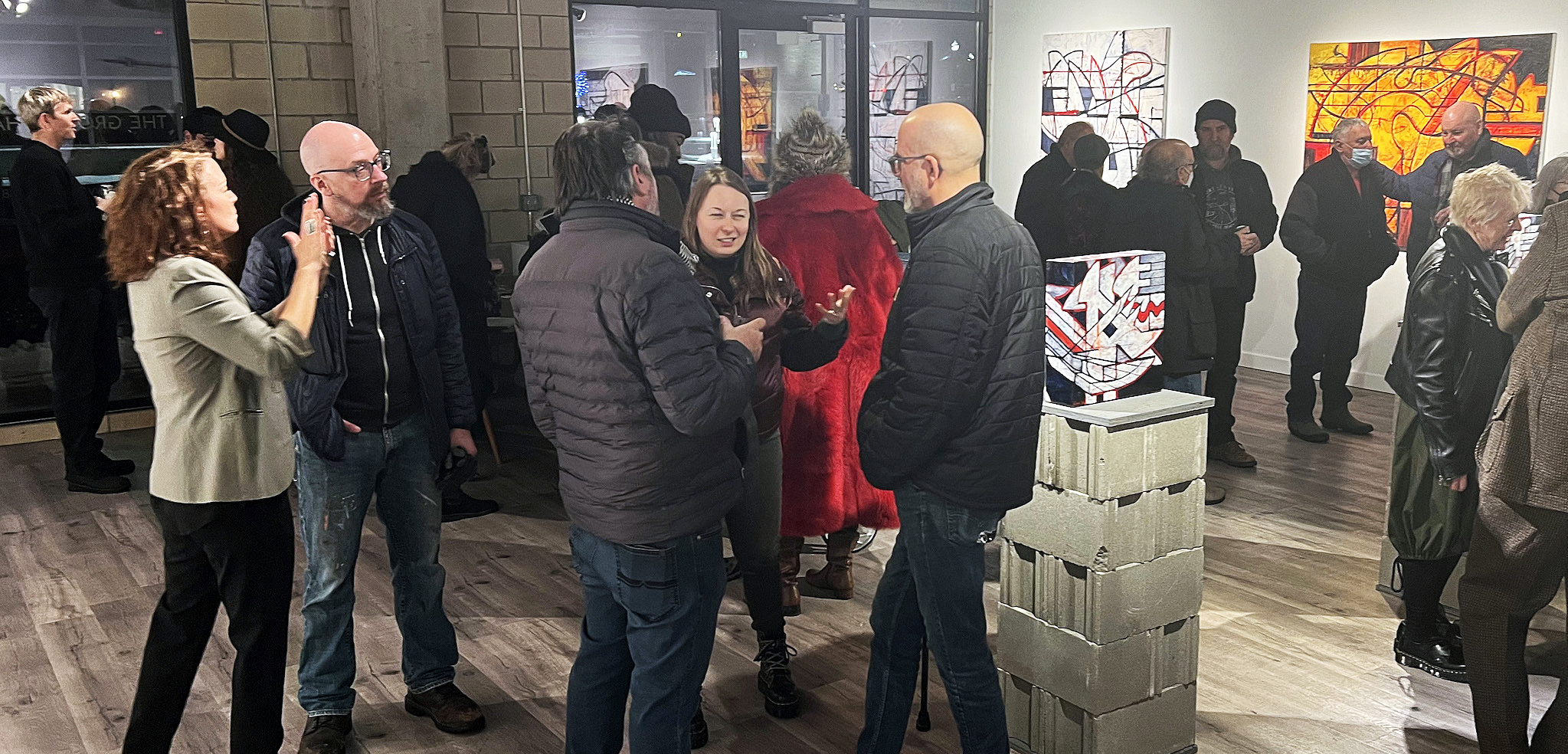
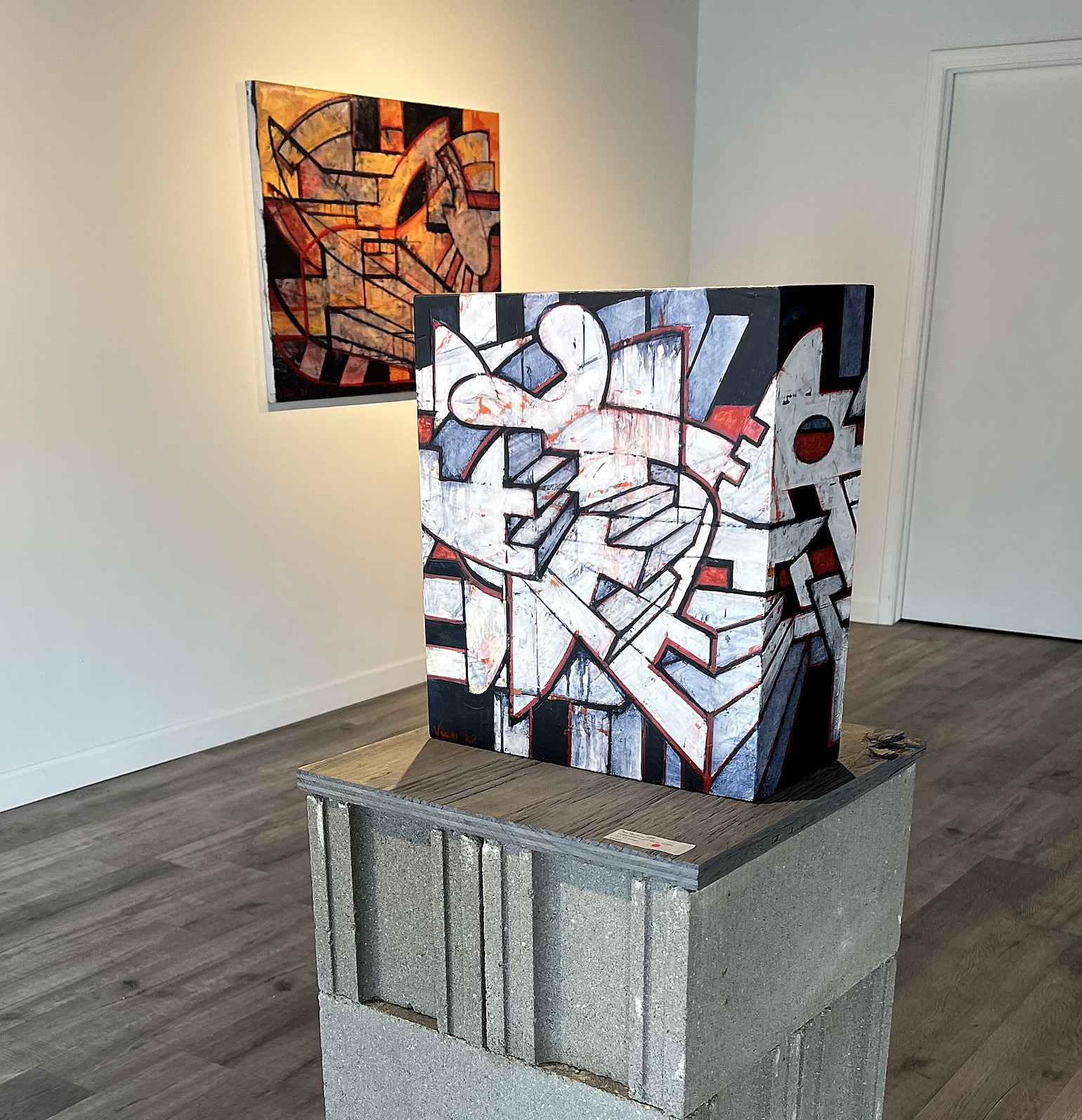
An installation view of Rick Vian: The Growth Habit at Ferndale’s M Contemporary through Feb. 18.   Image courtesy of DAR

Over a long career, Rick Vian has alternated between two seemingly contradictory subjects for paintings. The first were breathtakingly realistic portraits of Upper Peninsula tree canopies and the sky beyond, later abstracted and given sharper colors in his Yellow Knife series in the late ‘teens. The second set of subjects, however, involve aggressive abstracts that call to mind both industrial processes and the power of elemental forms.

The engaging show at Ferndale’s M Contemporary, Rick Vian: The Growth Habit, falls entirely into the latter abstract basket, even as its title refers to trees and the shape and form each species will ultimately take. The growth habit suggests a certain inevitability – when unimpeded, the oak is destined to achieve a certain height, width and outline, characteristics that set it apart from all others. So too, apparently, with the paintings in this show.

The Growth Habit will be up through Feb. 18, when there will be a closing reception and an Artist’s Talk from 4-6 p.m.

When you boil it down, the dozen or so polyurethane-and-oil paintings hung here – which bear a glancing resemblance to the Russian Constructivists and Fernand Léger’s 1920s “mechanical period” – all come out of roughly the same mold. They’re action-packed, geometric abstracts. On occasion they’ve got an Escher-like quality, with three-dimensional shapes going places they simply can’t, while at other points, the geometry morphs into something more sculptural and biological in form. It’s a dualism that sets up an tense, interesting balance.

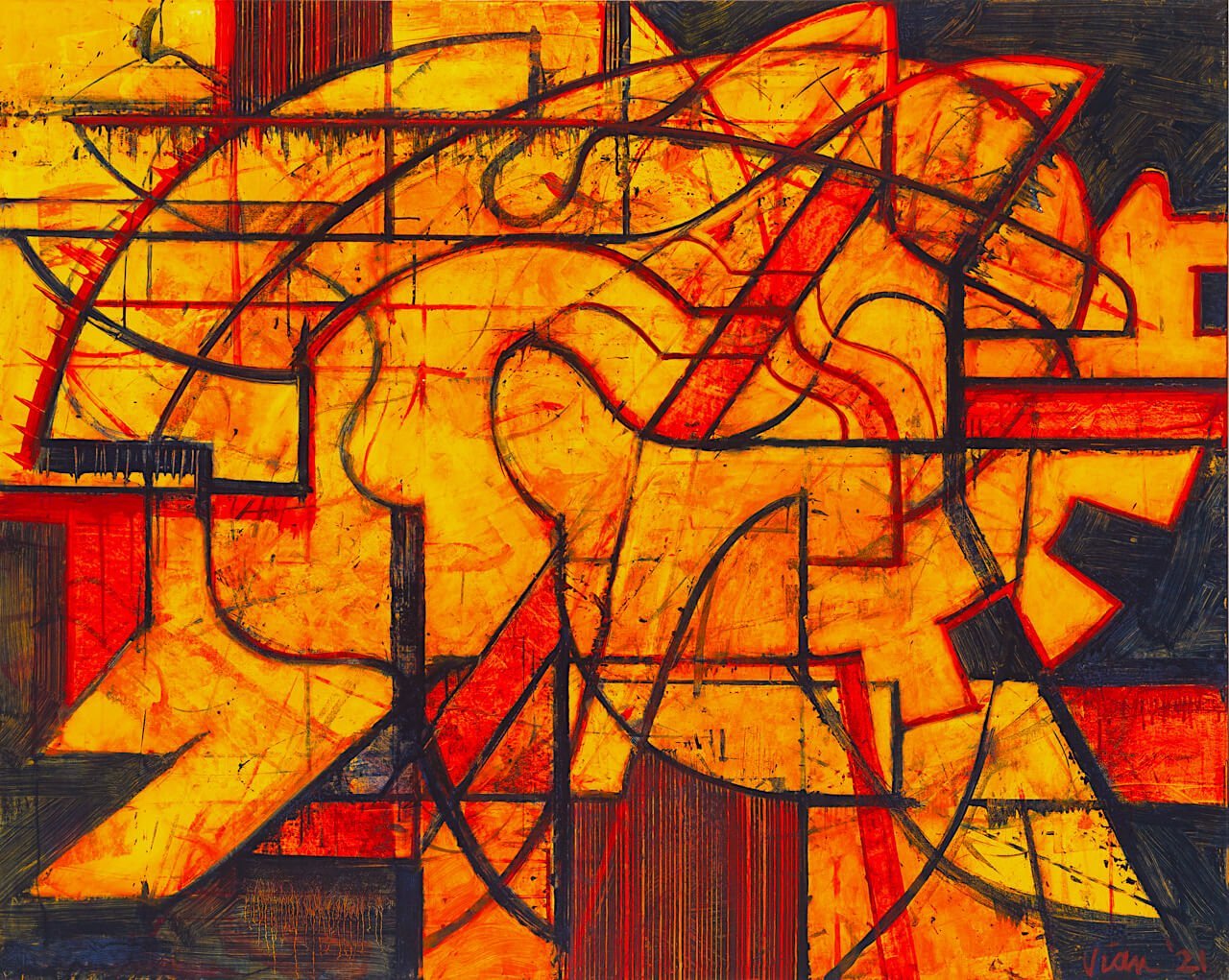
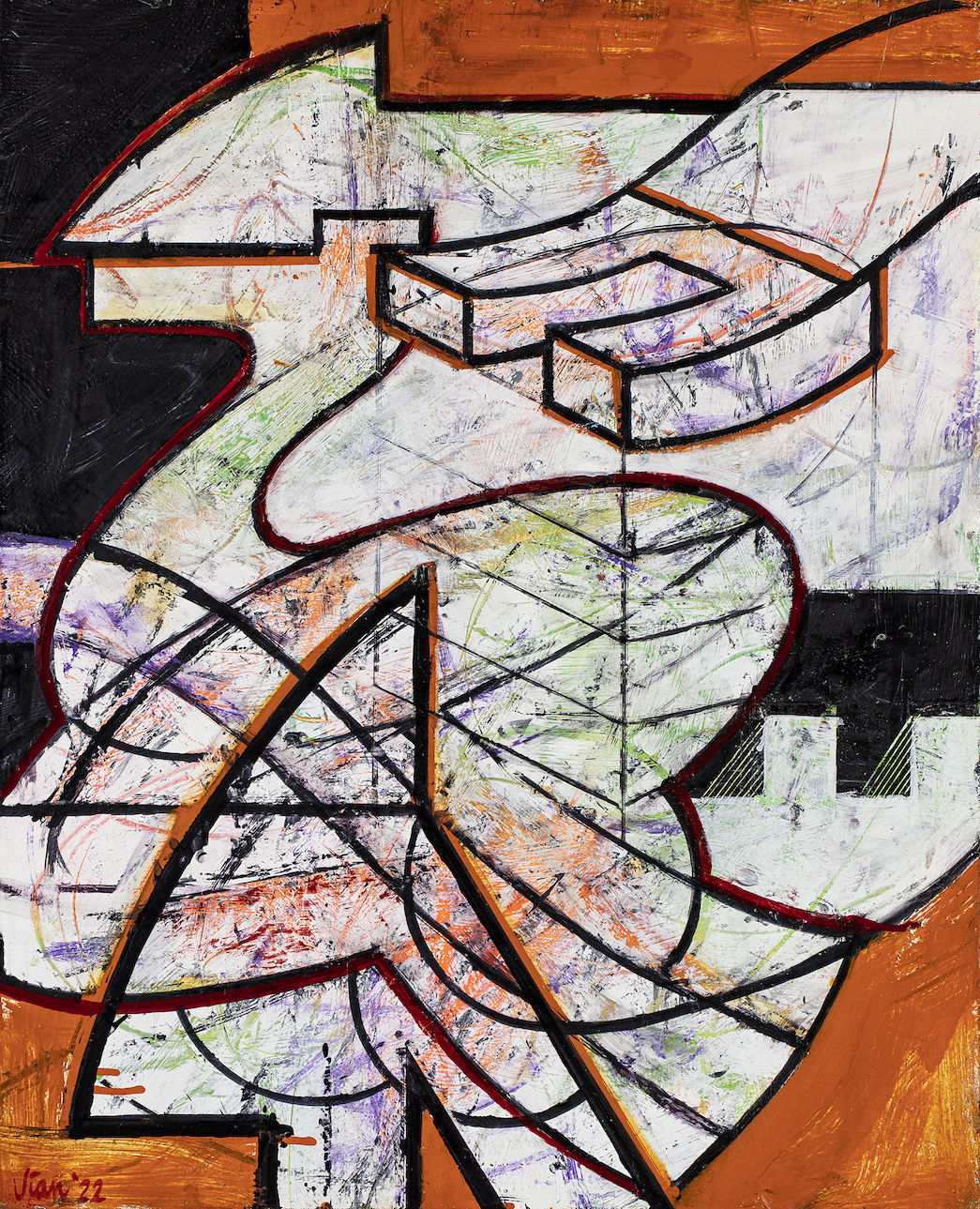
Rick Vian, Chickens in Bondage, II; Polyurethane and oil on canvas, 48 x 60 inches, 2021. Images courtesy of MContemporary Gallery.

There’s a dualism as well in Vian’s use of color. Works here alternate between a warm palette full of strong orange, black and vermilion, and a chillier one heavy on grays, whites, black, and occasional sharp-red details. Chickens in Bondage, II, once you get past the tongue-in-cheek title, is an absorbing color essay in tones of deep orange and red, all edged in black. As ever with Vian’s maze-like works, there’s a confusion of forms: Is that an individual on hands and knees somewhere near the surface, or the tail end of a chicken? And what’s going on with the big gear teeth over to the right? Bondage has more of a machine-like quality than most of the other paintings on hand, and the vibe isn’t entirely happy, either – not surprising, perhaps, given the realities of commercial poultry production.

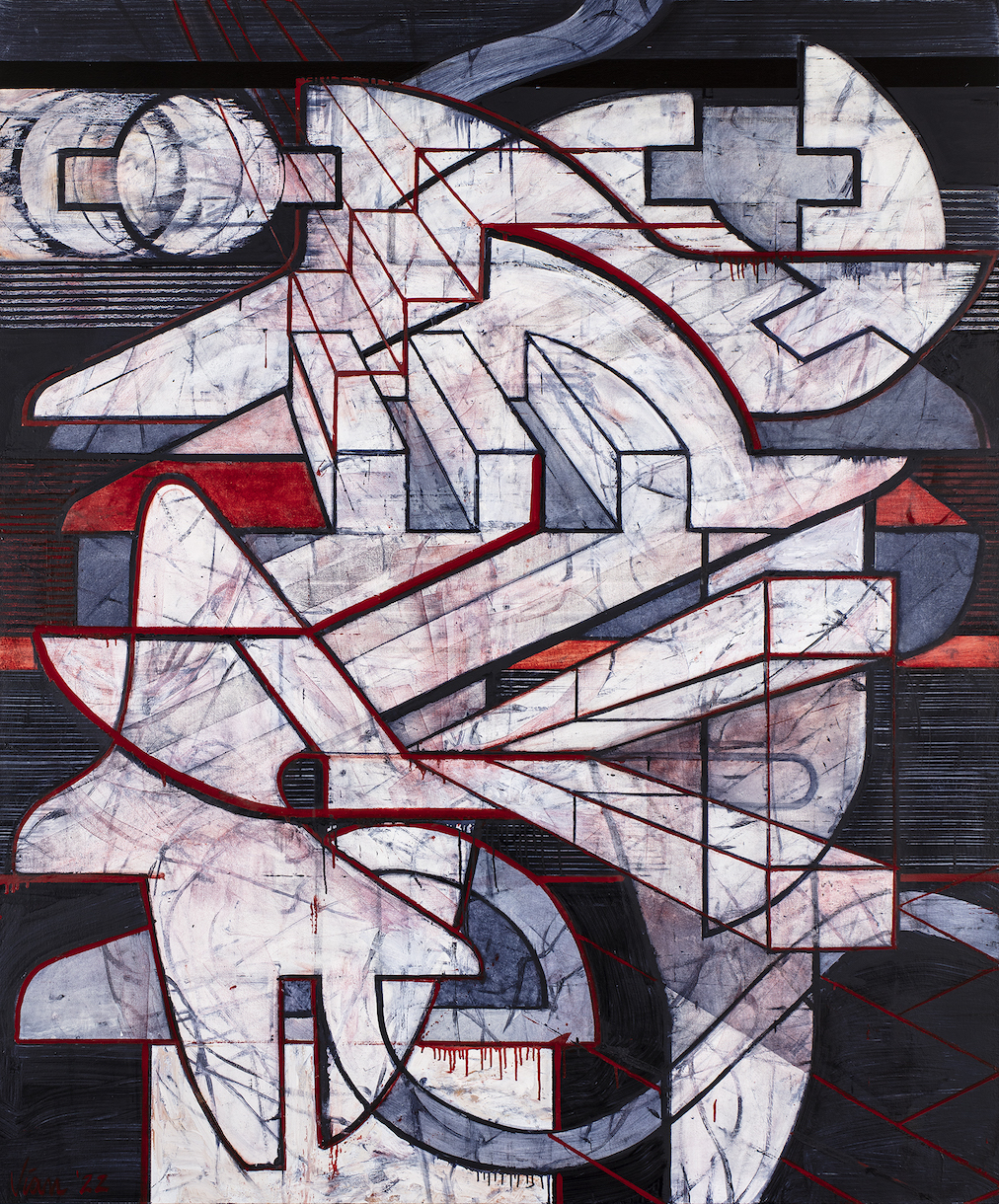
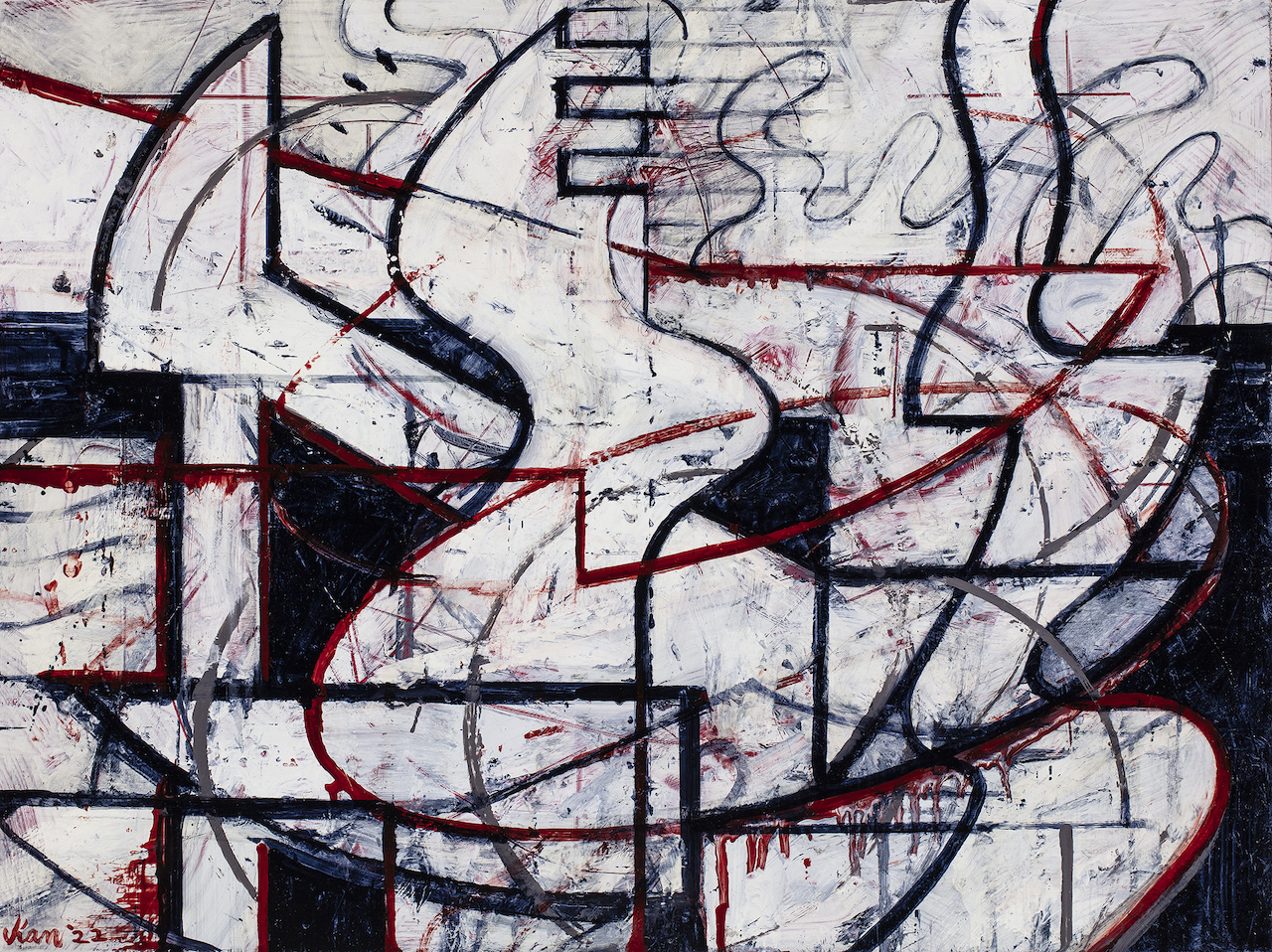
Rick Vian, Tell ‘Em Earl Lied; Polyurethane and oil, 72 x 60 inches, 2022.

M Contemporary owner and director Melannie Chard has had her eye on Vian for years and has always been a big fan. “Rick’s work is very energetic,” she said. “It’s got kind of a masculine feel to me — geometric but still organic, with that kind of play, that tension there that I find really interesting.” Indeed, both the mechanical and the organic fight for mastery on Vian’s canvases. This push-and-pull suffuses Tell ‘Em Earl Lied which, like most of Vian’s abstracts, seems to work simultaneously on several depth levels. There’s what’s going on at the surface, and then what’s partly obscured below, and then beneath that.

Rick Vian, Sex Machine; Polyurethane and oil on canvas, 15 x 13 inches, 2022. Image courtesy of DAR

Sitting on its own neat stack of cement blocks mid-gallery, is a much-smaller box painting, Sex Machine, one of several where the canvas wraps around all exposed surfaces. Thematically, there’s sort of a clamp-thing going on here. Three very similar “mechanical” devices — all of which look like they want to lock onto something, hard – march from stage left to stage right, setting up crosscurrents that pull much of the rest of the work with them, including what could fairly be described as a pair of abstracted Mickey Mouse ears.

Rick Vian, Horseshoes and Socks; Polyurethane and oil on canvas, 24 x 19 inches, 2022.

Vian, who did his undergraduate at Detroit’s School of the Society of Arts and Crafts (now the College for Creative Studies) and got his MFA at Wayne State, stands out among fine artists by having time spent in his past as a commercial and industrial painter. “That’s where some of his palette comes from — like ‘Safety Yellow’ and ‘Safety Red,’” Chard said, referring to stock industrial paint colors.

This series, she says, actually got its start way back in the early 1970s, but was put down for decades while the artist went in other directions. He picked it back up over the past couple of years.

Vian’s technique, Chard said, is “really intuitive. He doesn’t really know what he’s going to do when he starts. And I think that speaks to his other life as a jazz drummer.” Indeed, in a nice touch other artists might want to emulate — to blow off steam, if nothing else — Vian keeps a set of drums right at hand in his studio.

Finally, we’ll close with the one canvas that seemed, without question, to have some mordant humor flickering around its edges, Like Trying to Explain Wagner to a Dead Horse. It’s another of the chilly-palette paintings, with a lot of over-scribbling that gives it the look of a vigorous work in progress. But there’s no denying there’s something like a slumped body in the foreground, and, poking up into the air, a couple feet. It’s hard to shake the conviction they belong to the aforementioned dead beast.

Rick Vian, Like Trying to Explain Wagner to a Dead Horse; Polyurethane and oil on canvas, 18 x 24 inches, 2021.

Rick Vian’s exhibition The Growth Habit will be on exhibition at M Contemporary Gallery through February 18, 2023

[adrotate group=”2″]

Concerning Landscape @ Detroit Artists Market

An installation shot of Concerning Landscape at Detroit Artists Market, up through Feb. 18. Image courtesy of Michael Hodges.

Over the centuries, the venerable landscape painting has evolved far from the Dutch masters who first perfected the genre — a fact underlined by the heterogeneous work in Concerning Landscape, up through Feb. 18 at both the Detroit Artists Market and the new Brigitte Harris Cancer Pavilion at the Henry Ford Cancer Institute in Detroit.

Curator Megan Winkel has adopted a refreshingly ecumenical point of view in pulling this together. Works range from Ann Smith’s intriguingly peculiar sculptures with their bunched reeds and dangling root systems to Carla Anderson’s photographic prints of geologic forms, including lyrically striated rocks in a spring in Yellowstone County, Wyoming.

A fan of the grand view? Not to worry. Concerning Landscape also embraces figurative vistas, like Helen Gotlib’s meticulous intaglio print, West Lake Preserve II, or Bill Schahfer’s lush photo study, Lagoon Life.

Helen Gotlib, West Lake Preserve II, Intaglio print, carved birch panel, palladium leaf; 2021.  All Images courtesy of DAM

 “West Lake Preserve” places the viewer right in the tall weeds, looking up a small valley to a pond and woods, a highly satisfying view. The large print’s divided into eight separate panels, and with the exception of a little dull orange at the top, it’s mostly a duotone essay in sepia and black. The photographic print, Lagoon Life, by contrast, stars a white ibis posing beneath a jungle crush of palm trees that all loom, menacingly, over the elegant bird’s head.

Winkel comes at all this curation from an interesting vantage point. She’s the manager and curator for the Healing Arts Program at Henry Ford Health Systems in Detroit, tasked with buying art for the sprawling medical empire. “Curatorial projects for me are mostly big buildings now,” she said, “and thinking about all the ways people can experience art when they’re not seeking it out.” The landscape, she adds, has understandably long found a home in medical centers given its generally soothing visions of a natural world far beyond the reach of the artificial light of the hospital ward.

Landscape as an art subject, of course, has a long, respectable history. Both the ancient Greeks and Romans enjoyed the genre, and the walls in upper-class homes were sometimes painted with pastoral views. But the status of the landscape plummeted in the Middle Ages, when religion elbowed every other art subject aside. Indeed, the natural world was reduced to a mere afterthought, and one with generally lousy perspective, to boot.

Things began to turn around in the Renaissance, particularly during Holland’s “Golden Age” in the late 16th and 17thcenturies, when an exquisite sensitivity to landscape and weather welled up in many studios, yielding in the best cases – van Ruisdael comes to mind — breathtakingly believable clouds and storm-tossed skies. Indeed, an online essay by the National Gallery of Art notes that “with their emphasis on atmosphere, Dutch landscapes might better be called ‘sky-scapes.’” (The Detroit Institute of Arts, by the way, has an outstanding collection of Golden Age Dutch paintings, well worth seeking out on your next visit.)

Catherine Peet, Looking Up from the Deep, Mixed media, 10” diameter.

The one piece in Concerning Landscape that gives van Ruisdael a run for his money is the vertiginous, gorgeous, Looking Up from the Deep by Catherine Peet, which you’ll find at the Henry Ford Cancer Pavilion gallery. This delicate sunrise or sunset-tinged cloudscape feels like it should be peering down at you from the dome of some state capitol, an impression strengthened by its circular frame.

Sharing some of the same warm tones but at the far abstract end of the spectrum is Carole Harris’ mixed-media Desert Flower. The 2015 Kresge Artist Fellow has constructed an overlapping stack of hand-made fiber sheets that read like thick, highly textured paper, in colors ranging from cocoa to an alarming red peeking out beneath all the others.

The simplicity of this particular conceit is striking, as is Harris’ ability to make real drama out of colors that only emerge as narrow strips visible beneath the warm brown sheet on top. That Desert Flower pushes the boundary of “landscape” goes without question – so, too, the fact that it kind of knocks the wind out of you.

Carole Harris, Desert Flower, Fiber, 2023

Russian transplant Olya Salimova, currently on a one-year BOLT Residency with the Chicago Artists Coalition, gives us something entirely different with her Body into Dill, one of the most original and daffy conceptions in the entire show. The centerpiece of this photograph is a rectangular garden space – disturbingly, about the size of a grave – that’s dug into the patchy lawn of some unpretentious backyard. Metal garden edging sunk in the turned-up dirt sketches a simple human shape, rather like police outlines of dead bodies on the sidewalk. Within that human-like enclosure, someone – Salimova? — has planted dill weed.

Its obvious imperfections are part of what makes this image so compelling. The yard clearly needs work, and the plantings in the “body” are scattered, newly dug and unsubstantial — apart from some vigorous leaf action filling up the head.

Olya Salimova, Body into Dill, Photography, 2021.

For those who enjoy a little disorientation in their photography – And when well done, who doesn’t? – Jon Setter’s collection of a half-dozen large prints, all up-close shots of building details, is a delight to behold. Each reads as an abstract design in 1920s Russian Constructivist mode. But in one case you’re looking at parallel diagonals on the late, lamented Main Art Theatre in Royal Oak, and in another, the Detroit Free Press building downtown on West Lafayette.  As a group, these deliberately confusing framings are both mischievous and fun to examine.

Jon Setter, Purple and Gold with Shadow (Detroit Free Press), Archival pigment print, 2021.

 Finally, Scenic Overlook 2 by Sharon Que, an Ann Arbor sculptor who also does high-end violin restoration, might remind you of a minimalist diorama minus the glass case. On a simple wooden shelf, Que’s sacked two smaller pieces of wood topped by a chalky white boulder or peak – part of the fun is the uncertainty — next to which sits a big, black, bushy… something.

Let’s stipulate that the white form is, indeed, a mountaintop. Call the spiky black, roundish thing next to it a plant, and you’ve got a surprisingly convincing perspective study of a bush and a white peak far, far in the distance – never mind its actual proximity in the assemblage.

Is it weird? Is it oddly compelling? Yes and yes.

Sharon Que, Scenic Overlook 2, Wood, magnetite, paint; 2016.

Concerning Landscape at Detroit Artists Market, up through Feb. 18.

[adrotate group=”2″]

Page 18 of 84

Powered by WordPress & Theme by Anders Norén