Detroit Art Review

Critical art reviews of Detroit galleries and museums weekly

Rocco Pisto @ Strand Gallery in Pontiac

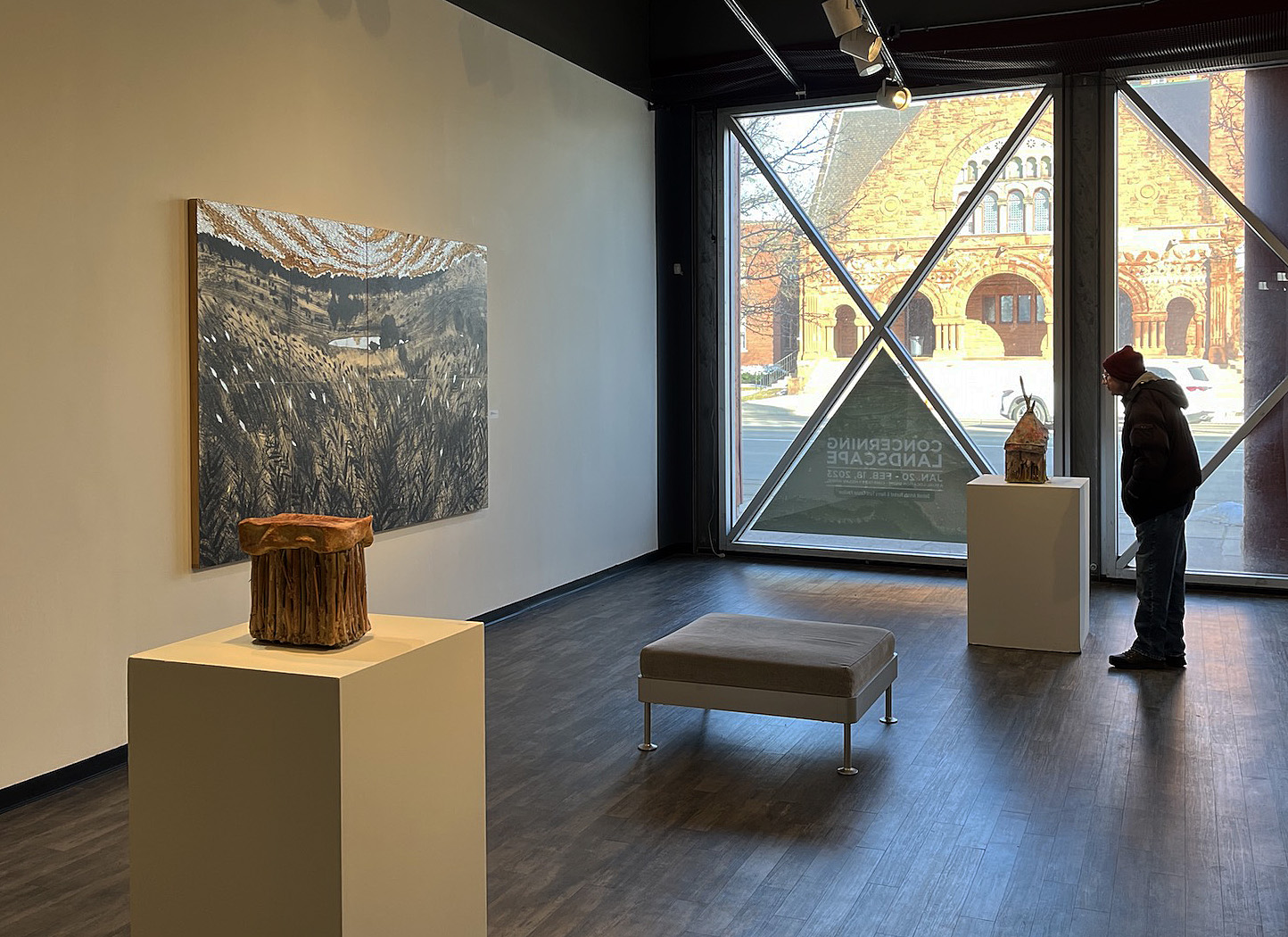
Rocco Pisto, Installation image, Strand Gallery, 2023

The newly restored Flagstar Strand Theater in Pontiac opened its gallery to a retrospective exhibition of artwork by Rocco Pisto on January 20, 2023, spanning fifty years of painting that began in 1976. Watercolor is a medium that has been around for over several hundred years, yet often thought of as a secondary choice of paint to oil and acrylic. You might look at the early work of Albrecht Durer, Georgia O’Keeffe, Paul Klee, Winslow Homer, and John Singer Sargent to realize its place in history and its ability to withstand centuries. Where oil and acrylic paint are additive mediums, watercolor is subtractive, usually on paper, and translates its nature with its ability to have the strength and capacity of transparency. Watercolor is made of pigments suspended in a water-based solution, which refers to both the medium and the resulting artwork. Rocco Pisto’s 50 pieces range from 1976 to 2022 and reflect the artist’s unique techniques in controlling and experimenting with the watercolor medium.

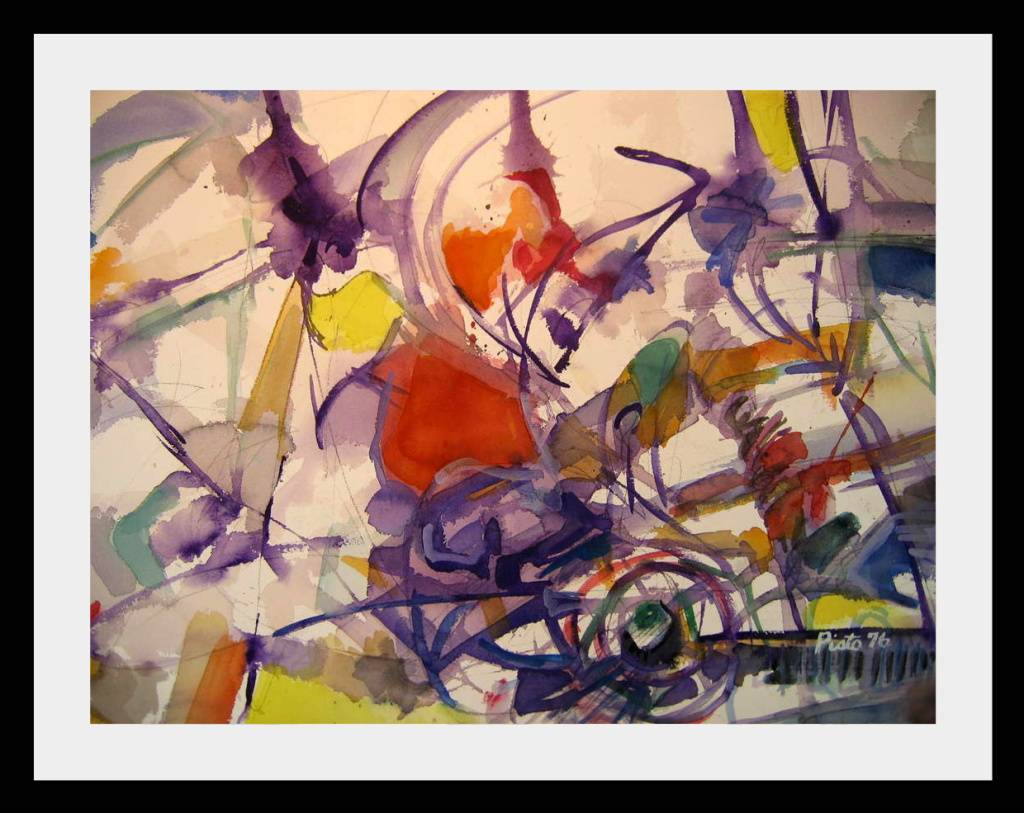
Rocco Pisto, Telegraph Run, Watercolor, 34 x 42″, 1976

The early work Telegraph Run, done in 1976 during Pisto’s MFA work at Eastern Michigan University, illustrates a fluid construction that builds a composition using carefully placed primary colors and a delicate violet line structure that holds it all together. In his statement, Pisto says, “As a painter for over fifty years, I never tire of the experimental process of starting a piece and solving the design problems along the way to make it a finished work. Spontaneity, discovery, individuality, analysis, visual balance, contrast, and contradiction summarize my thought process.”

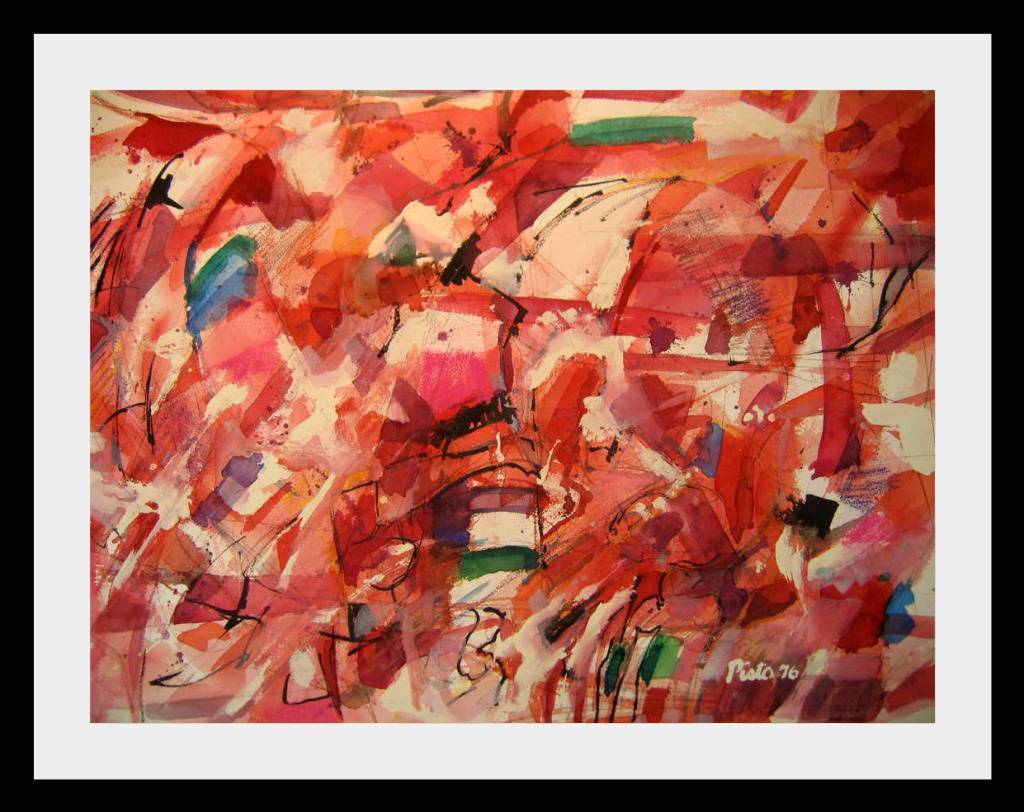
Rocco Pisto, Fire & Ice, Watercolor, 1976

Over time in Pisto’s work, we see various categories, including landscapes and figures, with all subjects that have evolved to the abstract expressionism in this field painting, Fire & Ice. The line that begins with the landscape and proceeds to abstraction is not straight. Pisto is back and forth throughout his career, keeping his thinking spontaneous and his trademark unique. He says, “The paintbrush becomes a performer, dancing across the paper, juicy and full of life. My work frees my imagination and provides many opportunities for magical accidents.”

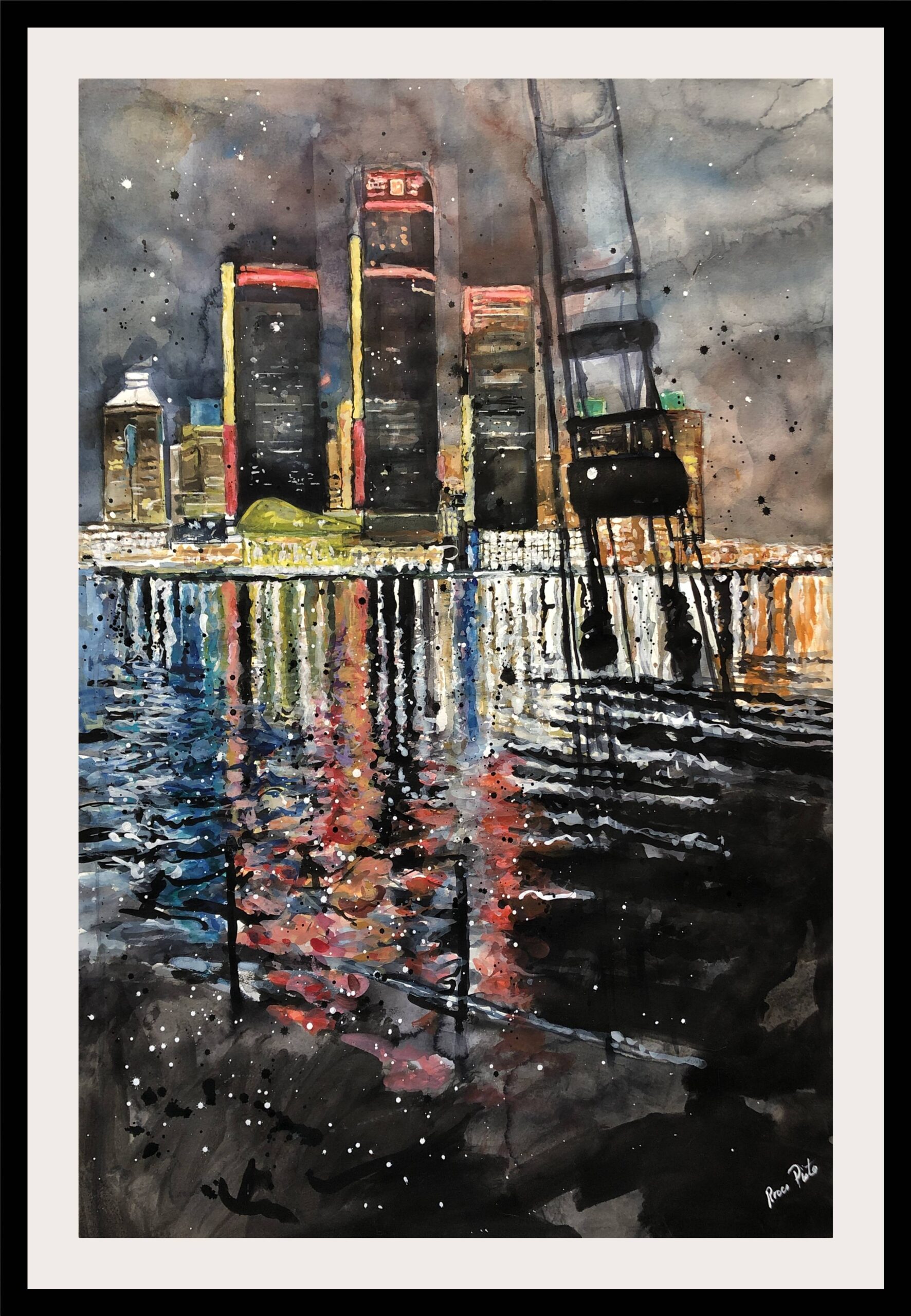
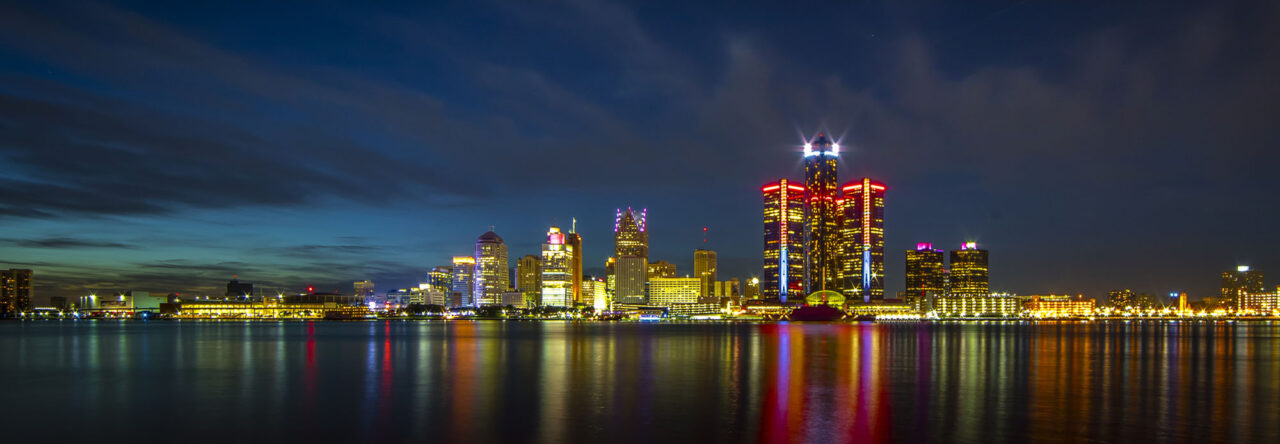
Rocco Pisto, RenCen at Night, Watercolor, 53 x 42″, 2001

More recent is the large image of the Ren Cen at Night,  which relies heavily on the waterfront river reflection looking on from the Canadian side of the river. This watercolor has been used as a backdrop for a commercial poster for the 75th MWCS exhibition. Pisto says, “My painting technique abstractly by dripping, pouring, splashing, and brushing paint allows the work to evolve until it meets my criteria of what constitutes a successful piece of art.”

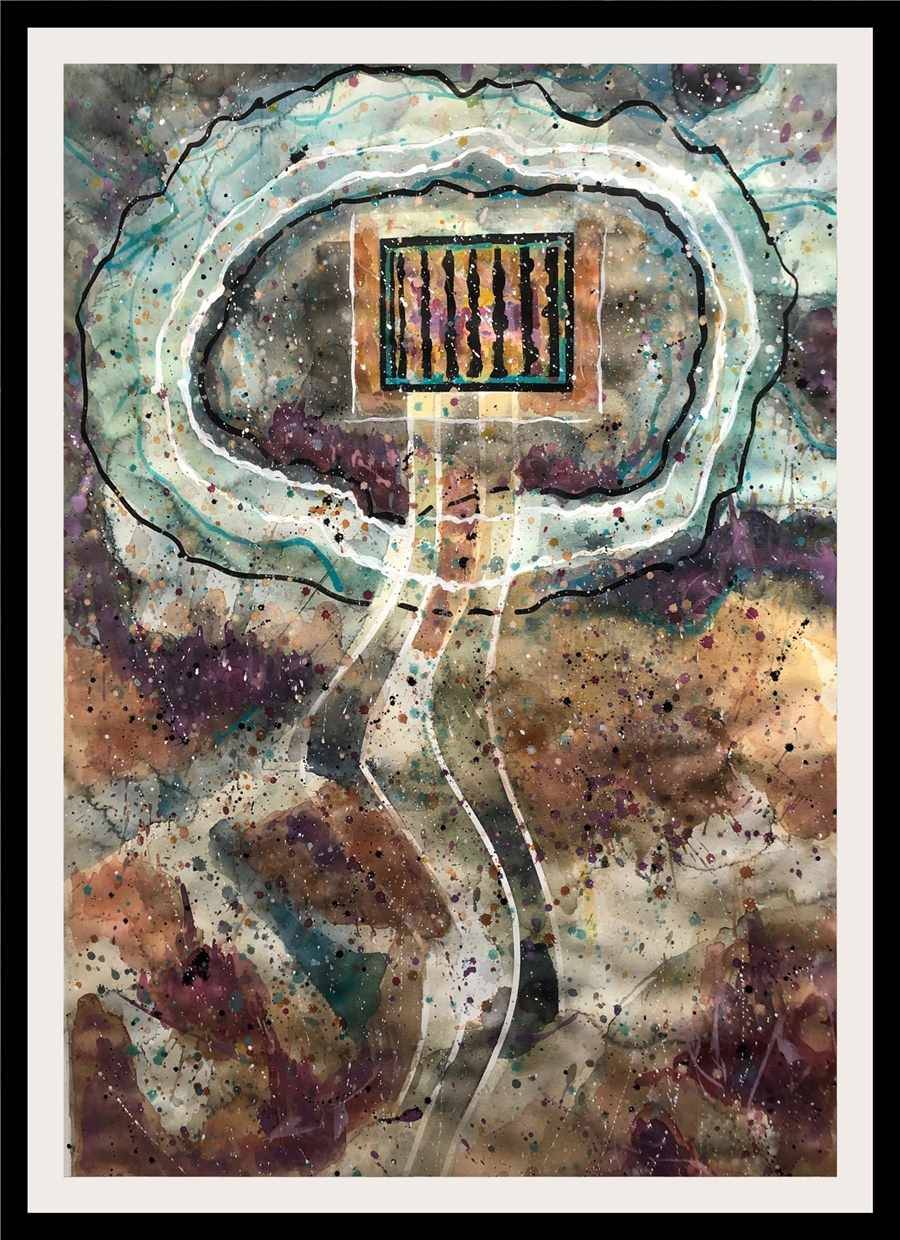
Rocco Pisto, Marsala Glow, 56 x 42″, Watercolor, 2021

The large watercolor in Marsala Glow is neither landscape, still life, figurative or pure abstraction. To this viewer, it is part aerial, part diagram, with a warm collection of color surrounding blue-green that suggests water, with a circular moat juxtaposed to an inner box. That leaves the interpretation up to the viewer to explain, whether broad or narrow. A viewer, as in all artwork, will bring their experience to the moment and draw a personal conclusion about the meaning of this work.

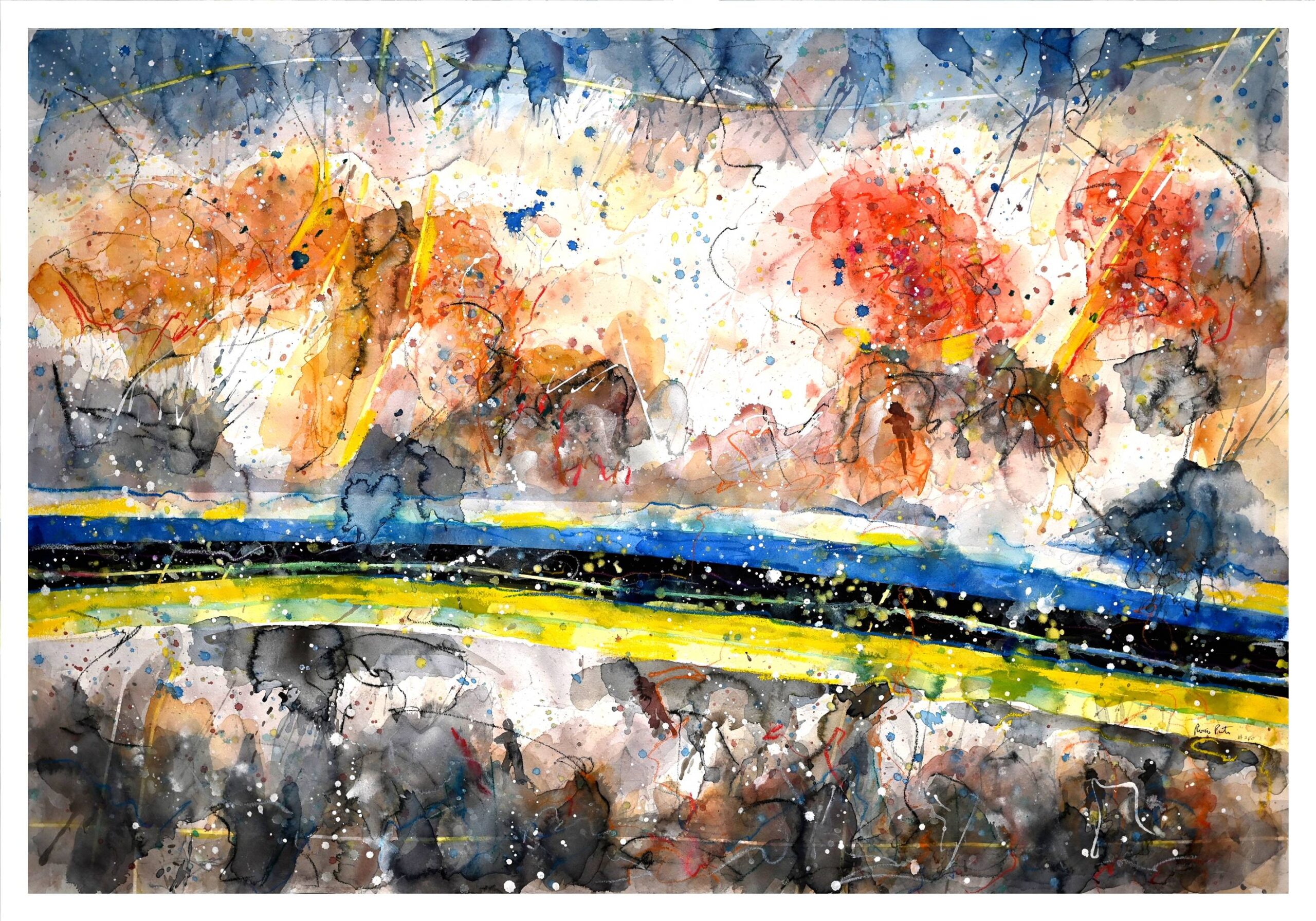
Rocco Pisto, The Fight for Ukraine, Watercolor, 43 x 55″, 2022

The painting, The Fight for Ukraine, is an example of creating art that draws attention to a current European event on everyone’s mind. What might be at first glance abstract, on a closer look, the viewer sees the bands of blue and yellow under siege with aerial bombardment resulting in the symbolism of the Russian armed invasion. The painting incorporates gouache, crayon, and India Ink, with watercolor to form a multimedia expression. Print sales from the original are currently being donated to first responders of the Ukrainian Army.

Rocco Pisto earned a Bachelor’s and Master’s degree in Fine Arts from Eastern Michigan University in 1974 and has been painting for over five decades. He is the recent President Emeritus of the Michigan Watercolor Society and holds a Signature Member and Great Lakes Fellow designation in that group. He also has membership in the National Watercolor Society, the International Society of Experimental Artists (ISEA), and the Brighton Art Guild. Rocco Pisto earned a Bachelor’s and Master of Fine Arts from Eastern Michigan University.

The solo 50-year retrospective at the Flagstar Strand Gallery in Pontiac will run through March 31, 2023.

[adrotate group=”2″]
Luxe @ David Klein Gallery Birmingham

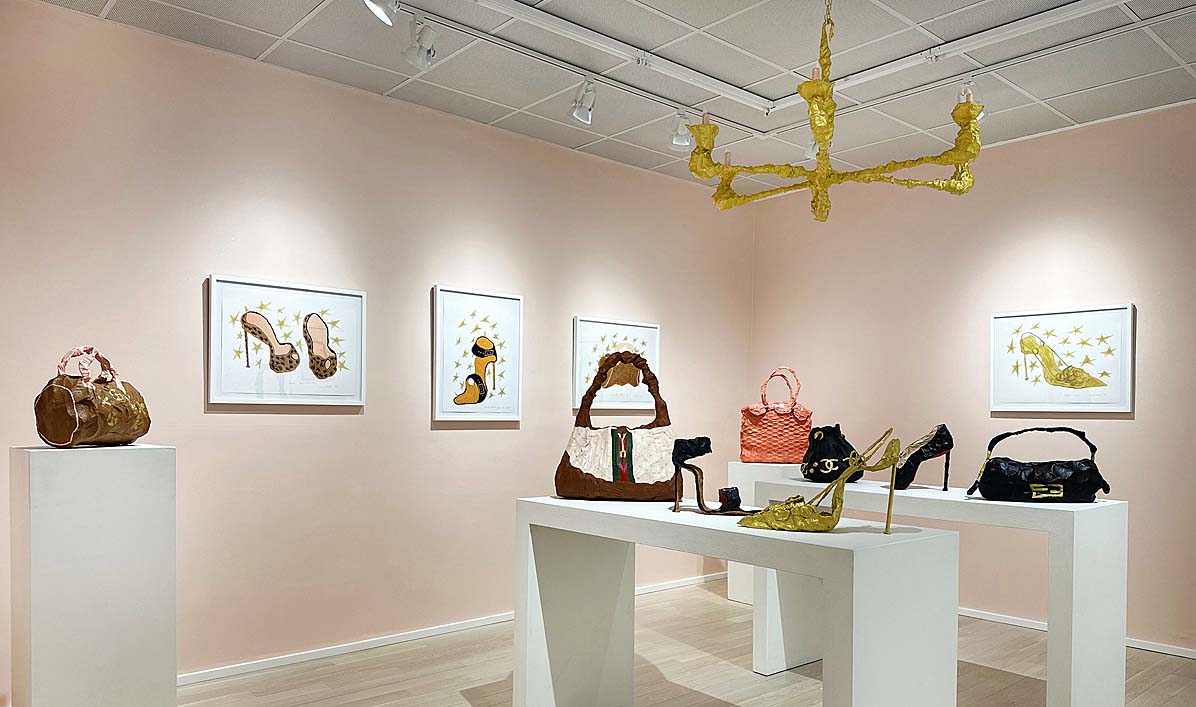
Mary-Ann Monforton, Luxe, installation, David Klein Gallery, 163 Townsend St., Birmingham MI

The breathless hype, the eye-watering price tags, the manufactured scarcity—we all recognize the strategies that the makers of designer goods use to promote luxury items. But Detroit artist Mary-Ann Monforton is having none of that. In her first solo exhibition at David Klein Gallery in the upscale Detroit suburb of Birmingham, she presents Luxe, a collection of 10 slightly oversized, comic replicas of well-known luxury brands that are both an homage and a send-up of late capitalist getting and having.

Monforton knows plenty about the world of red velvet ropes and status objects. Though she grew up in the Detroit area, her professional life has been centered in New York’s gallery and club scene, where she has lived several simultaneous lifetimes as a music promoter, art curator, visual artist and cultural media publisher. She has rubbed shoulders with late 20th and early 21st-century arts stars in her prolific and varied career–Keith Haring, Kenny Scharf and Jean Michel Basquiat, among others–and occasionally has collected their work.

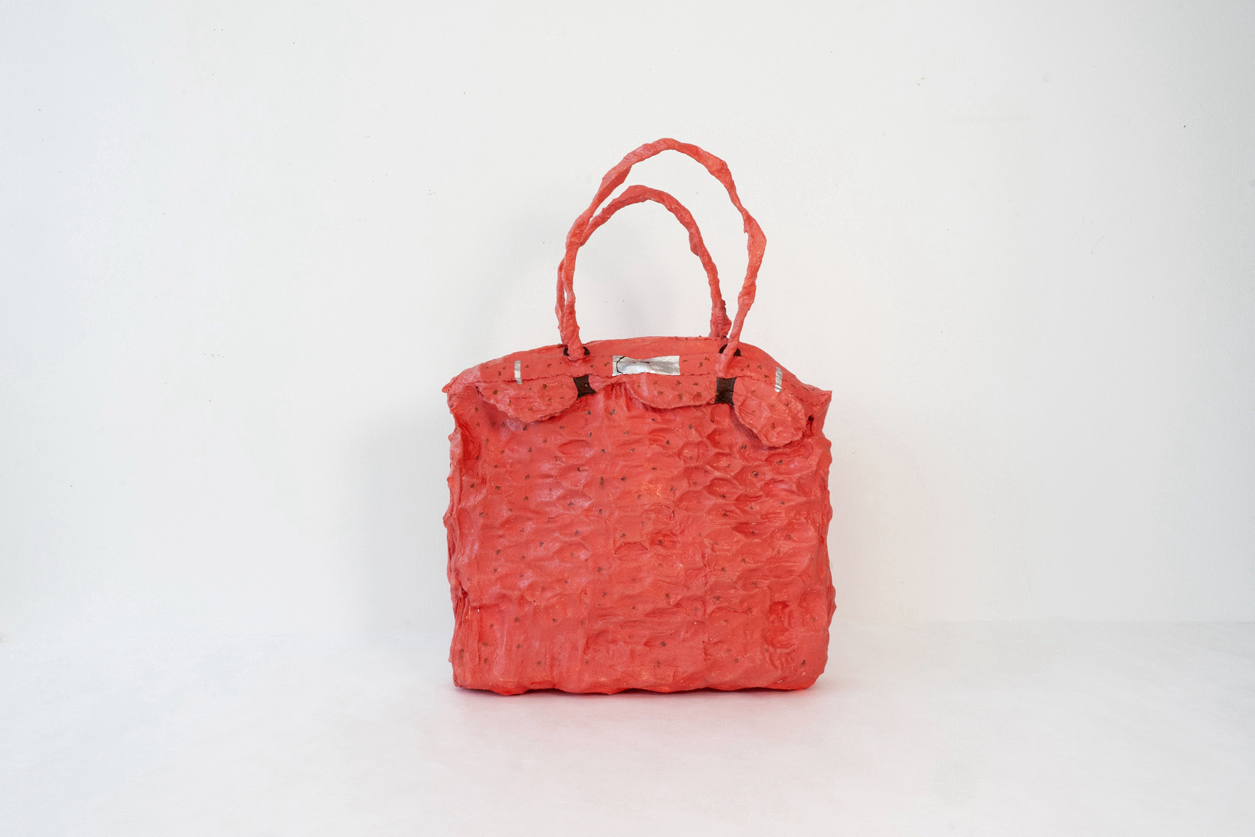
Mary-Ann Monforton, Hermes Birkin, 2022, wire mesh, plaster gauze, paint, 24.5” x 17” x 4”

Now that she is back in her hometown, Monforton is prepared to share a few thoughts on the pretensions inherent in the easily recognizable signifiers of status. Sharped-eyed but not unkind, her observations take the form of wonky and slyly ironic designer bags and shoes made of humble materials that loosely imitate prestigious consumer commodities.

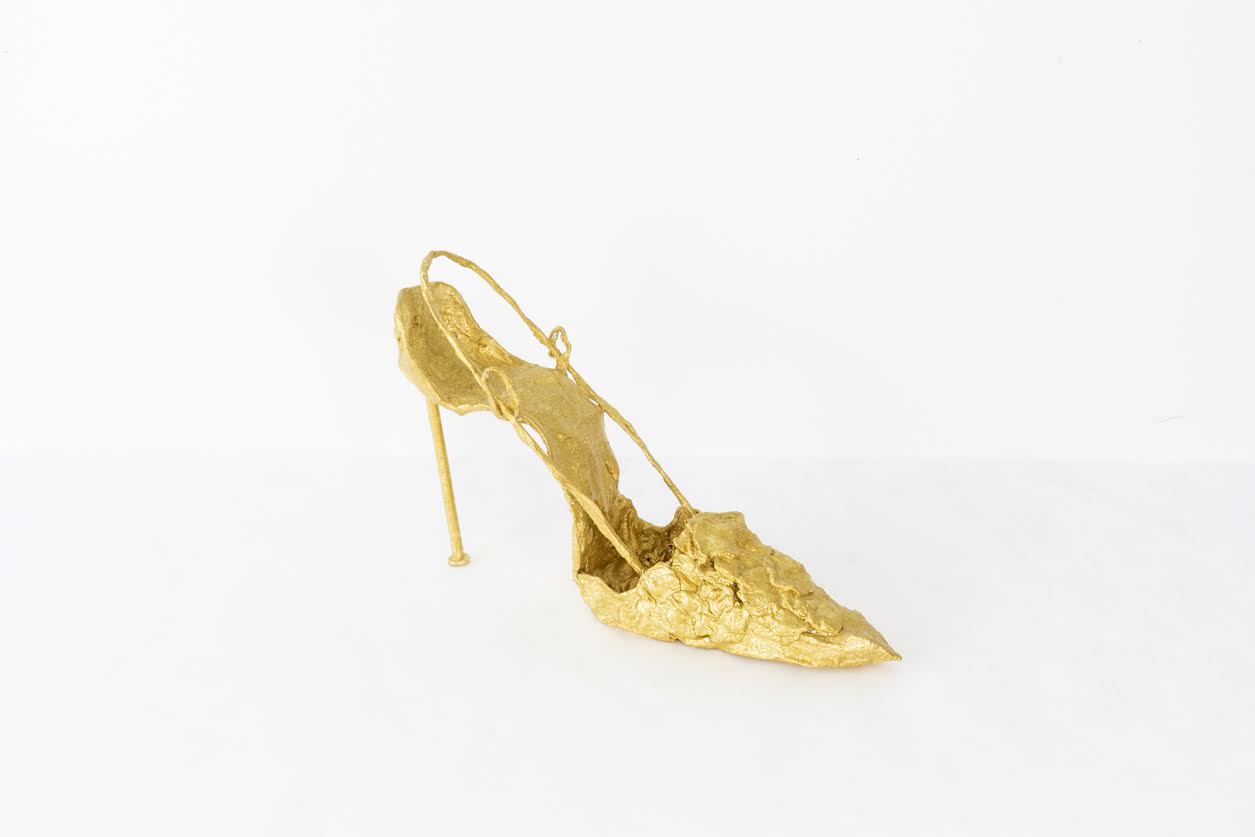
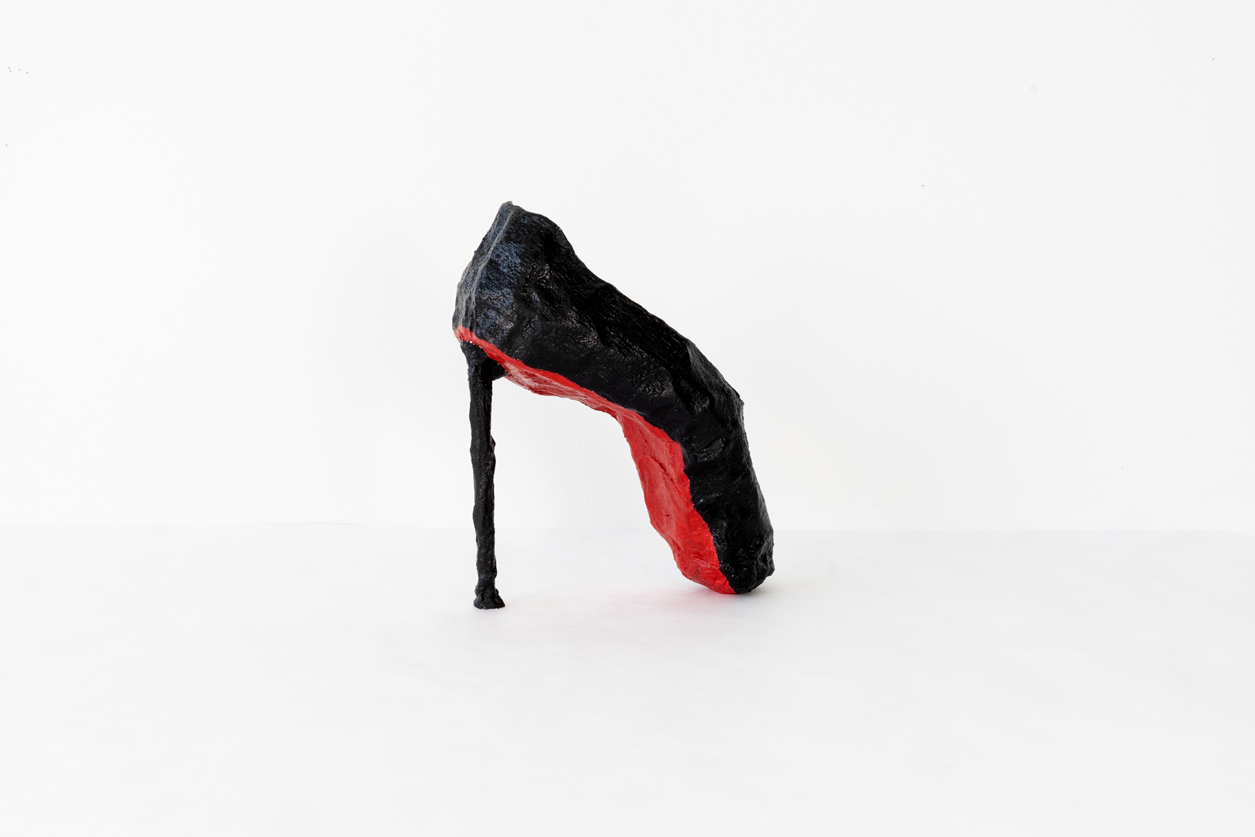
The artworks in Luxe are installed in David Klein’s middle gallery, now painted blushy pink in a kind of shorthand nod to a high-end boutique.  Artful silver wire stars hang from the ceiling and overhead a handmade imitation of a fancy chandelier casts a fictive glow on the bags and shoes below. Effortlessly holding the center of the space is an oversized replica of the iconic Hermes Birkin bag, in coral “ostrich,” for the fashionable giantess. Said giantess might also be interested in Monforton’s golden Valentino Garavani slipper with its pointy toe and (literally) spikey heel.  The chic send-up of the Manolo Blahnik open-toe stiletto is likewise a winner in the Brobdingnagian fashion department.   My personal favorite, though, is the improbably elegant black Louboutin Ballerina Ultimate, which manages to be both larger-than-life and dainty.

Mary-Ann Monforton, Valentino Garavani, 2022, wire mesh, plaster gauze, steel spike, string, paint, 11” x 6” x 17″

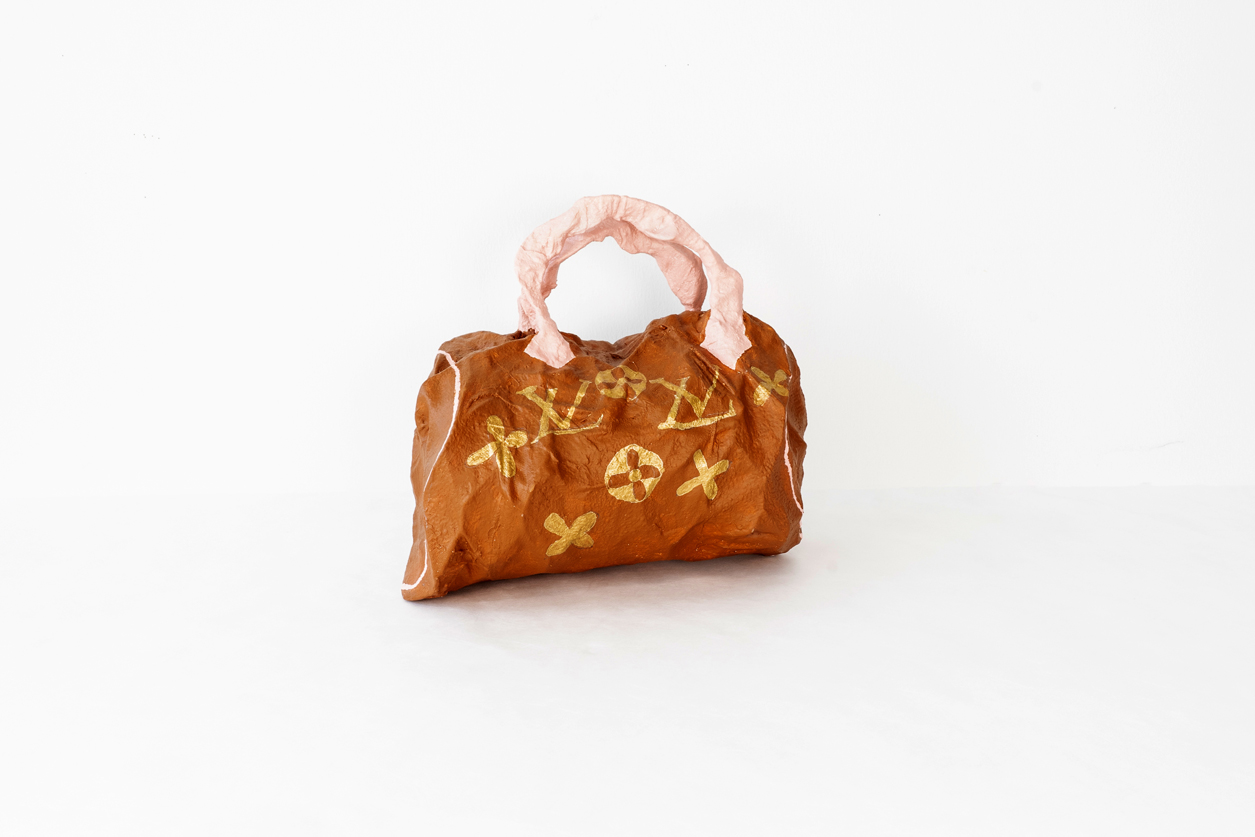
Monforton has some fun with the surface textures, colors and patterns of her fashionable facsimiles.  On her Louis Vuitton “Speedy” bandouliere, she subverts the well-known, militantly regular Louis Vuitton surface pattern, exploding it into an irregular constellation scattered across the satchel’s surface–less elegant perhaps, but more expressive. The intertwined C’s on her Chanel Bucket bag are both instantly recognizable and hilariously awry.   The materials that she references, lizard, ostrich, crocodile and precious metals–now rendered in plaster, wire mesh, and the odd metal spike–gleefully poke fun at the pretensions of the originals.

There is a kind of liveliness in these objects. They are imbued with character and seem ready to dance and move. Unlike the highly finished, larger-than-life sculptures of Claes Oldenburg, to which Monforton’s work is sometimes compared, these friendly avatars of luxury are approachable and relatable.  In some ineffable way, they are human.

Mary-Ann Monforton, Louis Vuitton “Speedy” 2022, wire mesh, plaster gauze, paint, 14” x 5” x 9”

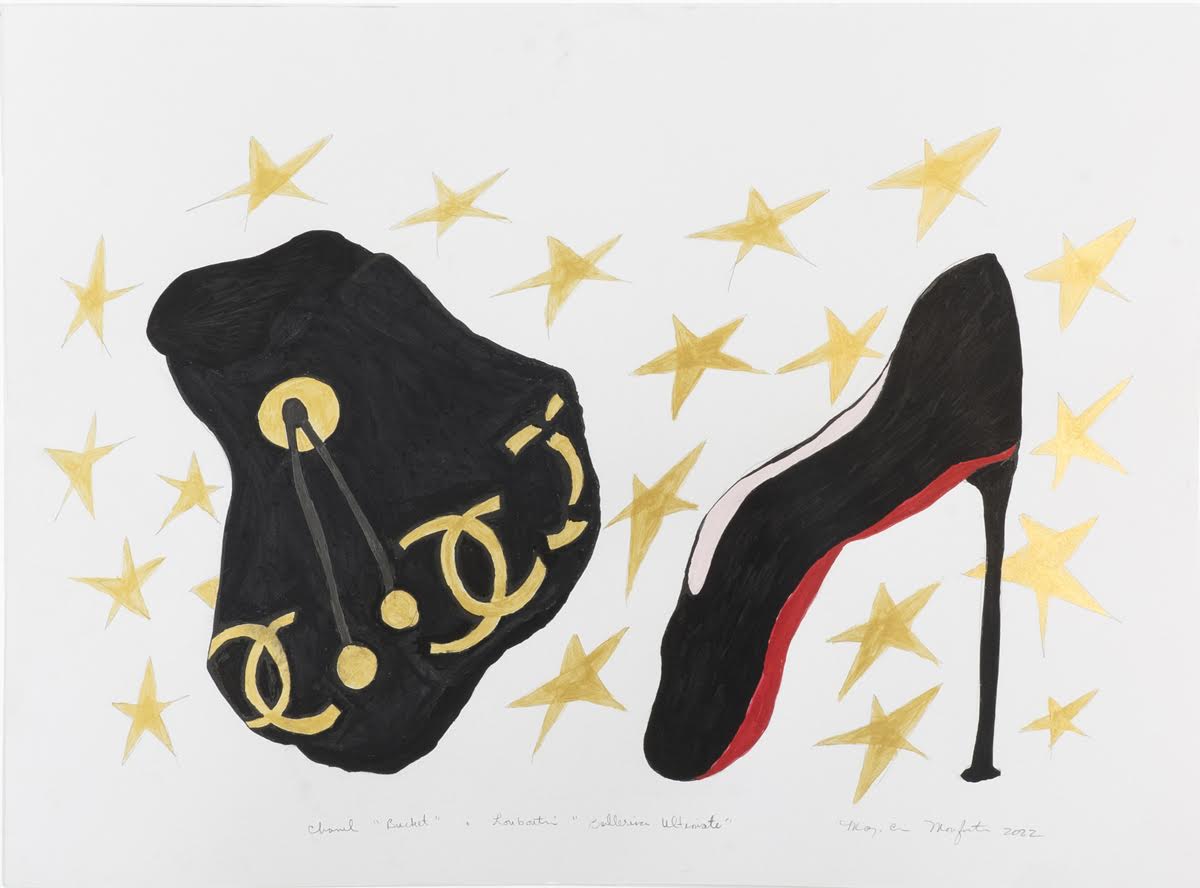
In addition to the three-dimensional artworks in Luxe, Monforton has created a series of drawings of her designer creations in pencil, pastel and paint on paper. Rather than preparatory drawings, the nine renderings were created after the fact in a kind of object portraiture that captures the soul of each subject, as any good portrait should.  The drawing of a Chanel Bucket bag and Louboutin Ballerina Ultimate high heel, paired in imaginary conversation, make a harmonious comic duet. A drawing of a pair of Louboutin leopard peep-toe platforms surrounded by stars, like the other drawings, reveals the affection of the artist for the objects she has birthed.  These animated images invite an immediate association to Andy Warhol’s 1955 drawings of fashion shoes, though the comparison is only glancing; Warhol’s shoes seem conventional and rather deadpan when compared to Monforton’s lively representations.

Mary-Ann Monforton, Louboutin Ballerina Ultimate, 2022, wire mesh, plaster gauze, paint, 12” x 5” x 9”

The artist’s history as a collector prepares her uniquely for her explorations into how we assign value to objects. In her artist’s statement, Monforton is clear about her aims: “These objects explore the psychology of fame, fortune, mega-wealth, and privileged consumption.” She continues, “The broader concepts of ascribing value to things is played out in this line of luxury goods that defy perfection and are rife with failure and humor.” The imperfect simulacra on display probe human preoccupations with social prestige and how it is related to craft and economy.

In Luxe, Mary-Ann Monforton combines her childlike joy in the making of a thing with a very adult moral framework that proposes the exchange of one set of values for another. She suggests a more humane ethic that privileges vulnerability and emotional expressiveness over materialistic status-seeking, perhaps a good new year’s resolution for 2023.

Mary-Ann Monforton, Chanel Bucket and Louboutin Ballerina Ultimate,2022, paint, pencil, pastel on paper, 18” x 24”

Luxe is on view at David Klein Gallery, 163 Townsend St., Birmingham, Michigan, through February 4, 2023.

[adrotate group=”2″]
Owlkyd @ Image Works

Owlkyd (AKA Darius Littlejohn) has a solo exhibition at Images Works in Dearborn, MI

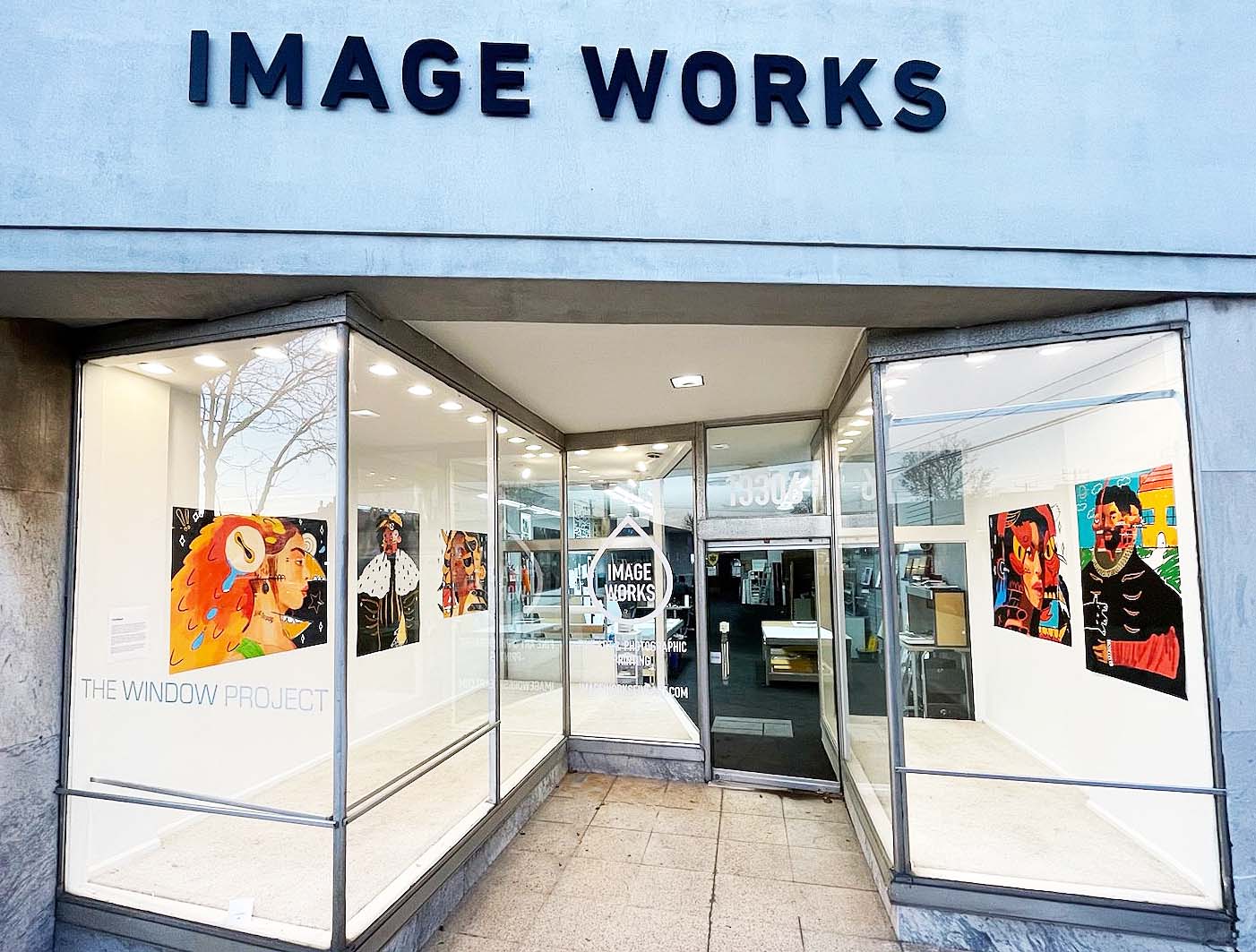
Installation image courtesy of DAR

Installation image courtesy of the gallery

Image Works opened the Detroit-based artist Darius Littlejohn’s artwork on December 2nd with Expressionistic figures produced in a lushness of high contrast color using computer-based software and printed on paper using a large inkjet printer. Chris Bennett, owner and curator of Image Works says, “Deeply impacted by the Neo-Expressionist works of Jean-Michel Basquiat and the Surrealism of Pablo Picasso, Owlkyd melds his love of Realism with the abstract ideals pioneered by the two to find beauty in the clash of these disciplines.”

Owlkyd, What’s It To Me, 40 x 50”, Digital artwork on paper. 2022

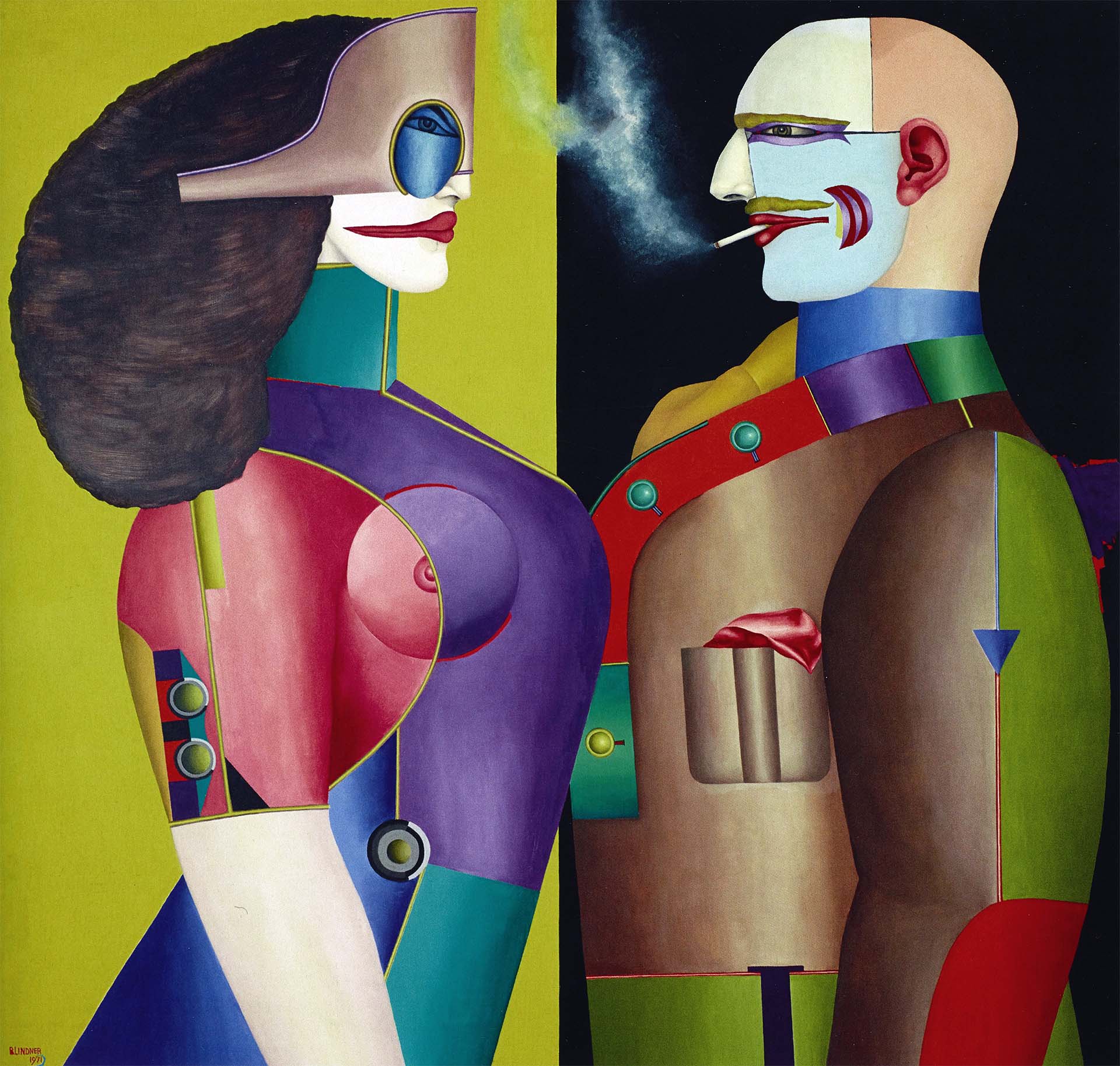
To place the artist Owlkyd in context, I recall following a similar artist in the mid-1970, Richard Lindner, the American/German artist born in Hamburg who moved to the United States in 1941 and taught at the Pratt Institute in Brooklyn, NY. Lindner’s works from this period are often characterized by a vague sense of nostalgia and sexual undertones. In Linder’s figurative work, he created powerful images that were both exotic and surreal in concept and bold in their use of high-contrast color.   Lindner’s figures are reminiscent of those by Fernand Léger

Richard Lindner, The Grand Couple, oil on canvas, 60 x 72”, 1971

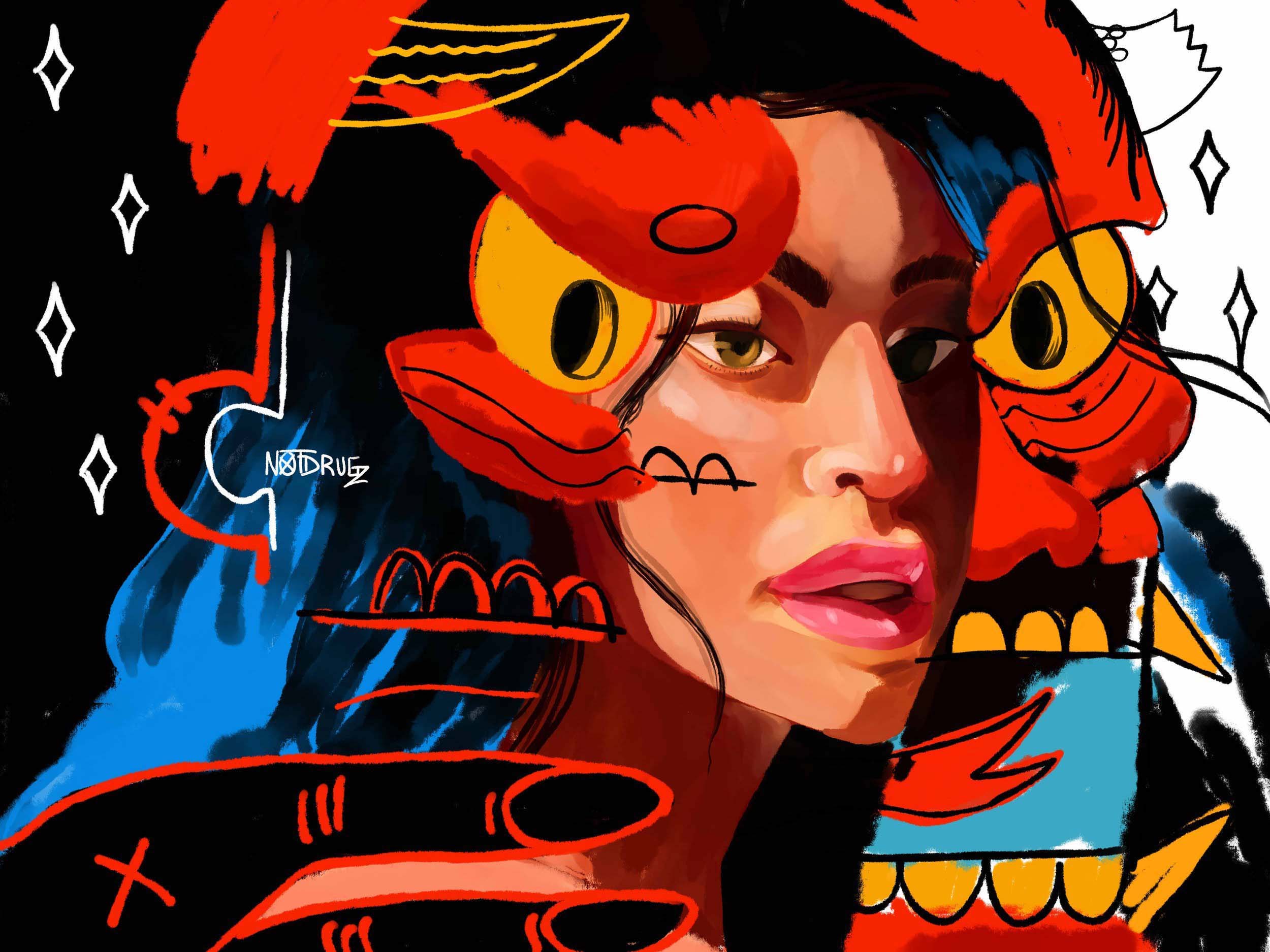
The works by Owlkyd are created in a digital environment using XP-Pen 15” drawing tablet, connected to his workstation using PaintTool Sai software, and printed out 40 x 50” using a large inkjet printer. These images are fluid Neo-Expressionistic portraits that use profiles of people with small design images spread out over the compositional spaces and set against various backgrounds.

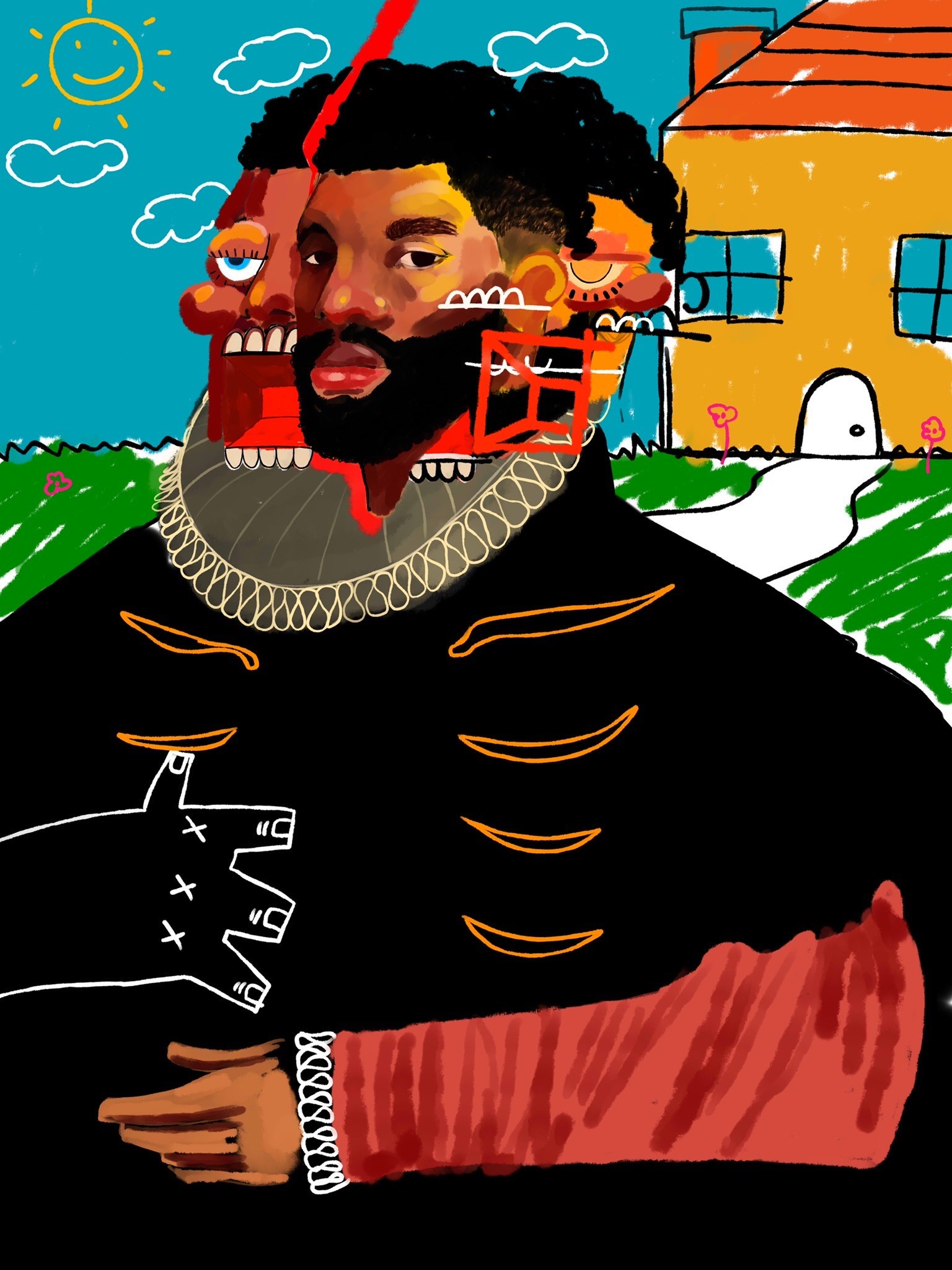
Owlkyd, Regal, 40 x 50”, Digital artwork on paper. 2022

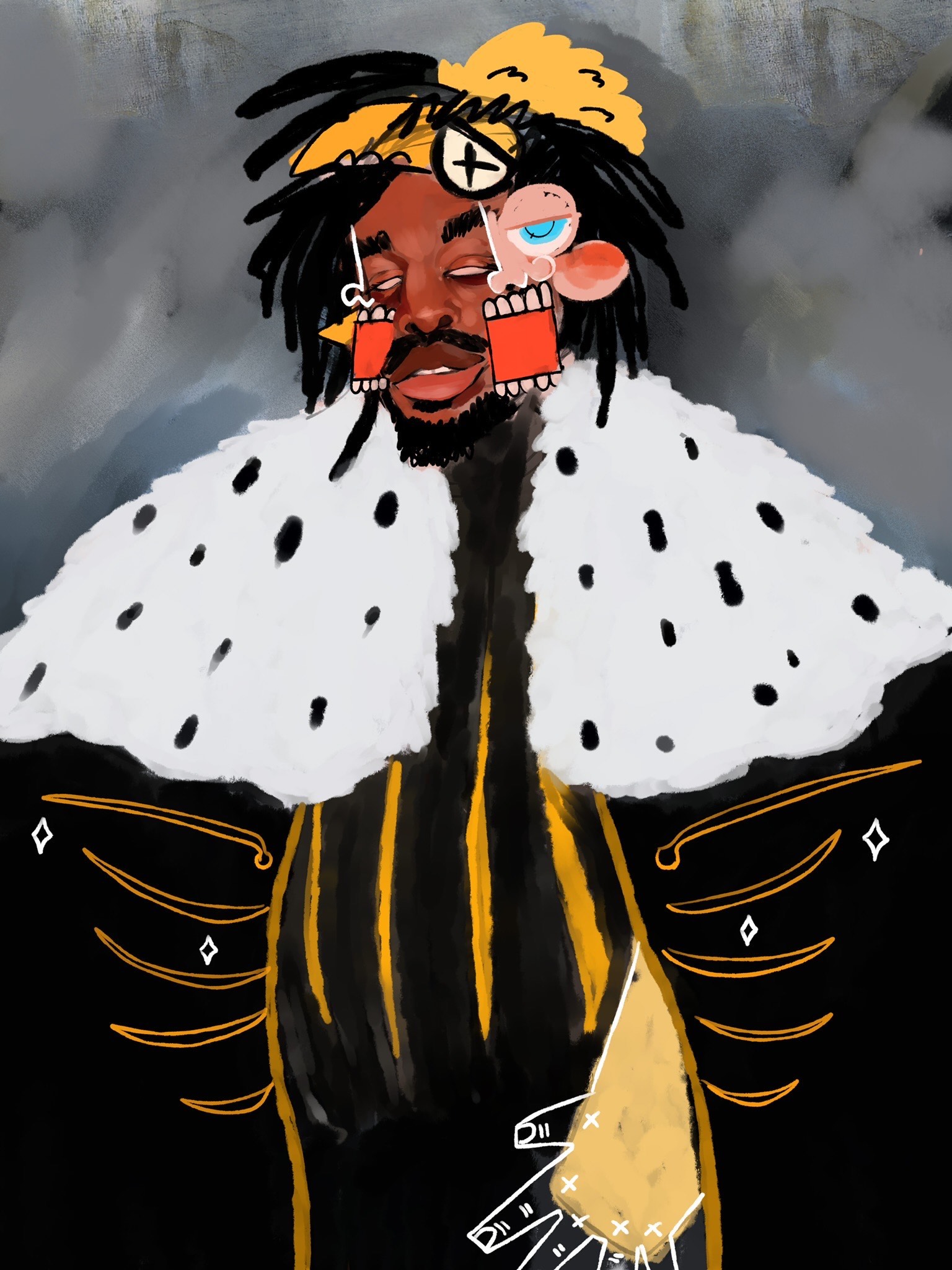
The work Regal has the figure set against a simplistic landscape with a figure that could be considered a self-portrait; again, dispersed throughout the composition are small design elements. At the same time, one arm is rendered in a realistic, painterly fashion, while the other has a flat white outline with three fingers. The childlike background contrasts with the uniformed figure, part realistic, part cartoonish. The expression of that contrast reaches out and grabs the viewer.

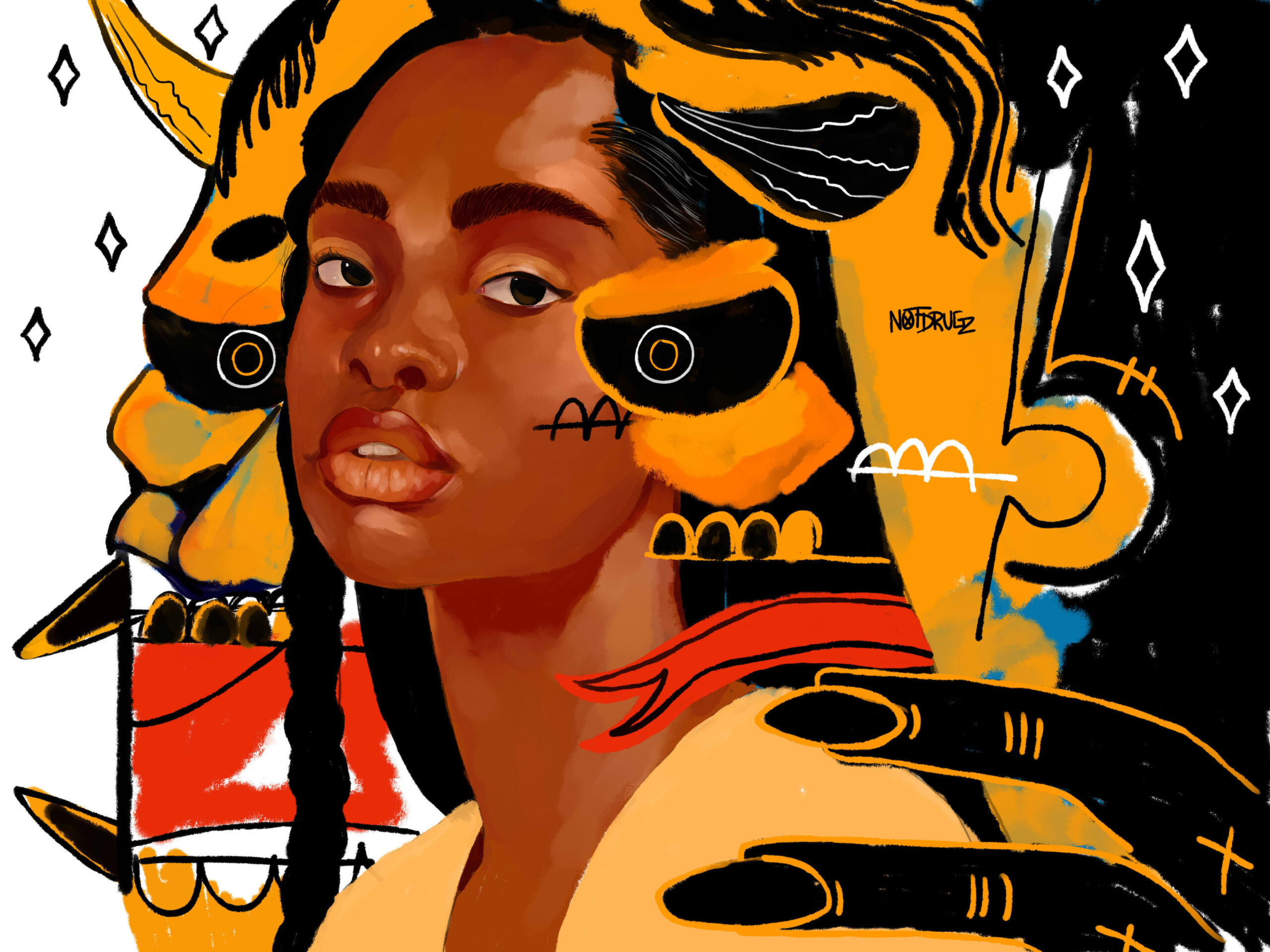
Owlkyd, Is My secret safe, 40 x 50”, Digital artwork on paper. 2022

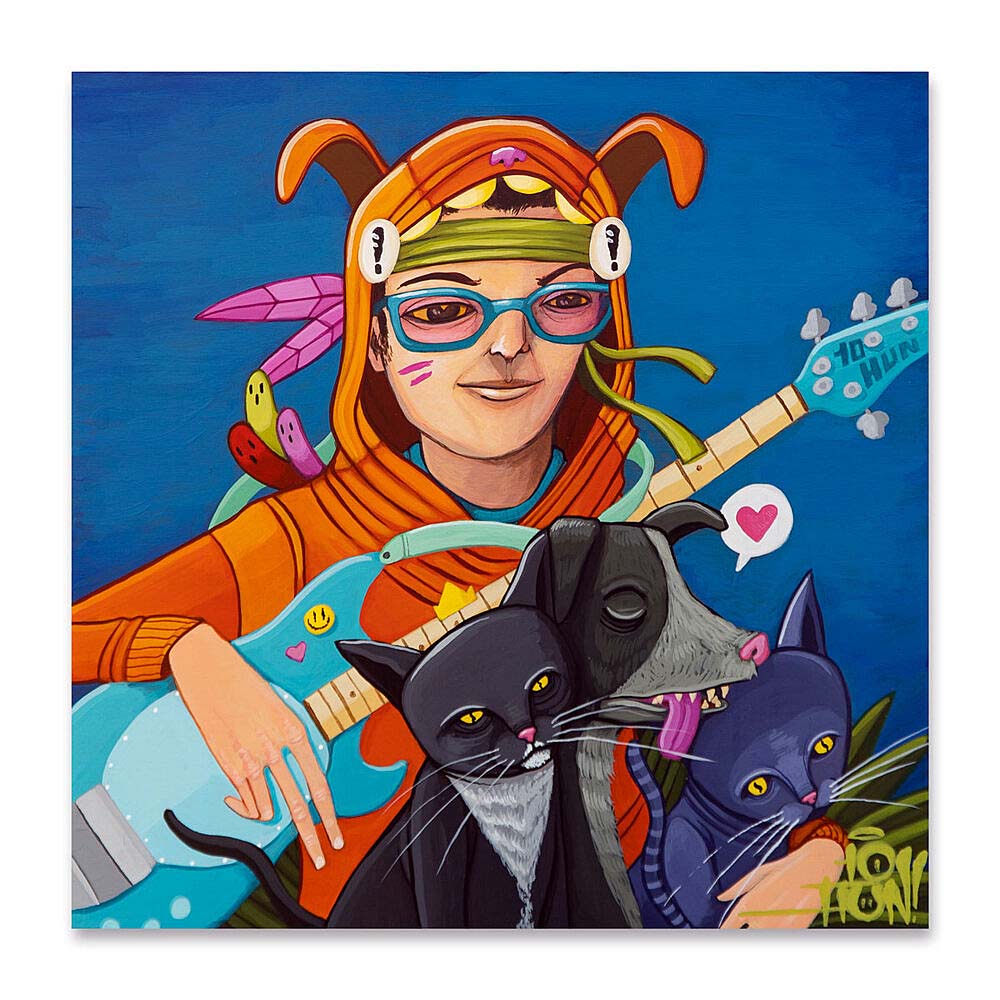
This three-quarter realistic female portrait, Is My Secret Safe, is heavily expressionistic in its surroundings, with small symbols contrasting against an abstract background. Separate from the first two portraits, the figure looks directly at the viewer with a listless expression that draws the viewer in. Owlkyd, in our conversations, mentions the artists who have been influenced well known most, like Picasso, Basquiat, and then Ten Hundred (Peter Robinson), a Michigan artist who specializes in bright, colorful, imaginative character work inspired by cartoons and anime, and graffiti, childlike imagination, comics, and world cultures.

Ten Hundred, (Ted Robinson), Bass Player, Digital Artwork example.

More evident in this figure, No More Opps, with cartoon images on and around the face, is again a self-portrait dressed in regal apparel.

Owlkyd, No More Opps, 40 x 50”, Digital artwork on paper. 2022

Owlkyd, (AKA Darius Littlejohn) supports his livelihood by working in the auto industry managing auto inventory systems for Chrysler. When asked about art school, he says,  “Like many, I didn’t really have the means to pursue any formal training so I am wholly self-taught standing on my various influences.”

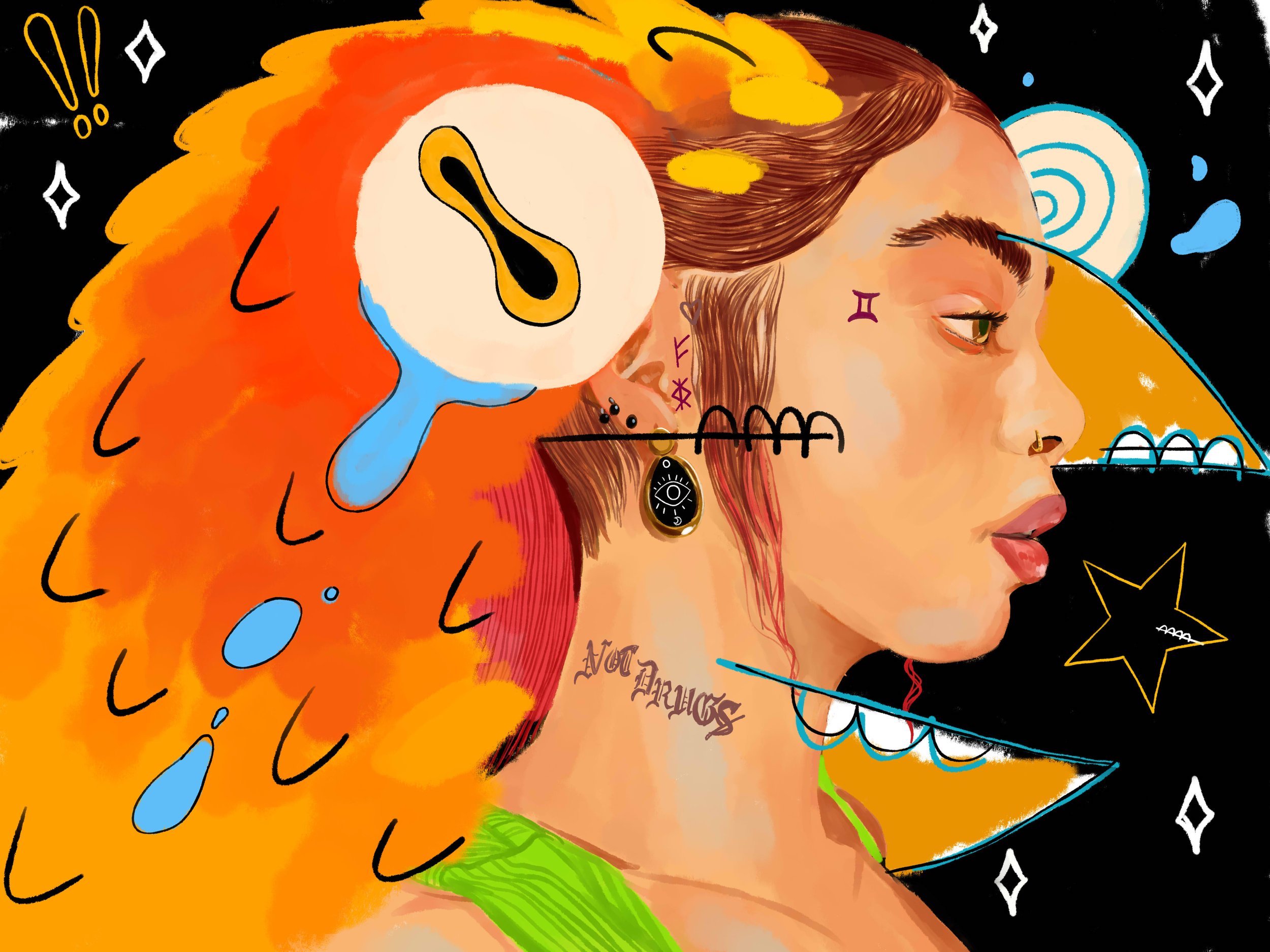
Owlkyd, Galactus, 40 x 50”, Digital artwork on paper. 2022

Throughout these portraits are words that express the message, “Not Drugs” and in this work Galactus, it is prominent.  The message appears in the female portraits only and not in male portraits.  It leads this writer to believe it is a statement that has particular meaning for females and reflects the artist’s need to send them a message.

Image Works, located on the far east side of Dearborn, specializes in archival pigment printing, also known as giclée or inkjet printing, for reproducing photographic and fine art imagery. Housed in a storefront on Michigan Ave, it uses the all-glass entrance as its gallery.

The Window Project at Image Works is on display through January 28th, 2023 – Closing Reception: Saturday, January 28th, 1-4 pm

[adrotate group=”2″]
Enchanted: A History of Fantasy Illustration @ Flint Institute of Arts

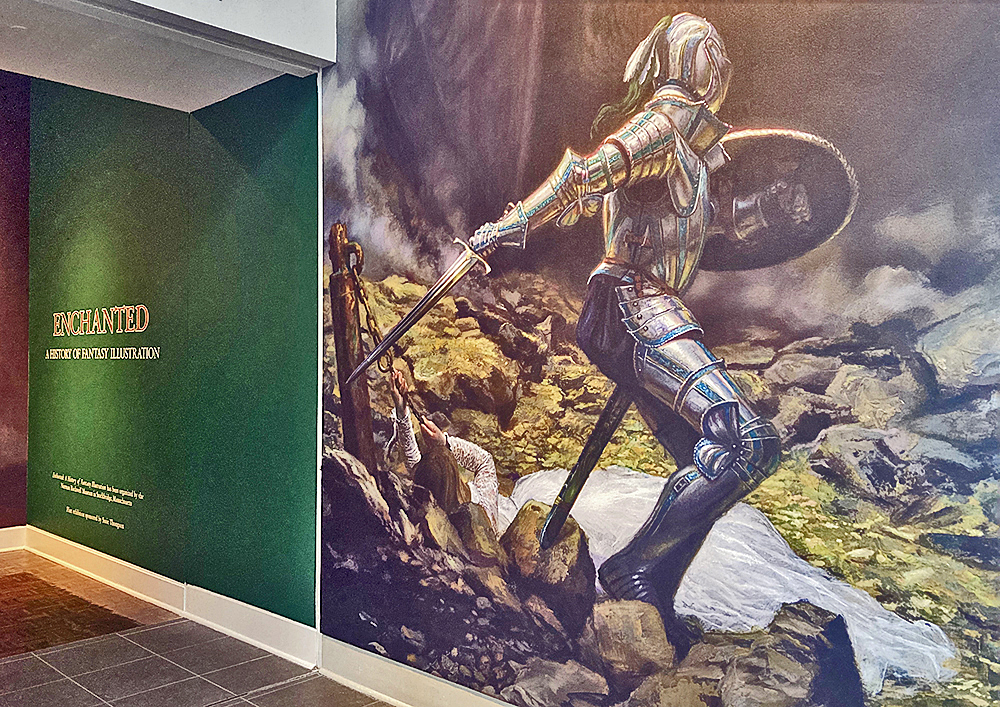
View of exhibition entrance with a large-scale digital print of St. George and the Dragon by Donato Giancola, oil on panel, 2010. All photos: Ashley Cook

The role that enchantment has played in the history of storytelling dates as far back as 2100 BC with The Epic of Gilgamesh, which is considered the point of emergence of the hero’s journey and various fantasy archetypes that we know so well today. The dragons, great floods, serpents and treks through the underworld are just some of the elements that have reliably appeared in scenes of imaginative tales told through time, so much so that the world-building efforts of fantasy writers have constructed an actual parallel universe complete with its own rules, landscapes, species and lessons. Since this first rendition of the dragon, writers and illustrators have contributed to further developing this place that conveniently mirrors our own to serve as a tool for catharsis, entertainment and morality. Enchantment: A History of Fantasy Illustration is the first ever full-scale exhibition to take a serious look at the expanse of this genre and its influence on the history of art, religion, popular culture, and subcultures, with a timeline of works spanning from as early as 1589 to as current as 2021.

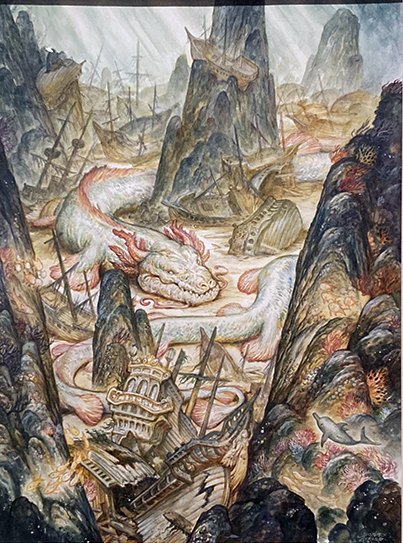
Justin Gerard, Lair of the Sea Serpent, watercolor on paper, 2019.

 Two large galleries of the Flint Institute of Arts have been reserved for over 150 original works; the collection was curated by Jesse Kowalski of the Norman Rockwell Museum in Massachusetts, where Enchantment was first shown. It is not surprising to learn that Kowalski has worked on a number of exhibitions that highlight illustration and fantastical subject matter. A text for this exhibition asserts that “the many facets of fantasy illustration have often been misunderstood or overlooked” and this observation seems to be one of the driving forces behind these curatorial efforts.

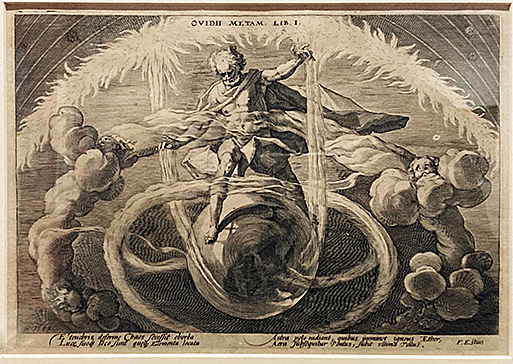
Hendrick Goltzius, Creation of the Four Elements, illustration, 1589.

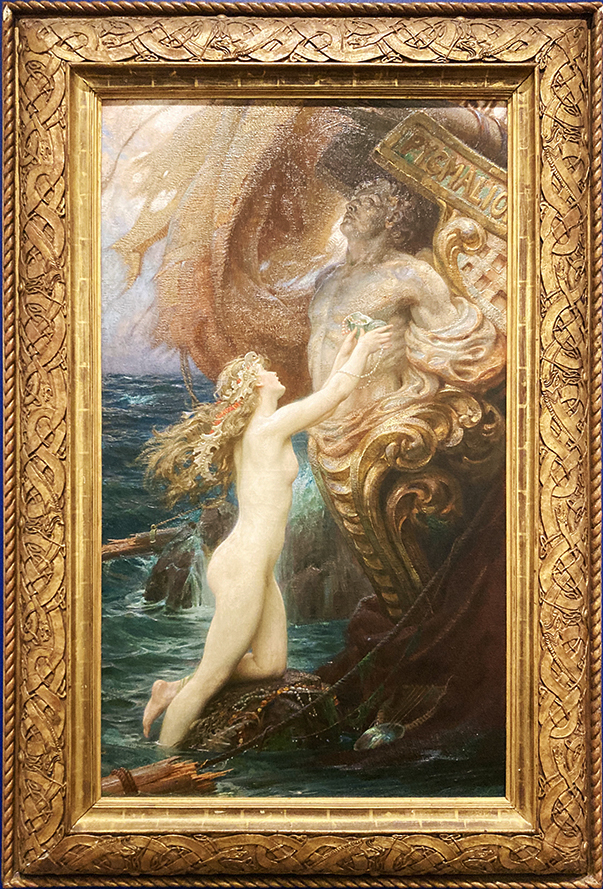
 Guests who are familiar with the Henry and Hodges galleries of the museum may notice the walls were freshly painted to set the tone for the rich colors and dreamy compositions of the show. Appropriate to the setting, the styles in which most of these pieces were done employ classical techniques like oil painting, etching, watercolor, and pencil drawings, with the occasional works rendered digitally by the 21st-century artists of the group. One may even occasionally forget that they are looking at scenes from a world of mythical landscapes and not from our own classical kingdoms of the past, as there is so frequently a thematic and aesthetic overlap between the two. Artworks like A Deep Sea Idyll by Herbert James Draper, Garden of Hope by James Gurney, or Allegory by Omar Ryyan place terrestrial beings and elements into impossible realities with a conviction akin to the old masters, and this blurring of the boundaries between imagination and reality is what makes fantasy so powerful.

Herbert James Draper, A Deep Sea Idyll, oil on canvas, 1902.

 The show has the potential to please visitors of many ages and backgrounds. For those whose palates are less versed in the world of fantasy, the exhibition space becomes a place for learning, with many sources of in-depth information and insight to contextualize the surrounding works. Along with exhibition texts focused on some essential aspects of fantasy including storytelling, adventure and the play between good and evil, there are also information plaques about each individual artwork which note the background of the artist and their role in the lineage of fantasy illustration. Taking in this information may be as enjoyable as basking in the quality of the material application or the beautifully carved frames surrounding the art, but for the visitors who are fantasy connoisseurs, it could be particularly special to read that some of the artworks before them were made for productions as big as The Lord of the Rings or Game of Thrones. In fact, almost all of the artworks included in the exhibition have played an important role in the history of fantasy illustration throughout time.

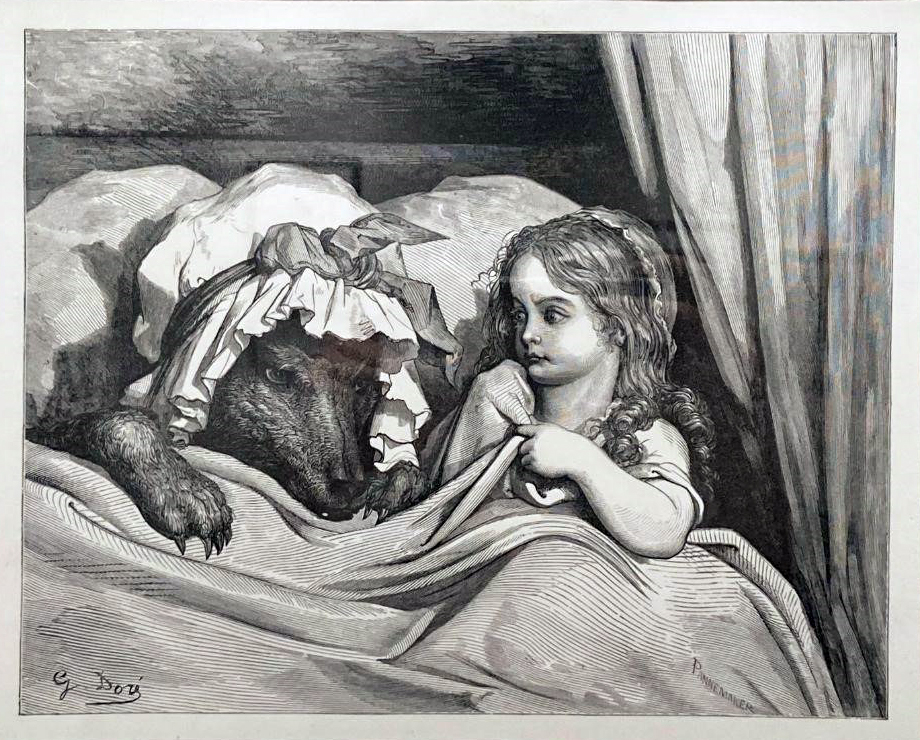
Gustave Doré, Little Red Riding Hood, antique woodcut on thick wove paper, 1880.

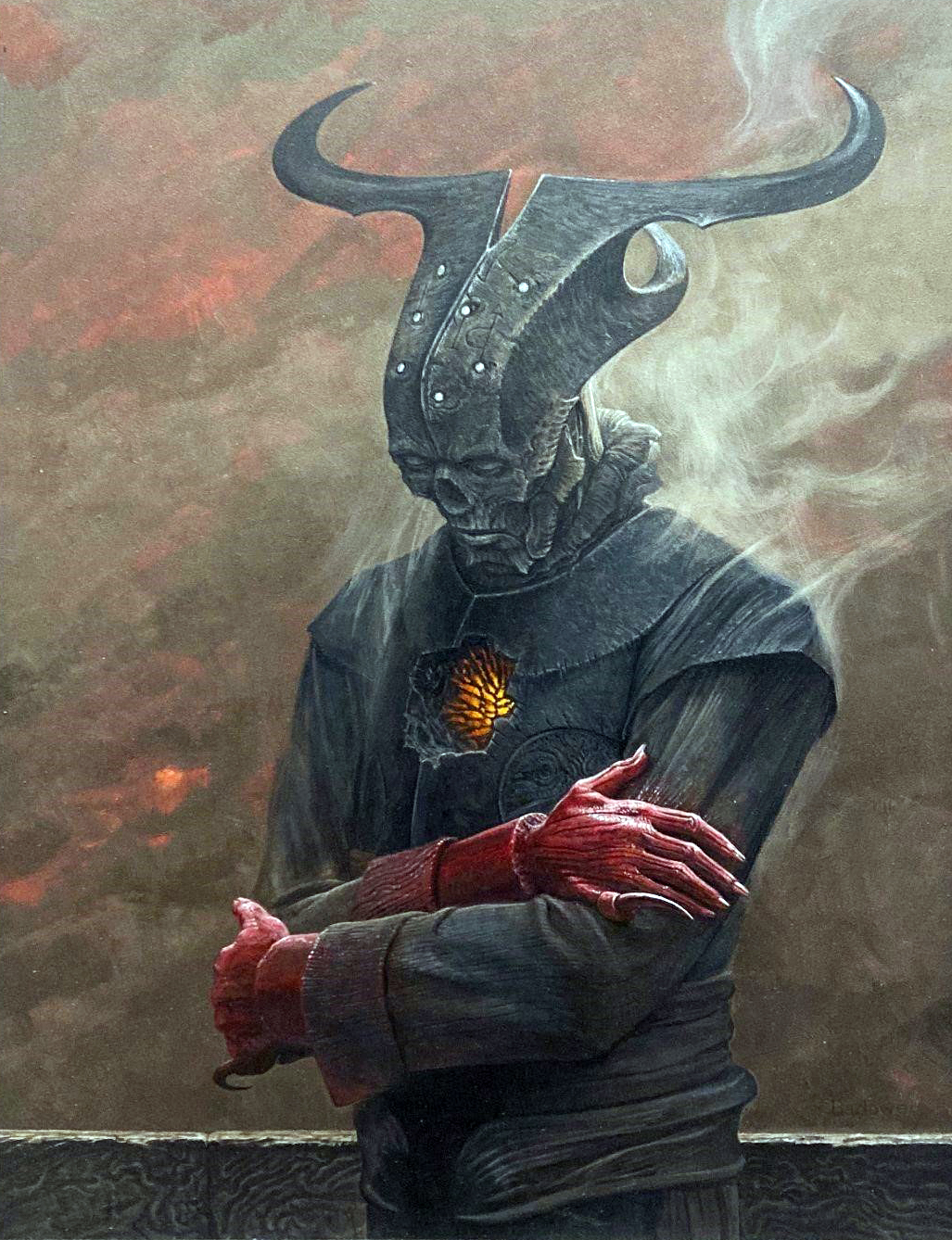
 What is interesting about this show is the breadth of work it covers, successfully linking old masters like Gustav Doré, Hendrick Goltzius, Arthur Rackham and Howard Pyle with emerging artists like Victo Ngai and Wayne Barlow. Despite all of the artworks being displayed in a traditional museum style, framed and hung on a wall, many of them were actually originally produced for films and books. There are comic book illustrators like Hal Foster with a drawing from the Prince Valiant series and Dan Dos Santos with the illustration of Red Rose made for Fables. Then we have pulp fiction illustrator Mark Zugs with The Princess of Mars, which was produced for the cover of Mars Trilogy, a compendium which contains original novels originally released in 1917-1919 by Edgar Rice Burroughs.  Henry Clarence Pitz’s Dark Water then brings us back to the early 20th-century ink on paper renderings, predated by the oil painting The Other Side by Dean Cornwell, yet throughout this extensive lineage, a strange consistency has been handed down from generation to generation that allows for almost anyone who has been read a fairy tale to feel at least somewhat at home.

Wayne Barlow, Demon Minor, acrylic on illustration board, 2018.

Enchanted: A History of Fantasy Illustration opened September 24, 2022 and is on view until January 8, 2023. Please visit https://flintarts.org/ for more information.

[adrotate group=”2″]
Zaha Hadid @ Broad Museum

Zaha Hadid Design: Untold at Michigan State University’s Broad Museum

An installation view of Zaha Hadid Design: Untold at Michigan State University’s Broad Museum through Feb. 12.

When the Eli and Edythe Broad Art Museum, designed by the late Iraqi-British architect Zaha Hadid, opened at Michigan State University 10 years ago, the structure was heralded as one of the most commanding pieces of modern architecture on any Midwestern academic campus. As Artforum noted at the time, the 46,000-square-foot structure is “not so much a building as an event.”

That pretty much nails it. Comprised of juxtaposed blocks of parallel steel folds and pleats, and emerging from the ground at skew angles, students immediately nicknamed the $45 million project the “spaceship.” The Broad (pronounced “Brode”) is an aggressive, entertaining structure dropped between MSU’s academic-revival class buildings and the Grand River Avenue commercial strip, a building that makes little visible effort to harmonize with its surroundings — even as it feels somehow perfect in its location. Indeed, the Broad resembles nothing so much as an alien vessel that plowed into the earth at high speed during an emergency landing.

The Eli and Edythe Broad Art Museum at Michigan State University, designed by Zaha Hadid. (Photo courtesy Michigan State University Communications.)

If the work of Hadid, a Pritker Prize-winner who practiced for decades in London until her death in 2016, challenges both geometry and convention, much the same can be said for the Broad’s exhibition up through Feb. 12, Zaha Hadid Design: Untold. This career retrospective, curated by the Broad’s former director, Dr. Mónica Ramirez-Montagut, and Woody Yao of Zaha Hadid Design, spans 40 years of creative work, and sprawls over three floors. Rather than concentrating on her buildings, Untold spotlights Hadid’s non-architectural work, including tables, chairs, colorful rugs, chandeliers, a tea service, a chess set, and a car prototype that looks a bit like a sharp-nosed egg with wheels. She even brought her skills to bear on sneakers and outré fashion.

Zaha Hadid, Installation view of carpets and table in Zaha Hadid Design: Untold, at the Eli and Edythe Broad Art Museum at Michigan State University, 2022. (Photo: Dustin Forest)

For their part, Hadid’s buildings have a habit of upending our expectations for what a structure ought to look like. In addition to the Broad, one of her best examples is the large, crystalline egg she balanced on top of a traditional, 19th-century building for the Port Authority of Antwerp, Belgium. Or you could point to her elegantly curvilinear Aquatics Center built for the 2012 London Olympics.

In like manner, the artifacts in this show challenge age-old assumptions for what shape ordinary objects should assume. “There are 360 degrees,” Hadid famously said. “Why stick to one?” Following this dictum, tables, chairs and shelving units in Untold shake off any pretense of rectilinearity or standard form, morphing into instruments at once sinuous, expressionist and functional. As Broad Interim Director Steven L. Bridges put it, these works “ask us to think and see things differently at every turn.”

Zaha Hadid, Installation view of furniture and shelving units in Zaha Hadid Design: Untold, at the Eli and Edythe Broad Art Museum at Michigan State University, 2022. (Photo: Dustin Forest)

Born in Baghdad in 1950, Hadid graduated with a mathematics degree from the American University in Beirut, Lebanon, before moving to London in 1972 to attend the Architectural Association of London School of Architecture where she won the Diploma Prize on graduating in 1977. Two years later she founded Zaha Hadid Architects in the British capital, though she wouldn’t complete her first building, the swooping Vitra Fire Station in Weil Am Rhein, Germany, until 1993.

Most of Hadid’s designs were built abroad, perhaps unsurprising for a European architect. She did, however, design a condo tower that’s nothing but curves adjacent to New York’s High Line, as well as the Lois and Richard Rosenthal Center for Contemporary Art in Cincinnati – a handsome exercise in Brutalist block geometry that was the first major American art museum designed by a woman. As much an educator as a pioneering designer, Hadid taught at London’s Architectural Association, and held guest professorships at the University of Applied Arts in Vienna, as well as Columbia, Harvard and Yale.

Zaha Hadid, Installation view of vase, table and carpets in Zaha Hadid Design: Untold, at the Eli and Edythe Broad Art Museum at Michigan State University, 2022. (Photo: Dustin Forest)

Hadid’s work is often called “transformational,” and the pieces in this exhibition underline how radical her vision could be. Indeed, The Guardian dubbed her “the queen of the curve” for her boundary-pushing architecture. Starting her career in the 1970s, Hadid was very much the exception in a profession dominated by men who didn’t necessarily take kindly to a brilliant Iraqi woman. Small wonder, then, that one of the adjectives most commonly used to describe her is “fearless.”

That gutsiness, tempered by extraordinary vision, can be found all over the Broad Museum, both in Untold and the structure of the interior spaces themselves. Cutaways allow for dramatic vistas from the third floor down to the second, and the walls, depending on where you are in the building, tilt from 15 to 40 degrees off the perpendicular. Much like Frank Lloyd Wright’s Guggenheim Museum in Manhattan, Hadid’s Broad Museum is as much an experiential thrill as an envelope to house artifacts. In this respect, going to Untold is something of a twofer – both an intriguing exhibition and a passage through mind-bending architecture.

Zaha Hadid, Installation view of Zaha Hadid Design: Untold, at the Eli and Edythe Broad Art Museum at Michigan State University, 2022. (Photo: Dustin Forest)

Zaha Hadid Design: Untold will be at Michigan State’s Eli and Edythe Broad Art Museum through Feb. 12.

[adrotate group=”2″]
Page 19 of 84

Powered by WordPress & Theme by Anders Norén