Critical art reviews of Detroit galleries and museums weekly

Month: September 2022

Mario Moore @ David Klein Gallery

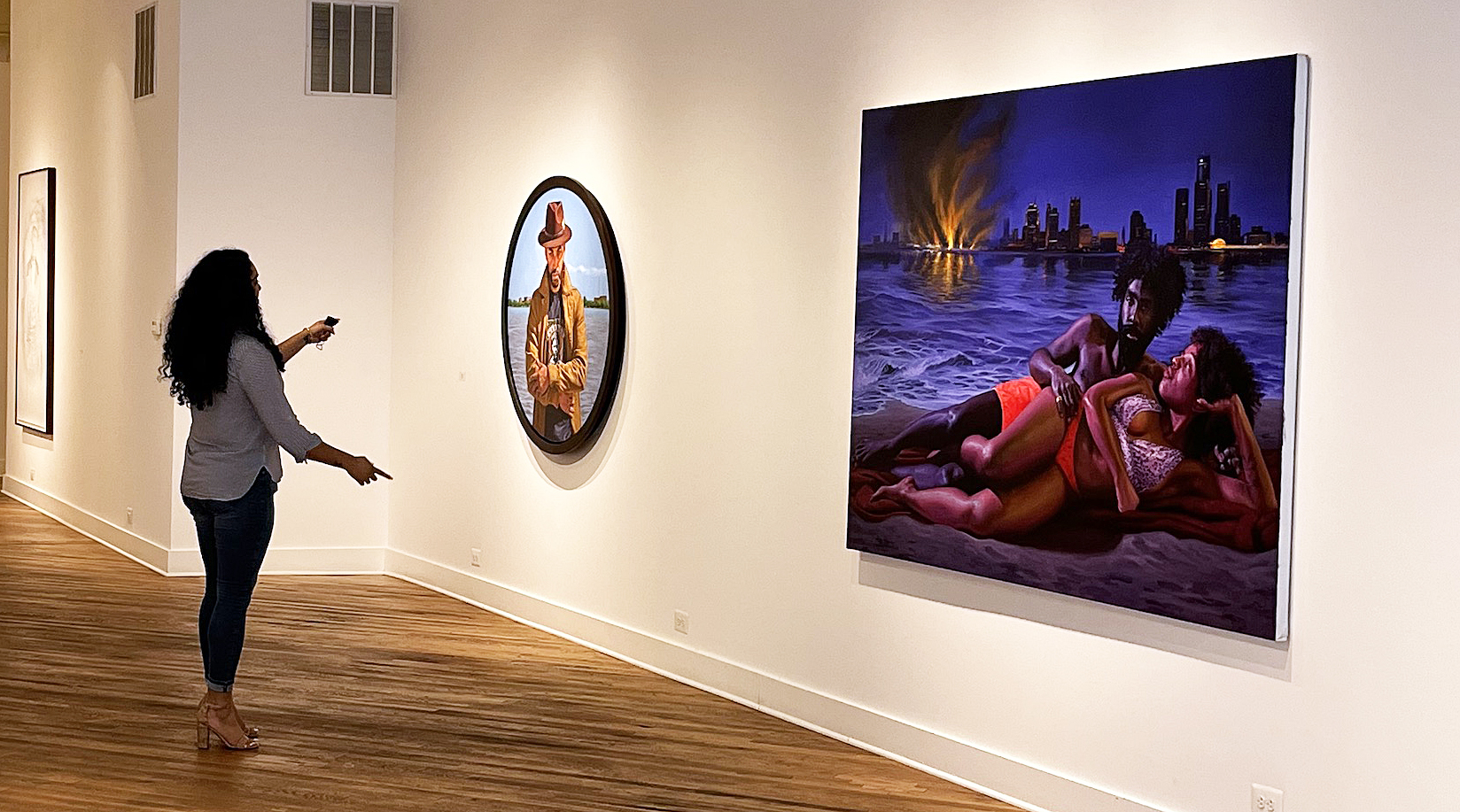
An installation view of Midnight and Canaan at the David Klein Gallery in Detroit, up through Nov. 5, 2022

Mario Moore’s solo show, Midnight and Canaan, which just opened at Detroit’s David Klein Gallery, is well worth going way out of your way to catch. The figurative oil paintings in front and the three silverpoint-on-paper works in the back room are mesmerizing, particularly when you get the story behind them.  Midnight and Canaan will be up through Nov. 5.

Moore, a College for Creative Studies grad with an MFA from Yale, has taken a sober, admiring look at Black leaders who worked the last stretch of the Underground Railroad in Michigan – names that would be unfamiliar to most people. In his Artist’s Statement, Moore notes that he learned a lot about the Great Migration in school, which brought African-Americans from the deep south to northern cities, but almost nothing about Black abolitionists before the Civil War, who deserve to be honored for their persistence and unfathomable courage, given all that they were up against.

As for the title, “Midnight” and “Canaan” were code words for Detroit and Canada, respectively, that abolitionists employed.

The operation of the Underground Railroad was both sophisticated and practical. Moore quotes from an 1886 Detroit Tribune interview with a William Lambert, who explains how they’d transport individuals fleeing slavery in “tin-peddling wagons with false bottoms, large enough to hold three men, traveling through the South.”

Lambert himself gets an affectionate shout-out with Moore’s large, silverpoint portrait. As with the other two silverpoint works of Sojourner Truth and George DeBaptiste, lines stitched onto the fabric by Moore’s mother, Detroit artist and Kresge Artist Fellow Sabrina Nelson, delineate the routes the three took while working for the Underground Railroad, whether to Battle Creek, Port Huron, Detroit or Amherstburg, Ontario.

Laid down with actual gold thread, the lines take the shape of branching railroad tracks. In all three cases, Nelson’s linear needlework frames the individual in question, hovering above their heads a bit like angular halos, at the same time that the lines all reach toward the right – i.e., the east – to Canada and freedom. As for the gentleman himself, Lambert — handsomely dressed in frock coat and tie — stares out at the viewer with determined, undeceived eyes. So too does Sojourner Truth on the facing wall.
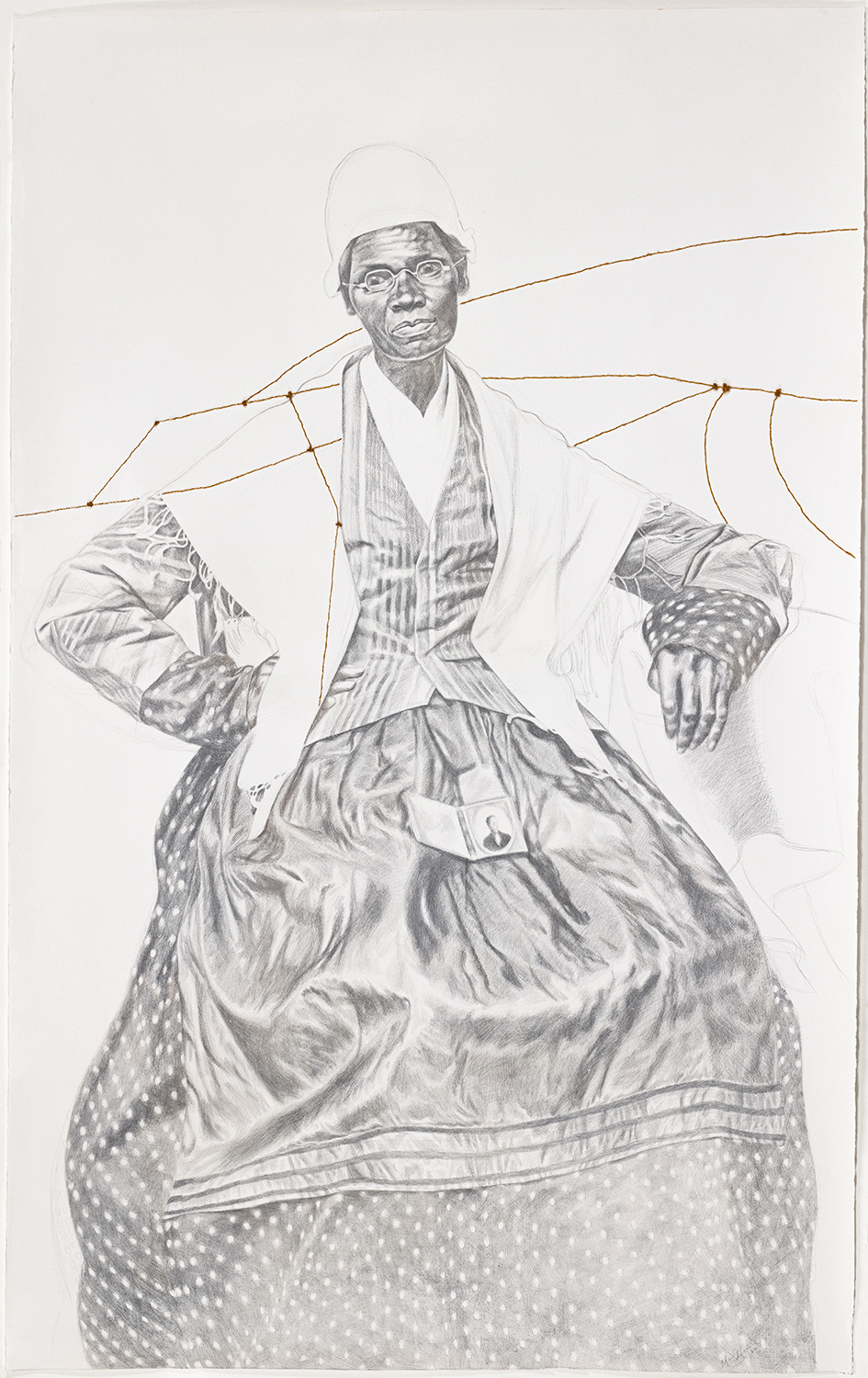
Mario Moore, Sojourner Truth, 2022, Silverpoint on prepared paper, Gold Thread, Embroidery by Sabrina Nelson, 74.5 x 47.5 inches, Courtesy David Klein Gallery.

What may not be apparent as you walk into the gallery is that the entire show, in one way or another, is a tribute to the Underground Railroad and those hardy souls it ushered to freedom in Canaan – even the contemporary pieces at the front of the gallery.

Reading through “A Fluid Frontier: Slavery, Resistance and the Underground Railroad in the Detroit River Borderland” from Wayne State University Press (edited by Karolyn Smardz Frost and Veta Smith Tucker), Moore stumbled upon a married couple – Thornton and Lucie Blackburn — who escaped slavery in Kentucky and finally settled and prospered in Toronto. The artist calls their story a “cornerstone in my understanding of Detroit’s Black militancy,” and little wonder.

The Canadian Encyclopedia notes that the Blackburns made a dramatic escape from Kentucky in 1831, only to be recaptured in Detroit two years later. Miraculously, somehow the two were spirited from their cells and across the waters where they were re-arrested and threatened with being sent back to the United States. That prospect sparked riots on both sides of the border, and ultimately, a change in Canadian law to admit political refugees.

Rather than portraying the pair in historic garb, as Moore’s done with the silverpoint portraits, they’re a sexy, 21st-century couple lounging in bathing suits along the Detroit riverfront – a flight of fancy that somehow helps us see these intrepid souls more clearly than we might if they were outfitted in historically accurate, if distancing, petticoats and trousers.

Thornton and Lucie Blackburn in Canaan shows the recumbent Blackburns apparently enjoying a hot evening in safety along the Windsor riverfront, with Detroit looming – and erupting in flames – behind them. Lucie’s gazing up at the stars, while Thornton, hand on her hip, stares straight out into the Ontario night.
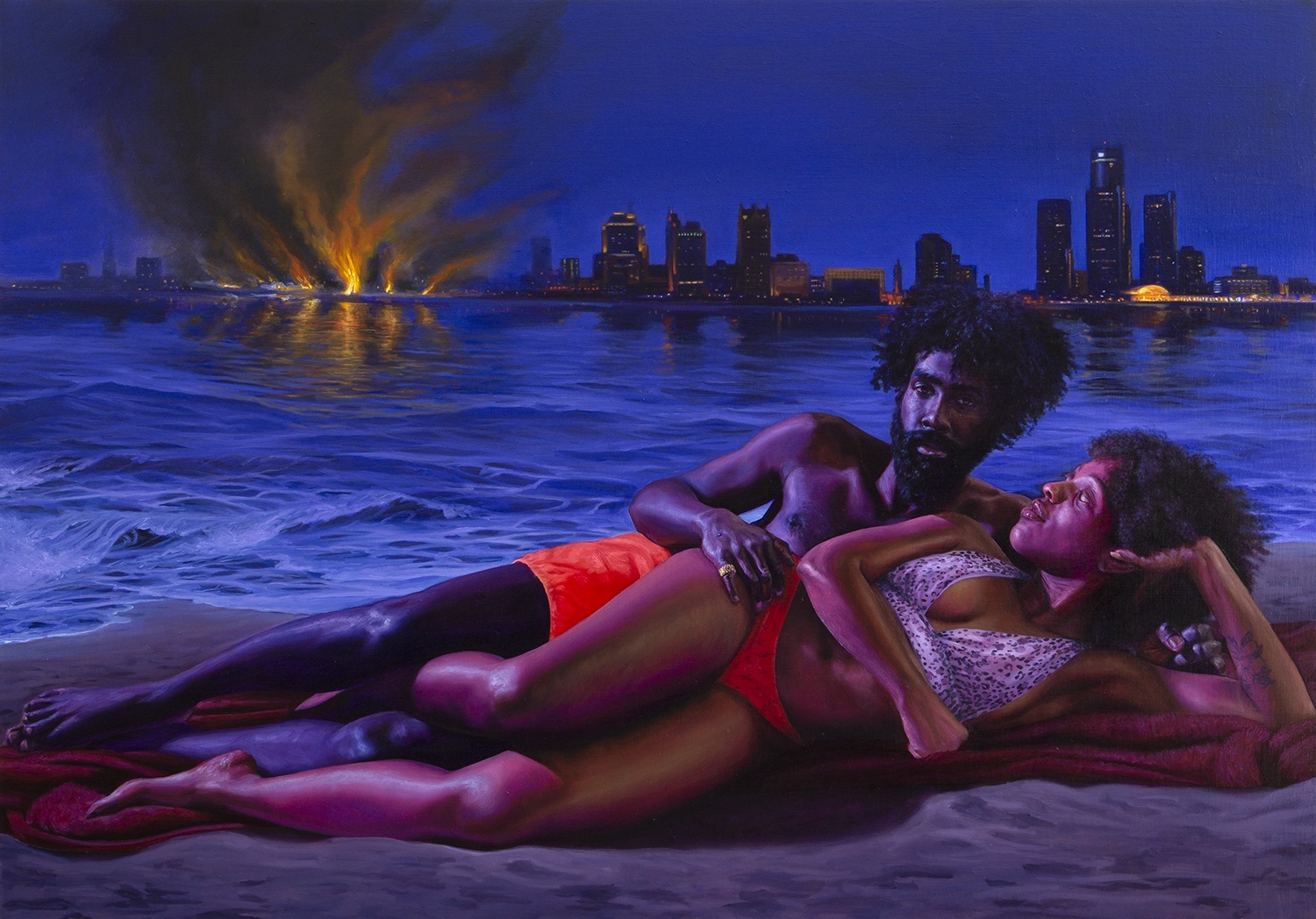
Mario Moore, Thornton and Lucie Blackburn in Canaan, 2022, Oil on linen, 63 x 90 inches, Courtesy David Klein Gallery.

Social and political themes underlie much of Moore’s artwork, as with these heroes of the Underground Railroad. In 2018, when he was the Hodder Fellowship artist-in-residence at Princeton University, he produced “The Work of Several Lifetimes” — painting the college’s African-American service workers in the style ordinarily accorded to the great and famous.

With Midnight and Canaan, Moore tips his hat to “Black pioneers” in contemporary Detroit as well, singling out Detroit artists like the much-respected Allie McGhee and metalworker Tiff Massey, who was also a Kresge Artist Fellow. His portrait of her, Tiff Like Granite, What Up Doe, is especially compelling. Standing defiantly on rocks by the riverside in long black cloak, aviator glasses and red slacks tucked into boots, Massey looks, for all the world, a bit like a Revolutionary War war hero.
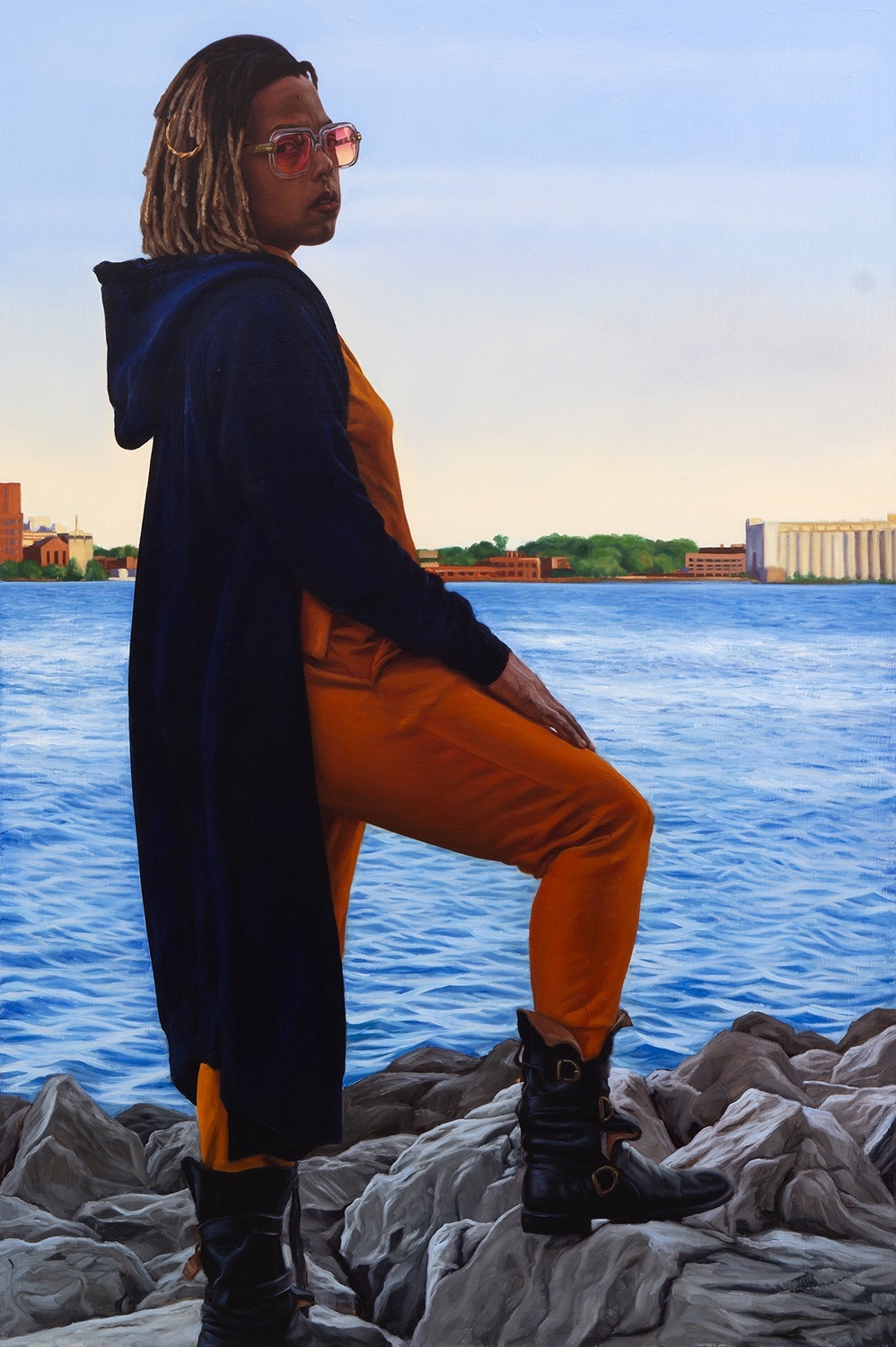
Mario Moore, Tiff Like Granite, What Up Doe, 2022, Oil on linen, 72 x 48 inches, Courtesy David Klein Gallery.

Rounding out his history of Michigan’s role in helping enslaved persons flee to Canada, Moore also paints two of the institutions – both churches – that played critical roles in the endeavor. His portrait of the Second Baptist Church, which was key to the freedom struggle, is about as heroic as a painting of a building can be. Lit by two outdoor lamps at night, the church positively glows with hope and promise.
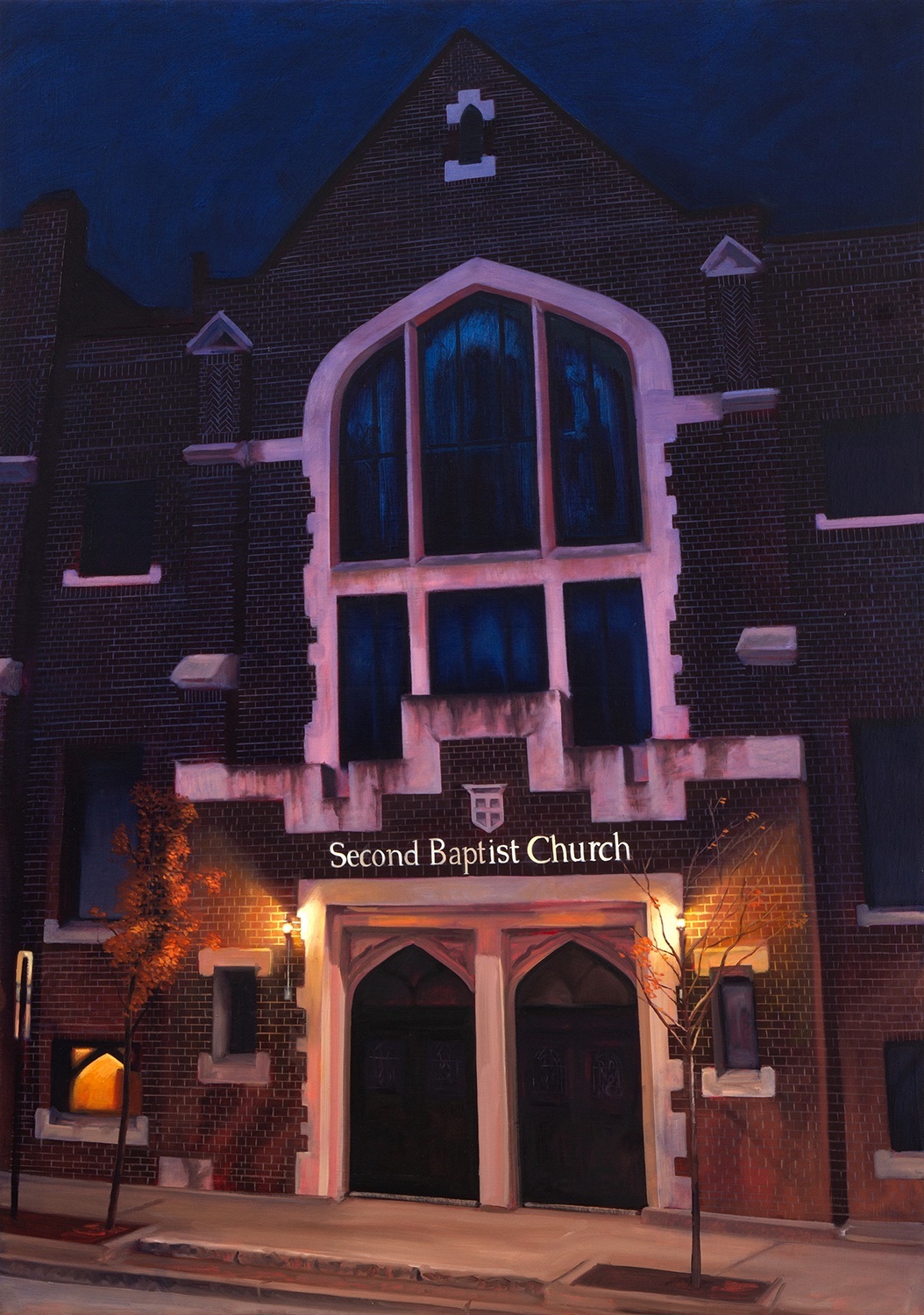
Mario Moore, Light in the Darkness, 2022, Oil on linen, 55 x 39 inches, Courtesy David Klein Gallery.

Finally, right at the front of the gallery above the reception desk, you’ll find Keep On Keepin On, Don’t Look Back, which is likely to intrigue and perhaps amuse all but the hard-hearted. Seemingly suspended a hundred feet above the Detroit River, with Renaissance Center and the Ambassador Bridge in the background, a nattily dressed couple – he in top hat and frock coat, she in a long red dress – walk slowly towards the Canadian Canaan, framed by dark wintry clouds.
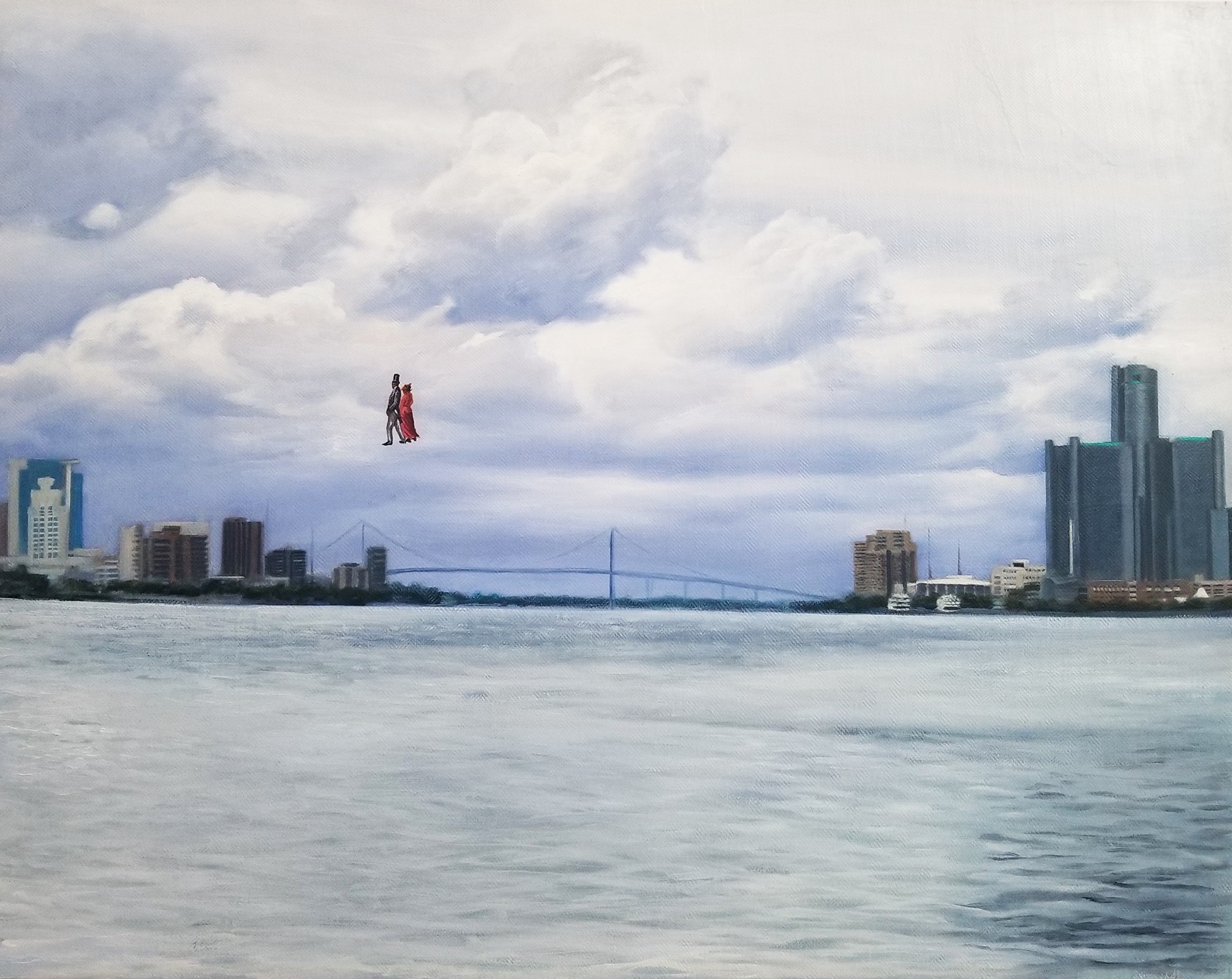
Mario Moore, Keep On Keepin On, Don’t Look Back, 2022, Oil on linen, 30 x 38 inches, Courtesy David Klein Gallery.

Midnight and Canaan will be up through Nov 5. A reception for the artist will take place on Saturday, September 24, 5 – 8 PM.

 Midnight and Canaan, a solo show by Mario Moore, will be at Detroit’s David Klein Gallery through Nov. 5.
Critical Voices @ Oakland University Art Gallery

Critical Voices: Selections from the Hall Collection at OUAG

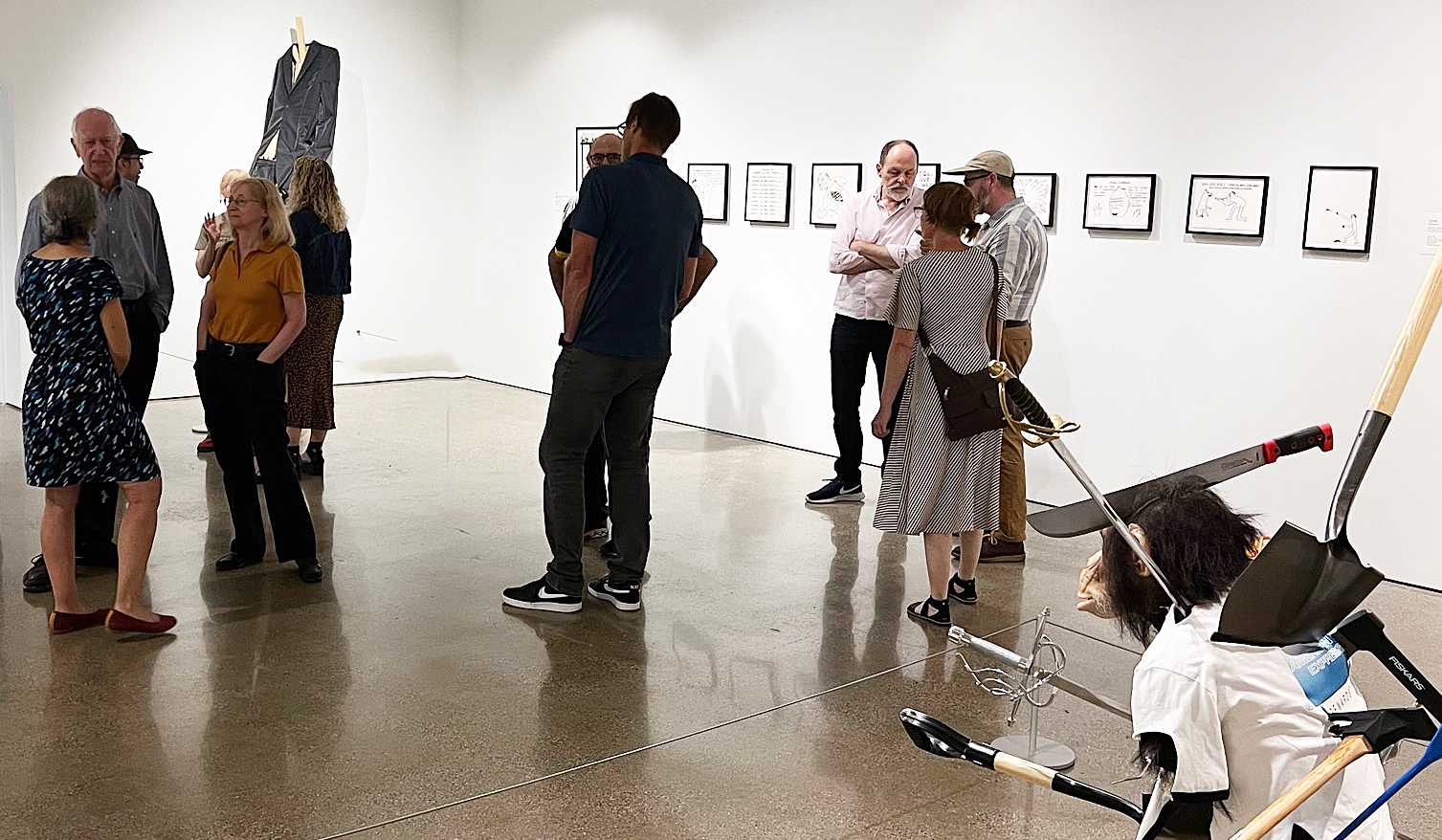
Install Image Critical Voices: Selections from the Hall Collection 2022

The Oakland University Art Gallery opened the fall season with Critical Voices: Selections from the Hall Collection on September 9, 2022,  curated by Leo Barnes, the new OUAG Gallery Manager.  This is Barnes’ curatorial debut, but he’s leveraging five years of prior experience working with the Hall Foundation and its highly respected collection of both American and German contemporary art.  He says, “The artworks, collected by Andrew and Christine Hall, present a unique index of the best contemporary art of the late 20th and 21stcenturies. It provides a window onto the complementary social conditions prevailing in two distinct continental spheres: Germany and the United States.

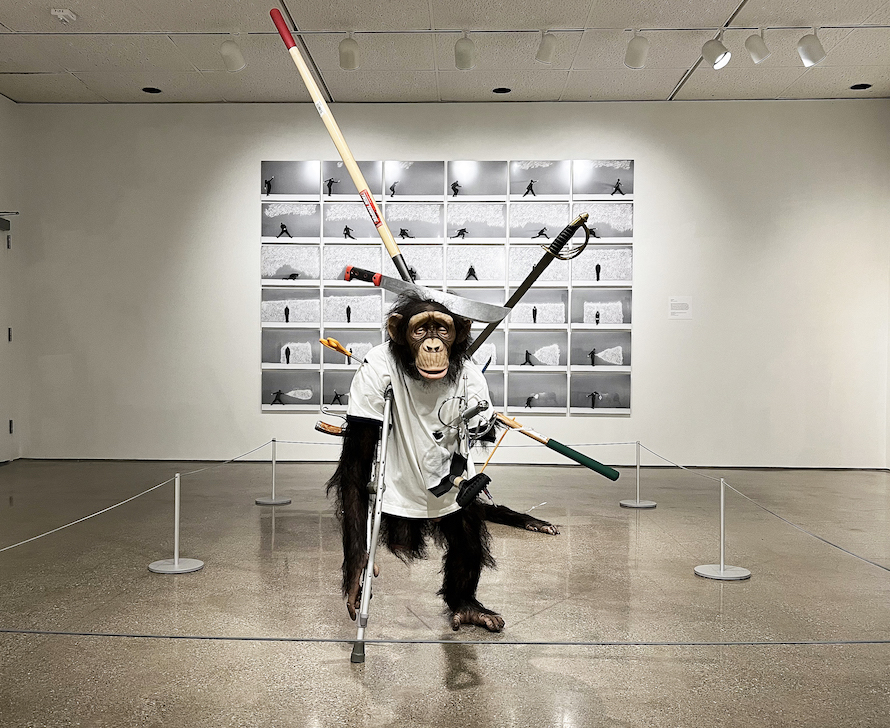
Tony Matelli, Fuck’d, Mixed Media Sculpture, the Hall Collection

Tony Matelli is an American sculptor perhaps best known for his work Sleepwalker. He was born in Chicago and received his MFA from the Cranbrook Academy of Art in 1995. He now lives and works in New York City. He incorporates figurative, botanical, and abstract forms in his sculpture, creating uncanny objects that are both unsettling and comical.  Fuck’d up is a good example of these characteristics as it takes center stage in the OUAG gallery. Mr. Matelli has employed his formula of high-quality craftsmanship and lewd provocation, like the chimp being crucified using garden and household implements. Whatever the message, the artist leaves the viewer to interpret and make sense of the experience based on their own experience.

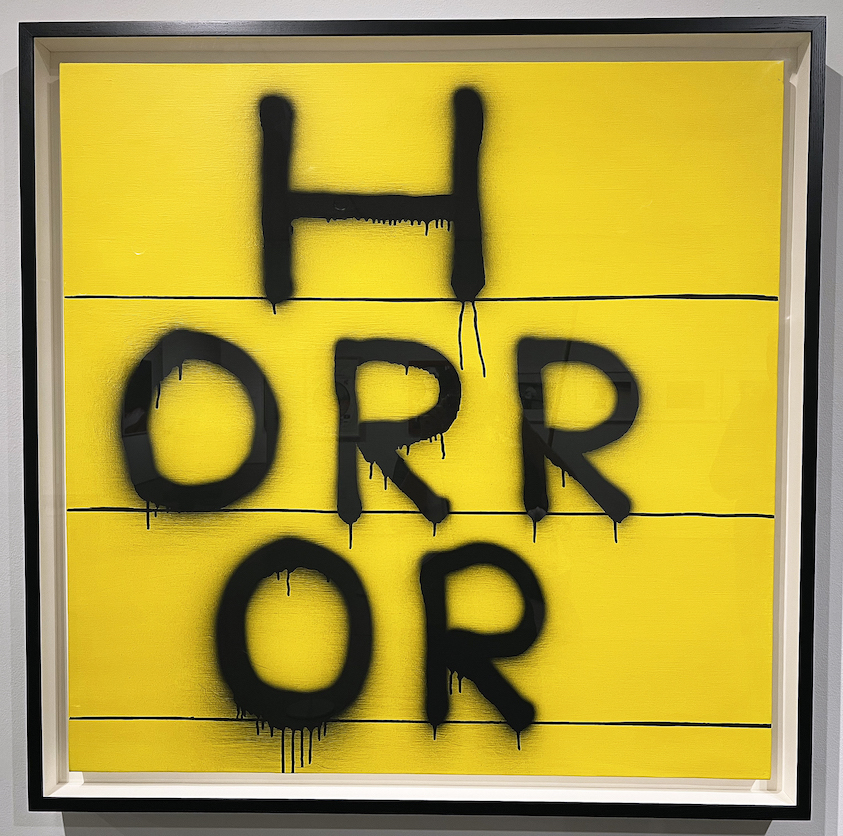
David Shrigley, Horror, Acrylic on Canvas, 40 x 40″, the Hall Collection

Horror is a kind of pop art with drips.  When you scroll through David Shrigley’s Instagram page, there is a continuous stream of simple, single images of objects, all using bright colors. A maverick and an artist working in multiple disciplines, David Shrigley is now considered one of the most significant figures in contemporary British art.  Making sense seems like nonsense is one way to describe his faux-naif work, which combines sweet childlike renderings with a sour, sardonic tone.   In January 2020, the artist was awarded the decoration of Officer of the Most Excellent Order of the British Empire (OBE). The British visual artist was born in 1968 and is now living in England after living in Scotland for 27 years.

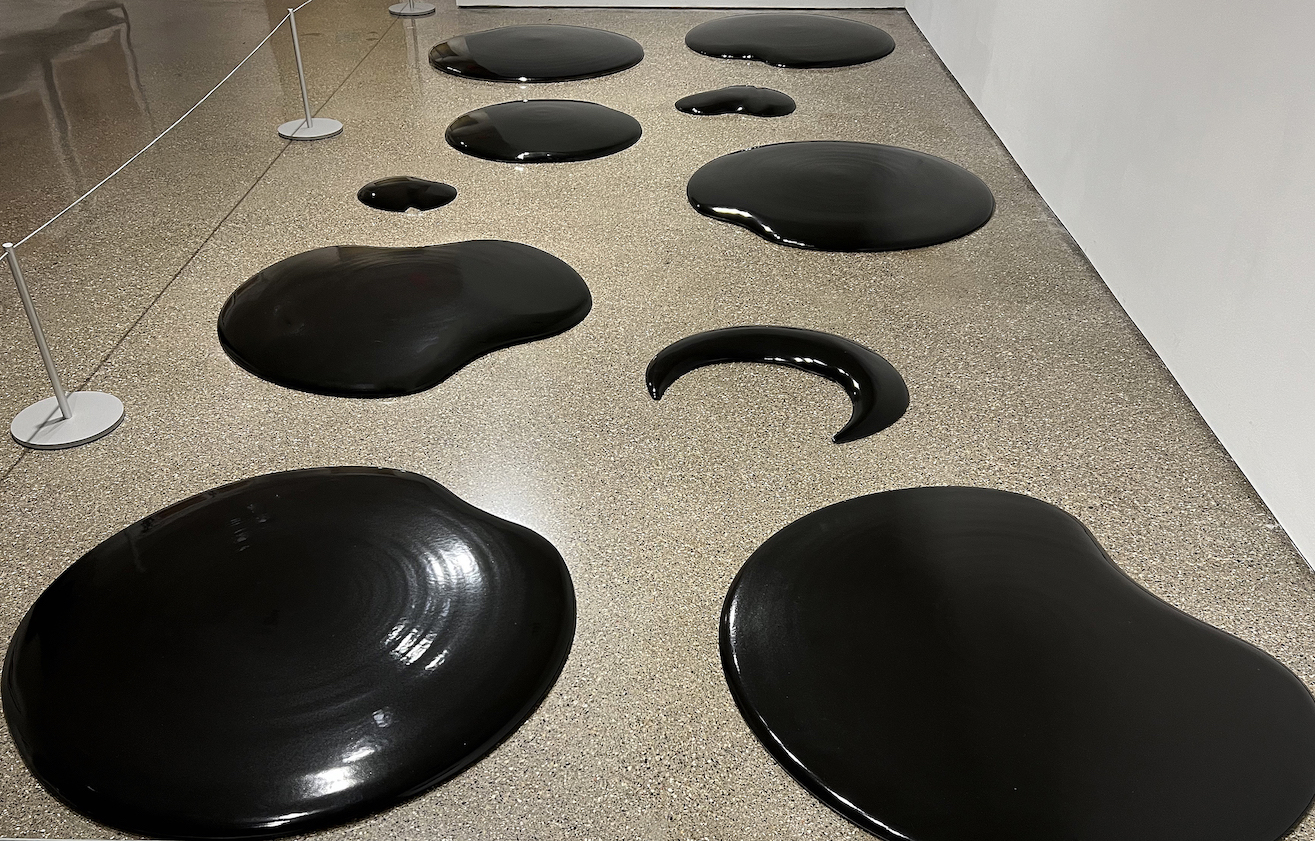
Al Weiwei, Oil Spills, 10 pieces, Porcelain, The Hall Collection

Oil Spills is an early piece by the renowned Chinese artist Ai Weiwei, a visual artist, dissident, and documentarian who is often referred to as the most influential artist of our time. Ai Weiwei was born in 1957 in Beijing. His father, the poet Ai Qing, was labeled a “rightist” in 1958, and Ai and his family were exiled, first to Heilongjiang in northeastern China and then soon after to the deserts of Xinjiang in northwestern China. Mr. Weiwei moved to the United States in 1981, living in New York between 1983 and 1999, where he briefly studied at the Parsons School of Design. His output over the past thirty years explores his ambivalent rapport with Western culture and with the culture of his own country.  Oil Spills is an example of his conceptual art that explores the social issue and the aesthetics of an oil spill. This short video documents his exhibition in New York City in 2017.   https://www.nytimes.com/video/arts/100000005490574/ai-weiwei-puts-up-fences-to-promote-freedom.html

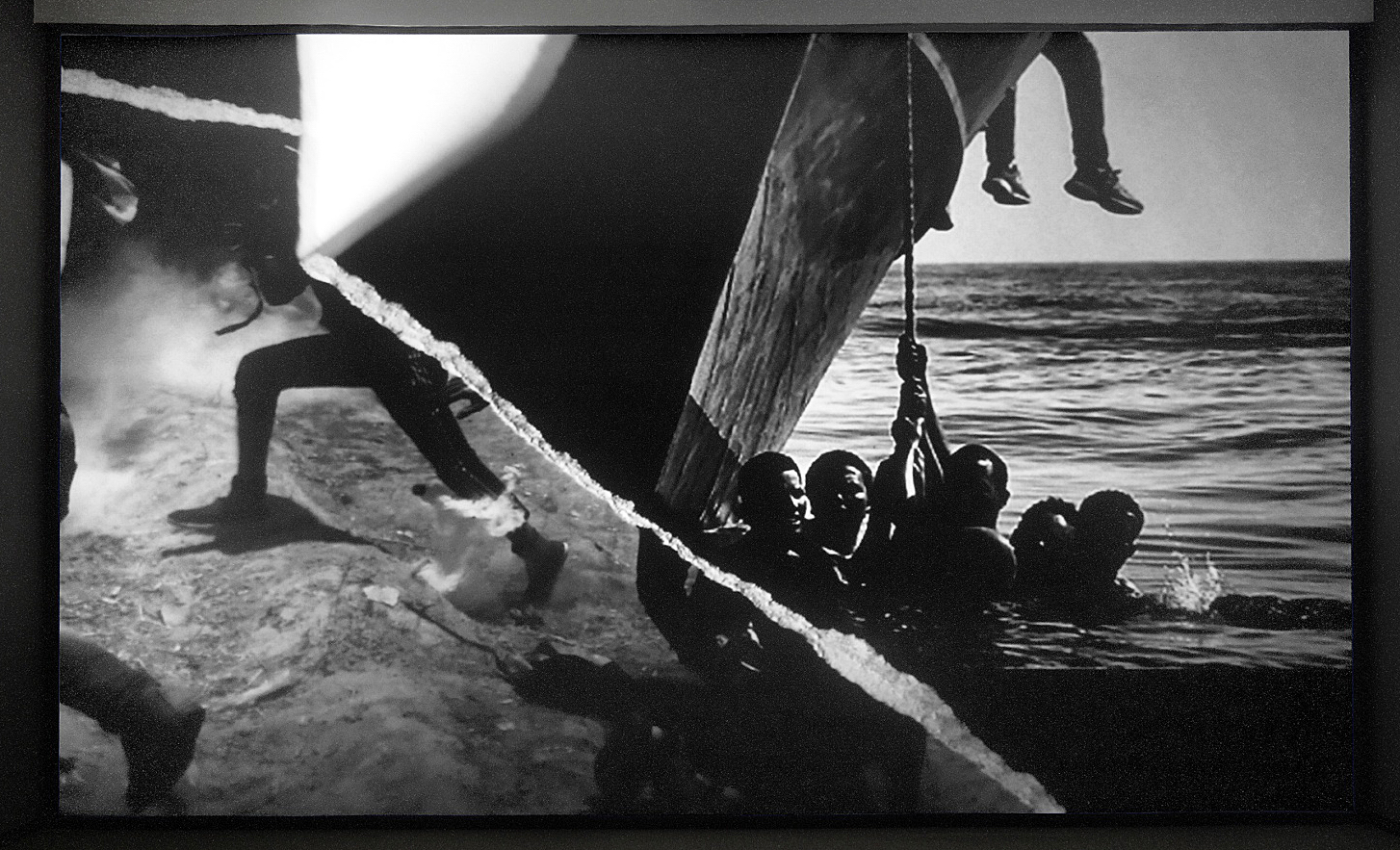
Robert Longo, Icarus Rising, Single Channel video projection, 9 minutes & 44 seconds. The Hall Collection

The video Icarus Rising from the title of the exhibition, Amerika, is the German spelling of America, where Robert Longo references the Franz Kafka novel that traces an immigrant’s journey from Germany to New York.  The nine-minute black and white video splices together images of torn paper and appears to be the artist’s first video work since the 1990s. The film features slowed footage of layers of printed photographic images, tweets, and headlines from news media being torn apart. The recorded incidental sounds of the tearing slowed in synchronization with the visuals, creating a soundtrack of groaning scrapes. The combined effect unsettlingly underscores the force, and often violence, of the actions captured in the images as well as the role the images play in shaping our world.  Sculptor, painter, and draftsman Robert Longo is well known for his bold drawings and sculptural works fusing pop culture and Fine Art. Longo attended the University of North Texas before deciding to study sculpture in New York; he later received a BFA from SUNY Buffalo.

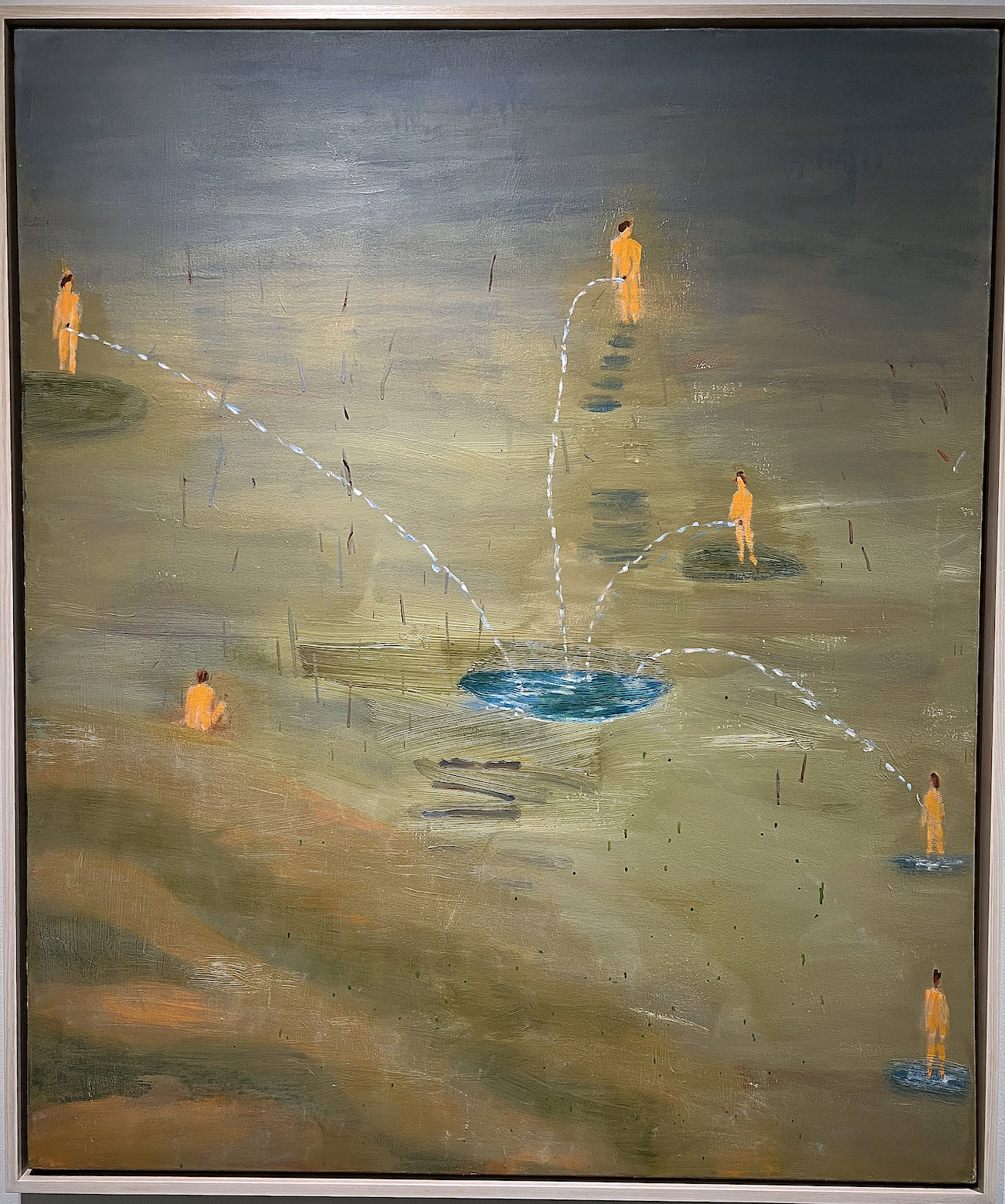
Katherine Bradford, Beautiful Lake, Oil on Canvas, 57×48″, 2009, the Hall Collection

The figurative painter, Katherine Bradford, provides this lush, color-saturated, and metaphorical lake to the Hall Collection. She combines a theatrical sense of light with an oblique narrative. The work here in Beautiful Lake is a kind of romantic realism, whimsical and spacious.  Best known for her irregular grids and rows of dots spread out and around the figures, her representational work is meditative, laconic, and poetic.  Born in 1942 in New York City, she attended Bryn Mawr College and later received her MFA from SUNY Purchase. The artist currently divides her time between Brooklyn, NY, and Brunswick, ME.

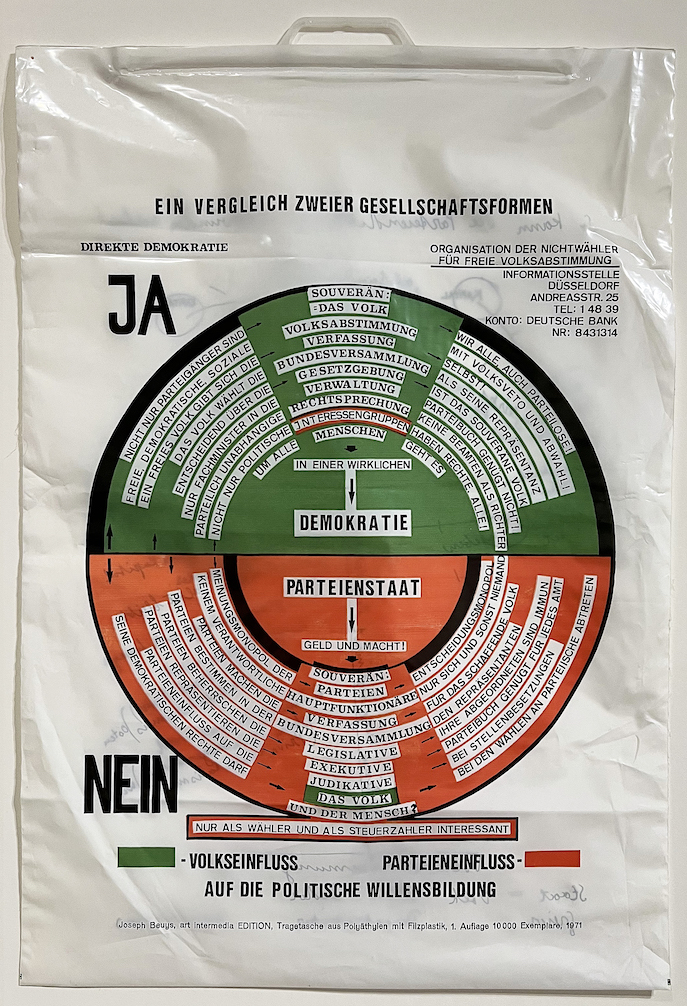
Joseph Beuys, The Dictatorship of the Parties Can be Overcome, Printed on a polyethylene shopping bag, 29.6 x 20, the Hall Collection.

Joseph Heinrich Beuys was a German artist, teacher, performance artist, and art theorist whose work reflected concepts of humanism, sociology, and anthroposophy.   He was a founder of a provocative art movement known as Fluxus and was a key figure in the development of Happenings.  The chart How the Dictatorship of the Parties Can Be Overcome was printed on a polyethylene shopping bag. It was produced by the Organization of Non-Voters Free Collective Referendum as a means by which to publicize their policies. The first diagram, which was originally hand drawn by Beuys, urges the replacement of political parties with a process of a direct referendum in German society.   Do you get the idea?  The complexity of his work is too large and long to mention here, but he says, “Only a conception of art revolutionized to this degree can turn into a politically productive force, coursing through each person and shaping history.” Joseph Beuys was born in 1921 in Krefeld, Germany, and died in 1986. After military service and time as a prisoner of war, Beuys studied sculpture at the Kunstacademie in Dusseldorf and served as Professor there from 1961 until 1972.

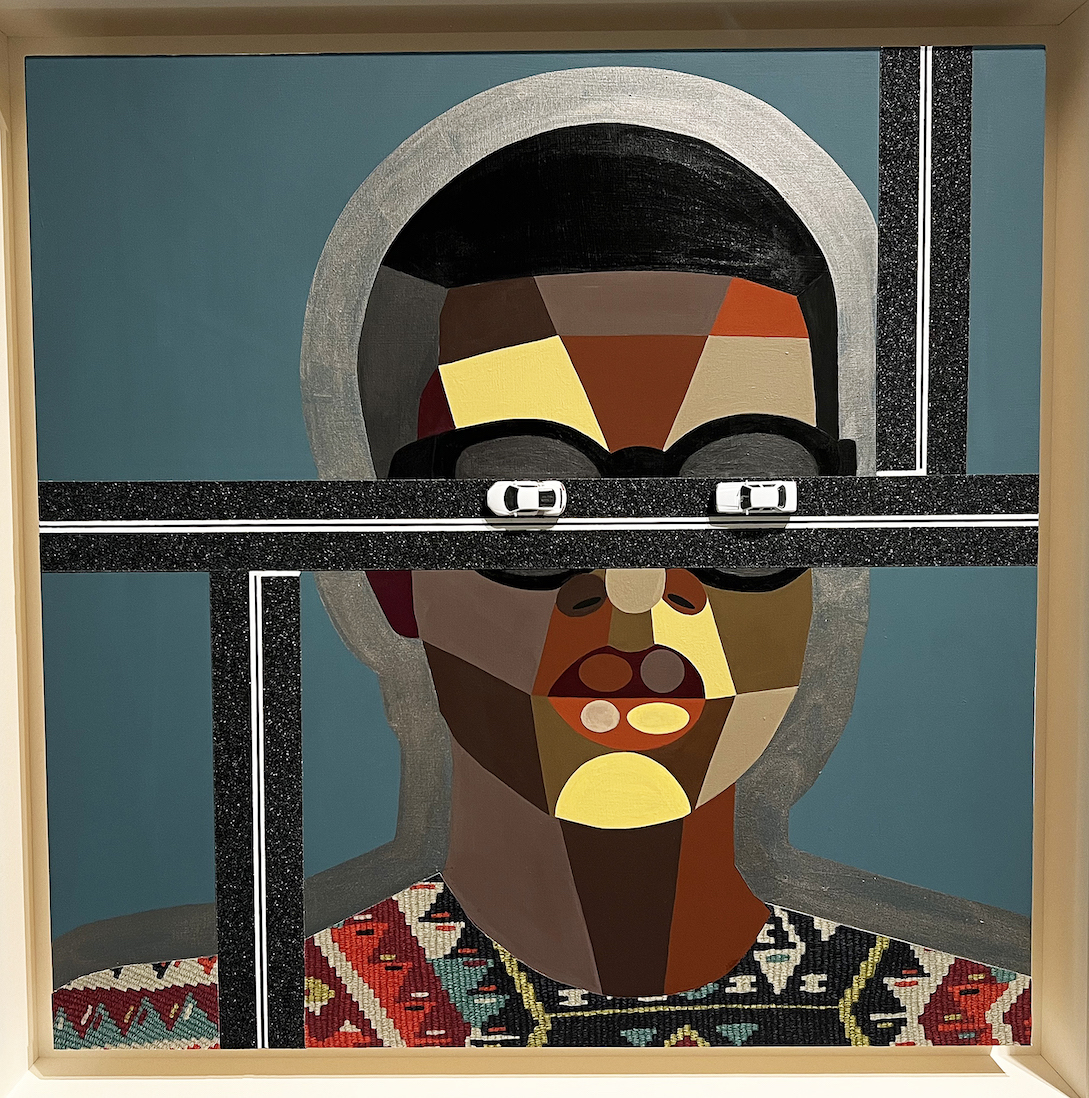
Derrick Adams, Figure in Urban Landscape, Acrylic paint and mixed media, 25 x 25″ the Hall Collection

In Figure in the Urban Landscape 40, Brooklyn-based Derrick Adams employs the tradition of portraiture to navigate and reimagine life in an urban society. On matte and painterly backgrounds of teal, silver, emerald, and integrated earth tones, two miniature model cars traverse the open, perpendicular blacktop roads that cut the ends of the composition. Adams draws inspiration from pop culture, personal memory, and neighbors; he says, “I pay attention to everything, from store windows to people in cafes talking, to people on the corner communicating. I like to think about surroundings as source materials.” Adams received his MFA from Columbia University and BFA from Pratt Institute.

Critical Voices: Selections from the Hall Collection includes artists:  Derrick Adams, Joseph Beuys, Katherine Bradford, Edward Burtynsky, Naoya Hatakeyama, Georg Herold, Barbara Kruger, Robert Longo, David Maisel, Tony Matelli, Carlos Motta, Robin Rhode, Wilhelm Sasnal, David Shrigley, Ai Weiwei.

For more than 40 years, the Oakland University Art Gallery (OUAG) has delivered diverse, museum-quality art to metro Detroit audiences. From September to May, the OUAG presents four different exhibitions – from cutting-edge contemporary art to projects exploring historical and global themes. The gallery also presents lectures, performances, tours, special events, and more.

The exhibition at OUAG  is open through November 20, 2022.


Powered by WordPress & Theme by Anders Norén