Critical art reviews of Detroit galleries and museums weekly

Author: Ron Scott Page 33 of 35

The 56th International Venice Biennale through Detroit Eyes

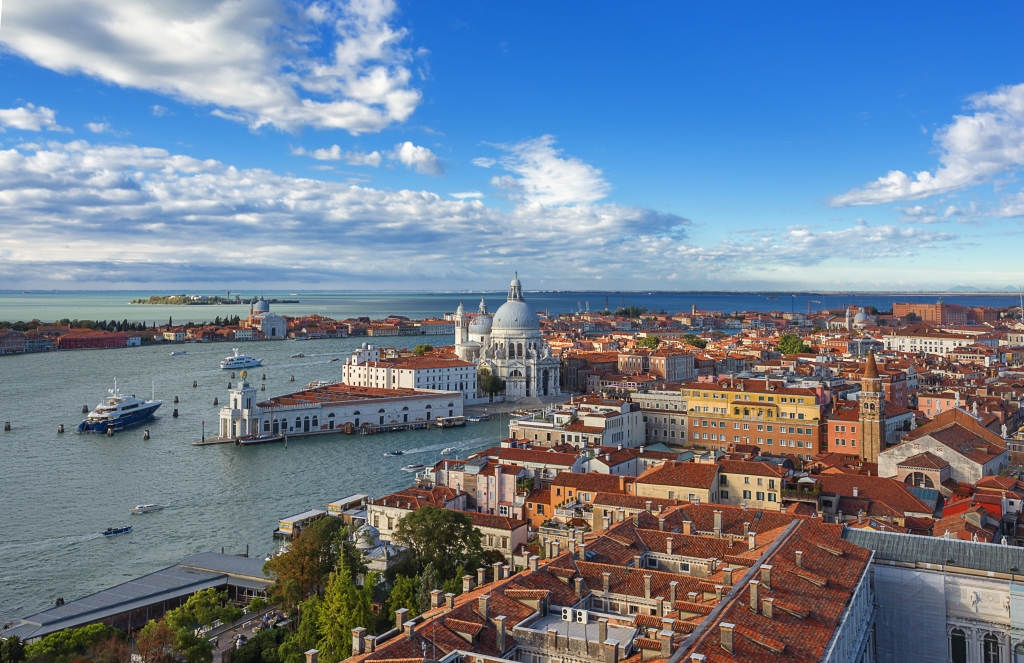
Venice overview image

Venice overview Image, Courtesy of the Venice Biennale

There is a mystique about the Venice Biennale, partly because of its age, (it was established in 1895) and partly because of its location in the Giardini area of Venice, Italy. By 1910 it exhibited artists like Renoir, Klimt, Courbet and Picasso. Over the years it has diversified beyond art to include film, architecture, dance and music. For the purpose of this piece, I will comment on the art exhibition at the Arsenale, but there are exhibits at Giardini and throughout Venice.

The 56th International Venice Biennale celebrates its 120th birthday with 136 artists from 53 countries around the world. The curator of this year’s Biennale, All the World’s Futures, is Okwui Enwezor, a Nigerian curator, art critic and writer specializing in history. He lives in New York and Munich and, in 2006, received the Frank Jewett Mather Award for art criticism from the College Art Association.

To write a review of the 56th Biennale as a whole would be lengthy, exhaustive and near impossible, so I will confine my remarks to work at the Arsenale that exhibited over a hundred works of art in a decommissioned warehouse once used by the Navy (to build ships, I assume). The Arsenale would easily be four or five football fields long and 200 feet wide. From that experience, I have selected ten artists to mention, based on my interest and curiosity. From the opening section that was dominated by Bruce Nauman’s neon pieces, rather simple works that simulate a restaurant sign in the window, to the entire section three devoted to Katharina Grosse’s Color Riot, which was an enormous room filled with spray painted dirt and cloth. There are many pieces like Color Riot, conceptual and installation works, that I do not have either the context or familiarity with to comment on.
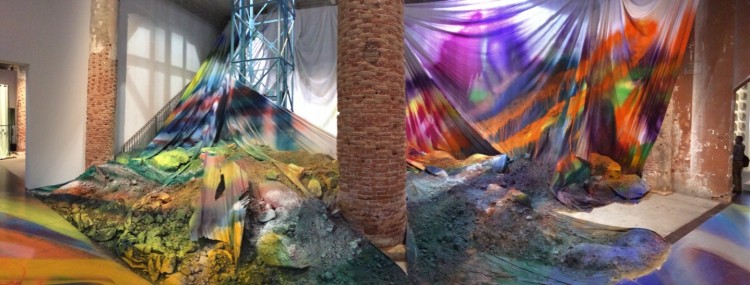
Color Riot 2

Katharina Grosse, Untitled Trumpet, 2015 – Germany
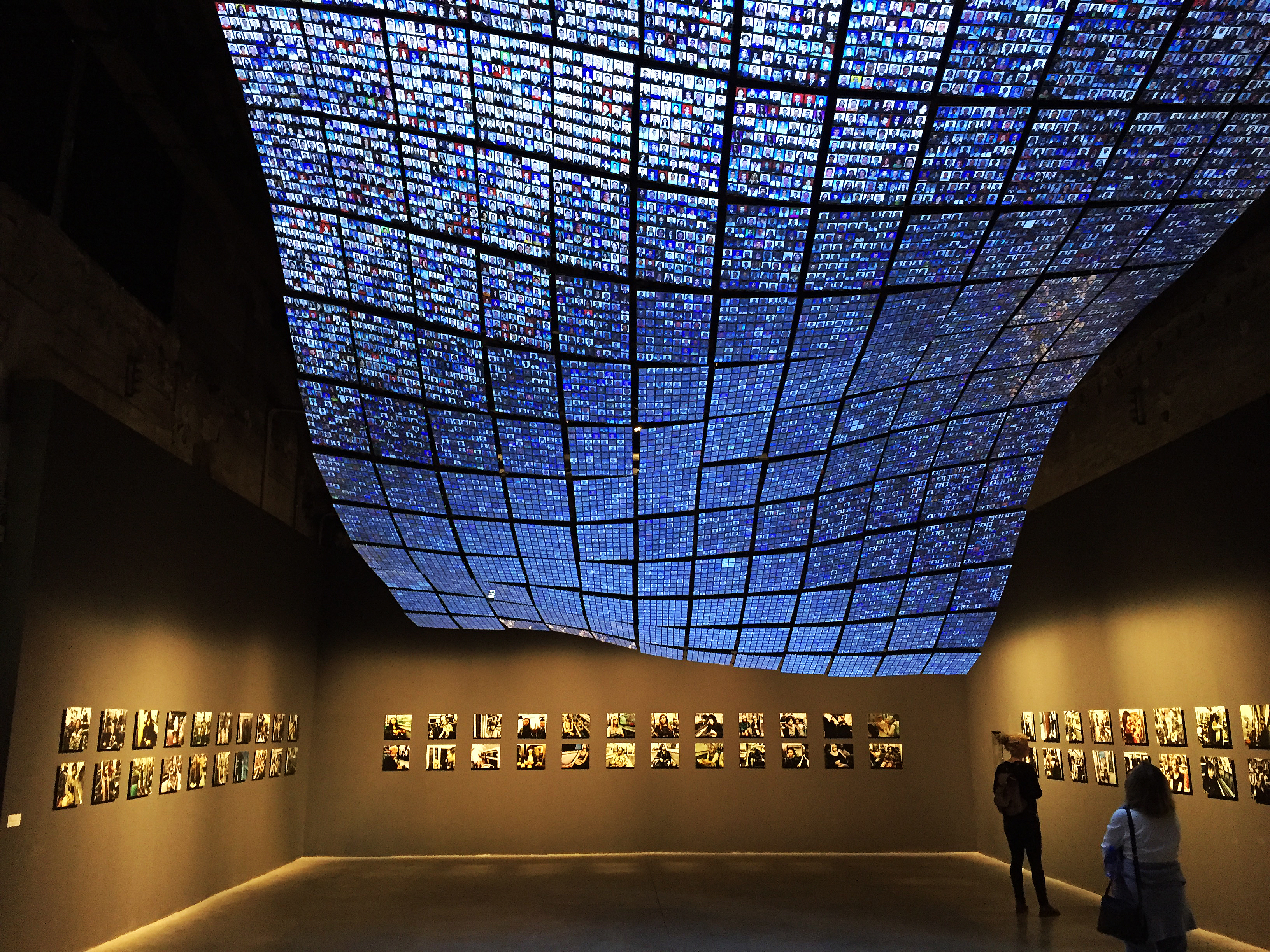
 

Chris Marker Passengers, France 2011

Chris Marker, Passengers, 2011 – France


One of the most breath-taking moments in the Biennale was the work of the late French artist, Chris Marker (1921 – 2012) and his photographic installation, Passengers, 2011. The 134 color photograph images around the perimeter of the room are of anonymous people from the Paris Metro and include small, ever-changing LCD images from above. In Passengers, Marker tracks his Parisians and captures them in an unguarded way, often looking for imagery that reminds him of images found in art history.
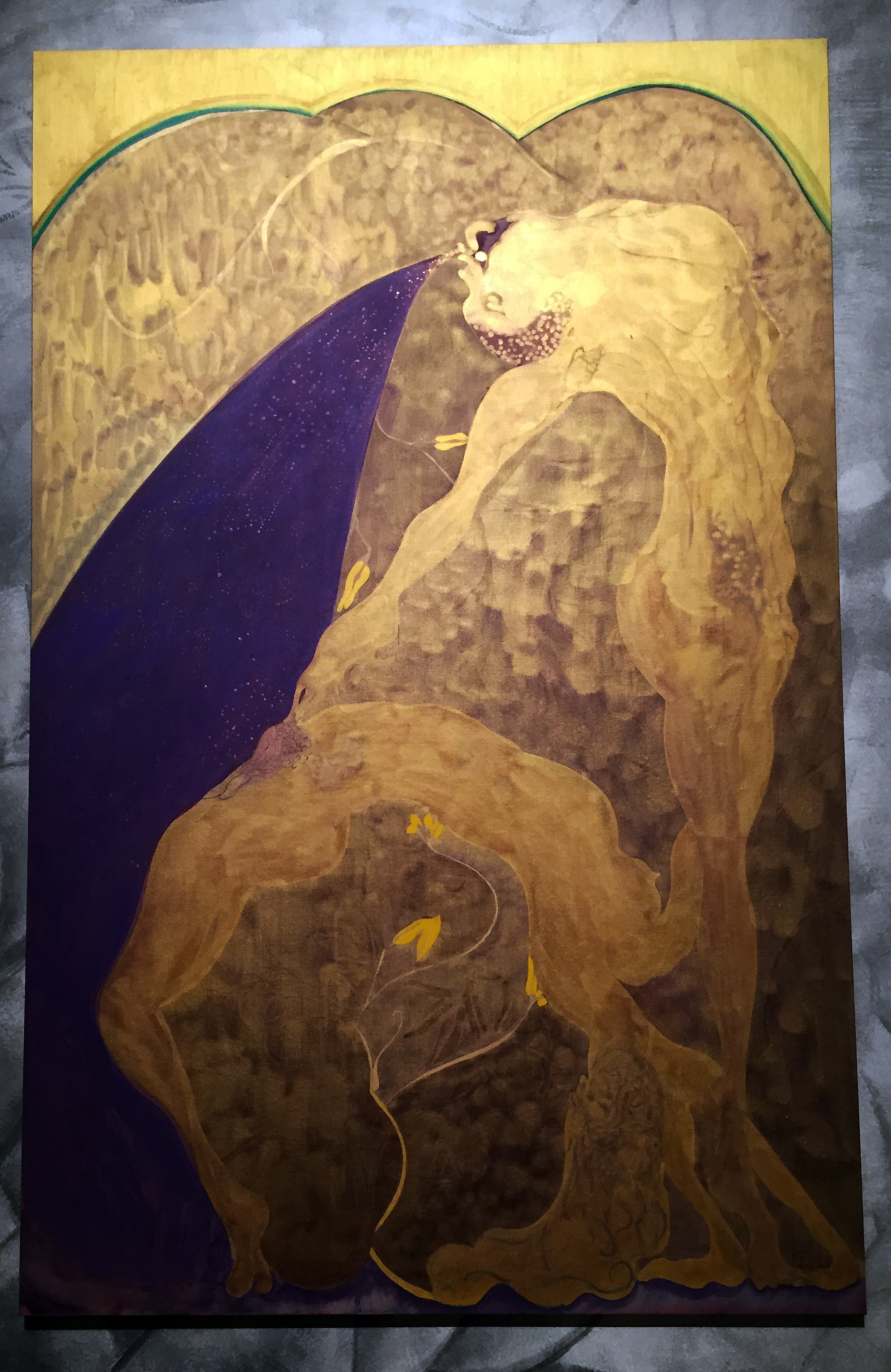
Chris Ofili, UK, 2015 Bending Over for Justice & Peace

Chris Ofili, Bending Over for Justice and Peace, 2015 – Great Britain

Having seen the solo exhibition Night and Day at the New Museum in NYC, November 2014, it was not surprising to see Chris Ofili’s work at the Biennale representing Great Britain. The vibrant and technically complex work enlists sexual, cultural, historical and religious references. His subject matter challenges and reinterprets racial stereotypes. Represented by the David Zimmer Gallery in New York City, his work often exposes the darker undercurrents of society. His M.F.A. was completed in 1993 at the Royal College of Art, and he won the prestigious Turner Prize in 1998. Bending Over for Justice and Peace, Ofili presents a staggeringly mysterious painting with flowing patterns around two inverted figures. The London-born, Trinidad-based artist presents four paintings in this year’s Biennale.
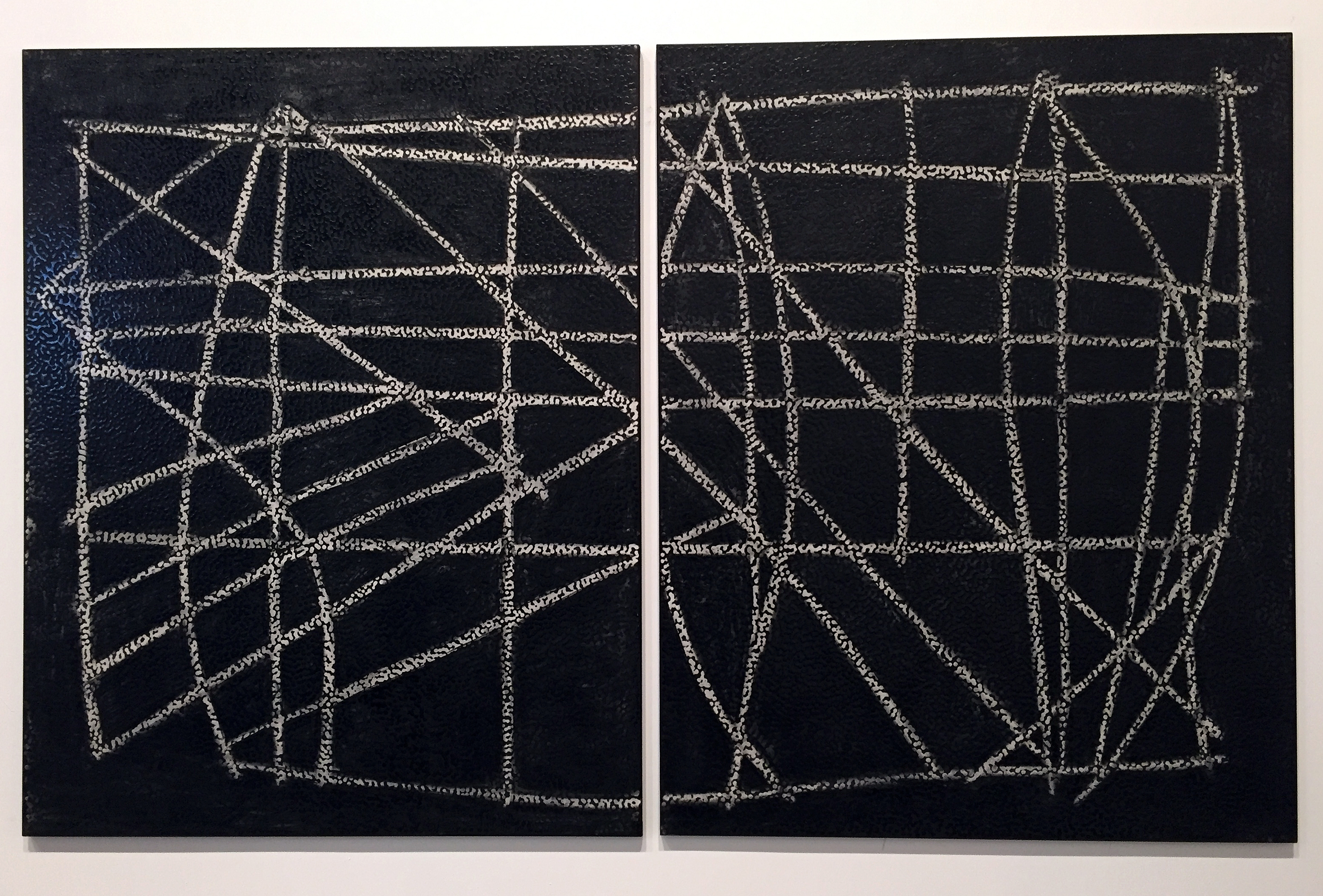
Daniel Boyd Austalia

Daniel Boyd, Untitled Diptych, 2014 – Australia

A young indigenous Australian artist, Daniel Boyd provides a fresh abstract interpretation of line and space to this year’s Biennale. Counter to his earlier figurative work in which he explored the relationship between the aboriginal people and the British Empire, he has moved to abstraction with the same methods except filters out color and focuses on interconnected space. The lively compositions are comprised of a dotted, intense surface that engages the viewer in the overall matrix.
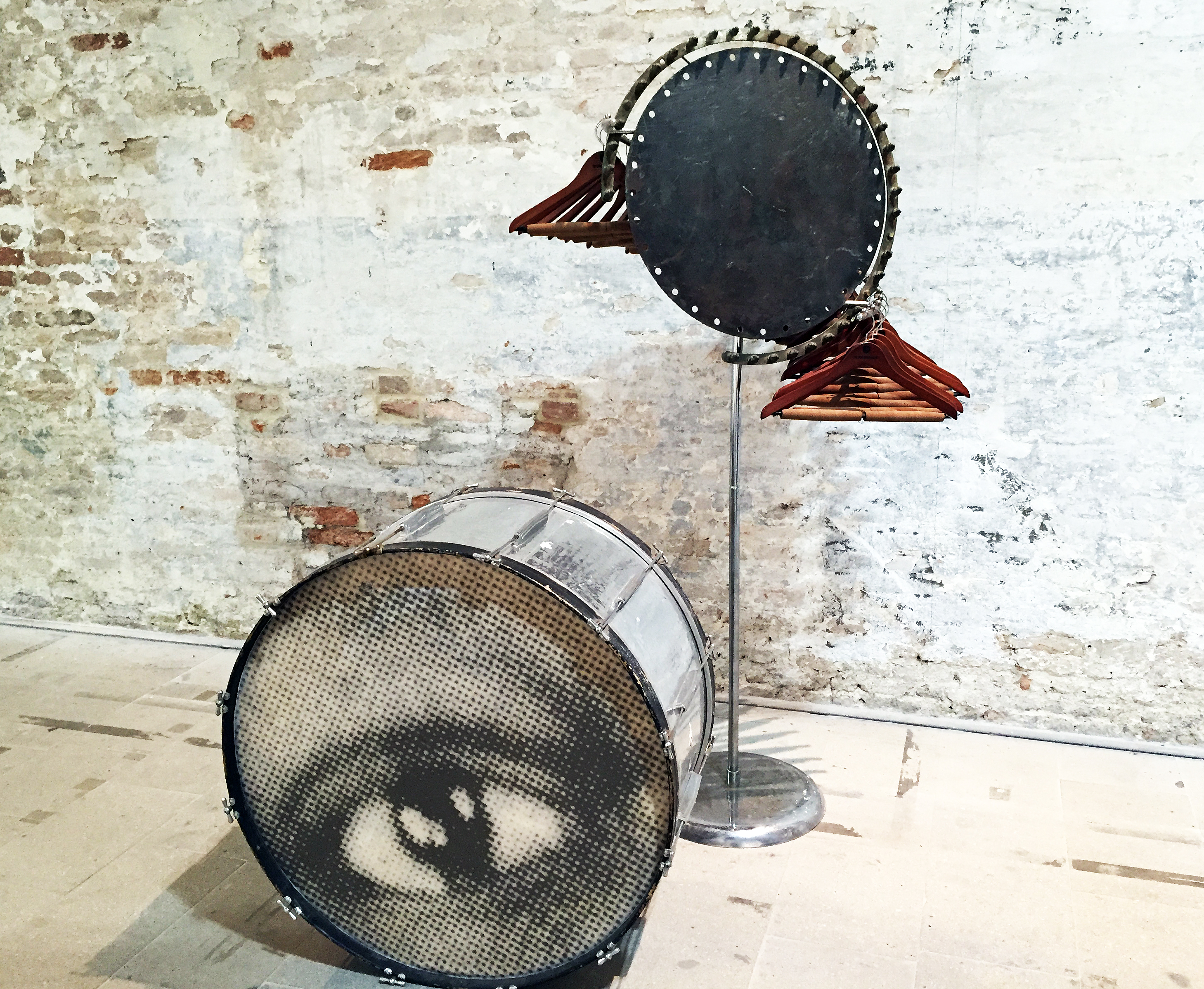
Terry Adkins USA

Terry Adkin, Matinée, 2007-2013 – Bronze, steel, hangers, burnt cork – USA


The late artist, Terry Adkins (1953 – 2014) was a professor at the University of Pennsylvania and was born in Washington, D.C. A musician and multi-media artist, his work explores historical figures and acts from Beethoven to Hendrix. His work Matinee at the Biennale approaches the art-making process from the viewpoint of the composer over a lifetime that was shortened in 2014 when he died of heart failure. His work has been arranged as sculpture, video and photography where he modifies musical instruments that are repurposed as objects.
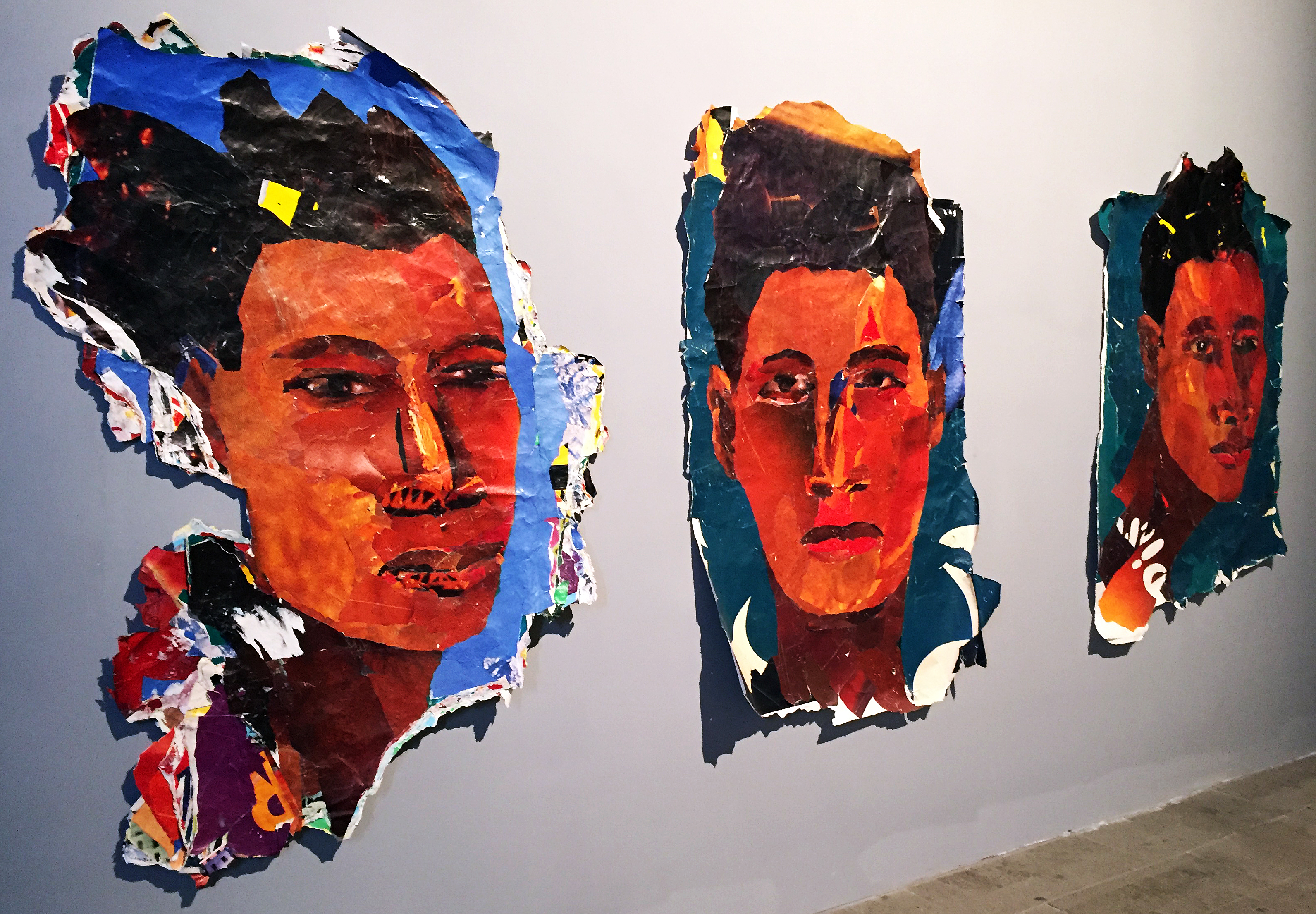
Kay Hassan, South Africa, Untitled 2015 Paper construction

Kay Hassan, Untitled, 2011, Paper – South Africa

Born in Johannesburg, South Africa in 1956, Kay Hassan is best known for his pieces of printed billboard posters but also works with painting installation and video. His themes have always revolved around migration, dispossession and urban life. Growing up as a child in Soweto, he witnessed the constant flight of South Africans as apartheid policies forcibly took peoples’ land. The mural-sized work depicts townspeople on the run. His techniques of deconstructing and constructing are realized fully on close inspection when it is clear that the work was made up entirely of disregarded paper.
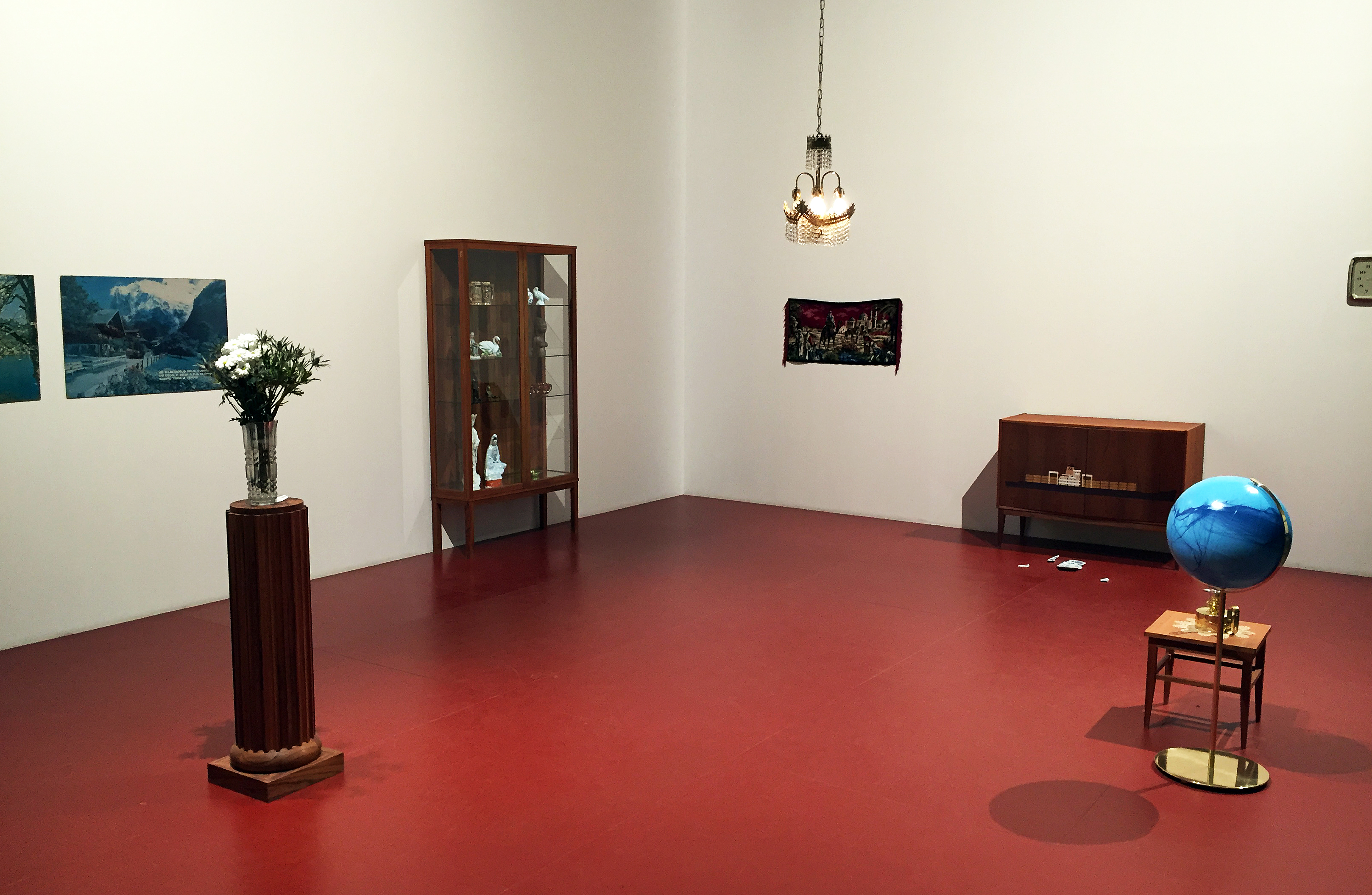
Meric Algun Ringborg Turkey, Souvenirs for the Landlock 2015 Installation

Meric Ringborg, Souvenirs for the Landlocked, Installation, 2015 – Turkey

Meric Ringborg was born in Istanbul, Turkey in 1983 and now lives in Stockholm. Her ready-made installation, Souvenirs for the Landlocked, is a large room reconstructed in Section 6 with objects that have a particular meaning for her. The installation is typical of her earlier work in that it takes a group of sculptural works and places them in a domestic-like room space environment. In her narrative she writes about her grandfather’s maritime travels, from which he would bring objects from all parts of the world. Each object in the installation carries with it a special meaning that reveals a type of interconnectivity. Ringborg did her graduate work at Royal Institute of Art, Stockholm, and she says in her statement, “Souvenirs are representative of what ‘has been seen’ and thus echo a highly subjective sight, much like photographs; albeit contrary to an image they are sculptural representations of experiences, markers of the transference from event to memory.
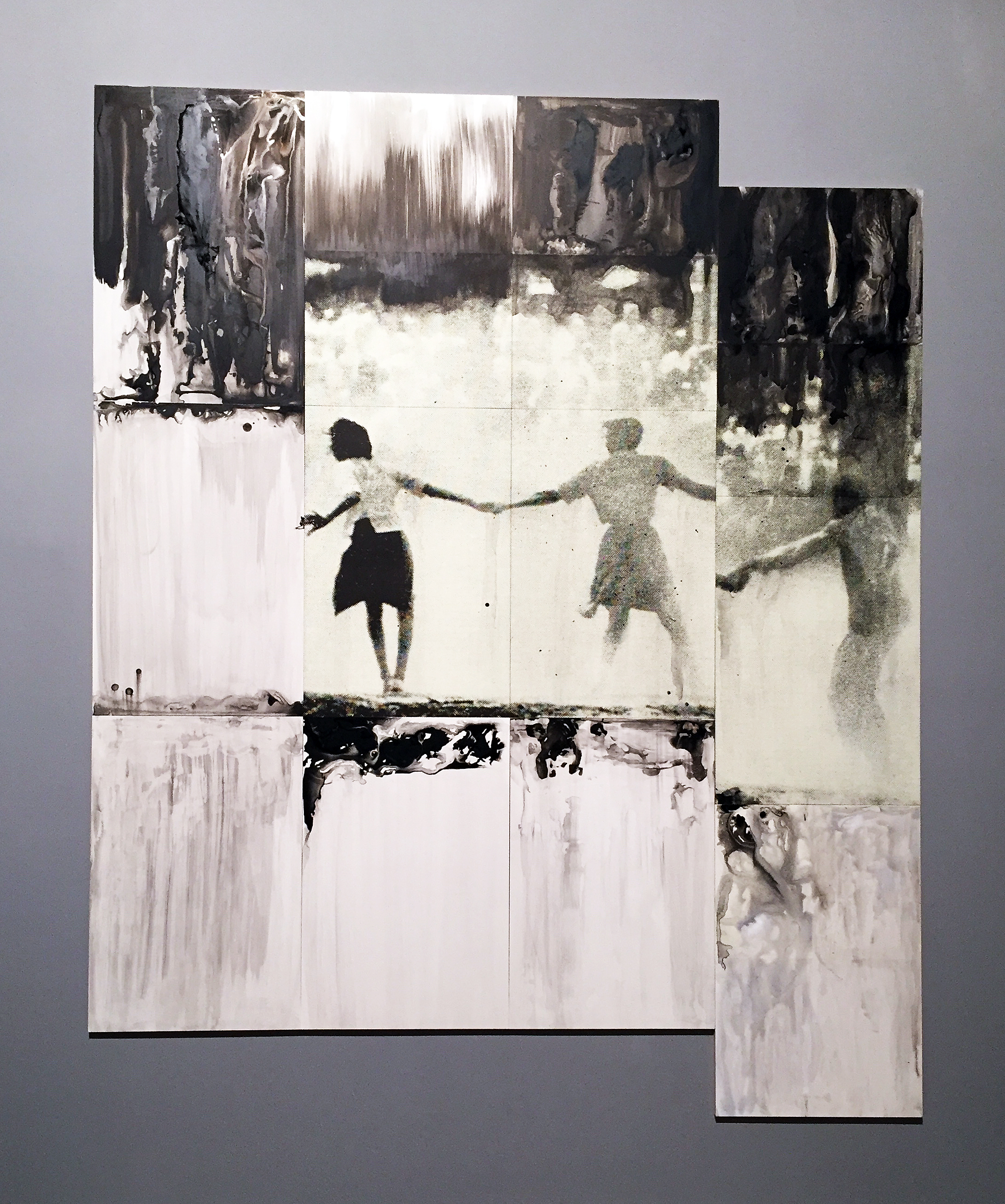
Lorna Simpson, US Three Figures, 2014 screenprint on Clayboard

Lorna Simpson, Three Figures, Ink & Screen-print on Claybord, 2014 – USA

The artist Lorna Simpson is represented at the Biennale with figure paintings and her photo-silkscreen, Three Figures. Her early work was as a street photographer where she reflected her feeling about race, society and multiculterism. She came of age during the early 1980’s after a generation of black power and the civil rights movement. Eventually she began to question the truth these supposedly objective photographs revealed and shifted to conceptual photography, which focuses on the idea, rather than the end product. She completed her M.F.A. in 1985 at the University of California and now lives and works in Brooklyn, New York.
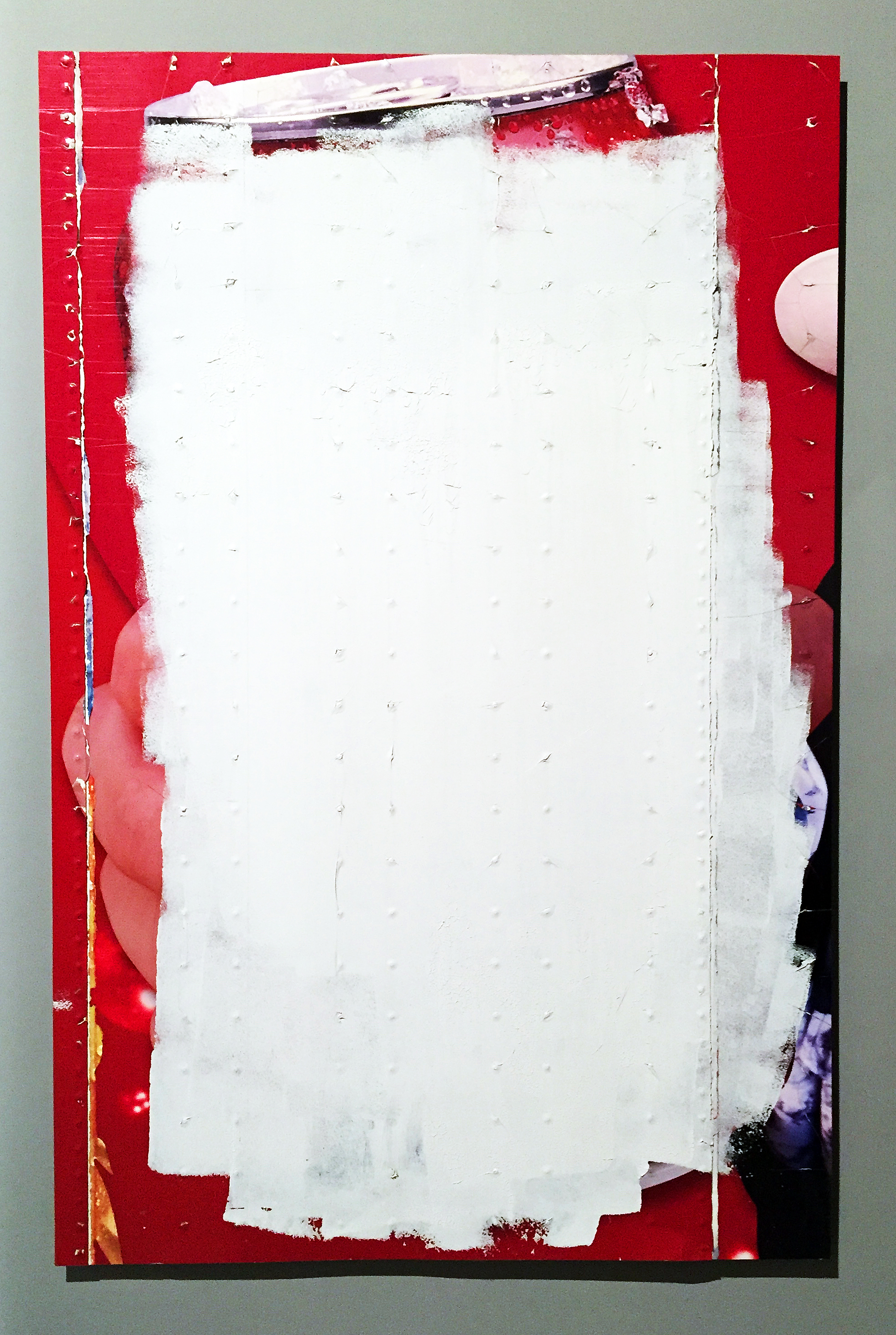
Gedi Sibony US Trident, 2015

Gedi Sibony, U.S. Trident, – USA

Born in New York in 1973, Sibony received his M.F.A. from Columbia University in 2000. His paintings draw on minimalism in a kind of pared down aesthetic. In the painting Trident, he uses a self-contained object, here a riveted piece of a ship or plane part. He has used cardboard, wood, and plastic sheeting, in a kind of simple style focusing on color and composition. Sibony has the ability to elevate this ready-made work to a kind of poetic beauty. He says in his statement, “I want to convey a kind of discovery by moving through things the way allegory incorporates various energies in a harmonious environment. This might be understood as an alignment of symbolic thinking and material tactility.”
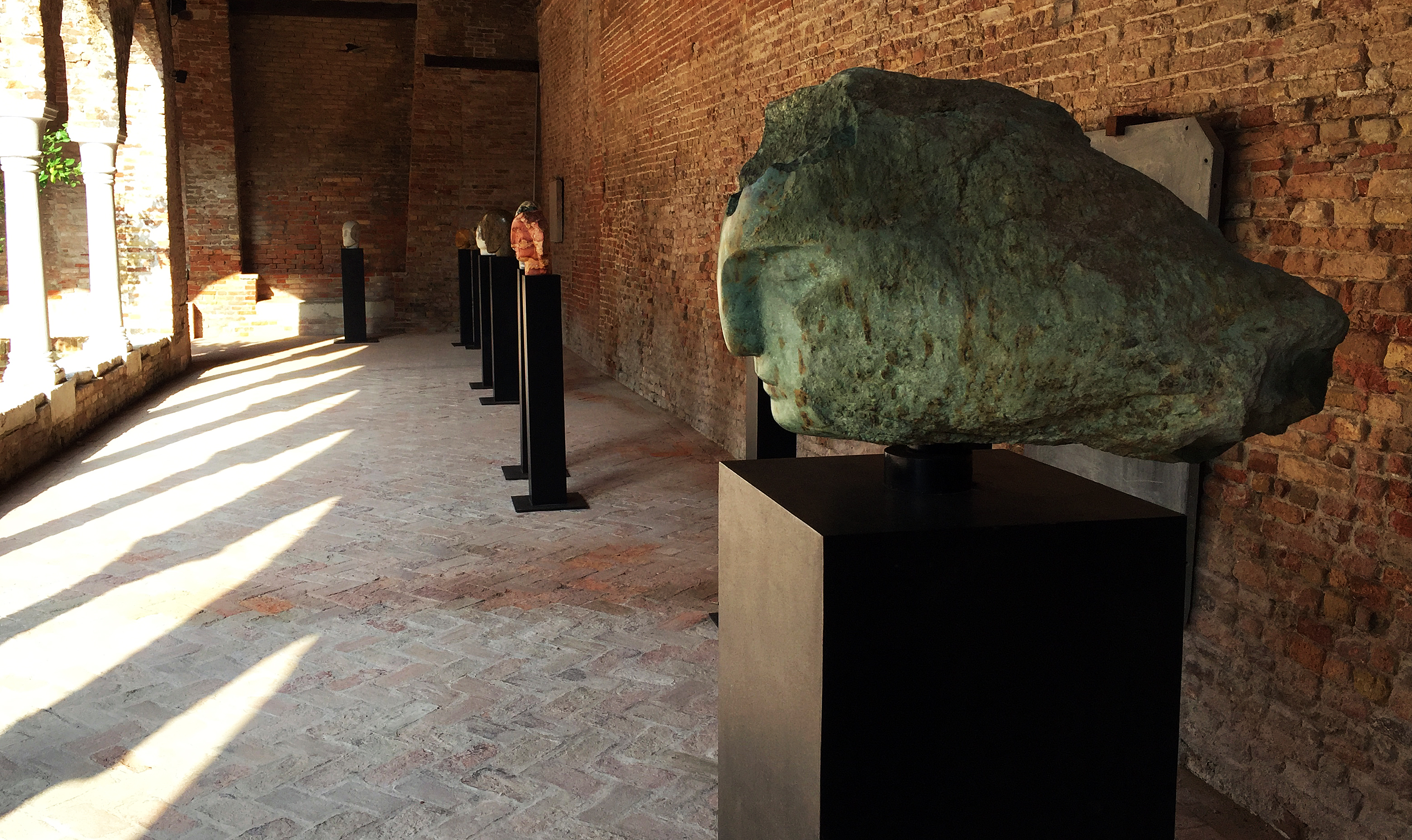
Rudra

Emily Young, Fufluns, Rouge de Vitrolles Marble, Great Britain – 2015

Additionally, I would like to mention an artist whose work was not on exhibit at the Biennale. Instead, sculptor Emily Young’s Call & Response was on display at the cloister of Madonna dell’Orto church in Venice. Using rock from quarries near her studio in the Etruscan hills, Young’s work fuses the age-old principles of stone carving with a progressive, widely informed approach to form and composition. The contemporary and ancient are united in these sculptures, creating a rare and poetic presence.

So how does an artist, say, from Detroit, get their work accepted into the 56th International Venice Biennale? Well, I am not sure I have the answer to that question because what you come to realize is that the answer lies between the published lines. There are eligibility requirements: You must be a U.S. citizen and come from a non-profit museum, school, gallery or visual art organization. An advisory committee convened by the National endowment for the Arts and composed of curators, museum directors and other curatorial experts reviews proposals. You don’t send off your images in an application. And it is written that you don’t submit a proposal without first discussing your project with the Cultural Programs Division of the U.S. State Department. Translation: You have be connected. To be selected as the curator of the Venice Biennale, you probably have to walk on water.

The 56th International Venice Biennale, All the World’s Futures,was curated by Okwui Enwezor, organized by la Biennale di Venezia and chaired by Paolo Baratta. The exhibition opened at the Giardini della Biennale and at the Arsenale to the public on Saturday, May 9th, and will close November 22nd, 2015. The awards ceremony and the inauguration took place on Saturday May 9th, 2015.


30 Americans @ the Detroit Institute of Arts

30A-artists-group

Photo Credit: Kwaku Alston

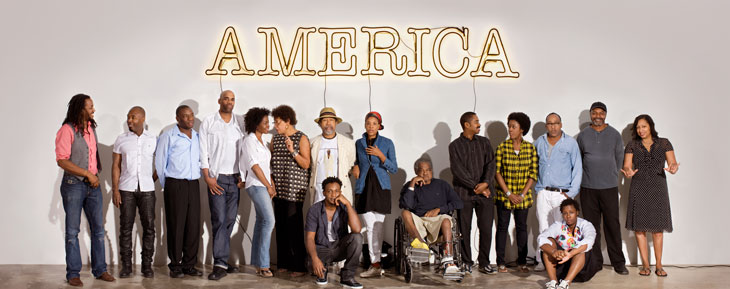
The new director of the Detroit Institute of Arts (DIA), Salvador Salort-Pons, took the podium and introduced the new 30 Americans exhibition with relaxed confidence. The selection and planning for this exhibition had begun more than a year ago when he was head of the European Department at the DIA since 2008. With a Ph.D. in art history and a MBA with a focus on finance and strategy, he comes to the museum directorship with an additional strength: sound business sense. His time at the podium was brief, but I sensed a transitional moment for the museum and the larger Detroit community.

30 Americans is an important exhibition, extremely well curated, designed, and at the right place and time for the City of Detroit. It reminded me of how I felt at the opening of the Shirin Neshat exhibition, March 2013, when the DIA hosted her mid-career retrospective and simultaneously reached out to the community, educating people on Islamic art. 30 Americans is similar in how it will educate the Detroit community by showcasing some of the most talented African-American artists in the United States today. In the 2010 census, 82% of people living in Detroit responded as African American.

“30 Americans powerfully demonstrates contemporary African American artists’ interests in the complexities of identity and developing a range of artistic approaches to portray or reference its distinctions and similarities,” said Valerie J. Mercer, DIA curator.

The exhibition comes from the well-known Rubell Family Museum in Miami, Florida. It is one of the world’s largest, privately-owned Contemporary Art collections, and the first time this work will be on display at the DIA. Each year, Rubell creates thematic exhibitions drawn from its collection, “We only show art we own. That is a founding principle of the Rubell Family Collection, a principle that gives us tremendous freedom and enormous constraints. When we set out to conceptualize a new exhibition, we know we will only get the depth and quality we seek if we already have a strong foundation of works by a core group of artists.”

image-357Wiley-Kehinde_Equestrian_Portrait

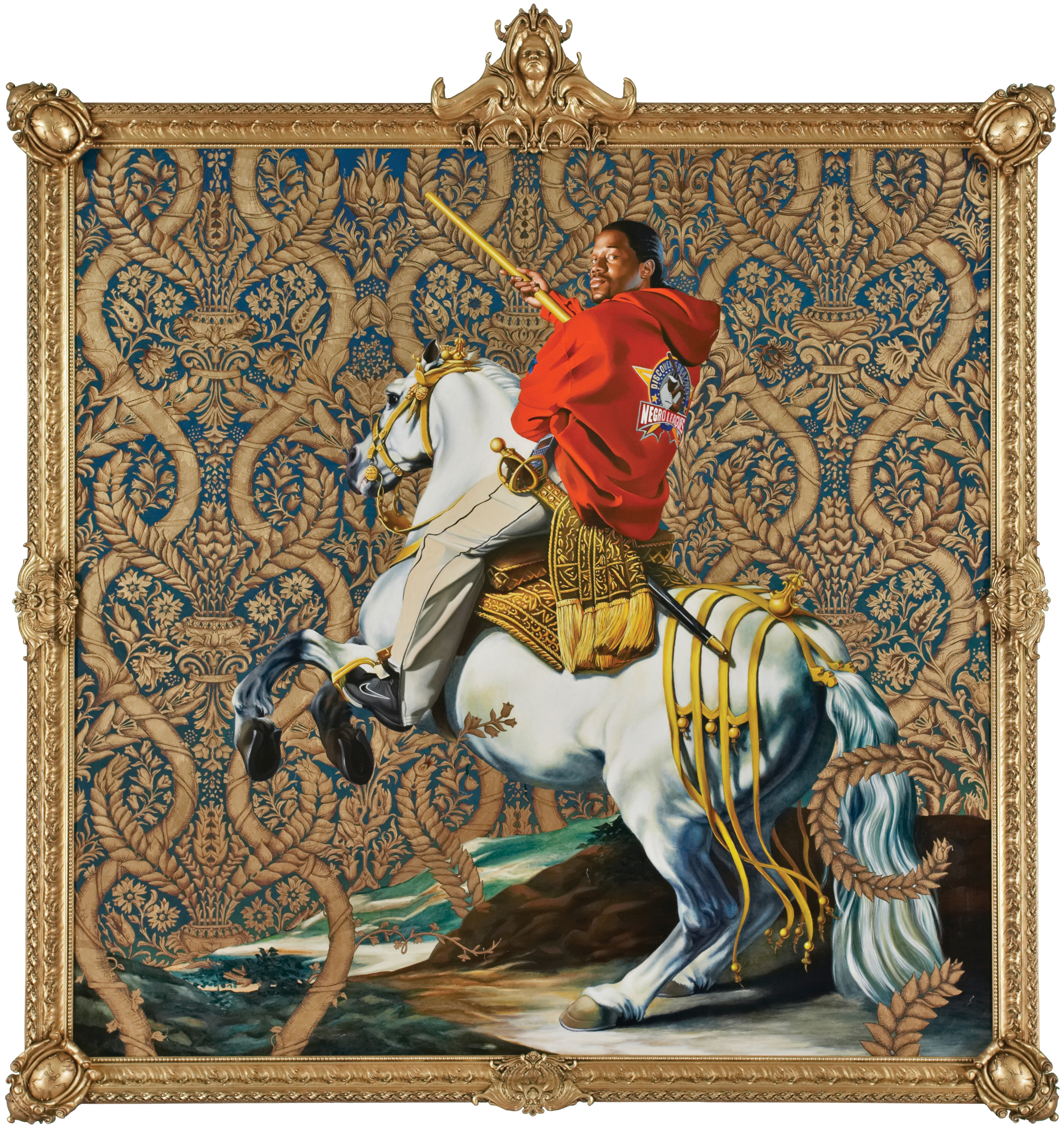
Kehinde Wiley, Equestrian Portrait of the Count Duke Olivares – 2005, oil on canvas. Courtesy of Rubell Family Collection, Miami


The most well-known artist in the exhibition is Kehinde Wiley, whose work dominates the show with three large paintings. The painting, Equestrian Portrait of the Count Duke Olivares, depicts a young black male figure in hip-hop clothing, set against a rich floral background. Based on the Spanish artist Diego Velazquez’s painting from 1634, Wiley engages in a type of surreal photorealism on a grand scale of 366 by 366 inches. He braids his foreground and background together, creating a picture plane tension. As a boy growing up in Los Angeles, he spent his time looking at historical paintings at the Library in San Marino, CA. He earned his undergraduate degree from San Francisco Art Institute and his M.F.A. from Yale in 2001.

image-359Wiley-K_Sleep

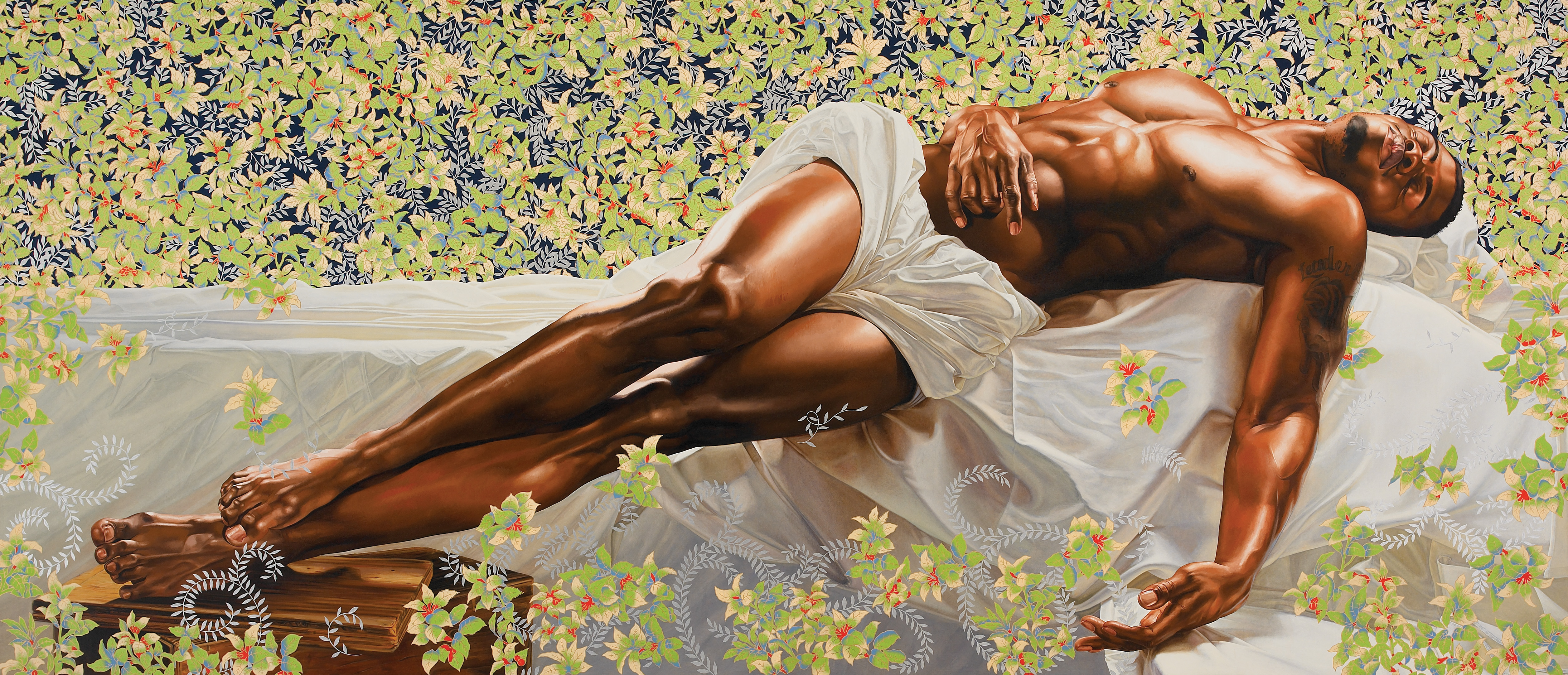
Kehinde Wiley, Sleep, 2008, oil on canvas. Courtesy of Rubell Family Collection, Miami

As you enter the second room, you are met with Sleep, a 132 X 300-inch monster-sized figure painting, part of his series of reclining erotic figures. Here again, his use of British Arts & Crafts designs in the background also enters the foreground in what has become a consistent element in his work. At times, it reminds me of paintings of Christ after he was taken down from the cross. Wiley’s signature portraits of street people designed around specific historical paintings seem to draw attention to the absence of African American people from Western cultural narratives. Like this work or not, he is a major force in contemporary art in American painting today.

image-355Thomas-Mickalene-Baby_I_AM_Ready_Now-2007

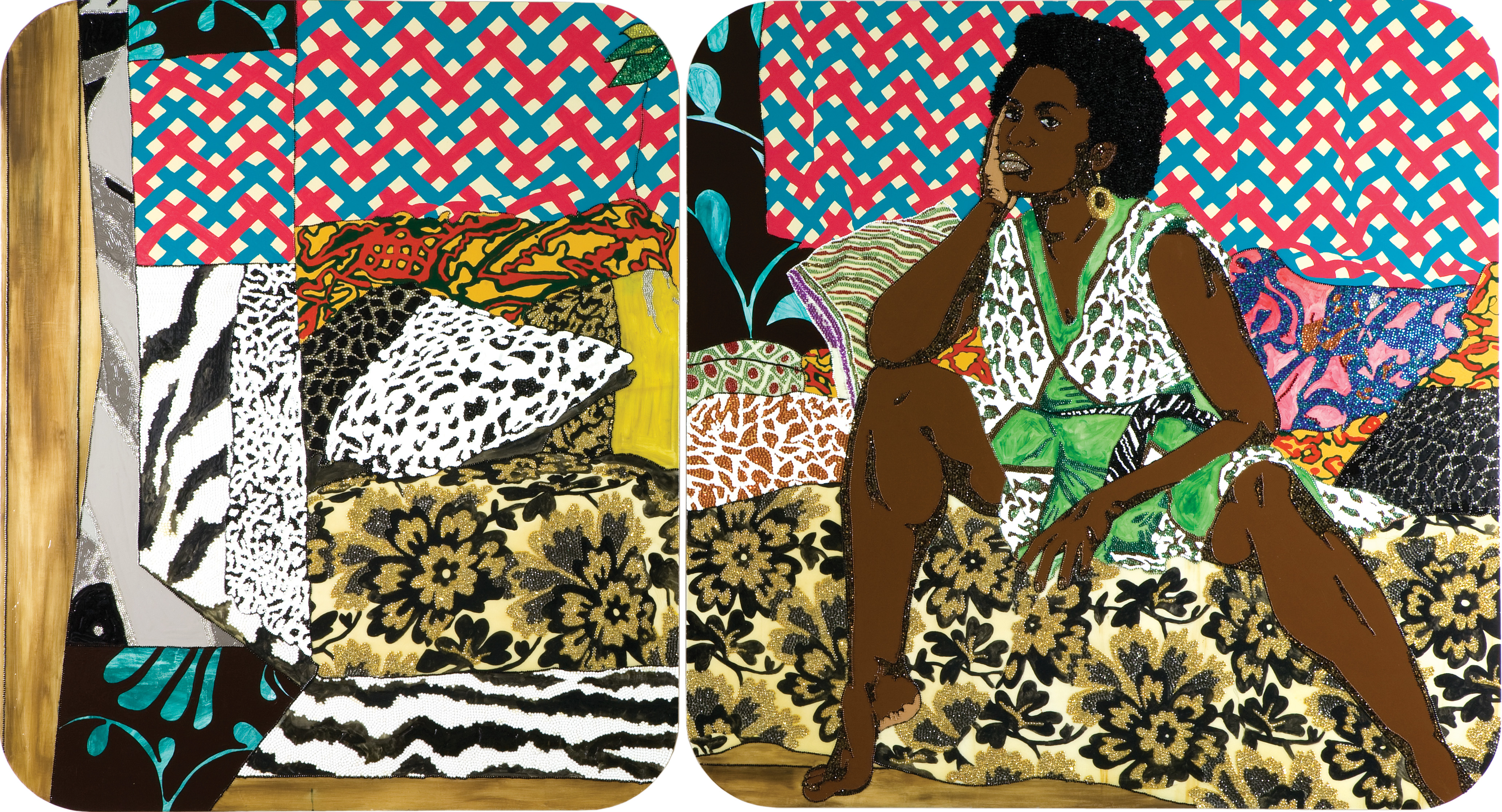
Mickalene Thomas, Baby I Am Ready Now – 2007, acrylic, rhinestone and enamel on wooden panel. Courtesy of Rubell Family Collection, Miami

The irrepressible Mickalene Thomas is comparable to Wiley in her weight and influence on the American art scene. The New York-based artist is known for her elaborate and complex work that often has a sexual overtone. She may be presenting what she thinks it means to be a black woman regarding a kind of cultural stereotype. The paintings are often composed using patterns, enamels, acrylic, and rhinestones and usually present a provocation. Her painting, along with the title, seems to bait the viewer. These round corners were a favorite of hers back in the mid 2000’s, but the new work has moved forward with a kind of spin on Picasso’s figurative Cubism. Check out: She Ain’t a Child Anymore #2, 2015.

image-339Basquiat-JM_OneMillionYen

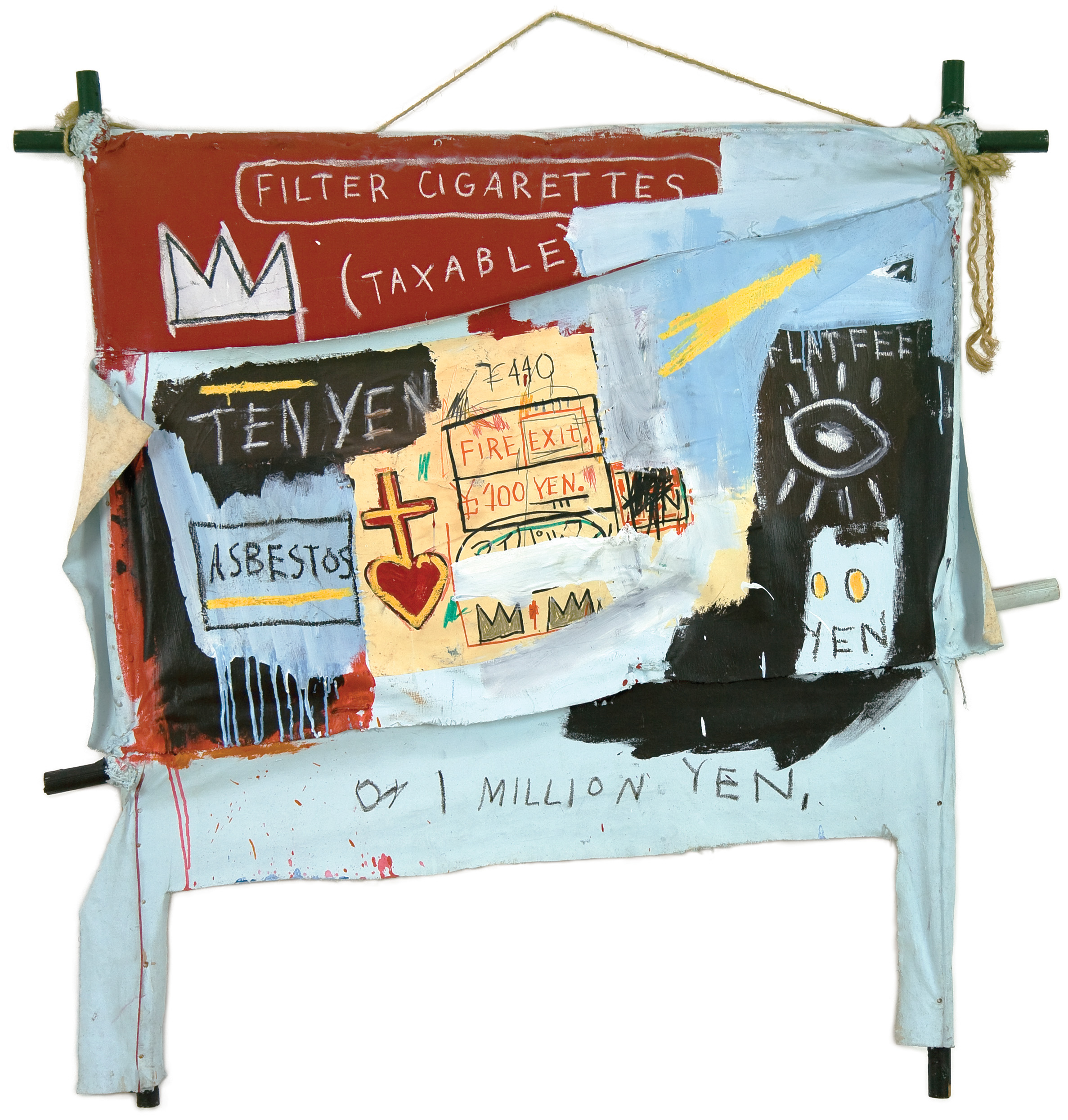
Jean-Michel Basquiat, One Million Yen – 1982, oil on canvas with wood and jute. Courtesy of Rubell Family Collection, Miami

More familiar to audiences is Jean-Michel Basquiat. The late American artist achieved notoriety during the 1980s when he was part of the Andy Warhol and Keith Haring scene in New York City. Born in Brooklyn, Basquiat was half Puerto Rican and half Haitian and has been described as a precocious and gifted child. Kellie Jones, who wrote Lost in Translation: Jean-Michel in the (Re) Mix says, “Basquiat’s cannon revolves around single heroic figures: athletes, prophets, warriors, cops musicians, kings, and the artist himself. In these images the head is often a central focus, topped by crowns, hats and halos. In this way the intellect is emphasized, lifted up to notice, privilege over the body and physicality of these figures (i.e. black men) commonly represented in the world.”

The Rubell piece, One Million Yen, from 1982 creates one of his “dichotomies” utilizing social commentary that attacks a power structure, while at the same time imparting a strong Neo-expressionist composition using mixed media material.

Duck, Duck, Noose

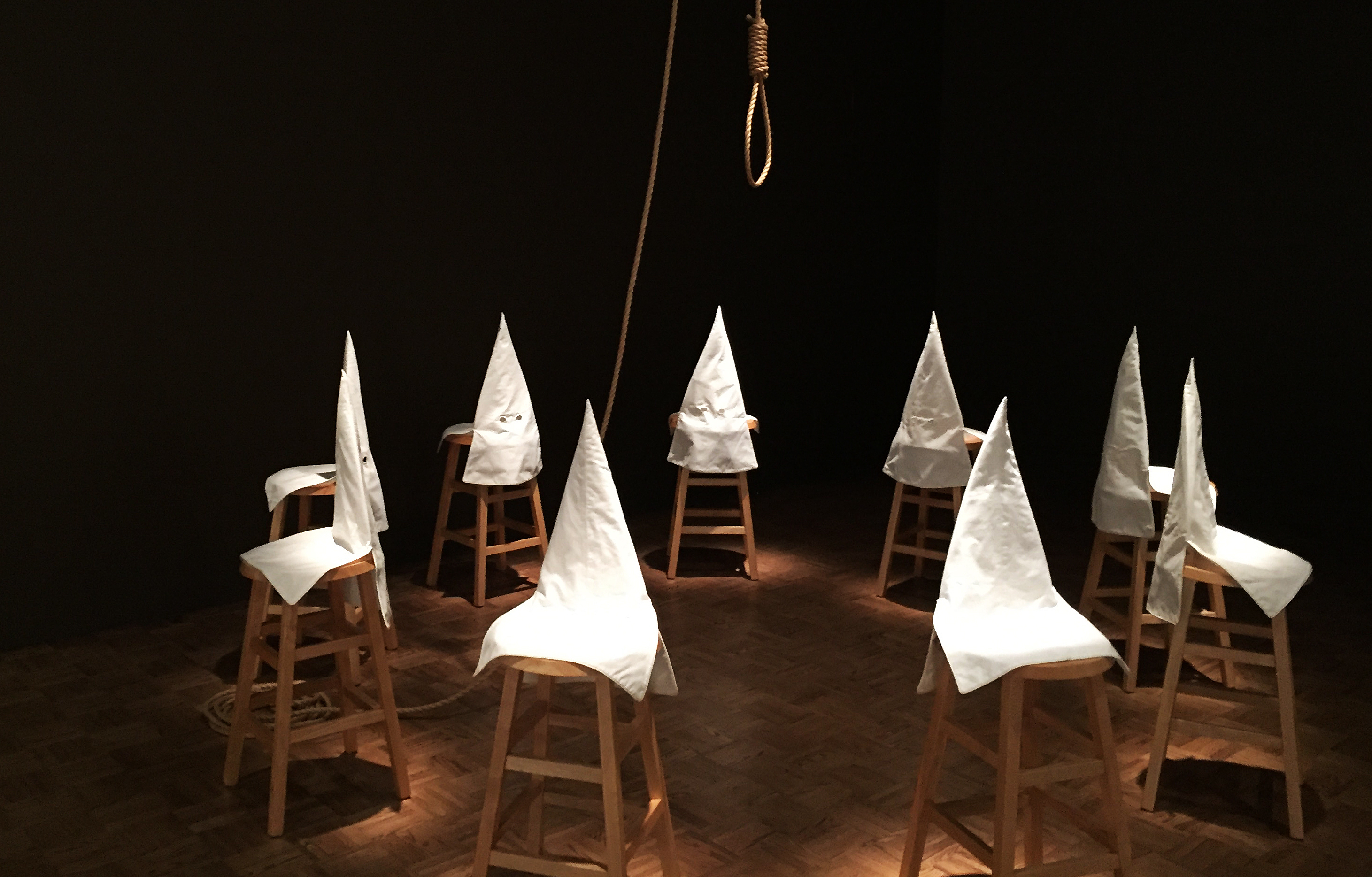
Gary Simmons – Duck, Duck, Noose, Installation, 1992 Image Courtesy of DIA

The exhibition is peppered with work by a variety of African-American artists that speaks directly to racial violence in the United States. When you enter the room housing the Duck, Duck, Noose piece by Gary Simmons, 1992, you are confronted by emotional experience where nine stools are arranged in a circle with KKK hoods on the seat with a noose hanging down in the center. The life-sized installation capitalizes on the audience’s familiarity with these symbols, reminding us of our historical past where injustices were committed against black men and women in the late 19th and mid 20th centuries. The title is a play on the English nursery game, Duck, Duck, Goose. The installation brings into focus the injustices that are continually committed against all peoples and through a juxtaposition of history where art imitates life. Gary Simmons’ work is currently representing the United States at the 2015 Venice Biennale.

30 Americans exhibits 55 paintings by artists such as Barkley Hendricks, Kerry James Marshall, Carrie Mae Weems, Lorna Simpson and the late Robert Colescott. Their influence on a younger generation can be seen in the works of artists such as Nick Cave and Kara Walker. Overall, the exhibition reflects a variety of approaches to creating artwork around identity, gender, race, sexuality and a confrontation to the traditional American genres.

Bravo to the DIA for bringing this exhibition to Detroit…now what’s next? A big contemporary exhibition? As soon as there is a curator.

The Detroit Institute of Arts  5200 Woodward Ave. Detroit, Michigan  48202    313.833.7900

For information about admission pricing, and hours: http://goo.gl/OJU15N


David Klein Gallery in Detroit @ Washington Boulevard

David-Klein-Gallery- Playground Detroit

Exterior Gallery Image courtesy of Playground Detroit

The David Klein Gallery opened its new doors September 17, 2015 at 1520 Washington Blvd. in downtown Detroit. The gallery will keep its original space in Birmingham, Michigan that opened in 1990, while the new downtown location is home to its contemporary program.

The First Show is a group survey of the living artists represented by the gallery, many of whom work in the Detroit Metro area. The new gallery provides 4000 square feet of space, twelve foot-high ceilings, and hardwood floors – so much space that if you blinked, you might think you were in a New York City gallery.

David Klein’s decision to move to downtown Detroit is a gamble. He is betting on the future of the City of Detroit, much of which is improving weekly before our eyes. The move, along with Wasserman projects, follows 323 East, Inner State Gallery, and The Butcher’s Daughter who took the leap to New York City. I have to say, it turned my head when Campbell Ewald, the premier ad agency formerly located across Van Dyke from the General Motors Tech Center, moved a year ago to Brush Street, sandwiched in between Ford Field and Comerica Park. For me, it was one of many signs that people and investment were moving into Detroit.

ADAMS Niagara Pair 4.1.15 copy

Jamie Adams, Niagara Pair, 2015, Oil on Linen, 60 X 48


As you enter the new gallery space, the figure painting on your right, Niagara Pair, by Jamie Adams, is a knockout oil painting from his Niagara series that requires a long look. Adams earned his MFA from the Pennsylvania Academy of Fine Arts, founded in 1805, that hosts a vigorous faculty and each year has visiting critics program. Even today the school has a reputation for pedagogy that addresses technical skills, and this training is evident in Adams’s work which has a technical competence not seen much these days (an exception would be Robert Schefman). When one views his body of work, it has a mid-1700s neo-classical feel. The canvases are inhabited by contemporary figures that often have Niagara Falls as background. Gazing looks between short-haired foppish men and women predominate.

R.Schefman Phasd.

Robert Schefman, Phasd, 2015, Oil on Canvas, 54 X 42, Courtesy of David Klein Gallery


Robert Schefman’s photo realistic figure painting is even better illustrated in this new painting, Phasd, where he follows his recent trajectory of the figure, nostalgic toys. Here the young woman looks into the audience (often not the case) from an interior room with dramatic stage light. It is as if you have caught and startled her rummaging through her old records. He may want to take us back in time to antique toys and vinyl 45s and 78s on turntables. In much of his earlier work, the figures are on a treasure hunt or attending a burial. He says, “This stuff would form family histories, be the backbone of every Ken Burns narrative, but digital storage is not so stabile, and the changing formats mean that personal information will not be around for my grandchildren to discover.”

The amount of space above the subjects is more than needed, but that is obviously intentional. The space is a counter balance to the activity below, and is perhaps a new element in his work. I interviewed Schefman for a solo exhibition in 2012 and asked him what artist he admired. “If anything, I had always appreciated Philip Pearlstein. He was the closest thing to the abstraction of the figure, in the way things are placed on the page, or chopped off – the way he uses shape and form – it seems as though the figure and objects are incidental to the shapes and color is incidental, but there is not a heavy content in Pearlstein and I was looking for more content.”

15.16.EasternMarketShadows.24x30

Stephen Magsig, Eastern Market, 2015, Oil on Linen, 24 X 30, Courtesy of David Klein Gallery

Stephen Magsig is a painter of discipline and routine. In addition to his work at the David Klein Gallery, he also exhibits his realistic urban and industrial landscapes at the George Bills Gallery in New York City. The discipline and routine that I refer to is his blog, Postcards From Detroit that contains 5 X 7-inch oil on linen, Hopper-esque paintings of scenes in and around Detroit. I am guessing he starts one of these small paintings outside, takes an image, and may finish in the studio, or maybe he knocks it out on location. He says in Painting Perceptions, “I have always enjoyed drawing even as a child/ I was in 3rd grade when I realized the joy of making artwork. I did a chalk mural on the blackboard and it made me aware that I had a special gift. I have been doing some kind of art ever since.”

It is hard to ignore the influence Edward Hopper must have had on Magsig, but it does not take away from the many paintings he has made that have nothing to do with Hopper, especially the portraits of storefronts, paintings of train wheels, with more attention to light, reflection and detail. His painting, Eastern Market, typifies his Detroit industrial landscape work: strong composition, with low light providing the right amount of drama. On his website he says, “I work in oils on linen canvas and linen panels in the simple and direct Alla Prima method. Although my work is representational, I am more interested in the “Story” of the scene and the “Plasticity” of the paint than in creating an exact representation of the subject.”

RELICS@Ernst&Young+detail

Relic, Scott Hocking, Clinton Snider, Assemblage 400 Boxes, Installation, Image Courtesy of Ernst & Young

On the rear wall of the new David Klein Gallery is a large section of a Scott Hocking and Clinton Snider collaboration. Relics, 2001, part of what was originally a much larger installation, but that consists now of 66 18 X 18-inch boxes of mixed media. At its original display at the Detroit Institute of Arts for its Tri-Centennial Celebration, the installation consisted of over 400 boxes that chronicled the 300-year history of Detroit by using found objects. What makes it particularly interesting is that it finds itself reconfigured from time to time, as it does in these 66 boxes of man-made found objects that take up most of the back wall of the gallery. Also, it’s my understanding that this work is ongoing, and each artist occasionally might contribute a new box to a new configuration, site specific. Perhaps it was artists like Hocking and Snider that played their part in drawing people back to the city. In Relics, they collaborate, install, save and inspire with an artistic and sensitive approach to creating a grid of reclaimed objects. Could the installation have gradually become a metaphor for what was once thought of as old, decayed, downtrodden and obsolete? Does it not help us all to realize that Detroit is rising from the ashes?

I asked Christine Schefman, Director of Contemporary Art for the Gallery, how long has this gallery development been in the works? “It’s been three years from the time David and I saw the movement to Detroit. We spent time looking at a variety of locations and settled on this space, and its proximity to Woodward. I think David has always wanted to be in Detroit.”

The new David Klein Gallery has happened at the right time and in the right place. Certainly, this new space will provide a better opportunity to exhibit larger work that includes painting, photography, sculpture and installation. There is no doubt that both the art and business communities will take notice. Princeton University’s Center for Arts and Cultural Policy published a study on how the arts impacts communities. To summarize the lengthy study, the arts draw people together, foster trust, becomes a source of pride for the community and increase civic engagement along with a further collective action. Don’t be surprised if the David Klein Gallery becomes an anchor for more art related venues in the neighborhood.


This September marks the 25th Anniversary of David Klein Gallery.

FIRST SHOW, features work by 30 gallery artists, including Susan Campbell, Liz Cohen, Mitch Cope, Matthew Hawtin, Kim McCarty, Brittany Nelson, Lauren Semivan and Kelly Reemtsen.

September 17 – October 31, 2015

http://dkgallery.com


Natural Selection Works @ the Scarab Club

Scarab opening

Scarab Club, Natural Selection Works, Installation image, Courtesy of Jim Pujdowski

When you visit the Detroit Institute of Arts, you look only a hundred yards away and see the Scarab Club, active in the community for over 100 years and a thriving force for local artists.

The Scarab Club’s most recent exhibition, Natural Selection Works opened September 10, 2015 and is curated by Jim Pujdowski, a longtime member of the Detroit Artistic Community. In his statement, Jim says, “The ten artists selected for this exhibition have the untiring desire to create. Each artist stands on their own and together they signify the strength of what is Detroit art.”

The exhibition, dominated by Wayne State alumni, brings together a community of artists that have dotted the landscape for many years. The longtime and exuberant director of the gallery, Treena Ericson, says, “Curating is an art form of its own. In this exhibition Jim has brought together ten artists with distinctly different styles, yet the show has a beautiful cohesion.” As you enter, ponder the names of those artists who have exhibited on these walls: Diego Rivera, Norman Rockwell, Pablo Davis, Gilda Snowden and Robert Wilbert, to name only a few.


Shirley Parish

Shirley D. Parish, After Midnight, Oil Painting 45 X 64 Image Courtesy of Ron Scott

As part of her cloud series, and most recently exhibited at the Ellen Kayrod Gallery, Shirley Dombrowski Parish presents the viewer with After Midnight, a large oil painting that evokes a spiritual feeling, a backdrop for a Michelangelo figure, or possibly a metaphorical abstraction for creation. In her statement, she says, “The painting of the sky began after many years of studying landscape. I try to capture light and breeze. I am aware of the constant shifting of light reflection of the sky, the sunset, water. The light is forever changing. These paintings are perceptions of experience, a visual poetry.” In her collection of thirty or more of these cloud based paintings, her subtle interpretation, wide and varied, provides the viewer with a vast range of interpretations, many that feel like a meditation. They are both representational and abstract, that create a kind of tension or play that may very well bring the viewer back again and again.

Andrew Blake

Andrew Blake, Untitled # 1, Acrylic on Canvas, 60 X 48, Image Courtesy of Ron Scott

An exception to an aging generation of artists in the exhibition is Andrew Blake with his painting Untitled 1, where he combines both figurative imagery with abstraction that invites the viewer into a complex composition relying on a diverse color palette and black line. The young artist attended the University Liggett School in Grosse Pointe before enrolling at the Maryland Institute in Baltimore, Maryland. Some may recall his exhibition at the Cass Café or know him from his musical performances at the Cadieux Café. The strength in Untitled # 1’s composition is the large figure in the upper right juxtaposed against the collage of abstract shapes, smaller figures and an array of line and shaped overlay.

Carlo Vitale

Carlo Vitale, Abstraction of Circles, Oil on Canvas, 48 X 60 Image Courtesy of Ron Scott


In this pointillist abstract composition, artist Carlo Vitale uses the circle as his theme for a colorful oil painting. The Detroit born artist says his influence often comes from working on a relative’s farm in the Michigan thumb area. Much of his work is devoted to a geometric grid approach to composition, with work that resembles a mosaic at a distance. He says, “My work is influenced by agricultural themes along with the colorful imagery of everyday life. The work generates kinetic and optical effects that are conjured up from music obsessions and the spirituality found in the art process.”

Robert Hyde

Robert Quentin Hyde, Untitled #3, Collage on Panel, 13 X 19, Image Courtesy of Ron Scott

Some may not want to re-visit Cubism, but I am guessing Robert Quentin Hyde might be a fan of Picasso, Fernand Leger, Georges Braque, and Robert Delaunay. In his intricate painting, Untitled #3, he unleashes the design of cubism and adds multiples of the feminine figure with an equipoise of primary and secondary color values. Yet another Wayne State University grad, who is known for his paintings that contain the heads of many women, Hyde builds in this composition a strong force of blue and orange that skillfully fuse the hermetic and detailed shapes together.

As a seasoned curator of exhibitions at the Liggett Gallery, Jim Pujdowski has sewn together familiar names and artwork by some of the better-known artists in the Detroit area. And what a better place to kick off the 2015 fall season than the Scarab Club where a team of people work hard to bring performance, literary events, and visual art exhibitions to midtown Detroit.

Natural Selection Works – September 10 – October 10, 2015

http://scarabclub.org

The New Whitney Museum @ the Meat Packing District, NYC

Whitney NYC

Whitney Museum image – Photograph by Ed Lederman – 2015

 From its first space in Greenwich Village in 1931, to another home at Madison and 75th Street in 1966, to its new home at 99 Gansevoort Street, the Whitney Museum  has been deeply rooted in celebrating American art.

Sculptor and patron Gertrude Vanderbilt Whitney was the driving force behind its development as she recognized the difficulty American artists were having exhibiting their work. Trying to keep up with its growth, it had established branches in various parts of Manhattan, and Stamford, Connecticut.

The new building at 99 Gansevoort Street is designed by the architect Renzo Piano, includes approximately 50,000 square feet of indoor galleries and 13,000 square feet of outdoor exhibition just east of the Hudson River. At the northern edge of the Meatpacking District, and the foot of Chelsea where the new High Line begins, is New York City’s newest and most unique public park.

As an artist and writer whose family is from NYC, the location choice for the new museum seems perfect, and at first glance, the interior space has an abundance of glass and terraced exterior space. One of the most impressive observations upon my first visit was the gallery interior wall. The fifth floor, for example, has 18,000 square ft. of open space where the 12” thick walls look and feel stationary, but, in fact, are movable. When you look up, you see a very thick steel grid that explains how these museum walls can be moved and repositioned based on curatorial design.

Chuck Close Installation

Chuck Close – Phil, 108 X 84, Acrylic and Graphite on Canvas, 1969 Image – Ron Scott

The first exhibition at the new Whitney Museum is America Is Hard to See, which provides a vehicle for its collection of American art that has been described as one of the arguments for moving into a new space. The collection includes over 21,000 works of art by more than 3000 artists who worked in the 20th and 21st centuries. The argument is that the Madison space never allowed for the proper leverage of the collection. This first exhibition, illustrates its capacity. Here in this installation image, Phil, 108 X 84, by the artist Chuck Close, one gets a feel for the gallery space. From his initial series in 1969, this acrylic and graphite on canvas presents a frontal portrait against a neutral ground. Close took an 8 x 10-inch photograph of his friend Phillip Glass, overlaid it with a penciled grid, and then painted a vastly enlarged blowup of each square onto the canvas using airbrushes to create a photographic image. In all the galleries, the flooring is reclaimed wide-plank pine from locations near the city and virtually column free.

Edward-Hopper-Early-Ssunday-Morning-1930 35 x 60 Oil on Canvas

Edward-Hopper-Early-Ssunday-Morning-1930 35 x 60 Oil on Canvas

The theatrical painting Early Sunday Morning, one of Edward Hooper’s most iconic paintings, takes its place in the exhibition as an example of social isolationism in this painting of Seventh Avenue, a north-south street, where light from the east cast it long shadows. Although Hopper is known as an archetypal twentieth-century American realist, his paintings are fundamentally representational. This painting demonstrates his emphasis on simplified forms, painterly surfaces, study of light and a thoroughly contemplated composition.

Jasper Johns

Jasper Johns – Three Flags, 30 X 45 Encaustic on Canvas, 1958

Three Flags is a signature image of Johns’, who got lumped into the Pop Art category by default when he decided to use everyday images in his work. Painting targets, maps, letters and numbers, Johns led some artists away from the abstract expressionism of the time. The familiarity and simplicity of his subject matter attracted audiences, often grounded in the imagery that was part of the everyday world at a time when the art world was searching for new ideas. In a statement, he says, “My work is largely concerned with relations between seeing, and knowing, seeing and believing, seeing and saying.” In Three Flags, he shifts the emphasis from emblematic meaning to a change of scale, discrete marks and surfaced texture.

David Smith

David Smith – Hudson River Landscape, 48 X 72, Welded & Stainless Steel, 1951


David Smith made what he called “drawings in space” using welded steel, as in Hudson River Landscape in 1951. Sometimes known as an abstract expressionist sculptor, similar to Pollock, Smith’s life was cut short when his pickup truck spun off the road in a crash near Bennington, Vermont at the age of 59. Best known for the Cubis, a series of stainless steel hand-brushed geometric shapes, his works have been included in exhibitions at the MOMA, Solomon R. Guggenheim Museum, Whitney Museum of American Art represented by M. Knoedler & Co. and Gagosian galleries.Smith continued to paint and draw throughout his life, pieces that included landscape and figurative work. Most of Smith’s work is an object lesson in what scale means with respect to the viewer. His work was that of a welder, not a forger, and is often referred to when expressing the concept of Constructivism.

Two women W.diKonning

Image of de Kooning Woman and Bicycle, 75 X 49, Oil, enamel, Charcoal on Linen, 1952

For this viewer and many others I assume, the painting Woman and Bicycle is the 1950’s hallmark of Willem de Kooning’s work. Acknowledged as one of the most influential Abstract Expressionists, he says in his statement, “I’m not interested in ‘abstracting’ or taking things out or reducing painting to design, form, line, and color. I paint this way because I can keep putting more things in it–drama, anger, pain, love, a figure, a horse, my ideas about space. Through your eyes, it again becomes an emotion or idea.” The most distinguishing attribute in Woman and Bicycle are the two smiles where banality meets beautiful.

In addition to the new museum and its exhibition, the web site for the Whitney Museum is excellent, one of the best I have experienced. Extremely comprehensive and user-friendly, there are many short videos that explain everything. http://whitney.org

As for what will become of the space on Madison, The Metropolitan Museum of Art plans to present exhibitions and educational programming at the Whitney’s uptown building for a period of eight years, with the possibility of extending the agreement for a longer term.


The Whitney Museum of American Art

America is Hard to See   May 1 – September 27, 2015

Upcoming: Frank Stella, A Retrospective   October 30 – February 7, 2016

http://whitney.org


Page 33 of 35

Powered by WordPress & Theme by Anders Norén