Critical art reviews of Detroit galleries and museums weekly

Author: Ron Scott Page 32 of 35

Dance! @ The Detroit Institute of the Arts

 DIA Presents a Multimedia Exhibition of Ninety works of American Art 1830-1960

How long have people been dancing? Probably longer than they were playing with fire. Nureyev captured the hearts of millions of ordinary people, while Baryshnikov stunned the critics and Martha Graham created the full-codified modern dance with her deviation from classical ballet.
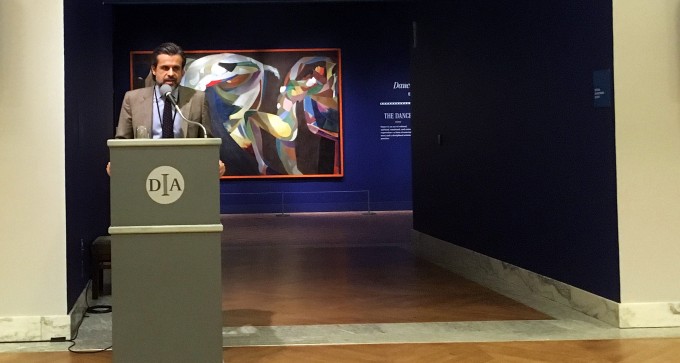
Salvador at Podium Dance 3.2016

Director Salvador Salut-Pons at Podium introducing the Dance! 1830 – 1960 exhibition

 Coming off a very successful 30 Americans exhibition, Salvador Salort-Pons took the podium to introduce the new exhibition Dance! American Art 1830-1960, at the Detroit Institute of Arts. Opening March 29, 2016 the multimedia exhibition surveys the history of Dance in America as seen through the eyes of American Artists.

“This is the first major exhibition to explore visual art related to American dance. Dance has such a rich history and has touched all segments of American society,” said Salvador Salort-Pons, DIA director. “This exhibition is not only about the representation of the art of dance, it explores how artists were inspired by how Americans move, how they interacted with each other and experienced the rhythm of music.”

It was clear from her remarks at the media preview that curator Jane Dini had been working on this exhibition since her time spent working at the DIA, and that this exhibition had been in development over the past five years. In Dance!, Ms. Dini has been able to create her life’s dream.

“In addition to the outstanding works of art, it was important for me to have the voice and expertise of dancers within the exhibition itself,” said Jane Dini, now associate curator of American Painting and Sculpture, Metropolitan Museum of Art, New York, and curator of the exhibition. “They help illustrate how dance as an artistic form had an enormous impact on the fine arts, especially painting and sculpture.”
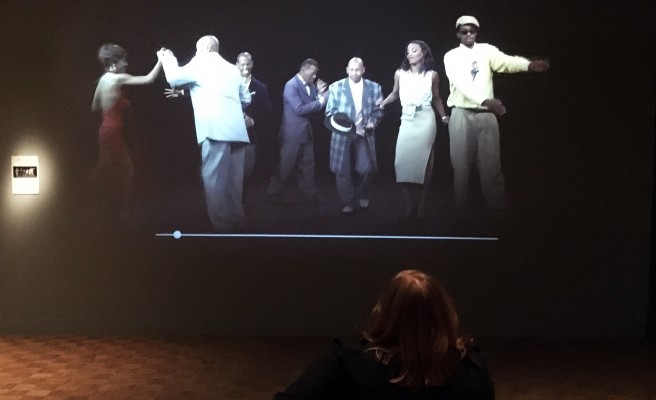
Video

Video of Dancers – One of several through out the exhibition

 I never danced, but my parents were both professional dancers, which gave me some built-in personal interest. My parents were both recruited by a New York dance company in the mid-1930’s. In addition, in the 1980’s, I facilitated an artist-in-residency program in the Utica Schools, where we brought the Detroit City Dance Company, under the direction of Carole Morrisseau, into our forty schools over the period of a school year. Getting to know the day-to-day lives of dancers is something that stayed with me. I learned they lived in a physical world and often from moment to moment. The dancers had a unique devotion to their bodies, especially their ankles and feet.

Ms. Morrisseau is now a visual artist practicing in Detroit, and I caught up with her at the Scarab Club, “The concept of the current exhibit at the DIA is a credible one and exceptional in its undertaking. I believe there is a very strong relationship between the visual and performing arts. Hopefully this exhibit will expand the public’s view of the art of dance and visual art.” Carole Morrissieau will exhibit her visual artwork opening this month at the Scarab Club.
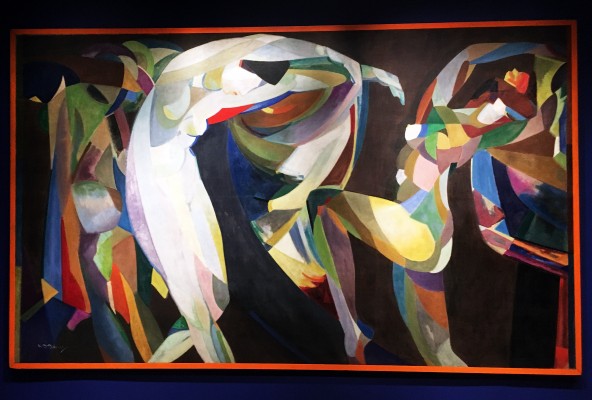
Arthur B. Davies

Arthur Bowen Davies, 1862 – 1928, Dances, 1915

Arthur B. Davies (1862-1928), often called an Ashcan painter, was an avant-garde American artist who spanned the boundaries between the 19th-century romantic tradition and early twentieth-century modernism in the United States. He was born in Utica, New York and studied at the Art Institute of Chicago in 1878 and at the Art Students League in New York in 1887. His idyllic figurative pastorals are often said to harken back to Botticelli. Davies supported the new abstract movement and participated in the early formation of MoMA in New York City. His work was collected ahead of its time by the Phillips Collection. In Dances, 1915, Davies used faceted planes of color to define the moving figures, resulting in a pattern of color evoking a dance celebration.
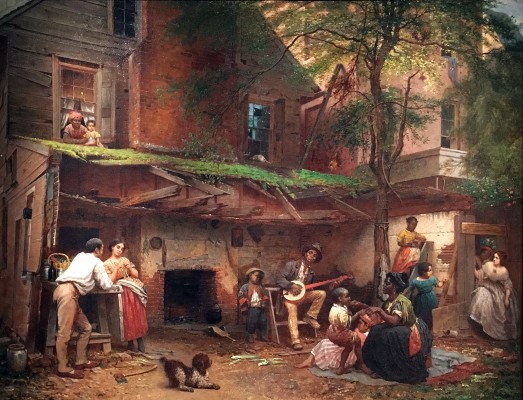
Eastman Johnson Negro Life at the South

Eastman Johnson, Negro Life at the South 1859, Oil on Canvas

Genre painter Eastman Johnson (1824-1906) had a turning point in 1859 with the exhibition in New York of his Negro Life in the South. His ambiguous picture of the leisure activities of a group of slaves was a sensation at a time when the topic of slavery was being universally debated. In the painting, a mother encourages her son to dance to the music of a banjo player. Born in Maine, Eastman Johnson was educated in Europe, where he was inspired by the work of Dutch Masters. He is best known for his realistic portraiture and as a co-founder of the Metropolitan Museum of Art in New York City.
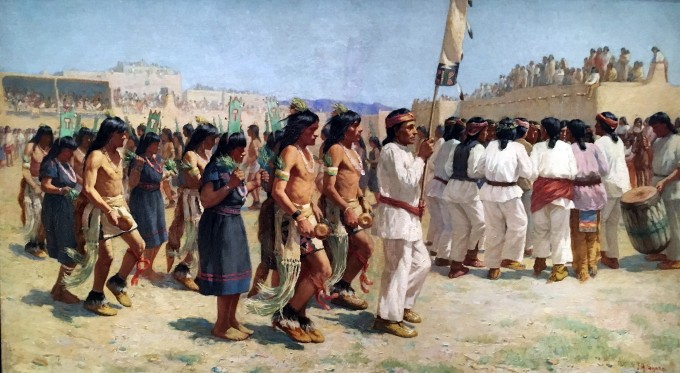
Henry Joseph Sharp, The Harvest Dance 1894

Henry Joseph Sharp, The Harvest Dance 1894, Oil on Canvas

Joseph Henry Sharp (1859-1953) was an American painter best known for his work painting Native Americans. Sharp was born in Bridgeport, Ohio to Irish immigrant parents and studied at the Academy of Fine Arts at Antwerp. Sharp’s first trip to the West was in 1883 at age 24. He visited pueblos in New Mexico, Santa Fe, Albuquerque and Tucson. In his work, Harvest Dance, Sharp illustrates a strong skill set for painting the figure and depicting the sunlight on his subjects. Sharp went on to become one of the six founding members of the Taos Society of Artists.
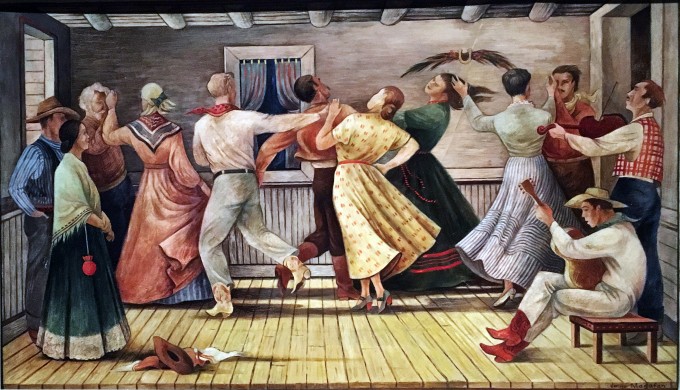
Sargent Johnson Dance Hall Study

Sargent Claude Johnson, Dance Hall Study, 1935, Tempera, Watercolor, and Graphic on Illustration Board.

Born in Boston on October 7, 1887, Sargent Johnson was the third of six children of Anderson and Lizzie Jackson Johnson. Anderson Johnson was of Swedish ancestry, and his wife was Cherokee and African American. As a member of the bohemian San Francisco Bay community and influenced by the New Negro Movement, Sargent Johnson’s early work focused on racial identity. Johnson’s art ranged from African American masks to producing paintings of local folks and creating small, figurative sculptures. Dance Hall, a study in watercolor and graphite, was a study for the San Francisco Housing Authority mural.
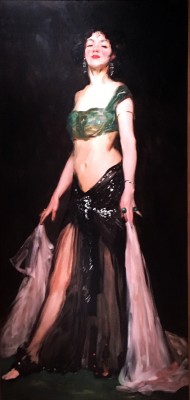
Robert Henri Salome Dancer

Robert Henri, Salome Dancer, 1909, Oil on Canvas

Robert Henri (1865 – 1925) was a leading figure in the Ashcan School of American realism who helped organize a group known as “The Eight.” Henri studied at the Pennsylvania Academy of Fine Arts in Philadelphia and under Thomas Anshutz, a protégé of Thomas Eakins. Art critic Robert Hughes declared that, “Henri wanted art to be akin to journalism. He wanted paint to be as real as mud, as the clods of horse-shit and snow, that froze on Broadway in the winter, as real a human product as sweat, carrying the unsuppressed smell of human life.” When Henri painted the dancer in the role of Salome, a seductress from the New Testament, in 1909, it was rejected by the National Academy because the exposed leg was considered too controversial by the fine arts world. Robert Henri was a popular and influential teacher at the Art Students League of New York.
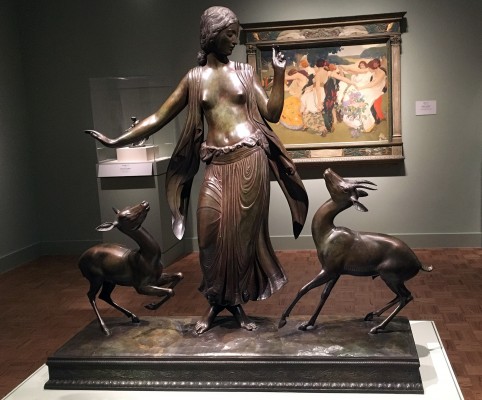
Paul ManshipDancer & Gaselle

Paul Manship, Dancer & Gasell, Bronze, 1916

Paul Manship (1885 – 1966) was born in St. Paul, Minnesota and began his art studies at the St. Paul School of Art in Minnesota. From there he moved to Philadelphia and continued his education at the Pennsylvania Academy of Fine Arts. At one time the country’s most famous exponent of Art Deco, he embraced archaic vocabularies of Greek, Roman and Indian art to create decorative, stylized, Neoclassical works. The statue in the fountain in New York City’s Rockefeller Plaza, Prometheus (1933), is one of his most famous works. The bronze Dancer and Gazelles, was completed in 1916 and won the National Academy prize in 1917. The tension in the small areas between the figures emphasizes the dancers’ gestures, which command the gazelles’ movements.
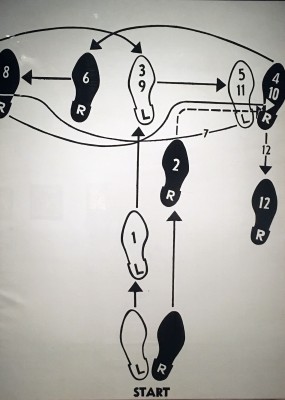
Dance Diagram A Wharhol

Andy Wharhol, Dance Diagram, 1962, Casein and Graphite on Linen

Andy Warhol (1927 -1987) a leading American Artist who ushered in the Pop Art movement, began to make paintings of iconic American objects such as dollar bills, mushroom clouds, electric chairs, and the most famous Campbell’s Soup can. The New York opening at the Stable Gallery on November 6, 1962, was Warhol’s first one-man show and also where he first debuted Dance Diagram. It was presented in a series featuring six additional Dance Diagrams with the source material taken from the Dance Guild’s 1956 book Fox Trot Made Easy. It shows Warhol’s interest in selecting objects from American culture as subjects for his artwork.

Biba Bell, a Detroiter who recently completed her PhD in performance studies at N.Y.U., says, “The ways that dance is taken up symbolically within visual art is so interesting! I’m imagining that each piece produces these figures and forms in diverse and unique ways, but there is something about the dancer, the body that is dancing, filled with movement and the moment and a kind of excess of life/ liveliness that is astounding and so important when depicting any culture.”

If you’re not a dance aficionado, Dance! American Art 1830 -1960 at the DIA might spark your interest, and while you’re in New York City, get tickets to see An American in Paris, by the Tony Award-winning choreographer Christopher Wheeldon who has created a critical and commercial success breaking new ground by bringing ballet to Broadway set to the music of the Gershwins.

I recall, my father watching black & white films of Fred Astaire & Ginger Rogers for hours, and he tap-danced into his eighties. When I was very young, attending a family wedding, my parents did something rare; They danced. Everyone gathered around to watch them exhibit their talents publicly for maybe the last time. I was so very proud.

The Detroit Institute of Arts deserves credit for this curatorial creation of its own that will travel to the Denver Art Museum, July 10 – October 2, and the Crystal Bridges Museum of American Art in Bentonville, Arkansas, October 22, 2016 – January 16, 2017.

Exhibition tickets are $14 for adults, $10 for Wayne, Oakland and Macomb county residents, $7 for ages 6–17, $5 for Wayne, Oakland and Macomb county residents ages 6–17, and free for DIA members. Admission is free every Friday. School groups need to register in advance. Tickets at dia.org or 313-833-4005
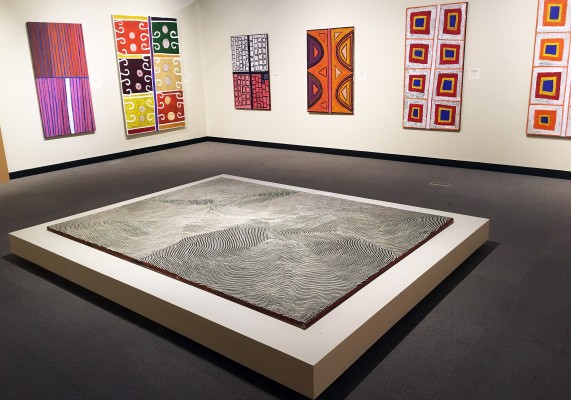
 

No Boundaries @ the Charles Wright Museum


Installation

No Boundaries, Installation Image – All Images Courtesy of Ron Scott

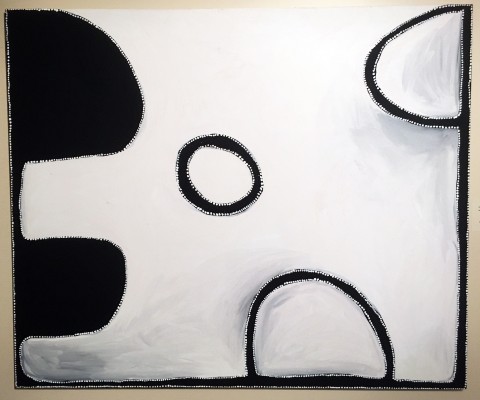
As part of a national tour, No Boundaries opened at the Charles Wright Museum of African American History on January 18, 2016. The exhibition represents nine aboriginal artists from the continent of Australia who were inspired by their ancient cultural traditions. The contemporary exhibition incorporates more than 75 paintings created between 1992 and 2012. The works are drawn from the collection of Debra and Dennis Scholl, Miami-based collectors and philanthropists.

“The artists all have a common thread, and each had reached a senior status in their communities.” said Dennis Scholl. “We chose works by those who, to paraphrase the artist Paddy Bedford, after having painted all of their mother ‘country’, and finally chose to simply paint.”

The indigenous aboriginal art of Australia has a rich history that has been studied by scholars from all parts of the world, especially the work that pre-dates the European colonization. The oldest forms are the paintings on rock in Central Australia that depict people, animals, plant life and spirituality. It is believed that Aboriginal people are the descendants of a single migration from Africa to the continent 64,000 to 75,000 years ago. All the artifacts and the earliest human remains suggest that the region now referred to as Queensland, was the single most densely populated area of pre-colonialized Australia. But this exhibition is about contemporary Aboriginal art that, according to some artists, is tied to their past.

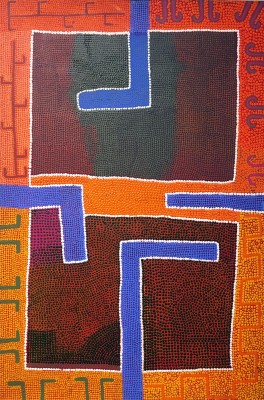
Paddy Beford Ngamalingy 2003

Paddy Bedford, 70 X 64 Polymer on Canvas

Paddy Bedford comes from Jurrawun, Australia and spoke the Gila language. His work was integral to the development of the landmark exhibition, “Blood on the Spinifex” that was held at the Ian Potter Museum at the University of Melbourne in 2002. In his artwork, he introduced a new expressionism, one that recognized the use of both positive and negative space and stark contrast. He rose to national acclaim when his images brought to memory the station massacres, because to some, they symbolized aerial maps. Paddy Bedford’s work is held in collections throughout Australia, Europe and the United States.

Boxer M Tjampitjin Purkiti 2005

Boxer Milner Tjampitijin, 40 X 32, Polymer on Canvas


Boxer Milner began painting in the 1980s at the Warlayirti Art Center in the Wirrimanku Balgo region. Buried in his palette and restricted formal syntax is his mastery of geometry and form. These rigid structures with high-keyed colored geometric shapes offer a rare idiosyncratic iconography not seen in other aboriginal art. Rendered in a measured architecture of lines and dots, they move into a more sophisticated sense of design. His work is part of many collections throughout Australia and at the National Gallery of Victoria.

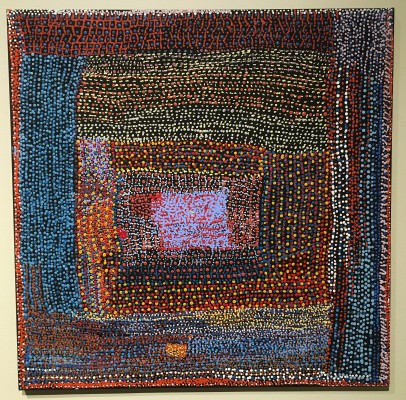
Tommy Mitchel 2012

Tommy Mitchel, 36 X 36, Polymer on Canvas


Born in the Gibson Desert near Papulankutja, Tommy Mitchel came to painting late in life. His glowing fields of overlapping dots create a patchwork of grids. Mitchel was quickly recognized as a regional talent at the Warakurna Art Centre. His graceful use of color and space take the viewer on a visual journey. He has described his work as drawing on his early life in the Ngaanyatjarra Country where he wandered as a child. His work is part of many collections, including the National Gallery of Victoria and the Art Gallery of South Wales.

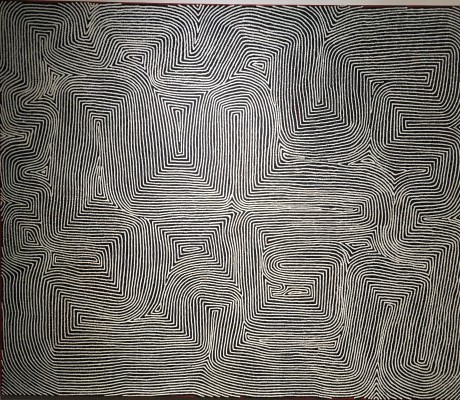
Warlimpirrnga Tjapaltjarri Kalparti 2003

Warlimpirrnga Tjapaltjarri, 66 X 70, Polymer on Canvas

Warlimpirrnga Tjapaltjarri is originally from Lake MacKay but lived nomadically with his family in the remote western desert. He eventually settled in to paint at the Papunya Tula Art Centre. His swirling lines of dots create a pulsating field of optical intensity. Shimmering like a mirage, they invoke a shifting of movement in the desert sand, a metaphor for the energy fields while ‘Dreaming’ that runs through everything. His work is part of many collections in Australia, including the National Gallery of Australia.

There is a wall of introductory information presented in the exhibition that includes biographies of each artist. The material introduces the term ‘Dreaming’ which occurs while the artist is awake or sleep. “For the artists in this exhibition, the Dreaming goes by different names: Tjukurrpa in the Western Desert; Ngarranggarni in the Kimberley; and Derulo in the North. The Dreaming incorporates ancestral beings, the creation of the universe and the laws governing social and religious behavior. It also dictates connections to a place that define individual Aboriginal identities. The Dreaming encodes the location of essential waterholes and food sources into stories, dances, and song.”

There is a short video as part of the exhibition, which is narrated by an art gallery owner. The cut-away shots of aboriginal people show them with little clothing and often sitting on the ground painting their dots. It caused this writer to research the history of the Aboriginal people of Australia which uncovered concerns raised by a United Nations report about unethical and discriminatory practices against Aboriginal indigenous people. Australia’s 460,000 Aborigines make up about 2 per cent of the population. They suffer higher rates of unemployment, substance abuse, and domestic violence than other Australians and have an average life expectancy of 17 years less than the rest of the country.

What would be educational in this exhibition is a section that places these artists in context to the overall treatment of these native indigenous people, their heritage, cultural, traditions, and challenges in a land that was colonized by Western Europeans in the mid-1700s. I am sure this kind of national show has been vetted and follows ethical standards for procurement by the collectors. Overall, the exhibition is a very good introduction to this contemporary art movement created by a native people whose art deserves recognition around the world.

This exhibit is free with museum admission. No Boundaries: Aboriginal Australian Contemporary Abstract Painting originated at the Nevada Museum of Art in Reno, Nevada and was organized by William Fox, Director, Center for Art and Environment, and scholar Henry Skerritt.

http://thewright.org/index.php/visit/general-info

A Glimpse @ Galerie Camille

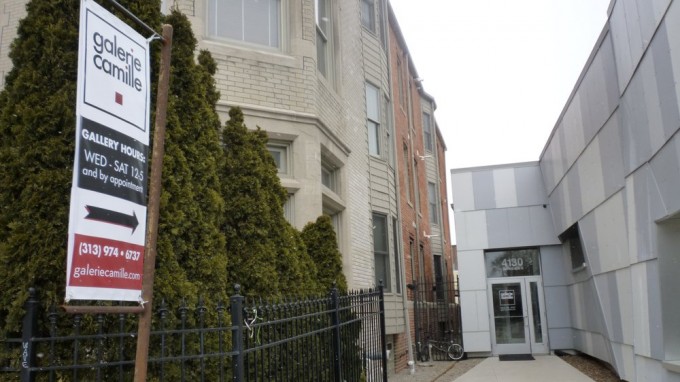
Galerie Camile exterious

Galerie Camille, Exterior image on Cass Avenue

The Galerie Camille opened a group exhibition, Glimpse, January 22, 2016 under the new directorship of Melannie Chard, a Michigan native who has returned from New York City where she worked as Vice President, Head of Valuations,  Americas at Sotheby’s Auction House over the past ten years. The gallery is the creation and manifestation of Adnan Charara, Detroit artist and entrepreneur who purchased the building nestled in the heart of midtown on Cass Avenue, in the block south of Willis. He says, “The gallery was founded in 1987 and renamed after the birth of my daughter, Camille. I renovated the space in midtown Detroit and first opened my artist’s studio in January of 2012 with the gallery following in May 2014. In addition to regular exhibitions, we also provide support to estates and collectors who wish to sell art and antiques on the secondary market.”

John Mclaughlin

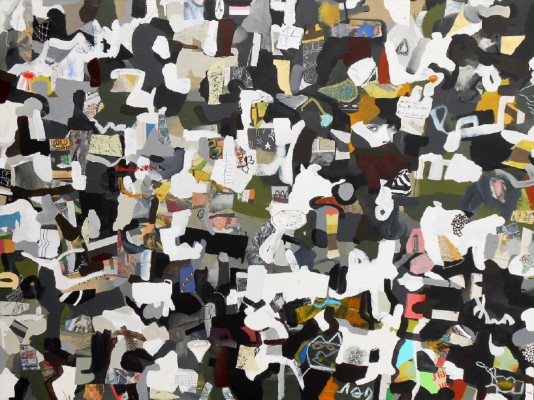
Spike the Punch Bowl, 2016 – Mixed media on canvas

John McLaughlin’s abstraction is a kind of mixed media of cut paper, some drawing, and paint where he embraces gesture from both natural and man-made imagery. The layers of his collage are purposely balanced both in shape, form and color. McLaughlin says, “ My art depicts a daily routine, combined with nature and music, with some mistakes along the way.” His array of hardline and organic shapes in his work Spike the Punch Bowl, becomes a field of balance where he allows the audience to form their own conclusions, a popular approach made by painters of the abstract field. I think he’s right about it when he says ultimately, “I make them because I like the way they look.”

Detroit Art Jondy Fruit of Klimt

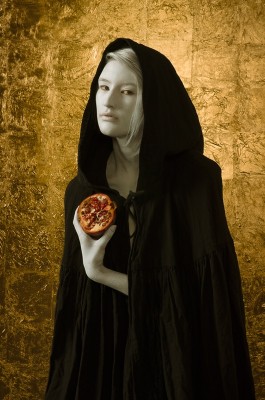
Fruit of Klimt, 2016 – Photo on aluminum, 8 x 12 inches

The exhibition includes the work of photographer John Dykstra, whose photograph Fruit of Klimt, is a variety of Photoshop work on aluminum where he brings his attraction of Gustav Klimt’s women in robes, to his image. The solemn figure holds a pomegranate, the symbol of the ancient Greeks for the “fruit of the dead.” There is a theme to Dykstra’s work: when he uses the female figure in isolation, sitting at the end of a dock, asleep in an abandoned home, or floating in a marsh, in one word… loss.

Queen Bee

LISA SPINDLER/ SPINDLER PROJECT 
in collaboration with Dr. Lycia Trouton/ 
nail project entitled “DRIVEN” Queen Bee Photograph on paper Edition 1/25

Another photographer in the Glimpse exhibition is Lisa Spindler, whose large 40 X 60 black & white photo, Driven, is a close-up of hands that have stood the test of time. A Detroiter for the last 25 years, Spindler is a commercial photographer who has made a lot of time to produce personal work, particularly her black & white photographs of the nude female figure that uses classic composition and an acute sensitivity to light. I personally know a lot of commercial photographers who have a large body of personal work, and there is no shame in making a living with the camera for artists who must survive in today’s expensive world. Lisa Spindler’s work is divided up into categories where you find more art than product, where much is non-objective and abstract. The end result is finding your work in a gallery, instead of a high-gloss magazine. Works for me.

Camille Gallery Bill Harris

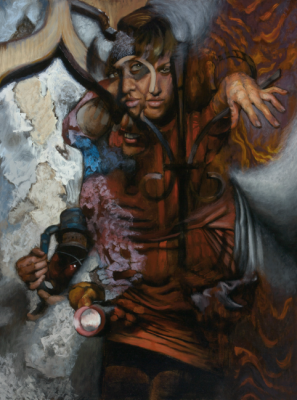
Totally Serious, 2015 Oil on canvas

Among the group of artists in the Glimpse exhibition, is the representational painter William Harris, whose Totally Serious oil painting captures the figure in multiple positions overlaid with light and movement. His work carries a commentary, and he has to keep is eye on the blurry line between a painting and an illustration. His draftsmanship and composition seems to be headed towards painting. When he opens the scale of his work to larger dimensions, good things could easily happen.

Opening and pursuing a gallery business is a noble and altruistic venture that everyone in the Detroit art community has to admire. “Glimpse is a window into what the gallery will be showing over the next year” says Melannie Chard, “We hope to provide opportunities to both seasoned and emerging artists.” Galerie Camille has a good location, a well-designed space, and ownership with a kind heart.

The Glimpse exhibition participants: Jon Parlangeli, Dessi Terzieva, Karianne Spens-Hanna, William Harris, MALT, Lisa Spindler, Scott Taylor, TEAD, Aimee Cameron, Brian Day, Robert Mirek, Paula Zammit, Paula Schubatis, John McLaughlin, Adnan Charara, Tony Roko, Alan Kaniarz, Kim Fey and John Dykstra.

Gallery hours are Wed-Sat 12-5. All other hours are by chance or appointment(313) 974-6737   info@galeriecamille.com

4130 Cass Ave, Suite C

Detroit, MI 48201

http://www.galeriecamille.com


Carlos Rolón/Dzine @ OUAG

Oakland University Art Gallery invites the audience to an installation that includes objects and performance.

Barbershop

Carlos Rolon Dzine, Barbershop, Mixed Media & Three Channel Video 2016 All images Courtesy of the Detroit Art Review

The installation work by Carlos Rolón/Dzine at the Oakland University Art Gallery is called Commonwealth and was created by this first generation Puerto Rican artist from Chicago.

Its title makes reference to the Commonwealth of Puerto Rico, a self-governing unit voluntarily grouped with the United States even though it remains an independent country. A post-colonial perspective melds Rolón’s memories of his youthful Hispanic cultural that includes a diverse hybrid of carefully crafted objects, installation, and performance that inform his work.

One entire gallery space is devoted to the re-creation of a 1940’s urban Barbershop that includes wall paneling, flooring, barber’s chairs and four surrounding video panels that display the hair cutting process. Rolón says “My intention is to introduce the Barber as artist/sculptor and how the barbershop creates a home and safe-haven to allow for freedom of expression.” The site-specific installation is inspired by a photograph by Jack Delano, Barbershop in Bayamon 1941, and on the opening night, two barbers were on site to provide haircuts to attendees. My interest was piqued because of my relationship with the Puerto Rican culture after having been immersed via my marriage for forty years. The food, music, religion and way of life have been part of my life since the early 1970’s.

Fine China object

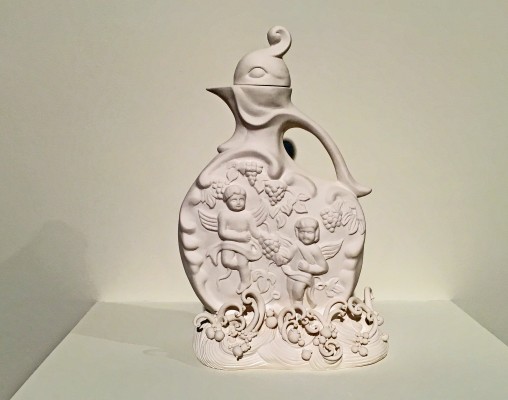
Carlos Rolon Dzine, Fine Regal China, Hand Made Porcelain, 2016


The porcelain vase/pitcher was designed by Rolón but produced in China and replicates some of the faux objects his mother collected when he was a child. For a family steeped in religious traditions, these type of porcelain objects represented high cultural art based on objects that you might think belong to an aristocracy, as do silk flower arrangements and clocks imbedded in ceramic frames. Adding these types of objects to the exhibition recreates markers or icons within Hispanic cultural traditions. Typically, these pieces were on display in ornate wooden display cabinets along with wedding favors and family photographs, all part and parcel of the culture.

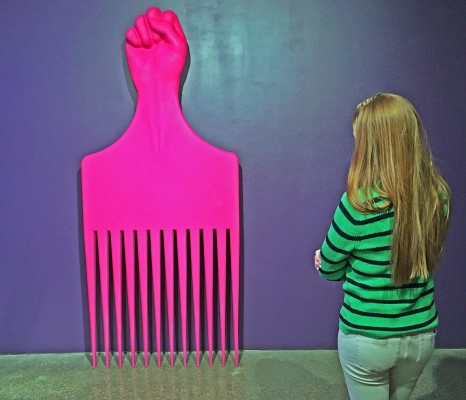
Afro Comb

Carlos Rolon Dzine, Afrocomb, High Density Urethane, Resin, Paint 2016


Included in the exhibition is a large and carefully crafted ‘pop art’ object, the Afro hair pic that includes a clenched fist as part of the handle, both symbols during the 1970s in urban cities. The cultural object here is used to shape hair and represent the Black Power Movement, prominent in the struggle against the establishment and a promotion of self-determination. This is yet one more part of Rolón’s installation, creating an environment that paints a picture of his early personal and cultural memories.

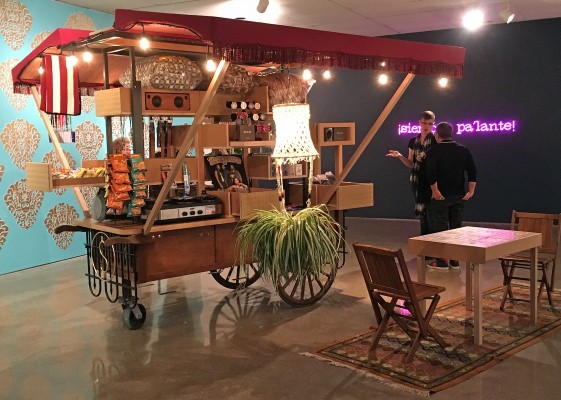
Vendor Cart

Carlos Rolon Dzine, Nomadic Habitat, Mixed Media & Merchandise 2016

In cities like New York or Chicago, there was a time when the vendor cart was commonplace. These carts represented all kinds of ethnic food, from hot dogs, pretzels, bagels, and blintzes to the Hispanic cart that sold tostones, empanadas, fritas and pasteles. The nomadic vending carts were located in neighborhoods where people sought a bite on the go. In his piece, Nomadic Habitat, Carlos Rolón/Dzine intentionally uses the memory of the cart to recreate a replica as a symbol of his cultural. First on exhibit in “The Potential of Spaces: The Arts Incubator helps bring the Chicago Architectural Biennial to the South Side” from the Chicago Art Institute, the piece articulates the relationship of culture to the community.

For me, writing about installation and performance art feels a little like a rubber band, causing this writer to stretch his experience to include new and emerging forms of artistic expression. Certainly there is a tradition in installation that includes British Artists Andy Moss, and Jamie Wardley, who created The Fallen, a visual display at D-Day landing on the beach of Arromanches in France, and Rain Room, by Berlin-based collective Random International where at Rice University you experience the rain without getting wet. Most recently at Art Prize 2014 in Grand Rapids, Michigan, Anila Quayyum Agha’s installation Intersections, casts a delicate web of shadows by filling a room with carefully crafted patterns from a laser cut wooden cube powered by a single light source. The result was a room illuminated with lace-like geometries cast onto the surrounding walls, and like Carlos Rolón/Dzine, she says, “For me the familiarity of space visited at the Alhambra Palace, created memories of another time and place from my past.” Both artists used memory and culture to form their biographical oeuvre.

Perhaps this brings me to the role of the Oakland University Art Gallery in exposing its audience of students, faculty and community to new trends in all forms of art, free from commercial purpose. The Oakland University Art Gallery has been leading in this respect for a number of years and continues to set the bar for others. University based galleries have the financial base to support such important endeavors and play an important role in educating the community in Metro Detroit.

http://www.ouartgallery.org


50 years @ the Detroit Institute of Arts

Collecting Prints, Drawings, and Photographs

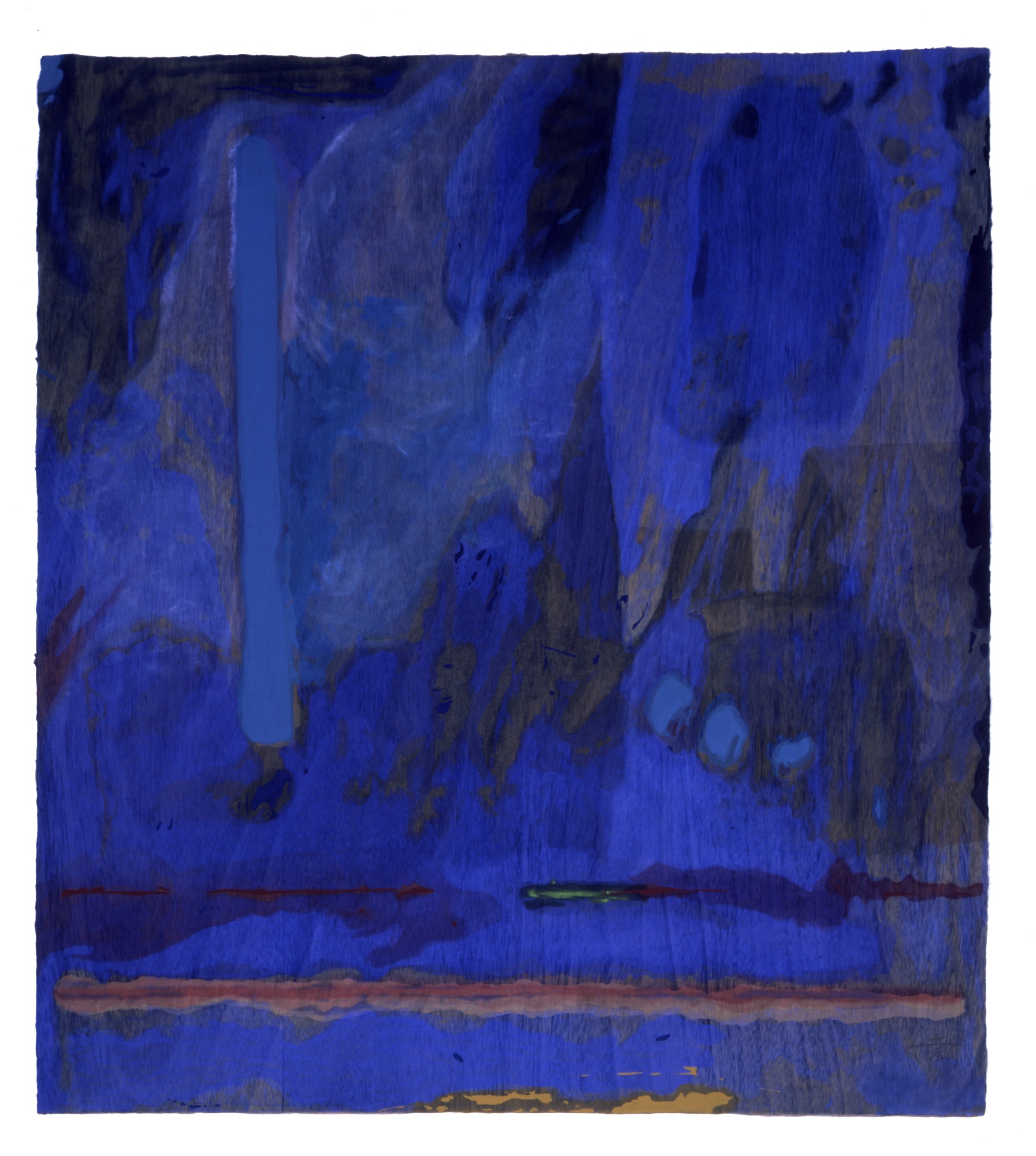
Frankenthaler

Helen Frankenthaler, American, 1928 – 2011 Tales of Genji III 1998 Woodcut and stenciling printed in color on handmade tan paper Image and sheet: 47 x 42 in.

At the center of the City of Detroit’s heart is the Detroit Institute of Arts (DIA). For many reasons, including its world famous collection, exhibitions, events, film theater, classes and workshops, the DIA serves as an aesthetic anchor to the entire metro Detroit area.

The December 15, 2015 opening celebrates the DIA’s 50th anniversary of one of its long-standing auxiliary support groups, Friends of Prints, Drawings, and Photographs (FPDP) with an exhibition curated by Nancy Sojka, head of Prints, Drawings and Photographs. The exhibit, 50 Years of Collecting Prints, Drawings and Photographs, marks her retirement from the DIA where she has worked since 1988. During her tenure she has organized more than 40 exhibitions from the DIA’s collection, including Ordinary People by Extraordinary Artists: Works on Paper by Degas, Renoir, and Friends (2014–15), Picasso and Matisse: The DIA’s Prints and Drawings (2012-13), Government Support of the Arts: WPA Prints from the 1930s (2009–10), The Big Three in Printmaking: Dürer, Rembrandt and Picasso (2006); Martin Lewis: Drawings and Related Prints (2000); Prints by Terry Winters: A Retrospective from the Collection of Robert and Susan Sosnick (1998–99), and Prints and Drawings in the Age of Rubens (1994).

“Over the years Nancy has organized dozens of exhibitions drawn from the museum’s rich collections of prints and drawings,” said Salvador Salort-Pons, DIA Director. “While we will miss Nancy’s ingenuity and expertise, we wish her the best in her retirement.”

Among the featured works are Berenice Abbott’s New York at Night, Robert Frank’s Belle Isle Detroit, Erich Heckel’s Die Brucke poster, Edvard Munch’s Lovers, Charles Burchfield’s In the Parlor, Helen Frankenthaler’s Tales of Genji III, James McNeill Whistler’s Yellow House, Lannion, Martin Lewis’ Which Way?, along with selections from Robert Rauschenberg’s Bellini Series.

“During her tenure at the Detroit Institute of Arts, Nancy Sojka has provided passionate scholarship, connoisseurship, and exposure of the graphic arts to an expanding citizenry from the Michigan counties of Wayne, Oakland and Macomb and museum attendees from far beyond Metropolitan Detroit.” says Norm Stewart, Director of Stewart & Stewart.  “The exhibitions she has presented in the Schwartz Graphic Art Galleries represent a curator with exceptional knowledge of graphic arts history, a keen awareness of contemporary graphics, and an understanding of the developing technologies that will shape what is to come.”

The exhibition provides a small glimpse of the complete collection showing 125 art objects, (from a collection housing approximately 35,000 objects, that breaks down to 10,000 photographs, 10,000 drawings, and 15,000 prints) which includes a good number of local artists.

Commenting, “The exhibit, What’s New – Recent Acquisitions in 2004 was evidence of the adventurous way in which Nancy grew the collection of art on paper at the museum. Nancy was very supportive of the artist’s in Detroit who worked on paper and I am deeply appreciative for her support over these many years.” by Doug Semivan, Art Chairman of Madonna University.


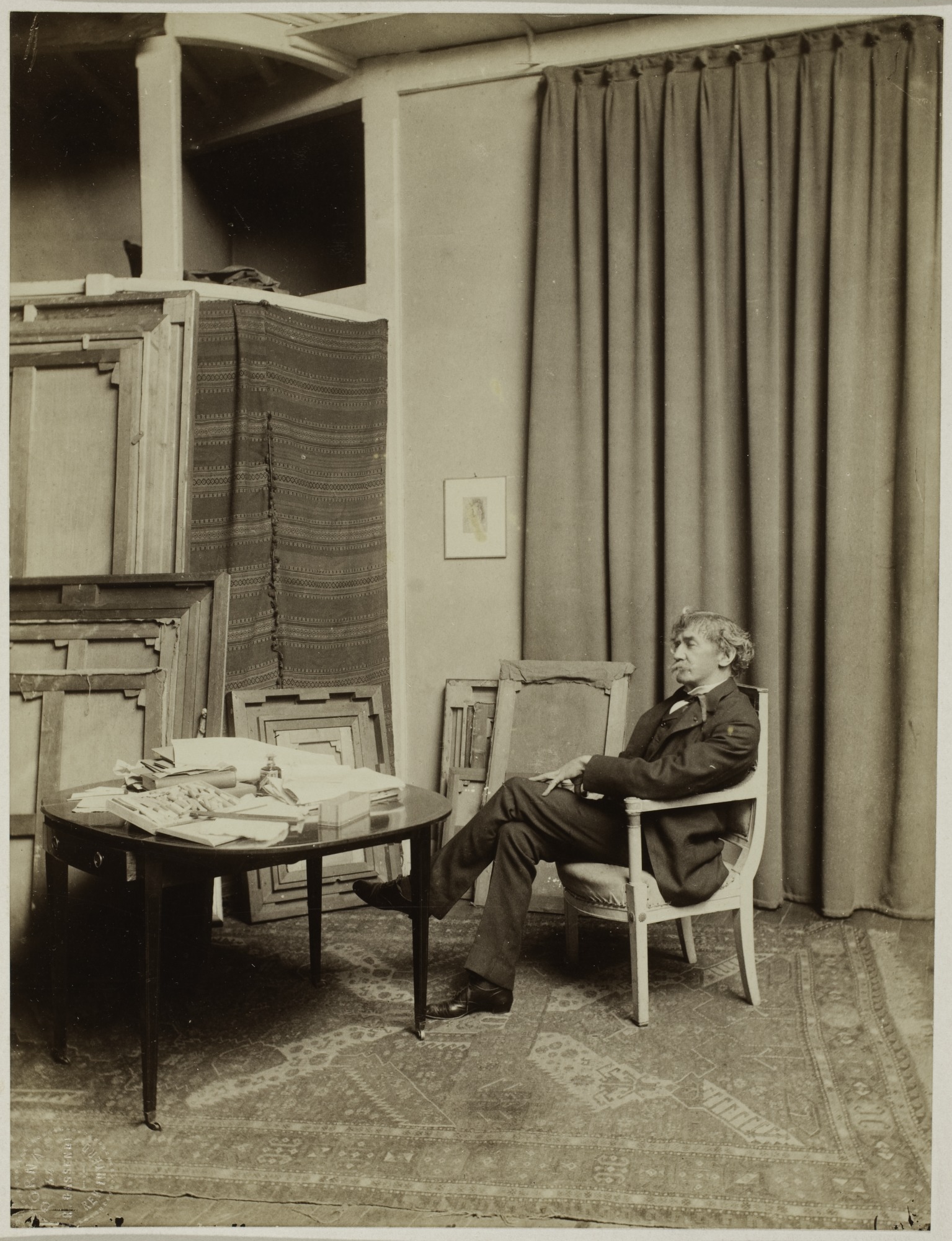
Whistler in his Studio

Paul François Arnold Cardon, French, 1859 – 1941 Whistler in His Paris Studio at 106 Rue Notre Dame des Champs 1892 Albumen print mounted to board. Sheet and image: 17 x 14 in.

French photographer, Paul Francois Arnold Cardon, or Dornac, specialized in personalities, and took this 17 X 14 photo in 1892 using the albumen print process mounted on board. The photo captures a rare moment of James A. M. Whistler, the American-born, British-based artist in his studio whose Yellow House, Lannion is also part of the exhibition. This image is a moment in time just as the art of photography starts to develop throughout Europe. The photograph was a gift of Leonard and Jean Walle.

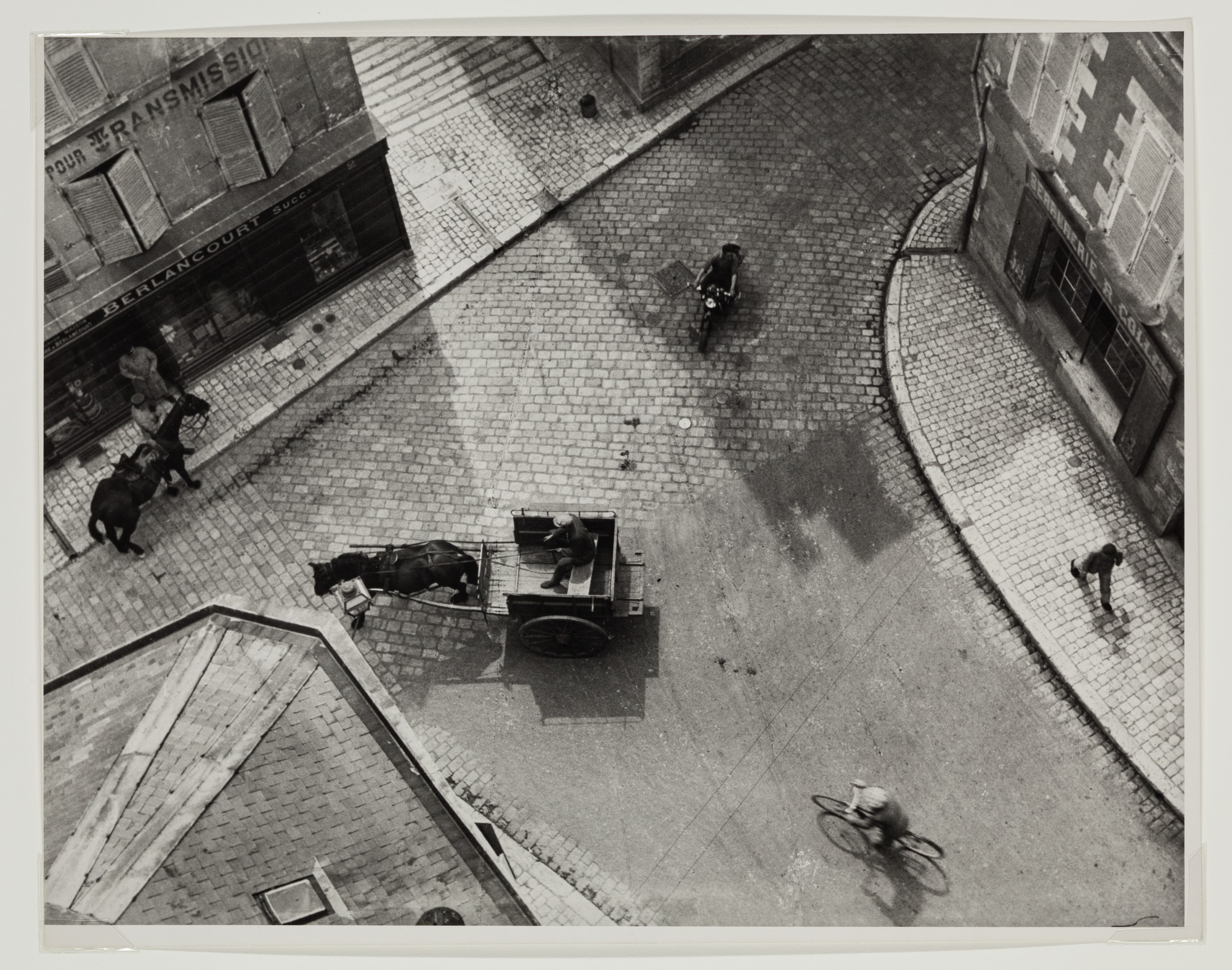
Kertesz - carrefour

André Kertész, American, 1894-1985 Carrefour Blois 1930 (printed 1970/1985) Gelatin silver print Image: 10 11/16 x 13 11/16 in. (27.4 x 35.8 cm)

The Hungarian photographer André Kertész spent many years in Paris and is known for his aerial black & white compositions that often capture the effects of low light casting long shadows on his subjects. After his education in 1912 at the Academy of Commerce in Budapest, he eventually found his way to Paris, where he spent the majority of his life producing portraits, streetscapes and distortions. When I visited the Getty Museum in 1996, the museum had recently purchased all of his remaining work and had just mounted a retrospective. Kertész brought a unique vision to the art of photography and influenced generations of photographers that followed.

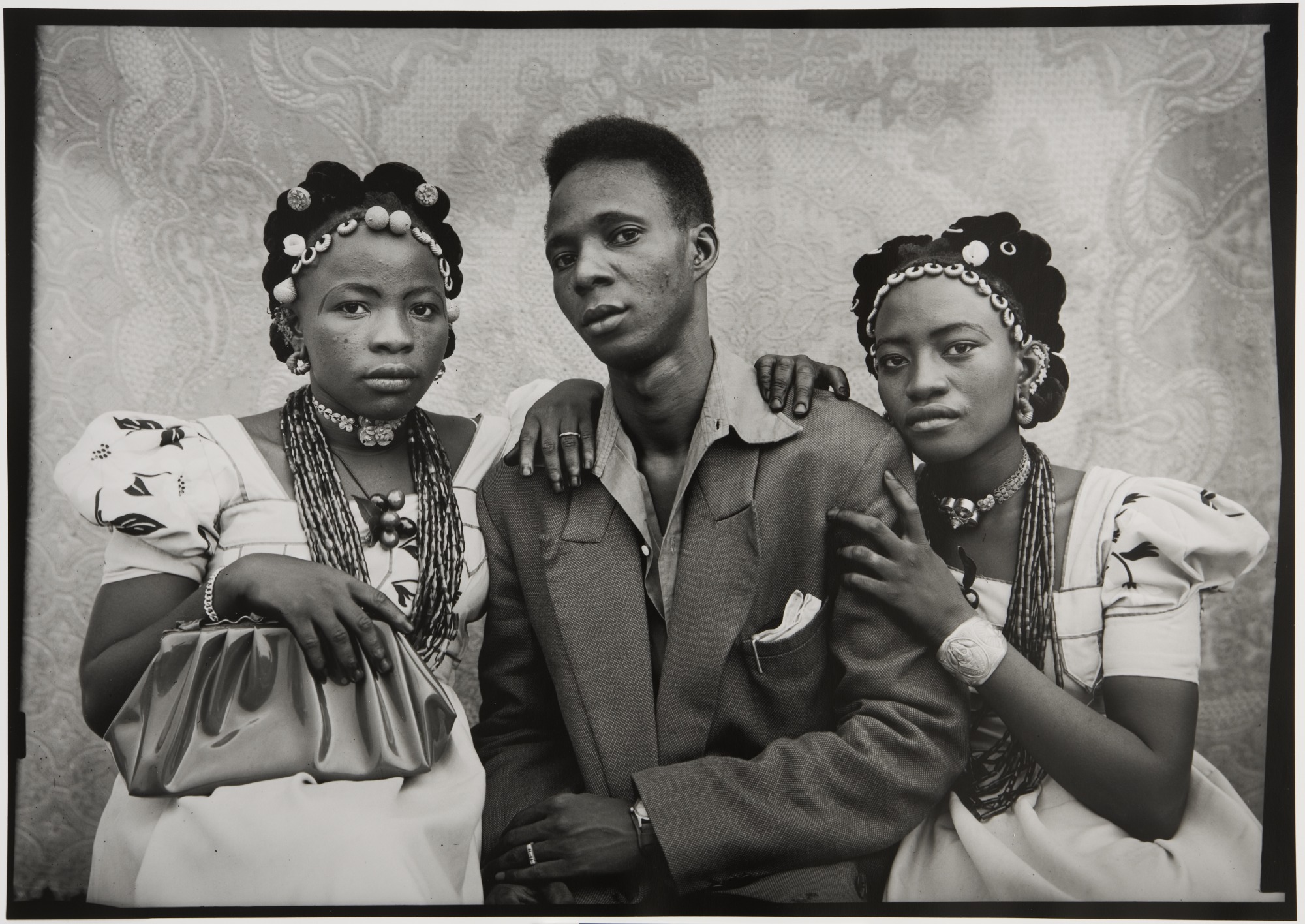
Seydou Keita

Seydou Keita, African, 1923 – 2001 Untitled #42A51 1956/1957 Gelatin silver print Image: 15 11/16 x 22 1/8 in. (39.8 x 56.2 cm) Sheet: 24 x 20 in. (61 x 51 cm)

The untitled 24 X 20 photo print by Seydou Keita typifies the work by this photographer from Bamako, Mali who spent much of his life photographing the people of this once-French colon. The self-taught photographer was introduced to his Kodak Brownie Flash camera in 1935 by his uncle and went on to pursue a career as a professional photographer. His strict sense of formality is combined with his ability to develop a level of intimacy with his subjects and capture a moment that withstood time. This photo was a museum purchase, with funds from William and Ellen Kahn.

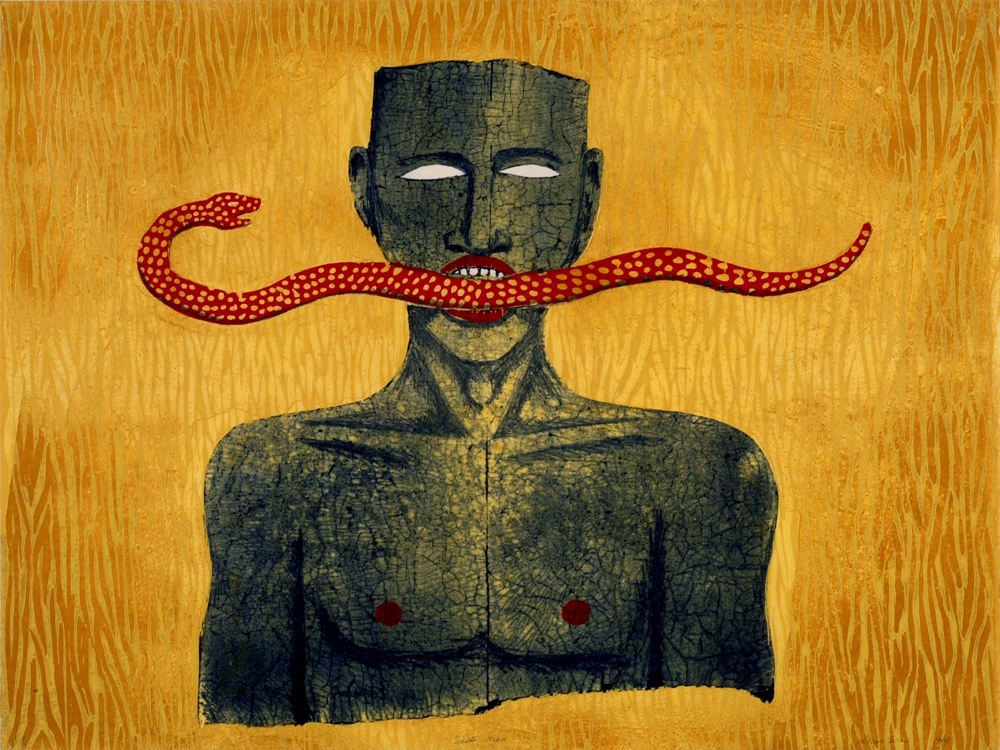
saar_allison-snake_man

Alison Saar, American, born 1956 Snakeman 1994 Woodcut and lithograph printed in color on oriental paper Image and sheet: 27 7/8 x 37 1/8 in. (70.8 x 94.3 cm)

A younger artist from the west coast, Alison Saar, has created a color woodcut and lithograph, Snakeman, 1994, (a gift from Marc Schwartz). She is a well known African-American artist whose work explores themes of African culture and spirituality. A recipient of a Guggenheim Foundation fellowship and a fellowship for the National Endowment for the Arts, Saar’s work has often included a variety of materials (bronze, lead, tar and wood) with which she creates a highly personalized amount of cultural context in her painting, sculpture and print formats.

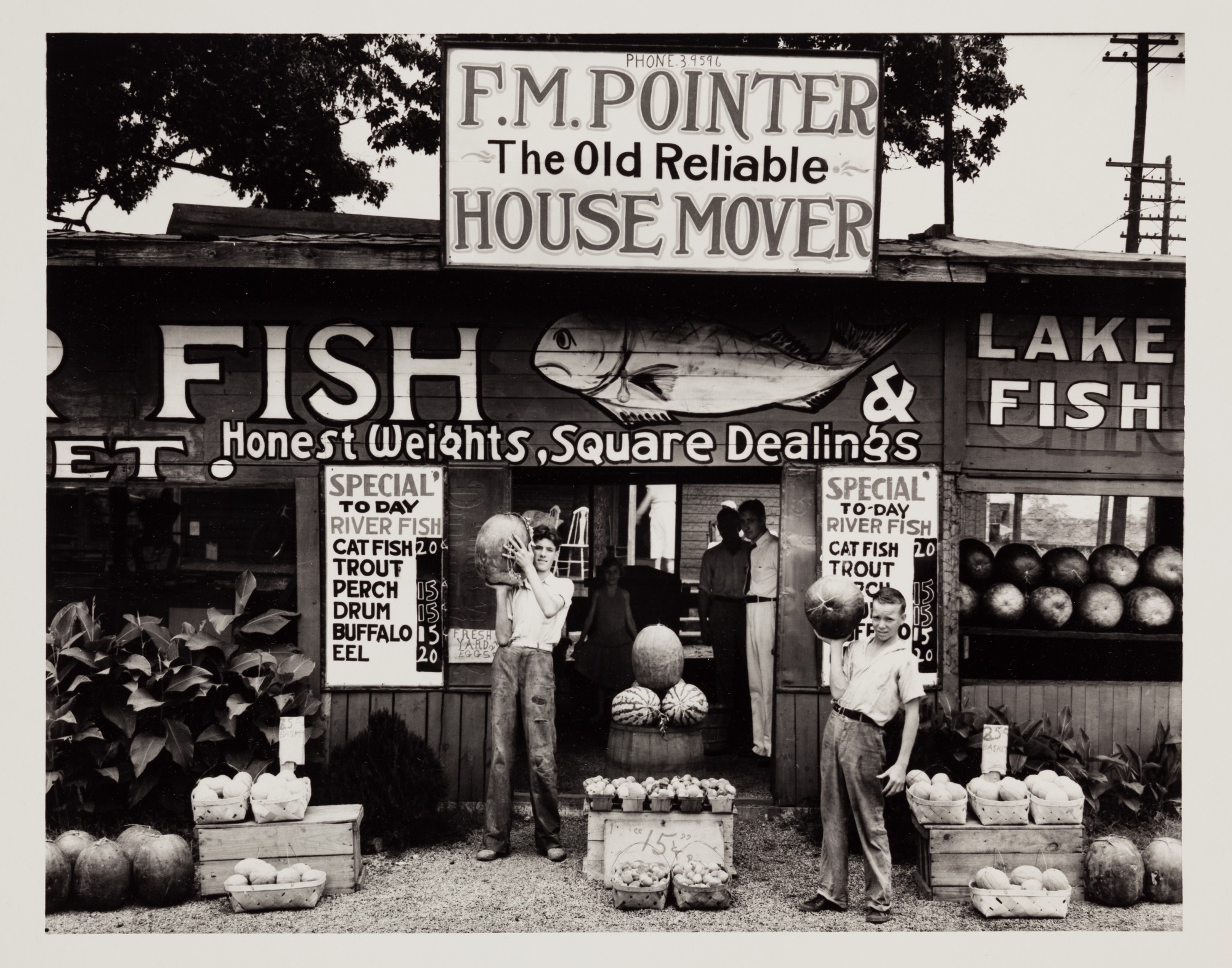
Walker Evans

Walker Evans, American, 1903-1975 Roadside Stand Vicinity Birmingham, Alabama 1936 (printed later) Gelatin silver print Image: 7 1/2 x 9 1/2 in. (19.05 x 24.13 cm.)

It could be said easily that Walker Evans is one of the most influential artists in the twentieth century and the progenitor of documentary-style photography in the United States. Although I had read about his work during my college years, it was the retrospective of his work at the Metropolitan Museum of Art in New York City in 2000 that left an indelible impression. Born in St. Louis, Missouri in 1903, Evans spent a year at Williams College where he indulged himself in literature and where he first envisioned himself as a writer. Fortunately for the art world, Evans gradually redirected himself toward photography. His lifetime of photography took him through the Depression years during which he worked alongside Dorothea Lange, Arthur Rosthstein, and Russell Lee as part of the government New Deal agency. He had been assigned to capture the essence of American life. His black & white images were of people found along the roadside, cafes, home interiors, and small town main streets. The photograph, Roadside Stand, from 1936 is a gift from Beverly Franzblau Baker, in memory of Morris D. Baker.

2004_65-d1_o2

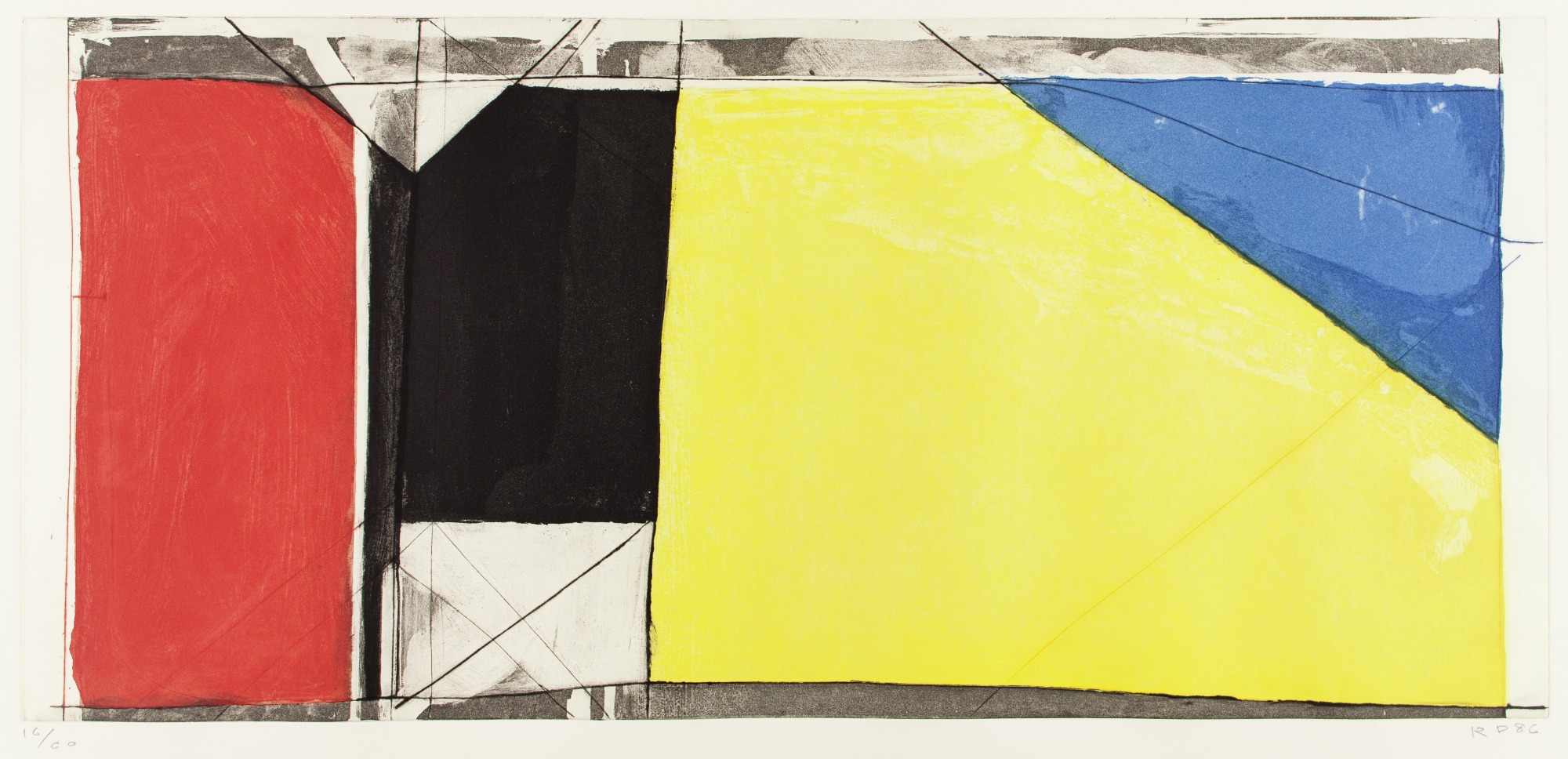
Richard Diebenkorn, American, 1922-1993 Folsom Street Variation III 1986 Soapground, aquatint, flatbite, and drypoint printed in color on off-white wove paper Plate: 12 x 25 7/8 in. (30.5 x 65.7 cm) Sheet: 26 5/8 x 40 1/8 in. (67.6 x 101.9 cm)

This aquatint and dry-point print from the work of Richard Diebenkorn, Folsom Street Variation III, 1986, gives us information about a West Coast abstract expressionistic painter who also engaged in printmaking. Best know for his abstract landscape series, Ocean Park, Diebenkorn’s work seems rooted in the outside world. His works on paper also included drawings using gouache and crayon, but it is his large body of painting that retains a quiet and distinctive intensity while presenting the viewer with an informal use of space, as oppose to, say, Piet Mondrian. The print is a gift from Dr. and Mrs. Robert J. Miller and Dr. and Mrs. Robert Moss.

The 125 pieces selected by Nancy Sojka and her staff for the exhibition 50 Years of Collecting Prints, Drawings, and Photographs serves as a nice send-off for Sojka and her years of work at the Detroit Institute of Arts. In this exhibition, she pays some attention to the Detroit artists in the collection, including Stanley Rosenthal, Janet Hamrick, Bill Rauhauser, Norman Stewart, Dave Jordano, Doug Semivan, Susan Campbell and others. As the public focuses on exhibitions of painting, sculpture, film and installation, let us not forget about the drawings, various print forms and photographs that rest in this grand collection at the Detroit Institute of Arts.

Detroit Institute of Arts – Hours and Admission

9 a.m.–4 p.m. Tuesdays–Thursdays, 9 a.m.–10 p.m. Fridays, 10 a.m.–5 p.m. Saturdays and Sundays. General admission (excludes ticketed exhibitions) is free for Wayne, Oakland and Macomb county residents and DIA members. For all others, $12.50 for adults, $8 for seniors ages 62+, $6 for ages 6–17. For membership information, call 313-833-7971.


Page 32 of 35

Powered by WordPress & Theme by Anders Norén