Critical art reviews of Detroit galleries and museums weekly

Category: Drawing Page 3 of 15

Beyond Topography Exhibition @ Janice Charach Gallery

Beyond Topography is a 23-person group show of Michigan Artists at the Janice Charach Gallery
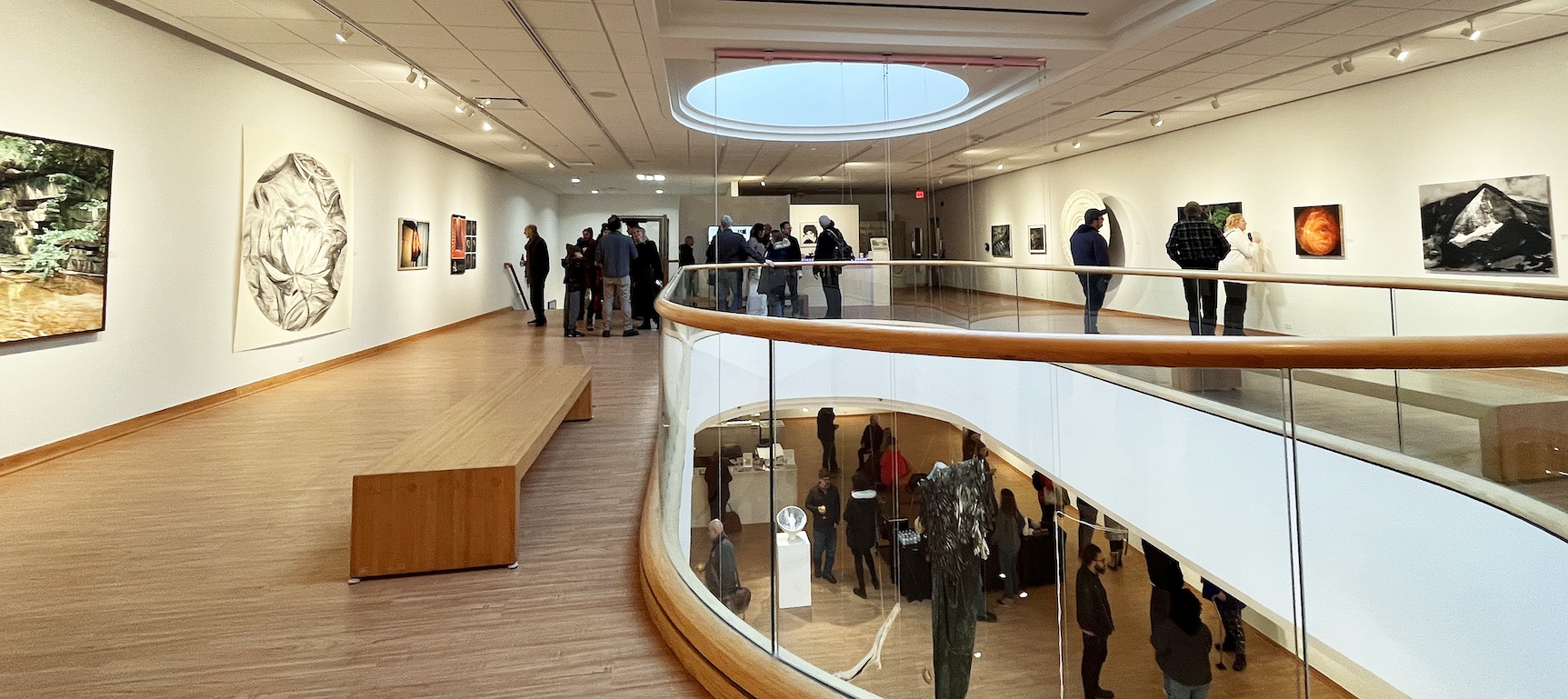
An installation shot of Beyond Topography, a group show up through Feb. 21 at the Janice Charach Gallery in West Bloomfield. (Photos courtesy of Clinton Snider.)

 Painter, curator, and teacher Clinton Snider always found early depictions of the American wilderness transporting. Think of the first large room in the American wing on the second floor of the Detroit Institute of Arts, with its canvases crammed with mountains, gorges and other examples of glorious, untamed landscape. Snider acknowledges the current of Manifest Destiny running through many of these paintings, but notes that “at the same time, they’re deeply beautiful and spiritual.”

So when Natalie Balazovich, the director of West Bloomfield’s Janice Charach Gallery asked Snider to curate a show on landscape, he found himself thinking of those classic works, but at the same time, in his words, “reacting against them.” He knew he didn’t want a show of pretty views. His intent was always to bend the landscape paradigm, but still arrive at something with spirituality and force. The result is Beyond Topography, a 23-person group show of Michigan artists up through Feb. 21 that takes a broad view indeed of what constitutes a landscape.
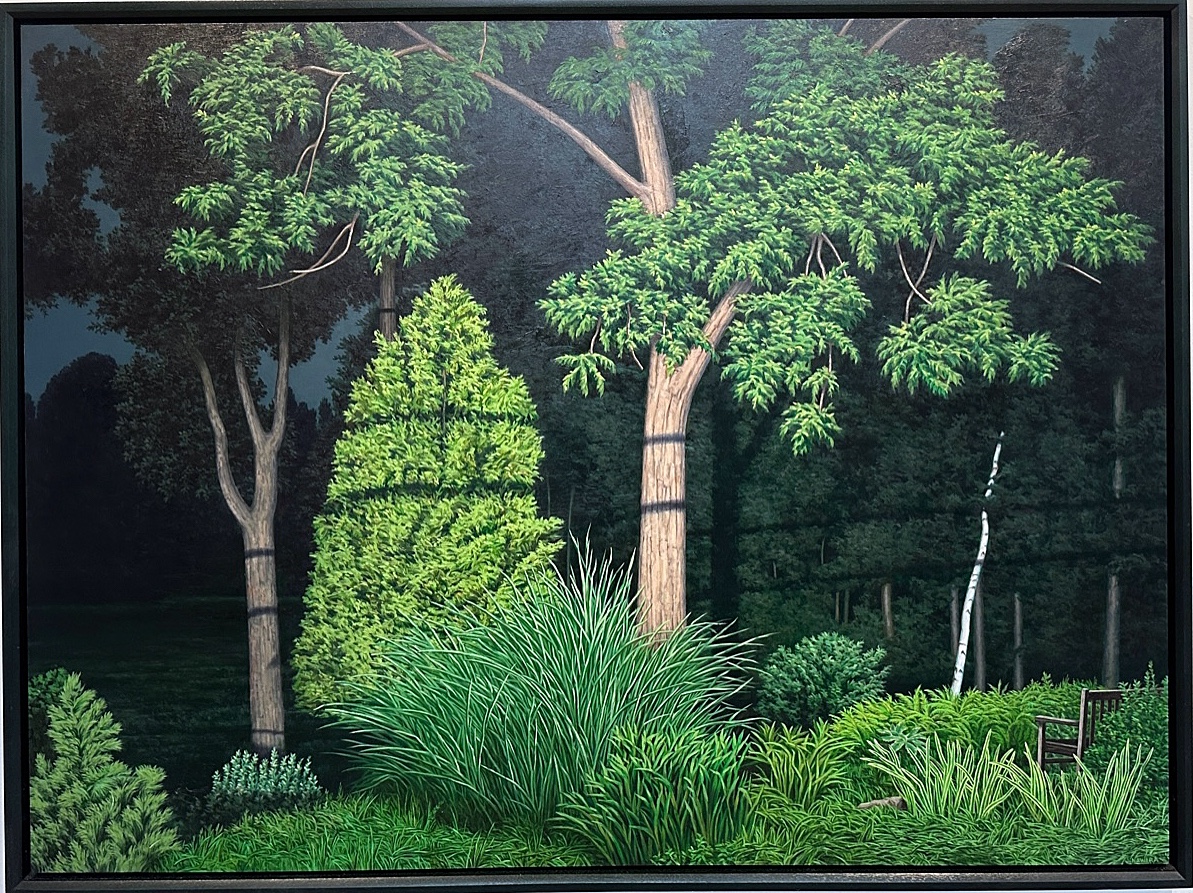
Jim Nawara, Studio View – Powerline Shadows, Oil on panel, 34 x 44 inches.

Studio View – Powerline Shadows by Jim Nawara straddles both the traditional landscape and the unconventional approach Snider is reaching for. The use of color in this lush portrait is exhilarating. It gives the composition three-dimensionality but also amounts to a stirring essay in greens and greenish-blues.

Cutting through this Arcadia, however, are two parallel black lines a little like skid marks – the shadows of overhead power lines that stripe horizontally across tree trunks and bush alike. It’s a human intervention – a desecration, if you will — that on the one hand coarsens this image of perfect beauty, but on the other elevates Studio View above and beyond the merely pretty, landing it someplace immensely satisfying.
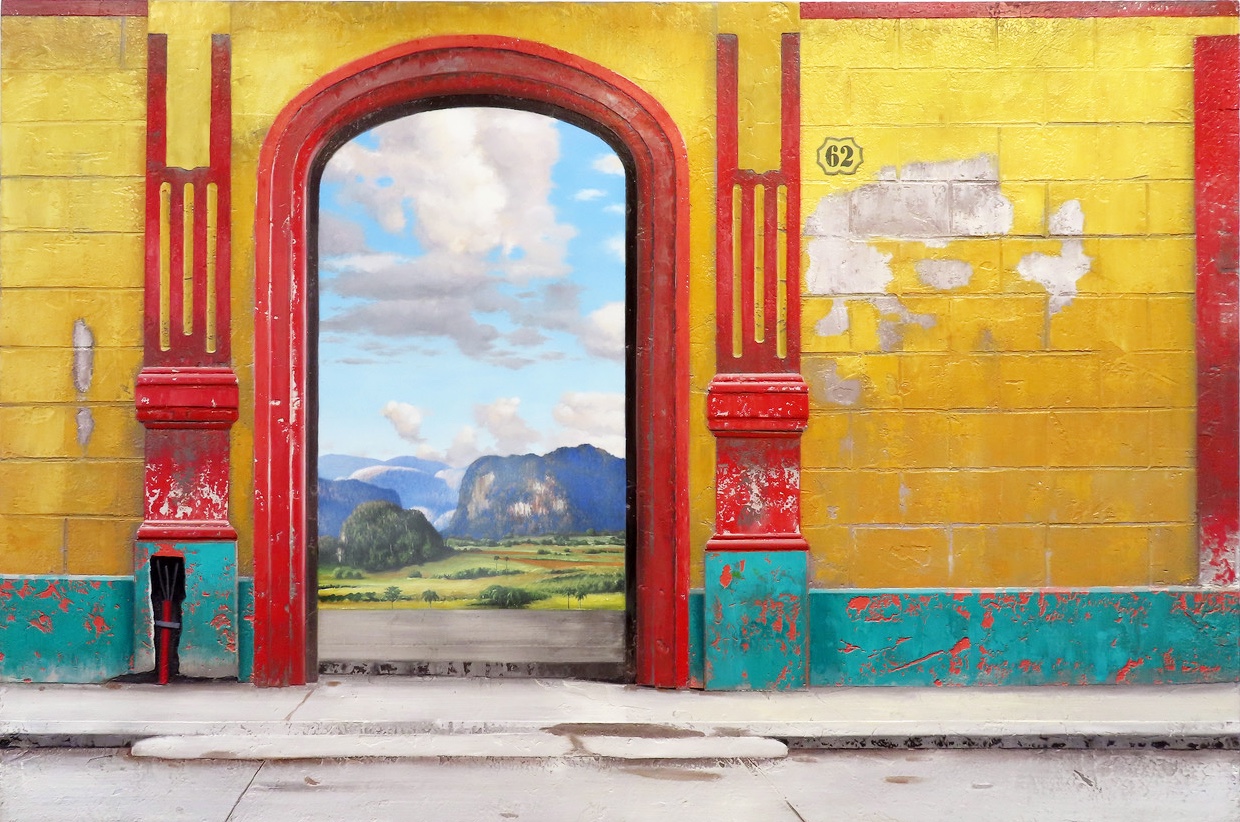
Mel Rosas, The Excursion, Oil on canvas, 48 x 72 inches.

In The Excursion, a peeling wall with a Spanish colonial look dominates the foreground, framing an arch that opens onto a sub-tropical landscape of fields and mountains that beckon like postcards from Eden. On our side of this magic threshold, all is every day and grimy. On the other side lies paradise, and the viewer can hardly resist its gravitational pull.  Rosas, who taught for years at Wayne State and says he grew up speaking English but dreaming in Spanish, has repeatedly traveled to Panama, where his father was born. The artist’s work nearly always involves these sorts of gritty, Latin urban vignettes, often pierced by a wormhole into a bucolic past that’s mostly lost or despoiled worldwide. These are visions both spiritual and deeply uncertain. Even within the imaginary logic of the specific painting, there’s no guarantee that the idyll beyond the door frame is accessible or even exists.
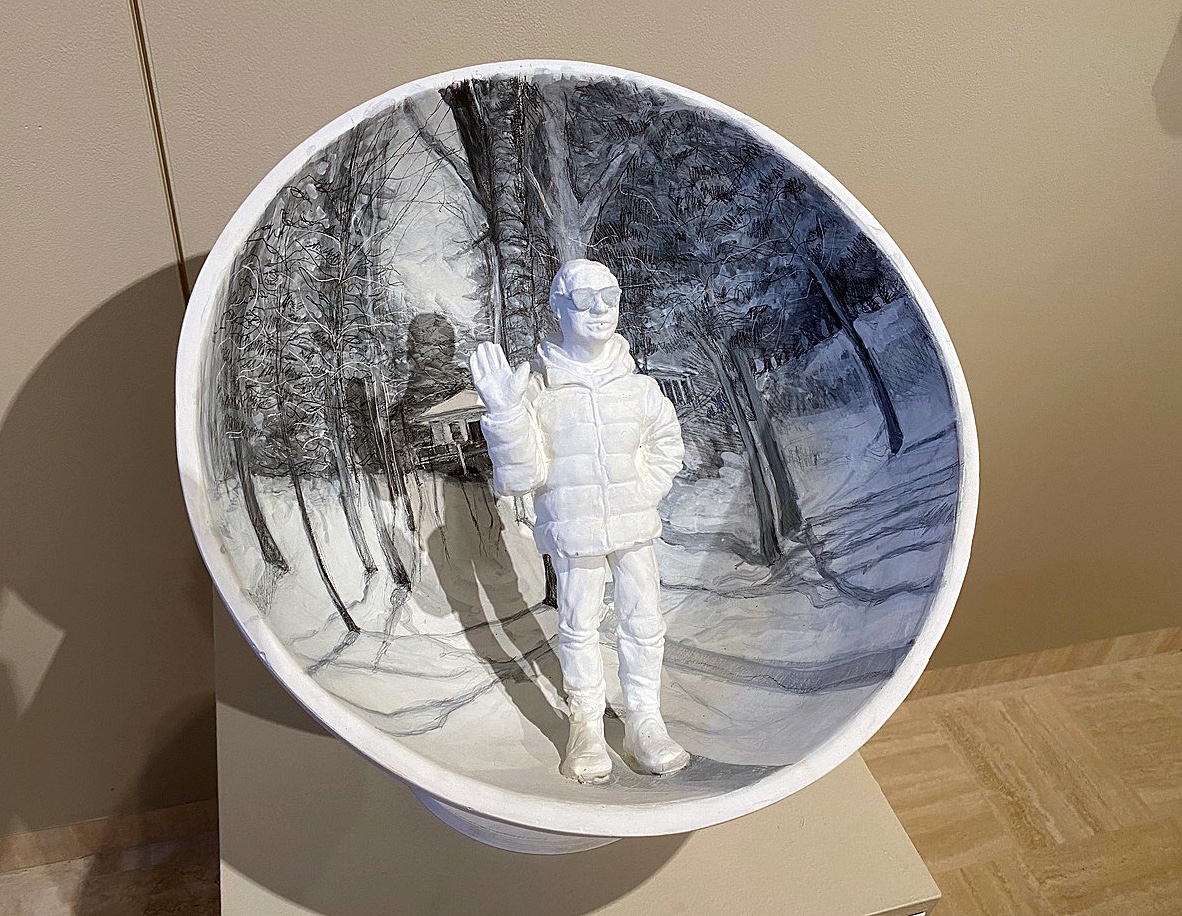
Andrew Krieger, Up North, Edenville, MI, Ceramic, 17 by 16.5 by 15 inches.

Andrew Krieger crushes the world of the diorama. He is the undisputed master of this three-dimensional genre so few artists risk, and one which Krieger inhabits with a pleasing mix of artistic brio and elementary-school goofiness. The artist, who’ s shown in Detroit at Popps Packing and the David Klein Gallery, as well as in Saginaw at the Marshall Fredericks Museum, creates visual narratives that usually involve a 3-D figure in front of a curved background screen. As you move around in front these constructions, changing depth and perspective conjure up an oddball sense of reality. Momentarily, the wooden or ceramic figure at the center of the story springs to life.

In the case of Up North, Edenville, MI, a hale fellow in a down parka and blocky sunglasses waves at the viewer. He’s framed by a shallow ceramic bowl painted in black and white with a surprisingly convincing wintry, wooded scene behind him. The ceramic sculpture of the waving gent in front, a blistering white that pops against its background, is at once funny and dead-on accurate in capturing the 21st-century, up-north Michigan male of the species.
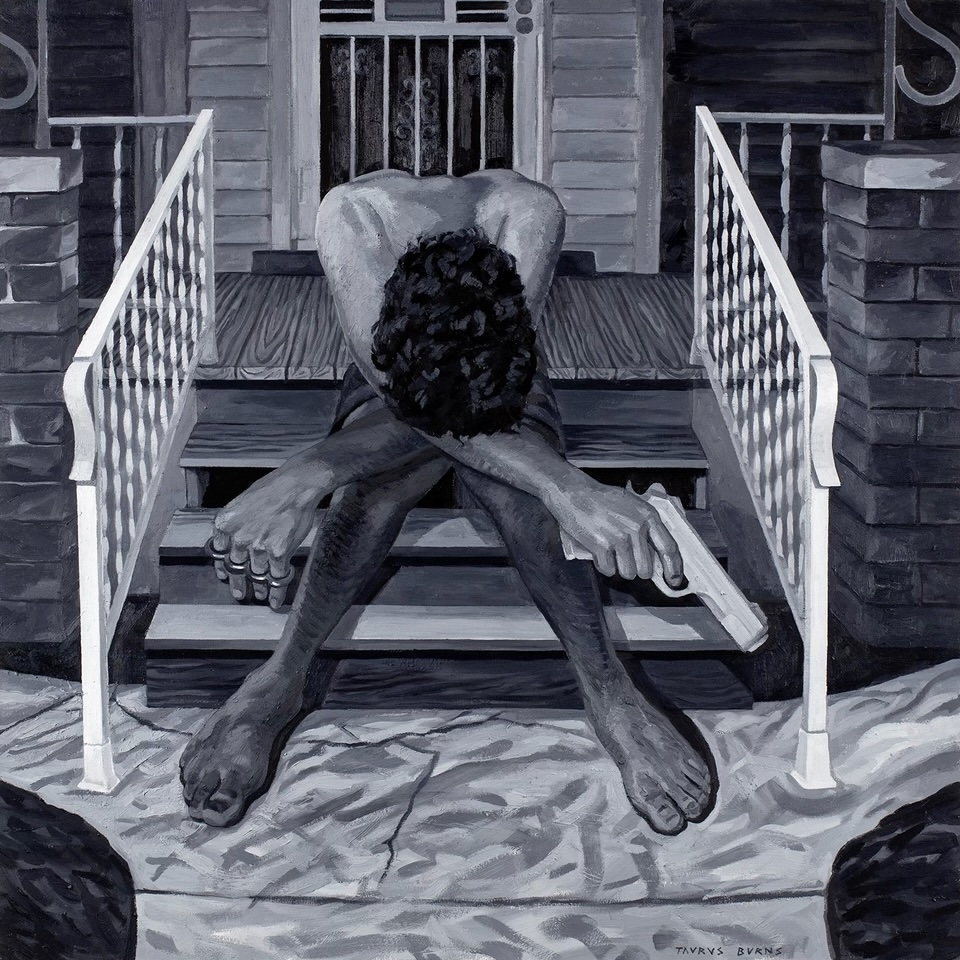
Taurus Burns, To Be Black and White in a Colorblind World, Oil on canvas, 48 x 48 inches.

The concept of landscape gets pushed to its tight-focus extreme with this black-and-white portrait of a front porch and a man, seemingly grieving, who’s slumped over holding a gun in one hand. Behind him is one of those barred metal doors to prevent break-ins, the sort you see all over iffy neighborhoods. Burns, who’s half Black and half White, has recently produced a series of works examining the nature of this dual identity. With To Be Black and White in a Colorblind World, we’re given a portrait of regret or despair framed by the white metal railings on each side of the porch steps. Burns, who earlier this year had a solo show at Ferndale’s M Contemporary, locates at the exact center of the composition a man hunched over on porch steps, his forehead resting on forearms crossed over his knees. Organizationally, this symmetrically composed portrait resolves itself in a series of superimposed triangles comprised of legs, arms and shoulders — an almost Renaissance conceit in its painterly geometry.
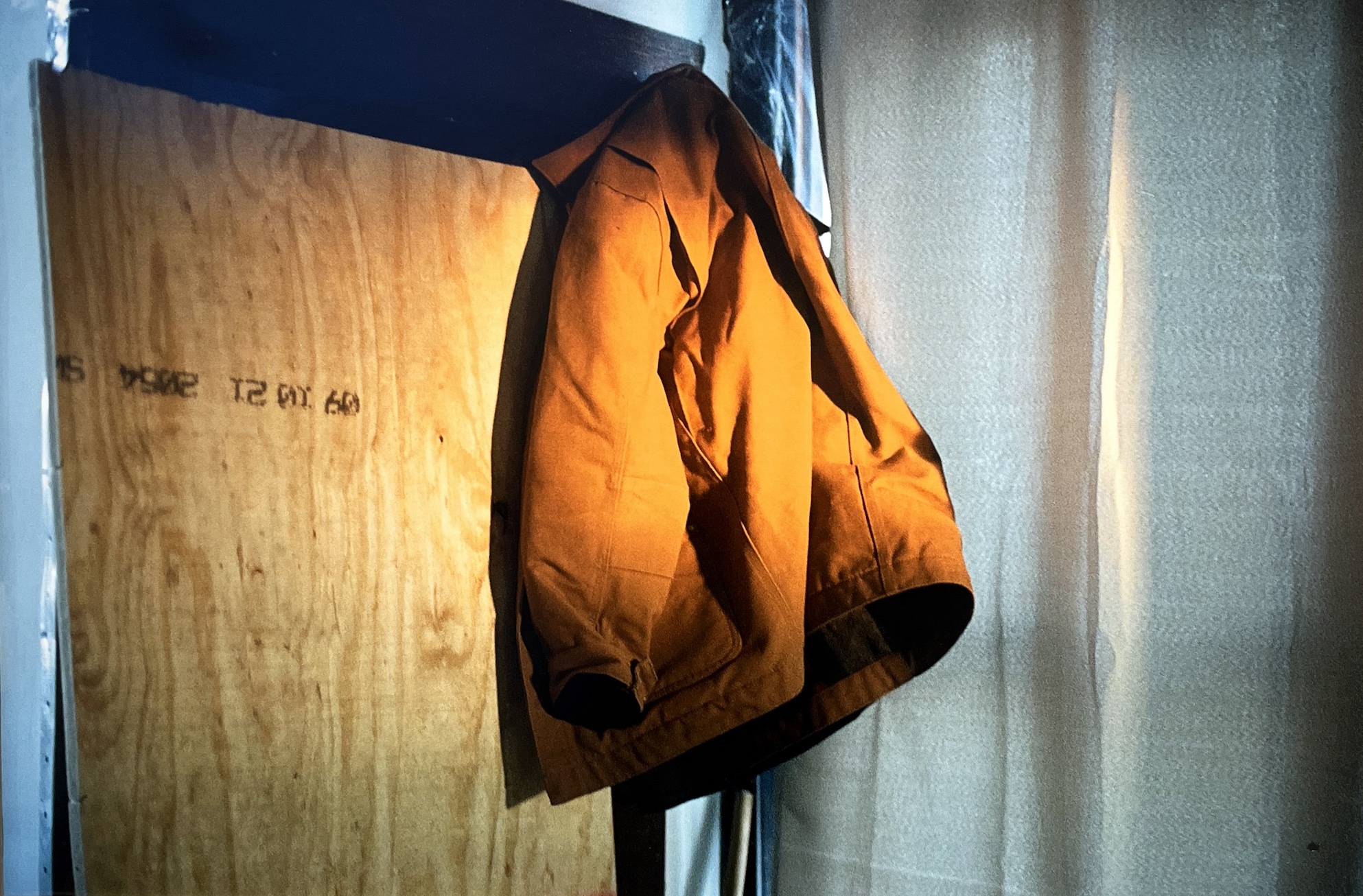
Bakpak Durden, Hanging On, Framed archival print from original negative, 27 x 40 inches.

Who knew a photo of a workman’s winter jacket – the sort Carhartt sells – could be so luminous and affecting? Draped in early morning or late afternoon sunlight on a plywood panel in some indoor construction site, the jacket in Hanging On – a tannish sort of orange – positively glows, while the contrast with the rough plywood and half-erected wall nearby makes the humble overcoat read almost like an object of great beauty.

Durden, who also has the exquisite Renaissance-style painting Mimicry in the show, is something of an artistic polymath. In addition to painting and photography, the artist – with recent solo shows at Cranbrook, the University of Michigan, and Playground Detroit – has turned a remarkable number of walls across Detroit into striking murals. Indeed, it’s hard to spend much time in the city without seeing one.
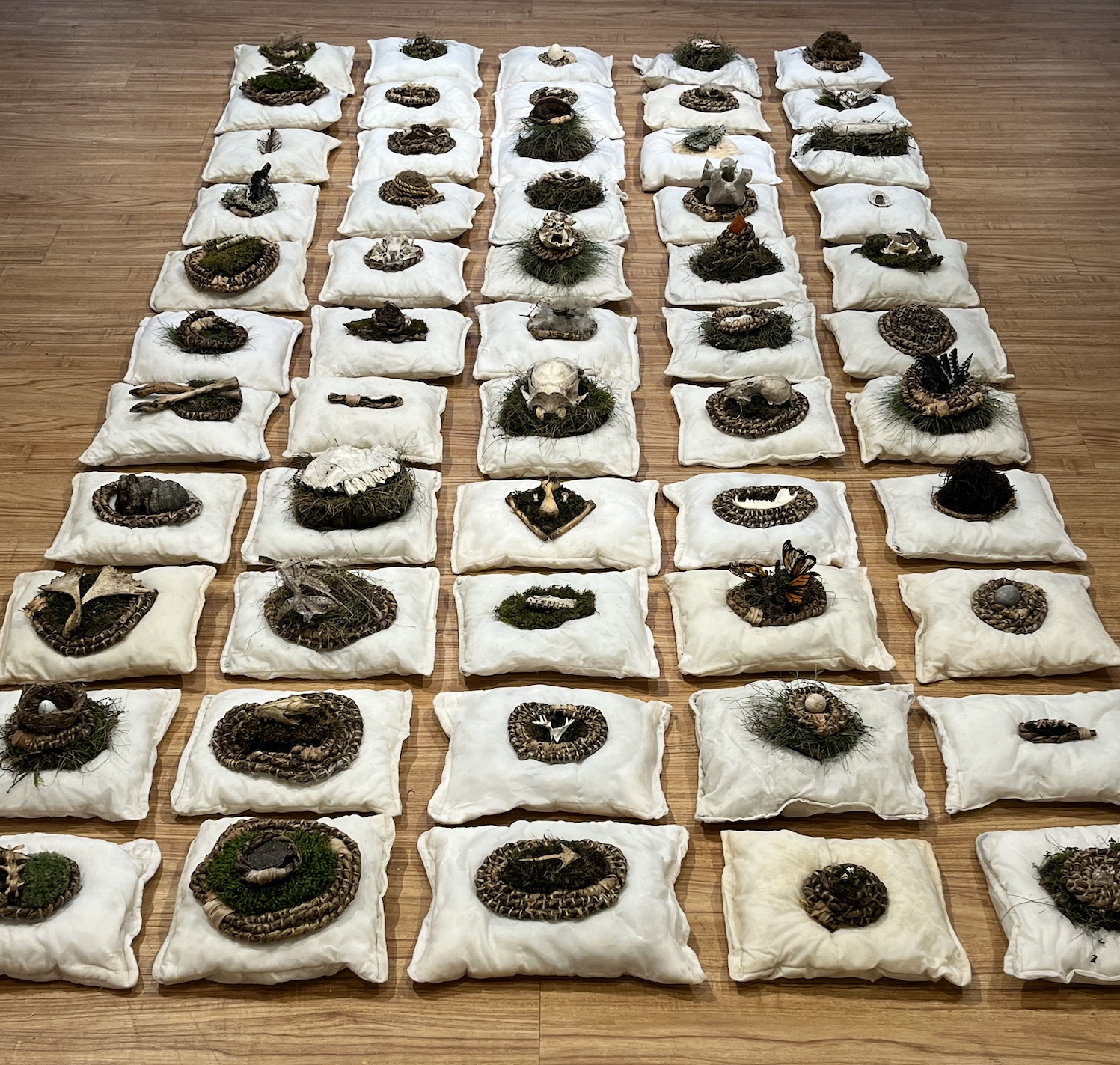
Denise Fanning, A Soft Place to Land (Rest in Peace), Cotton, beeswax, grass, moss, found remnants of nature, sea grass cordage, 6 x 9 feet.

A Soft Spot to Land (Rest in Peace) by Denise Fanning, who taught for years at the College for Creative Studies but now lives in Mt. Pleasant, creates a peculiar and beautiful “landscape” out of 55 identical off-white square pillows and 55 “nests” or creations she’s delicately placed on each one. While the artist does a lot of studio work and has exhibited in galleries from Detroit to Berlin, lately she’s spent an increasing amount of time out of doors arranging and creating in nature itself – crafting ephemeral installations designed, like much of Scott Hocking’s work, to weather and disintegrate over time.

This pillow field is arranged in a 5 by 11′ grid. If you stand at the narrow end and look up the construction, it does a remarkable job of creating a sense of distance and topography, however orderly and symmetrical. The compositions that have alighted on the pillows are extraordinary miniatures in themselves – tiny essays in natural grace.

Other artists in the show include Mitchell Cope, John Charnota, Joel Dugan, Adrian Hatfield, Scott Hocking, Faina Lerman, Alex Martin, Anthony Maughan, Michael McGillis, Ivan Montoya, Lucille Nawara, Rebecca Reeder, Tylonn Sawyer, Clinton Snider, Millee Tibbs, Graem Whyte and Alison Wong.

 The group show Beyond Topography will be up through Feb. 21 at the Janice Charach Gallery.
 

Skilled Labor: Black Realism in Detroit @ Cranbrook Art Museum

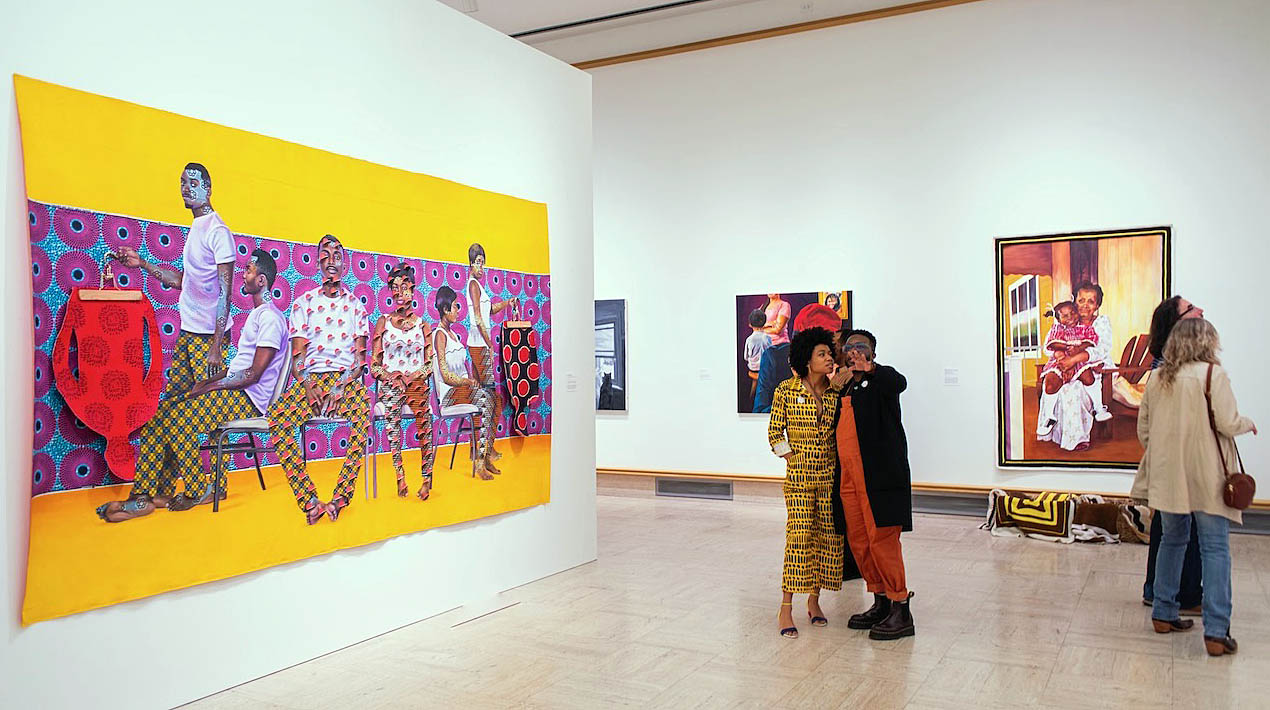
An installation shot of Skilled Labor: Black Realism in Detroit at the Cranbrook Art Museum, which will be up through March 3, 2024. (At left is Patrick Quarm’s Three Transitions.) Running through March 3, 2024 as well is LeRoy Foster: Solo Show. All images Courtesy Cranbrook Art Museum.

Two new exhibitions at Cranbrook Art Museum showcase the considerable talents of Detroit’s African-American portrait painters, both past and present. Both LeRoy Foster: Solo Show, and Skilled Labor: Black Realism in Detroit will be up through March 3, 2024.

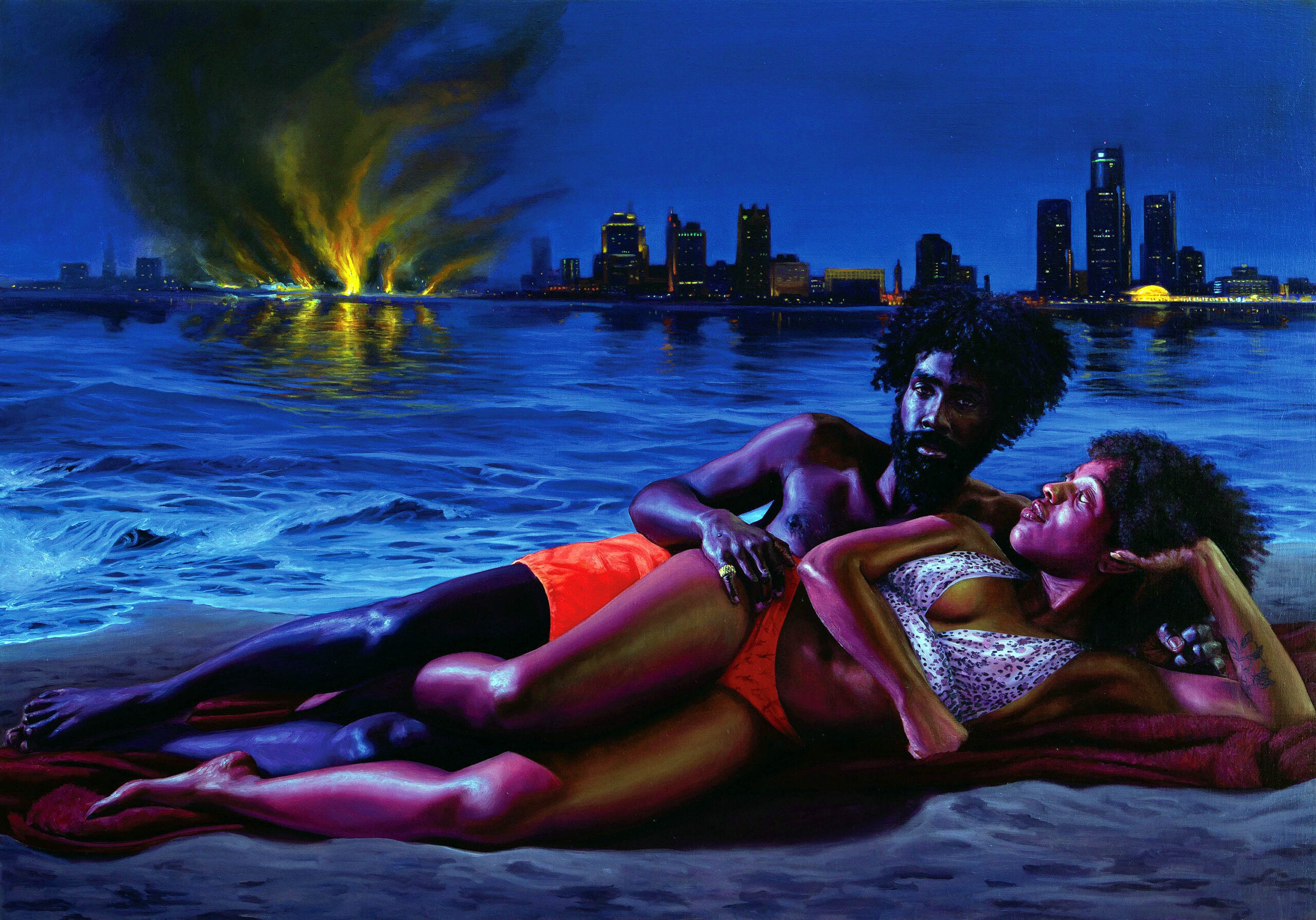
Skilled Labor is the larger of the two, and a complete stunner. The very first canvas you’ll see on entering this 20-painter group show is Mario Moore’s huge, undeniably sexy Thornton and Lucie Blackburn in Canaan – with a 21st-century Black couple in bathing suits lying on the Windsor waterfront at night, the Detroit skyline, part of it in flames, across the river.

Mario Moore, Thornton and Lucie Blackburn in Canaan, Oil on linen, 2022.

Chief curator Laura Mott organized this show with Moore,  a 2018 Hodder Fellow at Princeton University, and she loves “how he conflates history and time into one canvas.” In this case Moore’s employed contemporary Detroiters to portray the Blackburns, a couple who fled Kentucky slavery in 1833, ultimately making their way to Canada via Detroit and the Underground Railroad.

A bit like Kehinde Wiley, who inserts young, tattooed and dreadlocked Black guys into historical paintings of war heroes on rearing horses (Wiley turned one of those into a sculpture that now sits on Monument Avenue in Richmond, Virginia), Moore recontextualizes and illuminates history by dropping it into a modern framework.

Be sure not to miss Moore’s other large piece, A Student’s Dream, in which the artist himself, staring straight out at the viewer, lies naked on a dissection table surrounded by white doctors – a reference both to Moore’s own brain surgery, and the medical profession’s callous use of Black bodies in decades past for scientific research.

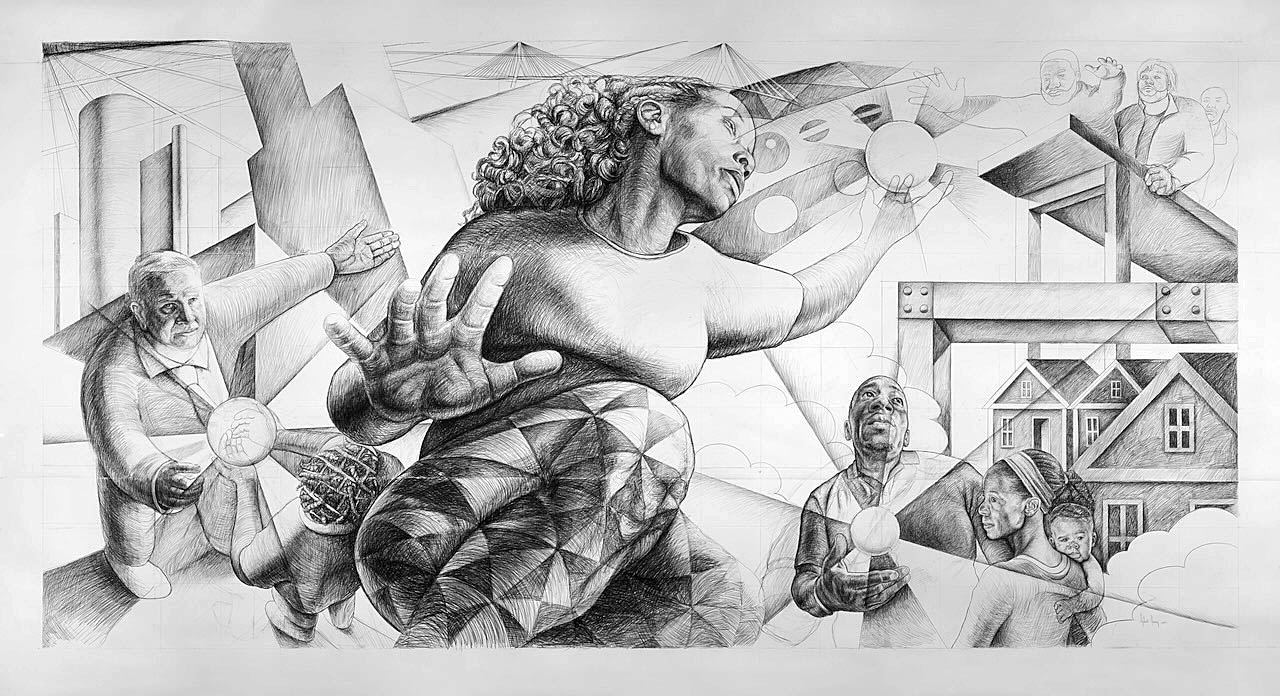
Also grappling with history, though in more sweeping, allegorical fashion, is Hubert Massey’s graphite-on-paper sketch for Forging the Future, a visual explosion of perspective and movement. The resulting fresco now commands the lobby of the new Huntington Tower on Woodward Avenue, just north of Grand Circus Park.

Hubert Massey, Sketch for Forging the Future, Graphite on paper, 2022.

You’re probably familiar with Massey’s work, whether you realize it or not. Among many other Detroit projects, Massey painted the mural on the exterior wall of the College for Creative Studies parking structure at Brush and Frederick streets, and designed the colorful mosaic on the soaring, modernist Bagley Street pedestrian bridge that vaults over the freeway trench dividing Mexicantown.

In pulling together Skilled Labor, Mott said Moore was particularly interested in what he calls “anti-portraits,” depictions that depart from the standard template of subject facing the world. This show has any number of intriguing examples, including several in which the individual in the painting has her or his back turned to the viewer. Consider, for example, Menorah’s Volta: A Light That Speaks by Cranbrook Academy of  Art alum Conrad Egyir, a gorgeous portrait of a Ghanaian woman looking away from us, across a vast African valley.

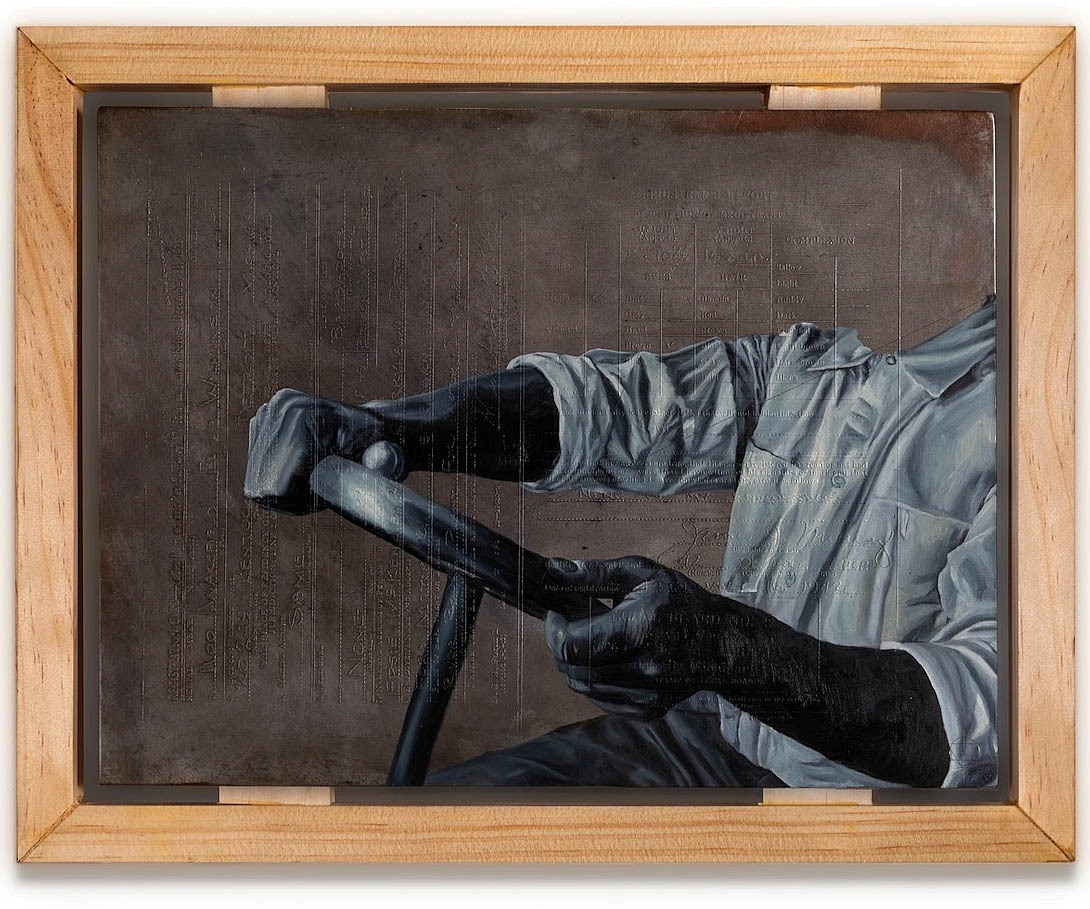
Anti-portraiture emerges in different fashion with Bakpak Durden’s How they recall his hands, an oddly moving portrait of an African-American man operating the wheel of some machine. The most notable feature is there’s no head above the meticulously rendered work shirt – suggesting, perhaps, that Black men were typically valued for their labor, but not for themselves. Durden, a self-taught multidisciplinary Detroit artist, was the subject of a solo show, The Eye of Horus, at Cranbrook in November, 2022.

Bakpak Durden, How they recall his hands, Oil on etch steel, pine, 2023.

A similar motif emerges in Cailyn Dawson’s three portraits on display, two of which clearly feature the artist herself, and one other, the 2021 “Untitled,” that stars a headless figure wearing a trench coat and white shirt. Said Mott, who first discovered Dawson in a show at Ferndale’s M Contemporary gallery, “When Cailyn talks about her work, she talks about learning about herself. She paints to investigate herself.” Assuming, then, that the untitled trench coat is the artist, one could possibly speculate that its meaning lies in a sort of obliteration or enforced invisibility.

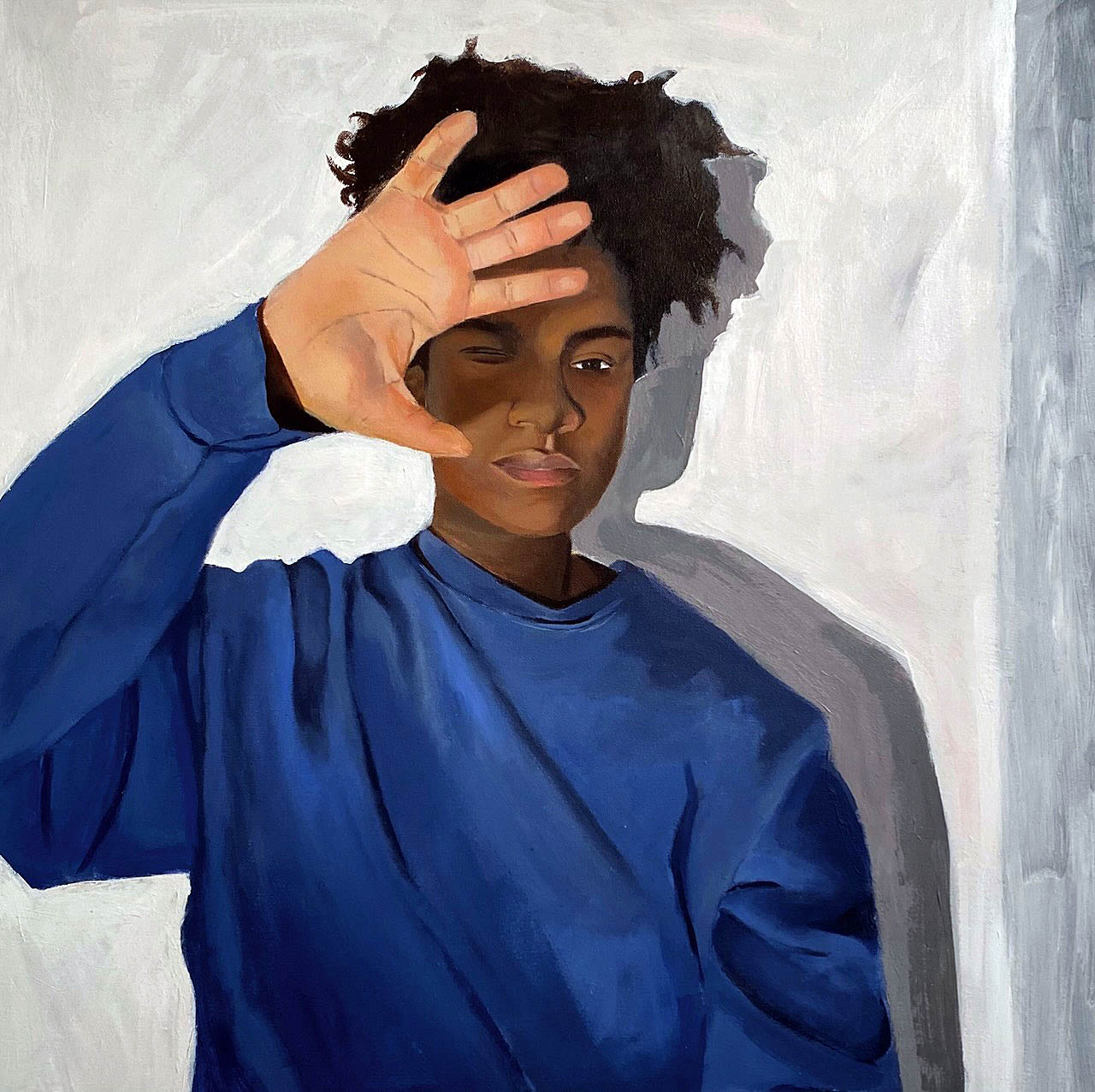
Dawson’s other works are equally enigmatic. In “Seeing Double,” the artist regards herself in a mirror, arms and hands visible in the foreground as well as in the reflection. The point of view almost seems to locate us in her body, with the exact same perspective that she’d have on herself. It’s both a bit disorienting and cool. Finally, in Spotlight the artist, who’s currently getting her MFA at New York City’s Hunter College, shields her eyes with one hand from a blinding light that casts a sharp shadow on the white wall behind her. As unexpected compositions go, this almost rises to the level of anti-portrait. As Mott notes, if this were from a photo series, such a squinting image is the one you’d likely toss. That’s no criticism; the very unexpectedness of her pose is what makes Spotlight so hard to look away from.

Cailyn Dawson, Spotlight, Acrylic on canvas, 2021.

Once you’ve made your way through Skilled Labor, which occupies the first, large gallery as you walk through the museum, do turn left into LeRoy Foster: Solo Show. Moore and Mott initially intended to select painters for Skilled Labor from both the 20th and 21st centuries, but ultimately decided it made more sense to focus on works produced in the last 10 years.

Inevitably, that meant letting go of any number of superb portraitists who are no longer with us. The one exception they made was with LeRoy Foster, born in 1925, whom they decided deserved his first-ever solo show in a museum, one supported financially by the City of Detroit’s Office of Arts, Culture and Entrepreneurship.

Foster, who graduated from the school at the old Detroit Society of Arts and Crafts (predecessor to CCS) and probably studied at Cranbrook, is a fascinating and surprising Detroit character – an unapologetically gay, Black artist in an era when that was perilous on any number of levels. In addition, the Detroiter, who lived in an abandoned theater on Livernois Avenue, was a portraitist in an era, particularly the 1950s and 60s, that mostly disdained any figurative art – much less the sort of lush, physicality Foster had such a gift for.

A reporter from National Public Radio, Mott says, wanted to know why an artist of Foster’s astonishing talents wasn’t better known. Mott laughs. “A Black, queer artist in mid-20th Century doing high-Renaissance style portraits? That was the era of Minimalism and Abstract Expressionism. And here’s Foster, hanging out being completely himself, doing paintings the art world at the time would likely have regarded as old-fashioned.”

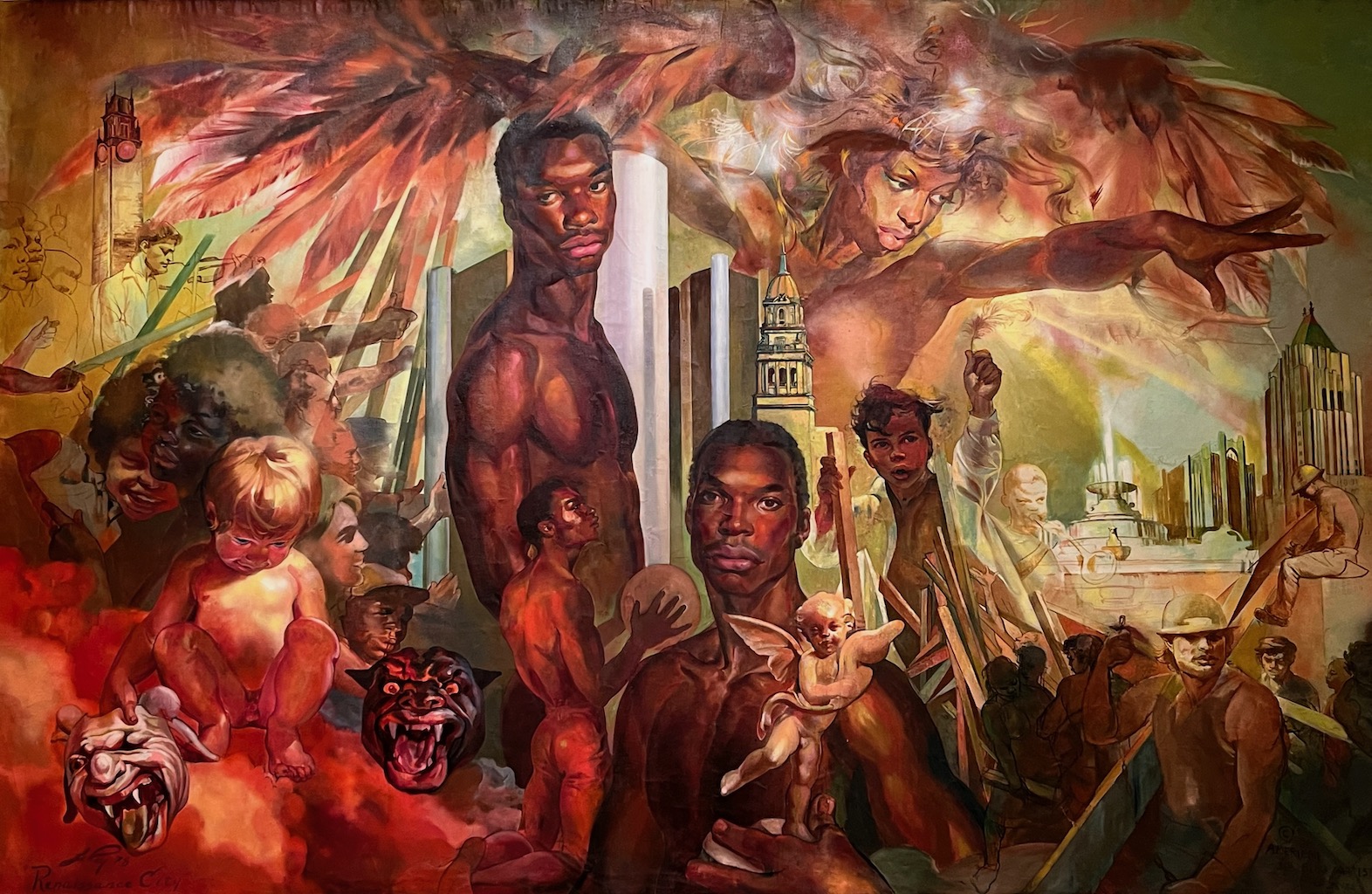
Foster may be best known for his mural inside the Frederick Douglass branch of the Detroit Public Library – or the one on display in this show, Renaissance City, that hung for years in the old Cass Tech High School, even after the school was abandoned in favor of a new building next door. A group of Cass art teachers, including Senghor Reid (who’s in Skilled Labor) rescued the mural.

Some time after this exhibition closes in early March, Renaissance City will be installed in the new Cass Tech.

LeRoy Foster, Renaissance City, Oil on canvas, 1978/1986.

This exhibition features 20 contemporary artists who have worked in Detroit over the last decade. These artists include Christopher Batten, Taurus Burns, Cydney Camp, Ijania Cortez, Cailyn Dawson, Bakpak Durden, Conrad Egyir, Jonathan Harris, Sydney G. James, Gregory Johnson, Richard Lewis, Hubert Massey, Mario Moore, Sabrina Nelson, Patrick Quarm, Joshua Rainer, Jamea Richmond-Edwards, Senghor Reid, Rashaun Rucker, and Tylonn J. Sawyer.

Skilled Labor: Black Realism in Detroit and LeRoy Foster: Solo Show will both be at the Cranbrook Art Museum through March 3, 2024.

[adrotate group=”2″]


Stan Natchez @ BBAC

Birmingham Bloomfield Art Center presents Stan Natchez, Brenda Kobs Russell, and Maria Balogna

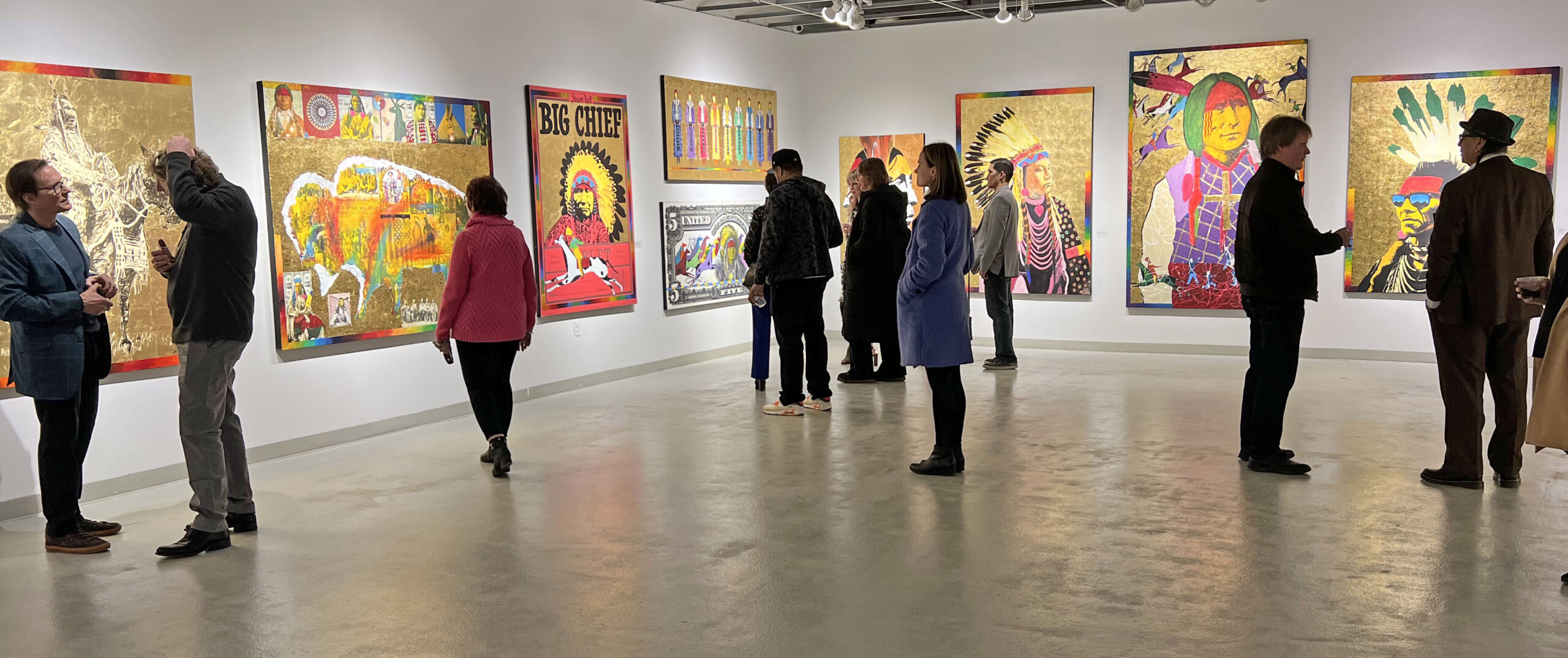
Stan Natchez, BBAC, Install 3.2023

The BBAC opened its three galleries with new visual art exhibitions on March 10, 2023, presenting work by a Native American painter, Stan Natchez, a printmaker, Brenda Kobs Russell, and drawings by Maria Balogna.

Stan Natchez was born and raised in Los Angeles. Still, the indigenous artist now lives in New Mexico and brings his exhibit, Indian Without Reservation, to the BBAC with support from the National Endowment for the Arts and Arts Midwest. By taking the philosophies and techniques of both modern life and the traditional Native American heritage, Natchez achieves a complex harmony in his work by using a distinctive Neo-Pop style. He says in his statement, “I paint the life I live, and so every painting, in some way, is a self-portrait. My art is about the way I respond. And that is my experience…my experience is my art…and art is my life.”

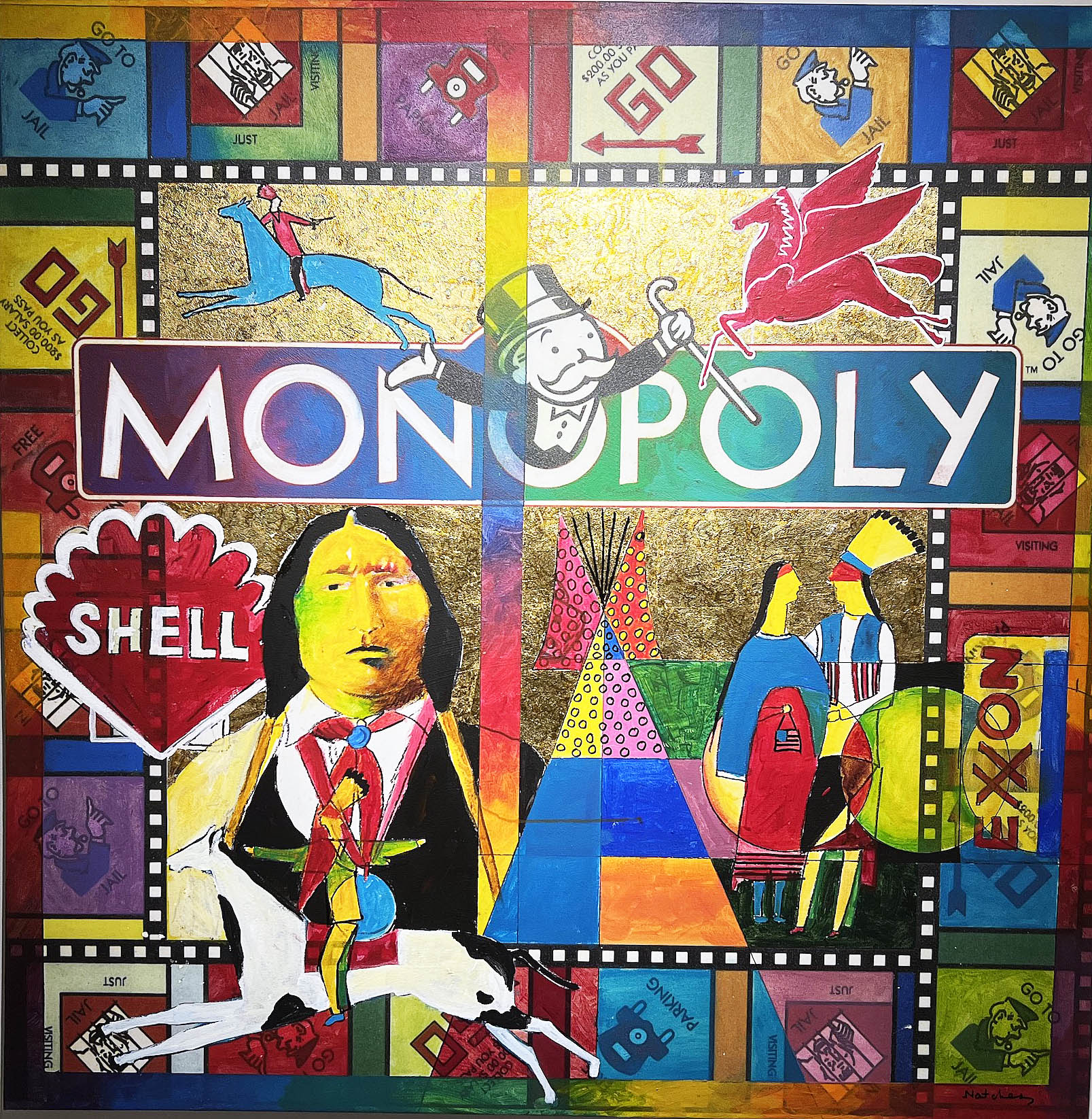
Stan Natchez, Monopoly, 58 x 58″ Mixed Media

Natchez talks about his influences, Andy Warhol, Jasper Johns, and Roy Lichtenstein, combined with artifacts from the Native American culture. They would be found in Monopoly, where he uses the popular board game as a compositional structure to combine the various corporate logos with Native figures and designs. (I know this writer has worked hard at eliminating the word Indian from my vocabulary to represent Native Americans, yet I find it ironic to see this in the title of this exhibition.)

Stan Natchez employs art appropriation in most of his work throughout the exhibition, where he uses pre-existing objects or images as an artistic strategy, intentionally borrowing, copying, and image transfer is a practice that is traced back to Cubism, Dada, and, more recently, Pop Art.

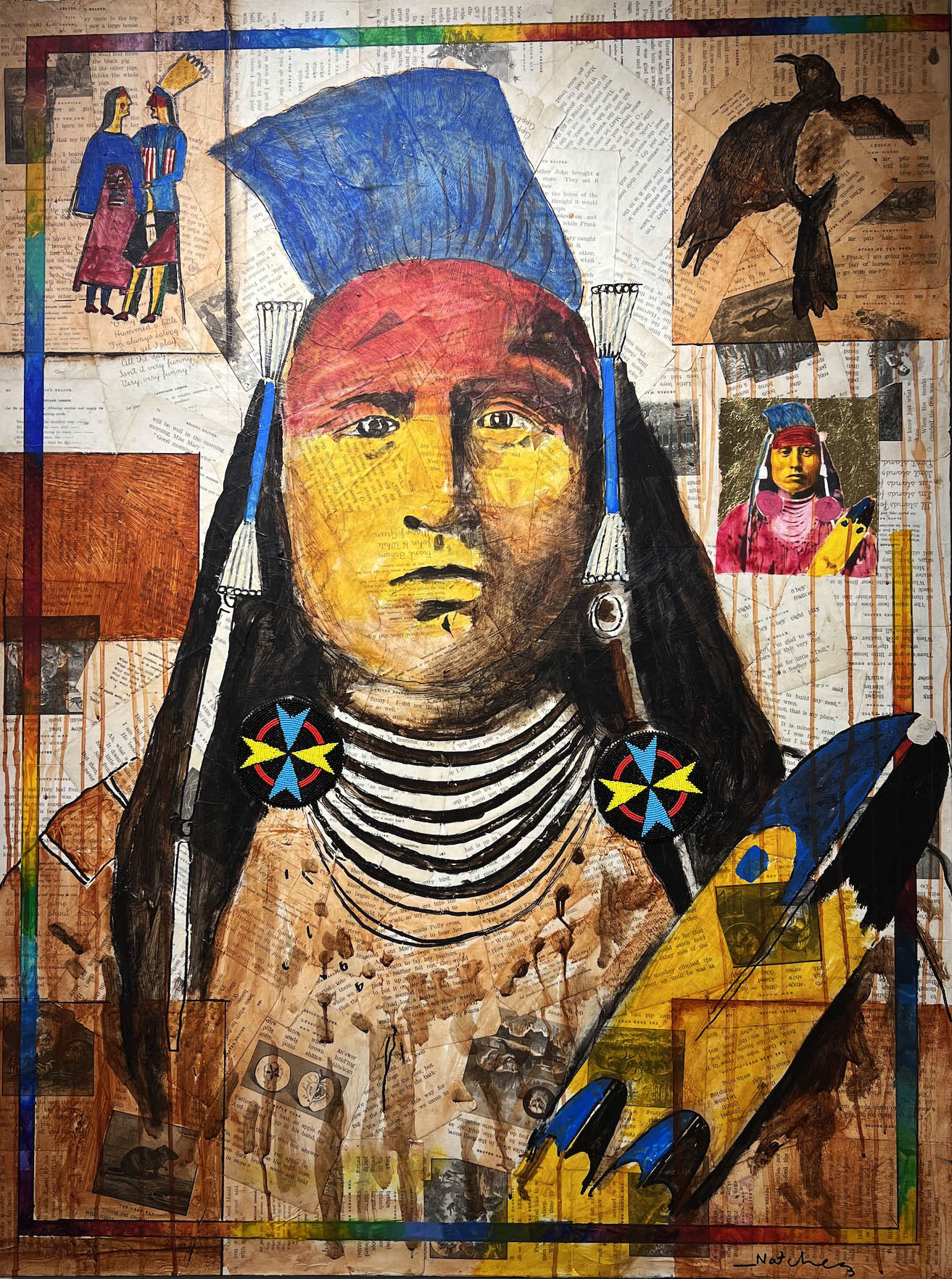
Stan Natchez, Medicine Crow Living in Two Worlds, 48 x 36″ Mixed Media

Medicine Crow comes from a warrior of the Crow tribe. He was a “reservation chief,” concerned with helping the Crow tribe “learn to live in the ways of the white man” as soon and as efficiently as possible. The subject for this painting is taken from an original black-and-white photograph. The crow symbolism represents messages from dreams or the sub-conscience, and the object he holds is a group of feathers attached to a wooden handle and is used in a variety of ceremonies. Natchez brings the three primary colors across the face to draw attention to the reservation chief.

Stan Natchez, Traveling Through Time, 48 x 66″, Mixed Media

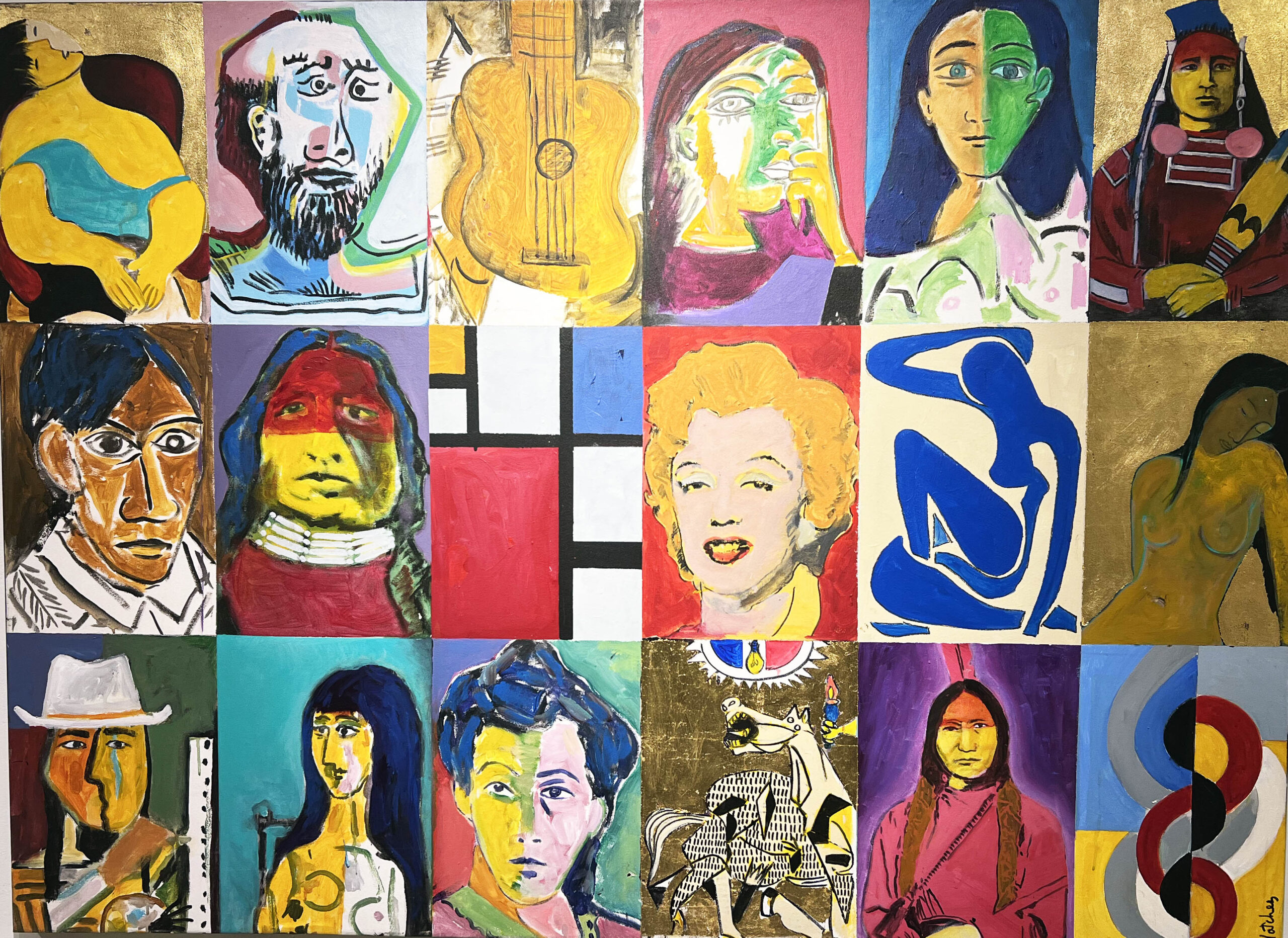
Natchez travels across time, mixing the images of Picasso, Matisse, Marilyn Monroe, Piet Mondrian, and a section of the painting Guernica juxtaposed with several Crow tribal leaders. He is mixing famous western images with Native American icons across time, creating a grid that compares and contrasts. By doing this, he places his people on par with world-recognizable images.

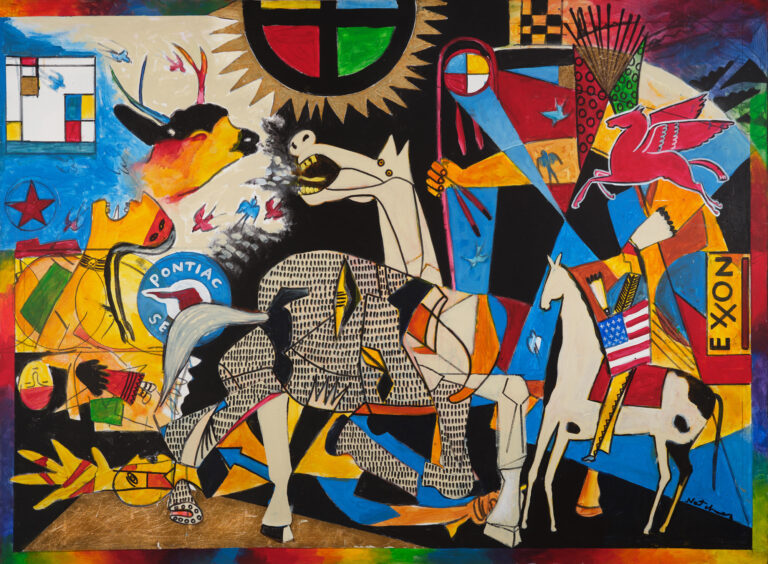
Stan Natchez, Guernica to Wounded Knee, 48 x 66″ Mixed Media

Part of this painting includes features of Guernica, the large 1937 oil painting by artist Pablo Picasso. Natchez spans time with imagery from events at Wounded Knee. It is one of his best-known works, regarded by many as the most moving and powerful anti-war painting in history. The painting here was made earlier in 2012 and then was sold and duplicated at a later date.

Stan Natchez earned his undergraduate degree from the University of Southern Colorado and his M.F.A. at Arizona State University. In addition to being a nationally known artist, Natchez has distinguished himself as a teacher, dancer, editorial advisor, and legal advocate for the Native American community.


Brenda Kobs Russell: Familiar Rhythms

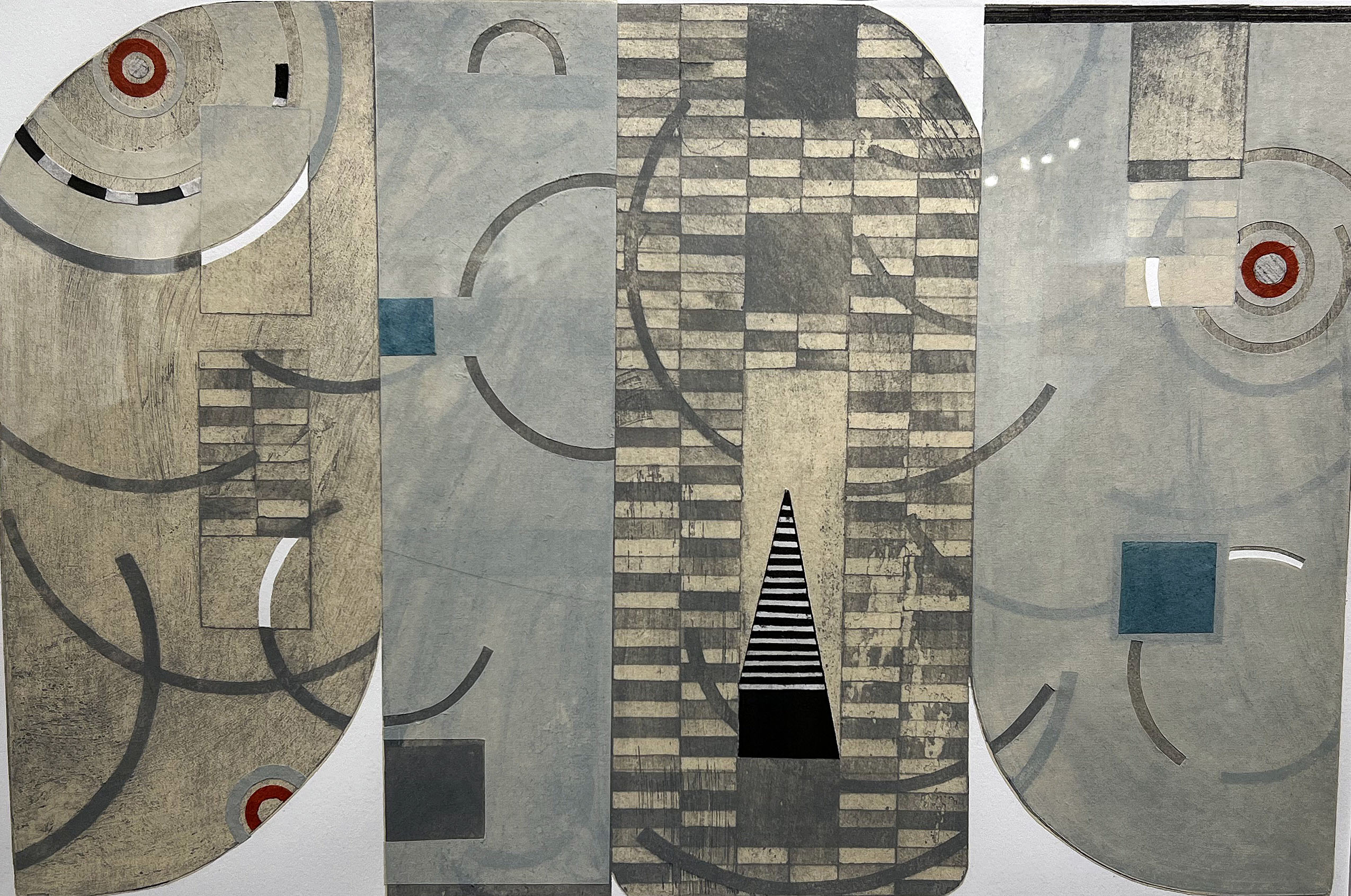
Brenda Kobs Russell, Sequence, Etching Collage

Brenda Kobs Russell is a locally based artist whose work reflects an ongoing investigation connecting her inner life to natural phenomena. Given her time in school, you could look to the abstract influences of Pablo Picasso, Fernand Leger, or Paul Klee. During the 1920s, geometric abstraction manifested itself as the underlying principle of the Art Deco style, which propagated the broad use of geometric forms to influence abstraction. For example, Sequence is an etching with touches of white gouache, making it a monoprint that has been popular among printmakers recently.

She says, “As a whole, my work serves as a record, mapping an interior investigation of my surroundings and a practice of abstracting the familiar. I am interested in the congruities between organic cycles of transformation and artistic process, particularly how an image evolves through the erosion of an etching plate and is further translated by ink into paper.”

Russell is an art educator, having taught students across a wide range of ages and abilities in private schools, art centers, and as a lecturer on the faculties of Oakland University and Penny W. Stamps School of Art & Design, University of Michigan. She earned her B.F.A. at Michigan State University (1983) and her M.F.A. at Cranbrook Academy of Art (1985).


Maria Balogna: by His stripes

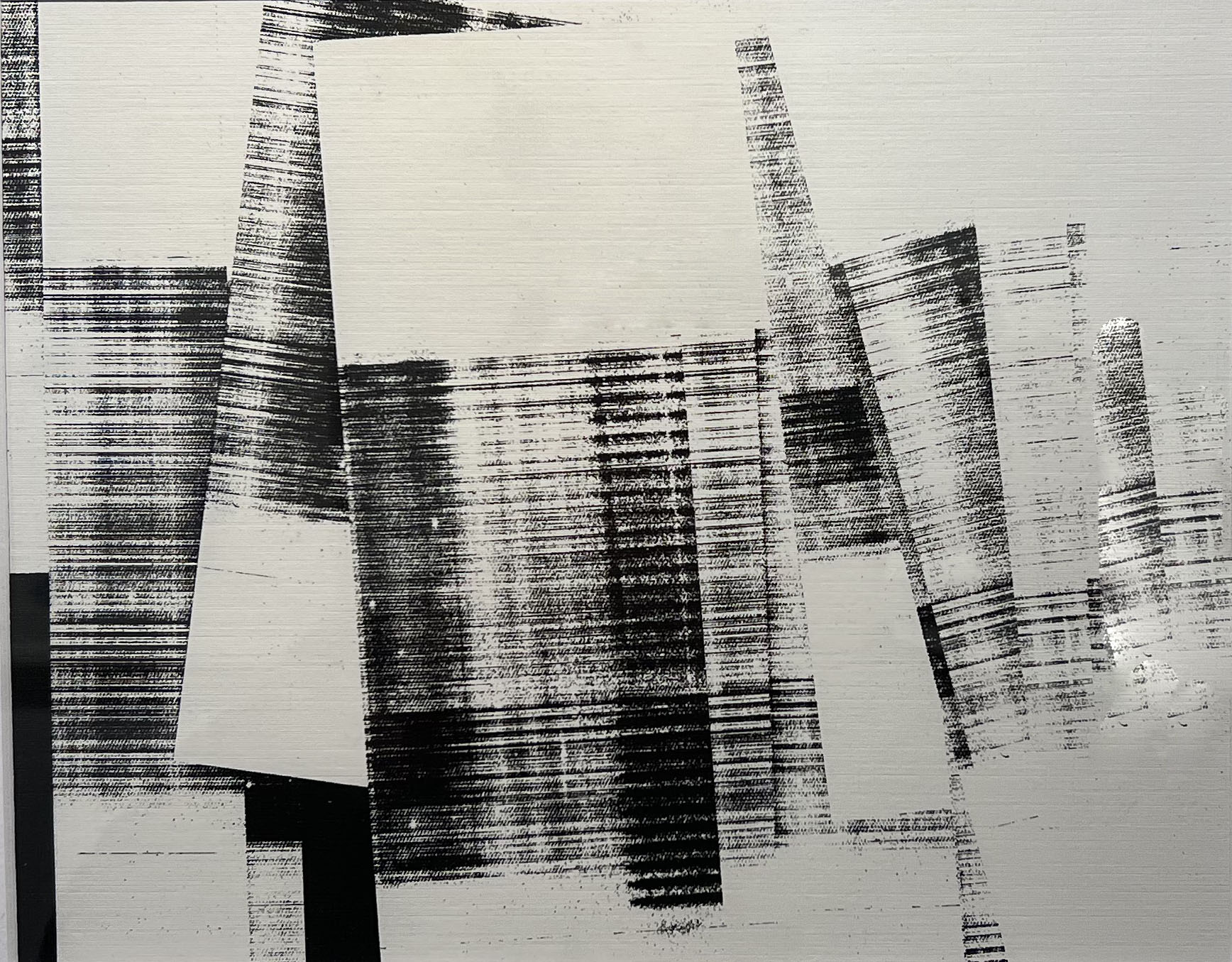
Maria Balogna, Darkness to Light III, Ink on Paper

“The Cost. The Wounds. The Enormity. Symbolic themes run throughout this collection of small drawings that outwardly express the salvific work of The Suffering Servant [ reference: Isaiah 53 ].” The abstract drawings of Maria Balogna contain undertones of Christianity without the weight of literary imagery.

The exhibitions will run through April 20, 2023.

The BBAC is open to the public. Masks are strongly recommended.

EXHIBITION GALLERY HOURS: Monday-Thursday 9 am-5 pm, Friday & Saturday, 9am-4 pm

[adrotate group =”2″]

Luxe @ David Klein Gallery Birmingham

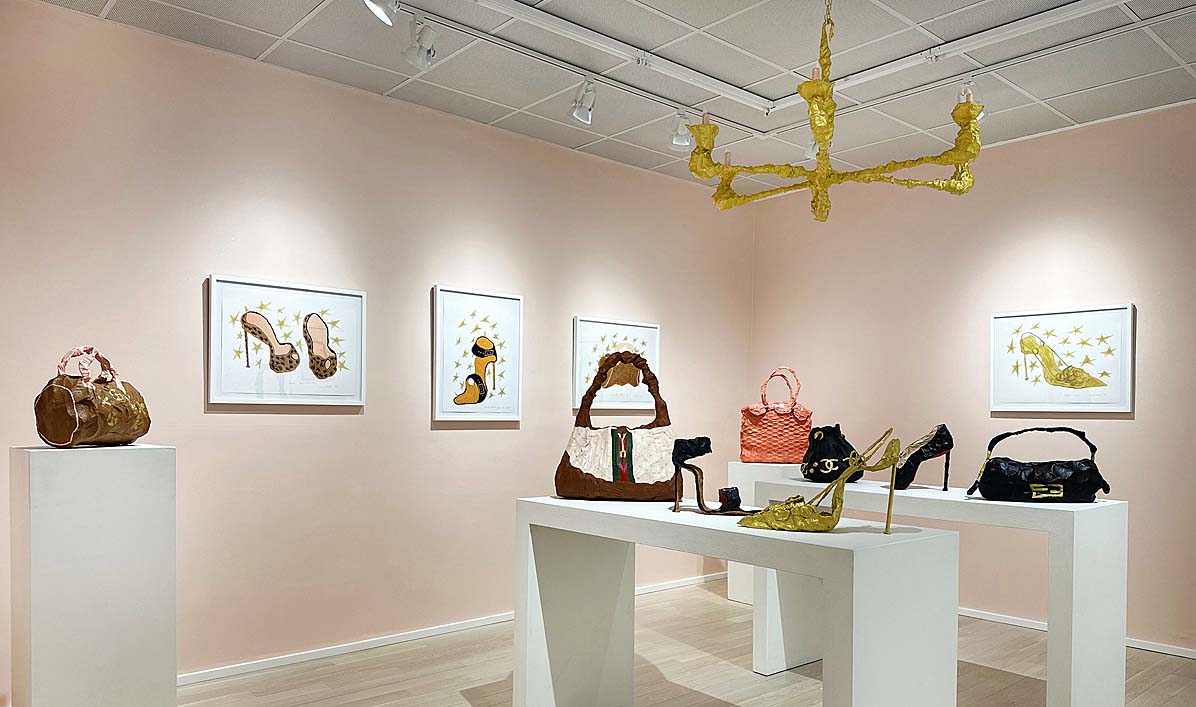
Mary-Ann Monforton, Luxe, installation, David Klein Gallery, 163 Townsend St., Birmingham MI

The breathless hype, the eye-watering price tags, the manufactured scarcity—we all recognize the strategies that the makers of designer goods use to promote luxury items. But Detroit artist Mary-Ann Monforton is having none of that. In her first solo exhibition at David Klein Gallery in the upscale Detroit suburb of Birmingham, she presents Luxe, a collection of 10 slightly oversized, comic replicas of well-known luxury brands that are both an homage and a send-up of late capitalist getting and having.

Monforton knows plenty about the world of red velvet ropes and status objects. Though she grew up in the Detroit area, her professional life has been centered in New York’s gallery and club scene, where she has lived several simultaneous lifetimes as a music promoter, art curator, visual artist and cultural media publisher. She has rubbed shoulders with late 20th and early 21st-century arts stars in her prolific and varied career–Keith Haring, Kenny Scharf and Jean Michel Basquiat, among others–and occasionally has collected their work.

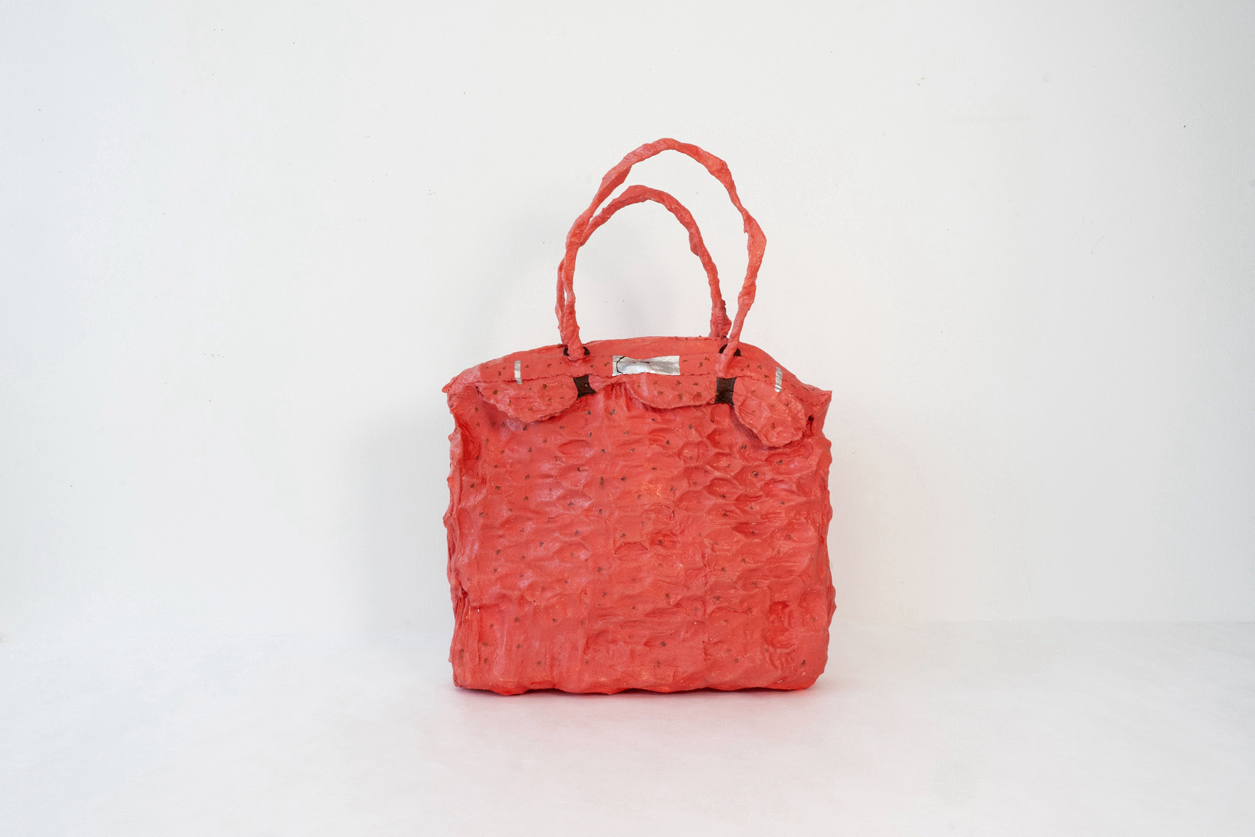
Mary-Ann Monforton, Hermes Birkin, 2022, wire mesh, plaster gauze, paint, 24.5” x 17” x 4”

Now that she is back in her hometown, Monforton is prepared to share a few thoughts on the pretensions inherent in the easily recognizable signifiers of status. Sharped-eyed but not unkind, her observations take the form of wonky and slyly ironic designer bags and shoes made of humble materials that loosely imitate prestigious consumer commodities.

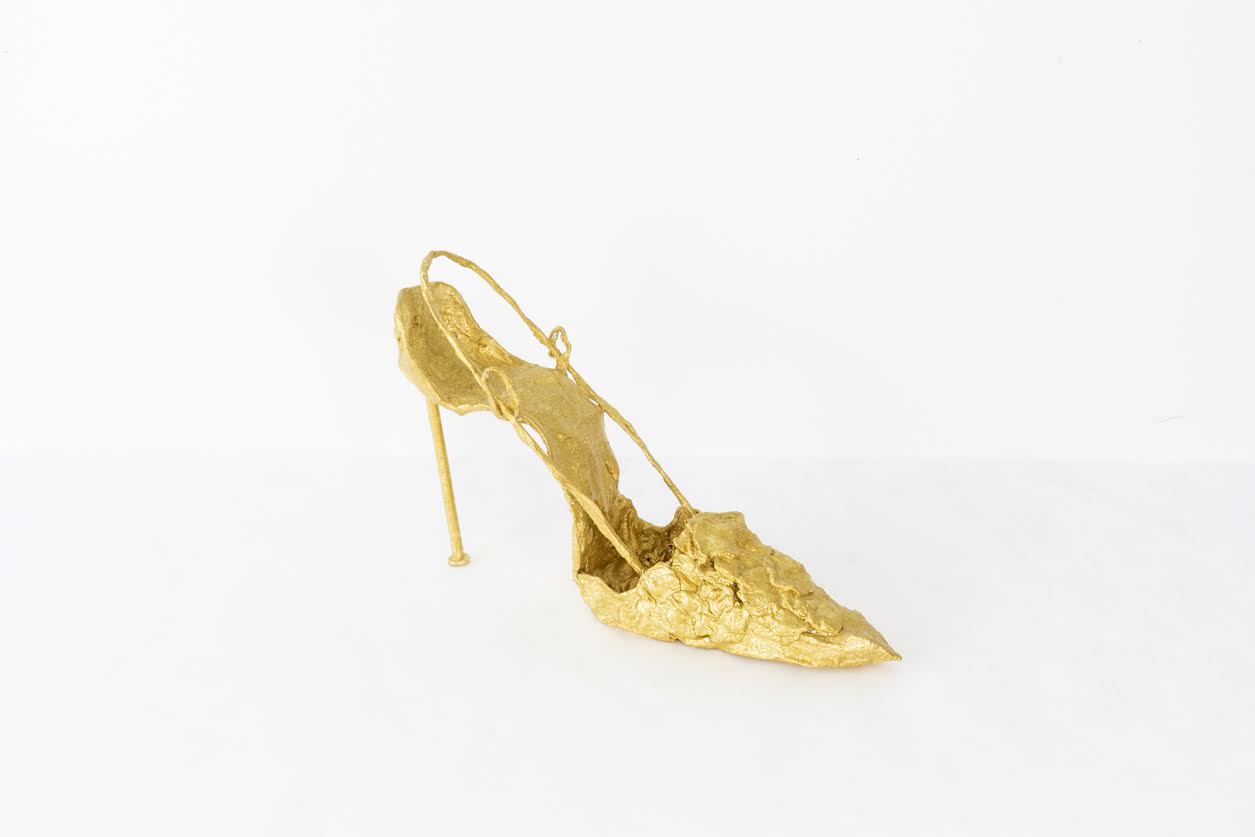
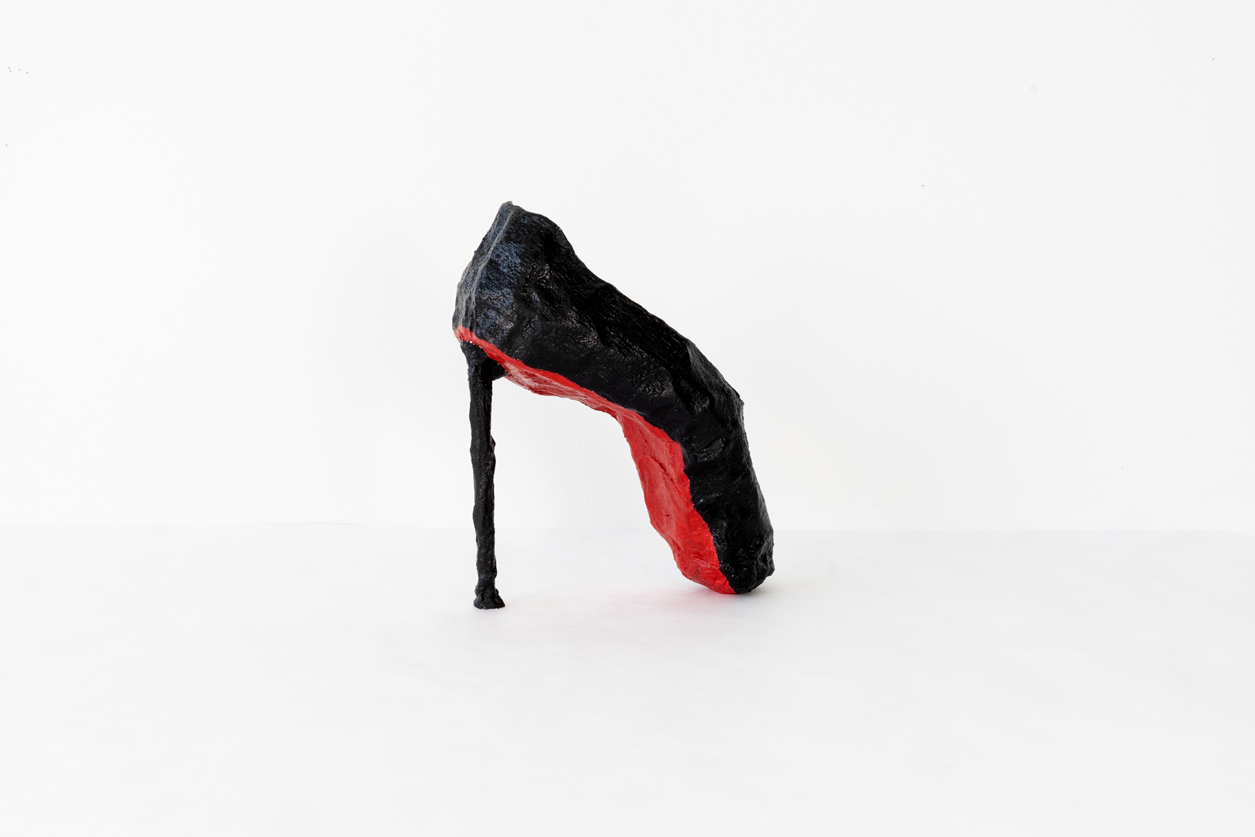
The artworks in Luxe are installed in David Klein’s middle gallery, now painted blushy pink in a kind of shorthand nod to a high-end boutique.  Artful silver wire stars hang from the ceiling and overhead a handmade imitation of a fancy chandelier casts a fictive glow on the bags and shoes below. Effortlessly holding the center of the space is an oversized replica of the iconic Hermes Birkin bag, in coral “ostrich,” for the fashionable giantess. Said giantess might also be interested in Monforton’s golden Valentino Garavani slipper with its pointy toe and (literally) spikey heel.  The chic send-up of the Manolo Blahnik open-toe stiletto is likewise a winner in the Brobdingnagian fashion department.   My personal favorite, though, is the improbably elegant black Louboutin Ballerina Ultimate, which manages to be both larger-than-life and dainty.

Mary-Ann Monforton, Valentino Garavani, 2022, wire mesh, plaster gauze, steel spike, string, paint, 11” x 6” x 17″

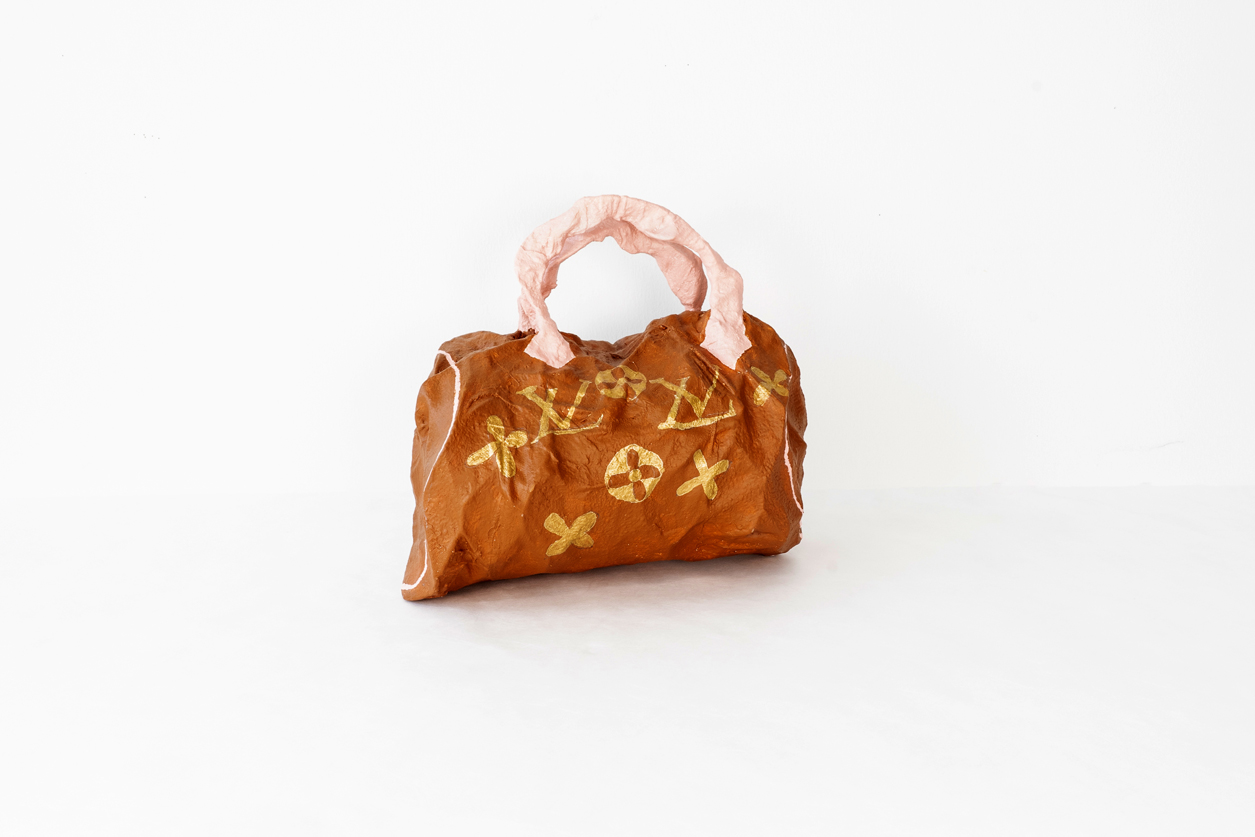
Monforton has some fun with the surface textures, colors and patterns of her fashionable facsimiles.  On her Louis Vuitton “Speedy” bandouliere, she subverts the well-known, militantly regular Louis Vuitton surface pattern, exploding it into an irregular constellation scattered across the satchel’s surface–less elegant perhaps, but more expressive. The intertwined C’s on her Chanel Bucket bag are both instantly recognizable and hilariously awry.   The materials that she references, lizard, ostrich, crocodile and precious metals–now rendered in plaster, wire mesh, and the odd metal spike–gleefully poke fun at the pretensions of the originals.

There is a kind of liveliness in these objects. They are imbued with character and seem ready to dance and move. Unlike the highly finished, larger-than-life sculptures of Claes Oldenburg, to which Monforton’s work is sometimes compared, these friendly avatars of luxury are approachable and relatable.  In some ineffable way, they are human.

Mary-Ann Monforton, Louis Vuitton “Speedy” 2022, wire mesh, plaster gauze, paint, 14” x 5” x 9”

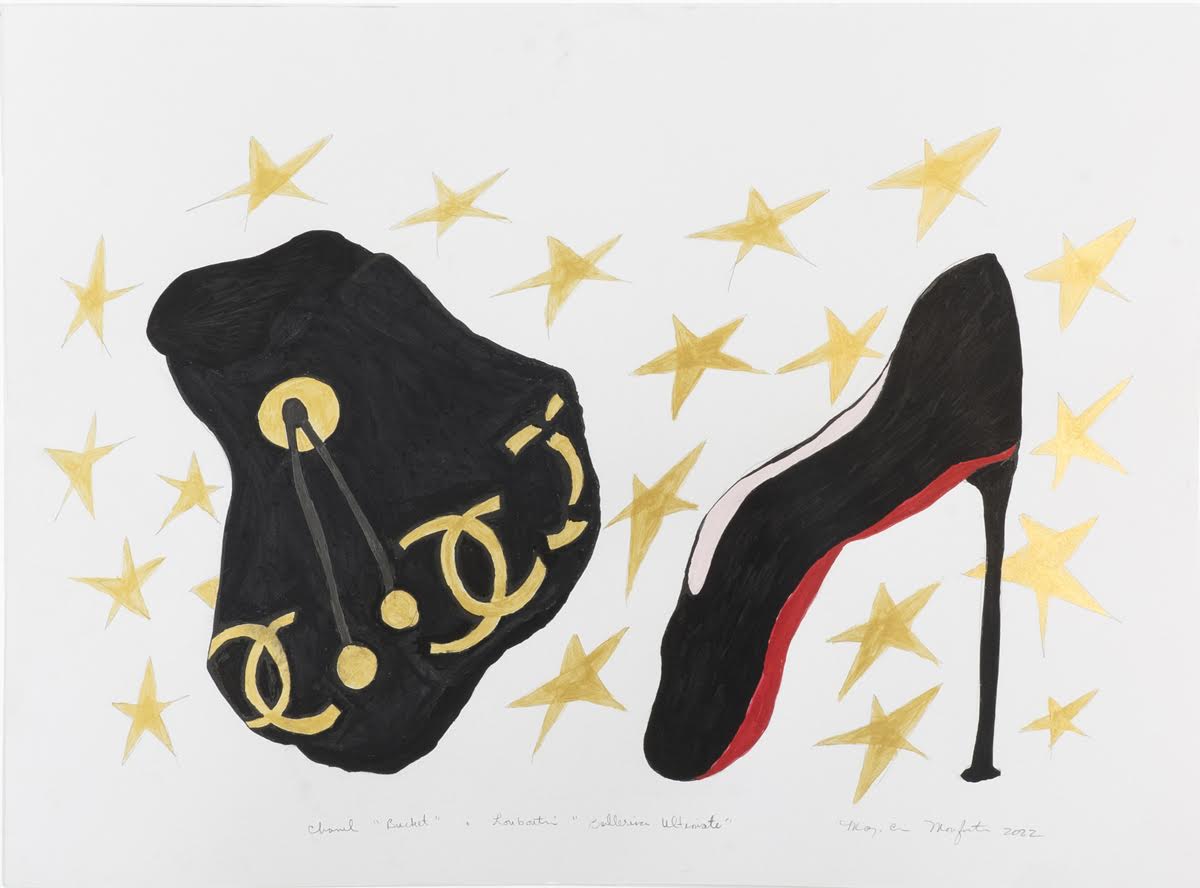
In addition to the three-dimensional artworks in Luxe, Monforton has created a series of drawings of her designer creations in pencil, pastel and paint on paper. Rather than preparatory drawings, the nine renderings were created after the fact in a kind of object portraiture that captures the soul of each subject, as any good portrait should.  The drawing of a Chanel Bucket bag and Louboutin Ballerina Ultimate high heel, paired in imaginary conversation, make a harmonious comic duet. A drawing of a pair of Louboutin leopard peep-toe platforms surrounded by stars, like the other drawings, reveals the affection of the artist for the objects she has birthed.  These animated images invite an immediate association to Andy Warhol’s 1955 drawings of fashion shoes, though the comparison is only glancing; Warhol’s shoes seem conventional and rather deadpan when compared to Monforton’s lively representations.

Mary-Ann Monforton, Louboutin Ballerina Ultimate, 2022, wire mesh, plaster gauze, paint, 12” x 5” x 9”

The artist’s history as a collector prepares her uniquely for her explorations into how we assign value to objects. In her artist’s statement, Monforton is clear about her aims: “These objects explore the psychology of fame, fortune, mega-wealth, and privileged consumption.” She continues, “The broader concepts of ascribing value to things is played out in this line of luxury goods that defy perfection and are rife with failure and humor.” The imperfect simulacra on display probe human preoccupations with social prestige and how it is related to craft and economy.

In Luxe, Mary-Ann Monforton combines her childlike joy in the making of a thing with a very adult moral framework that proposes the exchange of one set of values for another. She suggests a more humane ethic that privileges vulnerability and emotional expressiveness over materialistic status-seeking, perhaps a good new year’s resolution for 2023.

Mary-Ann Monforton, Chanel Bucket and Louboutin Ballerina Ultimate,2022, paint, pencil, pastel on paper, 18” x 24”

Luxe is on view at David Klein Gallery, 163 Townsend St., Birmingham, Michigan, through February 4, 2023.

[adrotate group=”2″]

Todd Weinstein @ Janice Charach Gallery

Todd Weinstein’s Stories of Influence: In Search of One’s Own Voice is at the Janice Charach Gallery in West Bloomfield, Michigan through Dec. 7.

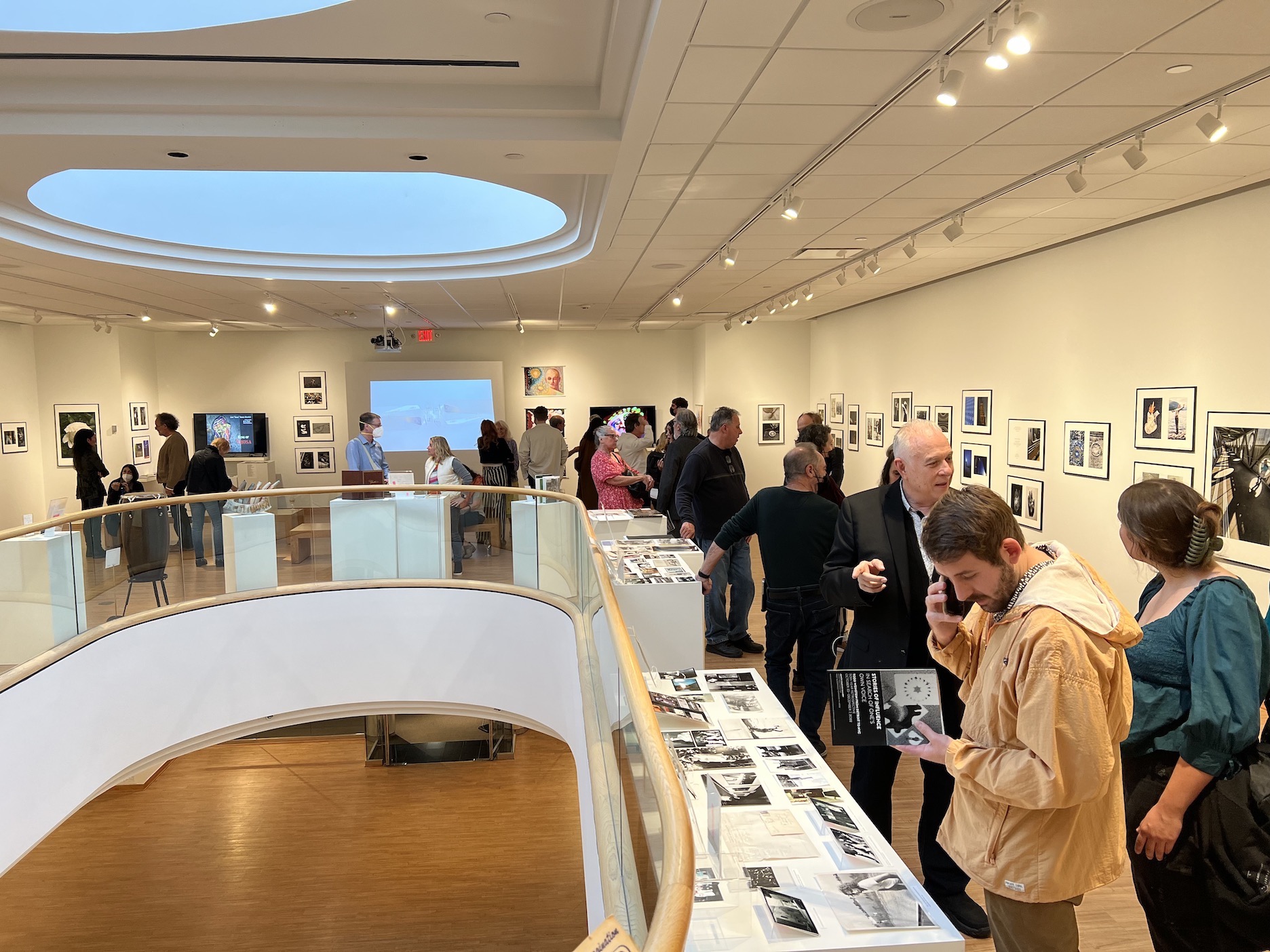
Install image, Stories of Influence: In Search of One’s Own Voice is at the Janice Charach Gallery in West Bloomfield, Michigan. 2022

Photographer Todd Weinstein’s Stories of Influence: In Search of One’s Own Voice is a high-concept show that employs a delightful gimmick – Weinstein pairs 68 of his photos with a corresponding image from one of his numerous mentors, teachers and friends, and then mats and frames the two together. It’s a career retrospective with punch, and will be up at the Janice Charach Gallery in West Bloomfield’s Jewish Community Center of Metropolitan Detroit through Dec. 7, 2022.

A commercial and artistic shutterbug who grew up in Oak Park, Weinstein had a gift as a youngster for talking his way into jobs with great photographers, some of whose influence he honors with this exhibition. He got an early start after dropping out of the old School of the Detroit Society of Arts and Crafts (now the College for Creative Studies), and approaching legendary auto photographer Dick James to ask if he needed an assistant. “How about third-assistant?” James responded. No fool he, Weinstein grabbed the chance.

Like so many young artists in the 1970s, he ultimately left Detroit in the 1970s to make his way in New York’s hurly-burly, and, as it happens, thoroughly succeeded. Weinstein’s got a thriving photography and multi-visual practice, and lives in one of Brooklyn’s handsomest old rowhouse neighborhoods, Boerum Hill.

Among other virtues, Weinstein appears to have an admirable gift for gratitude. The idea of pairing one of his photos with that of an esteemed teacher, mentor or friend as a way of paying tribute struck him when he was in Paris several years ago. Weinstein brought it up with Charach director Natalie Balazovich, and she was immediately enthusiastic, finding it refreshing and new. “Todd’s essentially saying ‘This is why I’m where I’m at,” she said, “’because of these people.’” She added, “I like that the show dives into almost a taboo subject – sharing the things that pushed him to become who he is, and showcasing them.”

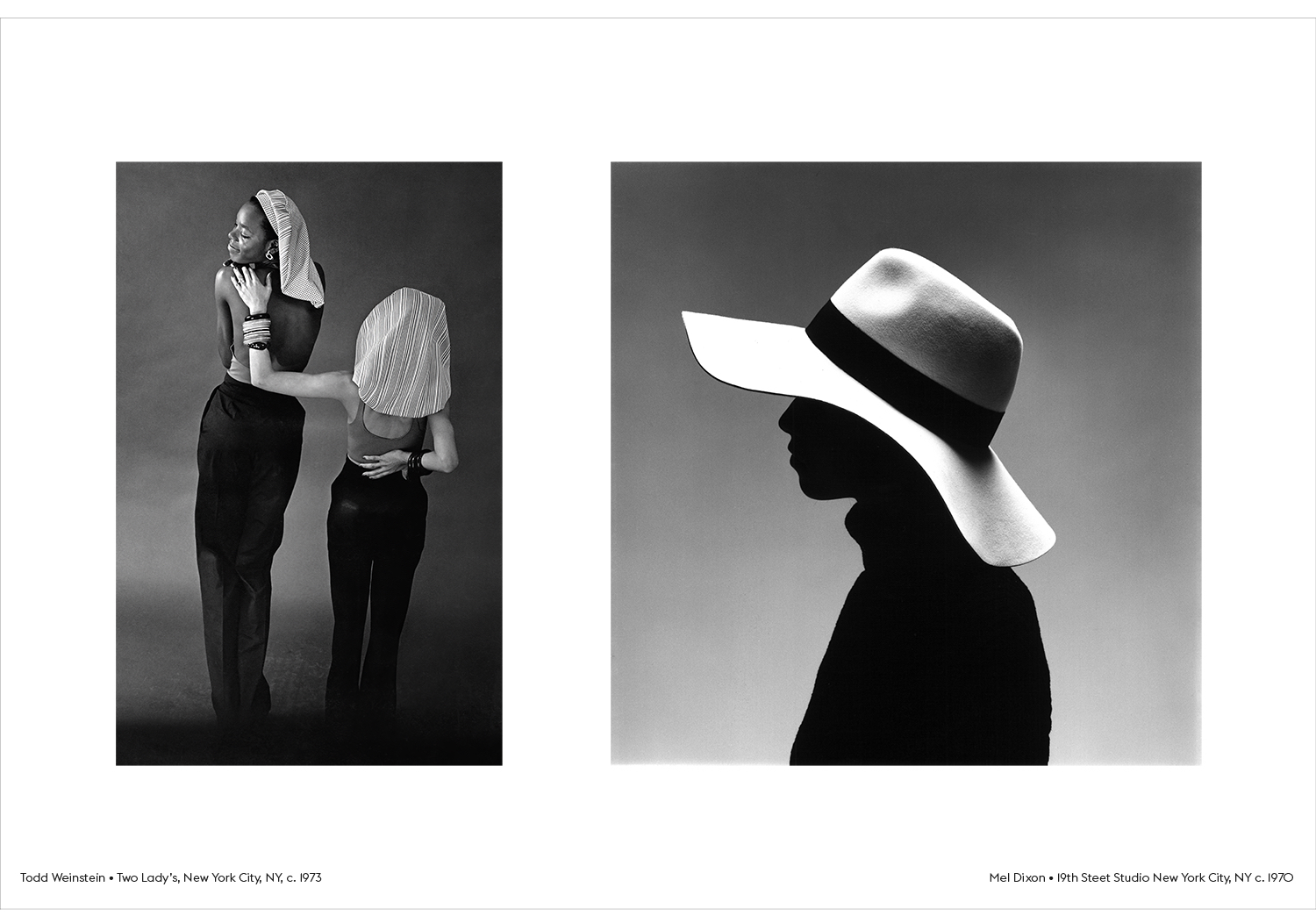
Todd Weinstein, Two Lady’s, New York City, NY, c. 1973; Mel Dixon, 19th Street Studio, New York City, NY, c. 1970.

A professional who helped Weinstein in his early New York days, when he was sleeping on a friend’s floor for eight months, was commercial photographer Mel Dixon. One of the first Black fashion photographers to go out on his own some 50 years ago, Dixon had a glittering background – he’d worked with photo greats Avedon and Hero. He offered Weinstein his first job in the big city, working in the studio on commercial and advertising projects.

“Mel gave me the chance,” Weinstein said. “We shot luggage, brides. All that kind of stuff.” He wasn’t really that interested in studio work, but it gave him the opportunity to earn a living while exploring other paths for his future.

The image Dixon contributed to the show is a black-and-white study of a girl. Her shoulders and face are completely dark, while her broad, white hat catches all the light in the frame. It’s elegant, high-class, high-fashion photography.

In his artist’s statement, Weinstein notes that in pairing images he relied on the structures of jazz – employing a sort of visual syncopation, as it were. You clearly see that in his rejoinder, the 1973 Two Lady’s, New York City, NY. It, too, is a fashion study — this time of two models facing away from us, one lithe and Black, the other short and white. Both are wearing headdresses that fall like curtains down to their shoulders. The white girl has a hand on the other’s back, which prompts her to twist her head around in apparent rapture.

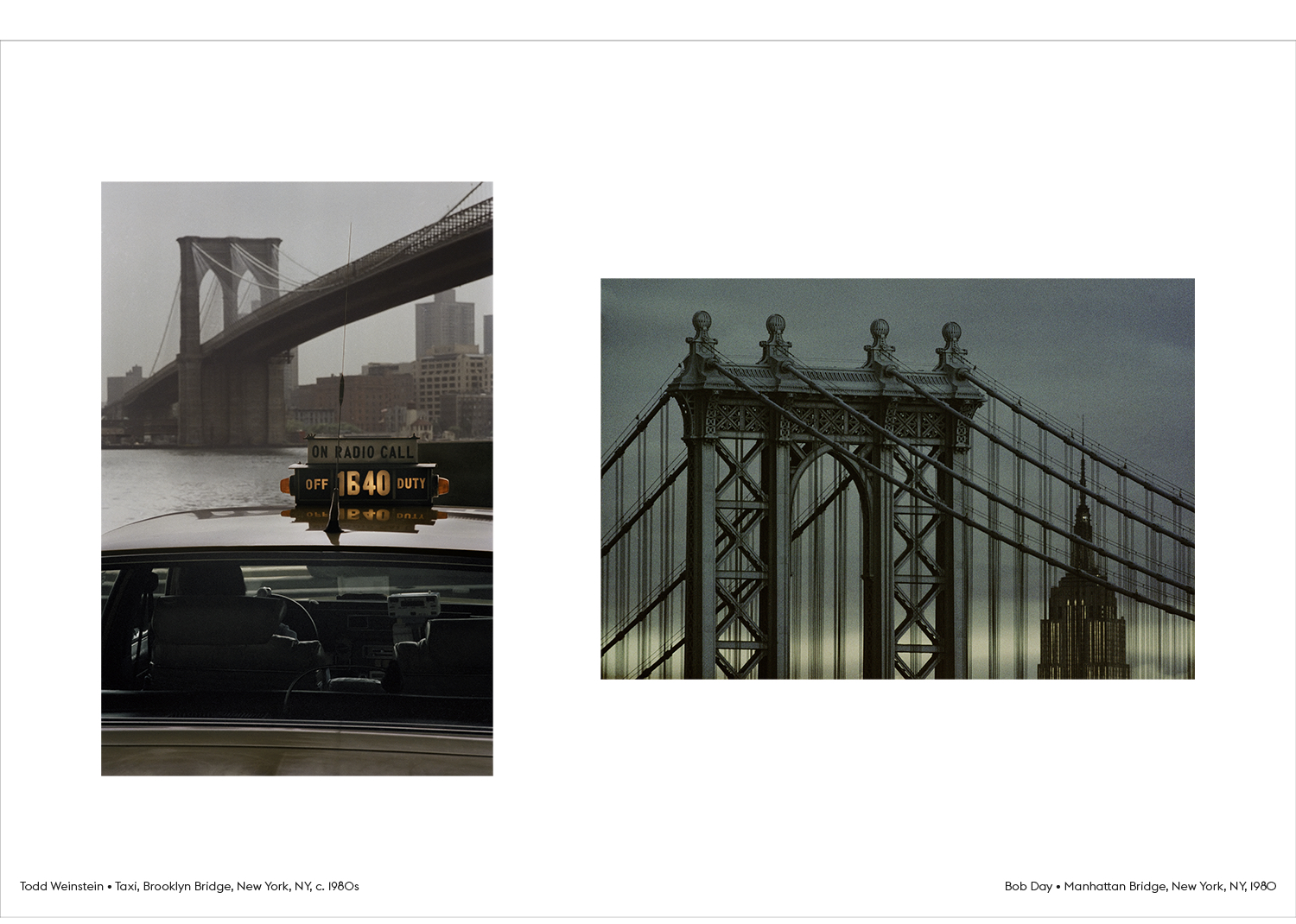
Todd Weinstein, Brooklyn Bridge, New York, NY, c. 1980s; Bob Day, Manhattan Bridge, New York, NY, 1980.

Another significant mentor was painter and photographer Bob Day. The two went into business together on Manhattan’s East 17th Street half a century ago, “back when you could get a 6,000-square-foot studio for like $300 a month,” Weinstein said. Day’s 1980 image, Manhattan Bridge, NY, NY, is a powerfully compressed telephoto shot. Day frames the very top of the Manhattan Bridge, a lush blue-green, sharply etched essay in cross-bracing around a central gothic arch. Looming in the near distance – unrealistically large, thanks to the powerful lens — is a gray and gold Empire State Building seen through the bridge’s vertical suspension wires. It lends immensely satisfying balance to the drama of the bridge crown in both shape and color.

By contrast, Weinstein’s Brooklyn Bridge, NY, NY is grittier. A close shot of a taxicab takes up most of the frame, the vehicle’s “Off Duty” crown lit and glowing. The aesthetic is ordinary and everyday — even the Brooklyn Bridge rising in the distance looks a little dull. All the print’s visual power, which is considerable, comes from the illuminated “Off Duty” sign that, alone out of the entire shot, glows with a warm light, and whose shape echoes the tops of the two bridges.

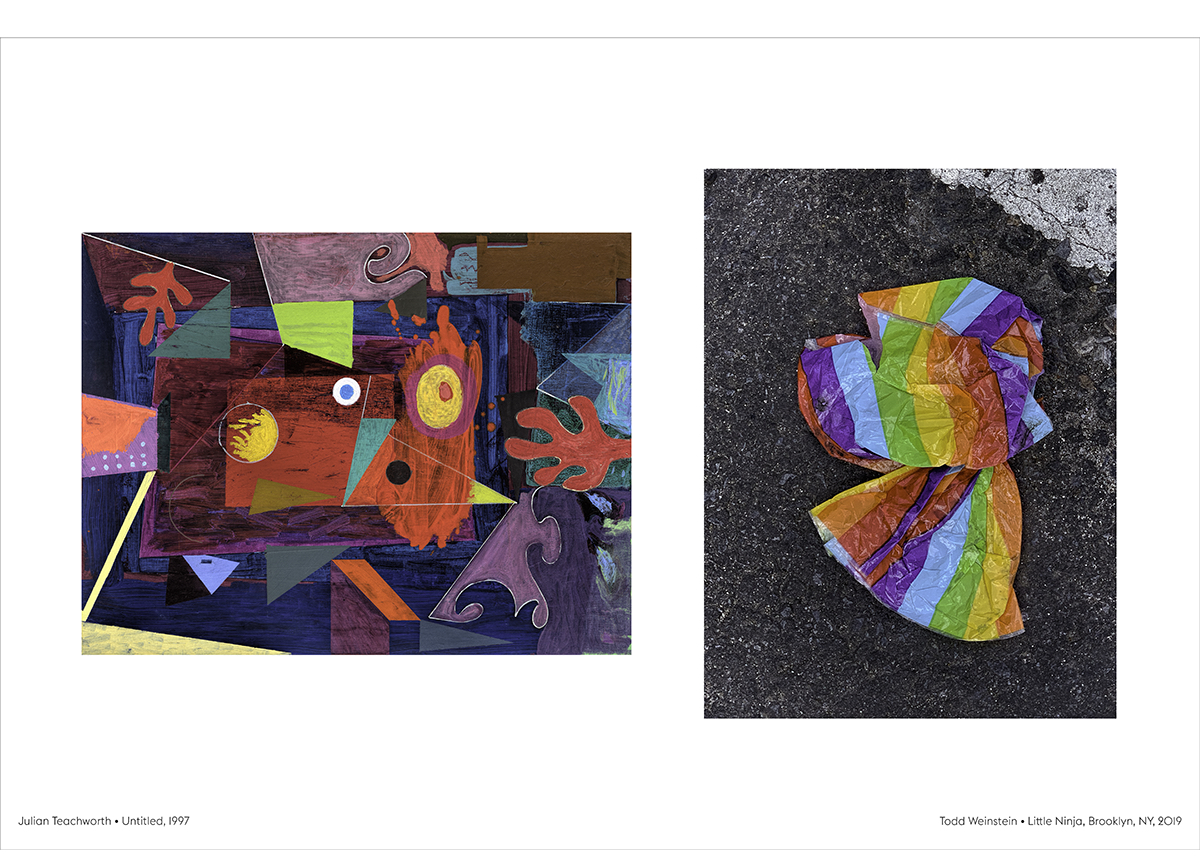
Julian Teachworth, Untitled, 1997; Todd Weinstein, Little Ninja, Brooklyn, NY, 1973.

Not all of the images contributed by mentors are photos. In one, Weinstein pairs his picture of what looks like a collapsed, rainbow-striped mylar balloon on the street with painter Julian Teachworth’s amusing and gorgeous abstract of many colors, an untitled work from 1997. Here Weinstein riffs on the similarity in colors and the loopy geometry present in both. “I photographed all of Julian’s paintings,” Weinstein said. “He’s an incredible painter, mentor and spirit.”

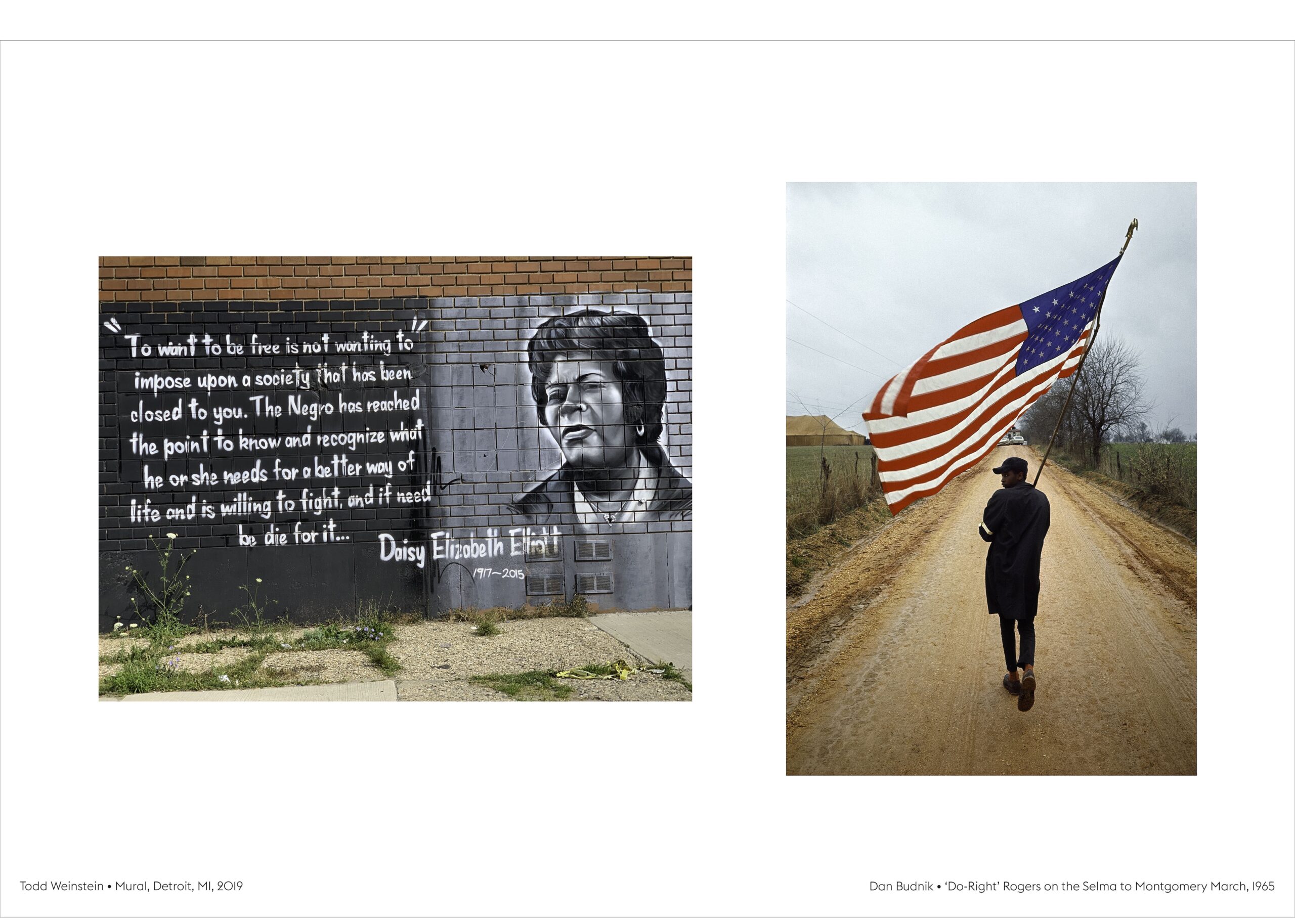
There’s something undeniably spiritual about the twinned images by Weinstein and the great photographer of the Civil Rights movement, Dan Budnik. The latter’s photo, ‘Do-Right Rogers’ on the Selma to Montgomery March, March, 1965 is a classic of the genre, and one that Weinstein says he recalls from childhood. A skinny, African-American youngster marches down an endless dirt road, carrying a pole with a large American flag that’s unfurled in all its red, white and blue glory. The association of deep patriotism with individuals who still had to fight a for their rights is palpably moving.

Todd Weinstein, Mural, Detroit, 2019; Dan Budnik, ‘Do-Right Rogers’ on the Selma to Montgomery March, March 1965.

For his part, Weinstein gives us a black-and-white mural in Detroit on a brick wall honoring the late Daisy Elizabeth Elliott, a champion of Black rights who died in 2015. The quote next to her portrait, in which she cites her willingness to die in the fight for civil rights, is powerful and unexpected – a bit like this show.

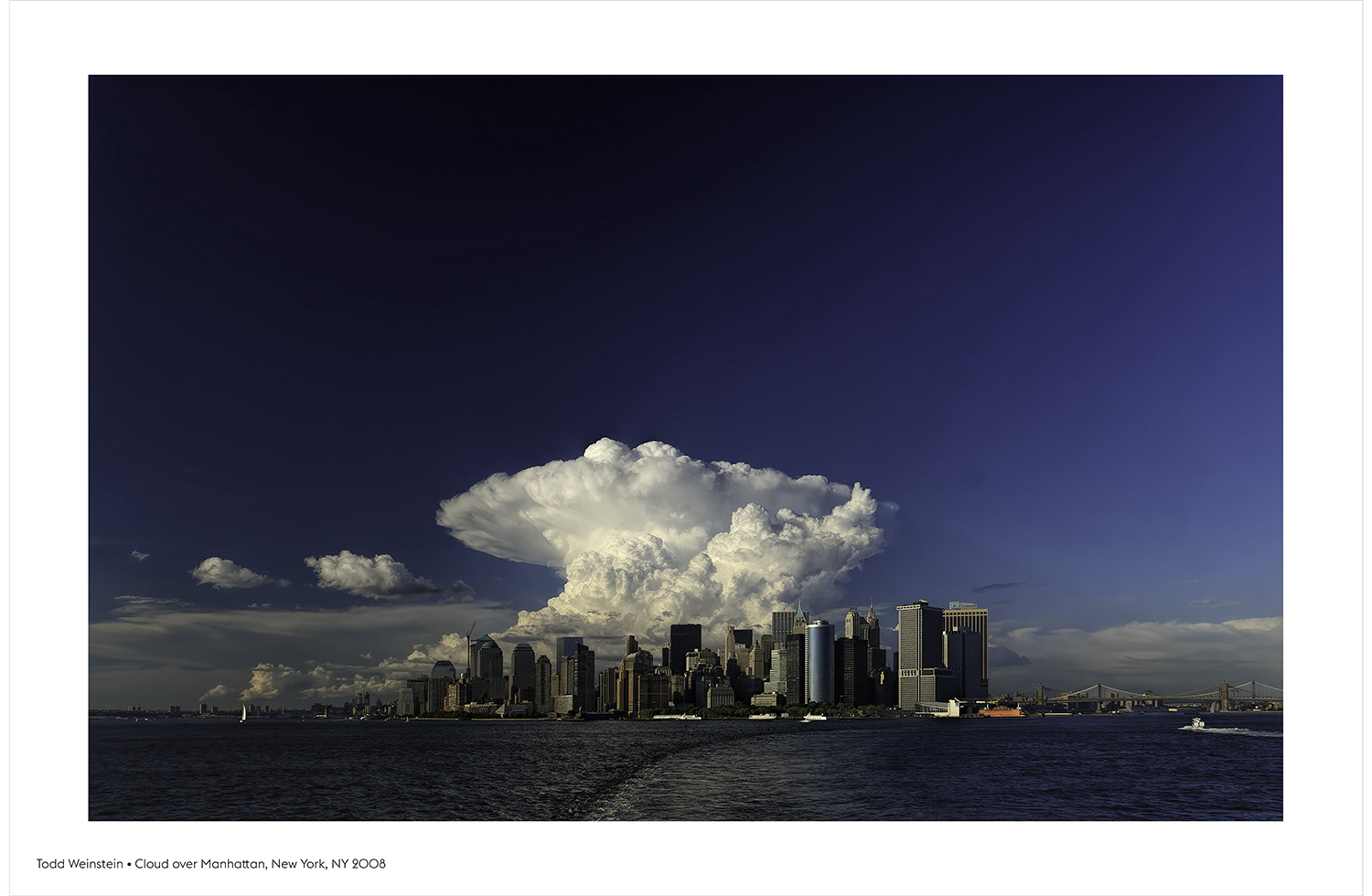
Todd Weinstein, Cloud over Manhattan, New York, NY, 2008.

Stories of Influence: In Search of One’s Own Voice is at the Janice Charach Gallery in West Bloomfield through Dec. 7.

Page 3 of 15

Powered by WordPress & Theme by Anders Norén