Critical art reviews of Detroit galleries and museums weekly

Category: Paintings Page 39 of 51

Group Exhibition @ N’Namdi Center for Contemporary Art

Jennifer Junkermeier Curates and Michaela Mosher Designs an Exhibition: Round in Circles.
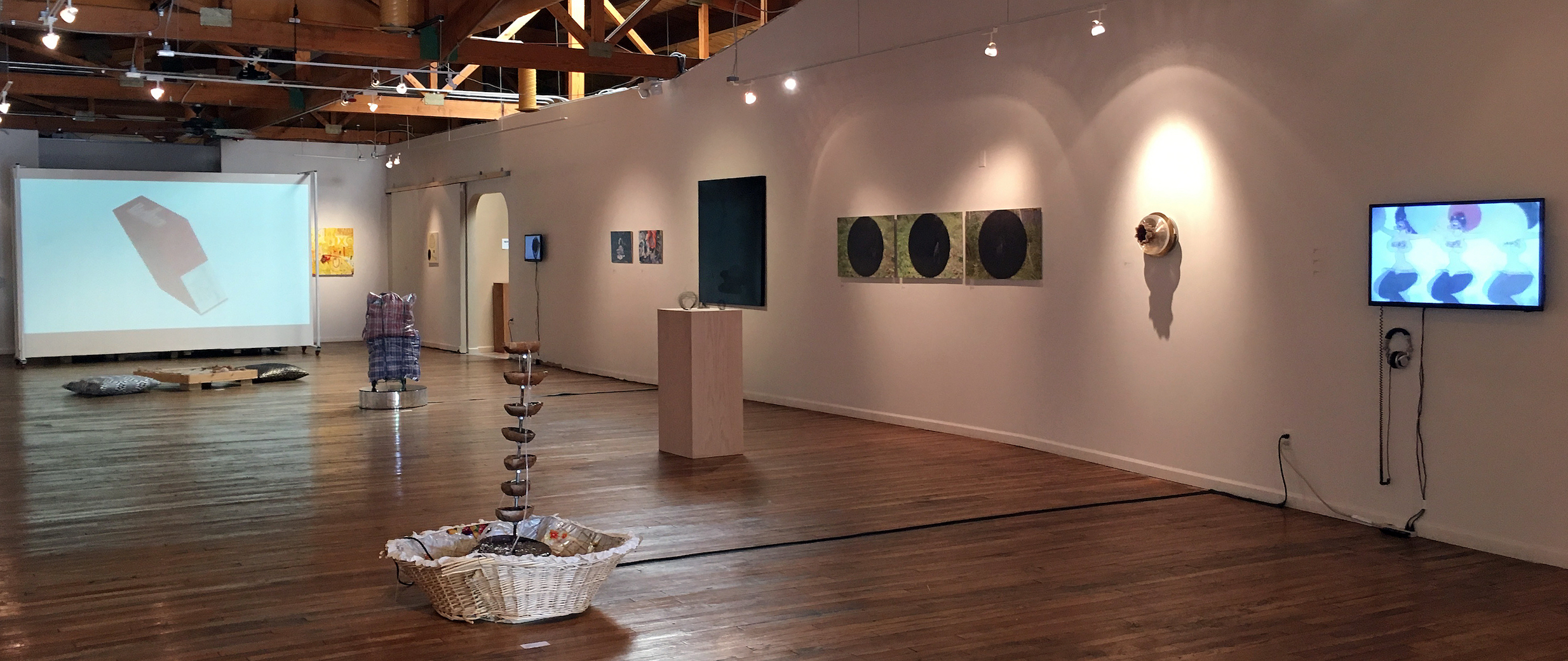
Installation Image, Round in Circles, N’Namdi Center for Contemporary Art, All Image Courtesy of the Detroit Art Review

For a gallery owner to ask someone to curate an exhibition is both exciting and a little risky.  But George N’Namdi has been in this business for more than thirty-five years, and he knows exactly what he’s doing. By inviting a guest curator Jennifer Junkermeier, he is injecting new energy into his space, one that capitalizes on Detroit-based artists (33) and may very well bring new audiences into the gallery. Simone DeSousa has done something similar in her gallery, recruiting Nancy Mitchnik to curate some 70’s aging Cass Corridor artists (she is one herself) into her gallery, and both go outside the regular season because summer is the right time to do it.  This is N’Namdi’s third annual summer show of Detroit artists with an invited curator. In 2016 it was Essay’d VI by Steve Panton, and 2015 was Mundo ‘Mericas curated by Vito Valdez.

Opening June 16, 2017, Round in Circles, is a collection of Detroit-based visual artists that provide nearly every medium, including painting, drawing, sculpture, video, projection, and literary work on the wall. If you need to tie that together with an idea, why not use the circle as a place to start, if not literally in the work, then probably in the mind of the artist, or a metaphor that applies to almost anything, dating back about 3000 years. She says in her statement, “Yes, going round in circles is dizzying, at once nauseating and exciting, impoverished and plentiful, the form that implies nothing also embraces the possibilities of being everything.”

It’s a pleasure for a writer to pick out some favorites, and say a little something because it is almost impossible to write a review when there is such a variety of work as there is in this exhibition.
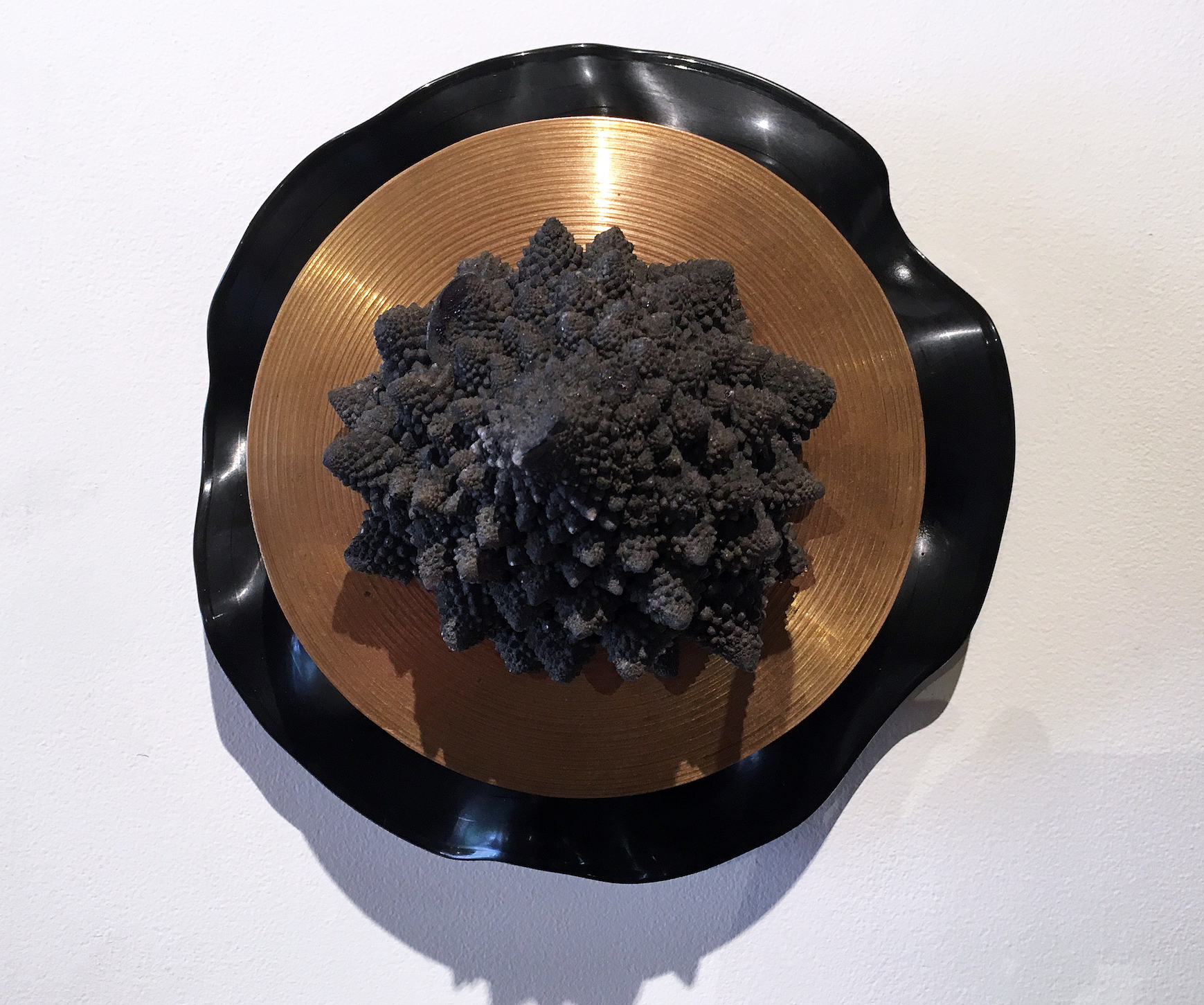
Graem White, You Are Here: Center of the Universe, Mixed Media, 11.5 x 14″

Graem Whyte is an artist that works with a wide variety of three-dimensional material, sometimes on the floor, sometimes on the wall.  Born and raised in metro Detroit, Whyte is based in Hamtramck, MI where he and his wife Faina Lerman oversee the community-based activity at Popps Packing. Whyte’s work always feels very unconventional, driven more by the idea than the material, illustrated in his one-person exhibition at Oakland University in 2012. In his work, You Are Here, it seems to play on the border, a manipulated LP record, a gold plate, and a burst of Mixed Media, suggesting that music can be concrete. Graem Whyte is an adjunct art instructor at the Center for Creative Studies.
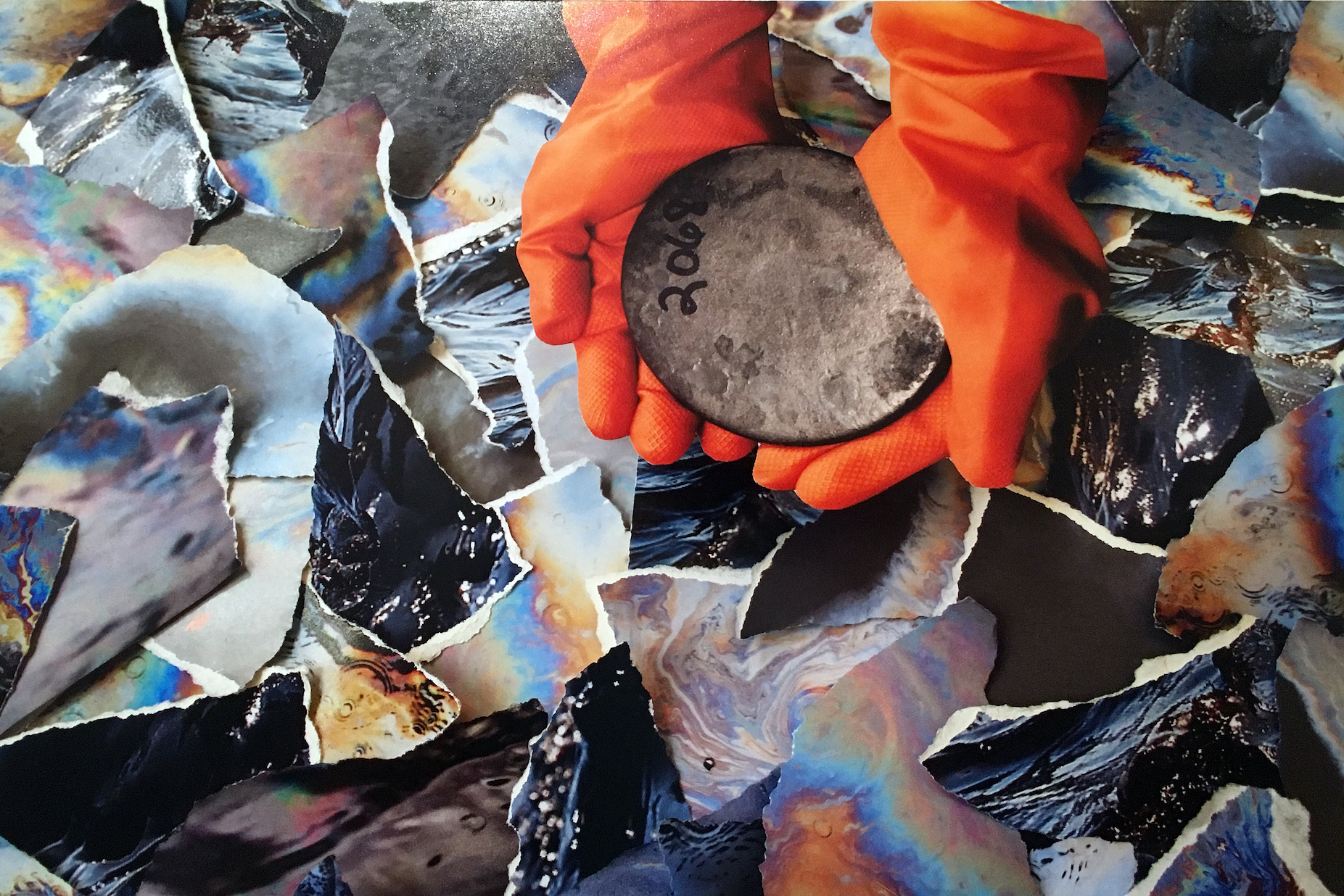
Shanna Merola, Untitled 2, from series “We All Live Downwind”, Archival inkjet pigment print, 14 x 20″

The photograph by Shanna Merola, from the series, We All Live Downwind, seems driven by her interest in documentary photography, and a deep concern for social justice. This writer is not trying to figure out the context of these orange gloves holding a ceramic dish, rather – enjoying the surrounding and colorful pieces of torn paper. Merloa was born in Bridgeport, Connecticut, 1980, earned her BFA at Virginia Commonwealth University, and an MFA Cranbrook Academy of Art.  She lives and works in Hamtramck, Michigan.
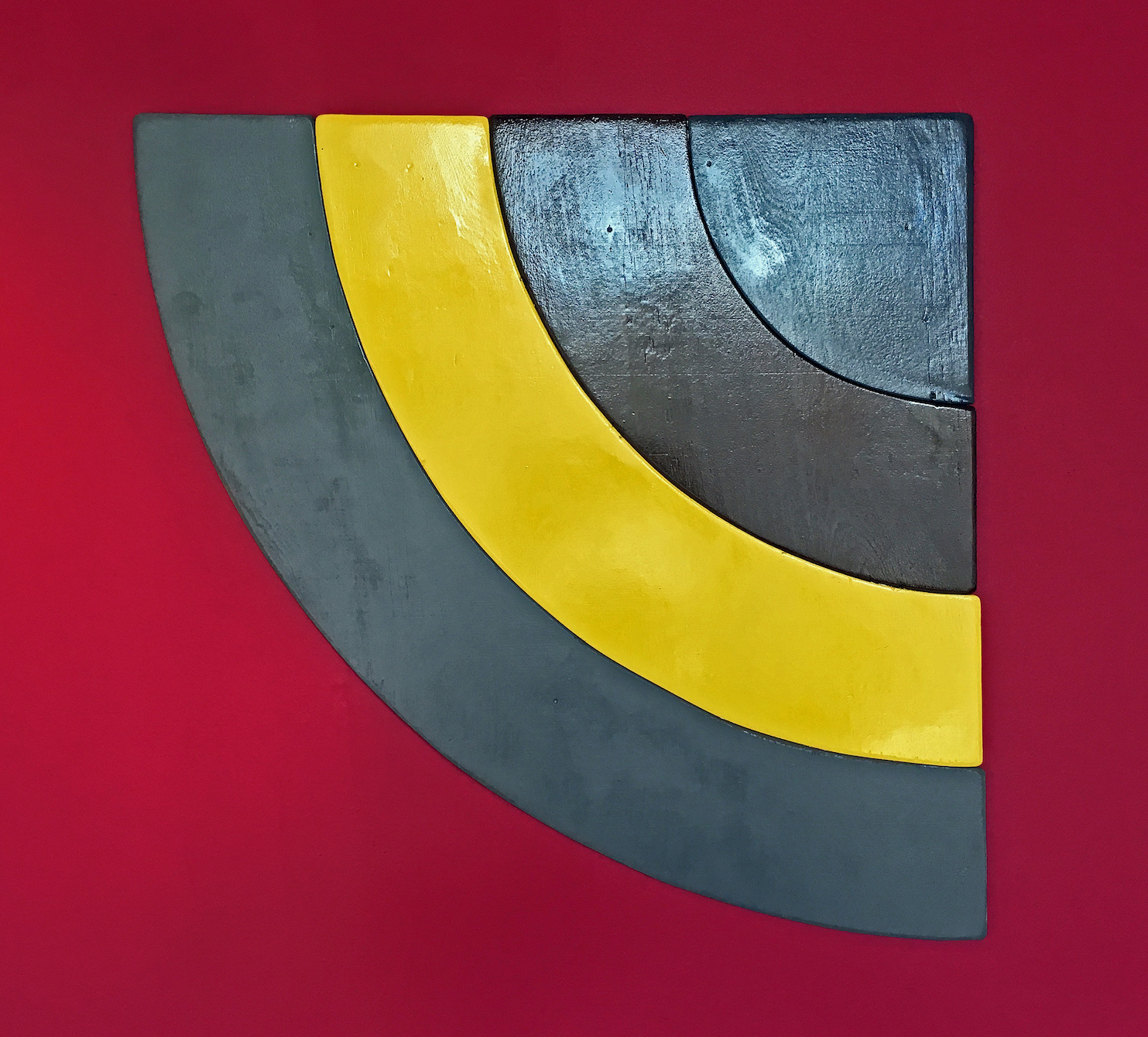
Todd Stovall, Untitled, Acrylic, Wood, 2 x 2′ 2017

Detroit artist Todd Stovall keeps the minimalist shaped canvas work alive in his work, Untitled, although this piece is entirely made of wood.  The context for this kind of approach might be artists like Charles Hinman, Ellsworth Kelly, and Frank Stella.  Stovall is not trying to do much with color, rather the simple power of shape, although the red wall is there to support his effort. 
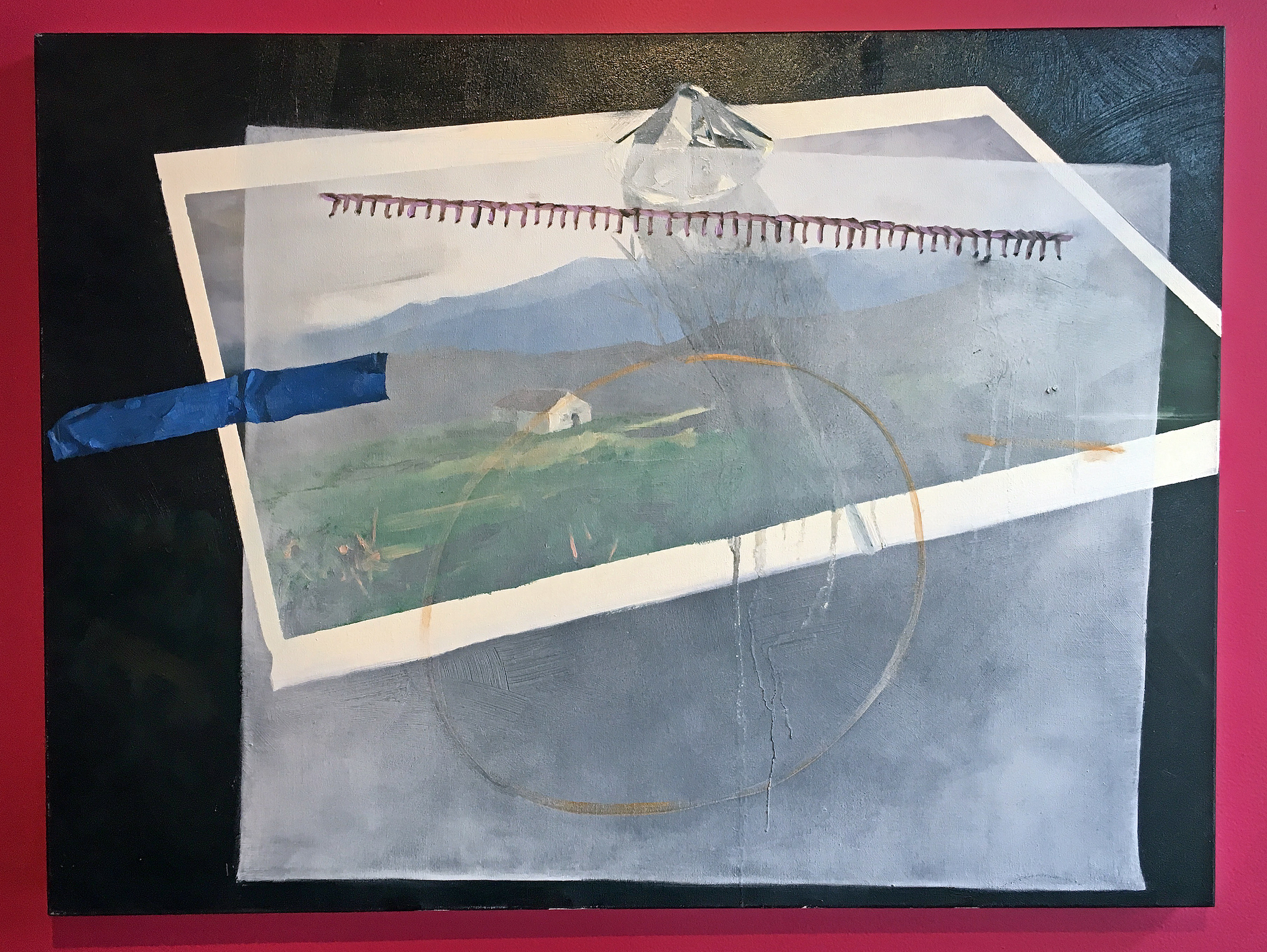
Clara DeGalan, A Veiled Asking, Oil on canvas, 2016

This oil painting, A Veiled Asking, by Clara DeGalan reflects a deep and progressive direction from her earlier work in graduate school, an MFA from Wayne State University in 2015, and a two-person exhibition in 2016 at the Birmingham Bloomfield Art Center. It’s this idea of transparency and the illusion of dimension that creates a mystery that leaves us wanting, combined with an offset but a sturdy sense of composition. All of this held together by a circle and a piece of blue tape. Lovely. 

Round in Circles is a group exhibition that explores formal and metaphorical implications of the circular.” Says Junkermeier.  The exhibition could send a signal to other galleries, to experiment (certainly some do) during your summer months, and realizing there is limited space for thirty-three artists, at least I can mention their names as part of this exhibition.

Contributing Artistis: ‘jide Aje, Danielle Aubert, Corrie Baldauf, Davin Brainard, Tyanna J. Buie, Alexander Buzzalini, Shane Darwent, Clara DeGalan, Simone DeSousa, Erin Imena Falker, Jessica Frelinghuysen, Ani Garabedian, Richard Haley, Asia Hamilton, Megan Heeres, Eli Kabir, Osman Khan, Austin Kinstler, Nicola Kuperus, Timothy van Laar, Anthony Marcellini, Adam Lee Miller, Shanna Merola, Eleanor Oakes, Ato Ribeiro, Robert Platt, Marianetta Porter, Dylan Spaysky, Todd Stovall, Gregory Tom, Graem Whyte, Elizabeth Youngblood, and Alivia Zivich

N’Namdi Center for Contemporary Art

Round in Circles through August 26, 2017
Whitney Biennial 2017: an Observation from Detroit

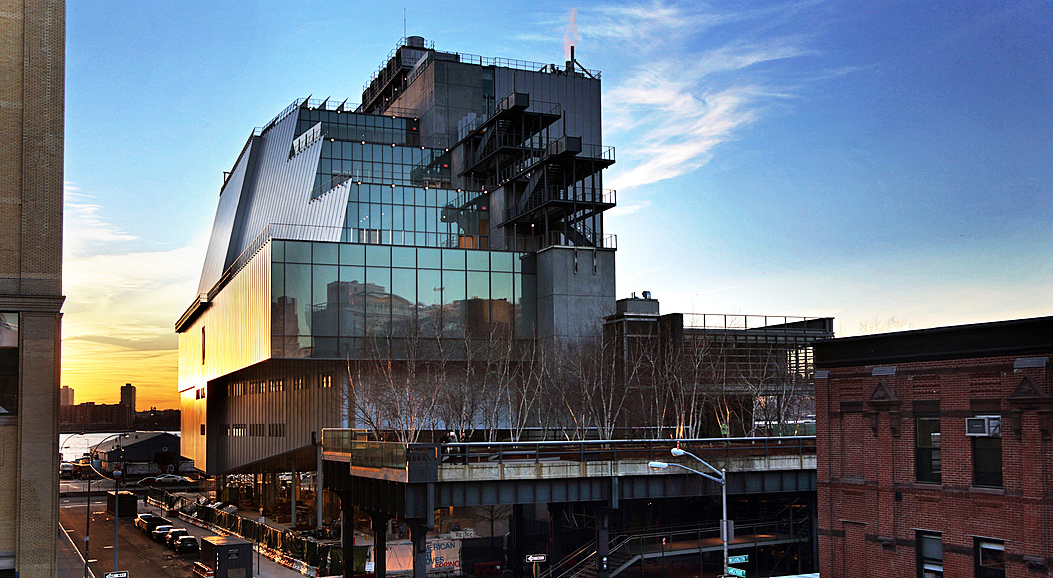
Whitney Museum of Art, Exterior, 2017 Courtesy of WMA by Ed Leaderman

The Whitney Biennial draws to a close, but not without a review from Detroit that showcases artists with roots in Metro Detroit.

Moving downtown into the Renzo -Piano- designed building on New York City’s Gansevoort Street delayed the 2017 Whitney Biennial a year, but it was worth the wait, as the spacious and beautiful new museum sits high just off the Hudson River overlooking the Highline Park and Chelsea art community. Organized by Christopher Y. Lew, the Whitney’s associate curator, and Mia Locks, an independent curator, the exhibition highlights work by sixty-three individuals and collective’s artist works from all parts of the United States. The diversity of artists and media is staggering when considering the large demographic of contemporary art that is represented.

I was mostly surprised by how much space was committed to each artist, where entire rooms with 5 to -7 pieces of work were on display by each artist. It speaks to the size and space the new museum provides, luring an art-world audience, as the selections confront edgy social issues in the American culture.

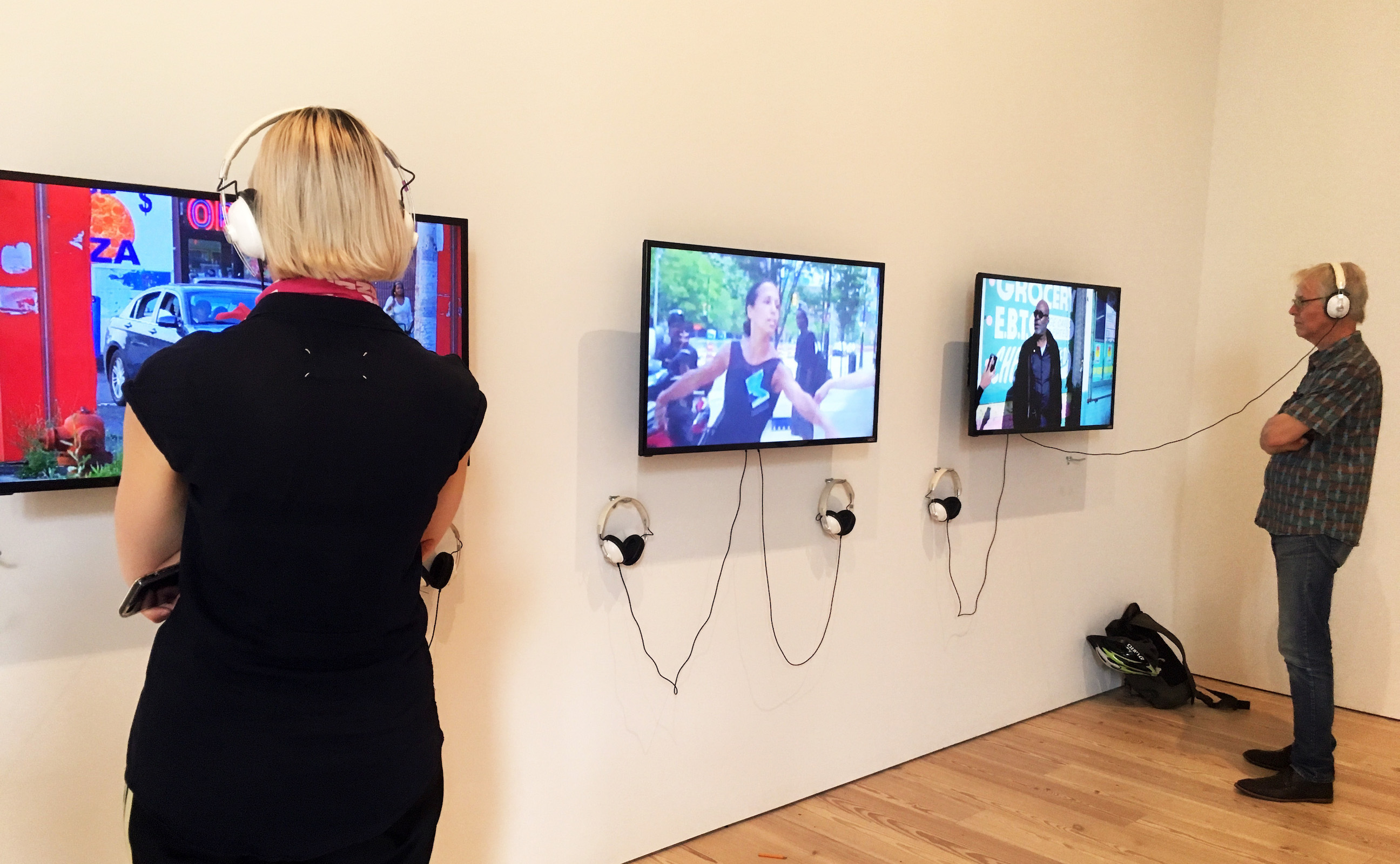
Maya Stovall, Liquor Store Theatre, Video Performance, 2016

As promised, let’s start with Detroit. The videos of post-minimalist ballerina Maya Stovall are front and center as she offers her art from the sidewalks of Detroit illustrating modern dance working with collaborators Biba Bell, Mohamed Soumah, and Todd Stovall, she presents the motivations, genealogies, and sources of her Liquor Store Theater.

She says in her statement, “I am an artist interested in monumental questions of human existence. I am interested in place and space, cities, power, and the affect and desire of the day-to-day in people’s lives. I approach monumental questions of human existence with up close rigor. My work is steeped in philosophy, theory, and resonates with my way of being in the world.” The video screens and audio-fed headphones document a series of dance performances from the streets of Detroit. Stovall pays respectful homage to the cultural traditions in the Detroit black community as commercial developers swirl rapidly to gentrify the city.

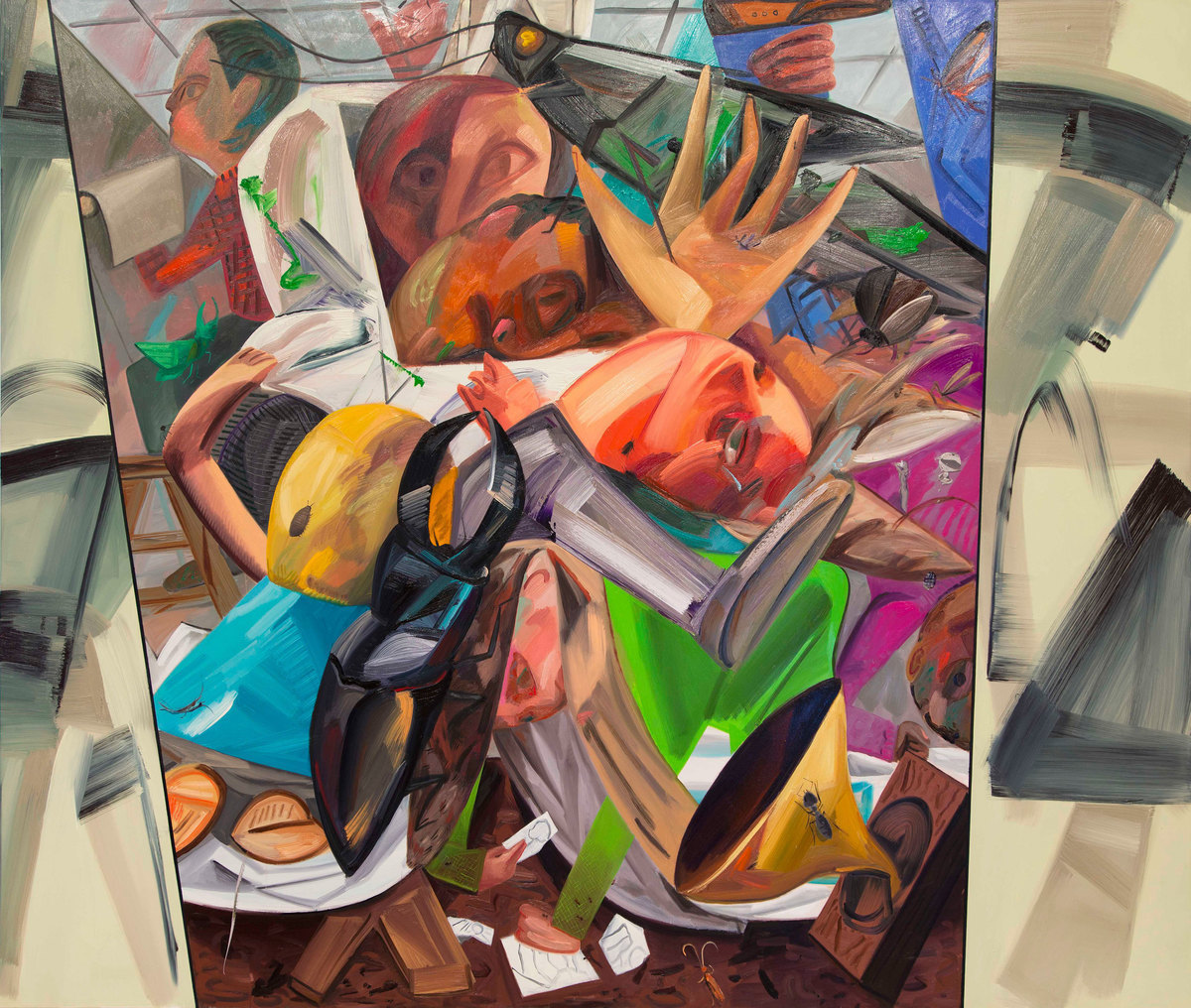
Dana Schutz, Elevator, 2017. Oil on canvas, 144 x 180″

The artist Dana Schultz grew up in Livonia, attended High School at the Adlai Stevenson High School, and went on to obtain her BFA from the Cleveland Institute of Art, and an MFA from Columbia University. As the elevator opens on the fifth floor of the Biennial, the viewer is immediately confronted with a large figurative oil painting, Elevator, which displays a kind of chaos occurring in the transitional space between two elevator doors, perhaps either opening or closing. There is an abstract, even cubist feeling to this colorful figure painting, depicting struggle and larger-than-life insects, adding to the feeling of anxiety, even fear. It took me a moment to understand why there were these two side panels attached to the work, until I read the title.

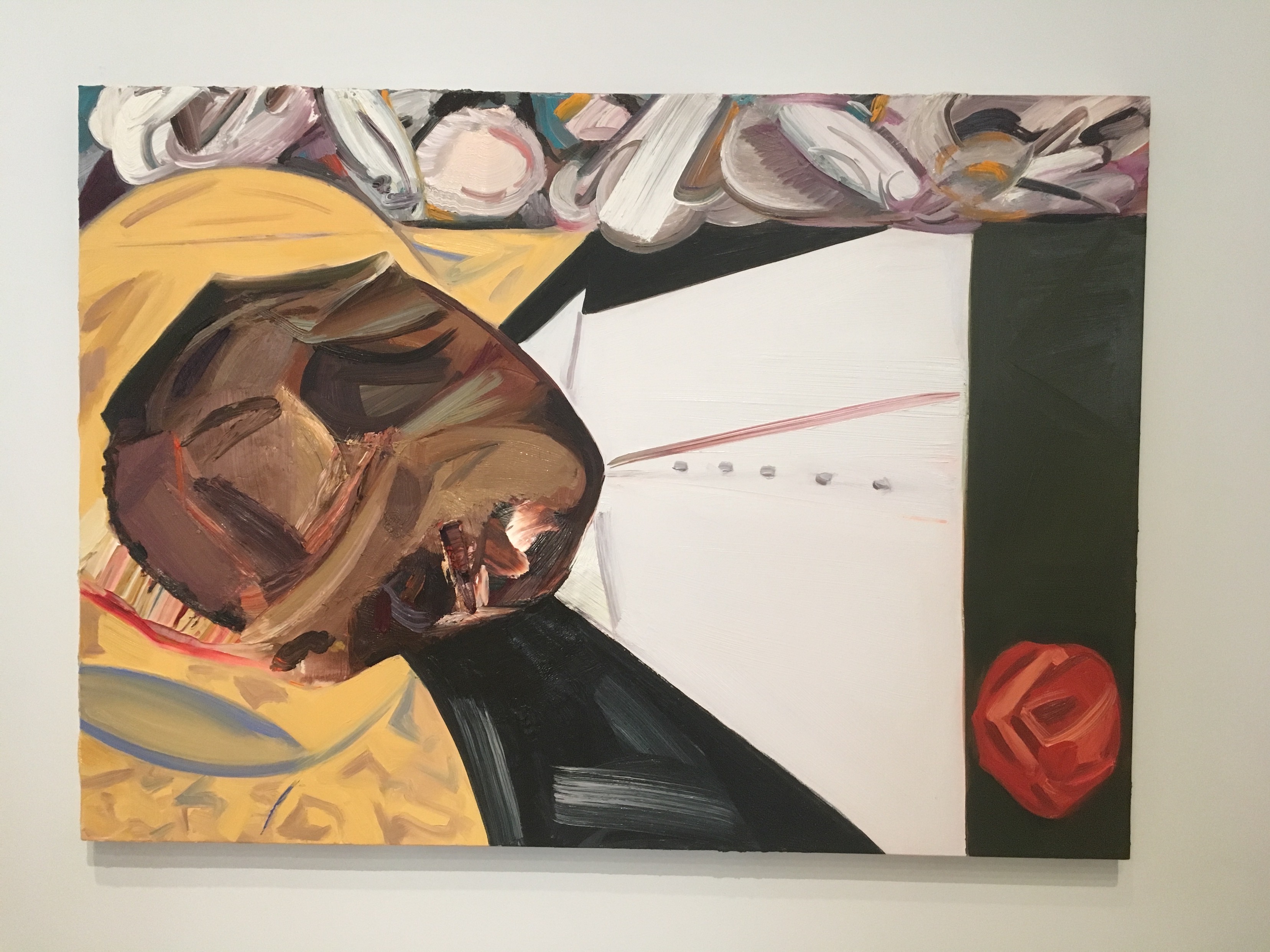
Dana Schutz, Open Casket, 2016. Oil on canvas, 40 x 56″

Schutz’s work seems to draw on social environments, best illustrated in her 2016 painting, Open Casket, that depicts her version of the mutilated corpse of Emmett Till, a seminal event in the American civil rights movement. Controversy swirled around the work as exploitation, best described in The New Yorker by Calvin Tomkins:

In the current climate of political and racial unrest, Emmett Till seemed like a risky subject for a white artist to engage with. “I’ve wanted to do a painting for a while now, but I haven’t figured out how,” [Schultz] said. “It’s a real event, and it’s violence. But it has to be tender, and also about how it’s been for his mother. I don’t know, I’m trying. I’m talking too much about it.” In a later conversation, [Schultz] said, “How do you make a painting about this and not have it just be about the grotesque? I was interested because it’s something that keeps on happening. I feel somehow that it’s an American image.”

Dana Shultz resides in New York City, works out of her studio in the Gowanus section of Brooklyn, and is represented by the Pretzel Gallery in New York City.

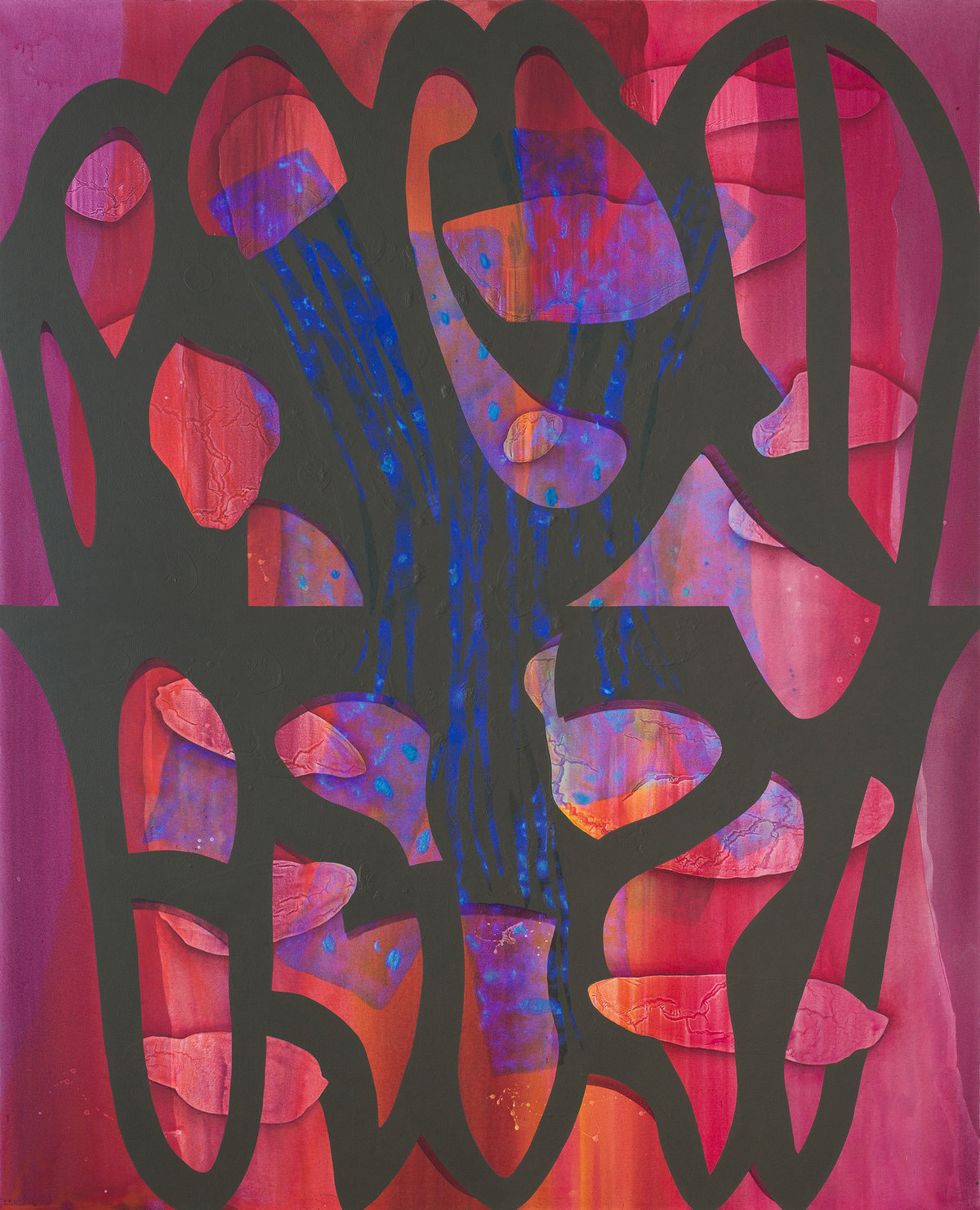
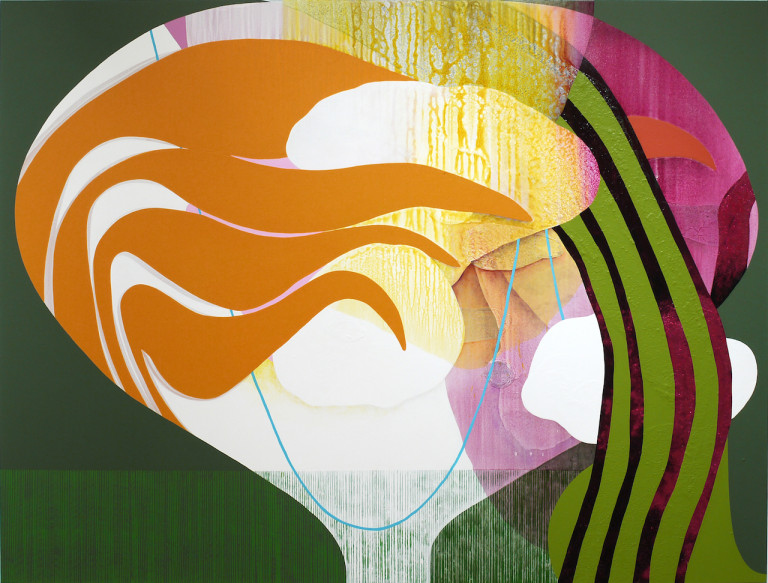
Carrie Moyer, Glimmer Glass, 2016. Acrylic and glitter on canvas, 96 x 78 in”

Another Detroit artist in the Biennial, now living in Brooklyn, NYC, is Carrie Moyer, who received a BFA from Pratt Institute in 1985, and an MFA from the Milton Avery Graduate School of the Arts at Bard College in 2001. In an interview with Jennifer Samet for Hyperallergic, she says, “I was born in Detroit, where my family has longstanding roots. My grandfather was a policeman during the Detroit riots in the 1960s. But I had countercultural parents who put us in a van when I was nine and drove us out to California with all of our belongings. My family lived all over the Northwest for the next ten years — California, Oregon, and Washington.”

In her large acrylic painting, Glimmer Glass, it is the overlay and transparency that compliments her distinctive use of form. The vibrant painting embraces visual pleasure with watery veils of florescent hues, often mixed with glitter. The artist explains, “I’m interested in abstract painting that is experienced both visually and physically. The forms are constantly shifting from the familiar to the strange in a way that seems to escape words.”

Carrie Moyer, Candy Cap , 2016. Acrylic and glitter on canvas, 72 x 96″

With her beginning in graphic design, Carrie Moyer has been a force in abstract painting since 2000 with a strong familiarity with the language of Abstract Expressionism and Minimalism; she draws on influences like Georgia O’Keeffe and Elizabeth Murray. I was struck by the work, Candy Cap, where she depends heavily on a feminine composition of flower and organic shapes to form this work using acrylic transparency, glitter, and Flashe on canvas. Moyer is a Professor in the Art and Art History Department at Hunter College, where she is the Director of the Graduate Program. Moyer is represented by DC Moore Gallery.

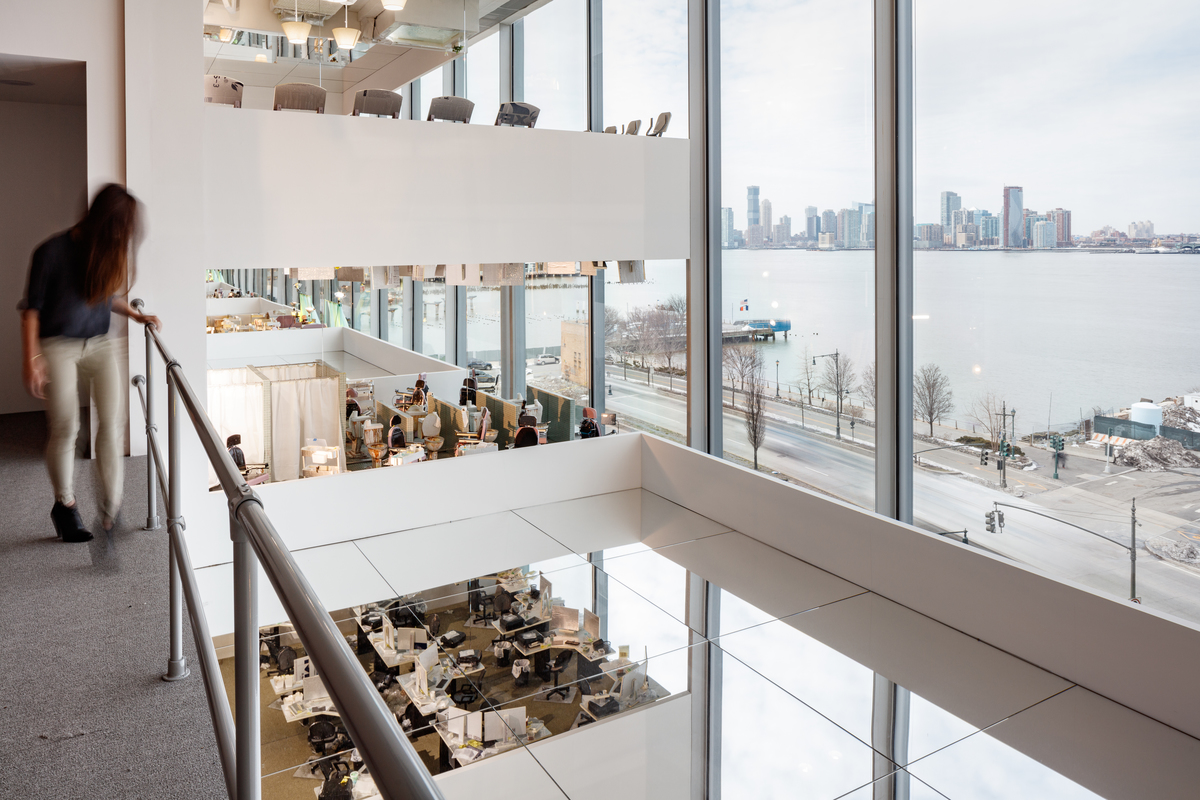
Samara Golden, The Meat Grinder’s Iron Clothes, 2017. (Installation, 5th floor West Gallery). Insulation foamboard, extruded polystryrene, epoxy resin, carpet, vinyl, fabric, acrylic paint, spray paint, nail polish, plastic, altered found objects and mirror.

The artist Samara Golden was born in Ann Arbor, Michigan in 1973, and received her BFA from Minneapolis College of Art & Design, and an MFA from Columbia University in 2009. She is an installation artist based in Los Angles, CA where her work often includes a combination of sculpture, video, and sound. Her first solo exhibition was The Flat Side of the Knife and was organized by Mia Locks at the Museum of Modern Art PS1. Golden’s work in the Biennial, The Meat Grinder’s Iron Clothes, feels like a dystopian environment overlooking the Hudson River that contrasts office and domestic spaces. Admittedly, this writer has limited skill in describing the aesthetic aspects of this work of mirrors, living rooms, and wheelchairs.

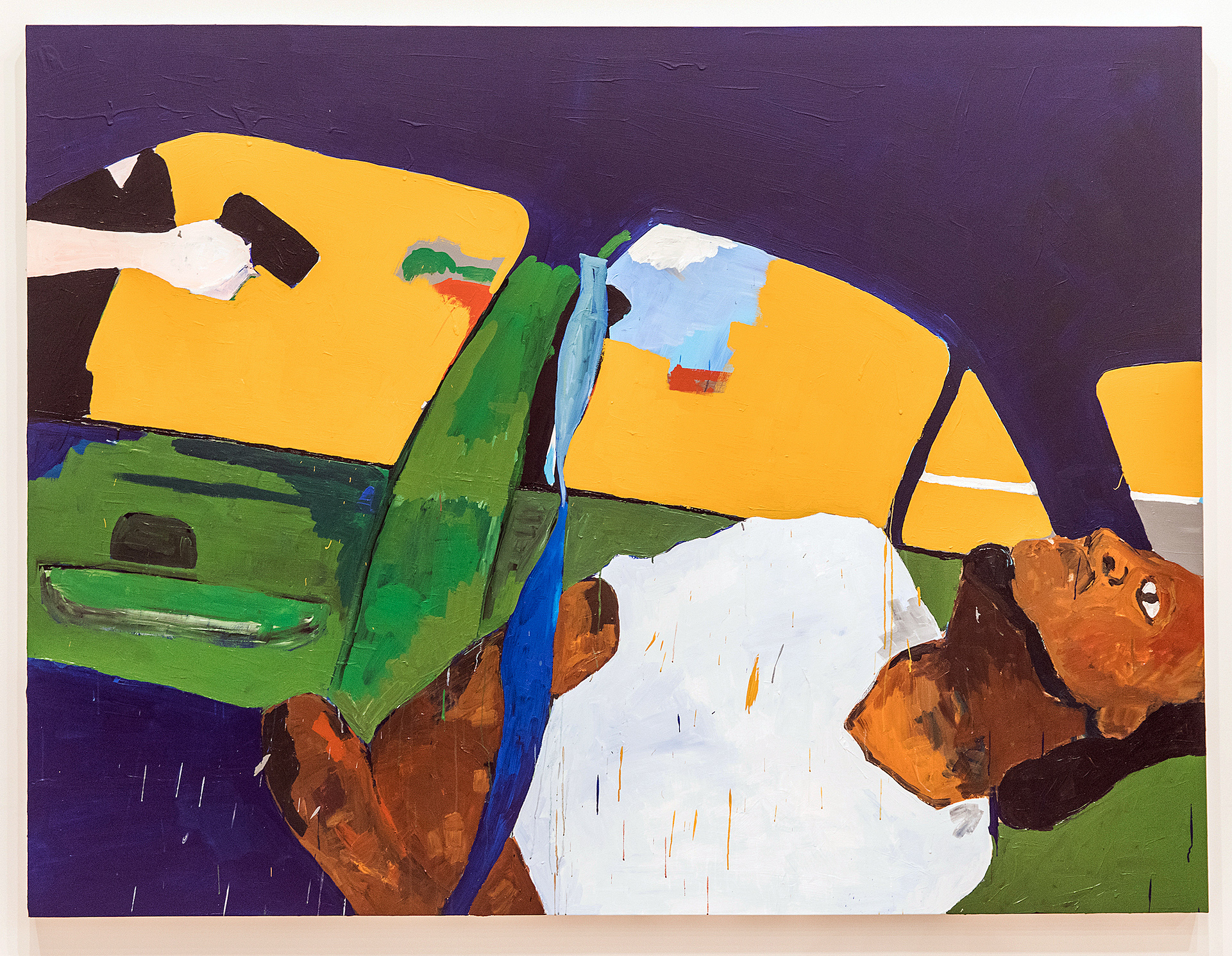
Henry Taylor, “THE TIMES THAY AINT A CHANGING, FAST ENOUGH! (2017), acrylic on canvas, 72 x 96″


There are sixty-three artists represented in the Whitney Biennial, and this review has had Metro Detroit artists as its focus, but I would like to mention another artist, Henry Taylor, living and working out of Los Angeles, CA. With a BFA from California Institute for the Arts and a variety of life experience, Taylor has created a body of work that has a critical social sensibility that confronts the racial tension between law enforcement and the community they serve. In his work, The Times They Ain’t A Changing, Fast Enough! drawn from video, captures the moments after Philando Castile had been fatally shot by a police officer. Aside from the social message, I am drawn to the composition and naïve style in which Taylor executes his unaffected imagery. His empathetic style may draw on his ten years of working at the Camarillo State Mental Hospital near Santa Barbara, CA. Taylor’s work is represented by Blum & Poe in Los Angles, CA.

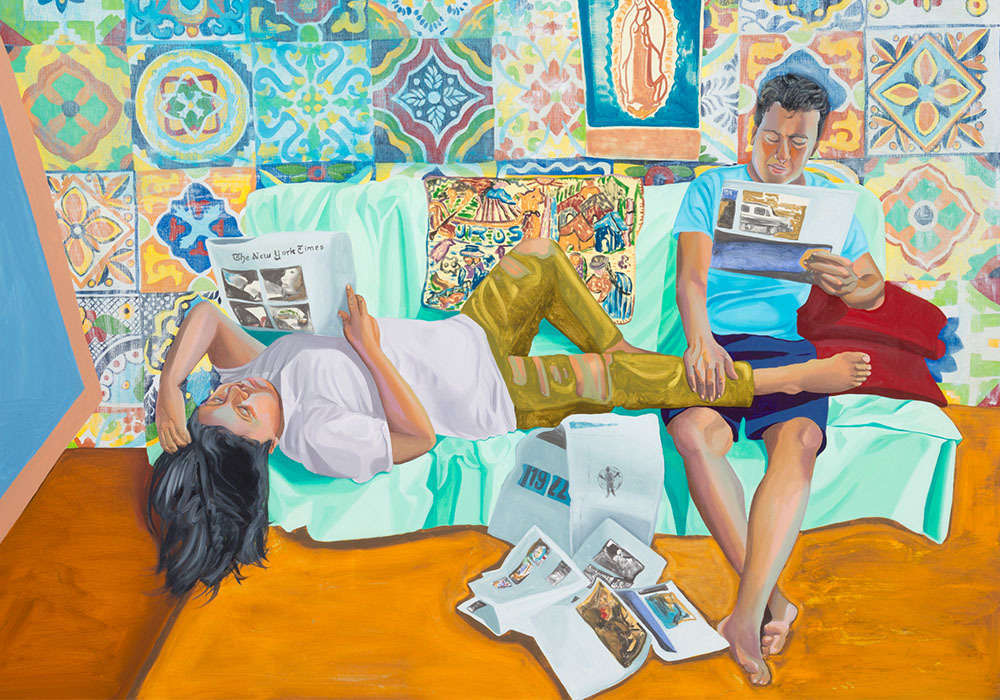
Aliza Nisenbaum (b. 1977), La Talaverita, Sunday Morning NY Times, 2016. Oil on linen, 68 x 88″

It could be that because this writer is also a painter, the work in the Biennial by Aliza Nisenbaum is immensely attractive. Known for depicting undocumented immigrants, there is something in the work La Talaverita, Sunday Morning NY Times, that combines working from live models, an elevated camera angle, and the casually colorful subject that connects with so many people. Born in Mexico City, Nisenbaum earned a BFA and MFA from the Chicago Art Institute. She says in her statement, “My work has repeatedly reflected on ideas of empathy or pathways for exchange between different people. My status as a legal American citizen makes me one of the few and privileged immigrants from my home country. Whether working with abstraction or, more recently, with still life and portraiture, I have tried to make paintings that support the experience of looking closer and with greater intention. My current body of work makes this connection explicit in its focus on the human face, which the philosopher Emmanuel Levinas suggests is inherently an ethical call to greater human justice.”

For me, her work personalizes the immigrant experience and could easily reflect the life in South West Detroit.

The new Whitney Museum of Art in its new location demonstrates in the curation of it’s 2017 Biennial a refreshing supply of under-recognized artists with diverse perspectives from all parts of the United States, and places itself at the center of American contemporary art.

Whitney Museum of Art

Suspended Disbelief @ Broad Museum, East Lansing

Transported Man Exhibition opens by New Director

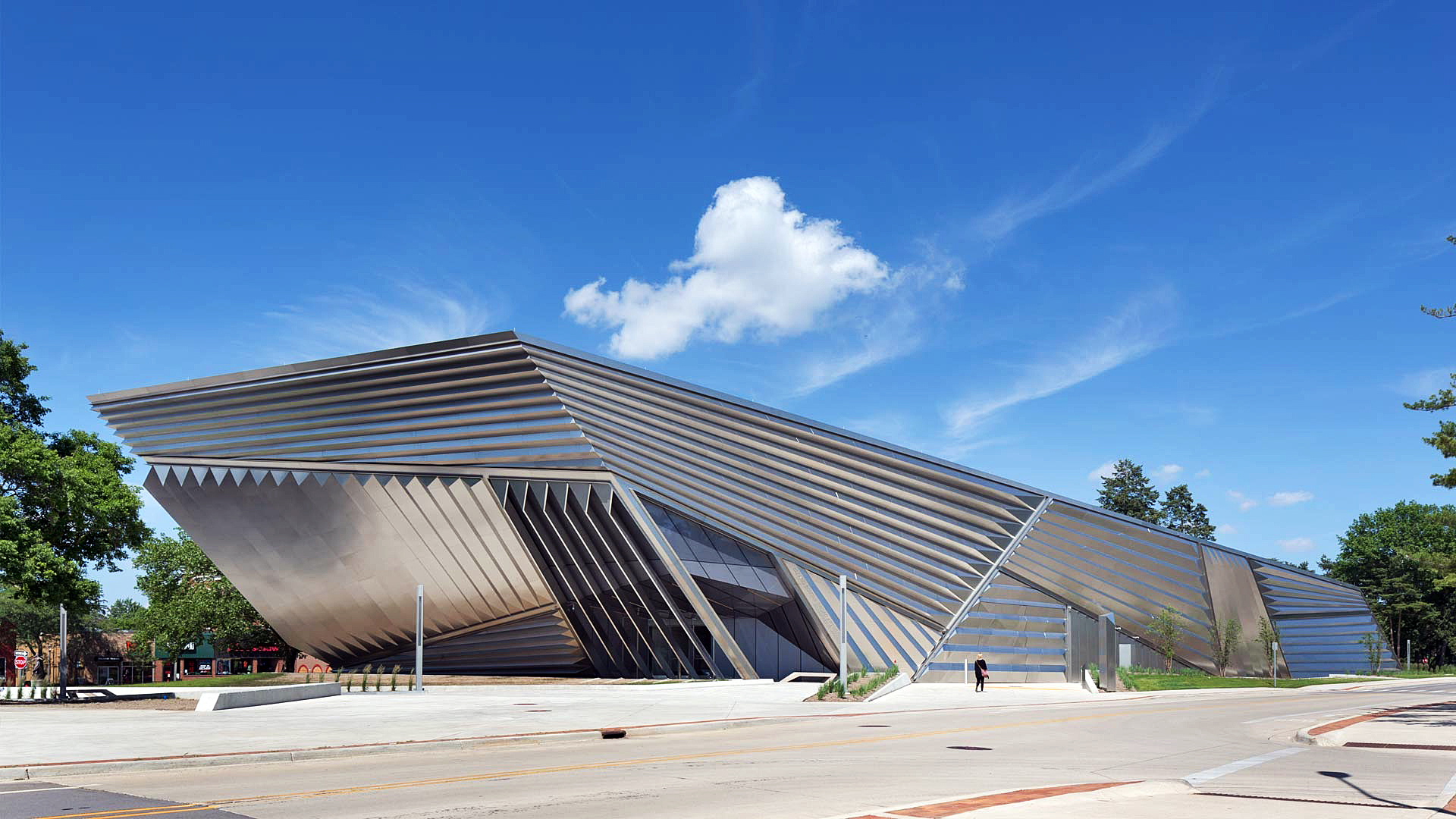
Eli and Edythe Broad Art Museum at Michigan State University, East Lansing, MI

I once entertained aspirations of being a professional magician (I was never good, but at one point I could make all the faces of a deck of cards disappear, using a trick deck, admittedly). It’s likely for the best that I never pursued that career, but the Broad Art Museum’s Transported Man suggests that perhaps the world of art and that of magic aren’t that different. Both, after all, inexorably rely on the viewer voluntarily suspending disbelief.

The Broad’s new director, Marc-Olivier Wahler has a tough act to follow. The museum’s grand opening in 2012 featured works by art world heavyweights Andy Warhol, Joseph Albers, Anselm Kiefer, and Damien Hirst. The building’s architect Zaha Hadid even made an appearance. But, with over 400 exhibitions under his belt, Wahler capably delivers a conceptually interesting and visually arresting debut exhibition. His first show is an ambitious exploration of the relationship between art and viewer, and it brings together over 40 international artists, some quite familiar (Duchamp and Magritte) and others either emerging or mid-career.

The Transported Man derives its title from the magic trick of the same name, as depicted in the novel (and movie) The Prestige. Using magic as a motif, the exhibition, broadly speaking, explores the mutability of perception. Mundane items—magically—become art objects once placed in a museum. Furthermore, the exhibition tests the limits at which art can fool us. It certainly works. By the time you’re done on the second floor, you’ll have seen so much trompe l’oeil wizardry and visual sleight-of-hand that you’ll be thoroughly confounded as to what’s real and what’s illusory. The Broad’s counterintuitively shaped spaces, replete with walls that slant every which way, make the experience even more disorienting.

The Transported Man, all images courtesy of the Eli and Edythe Broad Art Museum at Michigan State University

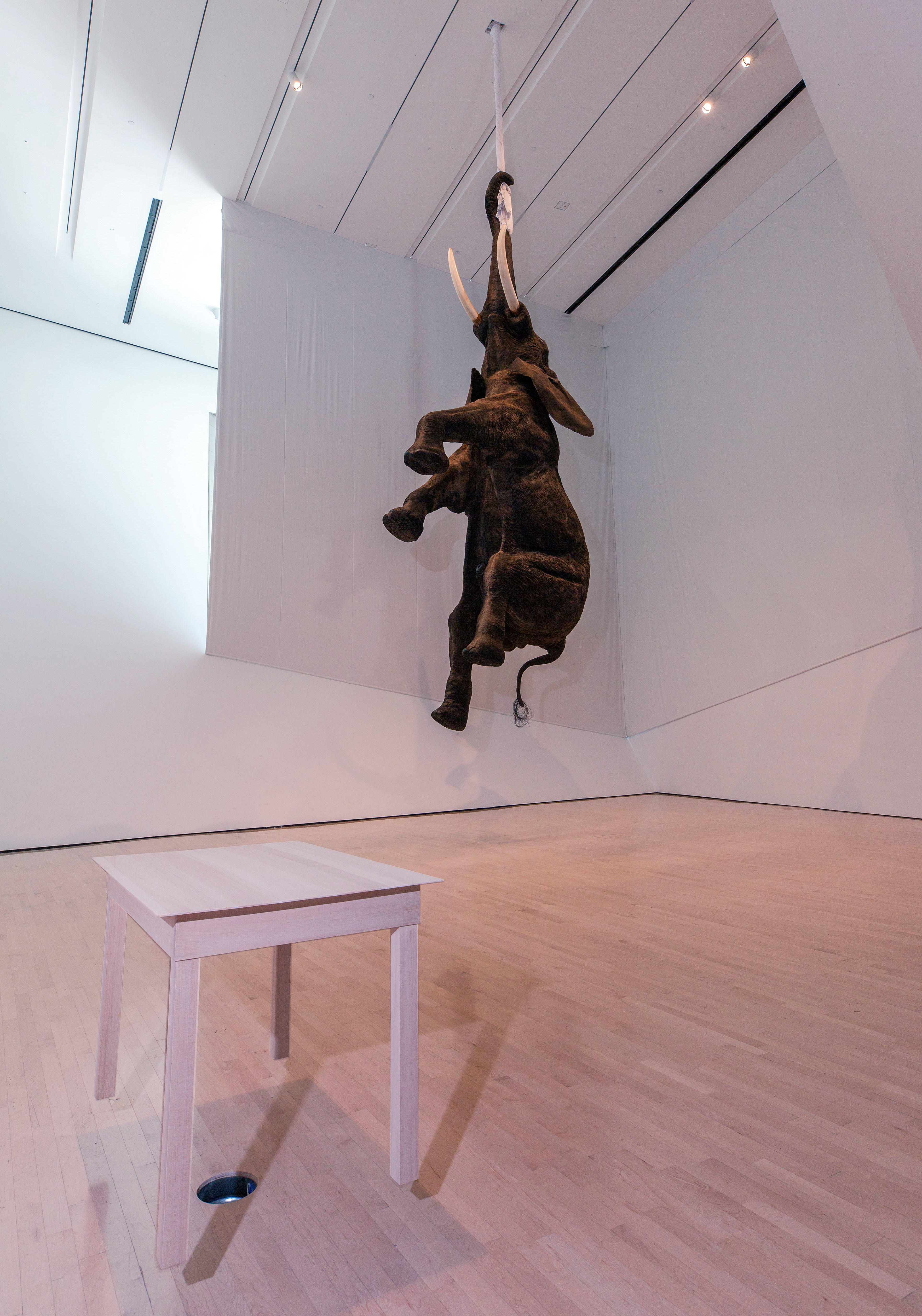
Stepping into the first level exhibition galleries, visitors will be met with a wooden table hovering in air; it’s propped up by a fan set within the floor (there’s no attempt at hiding that), yet how the air current so firmly holds the table in place remains a mystery. But the elephant in the room is, quite literally, the elephant in the room. It freely hangs with its trunk clasped around a rope affixed to the ceiling. Possessing all the convincing texture of an actual elephant, it’s actually a polyurethane resin, polyester, steel, and fiberglass sculpture by Daniel Firman. There’s something strangely beautiful and visually satisfying about the suspended creature so improbably defying gravity. (Look up Firman’s elephants on the internet; they’ve appeared in all sorts of places).

Perhaps the most disorienting work in the show is Synchronicity, an experimental work by Robin Meier and Andre Gwerder. It’s a big, black tent inside a big black tent. Step inside both and suddenly you’re walking on (and smelling, quite strongly, in fact) soil and grass, the atmosphere has suddenly become hot and extremely humid, and it’s very dark. Real crickets happily chirp away (afterhours, the lights within turn on, mimicking natural daylight, and the crickets, cicadas, and fireflies erroneously think it’s day). The work explores how we can manipulate nature through electronic stimuli. Small electronic LED lights stimulate actual synchronistic fireflies, which under the impression that it’s a hot, muggy night, flicker in a pulsating rhythm. While far from the point of the installation, I couldn’t help but reflect on our own susceptibility to electronic stimuli/media which we increasingly accept at face-value as truth.

Upstairs, the visual and sensory theatrics continue. In the corner of one gallery space you’ll find weeds sprouting improbably from the floor. They’re actually steel sculptures by Tony Matelli, and seem so convincingly real that you really do have to fight the urge to reach out and touch them…just to check.

The Transported Man, all images courtesy of the Eli and Edythe Broad Art Museum at Michigan State University

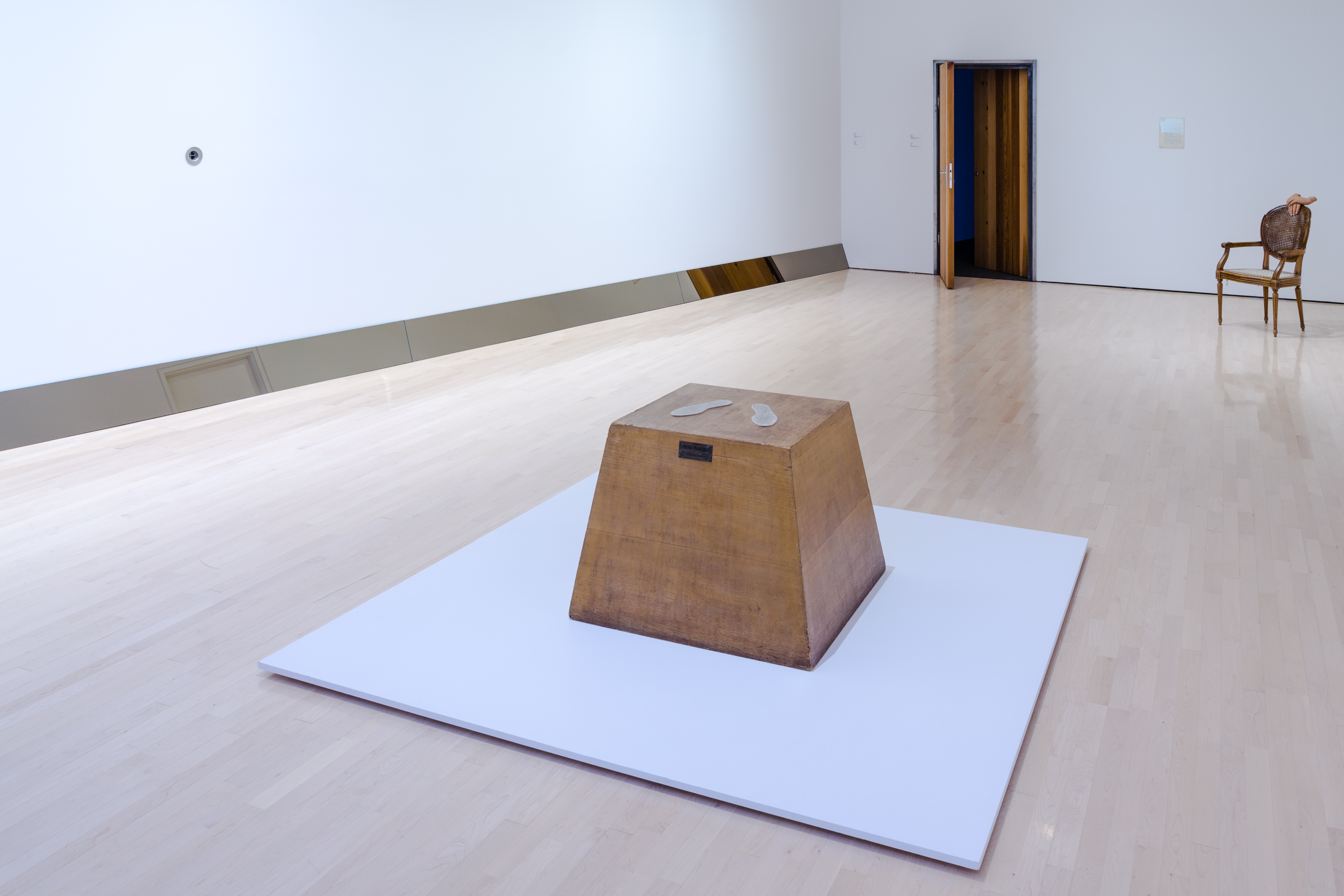
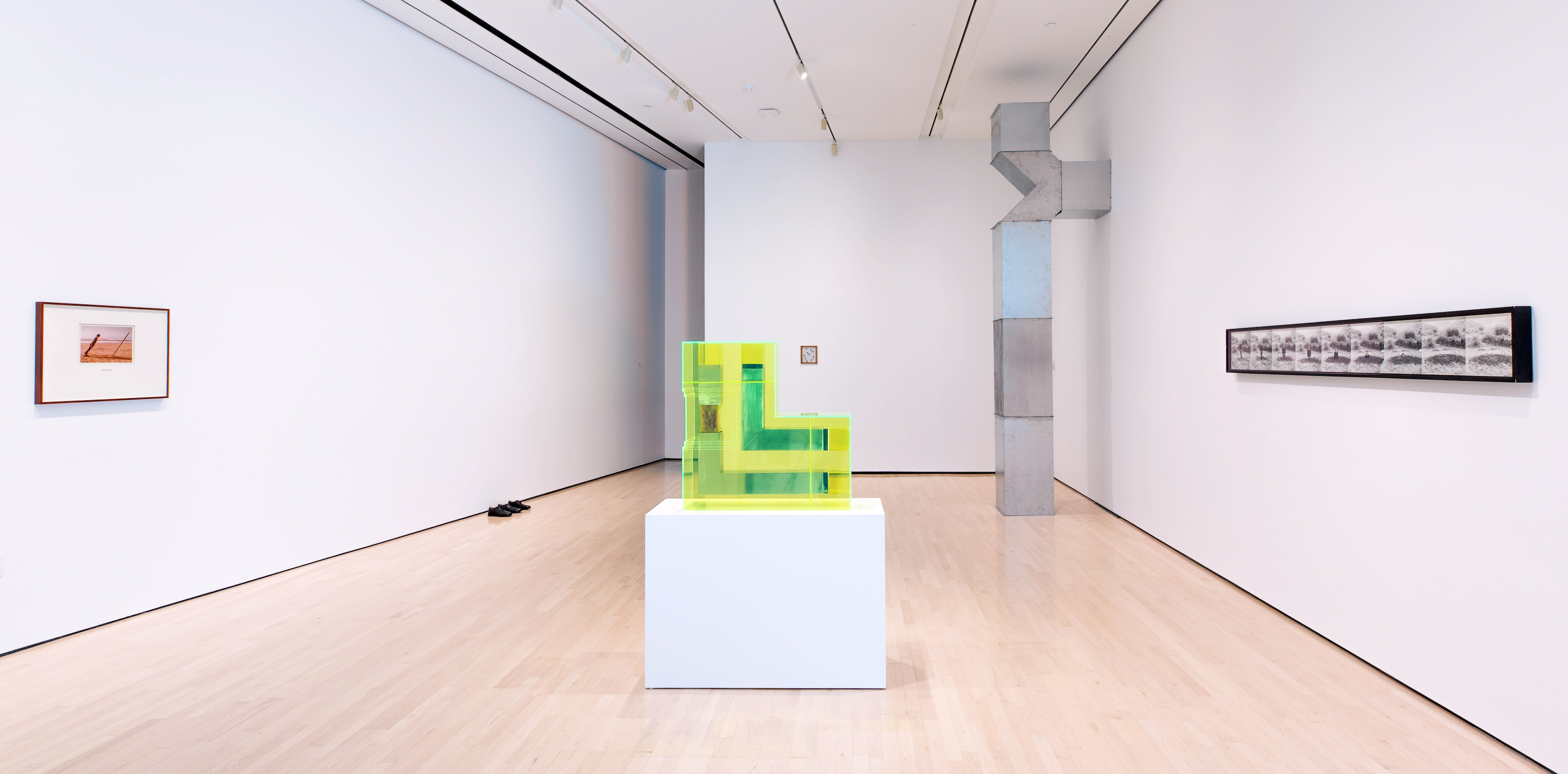
One subtext of the show is the uncanny transformation of mundane objects into works of art. The point is most explicitly made with Piero Manzoni’s Magic Base—Living Sculpture, a wooden pedestal upon which people are supposed to stand, thus momentarily turning themselves into art objects (for this exhibition, however, viewers are asked to kindly refrain from turning themselves into art objects, and thus help preserve the original base, now over half a century old). This also seems to be the point behind the many non-functional air ducts installed throughout the museum by Charlotte Posenenske, and the plywood plank (by Robert Gober) leaning against a wall. Visually, these works are uninteresting, but they nevertheless foster conversation about the nature of art, and in this respect they advance the goal of the exhibition.

The Transported Man, all images courtesy of the Eli and Edythe Broad Art Museum at Michigan State University


Perhaps ironically, the most conceptual part of the show may very well be The Transported Collection, a playfully inventive adjacent exhibition of works from the Broad’s permanent collection. About forty paintings and drawings hang on a wall in one of the Broad’s lower galleries, but without any obvious reference to their corresponding artists. The viewer is left in a quandary: which of these works are, in fact, generally recognized as great works of art? Stealthily tucked in the corner of the room are some laminated explanatory cards which identify the artists. I cheated and peaked; the list is impressive– Van Dyck, Picasso, Delacroix, Matisse, Giacometti, and others. But some of the most compelling works on view were by artists I’d not heard of, such as Federico Castelluccio, who fools the eye with a convincingly illusory painting of a torn up, wrinkled postcard of a Titian portrait which seemed to be taped back together and affixed to a wooden background. This small exhibition wittily questions the subjective process by which we determine what constitutes great works of art.

Jonathan Monk, Second Hand Daily Exchange, 2006 The Transported Man, all images courtesy of the Eli and Edythe Broad Art Museum at Michigan State University

Picasso famously said that art is a lie which points to the truth. He was right; after all, the overwhelming majority of art history is comprised of artists trying to fool us into seeing three dimensions on a two dimensional surface. But it’s while looking at illusory paintings that we’re made acutely aware of the beauty of the actual world…or the shortcomings of human nature, as the case may be. Art’s deception has a purpose; to paraphrase from Shakespeare’s Hamlet, it holds up a mirror to nature, and within that mirror’s distorted reflection, we’re more able to see ourselves.   So while the playful theatrics and visual punning makes The Transported Man an eminently enjoyable and accessible show, there’s substance behind the visual magic that speaks to art’s ability to nudge us toward beautiful, enduring– sometimes uncomfortable– truths

The Transported Man at  the Eli and Edythe Broad Art Museum at Michigan State University


Faina Lerman @ Cave, Russell Industrial Center

Family Album: Faina Markovna Lerman at Cave

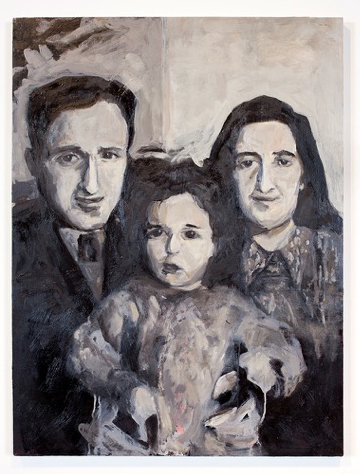
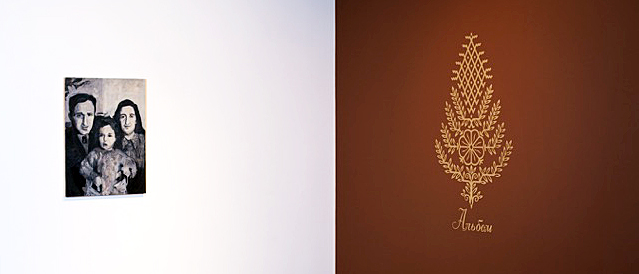
Faina Markovna Lerman worked with photographs to make the twelve paintings that comprise “Family Album” currently exhibited at Cave in the Russell Industrial Center. The photographs are mostly stored in the family album from which she took the name and from which she worked. In her artist’s statement for the exhibit she says:

“These paintings are inspired by the desire to honor my family history and experiences  that are fading, gone, or were well before my time. They reference photos from the  1950’s (post WWll Latvia)-1980 (when my family immigrated to the United States)”.

To make paintings in honor of the family is to celebrate and remember its existence but Lerman uses photos which, typically, already serve as memories. Family photos are the evidence, the signs, that the family was, and provide a sense of continuity and context, even likeness for heirs to compare themselves, to find lineage. As artifacts, they carry with them their own cultural information: the serrated edges of the square format photos, the fading chemicals used to make them, and the eroding paper on which the images are printed, these things locate them in time. What Lerman is after is more complex than either the fact and corroboration of their existence.

Faina Markovna Lerman, “Baba, Dzeda and Mom before Josef arrived (Riga 1955)”  Water-based oil on wood, 2017 All images courtesy of Corine Vermeulen


The first image that we encounter, and there is a definitive evolution of the twelve paintings, is “Baba, Dzeda and Mom before Joseph arrived (Riga 1955).” It is a black and white painting with pink tinges shadowing the figures. (I learned that Lerman painted over a painting of her grandfather with which she was completely dissatisfied: “There was red in it.”) We get a sense of her pursuit by the title. Baba and Dzeda are Russian names commonly used for Grandmother and Grandfather, and it is clear in this painting that Lerman was after likeness to the photo and mirroring the initial effect of the image at which she is gazing. She is interrogating the photo searching for connection. Whether intended or factual or not each figure has the same brush- stroked nose to accomplish the notion of family. Wonderfully the act painting contains a genetic component. Most interestingly Dzeda’s half of the portrait is shaded darker than Baba’s and her mother (Lerman’s mother), the baby between them, is half shaded and half in the light, representing a genetic sharing of her parents. Is this a conscious mirroring of the photograph or is it a factor of Lerman’s desire to find likeness in her family? While classically sober, in keeping with traditional family portraits, it is an energetically expressionistic rendering of her mother and grandparents. Each brush stroke is deft and fraught with meaning. The figures express an innocently touching but uncertain humanity.

Photographs might be considered a pure, distilled concentrate, a moment composed of many recognizable signifying features, a face, a nose, a certain dress, of a life. In her paintings Lerman is working at reconstituting a family “fading, gone, or were well before my time.” The painting becomes the echo within her of first family, of ontologically, her beginning. The painting is a reification of that history. It is not a slavish copying, but a deep mining of herself to affirm their lives.

Latvia, along with Lithuania and Estonia, borders the Eastern shore of the Baltic Sea. Riga, the capital of Latvia, where the photo was taken, was torn, like all Baltic Soviets, between Germany and Russia, between persecution of the Jews by both the invading Nazis and by Latvian nationalists themselves, and by the Russians. That said, Latvia was where Lerman was born and the site of her early childhood. “That culture, that landscape, the food, the smells, the music, that world is disappearing, that moment of the world is maybe gone and I want to preserve it somehow. I want my children to know it. When we would have dinner before they were gone I would sit there eating and cry, cry while I was eating, knowing how fragile the moment was and that it was disappearing.”

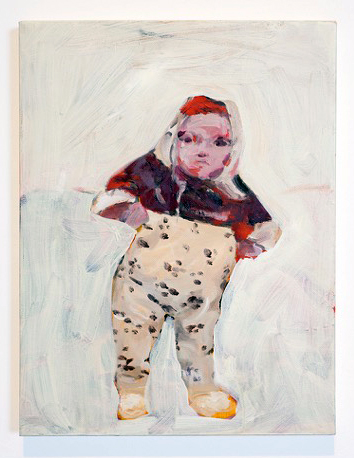
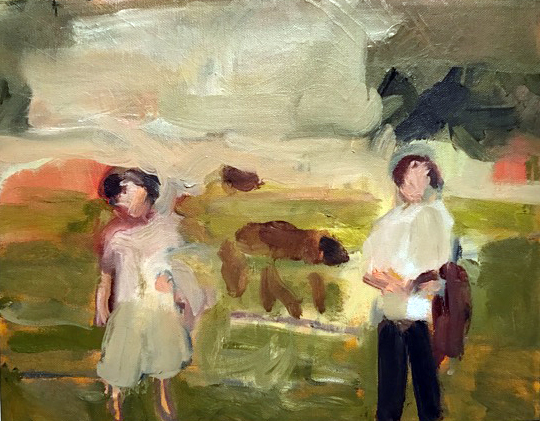
Faina Markovna Lerman “The Baby with a fever (Riga 1976)”, 1Water-based oil on canvas, 2017

There are two other paintings from Riga. One is “The Baby with Fever (Riga 1976)” based upon a photo of Lerman as an infant, straddled and supported by her parents. Her mother told her that because she was sick with fever she had bundled-her- up against the cold. Lerman painted-out, or intentionally left her parents out, and added color to the black and white image as if to create a reality for herself as a child that has faded or that she never had. It is a loose, gestural painting, with the sense of the infant almost rescued out of the painted-out background. There is also a look of decisive and emerging identity in the painting of the infant that Lerman has asserted.

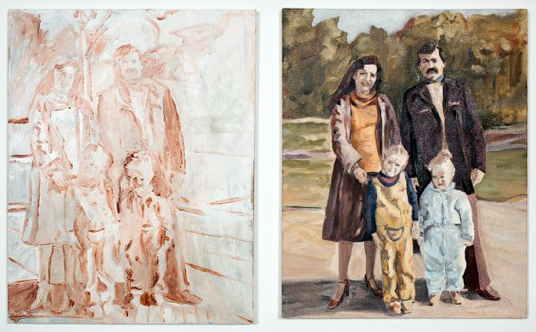
Faina Markovna Lerman, “Rainis Park (Last family photo taken before coming toAmerica,1980),”  Water-based oil on canvas, 2017

The other painting, “Rainis Park (Last family photo taken before coming to America,1980),” is a diptych. One panel is an almost transparent, study-like sketch of Lerman’s immediate family, her mother, father, sister and her. Riga’s Rainis Park is infamous in history as a site where in June 1941 the Nazis gathered and shot 300 Latvian Jews, and thousands of other Russian patriots and Jews were murdered in and around Riga. The transparent quality of the study, juxtaposed to the second painting that reveals a stylish and life-affirming family, throws a painful question into Lerman’s narrative tableau of what could have been.

Faina Markovna Lerman, “Baba Sonya and Josef with horses (date and place unknown),”  Water-based oil on canvas, 2017

There is a strong sense of evolution in “Family Album.” The paintings become looser and gestural, almost abstract. She is comfortable with her gestures and the marks she makes on the canvas are convincing and beautifully lyrical. In discussing Lerman’s “Family Album” exhibition and particularly the wonderful little painting, “Baba Sonya and Josef with horses (date and place unknown), “ 2017, a prominent Detroit artist said “This is a very brave exhibition and she learned to paint marvelous paintings doing it.”

Faina Markovna Lerman is a multi-talented artist and cultural activist and “Family Album” isn’t simply an exhibition of her artistic talent as a painter but illustrates her broad view of personal identity and our collective history.

The exhibition is punctuated by a few simple family possessions– original stools, linens, baby blanket and Russian Nesting dolls (Matryoshka)– that were brought from Russia when her family migrated to Detroit in 1980. The Latvian symbol for growth, fertility and prosperity, which is on the cover of her family album is reproduced on the wall of the Cave Gallery.


Cave through 5/12 17

Russell Industrial Center 1600 Clay St.

Building Four-Third Floor

Detroit, Mi 48211


Abstraction @ David Klein Gallery

Group Exhibition: Gisela Colon, Jeff Colson, Brad Howe, Heather Gwen Martin, Hugo McCloud, Ruth Pastine, Matt Wedel, Patrick Wilson

Who introduced abstract painting to Western culture? Today, Kandinsky is given credit as the father of abstract painting as early as 1910, with first a watercolor, then on canvas, but he had a manifesto in which he wrote about abstraction in 1909. Personally, I think abstraction will be in our art vocabulary for years to come, synonymous with words like cubism, impressionism and realism. David Klein Gallery has an exhibition of eight artists from various parts of the country that opened March 18, 2017, representing both paintings and sculptures. On the Road: American Abstraction, surveys artists from other parts of the country, providing the Detroit audience with abstract sensibilities on both the east and west coast, as well as work from the Midwest.

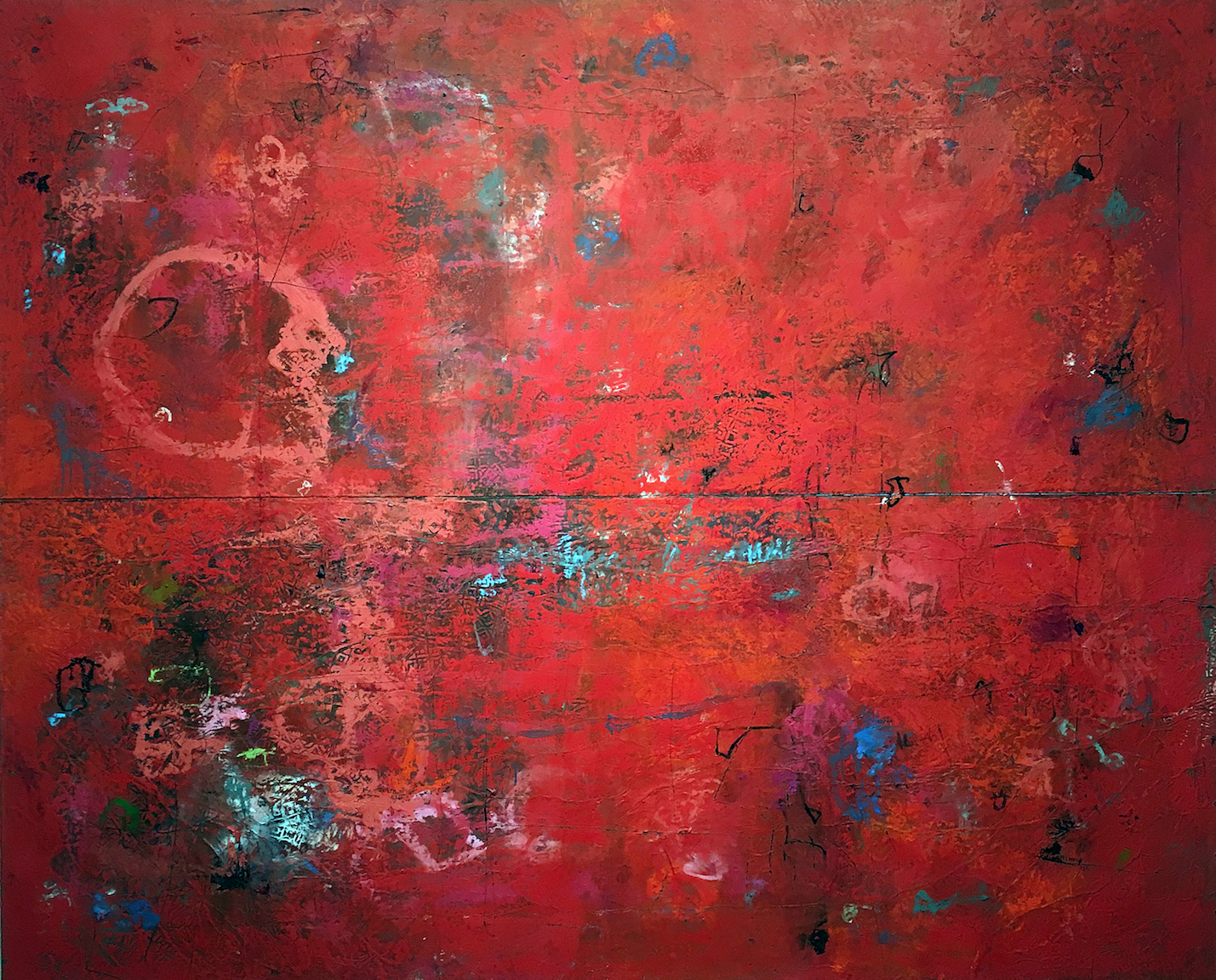
Hugo McCloud, Speechless Conversations, 2016, Aluminum Foil, Aluminum coating, Oil Paint, 79 x 98″

The work that grabbed most of my attention was the large red field abstraction by native Californian Hugo McCloud, who now lives and works in Brooklyn, New York. The horizontal diptych fuses unconventional materials, along with woodblock printing, where he creates a rich surface that reflects a type of urban decay. The rich surface contains a large variety of under painting both in terms of shape and color. Self-taught with a background in industrial design, he says in a statement to artnet, “All of my work is kind of process oriented. When I had a desire to go into the fine art realm,” he explained, “I didn’t really have an understanding of how to work on canvas or use brushes and traditional art making tools. That wasn’t really my foundation.” McCloud stretches his canvas out on the floor, sanding, marking, all driven intuitively by his desire to explore and uncover his personal aesthetic.

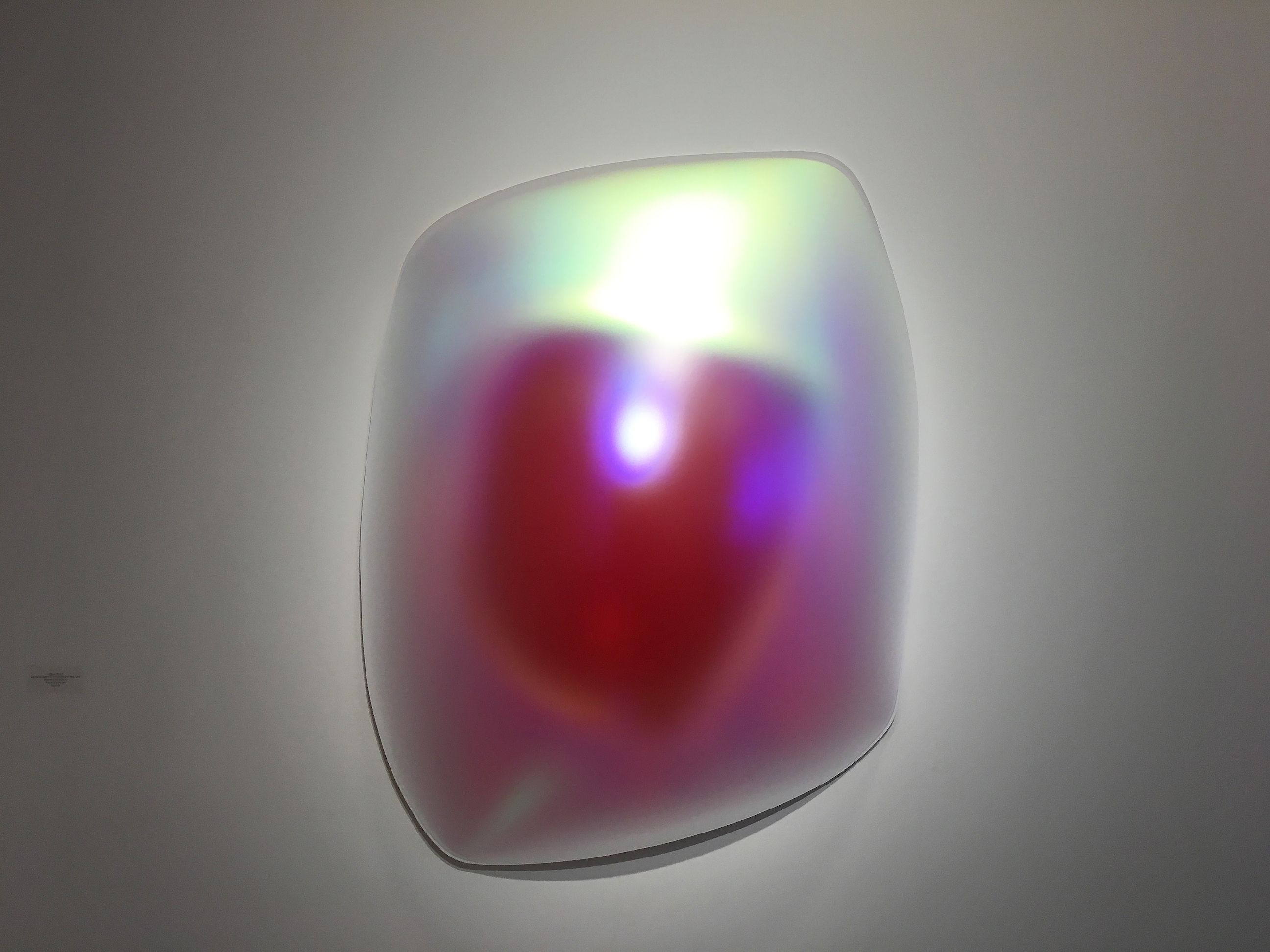
Gisela Colon, Skewed Square Glo-Pod, 2013, Blow-Molded Acrylic, 60 x 42 x 12″

On the other end of the abstract spectrum is the work of Gisela Colon, raised in Puerto Rico where she completed her undergraduate work at the University of Puerto Rico, and her JD from Southwestern University of Law, in Los Angles where she now resides. Her earlier work was acrylic over wood constructions, painted with an automotive lacquer, but here in this piece at the David Klein Gallery Irregular Rectangle Glo-Pod she has turned to the technique of blow-molding that uses sheets of colored acrylic. She calls that and subsequent pieces made without the use of paint ‘Glo-Pods’ due to what she deemed “a breakthrough in my use of materials that generated an internal self-generated glo without the use of paint.”Her work has been connected to the work of west coast artists interested in the properties of light and the nature of perception. To this writer, these sculptural objects have a focus that draws on the writings by Donald Judd and Robert Irwin from the 1960s. These ideas may have set up this minimalist approach to creating objects as sculptural reliefs using properties of light, technological elements and reductive forms that, in this case, attach themselves to the wall. The non-specific objects hover between painting a sculpture where light is emitted from within, creating a very contemporary piece of artwork designed to please.

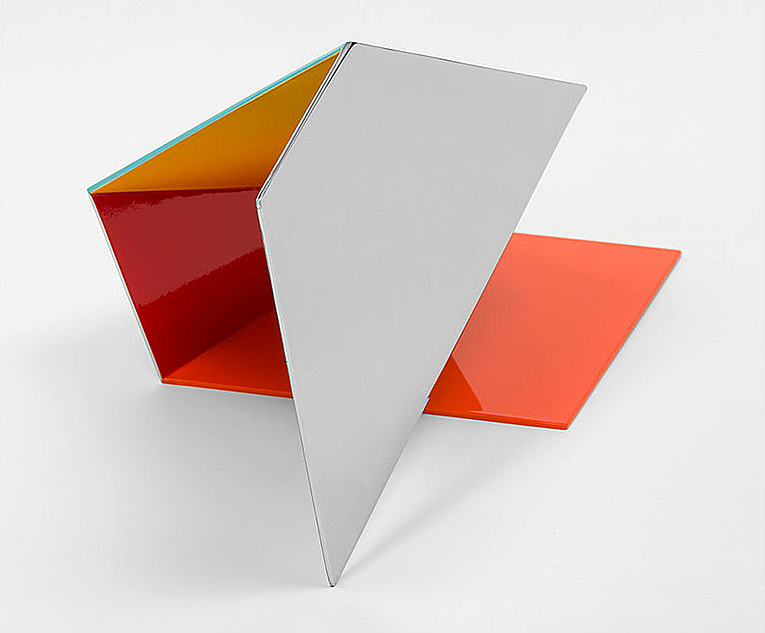
Brad Howe, Soft, 2016, Stainless Steel, Urethane, 12 x 24 x 9″

These abstract planes take me back to Tony Smith, allied with the minimalist school, where he worked with simple geometrical forms combined on a three-dimensional grid, creating drama through simplicity and scale. Created by artist Brad Howe, from Stanford University, these relatively small folds of stainless steel are impeccably constructed with effort and thought, providing simple form and color with attention drawn to their edges.

Howe says, “If we are to engage in the project of self-edification, the evolution of self, the enterprise is tied to our imagination. As Richard Rorty indicates, imagination is bound by our vocabulary, and it is in the growth of vocabulary we should focus. Vocabulary is tied to experience, and it is in energized moments of exposure to strangeness that our vocabulary expands. Encountering strangeness stretches and expands our self-image and seeds the rich potential for our collective conversations.”

Given the amount of concern that sculptors give to scale, these pieces feel like models waiting to be fabricated forty times larger than these tabletop sizes.

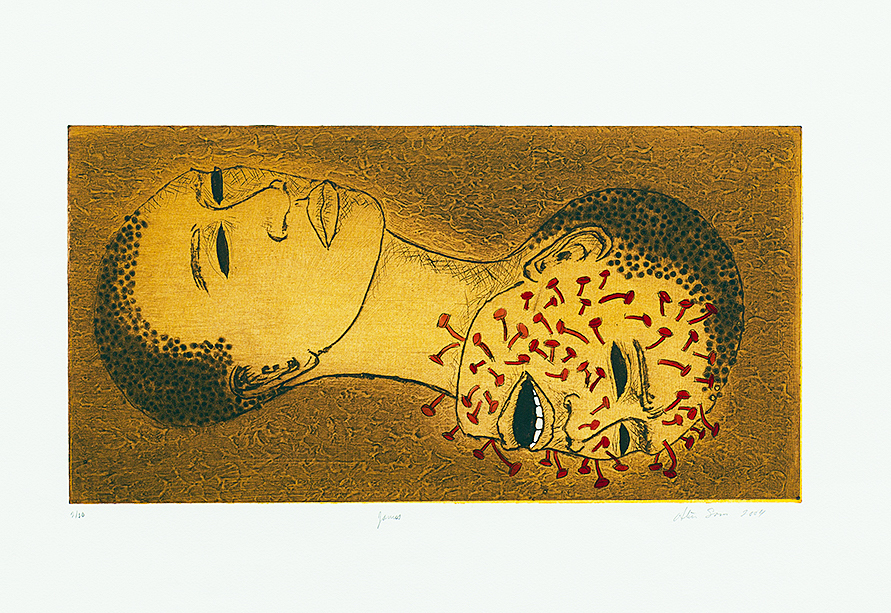
Alison Saar, Janus, 10/10, 2004, 10 x 19″

In its second gallery space, the David Klein Gallery provides an intimate collection of works on paper that includes lithographs, woodcuts and etchings. Of particular note is Alison Saar’s hand-tinted paper etching, Janus, that provides an image depicting the two worlds of the same woman, one existing in severe pain, the other in solitude. The expression may resonate with many people, women and men alike who find life to have its existence varied in a dichotomy of emotions. Saar says, “It was really poignant to me, this idea that a work of art could, somehow, turn a page, or shed a light, or lead back to a source. And that’s one of the things that’s exciting about being an artist; that your work threads people to other places, and not necessarily in straight lines.”

A native of Los Angles, Alison Saar’s work is primarily figurative, often female, in various emotional states or physical expressiveness. She seems to find symbolic richness in found objects, often with a narrative that offers a metaphoric view of life’s possibilities.

The David Klein Gallery has a long history of representing a collection of Detroit artists living and working in the Detroit Metro area. In contrast, On the Road: American Abstraction, Christine Schefman, Director of Contemporary Art, draws on artists who are represented by galleries from New York to Los Angeles, providing thought on some new experience and provoking exposure to the Detroit art community.

David Klein Gallery   March 19 – April 22, 2017


Page 39 of 51

Powered by WordPress & Theme by Anders Norén