Detroit Art Review

Critical art reviews of Detroit galleries and museums weekly

Full Circle: James Benjamin Franklin @ Cranbrook Art Museum

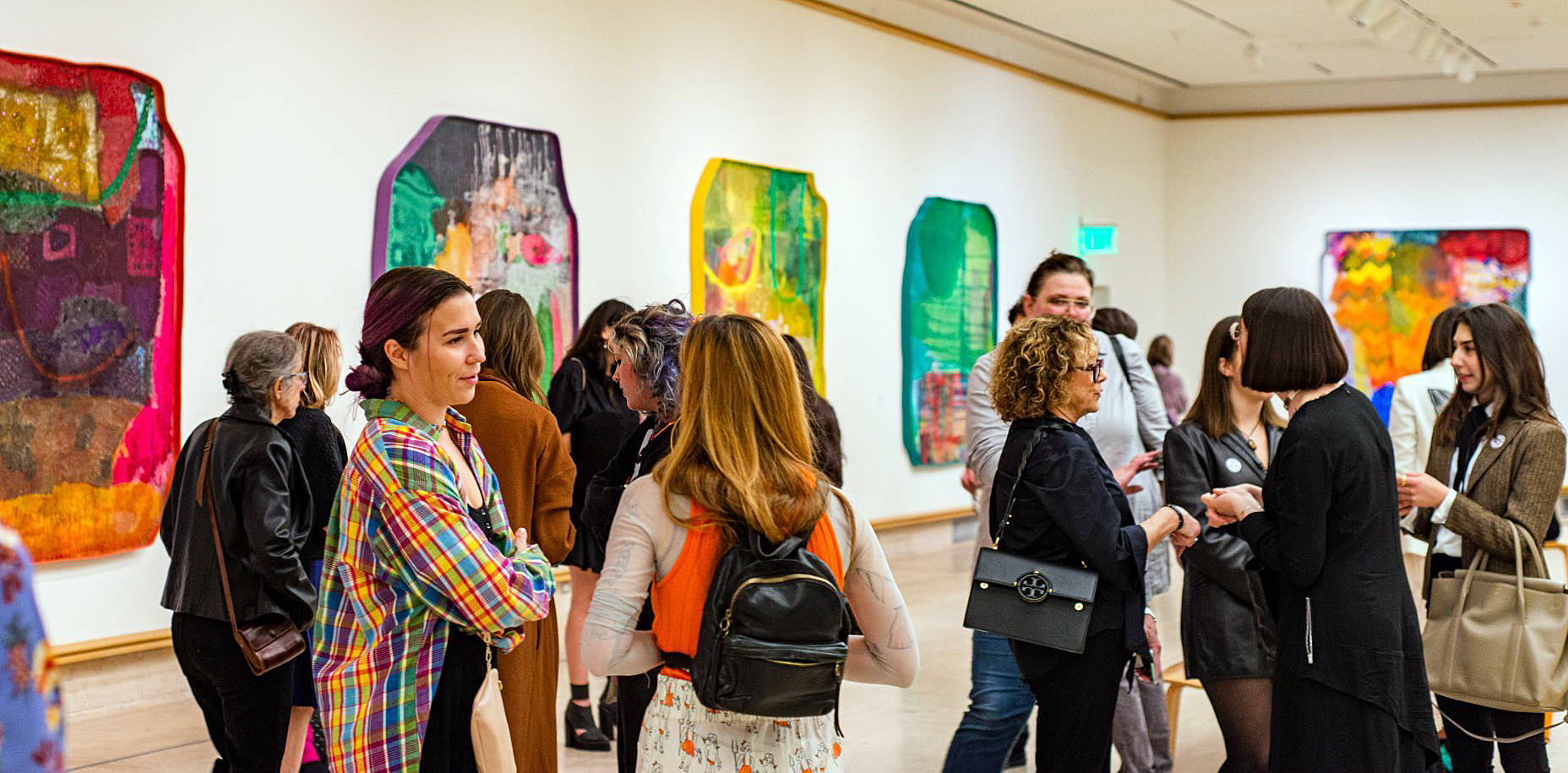
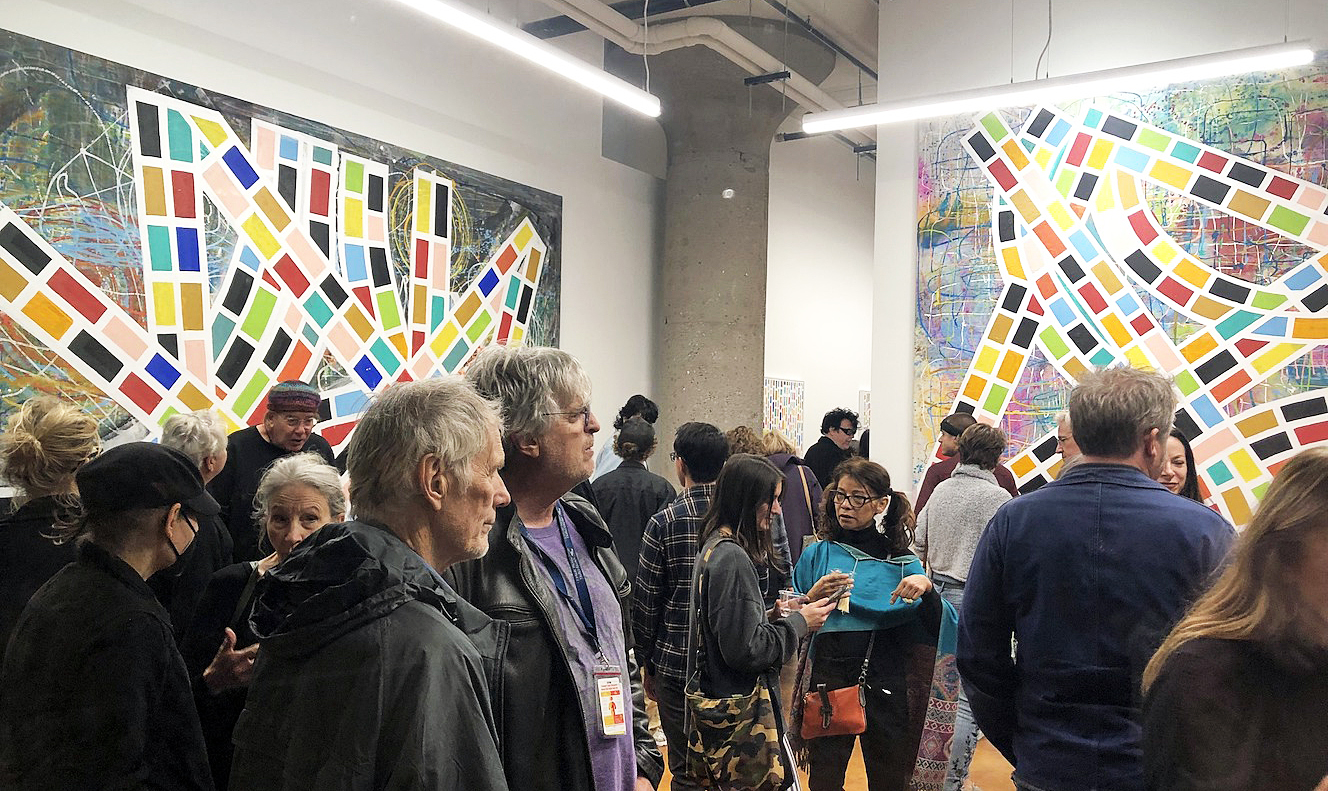
Installation Cranbrook Art Museum, James Benjamin Franklin, Full Circle, 2022

In the color-saturated, exuberant and irregularly shaped paintings of James Benjamin Franklin’s solo show Full Circle, humble and often degraded fiber elements of domestic detritus are transformed by all means necessary into improbably beautiful contrivances for seeing and being. With this exhibition of 11 recent artworks, on view until March 19, 2023 at the Cranbrook Art Museum,  he has returned—full circle–to the campus where he earned an MFA in 2017 for his first solo museum show. A West Coast native now living and working in Detroit, Franklin has absorbed the influence of the city’s surfaces and structures and has now transformed those raw materials into a lush visual feast.

Aim, 2022, acrylic, fabric, plaster, sand, epoxy on extruded polystyrene, 82.5” x 79” x 3.25 photo: K.A. Letts

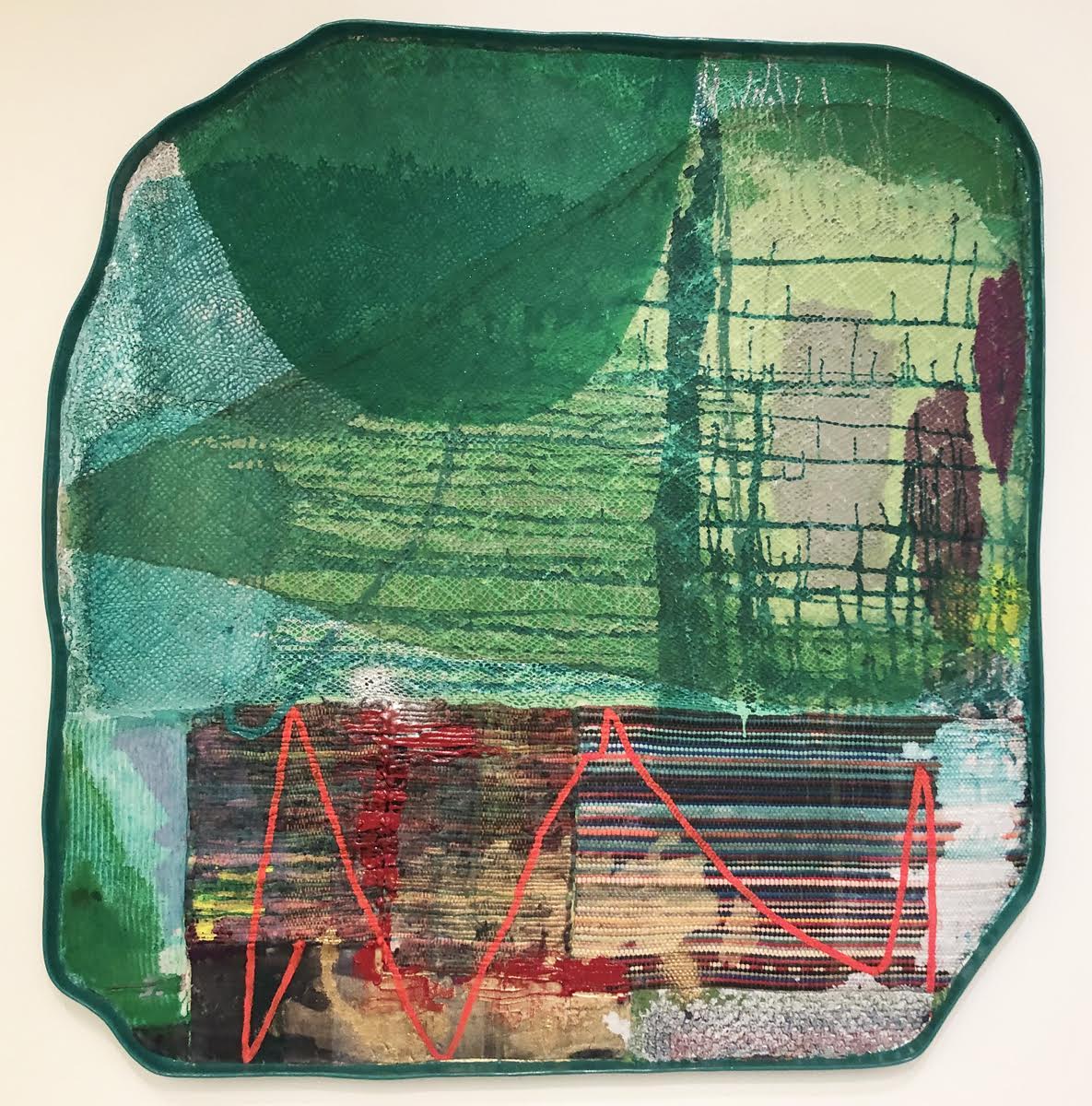
The paradox at the center of Franklin’s art practice is that he achieves these sumptuous effects while using the humblest of lowbrow materials. The artist creates his own eccentrically configured grounds from extruded epoxy and foam core, a process that takes several days and yields a flat shallow receptacle with raised edges. It’s a fictive playground of sorts for his highly idiosyncratic painted inventions. Into this sandbox-sized tray go thrift store fabrics, IKEA finds, blankets, bits of carpet, rugs and bathmats that form the underlying physical basis for the paintings. He also seems to have a particular affinity for crocheted afghans, lace doilies and other hand-crafted bric-a-brac. Next comes the audacious improvisational application of paint and glitter and sand and plaster in color combinations that vary considerably from artwork to artwork.

The resulting paintings balance esthetic refinement with the effect of a precocious child’s craft project. It’s evident that this is fully intended. “I needed to achieve the playfulness which was sitting at the back of my head,” Franklin said in a recent interview with Bomb magazine. “I want to get lost and get a sense of either joy or mystery in the work and all the materials that are used and just kind of all the things that are unexpected and surprising.”  Franklin credits the gritty urban environment of Detroit and a certain local DIY mentality for inspiration and he specifically cites the influence of the Dabls Mbad African Bead Museum.

We have the sense that as the artist continues to explore his improvised methods, he has become more confident in the capacity of his materials to convey the intended effect.  The paintings have become diaphanous and translucent, and the constituent parts are allowed to retain their identity while contributing to Franklin’s overall project.

Rise, 2022, acrylic, fabric, plaster, sand, glitter, and epoxy on extruded polystyrene, 5” x 79” x 3.25” photo: K.A. Letts

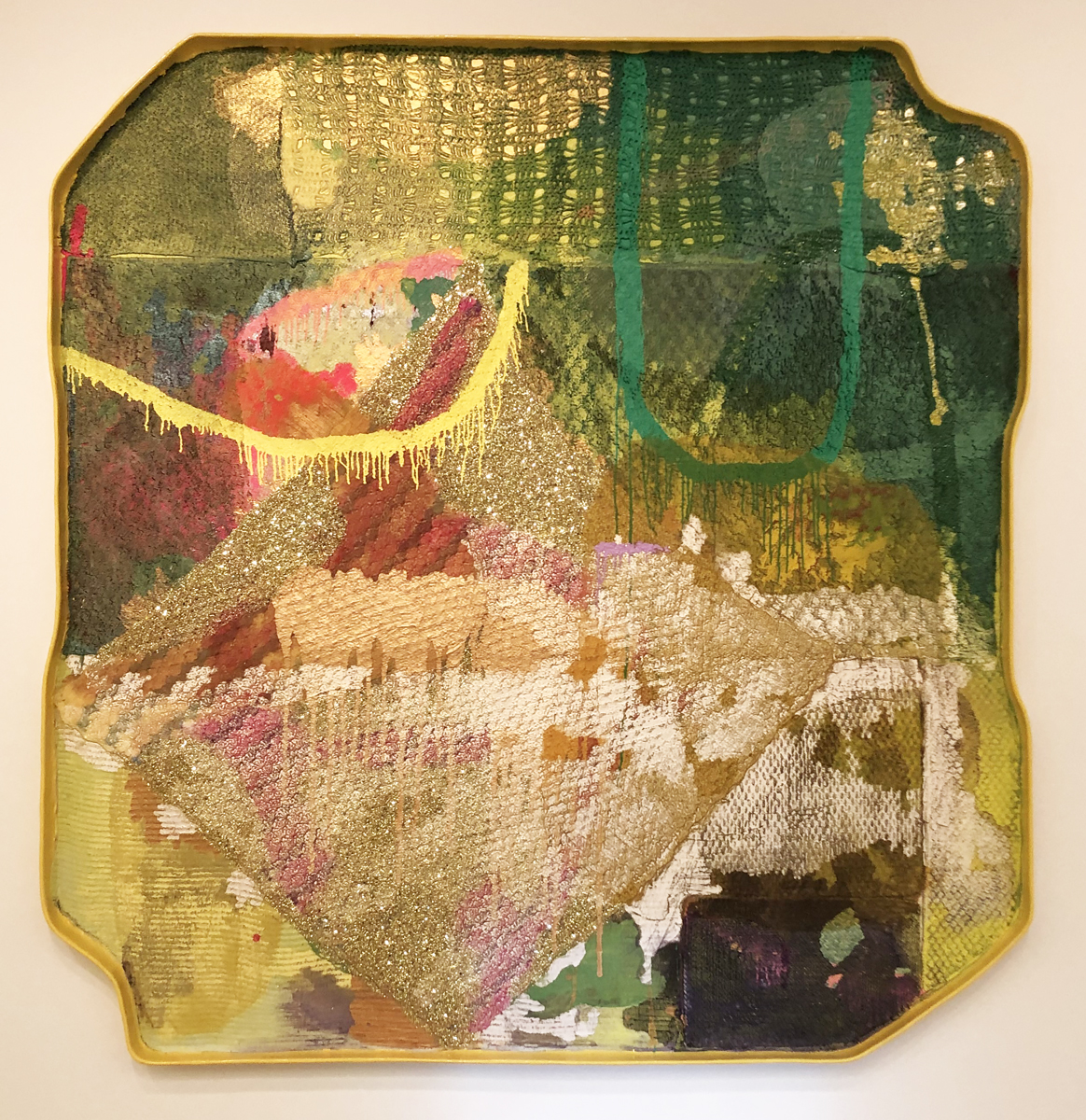
This is an artist who is willing to take risks, to experiment, and to trust his process and his vision. His painting, Rise, is emblematic of this self confidence.  Franklin depends on the physical roughness of the dimensional lacy fabrics to provide the formal substructure for a particularly offbeat composition. Dominated by the diamond shape in the lower, slightly left-of-center quadrant of the painting, Franklin softens its intrusive presence with varied shades of acid yellows and muddy pinks, plus a judicious sprinkling of metallic glitter. He has changed the orientation of the tray throughout the creative process, sometimes using gravity to move the paint and in other instances allowing the colors to puddle. Swooping yellow and green linear curves at the top quarter of the composition allow the irregular movement of the exterior shape to make inroads.  The spidery lace patterning at the top of the painting comes to the perceptual foreground while other elements are submerged by inchoate blobs of pigment. There is nothing programmatic; this process feels entirely intuitive.

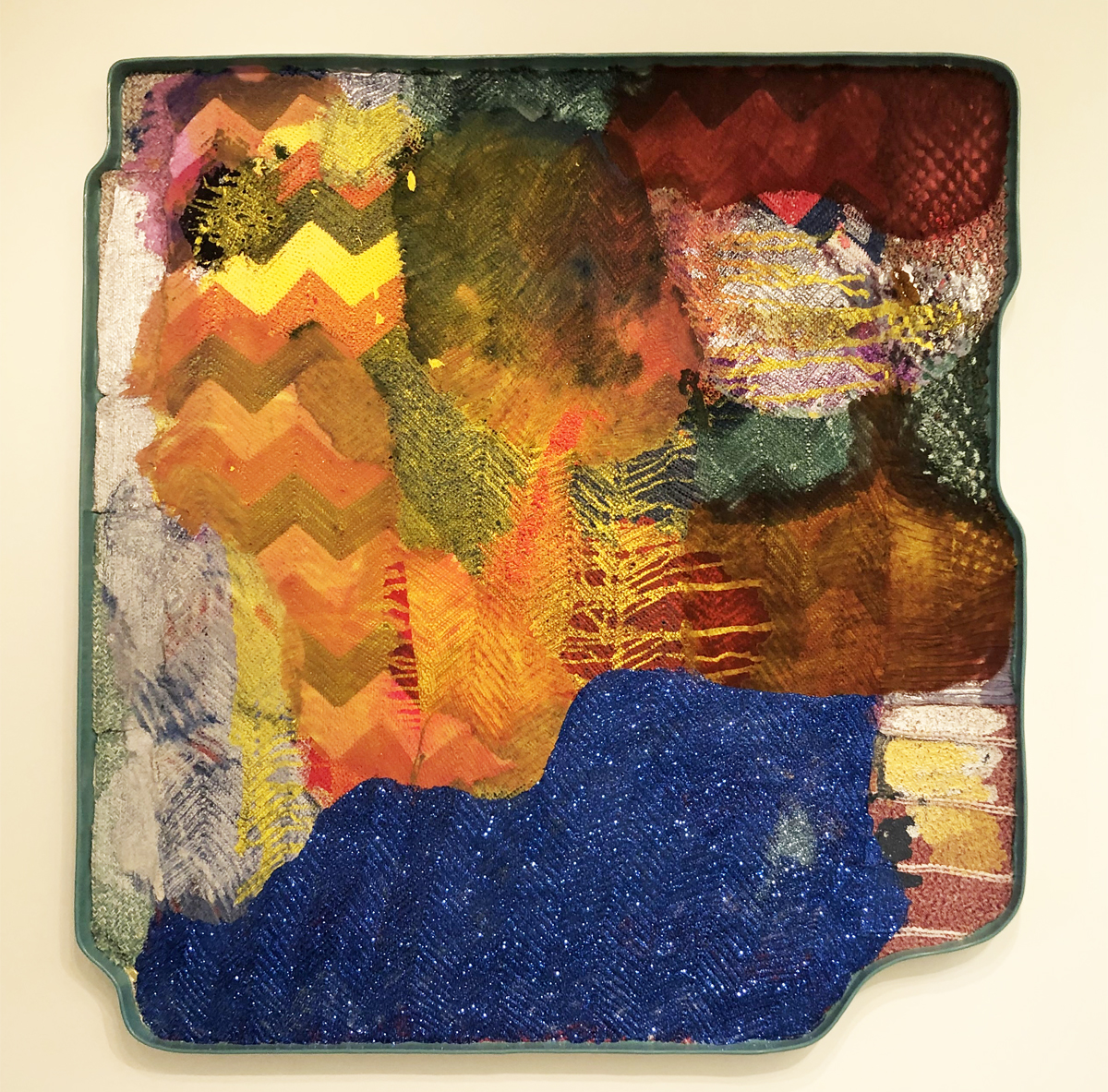
Every visitor will have their own favorites among the paintings in this exhibition.  I was particularly charmed by his painting Be, where Franklin has allowed the native colors of the yellow and orange 1970s zigzag afghan at the top of the picture to participate in the interplay of the constituent elements, while sunny lines created by dry brushing carry an implied landscape across the imaginary horizon. Thickly applied blue glitter makes a starry lake at the bottom of painting. The whole thing seems both incredible and inevitable.

Be, 2022, acrylic, fabric, sand, glitter, epoxy on extruded polystyrene, 82.25” x 80” x 3.25” photo: K.A. Letts

Of course, this level of risk-taking can go wrong, and in Accord, Franklin’s experimentation with framed voids in the interior of the painting seem, to me at least, to be unsuccessful, as they stop the flow of the composition at awkward points. But Franklin’s chance-y explorations more often meet with consistent, lightning-in-a-bottle success.

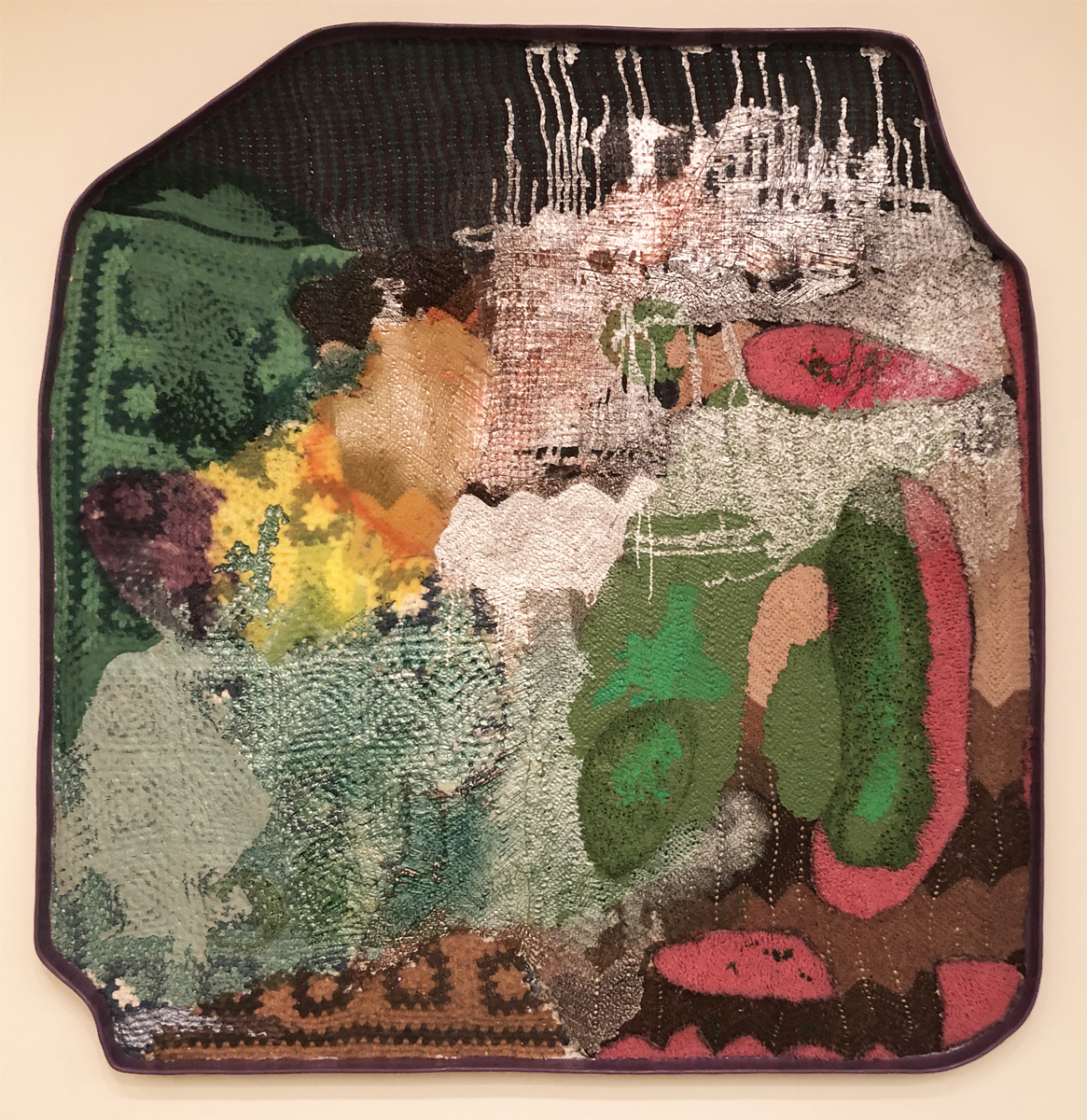
Every painting in Full Circle has its own idiosyncrasies and difficult-to-quantify virtues, as well as its own internal color-logic. They share procedural and material elements, but through careful examination, we discover that each artwork represents a singular dialog between the artist’s imagination and his medium. There is a courting of potential surprise–and even disaster–in each one, yet time after time Franklin successfully produces exhilarating paintings that surprise and delight.

Retain, 2022, acrylic fabric, plaster, sand and epoxy on extruded polystyrene photo: K.A. Letts

Full Circle: James Benjamin Franklin @ Cranbrook Art Museum, through March 19, 2023

[adrotate group=”2″]

Robert Sestok @ Simone DeSousa

Installation view of Robert Sestok: Space and Time at Detroit’s Simone DeSousa Gallery through Dec. 17.

Many Detroiters may associate Cass Corridor veteran Robert Sestok most with his towering steel assemblages, simultaneously daunting and mesmerizing, found around downtown and Midtown as well as at his City Sculpture Park. But with Robert Sestok: Space and Time at the Simone DeSousa Gallery, the 2017 Kresge Artist Fellow reminds us that in addition to being a large-form sculptor, he’s also an adroit painter perfectly willing to break form and startle his audience.

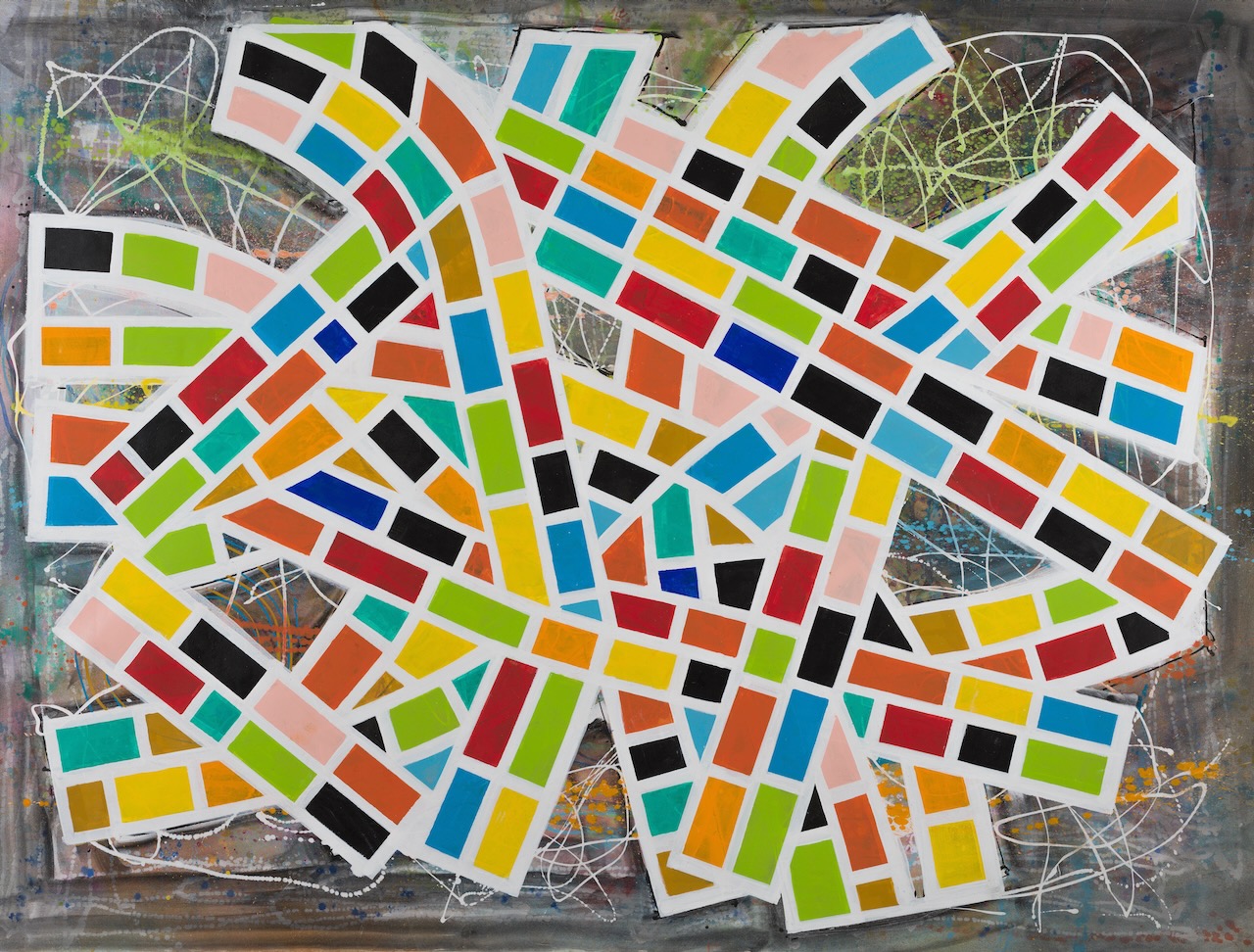
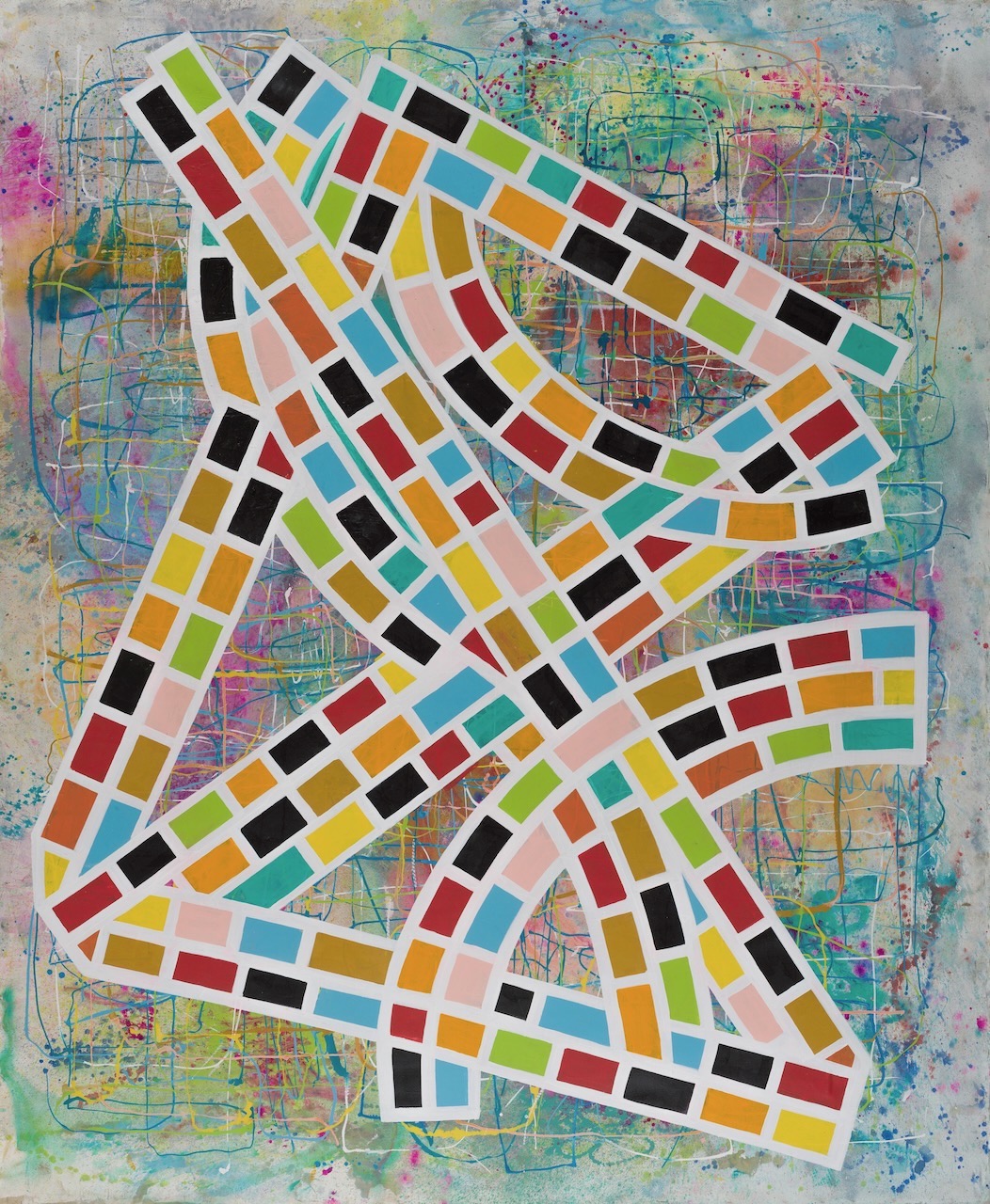
Space and Time, up through Dec. 17, speaks to both talents. Your first impression on entering might be one of technicolor roadmaps, given the belts of strongly colored “brick paths” barreling across the three Origins canvases in the first gallery. It’s all a bit hallucinogenic. Picture the Yellow Brick Road on acid and you’re halfway there. Contributing to the visual drama is that these are big pieces – in the neighborhood of 11 feet by nine feet – and our view is seemingly from high above, as if peering down on three incredibly complex, colorful LA freeway interchanges superimposed on gray backgrounds covered with thin, dreamy dribblings of paint.

Robert Sestok, Origin #3, 2022, Acrylic on canvas, 108 x 144 x 2 inches. (Courtesy Simone DeSousa Gallery.)

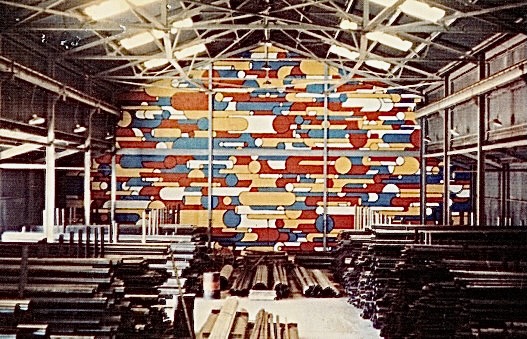
“This work reaches back to my early murals at the Duffy Company,” Sestok said, referring to the interior and exterior murals he created in 1971 at the behest of James Duffy, the collector and art patron who owned the warehouse at West Jefferson and Junction that housed his family’s steel-pipe business. (Duffy would later bequeath his outstanding Cass Corridor collection to Wayne State University.)

“When you walked in,” Sestok said of the warehouse, now leveled for the Gordy Howe International Bridge to Canada, “you’d see this huge pile of heavy steel pipes — and down the wall you’d see a mural of the pipes floating in space.”

The floating pipes were painted on concrete-block walls, and Sestok used the horizontal grout lines as a sort of hard-edged framing device for his lyrical circles. And there you can see the genesis, perhaps, of the bold linear stripes in Origins, underlining the artist’s habit of circling back to work made decades ago, pulling out old ideas and making them new again.

“I kind of shocked myself,” Sestok said. “I didn’t realize at first I was repeating something I’d done a long time ago. It just came out of me.”

Interior of the former Edward W. Duffy Co. steel-pipe warehouse near Fort Wayne, with Robert Sestok’s 1971 mural on the far wall. (Courtesy of the artist)

Sestok, who grew up in Birmingham, got his very first Detroit studio in 1967 with Gordon Newton in the Old Convention Hall near Wayne State University, a building that also housed other Corridor artists like John Egner, Michael Luchs, Brenda Goodman and Jim Chatelain. For his part, Sestok quickly developed a reputation for productivity – or, as critic Dennis A. Nawrocki’s put it in Essay’d, “the prime protagonist of the indefatigable do-it-yourself Detroit work ethic.”

(A good example of that ethic is Sestok’s one-man City Sculpture Park with about 30 works that went up in 2015 at the John Lodge Freeway Service Drive North and Alexandrine in Detroit, and came down in 2020. It was a striking gift to the city; those who’ve mourned its disappearance will be happy to learn that it’s been relocated a couple miles away to 3573 Farnsworth, just west of Mt. Elliott.)

Playing the role of midwife to the Cass Corridor movement was the formerly depressed neighborhood along Cass Avenue south of Wayne State – the sort of urban streetscape in the Sixties and Seventies where nervous suburbanites punched the gas pedal. In those years, the Corridor attracted dozens of young, artistic rebels with a collective attraction towards the gritty and the raw, and a bent for exploiting the city’s treasure trove of industrial detritus.

In spotlighting the work of this rowdy cohort, the movement’s principal exhibition space – the  Willis Gallery (where Avalon International Breads is today) — drew serious attention from Sam Wagstaff, curator of contemporary art at the Detroit Institute of Arts, as well as coastal art elites, who started paying attention to the Motor City for the first time in decades. (Indeed, there are some, Sestok included, who argue the Corridor represents the only actual artistic movement the city’s ever generated.)

“The art was kind of fast and furious,” Sestok told The Detroit News in an interview 10 years ago, “with people in competition with each other to get their work in the gallery and have a show. It was an exciting time.”


Robert Sestok, Origin #1, 2022 Acrylic on canvas 132 x 111 x 2 inches. (Courtesy Simone DeSousa Gallery)

 “Fast and furious” isn’t a bad description for Origins Nos. 1-3, cited above, all of which are three-step constructions. First Sestok poured and pushed (in some cases with a leaf-blower) thick gray paint to form the substructure, with a second layer of colorful, whimsical dribblings enlivening the surface. On top of that composition, and blotting out most of it, he laid down the severe, multicolored geometric pathways.

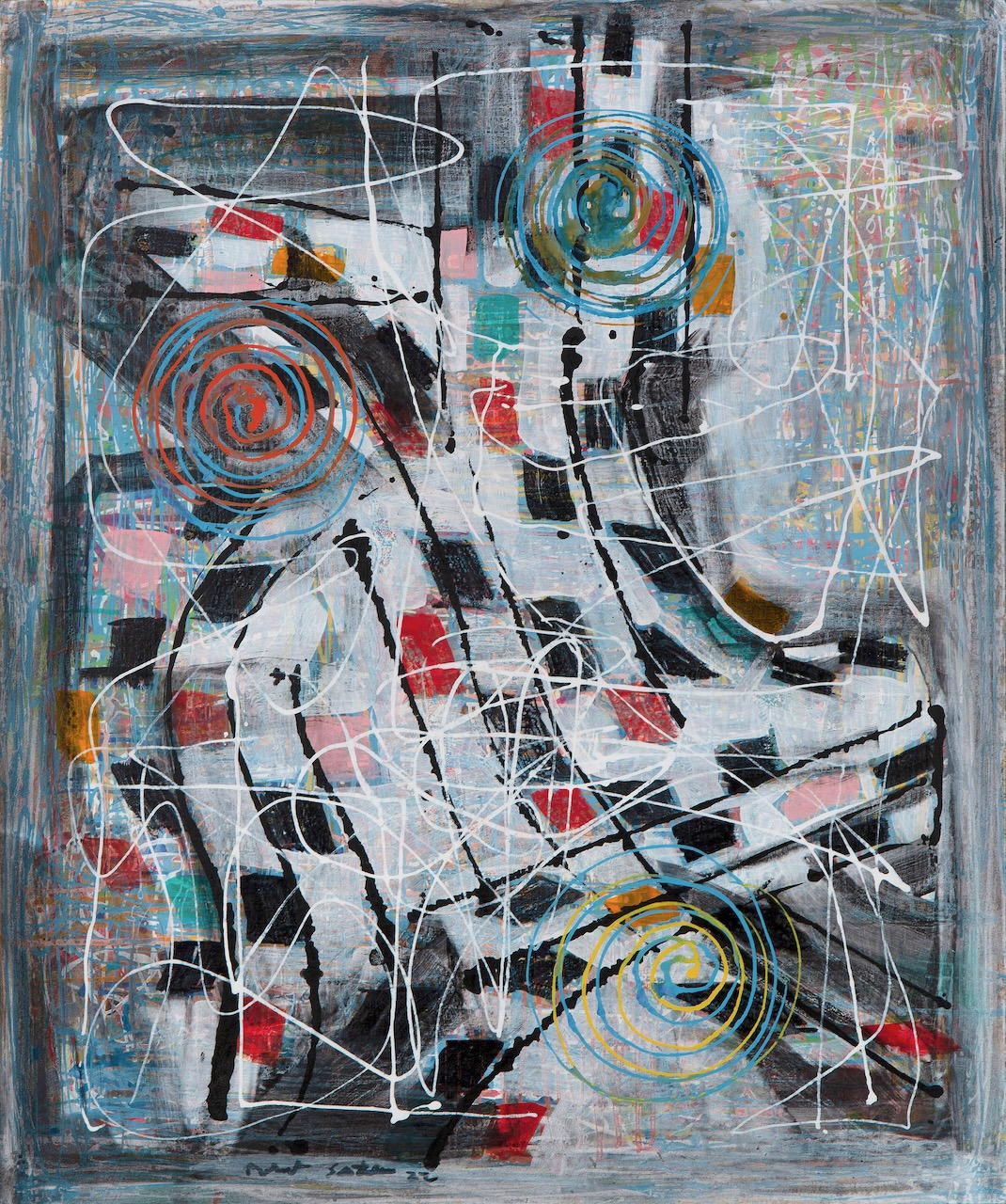
Intriguingly, the simply titled Origin in the gallery’s back room inverts this hierarchy. Here the geometric checkerboard is overlaid with thin, circular vortices and a drizzled white line that meanders, taking its time, all across the canvas. In some ways it’d be interesting to see Origin installed between two of the front-room pieces, rather than segregating it. The contrast in aesthetics, and the clear inversion in design, would be bracing.

Robert Sestok, Origin, 2022 Acrylic on canvas, 63 x 53 x 2 inches. (Courtesy Simone DeSousa Gallery)

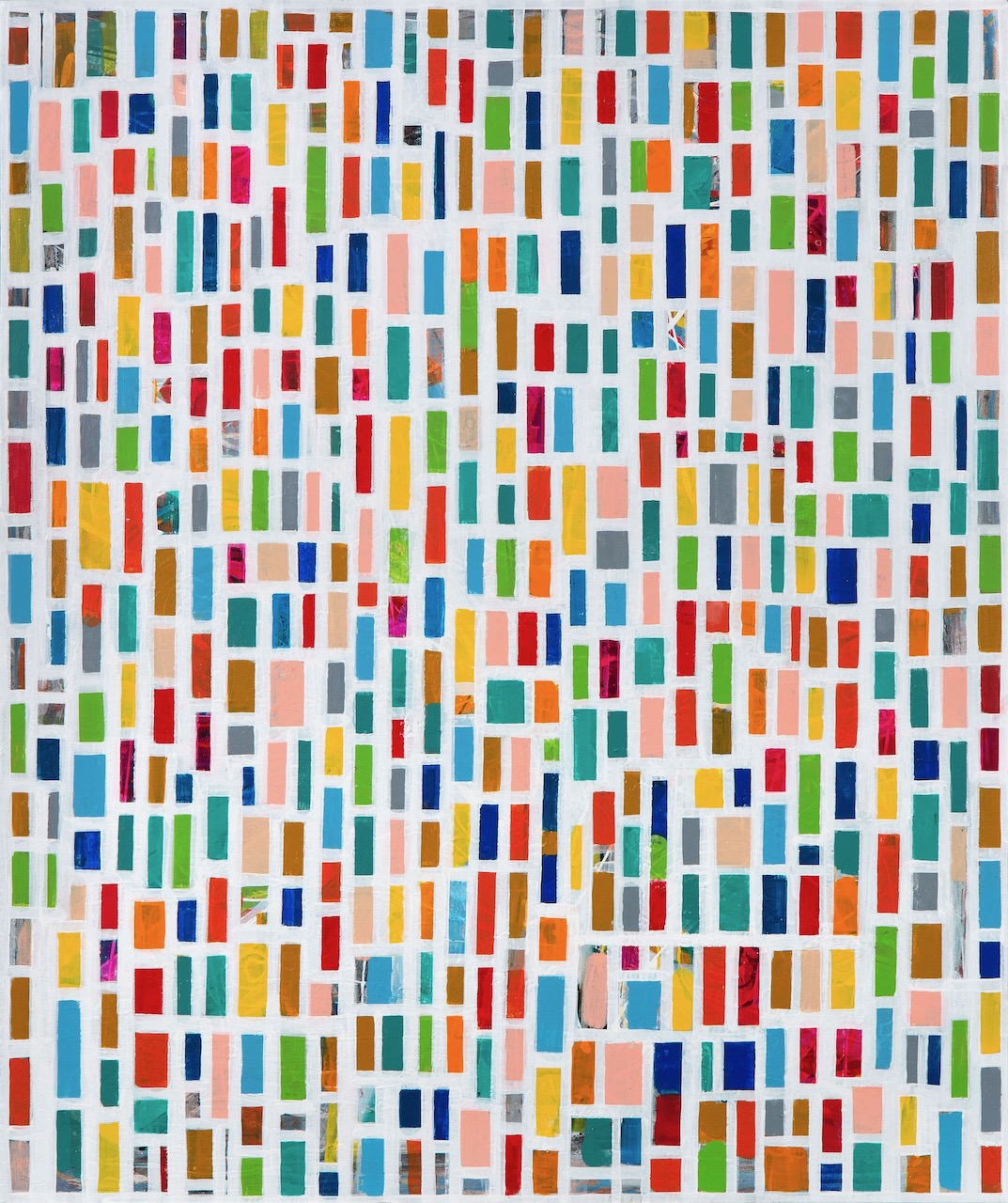
 Completing the show are several works, somewhat smaller than the exclamation points in the first gallery, that also lean heavily on geometry, but in a completely different fashion. Origins Nos. 4-6 feature something like gridworks of colored squares and rectangles – sharp and exact, as if cut into the white backgrounds with an X-Acto knife.

They are, it must be said, in many ways quite beautiful. “Yeah,” said Sestok, “if you can get away from the wallpaper idea.”

Robert Sestok, Origin #6, 2022, Acrylic on canvas, 63 x 53 x 2 inches. (Courtesy Simone DeSousa Gallery)

 Robert Sestok: Space and Time will be up through Dec. 17 at Detroit’s Simone DeSousa Gallery.

[adrotate group=”2″]
Contribute to Detroit Art Review on Giving Tuesday 2022

Giving Tuesday is on November 29th, and the Detroit Art Review is excited to participate again this year. We hope you can join us!  Giving Tuesday has dedicated a day of generosity and giving. It is one day to acknowledge the collective power of giving as simple acts of kindness.

On Tuesday, November 29, 2022, please support the Detroit Art Review its purpose, publishing critical art reviews of museum and gallery exhibitions.    Make your own meaningful donation by way of a check to the Detroit Art Review Inc. and mail it to:  Ron Teachworth, 1300 Lafayette, Apt. 313, Detroit, MI 48207. (old school for now)  We are now a 501-C3 non-profit, EIN 81-1394001.  Print this and send it with your check.  We will provide a receipt.

Every donation helps the Detroit Art Review sustain our efforts to have a review site for the visual arts, spanning most of South Eastern Michigan.    Thank you for your consideration and support on Giving Tuesday.

[adrotate group=”2″]

Scott Hocking @ Cranbrook Art Museum

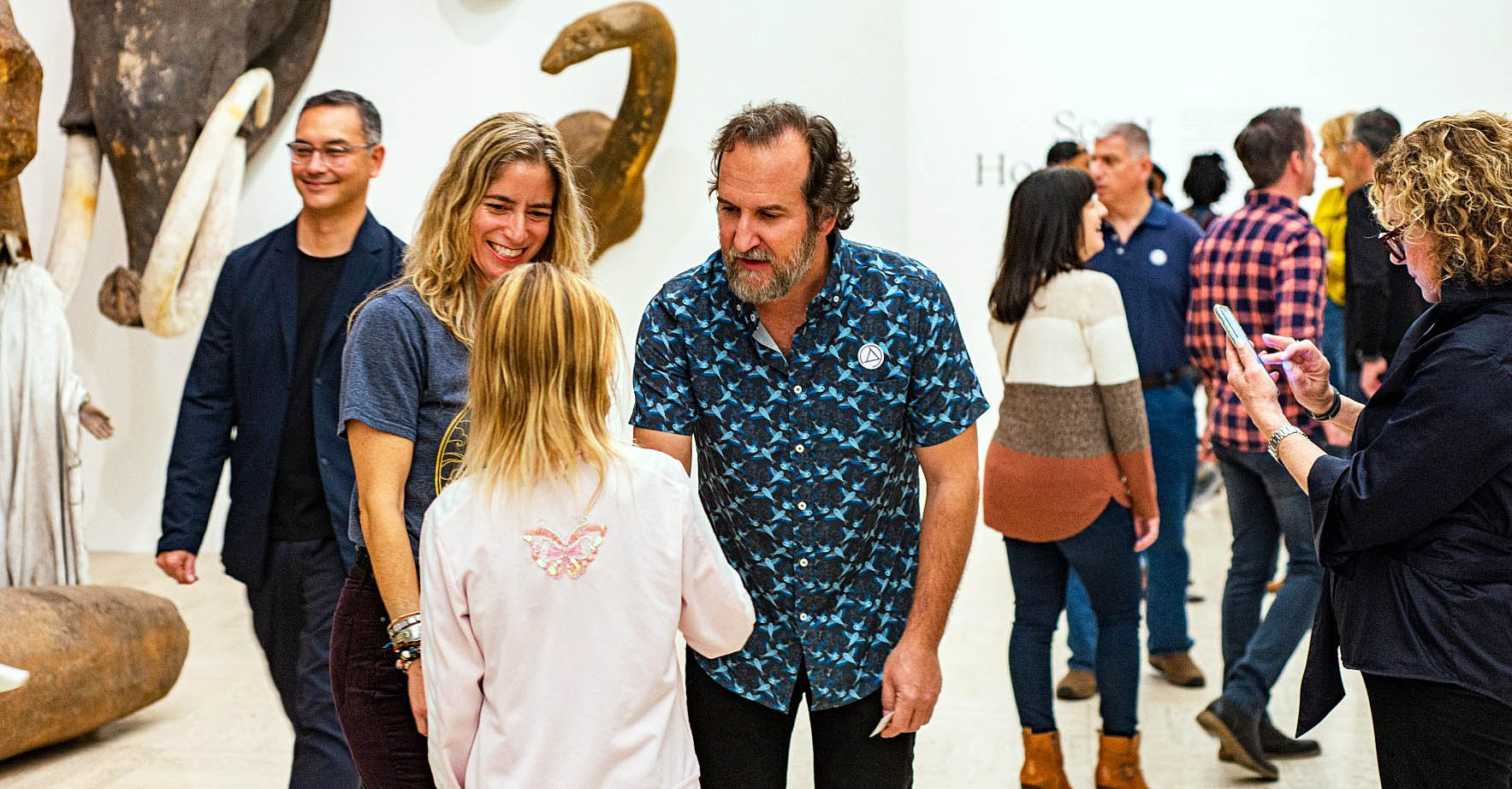
An installation view of Scott Hocking: Detroit Stories at the Cranbrook Art Museum. Detroit Stories is up through March 19, 2023.  Image courtesy of Cranbrook Art Museum

There was a time, not so long ago, when most suburbanites and even some Detroiters regarded our grand, dilapidated city as an embarrassment. It would take youngsters just out of college in the early 2000s, dazzled by the postwar-Berlin landscape and surfeit of abandoned buildings to explore, to start to write a different narrative that didn’t run away from the city’s blemishes, but celebrated the beauty to be found within our fabulous ruins.

Scott Hocking, a 40something working-class kid from Redford Township, was in the forefront of that cultural vanguard two decades back, and his early forays caught the attention of a nation accustomed to ignoring Detroit. Luckily for those unfamiliar with his work and those who love it alike, the Cranbrook Art Museum has just opened his first career retrospective, Scott Hocking: Detroit Stories, up through March 19, 2023.

After getting his degree at the College for Creative Studies, Hocking established himself as one Detroit’s most articulate storytellers, creating work that reminded the world that the Motor City, for all its problems, is a mythic place deeply rooted in the American consciousness.

Starting in 2008, Hocking – impoverished like many students after graduation – began working with that great Detroit resource, found objects, out of sheer necessity. They were about all he could afford. But unlike the gifted Cass Corridor artists from the 1970s and 80s, who plowed the same field, Hocking wasn’t just picking up junk and creating artful collage or 3-D pastiche. His ambitions were epic in scale, and it quickly became clear his was a unique voice in a city increasingly crowded with interesting artists.

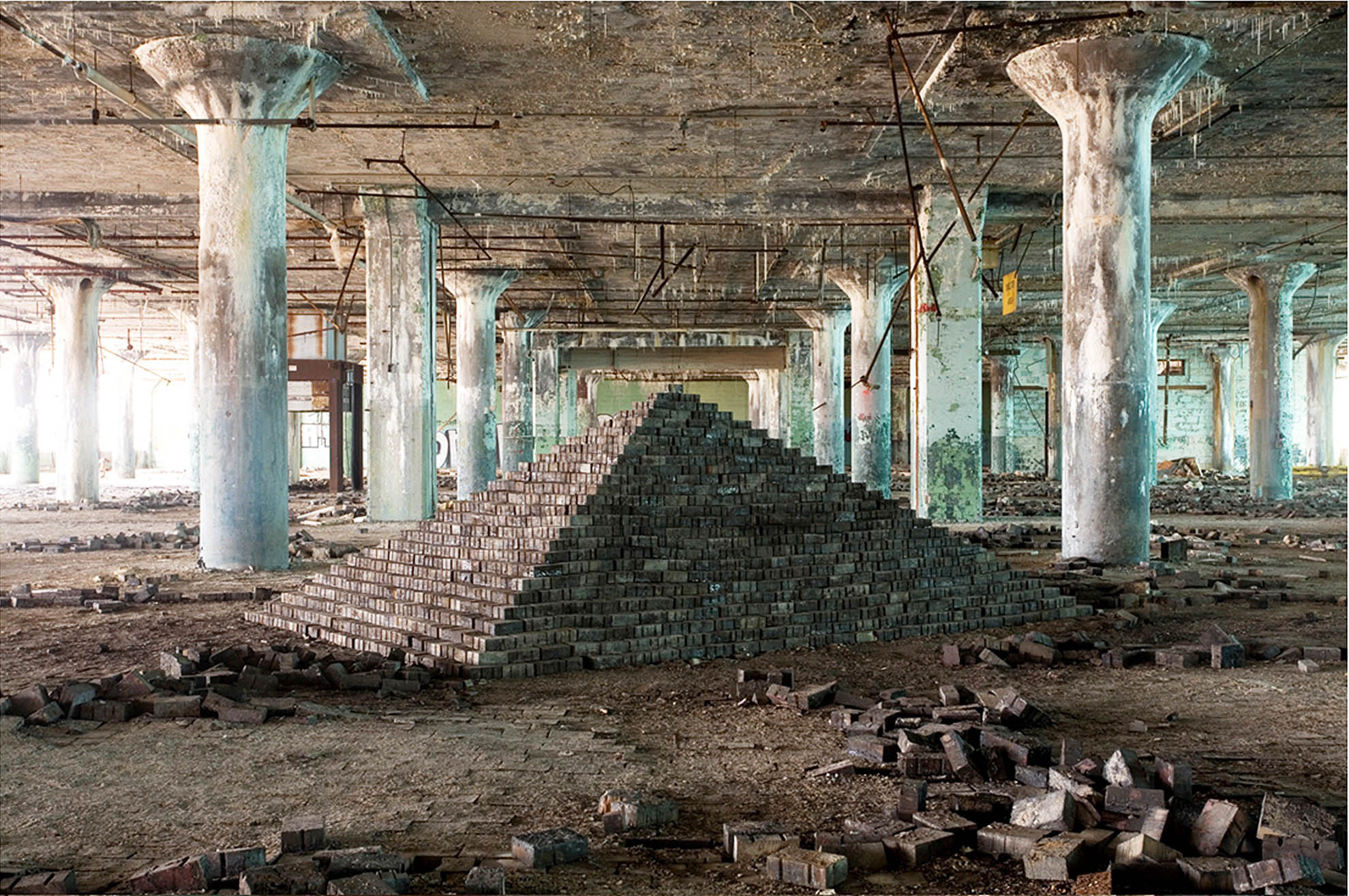
Scott Hocking, Ziggurat—East, Summer, 2008, installation view Fisher Body Plant 21, Detroit. Photo Courtesy of Scott Hocking and David Klein Gallery, Detroit.

Hocking’s first grand conceit lit up the art world like a meteor — and vanished almost as quickly. Collecting some 6,201 wooden “bricks” that paved the concrete floors of Fisher Body Plant 21, a crumbling auto factory near the east-side tangle of railroad tracks known as Milwaukee Junction, Hocking built, block by repetitive block, a majestic Ziggurat or stepped pyramid. Set in the dead center of a vast, rubble-strewn factory floor and framed by two rows of industrial “martini columns,” the massive structure looked, for all the world, like an artifact from a lost civilization. For pure sculptural drama, Ziggurat was unbeatable – mysterious and jaw-dropping all at the same time.

“I always try to explain the beauty I see in Detroit,” Hocking’s said, and it amounts to a sort of professional ethic. And indeed, his creations go a long ways toward accomplishing just that. For its part, Ziggurat quickly got national exposure. A photographer, Sean Hemmerle, rounded a corner while exploring the city’s industrial infrastructure and happened upon the monument unawares. In an interview with The Detroit News, he confessed it knocked him right off his feet. The picture he produced would end up running across a full page and a half in Time magazine as part of an essay on Detroit.

Unfortunately, Ziggurat had a short shelf life. In a development completely unrelated to the sculpture, the EPA bulldozed all the floors in Fisher Body Plant 21 to clear out toxic debris – including Hocking’s sober stepped pyramid. But it hardly matters. Also a talented photographer, he documents all his constructions so they live on long after they’ve degraded or disappeared.

It’s also worth noting, whether intentional or not, that Ziggurat works superbly at the symbolic level. Had Hocking erected a tombstone in a dead auto factory, it’d be a gesture both banal and trite. But a ziggurat, like the pyramids, is a funerary object — even if that’s not our first association upon seeing it. It’s the oblique nature of the reference that gave the doomed structure its pathos.

It has to be said that Hocking’s a veritable artistic polymath, with work ranging from the large-scale sculptures to installations to the haunting series, Detroit Nights, where he documents the dark city using available light. In the words of the show’s short introductory essay, Hocking – part archeologist and archivist – “[uncovers] layers of history, meaning and memory, with a historian’s sense of discovery and a writer’s craft of storytelling.”

Word to the wise: don’t miss his series of portraits of boats abandoned on Detroit streets.

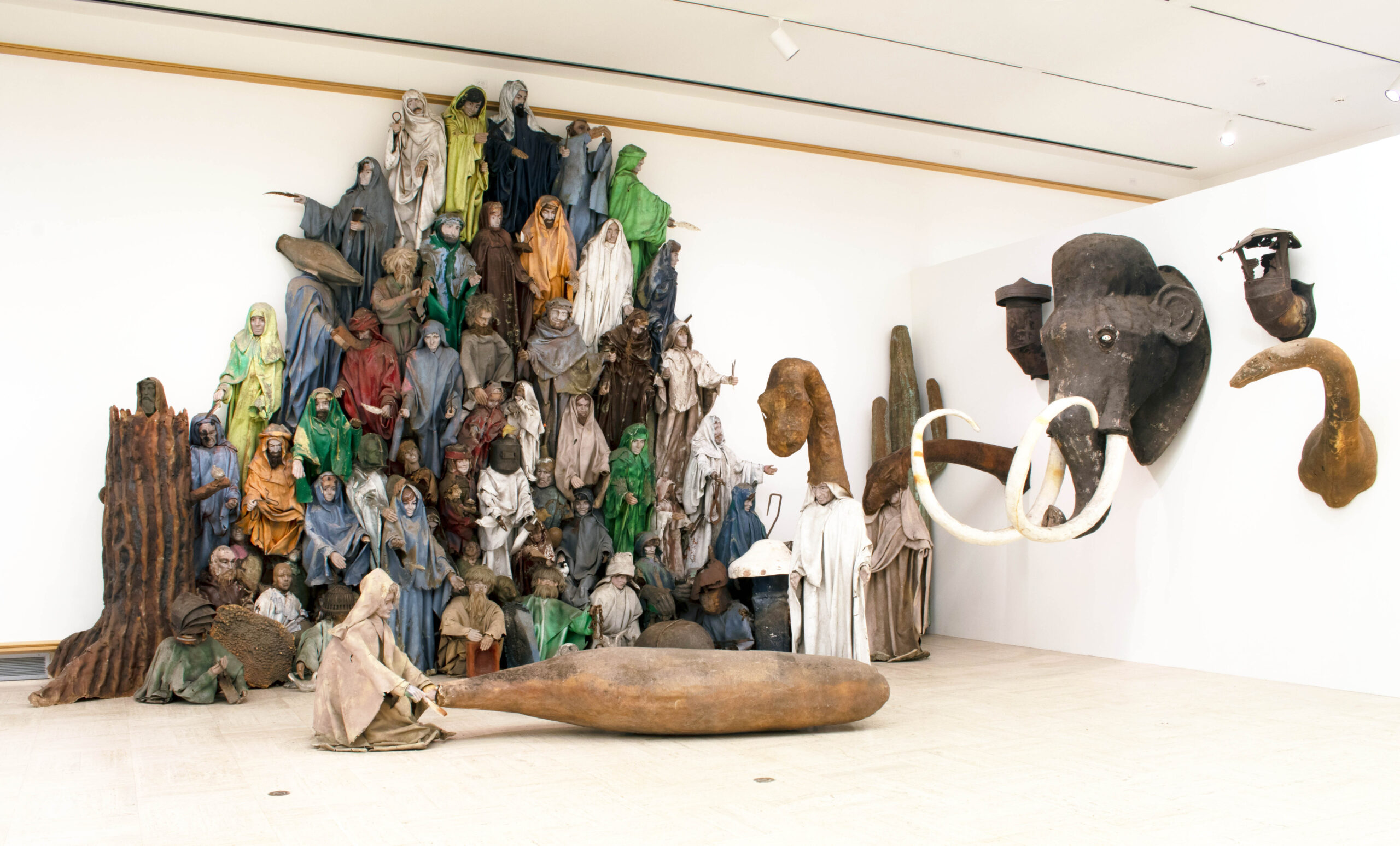
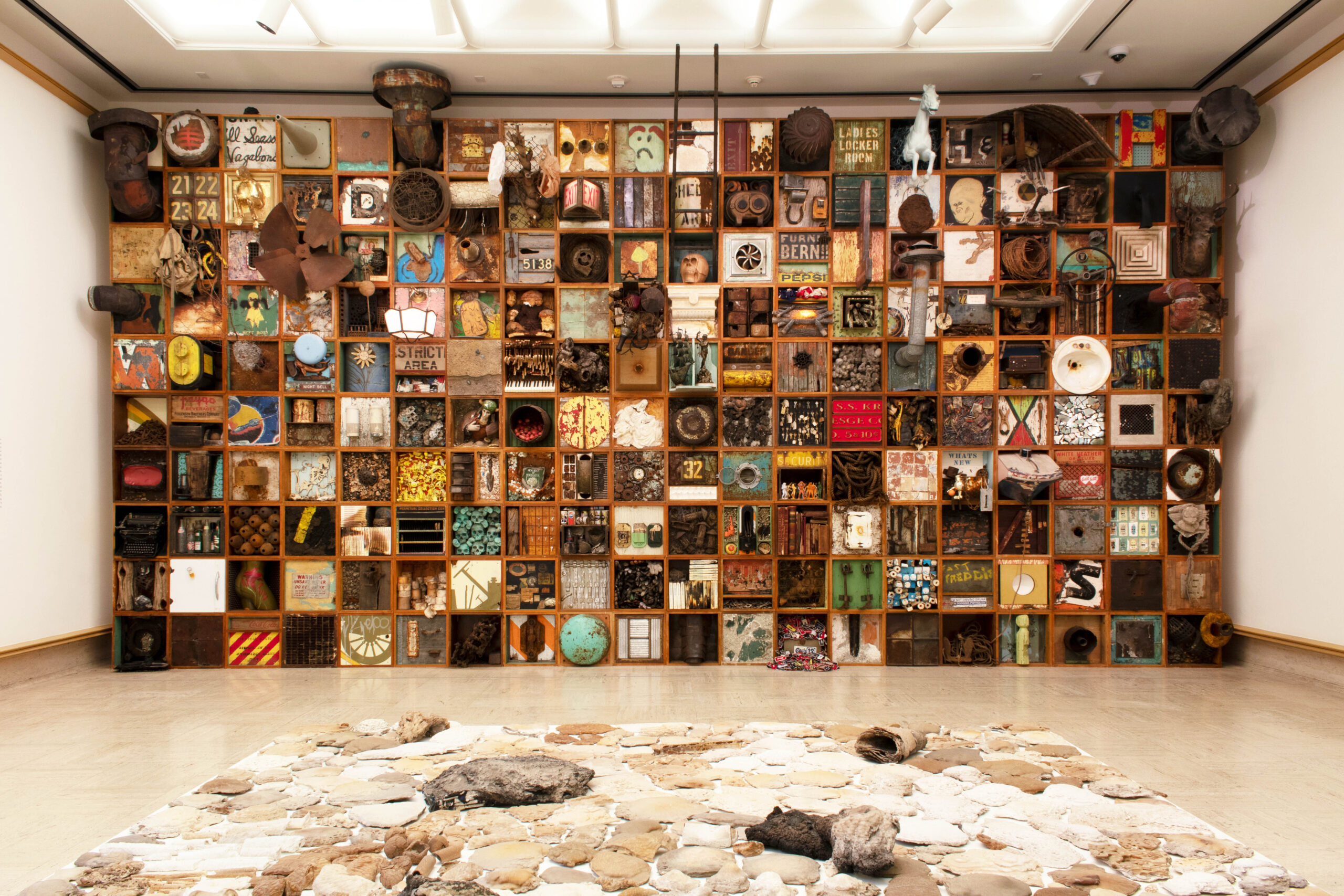
Scott Hocking, The Secrets of Nature, 2012 / 2014 / 2022, Fiberglas, wood paint, metal, concrete, various found objects, Courtesy of and David Klein Gallery, photo by deo Owensby.

One of the more striking assemblages on display, both funny and daunting, is the wall-sized Secrets of Nature. Here Hocking utilizes figurative artifacts, human and animal alike, found at what he calls “tourist traps and roadside attractions” – in particular, a clutch of Bible characters from the former Good Shepherd Scenic Gardens up north in Mancelona. The installation looms high above the viewer with dozens of saints and sinners peering down at you. The work’s got a weird depth. In the words of the accompanying label, Secrets focuses on “creation and destruction mythologies … and ancient prehistoric wisdom.”

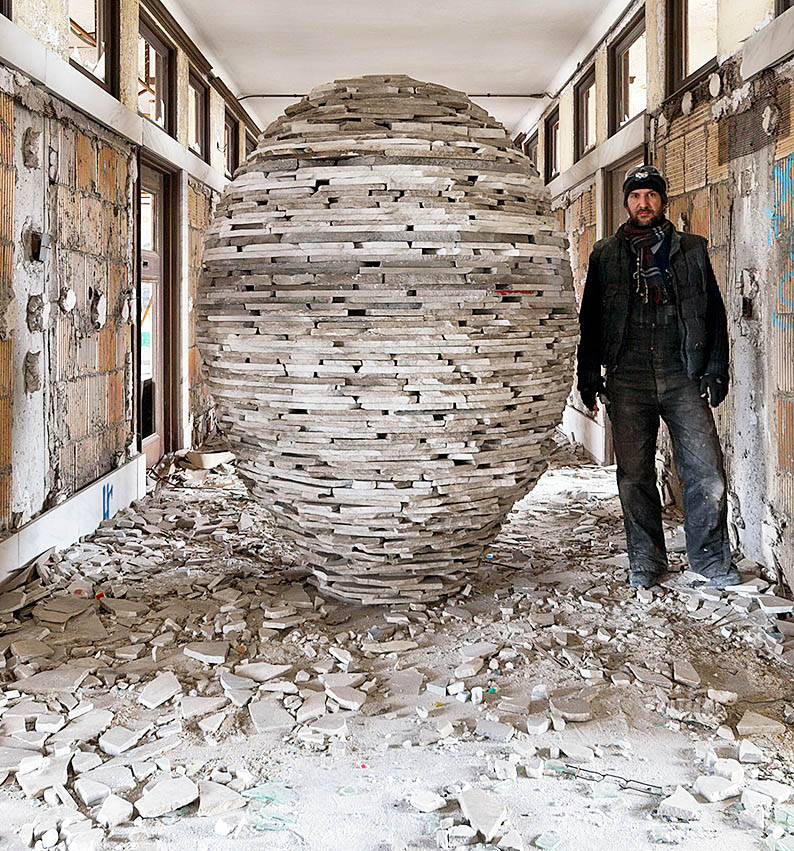
Scott Hocking with The Egg and the MCTS, 2012, Photo Scott Hocking; Courtesy the artist and David Klein Gallery.

Another of Hocking’s astonishing, large sculptures was The Egg in Detroit’s Michigan Central Station, the towering wreck on Michigan Avenue now being renovated by the Ford Motor Co. into high-tech office space — one of the most recognizable symbols of Detroit’s decline.

Using shattered pieces of marble that had cracked off the walls along one of the upper-story hallways after decades of freeze and thaw, Hocking painstakingly assembled thousands of shards to create a symmetrical ovoid sculpture that’s easily nine feet tall. The design has an almost Japanese aesthetic in its use of irregular, jagged elements — albeit all the same thickness – to produce something elegantly and breathtakingly symmetrical.

Workers doing asbestos removal before Ford acquired the depot helpfully suggested to Hocking that the egg’s weight might be too great for the floor. So they built a structural support system right below to prevent collapse.

The Egg reflects Hocking’s interest in geometric shapes, but as with Ziggurat, you can read something more into the design – in this case, birth and renewal rather than death.

Of course, this being Detroit, making art out of the city’s desolation exposes you to the charge of “ruin porn,” the cheap shot leveled most frequently at outsiders who can’t refrain from taking pictures of our astonishing dilapidation – like the French photographers and authors Romain Meffre and Yves Marchand, whose 2010 “The Ruins of Detroit” scandalized Michiganders but dazzled the world.

Cranbrook Art Museum Director Andrew Satake Blauvelt, who curated the show, isn’t buying the allegation. “In this case, Scott is from Detroit,” he said, creating actual art in these buildings, not merely gaping. “It’s not just depressing pictures that will go in a magazine,” Blauvelt said.  He points out that College for Creative Studies Prof. Michael Stone-Richards, who wrote an essay for the exhibition catalog, “also references the idea of ruins,” noting the fascination has a long history – indeed, going back to at least the 17th century, when Germans of means started traveling to Italy in search of the ancient and profound. “We go to Rome to venerate the ruins from past centuries,” Blauvelt said, because like Detroit, “they tell a story.”

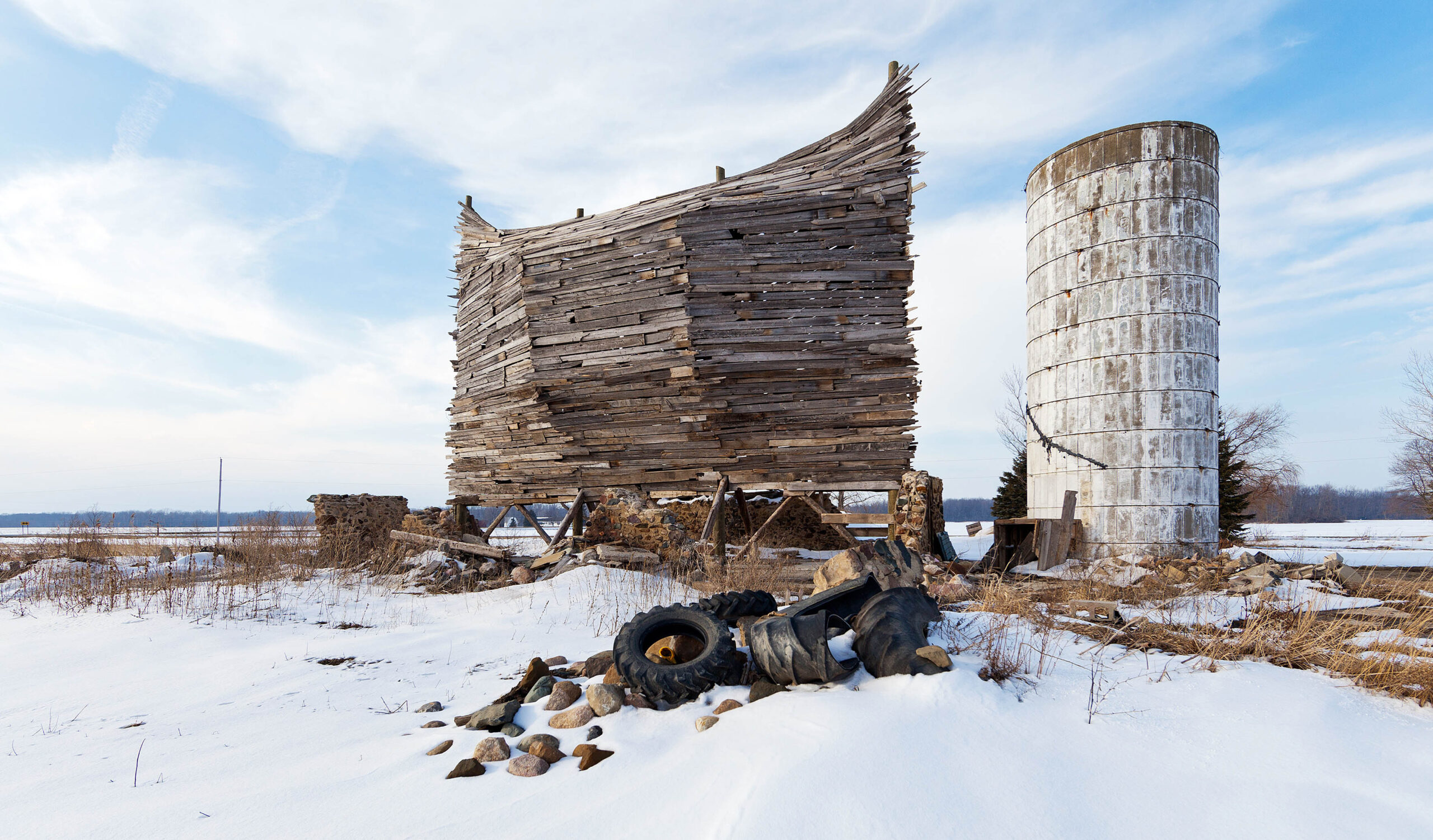
Scott Hocking, Celestial Ship of the North (Emergency Ark) AKA The Barnboat #0721, 2016, installation view, Port Austin, Michigan. Photo Courtesy of Scott Hocking and David Klein Gallery, Detroit.

Not all Hocking’s remarkable constructions are in the Motor City. Indeed, he’s been invited to create work around the world. But one of his most recent and compelling pieces is found in Michigan’s thumb outside Port Austin – where he created an enormous sculpture as part of the “barn art project” first launched by former Public Pool gallerist Jim Boyle along with Steve and Dorota Coy, two artists who go by the monicker Hygienic Dress League. The project’s turned four old barns scattered around the countryside into art objects both oddball and beautiful. (See especially architect Catie Newell’s “Secret Sky.”)

With permission from the owner, Hocking deconstructed an 1890s barn starting to slump and rebuilt it into an ark-like sculpture that hangs off several telephone poles — a fitting metaphor, many would say, for our imperiled times.

It’s often said that the arts have “saved” Detroit. And it’s indisputable that at the turn of the century, Detroit and the state of Michigan were fortunate in having a rich crop of talent who made the Motor City their subject long before it became chic – among them Taurus Burns, Clinton Snider, Corine Vermeulen and Andrew Moore. While Hocking’s work is the most peculiar and original of the bunch, they’ve all helped Michiganders and the world at large see Detroit in a fresh light.

Scott Hocking and Clinton Snider, Relics, 2001. Photo by deo Owensby.

Scott Hocking: Detroit Stories at the Cranbrook Art Museum is up through March 19, 2023.

[adrotate group=”2″]

Stephen Arboite @ N’Namdi Center for the Arts

Stephen Abolite, Installation image, N’Namdi Center for the Arts,  2022

N’Namdi Center for the Arts opened a solo exhibition on September 22, 2022, by the multidisciplinary artist Stephen Arboite born in Haiti, grew up in New York City, and now resides in Miami. Curated by George N’Namdi, he says, “ The spiritual work is dominated by a greater sense of self. Arboite asks the viewer to immerse themselves in an examination of understanding of self through a psycho-spiritual lens, hopefully generating awareness of emotional and mental well-being, and a path to a potentially reconstructed journey.”

Stephen Abolite, Untitled, Acrylic, Coffee, Graphic Collage, Mixed Media, 57″X56″ 2022

These multimedia collage self-portraits are obviously influenced by his Haitian heritage, which portrays the spiritual essence essentially manipulated by African spiritual practices. The mixture of human imagery with abstract elements engages the viewer with a combination of skill and ritual.

Stephan Aborite, Reflection Series #2, Acrylic, Coffee, Graphite, Collage Mixed Media on paper. 78″ x 31″ 2022

The artist refers to himself as multidisciplinary because some of the work is abstract fields of shape and color. As demonstrated in Reflection Series 2 there is a complex composition material set against a black background. He says in a statement, “Throughout that process, I found that the material itself, and how it dried, had a really intuitive quality,” says Arboite. “The same intuition that drew me to that led me to this current path. All these materials I use yield a certain weight, power, and energy. I think it is deeper than what is on the surface.”

Stephen Arboite, Bwa Kayıma, Acrylic, Coffee, Collage Mix Media, 50″ x 96″ 2022

This image is a combination of large shapes and small motifs that contrast with large solid areas in the composition soon led the artist on a powerful journey to explore his Haitian heritage and various discourses on the Caribbean diaspora. Many, if not most, of these collages use an overlapping outline of the artist’s face to make the point that all of these are self-portraits. Using a staining technique that includes ground coffee, metallic powders, and organic pigment, Arboite portrays the spiritual essence of his subjects. Whereas the spirit is primarily manipulated in African spiritual practices, his artworks perform a ritual that allows the aura to be seen up front and center.

Stephan Abolite, Reflection Series #3, Acrylic, Charcoal, Collage Mixed Media, 60 x 72″, 2022

Stephan Aboite is a multidisciplinary artist of Haitian descent who was born and raised in New York City and now resides in Miami. Arboite’s work considers beauty outside of classical aesthetic paradigms, emphasizing spiritual transformation and the evolution of human consciousness. Arboite considers himself primarily a self-taught artist with a foundation in drawing and painting from the State University of New York, Purchase College. His works have been exhibited nationally at the Museum of Contemporary Art in North Miami, N’Namdi Contemporary in Detroit and Miami, Prizm Art Fair, and the Urban Institute for Contemporary Arts in Michigan, amongst others. Some notable collections include the Jorge M. Pérez Art Museum of Miami, the Eric and Donna Johnson Collection, and the Arthur Primas Collection of African American Art.

The exhibition Big Good Angel is on display at the N’NAMDI Contemporary now through January 16th, 2023.

[adrotate group=”2″]

Page 20 of 84

Powered by WordPress & Theme by Anders Norén