Critical art reviews of Detroit galleries and museums weekly

Category: Drawing Page 5 of 15

Quiet As It’s Kept @ Whitney Biennial 2022

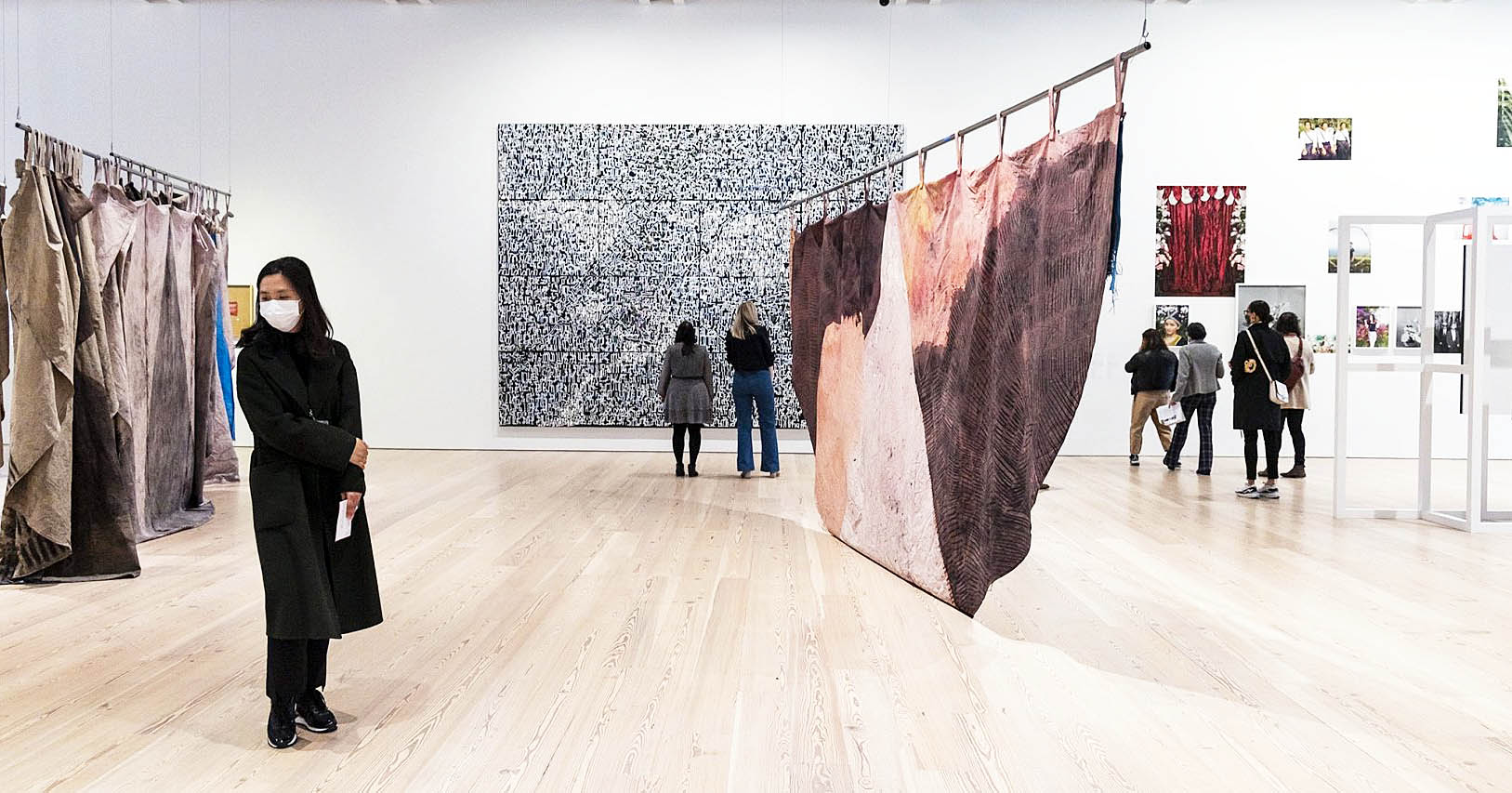
Whitney Museum of Art Biennial 2022, Installation image

The Whitney Biennial is the longest-running survey of American art and has been a hallmark of the Museum since 1932. Initiated by the Museum’s founder Gertrude Vanderbilt Whitney as an invitational exhibition featuring artwork created in the preceding two years, the biennials were originally organized by medium, with painting alternating with sculpture and works on paper. Much has evolved over the years and this year the Biennial comes after being postponed because of the pandemic. The spaces here contrast significantly, acknowledging the acute polarities in American society. One floor is a labyrinth, a dark space of containment and another is a clearing, open and light field. The subtitle of this year’s Biennial is Quiet as it’s Kept, is a colloquialism.  The quote comes from the writer Toni Morrison and is said prior to something, often obvious that should be kept a secret. The curators, David Beslin, and Adrenne Edwards have been entrusted with making the exhibition that resides within the Museum’s history, collection and reputation. This is the 18th iteration and continues to function as an ongoing experiment.
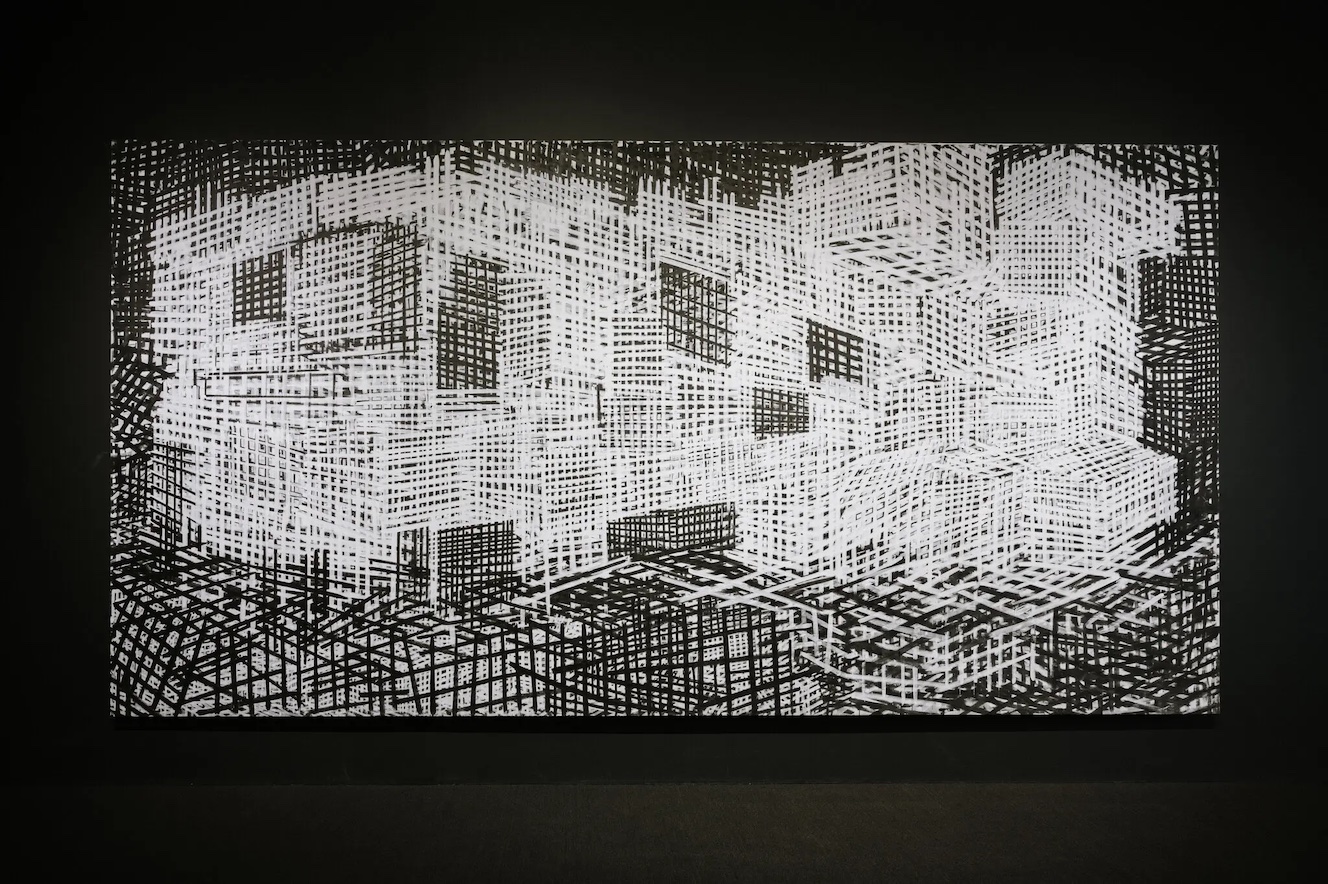
Denyse Thomasos, Displaced Burial/Burial at Gorée, 1993.

The sixth-floor section of the Biennial opens with two large-scale abstract works by the late artist Denyse Thomasos, who died in 2012 at 47. For these striking works, Thomasos was interested in creating the sense of claustrophobia felt by enslaved people crossing the Atlantic crossing and inmates being held in prisons. Her goal was “to capture the feeling of confinement,” she once said, per the wall text, as a way to explore how structures like ships and prisons have “left catastrophic effects on the Black psyche. Her black and white overlapping grids create a feeling of claustrophobia and captivity. There are two twin paintings presented here as the viewer enters a space that is entirely black. Most of this floor is divided up into rooms (all black) that serve as viewing rooms for art videos.
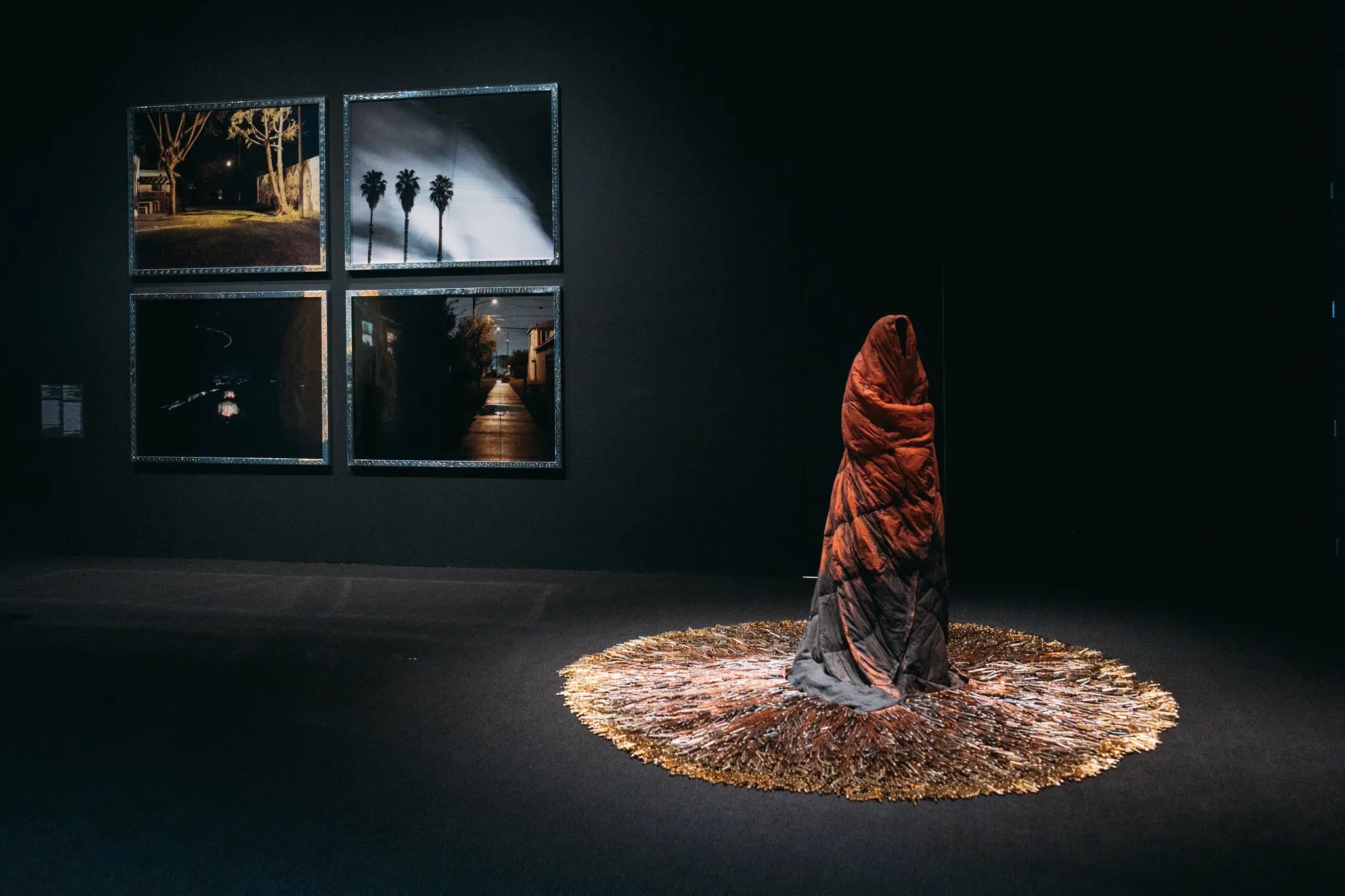
Rebecca Belmore’s sculpture, “ishkode (fire),” 2021

At the Whitney Biennial, center, the Indigenous artist Rebecca Belmore’s sculpture, “ishkode (fire),” 2021, made from clay and bullet casings.  The Anishinaabe artist Rebecca Belmore—who was the first Indigenous artist to present Canada at the Venice Biennale, in 2005—made this commanding ceramic sculpture from a sleeping bag cast in clay and surrounded it with an arrangement of empty bullet casings. The work, a critique of the historic genocide and ongoing disproportionate violence against Indigenous people, is a centerpiece of the sixth floor of the exhibition, illuminated from above in the otherwise darkened space. “The work carries an emptiness,” the artist writes. “But at the same time, because it’s a standing figure, I’m hoping that the work contains some positive aspects of this idea that we need to try to deal with violence.”  In the background, Guadalupe Rosales’s photographs of East Los Angeles, 2022.
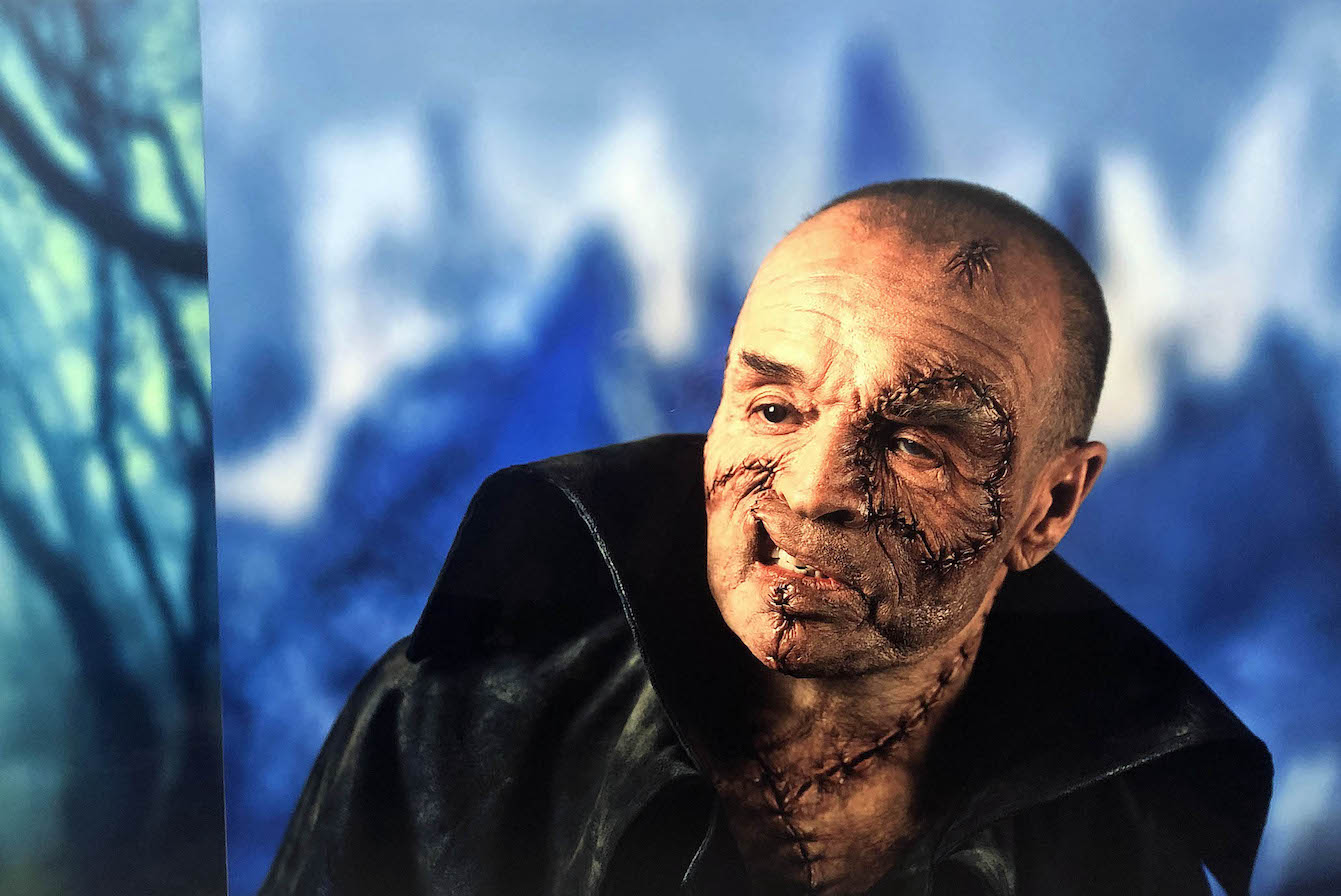
Daniel Matinez, Post Manifesto for the Future, 2022

There are five photographs that document what Daniel Joseph Marinez has described as “radical performative experiment of becoming post-human and the evolution of a new species.” Martinez used his own body to interrogate and bear witness to the extraordinary moment in human history, our own self-destruction.”  The recent abstract paintings on view here involve a process of accumulation in which the surface of the canvas is constructed of sweeping gestures, letters, drips, splatters, and moments of erasure is a reflection of how we evolve in life.  The black and white silkscreened work of marks and impressions tries to articulate who we are or who we might be at any given moment: a kind of visual poem or disruption.
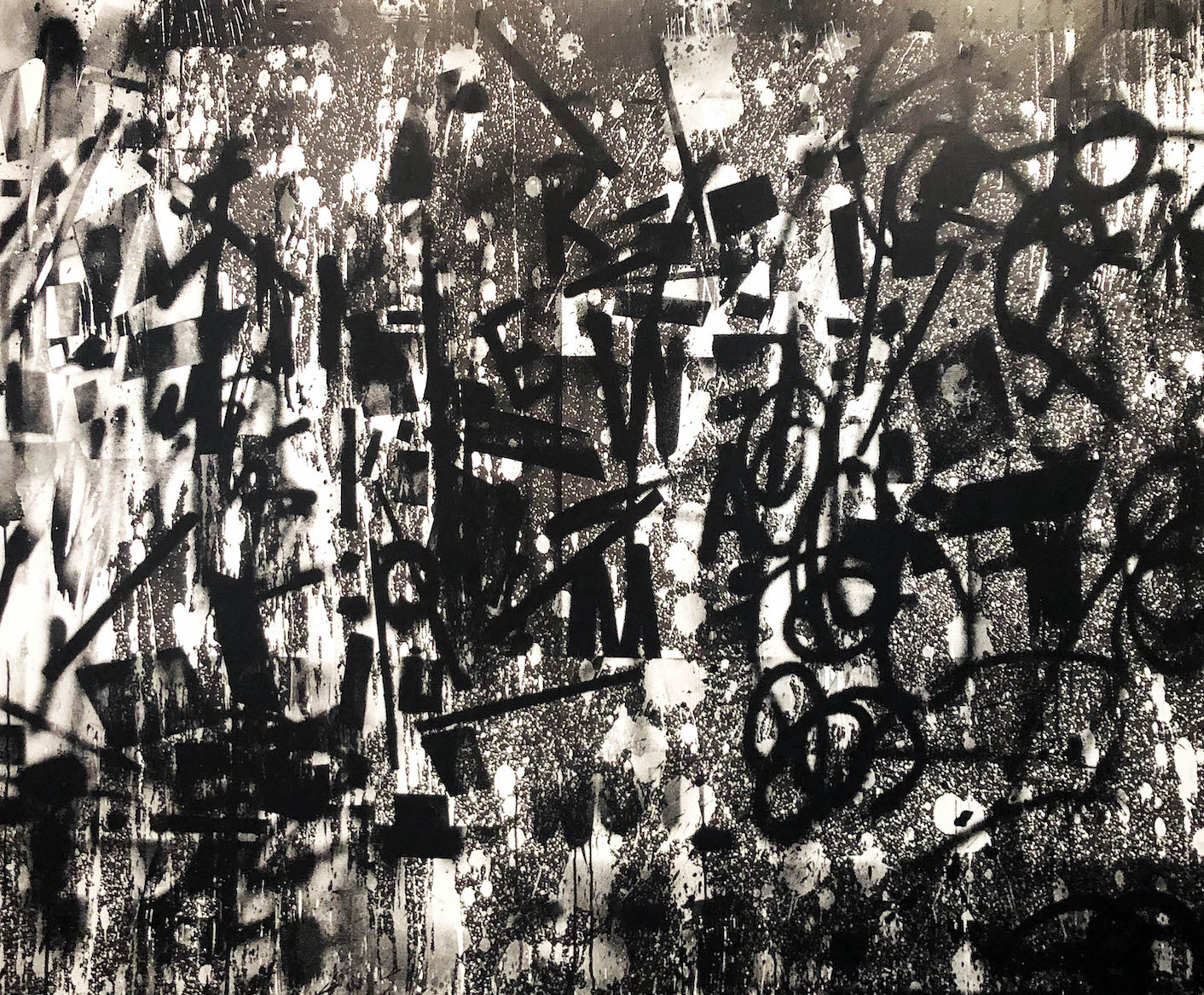
Adam Pendelton, Untitled 2021

Ralph Lemon is an interdisciplinary artist who works primarily in performance and has made drawings throughout his life.  For the Biennial he has created a choreography of work that is presented in a group and moves throughout the exhibition in a circle.  Every so often the work moves to a new position in the collection. Themes range from elaborate visual mediations and the nature of the artistic process itself to experiments refracting Black American culture, icons, music, and joy.  It is fair to say this is an installation of images that changes its position during the exhibition.
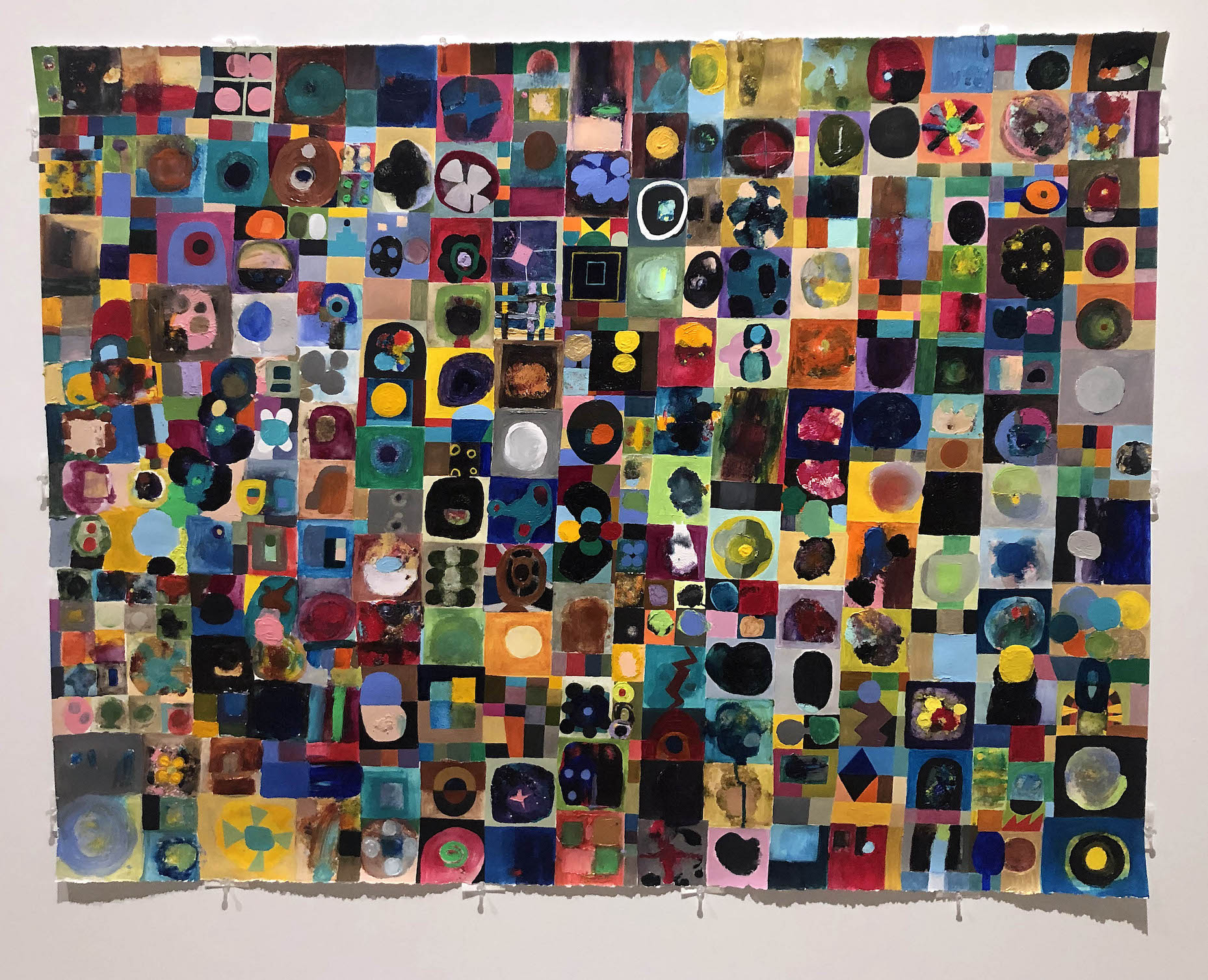
Ralph Lemon, One of several from an untitled series, that changes. 2022

There are five paintings by Jane Dickson who shares the hopes and aspirations that commercial signs convey both in contemporary suburban spaces she photographed in New York City during the 1980s.  The Motel is one of the five.   Dickson’s careful depictions suggest that certain violence comes with making generalizations in the writing off of those who lead their lives in the areas that are frequently overlooked or dismissed. In her statement she says, “I chose to be a witness to my time, not to document its grand moments, but to capture the small telling ones, the overlooked everyday things that define a time and place.
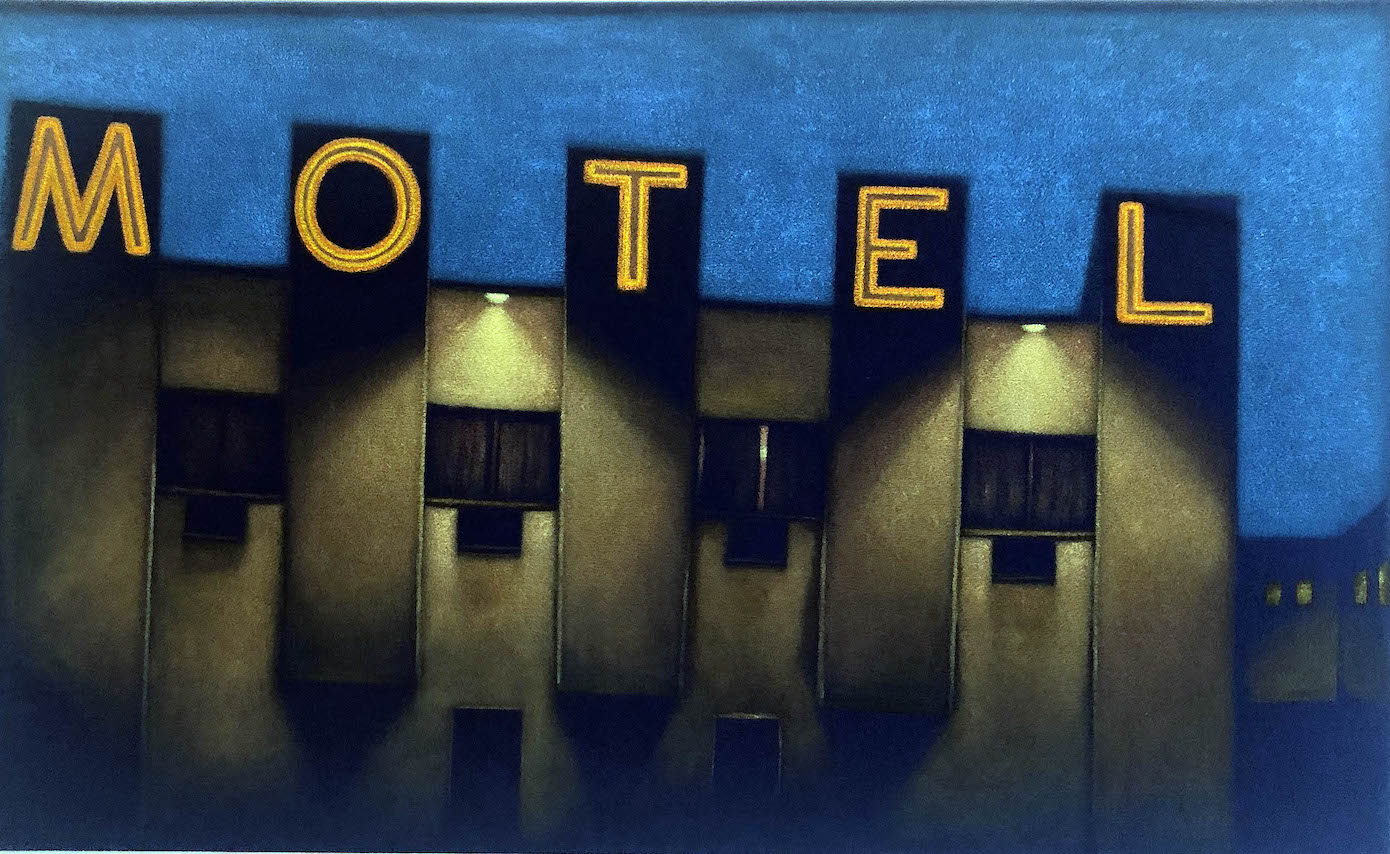
Jane Dickson, Motel 5, Acrylic on Felt, 2019
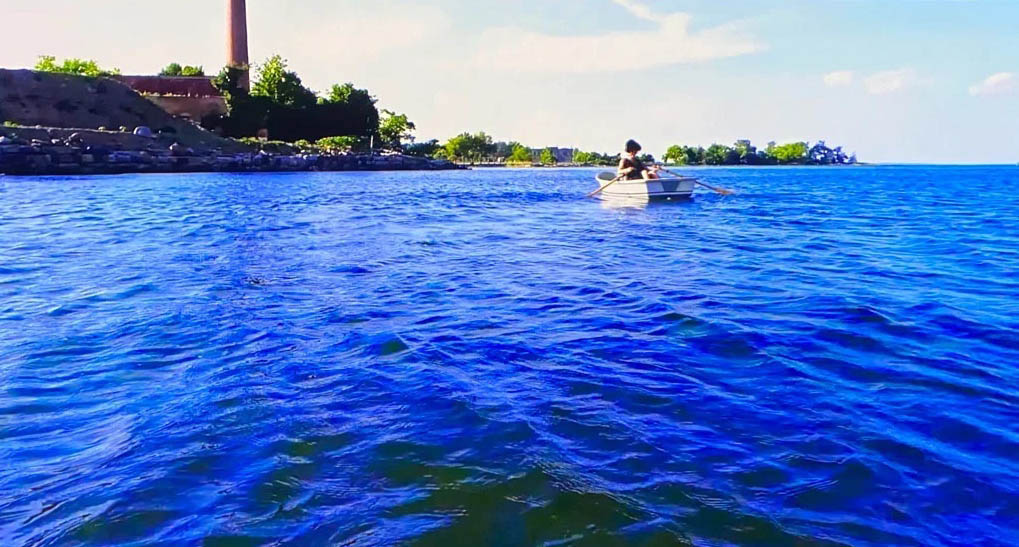
Coco Fusco, Your Eyes Will Be an Empty Word, 2021.

In this new video, Coco Fusco directly reflects on the death toll caused by the pandemic. We see her in a boat just off Hart Island, near the Bronx. The island has long been the site of New York City’s potter’s field, where unclaimed bodies are buried. At the height of the AIDS crisis in the ’80s and ’90s, many bodies of people whose families had disowned them were sent here; over the past two years, it has again become active at an alarming rate. Fusco tapped poet and writer Pamela Sneed, an AIDS activist who penned a 2020 memoir Funeral Diva about that era, to provide the narration—written by Fusco—for this poignant mediation on death, loss, and grief. Over the course of 12 minutes, Sneed tells us that there could be as many as a million bodies buried here, but no one accurately knows. With the staggering total death totals from Covid, she notes, bodies become numbers in ways that make us forget the stories of those who are lost. Throughout the film, like a chorus, Sneed repeats, “‘When death comes it will have your eyes,’ he said.”

If you are visiting New York City before September 6, 2022, it is always a good experience to see what is going on around the country.  Something worth note is there are four indigenous artists represented from various parts of Noth America.  The exhibitions are on floors, 1, 3, 5, and 6.

In Summary, I would agree with the art critic Peter Schjeldahl who says “ long on installations and videos and short on painting, conventional sculpture, and straight photography.” When he writes for The New Yorker. Whitney Biennial 2022
Many Voices: The Fine Art of Craft @ BBAC

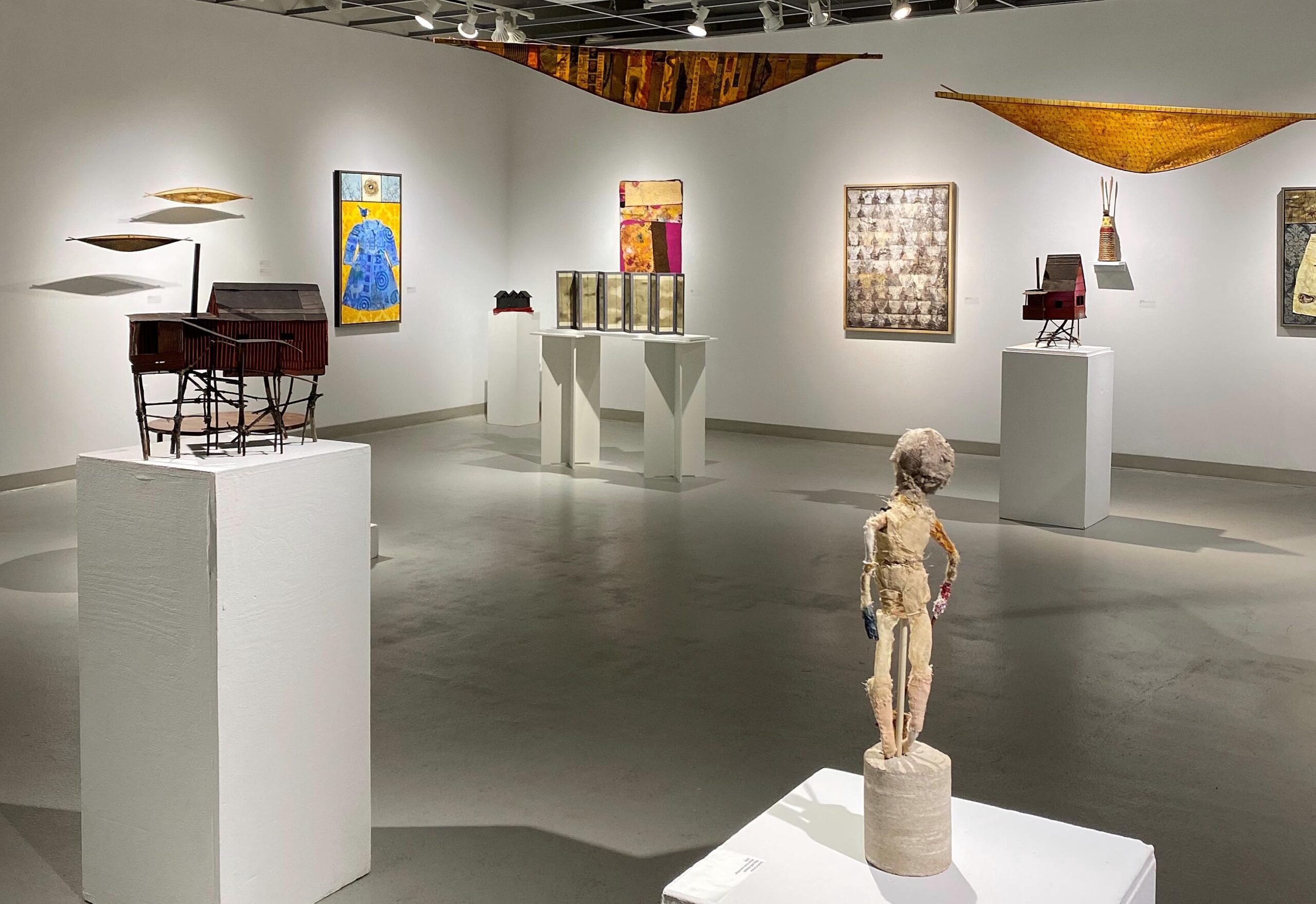
Installation image, Many Voices: The Fine Art of Craft @ BBAC

If there ever was a bright line of distinction between what we call contemporary fine art and what is now considered to be craft, that line has long ago been crossed and obliterated.  The mixed bag of artifacts on display in the exhibition at Birmingham Bloomfield Art Center from May 6 to June 2 illustrates this, with a range of objects and images that contrast the useful with the expressive, the carefully crafted with the emotionally contingent.  “Many Voices: The Fine Art of Craft” takes us on a tour of the increasingly porous borders between objects that can claim to be fine art, but qualify as craft only because they refer tangentially to traditional crafts and finely handmade objects that are intended for utilitarian purposes.

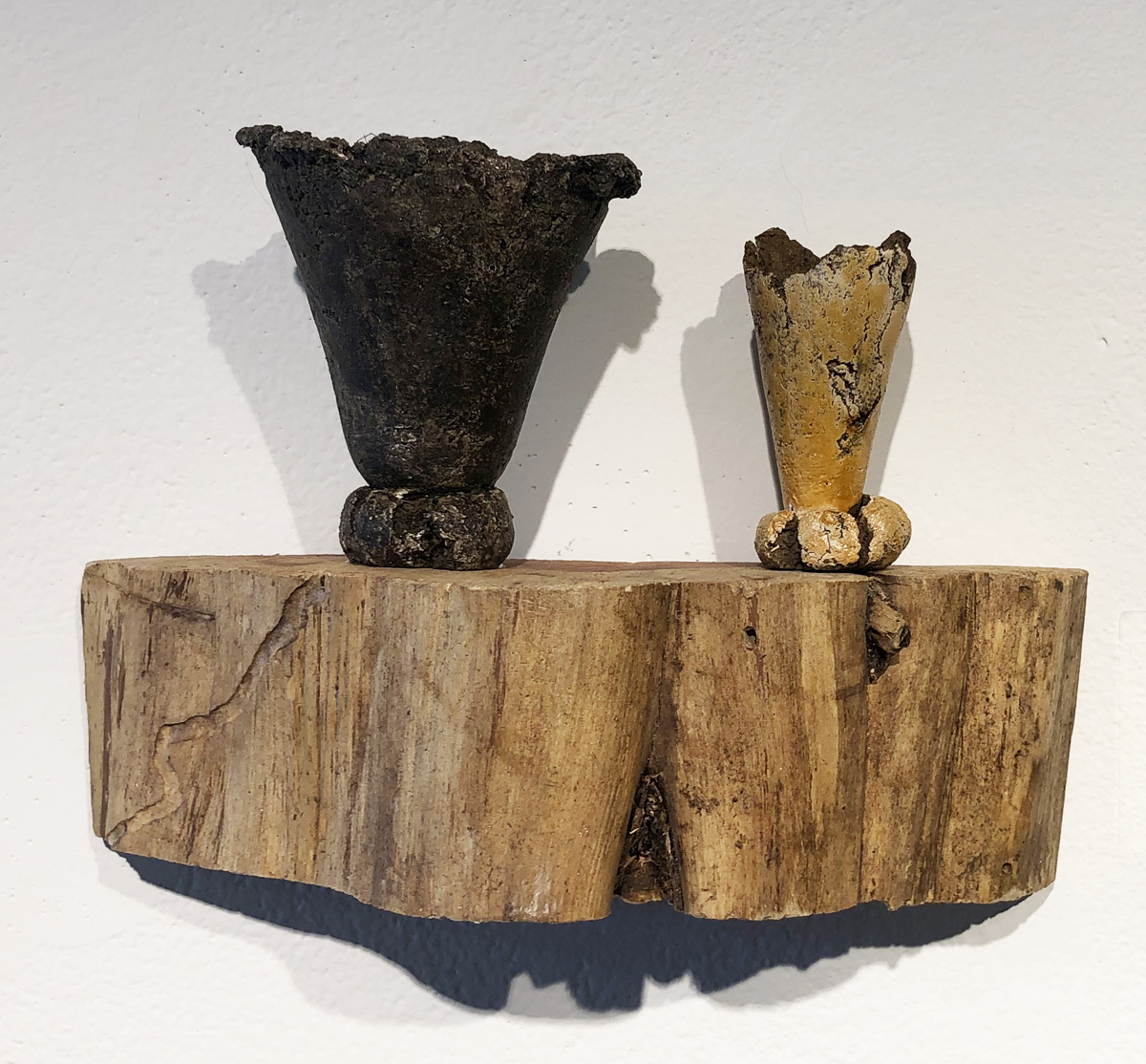
Wall Vessel V, Constance Compton Pappas, unfired clay, cedar


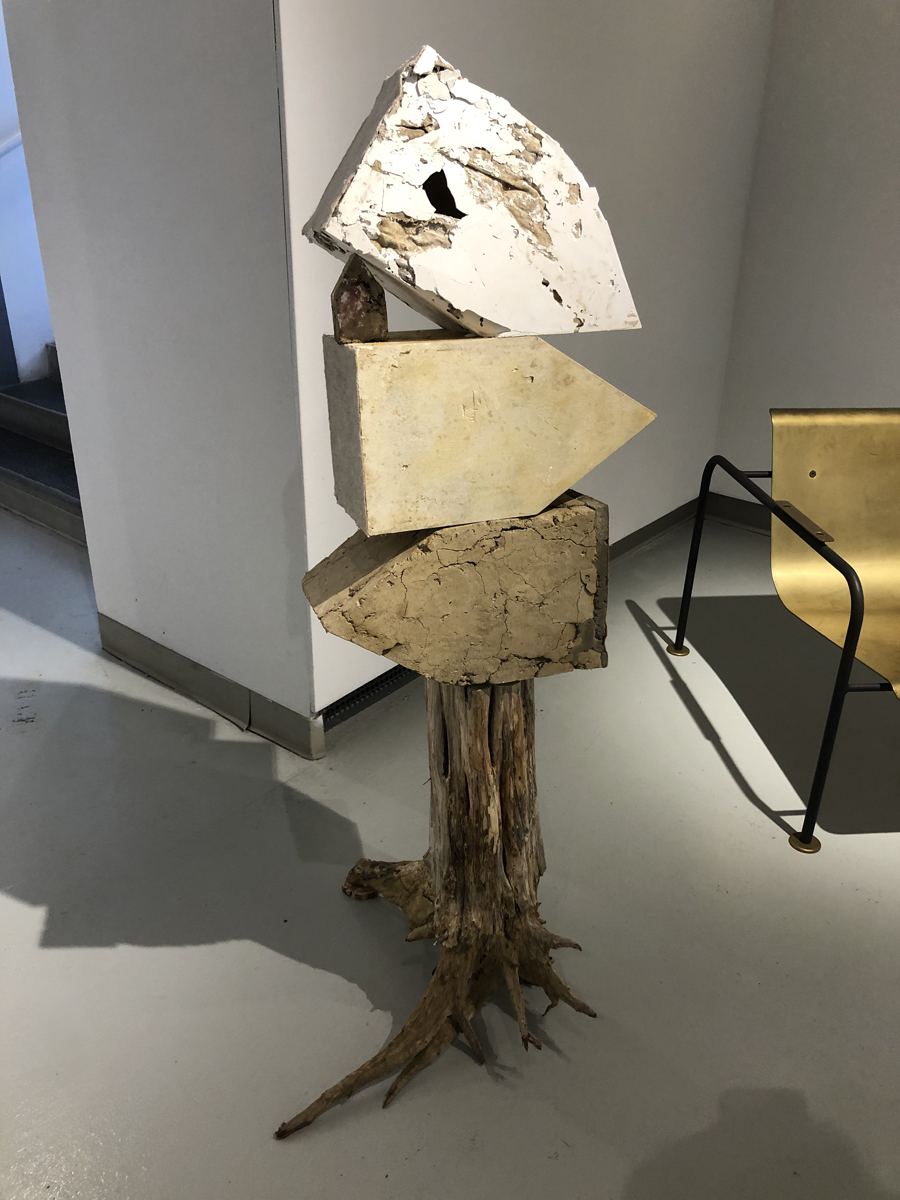
Balanced, Constance Compton Pappas, cedar, plaster, clay

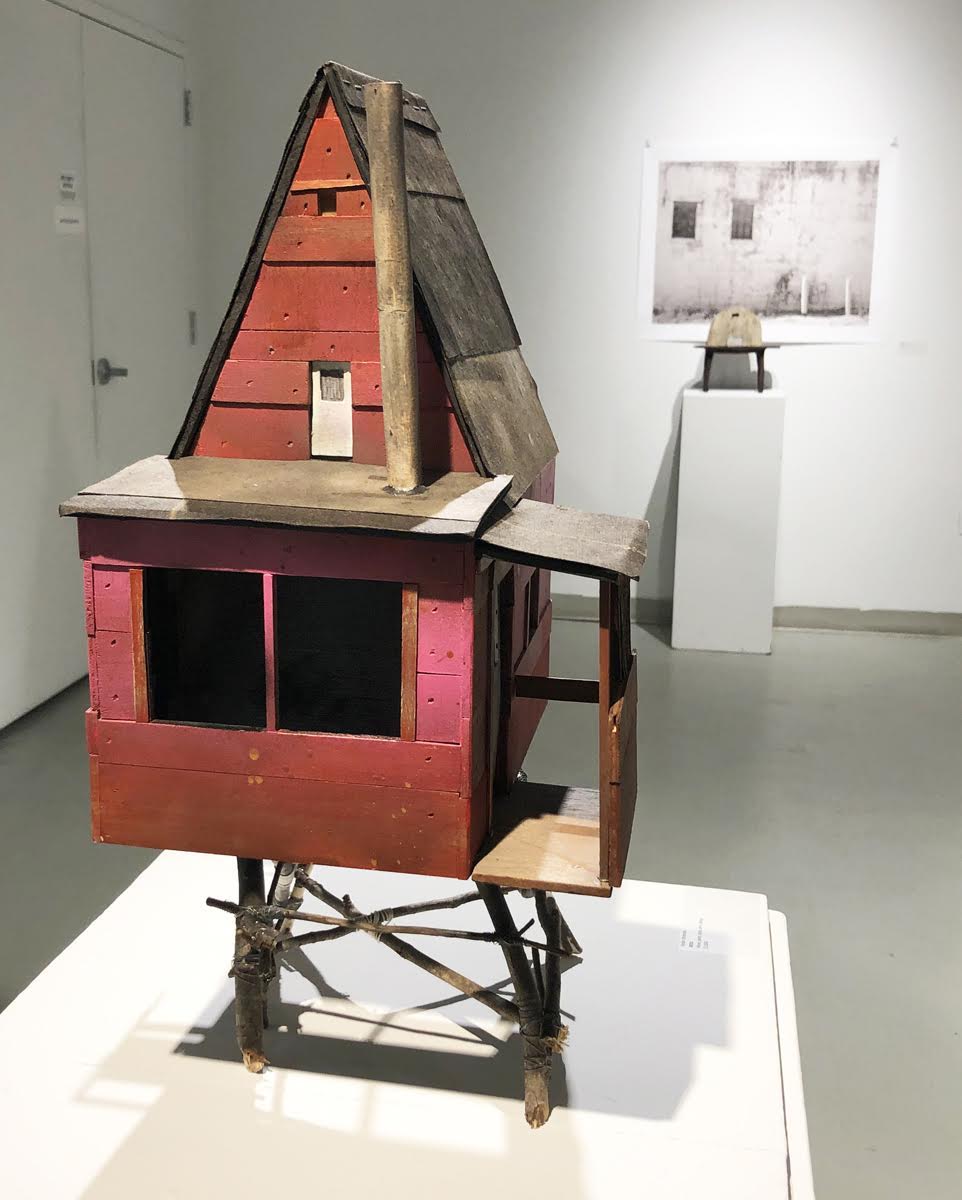
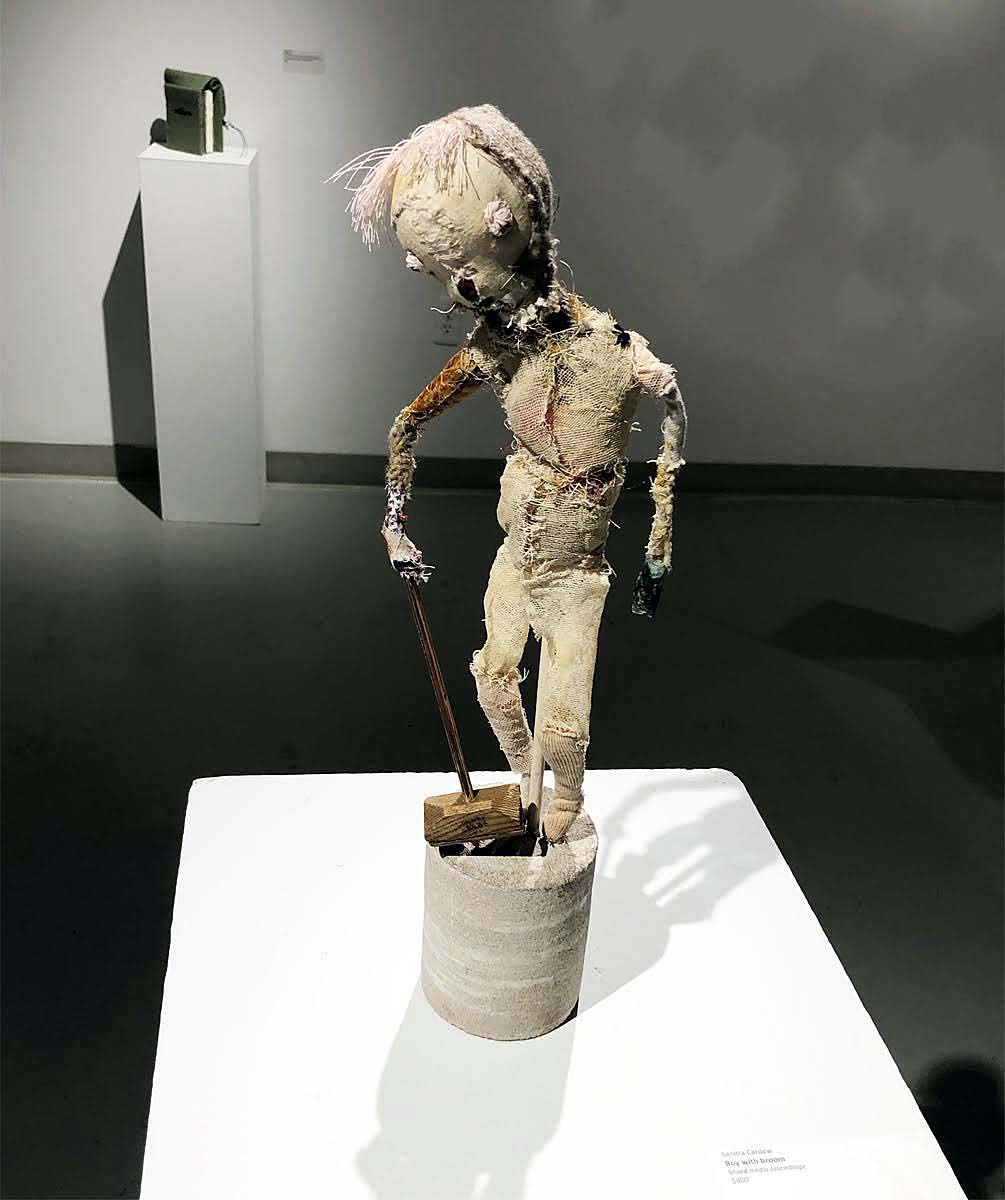
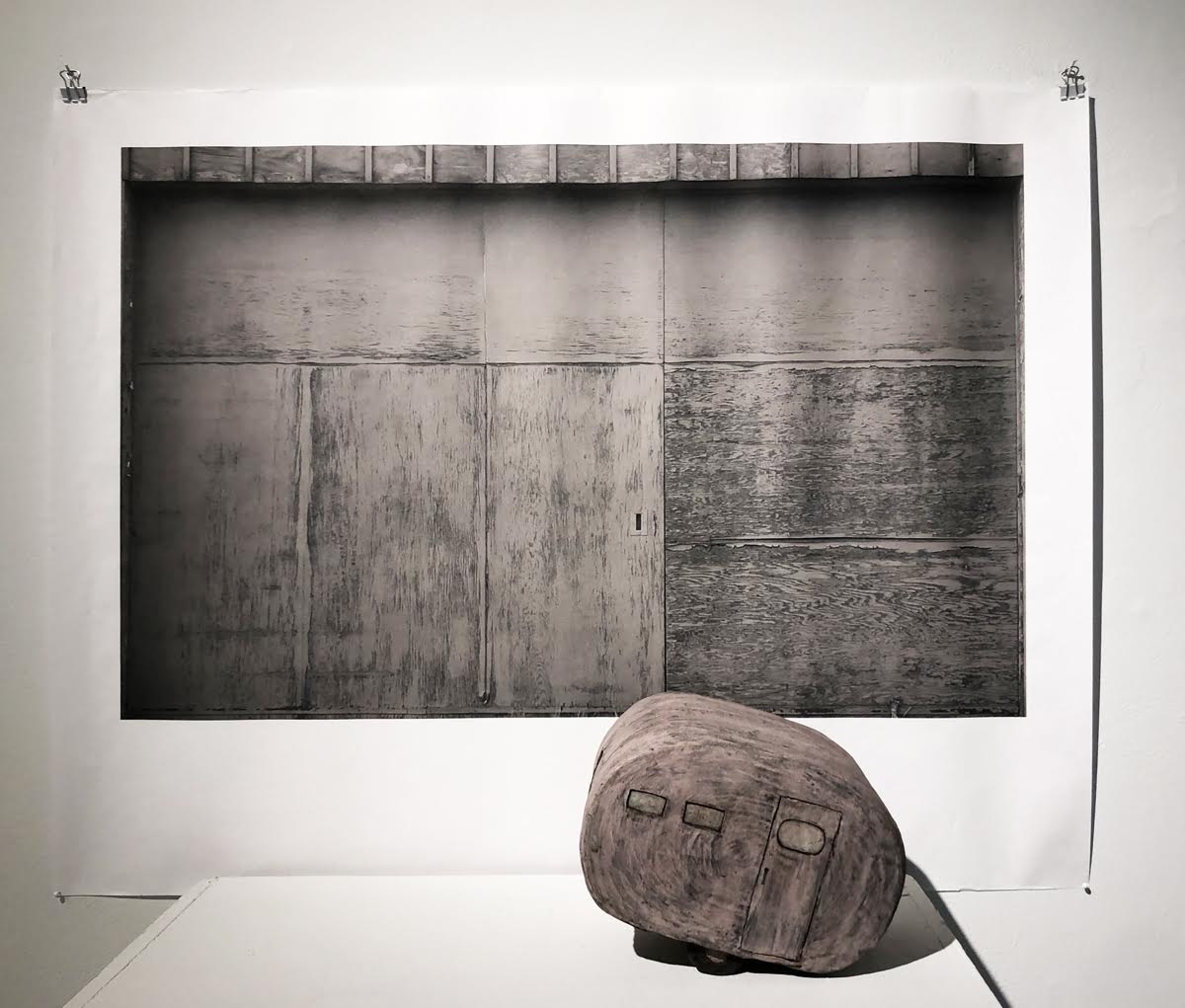
The objects in the exhibition fall roughly into two categories. Works by artists such as Constance Compton Pappas, Dylan Strzynski, Sandra Cardew and Sharon Harper privilege the expressive properties of the materials and push them to the limits of their identity. Often there is a toy-like mood to this work.  Any pretense to utility is deeply submerged beneath the artists’ emotionally poignant themes. Pappas’s wall-mounted, naturally irregular wooden shelves support clay objects that only refer to vessels, and certainly were never intended to function.  They are signs for cups and the considerable pleasure to be derived from them rests upon their rough, stony texture contrasted with the irregularities of the wooden support. Elsewhere in the gallery, Pappas uses the abstract shapes of 3 cast plaster houses, again placed on a raw wood pedestal in a stack, entitled Balanced, that implies a state of wonky precarity.  Dylan Strzynski’s playful, barn-red house model, Attic, made of wood, sticks and wire, suggests a kind of Baba Yaga cottage on legs, poised to jump off its pedestal in pursuit of the viewer. Sandra Cardew’s Boy with Broom continues the preoccupation with play. The subdued color and rough fabric of the golem-child is both a little funny and a little ominous. Sharon Harper’s Pink Trailer makes an interesting kind of mini-installation by hanging a 2-dimensional photo landscape on the wall behind a diminutive clay trailer, suggesting the possibility of travel through wide open spaces.

Attic, Dylan Strzynski, wood, paint, sticks, wire, string


Sandra Cardew, Boy with Broom, mixed media assemblage

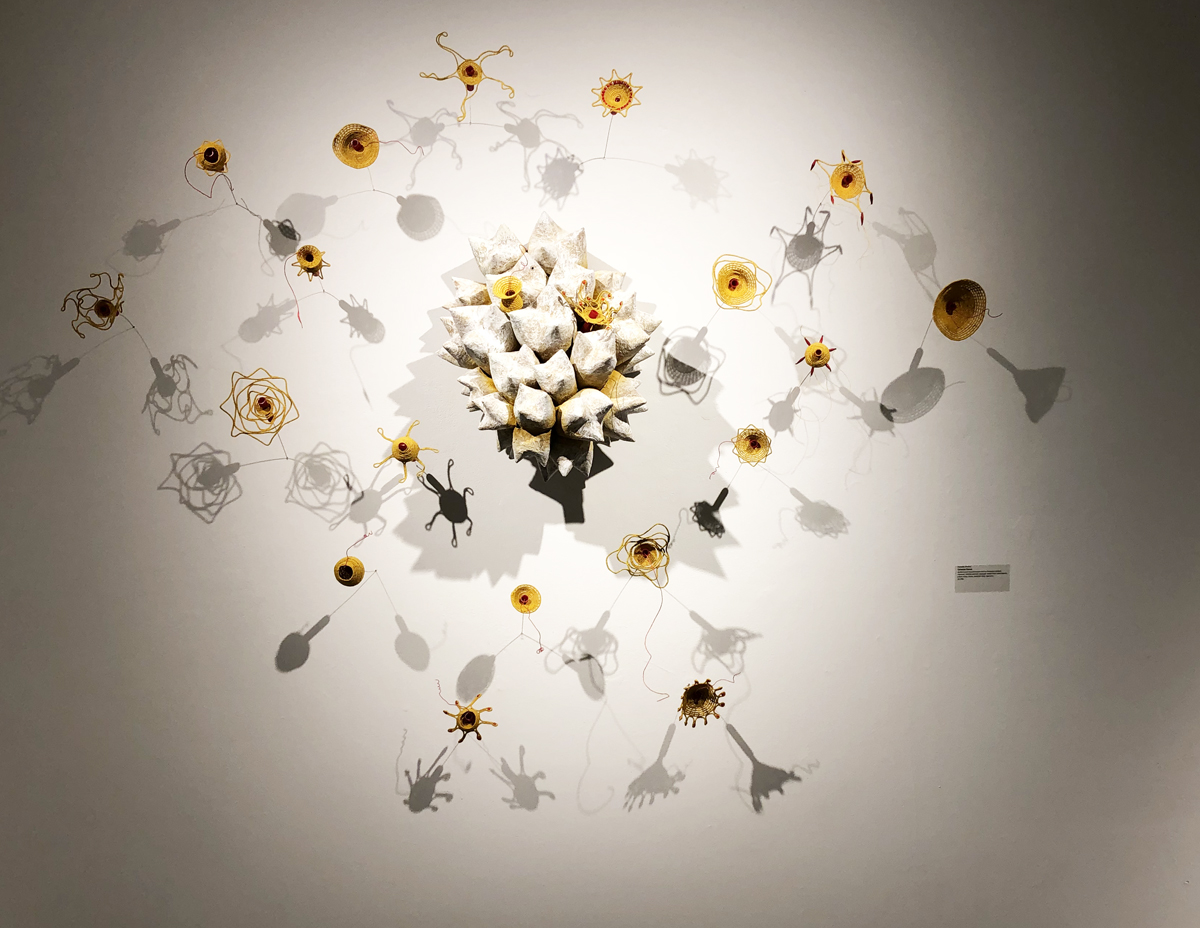
Danielle Bodine’s wall installation, Celestial Dance, offers a floating population of tiny woven wire and paper elements that might claim to be plankton or might be satellites.  Whatever they are, their yellow starlike shapes weightlessly orbit a larger, spiky planetary body, and cast lively shadows on the wall. The basketry techniques that Bodine has employed for nearly 20 years allow her complete freedom to invent these minute entities in three dimensions.

Sharon Harper, Pink Trailer, low fire clay, photograph

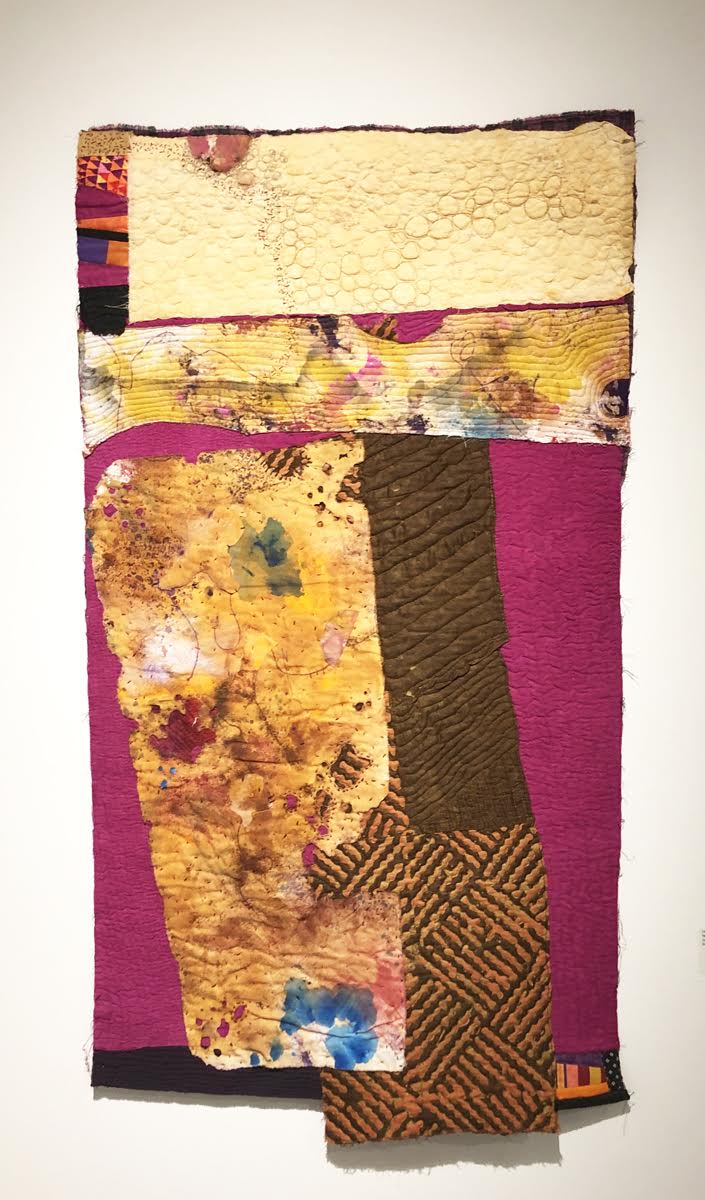
The fiber artist Carole Harris, who has several works in the show, continues to be in a class by herself. From her beginnings as a more conventional quilter, Harris has traveled far and wide, taking inspiration from Asia, Africa and beyond. Her carefully composed, expressively dyed and stitched formal abstractions are emotionally resonant and reliably satisfying. The artist employs a mix of fabrics and papers, along with hand-stitching and applique, with the easy virtuosity of long practice.

Danielle Bodine, Celestial Dance, mulberry and recycled papers cast on Malaysian baskets, removed, stitched, painted, stamped, waxed linen coiled objects, plastic tubes, beads,

Carol Harris, Yesterdays, quilted collage

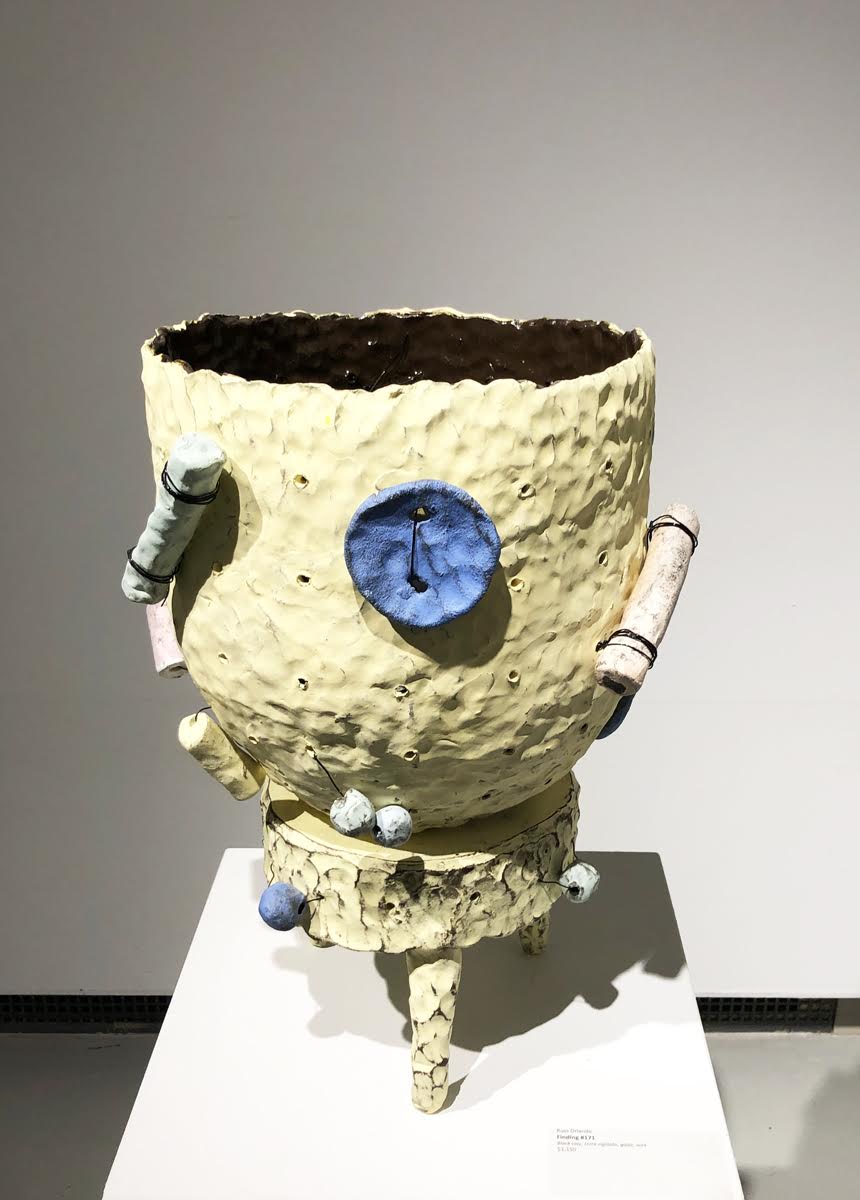
Russ Orlando’s pebbly pastel ceramic urn-on-a-table, Finding #171, is covered by contrasting buttons and frogs wired to the substrate. The vessel evokes a friendly presence: it wants to know and be known.

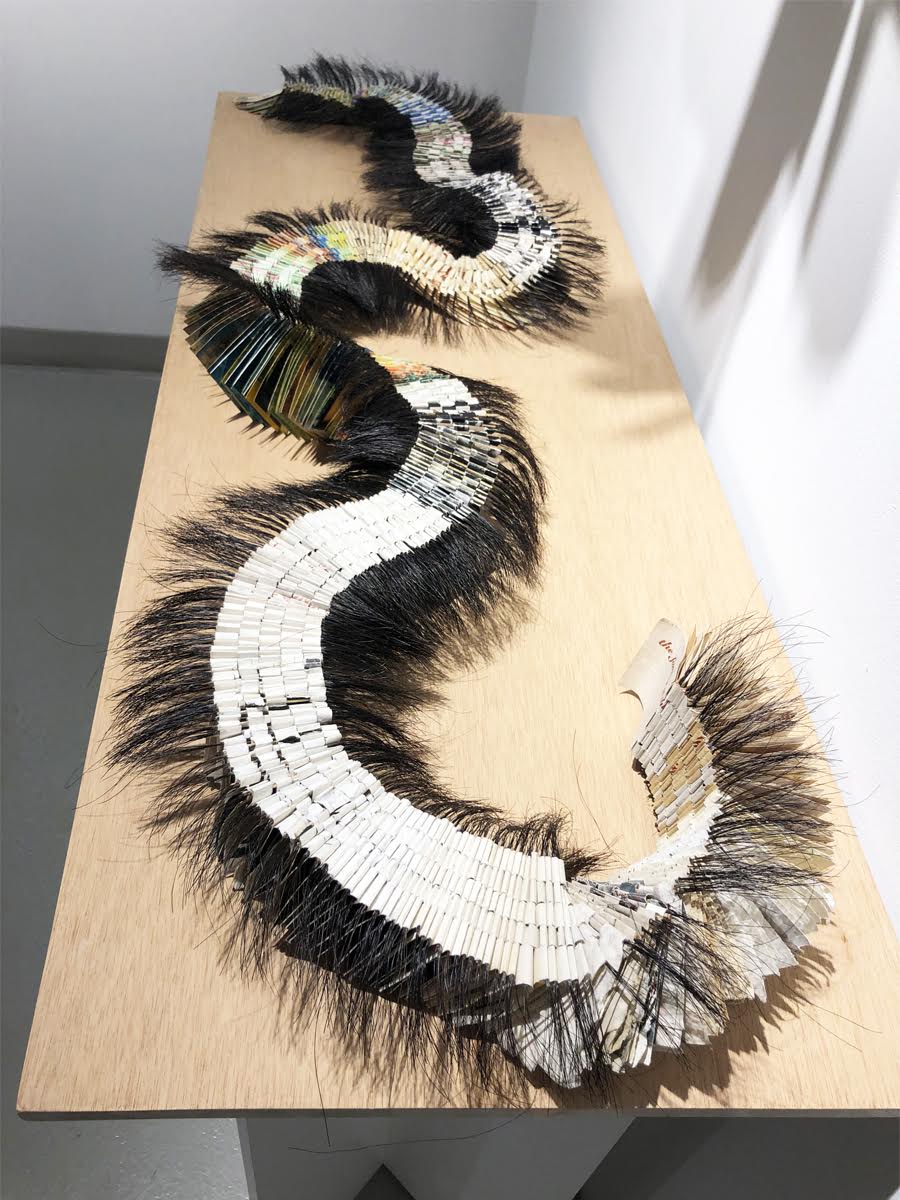
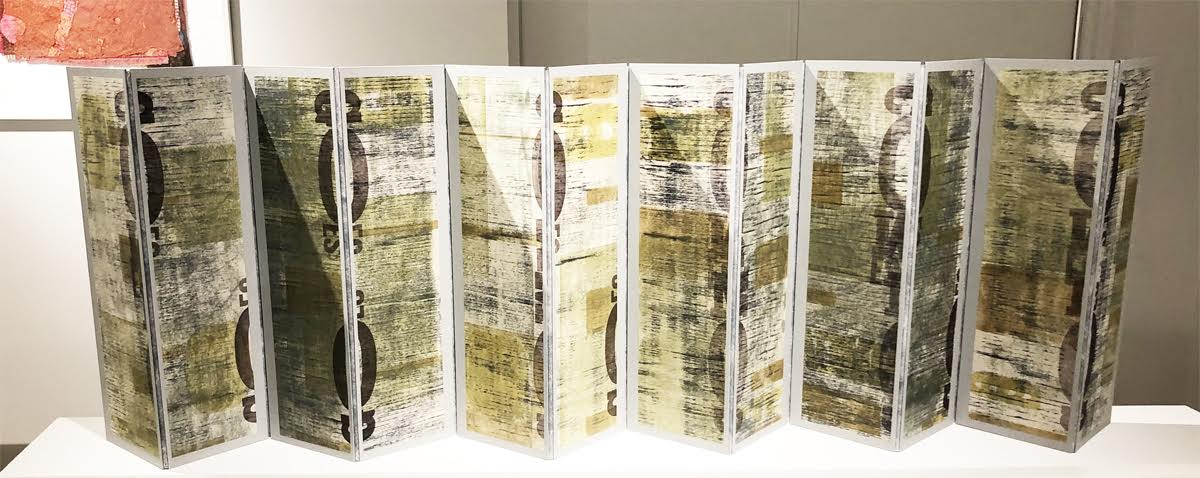
Two artists in “Many Voices,” Lynn Avadenka and Karen Baldner, are masters in the craft bookmaking/printing, whose work perfectly balances function and form, though to different ends. Baldner’s snaky, wiggly rice paper centipede of a book, Letting Go, shows how exquisite technique can pair with creative expressiveness to yield an original effect. The restrained elegance of Lynne Avadenka’s handmade screen Comes and Goes III demonstrates that utility and esthetic pleasure need not be mutually exclusive.

Karen Baldner, Letting Go, piano hinge binding with horsehair, mixed media print transfers


Lynne Avadenka, Comes and Goes III, unique folding screen, relief printing, letter press, typewriting, book board, Tyvek

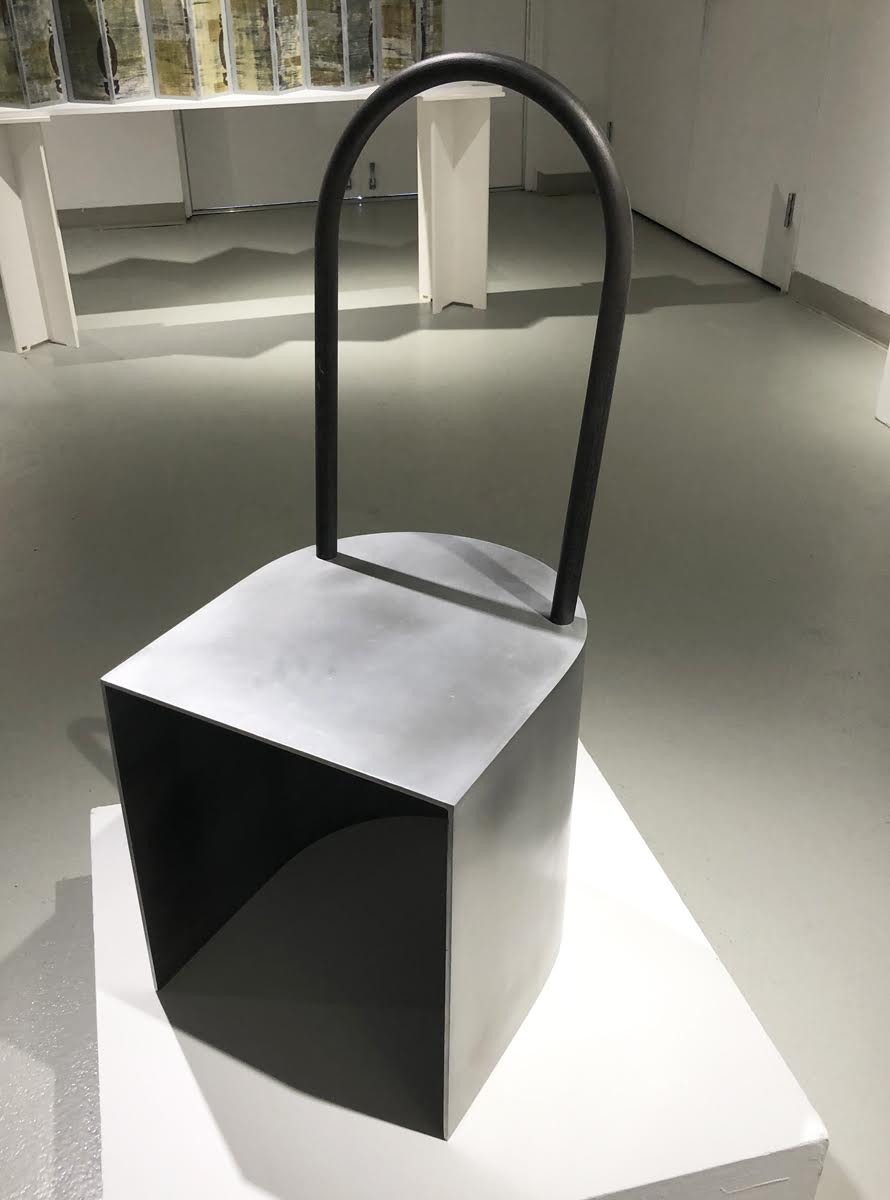
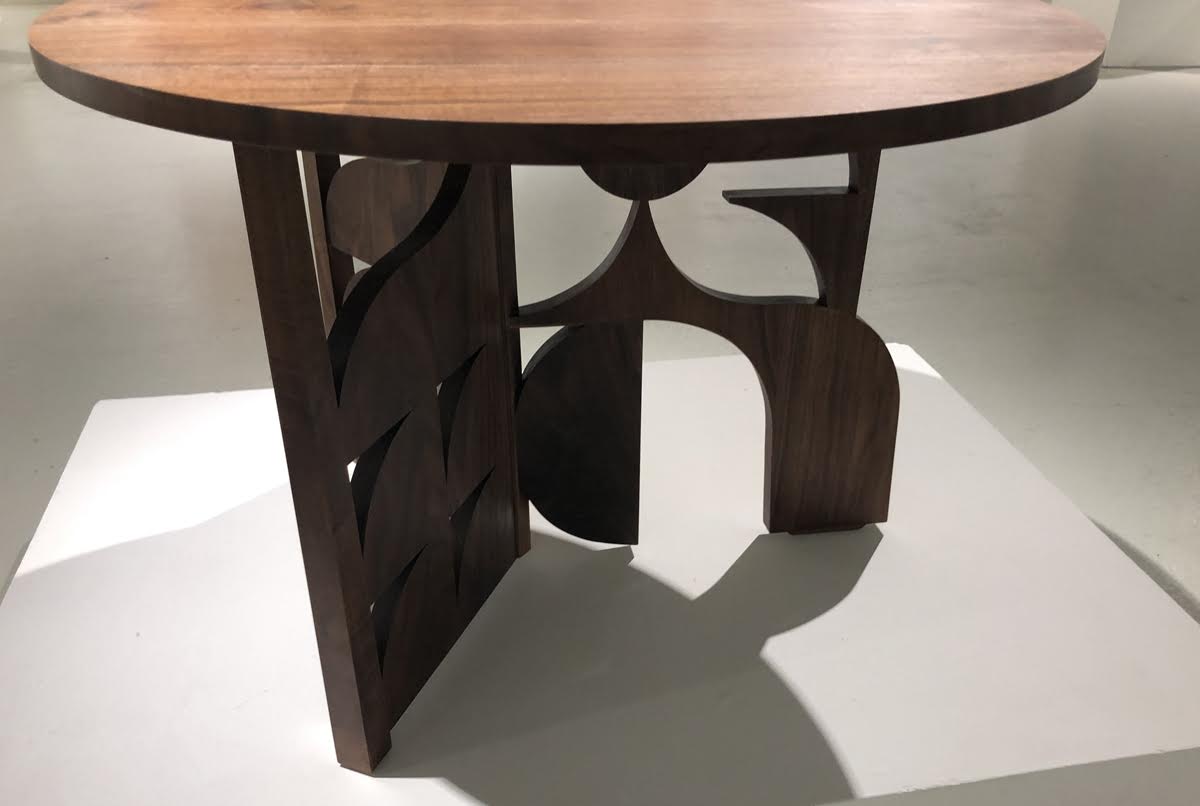
Among the objects in this collection, Colin Tury’s handsome, minimalist metal LT Chair hews closest to traditional ideas of craft, as does Cory Robinson’s smoothly crafted side table, which looks as if it belongs in a hip, mid-century bachelor’s lair.

Colin Tury, LT Chair, aluminum, steel


Cory Robinson, Canberra Table, American black walnut

In this time and place, and as illustrated by the artists in “Many Voices,” the categorization of an object as “art” or “craft” has become less and less useful. Historically, crafts based on highly technical knowledge—ceramics, fiber glass and the like –have been assigned a lesser status because of their identity as objects of utility.  It is undeniable too that many of these crafts were practiced by women, which devalued them in the estimation of collectors and galleries. Fortunately, those preconceptions are receding into the past, as artists progress toward a future that is more open to new forms and voices, new materials and subjects.

The artists in “Many Voices: The Fine Art of Craft” are: Kathrine Allen Coleman, Lynne Avadenka, Karen Baldner, Danielle Bodine, Sandra Cardew, Candace Compton Pappas, Nathan Grubich, Christine Hagedorn, Sharon Harper, Carole Harris, Amanda St. Hillaire, Sherry Moore, Russ Orlando, Cory Robinson, Dylan Strzynski, Colin Tury.

Many Voices: The Fine Art of Craft at the Birmingham Bloomfield Art Center runs until June 2, 2022.


Castagnacci: Quarry Echoes & Wanderings @ BBAC

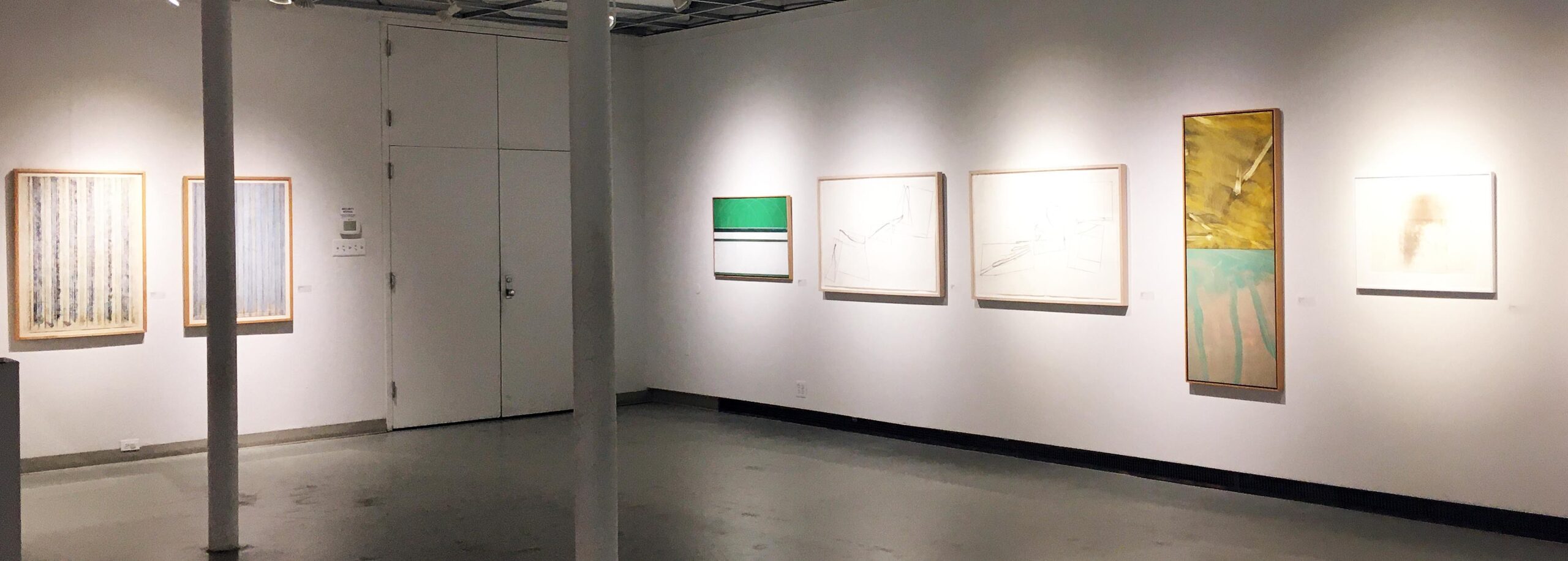
Vincent Castagnacci: Quarry Echoes & Wanderings at the Birmingham Bloomfield Art Center

An installation view of Vincent Castagnacci: Quarry Echoes & Wanderings, which will be at the Birmingham Bloomfield Art Center until April 21.

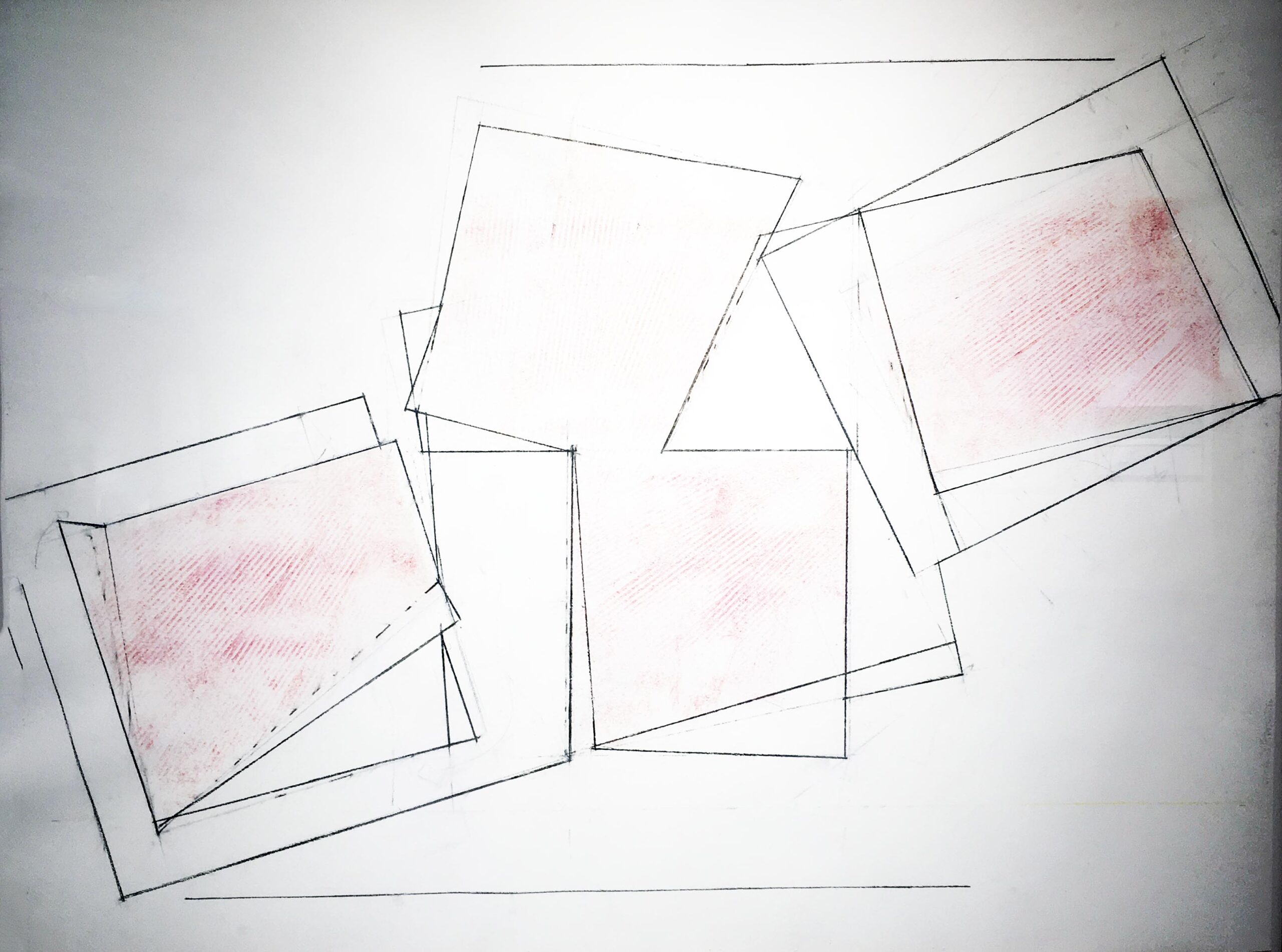
 Vincent Castagnacci: Quarry Echoes & Wanderings (1984-2021) is an intriguing tour through abstraction with a distinctly geometric cast, and will be up at the Birmingham Bloomfield Art Center through April 21. Castagnacci, the University of Michigan’s Arthur F. Thurnau Professor of Fine Art Emeritus, takes rationalism’s standard forms – squares, semi-circles, triangles and parallel lines – and twists them to his liking, confounding conventional expectations.

Take, for example, the large, black and white VII.06 – 19.VIII.06. This series of interconnected squares, some scored in dull red, has an undeniable momentum, and appears to be in the process of levitating from left to right. The piece is spare, and looks like it was sketched rather quickly — doubtless an illusion. In some respects, you could say it resembles a series of matchbooks or, more intriguingly, the sort of early renderings architects jot down to see how different building volumes will interact with one another.

Vincent Castagnacci, VII.06 – 19.VIII.06, Charcoal pencil, Dry pigment, Gesso, 2007.

But Castagnacci, who maintains a studio locally in Pinckney and one in Gloucester, Massachusetts, attributes the genesis of his work to the geometry of natural landscapes, not man-made forms. In his artist’s statement Castagnacci cites the “coastal topography of Cape Ann” around Gloucester, with its boulder-tossed beaches and craggy granite bluffs, as both inspiration and defining aesthetic undergirding his point of view. So perhaps VII.06 – 19.VIII.06 is less architectural and more a tectonic rendering of rock and hillside.

Castagnacci, who arrived at the University of Michigan in 1973, studied at the Boston Museum School at Tufts University, then followed that with both a B.F.A. and M.F.A. from Yale. He was most recently a Mellon Fellow at Kalamazoo College, and has also been a visiting artist at the American Academy in Rome. His artistic interests range widely. Encouraged by the dean of the U-M School of Art & Design to reach across academic boundaries, Castagnacci collaborated with percussionist and composer Michael Gould in a five-year project that in 2005 yielded Into the Quarry, an installation celebrating the convergence of art and music in space and time.

Annie VanGelderen, BBAC president and CEO, praised Castagnacci’s “incredible body of work, one that demonstrates both restraint and a thread connecting through the years.” The pieces on display, she added, “unfold in geometric presentation, whether with painting, drawing or printmaking.”

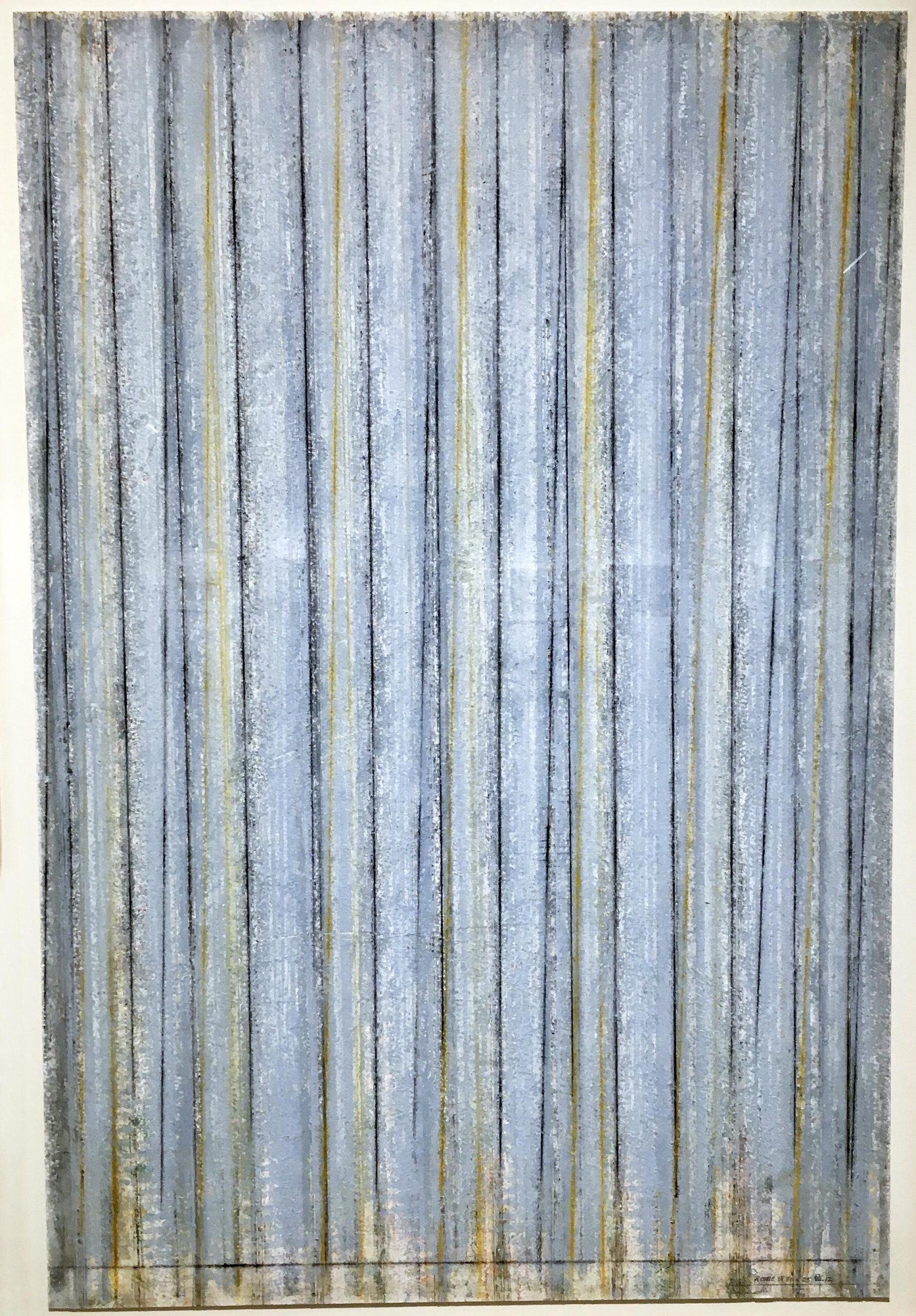
Vincent Castagnacci, Rome: III.25.80-20.VII.12, Oil and chalk, 2012

The contrast between Castagnacci’s spare black-and-white drawings and his colorful, texture-rich paintings, which pop like exclamation points, is part of what gives this exhibition its juice. The oil-and-chalk Rome: III.25.80-20.VII.12 offers a pleasing contrast to the “simpler” works, an essay in repetitive verticals that progress in color from dull, mottled shades of powder blue to nightingale brown. It’s a remarkably textured exercise. The effect, one viewer suggested, reminded her of the raw material for blue jeans, though for this visitor, it read more like a satisfyingly weathered, corrugated metal wall in tones of grayish-blue.

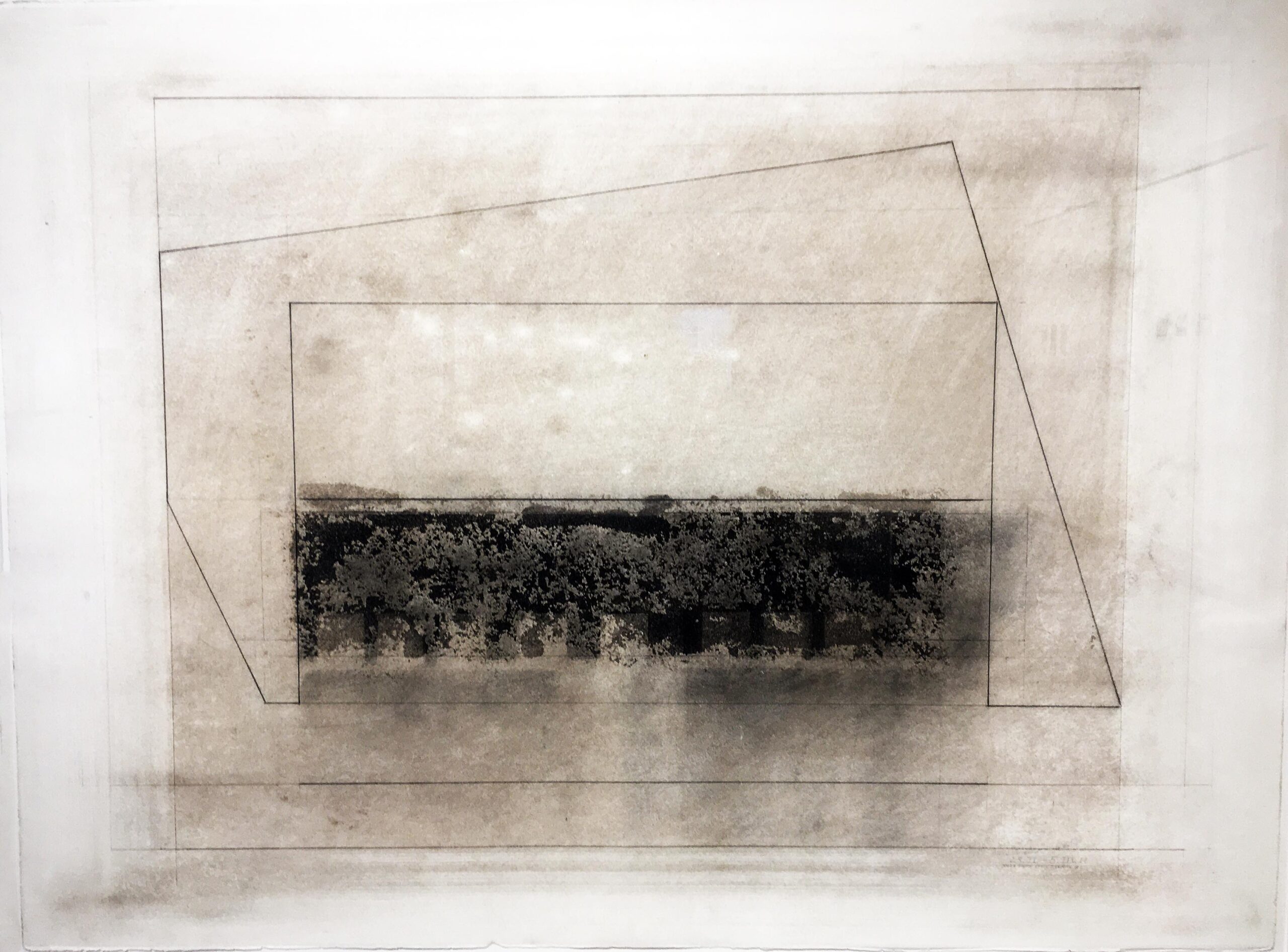
There are a number of absorbing essays in squares and rectangles here, including the austere, geometric 23.II-5.III.11#1, comprised of three or four superimposed frames. Two are squarish, while a third contained within the others tilts and lists into its fellows, like an unsteady parallelogram. Rendered in surprisingly rich tones of charcoal and ash, 23.II-5 almost amounts to a monochromatic color study, animated by a densely textured black rectangle that anchors the work and gives it its mesmerizing depth.

Vincent Castagnacci, 23.II-5.III.11#1, Oil, 1997

23.II-5.III.11#1, is a warm, color-saturated canvas in distressed shades of barn red, scored here and there with verticals and horizontals that almost suggest inset panels in a door. In some ways this lush, resonant piece feels thousands of miles from the Massachusetts coast and Cape Ann. In its warmth and seemingly ancient appearance, it calls up the Mediterranean more readily than the North Atlantic.

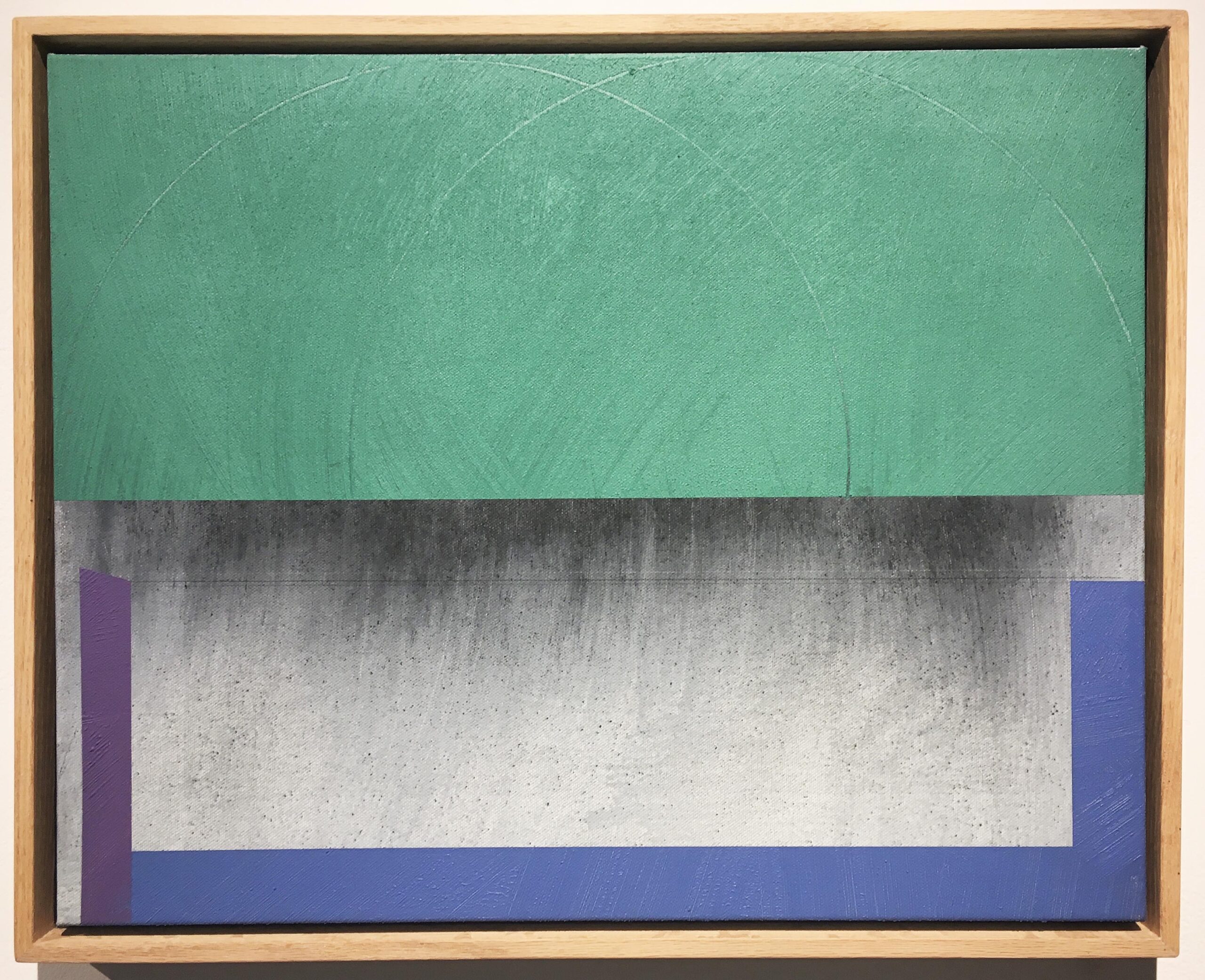
Finally, 7-11.X.19, one of the handsomest pieces on display, is a highly formalistic, acrylic-and-ash color study in green, periwinkle, lavender and shades of gray edging into black. Part of the charm of this composition is that while the strong colors all seem to occupy the same plane, the dark gray they frame looks downright three-dimensional, as if that quadrant of the canvas were receding several inches from the rest of the work. It’s an absorbing design that tiptoes to the edge of trompe l’oeil.

Vincent Castagnacci, 7-11.X.19, Acrylic, Ash, 2019.

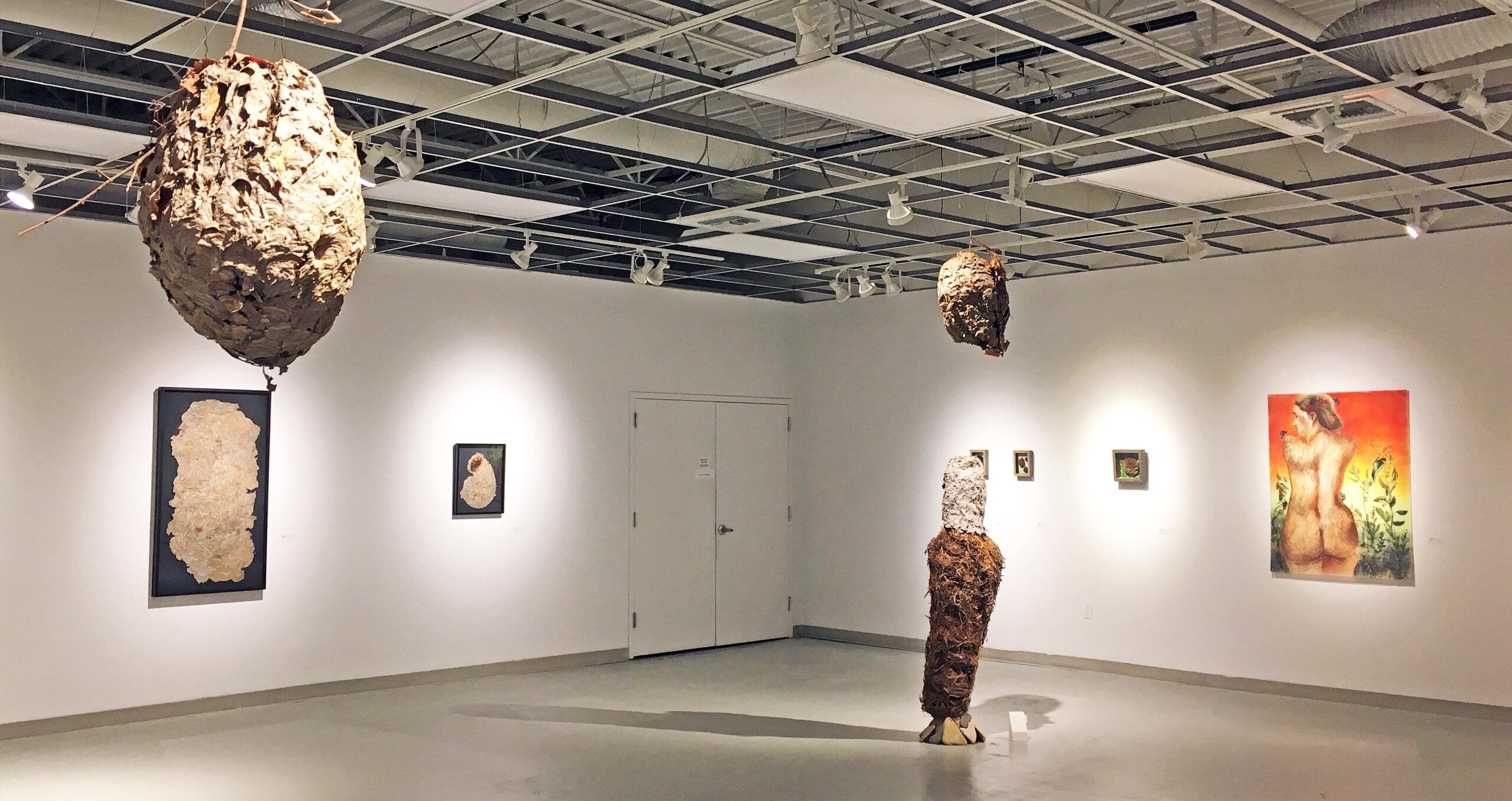
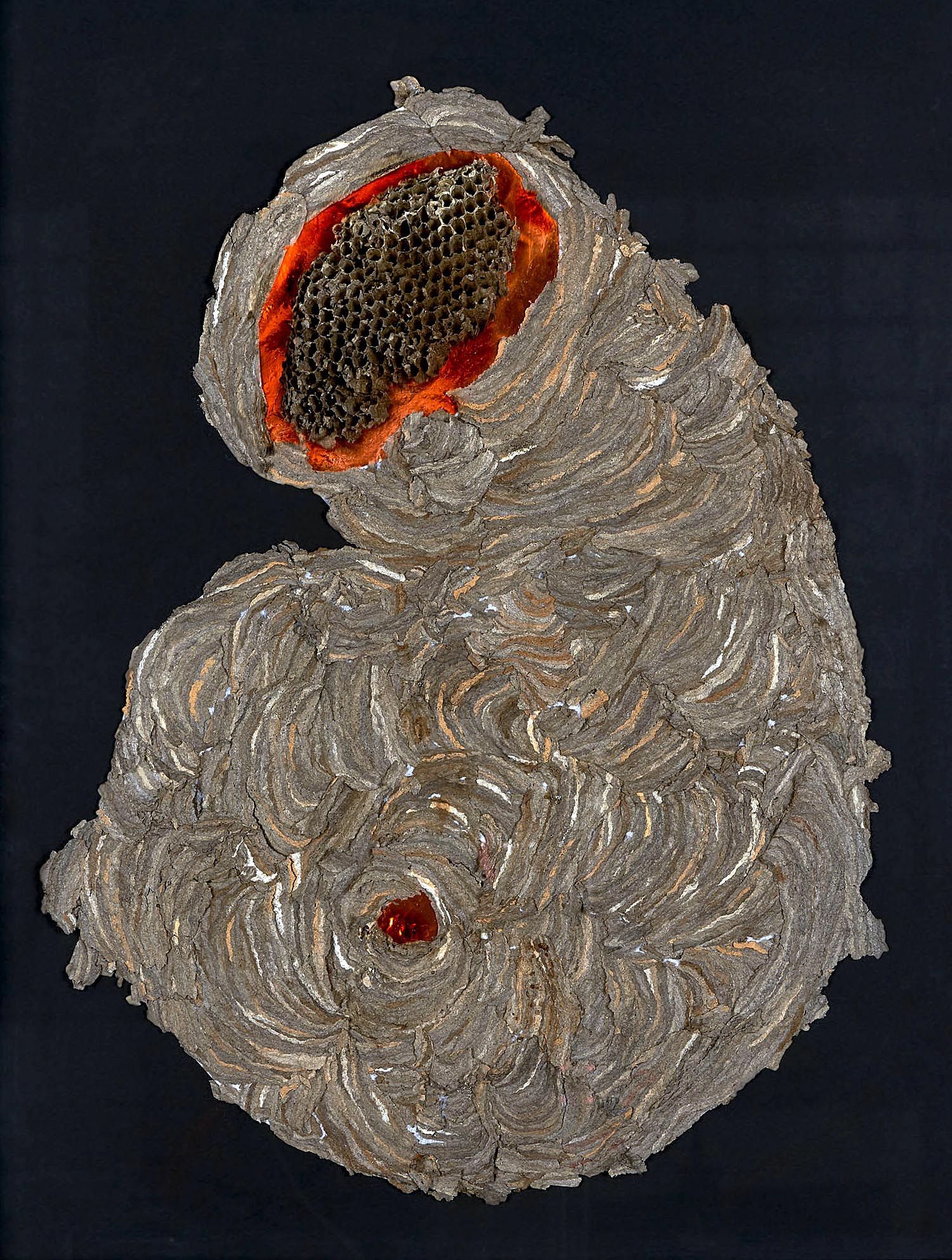
Get ready for something completely different when you pass from Castagnacci to the adjacent gallery housing Christine Welch’s Nature of Things, also up through April 21. The first work that greets you is a “wasp comb,” very much like a honeycomb, framed in a box atop a bed of greenish-yellow leaves. Wasp nests figure large in this unusual exhibition. Indeed, perhaps the most-striking elements are the several large paper-wasp nests hanging from the ceiling like so many cocoons of prodigious size.

Welch says she’s dazzled by our connection to nature, and in particular with the structural similarities beneath the surface of any number of natural forms, the human body included. With Nature’s Seamstress, she constructs a mannequin out of a clothing designer’s dress form, in a skirt made from large sheets of wasp paper, and a round wasp comb for a head. Completing the ensemble are two strands of large, brown seed pods strung together into a necklace.

The combination of oddball elements at first sounds like it might be amusing, a bit of a visual joke, but the actual assemblage is far more sobering than humorous, with suggestions of a totemic form constructed by a people far more intimate with the natural sphere than those of us in the “civilized” world.

An installation view of Nature of Things: Christine Welch, at the Birmingham Bloomfield Art Center through April 21.

Christine Welch, Hive, at the Birmingham Bloomfield Art Center

Both Vincent Castagnacci: Quarry Echoes & Wanderings (1984-2021) and Nature of Things: Christine Welch will be up at the Birmingham Bloomfield Art Center through April 21.


Sons: Seeing the Modern African American Male @ FIA

Sons: Seeing the Modern African American Male & Drawing from Life – Exhibition at the Flint Institute of Arts

Courtesy of the Flint Institute of Art and Jerry Taliaferro

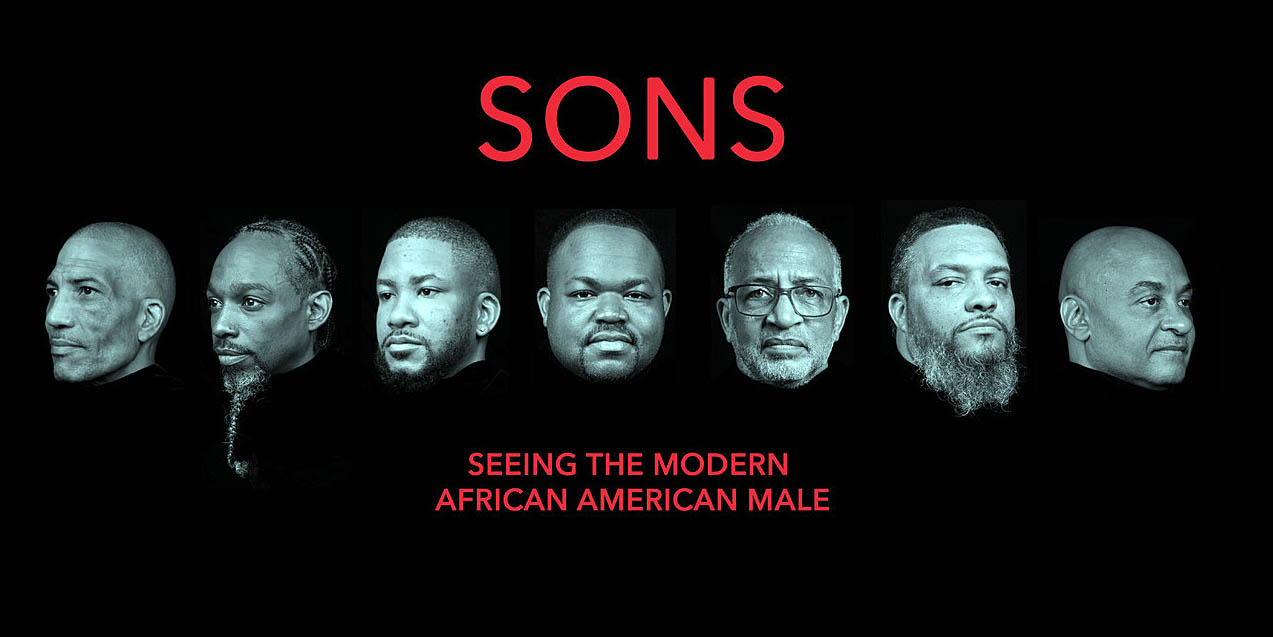
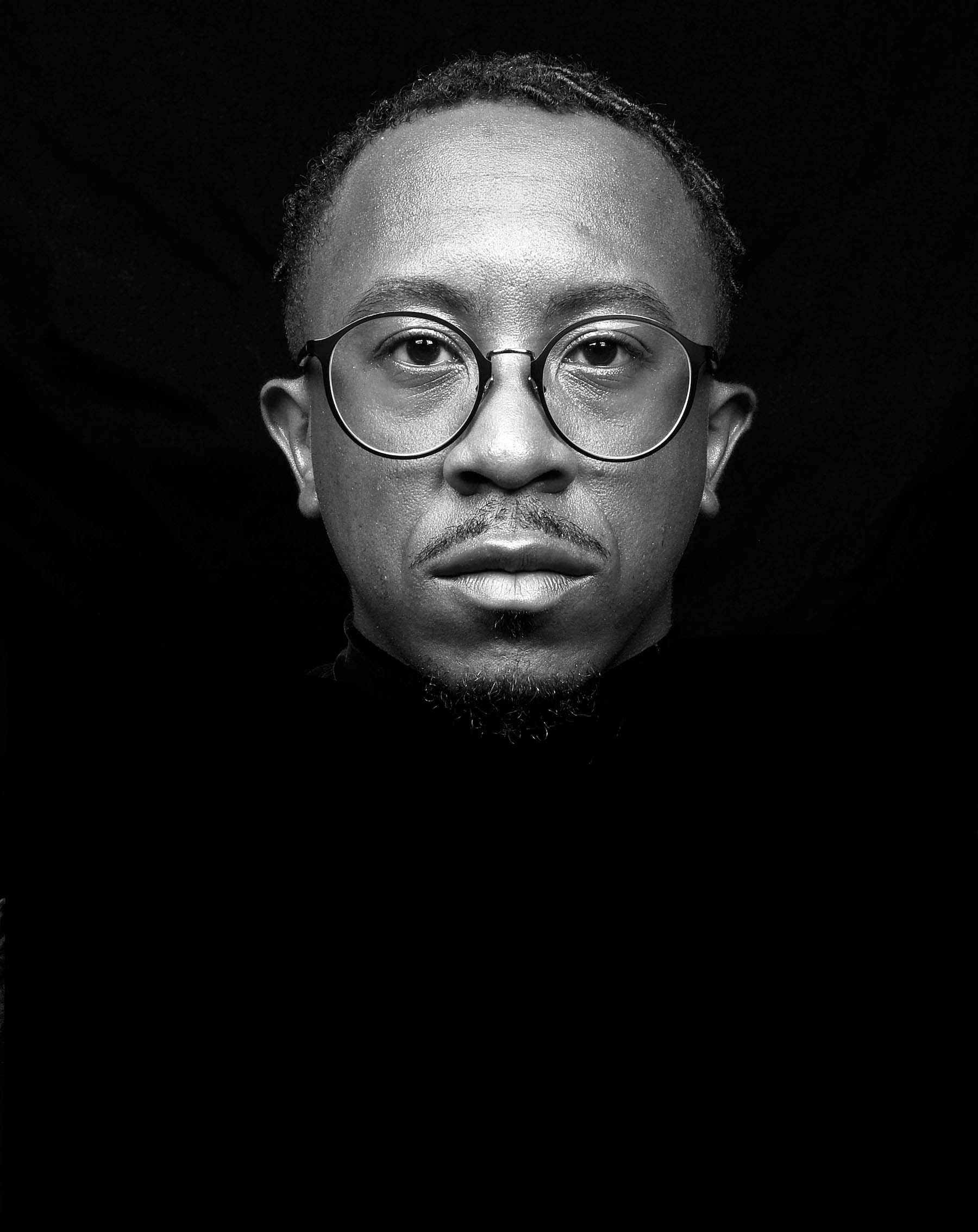
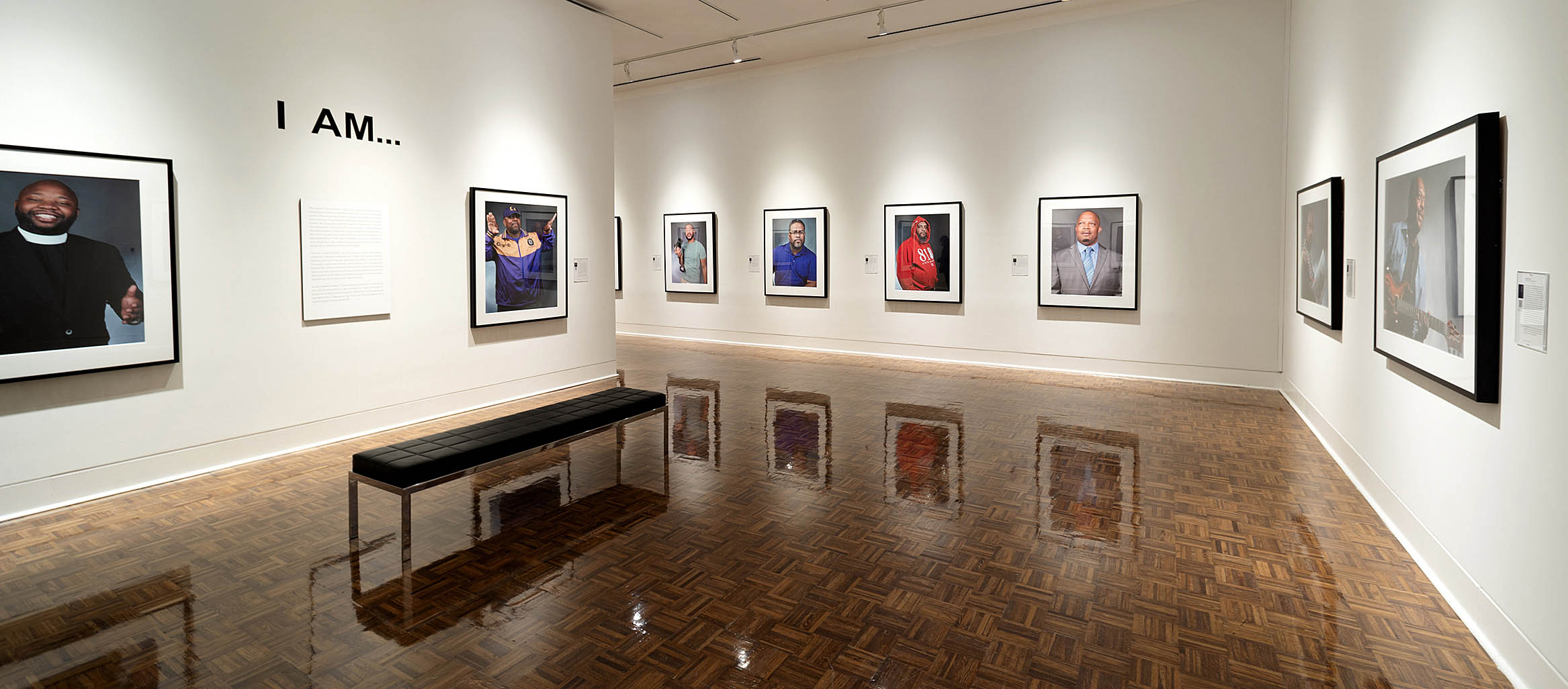
Five years ago, the Flint Institute of Art presented the exhibition Women of a New Tribe, an immensely popular photography show which celebrated the physical and spiritual beauty of 49 Flint area African American women, all photographed by North Carolina-based artist Jerry Taliaferro. An accomplished artist and commercial photographer, Taliaferro’s work has been exhibited in shows on both sides of the Atlantic, including two exhibitions sponsored by the U.S. Department of State. Taliaferro now returns to the FIA with Sons: Seeing the Modern African American Male. This is a large body of work that fills the FIA’s spacious Henry and Hodge Galleries, and serves to confront perceptions and biases while celebrating some of Flint’s civic, business, and spiritual leaders.

Courtesy of the Flint Institute of Art and Jerry Taliaferro

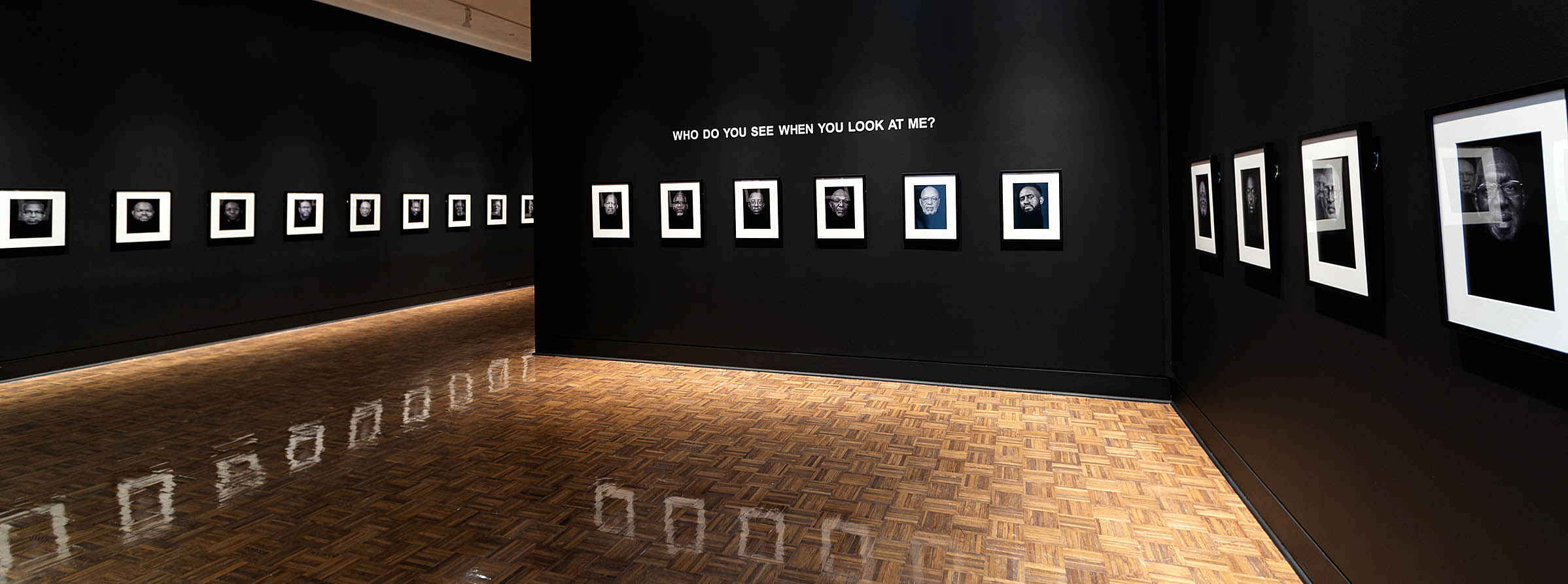
Like Women of a New Tribe, this is a traveling exhibition that has different iterations at each host venue. Here, community members nominated men who had impacted Flint in a positive way, and these individuals became the subjects of the exhibit. Entering the gallery space, visitors first encounter a set of black and white photographs of each individual, and text on the wall poses the question “Who do you see when you look at me?” Each subject meets the camera’s gaze, unsmiling. Everything below their chins is cropped out, and their heads seem to hover in indeterminate space. The absence of any props or details invites viewers to encounter each face at, well, face value, and try to read the furrowed brows and creased foreheads for some hint at deciphering their respective stories and personalities.

Courtesy of the Flint Institute of Art and Jerry Taliaferro


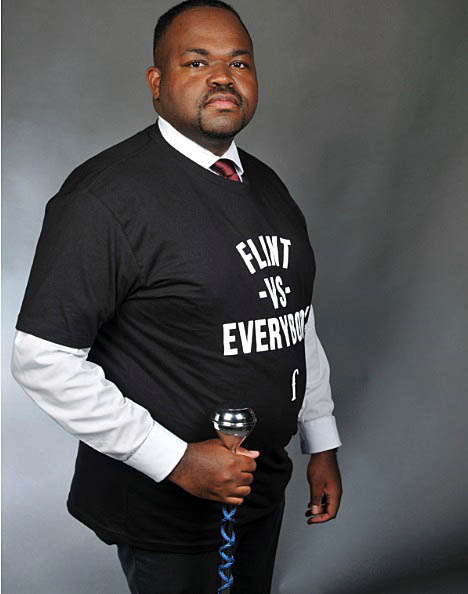
This first series of images is answered with a second set of larger color photographs, and accompanying text on the gallery wall declares “I Am…” The same men pose for three-quarter portraits this time, sometimes whimsically (though always dignified), and the clothing they wear and the props they carry offer us substantially more insight into who these individuals actually are. Unlike the first series, these photographs are accompanied with the name and a brief biography of each individual. All deeply involved in their respective communities, these men are teachers, pastors, businessmen, entrepreneurs, musicians, philanthropists, volunteers, husbands, fathers, and sons.

Careful and thoughtfully posed compositions assist in the visual storytelling to elevate these images beyond a photographic directory of Flint’s Who’s Who. And there is thoughtful conceptual significance in presenting these two parallel sets of portraits. Taliaferro writes, “As a Black American male I have sensed the discomfort of others (and myself) in certain encounters, I have also been amazed how this discomfort dissipates as we learn more about one another and discover the many things we have in common. This simple exhibition is a humble attempt to dispel some of the fear and discomfort.” Indeed, after we’ve learned about these individuals and heard their stories, returning to the first set of photographs seems like returning to old acquaintances, and the exhibition invites us to reflect on the ways and the frequency with which we subconsciously and baselessly draw conclusions about individuals.

Courtesy of the Flint Institute of Art and Jerry Taliaferro

Courtesy of the Flint Institute of Art and Jerry Taliaferro

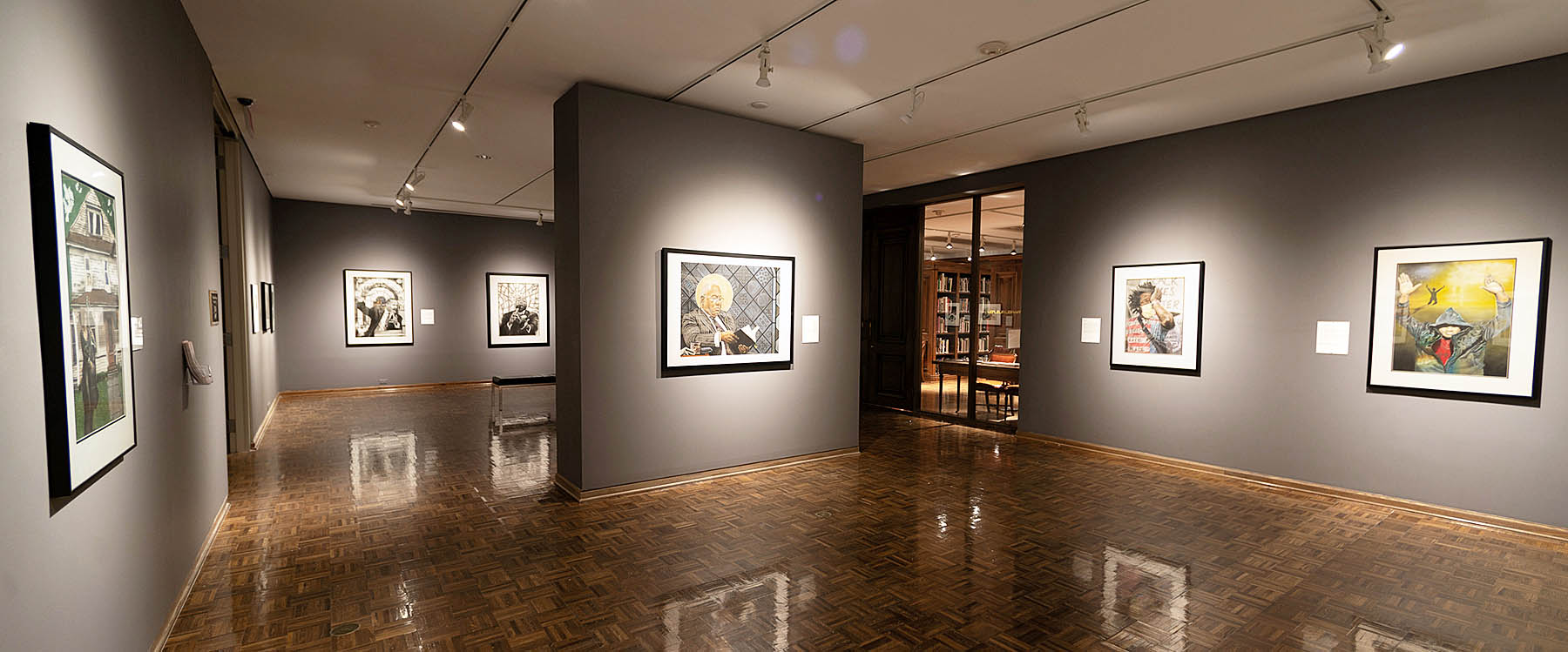
Drawing from Life, a concurrent (but unrelated) exhibition in the FIA’s single-space Graphics Gallery complements Sons with an exhibition of socially and spiritually resonant drawings by Ed Watkins, a Flint native who taught at the Genesee Area Skill Center and Mott Community College. The show takes its title both from the artistic practice of drawing from life, and also from Watkins’ philosophy of art, for which his creative practice is guided by his lived experience as a Black artist, and the Black experience is central to his work.

Courtesy of the Flint Institute of Art and Ed Watkins

Watkins’ ambitiously large drawings employ a visual magic realism; his figures are rendered with exquisite draftsmanship, and elements within his drawings add layers of symbolism and allegory. His drawings stylistically rhyme with the works of Chicago’s Charles White, whose drawings were also rendered ambitiously large and applied tight, representational draftsmanship relentlessly underscored by faith and a yearning for justice.

Some of his most socially resonant works are those inspired by the recent police shootings of Michael Brown (Surrender Jonesz) and the death of George Floyd (Breathe), the latter of which portrays Tristan Taylor, organizer of the “Detroit Will Breathe” march in the summer of 2020. Taylor’s face is largely covered by his facemask, but Watkins captures his impassioned eyes and furrowed brow, which speak to the moral weight of his cause.

Faith informs many of these images, some of which are richly freighted with spiritual symbolism. The Ravens: I Kings 17 depicts a volunteer distributing cardboard boxes of food to unseen recipients while under the watchful eyes of nearby ravens. The work references the Biblical story of Elijah, miraculously sustained in the wilderness by ravens who brought him food. It’s an image also inspired by the toll the Covid pandemic took on individuals suddenly displaced from their jobs, and the churches and community organizations that distributed provisions to the food-insecure.

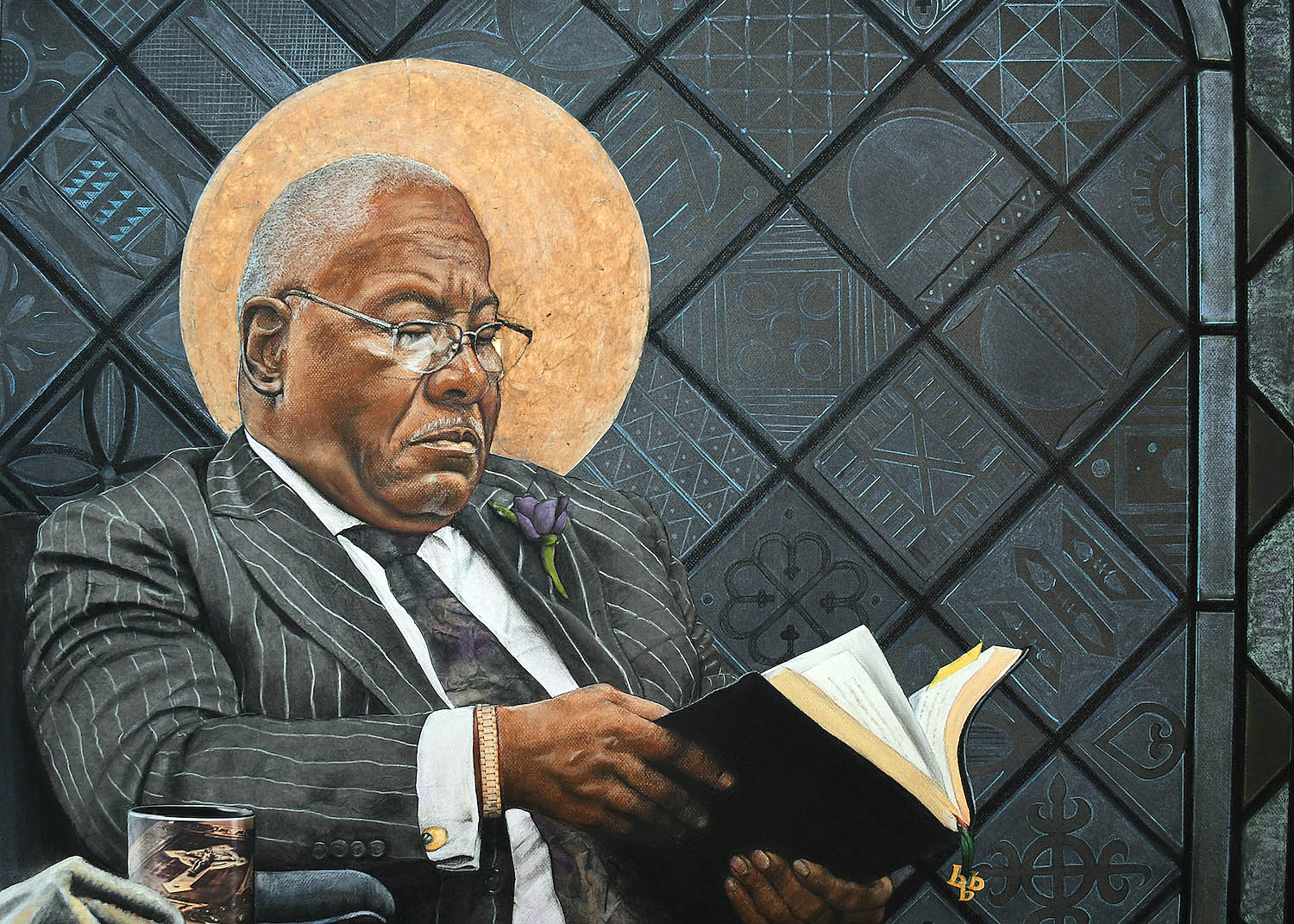
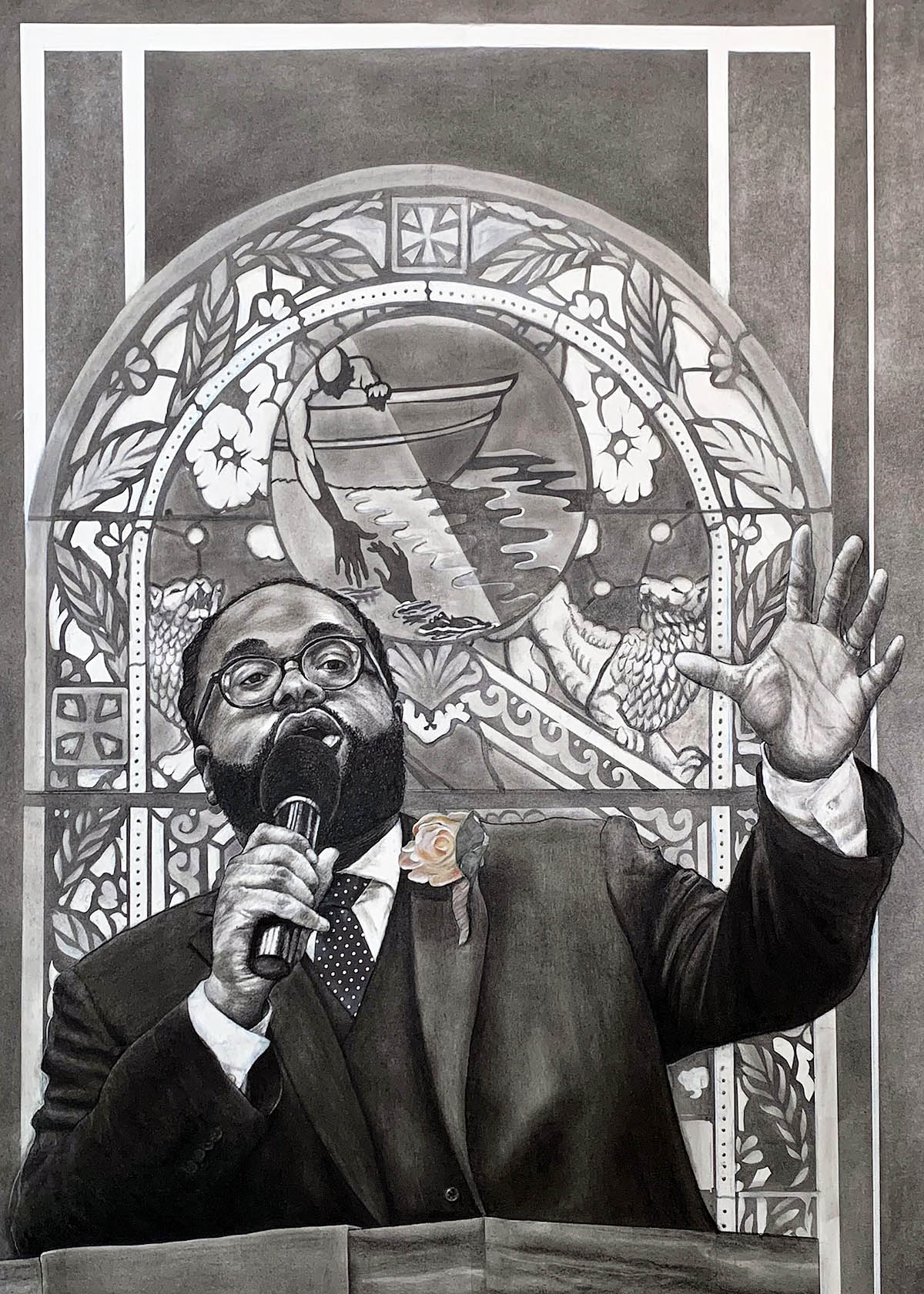
The four works on view from his Preacher series are particularly forceful. Sometimes rapturously animated, sometimes soulfully contemplative, but always expressive, these drawings portray pastors, including some from the Flint area.  Watkins tactfully uses the stained-glass windows in the background to underscore the content of the sermons which directly inspired each work. Most of these drawings show each preacher mid-sermon, but his portrait of Marvin Jennings (Sr. Pastor Emeritus of Flint’s Grace Emmanuel Baptist Church) captures the subject in a moment of solitude and quiet reflection, the stained glass panels in the background portraying Ghanaian symbols for peace, unity, and other virtues.

Courtesy of the Flint Institute of Art and Ed Watkins

Courtesy of the Flint Institute of Art and Ed Watkins

Taliaferro’s photographs and Watkins’ drawings are most rewarding when viewed in person, where their comparatively large scale can be best appreciated. But much of Taliaferro’s show can be accessed digitally, including video interviews of each of the men featured in Sons.  While each of these two exhibitions apply different media to explore different facets of the Black experience, they certainly pair well together. Both shows are imbued with social relevance, and each is fortified by quiet dignity and relentless optimism.

Sons: Seeing the Modern African American Male is on view at the Flint Institute of Art through April 16, 2022.

Drawing From Life: Ed Watkins is on view through April 10, 2022.


Northwest Michigan Regional Juried Exhibition @ The Dennos

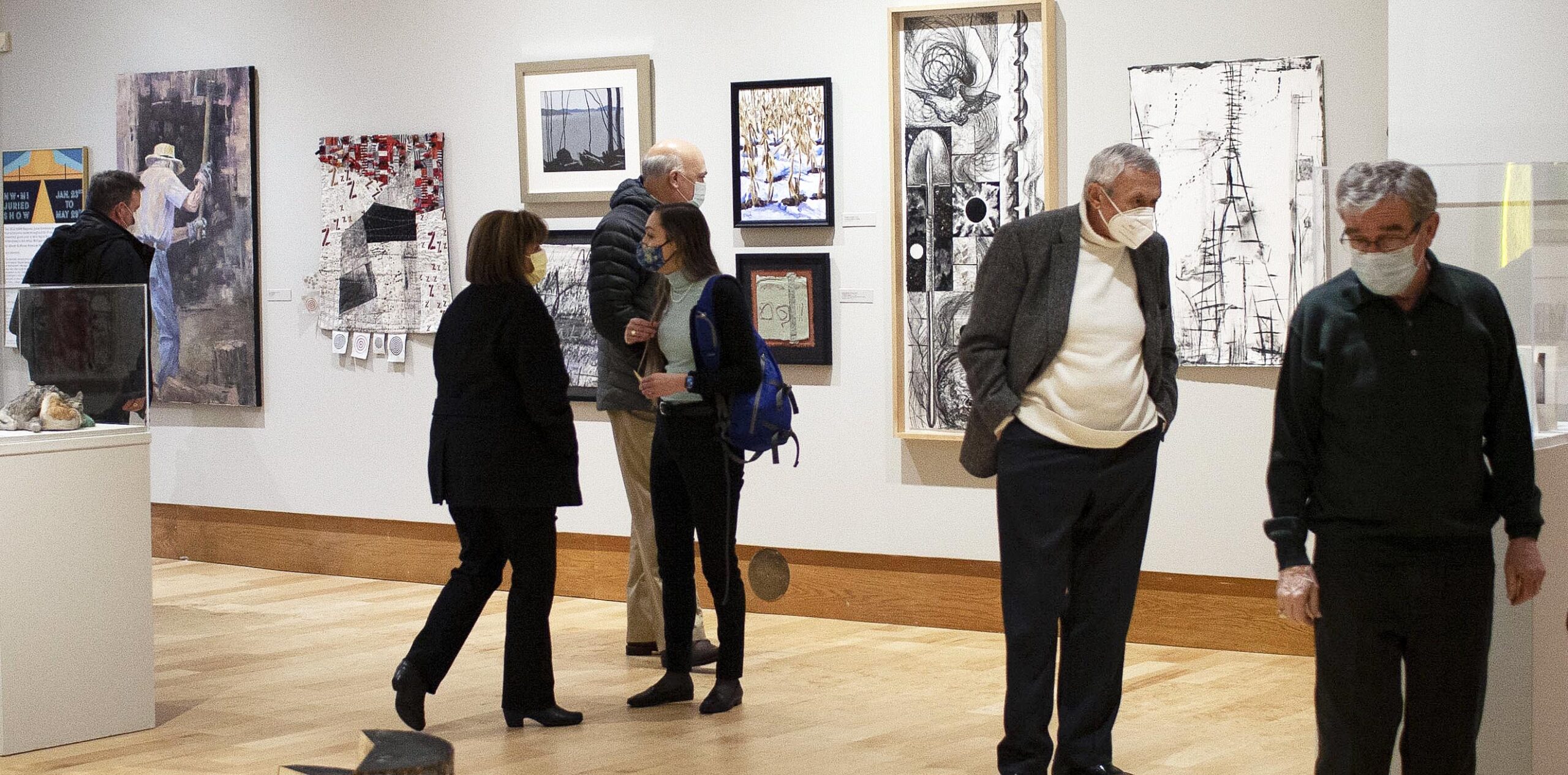
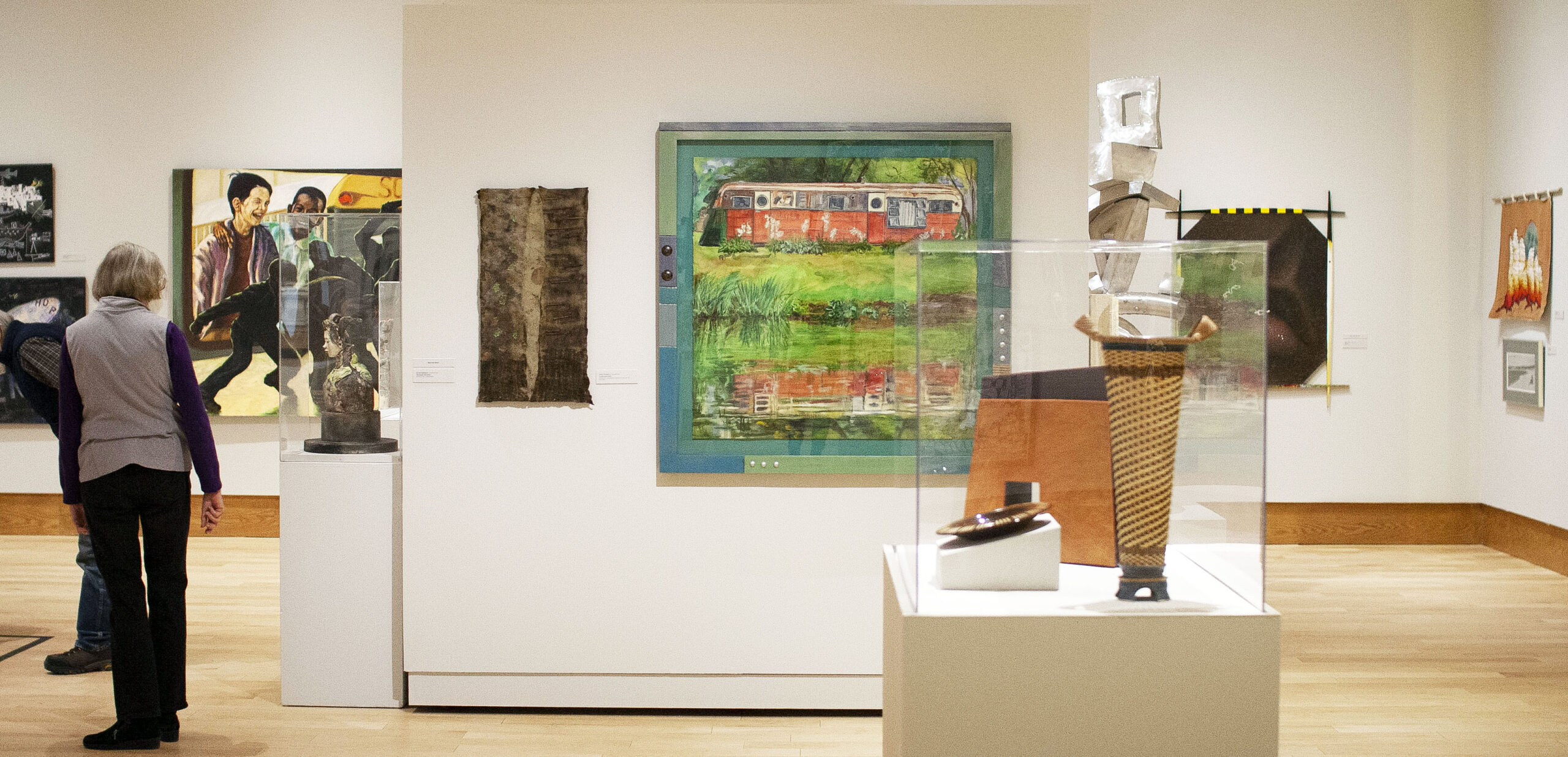
Installation image. All photos courtesy of the Dennos Museum Center

Visiting the Dennos Museum Center in Traverse City is an experience unique to Northern Michigan. Situated at the base of Old Mission Peninsula, since 1991 the Dennos served as a multipurpose art and science museum, and it houses one of the finest collections of Inuit art you’ll ever see. In 2018 it underwent a major expansion, and an impressively large suite of chic gallery spaces now allows the Dennos to show off much more of its permanent collection, and it really does have some good holdings. The museum has even just been awarded status as a Smithsonian affiliate. But while the focus of the museum is on the art within, the floor-to-ceiling windows of many of its exterior galleries offer visitors a commanding view of the pleasantly forested campus of Northwestern Michigan College.  Through May 29, this emphatically northern space is the appropriate home to the annual Northwest Michigan Regional Juried Exhibition.

The show amply fills the museum’s spacious temporary exhibition space. It presents multimedia work by artists from 37 Michigan counties, including the entirety of the Upper Peninsula and much of the Lower Peninsula’s Northwest.  Submissions were open to anyone, providing that the work was created during 2021.  Juried by Vera Ingrid Grant, a curator and writer based in Ann Arbor and whose accomplishments include fellowships at Harvard and Columbia universities, the 90 works on view represent highlights from the show’s nearly 400 submissions.

Dennos Museum Center in Traverse City Installation image.

Any juried show is destined to be varied in scope and media, and these works are certainly diverse– there are 83 artists represented, after all. Painting, sculpture, photography, and illustration join forces with quilting, fabric art, wood art, and pottery, blurring boundaries between fine art, folk art, and handcraft. Nevertheless, some themes do emerge, such as our shared experience of Covid-19, here directly addressed in about half a dozen works. Several works offer social commentary on timely subjects like media saturation and information overload.

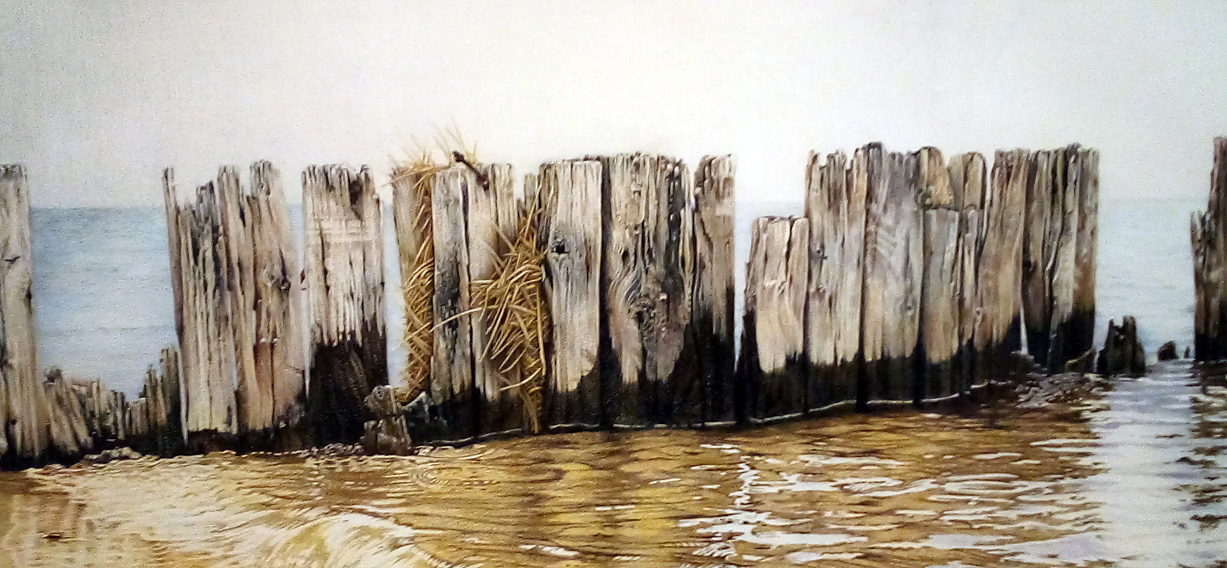
Many of these works take the landscapes, waterscapes, and textures of Northern Michigan itself as their subject. Ample views of Grand Traverse Bay and Lake Michigan’s sand-dunes firmly locate this show in Northern Michigan. Thomas Guback’s Northport Sailboat Race is a photograph that beautifully transposes the lucid diamond-tipped ripples of Lake Michigan’s waters into black and white, applying some of Ansel Adams’ magic to demonstrate that color isn’t necessary to give the viewer an arresting image. And Lynn Stephenson’s tightly rendered pencil drawing of a row of weathered, neglected dock pilings captures a sight common at any marina on Lake Michigan’s shoreline; Stephenson renders the texture of the mostly rotted wood and the ripples of the water with impressively photographic, illustrative detail.

Lynn Stephenson, Still Standing [detail]. 2021, Colored pencil on Paper.

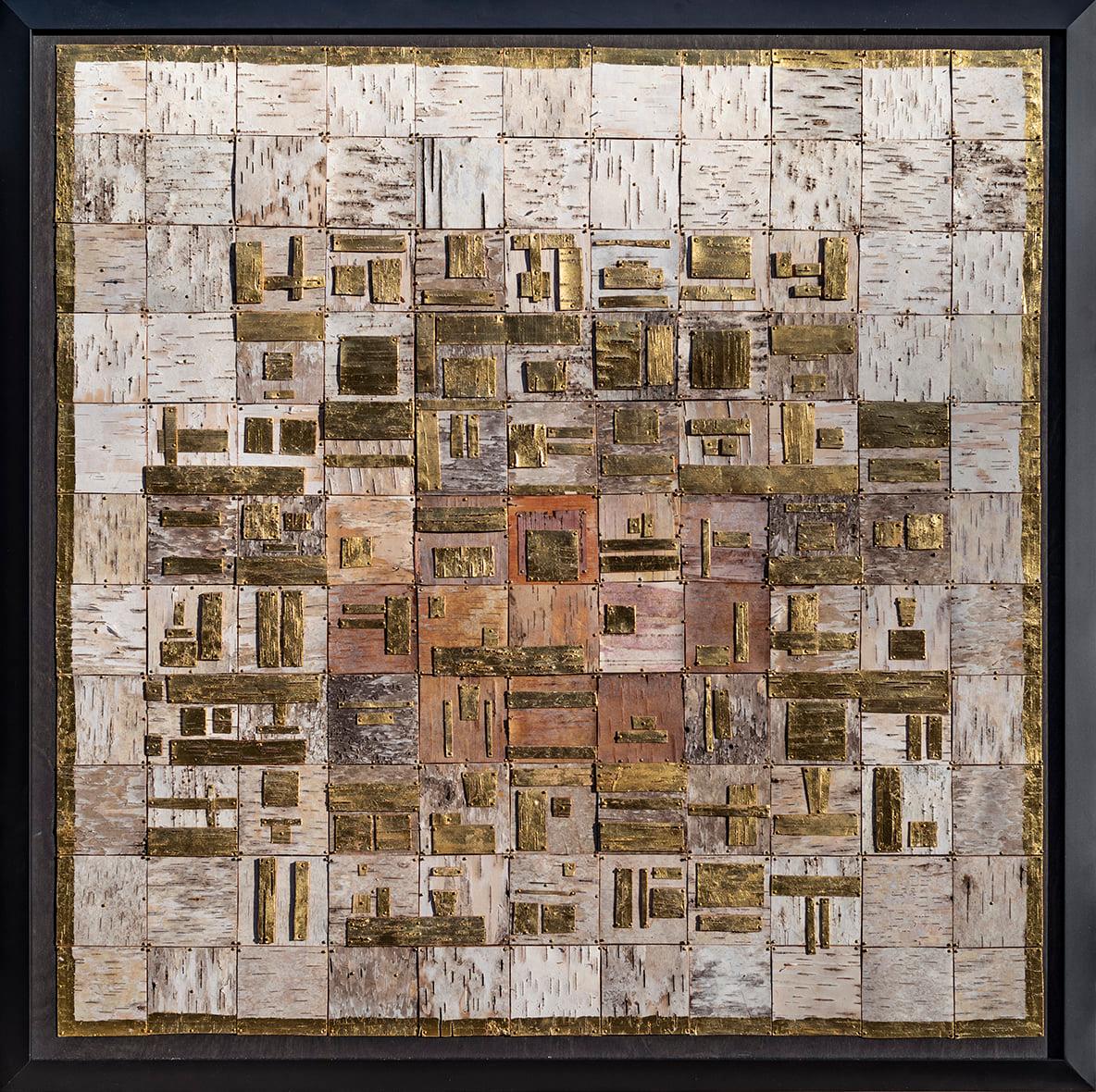
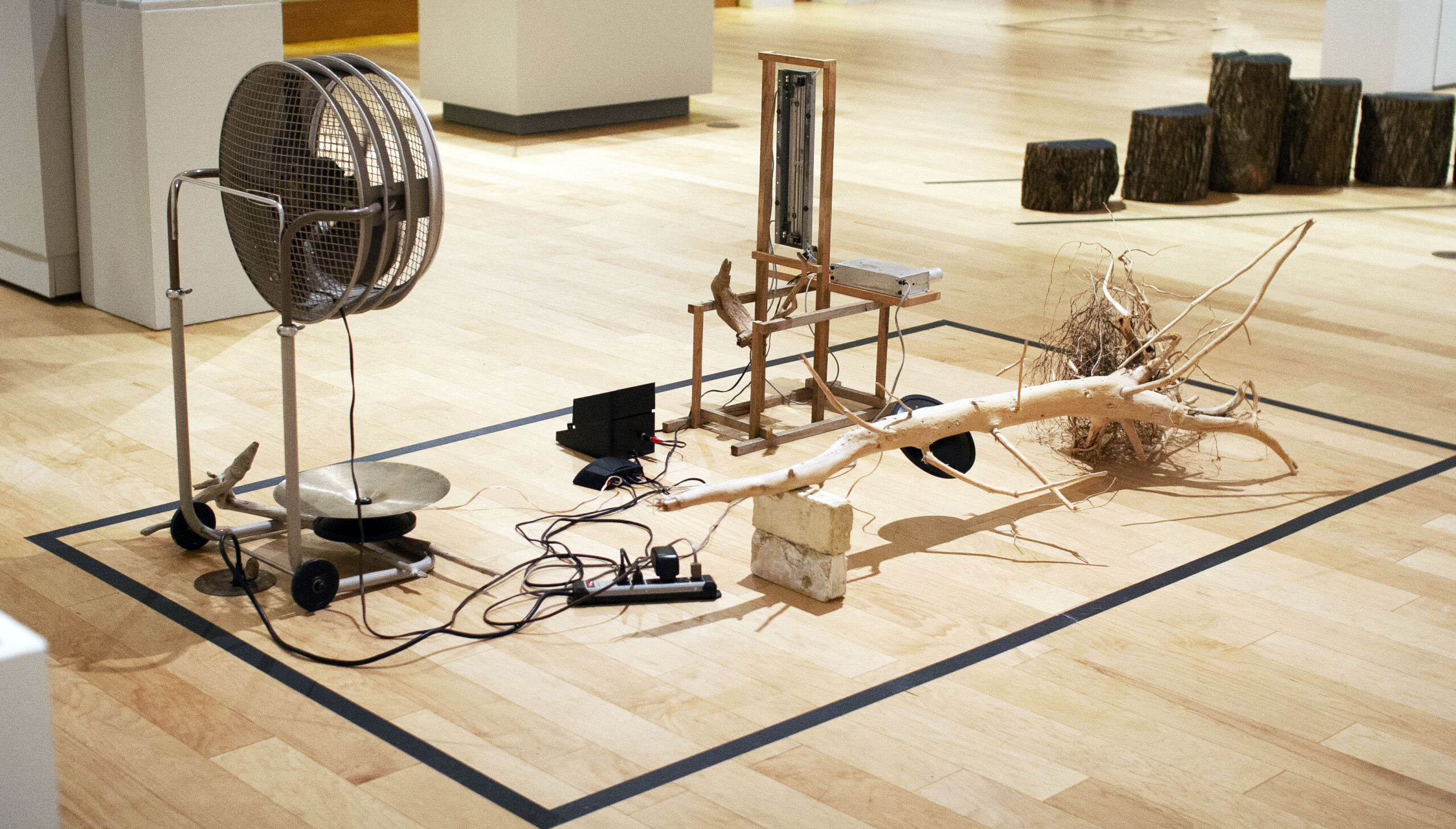
Other artists engaged Northern Michigan’s geography in more playfully abstract terms.  Susan Yamasaki’s Hieroglyphs applies perpendicular, geometric sections of birch bark and mixed media to create what could pass as Northern Michigan’s answer to Mondrian’s Broadway Boogie Woogie. And the Best of Show award went to Kevin Summers, a multimedia artist whose Michigan Shoreline is a conceptual installation comprising driftwood, electronic fans, and sound.

Susan Yamasaki, Hieroglyphs. 2021, Birchbark and mixed media on birch panel.


Kevin Summers, Michigan Shoreline. 2021, Driftwood, fans, and electronics.

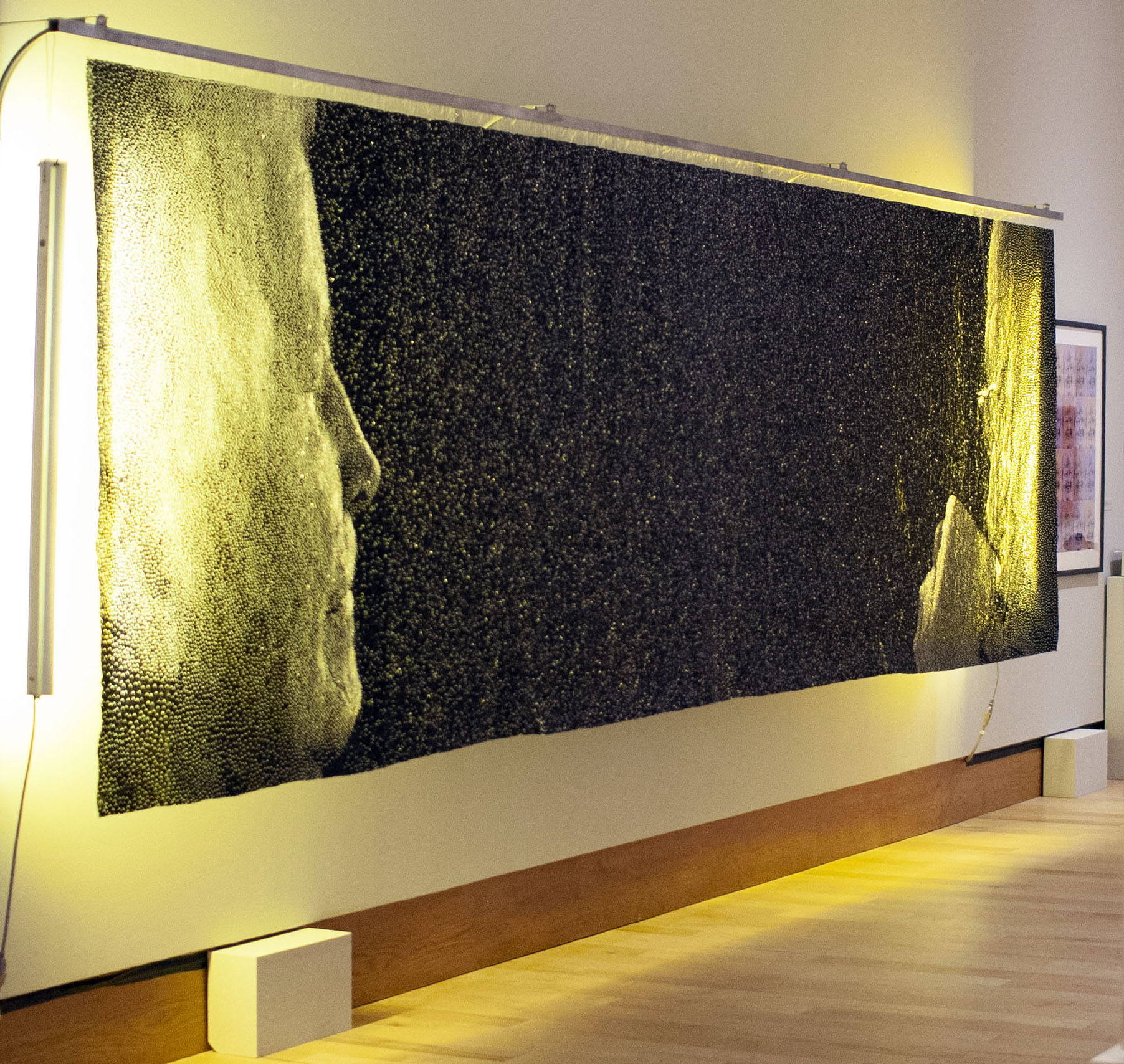
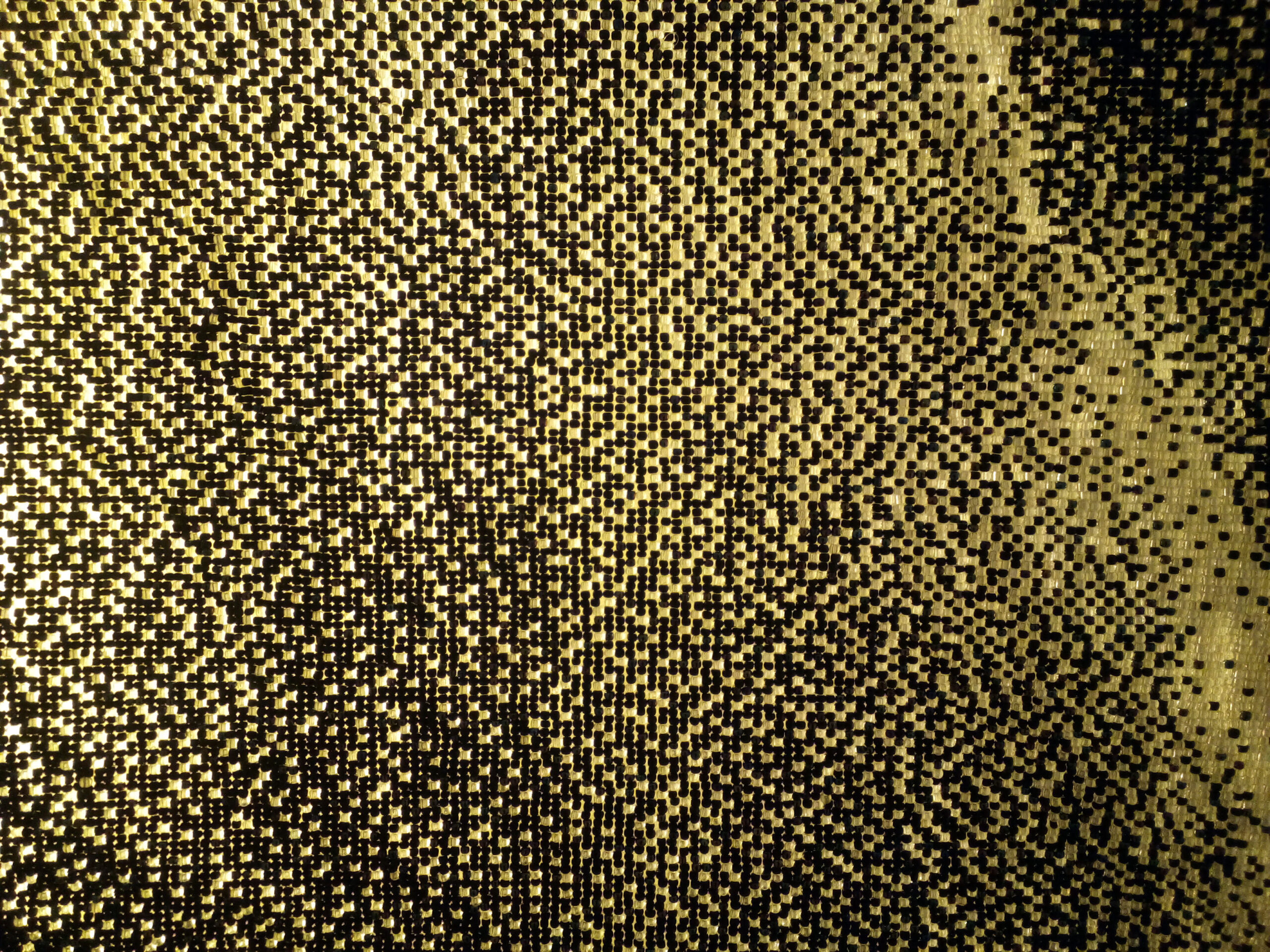
Certain to be a highlight among visitors is the mural-sized bead tapestry by Marie Wohadlo, 10:23. Gently backlit, this work comprises nearly a million individual luminous glass beads. It’s a work that invites viewers to play the same game as one might play with a pointillist work by Seurat. Step up close, and the individual beads create a pixelated, abstract void. Step back, and they materialize into a photographic rendering of two distant faces. The planning and execution of a work on this scale is impressive, even allowing for photographic and technological assistance.

Marie Wohadlo, 10:23 [detail]. 2021, Glass bead tapestry.

Marie Wohadlo, 10:23 [detail]. 2021, Glass bead tapestry.

Shows like this have a leveling, democratizing effect on art. There’s nothing to differentiate the skilled amateurs from the seasoned professionals.  And in the absence of any descriptive didactic panels, viewers are left to interpret these works entirely on their own. Perhaps this is a good thing; too often I find myself relying on an exhibition’s expository text to do much of the thinking for me.  But here, viewers are given the opportunity to approach the work on their own terms, and the works on view are given the chance to speak for themselves.

The 2022 Northwest Michigan Regional Juried Exhibition runs through May 29, 2022. Views of the evergreens on the NMC campus are available all year round.


Page 5 of 15

Powered by WordPress & Theme by Anders Norén