Critical art reviews of Detroit galleries and museums weekly

Category: Photography Page 19 of 22

After Dark @ Detroit Institute of Arts

dia-install-photo

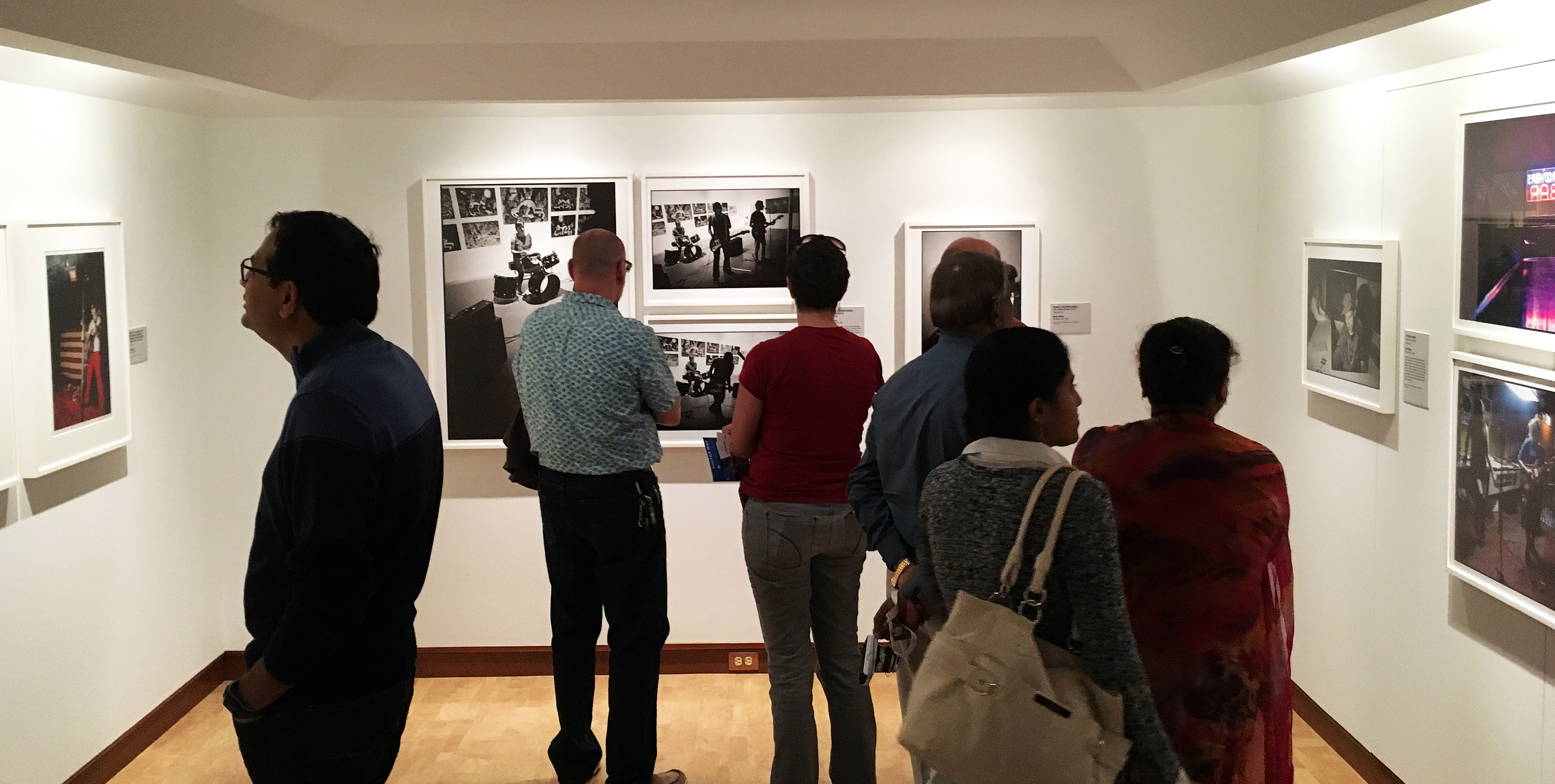
Installation, Detroit After Dark, Image courtesy of the Detroit Art Review

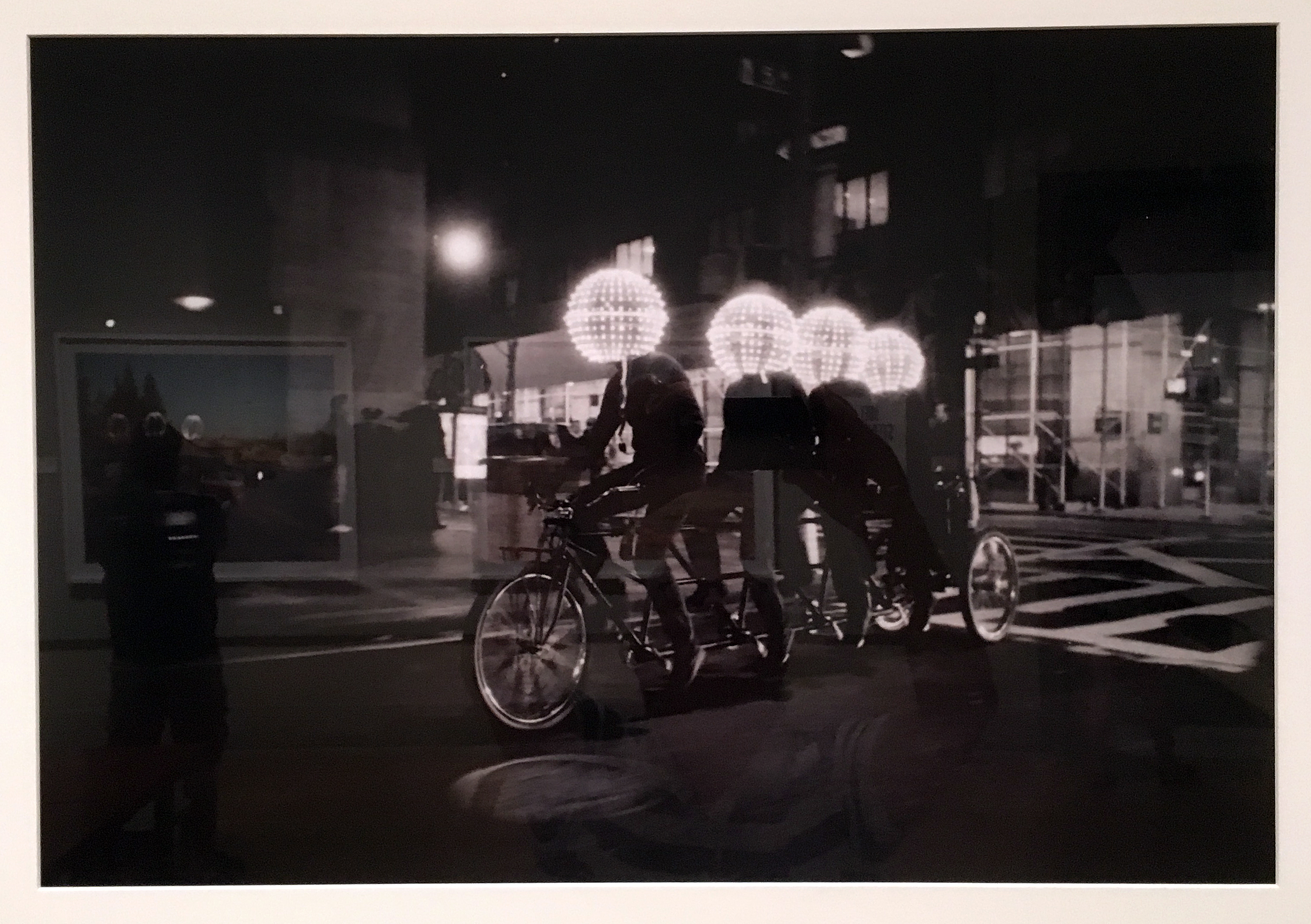
Photography at night has been around since the late 1800’s when photographers were experimenting with exposing a variety of sensitive chemicals to light, first on plates by Louis Daguerre, followed by salt prints on paper by William Talbot. Later in the early 1900’s Alfred Stieglitz began working at night, and in 1932, Brassai published Paris De Nuit, a collection of black and white photographs of the streets of Paris at night.

The Detroit Institute of Arts (DIA) has turned to its collection under the direction of Nancy Barr, Curator of Photography, to produce Detroit After Dark. She says in her statement in the catalogue, “Detroit After Dark: Photographs from the Collection of the DIA takes a closer look at night photographs made in the Motor City just after 1950 through present day—its city streets and architecture, as well as its diverse and often frenetic music scene.”

For the purpose of this review, this writer will draw a distinction between the journalistic photography (mostly the Detroit music scene) and focus on the art photography in the exhibition.
rf-untitled-%22strawberries%22-1955-gelatin-silver

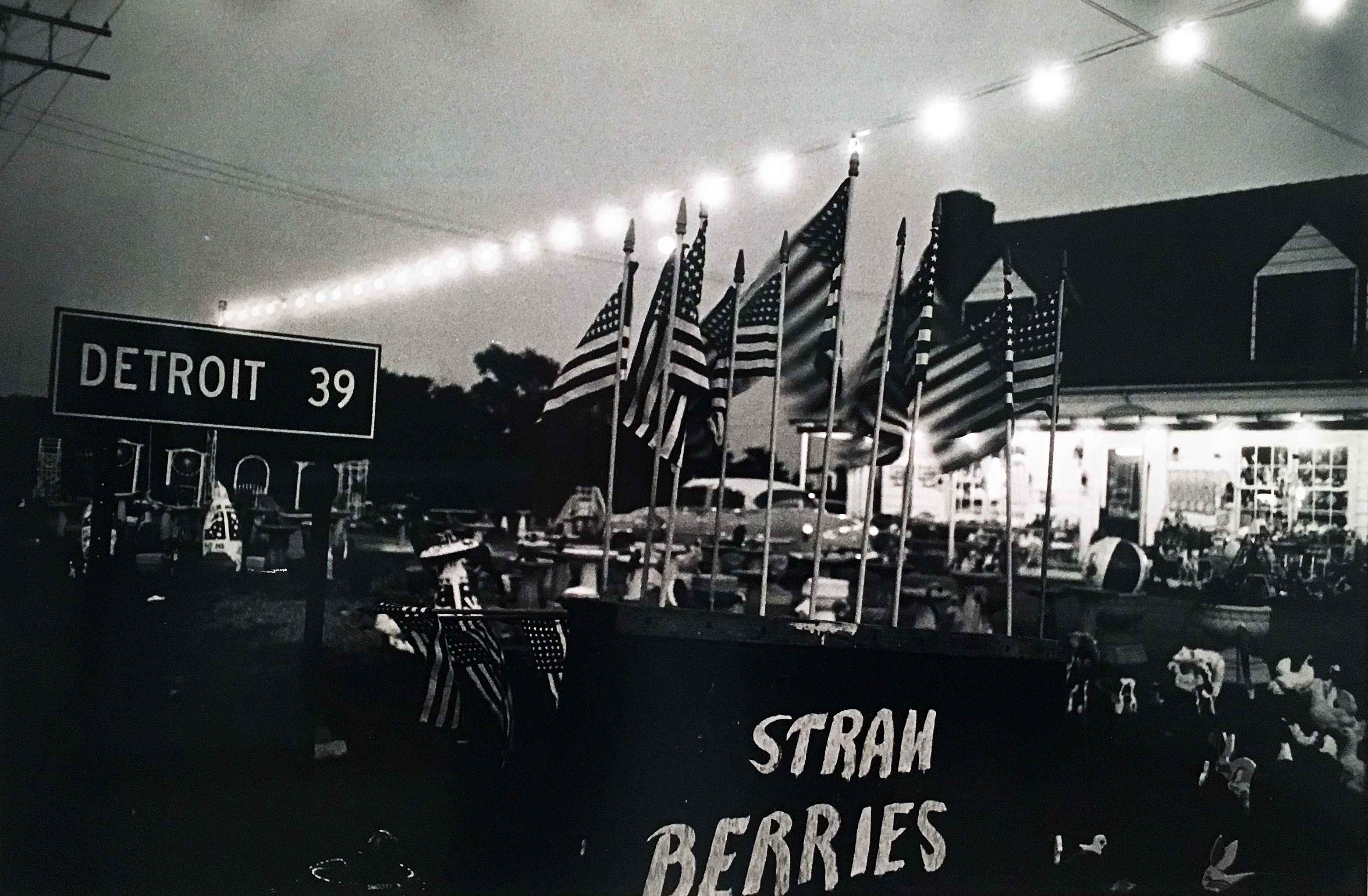
Robert Frank, Untitled, Gelatin silver print, 1955

With a Guggenheim grant in his pocket, Robert Frank bought a used Ford in June of 1955 and began a 10,000-mile journey around the United States. Detroit was one destination where he stayed long enough to capture images from Belle Isle to this Romeo strawberry stand at night, illuminated with a string of party lights. After developing and making contact sheets from 760 rolls of black and white Tri-X film, 83 images would be enough to make The Americans, first published in Paris, then eventually the United States. Frank didn’t set out to address the issues that faced the country, but inadvertently became an incontestable witness, using his 35mm Leica Rangefinder, to the solitude of American society.
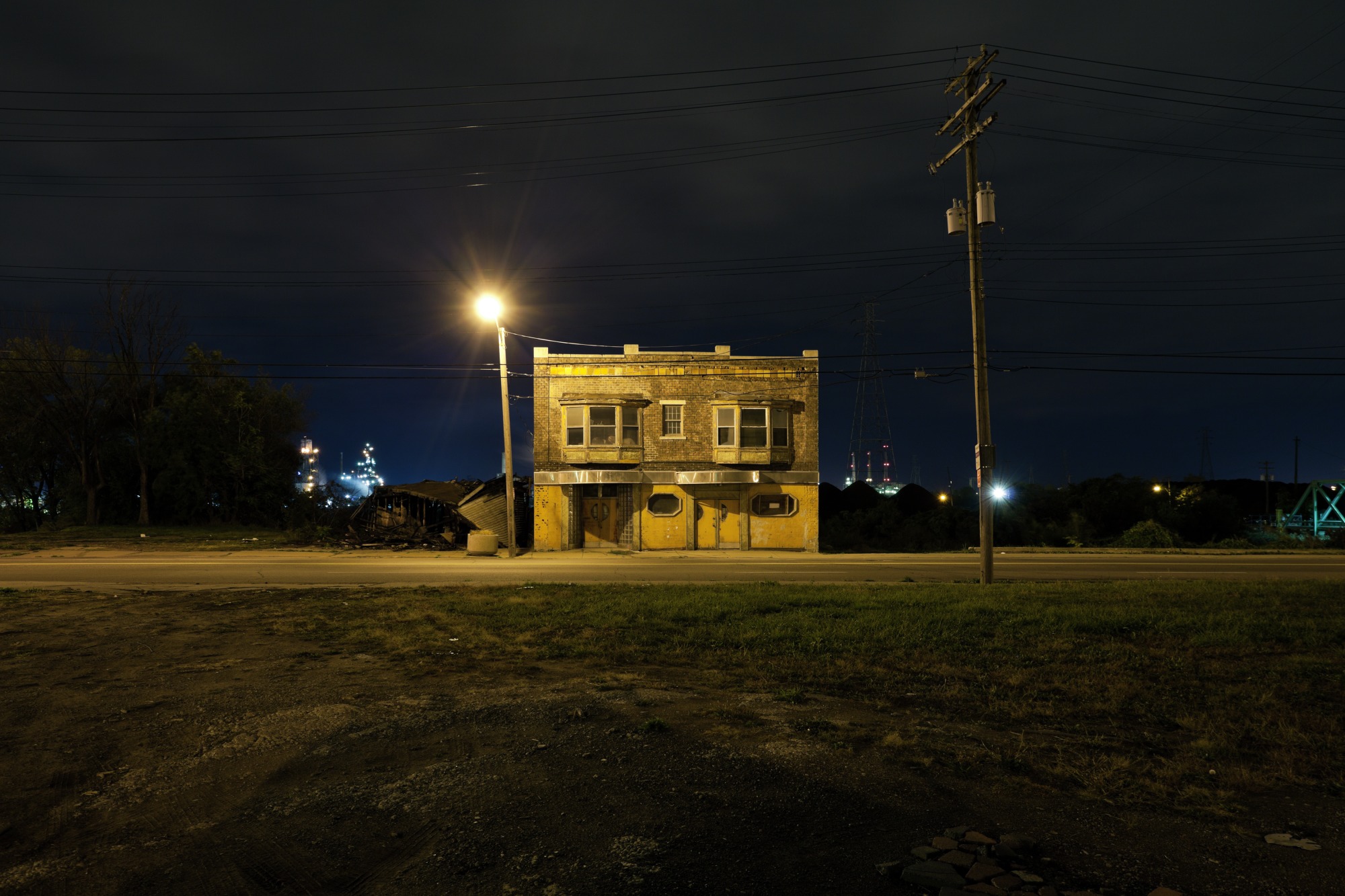
image-457jefferson-at-dearborn

Scott Hocking, Jefferson at Dearborn, Pigment Print, 2012 Courtesy of the DIA

Scott Hocking, a Detroit artist who has created site-specific sculpture installations and a variety of photographic projects, provides the viewer with a stark image of a lonely building on Jefferson Avenue, formally centered with time exposure that provides a lit building against a Windsor backdrop. The exposure is possible because of the stillness in the frame. Detroit Nights is an ongoing project, documenting the streets, railroads, quiet corners and unpredictable public lighting of Detroit at night. In a statement, he says, “I am interested in forgotten places, and things kept out of sight. I don’t know if this is because I’m from Detroit, a city that has become known for urban prairies and empty factories; but I try to work the same way no matter where I am.” Scott Hocking is represented by the Susanne Hilberry Gallery.
jenny-risher

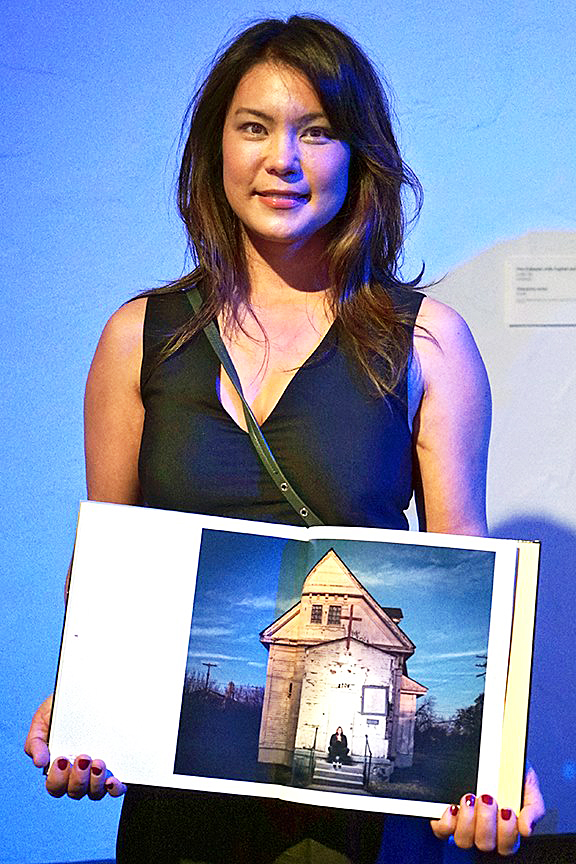
Jenny Risher, Image courtesy of Jeff Cancelosi

Jenny Risher, shown here holding her book with her photograph from the exhibition, is a commercial photographer with a collection of personal work. Known for her book, Heart Soul Detroit, where she interviewed and photographed 50 iconic Detroiters, including Smokey Robinson, Jack White Eminem and Lily Tomlin. Here in this image is Ms. Risher holding open her book, revealing the image from the exhibition, Mr. Porter.
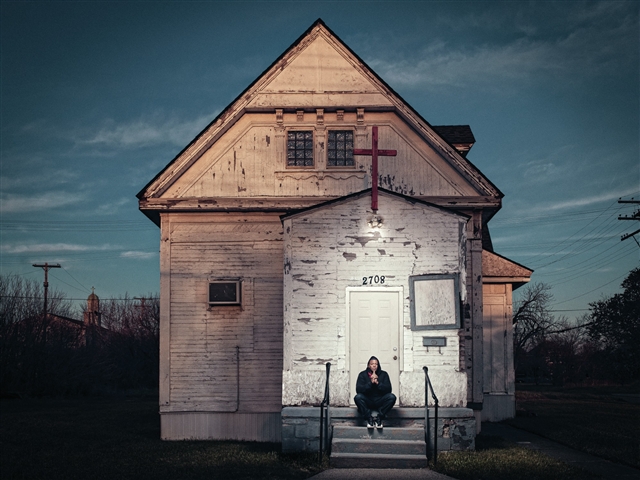


image-462mr-porter

Jenny Risher, Mr. Porter, Pigment print, Courtesy of the DIA


abandoned-brush-park-building-d-jordano

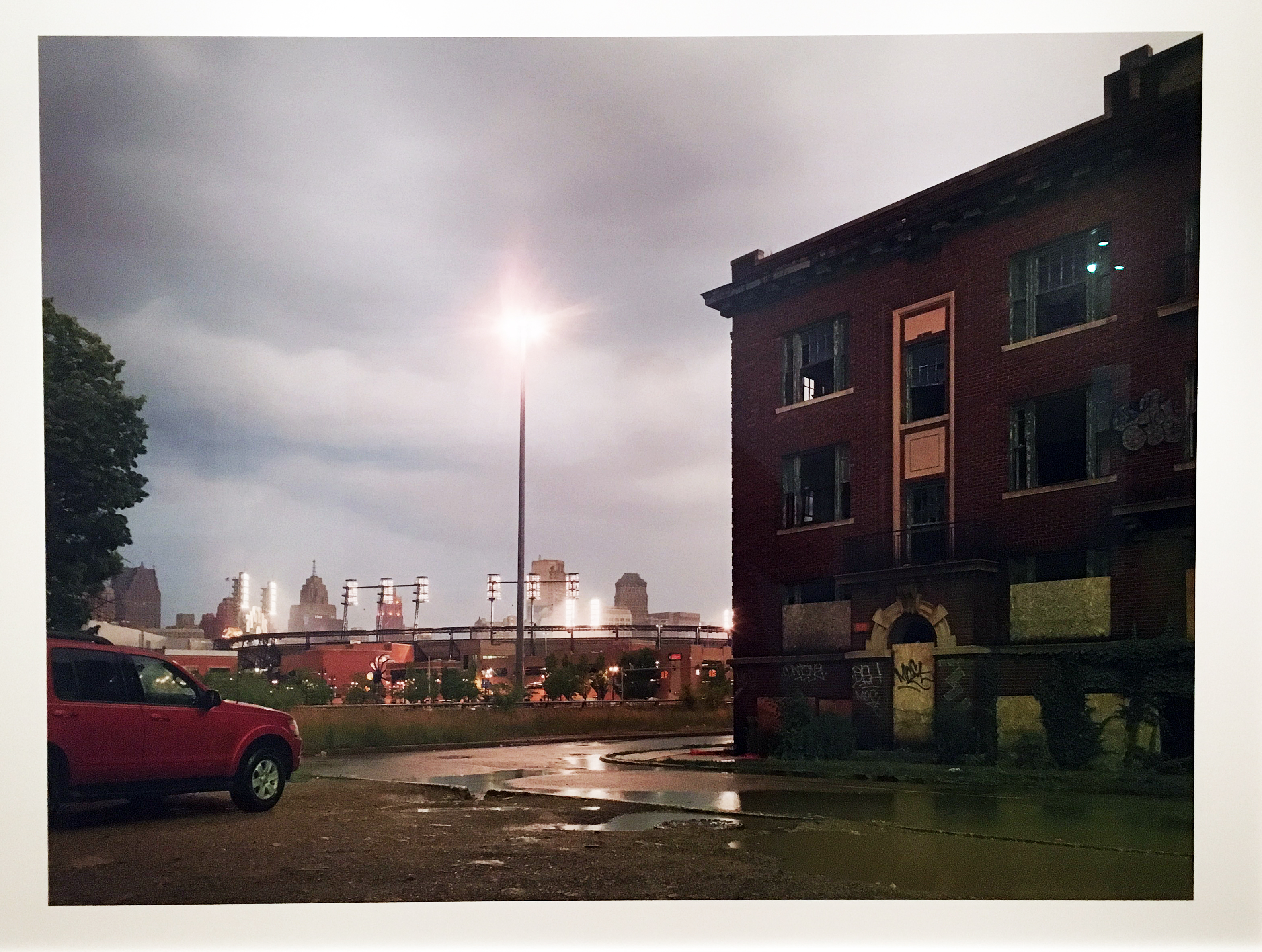
Dave Jordano, Abandoned Brush Park Building, Pigment print, 2010, Courtesy of the DIA

Dave Jordano first established himself as a successful commercial photographer in Chicago working with national print campaigns, before turning his lens to personal work here in Detroit. Jordano was born in Detroit and graduated from the Center for Creative Studies in 1974 with a BFA in Photography. His large image, Abandoned Brush Park Building, dominates the exhibition with its scale depicting the contrast between this abandoned building and the lights of Comerica Park. He says in a statement, “These photographs represent a visual document that speaks to the quiet determination of Detroit residents, both as independent shop operators and as home owners who have survived the long and difficult path of living in a post-industrial city stripped of economic prosperity and opportunity. These photographs speak truth without casting an overly sentimental gaze.” Like other photographers in Detroit, there seems to be a trend in capturing a still image using a tripod to provide the ability to depict a large depth of field and focus, highlighted by a light source.

The Detroit Institute for the Arts and its permanent collection bring powerful imagery in the Detroit After Dark, exhibition. DIA Director Salvador Salort-Pons says in the catalogue, “The DIA is indebted to the photographers committed to their practice in the city and who have contributed to this exhibition. I am grateful to those artists who have gifted their work to the museum and to the patrons who have donated art and contributed funds for the purchase and acquisitions of photographs for the permanent collection.”

Detroit Institute of Arts

5200 Woodward 9 a.m.-4 p.m. Tue. -Thu., 9 a.m.-10 p.m. Fri., 10 a.m.-5 p.m. Sat.-Sun.

Exhibition free with regular museum admission. Admission to DIA is free for residents of Wayne, Oakland, and Macomb counties. Others: $12.50 adults, $8 seniors, $6 ages 6-17.
 

Jim Crawford @ Trinosophes


sewer-series

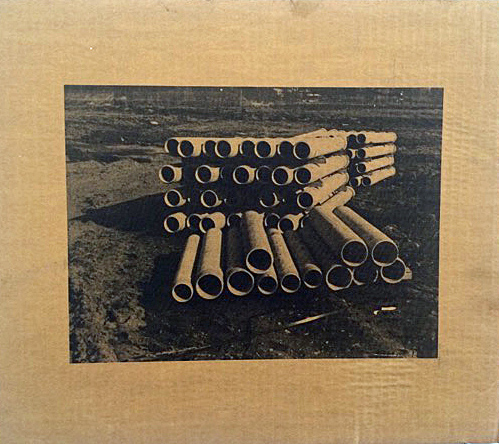
Jim Crawford, Pile Series, All images courtesy of Glen Mannisto, with assistance form Robert Hensleigh


The prevailing stereotype of Detroit’s ’60s and ’70s iconic Cass Corridor art scene is misleading. Images of beer-swigging, dope-smoking, post-adolescent boys, spitting on studio floors and recycling beer cans into expressionistic, assemblaged sculptures with which they hoped to violate the hallowed halls of the Detroit Institute of Arts come to mind. It was a myth created by romantic souls who tried to rescue bohemia from Detroit’s growing derelict landscape. Of course there was also a considerable population of heady, intellectual /artist types who cowed up around the Detroit Institute of Arts, read books, went to arty films, listened to music other than the MC5, even went to the opera and had jobs too. Artist Jim Crawford who has a mini-retrospective at Trinosophes, a performance space in downtown Detroit, seems like he could have been one of those.

jim-crawford-tea-stain-vitrine

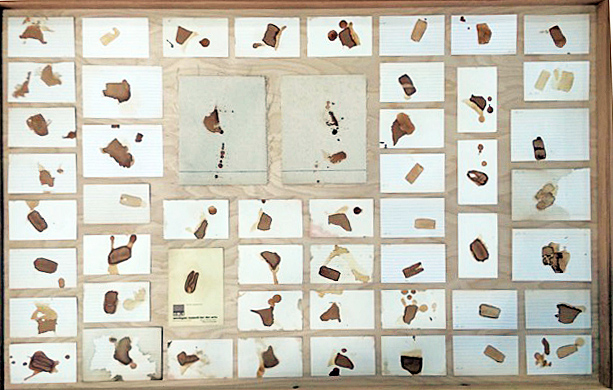
Jim Crawford, Tea Stain Series in Vitrine, 3 x 5 Cards

Crawford’s art is marked by a psychologically reflexive interiority—it occurs more in the mind as noumenon than as object or phenomenon—and makes what seems an ordinary material world into the extraordinary. Simple gestures or processes, replacing the traditional romance of creating a single object, are repeated and accumulated to explore a sense of time and evolved change, and to challenge our perception in an artistic process sometimes referred to as Conceptual Art. In 1970, in a beautifully measured and meditative ritual production, Crawford translated his daily cups of tea at his job at the Michigan Council for the Arts into a very deliberate series of over one hundred tea bag stains on 3”X5” cards. In the Trinosohes gallery, the tannic-colored blots have been arranged on a grid in two display vitrines to accomplish a stunning array of difference and signifying presence. Each stain records a moment with countless daily variables (temperature, emotional presence, gravity, haptics), or what acute perception can distinguish, becoming a sign of those variable influences as much as a thing to perceive in itself.

crawford-3-paper-edit

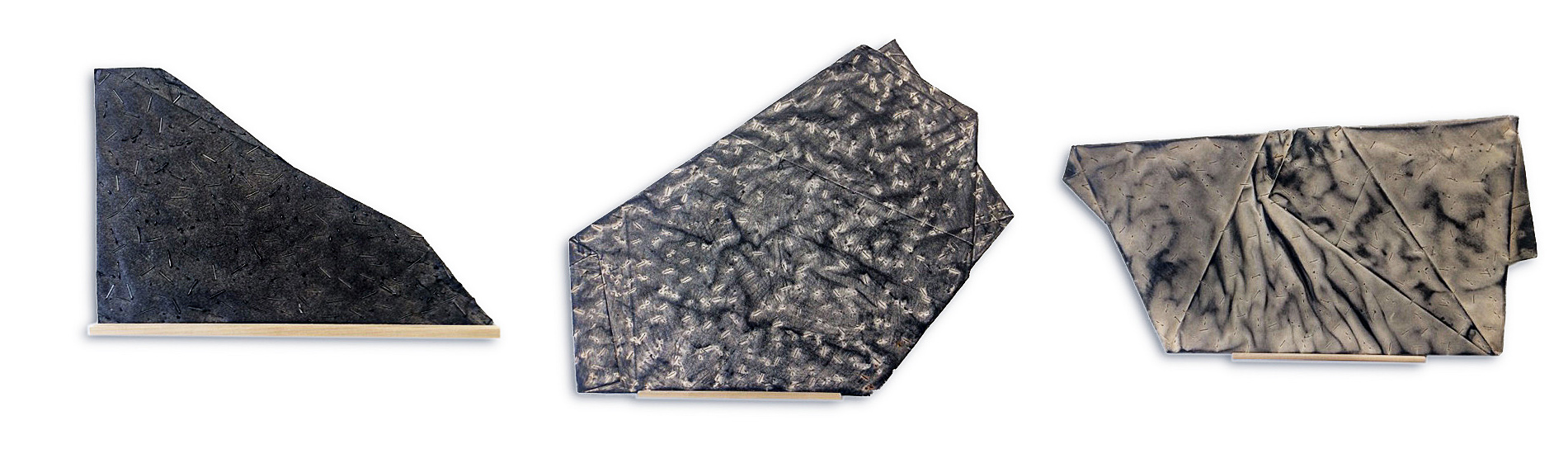
Jim Crawford, Folded Paper Series, Graphite, staples, paper, 1971 (smallest: 8″ x 12”, largest: 22” x 26”)

Like many artists Crawford works serially, and the Trinosophe exhibition features six main series that he has explored from the late ’60s until now. The most conventional form in the exhibition (created in the early ’70s, and of which seven individual examples are exhibited) is composed of sheets of paper folded into flat, randomly occurring geometric shapes, punctuated with staples, and marked or patinaed with graphite or paint. Created to be two-sided, they are a unique composition like nothing else: resembling geometric clouds (each is magnificently unique, but best experienced together so go see the show), and apprehended or readable more as signs than as objects. As in the best of human productions, the materials have dictated the form. In a public interview at the gallery, Crawford quipped, “I had a long staple gun,” allowing staples to reach and punctuate everywhere on these manipulated forms, depositing dash-like marks, leaving shadows and an almost musical notational presence. The scribbled or shaded graphite illuminates and posits a “natural” surface (think birch bark); and the creases of the folds give the pieces a sense of volume and mass, but therein lies the challenge. They suggest dimensionality or objectivity, yet are ultimately inscrutable, seductively flat signs, abstracted and void of referent.

crawford-stacks

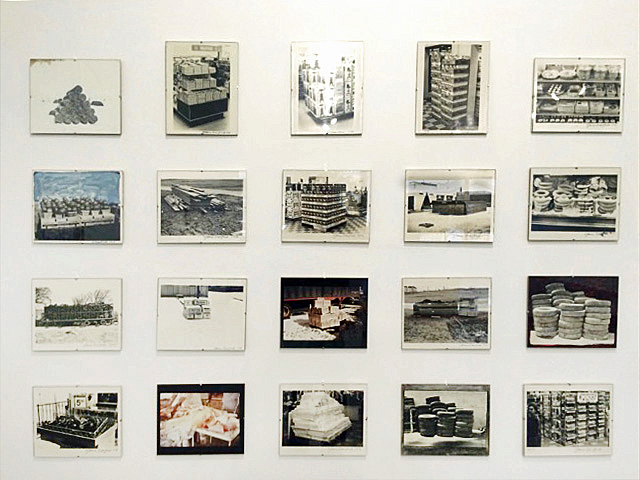
Jim Crawford, Pile Series, 1972, 20 Untitled photographs (1967, 1972 and 1972) color, black & white photos, paint – 8” x 10”

There is also a suite of photographs that document what Crawford has called the “Pile Series; discovered throughout the city, they record the presence of piles of various industrial or commercial materials that seem, through Crawford’s discerning eye, to achieve the status of sculpture. No doubt he has positioned these twenty images to both serve as ironic description of the identity of the artist (suggesting perhaps that art challenges perception, enabling it to discern “found objects” or objets trouvés as art, thus emphasizing the prominent part that ideas and concepts play in perception), as well as to call attention to the compelling nature of our landscape, and to create a dialogue that compares art to the supposed randomness of everyday material reality. Included in the series are photos of stacks of snow fence, old tires, boxes of fruit, and lumber at a construction site. Each of the photos reveals the particular effect that weather, light, and context play in conditioning both the appearance of the particular stack and our perception of it. The raw quality of the 40-year-old 8”X10” black and white photos and derelict framing of them adds a certain historical charm to the project.

eggshell-series

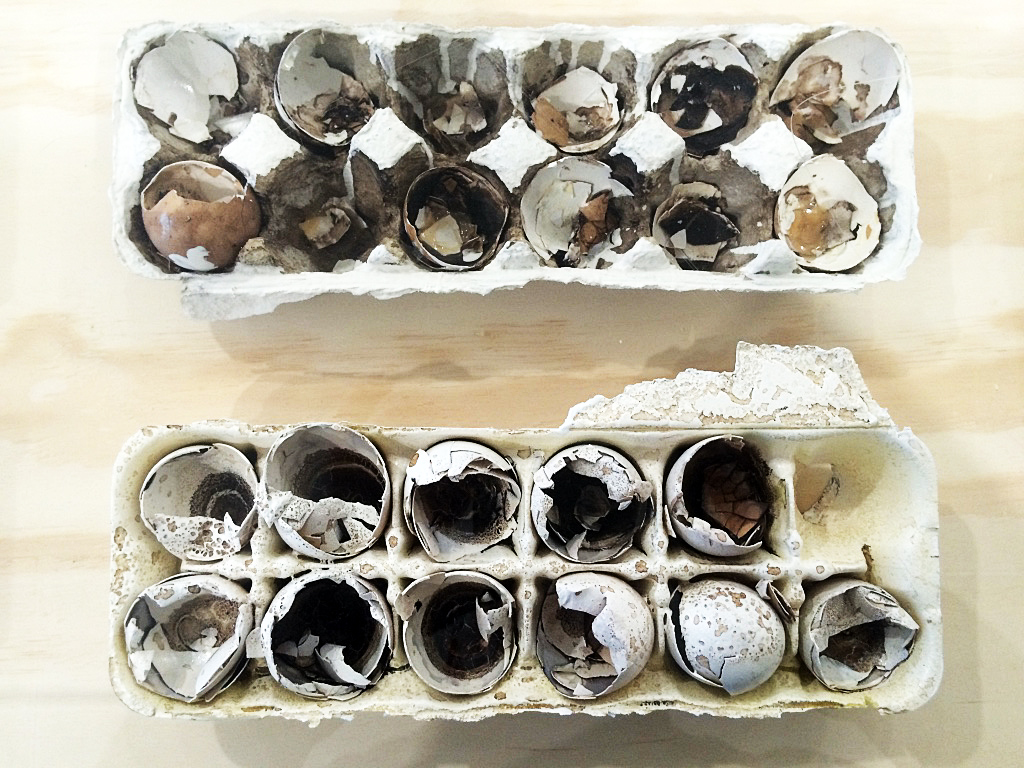
Jim Crawford, Eggshell Series (2015-2016) Mixed media (paint, glitter, walnut dye)

Two recently created series echo Crawford’s earlier strategies for dealing with recycled materials with an emphasis on personal biographical influences. Inspired by his grandmother’s practice of reading tea leaves at the kitchen table, Crawford, while cooking, has recycled cracked egg shells back into their cartons to produce stark abstracted images of the roundness of eggs. Like his grandmother’s tea leaves, the organic byproducts of his everyday life have become signs: a circle in a square, an egg in a carton, dyed with walnut stain from his walnut tree — painted and decaying they are ever changing and evolving. The delicate egg shells may at first appear as mere garbage or waste, but emerge with a powerful, though fragile, talismanic presence.

jim_crawford_cat-can-series

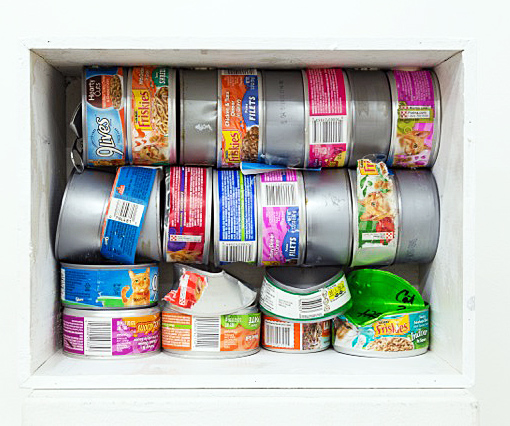
Jim Crawford, Cat Can Series, 10.5” x 14” x 9.5”, Mixed media, 2015-2016


In another series, Crawford has engaged Midnight, a stray black cat that wandered into his garden, to create the Cat Can Series. “An unlimited supply” of cat food cans from feeding Midnight becomes the material for a somewhat awkwardly stated, perhaps eccentric arrangement of aluminum cat food cans in various conditions: some painted or stained green (Midnight’s eye color), some crushed, some with labels intact (9 Lives and Friskies being the preferred brands), and all enclosed in boxed frames. Employing the same stacking gesture as the early 1970 series, Crawford resuscitates the theme of exploring the visual landscape for architectonic structure.

In wandering through Xavier’s modernist furniture store on Michigan Avenue in Detroit, Trinosophe’s co-director Rebecca Mazzei, along with Joel Peterson, ironically found a stack photos that intrigued her. Pursuing the maker of the photos, she rediscovered the seemingly forgotten artist and art of Crawford. In researching, organizing and designing the exhibition “Jim Crawford,” she has energetically brought to our attention one of the most intriguing figures of the Cass Corridor, one whose work challenges perception and through its changes translates time into evidence for the consideration of big ideas. The exhibition includes various support materials from Crawford’s own archives, such as a post card series and ring binders and files containing Crawford’s copious notations on his projects.

Jim Crawford at Trinosophes – Through December 23, 2016


Senghor Reid @ NCA Gallery

A Diabolical Element – Senghor Reid’s exhibition at the National Conference of Artist Gallery

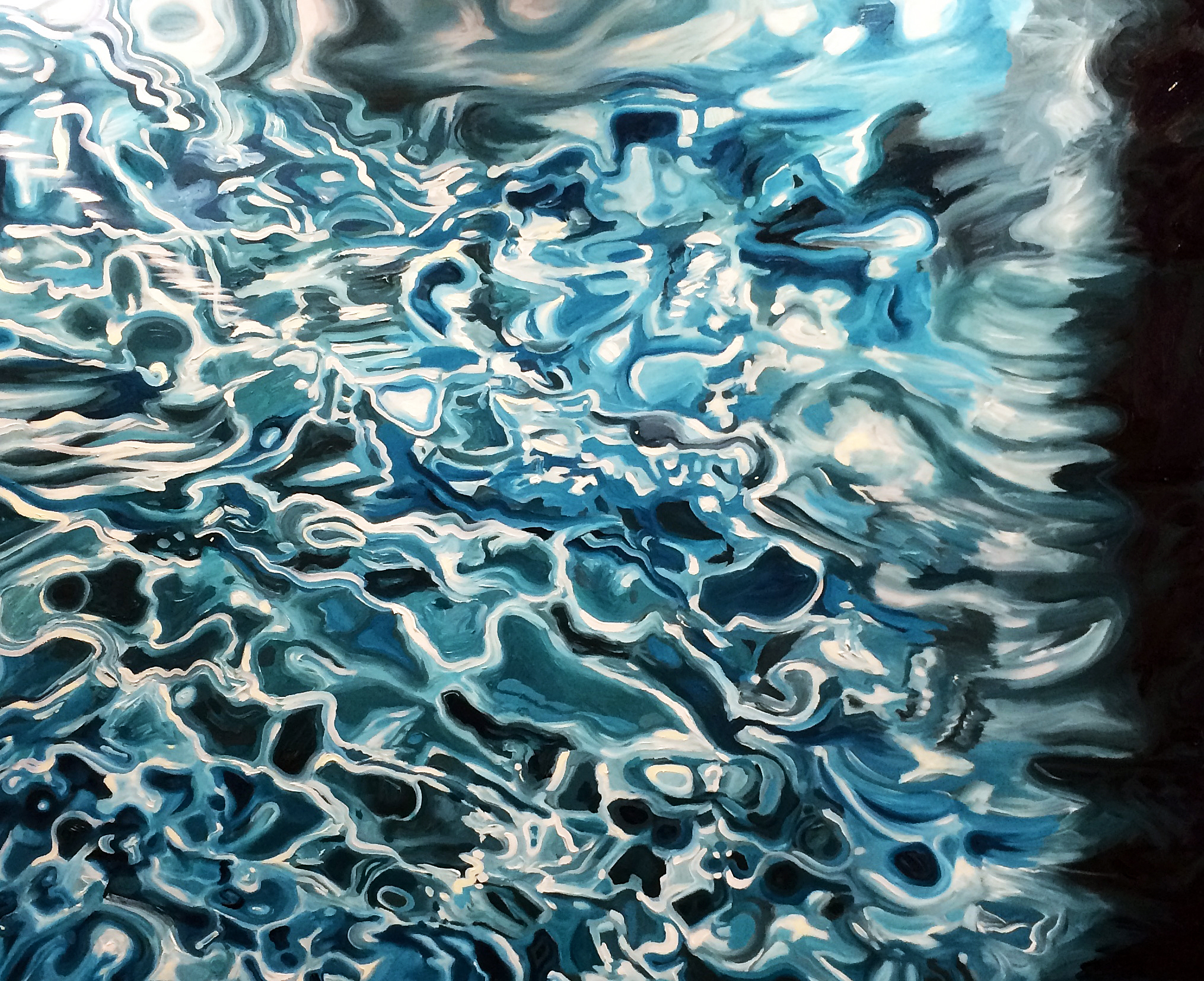
In the hallway outside of NCA Gallery, housed in a vibrant Community Center in Northwest Detroit, you encounter the first wave of Senghor Reid’s solo exhibition Diabolique. The imposing group of large-scale acrylic paintings depict shifting, shimmering surfaces of water in different weather conditions and light. Reid’s dynamic, disquieting treatment of the ever-moving element of water recalls David Hockney’s pool paintings. Both artists weave water as a substance in movements and marks that eerily echo the nature of the element itself- slashes, splotches, dense, doily-like layers of marks that begin to suggest forms even as those forms collapse and drain away before your eyes. Reid’s work evokes Hockney’s, also, in the strange, visually transmitted metaphor presented by both artist’s treatments of this element- that of the complete unknown, the otherworld that mirrors and impacts our own, that lies just beneath the surface.

image-1-senghor-reid-the-ice-storm-2-acrylic-on-canvas-48in-x-60in-2016

Senghor Reid, The Ice Storm 2, 48 X 60, Acrylic on Canvas, 2016

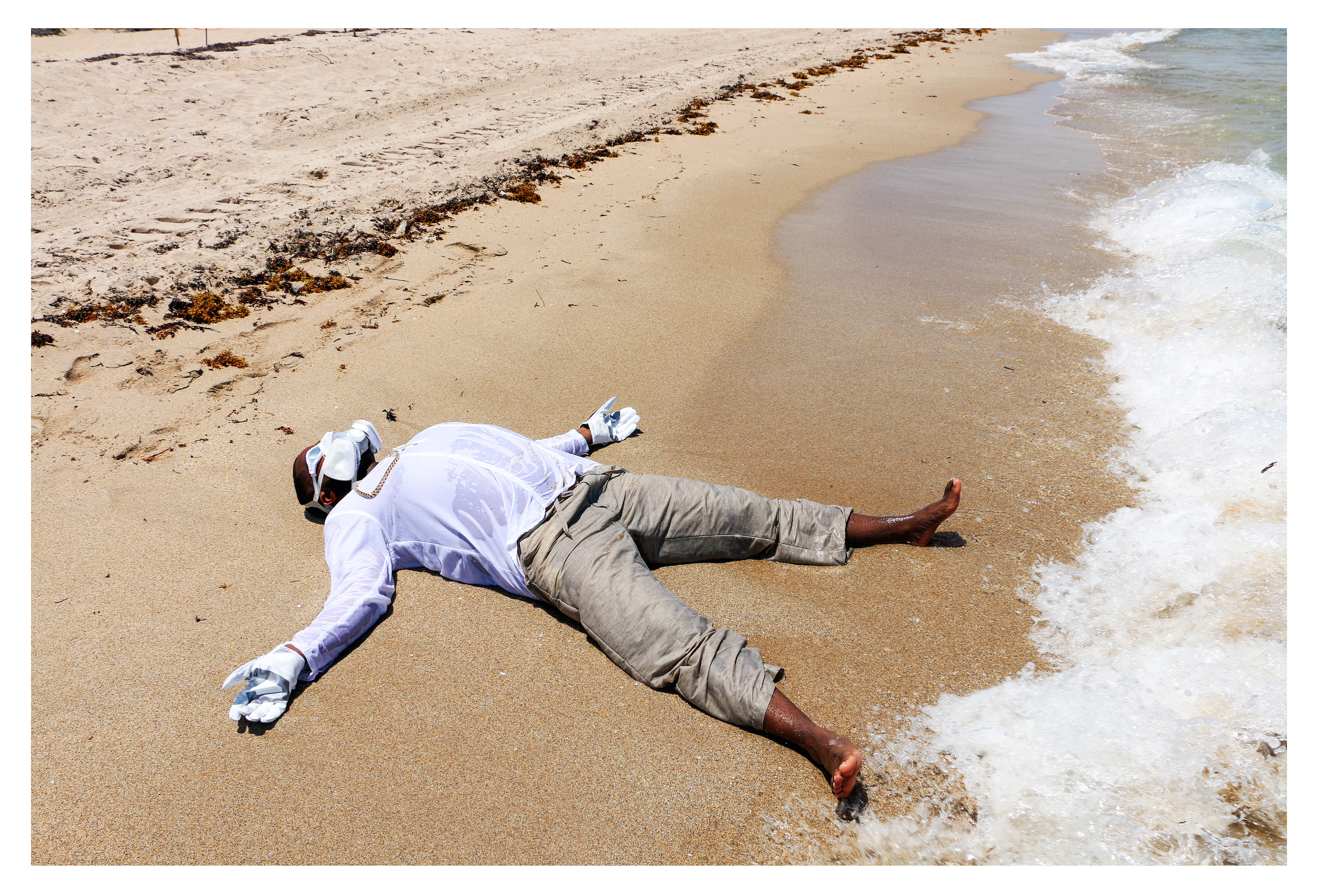
The title of Reid’s exhibition, Diabolique, references the 1955 French film Les Diaboliques, the plot of which revolves around the concealment of a corpse in a body of water. The water swallows the corpse and refuses to yield it up- it appears later, brought uncannily back to life, rising from the waters of a bathtub. The mysterious, treacherous capability of water to give both life and death, to absorb evil only to reveal it later in the most intimate settings, is examined with a plethora of materials and media, through scientific and aesthetic lenses, in Diabolique. True to the origin of its title, the exhibition features a series of self-portraits of the artist washed up on a vaguely tropical shore, an uncanny, amphibious humanoid, his face concealed behind swimming goggles and a gas mask that suggests both survival in a toxic environment and gills. The figure of the artist appears both resurrected and consigned to dwell forever in conditions his body was not designed for.

black-river-photo-4

Senghor Reid, Freshwater Assassins, 12 X 18″, Digital Print, 2016

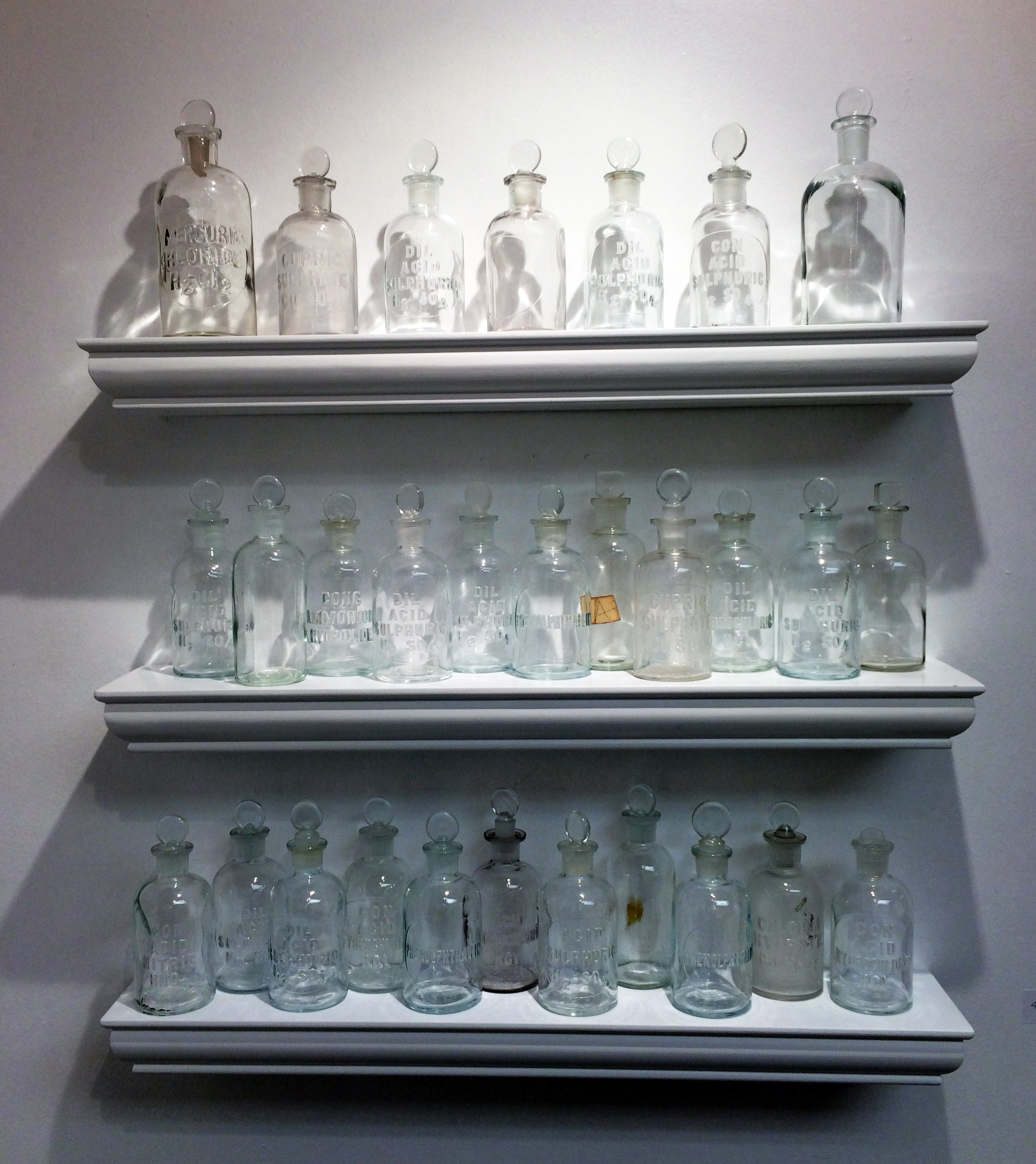
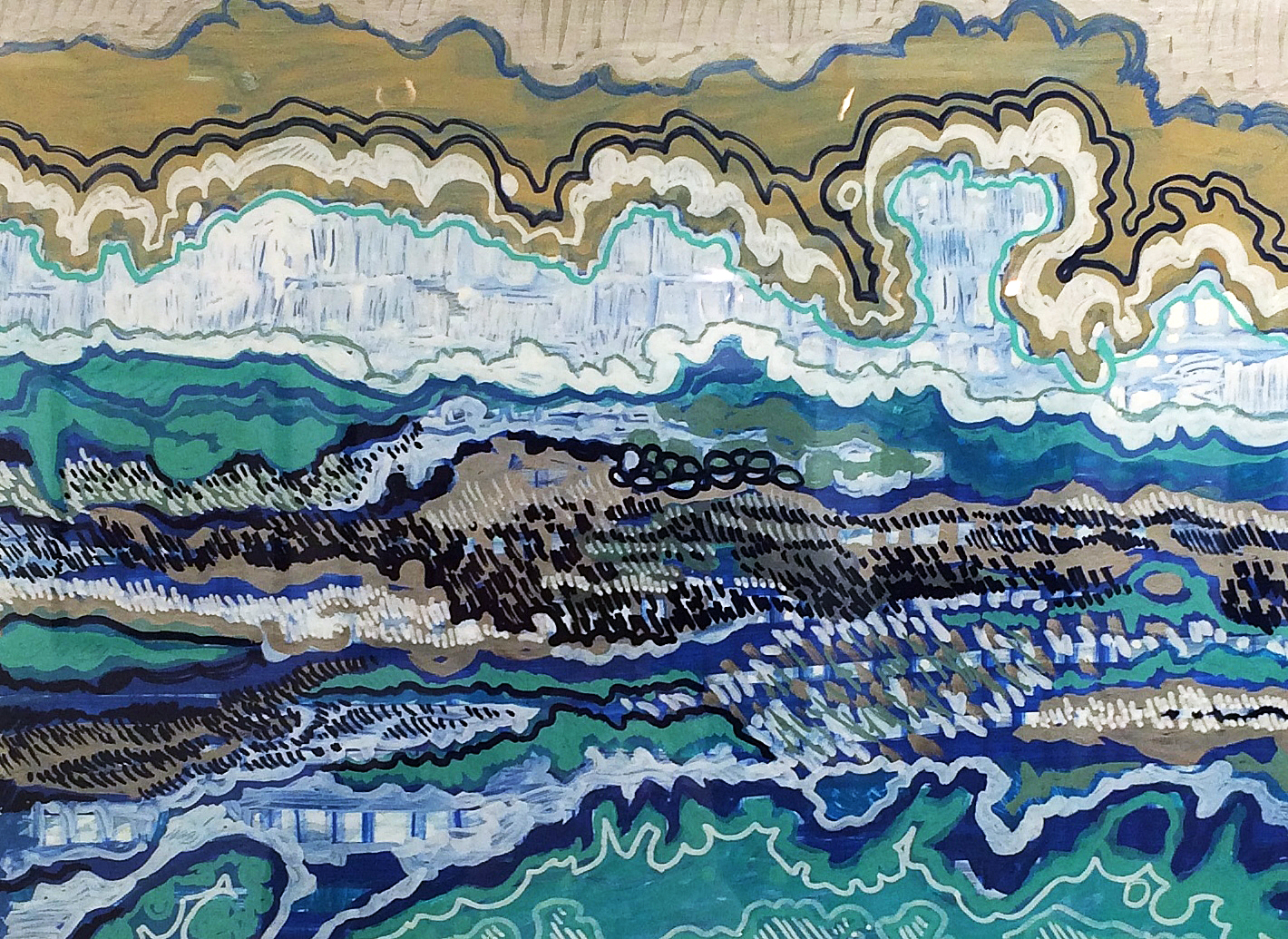
This could be seen as the fate of humanity at the dawn of the Twenty-first Century- our surroundings are now rife with invisible, and not so invisible, contaminants that have resulted from our misuse of the natural world. Reid uses the element of water as the aesthetic touchstone of his exploration of those harmful elements, and their insidious presence in our daily lives. The most sinister elements on the periodic table- mercury, cobalt, lead- are carried into our communities and bodies through the vehicle of water. These same elements, like water, are aesthetically beautiful- possessed of a seductive, ever-shifting sheen. That paradox of beauty, vitality, nature and toxicity is presented in every one of Reid’s works, the large-scale water paintings, the smaller water studies executed in oil pastel and paint marker, the sensuous prints on gold and copper paper, the installation of crystalline vintage bottles labeled with the acids and heavy metals they once held.

image-3-senghor-reid-the-element-of-crime-shelves-and-apothocary-bottles-24in-x-30in-2016

Senhor Reid, The Element of Crime Shelves & Apothecary Bottles, 24 X 30, 2016

The shimmer, and Reid’s capture of it in almost every medium imaginable, wreathes an elegant, fragile dialog between art, science and nature in Diabolique. It is the surface of water, which has become so loaded (the Flint water crisis and Detroit’s ongoing scandal of water shut-offs are only two examples of the element’s presence in crises of health, politics, race, and class) with essential and unanswered cultural urgencies. It is the glint of heavy metals, and the faceted surface of glass, containers and transmitters for elements that delight our eyes and leave putrid, invisible traces. It is deep, lurid, sensuous hues that sing of our love of nature as they paradoxically poison our environment. The shimmer conceals the corpse that will, inevitably, rise up from the murky inheritance of our chemical-spewing forbears. The rest of us may not be so lucky- yet, Diabolique seems to suggest, where there’s beauty, there’s hope.

image-5-senghor-reid-breaking-the-waves-4-paint-marker-11in-x-14in-2016

Senghor Reid, Breaking Waves 4, Paint Marker, 11 X 14″ 2016

 Diabolique,  by Senghor Reid,  at NCA Gallery through October 21, 2016.


Laszlo Moholy-Nagy @ Guggenheim, NYC

Guggenheim

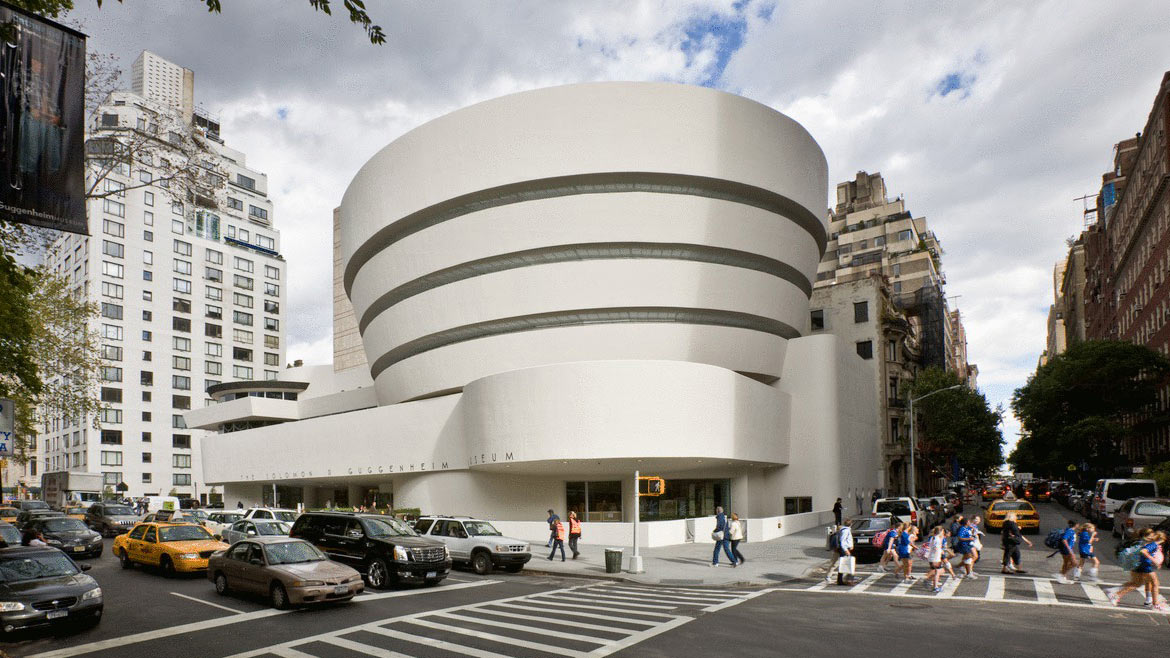
Guggenheim Museum, New York City. All Images Courtesy of the Guggenheim Museum.

Moholy-Nagy: Future Present

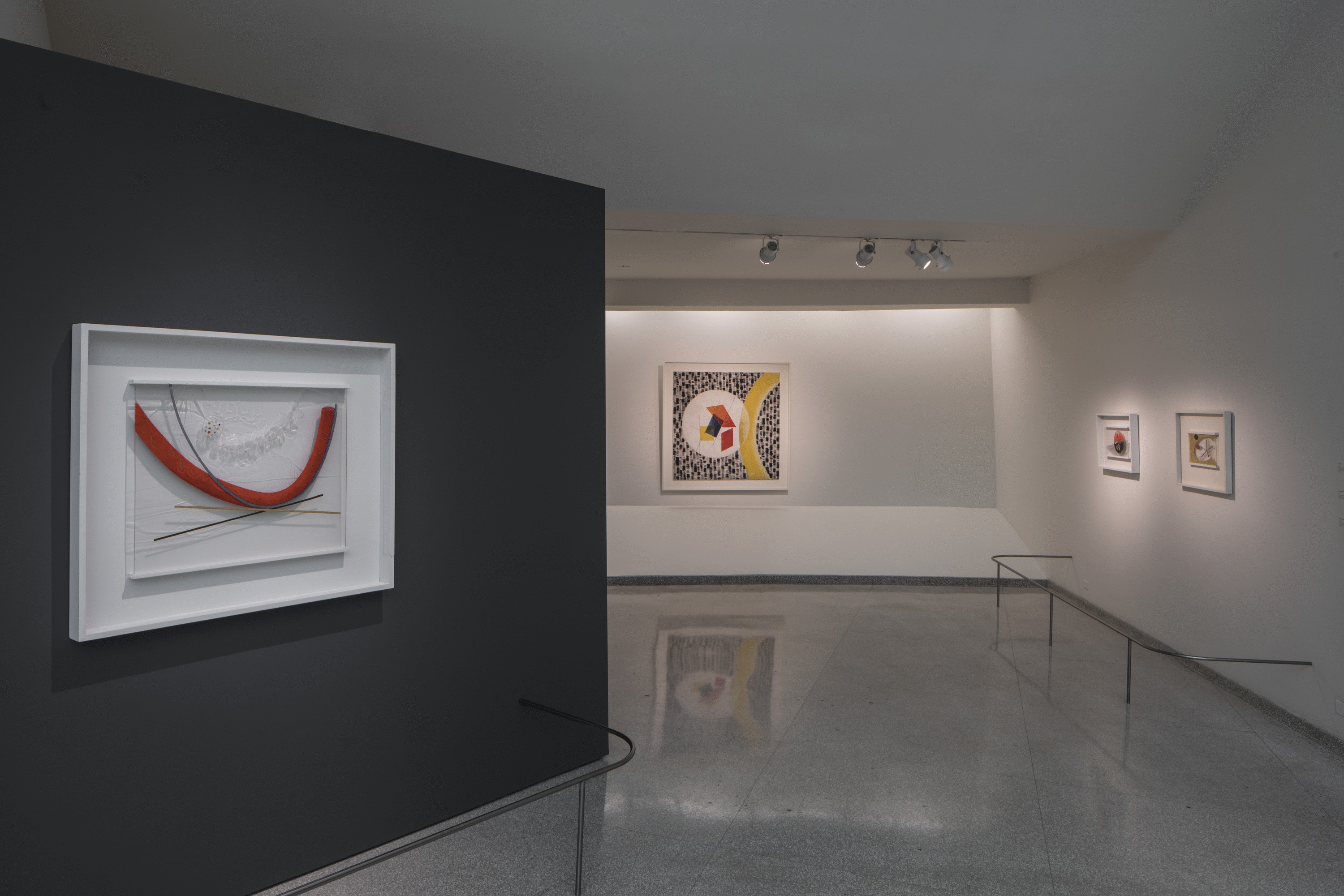
Before a recent visit to NYC, I was set on visiting the new Met Breuer Museum (housed in the former Whitney Museum building) that is hosting a large photographic exhibition by Diane Arbus. But my interest in European Modernism pulled me away to the Guggenheim, which has mounted a major retrospective of work by the Hungarian artist, László Moholy-Nagy (1895-1946) who is unknown to me.   The compilation of work is the first comprehensive retrospective of Moholy-Nagy, likely the first artist with a large and diverse field of media, including painting, sculptures, works on paper and Plexiglas, photograms and films. Despite his visibility as a Bauhaus teacher and artist, his profile has been little known to American art schools. This exhibition conveys the experimental nature of his work that includes industrial materials, movement, light, and a variety of photo-based images.

Moholy-Nagy-Install-exh_ph046

Installation View: Laszlo Moholy-Nagy, Future Present, Solomon Guggenheim Museum, 2016

The Bauhaus School (1919-1933), meaning in German to construct, struggled to exist at three locations in Germany during the early part of the 20th century. Founded by Walter Gropius in 1919, in Weimar, it moved to Dessau in 1925 where it housed an artist faculty that included Wassily Kandinsky, Marcel Breuer, and László Moholy-Nagy, and then finally ended up in Berlin for one final year until the Nazi Party came to power. The school specialized in fine and applied arts influenced by the Constructivism movement that originated in Russia in 1913 under Vladimir Tatlin, where art was practiced for social purpose, and included architecture and typography. Constructivists proposed to replace art’s traditional concern with composition, rather a focus on construction. For many Constructivists, this entailed an ethic of “truth to materials,” the belief that materials should be employed only in accordance with their capacities.

Laszlo Moholy-Nagy

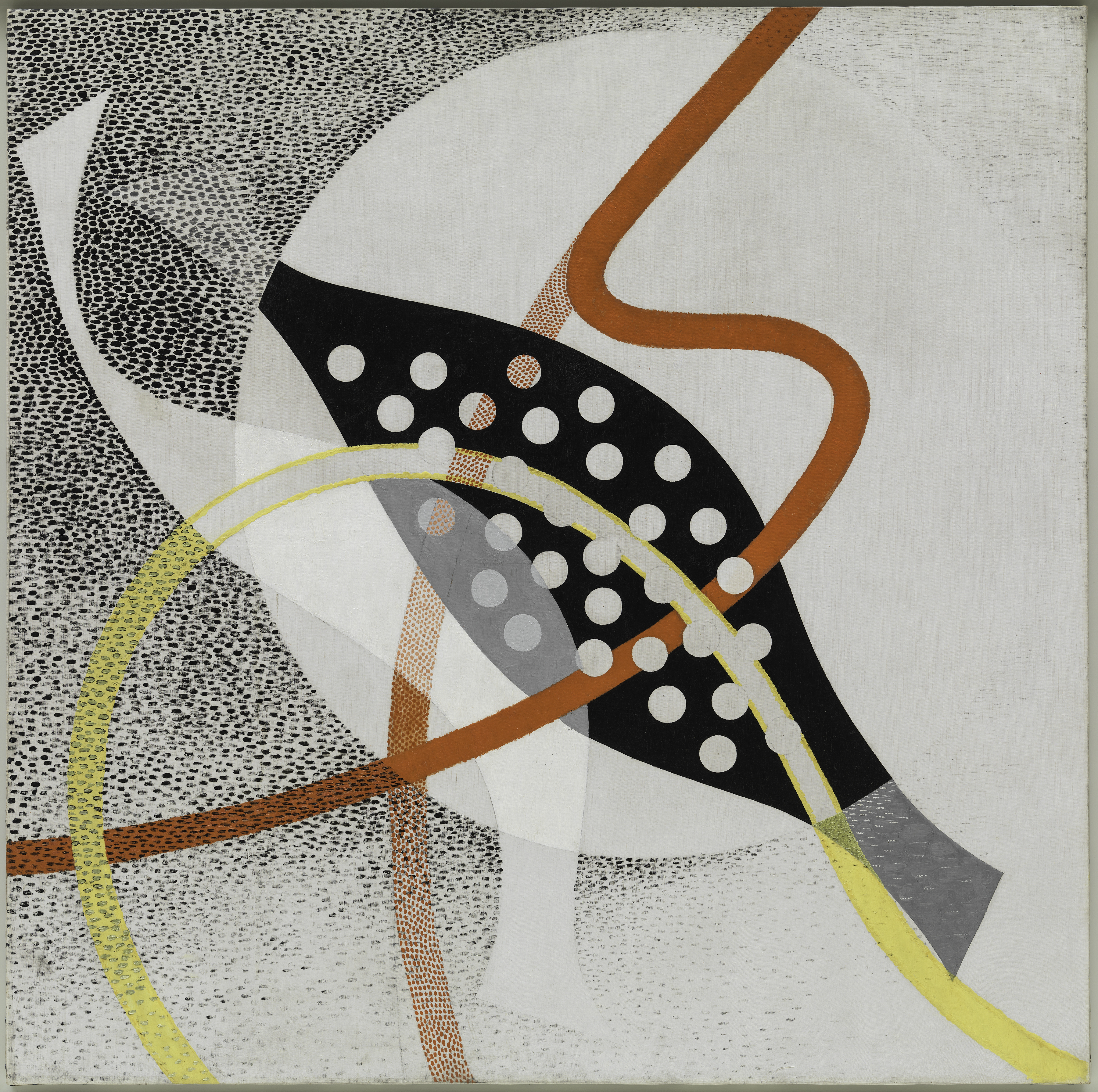
Laszlo Moholy-Nagy, CH BEATA l, 1939, Oil and Graphite on Canvas, Collection of the Solomon Guggenheim Museum

Juxtaposed against German Expressionism, Moholy-Nagy creates an image that reminds this writer of Kandinsky in his large oil on canvas, CH Beta 1. A non-objective abstract composition, the work relies heavily on design and the use of space, line and color on a flat plane void of objective meaning. If Kandinsky is the father of abstract art, then Moly-Nagy is an apostle presenting a new venue of work for the modern world. Born in Hungary in 1895, he attended art school in Budapest before bringing his Constructivist aesthetic to the Bauhaus school in Dessau. The mechanical free-floating geometries influenced many artists in the United States to follow, including Frank Stella, David Smith, Ad Reinhardt, Sol LeWitt and Sean Scully.

Moholy-Nagy-Nickel-Plated-Install-exh_ph037

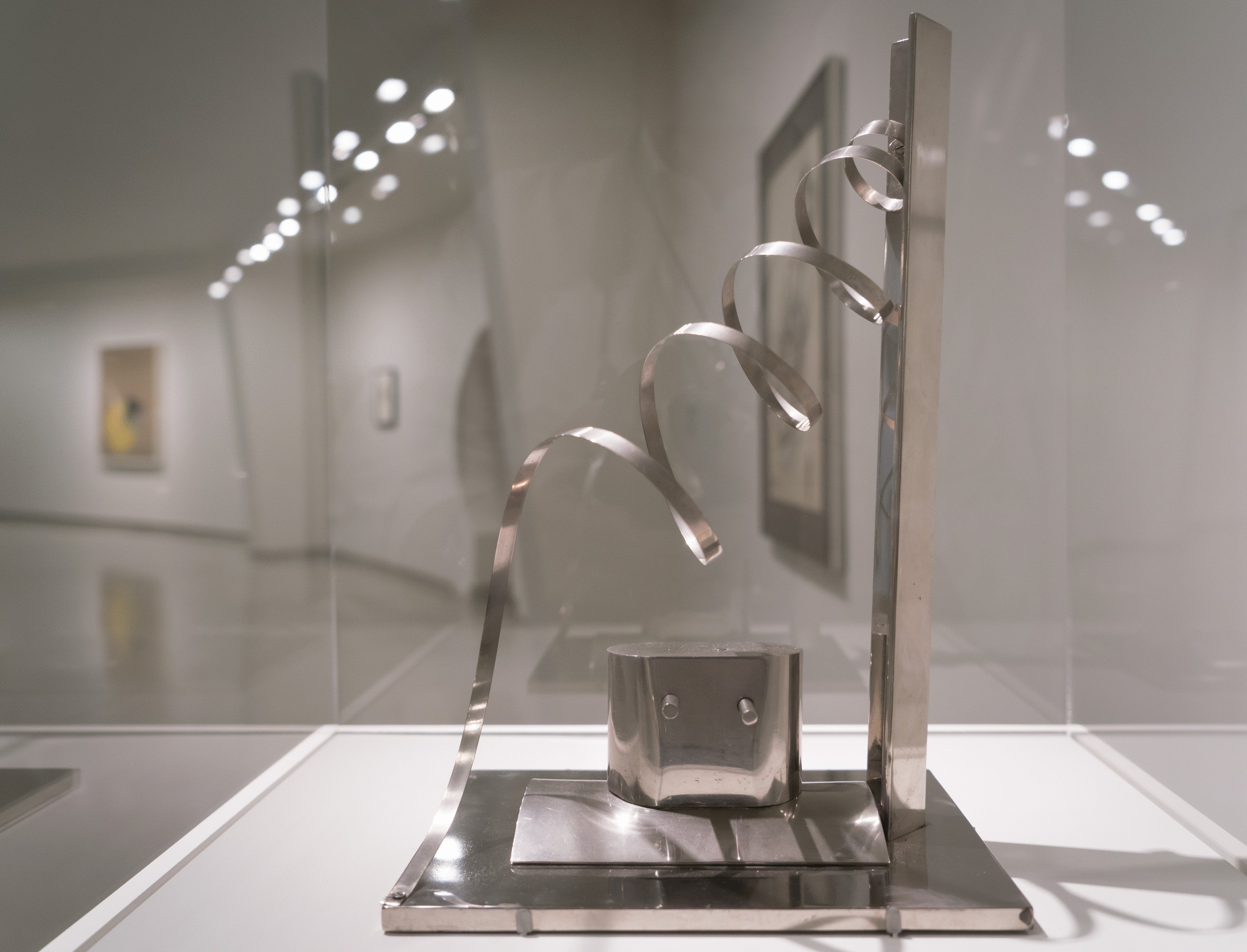
Laszlo Moholy-Nagy, Nickel Sculpture with Spiral, 1921, The Museum of Modern Art, Gift of Sibyl Moholy-Nagy

Moholy-Nagy’s nickel plated on iron-welded sculpture, owned by the Museum of Modern Art, demonstrates his industrial design and constructivist approach to the machining of objects and a spiral that inadvertently echoes the Guggenheim’s internal architecture.

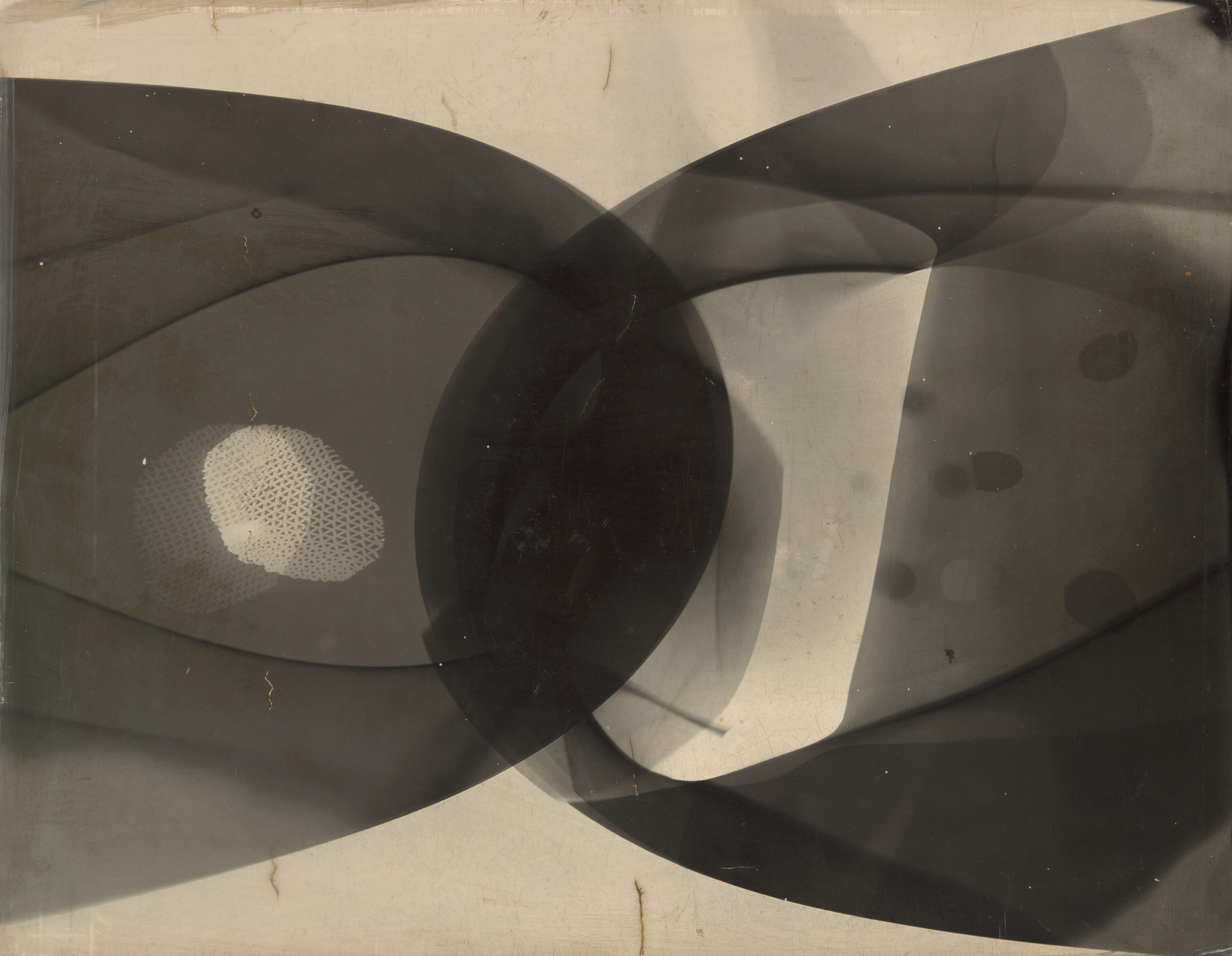
gen-press-moholy-nagy-photogram-1941

László Moholy-Nagy Photogram, 1941 Gelatin silver photogram, 28 x 36 cm The Art Institute of Chicago, Gift of Sally Petrilli, 1985 © 2016 Hattula Moholy-Nagy/VG Bild-Kunst, Bonn/Artists Rights Society (ARS), New York

Collected by Hilla Rebay and Solomon Guggenheim, founders of the museum, this exhibition is beautifully arranged by Kelly Cullinan, the senior exhibition designer. I especially appreciated the extensive writings of Moholy-Nagy displayed on each level of the museum in vitrines. If I were still teaching painting at the college level, I would spend more time discussing European Modernism, especially the influence of the Bauhaus School and its teachers and artists.

Moholy-Nagy: Future Present is co-organized by Carol S. Eliel, Curator of Modern Art, Los Angeles County Museum of Art; Karole P. B. Vail, Curator, Solomon R. Guggenheim Museum; and Matthew S. Witkovsky, Richard and Ellen Sandor Chair and Curator, Department of Photography, Art Institute of Chicago. The Guggenheim presentation is organized by Vail, with the assistance of Ylinka Barotto, Curatorial Assistant, and Danielle Toubrinet, Exhibition Assistant.

Guggenheim Museum


Road Trip @ Detroit Institute of Arts

Road Trip! Detroit Institute of Arts presents “The Open Road: Photography and the American Road Trip.”

IMG_1705

The Detroit Institute of Arts (DIA) opened a photography exhibition on June 17, 2016; The Open Road: Photography and the American Road Trip, sponsored by Aperture Foundation, New York, with a grant from the National Endowment for the Arts.

“Road trips are a tradition in America and can clearly reveal what is unique about this country’s culture,” said Salvador Salort-Pons, DIA director. “Photographers traveling through the United States have defined, critiqued and celebrated America.”

Truer words were never spoken. In my sophomore year of college while studying art and playing trumpet, I read On The Road by Jack Kerouac. I knew that after reading the novel, I had to take a road trip. That next summer I took my VW Beetle across the country to California and ended up in San Francisco’s North Beach listening to Grace Slick and The Jefferson Airplane at the Fillmore. Just by chance, I bought a copy of The Americans, the now famous book by Robert Frank, at the City Lights Book Store. Back then, the City of San Francisco offered free darkroom facilities to its city folk. I had brought my used 35 mm Nikkormat, with a 50mm lens and a carton of Tri-X film, so all I needed to do was buy a box of Agfa paper and start printing images from the trip. What a deal! Much of my experience that summer resonated as I browsed The Open Road.

R.Frank Gratiot Drive IN

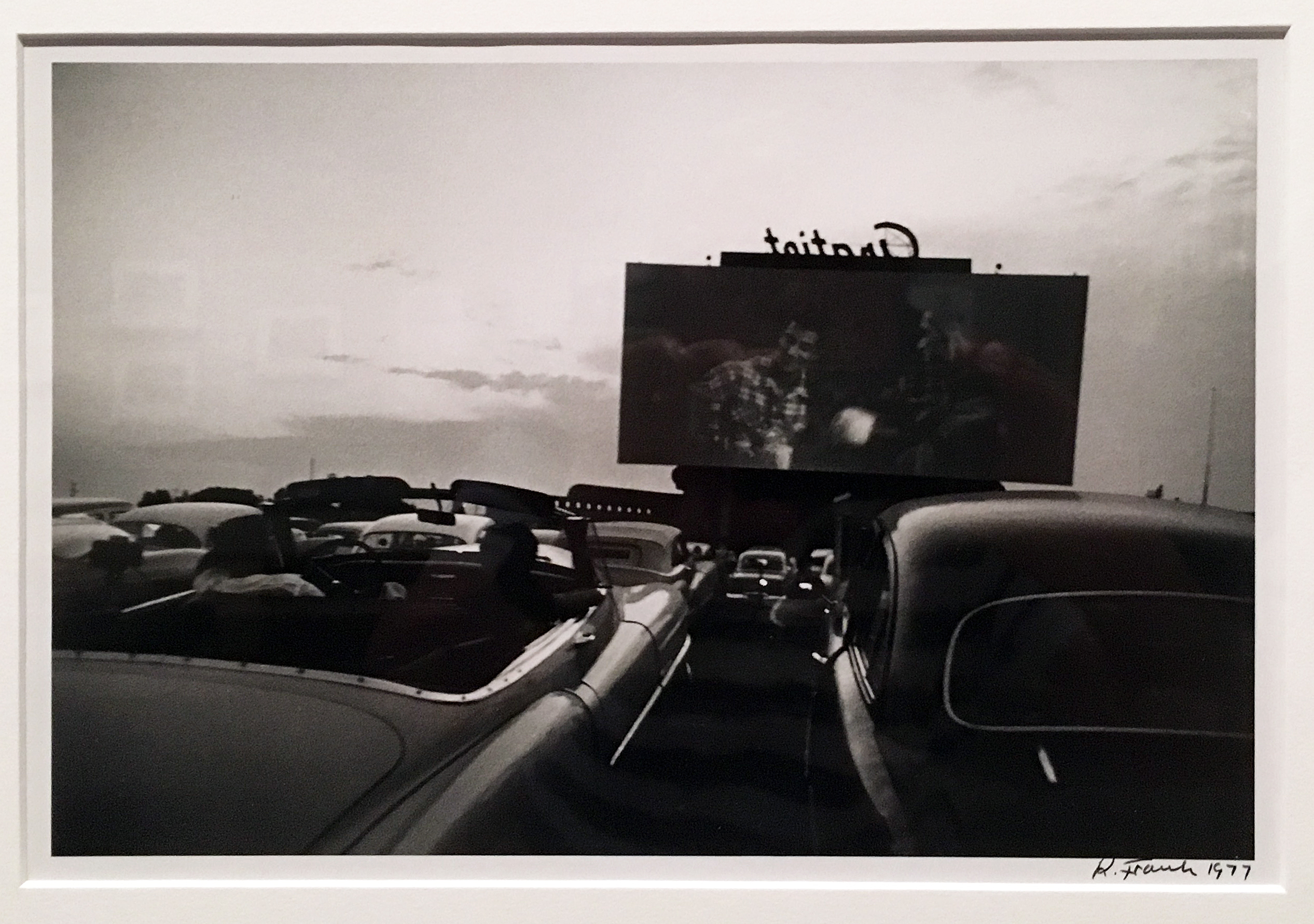
Robert Frank, Drive-In Movie, Detroit, 1955 (Printed 1978) Gelatin Silver Print, Courtesy of the DIA


Robert Frank emigrated from Switzerland to New York City in 1947, and eventually got work as a photo assistant at the fashion magazine, Harper’s Bazaar. After receiving a Guggenheim Fellowship in 1955, he embarked on a two-year trip across America and captured 28,000 images with his Leica 35mm rangefinder. Detroit was one of his longer stops, and here, Drive-In Movie, Detroit 1955, is one of sixty black & white images taken during his stay. This photograph, owned by the DIA, cements in time the moment, the light, the automobiles and the movie screen images that are so distinctly American. For this review, I pulled out my copy of The Americans, where Kerouac begins his introduction, “That crazy feeling in America when the sun is hot on the streets and the music comes out of the jukebox or from a near-by funeral, that’s what Robert Frank has captured in his tremendous photographs…”

Winogand Photo

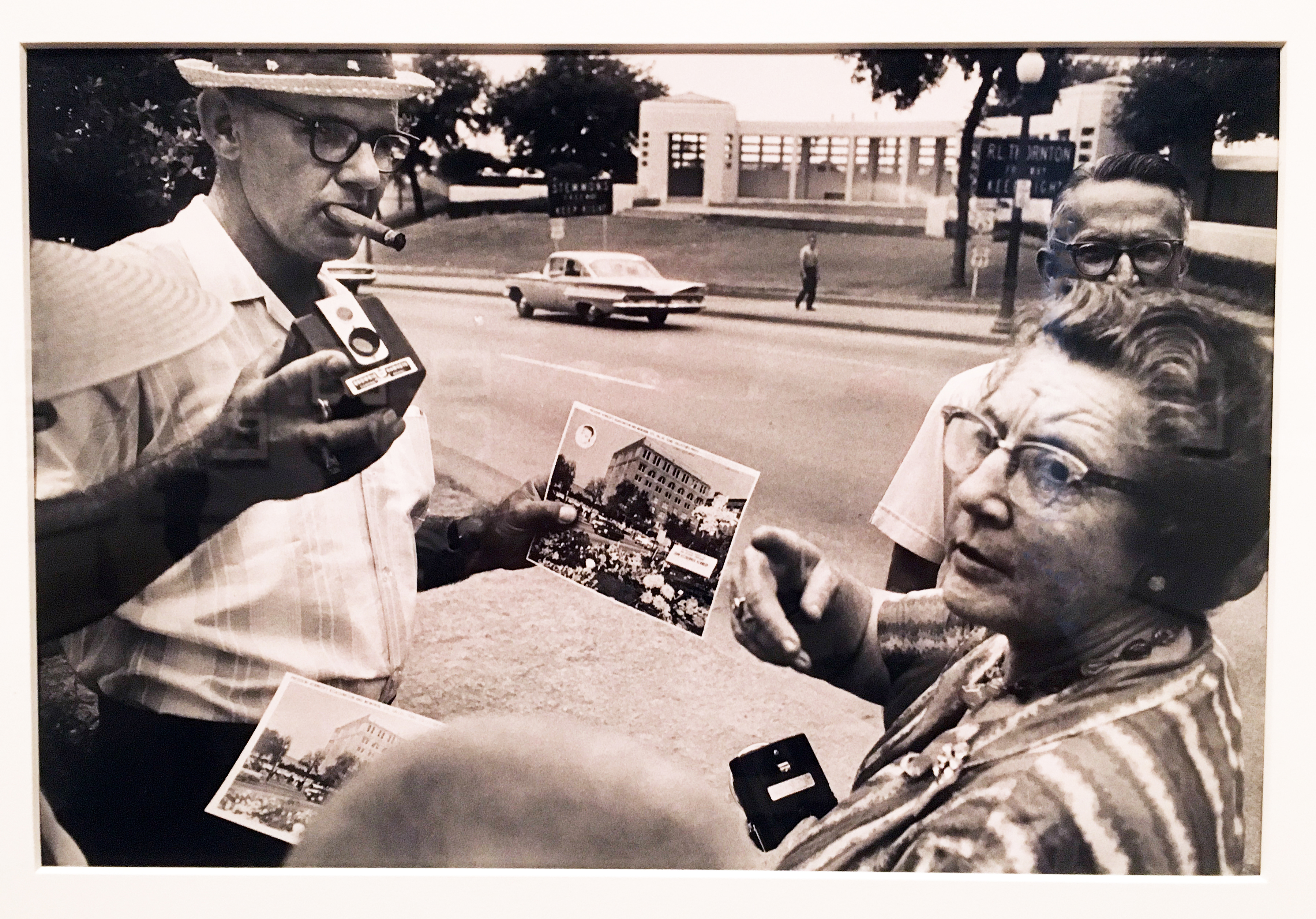
Gary Winogrand, Dealey Plaza, Dallas 1964

Gary Winogrand (1928-1984) was born in the Bronx, New York, and studied painting at City College of New York. Soon after, he studied photography with Alex Brodovich at the New School for Social Research and was commissioned by Harper’s Bazaar where he linked up with the American Society of Magazine Photographers. This photo, shot in Dallas, Texas, was part of a road trip that took him to fourteen states, where he shot 520 rolls of film. My favorite image is his untitled photo taken at a New York Thanksgiving Parade that captures a male figure high in the air in the middle of a flip off of a trampoline that was on top of a rolling float. Winogrand taught at Parsons School of Design and the School of Visual Arts, both in New York City. His work is a rendering of a classic street photographer, out of the tradition of Robert Doisneau, Ruth Orkin, and others.

Shinya Fujiwara

Shinya Fujiwara,Untitled, from the series American Rouleete, 1988 Courtesy of the Artist

This photographer, Shinya Fujiwara, a native of Japan, traveled across the United States for seven months in a motor home, seeking images that were peculiar to his sensibility. A leading Japanese photographer born in the 1940s, he has spent most of his adult life exploring different continents. He brought his life in another country and cultural to his experience on the road. Fujiwara has gone on to influence travelogues and books, both non-fiction, and fiction.

Lee Friedlander

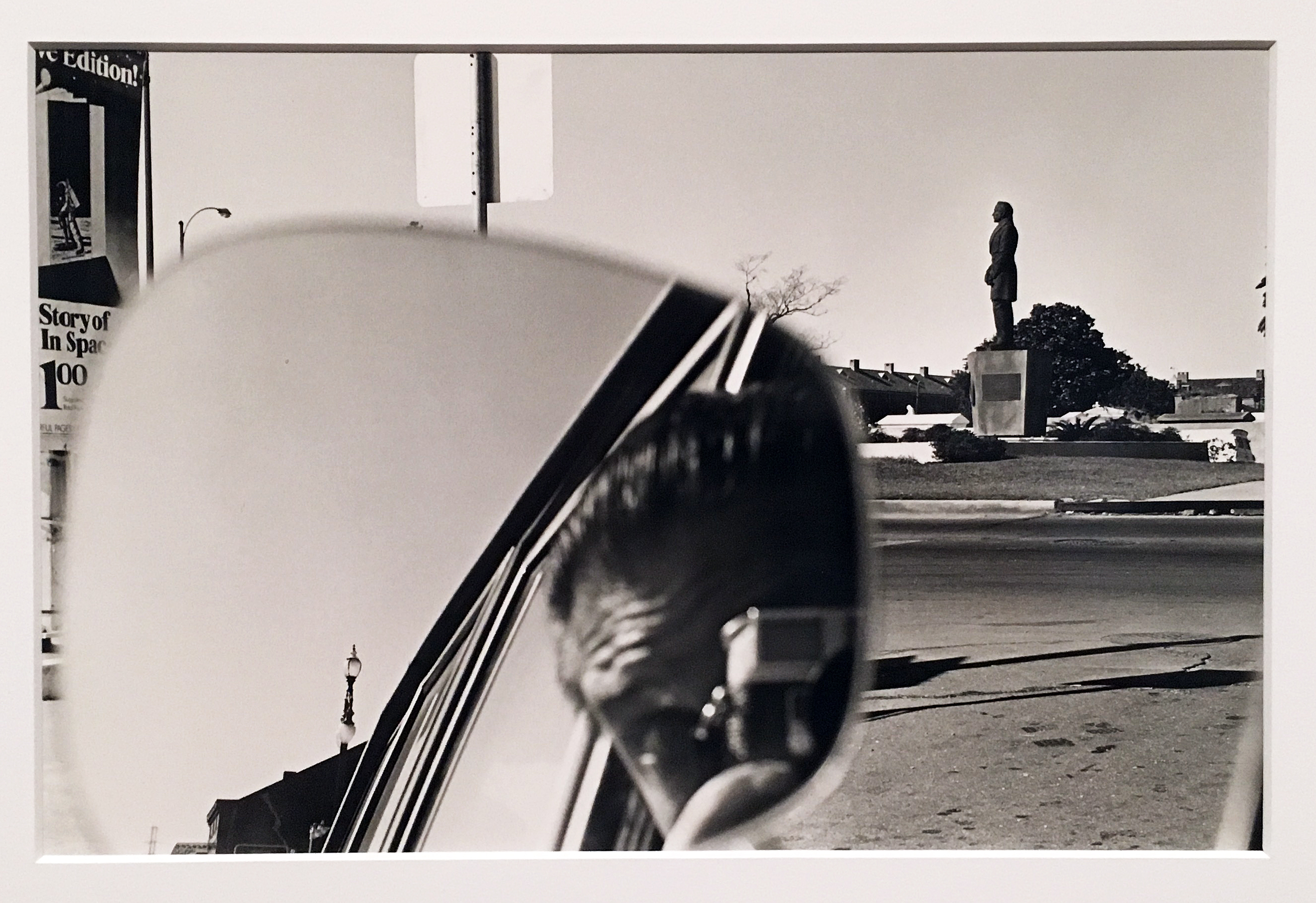
Lee Friedlander, Dealey Plaza, Gelatin Silver Print, 1964, Dallas, TX,

Lee Friedlander, born in 1934, began photographing the American social landscape in 1948. This photograph, New Orleans 1969, reminds me of his 2008 exhibition, America by Car, at the Fraenkel Gallery. It does so, because he used the rear view mirror on his car on many occasions, as a framing device, providing the viewer with a front and rear view of his subject. Friedlander was the recipient of the prestigious Hasselblad Award as well as the subject of a major traveling retrospective and catalog organized by the Museum of Modern Art. In 2010, the Whitney Museum of American Art, New York, exhibited the entirety of his body of work, America by Car.

Joel Sterneld

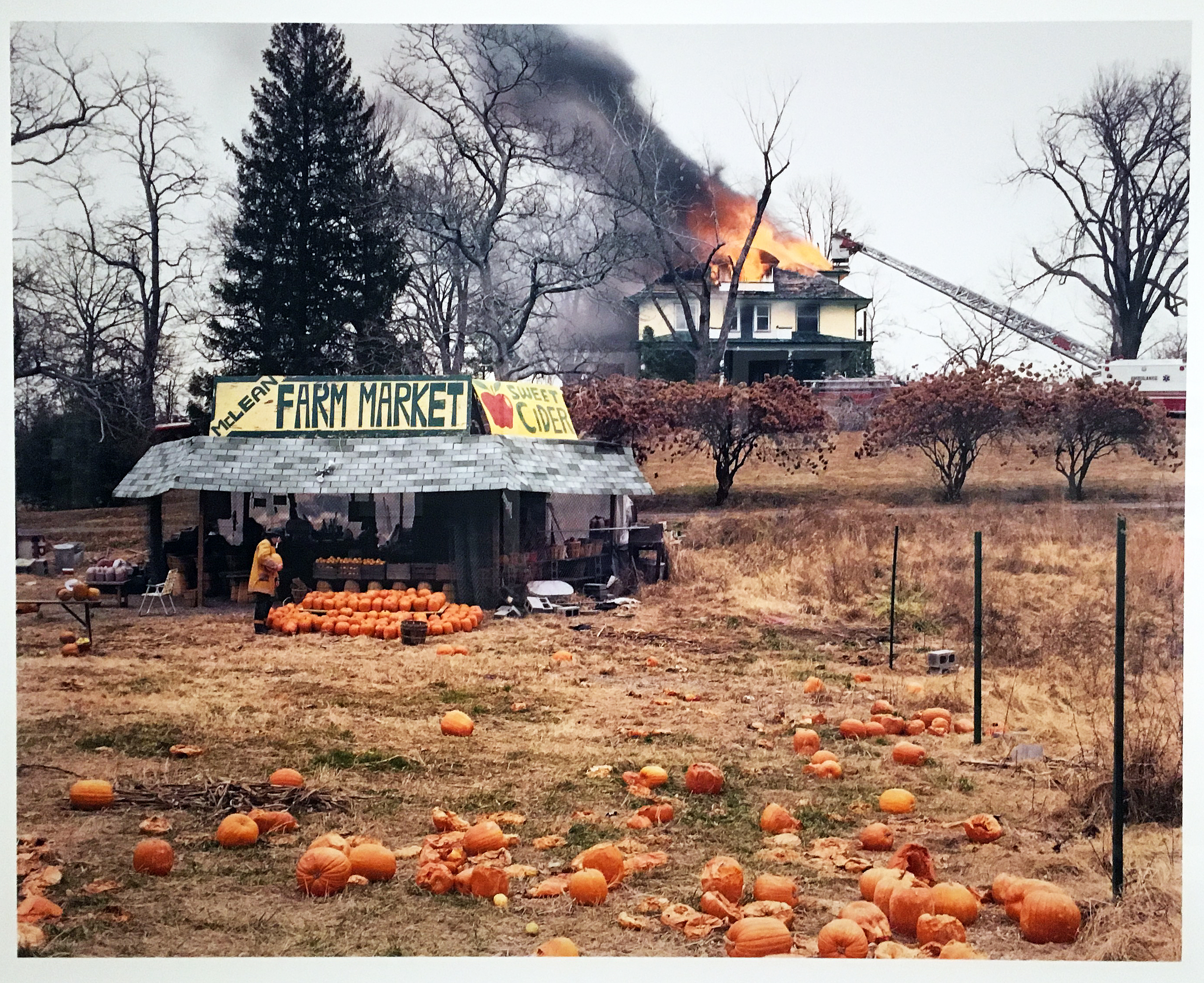
Joel Sternfeld, McLean, Virginia, December 1978

The America photographer, Joel Sternfeld, was born in 1944, received his BA from Dartmouth College and taught photography at Sarah Lawrence College. Known for his large format color photography, Sternfeld was influenced by color theory by Josef Albers. Here in Mclean, Virginia, December 1978, one of his most famous images, he depicts a fireman shopping for a pumpkin as a house burns in the background. The pumpkins’ vibrant oranges match the autumnal colors of the countryside, and ironically, the fire’s flames. The image is peculiar because the fireman appears to be casually browsing as the flames roar.

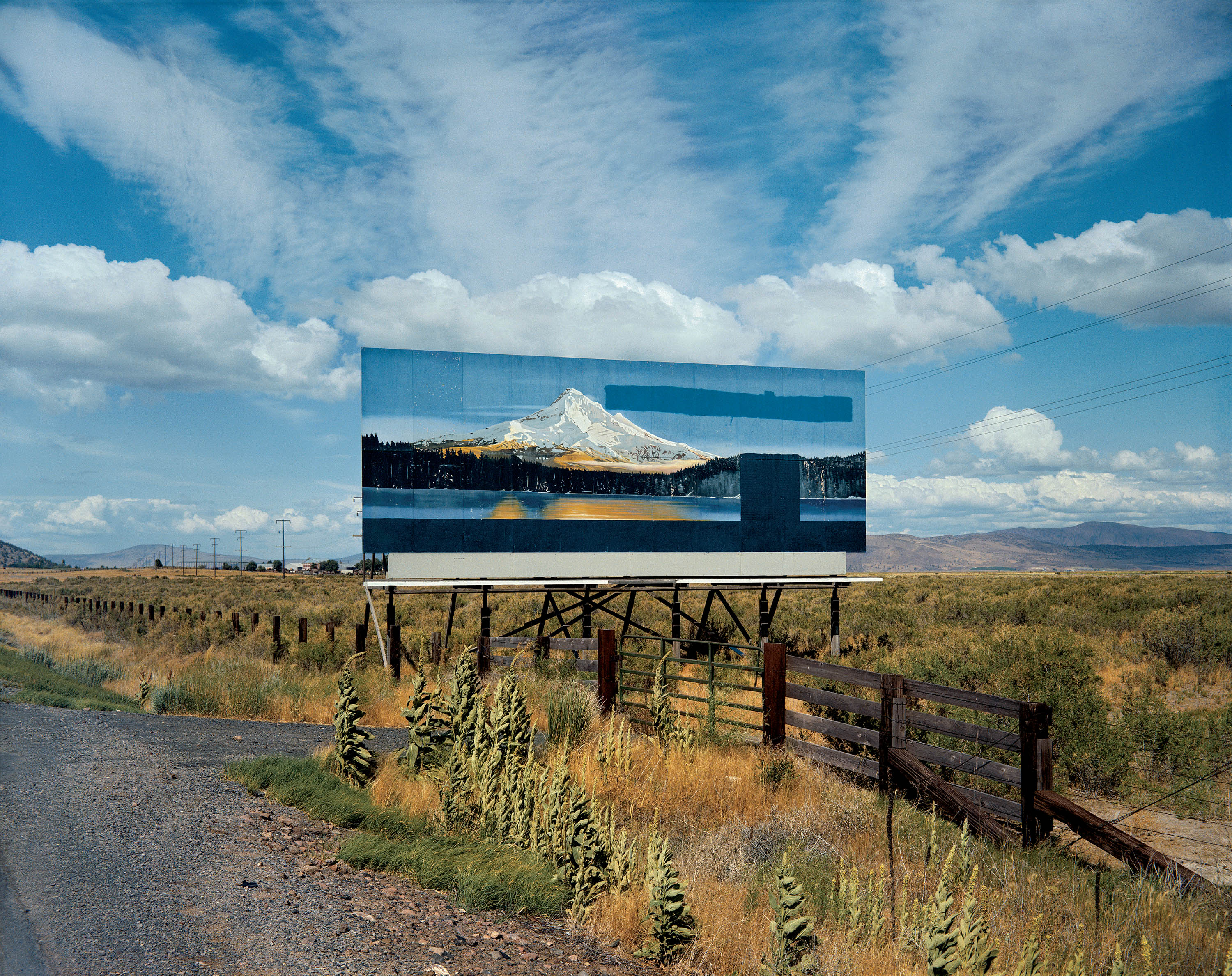
U.S. 97, South of Klamath Falls, Oregon, July 21, 1973

Stephen Shore“U.S. 97, South of Klamath Falls, Oregon, July 21, 1973,” Courtesy of the artist and 303 Gallery, New York

The billboard along a highway with its copy blocked out might just be the surface in transition, waiting for its next advertisement. For Steven Shore, it’s a landscape set against a landscape where he finds art along the road. Stephen Shore’s photographs are attentive to ordinary scenes of daily experience, yet through color and composition Shore transforms the mundane into subjects of thoughtful meditative. He was the first living photographer to have a one-man show at the Metropolitan Museum of Art in New York since Alfred Stieglitz, forty years earlier.

image-436Claire, 8th Ward, Justine Kurland, 2012

Justine Kurland – Claire, 8th Ward, 2012

One of the younger photographers in this Open Road exhibition, Justine Kurland, was born in Warsaw, New York in 1969 and studied photography at Yale University, graduating with her MFA in 1998. She was the only photographer who attended the opening at the Detroit Institute of Arts, where she appeared on a panel after the opening. There she described her years on the road, photographing images in all part of the United States, often with her husband and young child. Her photography is comprised of large-scale C-prints, mostly of rural landscapes made up of utopias or pre-industrial worlds. Many of her images capture cars, or parts of them, with anonymous auto-mechanics. She described in her talk the trials and tribulations of raising a family while traveling with the sole purpose of capturing this kind of post-apocalyptic imagery. She gained popularity with her work in the group show, Another Girl, Another Planet, at the Lawrence Rubin-Greenberg Van Doren, in Manhattan 1999, which was reviewed in the New York Times by Ken Johnson.

On The Road: Photography and the American Road Trip is a great survey of American photographers who traveled the country in search of moments in time, capturing oddities in the American culture with an eye on composition, color and light. It is good to know and remember that a revolution has taken place in photography, largely due to the technology that has given every smart-phone user a camera. The impact that the digital revolution has had on producing images is immeasurable. Many professional photographers have lost their employment to mammoth stock photo collections, like Getty Images, and with the development of the Internet, the delivery of imagery has made certain aspects of the profession, obsolete. People will say, “Today, everyone is a photographer.” An art director sends the intern out to get a shot with their cell phone.

But the truth is that once this settles down, photography by professionals will rise again, and although everyone will still be able to take a snapshot, true artistic composition will be an important commodity. Large format cameras and a variety of lenses with specific focal lengths will become unique and powerful. Let’s not forget that photography is an art, and this exhibition, On the Road, serves as an example of how artists use their cameras to capture and create amazing images.

Museum Hours and Admission

9 a.m. – 4 p.m. Tuesday–Thursday,

9 a.m. – 10 p.m. Friday,

10 a.m. – 5 p.m. Saturday and Sunday.

General admission (excludes ticketed exhibitions) is free for Wayne, Oakland and Macomb county residents and DIA members.

For all others, $12.50 for adults, $8 for seniors ages 62+, $6 for ages 6–17.

For membership information, call 313‐833‐7971.


Page 19 of 22

Powered by WordPress & Theme by Anders Norén