Critical art reviews of Detroit galleries and museums weekly

Category: Photography Page 2 of 22

James Barnor @ DIA

James Barnor: Accra/London – A Retrospective at The Detroit Institute of Arts
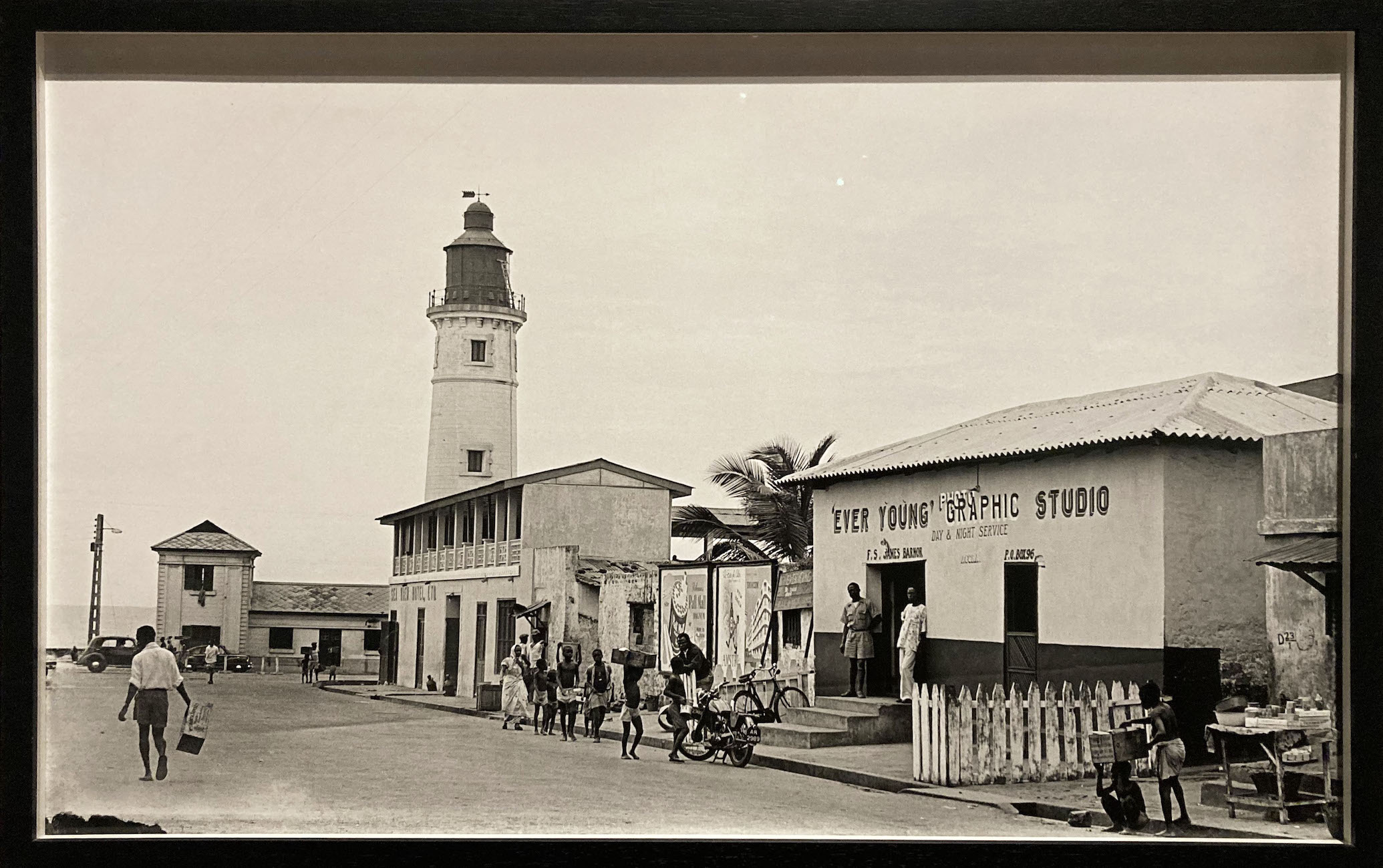
Ever Young Studio, Jamestown, Accra. 1953 (printed 2010-20) Gelatin silver print. Autograph, London.  All photos images: Ashley Cook

On May 28, The Detroit Institute of Arts celebrated the opening of Accra/London, a comprehensive retrospective of photographs by African photojournalist James Barnor. This exhibition illustrates his dynamic career as a photographer whose work documented the everyday life of Africans in Ghana and the diaspora as well as major turning points in the socio-political landscapes of Accra and London between 1950-1980. Born in 1929, Barnor was a first-hand witness to life under British rule on the Gold Coast. The influence of this experience on his view of the world undeniably guided his choice of subject and composition, and his perspective as a person of African descent led to particularly careful considerations of lighting, framing, and the use of tone and color. As the largest exhibition of his work to date, with over 170 photographs spanning three decades, visitors can now learn not only about James Barnor as an artist, but about the history and evolution of photojournalism as well as the impact that the medium of photography has had on social and political change on race relations between Africa and Great Britain.
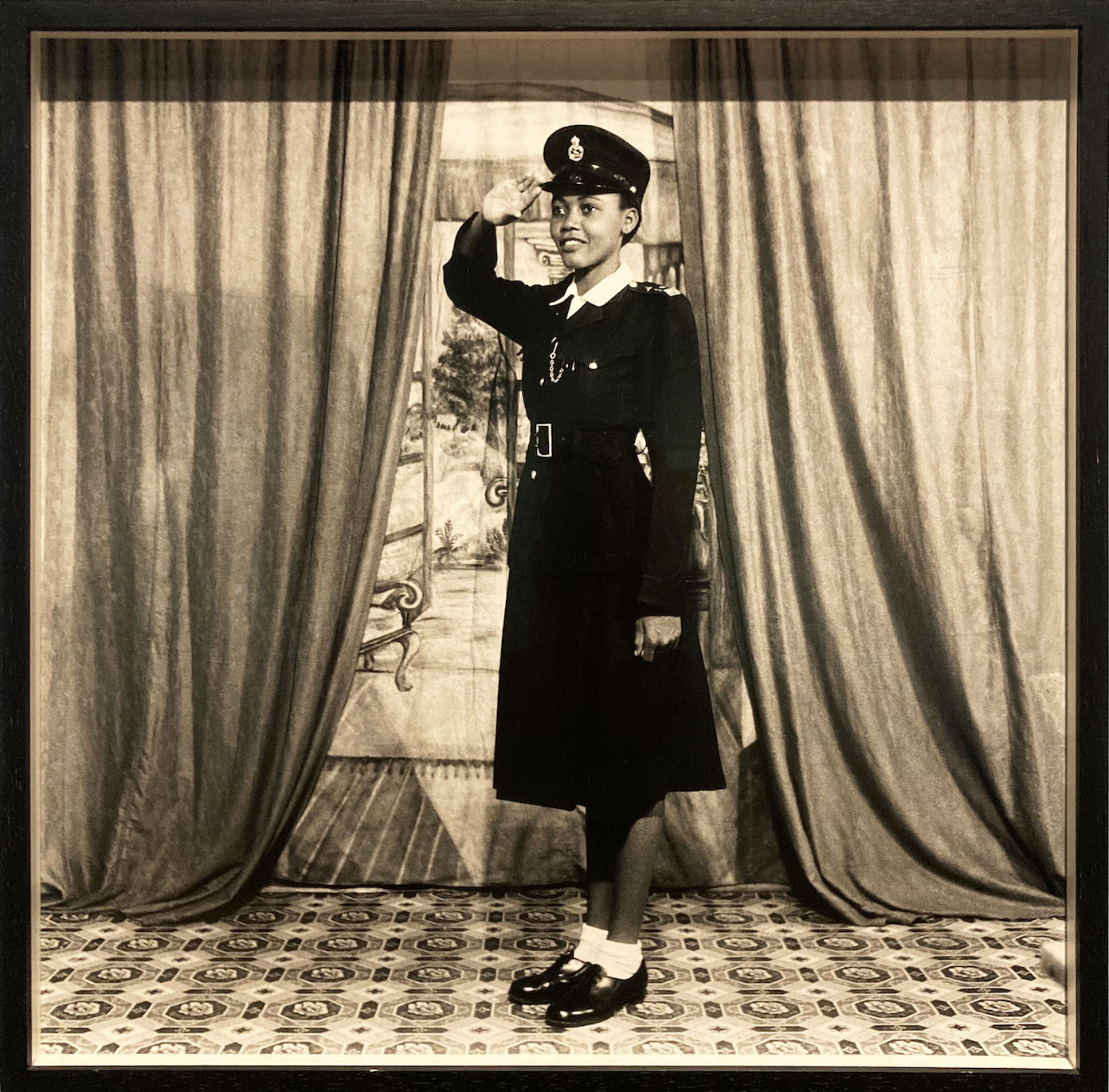
Selina Opong, Policewoman No. 10, Ever Young Studio, Jamestown, Accra. 1954 (printed 2010-20) Gelatin silver print. Autograph, London.

The short film presented at the exhibition’s entrance introduces us to the artist as a 91-year-old man keenly recalling details of his life and career. He recounts his youthful experience learning how to use a camera to photograph his friends, family, politicians, and professional athletes. He reflects on his role in documenting the history of Ghana from colonial to post-colonial life, his involvement with DRUM Magazine, and the expansion of his practice from Accra to London. Barnor’s light-hearted disposition in the film helps us understand how he could easily access people of various backgrounds, a trait that has proven to be critical to his professional success over time. Joy is the most consistent emotion detected in his photographs, despite their being taken in a world troubled with political unrest and racial discrimination.
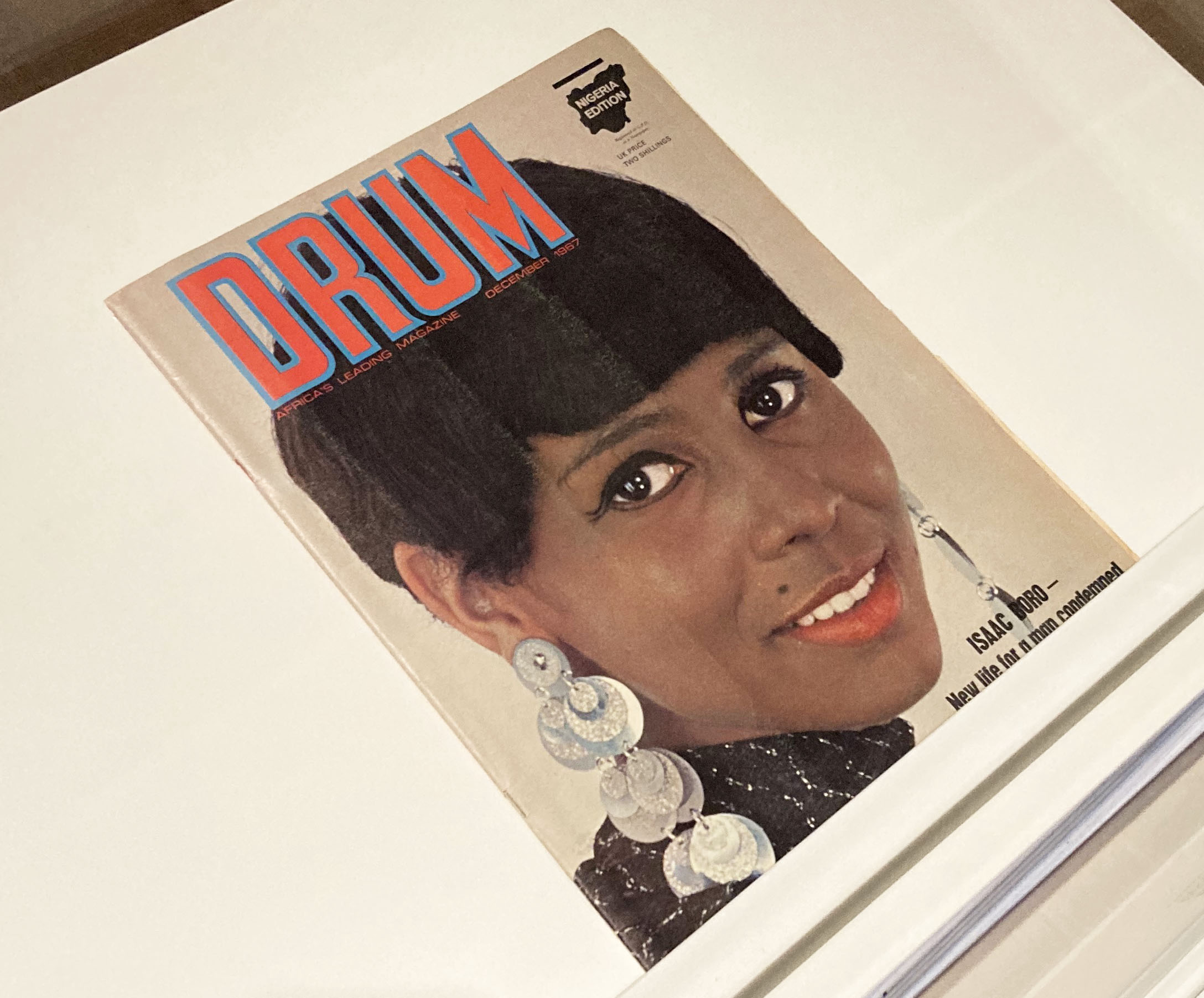
DRUM Magazine, Nigerian Edition, December 1967.

The story told through this retrospective begins with Barnor’s entrance into the professional world of photography. He started to work with the Daily Graphic newspaper in 1950 and established the Ever Young Graphic Studio in 1953 as an open-air studio on the streets of Accra. Eventually, Ever Young moved to a permanent location, and Barnor used his autonomy as the business owner to explore and develop his approach to taking portraits. He depicted African life on the coast of the Atlantic and its backdrop of colonial oversight. Indigenous fishing boats share a frame with James Fort, Barnor’s friends drive a car with an iconic lighthouse in the background; elsewhere, men and women are photographed in the studio dressed in their professional uniforms. His portraits of men, women, youth and children portray the successes of local people who he recounted in interviews as having been motivated by the excitement for liberation that was on their minds and in their hearts at that time.
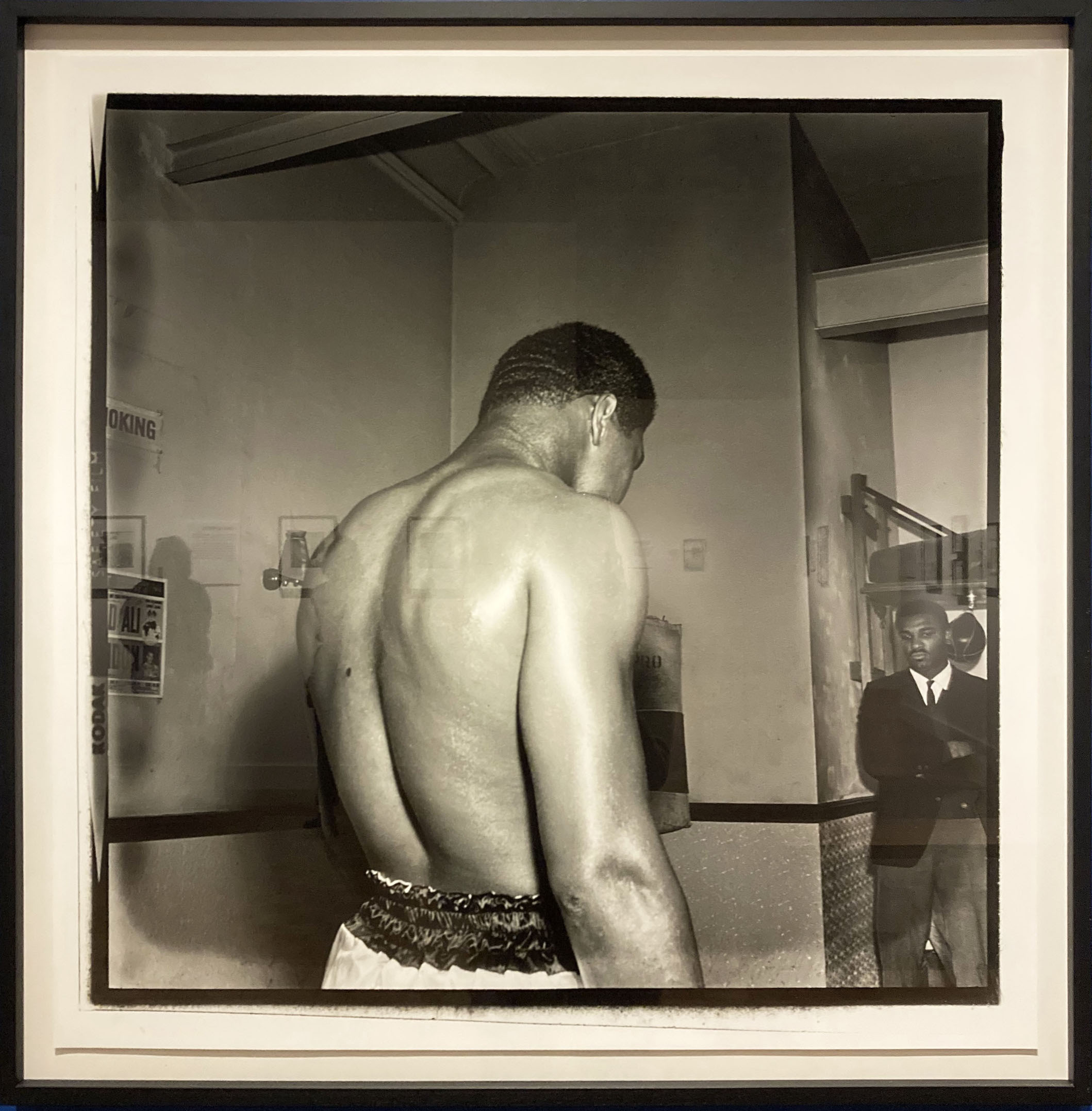
Muhammad Ali preparing for his fight against Brian London, 1966 (printed 2010-20) Gelatin silver print. Galerie Clémentine de la Féronnière , Paris.

Enlarged wall images, detailed placards, vintage cameras and copies of magazines are on view throughout the space to further support the storytelling efforts of the curators. Accra/London initially debuted at the Serpentine Gallery, London in 2021. Organized by Chief Curator Lizzie Carey-Thomas in collaboration with Awa Konaté, the Assistant Curator of the Culture Art Society, Clémentine de la Féronnière, Sophie Culière of the James Barnor Archives and Isabella Senuita. The exhibition was presented at MASI in Lugano, Switzerland in 2022 before coming to Detroit. The Detroit Institute of Arts recently acquired 22 of Barnor’s photographs (now included in the Detroit-based installation of Accra/London) in an effort to diversify the museum’s world-renowned collection and to enhance its holdings of works by living African artists.  Nii Quarcoopome, the DIA’s Curator of African Art, and Nancy Barr, the James Pearson Duffy Curator of Photography, worked together to bring this exhibition to a Midwest audience as part of the Detroit Institute of Art’s ongoing effort to promote its representation of people of color.
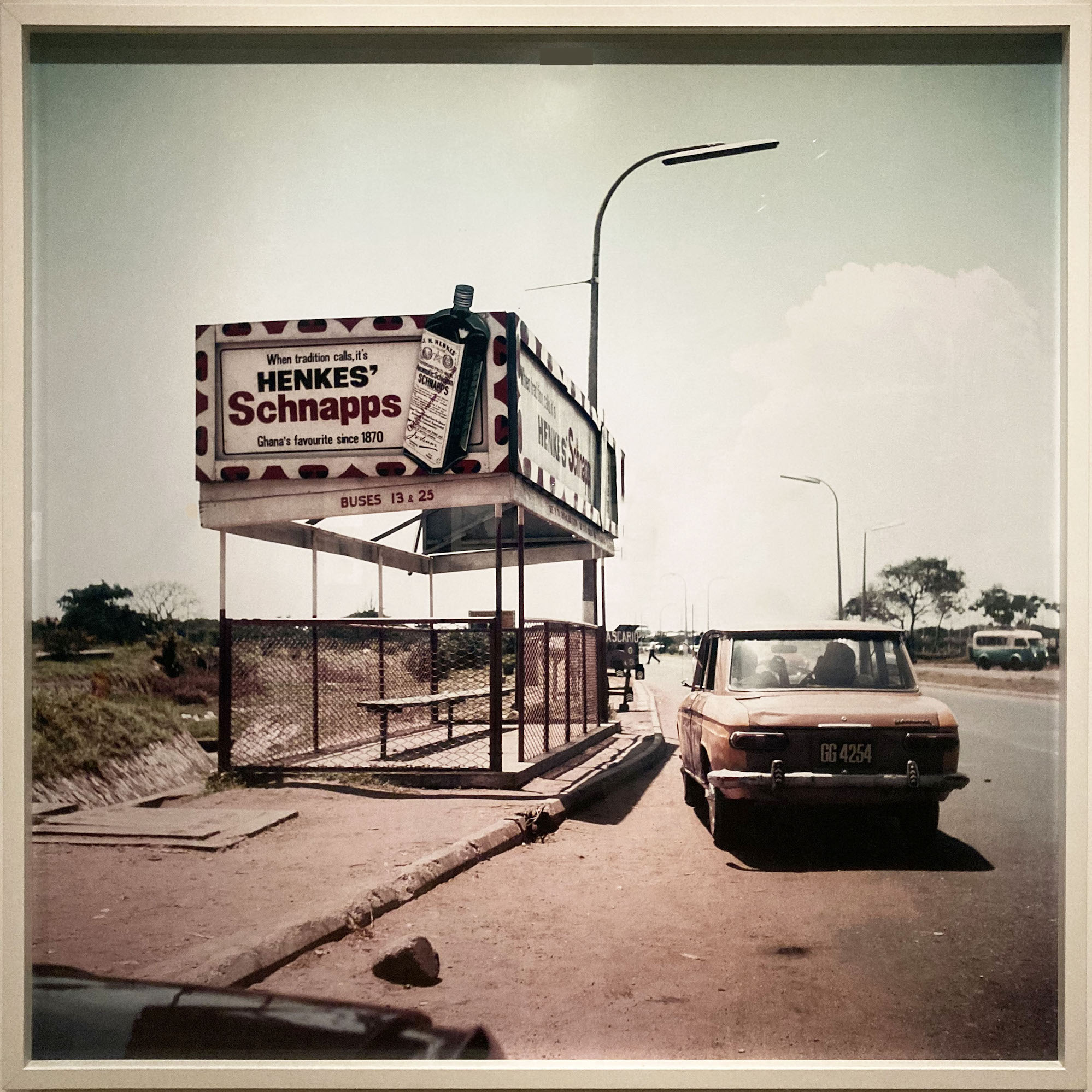
Ring Road, Accra, 1974 (printed 2010-20) Chromogenic print. Galerie Clémentine de la Féronnière, Paris.

Despite the collection on view being only a small sampling of Barnor’s entire archive of more than 32,000 images spanning six decades, it acts as a marker of the global growth in representation between 1950-1980 of people of color. In Accra, the photographer witnessed Ghanian boxer Ginger Nyarku publicly defeat his British opponent which challenged contemporary ideas of European superiority. He witnessed nurses, accountants, teachers and lawyers on the Gold Coast working together to weaken Britain’s control from within their government positions. He witnessed the transition of power from Queen Elizabeth II of Great Britain to Kwame Nkruma of Ghana. He witnessed a growing presence of African models on the covers of magazines in London and Barnor participated in all of this by presenting opportunities for them to be seen. His sitters were these mothers with their children, these models, these athletes, these politicians. They were carefully photographed with lighting that complimented their skin tone, and angles that framed their traditional hairstyles. They were positioned in ways that displayed the traditional patterns on their clothing. They were all shown to be confident and proud.
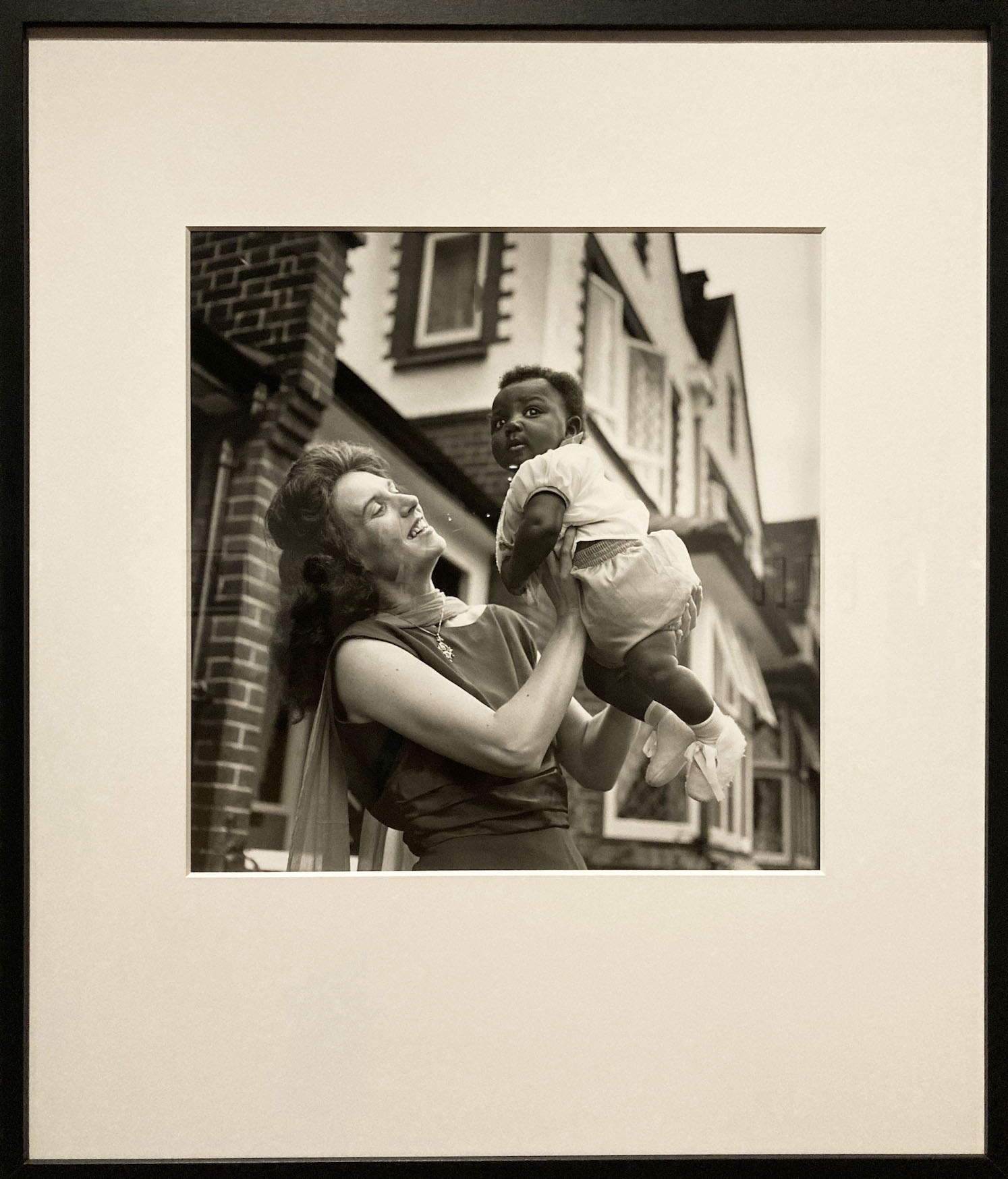
A woman holding a baby after the wedding of Mr. and Mrs. Sackey, Balham, London, about 1966 (printed 2010-20) Gelatin Silver print. Galerie Clémentine de la Féronnière, Paris.

 Although Barnor found racism embedded throughout the United Kingdom and its colonies from the time he arrived in London until he left, the discriminatory laws and customs were not strong enough to prevent a growing appreciation for Black culture. People of both African and European descent crossed strict boundaries and protested discrimination by actively celebrating the intermingling of cultures and the exchange of knowledge it allowed. Because of this, white subjects became increasingly prevalent in Barnor’s work. Joyful dissent was recorded in everyday-life moments of interracial couples and multi-racial friend groups while a growing number of Black figures began to appear in roles they previously were not allowed to have and in places that they were previously not permitted to be.
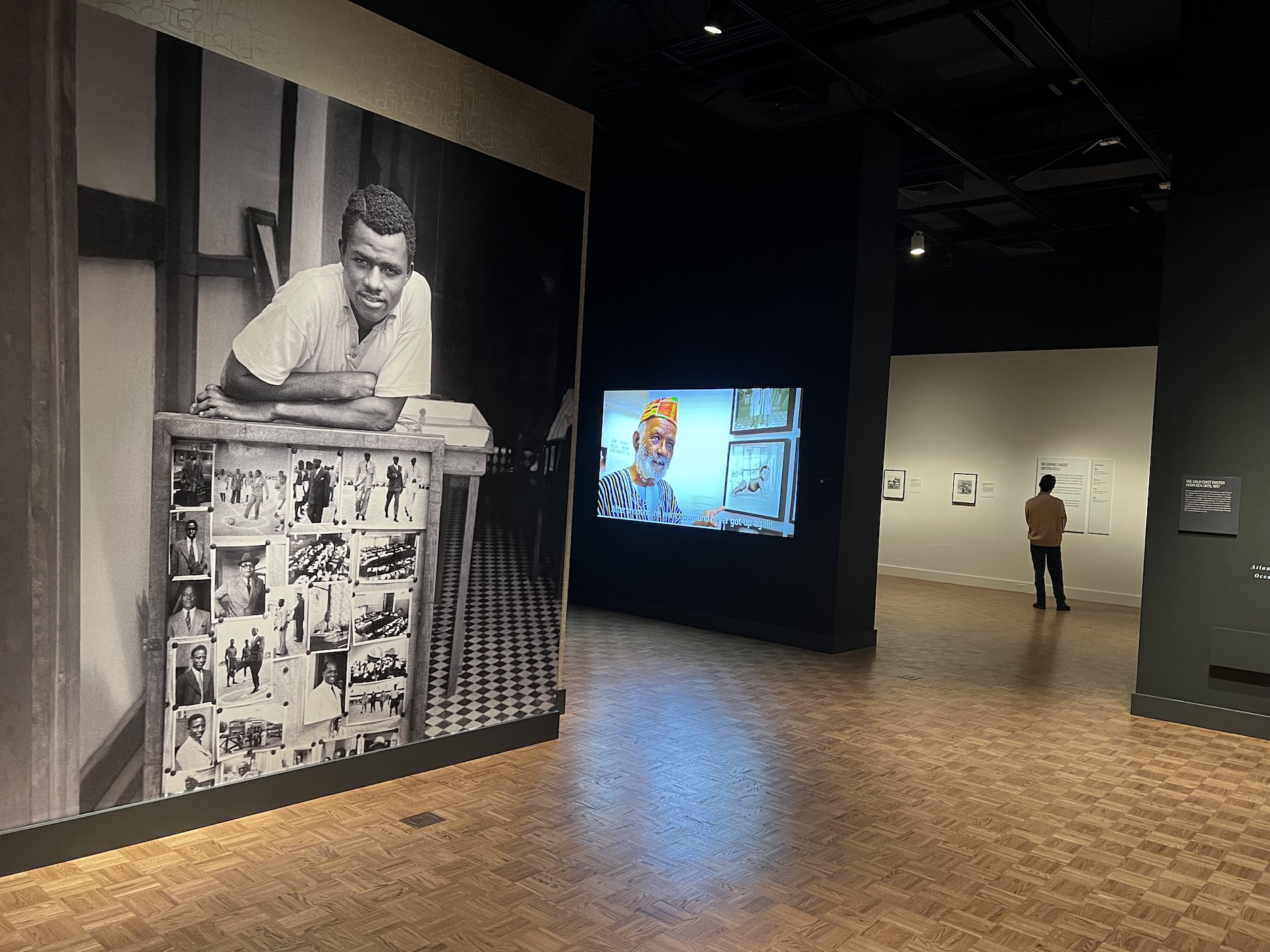
Installation, James Barnor: Accra/London – A Retrospective at The Detroit Institute of Arts. Image courtesy of DAR

James Barnor: Accra/London – A Retrospective is on view at The Detroit Institute of Arts until Closing October 15, 2023

[adrotate group = “2”]
Blind Spot: Stephanie Syjuco @ MSU Broad

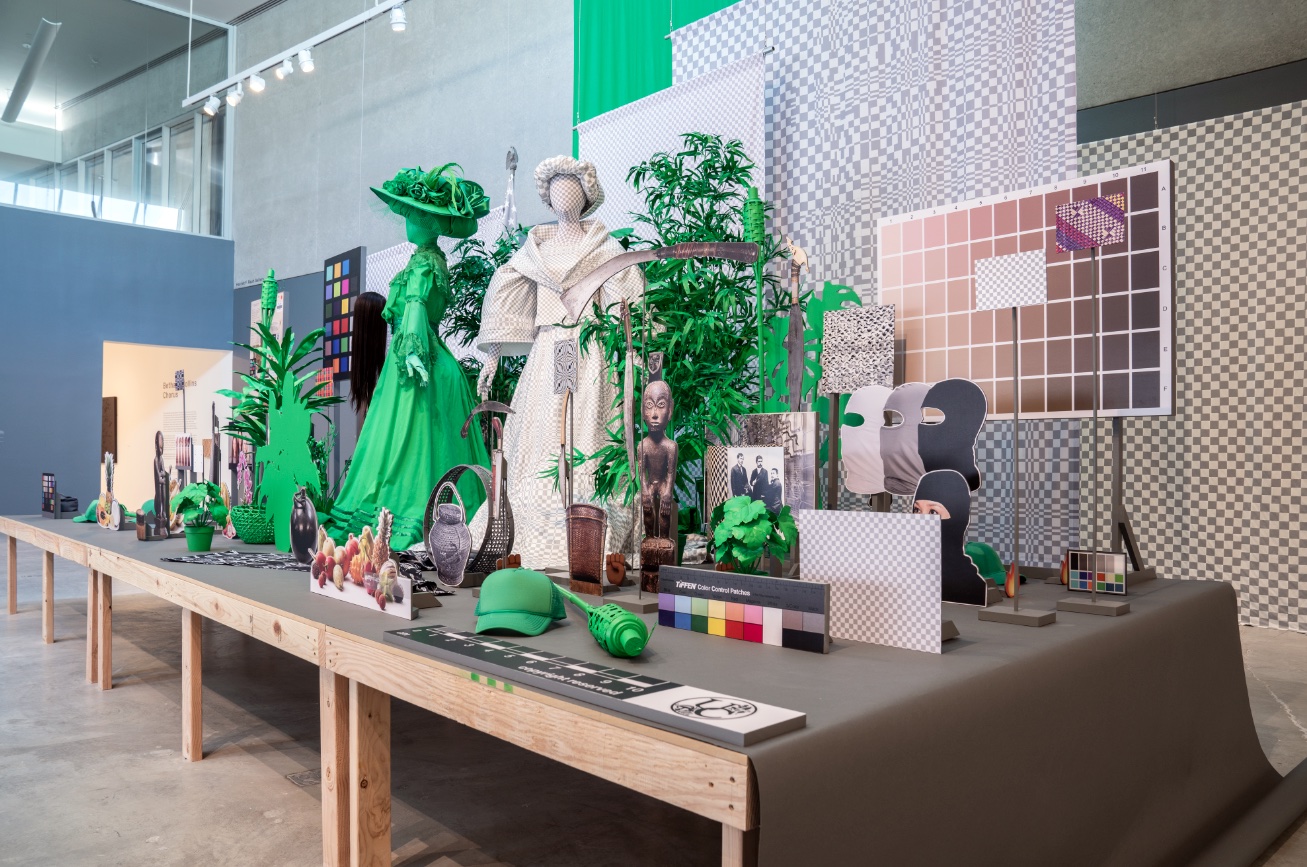
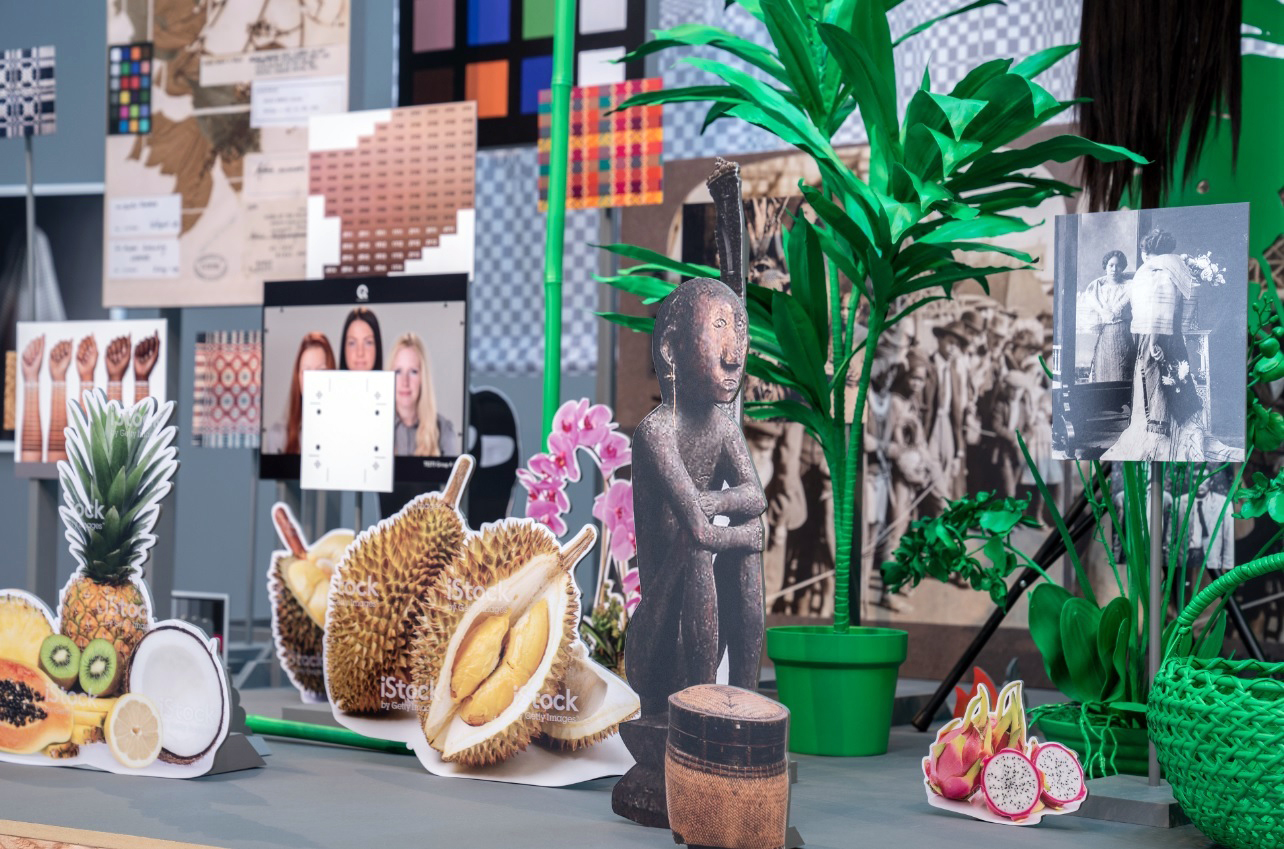
Dodge and Burn (Visible Storage) Stephanie Syjuco, Dodge and Burn (Visible Storage), 2019. Wooden platform, digital photos and printed vinyl on lasercut wood, chroma key fabric, printed backdrops, seamless paper, artificial plants, mixed media. Overall 20 x 17 x 8 feet. Photo: Dusty Kessler. Courtesy of the artist, Catharine Clark Gallery, San Francisco, and RYAN LEE Gallery, New York.

While I chatted with Rachel Winter (assistant curator at the MSU Broad Art Museum) about the artistic practice of Stephanie Syjuco, Winter described her as a “force of nature,” and given her many accomplishments, it’s easy to see why. Syjuco’s work has been displayed at the MoMA, the Whitney, and the Smithsonian Museum of American Art, and her awards include a Guggenheim Fellowship and a Smithsonian Artist Research Fellowship. Recently, she was featured on the PBS series Art21.  Born in the Philippines, Syjuco has spent most of her life in the United States, and currently teaches at the University of California, Berkeley. Using America’s colonization of the Philippines as a frequent reference point, her archival and research-based artistic practice addresses the ways photographs and objects can be used to construct skewed narratives.

Through July 23, the Broad presents the exhibition Blind Spot: Stephanie Syjuco, a collection of Syjuco’s work which traverses across photography, sculpture, craft-based media, and installation. This is a diverse body of work with a focused intent, addressing the ways individuals from the Philippines were represented in America during the years of American occupation (1898-1946). America’s history in the region is not given much attention in our history books, and is a “blind spot” for many of us. But these works also speak to colonialism and representation in a broader, more generalized sense.

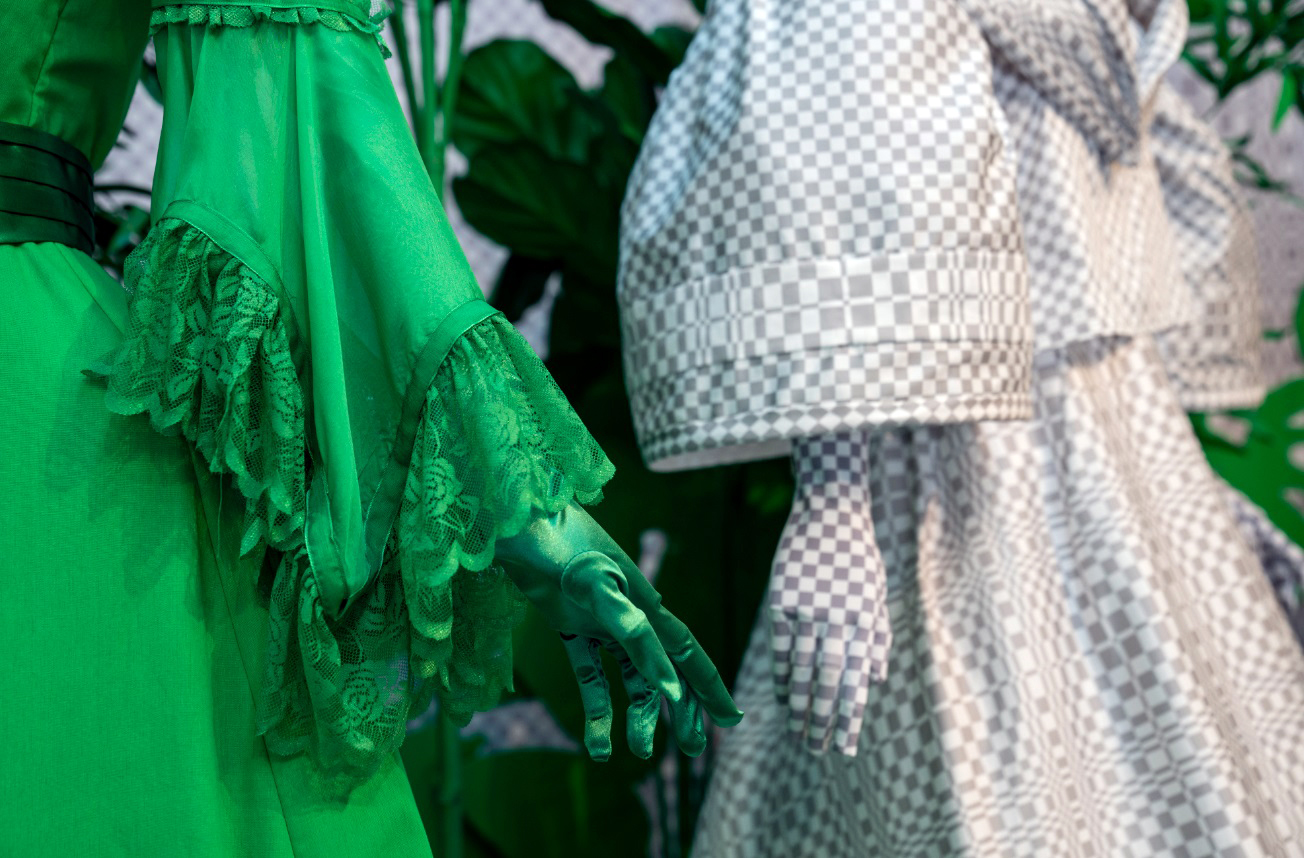
Syjuco frequently uses chromakey green in her works, a reference to the green-screen used in digital video post-production. And the grey and white checkered pattern she often uses is a reference to the transparency background in Photoshop which fills the negative space in an image after something has been deleted. These allow for both superimposition and erasure, and their prevalence in her work speaks to the omnipresence (particularly in the internet age) of manipulated images and narratives.

Dodge and Burn (Visible Storage) Stephanie Syjuco, Dodge and Burn (Visible Storage), 2019. Wooden platform, digital photos and printed vinyl on lasercut wood, chroma key fabric, printed backdrops, seamless paper, artificial plants, mixed media. Overall 20 x 17 x 8 feet. Photo: Dusty Kessler. Courtesy of the artist, Catharine Clark Gallery, San Francisco, and RYAN LEE Gallery, New York.

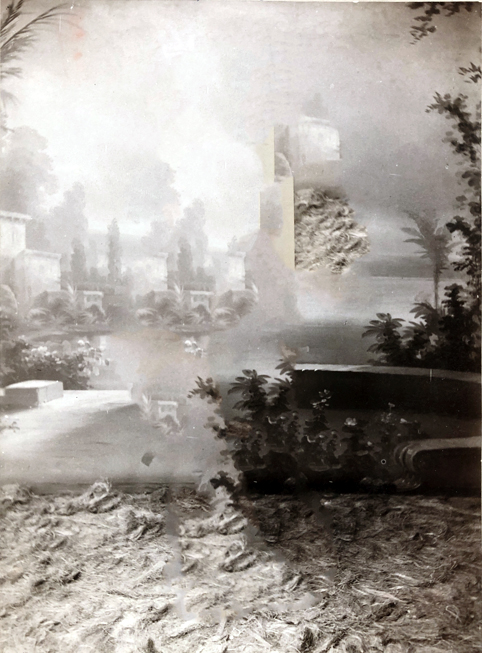
The exhibition’s namesake, Blind Spot, is an evocative digital reconstruction of photographs taken during the 1904 St. Louis World’s Fair. In addition to showcasing new technologies and scientific innovations, the fair also Included what was described at the time as a “human zoo,” featuring more than 1,100 individuals who were trafficked from the Philippines and who, for the duration of the fair, inhabited a Disneyland-style mockup of a village.  It was conceived as an educational display, but the exhibit also served to propagate notions about racial inferiority. Photographs of these individuals, taken as they posed in front of backdrops and dioramas suggestive of the South Pacific, helped disseminate these problematic ideas. Blind Spot is a digital intervention for which Syjuco manipulated these images in Photoshop, removing the people and leaving in their trace ghostlike, blurry apparitions. In the 40 images that comprise Blind Spot, all we see are the backgrounds that these individuals were posed in front of, and in removing the people from the photos, Syjuco symbolically liberates them from the ethnographic gaze. Begun in 2019 during a Smithsonian research fellowship, Syjuco completed the project specifically for this exhibition, and afterward it will enter the Broad’s permanent collection.

Blind Spot Stephanie Syjuco, Blind Spot, 2023. Pigmented inkjet prints mounted on aluminum. Eli and Edythe Broad Art Museum, Michigan State University, purchase, funded by the Nellie M. Loomis Endowment in memory of Martha Jane Loomis, 2022.33

Although the installation Dodge and Burn (Visible Storage) is sculptural, like Blind Spot it also directly addresses photography and representation. The title references the photographic darkroom technique of lightening or darkening certain parts of the image, though Dodge and Burn can certainly be read in more literal ways. The ensemble presents a large stage crammed with images and objects associated with the Philippines. Many of these are cut-outs of stock images (watermarks clearly visible) that are displayed as prop-like objects. The centerpiece of the ensemble are sculptural representations of two women from the late 19th Century, one in traditional Filipinx dress, and one dressed in more Western fashion. It’s an intentionally busy sculptural collage which the artist likens to having too many tabs open on a computer. While the work reminds us of America’s colonial history, contemporary references in the ensemble (emojis, photographic color calibration charts, and MAGA hats) encourage us to think about the extent to which America is still a colonial power (Puerto Rico and Guam remain U.S. territories, after all, an enduring legacy of the 1898 Treaty of Paris). Subtitled “Visible Storage,” the work serves as a critique of how objects in museums have often been used to construct problematic narratives.

Dodge and Burn (Visible Storage) Stephanie Syjuco, Dodge and Burn (Visible Storage), 2019. Wooden platform, digital photos and printed vinyl on lasercut wood, chroma key fabric, printed backdrops, seamless paper, artificial plants, mixed media. Overall 20 x 17 x 8 feet. Photo: Dusty Kessler. Courtesy of the artist, Catharine Clark Gallery, San Francisco, and RYAN LEE Gallery, New York.

While several bodies of work in this exhibit specifically address Filipinx representation, Syjuco’s work also addresses representation and constructed narratives in more generalized ways. One work in the show features 20 digitally printed flags suspended from the ceiling; their presence evokes the United Nations, and initially they seem to be an expression of unity. But these flags come from fictional rogue/enemy states portrayed in American and European movies; none of these states existed in reality. Most of these are from films produced during the cold war, and are stylized to evoke certain parts of the world; together they speak to a generalized fear of a foreign enemy.

Syjuco’s work is heavily based on archival research, and it raises questions about how archival holdings are acquired, interpreted, and displayed. In support of this exhibit, the accompanying booklet includes brief essays by the directors and registrars of Michigan State University’s varied collections across the arts and sciences (such as the herbarium and the university archives).  They discuss their holdings while acknowledging the “blind spots” that exist within these collections, underscoring the cross disciplinary relevance of Syjuco’s artistic practice.

The show takes full advantage of the Broad’s Zaha Hadid designed exhibition space. It’s both conceptually powerful and visually rich. And while the colonization of the Philippines occurred on the other side of the world, Syjuco, particularly with her Blind Spot project, reminds us of some of the ways that the enduring impact of America’s colonial legacy comes close to home.

 Eli and Edythe Broad Art Museum

Blind Spot: Stephanie Syjuco is on view at the Eli and Edythe Broad Art Museum through July 23, 2023

[adrotate group =”2″]

Ricky Weaver @ David Klein Gallery and University of Michigan Institute for the Humanities Gallery

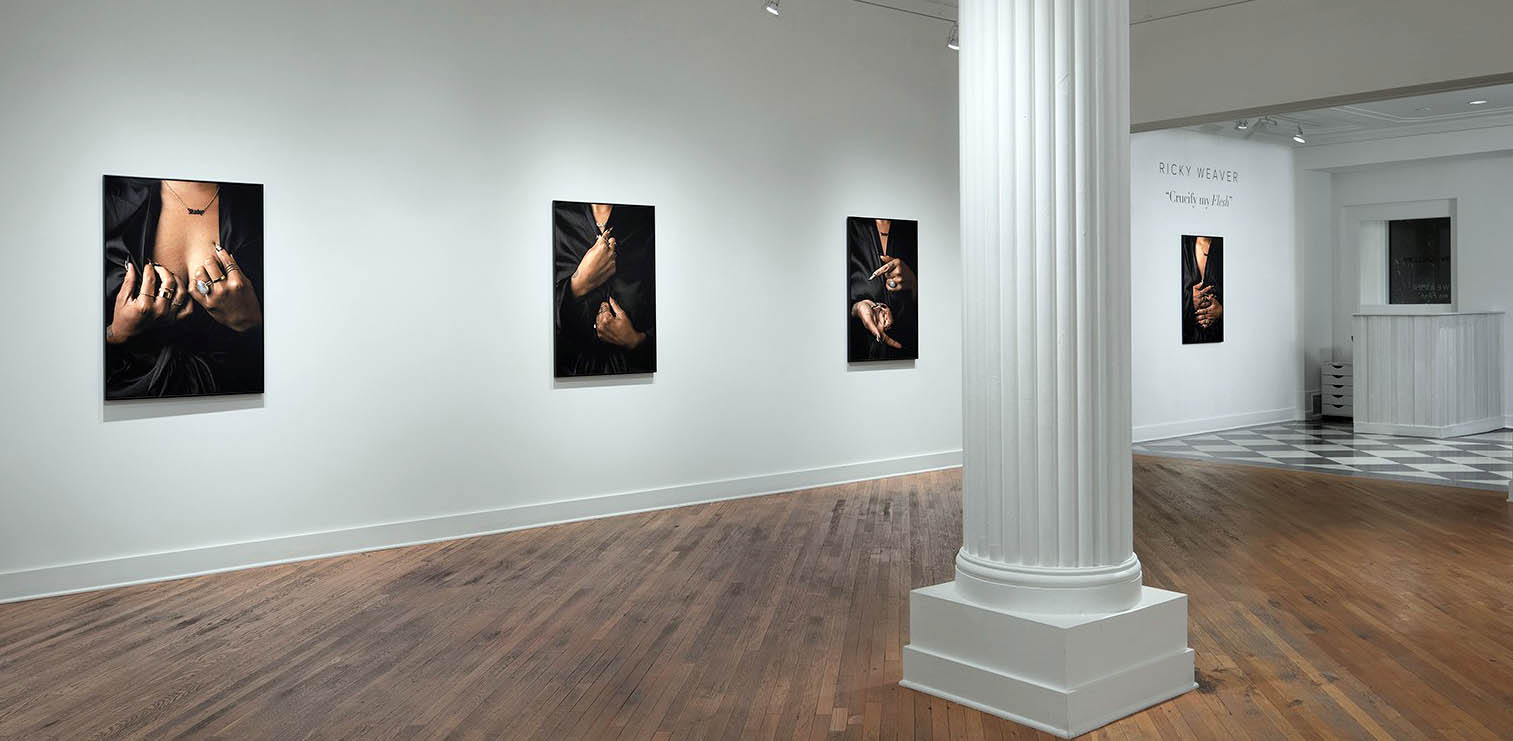
Installation, “Crucify my Flesh,” front gallery at David Klein, 2023, Detroit, MI, photo: P.D. Rearick

Spring, 2023 has been an eventful season for Detroit artist and photographer Ricky Weaver. Two exhibitions, one at David Klein’s downtown gallery entitled “Crucify My Flesh” began a survey of the artist’s recent work in March and is now followed by a companion show “Way Outta No Way“  at the Institute for the Humanities Gallery in Ann Arbor.

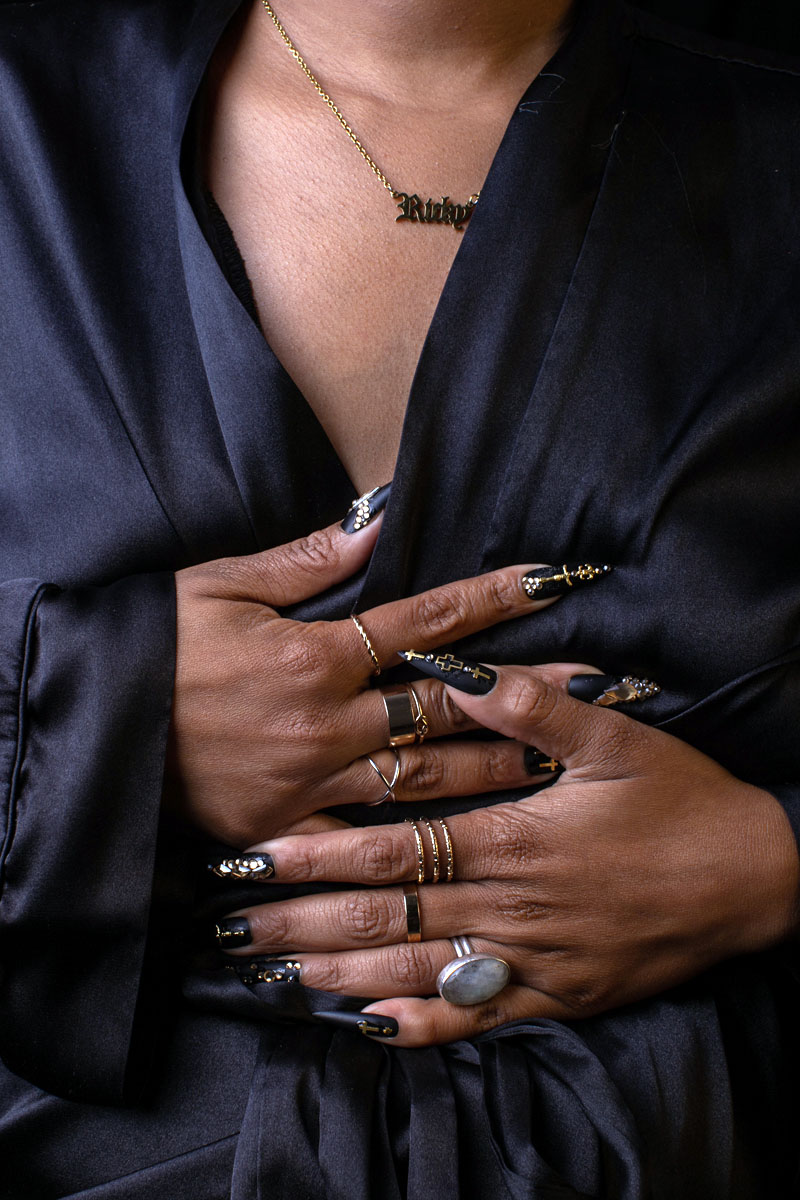
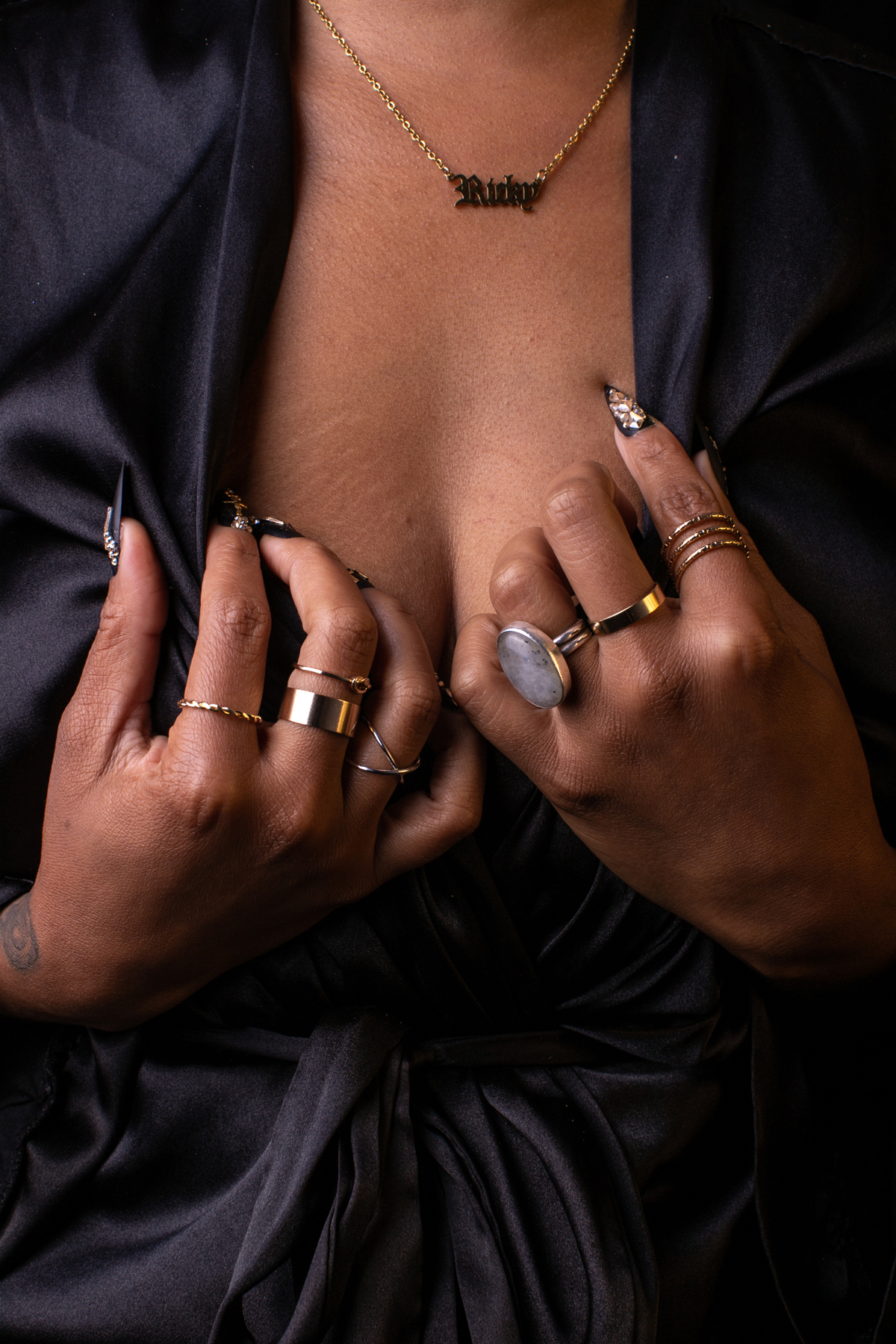
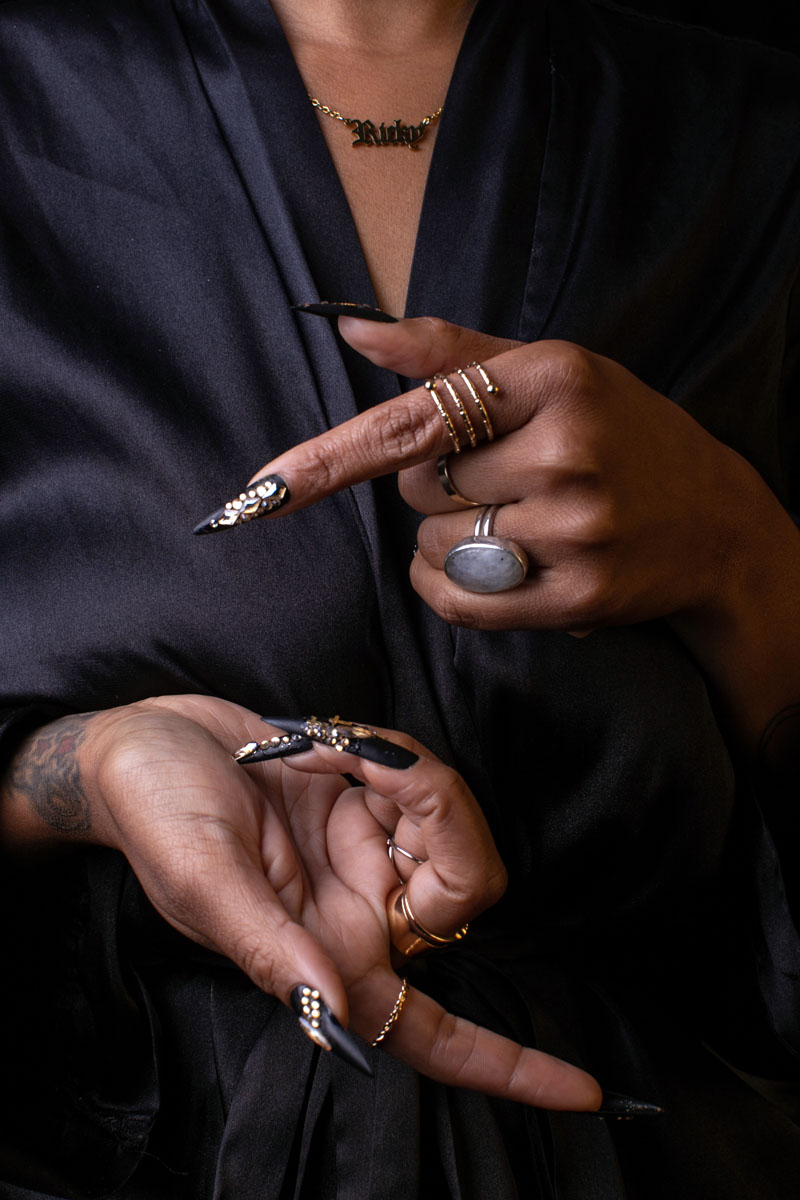
The series of seven large photographs in the main gallery at David Klein, Untitled, On the Mainline (Anthem), introduce Weaver’s highly charged subject: the vexed relationship between the Black female body and contemporary culture.  The artist prefers to call the pictures “image-based objects trafficking in the grammar of black feminist futurity” rather than self-portraits.  This strikes me as an evasion typical of her art practice, which simultaneously conceals and reveals. With this recent work, Weaver sets up a dynamic of approach/avoidance that persists throughout both exhibitions, at once attracting us while simultaneously holding us off.

Ricky Weaver, Untitled, On the Mainline, (Anthem) #9037, 2023, archival pigment print, 45” x 30,” ed. of 5 + 2 AP, photo: P.D. Rearick

Ricky Weaver, Untitled, On the Mainline (Anthem) #9084, 2023, archival pigment print, 45” x 30,” ed. Of 5 + 2 AP, photo: P.D. Rearick


Ricky Weaver, Untitled, On the Mainline (Anthem) #9084, 2023, archival pigment print, 45” x 30,” ed. Of 5 + 2 AP, photo: P.D. Rearick

The handsome images in Untitled, On the Mainline, (Anthem)are larger than life size and–oddly–cut off the subject from the neck up. The subdued color of the pictures emphasizes the velvety texture of the sitter’s skin, contrasted with the shiny lacquer of her nails. A delicate necklace helpfully names the subject as “Ricky” and Weaver pointedly focuses our attention on her elaborately manicured, gesturing hands, even as her body is swathed in liturgical black.  The nails, beringed and extravagantly appliqued with Christian symbols, are talon-like. They signify  both beauty and danger as they hint at meaning in some unknown sign language. Because the images are ranged around the gallery in a row, the impulse to read them as a coded narrative is almost irresistible. So we follow them around the room as the hands point to something outside the picture frame, as they clutch the fabric of her robe closed or hold it open, as a nail digs into her own breast. Without engaging in verbal exposition, Weaver suggests suffering, negation, devotion, refusal. The photographs in this series are an exercise in revealing and concealing, drawing in and pushing away.  The religious imagery and text suggest a spiritual struggle inherent in her negotiation of race and gender in a surrounding society that both sexualizes and demeans. Weaver’s refusal to reveal herself is hence her declaration of autonomy.

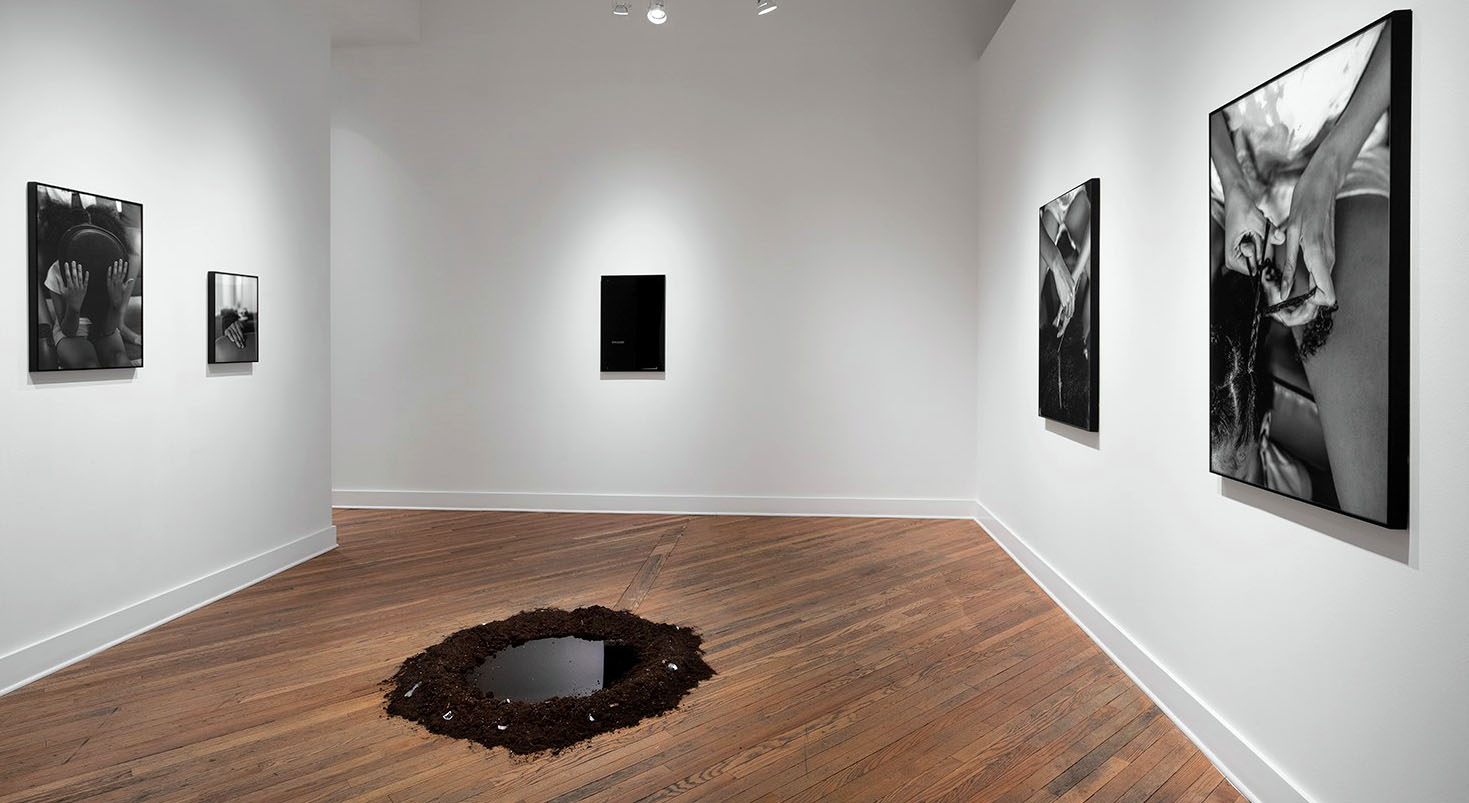
Installation, “Crucify My Flesh,” back gallery at David Klein, 2023, Detroit, MI, photo: P.D. Rearick

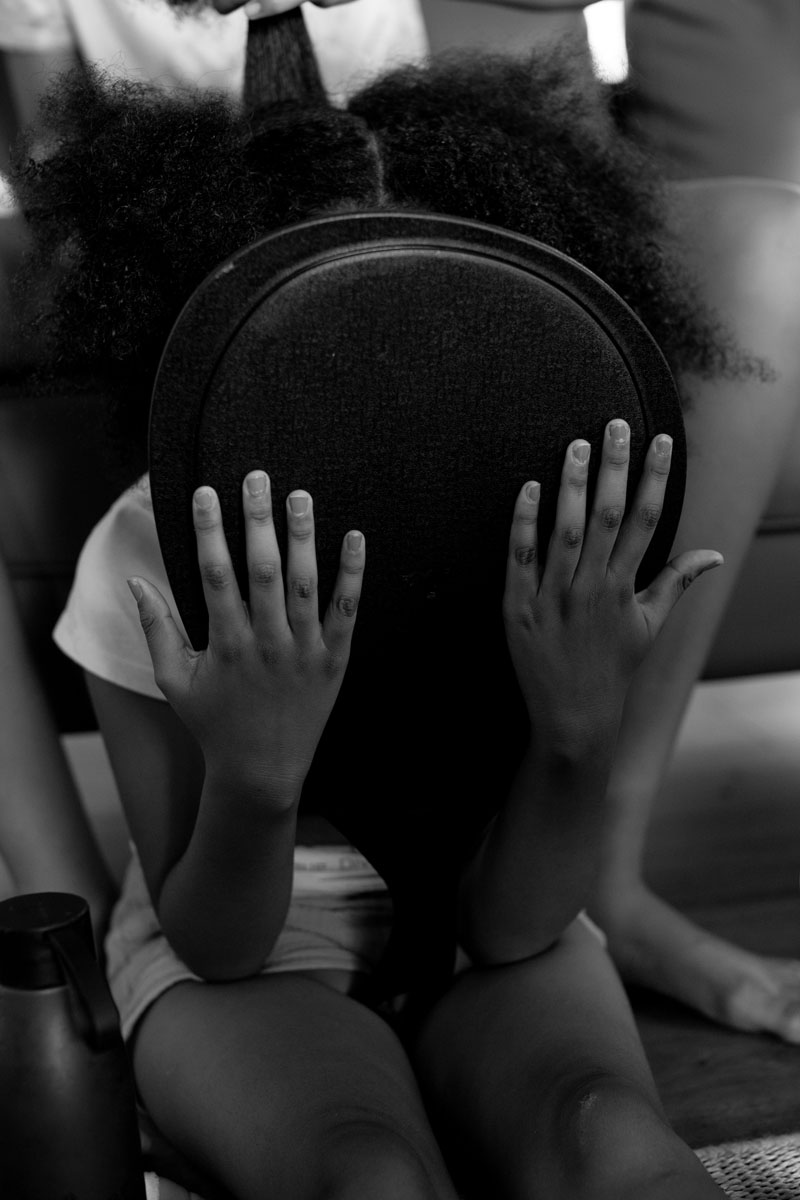
In the second room at David Klein, Weaver positions herself squarely within a matriarchal family structure bounded at one end by her recently deceased grandmother and at the other by tender photographs of her daughters in private moments of caregiving. A series of five images, Untitled, I Sound Like Momma’N’Em (Care and Council), shows Weaver’s daughters in an intimate setting and positioned to suggest vulnerability. Once again, the hands are the point of focus, as they delicately braid and dress hair or merely lie quietly on bare skin. Faces are obscured either by the camera angle or –as in the case of image #9997–purposely obscured by a hat.

Ricky Weaver, Untitled, I Sound Like Momma N’Em (Care and Council), #9997, 2023, archival pigment print, 30” x 20,” ed. of 7 + 2 AP, photo: P.D. Rearick

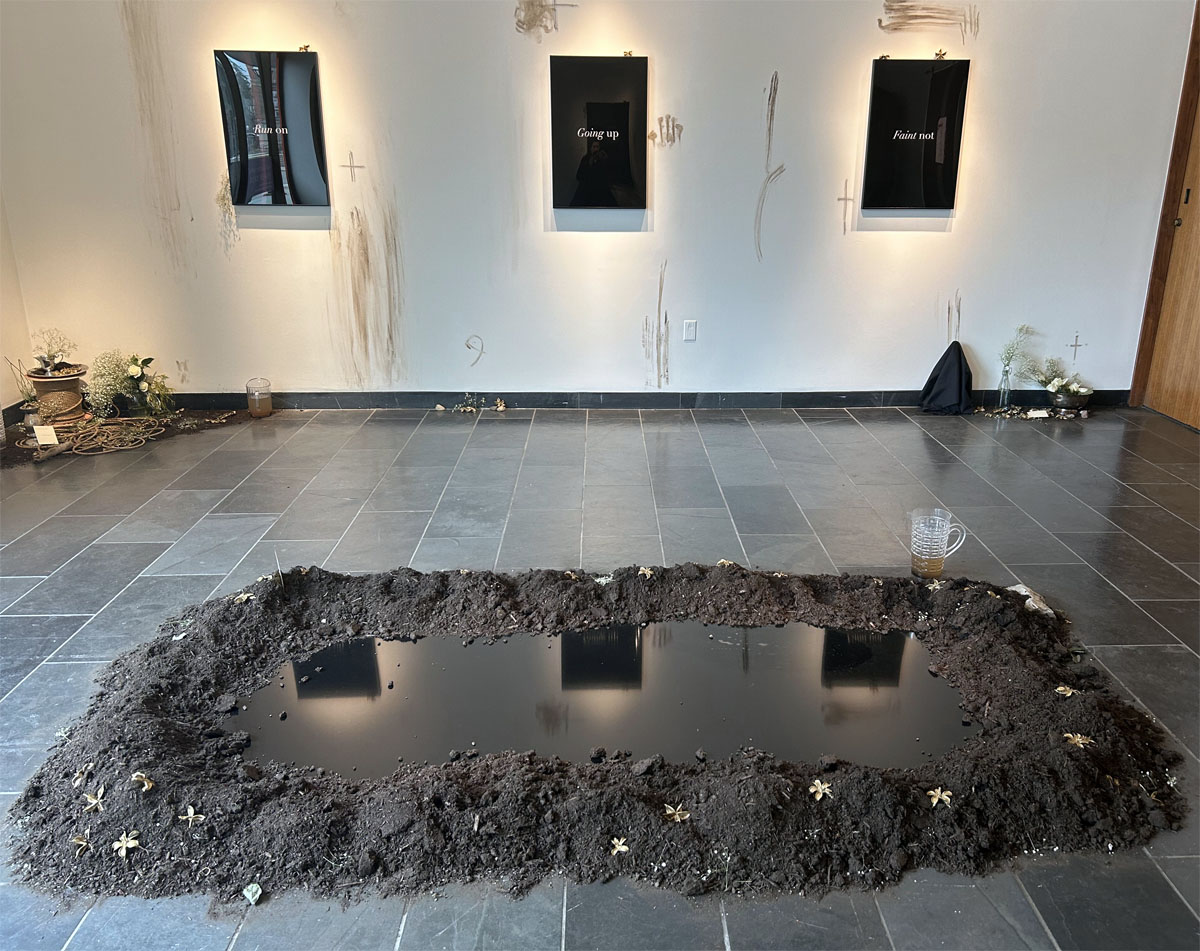
The recent death of Weaver’s grandmother, a central figure in her upbringing, has engendered an installation that examines universal themes of death, Black historicity and the connection of the living to the departed. The center of the gallery is devoted to an obsidian-black glass circle on the floor which suggests an open grave. It is ringed by loose soil, with ritual lavender and prayer candles. The skyring portal, though, also serves as a looking glass for the living, reflecting quotidian corporeality in the face of nothingness.  Two black mirrored images, Lay My Burdens Down 1 and 2, echo the dynamic of the floor installation and suggest death’s welcome escape from the burden of physical existence.

Installation, “Way Outta No Way,” 2023, University of Michigan Institute for the Humanities Gallery, Ann Arbor, MI, photo: K.A. Letts

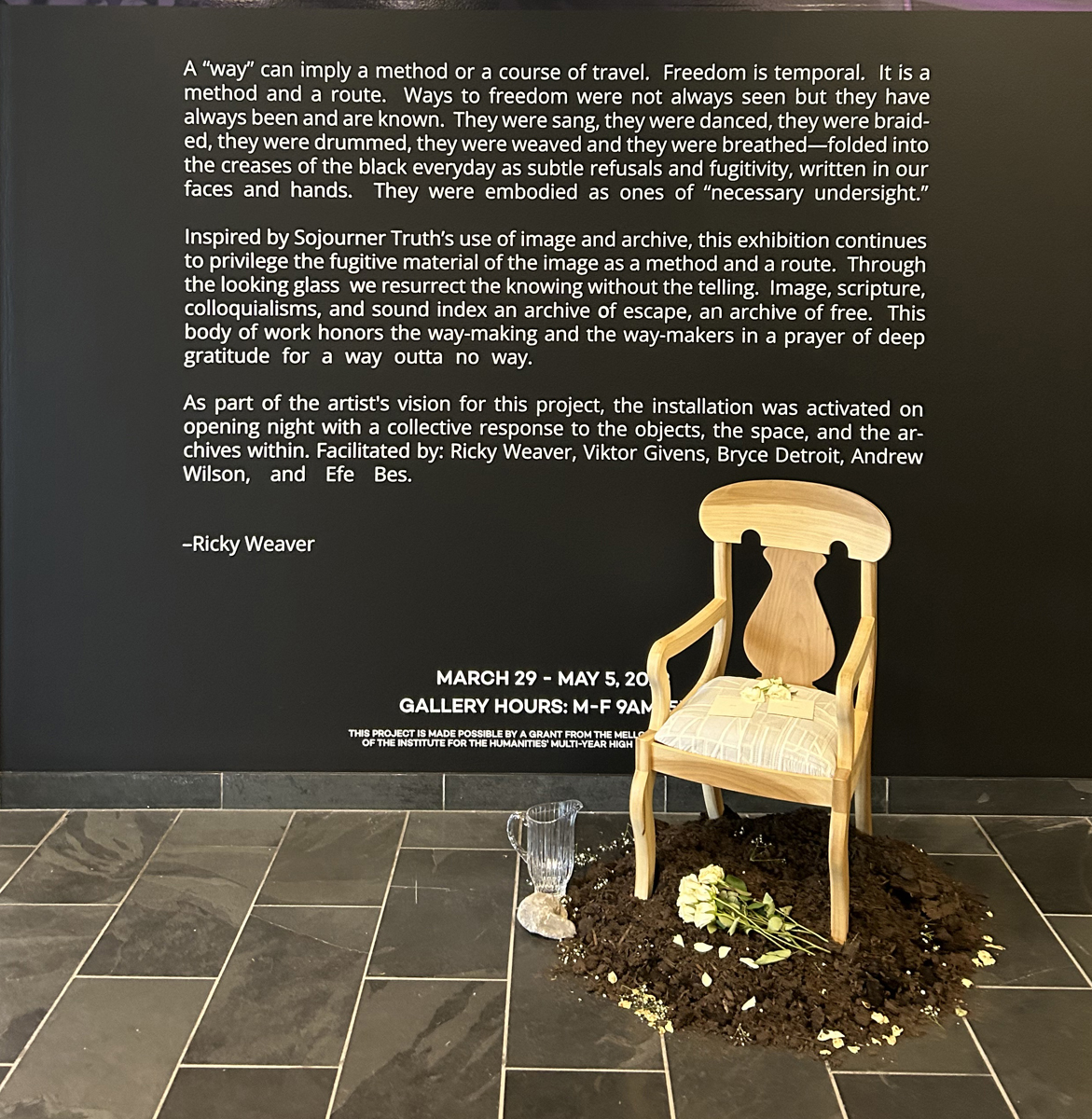
Moving on to the second exhibition, “Way Outta No Way” at the University of Michigan Institute for the Humanities Gallery, the black reflective image surrounded by soil reappears, now much larger and positioned in the center of the gallery, signifying  secret knowledge and resistance. Weaver has moved from the intimate focus of “Crucify My Flesh” to the broader significance of the fugitive image in resisting historic oppression of Black people. The elements of a ritual that can only be guessed at by the uninitiated govern the placement of the objects in the gallery.  Domestic furniture, flowers, dirt and water imply some cryptic, encoded body of knowledge. Or as Weaver says, “Ways to freedom were not always seen but they have always been and are known…This body of work honors the way-making and the way-makers in a prayer of deep gratitude for a way outta no way.”

Installation, “Way Outta No Way,” at the University of Michigan Institute for the Humanities Gallery, Ann Arbor, MI, photo: K.A. Letts

“Way Outta No Way” will be on view at the University of Michigan Institute for the Humanities Gallery in Ann Arbor until May 5.  For more information on images from “Crucify my Flesh”  go to https://www.dkgallery.com/exhibitions/91-ricky-weaver-crucify-my-flesh-detroit/

[adrotate group=”2″]

Outside Work: Faculty Exhibition @ OUAG

Outside Work: Faculty Exhibition at Oakland University Department of Art and Art History

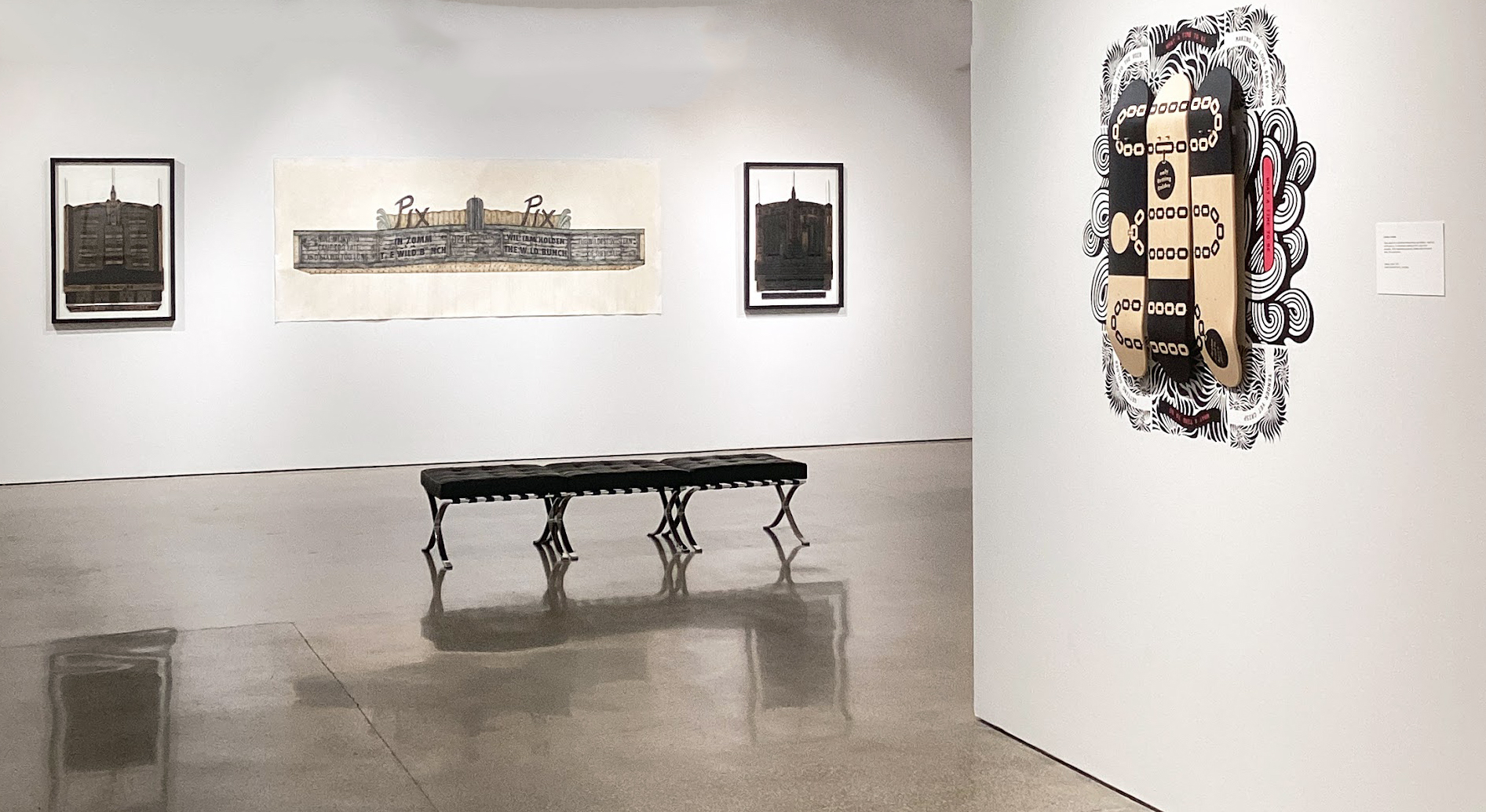
Installation view of Outside Work featuring Black Marquee, The Wild Bunch by Ryan Stanfest, and Getting Golder by Lindsey Camelio.  All images courtesy of Ashley Cook

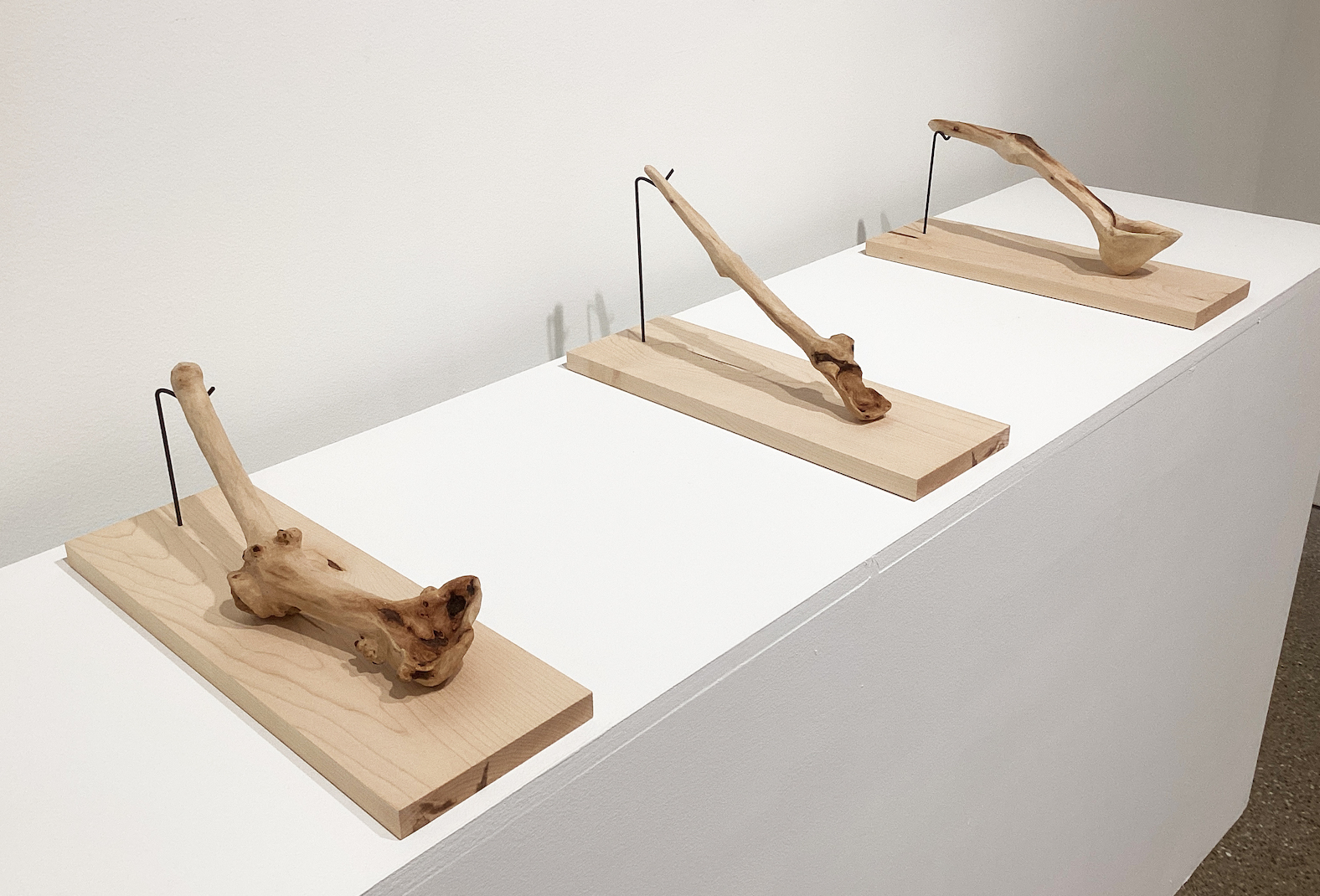
The promotional material for Outside Work at Oakland University Art Gallery includes an image of an organic object with a form similar to a bone or a piece of wood, lending itself to preconceptions that the exhibition would be focused on the natural outside world. Realizing upon visiting the work that this piece by David Lambert is a series of spoons carved from a native sycamore tree could pique the interest of nature lovers. The rest of the work, however, undermines from this assumption that nature is the consistent focus and quickly clarifies that what we have is a group of works by the faculty of the university done outside of their work within the Department of Art and Art History. Dick Goody is the director of the gallery and a Professor of Art at Oakland University; curated into the show are fourteen of his oil paintings along with other works of art by Claude Baillargeon, Meaghan Barry, Lindsey Camelio, Dho Yee Chung, Satareh Ghoreishi, David Lambert, Colleen Ludwig, Karen McGarry, Maria Smith Bohannon, Ryan Standfest and Cody VanderKaay.

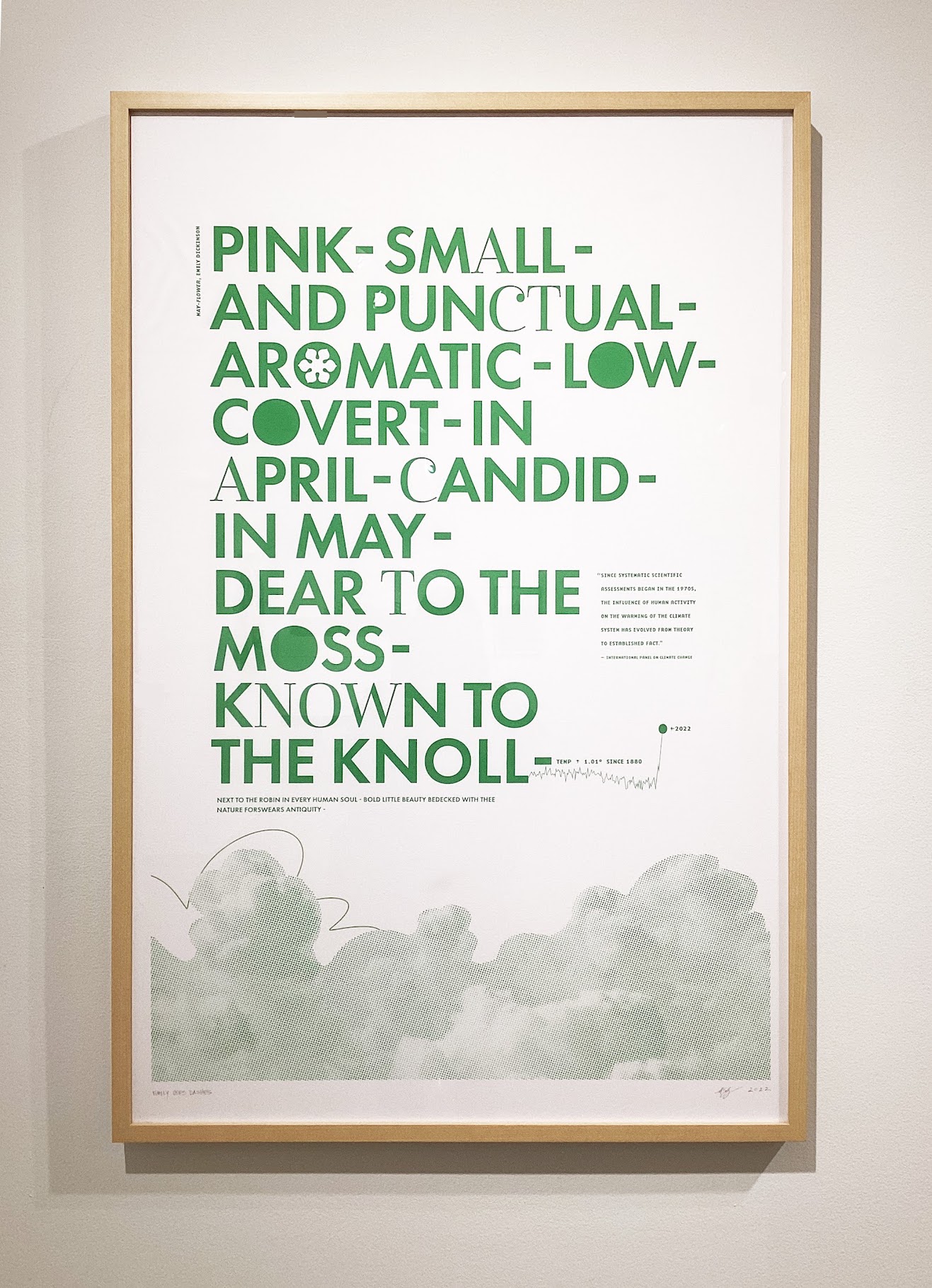
Maria Smith Brohannon, Emily uses Dashes, Glichee on canvas, 2022.

Visitors are first welcomed with a poster by Maria Smith Bohannon, who is an Assistant Professor of Graphic Design. This poster Emily uses Dashes places a strong focus on the poetic punctuation practices of Emily Dickinson in order to soften the heavy statistics of climate change that are peppered around the poetry. Eight conceptual maps by Karen McGarry are presented along the adjacent wall and then a second piece by Bohannon, Emily is Hopeful. The maps entitled These Places Thus Far by McGarry, who is a Lecturer in Art, utilize collage as the primary technique to touch on her experiences living in different places throughout her life as a student and arts educator, including Detroit, Chicago, New York, Oxford, Singapore, Dublin, Cincinnati and Los Angeles.

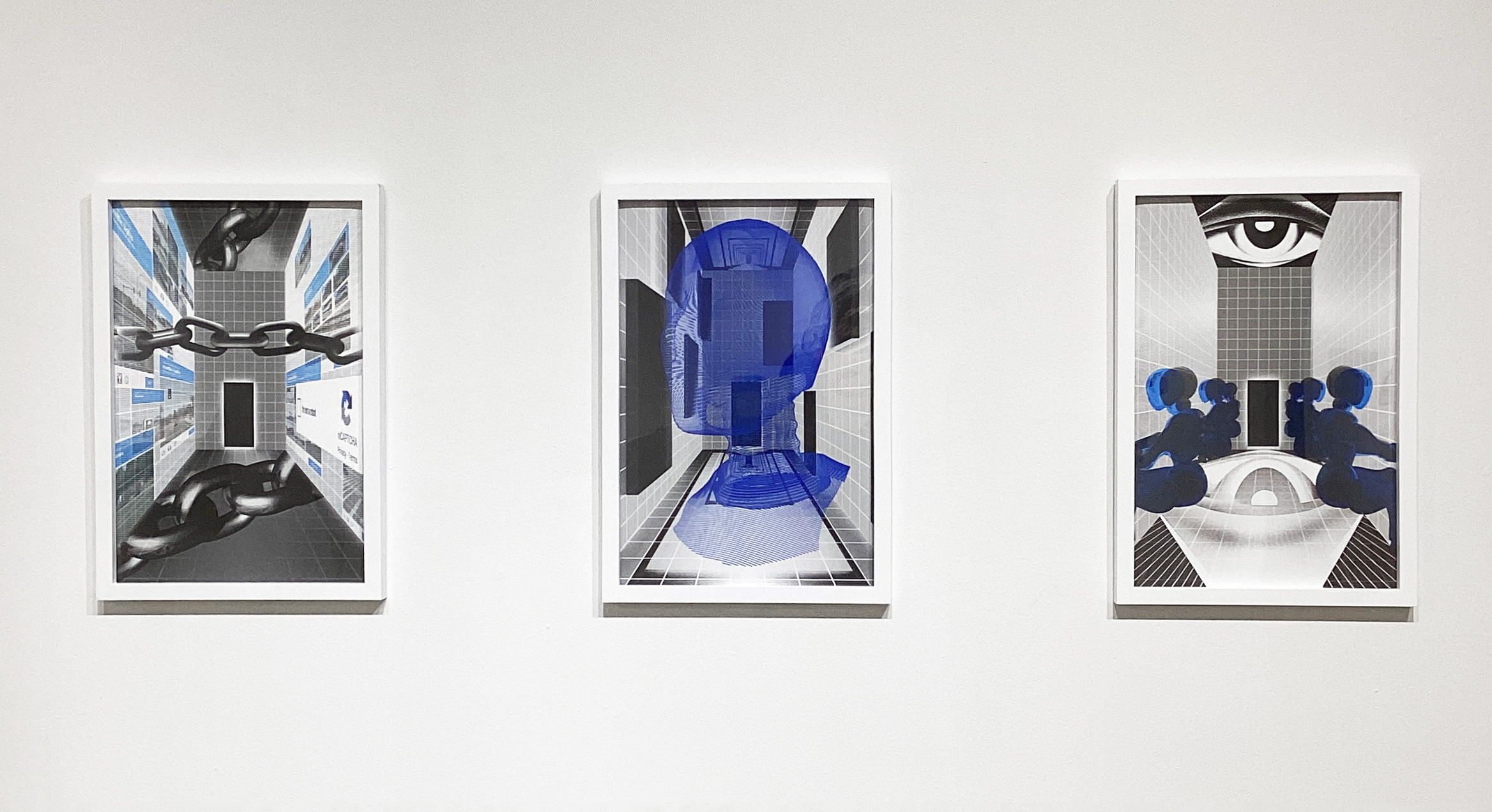
Dho Yee Chung, The Room Series, mixed digital media, 2022.

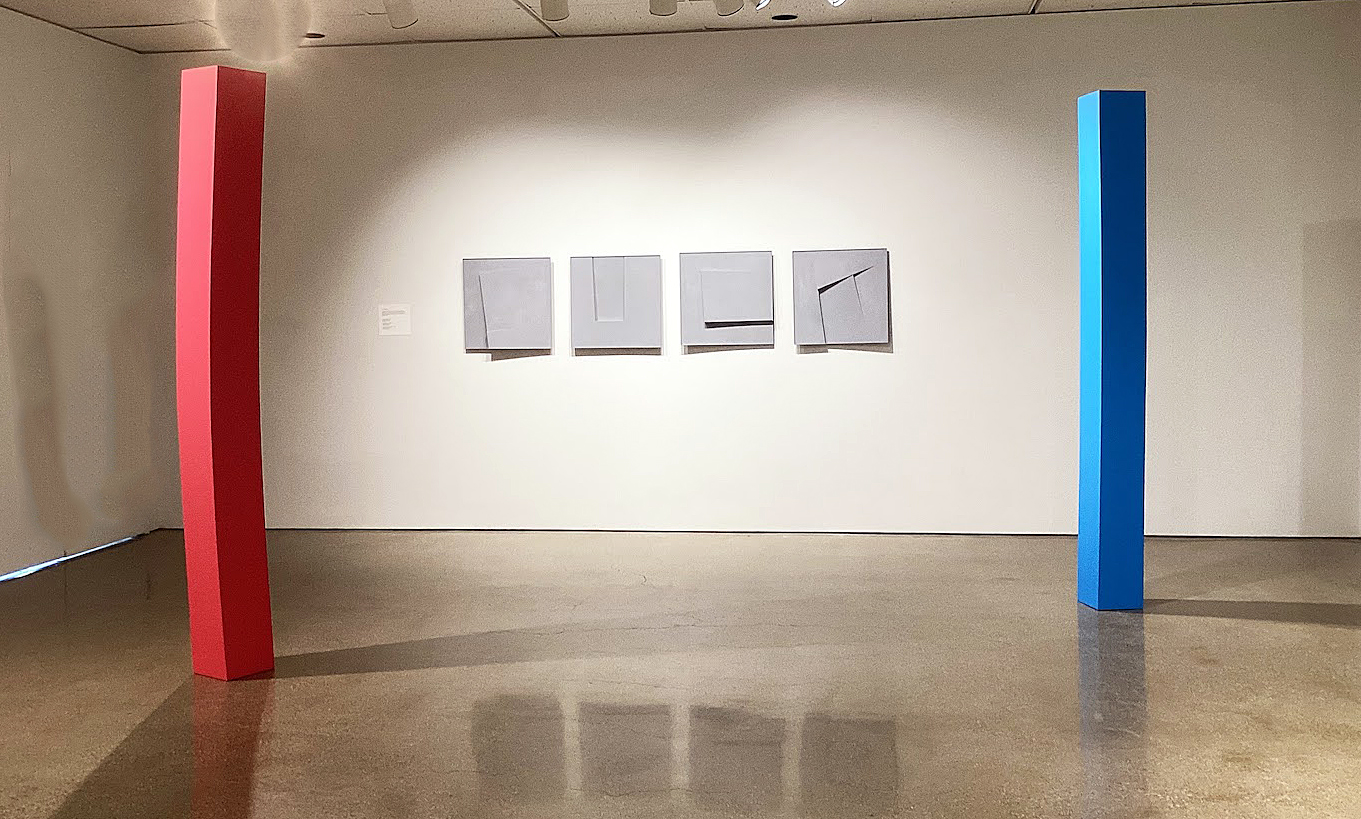
Works by Assistant Professors of Graphic Design Dho Yee Chung and Lindsey Camelio differ from each other despite both using digital media as their means of production. Dho Yee Chung’s triptych The Room Series uses surrealist compositions, missing ceilings and floors, animated walls, and translucent floating forms to depict the control of human labor within a digital workspace. Camelio embraces elements of surrealism too, but with the objective of exploring a realm between luxury and everyday life through odd combinations of subject, pattern, color, and form. A strong focus on color and form is also at play in the work across the room by Cody VenderKaay who is an Associate Professor of Art, the Director of the Studio Art Program, and a sculptor. These abstract red and blue towers are in fact made of pine despite them looking like plastic. This carries over as well to the gray wall works they frame, which are shaped and primed birch.

Cody VanderKaay, Lodestone (Roulette) and Lodestone (High Dive) made of shaped and painted pine, Untitled (Subliminal Landscape) made of shaped and primed birch, 2022.

Assistant Professor of Graphic Design Satareh Ghoreishi and Assistant Professor of Art Ryan Standfest encourage us to consider the impacts of Covid-19 on consumerism around the world. The two works by Ghoreishi focus on the massive influx of online shopping that took place during the onset of the pandemic through her sculptural assemblages that combine contemporary shipping boxes and fashion items with personal items from years ago. The 3D collages by Standfest highlight the unfortunate impact that the pandemic has had on our ability to gather together in physical spaces. He touches on this through the display of two abandoned movie theater facades and a watercolor painting of a rundown marquee. Sharing the same space is Associate Professor of Art Colleen Ludwig’s crocheted fiber and mushroom root sculptures Saccu 1 and Saccu 2. They use the superorganism mycelium to test its ability to merge with fiber with the aim of discovering the potential for new habitat designs to house small creatures within the natural world. This work has a very particular concentration that combines biology with creative production similar to Untitled (Spoons) by Lecturer in Art David Lambert, who uses the tradition of spoon making from his Scots/Irish ancestry to produce these seven forms that teeter on the line between concept and function.

David Lambert, Untitled (Spoons), sycamore, 2020.

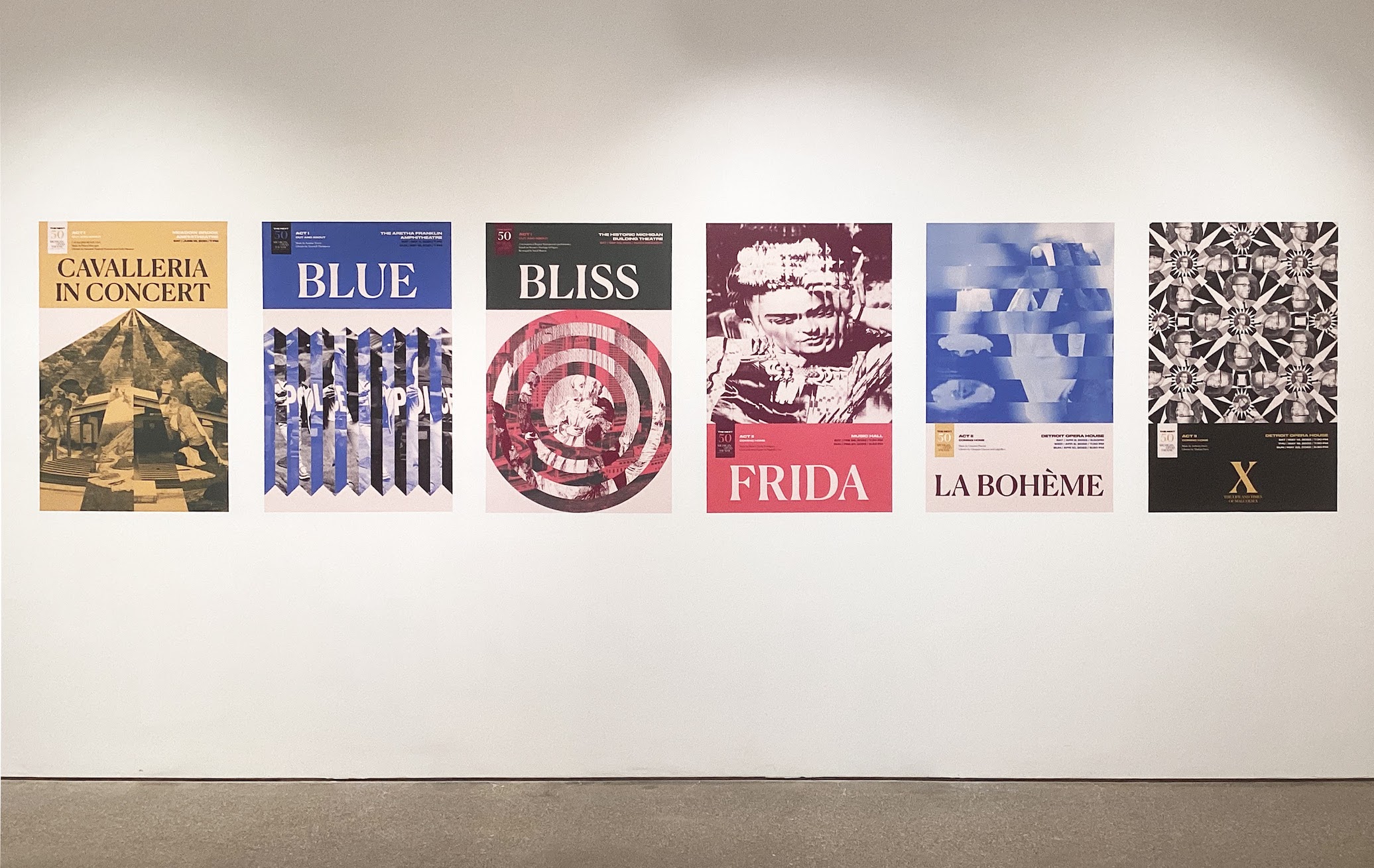
The long-standing painting practice of Dick Goody holds a place in this show alongside Professor of Art History Claude Baillargeon’s ink-jet prints entitled Memorial Monuments of Racial Terror, The Equal Justice Initiative (EIJ) Community Remembrance Project, and A Knight of Columbus Facing Justice. These photographs represent the Equal Justice Institute and its work in confronting the history of racism in the United States as a way of healing and achieving justice. And finally, the Department of Art and Art History Chair Meaghan Berry introduces her graphic design firm Unsold Studio through the presentation of six posters that were commissioned by the Michigan Opera Theatre’s 2021-2022 season In MOTion. These promotional designs were made for each performance in the season and visually communicated a freshness through the sense of motion with the goal of not only continuing to attract long-time attendees but new audiences as well.

Meaghan Barry, In MOTion: A visual identity system for Michigan Opera Theatre’s 2021-2022 Season, 2021.

The professional and personal concerns of the artists are represented through the work they chose to include in this group exhibition. Outside Work successfully highlights the dynamics at play within the Department of Art and Art History and makes it clear that each of these artists sustains a studio practice and active professional career in the world of art and design in addition to their position as an educator, which is an essential trait to the faculty of any distinguished university.

Outside Work at Oakland University Art Gallery opened on January 12 and is on view until April 2, 2023.   You can learn more at https://www.ouartgallery.org/exhibitions/outside-work/

[adrotate group=”2″]


Concerning Landscape @ Detroit Artists Market

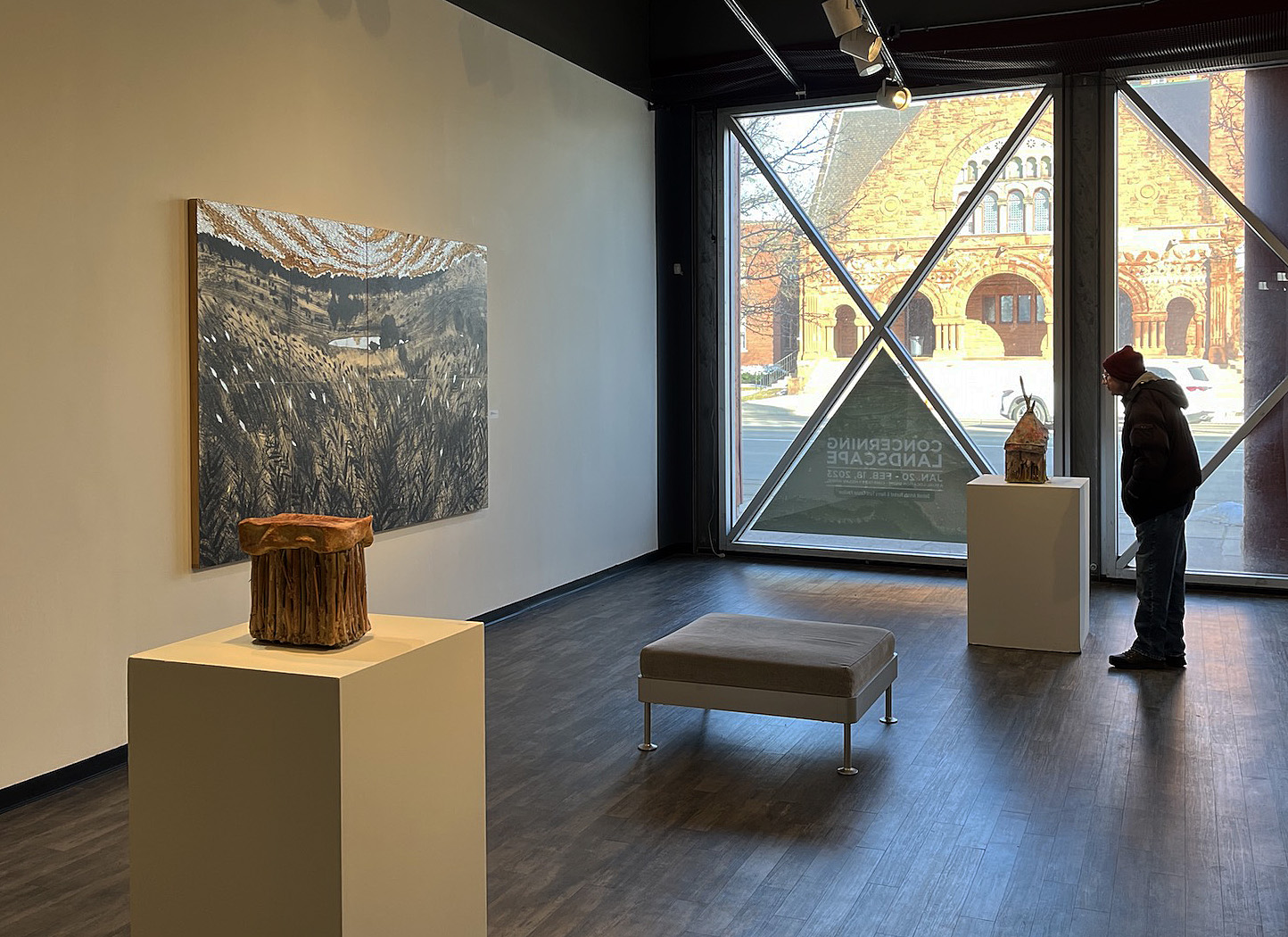
An installation shot of Concerning Landscape at Detroit Artists Market, up through Feb. 18. Image courtesy of Michael Hodges.

Over the centuries, the venerable landscape painting has evolved far from the Dutch masters who first perfected the genre — a fact underlined by the heterogeneous work in Concerning Landscape, up through Feb. 18 at both the Detroit Artists Market and the new Brigitte Harris Cancer Pavilion at the Henry Ford Cancer Institute in Detroit.

Curator Megan Winkel has adopted a refreshingly ecumenical point of view in pulling this together. Works range from Ann Smith’s intriguingly peculiar sculptures with their bunched reeds and dangling root systems to Carla Anderson’s photographic prints of geologic forms, including lyrically striated rocks in a spring in Yellowstone County, Wyoming.

A fan of the grand view? Not to worry. Concerning Landscape also embraces figurative vistas, like Helen Gotlib’s meticulous intaglio print, West Lake Preserve II, or Bill Schahfer’s lush photo study, Lagoon Life.

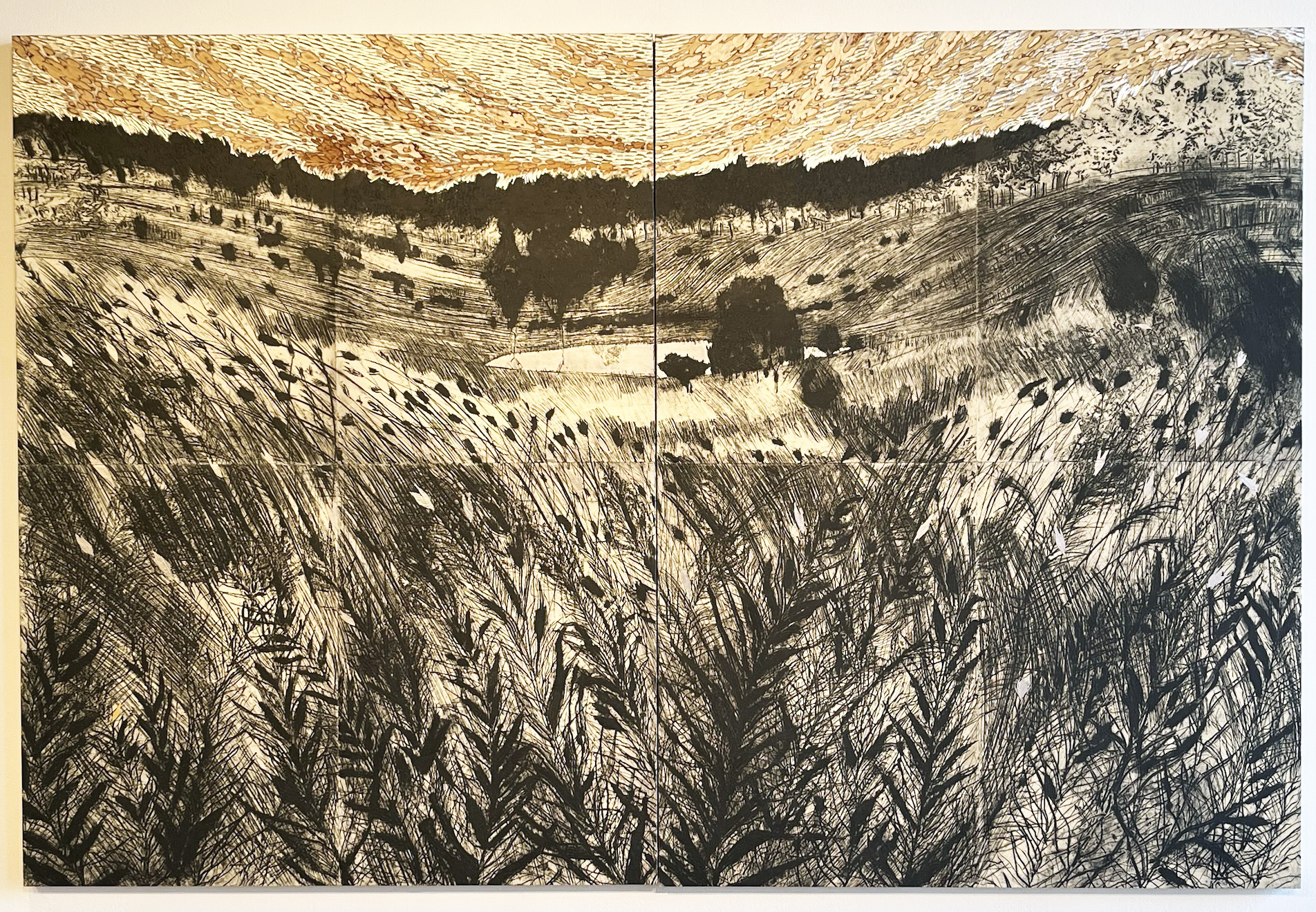
Helen Gotlib, West Lake Preserve II, Intaglio print, carved birch panel, palladium leaf; 2021.  All Images courtesy of DAM

 “West Lake Preserve” places the viewer right in the tall weeds, looking up a small valley to a pond and woods, a highly satisfying view. The large print’s divided into eight separate panels, and with the exception of a little dull orange at the top, it’s mostly a duotone essay in sepia and black. The photographic print, Lagoon Life, by contrast, stars a white ibis posing beneath a jungle crush of palm trees that all loom, menacingly, over the elegant bird’s head.

Winkel comes at all this curation from an interesting vantage point. She’s the manager and curator for the Healing Arts Program at Henry Ford Health Systems in Detroit, tasked with buying art for the sprawling medical empire. “Curatorial projects for me are mostly big buildings now,” she said, “and thinking about all the ways people can experience art when they’re not seeking it out.” The landscape, she adds, has understandably long found a home in medical centers given its generally soothing visions of a natural world far beyond the reach of the artificial light of the hospital ward.

Landscape as an art subject, of course, has a long, respectable history. Both the ancient Greeks and Romans enjoyed the genre, and the walls in upper-class homes were sometimes painted with pastoral views. But the status of the landscape plummeted in the Middle Ages, when religion elbowed every other art subject aside. Indeed, the natural world was reduced to a mere afterthought, and one with generally lousy perspective, to boot.

Things began to turn around in the Renaissance, particularly during Holland’s “Golden Age” in the late 16th and 17thcenturies, when an exquisite sensitivity to landscape and weather welled up in many studios, yielding in the best cases – van Ruisdael comes to mind — breathtakingly believable clouds and storm-tossed skies. Indeed, an online essay by the National Gallery of Art notes that “with their emphasis on atmosphere, Dutch landscapes might better be called ‘sky-scapes.’” (The Detroit Institute of Arts, by the way, has an outstanding collection of Golden Age Dutch paintings, well worth seeking out on your next visit.)

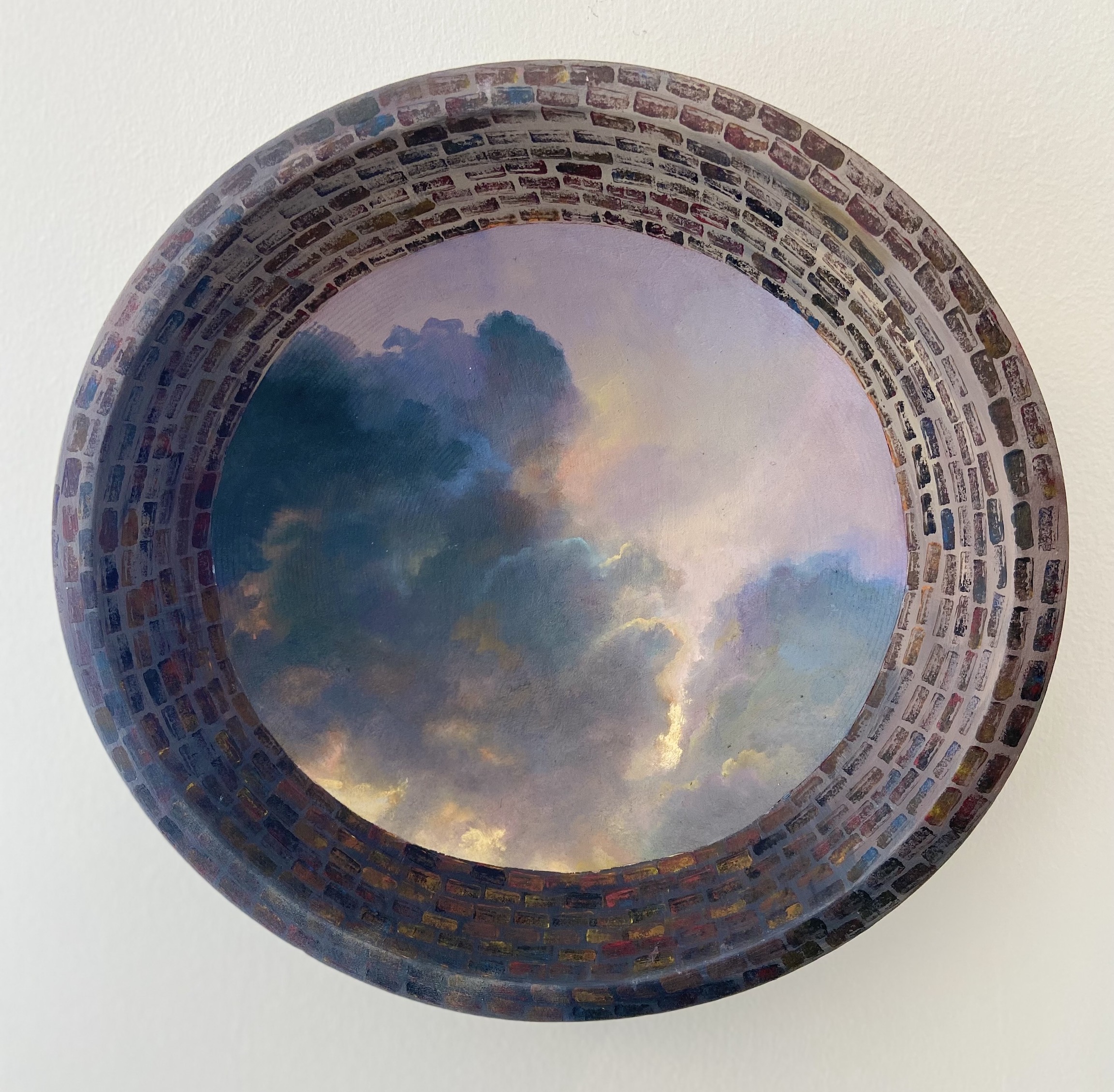
Catherine Peet, Looking Up from the Deep, Mixed media, 10” diameter.

The one piece in Concerning Landscape that gives van Ruisdael a run for his money is the vertiginous, gorgeous, Looking Up from the Deep by Catherine Peet, which you’ll find at the Henry Ford Cancer Pavilion gallery. This delicate sunrise or sunset-tinged cloudscape feels like it should be peering down at you from the dome of some state capitol, an impression strengthened by its circular frame.

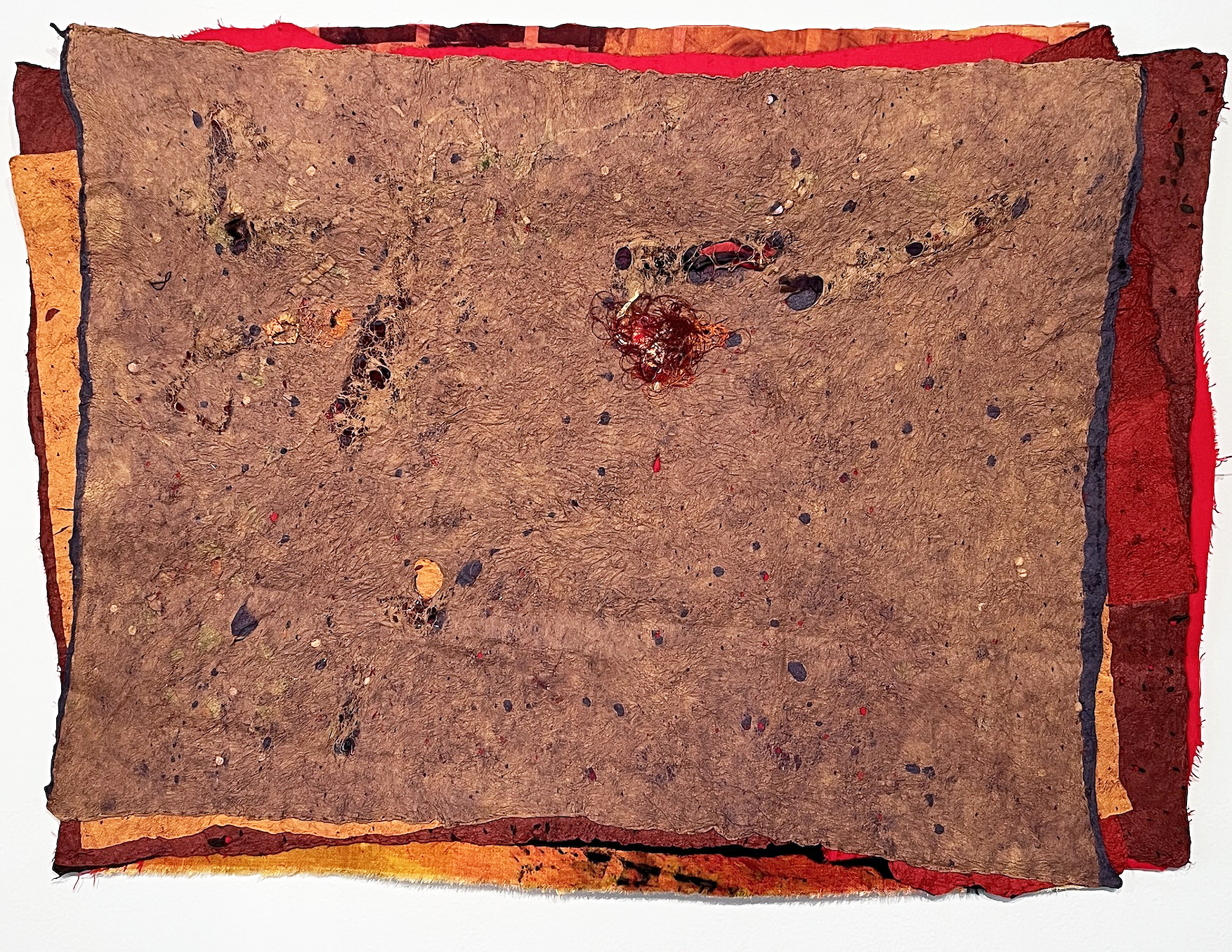
Sharing some of the same warm tones but at the far abstract end of the spectrum is Carole Harris’ mixed-media Desert Flower. The 2015 Kresge Artist Fellow has constructed an overlapping stack of hand-made fiber sheets that read like thick, highly textured paper, in colors ranging from cocoa to an alarming red peeking out beneath all the others.

The simplicity of this particular conceit is striking, as is Harris’ ability to make real drama out of colors that only emerge as narrow strips visible beneath the warm brown sheet on top. That Desert Flower pushes the boundary of “landscape” goes without question – so, too, the fact that it kind of knocks the wind out of you.

Carole Harris, Desert Flower, Fiber, 2023

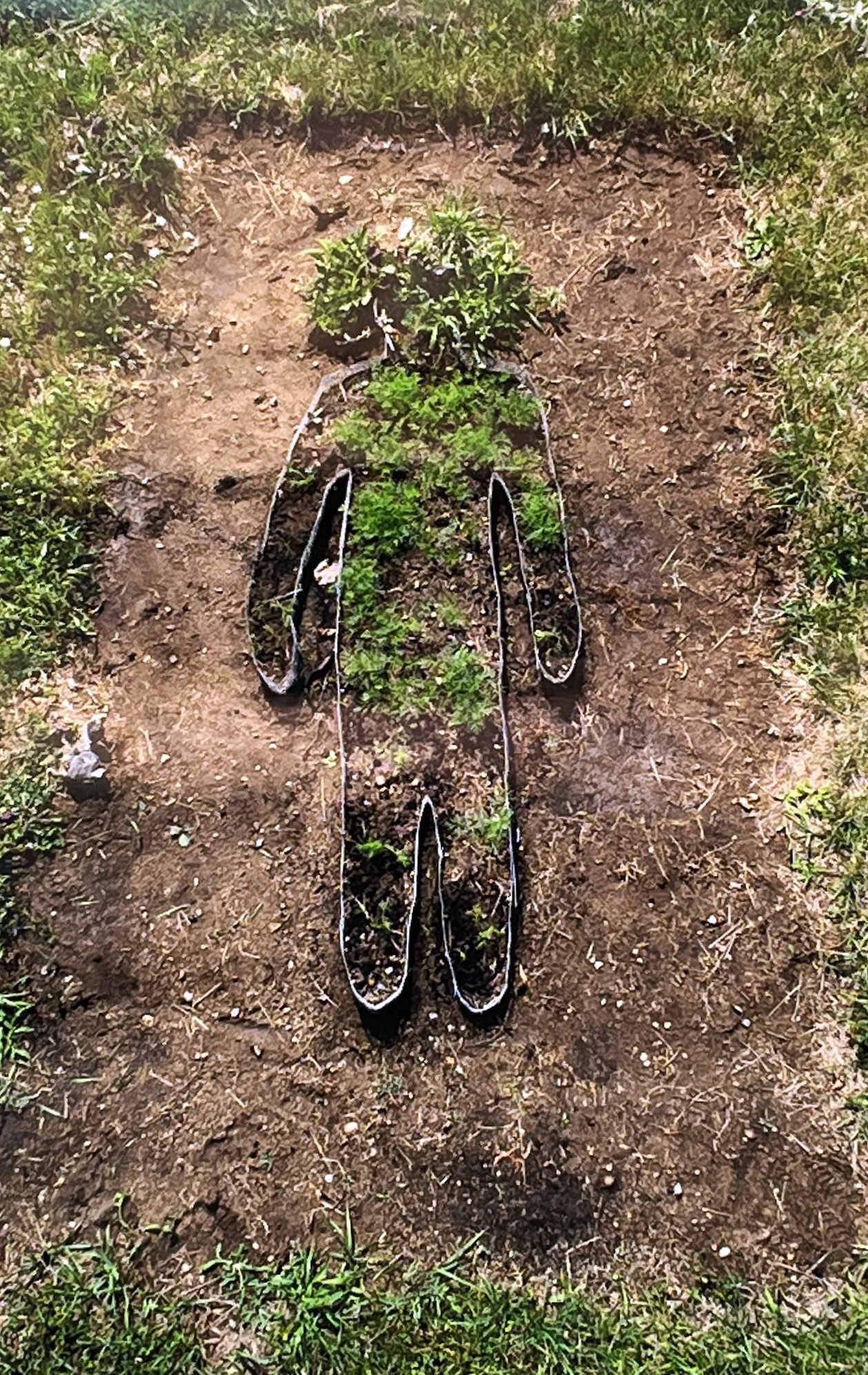
Russian transplant Olya Salimova, currently on a one-year BOLT Residency with the Chicago Artists Coalition, gives us something entirely different with her Body into Dill, one of the most original and daffy conceptions in the entire show. The centerpiece of this photograph is a rectangular garden space – disturbingly, about the size of a grave – that’s dug into the patchy lawn of some unpretentious backyard. Metal garden edging sunk in the turned-up dirt sketches a simple human shape, rather like police outlines of dead bodies on the sidewalk. Within that human-like enclosure, someone – Salimova? — has planted dill weed.

Its obvious imperfections are part of what makes this image so compelling. The yard clearly needs work, and the plantings in the “body” are scattered, newly dug and unsubstantial — apart from some vigorous leaf action filling up the head.

Olya Salimova, Body into Dill, Photography, 2021.

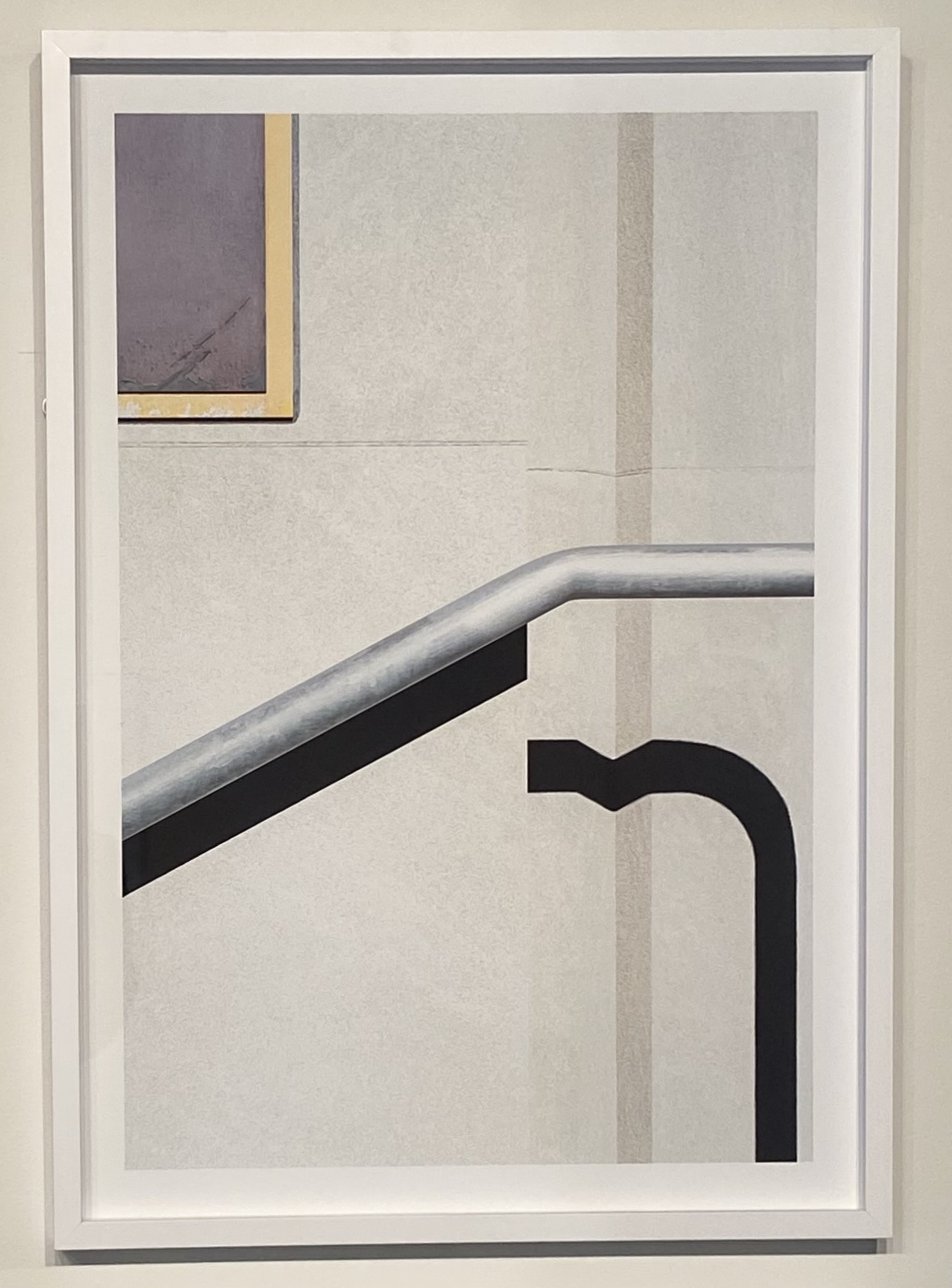
For those who enjoy a little disorientation in their photography – And when well done, who doesn’t? – Jon Setter’s collection of a half-dozen large prints, all up-close shots of building details, is a delight to behold. Each reads as an abstract design in 1920s Russian Constructivist mode. But in one case you’re looking at parallel diagonals on the late, lamented Main Art Theatre in Royal Oak, and in another, the Detroit Free Press building downtown on West Lafayette.  As a group, these deliberately confusing framings are both mischievous and fun to examine.

Jon Setter, Purple and Gold with Shadow (Detroit Free Press), Archival pigment print, 2021.

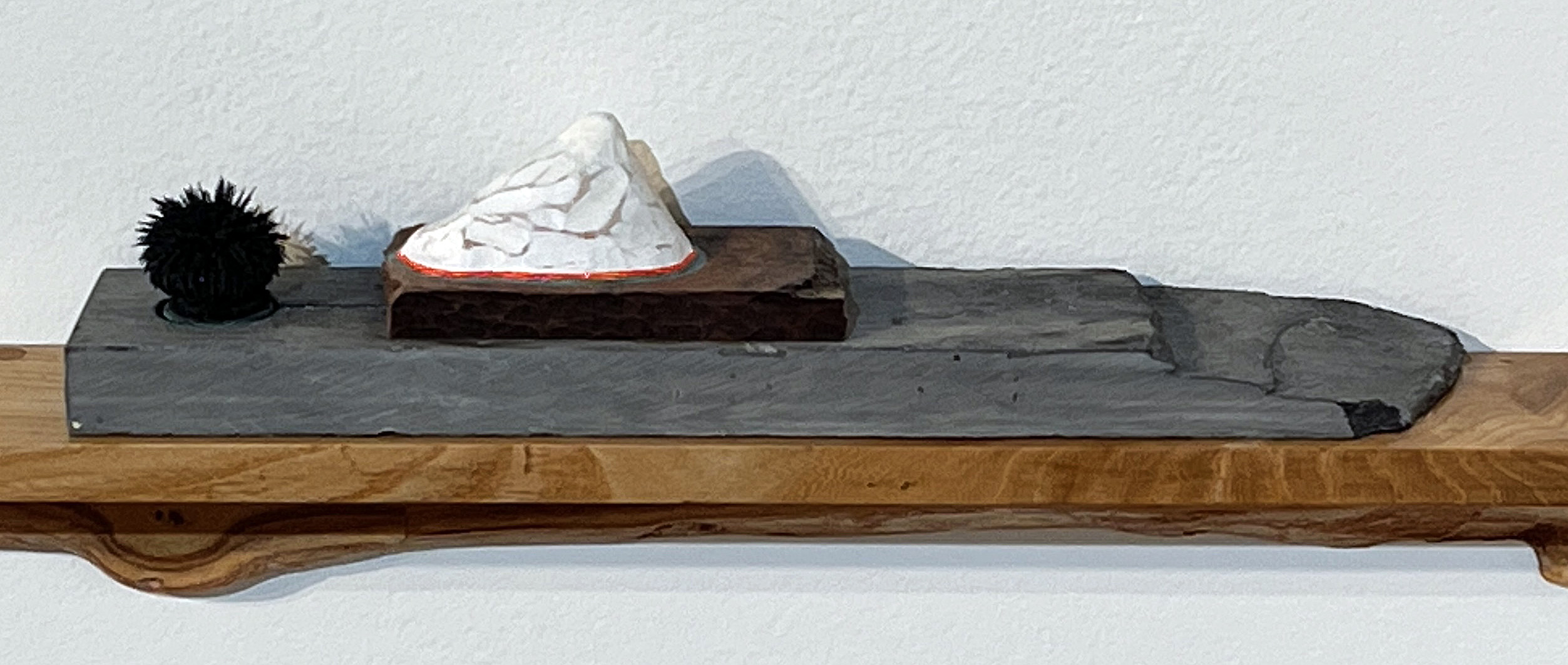
 Finally, Scenic Overlook 2 by Sharon Que, an Ann Arbor sculptor who also does high-end violin restoration, might remind you of a minimalist diorama minus the glass case. On a simple wooden shelf, Que’s sacked two smaller pieces of wood topped by a chalky white boulder or peak – part of the fun is the uncertainty — next to which sits a big, black, bushy… something.

Let’s stipulate that the white form is, indeed, a mountaintop. Call the spiky black, roundish thing next to it a plant, and you’ve got a surprisingly convincing perspective study of a bush and a white peak far, far in the distance – never mind its actual proximity in the assemblage.

Is it weird? Is it oddly compelling? Yes and yes.

Sharon Que, Scenic Overlook 2, Wood, magnetite, paint; 2016.

Concerning Landscape at Detroit Artists Market, up through Feb. 18.

[adrotate group=”2″]

Page 2 of 22

Powered by WordPress & Theme by Anders Norén