Critical art reviews of Detroit galleries and museums weekly

Category: Photography Page 3 of 22

Zaha Hadid @ Broad Museum

Zaha Hadid Design: Untold at Michigan State University’s Broad Museum
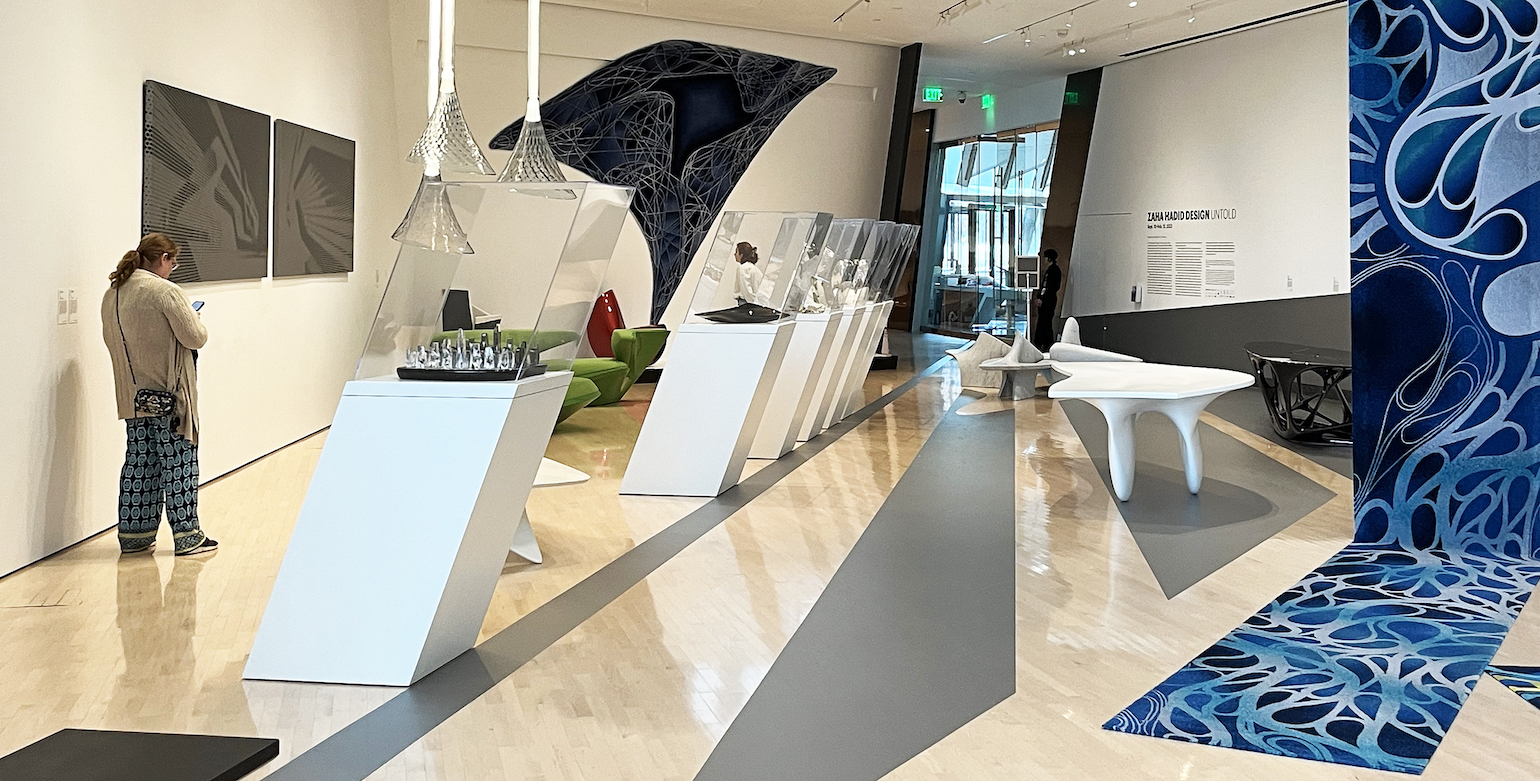
An installation view of Zaha Hadid Design: Untold at Michigan State University’s Broad Museum through Feb. 12.

When the Eli and Edythe Broad Art Museum, designed by the late Iraqi-British architect Zaha Hadid, opened at Michigan State University 10 years ago, the structure was heralded as one of the most commanding pieces of modern architecture on any Midwestern academic campus. As Artforum noted at the time, the 46,000-square-foot structure is “not so much a building as an event.”

That pretty much nails it. Comprised of juxtaposed blocks of parallel steel folds and pleats, and emerging from the ground at skew angles, students immediately nicknamed the $45 million project the “spaceship.” The Broad (pronounced “Brode”) is an aggressive, entertaining structure dropped between MSU’s academic-revival class buildings and the Grand River Avenue commercial strip, a building that makes little visible effort to harmonize with its surroundings — even as it feels somehow perfect in its location. Indeed, the Broad resembles nothing so much as an alien vessel that plowed into the earth at high speed during an emergency landing.
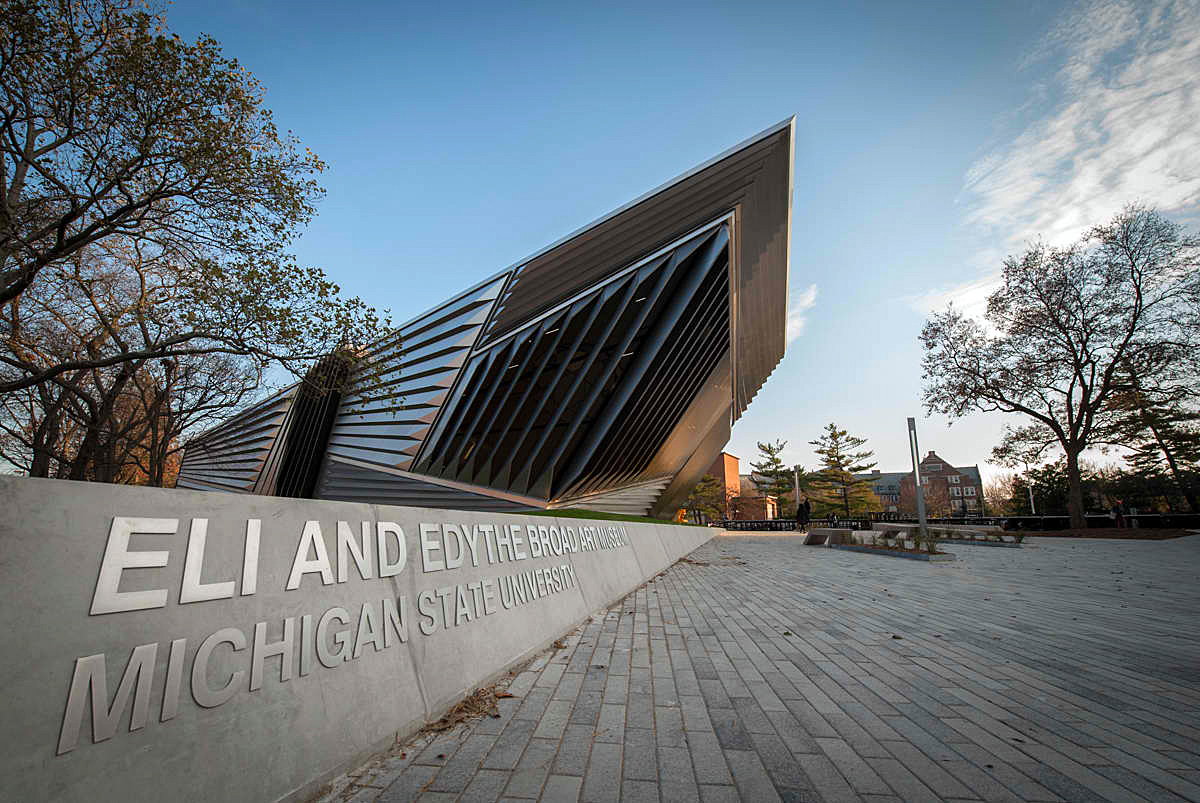
The Eli and Edythe Broad Art Museum at Michigan State University, designed by Zaha Hadid. (Photo courtesy Michigan State University Communications.)

If the work of Hadid, a Pritker Prize-winner who practiced for decades in London until her death in 2016, challenges both geometry and convention, much the same can be said for the Broad’s exhibition up through Feb. 12, Zaha Hadid Design: Untold. This career retrospective, curated by the Broad’s former director, Dr. Mónica Ramirez-Montagut, and Woody Yao of Zaha Hadid Design, spans 40 years of creative work, and sprawls over three floors. Rather than concentrating on her buildings, Untold spotlights Hadid’s non-architectural work, including tables, chairs, colorful rugs, chandeliers, a tea service, a chess set, and a car prototype that looks a bit like a sharp-nosed egg with wheels. She even brought her skills to bear on sneakers and outré fashion.
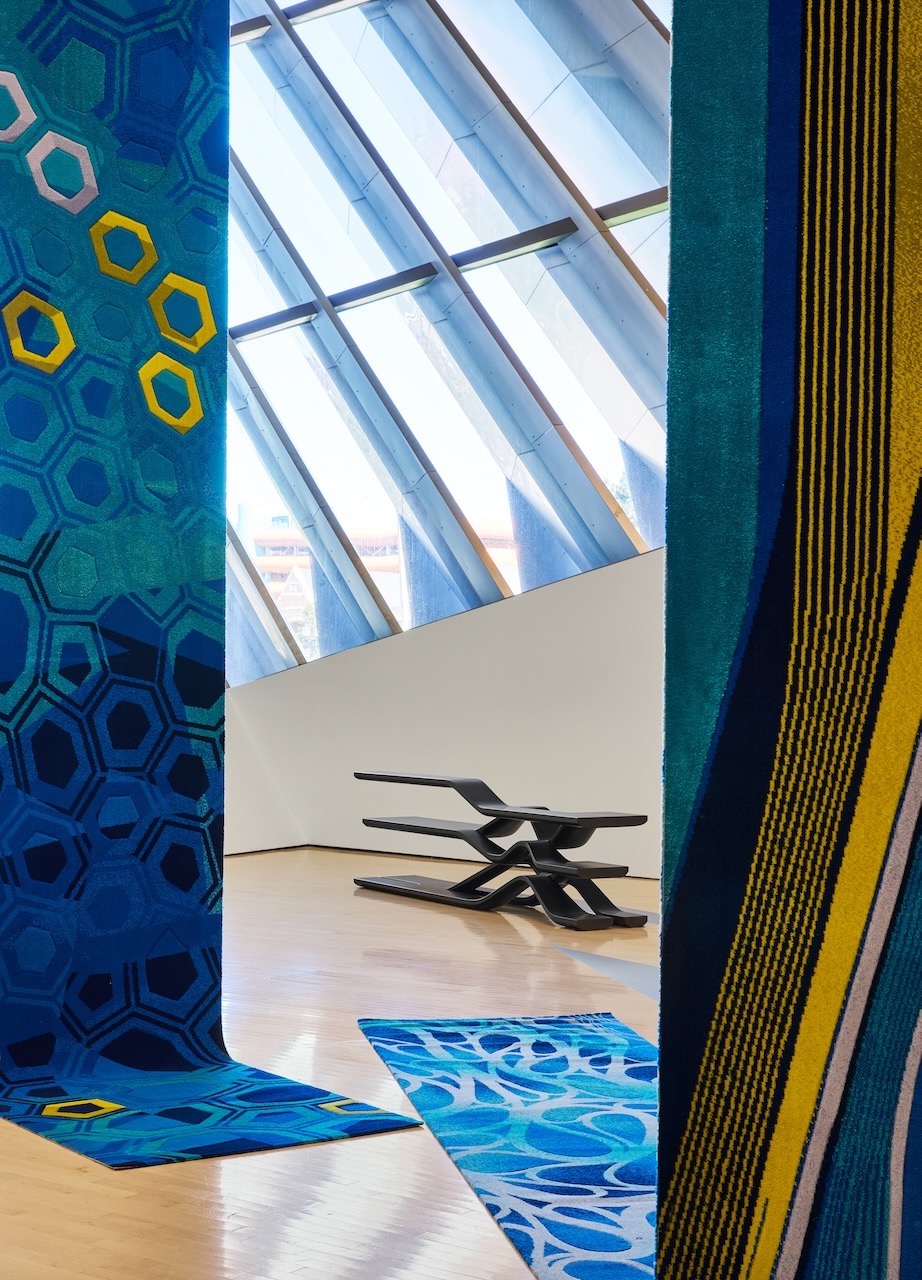
Zaha Hadid, Installation view of carpets and table in Zaha Hadid Design: Untold, at the Eli and Edythe Broad Art Museum at Michigan State University, 2022. (Photo: Dustin Forest)

For their part, Hadid’s buildings have a habit of upending our expectations for what a structure ought to look like. In addition to the Broad, one of her best examples is the large, crystalline egg she balanced on top of a traditional, 19th-century building for the Port Authority of Antwerp, Belgium. Or you could point to her elegantly curvilinear Aquatics Center built for the 2012 London Olympics.

In like manner, the artifacts in this show challenge age-old assumptions for what shape ordinary objects should assume. “There are 360 degrees,” Hadid famously said. “Why stick to one?” Following this dictum, tables, chairs and shelving units in Untold shake off any pretense of rectilinearity or standard form, morphing into instruments at once sinuous, expressionist and functional. As Broad Interim Director Steven L. Bridges put it, these works “ask us to think and see things differently at every turn.”
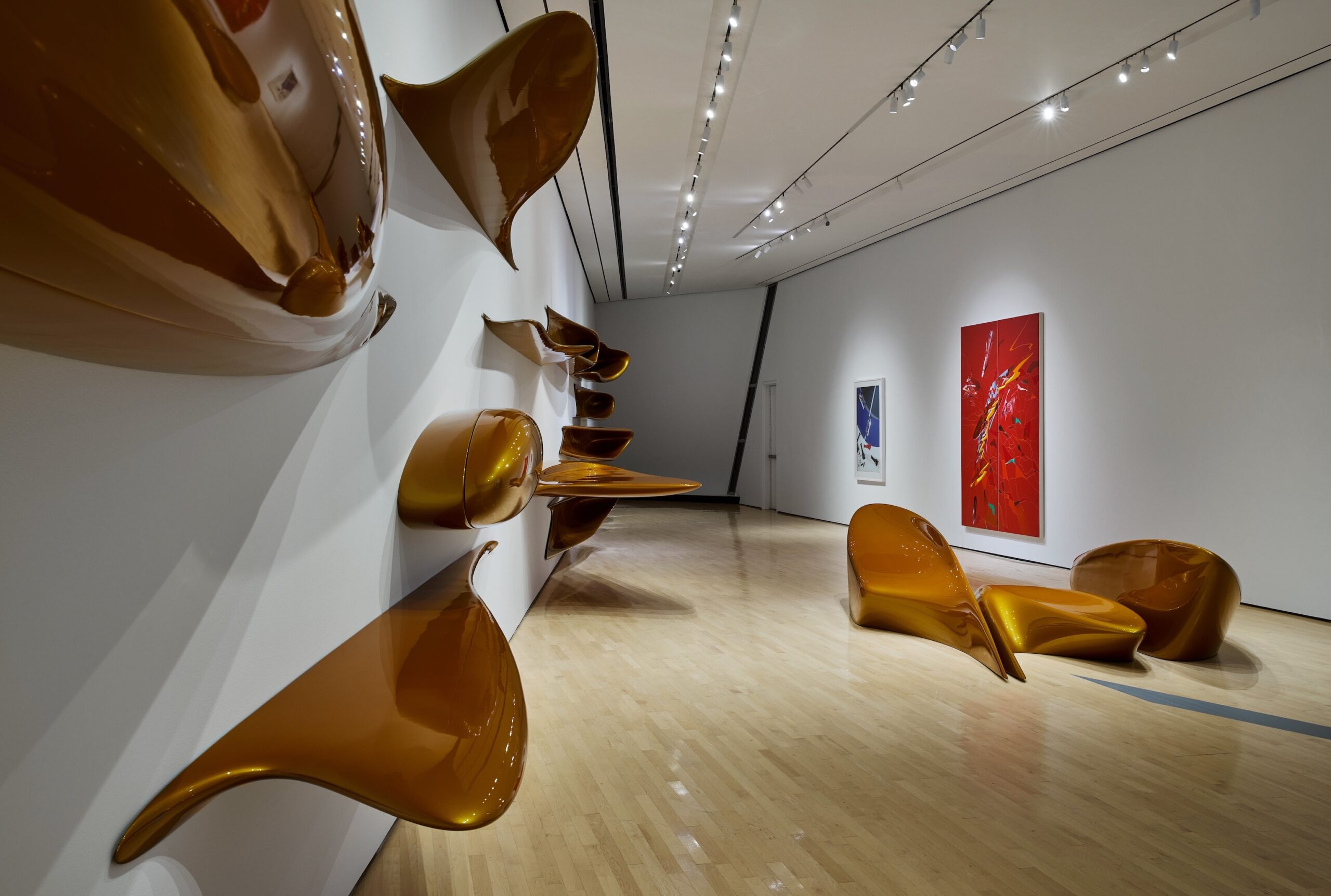
Zaha Hadid, Installation view of furniture and shelving units in Zaha Hadid Design: Untold, at the Eli and Edythe Broad Art Museum at Michigan State University, 2022. (Photo: Dustin Forest)

Born in Baghdad in 1950, Hadid graduated with a mathematics degree from the American University in Beirut, Lebanon, before moving to London in 1972 to attend the Architectural Association of London School of Architecture where she won the Diploma Prize on graduating in 1977. Two years later she founded Zaha Hadid Architects in the British capital, though she wouldn’t complete her first building, the swooping Vitra Fire Station in Weil Am Rhein, Germany, until 1993.

Most of Hadid’s designs were built abroad, perhaps unsurprising for a European architect. She did, however, design a condo tower that’s nothing but curves adjacent to New York’s High Line, as well as the Lois and Richard Rosenthal Center for Contemporary Art in Cincinnati – a handsome exercise in Brutalist block geometry that was the first major American art museum designed by a woman. As much an educator as a pioneering designer, Hadid taught at London’s Architectural Association, and held guest professorships at the University of Applied Arts in Vienna, as well as Columbia, Harvard and Yale.
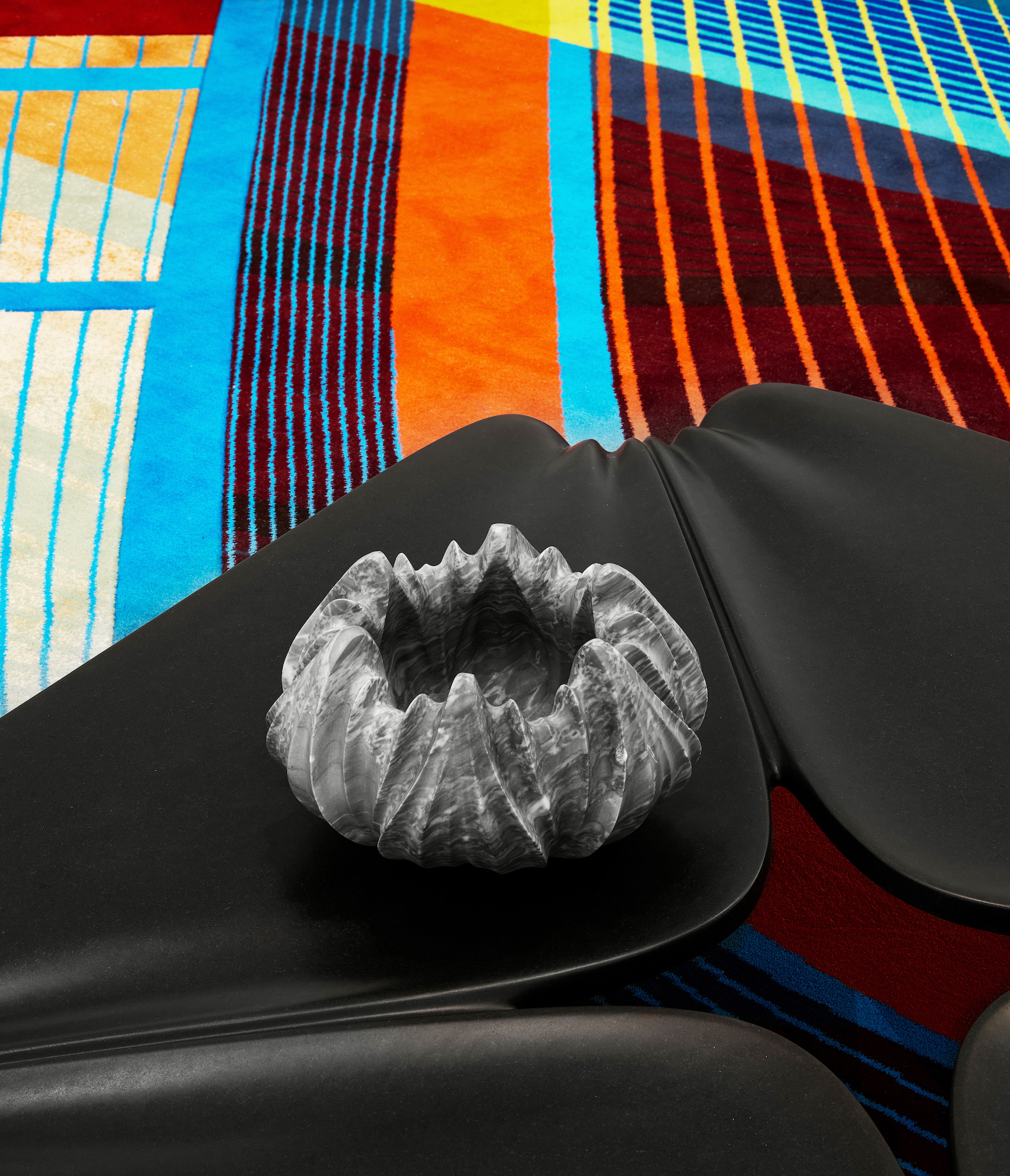
Zaha Hadid, Installation view of vase, table and carpets in Zaha Hadid Design: Untold, at the Eli and Edythe Broad Art Museum at Michigan State University, 2022. (Photo: Dustin Forest)

Hadid’s work is often called “transformational,” and the pieces in this exhibition underline how radical her vision could be. Indeed, The Guardian dubbed her “the queen of the curve” for her boundary-pushing architecture. Starting her career in the 1970s, Hadid was very much the exception in a profession dominated by men who didn’t necessarily take kindly to a brilliant Iraqi woman. Small wonder, then, that one of the adjectives most commonly used to describe her is “fearless.”

That gutsiness, tempered by extraordinary vision, can be found all over the Broad Museum, both in Untold and the structure of the interior spaces themselves. Cutaways allow for dramatic vistas from the third floor down to the second, and the walls, depending on where you are in the building, tilt from 15 to 40 degrees off the perpendicular. Much like Frank Lloyd Wright’s Guggenheim Museum in Manhattan, Hadid’s Broad Museum is as much an experiential thrill as an envelope to house artifacts. In this respect, going to Untold is something of a twofer – both an intriguing exhibition and a passage through mind-bending architecture.
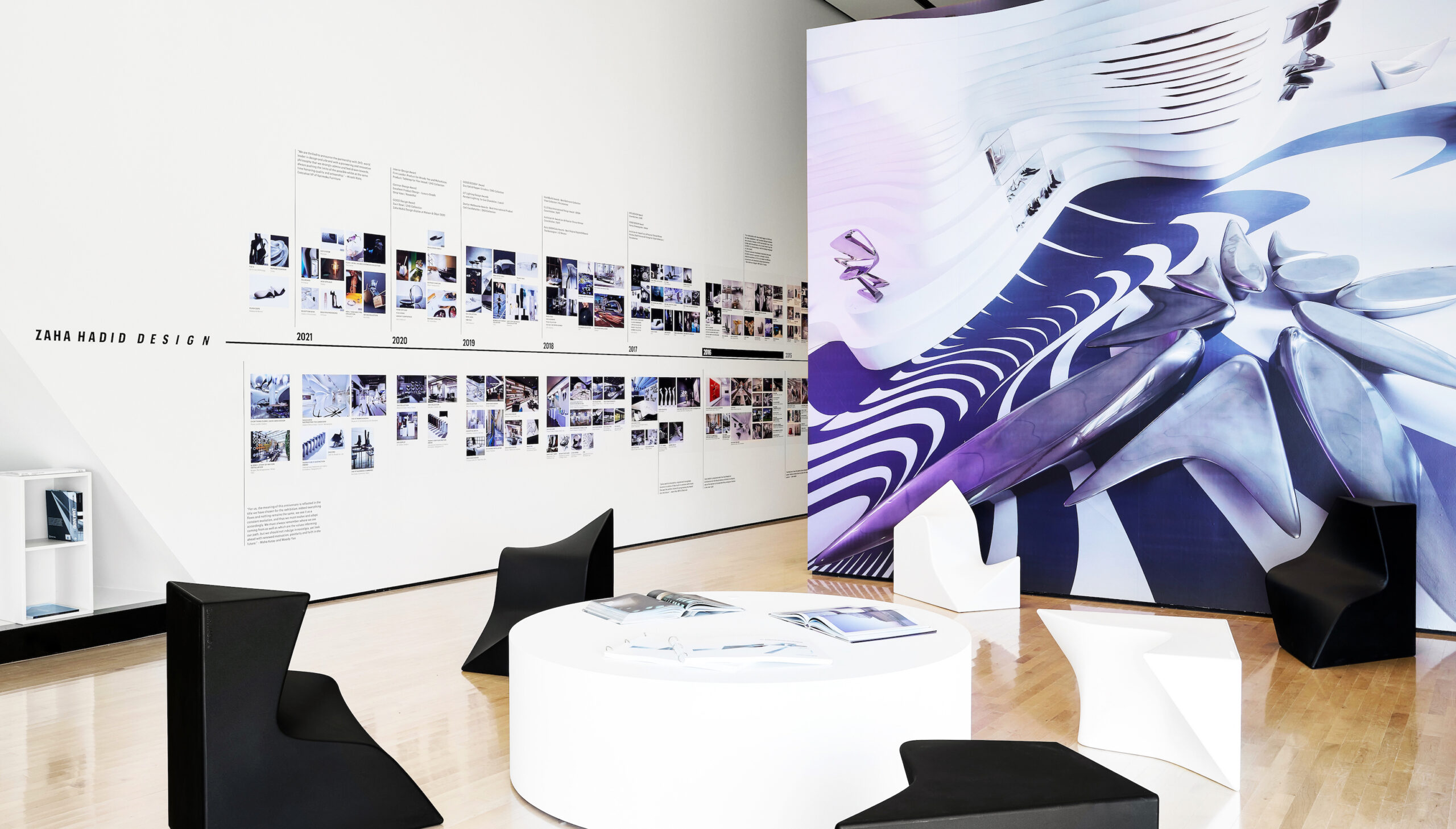
Zaha Hadid, Installation view of Zaha Hadid Design: Untold, at the Eli and Edythe Broad Art Museum at Michigan State University, 2022. (Photo: Dustin Forest)

Zaha Hadid Design: Untold will be at Michigan State’s Eli and Edythe Broad Art Museum through Feb. 12.

[adrotate group=”2″]
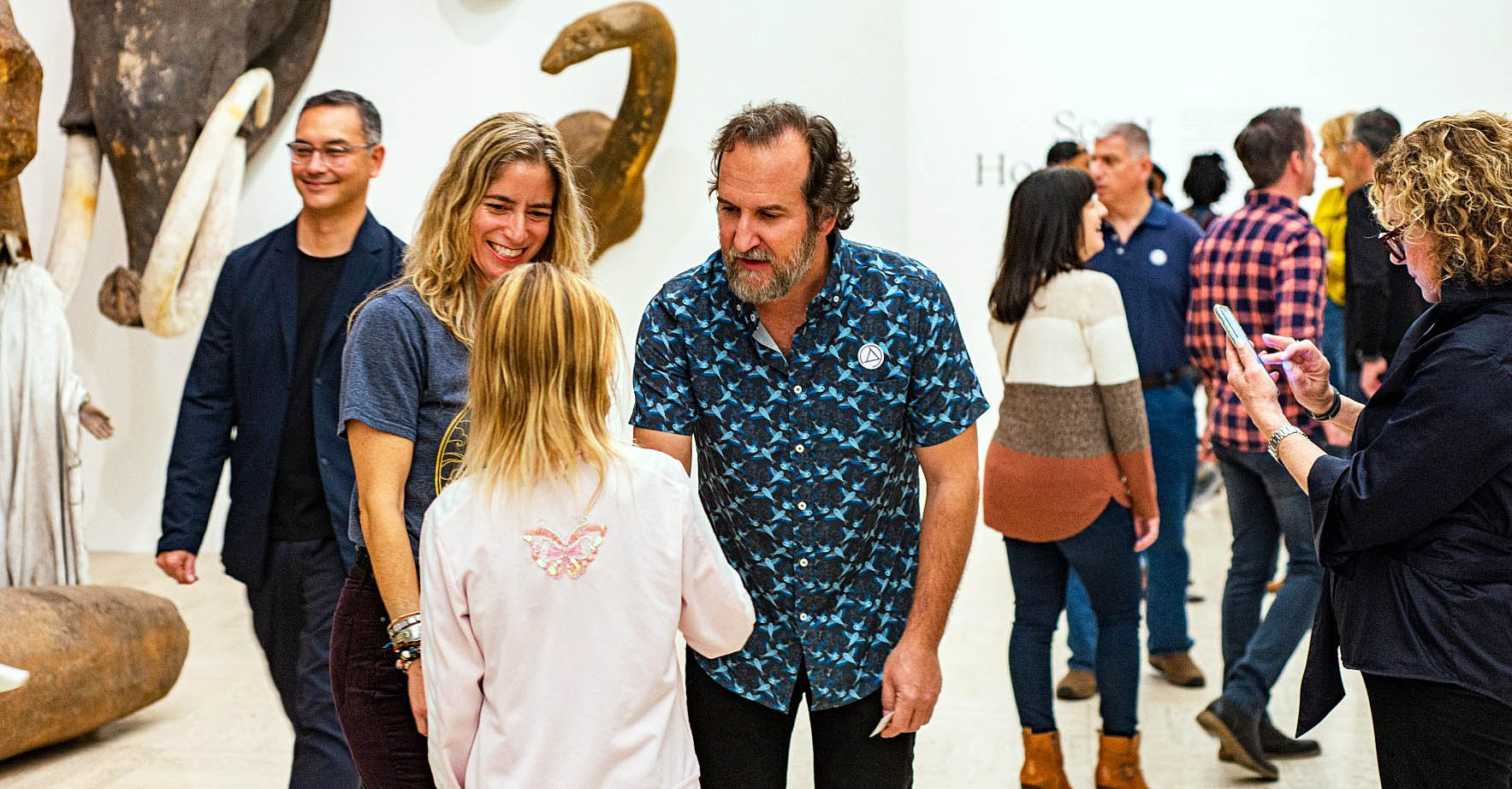
Scott Hocking @ Cranbrook Art Museum

An installation view of Scott Hocking: Detroit Stories at the Cranbrook Art Museum. Detroit Stories is up through March 19, 2023.  Image courtesy of Cranbrook Art Museum

There was a time, not so long ago, when most suburbanites and even some Detroiters regarded our grand, dilapidated city as an embarrassment. It would take youngsters just out of college in the early 2000s, dazzled by the postwar-Berlin landscape and surfeit of abandoned buildings to explore, to start to write a different narrative that didn’t run away from the city’s blemishes, but celebrated the beauty to be found within our fabulous ruins.

Scott Hocking, a 40something working-class kid from Redford Township, was in the forefront of that cultural vanguard two decades back, and his early forays caught the attention of a nation accustomed to ignoring Detroit. Luckily for those unfamiliar with his work and those who love it alike, the Cranbrook Art Museum has just opened his first career retrospective, Scott Hocking: Detroit Stories, up through March 19, 2023.

After getting his degree at the College for Creative Studies, Hocking established himself as one Detroit’s most articulate storytellers, creating work that reminded the world that the Motor City, for all its problems, is a mythic place deeply rooted in the American consciousness.

Starting in 2008, Hocking – impoverished like many students after graduation – began working with that great Detroit resource, found objects, out of sheer necessity. They were about all he could afford. But unlike the gifted Cass Corridor artists from the 1970s and 80s, who plowed the same field, Hocking wasn’t just picking up junk and creating artful collage or 3-D pastiche. His ambitions were epic in scale, and it quickly became clear his was a unique voice in a city increasingly crowded with interesting artists.

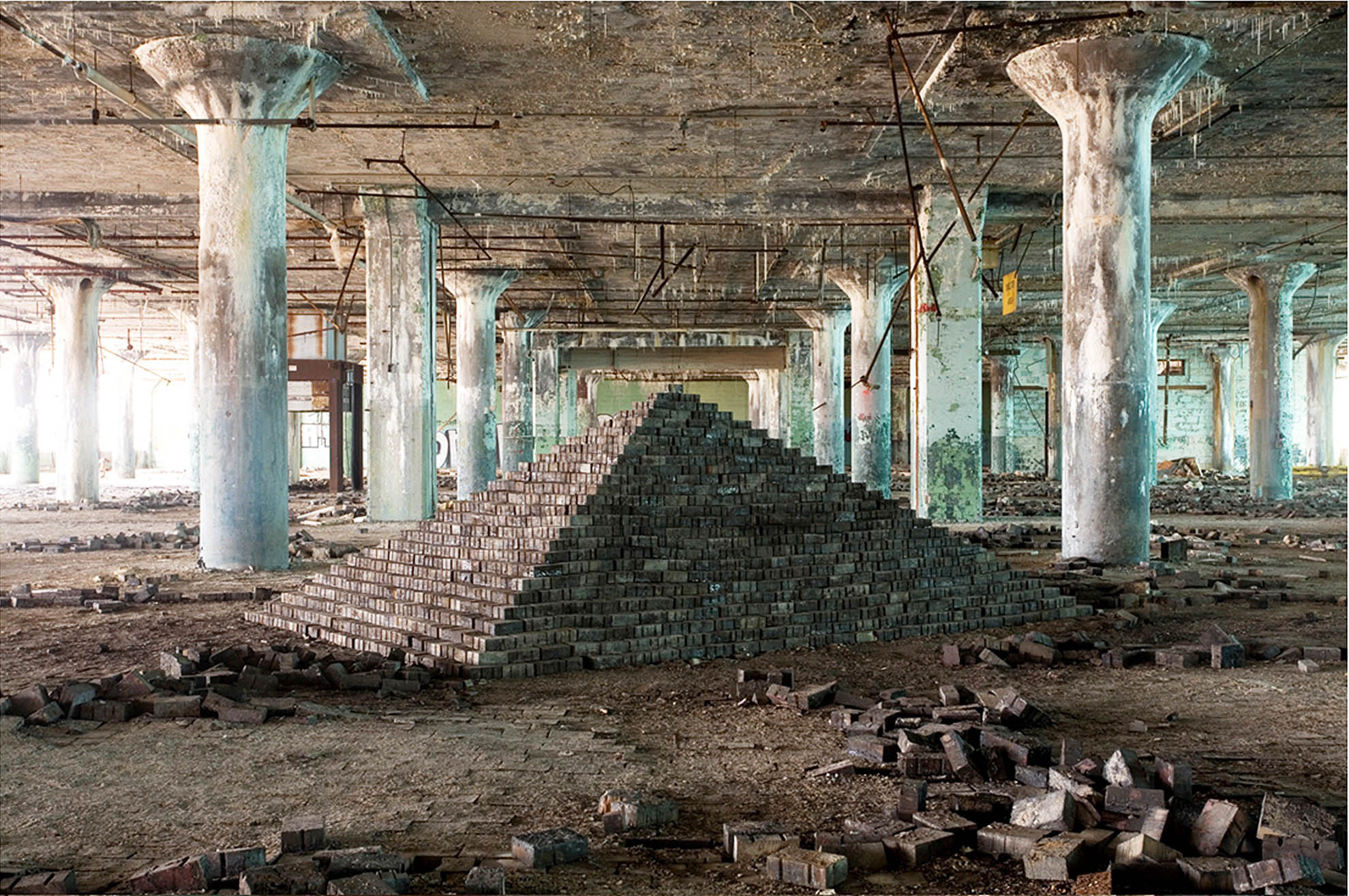
Scott Hocking, Ziggurat—East, Summer, 2008, installation view Fisher Body Plant 21, Detroit. Photo Courtesy of Scott Hocking and David Klein Gallery, Detroit.

Hocking’s first grand conceit lit up the art world like a meteor — and vanished almost as quickly. Collecting some 6,201 wooden “bricks” that paved the concrete floors of Fisher Body Plant 21, a crumbling auto factory near the east-side tangle of railroad tracks known as Milwaukee Junction, Hocking built, block by repetitive block, a majestic Ziggurat or stepped pyramid. Set in the dead center of a vast, rubble-strewn factory floor and framed by two rows of industrial “martini columns,” the massive structure looked, for all the world, like an artifact from a lost civilization. For pure sculptural drama, Ziggurat was unbeatable – mysterious and jaw-dropping all at the same time.

“I always try to explain the beauty I see in Detroit,” Hocking’s said, and it amounts to a sort of professional ethic. And indeed, his creations go a long ways toward accomplishing just that. For its part, Ziggurat quickly got national exposure. A photographer, Sean Hemmerle, rounded a corner while exploring the city’s industrial infrastructure and happened upon the monument unawares. In an interview with The Detroit News, he confessed it knocked him right off his feet. The picture he produced would end up running across a full page and a half in Time magazine as part of an essay on Detroit.

Unfortunately, Ziggurat had a short shelf life. In a development completely unrelated to the sculpture, the EPA bulldozed all the floors in Fisher Body Plant 21 to clear out toxic debris – including Hocking’s sober stepped pyramid. But it hardly matters. Also a talented photographer, he documents all his constructions so they live on long after they’ve degraded or disappeared.

It’s also worth noting, whether intentional or not, that Ziggurat works superbly at the symbolic level. Had Hocking erected a tombstone in a dead auto factory, it’d be a gesture both banal and trite. But a ziggurat, like the pyramids, is a funerary object — even if that’s not our first association upon seeing it. It’s the oblique nature of the reference that gave the doomed structure its pathos.

It has to be said that Hocking’s a veritable artistic polymath, with work ranging from the large-scale sculptures to installations to the haunting series, Detroit Nights, where he documents the dark city using available light. In the words of the show’s short introductory essay, Hocking – part archeologist and archivist – “[uncovers] layers of history, meaning and memory, with a historian’s sense of discovery and a writer’s craft of storytelling.”

Word to the wise: don’t miss his series of portraits of boats abandoned on Detroit streets.

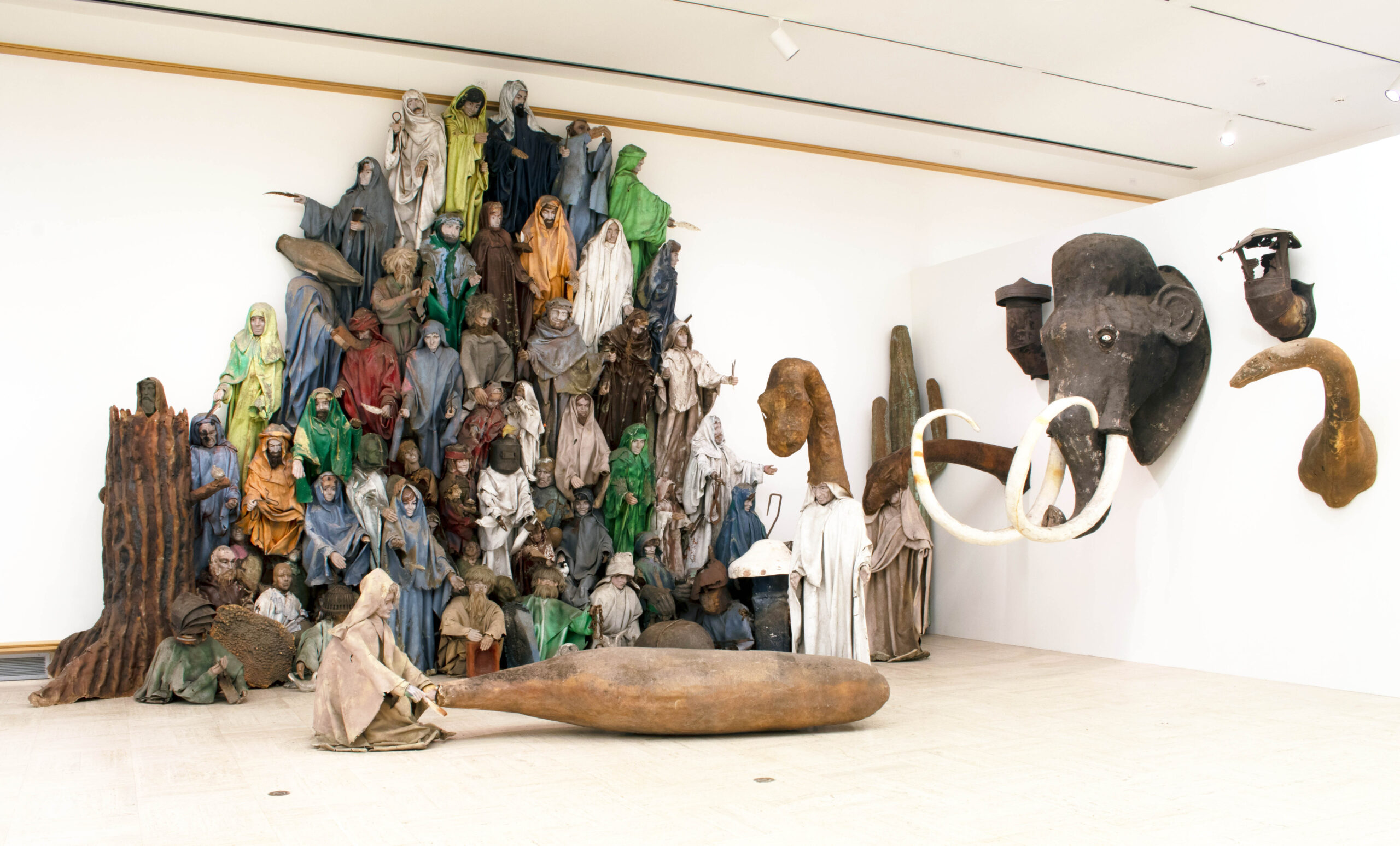
Scott Hocking, The Secrets of Nature, 2012 / 2014 / 2022, Fiberglas, wood paint, metal, concrete, various found objects, Courtesy of and David Klein Gallery, photo by deo Owensby.

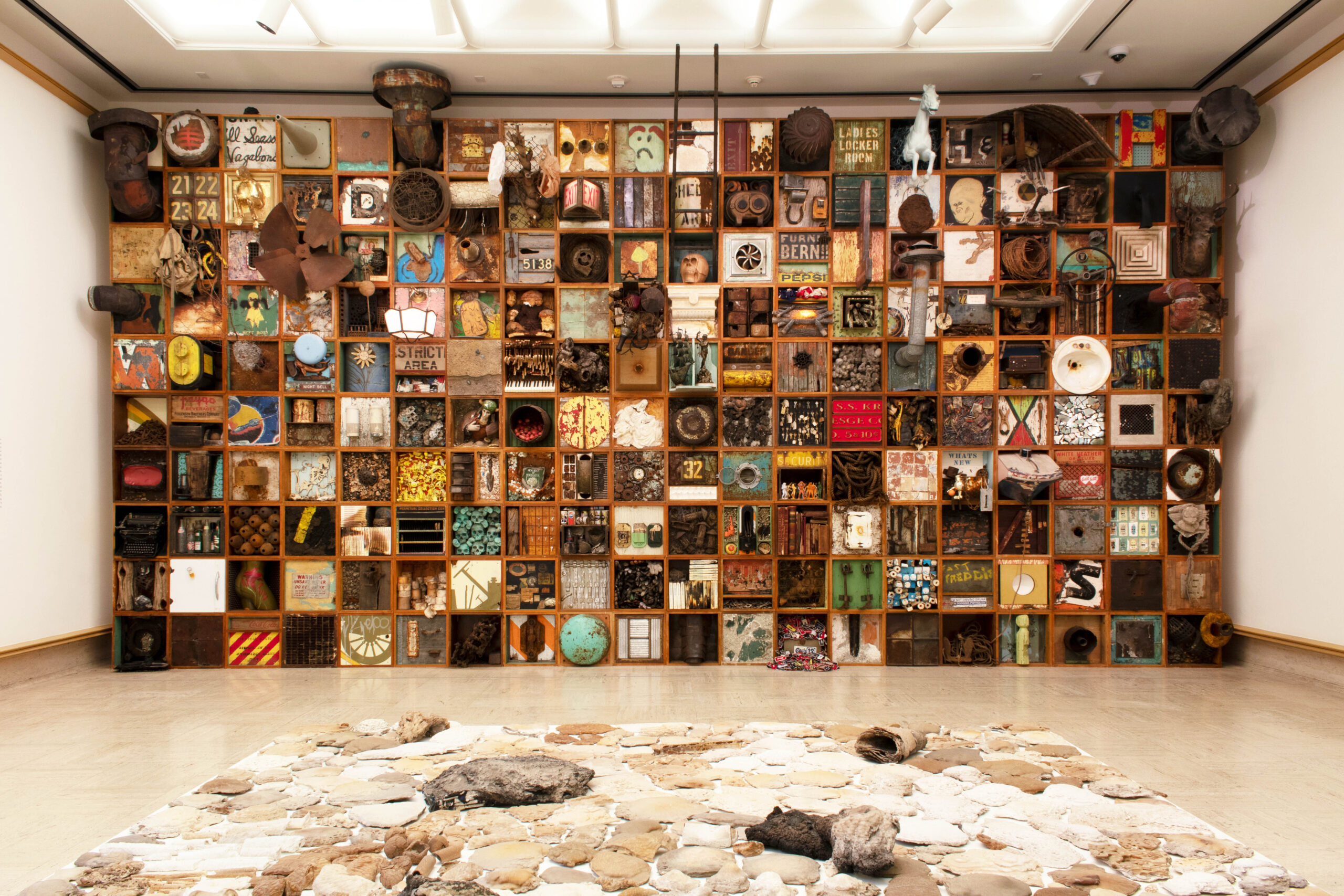
One of the more striking assemblages on display, both funny and daunting, is the wall-sized Secrets of Nature. Here Hocking utilizes figurative artifacts, human and animal alike, found at what he calls “tourist traps and roadside attractions” – in particular, a clutch of Bible characters from the former Good Shepherd Scenic Gardens up north in Mancelona. The installation looms high above the viewer with dozens of saints and sinners peering down at you. The work’s got a weird depth. In the words of the accompanying label, Secrets focuses on “creation and destruction mythologies … and ancient prehistoric wisdom.”

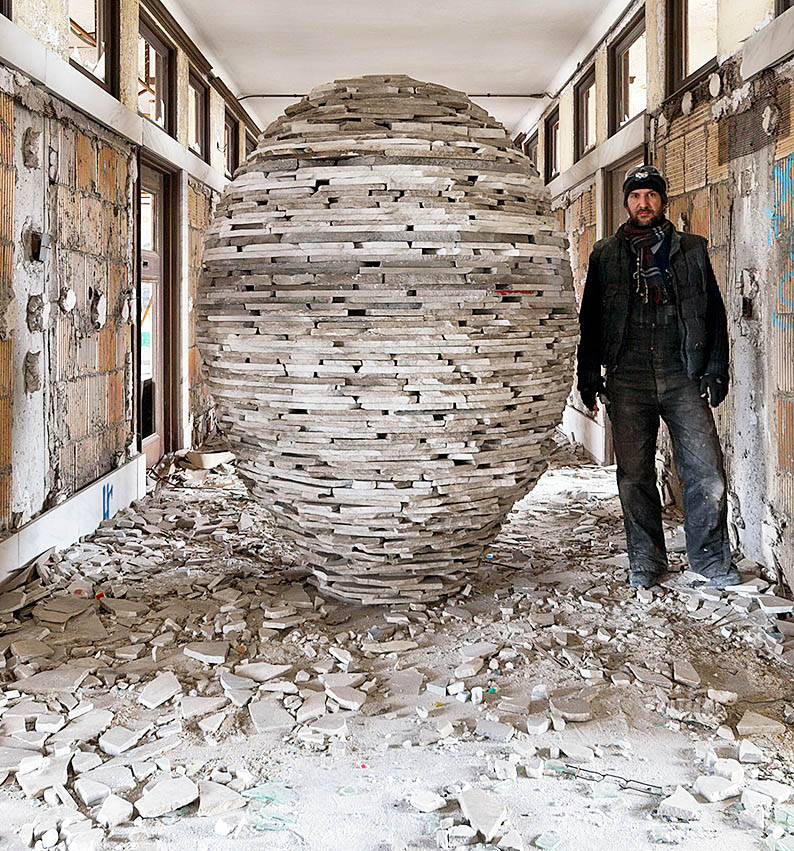
Scott Hocking with The Egg and the MCTS, 2012, Photo Scott Hocking; Courtesy the artist and David Klein Gallery.

Another of Hocking’s astonishing, large sculptures was The Egg in Detroit’s Michigan Central Station, the towering wreck on Michigan Avenue now being renovated by the Ford Motor Co. into high-tech office space — one of the most recognizable symbols of Detroit’s decline.

Using shattered pieces of marble that had cracked off the walls along one of the upper-story hallways after decades of freeze and thaw, Hocking painstakingly assembled thousands of shards to create a symmetrical ovoid sculpture that’s easily nine feet tall. The design has an almost Japanese aesthetic in its use of irregular, jagged elements — albeit all the same thickness – to produce something elegantly and breathtakingly symmetrical.

Workers doing asbestos removal before Ford acquired the depot helpfully suggested to Hocking that the egg’s weight might be too great for the floor. So they built a structural support system right below to prevent collapse.

The Egg reflects Hocking’s interest in geometric shapes, but as with Ziggurat, you can read something more into the design – in this case, birth and renewal rather than death.

Of course, this being Detroit, making art out of the city’s desolation exposes you to the charge of “ruin porn,” the cheap shot leveled most frequently at outsiders who can’t refrain from taking pictures of our astonishing dilapidation – like the French photographers and authors Romain Meffre and Yves Marchand, whose 2010 “The Ruins of Detroit” scandalized Michiganders but dazzled the world.

Cranbrook Art Museum Director Andrew Satake Blauvelt, who curated the show, isn’t buying the allegation. “In this case, Scott is from Detroit,” he said, creating actual art in these buildings, not merely gaping. “It’s not just depressing pictures that will go in a magazine,” Blauvelt said.  He points out that College for Creative Studies Prof. Michael Stone-Richards, who wrote an essay for the exhibition catalog, “also references the idea of ruins,” noting the fascination has a long history – indeed, going back to at least the 17th century, when Germans of means started traveling to Italy in search of the ancient and profound. “We go to Rome to venerate the ruins from past centuries,” Blauvelt said, because like Detroit, “they tell a story.”

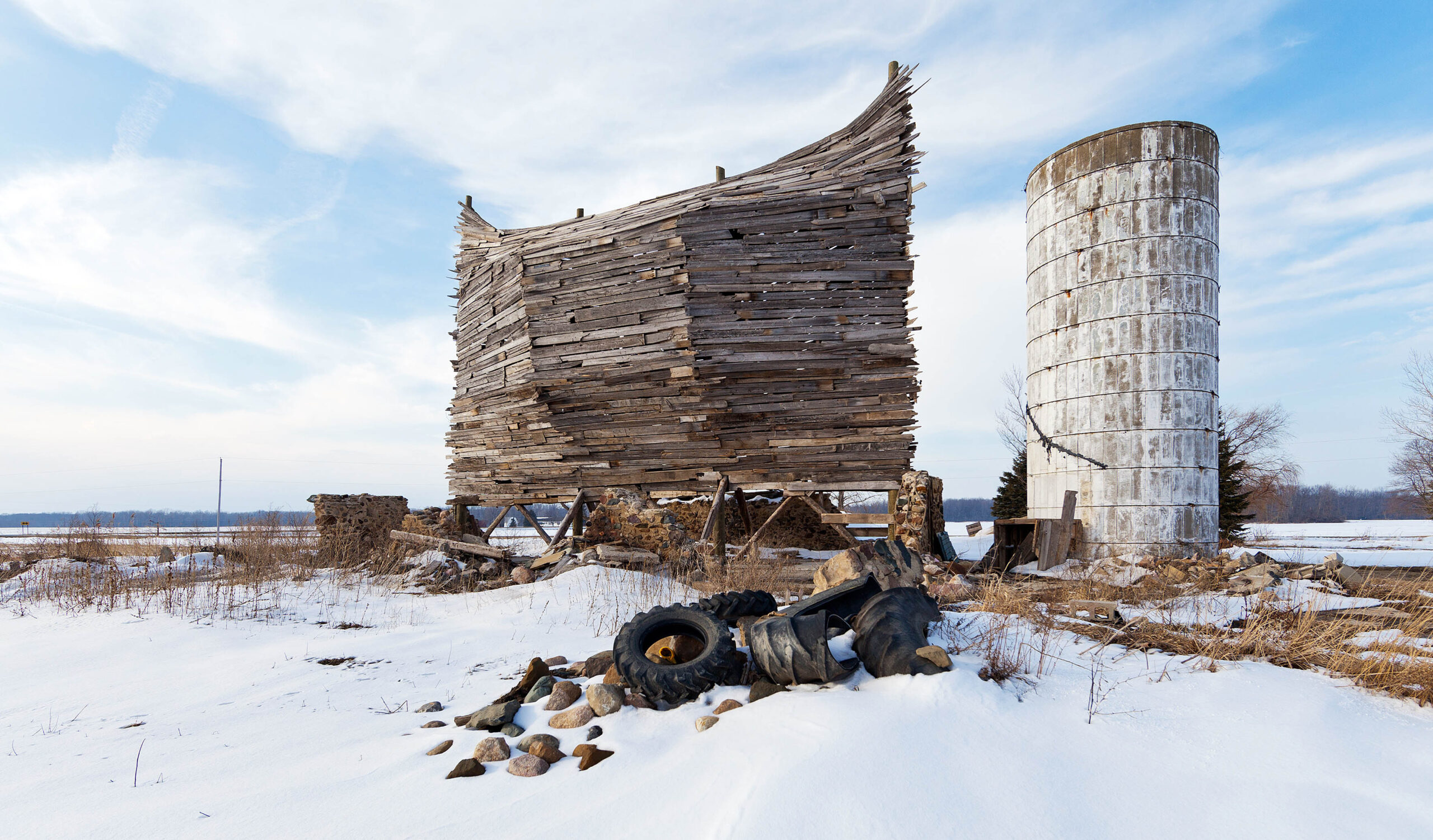
Scott Hocking, Celestial Ship of the North (Emergency Ark) AKA The Barnboat #0721, 2016, installation view, Port Austin, Michigan. Photo Courtesy of Scott Hocking and David Klein Gallery, Detroit.

Not all Hocking’s remarkable constructions are in the Motor City. Indeed, he’s been invited to create work around the world. But one of his most recent and compelling pieces is found in Michigan’s thumb outside Port Austin – where he created an enormous sculpture as part of the “barn art project” first launched by former Public Pool gallerist Jim Boyle along with Steve and Dorota Coy, two artists who go by the monicker Hygienic Dress League. The project’s turned four old barns scattered around the countryside into art objects both oddball and beautiful. (See especially architect Catie Newell’s “Secret Sky.”)

With permission from the owner, Hocking deconstructed an 1890s barn starting to slump and rebuilt it into an ark-like sculpture that hangs off several telephone poles — a fitting metaphor, many would say, for our imperiled times.

It’s often said that the arts have “saved” Detroit. And it’s indisputable that at the turn of the century, Detroit and the state of Michigan were fortunate in having a rich crop of talent who made the Motor City their subject long before it became chic – among them Taurus Burns, Clinton Snider, Corine Vermeulen and Andrew Moore. While Hocking’s work is the most peculiar and original of the bunch, they’ve all helped Michiganders and the world at large see Detroit in a fresh light.

Scott Hocking and Clinton Snider, Relics, 2001. Photo by deo Owensby.

Scott Hocking: Detroit Stories at the Cranbrook Art Museum is up through March 19, 2023.

[adrotate group=”2″]
Todd Weinstein @ Janice Charach Gallery

Todd Weinstein’s Stories of Influence: In Search of One’s Own Voice is at the Janice Charach Gallery in West Bloomfield, Michigan through Dec. 7.

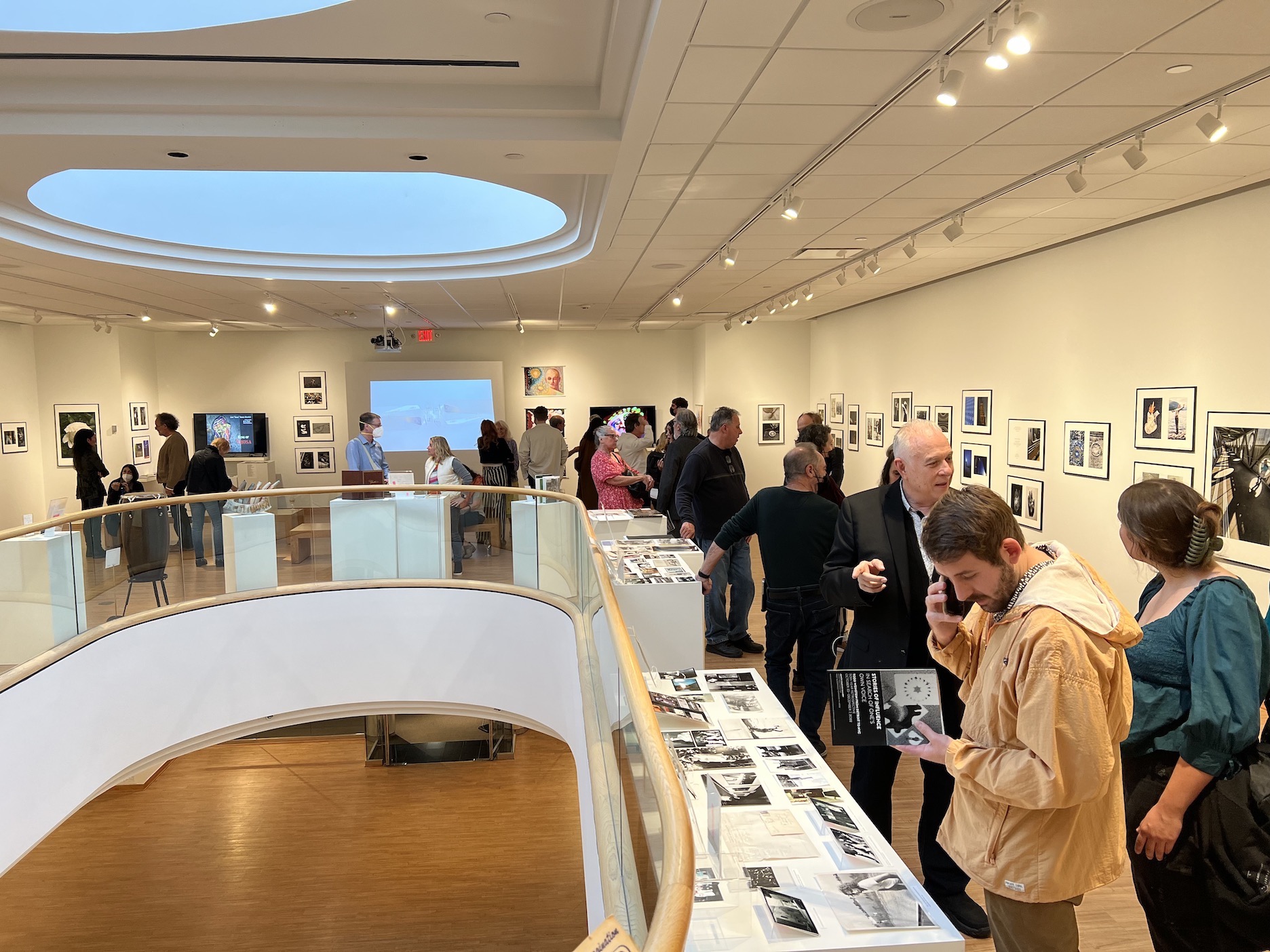
Install image, Stories of Influence: In Search of One’s Own Voice is at the Janice Charach Gallery in West Bloomfield, Michigan. 2022

Photographer Todd Weinstein’s Stories of Influence: In Search of One’s Own Voice is a high-concept show that employs a delightful gimmick – Weinstein pairs 68 of his photos with a corresponding image from one of his numerous mentors, teachers and friends, and then mats and frames the two together. It’s a career retrospective with punch, and will be up at the Janice Charach Gallery in West Bloomfield’s Jewish Community Center of Metropolitan Detroit through Dec. 7, 2022.

A commercial and artistic shutterbug who grew up in Oak Park, Weinstein had a gift as a youngster for talking his way into jobs with great photographers, some of whose influence he honors with this exhibition. He got an early start after dropping out of the old School of the Detroit Society of Arts and Crafts (now the College for Creative Studies), and approaching legendary auto photographer Dick James to ask if he needed an assistant. “How about third-assistant?” James responded. No fool he, Weinstein grabbed the chance.

Like so many young artists in the 1970s, he ultimately left Detroit in the 1970s to make his way in New York’s hurly-burly, and, as it happens, thoroughly succeeded. Weinstein’s got a thriving photography and multi-visual practice, and lives in one of Brooklyn’s handsomest old rowhouse neighborhoods, Boerum Hill.

Among other virtues, Weinstein appears to have an admirable gift for gratitude. The idea of pairing one of his photos with that of an esteemed teacher, mentor or friend as a way of paying tribute struck him when he was in Paris several years ago. Weinstein brought it up with Charach director Natalie Balazovich, and she was immediately enthusiastic, finding it refreshing and new. “Todd’s essentially saying ‘This is why I’m where I’m at,” she said, “’because of these people.’” She added, “I like that the show dives into almost a taboo subject – sharing the things that pushed him to become who he is, and showcasing them.”

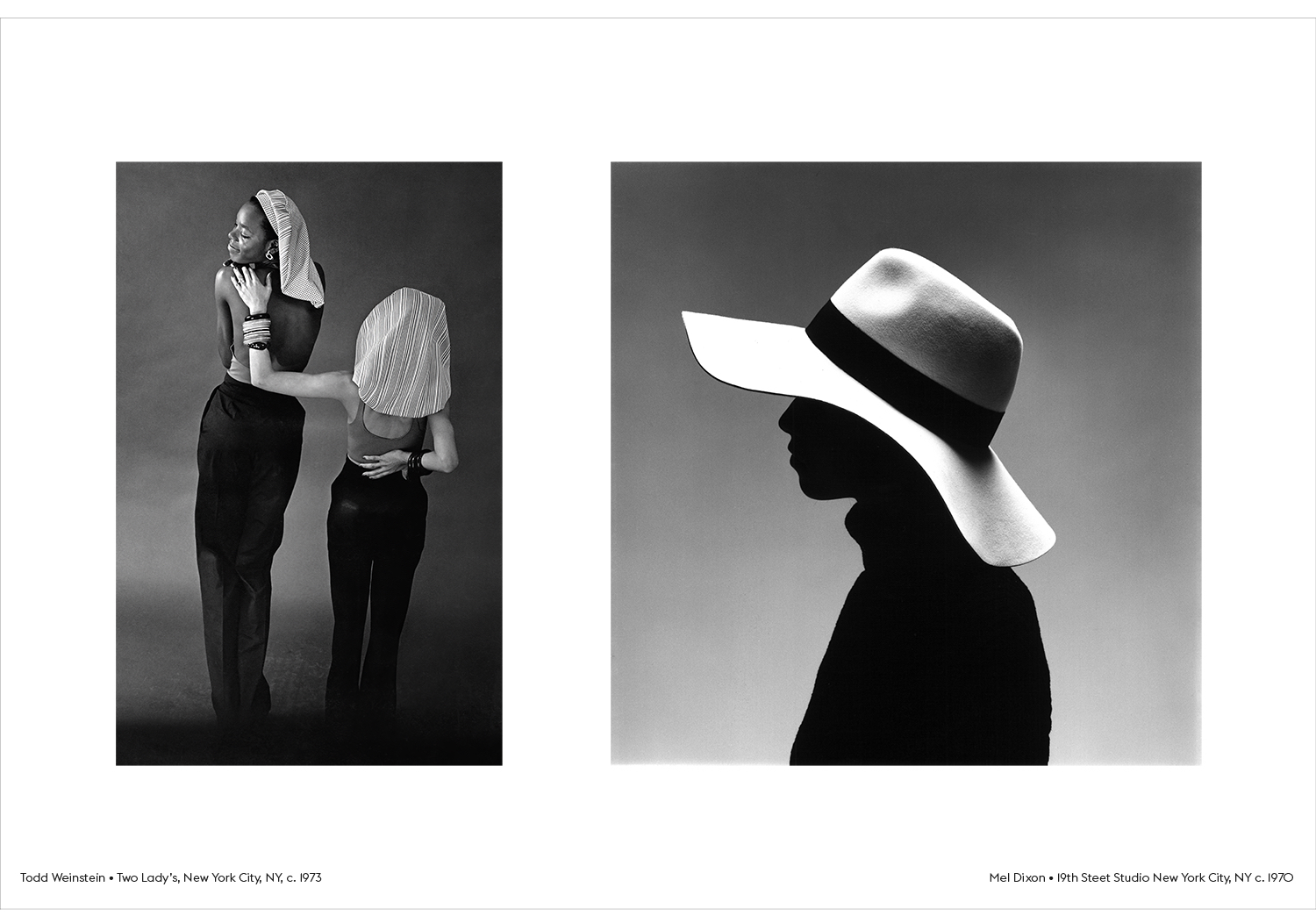
Todd Weinstein, Two Lady’s, New York City, NY, c. 1973; Mel Dixon, 19th Street Studio, New York City, NY, c. 1970.

A professional who helped Weinstein in his early New York days, when he was sleeping on a friend’s floor for eight months, was commercial photographer Mel Dixon. One of the first Black fashion photographers to go out on his own some 50 years ago, Dixon had a glittering background – he’d worked with photo greats Avedon and Hero. He offered Weinstein his first job in the big city, working in the studio on commercial and advertising projects.

“Mel gave me the chance,” Weinstein said. “We shot luggage, brides. All that kind of stuff.” He wasn’t really that interested in studio work, but it gave him the opportunity to earn a living while exploring other paths for his future.

The image Dixon contributed to the show is a black-and-white study of a girl. Her shoulders and face are completely dark, while her broad, white hat catches all the light in the frame. It’s elegant, high-class, high-fashion photography.

In his artist’s statement, Weinstein notes that in pairing images he relied on the structures of jazz – employing a sort of visual syncopation, as it were. You clearly see that in his rejoinder, the 1973 Two Lady’s, New York City, NY. It, too, is a fashion study — this time of two models facing away from us, one lithe and Black, the other short and white. Both are wearing headdresses that fall like curtains down to their shoulders. The white girl has a hand on the other’s back, which prompts her to twist her head around in apparent rapture.

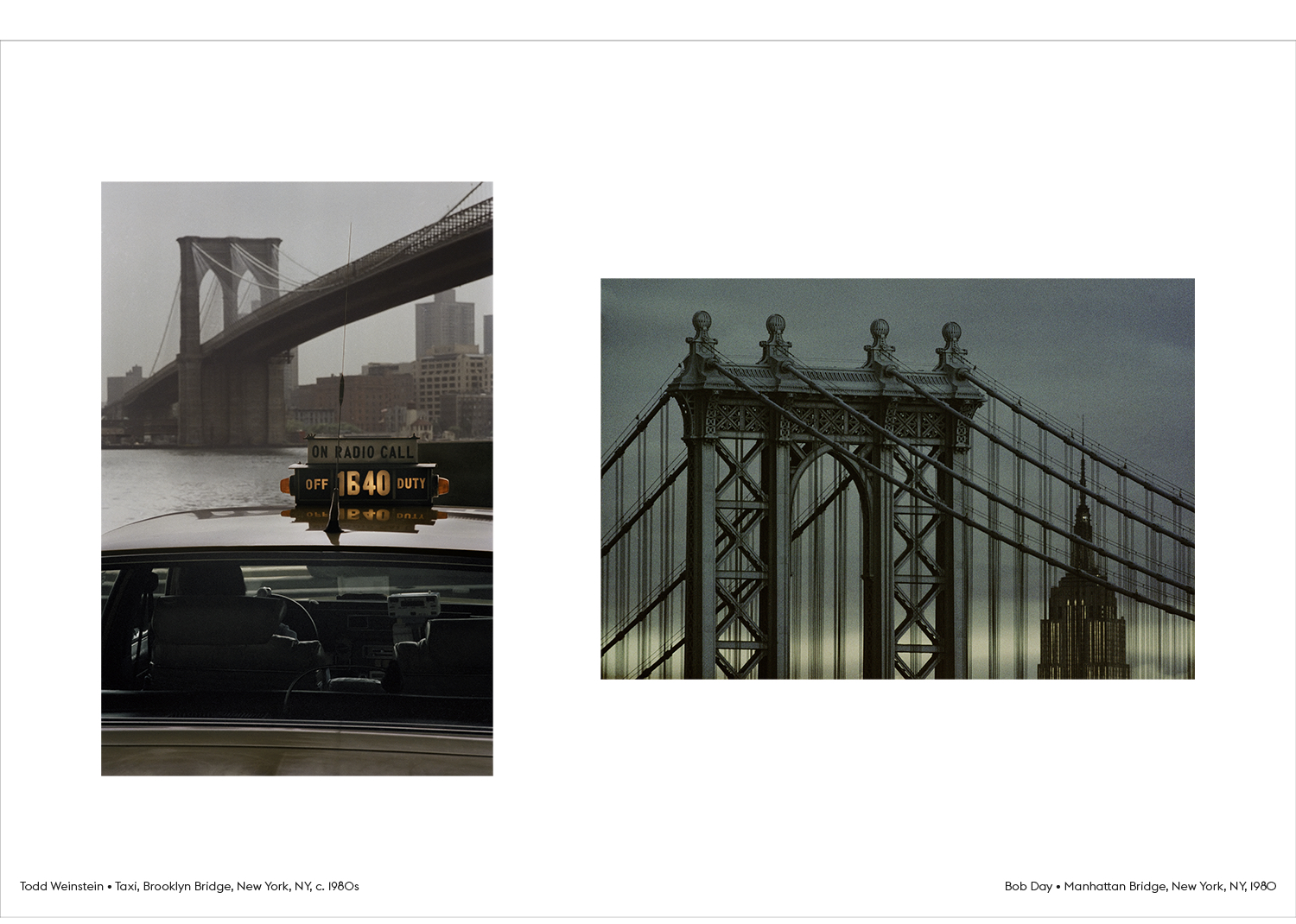
Todd Weinstein, Brooklyn Bridge, New York, NY, c. 1980s; Bob Day, Manhattan Bridge, New York, NY, 1980.

Another significant mentor was painter and photographer Bob Day. The two went into business together on Manhattan’s East 17th Street half a century ago, “back when you could get a 6,000-square-foot studio for like $300 a month,” Weinstein said. Day’s 1980 image, Manhattan Bridge, NY, NY, is a powerfully compressed telephoto shot. Day frames the very top of the Manhattan Bridge, a lush blue-green, sharply etched essay in cross-bracing around a central gothic arch. Looming in the near distance – unrealistically large, thanks to the powerful lens — is a gray and gold Empire State Building seen through the bridge’s vertical suspension wires. It lends immensely satisfying balance to the drama of the bridge crown in both shape and color.

By contrast, Weinstein’s Brooklyn Bridge, NY, NY is grittier. A close shot of a taxicab takes up most of the frame, the vehicle’s “Off Duty” crown lit and glowing. The aesthetic is ordinary and everyday — even the Brooklyn Bridge rising in the distance looks a little dull. All the print’s visual power, which is considerable, comes from the illuminated “Off Duty” sign that, alone out of the entire shot, glows with a warm light, and whose shape echoes the tops of the two bridges.

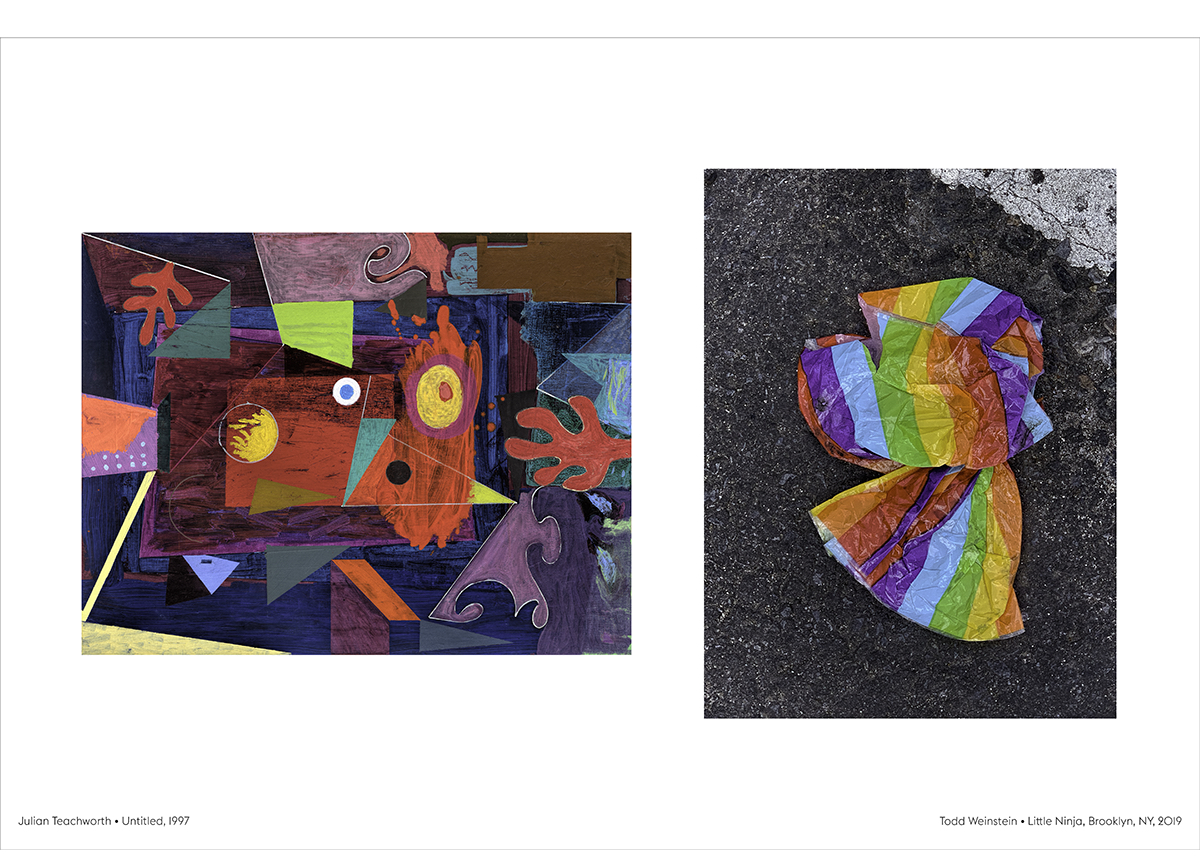
Julian Teachworth, Untitled, 1997; Todd Weinstein, Little Ninja, Brooklyn, NY, 1973.

Not all of the images contributed by mentors are photos. In one, Weinstein pairs his picture of what looks like a collapsed, rainbow-striped mylar balloon on the street with painter Julian Teachworth’s amusing and gorgeous abstract of many colors, an untitled work from 1997. Here Weinstein riffs on the similarity in colors and the loopy geometry present in both. “I photographed all of Julian’s paintings,” Weinstein said. “He’s an incredible painter, mentor and spirit.”

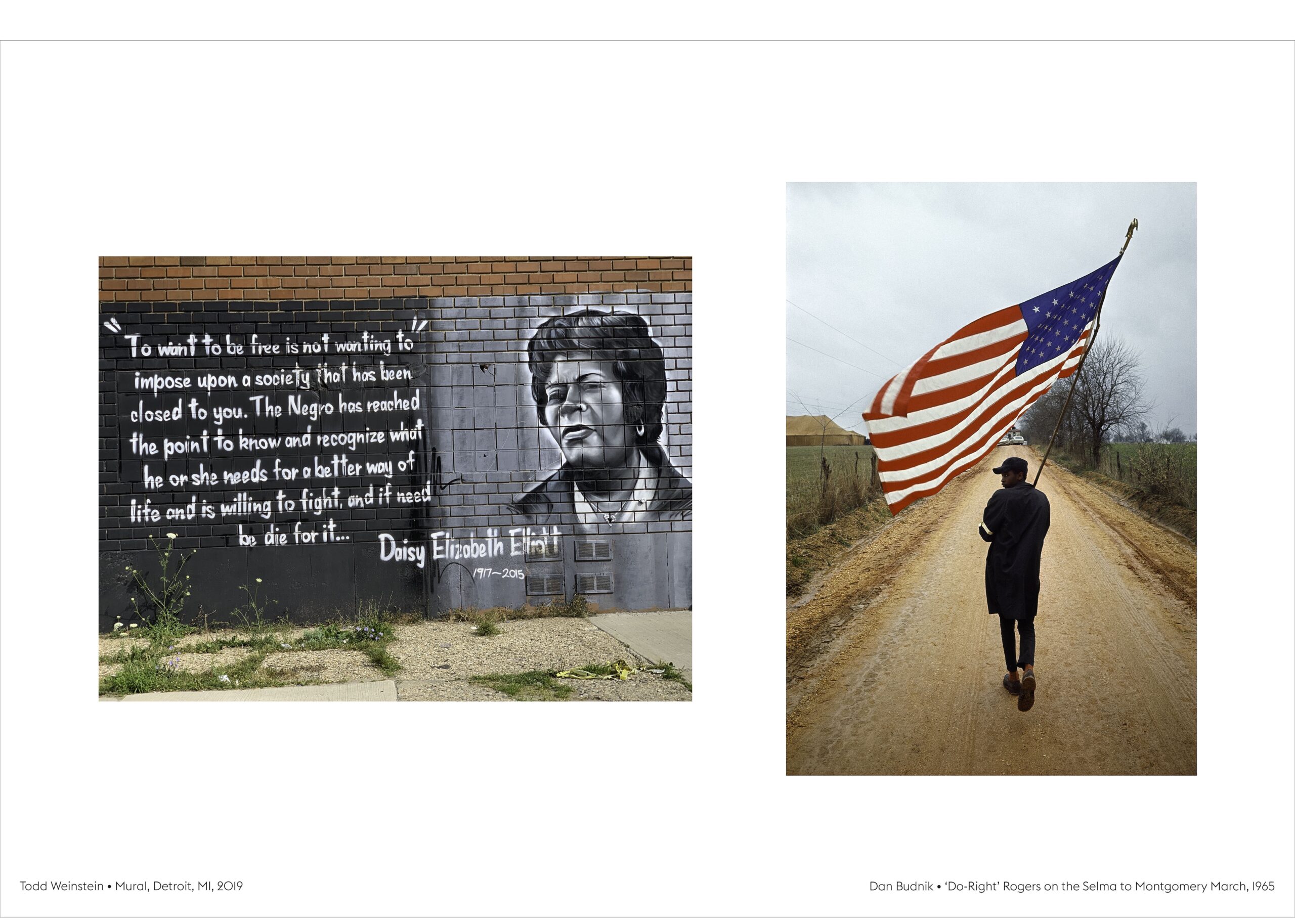
There’s something undeniably spiritual about the twinned images by Weinstein and the great photographer of the Civil Rights movement, Dan Budnik. The latter’s photo, ‘Do-Right Rogers’ on the Selma to Montgomery March, March, 1965 is a classic of the genre, and one that Weinstein says he recalls from childhood. A skinny, African-American youngster marches down an endless dirt road, carrying a pole with a large American flag that’s unfurled in all its red, white and blue glory. The association of deep patriotism with individuals who still had to fight a for their rights is palpably moving.

Todd Weinstein, Mural, Detroit, 2019; Dan Budnik, ‘Do-Right Rogers’ on the Selma to Montgomery March, March 1965.

For his part, Weinstein gives us a black-and-white mural in Detroit on a brick wall honoring the late Daisy Elizabeth Elliott, a champion of Black rights who died in 2015. The quote next to her portrait, in which she cites her willingness to die in the fight for civil rights, is powerful and unexpected – a bit like this show.

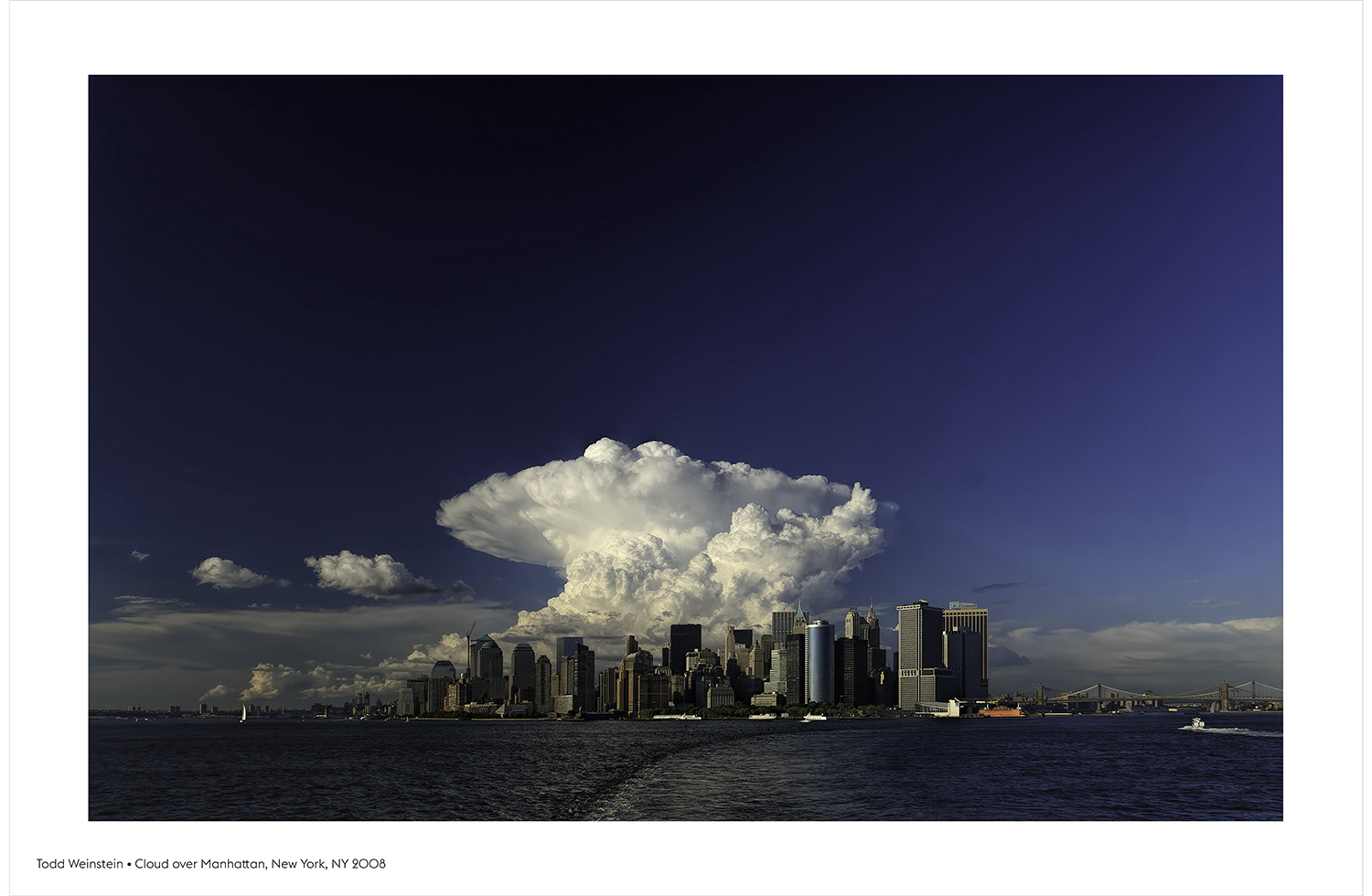
Todd Weinstein, Cloud over Manhattan, New York, NY, 2008.

Stories of Influence: In Search of One’s Own Voice is at the Janice Charach Gallery in West Bloomfield through Dec. 7.

Exposure @ Marshall M. Fredericks Sculpture Museum

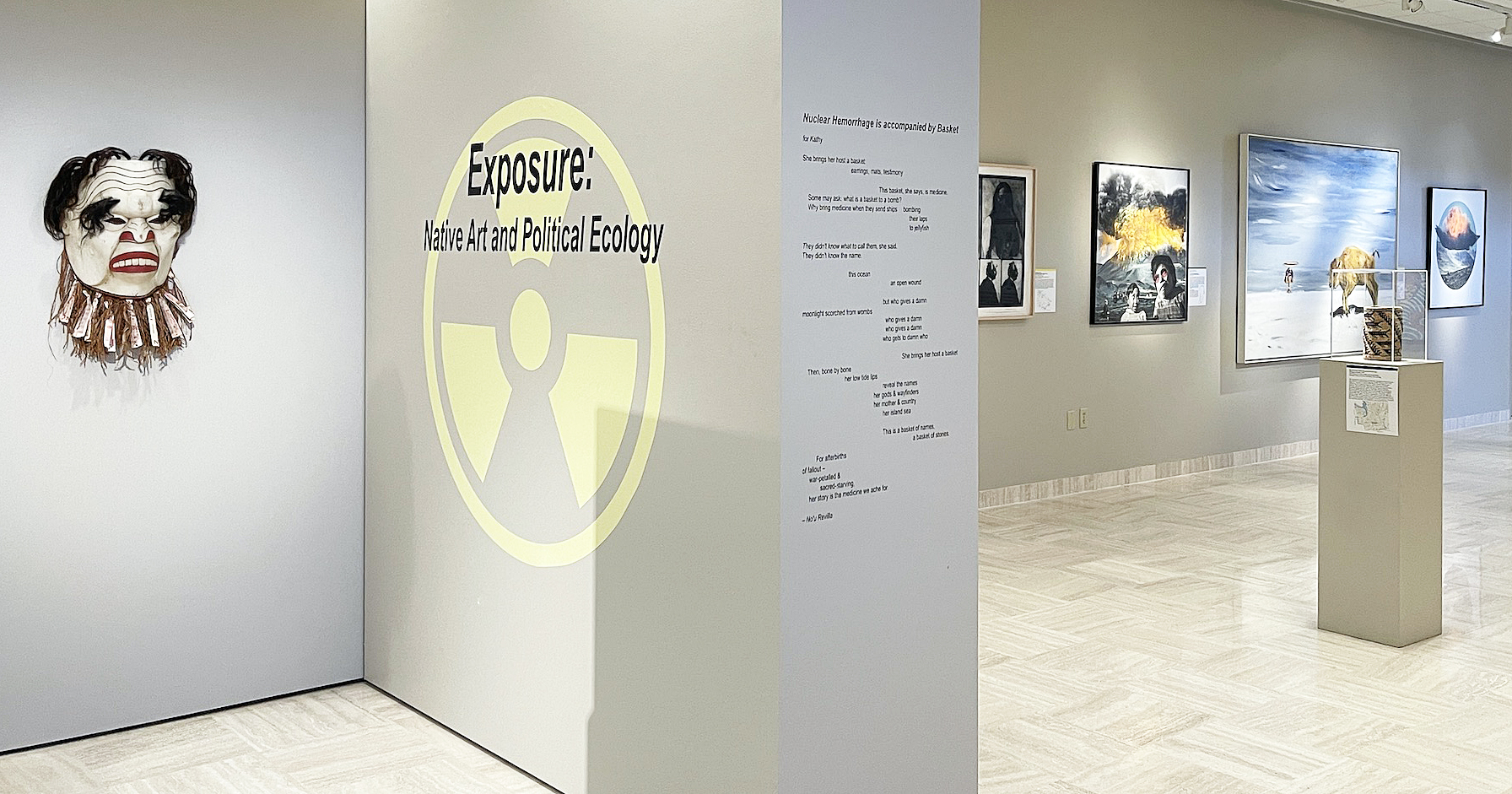
Installation shot of Exposure: Native Art and Political Ecology, which will be at the Marshall M. Fredericks Sculpture Museum in University Center north of Saginaw through Dec. 10. Courtesy Marshall M. Fredericks Sculpture Museum.

In contemplating the after-effects associated with mining uranium and testing the resulting nuclear devices, Geoffe Haney probably speaks for all of us when he admits he had no idea what a large operation it all is, even today.

“When I thought about atomic testing,” said Haney, collections manager at the Marshall M. Fredericks Sculpture Museum north of Saginaw, “I thought about the Marshall Islands or Nevada. I thought, ‘OK, we learned our lesson, and everything worked out.’ But,” he added, “it’s all ongoing, and the amount of uranium mining is insane.”

A traveling show at the museum on the Saginaw Valley State University campus, Exposure: Native Art and Political Ecology, underlines the wide range of countries that still have working mines. (The trade association for the nuclear industry, the World Nuclear Association, reports active mining in 20 countries.) The exhibition also points to the uncomfortable fact that most of the mines seem to be on the land of, or adjacent to, indigenous communities, whether in New Mexico, South Australia, Arizona, Saskatchewan or Hawaii – all of which contributed works for this colorful, ultimately disturbing show.

Exposure will be up through Dec. 10, 2022.

Organized by the IAIA Contemporary Museum of Native Arts in Santa Fe, New Mexico, the exhibition – which heads to Los Angeles next – is both engaging and politically astute.

For example, a text panel instructs us there are over 500 abandoned uranium mines and mills on Navajo Nation and Pueblo lands, “and most of them are unmarked.” Until 60 years ago, Native American miners worked in the uranium mines “without any protective equipment and lived in houses constructed from contaminated material.” Many were claimed by uranium-related illnesses and unknowingly seeded birth defects and cancer that have spread through succeeding generations.

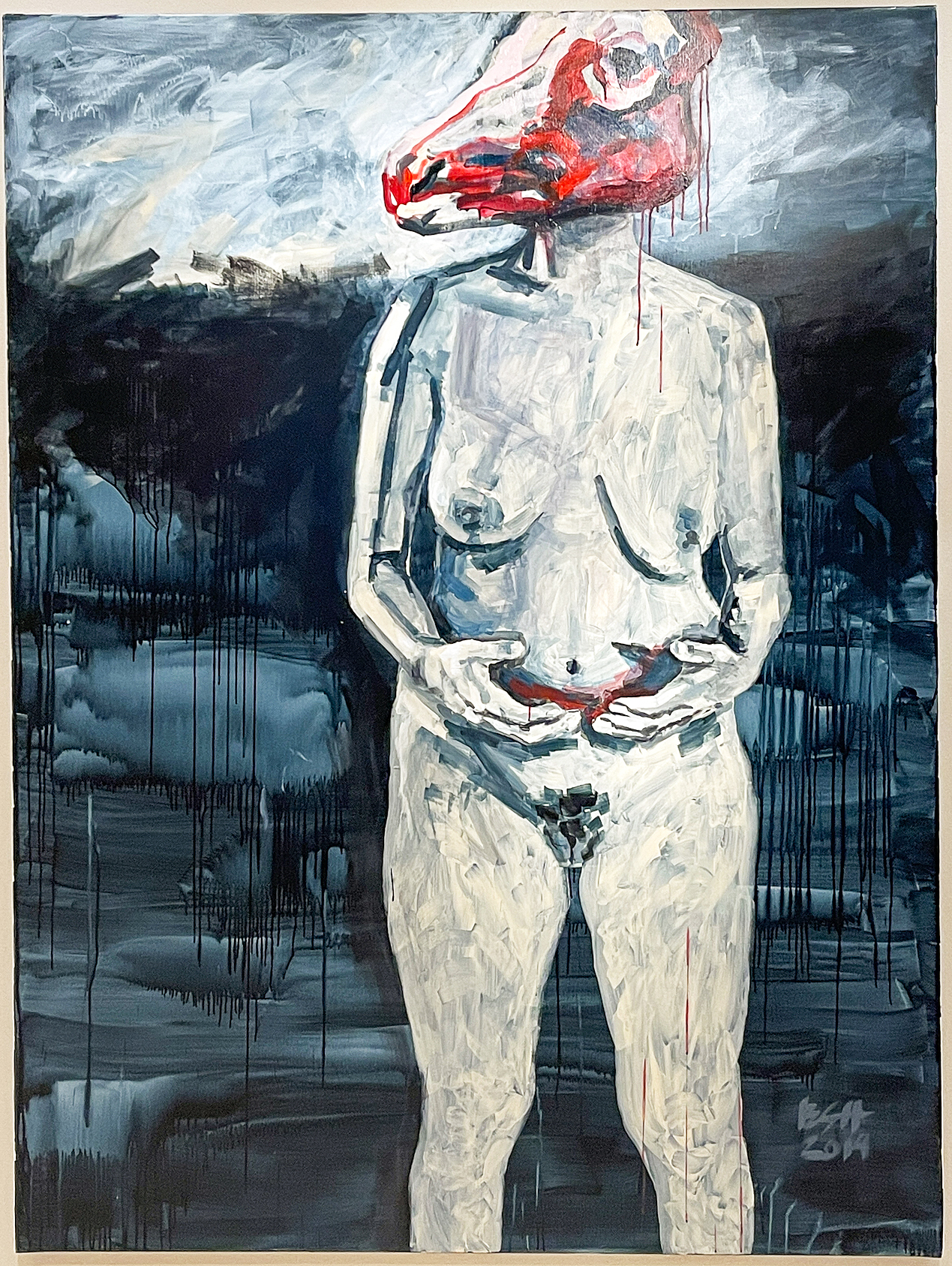
Bolatta Silis Høegh, Outside (from the Lights On, Lights Off series), 2015.

This suggestion of genetic tragedy gets a nice treatment by the Greenlandic Inuit artist, Bolatta Silis Høegh, who now practices in Copenhagen. Outside, a self-portrait from her 2015 “Lights On, Lights Off” series, presents a naked figure, rendered in crude, choppy, gray strokes. The woman is surrounded by a black landscape both lurid and elegant, and where her head ought to be there sits instead a bloody cow’s skull, gazing off to the right, as if it’d just heard something.

Is this a mask? Hard to tell, but it somehow doesn’t feel likely. All in all, Høegh conjures up a powerfully despairing portrait with an edge of anger.

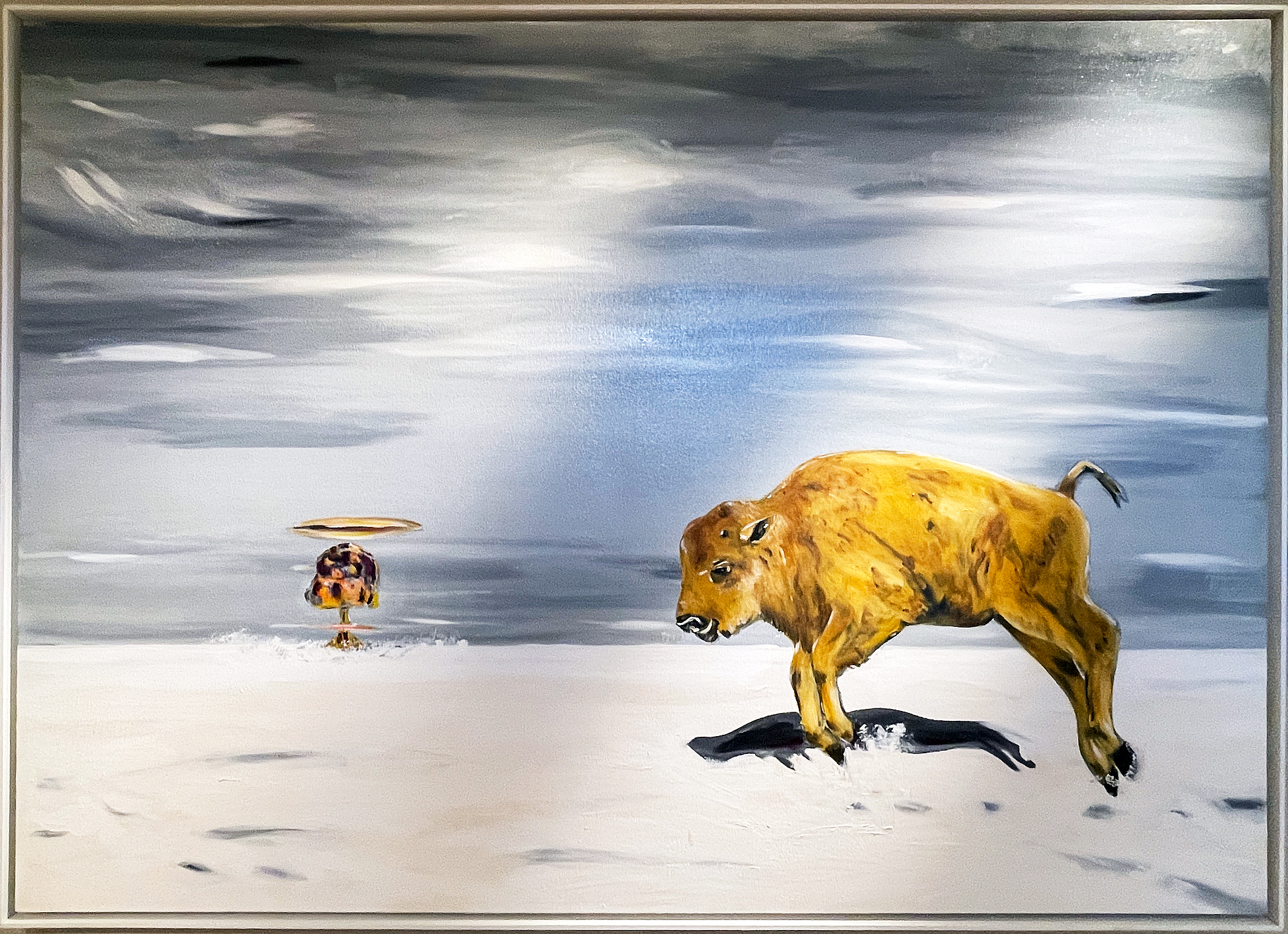
Visually amusing but no less hopeless in its way is Adrian Stimson’s Fuse 3 from 2010. The member of the Canadian Blackfoot nation gives us a beige, beach-like desert landscape under a heavy gray and black sky. At the left horizon, a diminutive mushroom cloud comprised of black, salmon-pink and dark yellow is rising into the sky, its blast apparently causing the mustard-colored bison who dominates the canvas to jump in alarm.

The treatment of objects and landscape alike is interesting. The mushroom cloud reads a bit like a cartoon, gaudy and almost cute, but the buffalo is rendered with sympathetic precision. And there’s surprising beauty and technique in both the menacing sky and milky-beige sand in the foreground.

Adrian Stimson, Fuse 3 (Series of three paintings), Oil and graphite on canvas, 2010. Courtesy Marshall M. Fredericks Sculpture Garden.

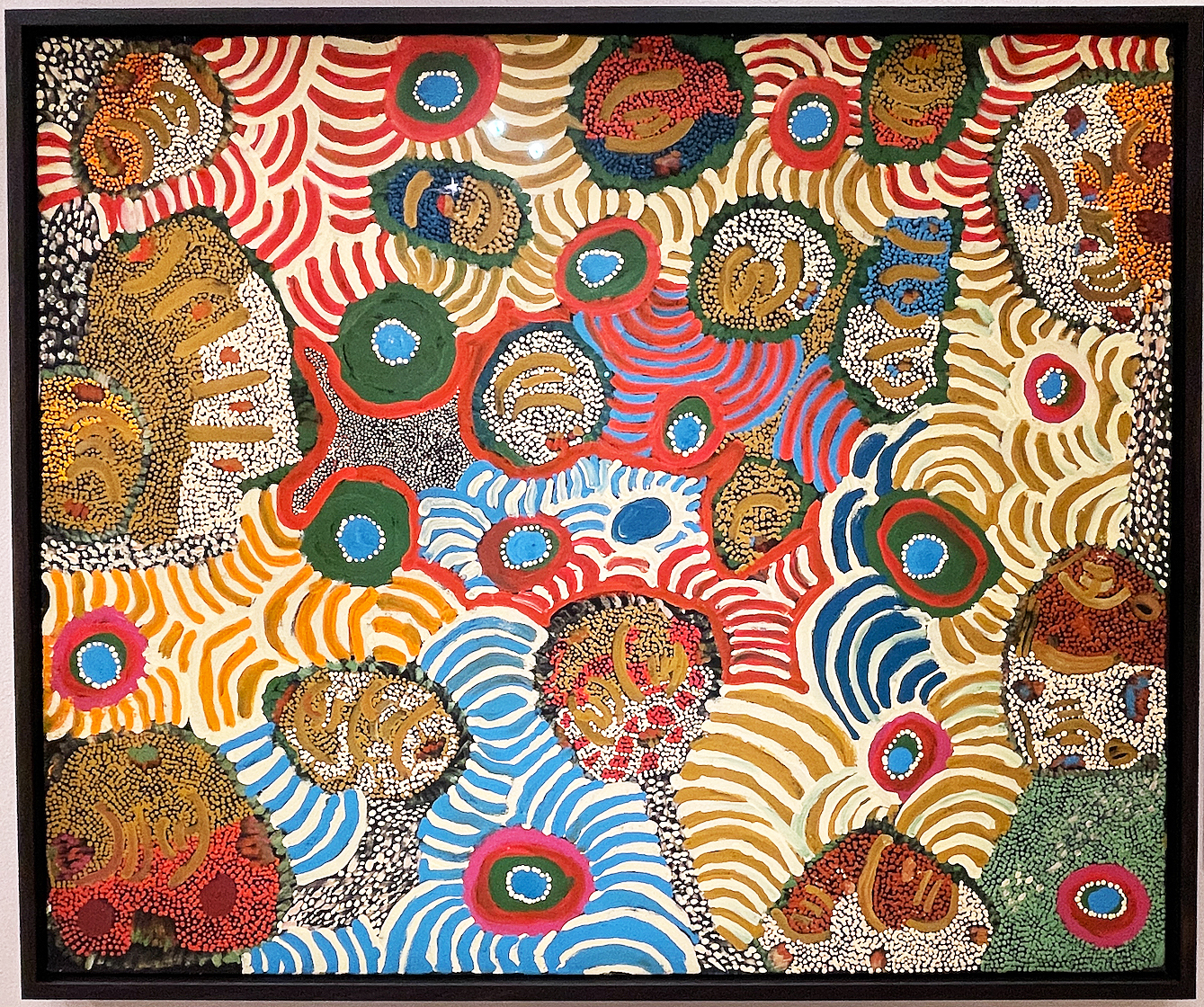
Between 1956 and 1963, the United Kingdom conducted seven nuclear tests at the Maralinga site in South Australia. At first blush, with its exuberant circles and parallel curves in a rainbow of colors, “Maralinga Bomb” looks almost playful. But Karrika Belle Davidson, an Aboriginal woman who was near one of those tests with her young son when it detonated, has embedded this acrylic abstract, so cheerful on the surface, with hard-to-decipher representations of the dead and dying, and the hundreds of spot fires that burned long after the explosion had mostly cleared.

Kunmanara (Karrika Belle) Davidson, Maralinga Bomb, Acrylic on canvas, 2016.

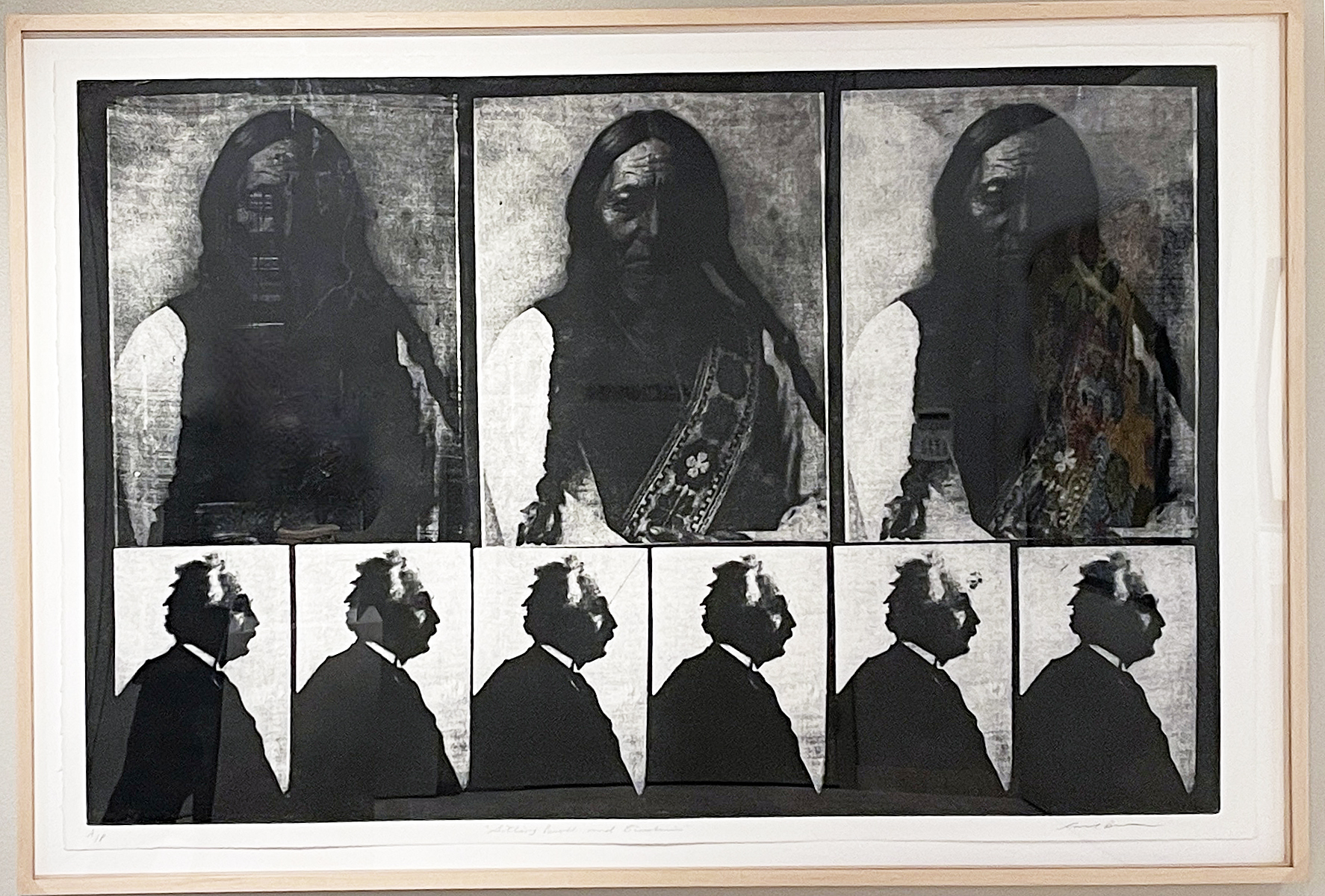
With Sitting Bull and Einstein, Ojibway printmaker and artist Carl Beam pairs the legendary Native leader with the scientist whose genius led to the most frightening destructiveness man has ever wielded. Here the Saskatchewan native, who influenced an entire generation of First Nations artists before his 2005 death, lines up a half dozen lookalike pictures of Einstein in profile along the bottom of this black-ink etching, topped by three larger images of Sitting Bull. Calm and august, he looks straight out at the viewer. There’s a little playing with what academics might call the standard hierarchies of power here, with the world-acclaimed scientist overshadowed by the mythic Native American.

Carl Beam, Sitting Bull and Einstein (From the series The Columbus Suite), Etching in black ink on paper, ca. 1990. Courtesy Marshall M. Fredericks Sculpture Garden.

 Some prospects – wholesale obliteration or lingering death, say — are too ghastly to dwell on without pause, which is doubtless why the art of catastrophe and doom often includes a side of black humor.

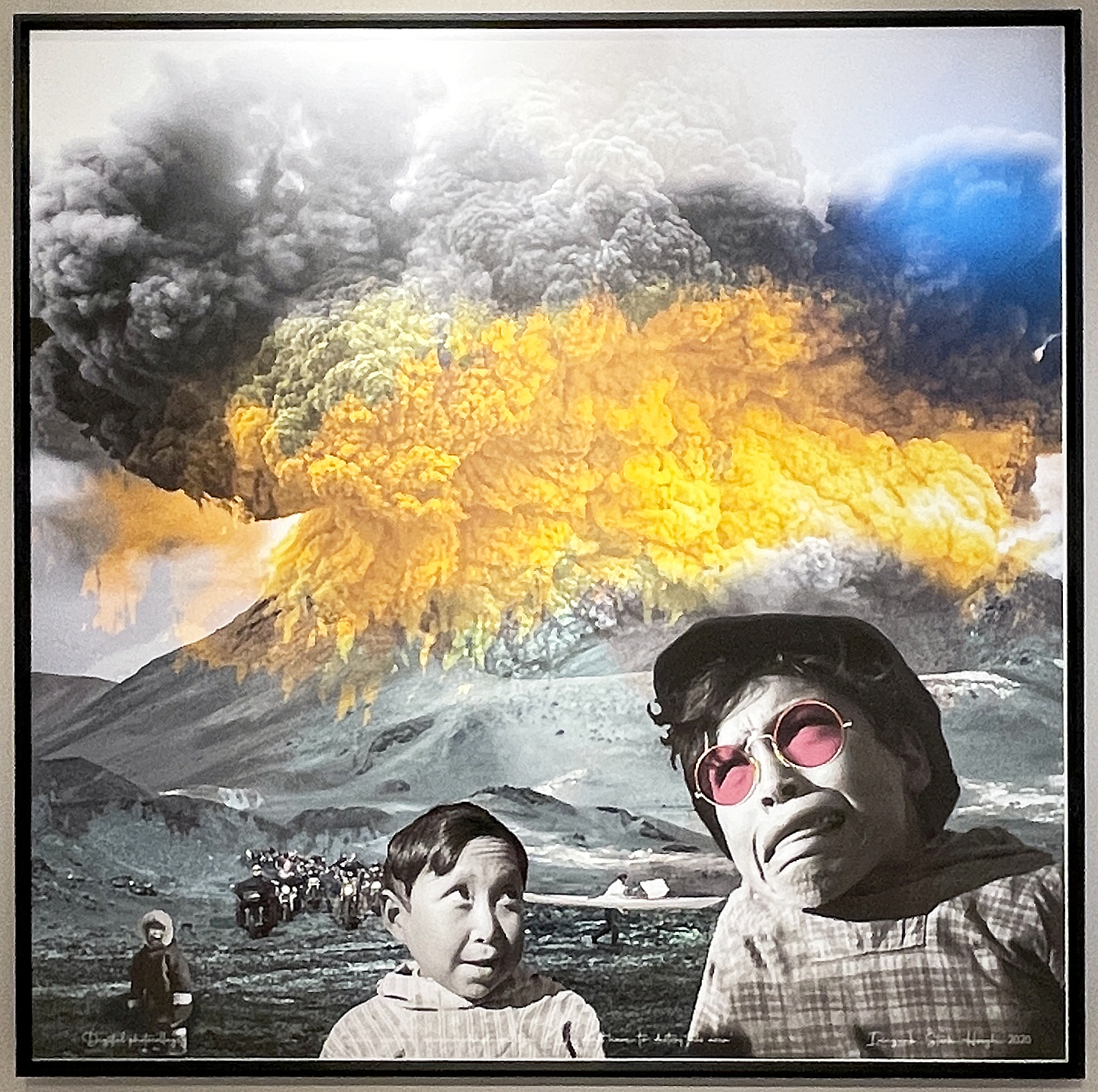
Greenlandic Inuit artist Ivinguak Stork Høegh invokes this cockeyed tradition with his funny, deeply odd, Sussa Manna Aserrungikkaluarutsigu (We Do Not Have to Destroy This Area), which stars an exploding mountaintop and, looming in the foreground, two dorky kids. Both taken from period photographs, one boy is wearing literal, rose-colored glasses. It’s only when you look close and get past the general jokiness that you realize the child’s face is twisted in a hideous grimace – as appropriate response to nuclear contamination and ruin as one can imagine.

Ivinguak Stork Høegh, Sussa Manna Aserrungikkaluarutsigu (We Do Not Have to Destroy This Area), Digital photograph, 2020. Courtesy Marshall M. Fredericks Sculpture Garden.

Exposure: Native Art and Political Ecology will be at the Marshall M. Fredericks Sculpture Museum at Saginaw Valley State University through Dec. 10, 2022.


Critical Voices @ Oakland University Art Gallery

Critical Voices: Selections from the Hall Collection at OUAG

Install Image Critical Voices: Selections from the Hall Collection 2022

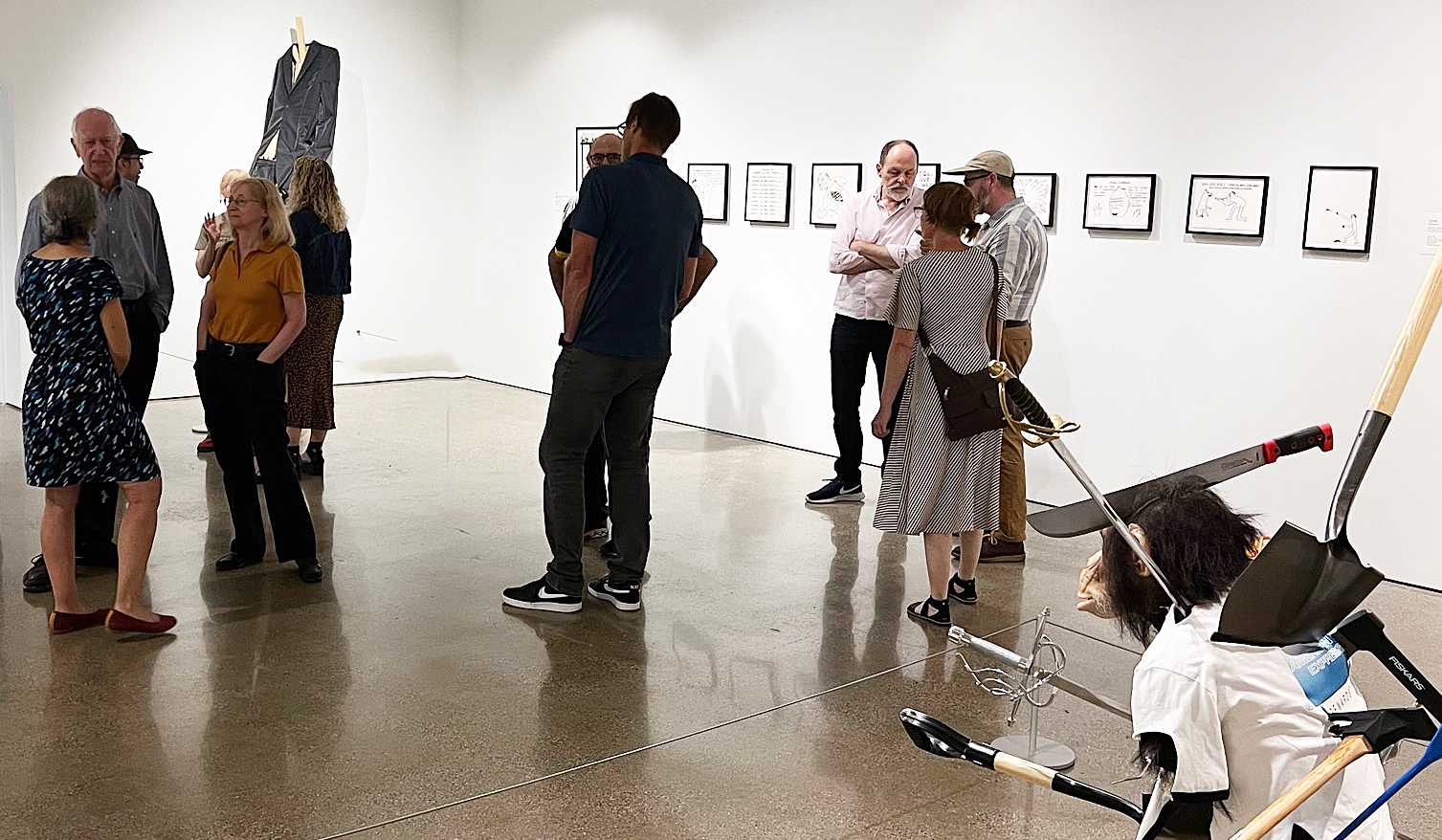
The Oakland University Art Gallery opened the fall season with Critical Voices: Selections from the Hall Collection on September 9, 2022,  curated by Leo Barnes, the new OUAG Gallery Manager.  This is Barnes’ curatorial debut, but he’s leveraging five years of prior experience working with the Hall Foundation and its highly respected collection of both American and German contemporary art.  He says, “The artworks, collected by Andrew and Christine Hall, present a unique index of the best contemporary art of the late 20th and 21stcenturies. It provides a window onto the complementary social conditions prevailing in two distinct continental spheres: Germany and the United States.

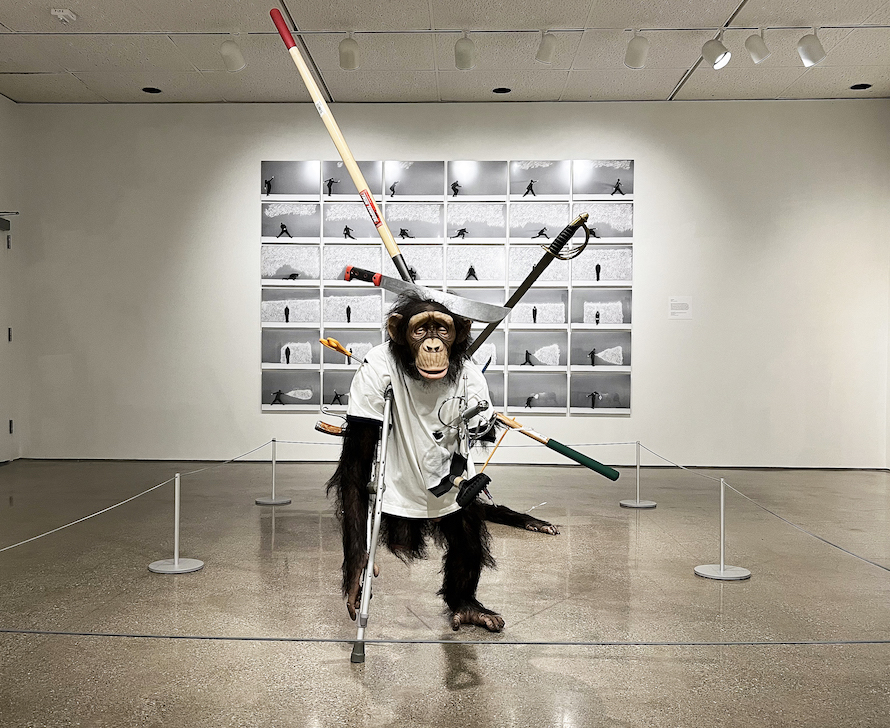
Tony Matelli, Fuck’d, Mixed Media Sculpture, the Hall Collection

Tony Matelli is an American sculptor perhaps best known for his work Sleepwalker. He was born in Chicago and received his MFA from the Cranbrook Academy of Art in 1995. He now lives and works in New York City. He incorporates figurative, botanical, and abstract forms in his sculpture, creating uncanny objects that are both unsettling and comical.  Fuck’d up is a good example of these characteristics as it takes center stage in the OUAG gallery. Mr. Matelli has employed his formula of high-quality craftsmanship and lewd provocation, like the chimp being crucified using garden and household implements. Whatever the message, the artist leaves the viewer to interpret and make sense of the experience based on their own experience.

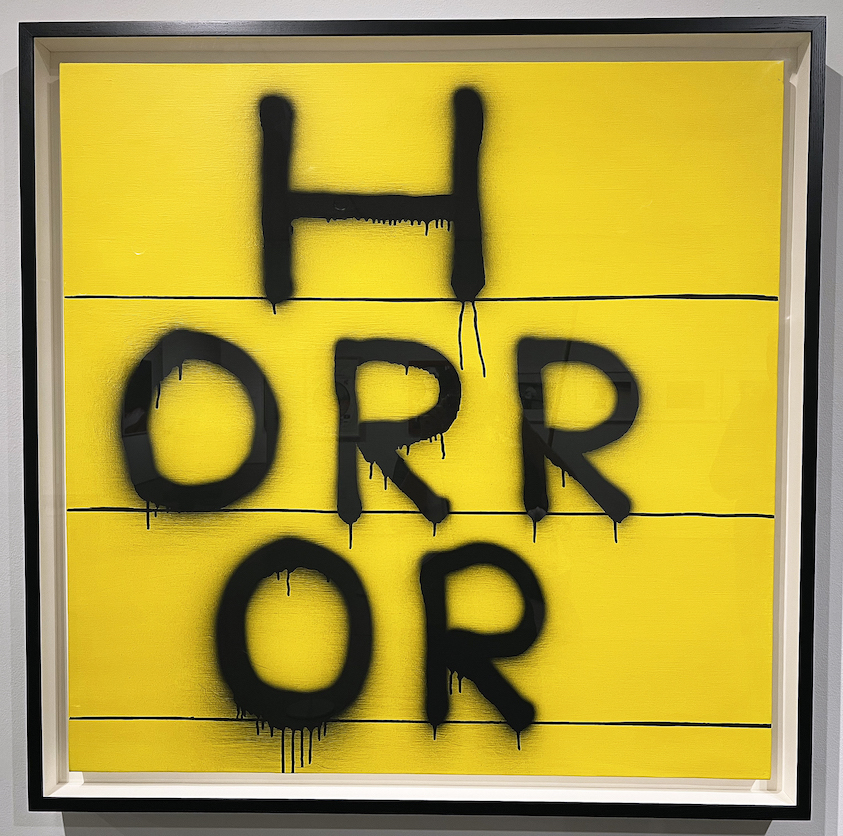
David Shrigley, Horror, Acrylic on Canvas, 40 x 40″, the Hall Collection

Horror is a kind of pop art with drips.  When you scroll through David Shrigley’s Instagram page, there is a continuous stream of simple, single images of objects, all using bright colors. A maverick and an artist working in multiple disciplines, David Shrigley is now considered one of the most significant figures in contemporary British art.  Making sense seems like nonsense is one way to describe his faux-naif work, which combines sweet childlike renderings with a sour, sardonic tone.   In January 2020, the artist was awarded the decoration of Officer of the Most Excellent Order of the British Empire (OBE). The British visual artist was born in 1968 and is now living in England after living in Scotland for 27 years.

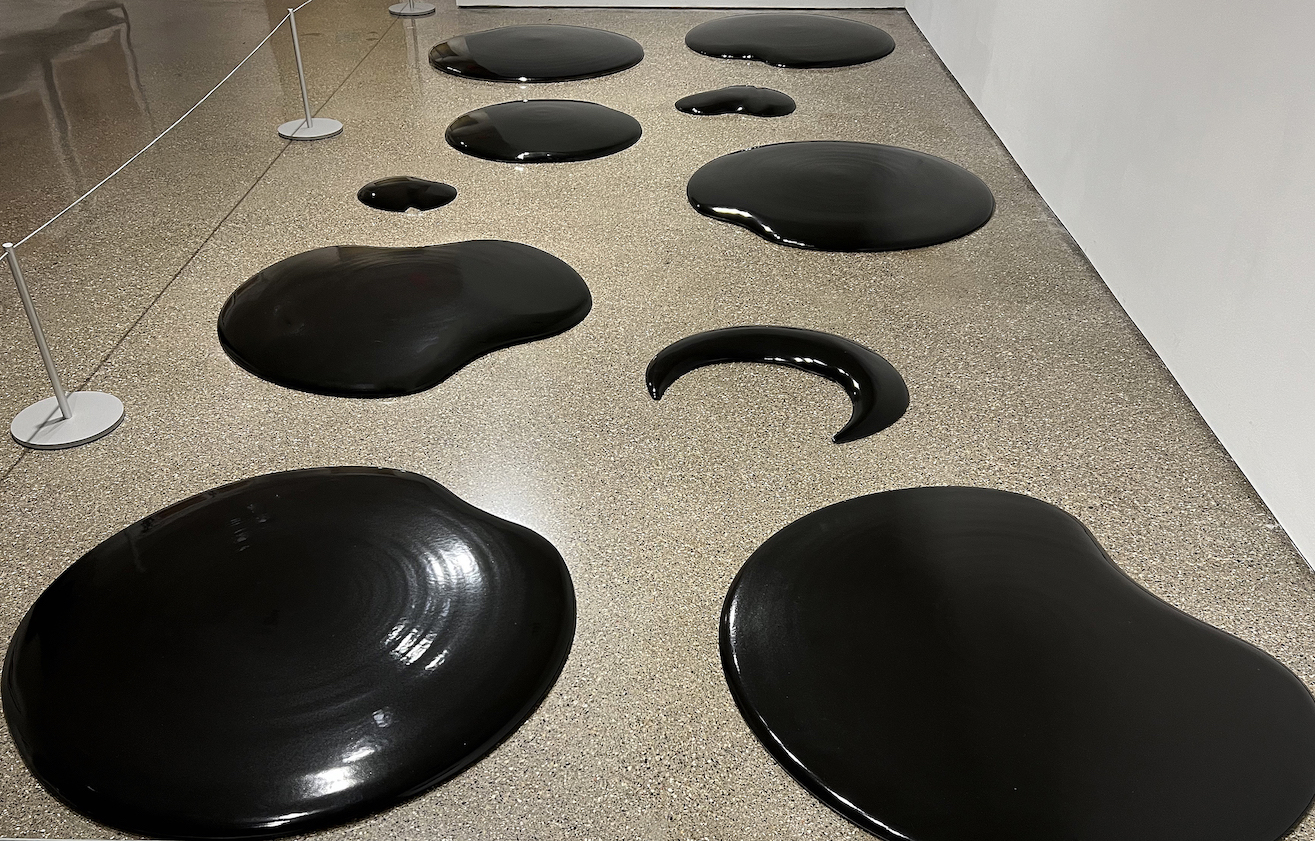
Al Weiwei, Oil Spills, 10 pieces, Porcelain, The Hall Collection

Oil Spills is an early piece by the renowned Chinese artist Ai Weiwei, a visual artist, dissident, and documentarian who is often referred to as the most influential artist of our time. Ai Weiwei was born in 1957 in Beijing. His father, the poet Ai Qing, was labeled a “rightist” in 1958, and Ai and his family were exiled, first to Heilongjiang in northeastern China and then soon after to the deserts of Xinjiang in northwestern China. Mr. Weiwei moved to the United States in 1981, living in New York between 1983 and 1999, where he briefly studied at the Parsons School of Design. His output over the past thirty years explores his ambivalent rapport with Western culture and with the culture of his own country.  Oil Spills is an example of his conceptual art that explores the social issue and the aesthetics of an oil spill. This short video documents his exhibition in New York City in 2017.   https://www.nytimes.com/video/arts/100000005490574/ai-weiwei-puts-up-fences-to-promote-freedom.html

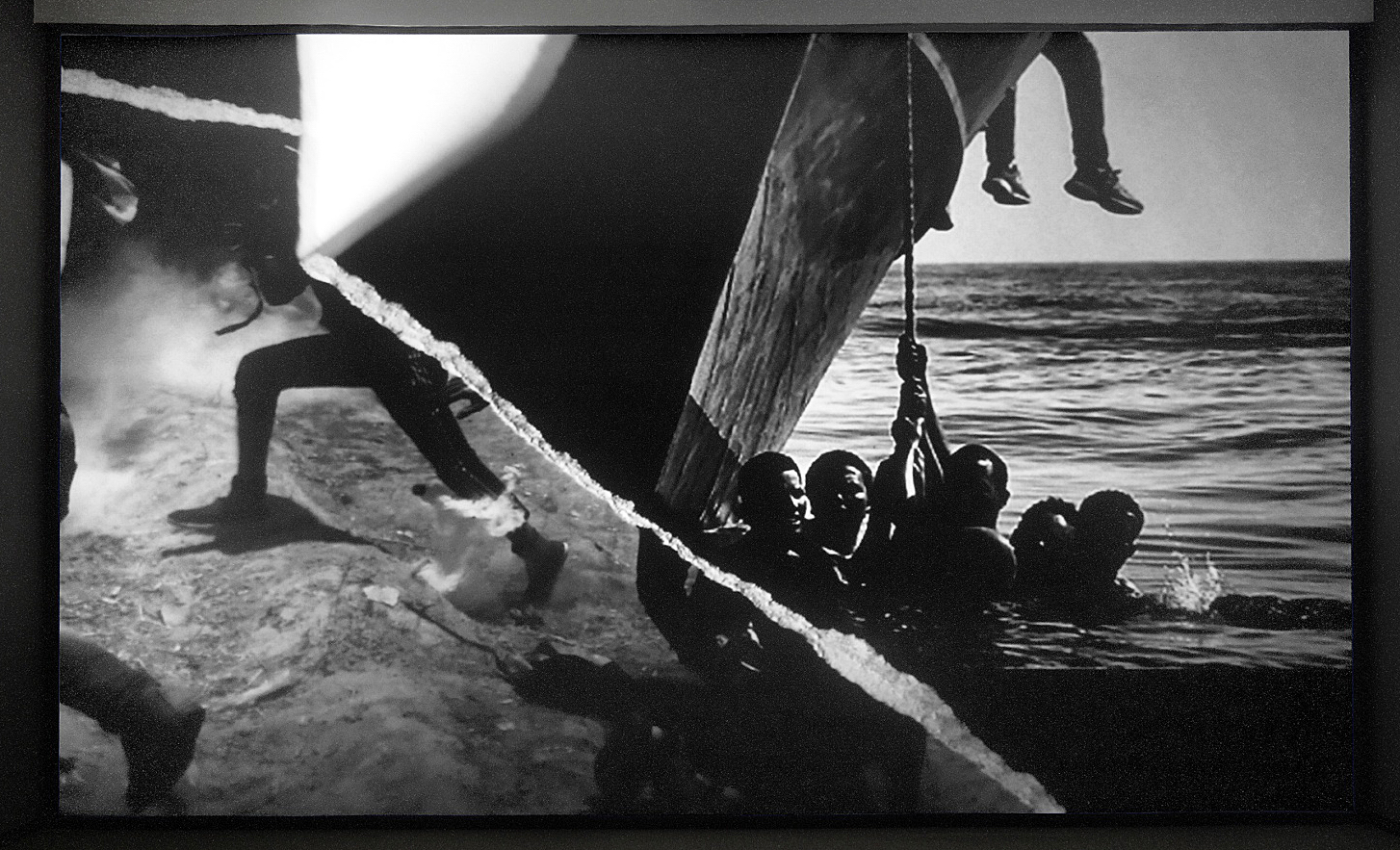
Robert Longo, Icarus Rising, Single Channel video projection, 9 minutes & 44 seconds. The Hall Collection

The video Icarus Rising from the title of the exhibition, Amerika, is the German spelling of America, where Robert Longo references the Franz Kafka novel that traces an immigrant’s journey from Germany to New York.  The nine-minute black and white video splices together images of torn paper and appears to be the artist’s first video work since the 1990s. The film features slowed footage of layers of printed photographic images, tweets, and headlines from news media being torn apart. The recorded incidental sounds of the tearing slowed in synchronization with the visuals, creating a soundtrack of groaning scrapes. The combined effect unsettlingly underscores the force, and often violence, of the actions captured in the images as well as the role the images play in shaping our world.  Sculptor, painter, and draftsman Robert Longo is well known for his bold drawings and sculptural works fusing pop culture and Fine Art. Longo attended the University of North Texas before deciding to study sculpture in New York; he later received a BFA from SUNY Buffalo.

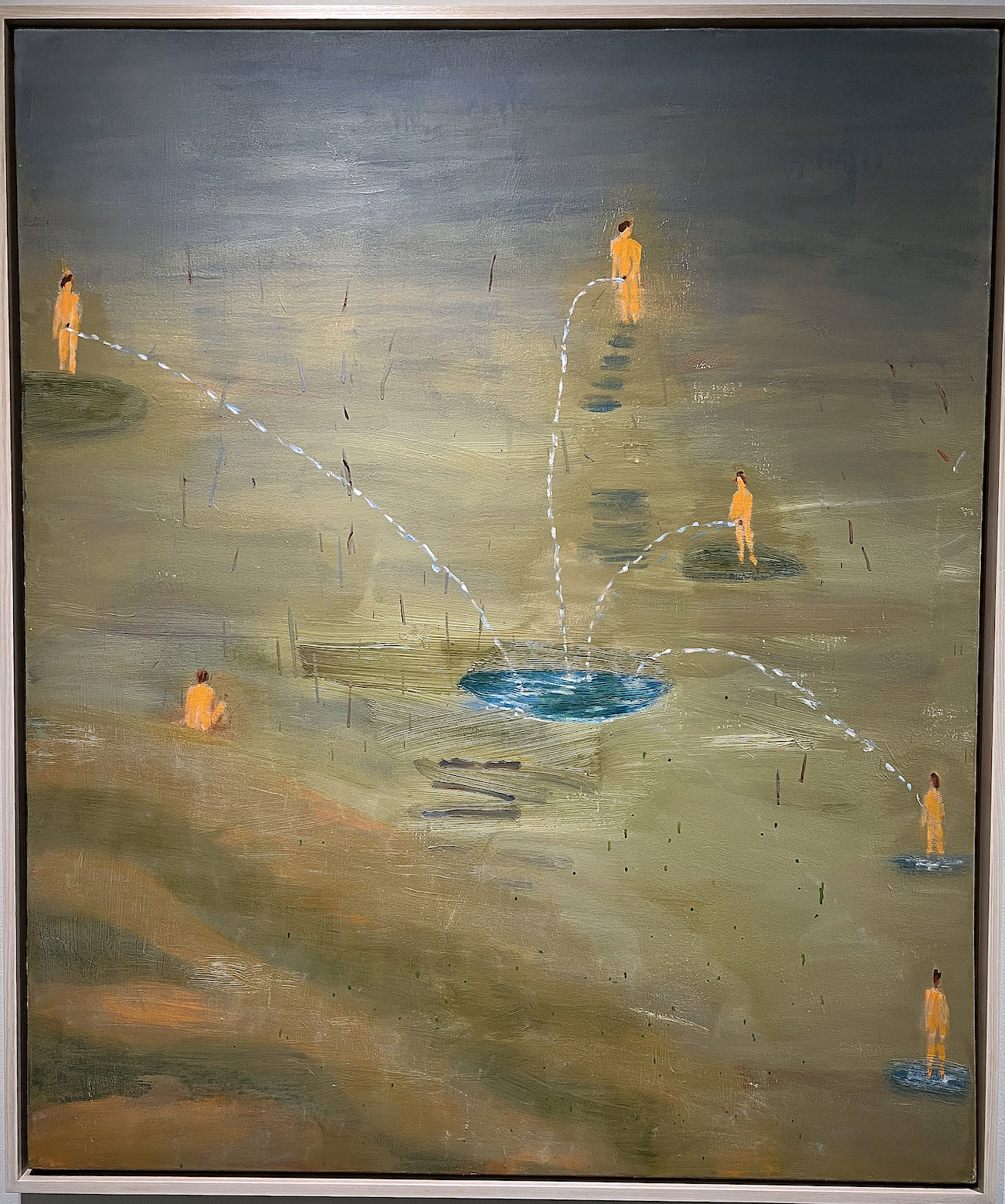
Katherine Bradford, Beautiful Lake, Oil on Canvas, 57×48″, 2009, the Hall Collection

The figurative painter, Katherine Bradford, provides this lush, color-saturated, and metaphorical lake to the Hall Collection. She combines a theatrical sense of light with an oblique narrative. The work here in Beautiful Lake is a kind of romantic realism, whimsical and spacious.  Best known for her irregular grids and rows of dots spread out and around the figures, her representational work is meditative, laconic, and poetic.  Born in 1942 in New York City, she attended Bryn Mawr College and later received her MFA from SUNY Purchase. The artist currently divides her time between Brooklyn, NY, and Brunswick, ME.

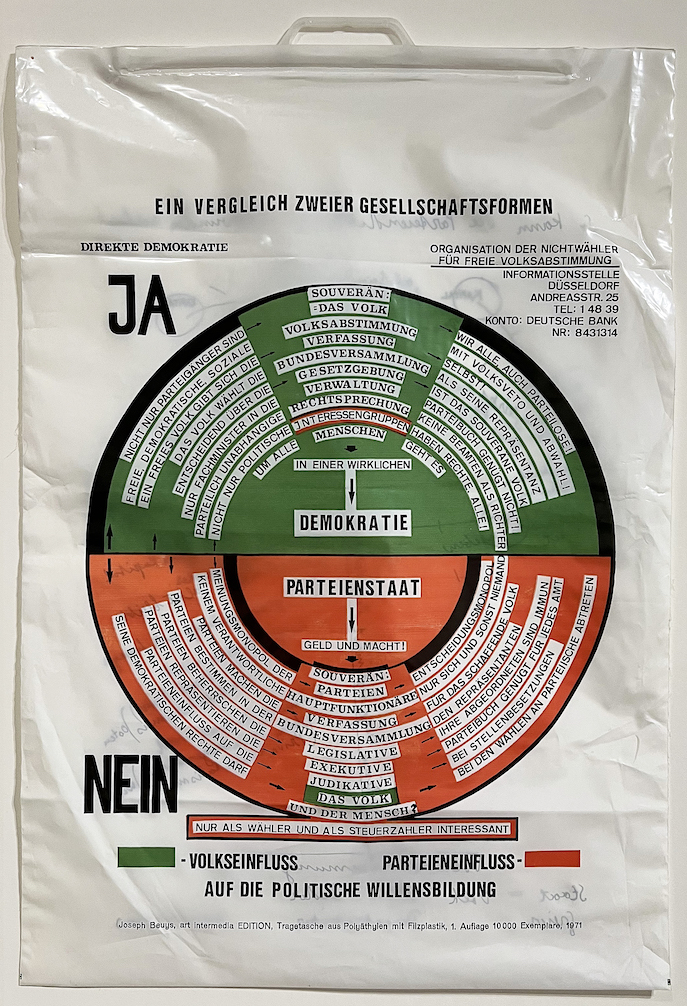
Joseph Beuys, The Dictatorship of the Parties Can be Overcome, Printed on a polyethylene shopping bag, 29.6 x 20, the Hall Collection.

Joseph Heinrich Beuys was a German artist, teacher, performance artist, and art theorist whose work reflected concepts of humanism, sociology, and anthroposophy.   He was a founder of a provocative art movement known as Fluxus and was a key figure in the development of Happenings.  The chart How the Dictatorship of the Parties Can Be Overcome was printed on a polyethylene shopping bag. It was produced by the Organization of Non-Voters Free Collective Referendum as a means by which to publicize their policies. The first diagram, which was originally hand drawn by Beuys, urges the replacement of political parties with a process of a direct referendum in German society.   Do you get the idea?  The complexity of his work is too large and long to mention here, but he says, “Only a conception of art revolutionized to this degree can turn into a politically productive force, coursing through each person and shaping history.” Joseph Beuys was born in 1921 in Krefeld, Germany, and died in 1986. After military service and time as a prisoner of war, Beuys studied sculpture at the Kunstacademie in Dusseldorf and served as Professor there from 1961 until 1972.

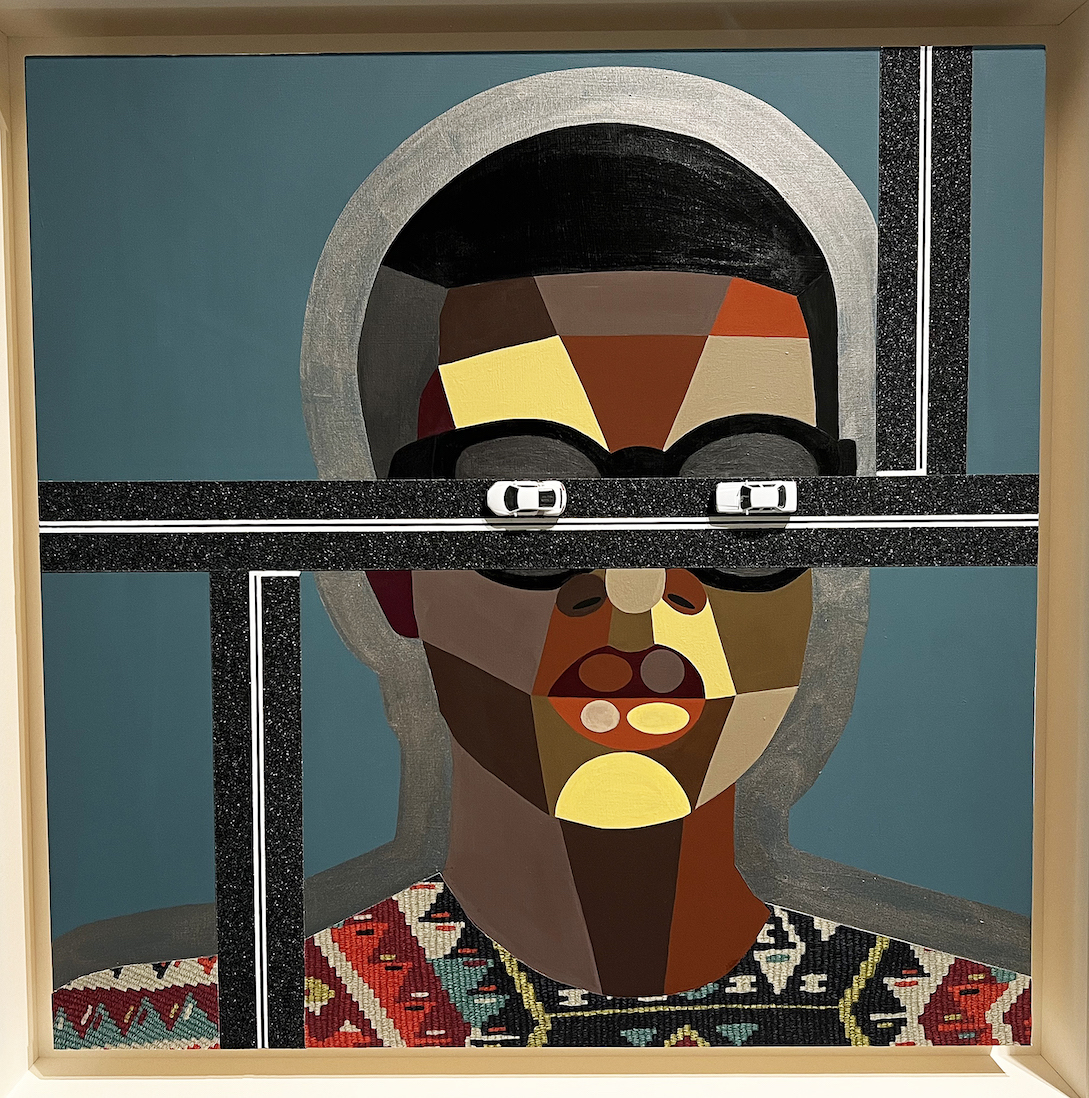
Derrick Adams, Figure in Urban Landscape, Acrylic paint and mixed media, 25 x 25″ the Hall Collection

In Figure in the Urban Landscape 40, Brooklyn-based Derrick Adams employs the tradition of portraiture to navigate and reimagine life in an urban society. On matte and painterly backgrounds of teal, silver, emerald, and integrated earth tones, two miniature model cars traverse the open, perpendicular blacktop roads that cut the ends of the composition. Adams draws inspiration from pop culture, personal memory, and neighbors; he says, “I pay attention to everything, from store windows to people in cafes talking, to people on the corner communicating. I like to think about surroundings as source materials.” Adams received his MFA from Columbia University and BFA from Pratt Institute.

Critical Voices: Selections from the Hall Collection includes artists:  Derrick Adams, Joseph Beuys, Katherine Bradford, Edward Burtynsky, Naoya Hatakeyama, Georg Herold, Barbara Kruger, Robert Longo, David Maisel, Tony Matelli, Carlos Motta, Robin Rhode, Wilhelm Sasnal, David Shrigley, Ai Weiwei.

For more than 40 years, the Oakland University Art Gallery (OUAG) has delivered diverse, museum-quality art to metro Detroit audiences. From September to May, the OUAG presents four different exhibitions – from cutting-edge contemporary art to projects exploring historical and global themes. The gallery also presents lectures, performances, tours, special events, and more.

The exhibition at OUAG  is open through November 20, 2022.


Page 3 of 22

Powered by WordPress & Theme by Anders Norén