
Detroit Art Review

Critical art reviews of Detroit galleries and museums weekly

Mark Beltchenko @ MFSM

Marshall M. Fredericks Sculpture Museum at Saginaw Valley State University exhibits the work of Mark Beltchenko

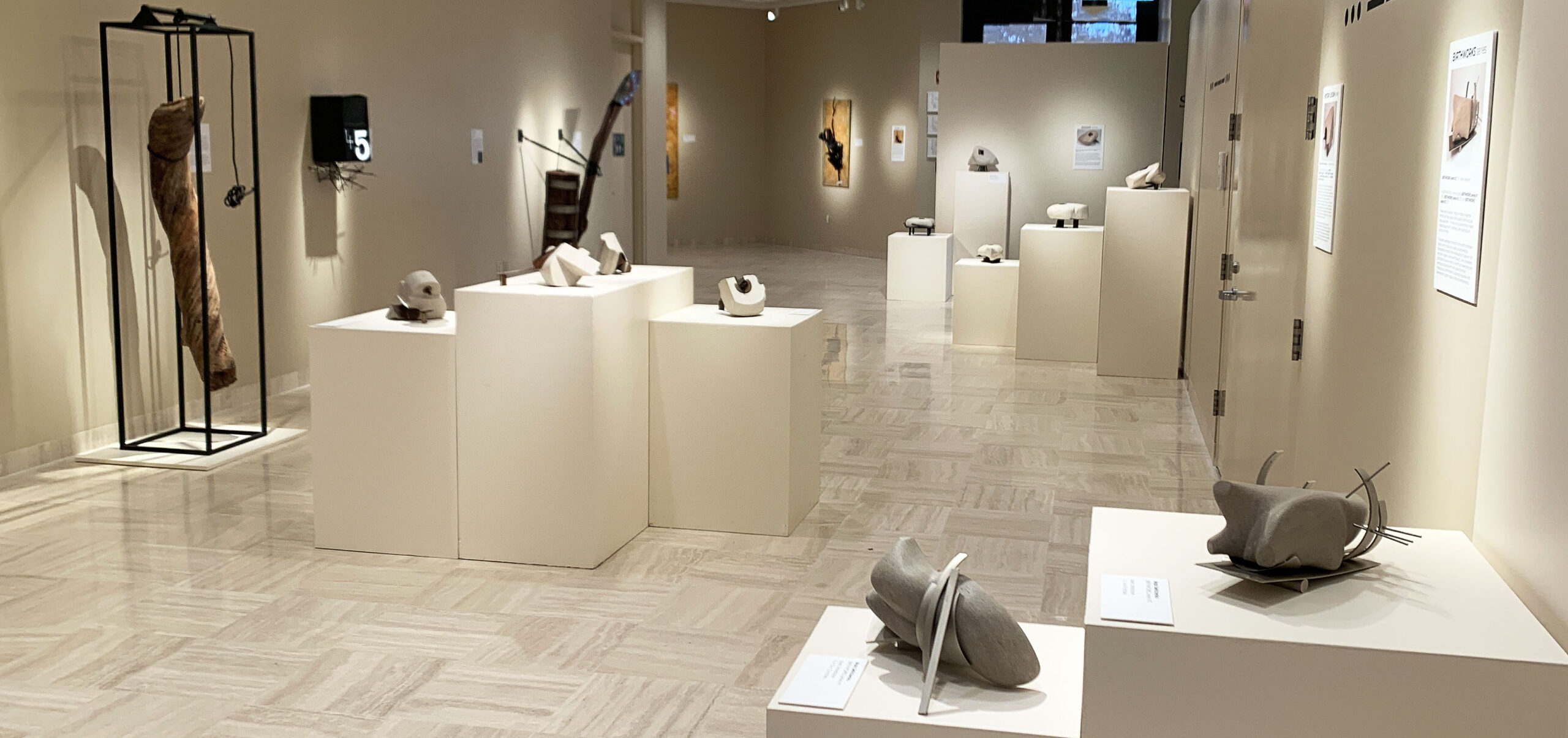
Mark Beltchenko, Installation image, Images courtesy of MFSM.

The Marshall M. Fredericks Sculpture Museum conducted its 2018 Regional Biennial Juried Sculpture Exhibition, a state-wide competition for sculptors, and the first prize went to the Detroit Artist Mark Beltchenko.  Part of that process resulted in a one-person exhibition at the museum. The Detroit-area sculptor is highly skilled in multiple media can be currently viewed online at marchshallfredericks.org  The title of this virtual exhibition ‘SOS (or ***—*** in Morse Code) is often used to denote phrases such as ‘Save Our Ship’ and is comprised of six different series of works by Beltchenko: INSIDER, BIRTHWORKS, HISTORY LESSONS, NOT MY PRESIDENT, PEDESTAL, and DISTRESS, spanning from the year 2006 to the most recent works completed in May 2020.

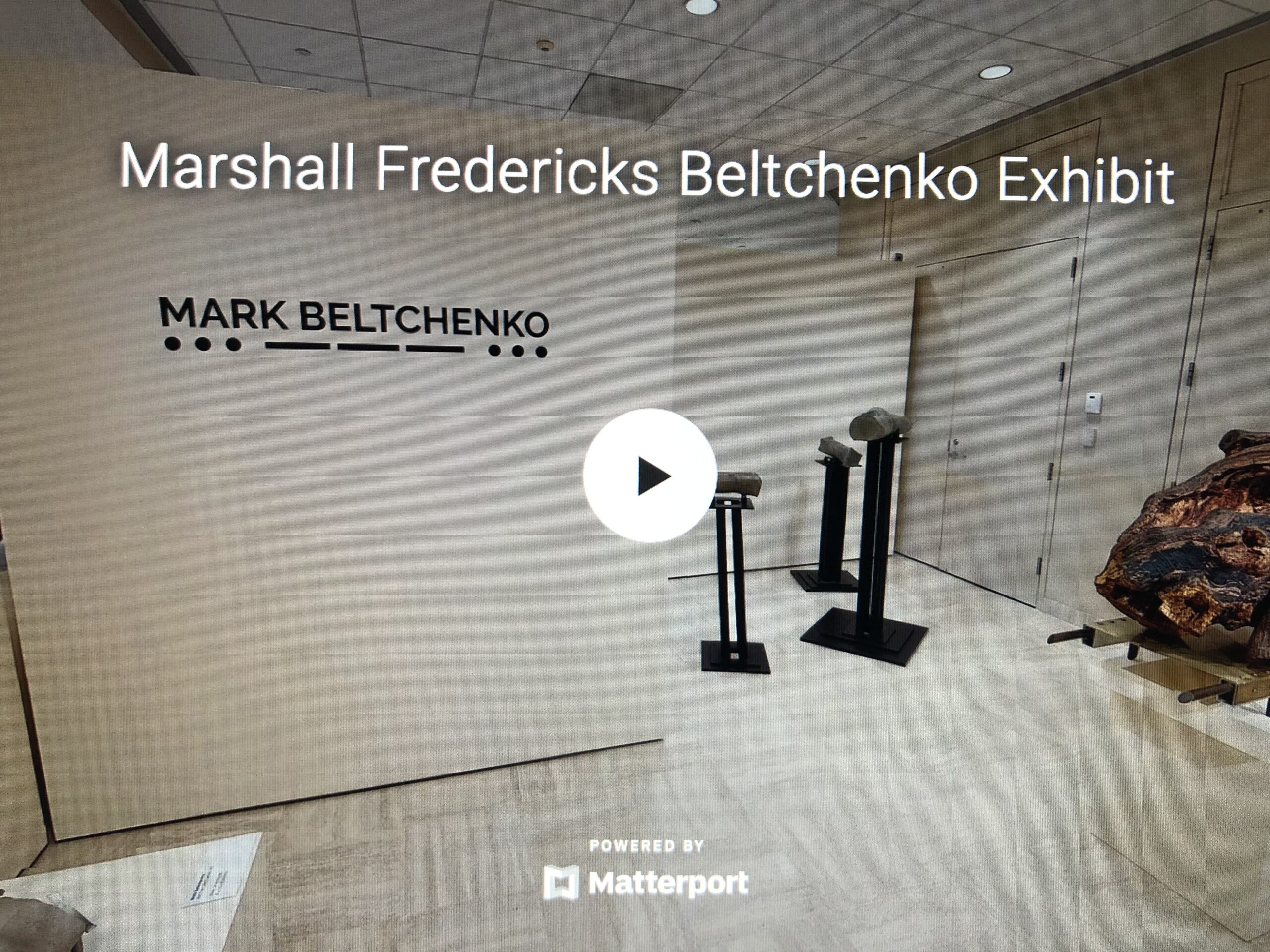
Mark Beltchenko, MFSM, virtual exhibition at their website, 11.2020

Museums in Michigan and around the country have been hosting virtual exhibitions due to the Covid-19 regulations and have harnessed various technologies to assist in the process.  The MFSM used MatterPort technology, allowing the viewer to begin at the open of the exhibition and proceed for a self-controlled visit through the virtual space. https://www.marshallfredericks.net/mb

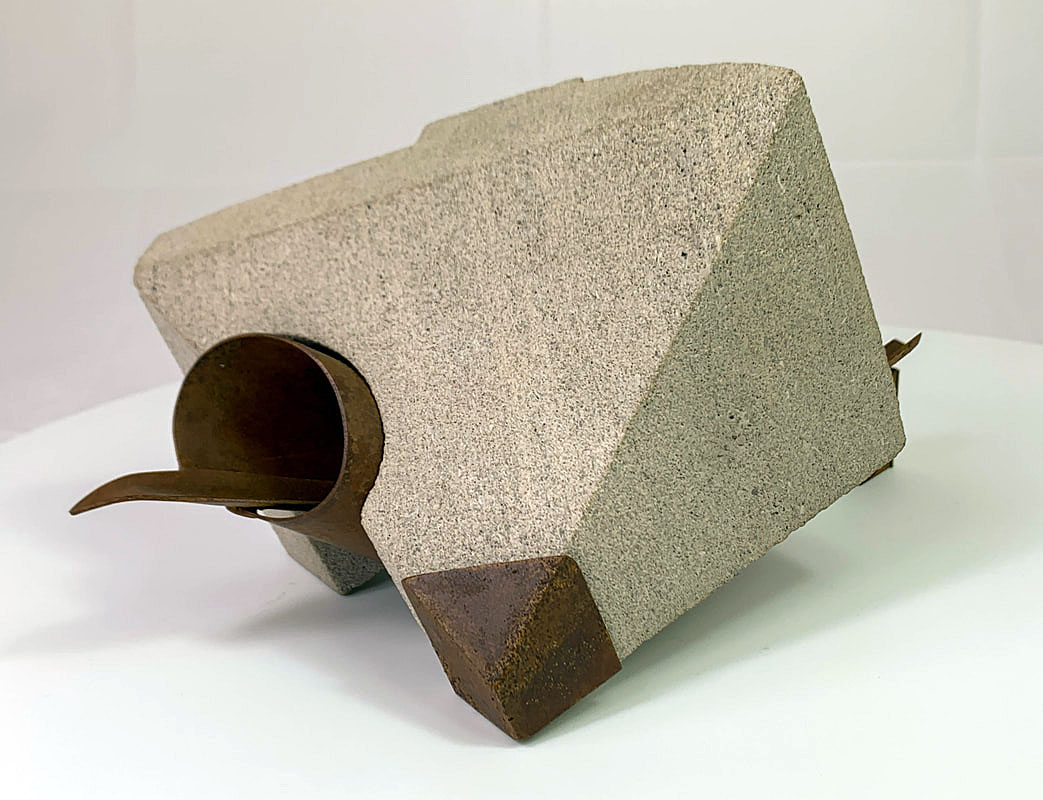
Mark Beltchenko, HISTORY LESSON – 3rd STONE steel, limestone, brass 6 x 11 x 8 inches

As mentioned, Beltchenko’s work is sorted by what he calls series, and these stone pieces are cut from building parts and then combined with other material. Steel, brass, and limestone carved to look like concrete structures are the ghosts of a man-made world in decay. The metals protrude from and through the concrete-appearing objects as the sculptor reclaims the man-made world’s parts.

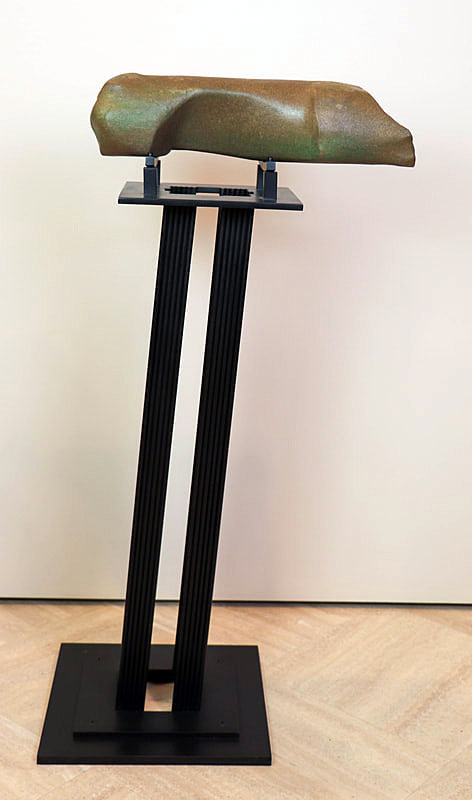
Mark Beltchenko, PEDESTAL SERIES #2, limestone, steel

Another series is Beltchenko’s pedestals. This series is a dystopian view of what art could look like in a world void of artistic expression and freedom. The sculpture, Pedestal #1 has an engraved plaque that states “1 of 3 carved objects discovered on the North American continent of Earth.” Art encapsulates and makes possible reasonable communication throughout the history of humankind. The limestone has been carved to resemble human bone as the pedestals are made of steel vein structures that are bare, out of balance, and leaning uncomfortably on edge.

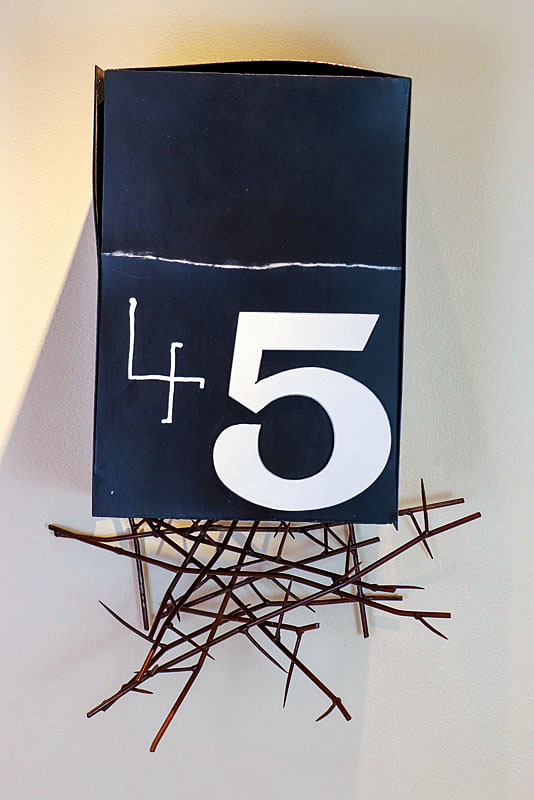
Mark Beltchenko, GOOD OLE NUMBER 45 – steel, 22 x 13 x 24 inches

Artists are people with political views, but few choose to bring those views into their art.  Mark Beltchenko is a three-dimensional artist who decides to devote a small part of his work to his view of the United States’ 45th President.  The artist uses thorns in this artwork represent the poisonous nature of the 45th President and his current administration; the hiring’s and the firings, the infighting, the tell-all book writing that now exists.  So much so, it requires the museum to place a disclaimer upfront: CAUTION This exhibition contains subject matter and imagery that some may find difficult, disturbing, and uncomfortable. Museum staff is available to discuss the works and the artist’s intent.

“The views and opinions expressed in this exhibition are those of the artist and do not necessarily reflect those of the Marshall M. Fredericks Sculpture Museum, Saginaw Valley State University, our funders or sponsors, including Michigan Council for Arts and Cultural Affairs.”

The director of MFSM, Megan McAdow, is quoted from a review, “Beltchenko is not a loud or verbose man, but his work screams at us with a dire urgency. That is not to say that his work is obvious; rather, it is not. It requires effort. One must spend time with the work and breathe into it. You may not immediately recognize the discourse; however, allow yourself to linger, and as one lingers, the layers begin to unfold and reveal its meticulous detail and dialogue. It affects and changes you.”

Equally comfortable working in stone, steel, aluminum, wood, and the non-ferrous metals, Beltchenko’s work serves as a meditation on the good and bad in our current lives: The environment, political hypocrisy, positive growth, greed, and human narcissism – not necessarily in that order, are all covered through his works.

His three-dimensional imagery communicates ideas in ways that are both primitive and profound.

The artist, through his work, is clear about his political views. Beltchenko states: “These works reflect extreme emotion because I’m highly affected by what is going on. I’ve never been politically motivated in the past, but we are at a point where we can’t take this anymore. I have a voice, and my voice is in my art.”

Mark Beltchenko earned his Bachelor of Fine Arts from Alma College, Alma, Michigan.

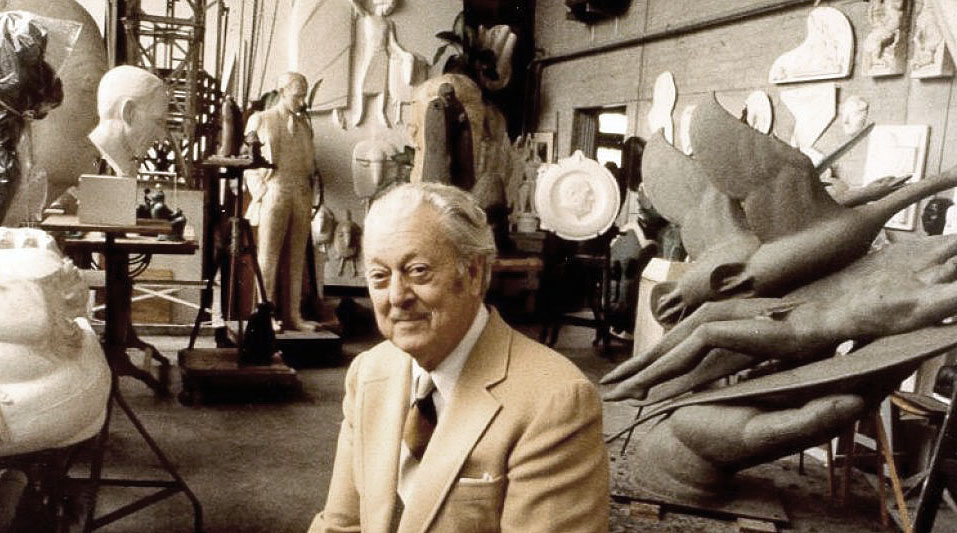
Marshall Fields, Sculptor, in his studio in the mid-1980s.

The exhibition at the Marshall M. Fredericks Sculpture Museum, Mark Beltchencko: • • • – – – • • • (SOS) runs through January 16, 2021.

To plan your visit:   https://www.marshallfredericks.net/mb


Tom Livo @ Image Works

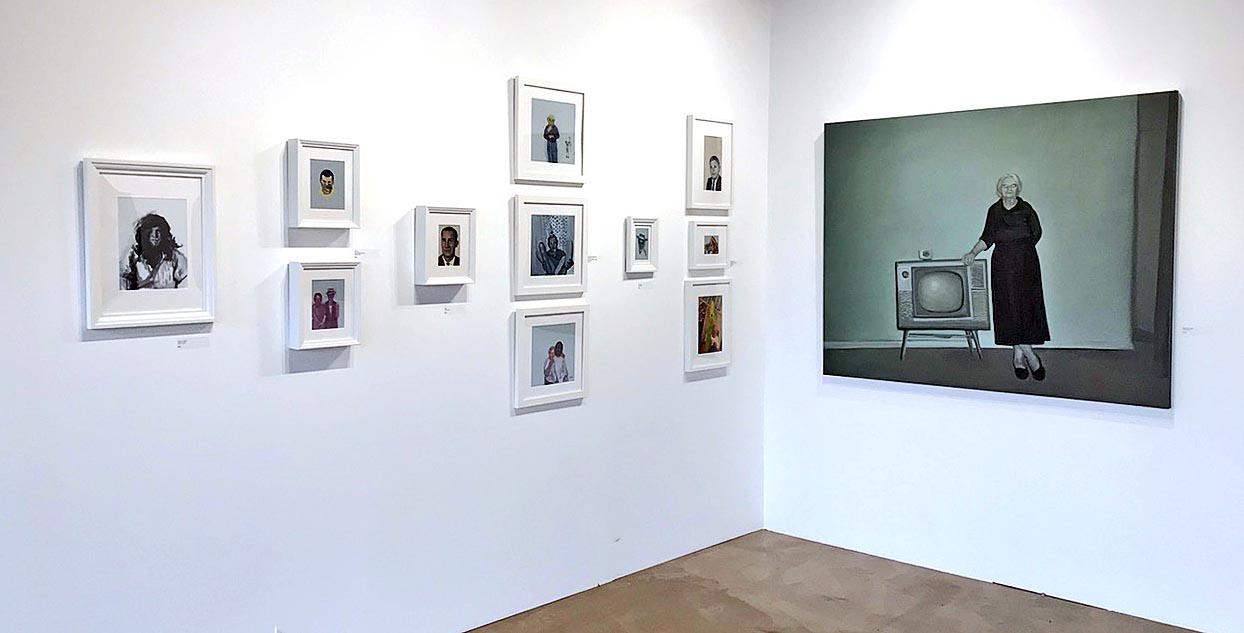
Paintings by Tom Livo, Installation shot, All images courtesy of Image Works

Like many cultural institutions in the era of Covid-19, art galleries are struggling with economic pain that goes along with the physical peril of the pandemic. So it’s a pleasure to find an art venue that is both showing interesting work and managing to keep the lights on.  Image Works is the brainchild of photographer Chris Bennett, a recent arrival to the Detroit area from Portland, Oregon. While the back portion of Image Works is dedicated to Bennett’s day job as a provider of fine art and photographic printing, the front features a small but pristine gallery where the paintings of Tom Livo are on display until November 27.

In the roomful of Livo’s images  now at Image Works, the artist explores childhood memories, translating family snapshots into painterly compositions that recapture and give significance to  fleeting recollections of times past. Born in Garden City, Michigan in the 60’s, the CCS graduate describes his method: “I revisited family albums, shuffling through stacks of old Polaroids and snapshots, choosing which to paint. The people and situations come alive again, reigniting fond, half memories and themes that, I suppose, resonate universally.”

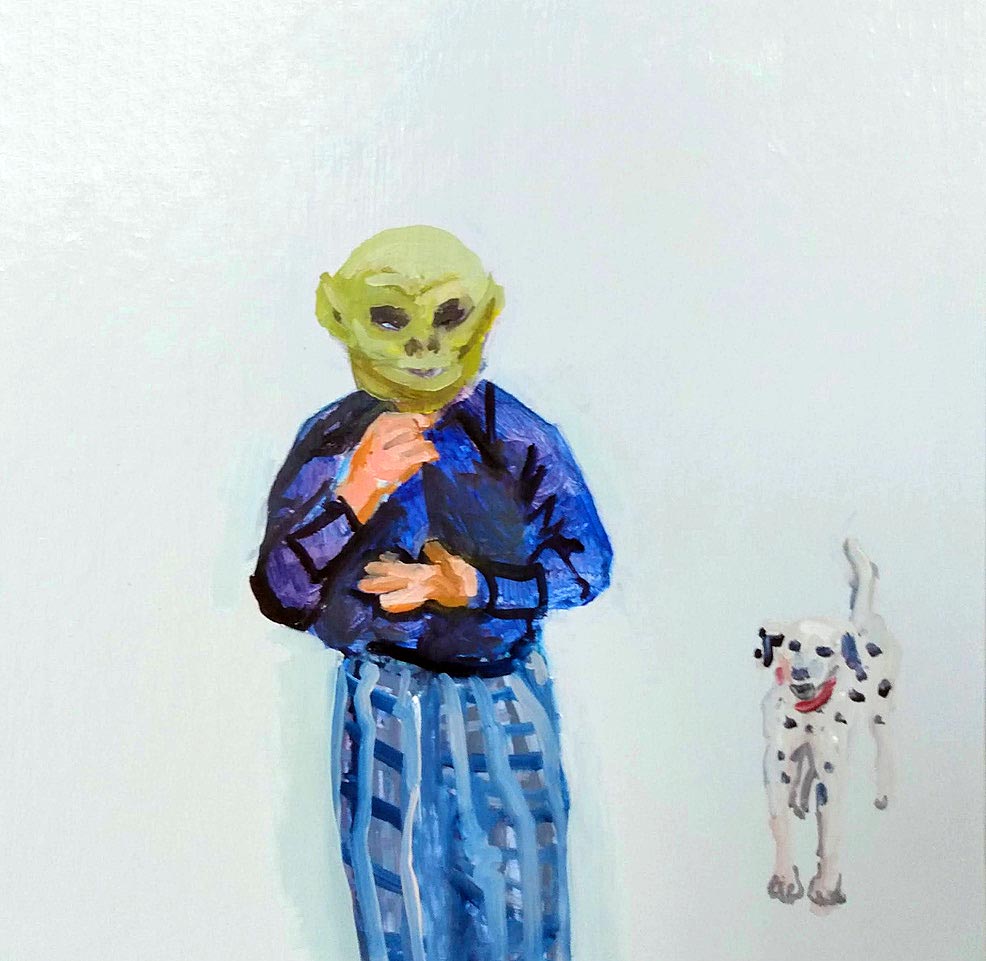
Tom Livo, Walking My Gargoyle, Oil on Board, 12×12″, 2019

Two bodies of the artist’s work are represented in the gallery, each quite different from the other in scale, palette, composition and mood. By comparing and contrasting them, we can find a way into the artist’s mind and discover both his ambivalence and his affection for family, friends and his own childhood.

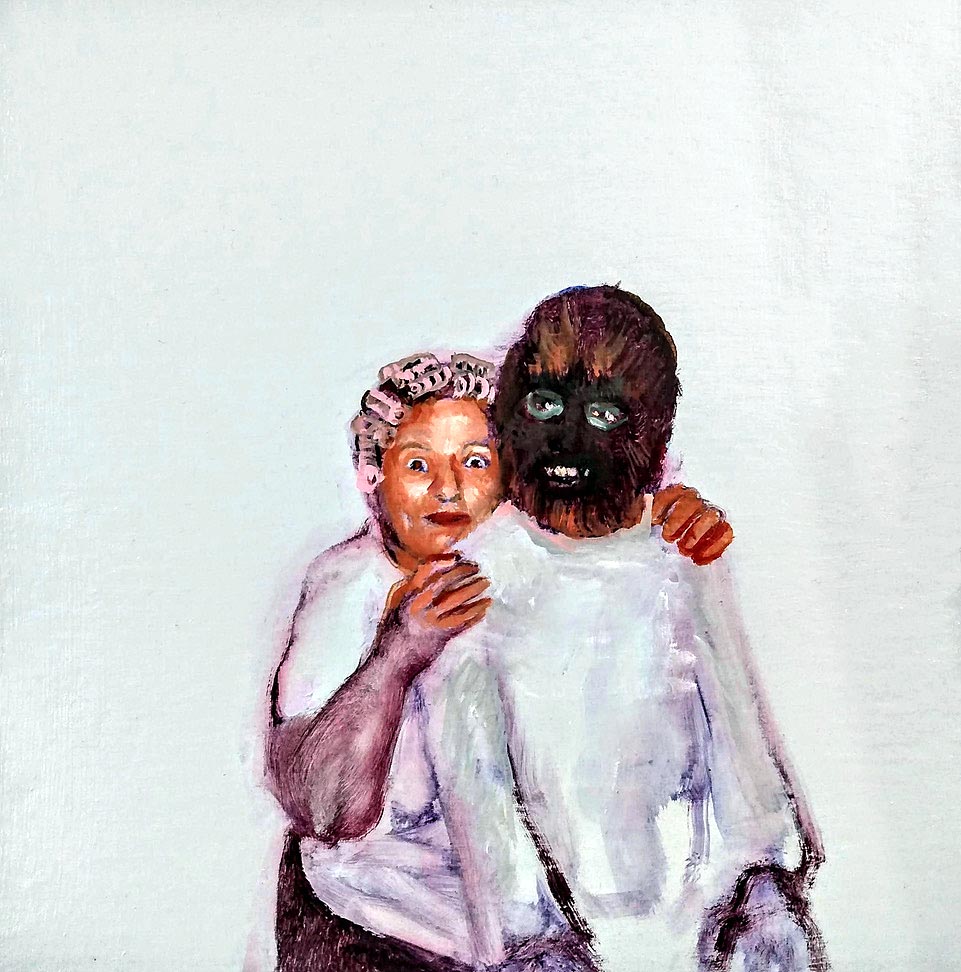
One side of the gallery is packed, salon style, with small, usually colorful, paintings of figures, many of them children. Derived from photographs of long-ago holidays and parties, the kids are routinely costumed and mugging for the camera. The compositions emphasize the outsize personalities of the subjects; often the children are disguised as monsters.  The pictured adults are lumpy, unglamorous, almost as monstrous as their costumed offspring, but unembarrassed by their own imperfections. They boldly make eye contact with the viewer: while they know they are being watched, they are also watching us.

Tom Livo, The Hair Curlers, Oil on Board, 12×12″, 2019

Because the pieces in this collection are intimate in scale, the virtuosity of Livo’s brushwork surges to the fore–these small works are beautifully painted. Backgrounds are either (mostly) flat white or minimally detailed. The general effect of these paintings, while subtly menacing, is cheerful, even gleeful.

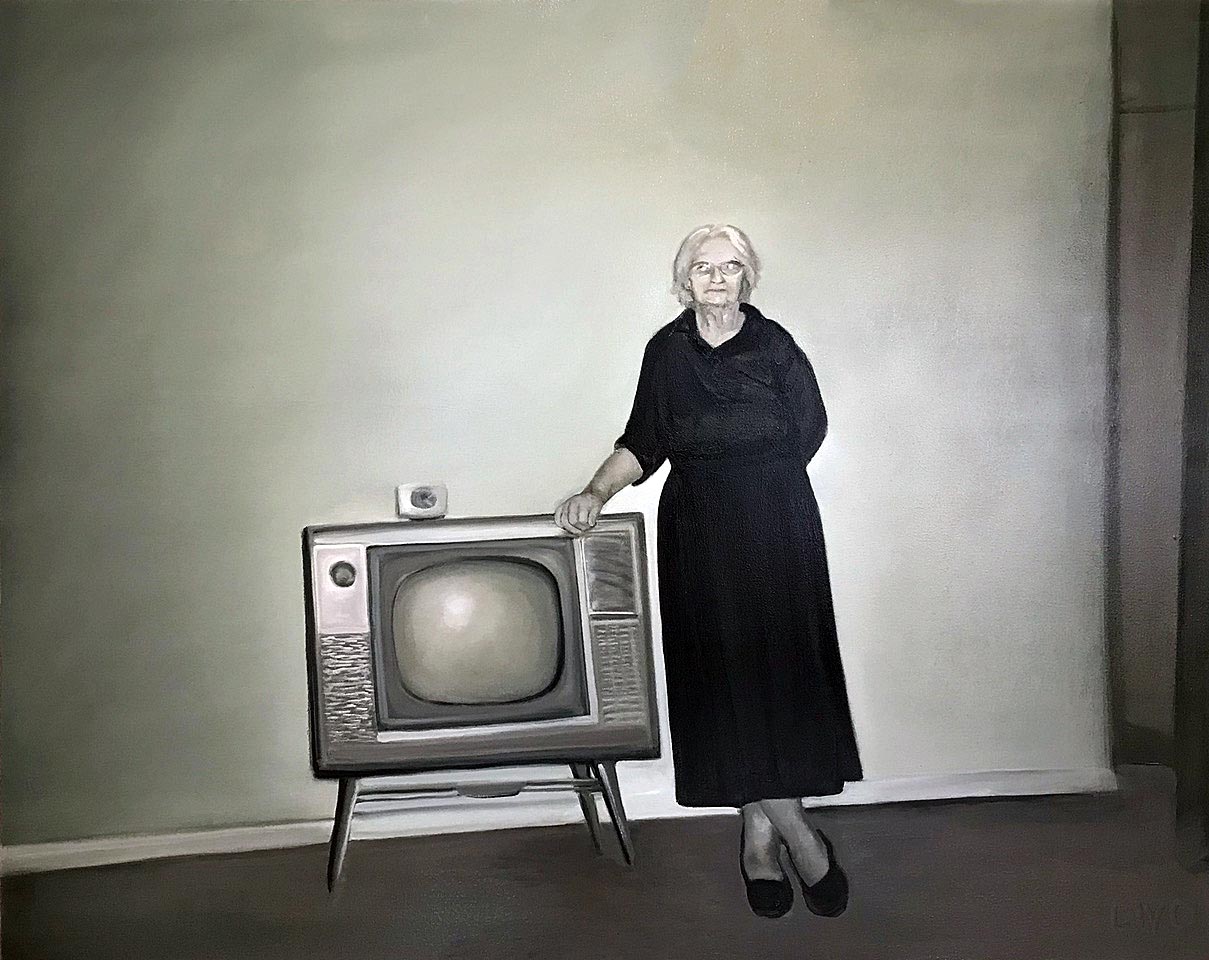
By contrast, the big monochrome paintings that make up the rest of the artworks in this exhibit are too chilly to be nostalgic. They are arms length recollections, replete with ambiguous meaning and emotion.   The painting She’s Not There, is an exercise in mid-tone gray that recalls the low resolution, low contrast images of pre-color television. An elderly woman (the artist’s grandmother, as it happens) stands in a featureless room, next to a television that is as much an enigmatic presence as she is. The blank face of the turned-off set is echoed in the glare of the woman’s glasses, obscuring her eyes, and implying, it seems, the diminished presence of old age.  The two companion figures, tv and woman, are relatively small within the blank expanse of the modest interior, a device the painter employs again in his painting N’Octover. In the picture, a young man reclines, apparently asleep in an armchair. The table lamp, centrally located, seems more sentient than the man. Here, the emptiness of the room suggests a barren psychic landscape where the inhabitants’ interior lives are unknown and unknowable.

Tom Livo, She’s Not There, Oil on Canvas, 64×48″, 2020

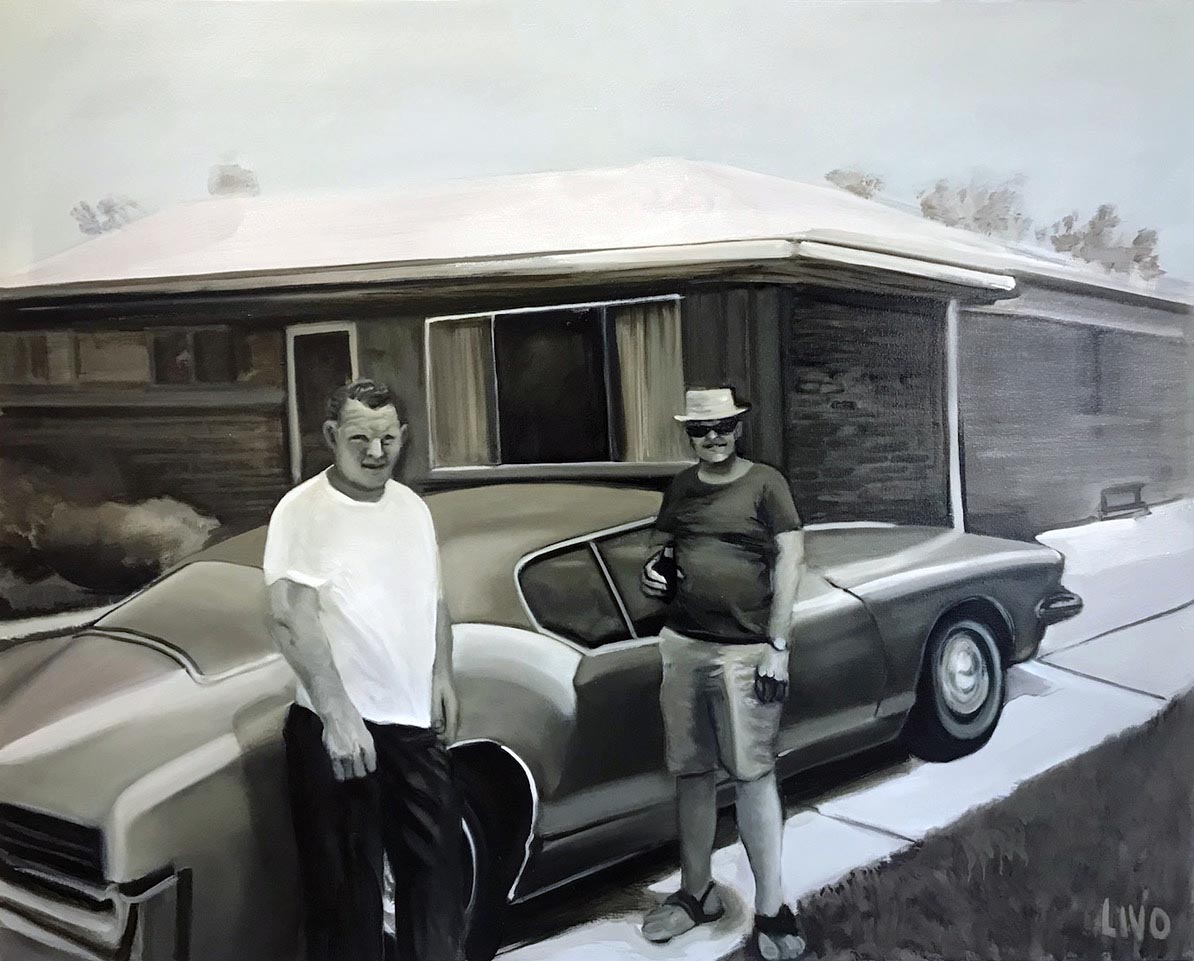
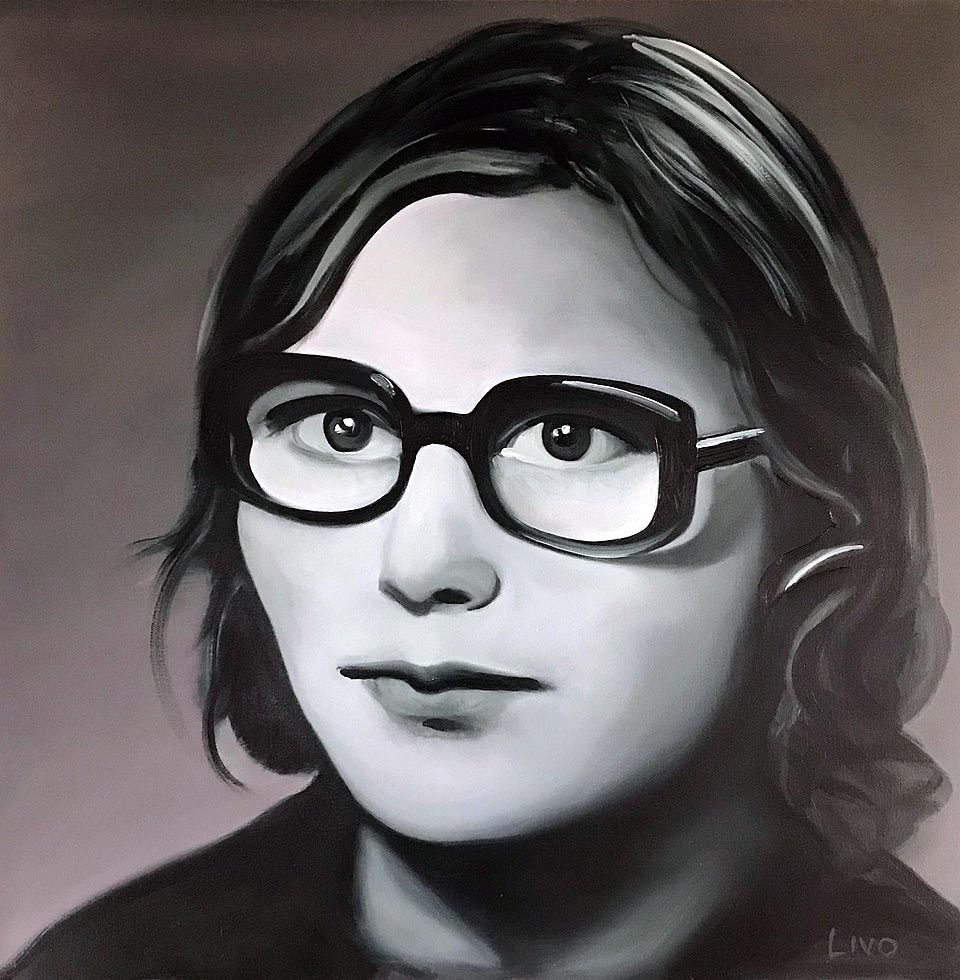
Livo explores a different compositional strategy in his portrait of a young, bespectacled girl. Her gray face fills the picture, like a woman in a particularly joyless Alex Katz painting, and we are hard pressed to penetrate the smooth surface of her skin to find the soul within.  The artist’s lens zooms back out for his most engaging black and white painting, The Riviera. Unlike She’s Not There and N’Octover, The Riviera  is set outdoors, in a neighborhood very much like the one outside the gallery walls of Image Works. A tidy brick ranch home with a lush yard provides the background for a sporty muscle car in the driveway. The two men in the picture seem relaxed and satisfied with their lot, comfortable at a time when the American Dream seemed like an entitlement. Today, the neighborhood remains, but the sense of ease has gone.

Tom Livo, The Riviera, oil on canvas, 48” x 60”, 2020

Livo’s paintings memorialize a time and place to which he can’t return, and it isn’t clear from the mood of the paintings if he even really wants to.   Instead they provide a frame of reference for the present, to help us remember when things were different, if not better.   The world we live in today is more consumer driven, more atomized, more diverse and less secure than ever. The past will remain forever out of reach, but with these paintings, Livo seems to be saying that, just sometimes, it’s a joyful and useful exercise to remind ourselves what those days, those people, those places–and we–were like.

Tom Livo, Polish Karen, oil on canvas, 48” x 48” 2020

During the pandemic, Image Works, located at 3726 Monroe St., Dearborn MI 48124, is open by appointment: call 313-768-5020 or email info@imageworksfineart.com


Moving Forward @ OUAG

Oakland University Art Gallery opens the fall season with a faculty exhibition

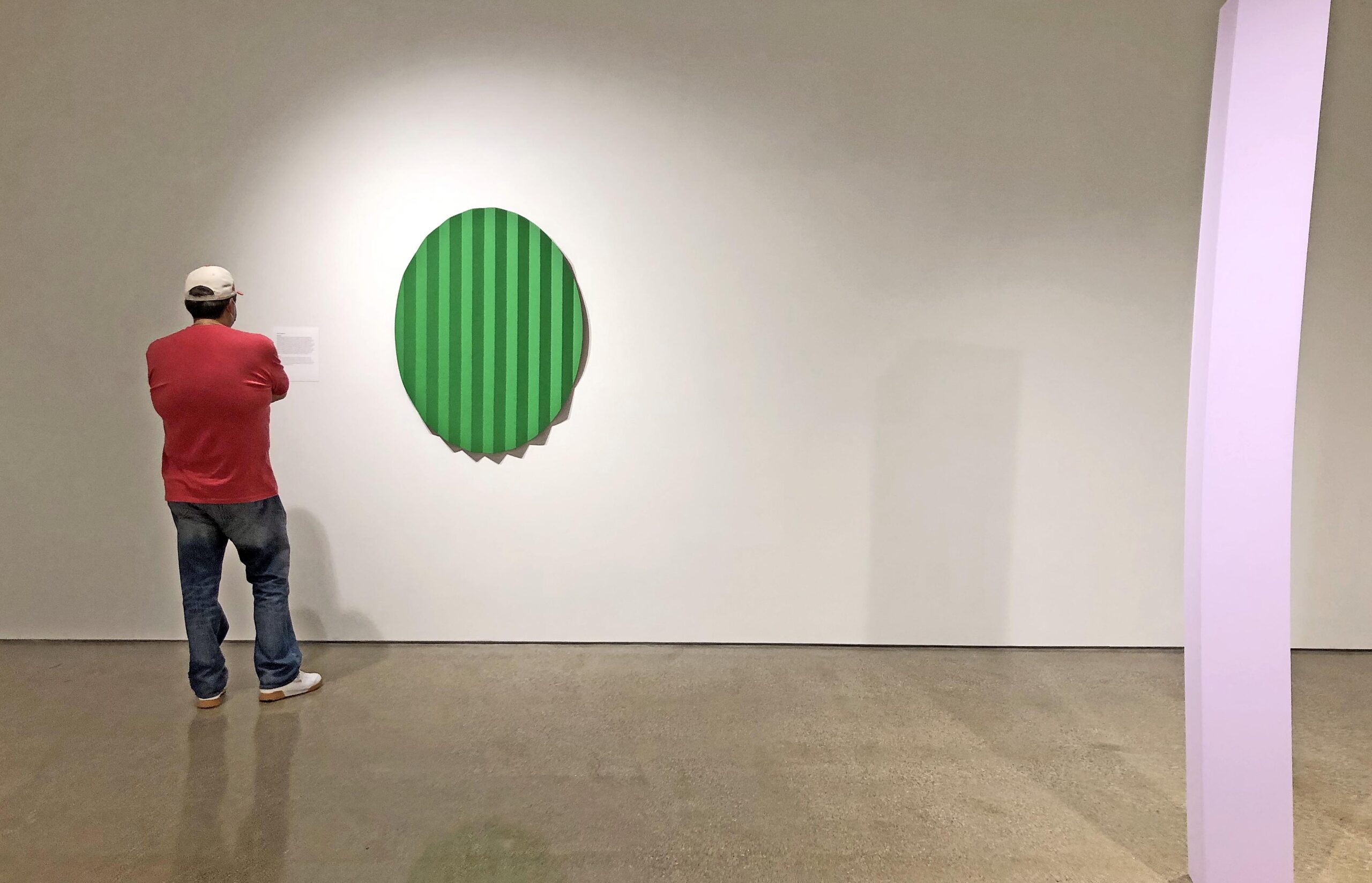
Installation image, Moving Forward, OUAG, 10.2020

Every fall since I can remember, the Oakland University Art Gallery, under the direction of Dick Goody, Professor of Art, Chair of the Department of Art & Art History and director of the Oakland University Art Gallery, has started off the fall season with a large curated show (supported with a four-color catalog) that would have required months in the planning and often brought in artwork from various parts of the United States and beyond.  Given the current situation under Covid 19 restrictions, Goody has opted to curate a faculty show, including his own work, supported with information on the web site to provide a venue for his faculty members. I suspect he is waiting until later in 2021 to present the public with something more in keeping with his previous tradition. Nevertheless, the gallery is open to the public, with Covid 19 restrictions in place,  noon – 5 pm, Tuesday through Sunday, closing November 22, 2020. It’s worth a visit.

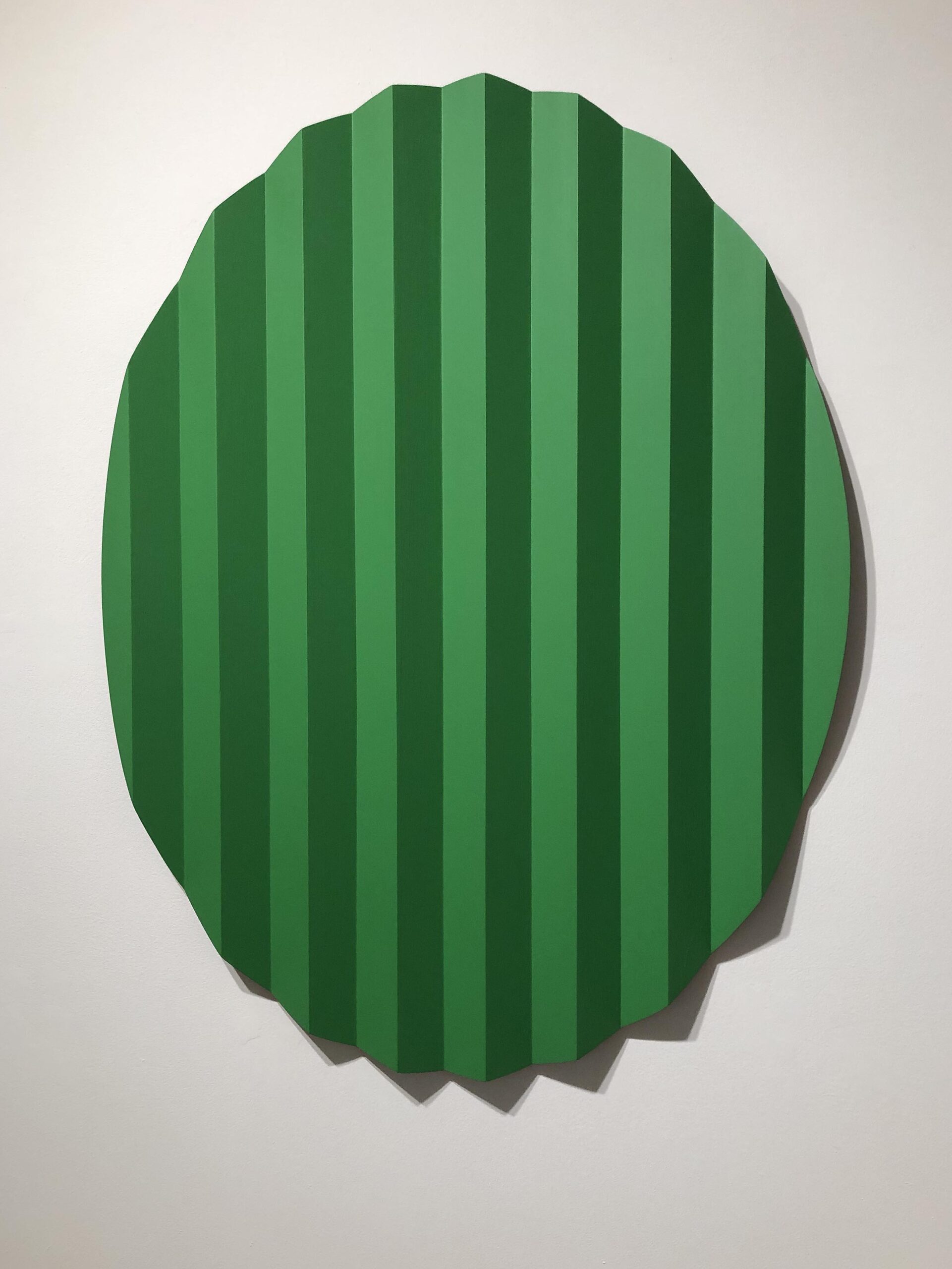
Cody VanderKay, Flattening, 32 X 43 X 3 20, PAINTED OAK, 2020


The work of art that jumped out at me was Backstage, by the artist Cody Vanderkaay, an eclipsed shape object with a highly constructed surface of vertical squared planes painted in progressive shades of green. It’s a new experience.  Not a figure, landscape, still life or photo image reference, but a newly experienced object.  In the surge of artist returning to painting the figure, Vanderkaay stays on course with his abstract imagery presenting a consistent path for his work to expand and enlighten.

He says in his statement, “The artworks explore and consider how individuals, objects and spaces interrelate, and how relationships between these entities develops over time. The sculptures displayed in this exhibit signify various states of change: A circular plane of wood appears pleated and compressed to produce a variegated effect; a vertical square column bends in diverging directions under invisible force; a small-scale architectural relief implies stories behind the scenes.”  Cody VanderKaay was born and raised in North Metro Detroit and graduated from Northern Michigan University with a B.F.A. in Sculpture and from the Lamar Dodd School of Art at the University of Georgia with an M.F.A. in Sculpture.

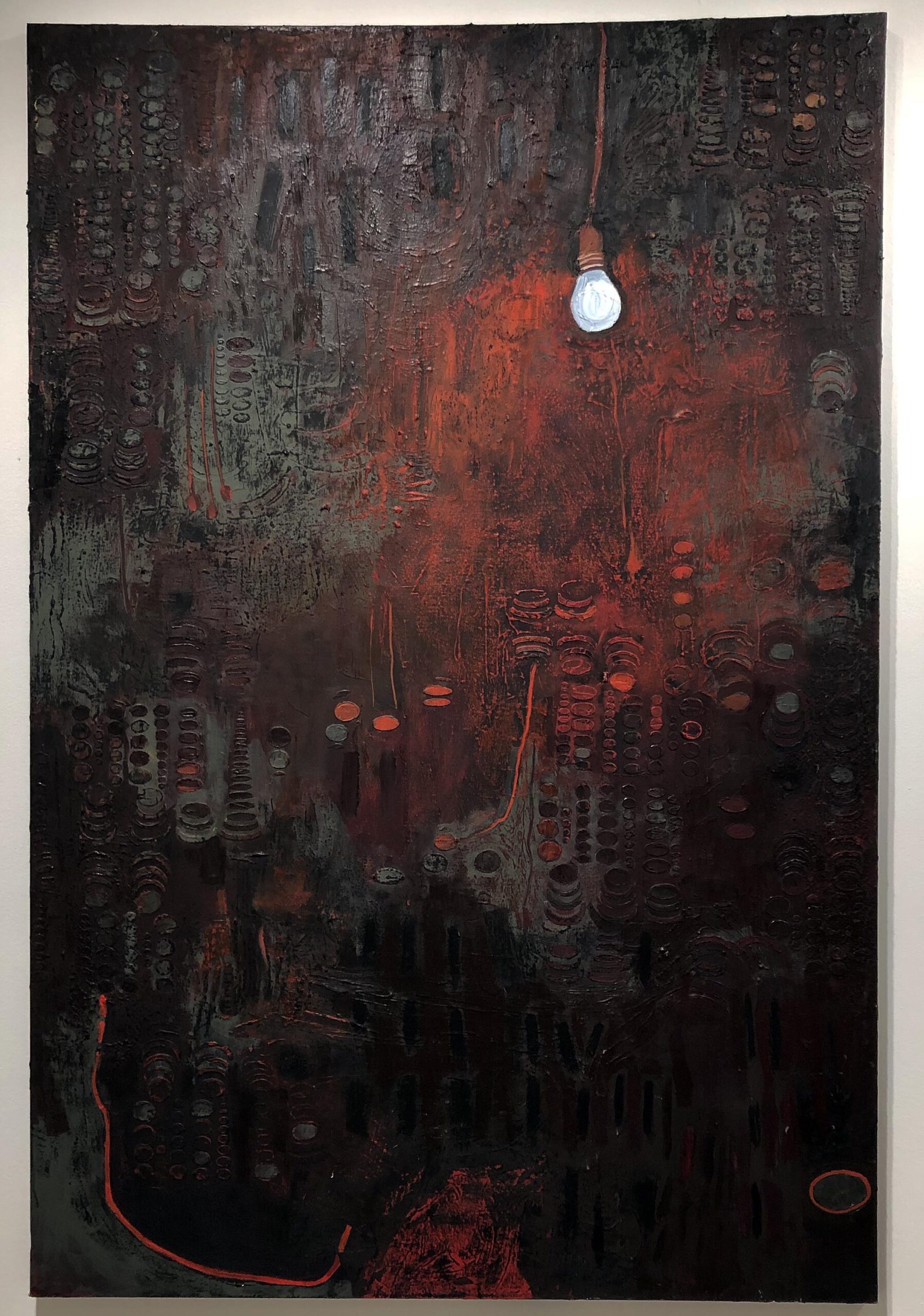
Sally Schluter Tardella, Bulb, Oil on Canvas, 72 x 48”, 2020

The work of Sally Schluter Tardella, Bulb, also attracted this writer, a sort of melancholy oil painting that revolves around a painter’s favorite subject, light.  This single bulb illuminates its surrounding  vertical space filled with tones of red, brown and grey and a repeating motif of ellipses, lines and small shapes creating a somewhat mysterious abstract space.  It is the idea that draws the viewer to the work of art highlighted by something we all recognize: a small domestic light bulb.

Tardella says in her statement, “A wall surrounds, encloses, immures. A barrier, it is a continuous surface that divides rooms, separates and retains elements. I see transparent and opaque layers of material from above and below, as I imagine cross sections of wood beam structures folding into new systems of wall. In Bulb the atmosphere is lit by the single light bulb, the space defined is both deep and blocked by surface texture, whereas in Light, the light source is transparent and the space is shallow. In Fan the screen is made of tactile architectural symbols.”  Sally Schluter Tardella uses architectural tropes as metaphor to explore personal ideas of body, gender, culture, and politics. Tardella moved from New Jersey to study Painting at Cranbrook Academy of Art.

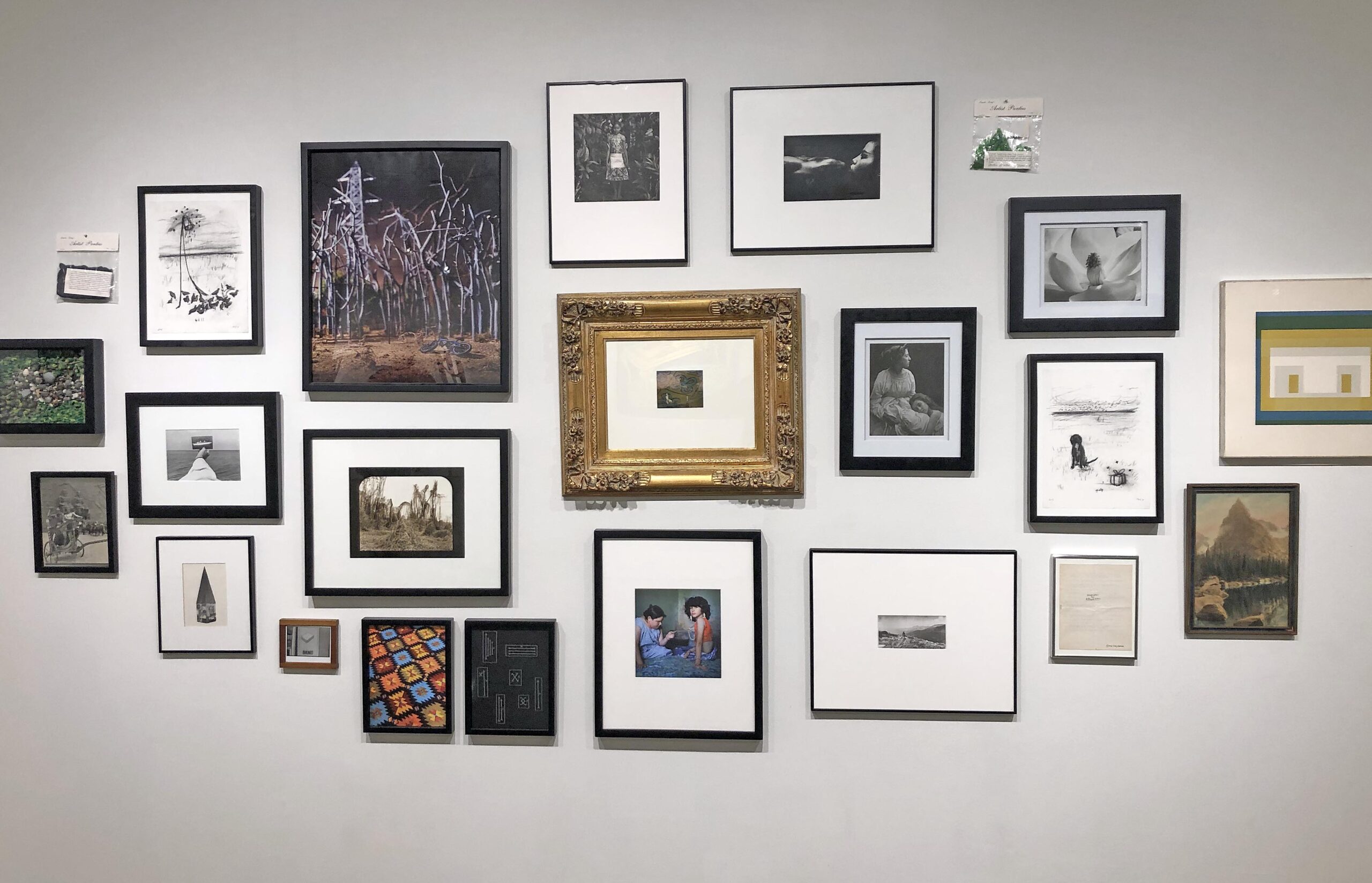
Susan Evans, Some Art From My House, Mixed Media, 2020

This eclectic collection of photo imagery, Some Art From My House, is exactly that, a mixture of small photographic images that vary in color size, format and subject, which is meant to demystify the taking of images and their content.  There are images I like and others not so much, but it is a window into her perception of what photography is, at least for her.

Evans says in her statement, “ What we look at everyday becomes familiar and generally, familiar things become preferences which define ideas, beliefs and experiences. Although I have not made any of these works as a group these pieces become an intimate self-portrait. The true meaning of the piece is not about each image individually, instead it is about the sum, juxtaposition and connection between the different elements. Who then is the true author of the artwork?”  Susan E. Evans received her B.F.A. in photography/holography from Goddard College, and an M.F.A. in photography from Cornell University.

The Moving Forward exhibition features the work of the full-time faculty of the Department of Art & Art History at Oakland University that includes the work of Aisha Bakde, Claude Baillargeon, Bruce Charlesworth, Susan E. Evans, Setareh Ghoreishi, Dick Goody, David Lambert, Lindsey Larsen, Colleen Ludwig, Kimmie Parker, Sally Schluter Tardella, Maria Smith Bohannon and Cody VanderKaay.

OUAG Hosts Faculty Exhibition Moving Forward closing November 22, 2020


Visual Citizenship @ MSU Broad Museum

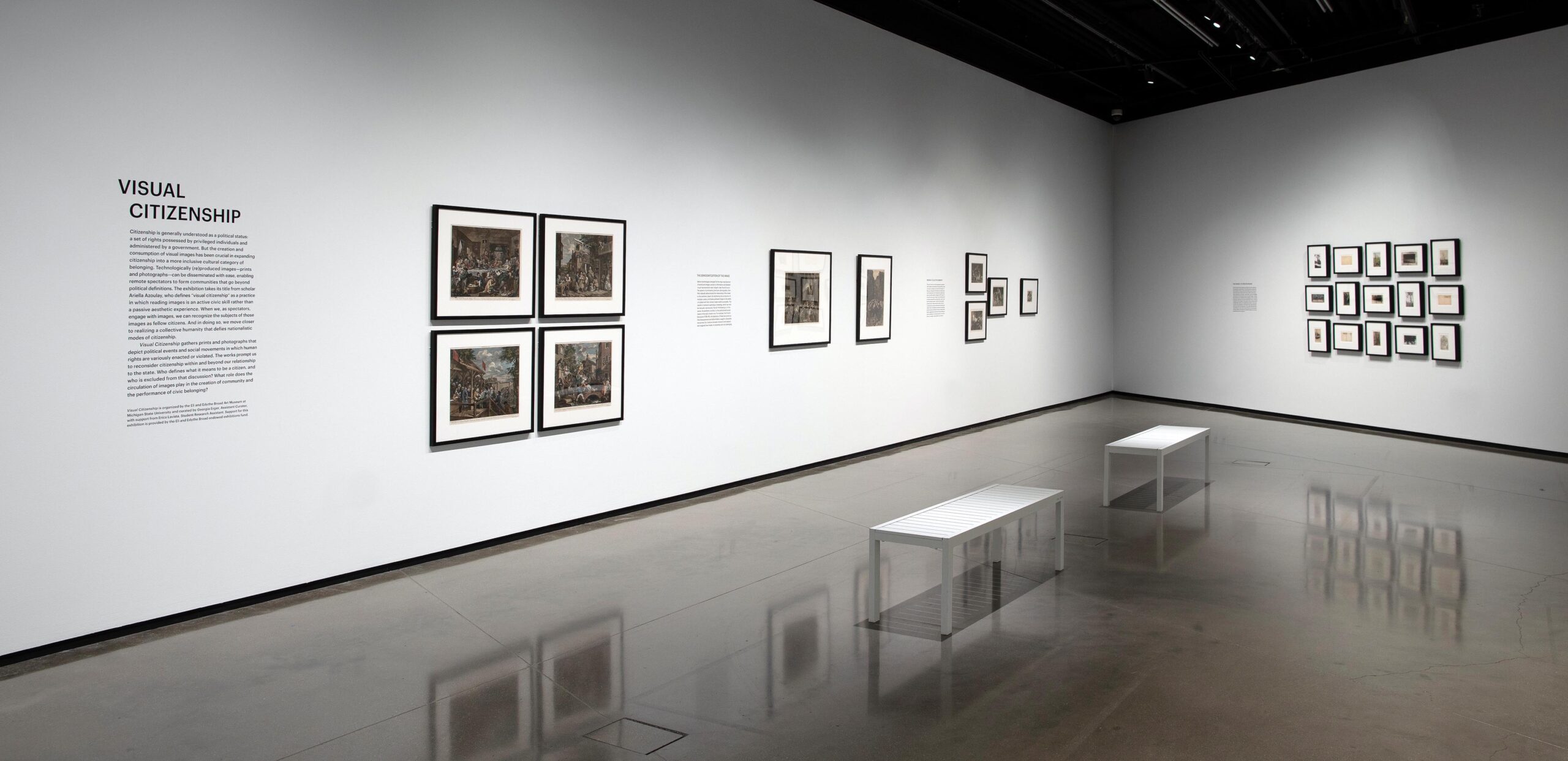
Visual Citizenship, installation view at the Eli and Edythe Broad Art Museum at Michigan State University, 2020. Photo: Eat Pomegranate Photography.

The exhibition Visual Citizenship, on view at Michigan State University’s Broad Art Museum through December 26, is a considered show that comprises politically-charged prints and photographs that snugly fill the museum’s trapezoidal Collections Gallery.  Its title comes from scholar, author, and filmmaker Ariella Azoulay, who argues that image-viewing is an active civic engagement, and Visual Citizenship explores the implied moral, ethical, and civic questions and obligations presented when a viewer confronts images, particularly images of injustice. The show is thoughtful, timely, and visually satisfying, and it includes artists whose names carry some real weight in the art-world, such as Kathe Kollwitz, William Hogarth, Francisco Goya, and others.

The advents of photography and printing democratized the image to a degree unparalleled until the age of the internet.  They’re both relatively inexpensive media, and they don’t rely on moneyed and powerful patrons.  Furthermore, photos and prints are easily reproduceable, and together they helped introduce a new visual language of civic and political discourse.

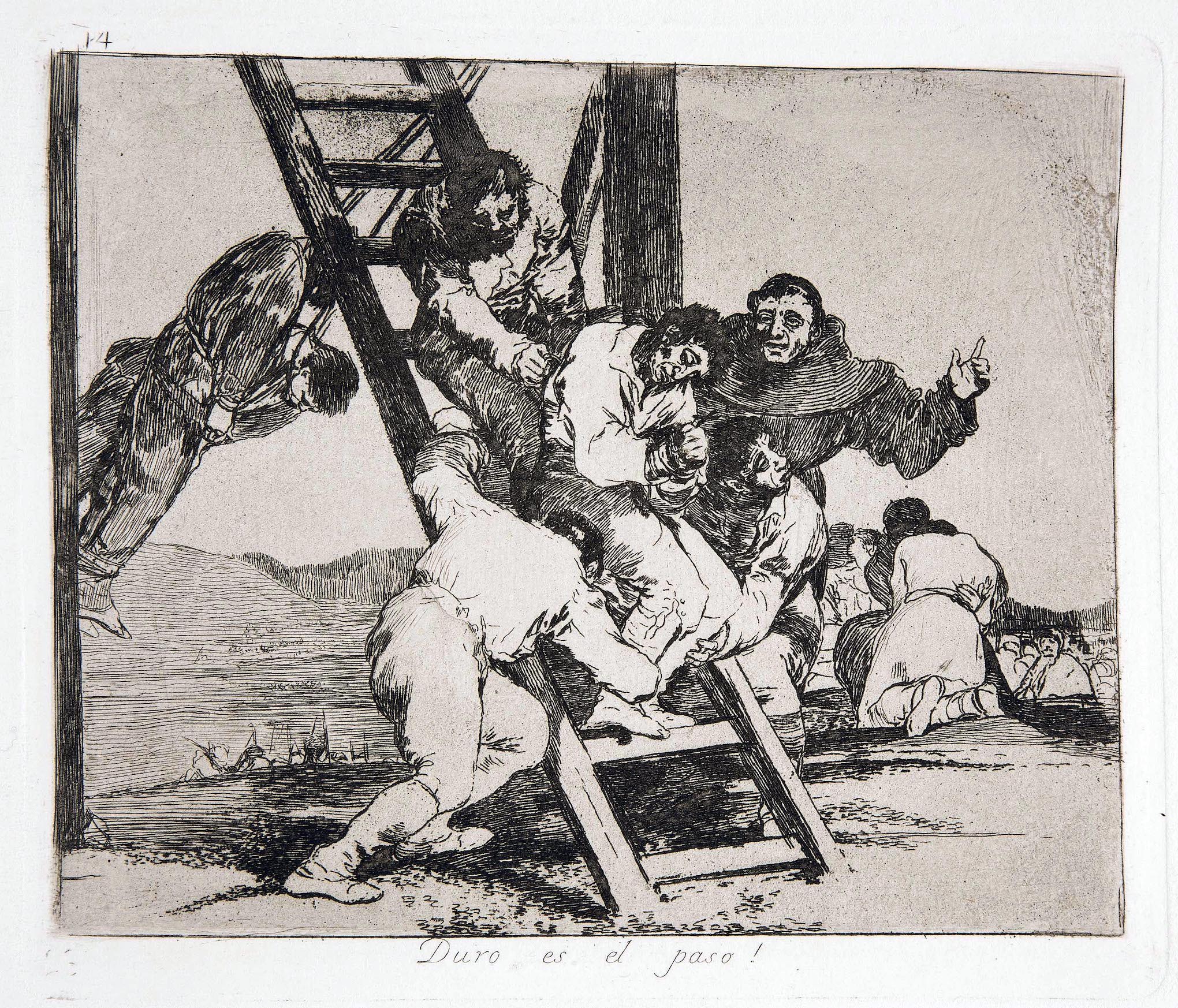
Francisco Goya wasn’t the first artist to harness printmaking to document social and political injustice, but he’s certainly among the most famous.  His series of just over 80 prints which comprise his Disasters of War relay in first-person perspective and with unrelenting honesty the gritty and violent events that transpired when Napoleon’s army invaded Spain.  The show’s informational panels aptly compare Goya’s etchings to the photographs captured by a modern-day war correspondent.  On view is an etching from his Disasters, showing hangmen leading prisoners to a makeshift scaffold where several dead bodies already swing.  There are also several etchings from his satirical Follies series.  These images, never published in Goya’s lifetime, are freighted with dark and surreal imagery that seems to anticipate by a hundred years the style of the early 20th century symbolists.  Goya’s work is rarely pleasant, but it’s a welcome foil to much of the fawningly polite Napoleonic propaganda produced by the likes of Jacques Louis David or Antoine-Jean Gros.

Duro es el paso! (The way is hard!), from The Disasters of War, 1810-14. Etching and aquatint, 9 1/2 x 12 7/8 inches. MSU purchase, funded by the MSU Development Fund 64.76

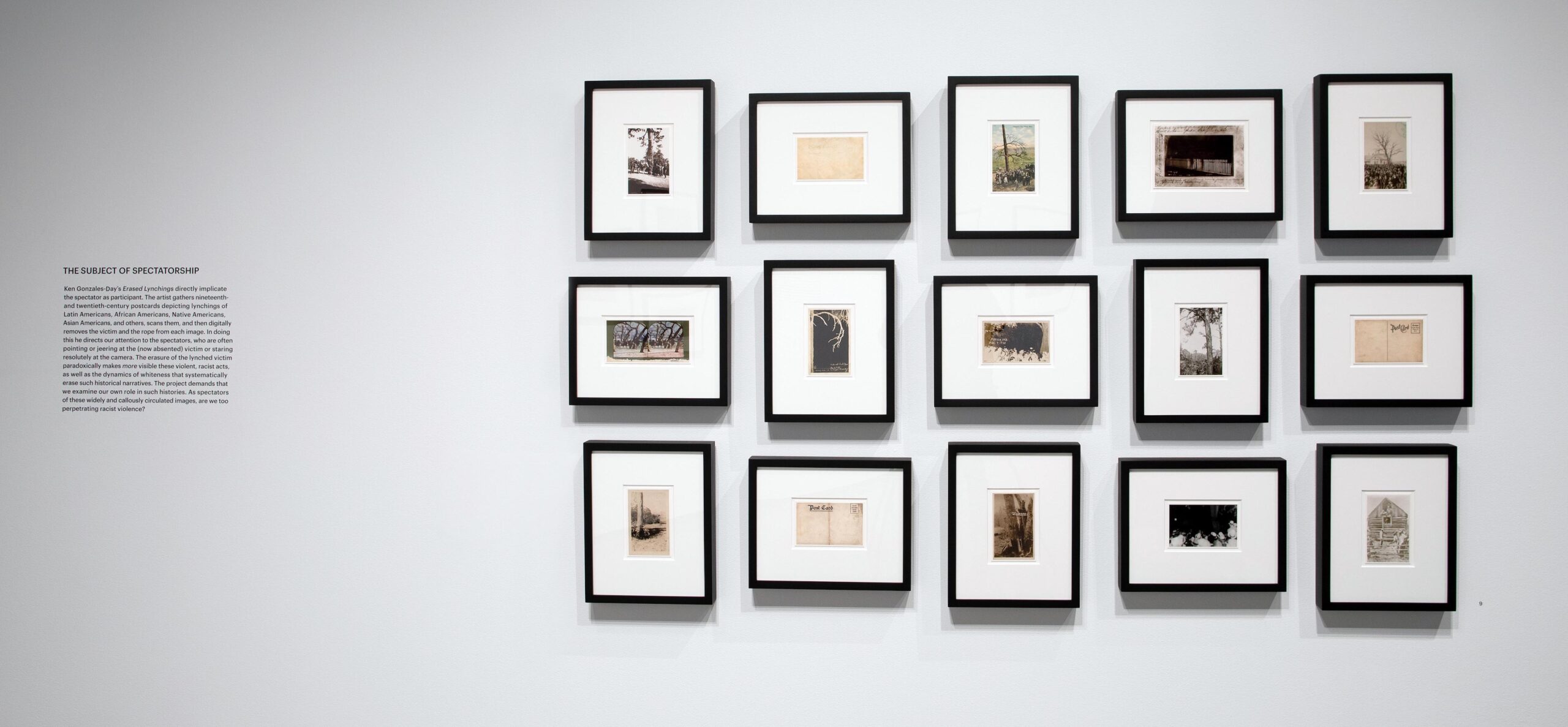
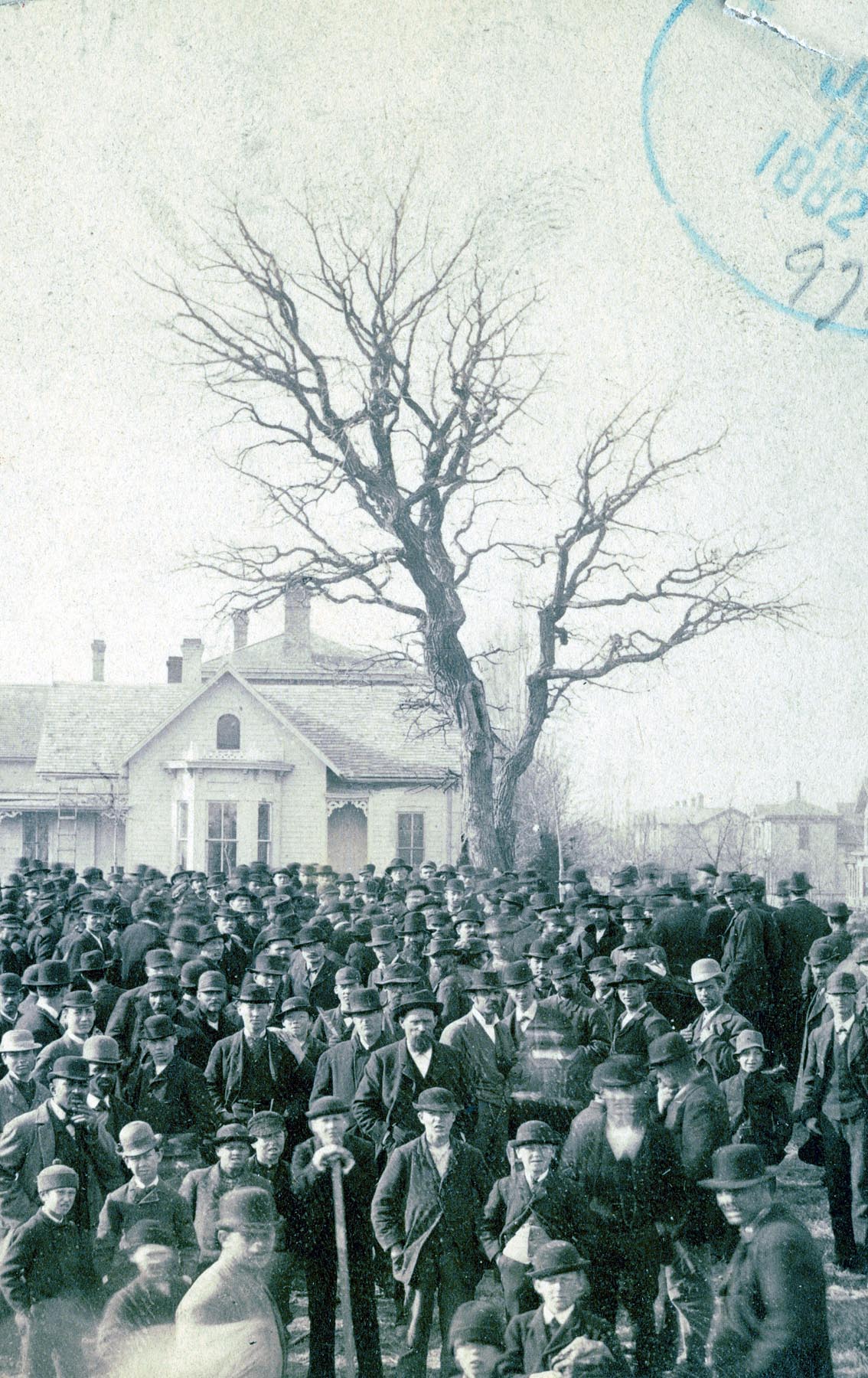
Perhaps the most arresting and uncomfortable ensemble of images in the show is the Erased Lynchings series by conceptual artist Ken Gonzales-Day.  Gonzales-Day scanned images from actual postcards spanning from 1870 to 1940, all of which depicted photographs of the lynching of Lantin Americans, African Americans, Native Americans, and Asian Americans.  He then digitally erased the victims, leaving only the spectators, who now become the subject of the image.  The series addresses the role that bystanders and spectators play during social and political atrocities, and also the erasure of uncomfortable moments from our national narrative.

Erased Lynchings, installation view at the Eli and Edythe Broad Art Museum at Michigan State University, 2020. Photo: Eat Pomegranate Photography.

Lynching of Frank MacManus, Minneapolis, MN, 1882, from Erased Lynchings 2006-2019.  Archival inkjet print on rag paper mounted on cardstock, 6 x 4 ½ inches. MSU purchase, funded by the Nellie M. Loomis Endowment in memory of Martha Jane Loomis, 2019.17.1-5

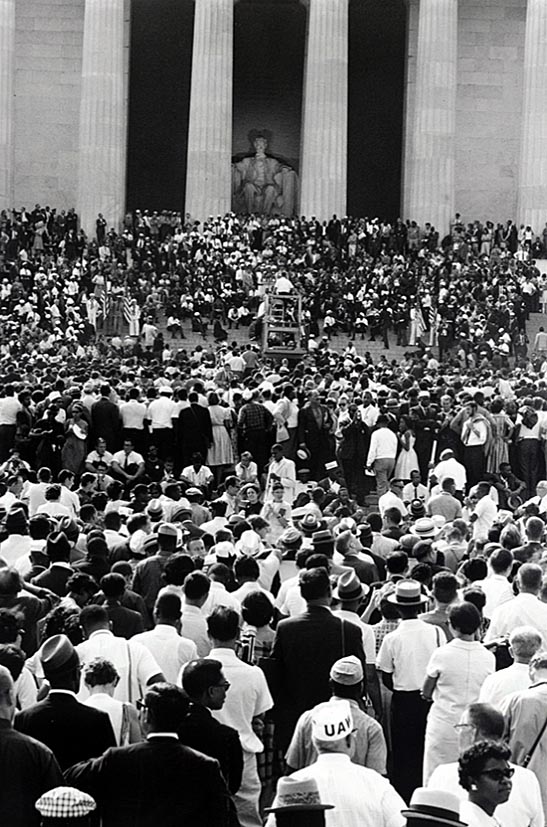
A generous selection of photographs of significant political marches, rallies, and protests highlights the role that documentary photography played in making people aware of the Civil Rights Movement, perhaps something easily taken for granted now that anyone with a smartphone and a social media account is a potential lay-photojournalist.  These images include an ensemble by Leonard Freed, a photojournalist whose seminal work Black in White America (1968) documented the Civil Rights Movement with sensitivity and empathy, emphasizing the humanity of his subjects rather than the acts of violence and brutality they endured—the reverse of what Susan Sontag referred to in On Photography as the “atrocity exhibition,” which have a danger of becoming counterproductive to their cause.  Here, a selection of Freed’s photographs variously document a civil rights protest in Brooklyn, the historic 1963 March on Washington, and the 20th Anniversary March on Washington in 1983.

1963, Washington D.C., USA (March on Washington, 8-28-’63), 1963. Photograph  11 x 14 inches.   Courtesy Special Collections, MSU Libraries, Michigan State University

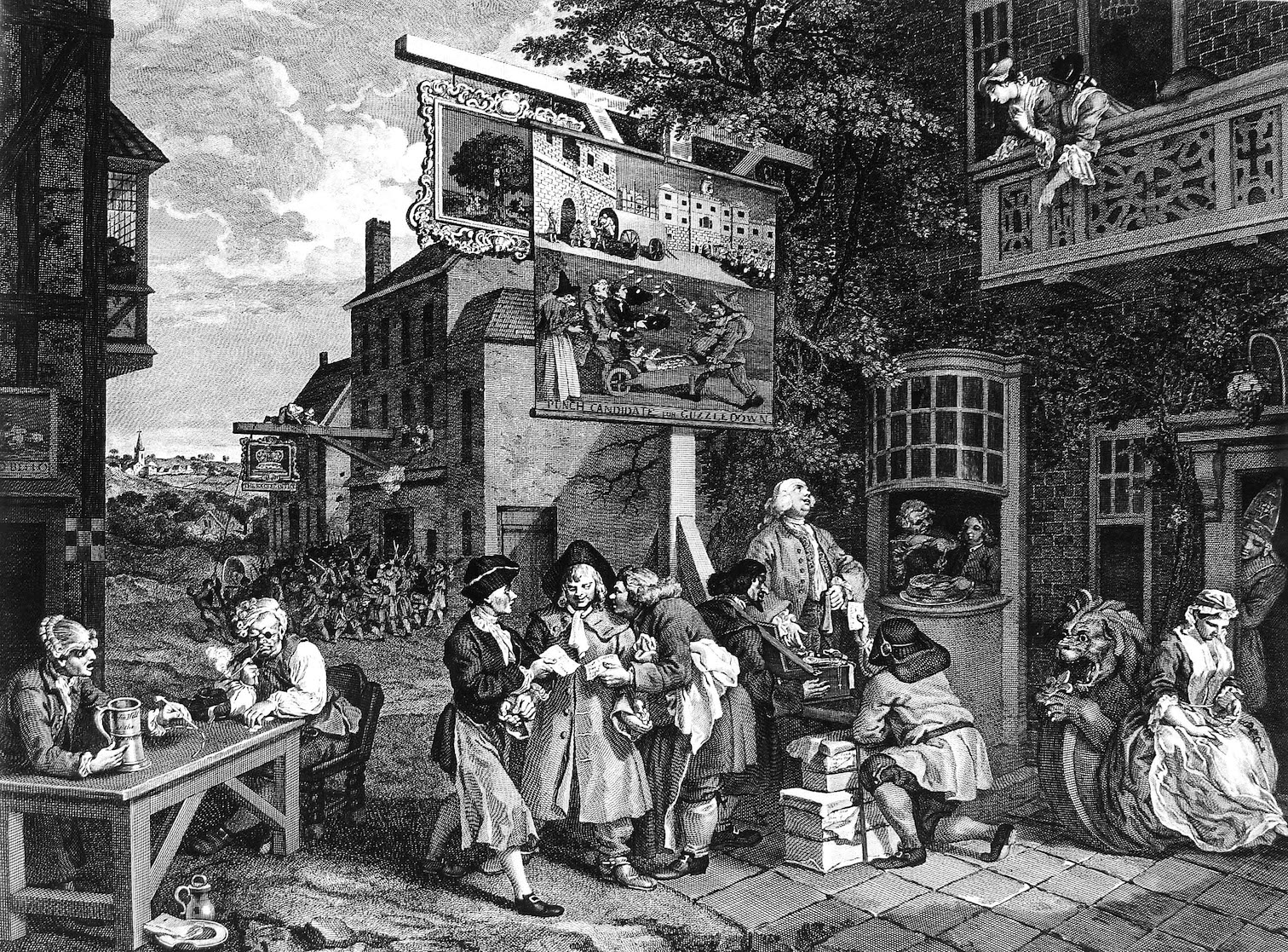
Finally, a quartet of engravings by William Hogarth adds some levity to the exhibit, as Hogarth’s wry, satirical works always tend to do.  His characteristically tongue-in-cheek series Humours of an Election, based on an actual 1754 Oxfordshire election, implicates both the Whigs and the Tories in trying to hijack the election through any means necessary.   Hogarth’s humorous approach to political critique is about as far from Goya’s nightmarish visions as one could possibly get, though both artists certainly shared a jaundiced perception of those in political power.

Four Prints of an Election: Plate II, Canvassing for Votes, 1757. Hand-colored engraving, 15 3/4 x 21 1/4 inches. MSU purchase 64.16

Visual Citizenship is a rewarding show, and each vignette of photographs or prints could easily be the starting point for a subsequent exhibition.  It’s certainly relevant and timely, and not just because this happens to be an election year. After all, in the age of social media, the smartphone, and the viral video, images have become the primary way we gather news and process information, which certainly seems to underscore Ariella Azoulay’s original point that image-viewing is a civic act.

MSU Broad – Visual Citizenship, on view at Michigan State University’s Broad Art Museum through December 26, 2020


Familiar @ David Klein Gallery

Mario Moore Curates a Group exhibition at the David Klein Gallery

Familiar Installation, Jason Patterson (L) , Mario Moore (C), Senghor Reid (R) All images courtesy of David Klein Gallery except noted.

The historical moment in which we find ourselves, a moment when a pandemic and racial unrest crash into the political upheaval of a presidential campaign, seems to demand that artists respond  somehow with starkly political work that addresses our collective  pain.  And many artists have responded with polemic art, to great effect.

But there is a more intimate, personal and equally valid response to make at this juncture in our history. That is the road that Detroit artist and curator Mario Moore has chosen to follow.  For this  group exhibition Familiar, at David Klein Gallery until October 24th, Moore has chosen five other like-minded artists to join him in meditations on memory, work, and family–most particularly mothers–in Black American history. These artists have taken the cultural moment into account, but they produce art that acknowledges the zeitgeist while operating on a deeper, more enduring level.

Mario Moore has become a visual historian of Black experience through his intimate portraits of the people that inhabit his world. His recent project, The Work of Several Lifetimes, emphasizes the importance of  essential workers,  often unseen and under-appreciated. In his paintings, he brings the figures that inhabit the background into the foreground, and in so doing makes an argument for the dignity of labor in all its forms.

Mario Moore, I Continue to Dream, 2020, oil on linen,44” x 62”

The three paintings Moore has chosen for exploration in Familiar are based on a photograph he recently discovered, of a Detroit diner once owned by his family.  Moore was unfamiliar with this part of his family history and he set about learning more. Initially, he made a faithful black and white painting of the restaurant and its occupants, which included his grandmother and great grandparents. The two subsequent paintings are colored–literally–by the artist’s conversations with his grandmother, who described the place and people in more detail, thus combining archival images with familial oral history to recapture a past he never knew.

In contrast to Moore’s intimate storytelling, Illinois-born artist Jason Patterson’s images are arms-length and archetypal. He can convincingly claim to be an archivist and cultural historian of Black experience in addition to his considerable skills as a draftsman and craftsman.  For the diptych The Negro Mothers on display, part of his series New Americans: Our Mutual Improvement & Social Elevation, he has drawn from vintage photographs of Reconstruction era Black women in the Randolph Linsly Simpson Collection in Yale’s Beinecke Library. The resulting monumental pastels of upwardly mobile African American matriarchs of the 19th century stand their ground on varnished, sepia-toned raw canvas. Patterson has surrounded and embedded these towering images in elaborate, coffin-like pine boxes that foreshadow the frustration of Black aspirations during Jim Crow. To further press his point, Patterson has carved quotes from the Langston Hughes poem, The Negro Mother, into the pine boxes.

Beverly McIver, Turning 50, 2013, oil on canvas, 40” x 30”

Beverly McIver comes at her examination of family through intimacy.  Her medium-sized square compositions are dominated by the larger-than-life heads of her subjects, in this instance her father, her sister and herself.  The backgrounds are hazy, featureless fields of color, her lively brushwork is confined to the interiors of the painted faces. Compositional simplicity powers these modestly sized but impactful paintings. The portrait of her sister, Renee, is particularly interesting, her smiling face in the upper third of the picture offset by the flat whiteness of the cat in the foreground.  McIver’s self-portrait is equally satisfying; she gazes ruefully out of the picture plane, a party hat perched on her head as she contemplates turning 50. The elegant simplicity of McIver’s paintings is a pointed reminder that sometimes less really is more.

Senghor Reid, In Which We Serve, 2020, oil on canvas, 58” x 39 ½ “

Detroit artist Senghor Reid’s harshly daylit, everyday rooms can be interpreted as metaphors for his interior life. Each element in these crowded interiors–a book, food, a potted plant–is apparently mundane but exists simultaneously on a parallel symbolic plane.  Of particular interest among the three paintings Reid has contributed to the show is In Which We Serve which brings up, once again,  the importance of the black mother in the life of the family and in the context of the larger community.  Shirley Woodson Reid, a prominent Detroit arts educator and Senghor Reid’s mother, is the  authoritative primary figure. Her stern features occupy the center of the painting, both literally and figuratively, while arrayed before her are carefully selected objects that seem to suggest devotional offerings. Her importance, both to the artist and to the community, is acknowledged even within this modest domestic setting.

Photographer Ricky Weaver examines her ambivalence toward female identity from within.  Her two self-portraits, Breathing 1 and 2, show the artist in conflict with the camera’s lens, the unwilling protagonist in her own story.  Trapped by the camera’s eye, Weaver is locked in a futile struggle to escape her environment, her blurred image simultaneously there and not-there. She makes herself  both subject and object, the viewer and the observed. The theme of the cornered subject is repeated in Untitled (Sunday Morning) which features the artist’s daughter backed up against the fence in an otherwise idyllic environment.

Chris Watts’s single translucent abstraction, Invisible Mirror II, features cloudy veils of pigment on silk; it’s an outlier among the more figurative works in Familiar.  Its intrinsic merits aside, this seems an odd inclusion in an otherwise tightly organized collection of narrative work.

The temptation for artists to descend into the topical is powerful at this moment in history, when so much seems to be in contention. But the artists in Familiar seem well aware that there is a larger story to tell, and one that will continue regardless of current events. They know that their job is not just to advocate, but also to observe, report–to think–in broader and more abiding terms about the struggles that concern us all.

Familiar Installation, Ricky Weaver (L), Mario Moore (R)

Familiar, curated by Mario Moore, includes work by Moore, Beverly McIver, Jason Patterson, Senghor Reid, Chris Watts and Ricky Weaver.

David Klein Gallery is located at 1520 Washington Blvd, Detroit. Gallery Hours, Wednesday through Saturday 12 p.m.-5:30.


Page 37 of 84

Powered by WordPress & Theme by Anders Norén